This series is, by far, the best intel I have read in the Alternative Media regarding the takeover of the U.S. Dollar in an attempt to replace it with digital currencies.
While she may use AI ethically for research and to help her create graphics (although I have no idea if she does), this is real intel and she provides links to her sources, unlike many Substack Pages that are completely written by AI with no sources given to fact check their content.
I have been publishing evidence for years now that the American Financial System is a system built on the Jeffrey Epstein child sex-trafficking network.
And this latest article by The Leah Files provides strong evidence to that fact, and connects all the dots showing just who is doing this in this current Zionist Trump Administration.
You will also learn in this latest article why this Administration gives Argentina such preferential treatment, including giving them better deals on beef than they do to U.S. farmers.
Read Health Impact News‘ coverage of her first two articles in this series, which is our most-read article so far in September, here:
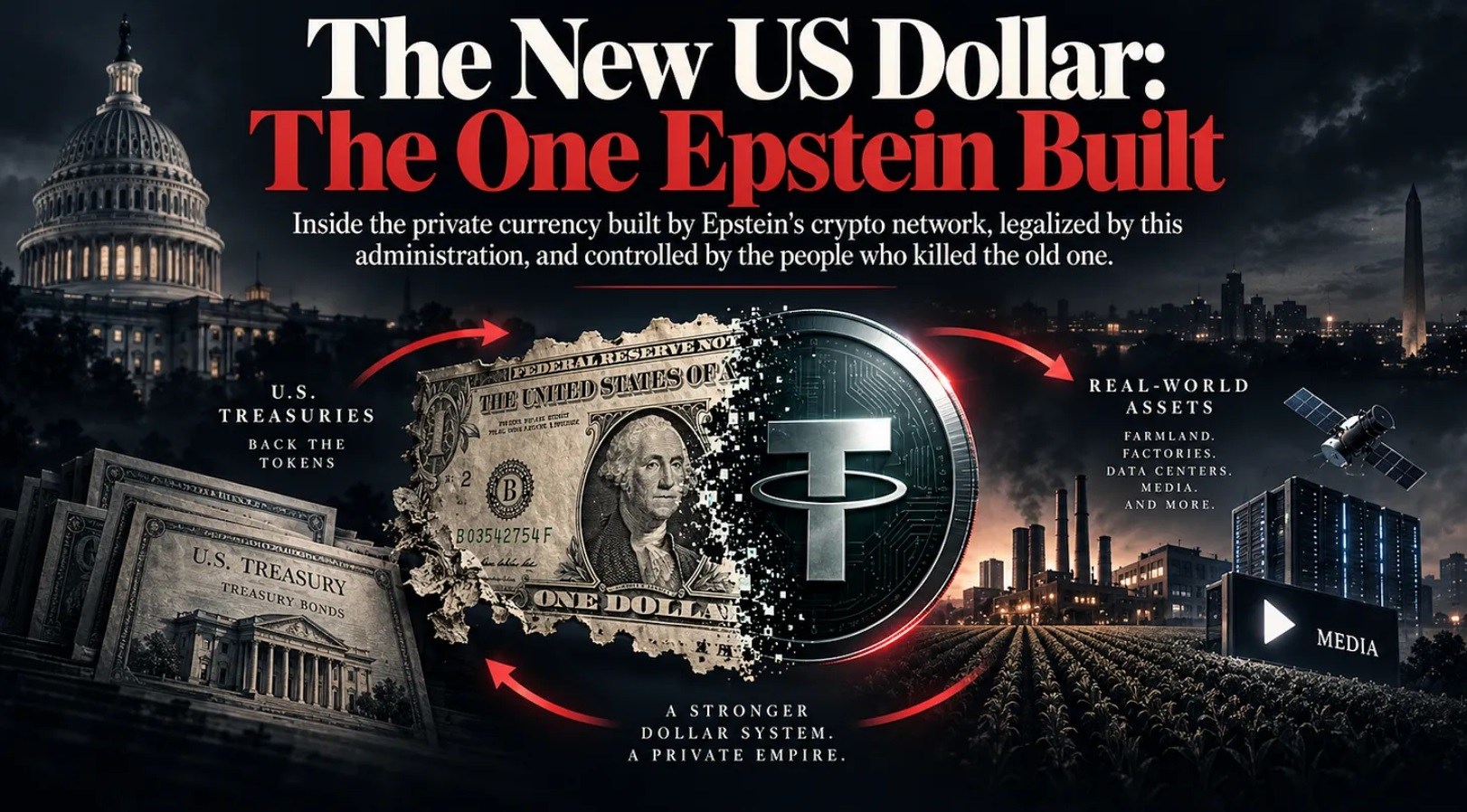
I think they are replacing the US dollar with a private one.
Not in some distant future, not as a theory, but right now. Exposed and documented, happening in front of us, and no one is stopping it. If you haven’t read Parts I or II of my Currency Killer Series, go check them out. This is Part III and it may be the worse one yet.
The United States government banned itself from making a digital dollar. Then it crashed the real one. Then it handed the replacement to a private company connected to $17 billion in organized crime, whose co-founder spent eight years as Jeffrey Epstein’s personal crypto advisor, and whose largest shareholder was convicted of software piracy before becoming the richest man in Italy.
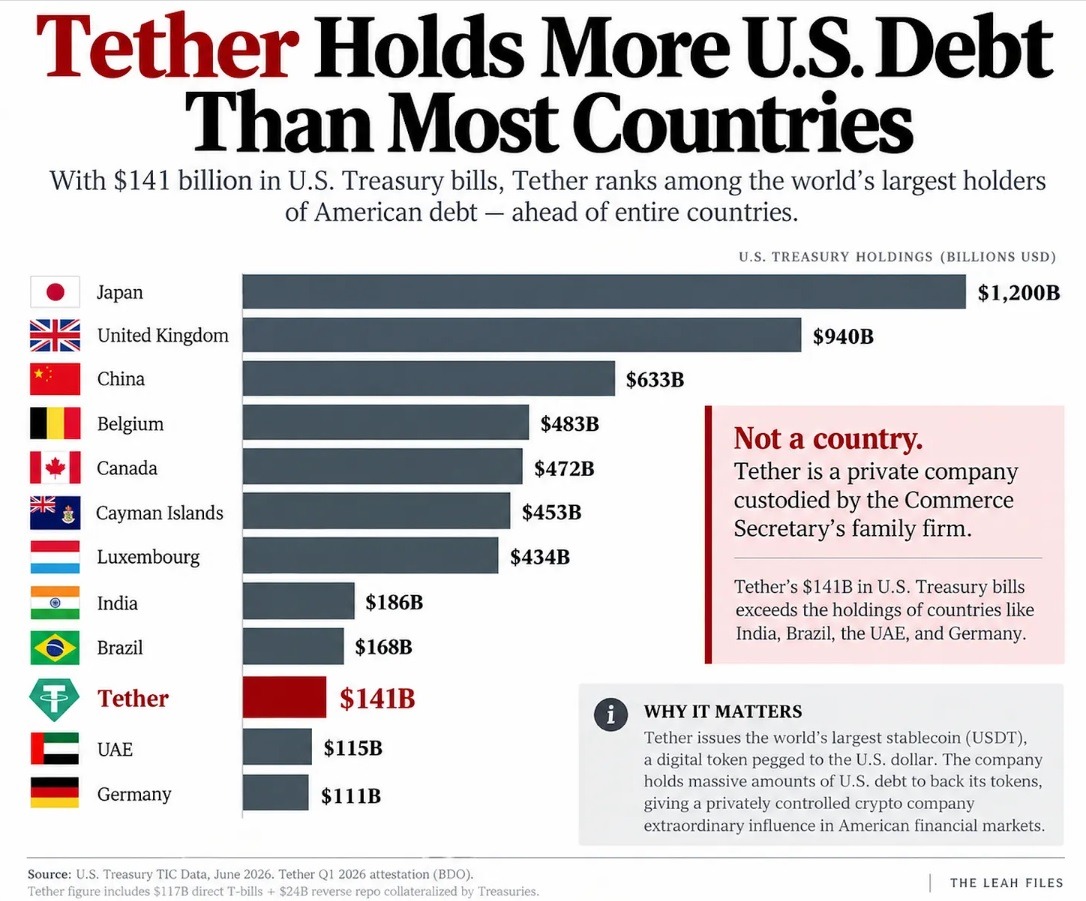
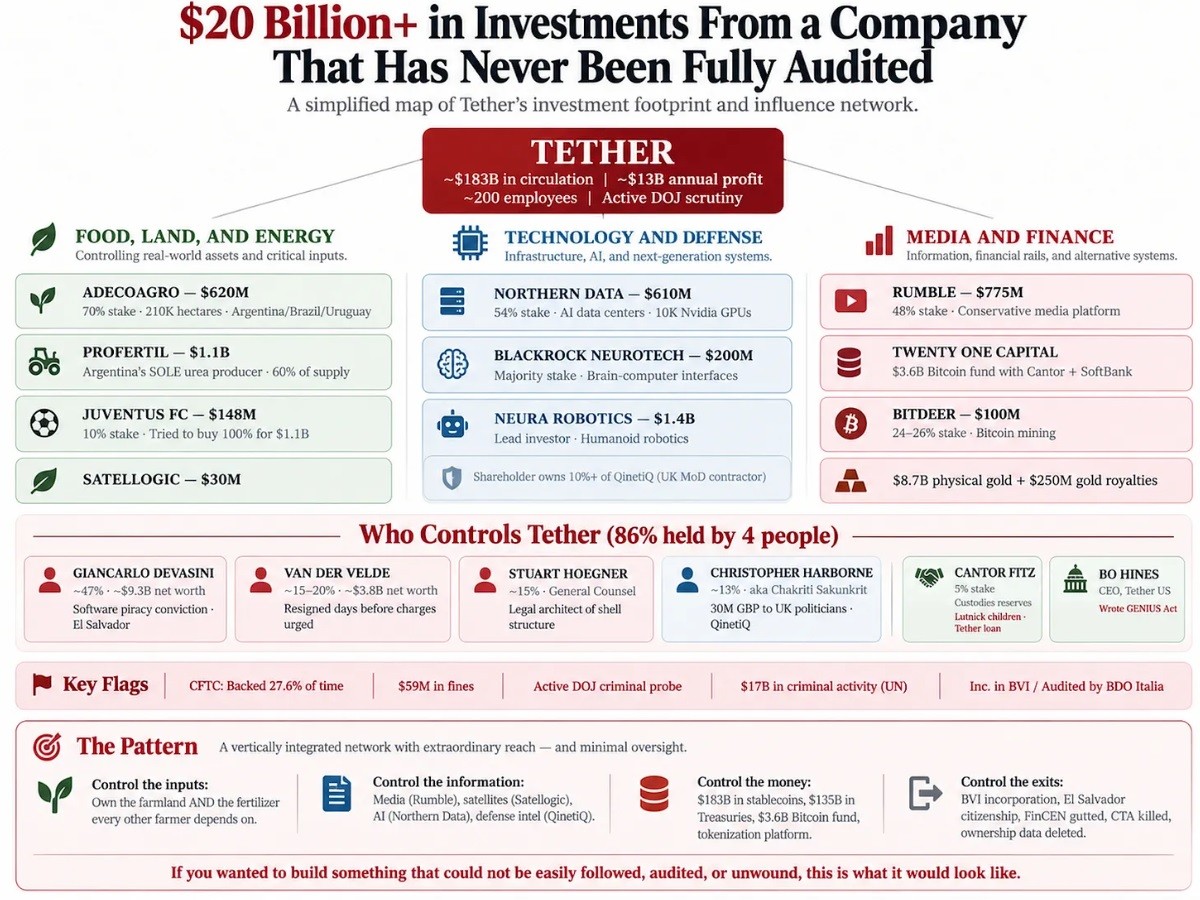
That company is called Tether. It controls $183 billion in digital currency and it is now the 17th largest holder of US government debt on earth. It has never completed a publicly released independent audit. The UN has linked it to $17 billion in organized crime.
Tether is a stablecoin company, but it also owns 210,000 hectares of South American farmland and operates Argentina’s sole fertilizer producer. It holds a majority stake in a brain-computer interface company. It is the lead investor in a humanoid robotics firm. It owns 48 percent of a conservative media platform. Its third-largest shareholder controls a 10 percent stake in the privatized research arm of the UK Ministry of Defence.
Everyone involved is getting rich, except the American people.
Howard Lutnick’s sons’ own a piece of Tether. His firm, Cantor Fitzgerald custodies its reserves. Lutnick’s former minion, Bo Hines, championed the law regulating it from inside the White House and resigned one month after the president signed it, becoming CEO of the company the law was written for.
Scott Bessent is blocking a billion dollars in suspicious Epstein banking records while his old fund was paying an intelligence firm controlled by Epstein’s partner. Trump’s family has made over a billion dollars launching their own stablecoin.
This is not deregulation, it’s a heist. And I am going to show you what they are doing.
Welcome to Part III of the Currency Killer series.
What Is Tether
Most people have never heard of Tether. So let’s start there.
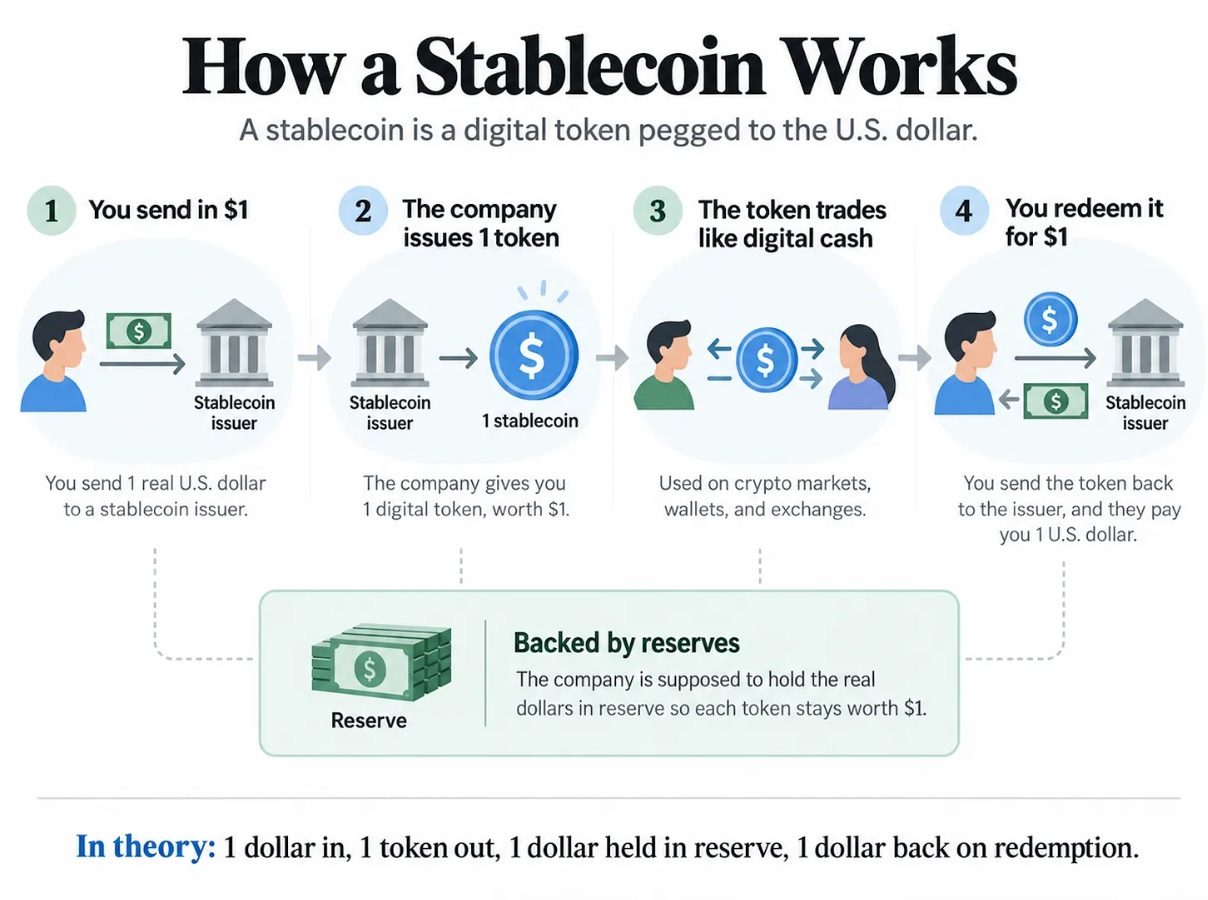
A stablecoin is a digital token pegged to the US dollar. You send a company one real dollar, and they give you one digital token that is supposed to be worth one dollar. The company holds your real dollar in reserve.
The token trades on crypto markets like cash. When you want your money back, you redeem the token and the company gives you a dollar.
Tether is the largest stablecoin on earth.
It has $183 billion of these tokens in circulation. That makes it bigger than the GDP of most countries.
The company is supposed to hold $183 billion in real reserves to back them. It earns interest on those reserves, mostly US Treasury bills, which generated $13 billion in profit in 2024 alone. It has roughly 200 employees.
Here is the problem: the CFTC found in 2021 that Tether was actually fully backed by reserves only 27.6 percent of the time. The company paid $41 million in fines.
The New York Attorney General’s office reached a separate $18.5 million settlement over similar misrepresentations. The UN has linked Tether’s token to $17 billion in criminal activity.
The DOJ has an active criminal probe. And the company has never completed a full, publicly released independent audit.
That is the company at the center of this story.
Now let’s look at who built it because this is where I knew there was something more nefarious happening.
The Man Who Built Tether
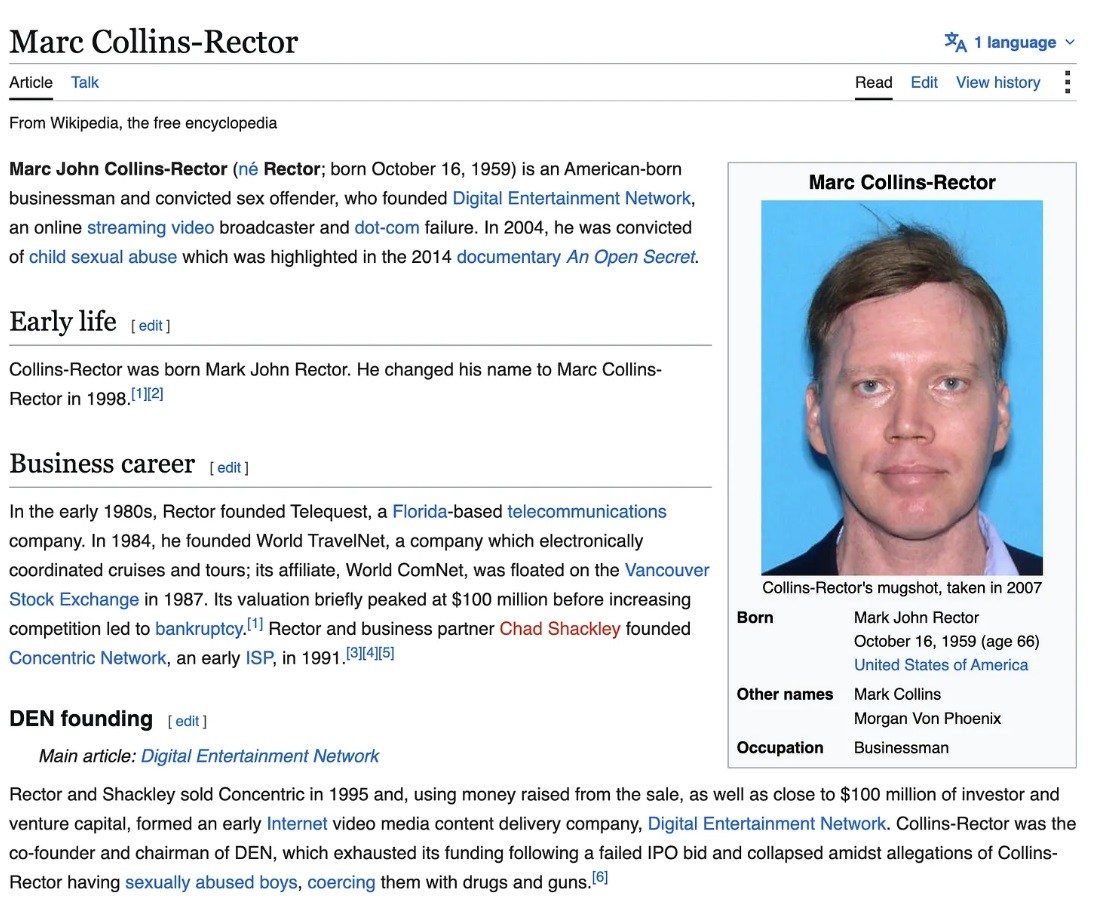
His name is Brock Pierce. Before he co-founded Tether, he was the teenage Vice President of a company called Digital Entertainment Network (DEN).
The founder of that company, Marc Collins-Rector, was later convicted of child sex trafficking.
In the late 1990s, Pierce became Vice President of Digital Entertainment Network (DEN), a pioneering internet video company founded by Marc Collins-Rector, at the age of 17, earning a salary of $250,000.
At DEN’s Hollywood Hills parties, Collins-Rector and others allegedly sexually assaulted half a dozen teenage boys, including a 15-year-old, according to civil lawsuits filed between 1999 and 2002. When Collins-Rector fled the country to avoid prosecution, Pierce went with him.
They ended up in a villa in Marbella, Spain, which police raided in 2002 and found Collins-Rector, Pierce, and a third DEN executive, along with child pornography and firearms.
Collins-Rector was convicted of child sexual abuse in 2004. Pierce was never charged, but the civil lawsuit resulted in a $2,000,030 default judgment plus $1 million in interest because Pierce and his co-defendants never responded to the allegations of rape, assault, and death threats.
In 2010, Jeffrey Epstein was trying to salvage his reputation after his first sex trafficking conviction. He hired a man named Al Seckel, a serial scammer and self-styled illusionist who had been in a relationship with Ghislaine Maxwell’s sister Isabel for years.
Seckel organized a conference for the Epstein Foundation on Little Saint James, Epstein’s private island, called the Mindshift Conference.
Pierce was invited to present on Bitcoin. It was January 2011. Epstein noticed him immediately.
In an email sent under a fake name, Epstein singled out “brock” as “interesting.” Within three months, Pierce was at Epstein’s Manhattan townhouse asking for financial advice. Their partnership lasted eight years.
The way they were introduced tells us a lot.
Pierce entered Epstein’s world through a man who was dating the sister of Ghislaine Maxwell, the woman who procured and groomed girls for Epstein’s trafficking operation, now serving twenty years in federal prison.
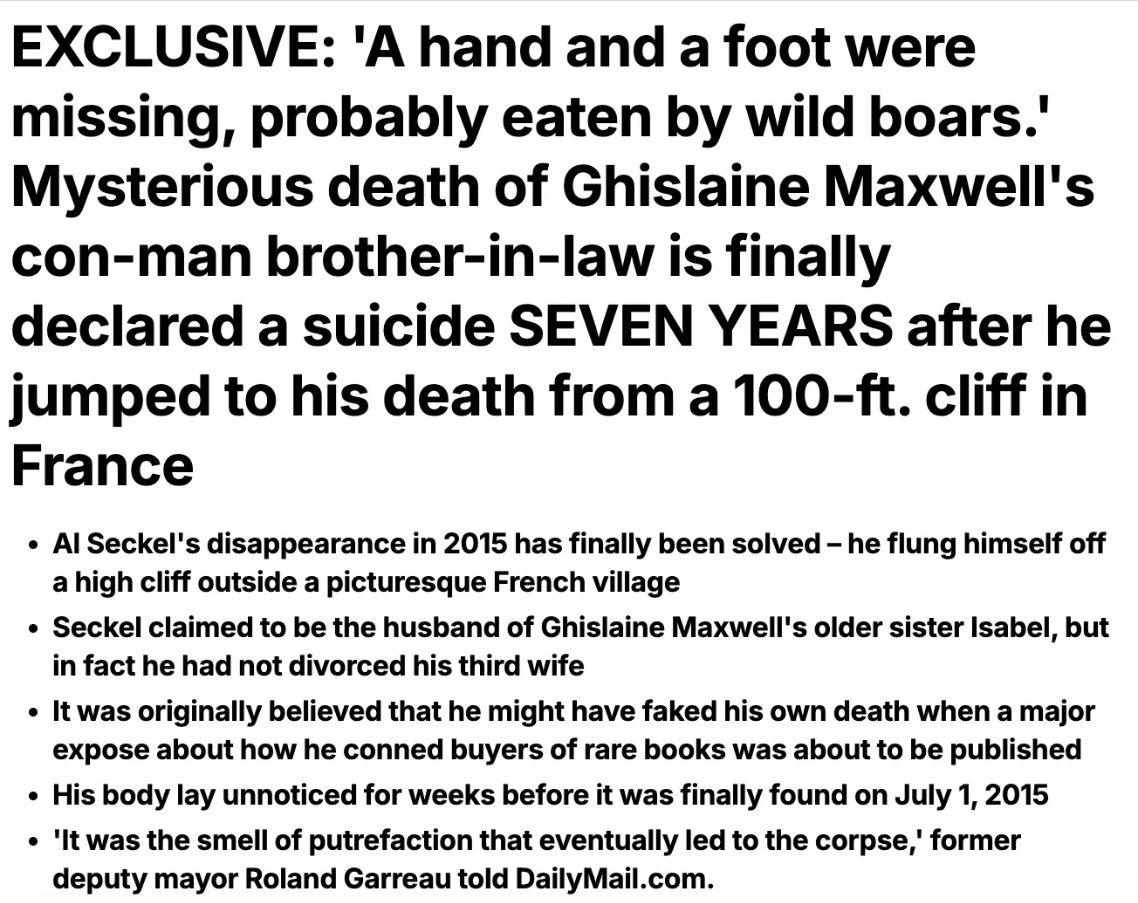
The man who made the introduction, Seckel, was later found dead at the bottom of a hundred-foot cliff in southern France.
And Pierce walked in already carrying a default judgment for rape and an affinity for child porn. Epstein saw exactly what he was getting and Pierce was the perfect target.
What followed was not casual networking. It was an eight-year operational relationship between a crypto pioneer and a convicted predator, documented in thousands of pages of emails released by the Department of Justice on January 30, 2026.
The Emails
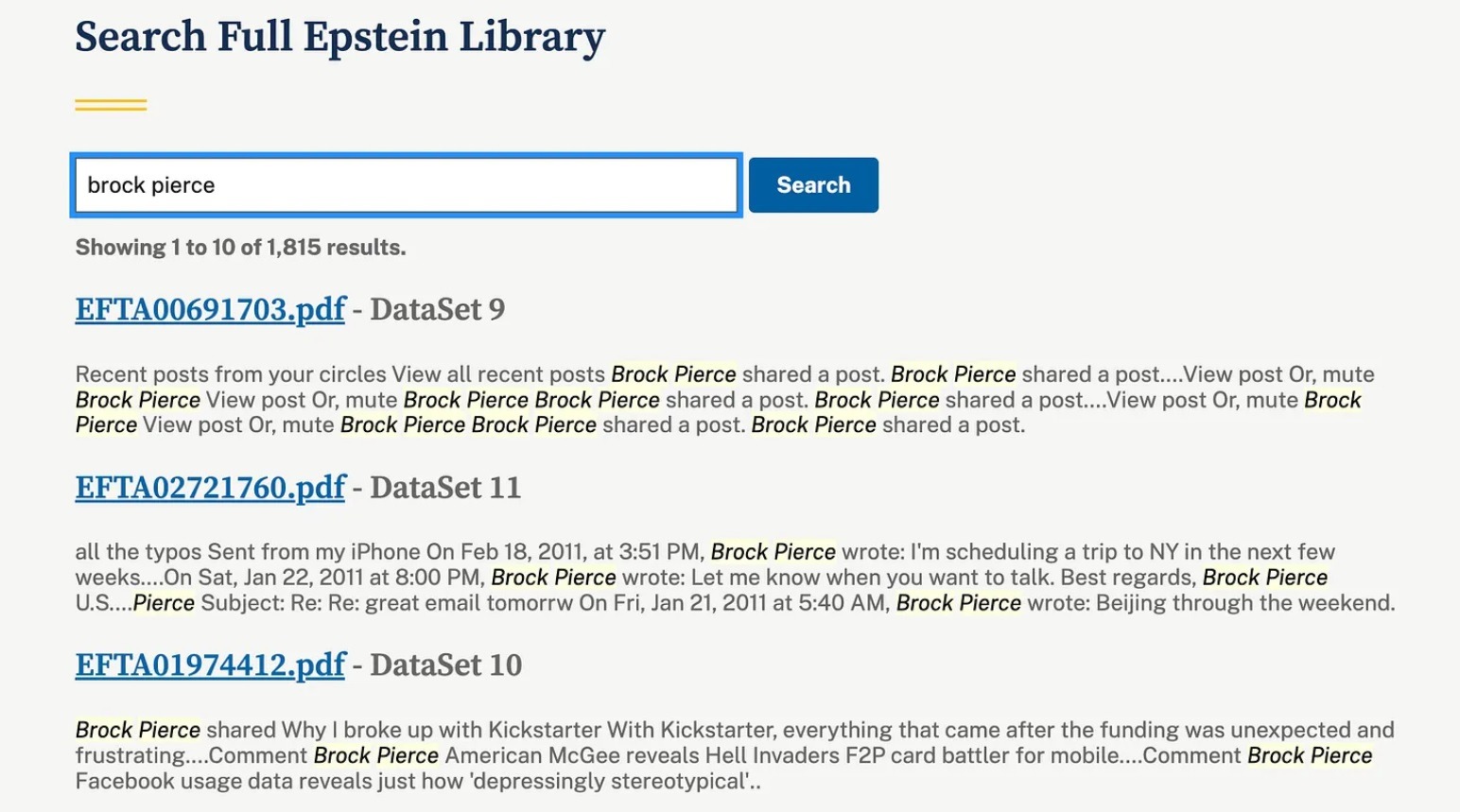
The DOJ released over 3.5 million pages of Epstein files, including direct correspondence between Pierce and Epstein spanning 2011 to 2019.
Pierce was mentioned 1,815 times, more than almost any other private figure.
The emails continued for months after Epstein’s second arrest on federal sex trafficking charges. Here is what they show.
By 2012, the correspondence had turned dark. Pierce sent Epstein dozens of photographs of a Ukrainian woman named Anastasia, three days after Epstein asked him to “take photos and find me a present.” Pierce wrote back that “Ukraine is now my favorite country.”
In a separate exchange, Pierce told Epstein there was “a boat in Antigua full of amazing Ukraine’s finest” waiting for him.
In another email, Epstein’s assistant wrote that Brock had a “great time with the girls in St. Barths.” Pierce’s own assistant sent Epstein’s team photos from Ukraine and mentioned upcoming meetings. There were references to visits on Epstein’s boat and coordination around events with Epstein’s inner circle.
These are the emails of a man inside the operation. Not an acquaintance. Not a networking contact. Pierce was coordinating women, referencing boats, sending photographs on request, and maintaining this relationship for years after Epstein’s first conviction.
But the business side of the relationship is what changed the world.
Pierce was not just advising Epstein on crypto. He was the bridge between Epstein’s money and the people who would build the infrastructure that now threatens to replace the US dollar.
He brokered the Coinbase deal.
In December 2014, Pierce connected Epstein to Coinbase’s Series C round through his venture firm, Blockchain Capital. Epstein invested $3 million. Coinbase co-founder Fred Ehrsam emailed asking to meet Epstein in New York.
In 2018, a trust associated with Epstein sold $15 million of Coinbase equity back to Blockchain Capital. Pierce wired $15 million to Epstein.
That $3 million seed investment would eventually be worth billions when Coinbase went public at a $51 billion valuation.
He pitched Bitcoin to Larry Summers at Epstein’s townhouse.
Epstein hosted the meeting. Pierce described himself to Summers as “the most active investor in Bitcoin.”
Summers said he saw “opportunities” but was worried about reputational damage if he lost money. A fact-checker for a planned New York Magazine article in 2015 asked Epstein:
“Did you meet with Brock Pierce to discuss Bitcoin? Did Larry Summers join this meeting?”
Epstein immediately forwarded the questions to author Michael Wolff with a two-word response: “nfw” (no f*cking way).
The article was never published.
The Network
Pierce and Epstein did not operate in a vacuum. Their shared network reached into the political and financial circles that now control American crypto policy.
Steve Bannon. Pierce and Bannon had worked together for seven years before any of this. Pierce hired Bannon in 2005 to run the financial side of his company Internet Gaming Entertainment, later saying
“Steve Bannon was my right-hand man for, like, seven years.”
Decrypt reported that Pierce and Epstein “appeared to use each other’s connections to develop business partners like Andrew Farkas and politicos like Steve Bannon.”
By August 2018, text messages released by the House Oversight Committee show Epstein was coaching Bannon’s media strategy in real time.
During a six-day exchange, Epstein offered line-by-line feedback on Bannon’s MSNBC appearances and crafted talking points on tax cuts, immigration, and security clearance revocations.
After one interview that ran a full hour, Epstein wrote “Atta boy.” In a separate exchange, Epstein asked Bannon about “brocks people,” meaning Pierce’s crypto network.
He suggested the Treasury Department create a voluntary disclosure form for crypto gains. Bannon would later describe cryptocurrency as “disruptive populism” that “takes control back from central authorities.”
Peter Thiel. Epstein invested $40 million into Thiel’s venture firm, Valar Ventures, in 2015 and 2016. Reid Hoffman made the introduction.
That bet became the single largest asset of the Epstein estate, valued at roughly $170 million by the time Epstein died.
Thiel’s proteges now run US crypto policy: JD Vance is Vice President, David Sacks served as crypto czar, and Thiel’s Founders Fund was the largest investor in Polymarket.
Pierce’s direct role in the Thiel connection is not documented, but both men operated in the same small circle of Epstein’s crypto and tech advisors during the same period.
The result: Pierce co-founded Tether, brokered Epstein’s crypto investments, worked alongside Bannon for years, and operated in the same orbit as the Thiel network that now shapes policy.
The man who co-founded the stablecoin holding $135 billion in US government debt was at the center of all of it.
There is a reason we haven’t heard much about Pierce. Now ask yourself why they are they protecting him?
Where Pierce Is Now
Brock Pierce lives in Puerto Rico, where Act 60 allows him to pay near-zero taxes on capital gains. He is still Chairman of the Bitcoin Foundation. He still runs the Integro Foundation, whose most recent IRS filing shows $78 in total assets.
He ran for president in 2020 and expressed regret for his ties to Epstein during the campaign. Conveniently he denounces his relationship a year after Epstein was “found dead” in his cell.
In 2025, Pierce was spotted at Mar-a-Lago cutting the ribbon for a golden statue of Donald Trump.
That same year, he gave over $1.1 million to a super PAC supporting the reelection of New York City Mayor Eric Adams, five days before Adams dropped out of the race. When Adams withdrew, Pierce launched a campaign called “Draft Eric Back” to get him to reconsider.
Adams had been indicted on federal corruption charges.
Pierce’s “Pierce School” in Washington, DC is not a school. It is a historic building near Capitol Hill that he purchased and converted into a residential penthouse and event space where he hosts crypto policy roundtables with members of Congress.
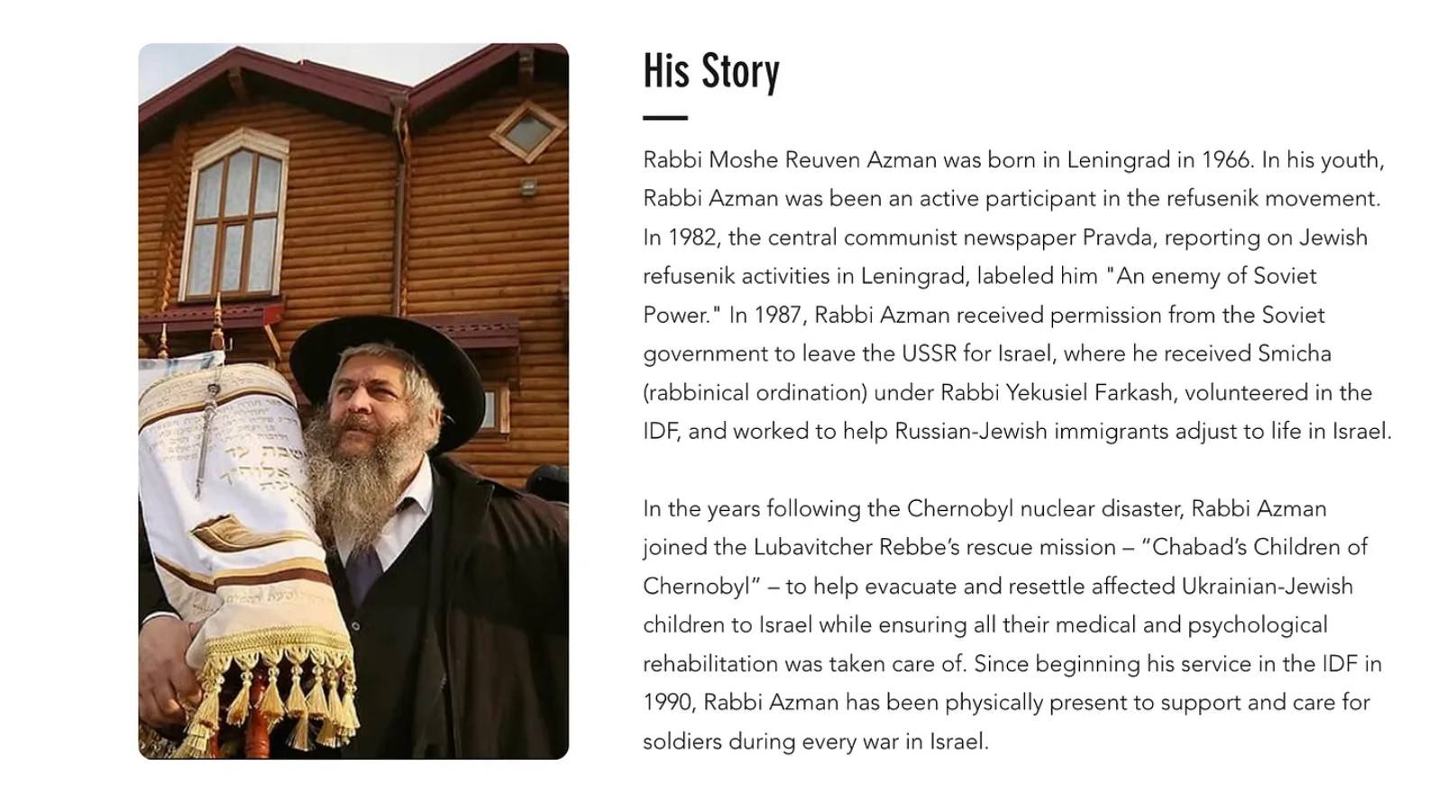
In March 2025, he and Rabbi Moshe Reuven Azman, who served in the IDF, laid a foundation stone for a planned “business school” at Anatevka, a gated compound outside Kyiv.
Pierce’s “charity” has donated at least $630,000 to Chabad-affiliated organizations.
No evidence exists that the school teaches anything, has enrolled students, or has begun operating.
This is a man who was sending photos of Ukrainian women to a convicted sex offender, brokering introductions between that sex offender and the people who now control American crypto policy, and who is now hosting congressional roundtables, attending presidential events, and donating millions to indicted politicians. His foundation holds $78 and looks like a personal shell charity.
Tether Today
Now that you know what Tether is and who built it, here is who runs it.
Who Owns It
Tether has never voluntarily disclosed who owns it. It is a private company incorporated in the British Virgin Islands with no public reporting obligation.
The only known ownership data comes from leaked documents reported by the Wall Street Journal in 2023, showing stakes as of 2018. As of those documents, four people controlled 86 percent of the company.
The Empire Build
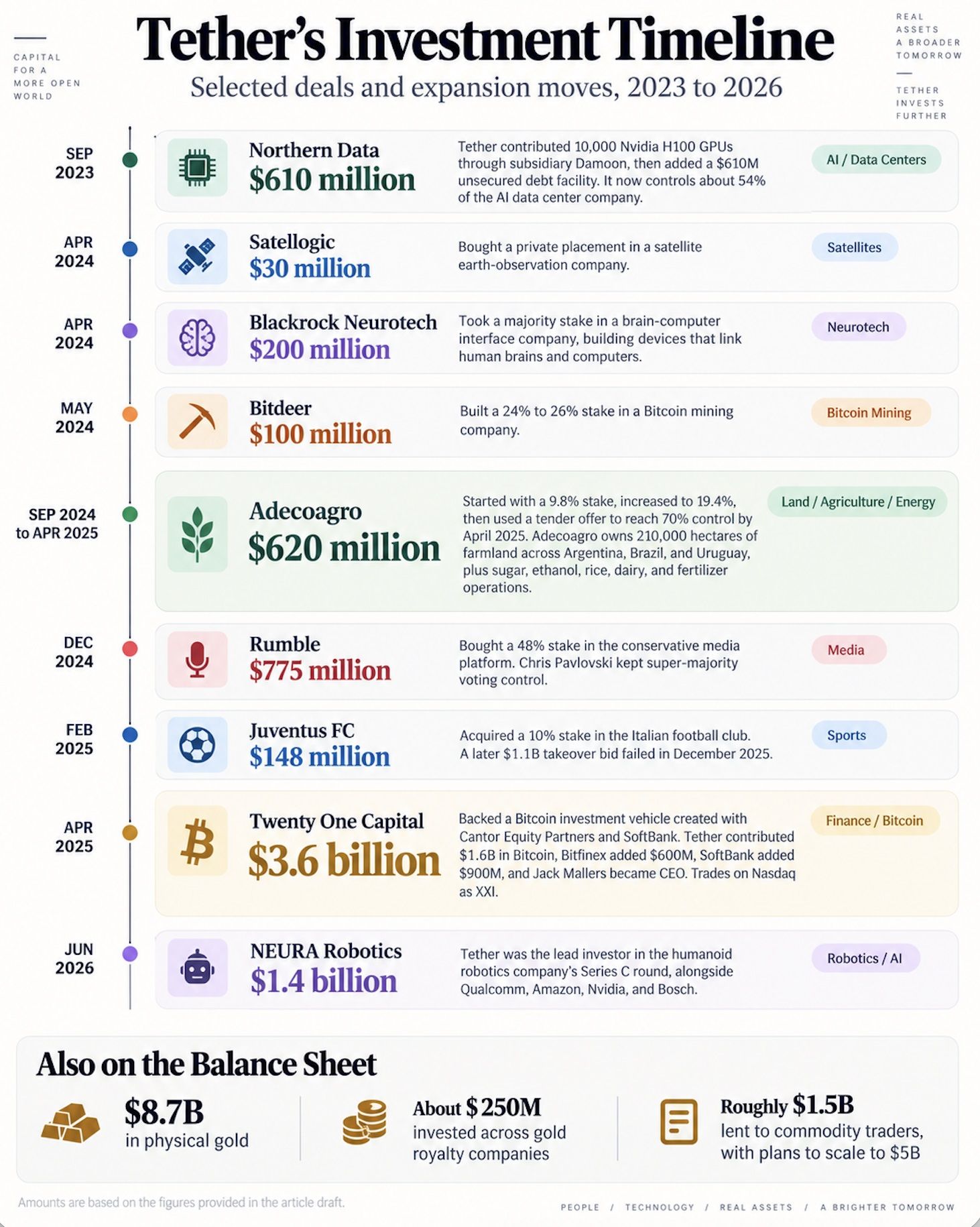
Starting in late 2023, Tether began spending its profits at an extraordinary pace, acquiring stakes in companies across sectors that have no obvious connection to stablecoin issuance.
The Farmland
This is the part of the story that made me stop and ask what we are actually looking at.
Adecoagro is not a farm. It is a vertically integrated agro-industrial conglomerate incorporated in Luxembourg and listed on the New York Stock Exchange.
When Tether took control in April 2025, it took control of the entire chain from soil to supermarket shelf: the land itself, the crops grown on it, the mills that process them, the dairy plants, the rice processing facilities, the peanut sorting plants, the branded consumer products, the export terminals, and the port infrastructure.
In mid-2026, Adecoagro launched a Bitcoin mining pilot at its Brazilian sugar mills, using surplus electricity from sugarcane bagasse cogeneration to power approximately 1,280 mining machines. This connects directly to Tether’s stated goal of becoming the world’s largest Bitcoin miner.
And then there is the fertilizer.
Profertil
In December 2025, eight months after Tether took control of Adecoagro, the company acquired a 90 percent stake in Profertil for approximately $1.1 billion.
Profertil is Argentina’s sole producer of urea, the most widely used nitrogen fertilizer in the world. The plant in Bahia Blanca produces 1.3 million tons of granular urea per year and supplies roughly 60 percent of Argentina’s domestic fertilizer demand.
This means that a company whose co-founder was sending photos of Ukrainian women to Jeffrey Epstein and brokering introductions between Epstein and the people who now control American financial policy now also controls the fertilizer supply that South American agriculture depends on.
Every other farmer in Argentina who needs urea to grow crops is buying it from a Tether subsidiary.
The acquisition nearly doubled Adecoagro’s annual earnings, from $277 million to $467 million in EBITDA.
They also appointed Kyril Louis-Dreyfus to the Adecoagro board. His family founded the Louis Dreyfus Group, one of the four largest commodity trading houses on earth.
Now here is the part that made me consider this one the most important articles of the Currency Killer series.
This is not a hedge fund buying farmland as an inflation hedge. Tether looks to be building something specific.
Adecoagro co-founded a company called Agrotoken, which has already created three grain-backed stablecoins: SOYA, CORA, and WHEA.
Each token represents one ton of grain.
Farmers can use them as currency. Agrotoken partnered with Visa so producers can spend grain tokens with a card. They have already tokenized 230,000 tons of grain and transacted $70 million in deals. Adecoagro’s CEO said the goal was to build “tokenized land.”
Tether told CoinDesk that
“land is a crucial asset class, complementing its existing investments in bitcoin and gold.”
The company is building its own real-world asset tokenization platform designed to create digital versions of bonds, stocks, funds, and physical commodities.
Now connect the pieces.
Tether now controls the land, the crops grown on that land, the fertilizer those crops need to grow, the mills that process the harvest, and the platform that can tokenize all of it into digital currency. It already issues the largest stablecoin on earth.
This is a closed loop. Own the physical asset, process it, tokenize it, and issue the currency it trades in. They are not replacing the dollar with a digital version.
They are building an entire parallel financial system backed by food, land, and fertilizer, controlled by four people who have never disclosed who they are to the public, operating out of the British Virgin Islands.
The Switch
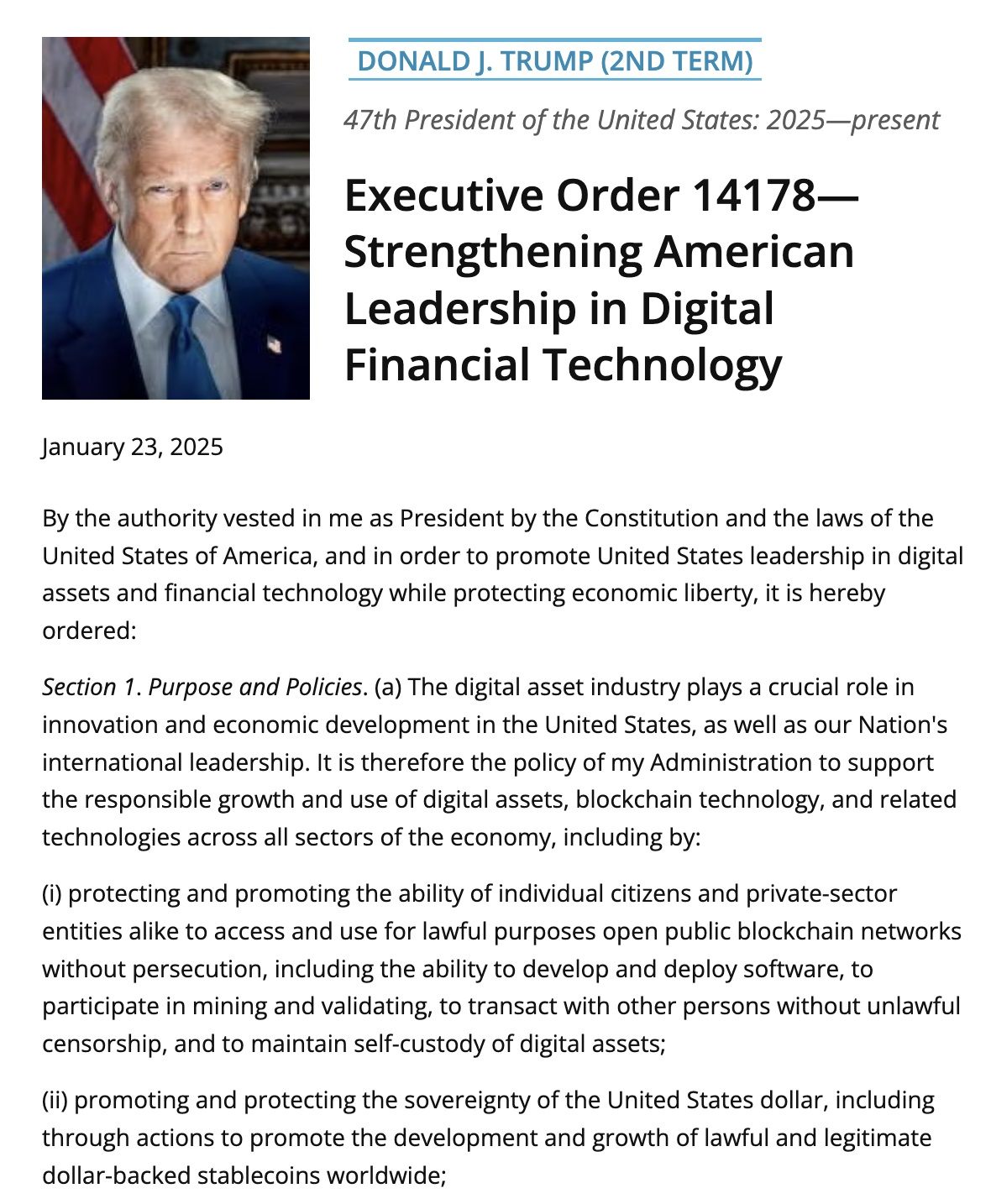
On January 23, 2025, Trump signed Executive Order 14178. It banned all federal agencies from developing or promoting a central bank digital currency. No government digital dollar.
The only digital dollars allowed in America would be private ones.
That same executive order explicitly promoted “the development and growth of lawful and legitimate dollar-backed stablecoins worldwide.” They banned the public option and endorsed the private replacement in the same document.
Then they weakened the dollar.
The Replacement
On July 18, 2025, Trump signed the GENIUS Act into law. It created the first federal framework for privately issued stablecoins, the exact product Tether sells.
The law allows stablecoin issuers to operate under a three-year grace period before meeting full compliance requirements and does not mandate independent audits.
Treasury Secretary Scott Bessent signaled that the law “will drive demand from the private sector for US Treasuries,” and indicated that stablecoin firms could buy up to $1 trillion in US government debt.
Here is the logic. Every dollar minted as a stablecoin creates a dollar of mandatory Treasury demand, because stablecoin issuers have to hold reserves.
Unlike normal investors, they are price-inelastic buyers, meaning they buy Treasuries regardless of yield. So you weaken the dollar abroad through tariffs and trade wars, driving countries away from the physical dollar, but you maintain dollar dominance through digital stablecoins that buy Treasuries automatically.
The European Central Bank warned in May 2026 that this “effectively outsources parts of the national debt to the crypto sector.”
But here is what matters, who controls those digital dollars?
It’s not the government, it’s not the Federal Reserve, it’s private companies.
Tether holds $135 billion in US Treasuries, making it the 17th largest holder of US government debt. And the people who own Tether, custody its reserves, and wrote the law that legalized it are all in the same room.
Bessent redefined what “strong dollar” means at his confirmation hearing:
“The price of the dollar has nothing to do with a strong dollar policy.”
He called CBDCs
“a first step toward financial surveillance”
and declared them “off the table.”
The private digital dollar is the only option, and everyone who built the framework is getting paid.
Who Else Is Getting Rich
The Trump Family
World Liberty Financial, the crypto venture backed by the Trump family, has generated over $1 billion in revenue. It launched its own stablecoin, USD1, which was used in a $2 billion investment deal between a Binance-affiliated entity and Abu Dhabi investors.
The president’s memecoin, $TRUMP, briefly hit a market cap of over $14 billion before crashing, with third-party analysis showing retail investors collectively lost approximately $3.8 billion while insiders profited.
The Thiel Network
Peter Thiel took $40 million from Epstein through the Valar Ventures fund, an introduction brokered by Pierce. That investment produced $170 million in returns and became the largest single asset in the Epstein estate.
Thiel’s network has been central to shaping crypto policy: his protege JD Vance is now Vice President, David Sacks served as the administration’s crypto czar for 130 days, and Thiel’s Founders Fund was the largest investor in Polymarket, the crypto prediction market that went from a $350 million valuation to $21 billion under the new deregulatory framework.
Polymarket has Trump Jr. on its advisory board and has flagged $200 million in suspicious trading activity.
The Beef
In February 2026, Trump signed an executive order quadrupling beef imports from Argentina. The order authorized 80,000 additional metric tons of tariff-free lean beef trimmings, allocated entirely to Argentina, with plans to scale to 300,000 tons.
He said it was to lower ground beef prices, which had hit a record $6.90 per pound as the US cattle herd shrank to a 75-year low.
American ranchers called it a “misguided effort” that would “undercut the future of family farmers and ranchers.” The National Cattlemen’s Beef Association said it “cannot stand behind the President while he imports Argentinian beef.”
China had just rejected 22 tons of Argentine beef over a banned antibiotic. Republican lawmakers opposed it. Ranchers warned it would destroy America’s ability to rebuild its own herd.
Now remember who controls Argentine agriculture.
Tether owns 210,000 hectares of Argentine farmland. Tether owns Argentina’s sole fertilizer producer. Tether owns 14,500 milking cows and two dairy processing plants.
Tether’s subsidiary Adecoagro is one of the largest agricultural conglomerates in South America. And the president just signed an executive order flooding the US market with Argentine beef at the exact moment Tether controls the land, the feed, the fertilizer, and the infrastructure that Argentine agriculture runs on.
The company that prints the digital dollar. The company whose reserves are custodied by the Commerce Secretary’s family firm. The company whose law was championed by a man who became its CEO. That company now sits at the center of a trade deal that undercuts American ranchers to benefit Argentine agriculture, the same Argentine agriculture it owns.
Maybe it is a coincidence. Maybe the president opened the floodgates to Argentine beef imports without knowing or caring that a company connected to Jeffrey Epstein controls the supply chain on the other end. Maybe.
But I do not believe in that many coincidences, especially based on what we have seen over the last year.
The Thread
One man attended a conference to rehabilitate a convicted sex offender in the Virgin Islands. Over the next eight years, he sent photos of women on request, brokered crypto deals that funneled millions through the sex offender’s accounts, and co-founded the company that now holds more US government debt than most countries.
His foundation holds $78. His network moves billions. Nobody has asked him a single question under oath.
The thread runs from a dead man’s island through a crypto pioneer who sent him photos on request, through the deals that funneled millions through Epstein’s accounts, through the network that connects Epstein’s money to the vice president’s mentor and the president’s former strategist, through the company that holds $135 billion in US Treasuries, through the law that legalized it, through the man who championed it and became CEO of it, through the Commerce Secretary whose children own a piece of it, through the Treasury Secretary blocking the dead man’s records, through the farmland and fertilizer in Argentina, and all the way to the executive order that just opened the US market to the country whose agriculture they now control.
The Navy says it is making a concerted effort to apply the hard lessons learned from the marathon deployments of the USS Gerald R. Ford and USS Abraham Lincoln, both in combat and in quality of life for the crew, according to a new video posted by the Chief of Naval Operations, Adm. Daryl Caudle. The changes will be rolled out when USS Theodore Roosevelt deploys following a brief, last-minute, and previously unreported maintenance availability, TWZ has learned. Meanwhile, the United States and Iran are quickly climbing the escalation ladder again, as the latest series of tit-for-tat strikes has resulted in a massive overnight ballistic missile attack on a Jordanian base hosting U.S. forces and the destruction of 10 Iranian commercial oil tankers over the past week.
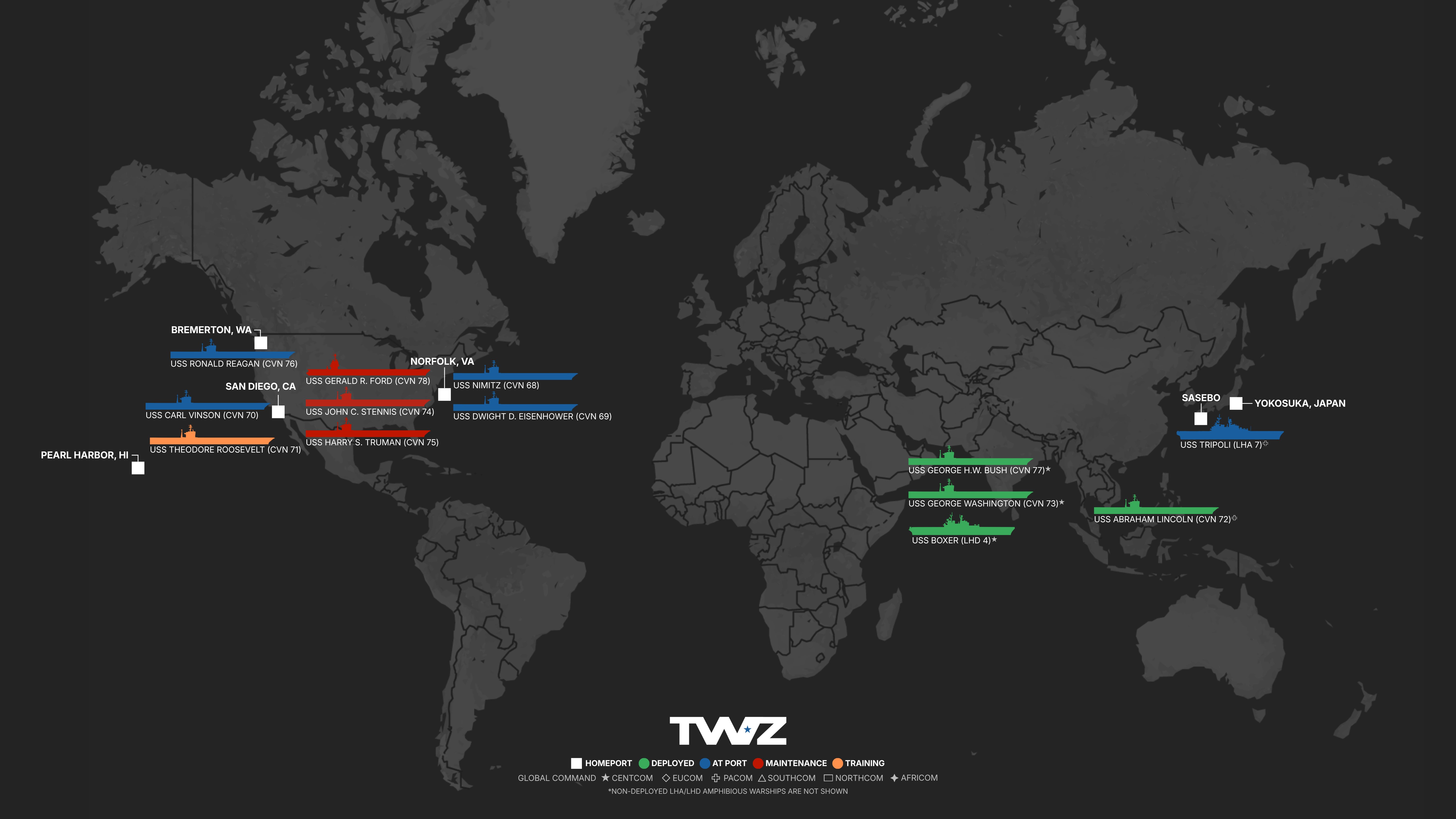
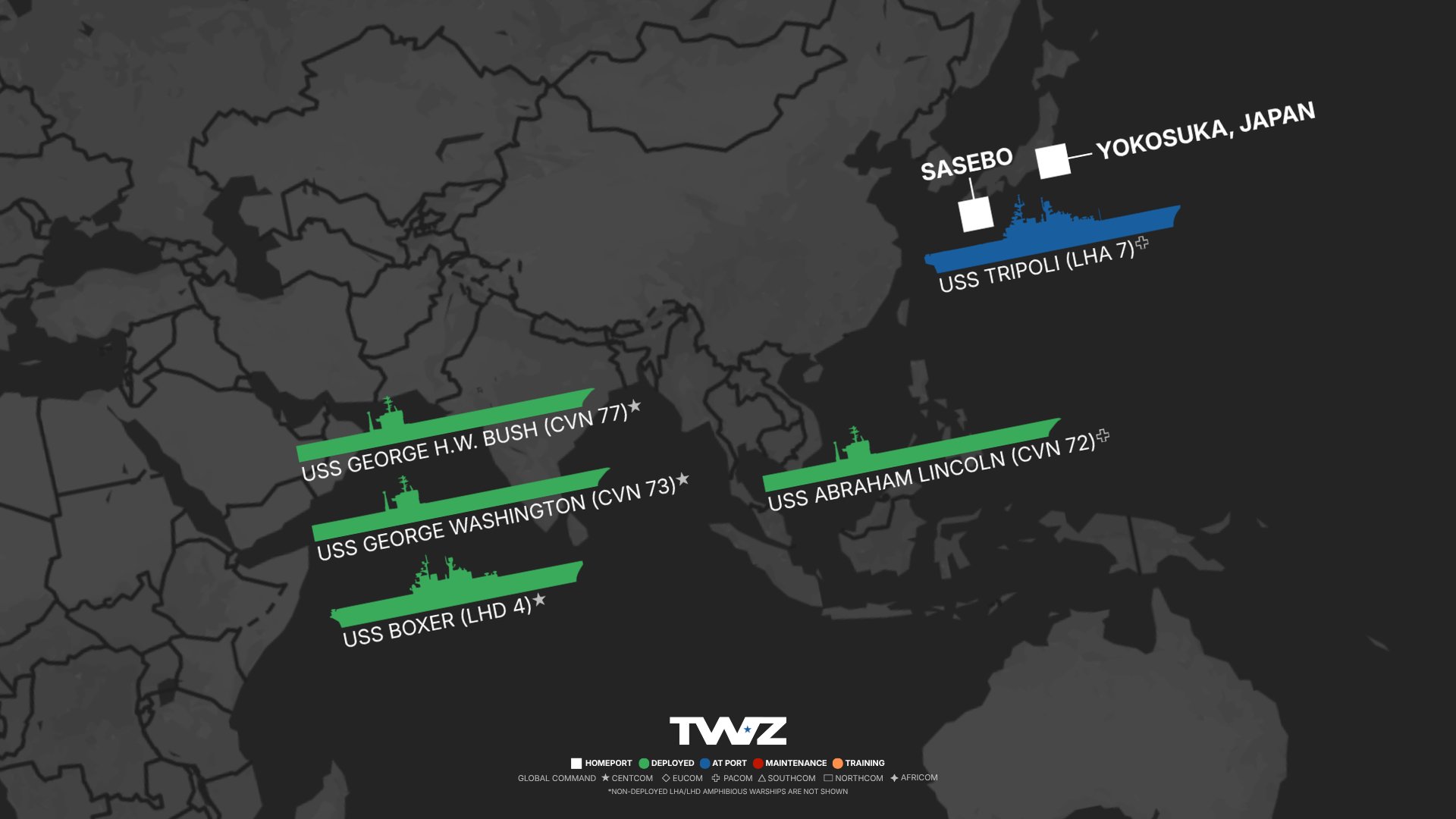
Here’s TWZ’s weekly carrier tracker monitoring America’s flattop fleet, including deployed Carrier Strike Groups (CSG) and Amphibious Ready Groups (ARG), using publicly available open-source information. Check out last week’s report here.
TWZ/IAN ELLIS-JONES (High Resolution)
George Washington Strike Group Evades Iranian Ballistic Missiles
Less than a month after taking up station in the Middle East, elements of the George Washington CSG reportedly came under ballistic missile fire from the Islamic Revolutionary Guard Corps (IRGC) on September 5, according to Iranian media. “A U.S. aircraft carrier and guided-missile destroyer successfully evaded multiple unprovoked Iranian attacks,” U.S. Central Command (CENTCOM) confirmed in a statement, without identifying which warships were targeted. TWZ cannot independently verify the Iranian reports, and the Islamic Republic has frequently leveraged disinformation throughout the war.
U.S. forces responded swiftly the same day, striking three Iranian commercial oil tankers, part of the “shadow fleet” that funds IRGC operations, in a notable step beyond U.S. President Donald Trump’s recently announced tanker-for-tanker policy. “Let the message to the IRGC be clear: If you shoot at two of our ships, we will impose an even higher economic cost – taking out three of yours,” Adm. Brad Cooper, the CENTCOM commander, warned. “We will not hesitate to defend American forces, and if necessary, destroy Iran’s limited and exposed oil fleet,” he added. No U.S. casualties or damage to the American ships was reported.
Video of U.S. Central Command forces striking three Iranian crude oil carriers on September 5, 2026. (USCENTCOM video)
Details surrounding the attack on September 5 are limited, but Iranian-affiliated channels claimed the IRGC fired the Qassem Basir medium-range anti-ship ballistic missile (ASBM) for the first time. If true, it would represent the first known combat employment of the ASBM since it was unveiled in May 2025 and poses a new threat to Navy warships operating within the 1,200-kilometer, or roughly 750-mile, stated range (although that figure is more than likely overstated). Generally speaking, American cruisers and destroyers can engage ASBMs in two layers, in some cases using Standard Missile-3 (SM-3) in the midcourse phase and SM-6 during the terminal phase. Both are finite resources, and only so many can be loaded in their Vertical Launch System (VLS) cells.
Since the initial exchange on September 5, the tit-for-tat strikes have continued to escalate. CENTCOM destroyed another five crude oil tankers on September 8, bringing the total to 10 in a week, after the IRGC targeted an unidentified Navy warship again with ballistic missiles. Iran answered overnight, launching a huge salvo of ballistic missiles toward Muwaffaq Salti Air Base in Jordan, where a significant contingent of U.S. forces is forward-deployed. Dramatic videos on social media show Patriot batteries firing against the incoming projectiles, with open-source analysts counting at least 60 interceptors employed.
U.S. destroys another five Iranian tankers after the IRGC targets another American warship. (CENTCOM video)
The USS George Washington arrived in the CENTCOM area of responsibility (AOR) on or around August 19, escorted by a single guided-missile destroyer, USS Shoup. The pairing matches the composition described in CENTCOM’s statement about the IRGC attack on September 5. Washington’s public affairs team reposted the statement on their social media accounts.
The possibility that the second Nimitz class flattop operating alongside Washington in the Middle East, the USS George H.W. Bush, was the target of the attack cannot be ruled out. Both carriers are the same class and look alike from a distance (or through a seeker). The George H.W. Bush CSG is currently composed of a guided-missile cruiser, USS Princeton, and two guided-missile destroyers, USS Ross and USS Donald Cook.
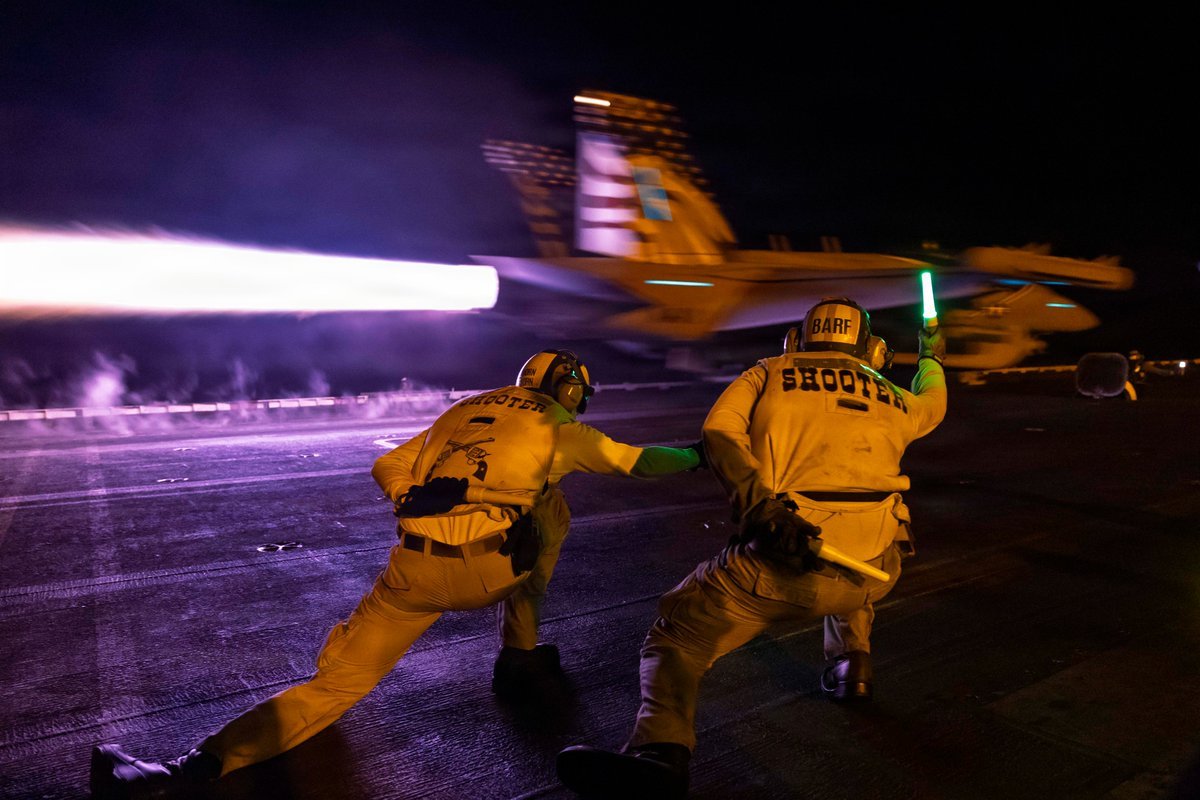
An EA-18G Growler launches from the flight deck of USS George H.W. Bush during night flight operations. (CENTCOM photo) An F/A-18F Super Hornet on the flight deck of aircraft carrier USS George H.W. Bush (CVN 77). (U.S. Navy photo) U.S. Central Command Public Affa
Bush was pictured conducting nighttime flight ops in CENTCOM’s most recent update detailing the status of the ongoing blockade: U.S. forces redirected 94 commercial vessels, kinetically disabled three, and boarded two to ensure compliance, as of September 7.
USS Theodore Roosevelt Undergoes Last-Minute Maintenance Ahead of Deployment
The next carrier scheduled to deploy from the U.S., the USS Theodore Roosevelt, recently got underway after a brief maintenance period. While there was no mention of an upcoming availability in budget documents, we noticed what appeared to be pierside work in commercial satellite imagery, similar to the brief stints Washington and Vinsoncompleted recently while in homeport. In response to our inquiry, a Navy official told TWZ, “Nimitz-class aircraft carrier USS Theodore Roosevelt (CVN 71) is currently in port at Naval Air Station North Island in San Diego conducting routine, planned maintenance. While we do not comment on future operations or movements due to operations security, aircraft carriers follow an optimized fleet response plan that provides full realignment of maintenance, training, and deployment cycles to fit in a standard 36-month rotation.”
Roosevelt’s upcoming deployment has been the subject of heavy speculation, as there will soon be no carriers available in Asia should a contingency arise. While Lincoln is currently in the South China Sea, she’s at the tail end of her deployment and in the process of heading home. The same official addressed the coverage gap, telling us, “U.S. Pacific Fleet’s posture across the region remains strong, adaptive, and ready. The U.S. Navy is purpose-built to flex, surge, and sustain across multiple theaters simultaneously – and that flexibility is a strategic advantage, not a vulnerability. U.S. Pacific Fleet’s commitment to the region is enduring – backed by the Joint Force and a strong network of allies and partners – and we will continue to fly, sail, and operate wherever international law allows to support a free and open Indo-Pacific.”
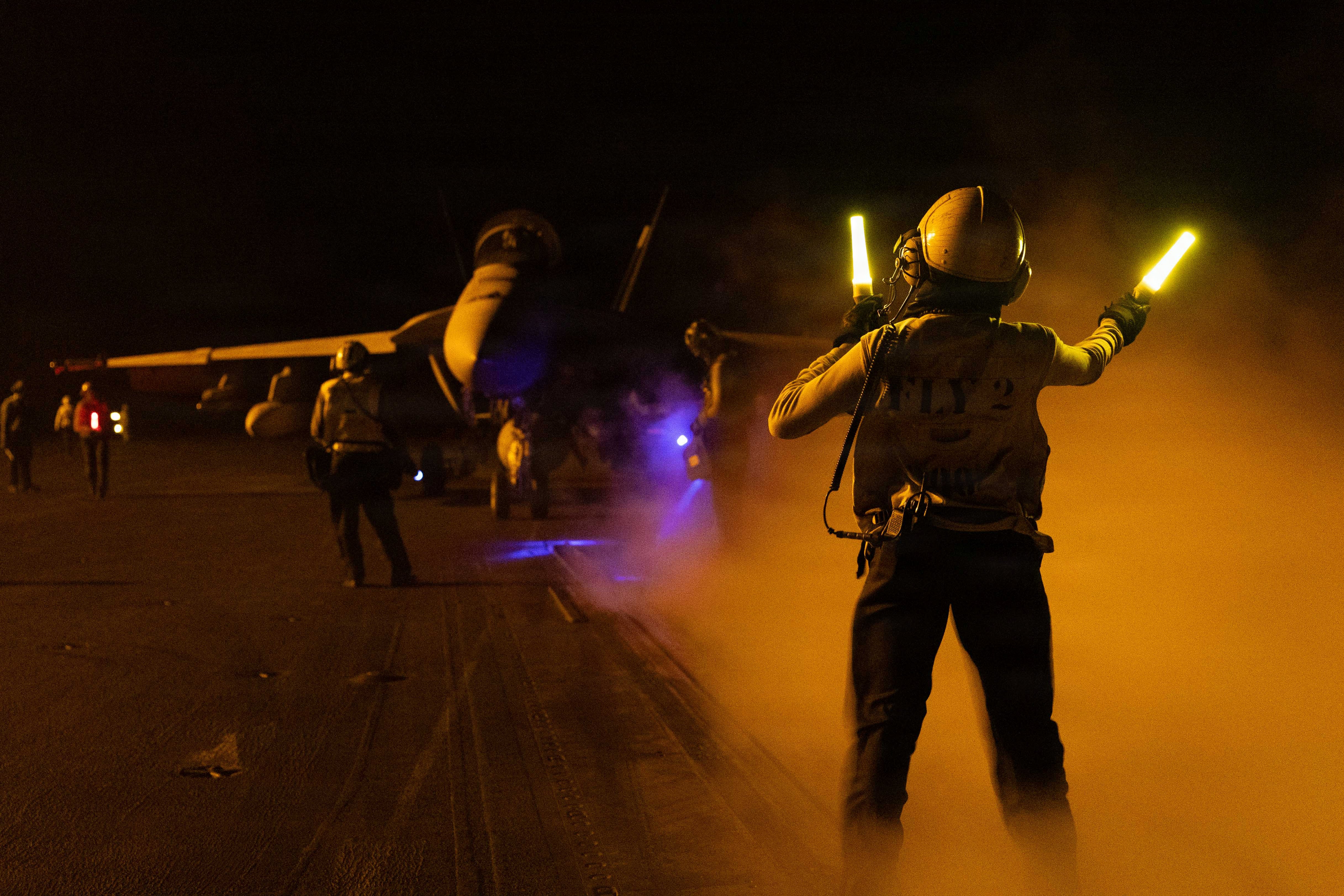
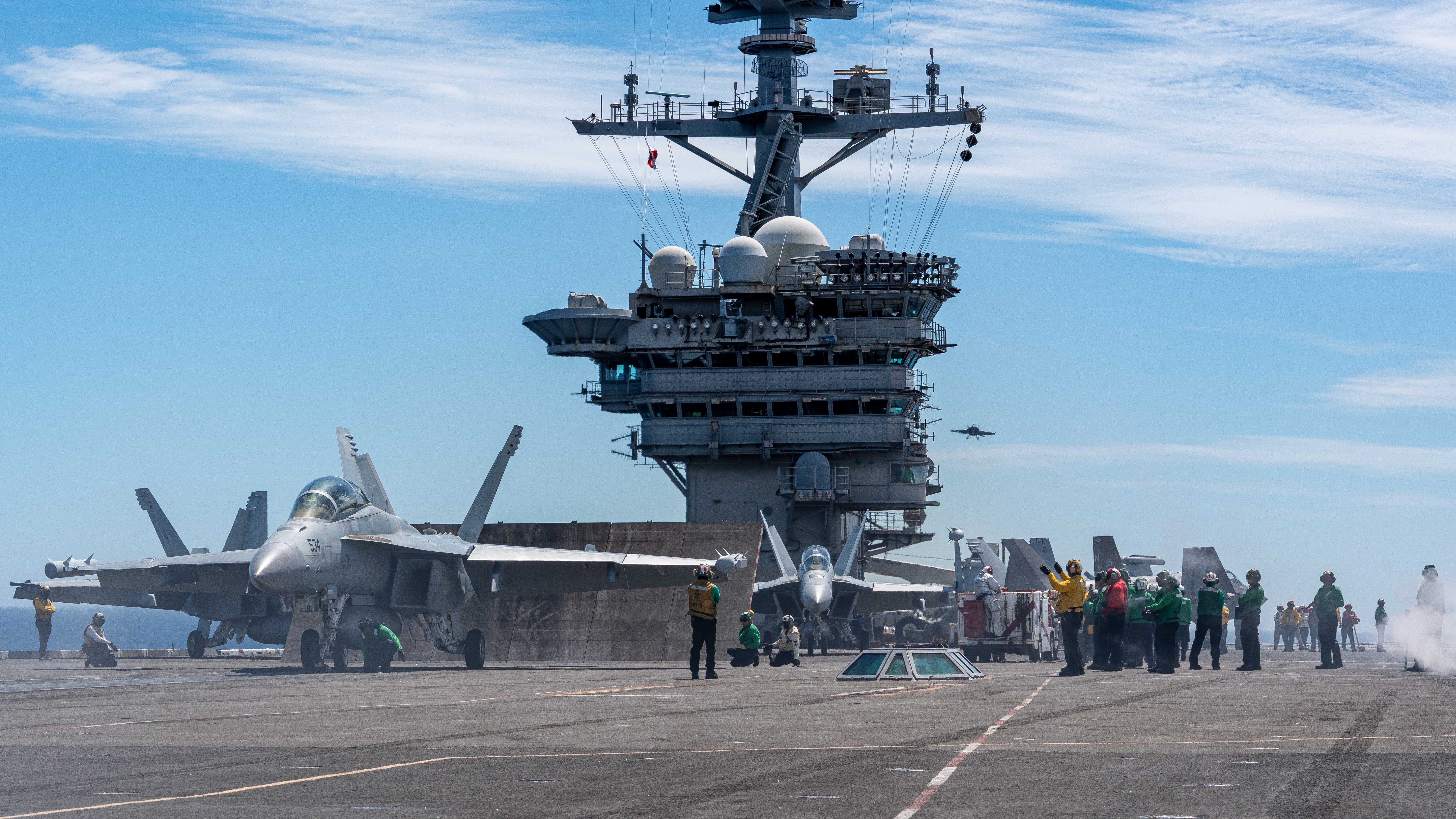
Flight operations on USS Theodore Roosevelt (CVN 71), Sept. 7, 2026. (U.S. Navy photo) Petty Officer 3rd Class Alexander BussmanSailors direct the launch of an F/A-18E Super Hornet on USS Theodore Roosevelt (CVN 71). (U.S. Navy photo) Petty Officer 3rd Class Alexander Bussman
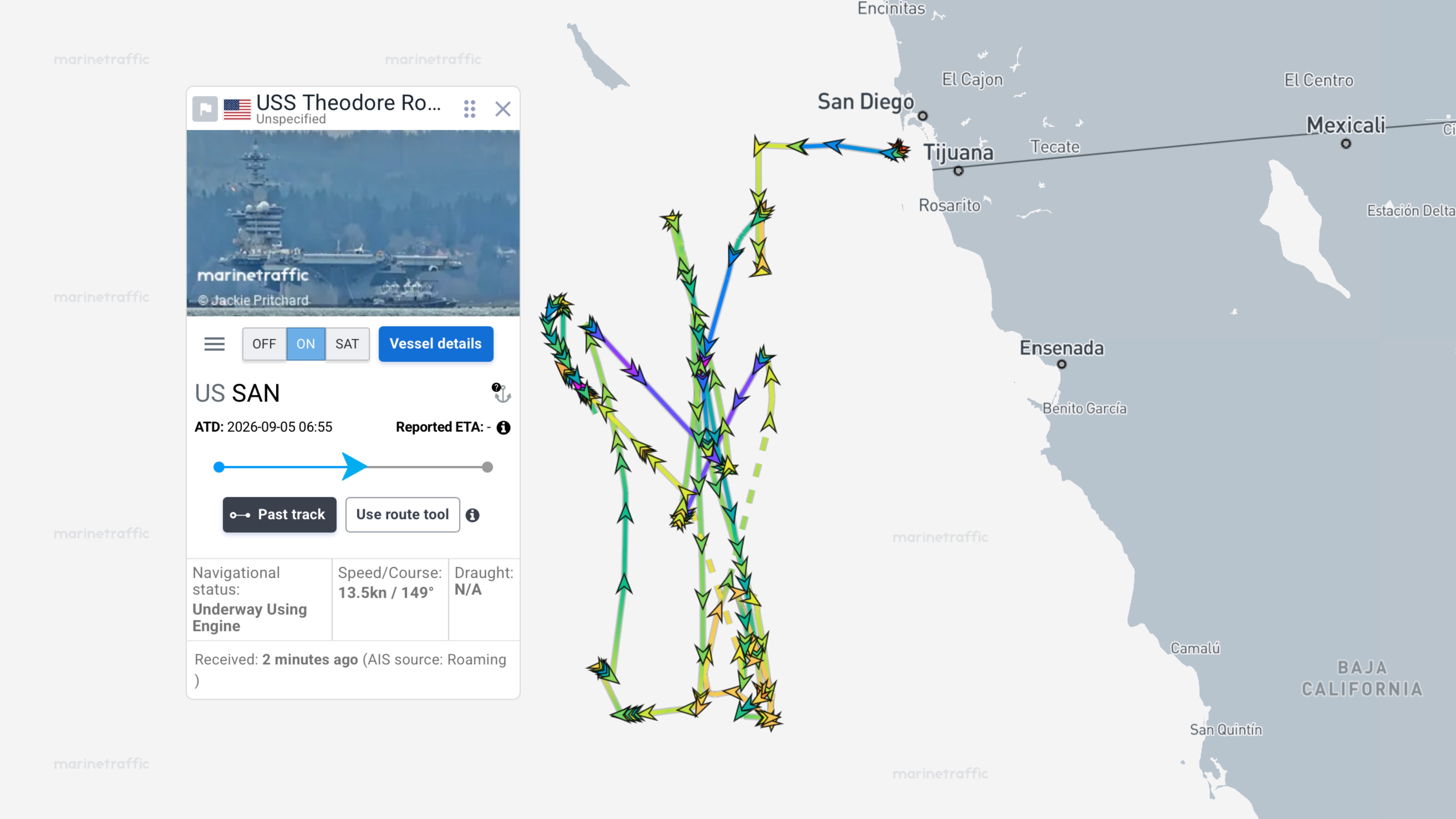
Roosevelt departed San Diego on September 5 and is still at sea as of publication. Imagery posted two days later on DVIDS, the military’s content-sharing platform, shows the flattop carrying out flight operations in the U.S. 3rd Fleet AOR and conducting “advanced training to bolster strike group readiness and capability.” The carrier was last tracked broadcasting a position publicly with her Automatic Identification System (AIS) transponder on, operating to the west of Baja California, Mexico, according to MarineTraffic. It’s unclear if the maintenance has been completed or if additional modifications and training will be required before the CSG deploys.
Transit of USS Theodore Roosevelt off the west coast while working up. Source: MarineTraffic/KPLER (Reprinted with permission)
As noted above, the Chief of Naval Operations, Adm. Daryl Caudle, alongside Master Chief Petty Officer of the Navy (MCPON) John Perryman, posted a video yesterday with new information on Roosevelt’s upcoming deployment. “The lessons you’re bringing home are helping us better prepare the next team to deploy,” Perryman explained, addressing Lincoln’s crew. “Right now USS Theodore Roosevelt is putting those lessons into action using what we learned from Abraham Lincoln and Gerald R. Ford,” Caudle added. On logistics, that means maximizing the loadout of food, retail products, and hygiene items by converting available spaces into additional storage facilities. Regarding quality of life, improvements include new entertainment, more fitness equipment, and holiday materials purchased in advance.
“Small things matter during a long deployment because taking care of our Sailors is part of maintaining combat readiness,” Perryman noted. Watch the full video below.
CNO Adm. Daryl Caudle and MCPON John Perryman provide an update on USS Theodore Roosevelt’s upcoming deployment. (U.S. Navy video)
Three other U.S.-based carriers, USS Carl Vinson, USS Dwight D. Eisenhower, and USS Ronald Reagan, were recently underway for training but have returned to their respective homeports since our last report on September 1.
Eisenhower returned to Pier 14S at Naval Station Norfolk on September 2 after a 12-day underway for Fleet Replacement Squadron (FRS) and Training Command (TRACOM) Carrier Qualifications (CQ) in the Virginia Capes and Jacksonville operating areas. Vinson completed 25 days of Tailored Ship’s Training Availability (TSTA) and Final Evaluation Period (FEP) before mooring at Juliet Pier on Naval Air Station North Island, San Diego, on September 4. And Reagan, which just finished a nearly 18-month Drydocking Planned Incremental Availability (DPIA), returned to Naval Base Kitsap-Bremerton in Washington state on September 7 after a four-day post-availability shakedown and sea trials. It’s unknown how many rounds of sea trials will be required before Reagan returns to the fleet.
For the time being, America has one carrier coming back online, but the net gain will be short-lived, as Lincoln is expected to begin a DPIA after returning home.
USS Abraham Lincoln Leaves Thailand Looking Like A Different Ship
Elements of the Abraham Lincoln CSG, as well as escort cruiser USS Robert Smalls, arrived in Thailand on September 2 for what the Navy characterized as the “first full port call” of their nine-plus-month deployment. The crew of roughly 5,000 Sailors and Marines was finally able to leave the ship for liberty, with the majority standing on solid ground for the first time since November 2025.
“This port visit to Pattaya was a tremendous opportunity for this crew to recharge and a highlight for the strike group,” Abraham Lincoln’s commanding officer, Capt. Dan Keeler, said in a press release. “Thailand has such a rich culture and history, coupled with incredible hospitality, and that all shone through in this port visit. We are grateful to our Thai allies for hosting us, and we look forward to continuing our mission here in 7th Fleet, alongside Thailand and our other regional allies and partners.”
The USS Abraham Lincoln (CVN-72) arrives at Laem Chabang Port in Thailand on September 2, 2026. (Photo by Thananuwat Srirasant/Getty Images; Reprinted with permission)
According to the press release, the crew “experienced all the sights and sounds Thailand has to offer, deepening their understanding of the Thai people and strengthening interpersonal bonds.” Lincoln pulled into port looking worse for wear after 286 days at sea, with noticeable algae and rust spots, conditions that are expected given the high operational tempo endured during nearly seven months of combat. Videos surfaced of the hull being scrubbed by Thai contract crews at a fraction of what the same job would cost stateside. The carrier departed five days later on September 6 in much better shape.
Timelapse video of USS Abraham Lincoln leaving Thailand on September 6, 2026. (Abraham Lincoln video by MC3 Castro)
Lincoln is now continuing the journey home to San Diego, though whether any additional stops will be made along the way is unknown. A single-sourced report from Newsweek, which TWZ has not verified, claimed that another port call might be added, according to the wife of an officer aboard. As of publication, Lincoln is 293 days into the deployment, just 33 days short of the 326-day record set by USS Gerald R. Ford earlier this year.
U.S. Navy Big-Deck Fleet At A Glance
Overall, three U.S. carriers are deployed (with one heading home), one is preparing to deploy in the near term, three are working up in various states of readiness, three are in current or upcoming maintenance, and one is being used primarily for training before deactivation next year. One amphibious ready group is deployed, one is forward-deployed and at homeport, four are working up or in port, and three are in maintenance.
Note: Positions are general approximations.Non-deployed LHA/LHD amphibious warships are not shown.
Greek popular singer Giorgos Mazonakis died suddenly on Wednesday at the age of 54. According to initial information, the beloved artist died in Elpis hospital in Athens from a heart attack. Media reported that the ambulance service EKAV received a call at 4:30 on Wednesday afternoon from a private doctor’s clinic in Kolonaki district of […]
The price of oil surpassed $100 a barrel for the first time since July after attacks on oil facilities and ships in the Middle East threatened an already weakened supply chain.
The price of oil surpassed $100 a barrel for the first time since July after attacks on oil facilities and ships in the Middle East threatened an already weakened supply chain.
The White House ballroom project is wildly unpopular. Donald Trump doesn’t care. Ben Terris reports on Trump’s obsessive bid for architectural immortality, which is now barreling toward completion, and captures the breathtaking sycophancy required to work for this president:
“We had asphalt going into here,” Trump says, standing on the pathway leading to the residence of the White House. “Now you have the best stone.” He points at a pile of square-cut granite—the type being used to replace the asphalt walkway—and looks to his communications director, Steven Cheung, who is accompanying us on this impromptu tour of the White House grounds en route to the construction site.
“That’s some stone, huh, Steven?” he says.
“It’s incredible,” Cheung concurs.
“Look at the thickness of it,” Trump says. “Normally, you use one inch, as thin as you can. It’s the White House—I said, ‘Fuck it, what’s the best you have?’ They said, ‘We have one that’s four inches.’”
“You’re restoring glory to the White House,” Cheung says, shaking his head in apparent awe.
An important medical achievement with a distinct human dimension was recorded in Athens on Wednesday: A 54-year-old woman gave birth to a healthy baby girl, weighing 3,490 grams, from an embryo that had been cryopreserved on March 17 2004. The embryo transfer took place on December 23 2025 at a private clinic. According to the […]
Greek-owned tanker “New Andros” was attacked by a drone while sailing in Iraqi territorial waters on Wednesday, September 9, 2026. According to the Greek Ministry of Maritime Affairs and Insular Policy, the two Greek nationals onboard, the captain and the chief engineer, are safe and in good health. The Panamanian-flagged, Greek-owned tanker was carrying around […]
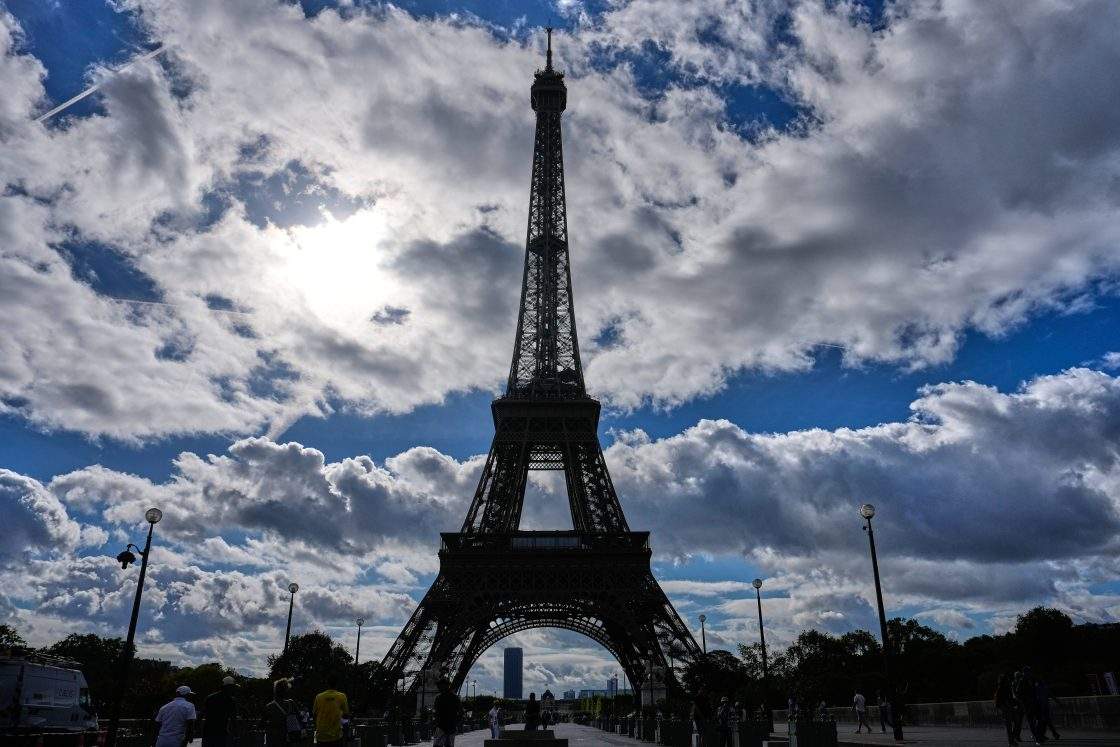
The Eiffel Tower reopened Tuesday after a strike to protest what a union official called “unacceptable” management instructions limiting the presence of women ended.
The Eiffel Tower reopened Tuesday after a strike to protest what a union official called “unacceptable” management instructions limiting the presence of women ended.
A European Parliament compromise on reforming the EU’s Sustainable Finance Disclosure Regulation (SFDR) has opened a politically sensitive dispute over whether entire industries should be excluded from sustainable investment — with fossil fuels offered a conditional transition route while tobacco remains outside.
The revision of the Sustainable Finance Disclosure Regulation, better known as SFDR, is emerging as a key political battleground over the future boundaries of sustainable finance in the European Union.
Although formally concerned with disclosure requirements and the categorisation of financial products, the dispute now goes considerably further. At stake is a fundamental question: should entire sectors be excluded from sustainable and transition finance because of the nature of their business, or should companies be judged primarily on their actual environmental performance, investment plans and capacity to transition?
That distinction has potentially significant consequences for companies, investors and access to capital.
The file is currently under consideration in the European Parliament’s Economic and Monetary Affairs Committee, ECON, where a compromise has been reached between political groups ahead of the committee vote.
Under the emerging agreement, sectoral exclusions remain within the proposed framework. Tobacco cultivation and production, as well as controversial weapons, remain outside the relevant sustainable investment categories.
Fossil-fuel companies, however, have been given a potential route into the proposed transition category where specified conditions are met.
The result is an unusual regulatory distinction.
An oil or gas company may potentially demonstrate that it is directing sufficient capital towards sustainable activities and implementing a credible emissions transition. A tobacco business, however substantial its environmental improvements, would remain excluded because of the sector in which it operates.
Crucially, however, the EPP’s decision not to challenge the tobacco exclusion should not be read as an endorsement of blanket sectoral exclusions.
Markus Ferber, the EPP’s ECON coordinator, has told EU Reporter that the decision was driven by parliamentary arithmetic and the need to assemble a stable majority for the overall compromise.
In other words, the EPP did not abandon its reservations about blanket exclusions because it had become convinced that such exclusions were the right policy. It accepted the compromise because, in Ferber’s assessment, there was no realistic parliamentary majority for an alternative amendment that would have created a performance-based pathway for tobacco.
That distinction is politically important.
It means the tobacco exclusion survives not because the EPP has embraced the principle behind it, but because the group concluded that challenging it would jeopardise the broader compromise.
Ferber: transition should matter more than sector
Ferber made clear that his underlying policy position remains strongly performance-based.
“Per se, EPP does not like blanket sectoral exclusions, but unfortunately it is not only the EPP’s position that determines the final outcome of negotiations and we had to strike compromises with other political groups to achieve a stable majority,” he told EU Reporter.
Asked whether sustainable-finance rules should judge companies according to the sector in which they operate or according to their measurable environmental progress, Ferber was unequivocal.
“In my view, the objective should be to finance the transition,” he said. “Hence, environmental performance and credible transition plans should matter more than the sector.”
That comment goes to the heart of the controversy surrounding tobacco.
The sector remains excluded irrespective of whether individual companies reduce emissions, restructure production, invest in Taxonomy-aligned activities or adopt measurable transition plans.
Fossil-fuel companies, by contrast, are being offered a conditional route into the transition category.
The tobacco exclusion survived because of the numbers
Ferber’s most significant intervention concerns why the EPP did not attempt to overturn the tobacco exclusion through an alternative compromise amendment.
Asked directly why he was not tabling such an amendment, despite previously opposing blanket exclusions affecting tobacco, Ferber replied:
“We have assessed all options for a stable majority in the Parliament and were not convinced that tabling alternative compromises would yield such a majority.”
That answer makes the political calculus unusually clear.
The tobacco exclusion was not retained because Ferber or the EPP ECON leadership had positively embraced the underlying principle. It remained because the EPP judged that there were insufficient votes to replace it while preserving the wider agreement.
The distinction matters because it changes the interpretation of the compromise.
Rather than representing an ideological conversion by the EPP towards sector-based sustainable-finance rules, it represents a tactical concession made in the context of difficult parliamentary mathematics.
Ferber reinforced that point when discussing the wider negotiations.
“I am not enthusiastic about the compromise,” he said, “but it reflects what is politically possible in light of difficult majorities and a rapporteur that has pursued a hard-left line from the beginning.”
The Parliament’s lead rapporteur on the file is Dutch Renew Europe MEP Gerben-Jan Gerbrandy.
Ferber’s description of Gerbrandy’s approach as “hard-left” is his own political characterisation, but his remarks underline how far the SFDR revision has moved beyond a purely technical debate over disclosure rules.
EPP reservations remain
The EPP has repeatedly positioned itself as an opponent of unnecessary blanket exclusions and an advocate of competitiveness, regulatory simplification and performance-based rules.
A number of centre-right amendments tabled during the ECON process sought to remove or narrow the exclusion provisions.
The material submitted to EU Reporter notes that among the amendments tabled in committee, several concerning exclusions were proposed by EPP, ECR and other centre-right lawmakers.
Asked whether significant numbers of EPP members would have preferred the exclusions to be removed or narrowed, Ferber acknowledged that different views existed within the group.
“In a large and diverse political group, you always have different positions to reconcile,” he said.
He added that EPP shadow rapporteur Luděk Niedermayer had “checked back frequently to ensure that he has sufficient backing within our group.
Luděk Niedermayer said "There were different priorities from different political groups and differences are even above different MEPs from same group. The current text reflects the agreement reached as a compromise.
Asked how much room did the EPP have to negotiate changes to Article 7, and what concessions did the Group obtain in return for accepting the final package? he said :
"As with every file, each political group has its own priorities. For the EPP, one of the key priorities was Article 7, where we managed to secure a text that is acceptable to the Group and which, in my view, better reflects the nature and purpose of the transition category than the Commission proposal."
Ferber therefore rejects the suggestion that the final compromise amounts to Niedermayer departing from an agreed EPP line.
Asked directly whether there had been a disagreement between the two men over the treatment of tobacco and sectoral exclusions, he replied:
“No, our shadow rapporteur has faithfully defended the line agreed within our group, but it has always been clear that in compromise negotiations the EPP would not get 100% of its wishes. That is the nature of a compromise.”
Niedermayer said " Maintaining a limited set of exclusions helps preserve the credibility of products marketed as sustainable without extending blanket exclusions more broadly. Furthermore, energy and utility companies are more likely to follow a credible transition pathway than the sectors mentioned above. Consistency between SFDR and Delegated Regulation (EU) 2020/1818 under the Benchmark Regulation is also a strong argument for such an approach.
Tobacco as the test case
The tobacco issue exposes the central philosophical question running through the SFDR revision.
Under a blanket exclusion, the decisive question is: what does this company produce?
Under a performance-based model, the question becomes: what is this company actually doing to transition?
The distinction matters because an automatic exclusion can remove the regulatory benefit of environmental improvement.
A company that reduces emissions, changes production methods, invests heavily in renewable energy or directs substantial capital expenditure towards EU Taxonomy-aligned activities may still receive exactly the same treatment as one making no transition effort at all.
That is the fundamental criticism of blanket exclusions contained in the material examined by EU Reporter.
The fossil-fuel exception makes the question more acute.
If an oil or gas company can potentially qualify for the transition category by demonstrating credible investment and emissions reductions, opponents of the tobacco exclusion ask why businesses in another lawful sector should not at least be permitted to make the same case.
Ferber’s own words strengthen that argument: environmental performance and credible transition plans, he says, should matter more than the sector itself.
Why fossil fuels are treated differently
Ferber nevertheless argued that there is a rationale for distinguishing between some industries.
“One can make an argument that energy companies engaged in fossil fuel projects today are likely to ultimately change their business model towards more sustainable projects, while a controversial weapons manufacturer is likely to still manufacture deadly weapons in the future,” he said.
“So, the transition case is weaker.”
That explanation addresses controversial weapons more directly than tobacco, however.
For tobacco, the unresolved policy question remains whether environmental transition should be assessed separately from the social and health characteristics of the product being manufactured.
That is precisely where the SFDR debate is becoming politically significant.
The issue is no longer merely whether tobacco is socially desirable. It is whether a sustainable-finance regulation should use sector identity as an automatic barrier to recognising environmental transition.
The Green Deal legacy
The controversy also reaches into the EPP’s wider political argument that the EU needs to move away from parts of the regulatory philosophy associated with the previous Commission and the European Green Deal.
Asked whether retaining blanket exclusions amounted to accepting part of that earlier approach, Ferber was sharply critical of the sustainable-finance framework as a whole.
“The whole sustainable finance framework is a legacy product from the previous two terms,” he said.
“In my personal view, it contains some fundamental flaws, that are difficult to change with targeted reviews of individual files.”
“We have done the best we could to fix some mistakes within the SFDR. That does not mean it is perfect. If I was given a blank slate, I would design the framework differently.”
His comments underline the political paradox.
The EPP remains sceptical of the principle behind some sectoral exclusions, yet has accepted a compromise that preserves them.
The explanation, according to its ECON coordinator, is not policy conversion but political necessity.
That is likely to become one of the most important distinctions in the debate as the file moves towards its committee vote and later parliamentary stages.
Two different approaches inside EU sustainable finance?
The controversy also raises questions of regulatory coherence.
The EU Taxonomy measures environmental sustainability using economic indicators including turnover, capital expenditure and operational expenditure associated with qualifying activities.
The SFDR compromise can operate differently by establishing a sectoral gateway before a company’s environmental performance is assessed.
The material examined by EU Reporter argues that this risks creating two different regulatory philosophies: the Taxonomy assesses measurable activity, while SFDR can exclude by sector identity.
That matters at a time when Brussels has promised simpler and more coherent regulation.
If transition finance is supposed to encourage companies to change behaviour, critics argue that the system needs to explain why measurable transition is sufficient for one sector but irrelevant for another.
Growers and SMEs watch closely
The impact is not confined to multinational tobacco manufacturers.
European tobacco growers and processors have warned MEPs that exclusion from sustainable-finance frameworks could have consequences for agricultural communities and smaller businesses.
Ten thousands of family farms would be potentially affected, alongside thousands of SMEs, many of them located in economically vulnerable agricultural regions.
The broader economic figures advanced by industry organisations should be treated as industry estimates, but the principle being argued by growers is more straightforward.
They are not asking for tobacco automatically to be labelled sustainable.
They are asking to be allowed to demonstrate transition against objective criteria.
In that respect, the fossil-fuel derogation has become politically significant.
If Europe is prepared to recognise transition in one of the world’s most carbon-intensive sectors, tobacco industry stakeholders ask why no equivalent environmental-performance test should exist for their own.
No change expected before the vote
Despite his reservations, Ferber told EU Reporter that he does not expect the compromise to be altered before the ECON vote.
“I do not anticipate any changes to the text that was agreed ahead of the vote,” he said.
The immediate political battle may therefore already have been settled.
But the wider argument is unlikely to disappear.
The SFDR revision was intended to simplify sustainable finance and make it clearer for investors.
Instead, it has exposed a fundamental policy choice over whether sustainable finance should reward measurable transition or exclude entire sectors in advance.
And in the case of tobacco, the EPP’s position is now particularly clear: the exclusion remains not because its ECON leadership endorses blanket sectoral exclusions, but because it concluded that Parliament did not contain the votes necessary to remove it without jeopardising the wider SFDR compromise.
That distinction is now stated in the introduction, given its own section, and repeated in the conclusion, so it becomes the central political takeaway rather than being buried inside the Ferber interview.
Cover image: picture alliance / Hans Lucas | POOL UNION EUROPEENNE / AGENCE HANS LUCAS
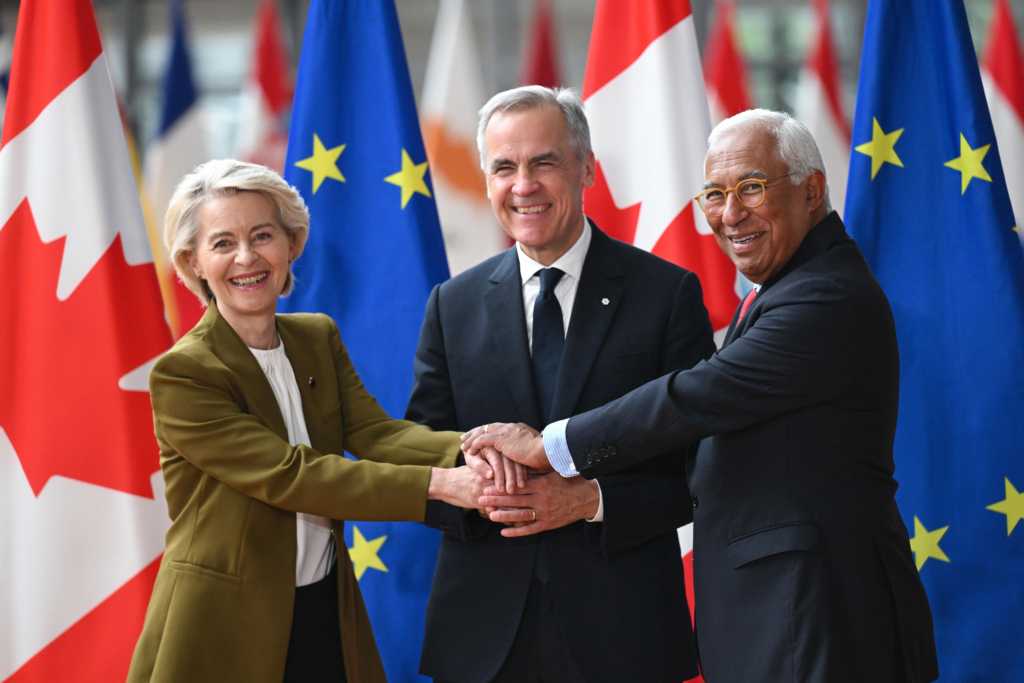
European leaders losing sleep over Trump’s economic and territorial threats should spare a thought for their Canadian counterparts. On August 22nd, Canadian prime minister Mark Carney announced that his country was “at war” with the United States after trade negotiations collapsed at the eleventh hour. Trump’s subsequent renaming of Lake Ontario to Lake America echoed the crisis with Greenland in January, when the US called into question Denmark’s sovereignty over the territory and refused to rule out taking it by military force.
Both the EU and Canada, in other words, face a similar conundrum: how to de-risk their relationship with an increasingly predatory United States, which exposes them to security threats from Russia and poses a new threat of its own. It is against this backdrop that Carney will attend commission president Ursula von der Leyen’s State of the European Union Speech in Strasbourg on September 16th. An EU-Canada summit will follow in October. The timing could scarcely be better for Europe and Canada to make common cause. But if European leaders want to shift the relationship into a new gear, they will have to revise their usual approach to how the EU treats third countries, particularly in defence and security, where both sides’ dependence on the US runs deepest.
Blurring the lines
Some Canadians, traumatised by Trump’s bullying, have fantasised about joining the EU. Alas, Article 49 of the Treaty on European Union—its accession clause—restricts membership of the bloc to European states. But the EU need not choose between full membership and arm’s-length third-country status. A strict in-or-out model of security and defence co-operation risks excluding partners like Ukraine, Britain, Norway and Canada from key initiatives and the bloc’s defence technological and industrial base—leaving Europe less safe as a result.
The EU already treats one non-member as something more than an ordinary third country or even one on the path to membership: Ukraine has received notable carve-outs for the European Defence Industry Programme (EDIP) and the EU’s Security Action for Europe (SAFE) mechanism, which offers €150bn in low-interest defence loans—not to mention exemptions in other areas like trade, energy, and telecommunications. In other words, the question is not whether bending the rules is permissible under certain circumstances, but what those circumstances are. Extending the same treatment to Canada (as inoffensive an ally as they come) would be popular at home and would offer a template for how other relationships, including with Britain, could be structured.
There is already a clear trend towards a closer relationship between Brussels and Ottawa, especially on the defence industrial side. In 2021, Canada joined the military mobility project of the EU’s framework for deeper defence co-operation, PESCO. Last year, both sides signed a security and defence partnership and this year they agreed to Canada’s participation in SAFE.
On the bilateral front, Berlin and Ottawa are finalising a strategic partnership agreement which will include elements on defence cooperation, on top of agreements already signed with France, Denmark, and other Nordics. On the procurement side, German shipbuilder ThyssenKrupp Marine Systems won a contest to build 12 submarines for the Royal Canadian Navy—the biggest defence deal in Canadian history. Canada is also considering buying Swedish Gripen fighter jets instead of American F-35s and is building ice-breakers in Helsinki. Finally, Canada is actively involved in deterring Russia with boots on the ground in Latvia, where it leads a multinational brigade as part of NATO’s Enhanced Forward Presence (eFP).
But these efforts are mostly non-binding and aspirational—except for SAFE (which is time-limited) and eFP (which sits outside of EU structures entirely). The EU-Canada summit at the end of October gives Brussels and Ottawa a concrete opportunity to turn these efforts into specific investments, capabilities and operational co-operation.
Under the radar
Canada is an underrated military power. The 2% of its GDP that it currently spends on defence is already more than the 14 smallest EU defence budgets combined
The EU stands to gain more from a closer relationship than one might think. Canada is an underrated military power. The 2% of its GDP that it currently spends on defence is already more than the 14 smallest EU defence budgets combined. Compared to the EU’s biggest defence spenders, it ranks behind only Germany, France, Italy and Poland. And its budget is set to increase significantly as Canada moves to spend 4% by 2030 and C$500bn (€310bn) over the next decade.
Much of that money will be invested in equipment and suppliers outside of Canada. As Carney made clear in a recent speech: “The days of our military sending 70 cents of every dollar to the United States are over.” EU defence projects should open up to countries outside the EU and the European Economic Area. Canada’s armed forces bring significant know-how in Arctic warfare, an area of increasing interest to Europe amid growing threats from both Russia and the US. And its six decades within the joint US-Canadian air-defence command, NORAD, give it rare experience of continental-scale air defence and early warning, just as Europeans scramble to expand their own independent missile-defence network.
Deeper cooperation
The EU can use these resources and capabilities to deter Russia and wean itself off its dependence on America, starting with deeper Canadian co-operation with the EU’s defence projects and agencies. A first step would be encouraging Canada to join further PESCO projects. Canada’s expertise could be of great help in ACCESS, which aims to develop Arctic-capable, GPS-denied electronic warfare and sensor systems, and TWISTER’s space-based early warning strand. Canada could join both without too much red tape (for EU standards) because neither project is supported by the European Defence Agency (EDA). A second step would be an administrative arrangement between Canada and EDA, which would allow Canada to join EDA-supported PESCO projects it is currently ineligible for, as well as joint training, monitoring and research. Since the US already has such an arrangement, extending it to Canada should prove uncontroversial.
But the most ambitious step the EU could take would be to treat Canada as a full-fledged member of the EU’s defence technological and industrial base instead of as a third country. Member states and the commission should write Canada into EDIP’s successor, the ring-fenced defence-spending stream—or “window”—of the upcoming European Competitiveness Fund (ECF), which is currently being negotiated as part of the EU’s next budget.
As it stands, current EDIP rules will likely roll over into the ECF unchanged. Under those rules, a system built in Europe carrying 35% American components would qualify for funding, but a wholly Canadian one would not. When EDIP was being negotiated, members states deliberately created a carve-out for Ukraine. Member states should extend the same preferential terms to Canada under the ECF, but also go further, letting Canada run programmes as well as bid for them.
These would be major concessions and they must not be given away for free. The expectation should be that Canada pay for access, open its own procurement to European firms in return, and align its export controls with the EU’s. As a proof-of-concept, both sides could design at least one major system with no US export-controlled parts in it (a counter-drone system would work very well).
In addition to these efforts, Berlin and Paris should also throw their weight behind Canada’s proposal for a Defence Security and Resilience Bank. They might even propose merging it with Britain’s proposed Multilateral Defence Mechanism to create a coalition spanning Britain, Canada and EU member states.
Skin in the game
As the EU’s borders come under pressure from multiple directions, there is a strong case for expanding Canada’s stake in European territorial integrity. That begins by establishing reciprocity. Europeans shouldn’t scoff at Canadian concerns—just as Denmark flew blood bags to Greenland in anticipation of a US invasion in January, so too have the Canadian Armed Forces modelled a possible US military invasion.
European countries should make it clear to Washington that its statements calling into question its ally’s sovereignty are intolerable. They should also prevail upon Canada to unequivocally pick sides should the US raise the Greenland issue again. In the event of a future military mission to Greenland, similar to the Danish-led Operation Arctic Endurance, or even a mission under the EU’s common security and defence policy, Copenhagen should invite Ottawa to join with boots on the ground, just as it has done in Latvia. Likewise, the EU could bind its anti-coercion instrument to equivalent Canadian countermeasures, ready for joint activation during a crisis.
Boosting Ottawa’s participation in Arctic issues would tie it more closely to the defence of the region more broadly and would give it a bigger role in defending European borders. After all, no serious conversation about the region is conceivable without Canada, whose Arctic territory is vastly larger than that of most other Arctic states. Canada is already part of the region’s multilateral infrastructure, but there is still scope to deepen its co-operation with the EU instruments specifically. One way to bridge the gap would be to take up the European Parliament’s proposal to create a dedicated EU-Canada Arctic cooperation framework with structured dialogues between EU and Canadian institutions.
An additional step which would contribute decisively to European security would be to invite Canada to the Joint Expeditionary Force (JEF), the UK-led coalition of northern European states. Canadian forces have already taken part in JEF exercises in Latvia last year and Carney has participated in virtual meetings of the group. Formally joining JEF, which sits outside NATO and EU structures, would involve little red tape and could happen almost immediately. As the US considers far-reaching troop reductions in Europe, any step that improves interoperability among non-US NATO allies is a win for the entire continent.
A price worth paying
The steps outlined above are likely to draw America’s ire and invite retaliation. The US has repeatedly cast scorn on Carney’s middle powers strategy—an effort to rally mid-sized states against pressure from larger ones—which it increasingly views as a serious challenge to its primacy. Under-secretary of war for policy Elbridge Colby recently suspended the Permanent Joint Board on Defence, a longstanding US-Canadian strategic consultative body, and linked the pause to Canada’s weak defence spending and its middle powers strategy. Both the EU and Canada should expect increasing pushback if they embark on this joint course. But any American paroxysm will prove the point—that both Europe and Canada are better off together than alone or in thrall to Washington. If that means blurring the boundaries between EU member states and third countries, so be it.
To find out what “Europe” means to people today, ECFR commissioned almost 6,000 interviews in six European countries and qualitative desk research across 15 more.
The interviews reveal that most people have strong opinions about Europe and its future; the complementary research found that geopolitical chaos and culture wars are helping the EU become more politicised in domestic debates.
How people feel about Europe may thus affect how they vote in the potentially seismic domestic elections to come, in many of which the far right leads in the polls.
The interviews also found many people want a stronger, more independent and more united Europe. But relatively few can picture a credible route from today’s disruptions to that destination.
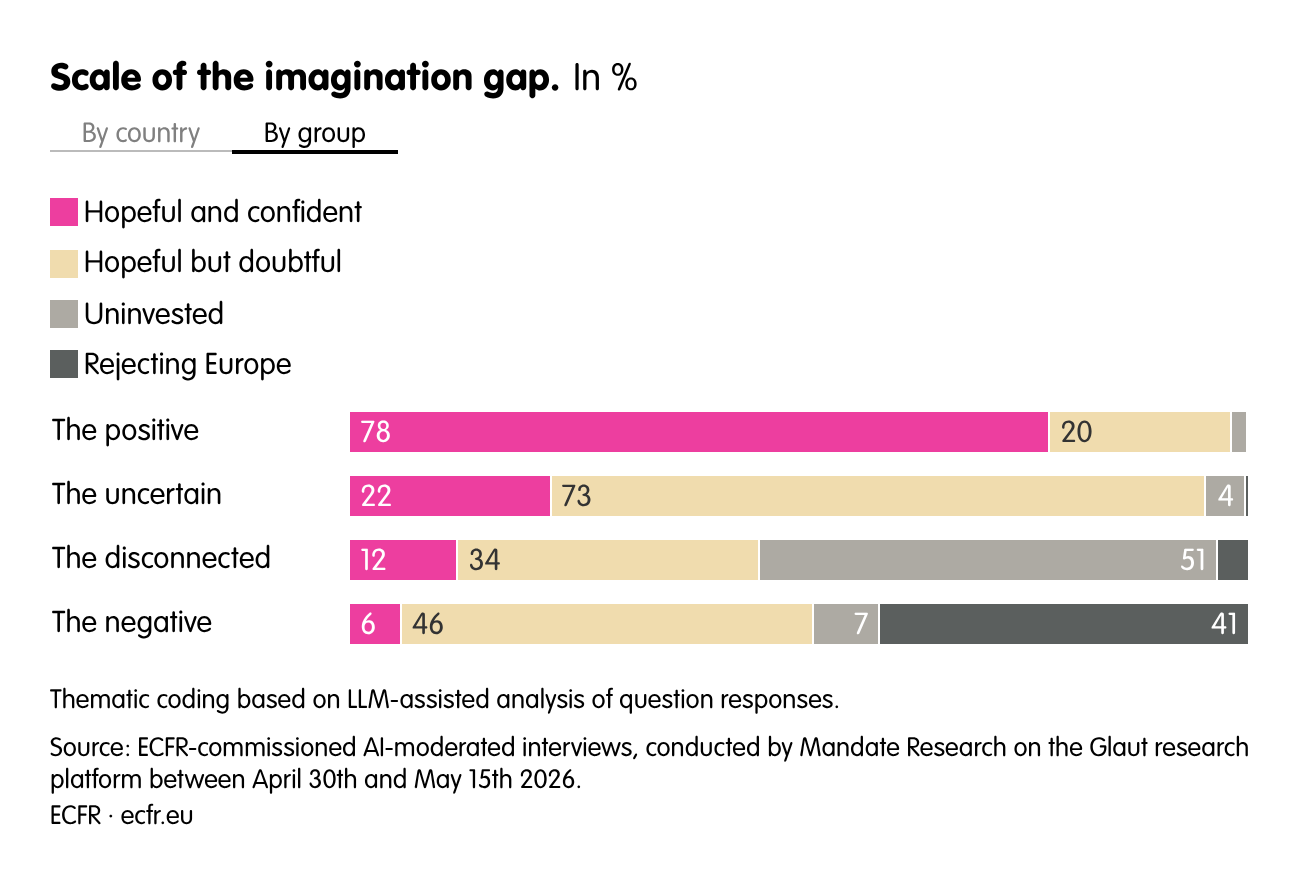
This imagination gap is most prevalent among a pivotal constituency we call “the uncertain”. Pro-European leaders need to fill it, lest people become more receptive to politics that reinterpret the past as the future.
These leaders can do so by harnessing the power of “future nostalgia”, or a longing for a time when a better future seemed within reach.
For decades, Europe had quite a successful record. Its countries grew accustomed to living under America’s protection, trading freely with one another, and enjoying peace and prosperity at home. Borders opened and the EU expanded. Europe came to think of itself as one of the world’s economic and political centres of gravity—or even a model for others to follow.
But then, one by one, the cosy assumptions on which Europe had built its post-cold-war existence began to fall apart. It was time for Europe to change its tune. As European Commission president Ursula von der Leyen put it, there was “no time or room for nostalgia… this must be Europe’s independence moment”. Leaders across the continent offered variations on the same theme: Europe must become stronger, more united and more independent.
As the months passed, parts of the public saw Europe moving in that direction. But many others concluded different things from the same events. For some, the disruptions had exposed a system that had long been dysfunctional and captured by elites. Others hesitated, realising that the danger could finally stir Europe from its slumber but that it could also expose divisions impossible to overcome. And then there were some like the Frenchman quoted at the start of this section who just did not care: Europe was and always had been a background hum that barely registered in their lives.
This paper shows that people with views like his are in a minority. “Europe” may not be the most important issue in people’s lives, but it is something a lot of them care about. How people feel about Europe may thus affect how they vote at home and contribute to how much say the far right has in shaping the future of the continent.
The paper draws on 5,834 AI-moderated interviews with European citizens conducted in May and June 2026 in Britain, France, Germany, Italy, the Netherlands and Poland. These capture how ordinary people, in their own words, imagine Europe’s future. They also provide (after weighting) a nationally representative picture of how people’s views are distributed. The interviews are complemented by comparative desk research on public and political debates in 15 EU member states. This examined how Europe and the EU are discussed across national political and media environments.
The main finding of the research is that many Europeans have an “imagination gap”. A lot of the people interviewed—especially among a substantial group we call the “uncertain”—want a stronger, more integrated and more independent Europe. But they often struggle to picture a credible route from today’s disruptions to that destination. The complementary research finds this gap exists at a time when Europe and the EU are becoming more salient in the public debate, and more politicised.
The people we spoke to are hardly alone in their pessimism. ECFR’s 2025 polling revealed Europeans to be notably gloomy about the future of their countries and the world, and that Americans and Turks shared similar sentiments. But pessimism comes with a unique political risk in Europe. Americans who lose faith in the future cannot realistically demand that the US be dismantled. Yet Europeans who lose confidence in the EU can plausibly ask for “less Europe” or even their country’s exit. And European integration has always depended on a future-facing promise: the idea of an “ever closer union” asks people to believe in both what Europe is and what it might become.
So, the imagination gap could help explain why nostalgic politics has become attractive to some voters in Europe. When people struggle to imagine a believable tomorrow, they become more receptive to visions that reinterpret the past as the future. But pro-European leaders should aim to harness a different kind of nostalgia—a “future nostalgia”, to borrow Dua Lipa’s 2020 album title, or a longing for the sense that a better future was within reach. They may need to hurry. As Europe braces for national elections in several influential countries, some with the far right leading in the polls, pro-Europeans need to help ensure a recognisable Europe exists to defend in the years ahead.
Each interview begins with an icebreaker question: “Let’s imagine you have a friend who fell asleep five years ago and has just woken up. This friend asks you: ‘How is Europe doing at the moment?’ How would you describe Europe today—what would you tell them?” In their answers, by far the largest group of respondents (on average 68% across the six countries studied) talks about a general deterioration or loss of normality. Only 12% see opportunity in the crises confronting the continent and frame their responses in terms of Europe’s awakening or renewal.
Respondents speak of Europe’s awakening most often in Poland (21%). This is the most recent one of the six countries studied to join the EU and is closest to the Ukrainian war zone. According to one Pole, born in the 1980s, “Europe is doing reasonably well. It’s trying to strengthen itself and be more independent from the USA.”Read the extended quote from A European from Poland, born in the 1980s03 Or, to quote an older respondent in Germany, where just 13% of people raise these themes, “Crises make you stronger, and I think that applies to Europe as well. Investment in defence is increasing again. The crises have revealed the weak points, and we can start working on them.”Read the extended quote from A European from Germany, born in the 1960s04 Such voices of encouragement are particularly sparse in France, where a mere 5% of respondents describe today’s Europe in terms of awakening or renewal. This is despite a decade of calls for “strategic autonomy” from President Emmanuel Macron.
When it comes to naming Europe’s challenges, people most often talk about war and security, followed by economic pressures. But almost three-quarters of the people interviewed say Europe is coping badly with its greatest challenges. For this, they blame national governments twice as often as European institutions and EU leaders. According to a French respondent, born in the 1960s, “Leaders of the countries do what suits their own country; they don’t see unity and don’t want it.”Read the extended quote from A European from France, born in the 1960s05
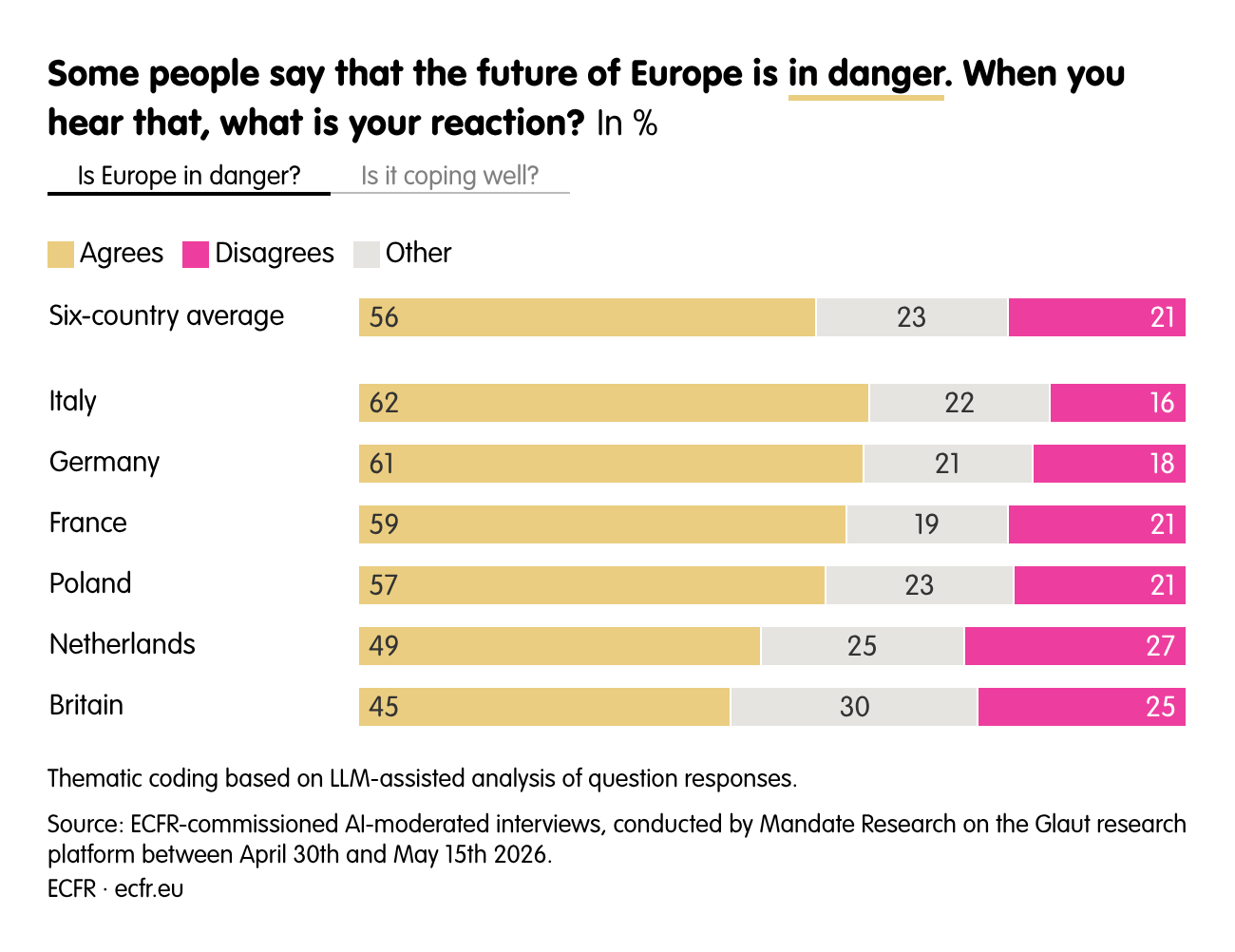
Turning to where things are heading, the AI asks: “Some people say that Europe’s future is in danger. How do you react when you hear that?” In response to this, on average 56% agree, against only 21% who disagree.
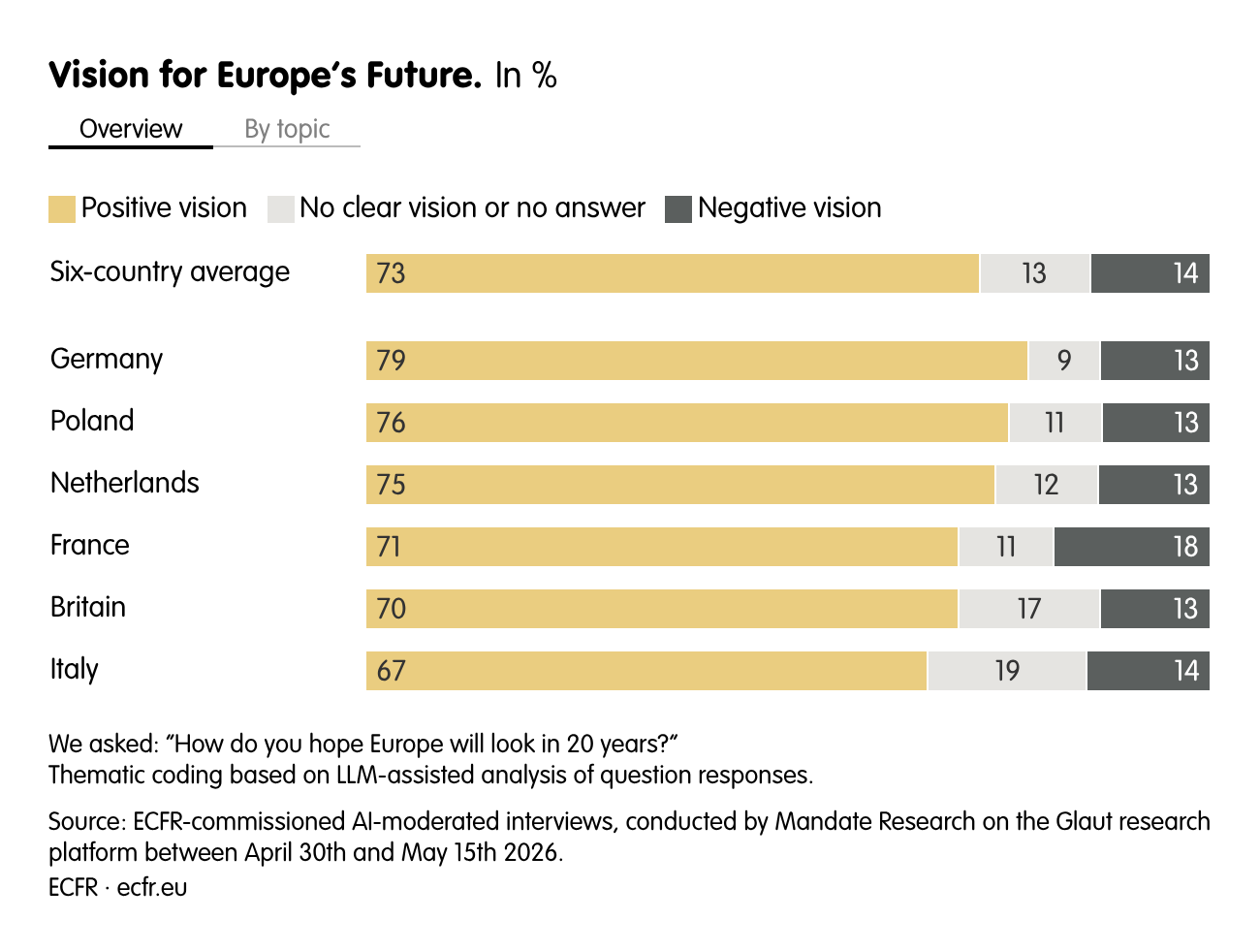
Still, many of the people interviewed identify strongly with Europe and want it to flourish. When asked what they would like Europe to look like in 20 years, three-quarters describe a positive European vision. They most often talk about unity and political integration, peace and security, and prosperity and well-being. Only around 13% hope for “less Europe” or for the EU’s dissolution.
But big dreams about Europe often come with big doubts. As one German, born in the 1990s, says: “I’m regularly relieved that I live in Europe. It’s not perfect and some things are going in the wrong direction at the moment, but no region in the world is safer, freer and more democratic.” He sees “climate catastrophe and attacks on democracy from the far right” as the greatest challenges facing Europe today—but does not think Europe is handling them very well. Asked about the reasons for this, he replies: “Elections focus too much on the here and now and not enough on the future.” Thinking about Europe in 20 years, he would like it to be “free, democratic, sustainable, less indebted, politically further to the left [and] peaceful”. But, on whether this is likely to happen, his response is a brusque: “No”Read the extended quote from A European from Germany, born in the 1990s06.
Across the countries covered by our interviews, many conversations followed a similar pattern. People appreciate Europe, but they recognise the challenges it faces and express little faith in its collective capacity to deal with them. Even when respondents have big ambitions for Europe, they often talk about them as mere aspirations that are unlikely to become reality.
So, it may no longer be enough to distinguish only between pro-European and Eurosceptic voters. Another important divide is whether people believe European leaders (EU and national alike) can turn their hopes into reality.
Four tunes
And how would you like Europe to look in 20 years’ time?
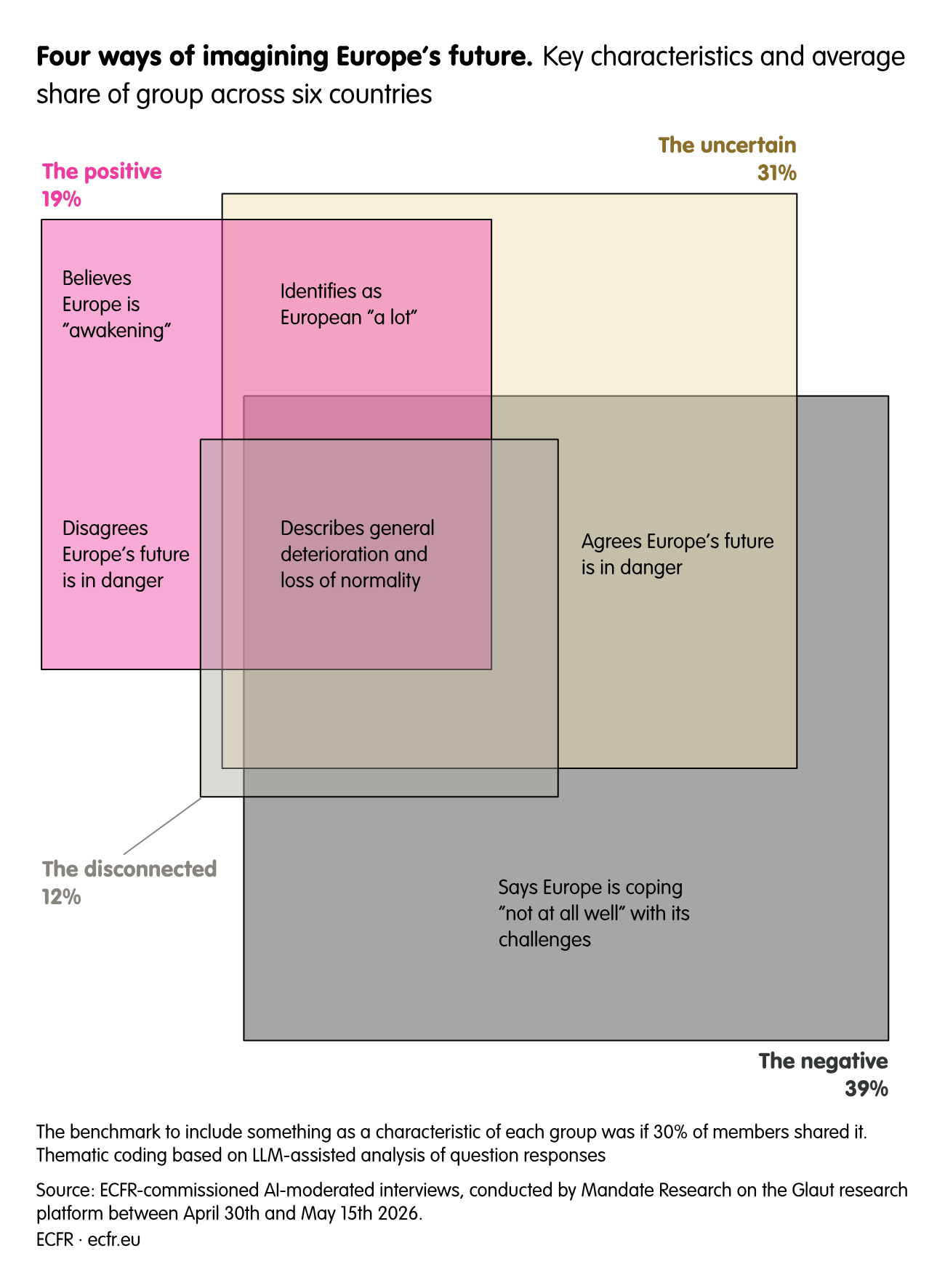
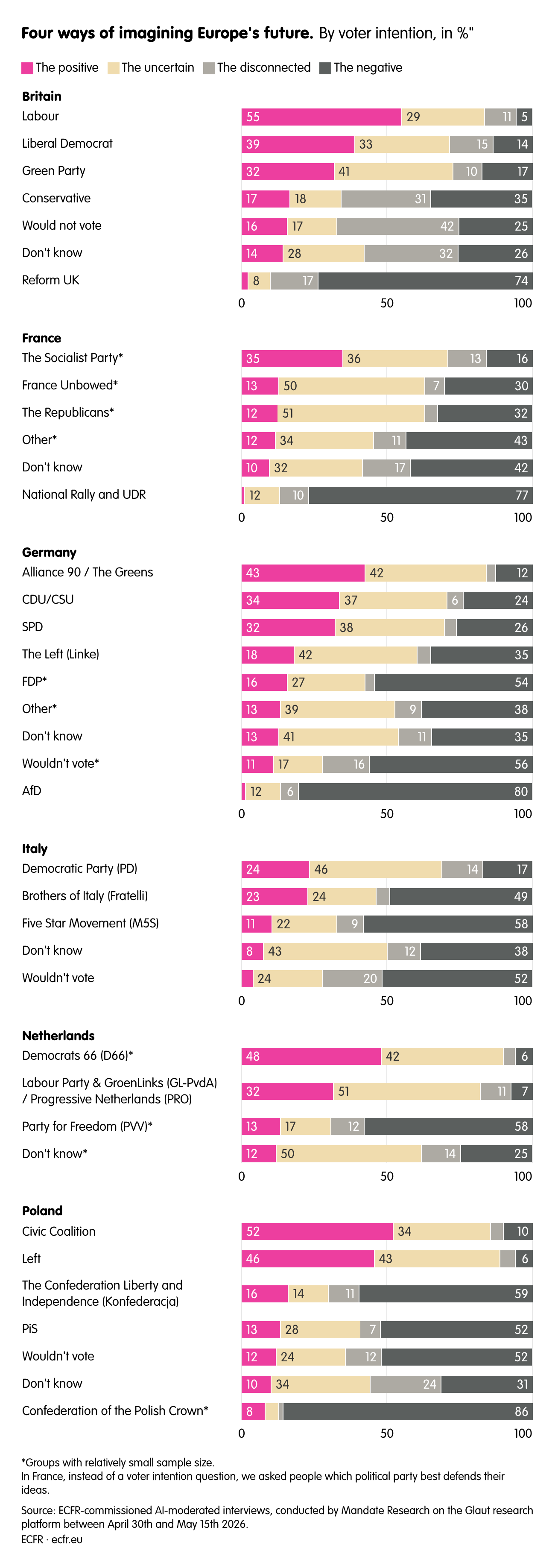
Most of the people interviewed express strong opinions about Europe’s future. And they tend to imagine that future in one of four ways.
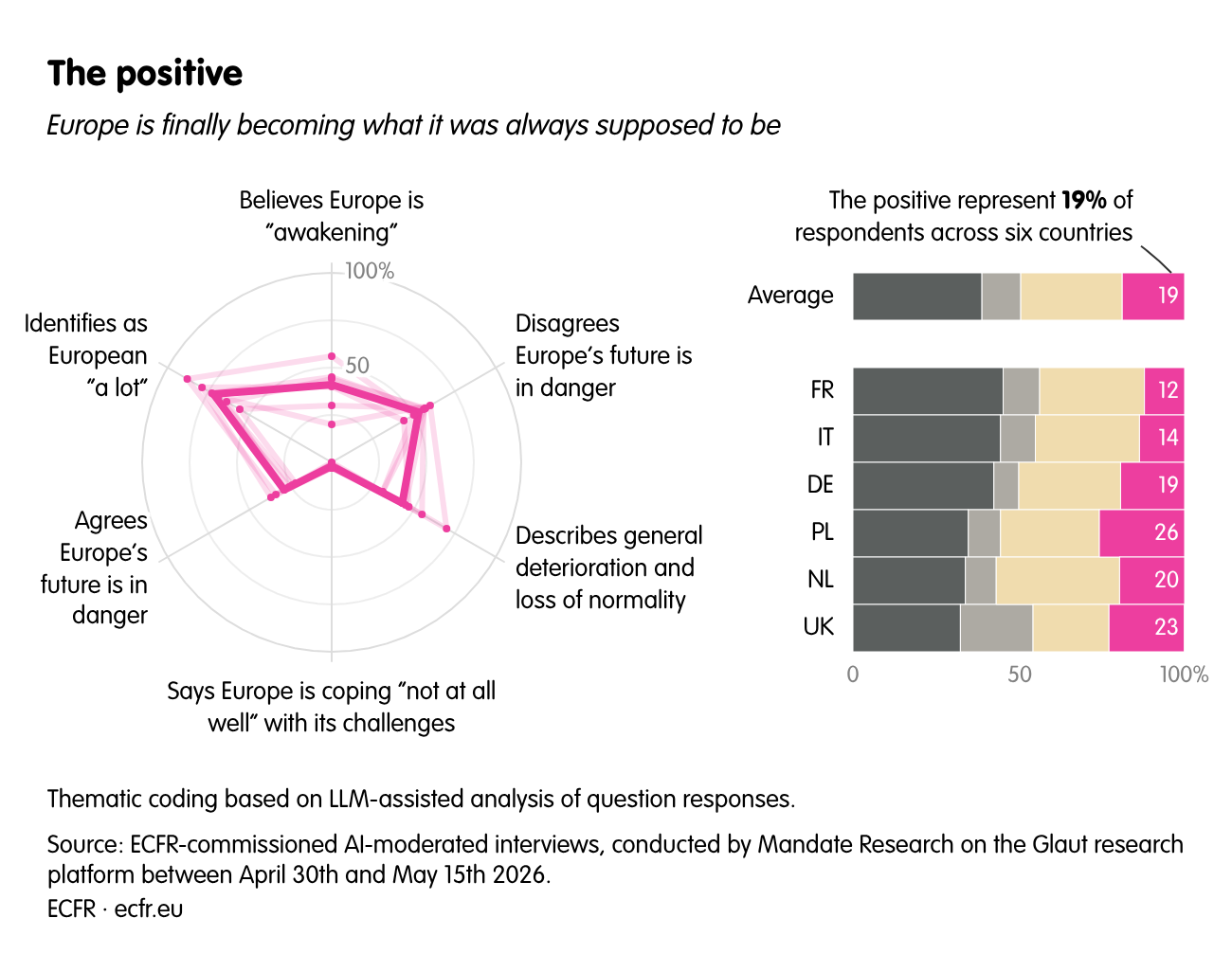
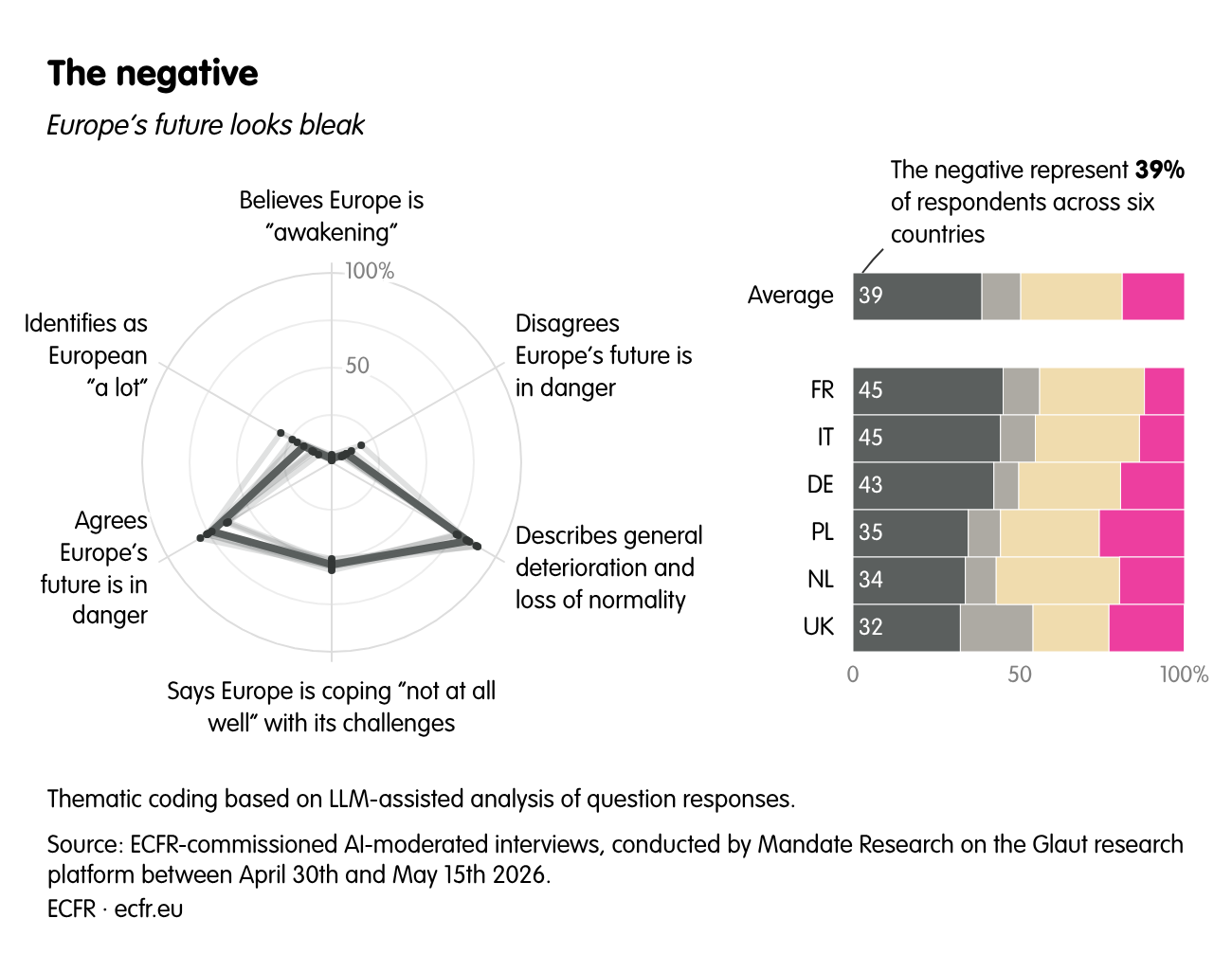
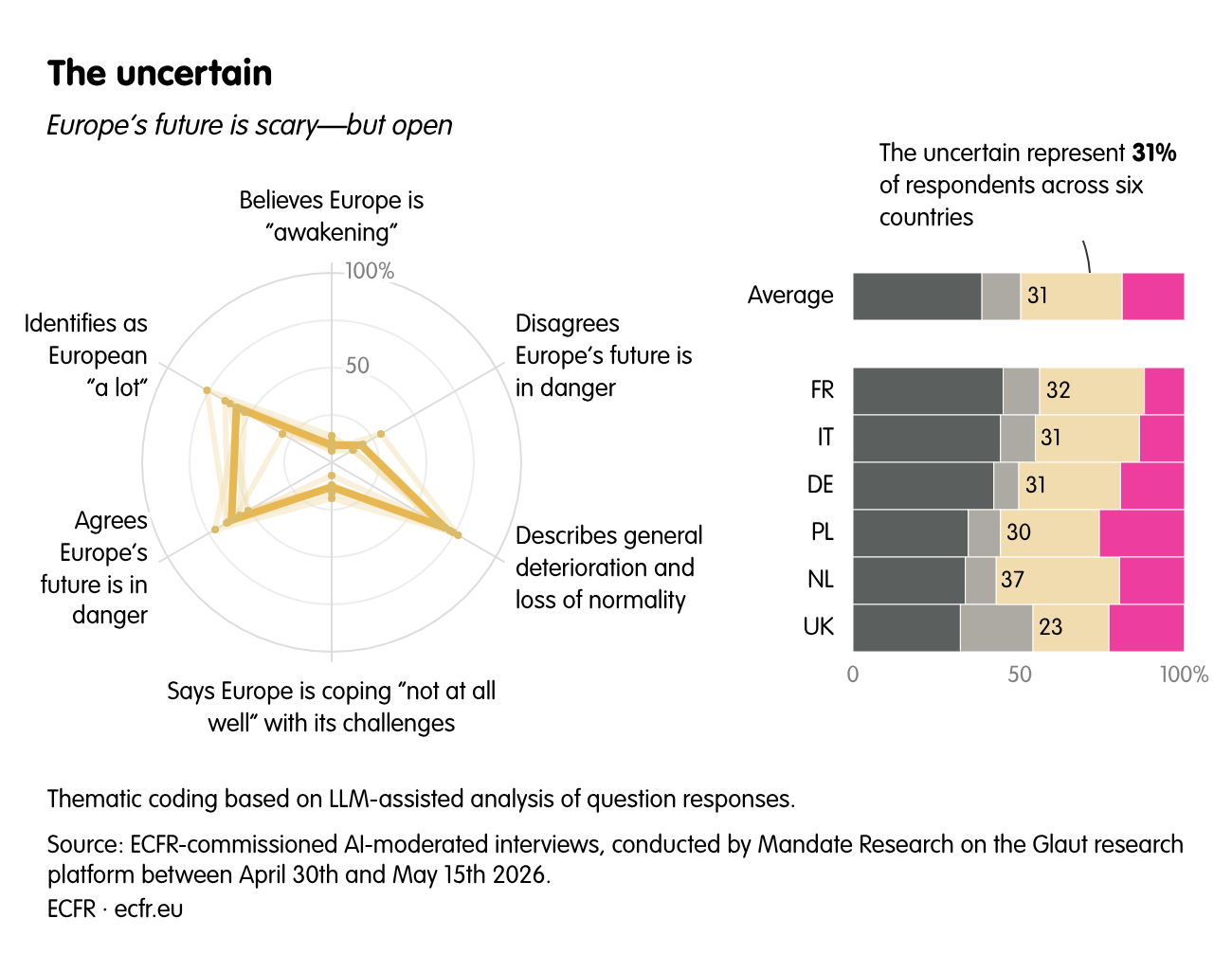
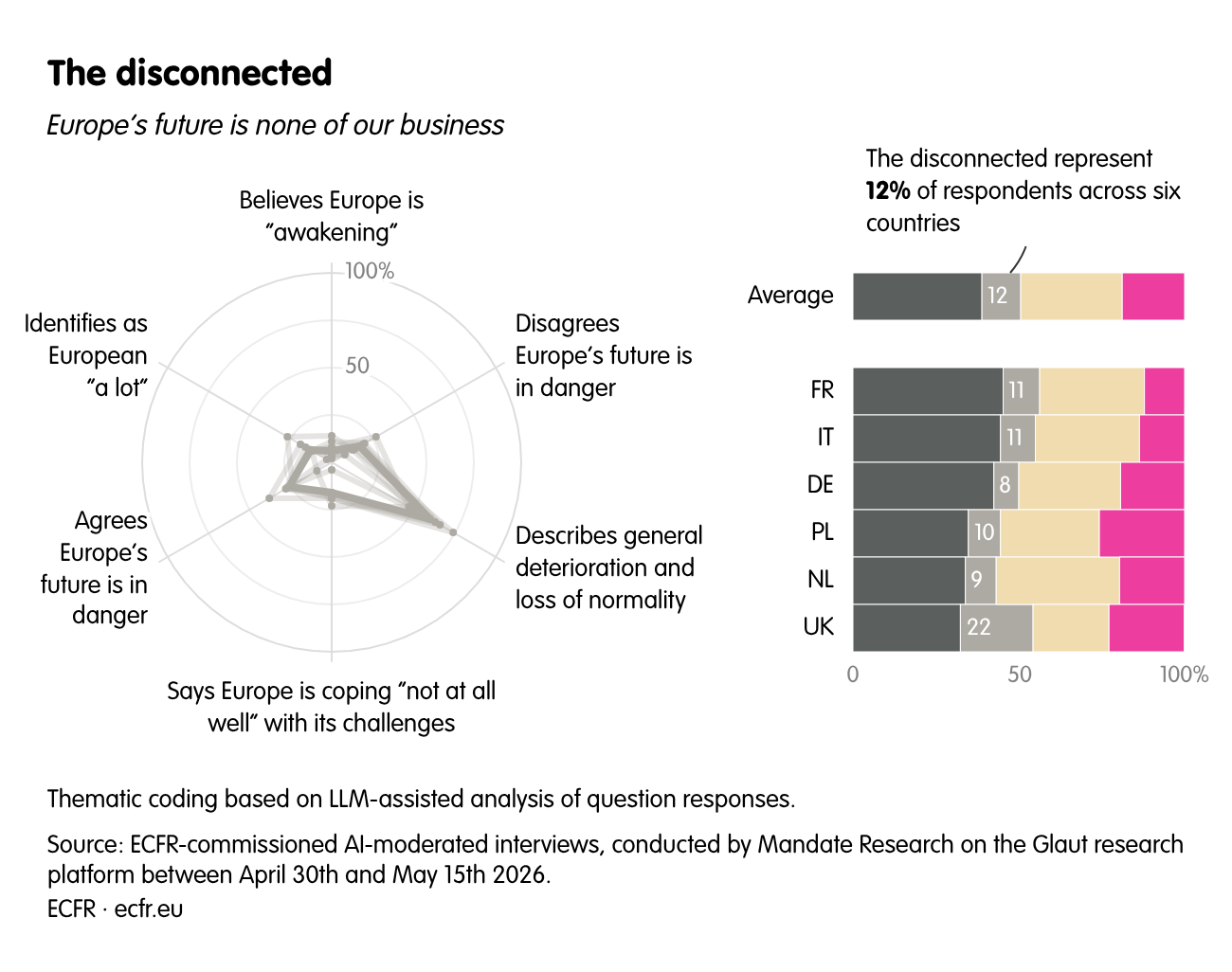
The positive hear an anthem of renewal: today’s disruptions are finally forcing Europe to become stronger and more united. The negative hear a ballad of decline, with each new crisis confirming the continent’s best days are behind it. For the uncertain, the melody of a better Europe is recognisable, but the song is not finished—and they are not convinced it ever will be. Very few people belong to the disconnected, for whom Europe is just a background hum coming from too far away to command much attention.
The tunes vary by country. But the four basic themes recur across borders, genders and generations.
The present: The positive identify strongly as European, and two-fifths of them describe the EU’s situation today in terms of awakening. They are well represented in the electorates of EU-enthusiastic parties like the centrist Civic Coalition in Poland, Liberal Democrats in Britain and D66 in the Netherlands, as well as left-leaning EU-fans like the German Greens and the UK’s Labour Party.
Many of this group see the disruptions of the present as giving the EU the shock it perhaps always needed for its leaders to push for greater European integration and autonomy. One Dutch D66 voter, born in the 1980s, describes this as “a sense of urgency, the realisation that we must stand up for ourselves”. He stresses “a shared awareness from the population”Read the extended quote from A European from the Netherlands, born in the 1980s10 as contributing most to this.
The future: This is not to say the positive think it will be easy. They recognise that to overcome Europe’s problems, political will and institutional reform will be necessary. Many of this group also think the EU will have to address the national vetoes that hinder collective action.
It is common among the positive to worry about the rise of the far right, but they still tend to believe change is possible precisely because the alternative has become so visible: a fragmented Europe, dependent on others and unable to defend itself or its interests. “Five years ago, I think there was more of an illusion of stability,” says one Italian, born in the 1990s, but “today many things are more explicit … so I’d say [Europe has become] more unstable but more honest compared to before.”Read the extended quote from A European from Italy, born in the 1990s11
Still, most of the positive disagree with the idea that Europe’s future is in danger. “It’s a very serious crisis, but I think that with wise policymaking [the danger] can be avoided,”Read the extended quote from A European from Poland, born in 1990s12 says a Civic Coalition voter in Poland. Members of this group want Europe to show leadership and assertiveness internationally. And in 20 years, most of them hope to see a more united and better integrated Europe. They also tend to believe such a future is achievable.
In the world of the positive, the EU does not need to take a fundamentally different direction; rather, it needs to become what it was always meant to be. “We have it in our hands,” says a Dutch D66 voter, born in the 1980s, who has “doubts about the pace, not the direction”Read the extended quote from A European from the Netherlands, born in the 1980s13.
The negative
At the other end of the spectrum sit the negative. This is the largest group in every country studied, except the Netherlands, and is home to almost half of respondents in France, Italy and Germany. The negative hold a near-hegemonic position in the electorates of the far-right Alternative for Germany (AfD), National Rally (RN) in France and Reform UK. They are also strongly present on the Polish right and far right, among Party for Freedom (PVV) voters in the Netherlands, and in the electorate of the progressive populist Five Star Movement in Italy. They are well represented among non-voters in Italy, Germany and Poland, too.
The present: The negative stand out in their strong criticism of today’s Europe, which is characterised by a notable anti-elitist and anti-migrant streak. One Italian, born in the 1980s, describes Europe as: “A community run by people who have only thought about their own well-being until now; they’ve ruined our lives with surreal green ideologies, financing unjust wars, opening up to immigration that is destroying European identity and that of member states. [They are] unprepared on the military front [and] divided as peoples both in terms of collective thinking and economically.”Read the extended quote from A European from Italy, born in the 1980s14
Such pessimism is not always rooted in opposition to European cooperation. Many of the negative instead rail against what they consider the EU’s over-reach: “The EU is pushing itself literally everywhere, even into areas where it was never granted any competencies,”Read the extended quote from A European from Poland, born in 1980s15 says one Pole, born in the 1980s, who votes for the radical-right Konfederacja. It is common for people in this group to describe politicians as self-interested, captured by lobbies or too removed from ordinary life to be able to do the right thing. Negatives tend to interpret the crises piling up—and this group cites migration and inflation above all—as symptoms of deeper decay: “I feel sad for what once was a great place,”Read the extended quote from A European from the UK, born in the 1960s16 says a Reform UK voter, born in the 1960s.
The future: For most of the negative, Europe’s future looks bleak. But variation exists in how they feel about this. One Pole, who was born in the 1980s and votes for the nationalist Law and Justice party (PiS), agrees Europe’s future is in danger and is “pleased about it.”Read the extended quote from A European from Poland, born in 1980s17 Her Italian peer, who votes for the ruling Brothers of Italy party, expresses fear and anxiety: “I am afraid,” she says, before adding, “of war.”Read the extended quote from A European from Italy, born in the 1980s18 Asked about her hopes for Europe in 20 years, she mulls whether the EU will still exist. Other negatives actively want the EU to be whittled down or dismantled altogether. As they see it, less or no Europe would restore national sovereignty and give citizens a more direct say in how they are governed. Some of them want to recover what they feel they have lost: “We lived much better when the European Union didn’t exist,”Read the extended quote from A European from France, born in the 1950s19 says an RN voter in France, born in the 1950s.
The uncertain
Somewhere between the negative and the positive dwell the uncertain. This group accounts for around a third of the public in most of the countries studied (but only around a quarter in Britain). They are common among the electorates of left-wing parties in all six countries, though they also feature prominently among voters of the ruling centre-right parties in Germany, the Netherlands and Poland.
The present: More than half of the uncertain identify strongly as European. Yet they rarely describe Europe today in terms of “awakening” and often bring up themes of decay and loss of normality. “Europe is doing badly, the different countries are not united, and we are facing a war on our doorstep,”Read the extended quote from A European from France, born in the 1960s20 says a French respondent born in the 1960s, who votes for Macron’s Renaissance party.
People in this group often see the case for optimism and pessimism alike. They recognise that the EU has made it through crises before and that the threats of today are producing solidarity. They tend to see support for Ukraine, developments in defence cooperation and the gradual reduction of dependence on the US as indicators that something is shifting for the better.
But political will appears fragile to the uncertain. They worry that nationalist and far-right forces could unravel European cooperation and that a gulf exists between European leaders’ words and their deeds. According to a Polish progressive, born in the 1990s, the EU suffers from a “lack of a common direction, disagreement amongst member states, poor ideas being implemented by force.”Read the extended quote from A European from Poland, born in 1990s21 Another Pole points to “lack of imagination among politicians, the habit that Europe doesn’t need to take responsibility for itself because someone will always save us.”Read the extended quote from A European from Poland, born in 1980s22
The future: When the uncertain think about the future, they worry. Most of them believe Europe’s future is in danger and what becomes of the EU will depend on choices that leaders have not yet made. Like the positive, most uncertain want Europe to become more united and integrated—but they are much less confident that it will.
The disconnected account for only around a tenth of the public in most countries studied, except in Britain, where (perhaps reflecting the country’s non-EU status and the legacy of Brexit) their share rises to 22%. They feature in the electorates of every party but almost never constitute more than 15%. The only exception is the UK’s Conservative Party, in which they account for almost a third.
The present: This group sees Europe’s future as largely not their business because they do not experience it as central to their lives (and this often extends to politics in general). “I don’t ask myself all these political questions,”Read the extended quote from A European from France, born in the 1990s26 says a French respondent, born in the 1990s. Asked to describe today’s Europe to a friend who had just woken from a five-year sleep, a Pole born in the 1980s replies: “Mate. You’ve only just woken up and that’s the first question you’re asking?”Read the extended quote from A European from Poland, born in 1980s27 A Dutch respondent, born in the 1990s, is more direct still: “I just live my life the way I want, and Europe or whatever doesn’t interest me.”Read the extended quote from A European from the Netherlands, born in the 1990s28 Their responses to questions concerning Europe tend to be brief and evasive—don’t know, no idea, don’t care.
The future: When asked what they want Europe to look like in 20 years, the disconnected tend to reach for similar answers: more or less the same, no idea, it doesn’t matter. They are animated neither by fear of European collapse nor by hope for European renewal (although many still describe today’s Europe in terms of deterioration or a loss of normality). For the disconnected, the EU is largely a background institution. It occasionally affects prices and makes rules but otherwise feels remote from everyday life and domestic concerns. This group is unlikely to have much say in Europe’s political direction.
***
That role as a pivotal constituency belongs to the uncertain. This is not to say they are the only ones suffering from an imagination gap. Three-quarters of them are, but so are almost half of the negative and a third of the disconnected. Overall, about half of the European public seem to have an imagination gap. Poland is the exception: only around a third show symptoms there.
What makes the uncertain so pivotal, apart from the group’s size, is that they have not decided where things will end up. This distinguishes them from the positive, for whom Europe is already succeeding; the negative, many of whom have concluded that it cannot; and the disconnected, who just aren’t that bothered. Pro-European leaders will therefore need to focus their attention on filling the imagination gap among the uncertain, particularly given the growing salience and contestation of the EU in the public debate.
The dominance of strong opinions about Europe—positive, negative and uncertain—in the interviews aligns with our complementary research across 15 countries. That research suggests “Europe” has become more prominent in the public debate and thus more politically salient. This is corroborated by findings from other research that points to growing identification with Europe throughout the crises.
Three overlapping dynamics seem to be driving these developments.
First, foreign policy upheavals mean geopolitical questions of European power and vulnerability have landed squarely on people’s kitchen tables. Should we prepare for war? Can our countries defend themselves alone? If not, whom should they consider as their key allies—Americans or other Europeans? And is the EU, conceived as a peace project, still fit for purpose in times of “unpeace”?
Second, the EU is becoming “domesticated”. This is because the bloc’s policymaking increasingly reaches into some of the most politically sensitive areas of people’s lives (migration, climate and the cost of living, for example). Some member states, like Greece and Cyprus, experienced this well before others. In their case, the euro-zone crisis led to a lasting slump in public trust towards the EU.
But now the EU is in the limelight almost everywhere, in part because of Brussels-led policy initiatives. These policy choices are testing people’s vague or instinctive pro-Europeanism against consequences they feel. Should the EU spend more on defence? Is it a good idea to ban plastic straws, or phase out diesel cars and fossil fuel boilers? Should all European countries have mandatory refugee quotas? Such decisions can nudge European citizens towards developing more concrete pro-European attitudes. But they can also make their views more conditional, critical or ambivalent.
Finally, some political actors are stoking the culture wars. As I argued in last year’s Sentiment Compass, “Europe” is a target in the Trumpist political project and those of like-minded forces on this side of the Atlantic. Some well-known social media moguls and platforms play an active and polarising role in this. European far-right politicians need not support Trump or advertise closeness to his administration to draw on a similar repertoire: Brussels is bureaucratic; Europe is weak; the mainstream is ideologically captured; European institutions are obstacles to national sovereignty and cultural authenticity. Such narratives contest what “Europe” is for. They also call into question whose values it represents and whether its institutions deserve citizens’ allegiance.
This is not to say greater salience always translates into less support for a stronger, more united Europe. It can also open up space for a more serious debate in which pro-Europeans can clarify and update the case for integration. Geopolitical insecurity, for example, can strengthen the perceived value of European cooperation in the eyes of the public, as a growing pro-Europeanism of Danes and Swedes suggests.
The politicisation gap
But greater salience can push people to start feeling anxious about Europe’s future. It also strengthens the temptation for political forces to convert the EU into one of the main political and electoral battlegrounds. This is especially the case on the far right. The AfD’s co-leader Alice Weidel, for example, has called for Germany to leave the euro zone and the Schengen area; President Karol Nawrocki in Poland attacks European “follies”. They and others, like RN leader Marine Le Pen, seem to have concluded that trolling the EU gives them a language through which they can explain who they are. Such figures also use it as shorthand for what they oppose and what future they offer.
Pro-European political leaders often struggle to respond with the same confidence. Some react with unconditional defence of the EU (for instance, the Dutch prime minister Rob Jetten and his Spanish counterpart Pedro Sánchez). But that can stop them addressing people’s anxieties about Europe. Other leaders, including Donald Tusk in Poland and Friedrich Merz in Germany, offer a trimmed pro-Europeanism instead (for example, by posing as “realist” on migration and climate). This might bring them closer to a median national voter, but it also risks making far-right views about Europe look more normal.
Leaders thus tend to preach to the positives or bow down to the negatives. Yet it is among Europe’s uncertain that belief in Europe’s future is up for grabs. If the uncertain’s anxieties remain unaddressed, they could veer away from pro-European parties or even detach from politics altogether. And if people choose not to vote or to vote for far-right or Eurosceptic parties in their national elections, the entire continent could move in a direction that renders it unrecognisable in 20 years’ time. This is not to mention that it could become more vulnerable to Russia and even Europe’s old friend across the Atlantic.
One example of how things could be done differently comes from Romania. Speaking on television on Europe Day, President Nicusor Dan offered a nuanced view. He accepted that Europe has made mistakes, but at the same time defended its capacity for self-correction. In a country that has become highly polarised, this may have been an instinctive appeal to Romania’s version of the uncertain.
Other pro-Europeans who take the uncertain seriously may also be able to come up with a better response. In their voting preferences and media habits, the uncertain resemble the positive much more than the negative. (For more evidence, see the bonus track at the end of this paper.) Yet, when asked about Europe’s future, they do not share the positives’ confidence. And if these voters already inhabit relatively pro-European political and media environments (and, as discussed, identify strongly with Europe), their doubts cannot be explained only by exposure to Eurosceptic parties, hostile media and culture wars. Something other than old-school pro-Europeanism might thus be necessary to make them believe in Europe again.
A European from the Netherlands, born in the 2000s
Three recurring concerns appear to be holding the uncertain back: they doubt whether Europe can act when it needs to; whether it can live up to the values it professes and command respect; and whether it can really keep Europeans safe.
European slowness
One of the most striking findings from the interviews was that, across the six countries, respondents often mention Europe’s “slowness” as one of its most frustrating characteristics. This theme comes up most often in the Netherlands and Germany (where Merz once criticised the EU’s “massive over-bureaucratisation of almost all parts of life”). Positive and negative respondents also mention slowness, but the uncertain talk about it even more than any other group.
Many of the uncertain focus on the pace of decision-making. One millennial German, who voted for the centre-right Christian Democrats (CDU/CSU) in 2025 but now prefers the SPD, complains that “the bureaucratic apparatus is far too large and cumbersome. It takes far too long for a decision to be made. Some issues need to be addressed quickly, but by the time everything has gone through all the levels and member states, it’s usually already too late.” Asked who is responsible, he blames both sides: “EU institutions are too bureaucratic and bloated, and the member states don’t want to give up any responsibility or authority whatsoever.”Read the extended quote from A European from Germany, born in the 1980s31
For others, the problem is more structural. As a young Pole, born in the 2000s and looking beyond the mainstream parties, puts it: “The EU fundamentally discusses a lot but does nothing.” He attributes this partly to “the culture of operation of the states with the greatest influence in the EU.”Read the extended quote from A European from Poland, born in 2000s32 A Bavarian, born in the 1970s, who voted CDU/CSU in 2025 but is considering switching parties, says: “Everything takes far too long. By the time Europe reaches agreements, years have passed or nothing happens because one EU country is against it.”Read the extended quote from A European from Germany, born in the 1970s33 Her solution is to replace unanimity with, for example, a three-quarters majority. Similarly, a Dutch respondent who used to vote for the centre-right People’s Party for Freedom and Democracy, born in the 1970s, complains about “Lengthy consultations [and] little or slow decision-making,”Read the extended quote from A European from the Netherlands, born in the 1970s34 blaming member states for this.
But something else emerges from these conversations besides familiar complaints about Brussels bureaucracy. In a faster-moving and more dangerous world, slowness becomes a measure of Europe’s (in)ability to act.
A German man, born in the 1960s, links cumbersome procedures to declining competitiveness: “If a simple approval procedure in Europe takes years and sometimes decades, nobody can compete with such an industry-friendly society as in the USA, China or India.”Read the extended quote from A European from Germany, born in the 1960s35 His compatriot, a Green voter born in the 1990s, goes further, describing Europe as being “in an odd in-between state between the old and a new world order”. Because of regulation and bureaucratic hurdles, she argues, Europe is “not really able to adapt quickly enough and is being massively overtaken technologically by Asia and the USA.”Read the extended quote from A European from Germany, born in 1990s36
So, slowness makes the future the uncertain want hard to believe in. If Europe aspires to become more sovereign and competitive, as several European leaders have promised, then the uncertain first need to see evidence that the EU can make decisions and implement them—and that it can react quickly enough to the fast-changing global environment. This might require the EU to eliminate national vetoes in some areas. Or smaller groups of countries could lead on some initiatives when unanimity between countries is impossible to reach. But whatever the actions, they need to challenge the overwhelming impression of Europe being unable to act. Otherwise, too many people will continue to have the same impression as a British Labour voter, born in the 1990s, according to whom Europe simply “feels slow”Read the extended quote from A European from the UK, born in the 1990s37.
European hypocrisy
The second chord of doubt relates to perceptions of Europe’s lack of integrity. This theme is most common among the negative, but the uncertain also raise it fairly often. It comes up regularly among uncertain supporters of more radical left-wing parties, like LFI in France, Die Linke in Germany, and the Green Party in Britain. Yet the negative and uncertain focus on different things. The negative tend to focus on the dishonesty and hypocrisy of the political class; the uncertain are more likely to point to moments when Europe disappointed them.
Complaints among the uncertain take two main forms: Europe failing to live by the values it professes, and Europe failing to stand its ground when confronted by more powerful actors.
On double standards: “First the silence. Then the hypocrisy”, says an LFI voter who was born in the 1990s. “Russia attacks Ukraine; Russia is the villain. Israel attacks Palestine, but they’re terrorists. It doesn’t make sense.”Read the extended quote from A European from France, born in the 1990s38
On a lack of courage, the EU’s tariff agreement with Donald Trump’s administration seems to have become a powerful symbol. A Die Linke voter in Germany, born in the 2000s, says he felt “terribly ashamed” when “von der Leyen just caved in to the US”. He found it “really embarrassing personally, that we capitulated so hard”. For him, the episode represented something larger: “Every time the EU capitulates, it shows … we don’t want to do anything and would rather cling to the old status quo.”Read the extended quote from A European from Germany, born in the 2000s39
The disappointment about the tariffs crosses political boundaries. A Renaissance voter in France, born in the 1950s, was similarly ashamed of the tariff agreement. She saw it as “Letting ourselves be led by the nose by a madman,”Read the extended quote from A European from France, born in the 1950s40 and used even stronger words to describe what she saw as von der Leyen’s submission to Trump.
Nor does the accusation come only from those who want Europe to confront America or Israel more forcefully. A German, born in the 1980s, who previously voted Green but has since shifted towards Die Linke, is disappointed by what she considers insufficient support for Ukraine. “The usual hypocrisy,” she says. “Words are easy to say—actually providing real help is another matter. It requires genuine action.”Read the extended quote from A European from Germany, born in the 1980s41
This is particularly damaging given European leaders’ rhetoric about sovereignty and independence. The uncertain observe a distance between the Europe they are told is entering its “independence moment” and the one they see backing down when confronted by a stronger power. This does not mean they reject compromises as such, given compromising is something all political actors need to do. But for many uncertain, giving in on values is a no-go. One German, born in the 2000s, was also ashamed of the tariff agreement with Trump but saw it as a demonstration of a broader pattern: “The EU no longer stands unreservedly behind its values. Everything becomes a compromise solution; no solution is confined to true values.”Read the extended quote from A European from Germany, born in the 2000s42
As the “Samples of hope” section will show, shared values come first when the uncertain are asked to explain what being European means for them. So, when leaders in Europe appear to be compromising on these values in their foreign policy, this not only tarnishes Europe’s image abroad but also comes with a political cost at home. The challenge for leaders is to show that people can still take seriously both the values Europe professes and the claims it makes about its own power.
European insecurity
The third chord of doubt is about people’s feelings of insecurity. Half of the uncertain describe war and security as Europe’s greatest challenge. The positive mention it just about as often, but they also tend to refer to the more strategic notion of “geopolitical autonomy” (which fewer of the uncertain do); the negative divide their attention more evenly between inflation, immigration and war.
The uncertain tend to connect insecurity to broader European vulnerabilities, such as dependence on America. They also talk about the EU’s internal divisions and the rise of the European far right. “The USA will increasingly withdraw and Europe must be able to defend itself,”Read the extended quote from A European from Germany, born in the 1980s43 says a German, born in the 1980s, who previously voted SPD and now leans Green. She links this to concerns about the possibility of the AfD entering government and the divisions this could create in the face of Russia. A progressive Dutch voter, born in 2000s, makes a similar connection: “I’m worried about poor cooperation and that Europe is therefore less resilient to external threats—for example Russia, but also the US which wants to portray Europe as weak.”Read the extended quote from A European from the Netherlands, born in the 2000s44
This is not far removed from the positive vision of a more autonomous Europe. The difference lies in the extent of the imagination gap. A Renaissance voter in France, born in the 1950s, describes “war on Europe’s doorstep” as a major problem. But thinking about Europe’s response makes her feel “Europe is doing what it can, but it doesn’t actually have the means.”Read the extended quote from A European from France, born in the 1950s45
Finally, one Italian Five Star Movement voter, born in the 1960s, connects insecurity back to Europe’s slowness. “The first [challenge] is certainly security because the war near our borders has changed the general atmosphere,” she says. But Europe is not tackling it well because “there is often a lack of speed and unity in decision-making.”Read the extended quote from A European from Italy, born in the 1960s46
***
The imagination gap among the uncertain thus comes from things they believe they can observe. They see decisions that take too long, aspirations that sound hollow and threats Europe may lack the means to confront. To close the gap, leaders will have to offer more than an attractive vision of the future. They will have to show people Europe can act, command respect and protect them.
Still, if everything were gloomy in the world of the uncertain, they would belong among the negative. Like the positive, though, they often invoke shared values and principles when explaining what being European means to them. When asked what they would like Europe to look like in 20 years, many hope for greater European unity and political integration. They can also usually identify moments when Europe made them proud.
All these can serve as potential “samples of hope” for pro-European leaders to reconnect with the uncertain. But two aspects appear politically the most crucial: their memories of when Europe made them proud and the type of leadership they admire.
Memory bank
Politicians need to be able to tap into people’s best memories about Europe. When asked about moments when they felt proud of Europe or of being European, the uncertain can usually reach into their own experience and find evidence of Europe behaving in ways they value. This suggests that their attachment to Europe does not come from aspiration alone.
The examples differ widely and reflect the varied national histories of the respondents. They also come from people’s diverse political outlooks and personal experiences—from witnessing the opening of borders to participating in the Erasmus programme of academic exchange.
More than 70 years since European integration began, people still recognise how remarkable the beginning of the story was (even if they were born decades later). As a young Pole, born in the 1990s, says, “Europe emerged from a tremendous crisis after the [second world] war and rose above its divisions—that’s a great reason for pride.”Read the extended quote from A European from Poland, born in 1990s48
A French respondent, born in the 1950s, remembers the 2015 terrorist attacks in his country and the solidarity they generated across the continent: “I had the impression that Europe was entirely with us, the French, and I felt proud to be part of this union.”Read the extended quote from A European from France, born in 1950s51
For an Italian, born in the 1990s, the defining moment was the covid-19 pandemic, when European institutions intervened with economic support and helped secure vaccine distribution. What impressed him was that “for once the interests of individual countries were set aside to advance a broad-reaching, visionary and solidaristic intervention.”Read the extended quote from A European from Italy, born in 1990s54“A much older Italian recalls the 1976 earthquake in Friuli and the aid received from other Europeans.”Read the extended quote from A European from Italy, born in 1940s55
People’s national experiences offer particularly vivid sources of pride. Respondents in Poland often point to their country’s accession to the EU, and the freedom of movement that followed. In the Netherlands, respondents mention the introduction of the euro and European support for Ukraine—but also, rather wonderfully, the “Eurovision Song Contest.”Read the extended quote from A European from the Netherlands, born in 1990s56
The pattern underneath these scattered memories is that people tend to feel proud when European countries act collectively in accordance with something respondents value. When the EU shows solidarity, for example, or protects freedoms. Or when the bloc overcomes national divisions to stand up to external pressure. Or when the EU shows European cooperation can make things happen that individual countries could not achieve alone.
This is almost the mirror image of the hypocrisy described in the previous section. Shame arises when Europe’s leaders proclaim values but fail to act on them, or talk about power while appearing unable to exercise it. Pride wells up when words and actions come together.
These memories thus provide something the uncertain otherwise struggle to find: evidence that collective European agency is possible. Europe has acted. It has overcome national differences. It has shown solidarity. It has occasionally behaved with the ambition and courage the uncertain would like to see more consistently.
Given how much bad news about Europe people see, any piece of good news has a strong chance of standing out and being remembered. Indeed, some people actively seek out more promising stories. One example was the defeat of Viktor Orban in Hungary after 16 years in government. This was fresh in respondents’ minds at the time the interviews took place and was mentioned more than sporadically in the conversations, including among the uncertain. They would certainly welcome more good news like this.
Faces of change
The second sample of hope might prove politically harder to act on. This is about national leaders being able to offer principled leadership at the European level, so that the promise of Europe’s renewal can have a face attached to it. The song of Europe needs its lead singers to tell, and show, people who the leads are—not only who and what they are against.
As things stand, respondents struggle to name any countries, institutions or political figures that would represent, in their eyes, positive examples of European action. Almost half of the respondents (44%) fail to mention anyone; this is also the case among the uncertain. When they do mention someone, they often point to their own country or the leader of the party they vote for.
One European leader bucks this trend: Sánchez. Across the six countries polled (which did not include Spain), 8% mentioned Sánchez specifically, or Spain under his watch, as positive examples. No other country or leader generated comparable admiration. Sánchez and Spain proved especially popular in Italy, where (quite remarkably) a quarter of respondents referred to them, and in France, where 1 in 10 did. In both places, left-wing voters were particularly fond of the Spanish example. And the popularity of Spain and Sánchez was equally visible among positive and uncertain voters, with 10% of each group mentioning them as an example worth following.
Sánchez is a controversial figure. His country lags the rest of Europe in terms of defence spending, even if it has raised its level from previous lows. He is unpopular at home and often seen as using international activity to repair struggling domestic ratings. He does not have many friends in other European capitals, and even fellow social democrats from Denmark criticised his government’s migration policy in reaction to events in Ceuta over the summer. And as the leader of a country far away from Russia and Ukraine, he can afford more assertiveness vis-à-vis the US than his peers in Berlin or Warsaw.
But it is hard to dismiss the fact that today hardly any European leader offers an equally principled foreign policy stance. It is also rare for leaders to place Europe so centrally in their politics, and say things like: “We defend Europe because we can no longer conceive of any other way of being and existing in the world,” or, “the EU is the greatest project of peace and unity in history.”
Macron used to offer a similar form of leadership, using his speeches and interviews to urge other countries to boost Europe’s strategic autonomy. But, as he prepares for retirement and deals with a divided parliament, his star has clearly faded. Across the six countries studied, just 4% mention him as a positive example (though this still puts him in second place). And apart from these two, hardly any other politician not from the respondent’s own country—not even von der Leyen—is mentioned more than sporadically as a positive example. Undoubtedly, there is a vacuum here.
***
Taken together, the conversations suggest that the foundations for belief in the future extend well beyond committed Europhiles. The uncertain retain a language of European belonging, a relatively clear sense of the Europe they would like to see, and memories of moments when collective European action made them proud. Yet they still need convincing that the moments of pride can become the norm in the future, not exceptional memories of the past. And Europe often lacks leaders the uncertain consider an example worth following.
Pro-European leaders cannot afford to be naive about the contested information environment in which arguments (and falsehoods) about Europe circulate. But Europe’s imagination gap cannot be fact-checked away or repaired with the help of influencers alone. Many of the doubts our interviews uncovered come from what people believe they can see with their own eyes. The uncertain and many people in other groups resent decisions that take too long and principles that the EU applies inconsistently. They also see a continent that still seems unable to guarantee its own security or even stand up to those who threaten it. These are matters of policy as much as communication.
In their policymaking and communications, pro-European leaders should take a broader political lesson from our research. This paper has shown how geopolitics and culture wars combine with the domestication of EU policy to increase the salience of Europe in national political competition. But the mainstream has too often participated in this politicisation by offering an unconditional defence of Europe against its critics or by ceding ground to them.
The problem with blind defence is that it polarises voters into “for” and “against” Europe. Some leaders therefore risk treating people’s doubts about Europe’s performance as evidence of insufficient commitment. This could end up alienating the uncertain voters who identify strongly with Europe but who doubt whether what they want for the continent will come to pass. By moving closer to Eurosceptic or far-right views, other leaders allow their opponents to define what is wrong with Europe and what policies might rectify that.
So, pro-European leaders need to take back control of Europe’s politicisation. They should start by going beyond defence of the status quo. Uncertain voters already want the things the mainstream defends, but they worry that something not quite as rosy may lie ahead. To address these anxieties, leaders should acknowledge Europe’s slowness and inconsistencies. They should also speak openly about the EU’s policy failures. But they must offer clear ideas of their own about how to correct them, spelling out why dismantling the capacity Europeans have built together will do nothing of the sort.
But Europe’s mainstream also needs to change its relationship with time. When EU and national leaders alike offer grand visions but do not show how they intend to get there, people seem to doubt they ever will. But showing only small steps with no clear destination looks like crisis management. Leaders need to connect the two more explicitly.
If they do not, the past may become an even more attractive place for people to look for direction. Nostalgic politics thrives on offering familiarity in place of possibility, repackaging versions of yesterday as answers to tomorrow. This is proving only too successful. Far-right parties lead in the polls in several member states, with the AfD winning the largest share of votes in a regional election in Germany in early September. The same weekend as the AfD’s seismic triumph, Britain saw masked protesters clad head to toe in black march on the south coast, just after Reform UK leader Nigel Farage signed a pact with Le Pen’s protégé Jordan Bardella to “stop the boats” crossing the English Channel. All these parties and their many kin across Europe sell the vision of the past as the future. All these parties, in power, would also likely attempt to enact policy agendas to weaken Europe and dismantle its frameworks of cooperation.
Pro-European leaders urgently need to put Europe’s past to work for a different purpose. The conversations in this paper are full of memories of moments when Europe acted collectively, overcame national divisions, stood by its principles or simply made people proud to belong. Leaders will need to help those memories become evidence: reminders that European collective action is possible and that periods of crisis need not last forever. This is the possibility contained in “future nostalgia”. Its promise lies not in a longing to return to yesterday, but in a desire to gain a sense that the tomorrow people want is within reach.
Practical politics with a horizon
So, Europe needs practical politics capable of reproducing future nostalgia. Proponents of European integration once excelled at creating expectations and turning some of their most ambitious plans into reality. Europeans gained a sense of direction from successive waves of enlargement, the removal of borders and the introduction of a common currency. The future exerted a pull on the present.
Today, the direction seems reversed. Politicians manage one emergency after another, while the future increasingly appears to be something threatening. Some of these threats are existential, like war creeping ever closer and the climate disruption that landed so forcefully on Europeans’ doorsteps this summer (and the summers before that). Some are less immediately perceptible, such as Europe’s technological decline and economic “slow agony”. Some, like demographic ageing, are more generational. Others, such as “civilisational replacement”, are based in conspiracy theories but nonetheless provoke anxiety among parts of Europe’s population.
Telling people to “dream big” cannot overcome such a range of fears for the future. Pro-European leaders instead need to govern the present in ways that make a better future imaginable. Future nostalgia therefore describes a capacity that European politics has lost—and might recover—rather than a mirror image of the backward-looking politics it seeks to counter.
Again, the way national leaders respond to Europe’s politicisation will be important. As Europe has become more domesticated, issues like migration that citizens experience as national and personal are increasingly becoming debates about “Europe” itself. So far this has often worked to pro-Europeans’ disadvantage because Europe becomes implicated in people’s grievances; the EU becomes associated with the costs and constraints of policies that touch their everyday lives.
Leaders instead need to make European action today part of a practical account of how they intend to improve people’s lives tomorrow. Many of them have to date struggled to tell this side of the story, leaving Europe’s critics freer to define integration primarily through its costs, constraints and risks. This also gives Eurosceptics space to sell the illusion that the future would be so much easier with less integration.
To reach beyond the most committed Europe-believers, pro-Europeans cannot simply say: “Vote for me because I believe in Europe.” Nor can they tell people to “accept this painful policy because Europe requires it.” Their arguments need to be more concrete: “Here is the problem you care about today. Here is what we can do nationally. Here is what we cannot do nationally and where we need other Europeans. And here is what that combination could make possible five years from now.” If getting there requires changing the way the EU works today, so be it. But those reforms should not become another abstract European project that looks like a distraction; leaders really need to show what policies would bring the desired future within reach.
That would amount to a rather different kind of European politics. It would cast “Europe” as neither an identity proposition nor a distant dream. Europe would instead become part of the causal chain connecting the problems people feel now to tomorrow’s improvements. Pro-European leaders’ task is thus to show people where Europe’s unfinished song is going rather than keep on promising a future masterpiece. It is also to show the public, measure by measure, that Europe is truly capable of keeping the record turning.
Methodology
This paper draws on 5,834 AI-moderated interviews (AIMIs) conducted by Mandate Research on Glaut—a market research platform focused on AI-moderated voice interviews. The interviews were conducted between April 30th and May 15th 2026 across six European countries: France (815 interviews; May 5th-15th), Germany (1,253; April 30th-May 13th), Italy (1,039; April 30th-May 14th), the Netherlands (556; April 30th-May 15th), Poland (989; April 30th-May 15th), and the United Kingdom (1,182; April 30th-May 7th).
Participants were recruited from an online panel provider using quota sampling. After an initial pre-survey, respondents were asked whether they consented to take part in the AIMIs; 5,834 of the original 9,757 respondents (60%) consented to participate and subsequently completed the interview. These final interviewees were weighted according to their demographic and political characteristics to ensure the final sample aligned with the profile of each country’s adult population.
Each interview followed a structured discussion guide. Because the UK was the only non-EU state included in the research, the discussion guide here differed somewhat from the one used in other countries. Interviewees chose between conducting the conversation by providing audio responses (21%) or through a written chat (79%). On average, the interview took just under 18 minutes to complete. Responses were subsequently transcribed, machine translated into English and thematically coded with AI assistance.
The taxonomy of the four segments (the positive, the negative, the uncertain and the disconnected) was designed by the author based on the analysis of the data and interviews. Each interview was allocated to one of the four segments using AI-assisted coding to help manage the large volume of interviews. The research team provided a large language model (LLM) with detailed definitions of these four groups (see below). Acting as a digital research assistant, the model read through each interview, evaluated the respondent’s view of Europe’s future, and—based on the guidelines—assigned the most fitting label to each conversation.
For the purposes of the coding, the following definitions of the four groups were used:
The positive: “Those who feel European, and even if they are concerned about Europe, they still retain hopes about the continent’s capacity to surmount the current challenges. Some of them might feel proud of how it’s already dealing with those, but this is not a must to qualify for this group. The key criteria are feeling European and seeing the light, even if it’s only at the end of a long tunnel.”
The negative: “Those who are the most critical about Europe, the EU, its leadership and where the things are going. They might still be concerned—but for them Europe’s problems might largely be proof that European integration was a bad idea in the first place.”
The uncertain: “Those who feel European but have much less confidence about where things are going. They might display some ambivalence, for example: great hopes, little confidence; or strong attachment to Europe but major disenchantment with leaders.”
The disconnected: “Those who do not necessarily feel European that much and therefore, whatever the state of Europe or its imagined future, it does not concern them that much. They might often lack an opinion or their opinions might be very brief, basic and superficial. They seem as though they do not really care about Europe and its future.”
Similarly, the AI helped to assess the scale of the “imagination gap” by allocating respondents to groups based on the following definitions:
Hopeful but doubtful: “Expresses a clear desire, hope or preference for a positive future (unity, peace, prosperity, geopolitical strength, democracy, environment, and so on) for Europe, but simultaneously expresses scepticism, pessimism or significant doubt that this future will actually materialise. They want the European project to succeed but feel constrained by current political, economic or social realities.”
Hopeful and confident: “Expresses both a desire for a positive European future (unity, peace, prosperity, geopolitical strength, democracy, environment, and so on) and genuine belief or confidence that this future will come to pass. Their positive hopes align directly with their positive expectations for the future.”
Rejecting Europe: “Expresses a hope or desire for less Europe/EU involvement in the future or the dissolution of the EU. This includes individuals who are actively opposed to the European project and believe it is fundamentally flawed.”
Uninvested: “The participant is disengaged on the question of Europe and their future expectations or the participant does not discuss their personal hopes, dreams regarding Europe or the EU”
For this paper, AIMIs were complemented by qualitative research on public and political debates in 15 European countries: Bulgaria, Cyprus, Denmark, France, Germany, Ireland, Italy, Lithuania, the Netherlands, Poland, Portugal, Romania, Slovakia, Spain and Sweden. This comparative desk research examined how Europe is discussed and framed across different national political and media environments. It was carried out—in June 2026, using a standardised questionnaire—by ECFR’s staff and through ECFR’s network of associate researchers.
About the composer
Pawel Zerka is a senior policy fellow at the European Council on Foreign Relations. As lead analyst on public opinion, he spearheads the organisation’s polling and data research on foreign affairs.
Credits
The author would like to thank the European Cultural Foundation (ECF)—especially André Wilkens, Isabelle Schwarz and Tsveta Andreeva—for their unfailing interest and support in exploring the nexus between culture and foreign policy, and for their confidence in developing the European Sentiment Compass as a joint ECFR-ECF partnership and initiative: already in its fifth consecutive year!
The use of AI-moderated interviews for this study would not have been possible without the close assistance of and prior inspiration from our colleagues at Mandate Research who were responsible for the technical and operational part of this endeavour. In particular, Alex Hymer has been a tireless partner in conducting the analysis.
This project is also based on qualitative research conducted by ECFR’s associate researchers, whose hard work needs to be recognised. They included: Hüseyin Silman (Cyprus), Christine Nissen (Denmark), Stephan Naumann (Germany), Harry Higgins (Ireland), Alberto Rizzi (Italy), Justinas Mickus (Lithuania), Niels van Willigen (Netherlands), Lívia Franco (Portugal), Oana Popescu-Zamfir (Romania), Matej Navrátil (Slovakia), and Ludvig Broomé (Sweden). Our colleagues at ECFR offices in Madrid and Sofia—Carla Hobbs, Irene Olombrada, Maria Simeonova and Alexander Velichkov—provided research on Spain and Bulgaria. (The author covered France and Poland, the two countries he knows best.)
A project of this scale is inevitably the result of teamwork. It would be hard to overstate the contribution of Kim Butson, who demonstrated incredible patience, meticulousness and ingenuity as editor. Jeremy Cliffe and Adam Harrison provided sage advice. Special thanks go to Chris Eichberger for graphic design, Nastassia Zenovich for data visualisations, Martin Tenev for his brilliant web design, Andreas Bock for managing the communication side of the project, as well as Angela Mehrer and Karel Solar for leading on the advocacy side. And the author would not get very far without the trust of Susi Dennison and Anna Kuchenbecker, who have supported this project since its inception in 2021.
We are also grateful to MEP Michal Wawrykiewicz for offering the opportunity to discuss this paper in the European Parliament on its launch day; and to MEP Hannah Neumann for accepting our invitation to speak at that event.
Finally, big thanks to Dua Lipa for offering such a well-fitting framing. We will be happy to explore further collaboration.
This year’s project has also been supported (in part) by a grant from the Open Society Foundations.
Any mistakes or omissions are the fault of the author alone.
Bonus track
The charts below provide more evidence on the media habits of the four groups; the shares of the groups within the electorates of each of the six countries’ main political parties; and on people’s hopes for Europe in 20 years in the countries covered.

 Login