❌

Reading view

New Details On How Space Force Has Waged Electronic Warfare Against Iran

U.S. Space Force’s top officer has shared new details about his service’s use of electronic warfare capabilities during Operation Epic Fury against Iran earlier this year. This underscores how space is steadily becoming an arena where conflict actually occurs, and the implications this has for forces operating inside and outside of the Earth’s atmosphere.

Chief of Space Operations Gen. Douglas Schiess highlighted the actions of a member of the 42nd Electromagnetic Warfare Combat Detachment (EWCD) in support of Epic Fury during a keynote speech earlier this morning. Schiess’ remarks came at the Air & Space Forces Association’s (AFA) 2026 Air, Space & Cyber Conference, at which TWZ is in attendance. This is his first major engagement since taking over as head of Space Force less than two weeks ago.
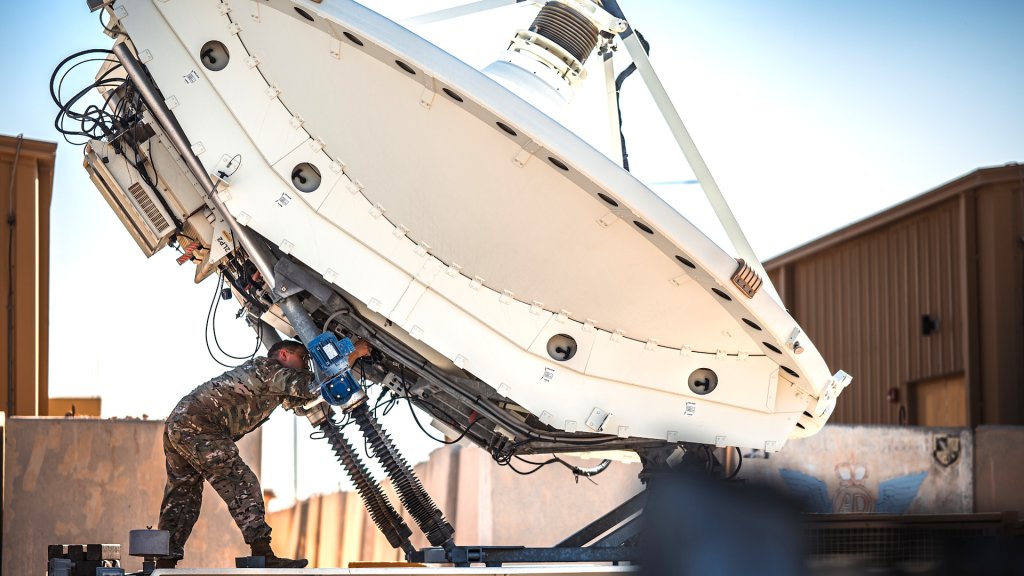
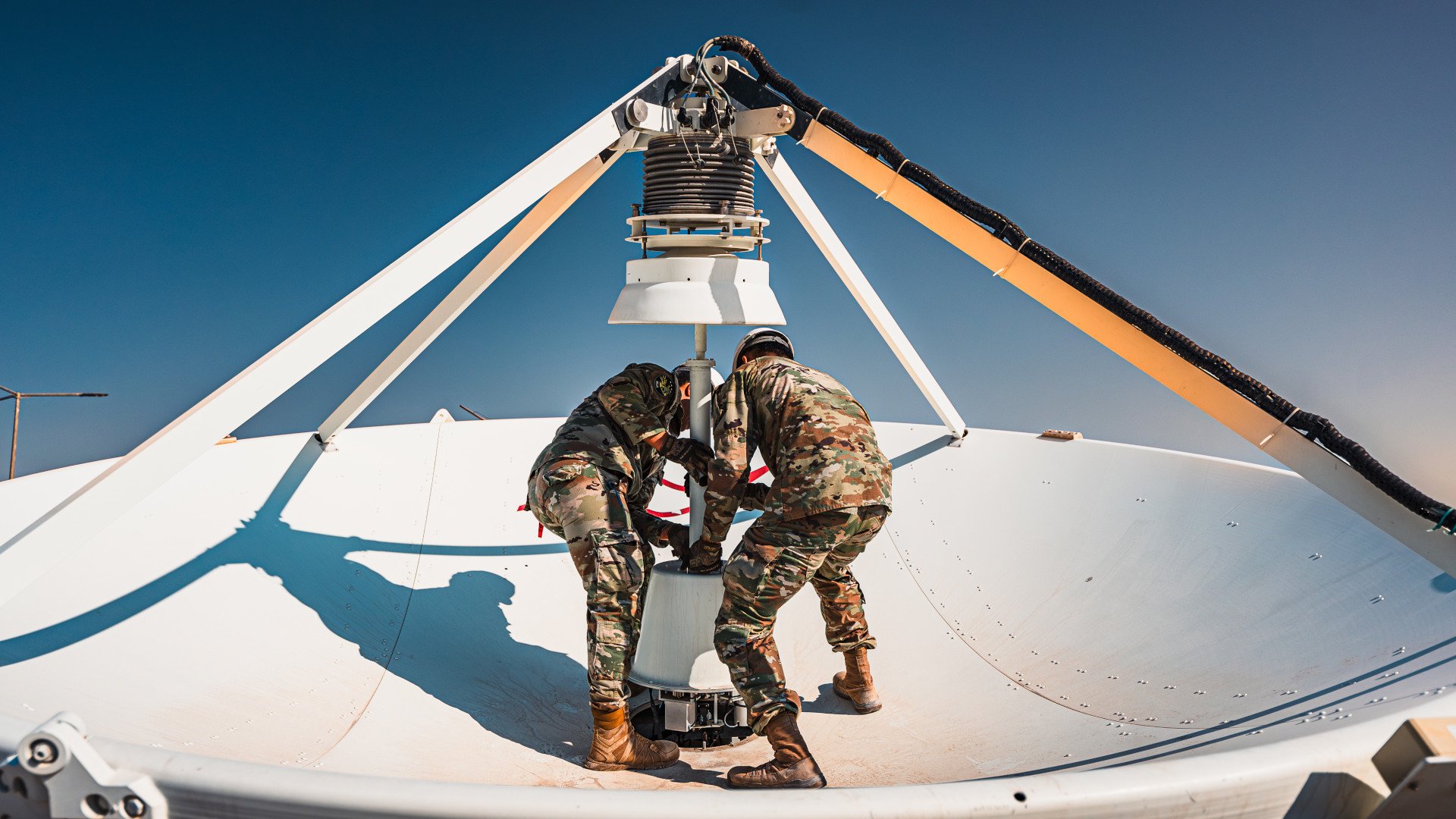
A previously released picture showing a member of the 42nd Electromagnetic Warfare Combat Detachment forward-deployed somewhere in the Middle East in 2024. USAF/Senior Airman Zeeshan Naeem

“During Operation Epic Fury, our components, notably at U.S. Central Command and Space Command, with support from our components at European Command and Pacific Command, demonstrated that Guardians [the official term for uniformed Space Force personnel] are not supporting from the sidelines as a nice-to-have [sic], but we are delivering space power directly into the fight as a need-to-have,” Schiess said. “One of those impressive Guardians is Specialist Gray, who hails from Tampa, Florida. She joined the Space Force just two years ago, but listen to the impact she [has] made in her short term already.”

“She deployed to the CENTCOM AOR [Central Command area of responsibility] as a part of the 42nd Electronic Warfare Detachment [sic], and within hours of OEF kicking off, she received a top priority target package with one critical objective: reconfigure her weapon system and execute critical non-kinetic fires,” he continued. “She locked onto the target, optimized her weapon system, and waged electromagnetic warfare against a determined adversary. Even as ‘Alarm Red’ sirens were blaring, and incoming missiles targeted her site, she courageously held the line, protecting forces, denying adversary capability, and delivering space effects, until her commander had to literally pull her from the console to safety.”

“Specialist Gray is just one of the outstanding members of the entire enterprise of dedicated guardians, including the acquisition professionals that developed and fielded the weapon system that she operated, the intel Guardians that developed the targeting package that she used, and the cyber guardians who ensured communication, connectivity, and network defense for the command and control, the guardian instructors who trained her for combat, and the list goes on and on,” the Chief of Space Operations added.

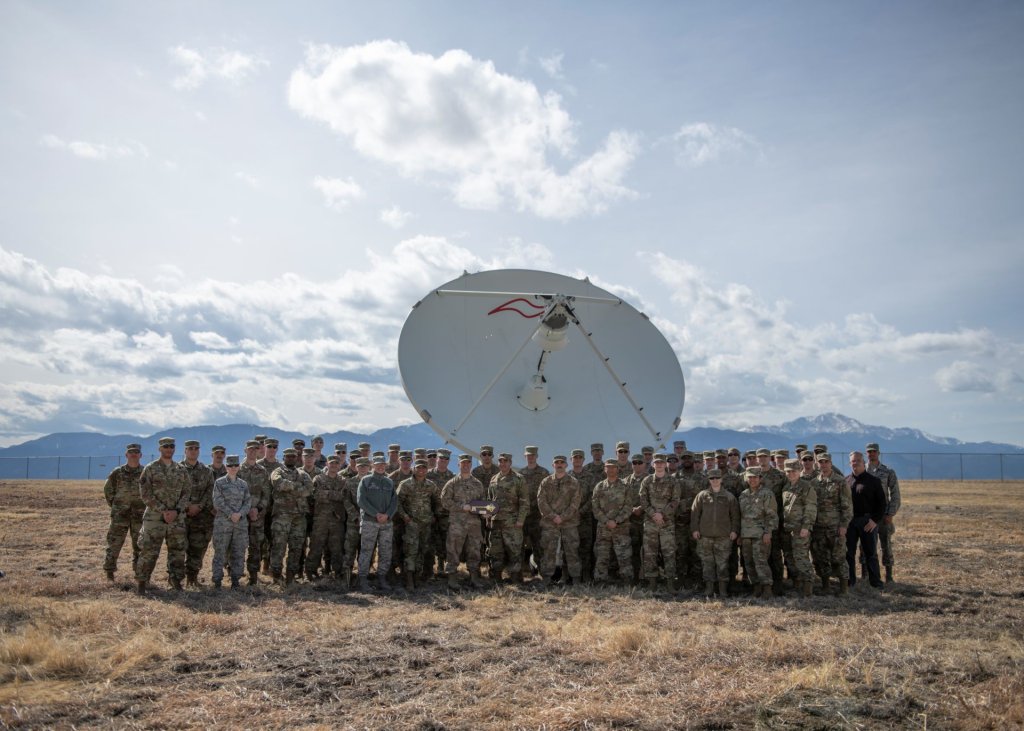
Schiess did not name the system in question or elaborate further on how it was employed. However, previously released pictures of elements of the 42nd EWCD in the Middle East have shown personnel working with trailer-mounted multi-band antennas that have been associated in the past with variants of the Counter Communications System (CCS). CCS is a family of ground-based electronic warfare jammers primarily designed to disrupt enemy space-based communications capabilities. Prior to yesterday, CCS was the U.S. military’s only publicly acknowledged anti-satellite weapon. Space Force has now confirmed it also has weapons in orbit, which we will come back to later on.
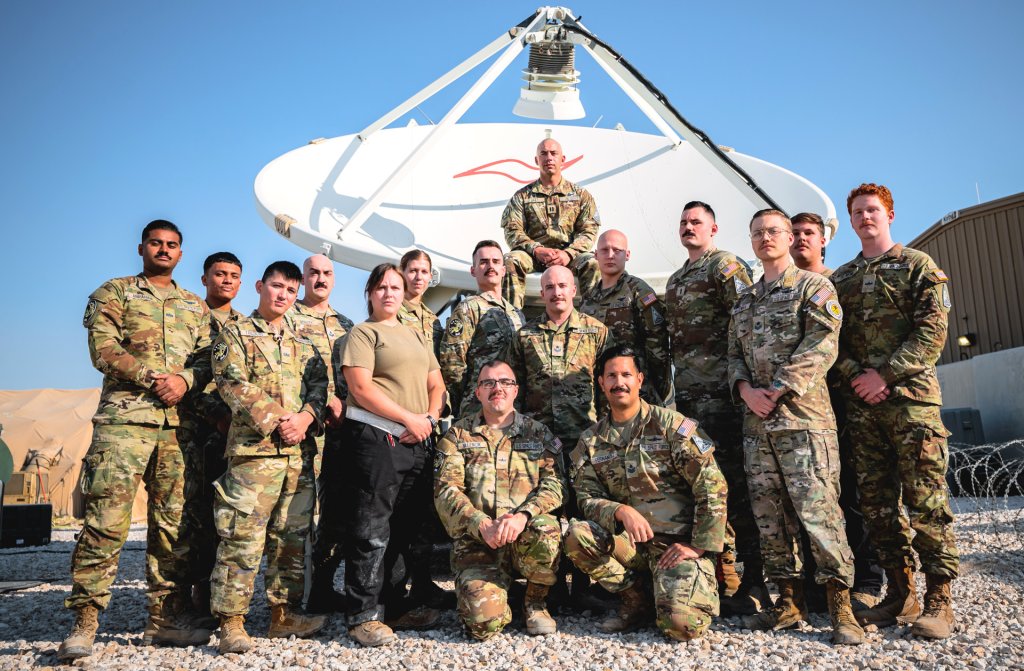
Members of the 42nd EWCD pose in front of a trailer-mounted antenna at an undisclosed location in the Middle East in 2024. USAF/Senior Airman Zeeshan Naeem
A picture released in 2020 showing members of the 4th Space Control Squadron standing in front of what is explicitly said to be an element of the Block 10.2 version of the Counter Communications System. USAF

The 42nd Electromagnetic Warfare Combat Detachment has been operating in the Middle East since at least 2024 under the umbrella of Space Force’s main headquarters in the region, U.S. Space Forces – Central (SPACECENT). President Donald Trump briefly called attention to the detachment’s “cutting-edge defense activities” during a Christmas Eve conference call with deployed service members last year.

“Sometimes we have to be within the footprint of the satellite, and so that’s why Guardians go into harm’s way,” Gen. Schiess did tell TWZ and other outlets at a roundtable after his speech this morning when asked for more details about the 42nd EWCD’s role in Operation Epic Fury, and what lessons Space Force has been learning from the conflict more broadly.

“Electromagnetic warfare was a big part of that, but also satellite communications,” he added. “The ability to keep communications, obviously GPS and PNT [positioning, navigation, and timing], were important there.”

“And then, really, missile warning and missile tracking was [sic] incredibly important. Both [Air Force Chief of Staff] Gen. Wilsbach and I talked about ‘Red Alarm’ situations,” the Chief of Space Operations continued. “Being able to tell our forces to be able to take cover was extremely important. And as we’ve seen from Ukraine to Iran, the amount of missiles and the amount of things, the folks that are doing that each and every day are incredible, and they are saving lives.”

Chief of Space Operations Gen. Douglas Schiess. USAF

Gen. Schiess’ anecdote about Specialist Gray and the 42nd EWCD did highlight how Iran, especially in the opening phases of the conflict earlier this year, was able to deal real blows to U.S. and allied facilities and forces across the Middle East. Iranian missiles, drones, and other capabilities were able to damage and/or destroy a variety of high-value assets, including aircraft and radars, and cause hundreds of casualties, as TWZ has drawn attention to on several occasions in the past. This has already been a sobering wake-up call with serious implications for potential future conflicts against larger and even more capability opponents, especially China.

“I think the whole joint force is learning a lot from Operation Epic Fury, the previous operation there, on exactly what needs to be in underground facilities, [and] what maybe can we do from remote locations,” the head of Space Force said at the roundtable today. “You could also look at what can we do from space to do some of those things? And so we’re looking at all those [lessons learned].”

Gen. Schiess mentioning subterranean facilities and remote operations is particularly notable. Even before Operation Epic Fury began, the U.S. Air Force had been working to expand options for directing operations in the Middle East from a command center in the United States. The service had also been looking to push certain command and control functions at Al Udeid Air Base in Qatar underground. Al Udeid was among the many bases Iran subsequently targeted.

Operation Epic Fury has already added new fuel to a larger ongoing debate about balancing U.S. military base defense priorities globally, including the relative value of investing in new physically hardened infrastructure. TWZ has been following these discussions very closely in recent years. The conflict with Iran has raised serious questions about future operations of any kind at certain bases across the Middle East, and there have been reports that a larger reorientation of America’s force posture in the region could be coming.

For Space Force, operations against Iran have provided a broader opportunity for the service to demonstrate its active role in forward-deployed operations. That, in turn, has generated its own lessons learned beyond just steps needed to help better protect units in the field.
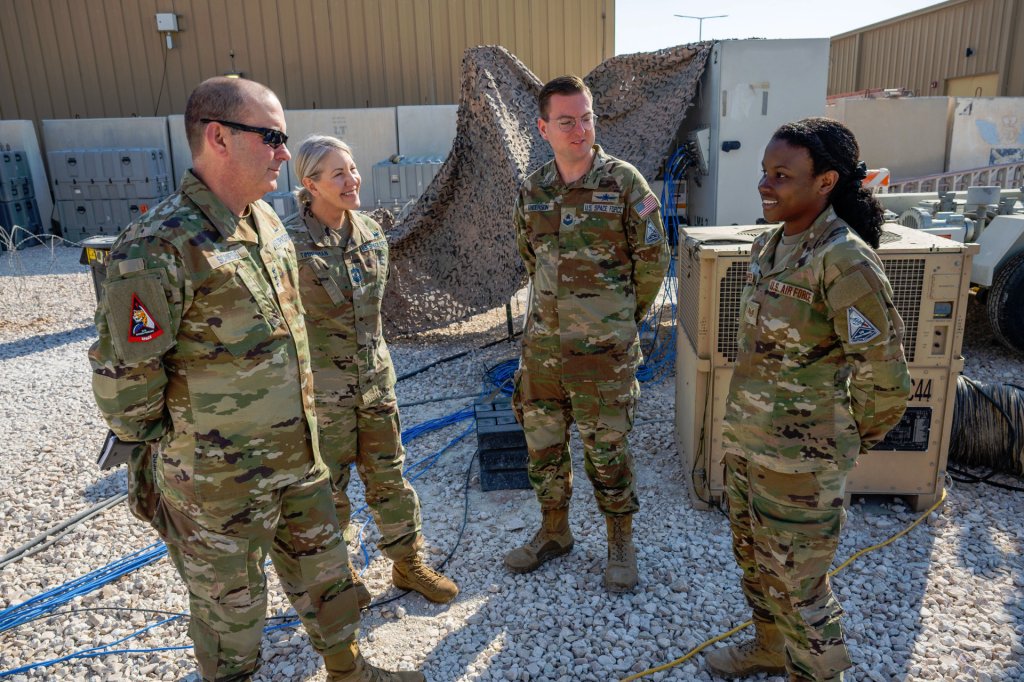
Then-Lt. Gen. Douglas Schiess meets with forward-deployed members of the 42nd Electromagnetic Warfare Combat Detachment in 2025. Schiess was head of US Space Forces – Space (S4S) and the Combined Joint Force Space Component Commander at SPACECOM at the time. Space Force

This extends to “reconstitution [of forces] in a combat environment, the logistics and the importance of that relationship with TRANSCOM [U.S. Transportation Command] and to be able to get supplies and replenishment into the theater,” Chief Master Sergeant of the Space Force John Bentivegna also said today, speaking alongside Gen. Schiess at the roundtable. That is “something we haven’t really worked on before. So definitely, it was a great lesson learned.”

Space-based capabilities including early warning, general intelligence gathering, weapons guidance, near-real-time communications, and more, are already absolutely central to U.S. military operations. America’s long-standing dominance in space is also steadily being eroded, with China, in particular, surging ahead in the deployment of new satellites to support a host of mission requirements, including intelligence-gathering and long-range targeting. The ability to leverage space is also proliferating to smaller adversaries, including Iran.

In addition, as mentioned, the space domain is no longer limited to just supporting operations within the atmosphere, but is a place where real engagements happen. The U.S. military is now capable of generating so-called counter-space effects using forces and assets within the atmosphere as well as in orbit, as was just disclosed yesterday.

Overall, Gen. Douglas Schiess’ comments today about the role played by Specialist Gray and the 42nd EWCD during Operation Epic Fury are indicative of not just what is to come in future operations, but how the Space Force is already engaged in combat missions now.

Contact the author: joe@twz.com

The post New Details On How Space Force Has Waged Electronic Warfare Against Iran appeared first on TWZ.

  •  

Gov’t spokesman proposes sharp cut of “unemployment benefits” down to just two months

Government spokesman Pavlos Marinakis triggered an outrage when he proposed that the “unemployment benefits” should last just two months in order to force jobless to take up a work. According to Greek legislation, the unemployment benefit of 526 euros per month increased by 10% for each child runs for maximum 12 months provided that the […]

The post Gov’t spokesman proposes sharp cut of “unemployment benefits” down to just two months appeared first on Keep Talking Greece.

  •  

Greece’s new goals: “Electricity self-consumption” and “Energy democracy”

“Electricity self-consumption” and “energy democracy” are the new fancy terms the Greek government has introduced to convince citizens of its new policy framework and promotion of increased personal responsibility regarding lower energy cost in exchange of personal investments. A new framework for “electricity self-consumption” came into force on Monday, following a ministerial decision by Environment […]

The post Greece’s new goals: “Electricity self-consumption” and “Energy democracy” appeared first on Keep Talking Greece.

  •  

Allianz retira su patrocinio del Festival de las Ideas tras las protestas de varios participantes por sus vínculos con Israel

✇El Dia
By: EP
Allianz se ha desvinculado del Festival de las Ideas de Madrid y retira así su apoyo económico como patrocinador del evento después de que el cineasta Rodrigo Sorogoyen, la presentadora Inés Hernand, la escritora Alana S. Portero o el cantante Rodrigo Cuevas hayan puesto "en suspenso" su participación en el certamen hasta que este no renunciara al "apoyo económico" del patrocinador Allianz por sus vinculaciones con Israel.

  •  

Young mother confesses abuse of her newborn; infant in critical condition

A young mother on the island of Crete confessed to judicial authorities on Tuesday that she had beaten her newborn baby. The 17-day-old infant is in critical condition and is struggling for its life with heave head injuries in the ICU of the Neonatal ICU in Heraklion. The 18-year-old mother apologized for beating her newborn […]

The post Young mother confesses abuse of her newborn; infant in critical condition appeared first on Keep Talking Greece.

  •  

Gallardón defiende que una operación del Canal de Isabel II tuvo informes "favorables" y ningún perjuicio para Madrid

✇El Dia
By: EP
El exministro de Justicia y expresidente de la Comunidad de Madrid, Alberto Ruiz-Gallardón, ha expresado que la compra por parte del Canal de Isabel II de la empresa colombiana Inassa tuvo informes "favorables" y ha defendido que no causó "absolutamente" ningún perjuicio ni para el ente ni para la región.

  •  

Ex high-ranking member of neo-Nazi “Golden Dawn” released from prison

Former MP of neo-Nazi Golden Dawn party, Ilias Kasidiaris was released from Domokos Prison at noon on Tuesday after serving the lengthy sentence imposed on him for his actions as the ‘first lieutenant’ within the criminal organisation Golden Dawn, a neo-Nazi group that had entered Parliament at the height of the Greek crisis. Kasidiaris supporters […]

The post Ex high-ranking member of neo-Nazi “Golden Dawn” released from prison appeared first on Keep Talking Greece.

  •  

Europe’s young research talent takes on cancer, climate and more

The third edition of EU TalentOn closed with the announcement of its winning teams on 11 September in Brest, France. Over five days, 100 early-career researchers aged 21 to 35 of 43 different nationalities, worked in teams to develop concrete responses to some of Europe's most pressing challenges, based on the five EU Missions under Horizon Europe.

The participants competed for a share of an €80,000 prize pool. First and second prizes were awarded in each of the five categories, alongside an Alumni Prize, a Special Jury Prize and the overall Grand Jury Prize.

The teams winning the 1st prize were:

  • Adaptation to climate change: Alejandro Roman, Marie Johanna Univer, Edoardo Kimani Bellotto and Florin Miron won with IMPRREST - from big data to decisions, a tool that gives responders one verified assessment of climate emergencies and evidence for adaptation.
  • Cancer: Xhilda Dhamo, Oliwia Kosecka and Jafar Gura won with CogniVoice - a patient centered speech monitoring platform for post-treatment surveillance of Brain Cancer.
  • Restore our Ocean and Waters Mission: Gabriel Tejero, Siddhanth Shishodia, Dominika Czekanowska and Gjylije Hoti won with Mission PFASSible – a solution that helps with pollution removal into verified risk reduction: sensing, capturing, concentrating, and proving water safety. 
  • Climate-neutral and smart cities: Lucia Petronio, Samar Momin, Samira Huber and Imen Kaabachi won with Block2City - turning building data into renovation choices, funding guidance and expert handoff, while helping cities map local demand.
  • Soil: Natasha Waris, Ilaria Bertolini, Felipe Quiroz, and Victoria Boycheva, won with RhizoSentinel – a solution that turns plants into living soil biosensors that reveal hidden soil biological threats before they cause crop losses, enabling earlier intervention and smarter soil management.
  • The Grand Jury Prize of €12,000 for the best overall project went to RhizoSentinel, while the Special Jury Prize of €3,000 was awarded to Marion Le Meur, Narjes Yazdi, Suresh Ajmeera, and Alberto Galindo Caballero with their project Colospy - a rapid, saliva-based molecular test detecting colorectal-cancer-miRNA signature, designed as a stool-free screening option.

The projects were assessed by a jury of experts from academia, business and government on both scientific merit and market potential – the ability to become real innovations that would contribute to Europe's competitiveness.

Startups, Research and Innovation Commissioner Ekaterina Zaharieva (pictured) said:

“Congratulations to the winners of EU TalentOn 2026. The solutions you have put forward show what European talent can achieve when it is given room to think differently. Results like these underline that Europe's most important asset are its brightest minds.”

Background

EU TalentOn brings together early-career researchers to develop solutions to major societal challenges linked to the five EU Missions under Horizon Europe. By bringing science closer to citizens and building new connections between science and society in open, playful and engaging ways, it supports the objectives of the ERA Policy Agenda. 

EU TalentOn is a flagship event of Science Comes to Town, the Commission's year-long initiative bringing research and innovation closer to citizens across three host cities in 2026: Kiel (Germany), Brest (France) and Split (Croatia). With over more than 1,000 activities and with more than 70 partners, Science Comes to Town 2026 is connecting scientific institutions, innovation ecosystems and the public throughout the year.

The programme continues later this month, when Kiel hosts the 36th EU Contest for Young Scientists (EUCYS 2026) from 22 to 27 September, before Science Comes to Town 2026 draws to a close with a joint Closing Event and Ceremony on 14–16 December.

Science Comes to Town will return for a second edition in 2027, hosted by four new cities: Aarhus (Denmark), Genoa (Italy), Kaunas (Lithuania) and Oeiras (Portugal). EU TalentOn 2027 will be held in Kaunas, while EUCYS 2027 will take place in Genoa.

Women accounted for 54% of participants in the 2026 edition, reflecting the growing contribution of female talent to Europe’s research and innovation landscape.

More information

  •  

EU-funded Arctic city co-operation expands with launch of new BRIDGE project

Towns and cities from around the Arctic took part in the launch of an EU-funded Arctic co-operation initiative that will enable more municipal leaders, Indigenous representatives and youth to work together.

The European Union has launched a new initiative gathering 21 towns and cities from across the Arctic to work together on shared priorities. BRIDGE, Building Resilient International Dialogue and Governance for Arctic Engagement, is led by the Arctic Mayors’ Forum (AMF), building on the foundations of the Arctic Regional and Urban Cooperation network (AURC).    

AURC
European Commission

“At a time of ever-increasing environmental and geopolitical change, cooperation among Arctic communities is more important than ever,” said Peter M. Wagner, Head of the European Commission’s Service for Foreign Policy Instruments, speaking at the EU Arctic Forum 2026 in Brussels. “We are proud to launch a new phase of EU support to Arctic cities forging connections across borders, building local capacity, and delivering tangible benefits for their residents.” 

“A safe, resilient and inclusive Arctic isn't a side interest for the EU, it's a shared project,” said Patti Bruns, AMF Secretary General. “I’m excited about our work over the next four years, bringing together communities from Alaska, Canada, Greenland, the Faroe Islands, Iceland, Norway, Sweden and Finland to strengthen cooperation between local governments who face increasing challenges – and opportunities.”

More cities co-operating in a permanent structure

BRIDGE integrates AURC’s approaches and methods into AMF’s permanent structure, extending the cooperation to more Arctic mayors and urban practitioners. 

Despite variations in size and governance structures, Arctic communities share a surprising range of challenges. Building on AURC achievements, these cities are now identifying common themes for the next four years of peer learning, exchanges, study visits, and collaborative problem-solving.

AURC
European Commission

AURC sparked positive changes in Arctic communities 

In 2024, AURC gathered 15 Arctic local authorities from Canada, Finland, Greenland, Iceland, Norway, Sweden and Alaska in the United States for the first time to work together on sustainable development. After two years of structured cooperation with expert support, positive local results were already visible. 

“Whether it was learning from Tromsø’s approach to community hubs or troubleshooting heavy equipment with our Canadian neighbours, AURC provided us with a roadmap for growth,” says Assisaun Toovak, Mayor of Utqiaġvik, the northernmost town in the United States. “We aren’t just a remote town in Alaska: we’re a key player in a global Arctic community.”

From new international welcome houses and services in Rovaniemi (Finland), Gällivare and Luleå (Sweden) and Tromsø (Norway) to plans for a new Youth Commission in Fairbanks North Star Borough (USA) inspired by peers in Sweden, Norway, Iceland and elsewhere, AURC sparked an array of positive local changes across the Arctic. These span citizen engagement and youth participation; attracting and retaining talent; sustainable tourism; culture and inclusive economic development; and resilience and emergency preparedness.

AURC
European Commission

Arctic connections supporting resilience and sustainability

Beyond these tangible changes on the ground, trusted exchanges between mayors and staff of Arctic local authorities are boosting knowledge, capacity to adapt, and new initiatives. So far, these include cross-border cultural exchanges, focused workshops for sustainable Arctic tourism professionals, and best-practice sharing on wildfire preparedness. 

Another major result is a new Interreg Aurora project TALENT NORTH, Attracting and Anchoring Global Talent in the Arctic, developed by the Arctic Six universities alliance and AMF, along with administrations and universities of several Arctic cities.

Erkki Parkkinen, Mayor of Salla, Lapland (Finland), said: “It was the best thing for Salla to join AURC: I can now exchange good practices with friends across the Arctic. It’s very important for our municipalities to stay in touch with each other, for the future of the Arctic, for resilience.”

Read more about positive changes EU-funded cooperation has sparked in Arctic towns and cities. 

BRIDGE is funded by the European Commission’s Service for Foreign Policy Instruments (FPI), working closely with the European External Action Service, the diplomatic wing of the EU, and the Directorate-General for Maritime Affairs and Fisheries (DG MARE).

Arctic Mayors’ Forum is pan-Arctic forum representing the voices of Arctic Peoples through elected leaders at the municipal and community level. They provide an open, collaborative platform for their members, including Indigenous Peoples from around the Arctic.

  •  

Commission approves €52 million Romanian state aid for cattle farmers facing increased fuel and fertiliser prices

The European Commission has approved a €52 million (RON 277 million) Romanian state aid scheme for cattle farmers facing increased fuel and fertiliser prices due to the Middle East crisis.

The scheme was approved under the Middle East Crisis Temporary State Aid Framework (METSAF) adopted by the Commission on 29 April 2026.

The Romanian scheme

Romania notified to the Commission a €52 million scheme to support companies active in the cattle farming sector. The scheme, which will run until 31 December 2026, aims to mitigate the impact of the increase in agricultural fuel and fertiliser prices.

The aid will take the form of direct grants, with a maximum of €50,000 per company.

The Commission assessed the scheme under EU state aid rules, in particular Article 107(3)(c) of the Treaty on the Functioning of the EU, which enables member states to support the development of certain economic activities subject to certain conditions, as well as Sections 1 and 2.1 of the METSAF.

The Commission found that the scheme is in line with the conditions set out in the METSAF. In particular, the aid will be granted based on a scheme with a clear estimated budget and will be provided to temporarily support the development of companies active in the primary production of agricultural products. The Commission concluded that the scheme is necessary, appropriate and proportionate to facilitate the development of an economic activity and does not adversely affect trading conditions to an extent contrary to the common interest.

On this basis, the Commission approved the Romanian scheme under EU State aid rules.

Background

On 29 April 2026, the Commission adopted the METSAF to enable member states to support the EU economy in the context of the Middle East crisis. The METSAF is a targeted and temporary framework to address the effects of the crisis on some of the most exposed sectors of the economy: agriculture, fishery, transport and energy-intensive industries. The METSAF will be in place until 31 December 2026. During its period of application, the Commission will keep the content, scope and duration of the framework under review in the light of developments in the Middle East and of the general economic situation.

While the transition towards a clean economy remains the long-term solution to shield EU companies from the effects of global energy shocks, the METSAF allows Member States to act immediately to make sure that the growth of the most exposed companies is not irreparably hampered by the current crisis.

To this end, support can take various forms for companies active in the agriculture, fishery and transport sectors. This includes aid based on actual consumption to cover part of the price increases for fuel or fertilisers, and a simplified approach for small amounts of aid.

The METSAF also includes a temporary adjustment to the Clean Industrial Deal State aid Framework allowing for further flexibility and higher aid intensities to address electricity price spikes.

More information on the METSAF can be found online.

For more information

The non-confidential versions of today's decisions will be made available under case number SA.124647, in the state aid register on the Commission's competition website. New publications of state aid decisions on the internet and in the Official Journal are listed in the Competition Weekly e-News.

Related topics

Competition

State aid

  •  

U.S. Admits It Has Weapons In Orbit

Secretary of the Air Force Troy Meink made a bombshell admission this morning, disclosing that there are on-orbit weapons deployed right now to protect America’s interests in space. Those weapons support a Space Control mission set, and the U.S. Space Force has now also shared additional details about that directly with TWZ.

Meink first made mention of what he described as “on-orbit space control weapons” during his keynote speech earlier today at the Air & Space Forces Association’s (AFA) 2026 Air, Space & Cyber Conference, at which TWZ is in attendance. As head of the Department of the Air Force, Meink serves as the top civilian overseeing both the Air Force and the Space Force. Space-based weapons have historically been a very sensitive topic for the U.S. military, with much discussion over the decades about whether such capabilities could already exist to varying degrees in the American arsenal. There has already been a dramatic shift in this regard in recent years, with the head of U.S. Space Command (SPACECOM) openly declaring the acquisition of new anti-satellite weapons to be a top priority just last month.

The first official painting commissioned by the Space Force, seen here, explicitly depicts a duel between a reusable spaceplane and a hostile ‘killer satellite.’ USSF

“Today, we continue to ensure we remain ready to meet the challenges of evolving threats, wherever they exist,” Meink said during his keynote address. “This is why the United States now has on-orbit space control weapons capable of defending the joint force against hostile adversary action.”

“That phrase was very well thought out. So whatever I said before is what I say again,” he said when asked if he could elaborate in any way on those capabilities at a question-and-answer session immediately following his speech. “It is critically important that we maintain our dominance not only in the air, but in space, and so we’ve had to take steps to make sure that when we’re threatened, we can take care of that.”

“Not going to go into specifics on the type of weapon,” Meink said when asked again if he could elaborate at a press roundtable with TWZ and other outlets on the sidelines of the Air, Space & Cyber Conference today. “Just like in air dominance, we need to maintain dominance in space as it becomes more and more important to how we function, how we operate militarily, and economically [and] civilian-wise.”

“There’s a lot of factors that go into how we talk about these things. We spend a lot of time talking about how we’re going to talk about these things,” Meink added at the roundtable when asked about why this disclosure was being made now and its implications for deterring adversaries.

“It is important from a deterrence perspective, but on the other hand, me talking about the details of what we’re doing would actually not benefit that deterrence,” he continued. “So I’m not going to talk about the specifics of what we’re doing, whether we’ve tested or not tested, or anything else.”

Secretary of the Air Force Troy Meink speaks during the change of responsibility ceremony for Chief of Space Operations Gen. Douglas Schiess on Sept. 3, 2026. USAF/Eric Dietrich

TWZ had separately reached out for more information after Meink made his initial remarks this morning.

“It is longstanding policy that the U.S. will protect and defend the Joint Force through all domains,” a Space Force spokesperson subsequently told us. “We are increasing readiness against existing threats, and the U.S. has on-orbit space control weapons capable of defending the Joint Force against hostile adversary action.”

“Space control encapsulates the mission areas required to contest and control the space domain – employing kinetic and non-kinetic means to affect adversary capabilities through disruption, degradation and even destruction, if necessary,” they continued. “These capabilities can be employed for offensive and defensive purposes at the direction of combatant commands. U.S. military operations are conducted in compliance with international law, including the Outer Space Treaty and LOAC [the Law of Armed Conflict].”

The Outer Space Treaty, which came into force in 1967, prohibits the United States and other signatories from placing nuclear weapons and other weapons of mass destruction (WMD) in orbit. It does not impose limits on the deployment of conventional weaponry. After receiving this initial statement from Space Force, TWZ followed up to ask whether the service was confirming that it has kinetic (e.g. physical interceptors) and non-kinetic space control weapons (e.g. electronic warfare jammers) now, and that any such weapons could be employed both offensively and defensively.

“We are confirming that the United States has on-orbit space control weapons capable of defending the Joint Force against hostile adversary actions,” the Space Force spokesperson said in response. “Beyond that, we will not discuss specific operational methods, payloads, technical characteristics, or employment concepts.”

A look inside a U.S. space command center. US Space Command

“As the Space Force continues to mature, our public discussion is intended to clarify doctrine and mission sets, not disclose sensitive operational details,” they added. “What is important is that the U.S. Space Force is committed to the long-term safety, security, and sustainability of the space domain, and our operations are guided by longstanding principles of professional military behavior and international law. That commitment remains central as space operations continue to mature and normalize.”

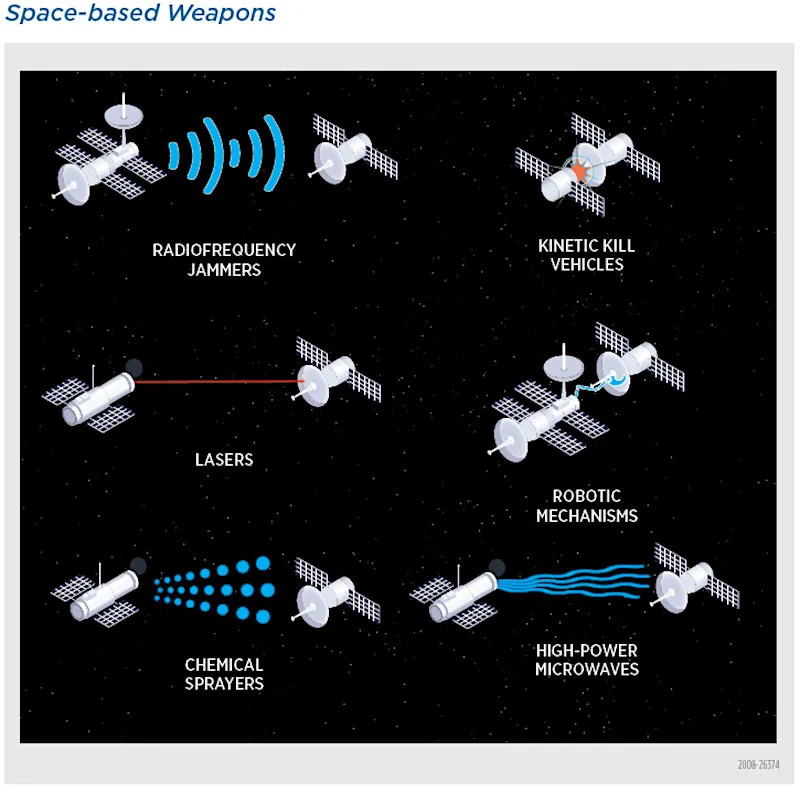
There are a wide range of means by which a platform on-orbit can attack another or otherwise defend against incoming threats. Not all of those options involve effects that are destructive or even irreversible, either. For instance, a laser could be used to blind optics on a target temporarily without damaging them. Electronic warfare suites could similarly disrupt a threat without causing any kind of permanent harm. Doing so could help provide extra time for a friendly asset to maneuver out of danger. There are, of course, also capabilities that do seek to damage and/or destroy a target, such as physical interceptors, grappling arms, aerosols that can be sprayed on optics and solar panels, or even just using one satellite as a kinetic weapon to smash into something else.

A U.S. Defense Intelligence Agency graphic highlighting some of the ways on-orbit attack can be carried out. DIA

So-called counter-space weapons, as a broad category, are also not limited to space-based capabilities. There are also direct-ascent anti-satellite (ASAT) interceptors launched from the surface and other capabilities deployed from within the Earth’s atmosphere. Prior to today, the only acknowledged anti-satellite weapons the U.S. military had in inventory were ground-based electronic warfare systems. In 2022, under President Joe Biden, the U.S. government had announced a self-imposed moratorium on destructive direct ascent anti-satellite weapons testing. Still, this would not have precluded development of those capabilities using other means, and it’s not even clear if that policy is still in place.

It is important to further note here that plans for new space-based anti-missile interceptors are at the core of the Trump administration’s Golden Dome missile defense initiative.

There is certainly no debate about the absolutely vital role that space-based capabilities – including early warning, general intelligence gathering, weapons guidance, near-real-time communications, and more – play in U.S. military operations today. Similarly, it is well-established at this point that America’s principal global competitors and potential adversaries, especially China and Russia, have been actively developing and fielding increasingly more threatening anti-satellite capabilities. China’s People’s Liberation Army (PLA) has also been dramatically expanding its own space-based capabilities, steadily eroding the U.S. military’s historic dominance in this domain and presenting new threats to U.S. forces.

“From the broadest perspective, maybe the most critical characteristic of the responsive and adaptive national security space architecture called for in the President’s Ensuring American Space Superiority executive order is that survivability matters at least as much as performance,” U.S. Space Force Gen. Stephen Whiting, head of SPACECOM, said in August at the annual Space & Missile Defense (SMD) Symposium. “In space, there is no safe harbor. You can’t dig a trench or build a shield. Our satellites are consistently or predictably in an opponent’s weapons engagement zone. And we can build the most high-performing, exquisite satellites in human history, but if they depend on fragile, targetable supporting infrastructure, their performance will drop to zero on the first day of the next war.”

U.S. Space Force Gen. Stephen Whiting, head of US Space Command, seen speaking at the 2026 DoDIIS Worldwide Conference on August 10, 2026. DIA

Whiting publicly declared at that time that having “credible, acknowledged” options for countering enemy capabilities in space, to include damaging or even destroying them, was a key priority for deterring hostile action and surviving if a major fight in orbit were to break out.

“Protective measures on satellites is just like thinking about protective measures on aircraft, okay? And we’re working through that,” Lt. Gen. Gregory Gagnon, head of the Space Force’s Combat Forces Command (CFC), also told TWZ and others more recently at a roundtable at AFA’s Warfare Symposium back in February. “I won’t provide specifics, because I want those protective measures to work, right? I don’t want to tell Beijing and Moscow what I’ve done.”

“But protecting and defending satellites can’t simply be done by protect and defend. You can’t run away from a bully forever. Sometimes you got to turn around and punch,” Gagnon continued. “So protect and defend, although necessary, is insufficient to deliver space control. We also need, as part of our joint force, the ability to attack.”

U.S. Space Force Lt. Gen. Gregory Gagnon, commander of USSF Combat Forces Command, at center, seen at Schriever Space Force Base, Colorado, in December 2025. USSF

Meink’s remarks today put Gagnon’s prior comments, in particular, in a whole new light.

The Secretary of the Air Force’s new disclosure has prompted additional questions beyond just what actual weapon systems the U.S. military has actually fielded in space. There are long-standing concerns about the potentially wide-reaching ramifications of increasingly weaponizing space. As Meink himself noted today, space-based communications and other capabilities are increasingly central to daily life, in general, and widespread, long-term disruption could have serious negative economic and other impacts.

At the roundtable today, Meink pushed back on a question about these concerns, citing Chinese and Russian anti-satellite developments.

“Is there a question in the room by anybody about whether or not the Chinese and Russians have been developing these sorts of weapons?” he said. “We are focused on making sure we can protect ourselves and operate in that environment.”

“Depends on where you sit, right, you know? But to say that it’s the responsibility for the U.S. government to protect its citizens from emerging threats makes perfect sense to me,” now-retired Chief of Space Operations Gen. Chance Saltzman said last year when asked a similar question in the context of the Golden Dome initiative’s plans for space-based interceptors. “And we clearly see a country like the PRC [People’s Republic of China] investing heavily in these kinds of threats, whether it’s hypersonic [weapons], whether it’s threats from space. And so now it’s time for the U.S. government to step up to the responsibilities to protect American citizens from those threats.”

Though many questions remain, it is now clear that the U.S. military is not just planning to, but has already fielded at least some weapon systems in orbit as the threat ecosystem outside the Earth’s atmosphere continues to expand and evolve.

Contact the author: joe@twz.com

The post U.S. Admits It Has Weapons In Orbit appeared first on TWZ.

  •  

Criminalisation du journalisme au Mali : Abdrahamane Kéita, du Témoin, condamné à deux ans de prison ferme

Au Mali, le directeur de publication du journal Le Témoin, Abdrahamane Kéita, a été condamné le 14 septembre à deux ans de prison ferme après des déclarations sur la situation sécuritaire dans le nord du pays. Reporters sans frontières (RSF) dénonce ce verdict inique et appelle les autorités maliennes à cesser de criminaliser le journalisme […]

L’article Criminalisation du journalisme au Mali : Abdrahamane Kéita, du Témoin, condamné à deux ans de prison ferme est apparu en premier sur .

  •  
❌