❌

Reading view

MEPs vote for €47bn in new Erasmus+ funds, as frugal states seek cuts to EU budget

The European Parliament’s culture committee on Tuesday (29 September) agreed to boost the flagship Erasmus+ student exchange programme by €7bn in 2028-2034 linked to rule-of-law conditions, even as so-called frugal countries seek to cut overall funding. 

MEPs backed in April to increase the European Commission’s original proposal from €40bn to €47bn as part of a interim report on the EU’s long-term budget (MFF).

On Tuesday, they also said funds should be linked to respect for the rule of law and transparency standards – a clear reference to the situation facing Hungarian universities in the past, which were unable to participate in Erasmus+ during the illiberal rule of former prime minister Viktor Orbán. 

Candidate countries, such as Ukraine and Moldova, may be able to participate in the next Erasmus+ in the coming cycle, provided they met “certain conditions,” Polish centre-right and lead MEP on the file, Bogdan Zdrojewski, said during a press conference in Brussels.

The UK and Switzerland are also set to rejoin the programme already in 2027.

And Canada might be able to participate too, Zdrojewski said, should it gain an associate EU membership – an unclear status presented by EU commission president Ursula von der Leyen during her State of the Union speech on 11 September and welcomed by Canada’s prime minister Mark Carney.

Around 17m participants have taken part in Erasmus+ since it was launched 39 years ago, in what is widely considered one of the most popular EU integration projects.

An estimated one million babies have also been born from couples who have met during their exchange. 

The committee boost comes amid long-term EU budget talks for the next seven years, in which frugal states such as Germany and the Netherlands want to pay in less than in the past, but Zdrojewski was “feeling optimistic” about getting through the proposed Erasmus budget increase. 

He said he counted on EU capitals to defend the programme in future negotiations.

MEPs want to make Erasmus+ more inclusive, highlighting special programmes for adult learners and students in informal education programmes.

They also aimed to set a 20 percent quota for participants with underpriviliged access to career and educational opportunities.

To make Erasmus+ easier to manage, they proposed dividing the funding between different areas: education and training (74 percent), youth and volunteering (15 percent), and sport (four percent).

The committee report will now be voted on by the EU Parliament plenary, although it is still unclear when, when it becomes part of MEPs’ formal basis for negotiations with EU capitals.

This article was updated on 30 September 2026 to make clear that the €47.39bn figure was first set out in Parliament’s interim report on the MFF, adopted in April. Tuesday’s committee vote incorporates that figure into the Erasmus+ regulation, alongside new rule-of-law and transparency conditions.

  •  

EU reduces funds for women’s rights groups, in wider budget bonfire of good causes

As the EU seeks budget cuts to break a stalemate in member states’ talks, women’s rights groups are on the chopping bloc, prompting advocates’ concern that the cause is fading from the common agenda.

Research published on Monday (28 September) by rights initiative MOTERIS showed a consistent loss of funding for feminist organisations across EU countries.

Some groups are also facing political conditions on the money they receive, for instance in Poland and Croatia, alongside groups reporting increasing dependance on unpaid work.

And the trajectory points toward decreased funding in the 2028-2034 EU multi-annual framework (MFF), which is currently being haggled in Brussels, making matters worse.

Feminist groups pointed toward AgoraEU as evidence of the trend – the proposed new single-funding stream is to merge grants for culture, media, equality and civil society under in the same MFF bracket, in what would make equally worthy causes and their defenders compete against one another for diluted resources.

And the ongoing cuts at national level meant that “EU funds are a crucial lifeline for many women’s rights groups where state funding is insufficient,” MOTERIS said.

Small, grassroots rights groups, many of whom MOTERIS represents, find it even harder to access grants due to heavy administrative requirements.

Meanwhile, the Czech Republic and Lithuania served as examples of EU countries whose philanthropy was dependent on external top-ups, making them “more vulnerable to geopolitical shifts, such as the withdrawal of US funding.”

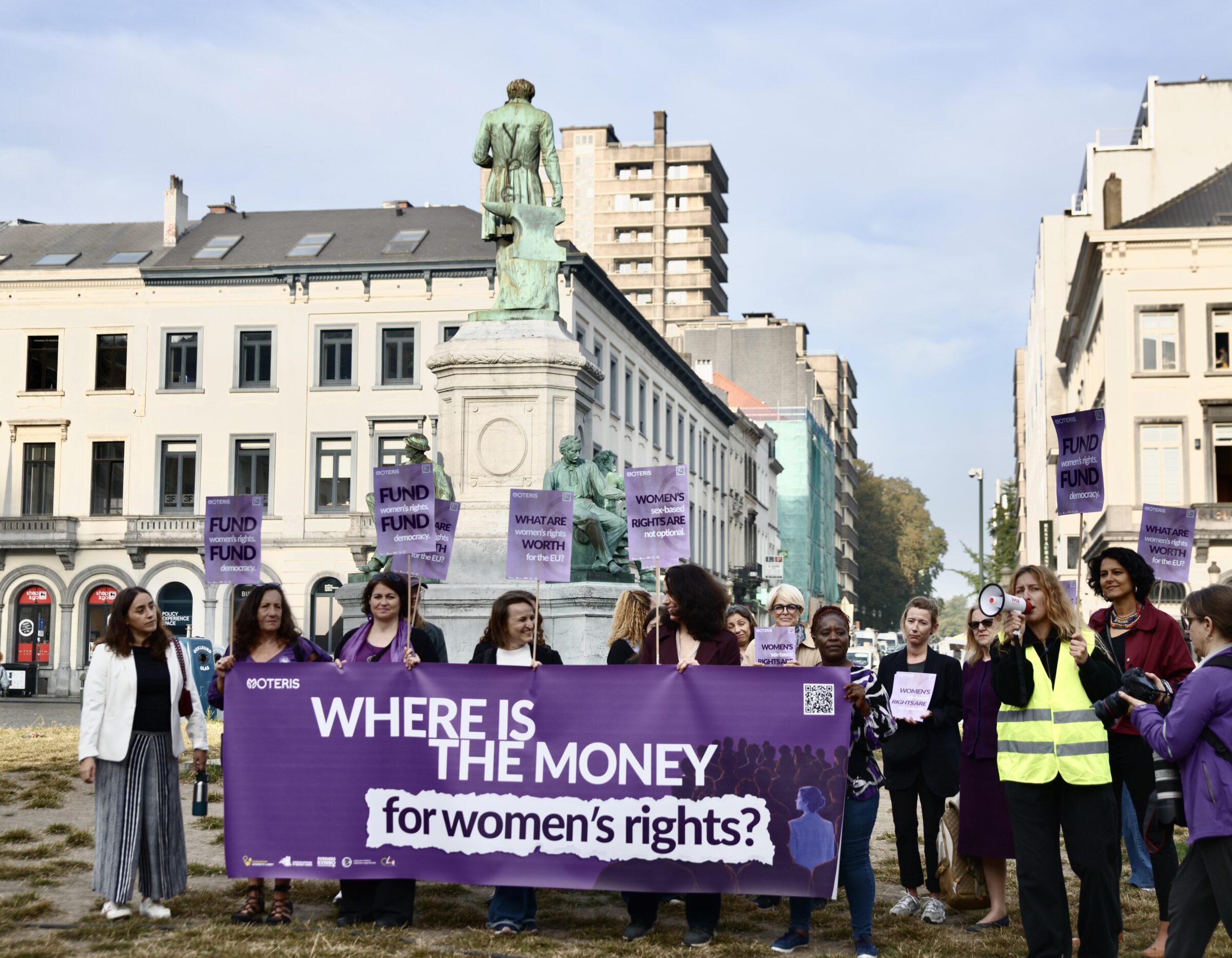
MOTERIS staged a protest to push for MFF support for women’s rights groups outside the European Parliament in Brussels on Tuesday (29 September), ahead of an MEPs’ debate on the topic. 

This article continues, but the full version is available only to EUobserver.com subscribers. Visit account.euobserver.com/membership

  •  

Listen: Can EU countries agree on the next long-term budget?

Production: By Europod, in co-production with Sphera Network.

EUobserver is proud to have an editorial partnership with Europod to co-publish the podcast series “Briefed” hosted by Léa Marchal. The podcast is available on all major platforms.

Find the full transcript below:

The EU is negotiating its next long-term budget, worth 2 trillion euros. But reaching an agreement among the 27 member states is proving difficult. The deadline is approaching, and the stakes are high.

Will the EU member states be able to agree on the budget? And what are the different options?

The bloc’s next long-term budget covers the period from 2028 to 2032.

The aim is to reach an agreement by the end of this year. Then, in 2027, the European Parliament will have to give its consent, and the political agreement will need to be translated into legislation, with funding allocated to the different programmes.

But with just three months left before the end of the year, reaching a deal on time is proving difficult. A meeting of EU ministers dedicated to the budget last week led nowhere. Countries stuck to their positions.

On one side are the so-called frugals: Germany, Austria, Denmark, Finland, the Netherlands and Sweden. But they prefer to call themselves “modernisers”. They want to limit spending and are reluctant to increase their contributions to the EU budget.

On the other side are countries worried about receiving less European funding in the years to come.

The European Commission argues that the next budget needs to be bigger than the previous one to address new challenges, including European competitiveness and defence.

And it’s not just the Commission’s view. The European Parliament and many observers share it.

But the countries calling for spending cuts say the EU cannot simply add new priorities to existing ones. They argue that choices have to be made.

So the Commission has proposed another option: increasing the EU’s own resources.

These are revenues that go directly into the European budget, rather than relying entirely on contributions from member states. The idea is to raise additional money without asking national governments to pay more.

But this proposal is also facing opposition from countries calling for spending restraint. They argue that the bloc should not simply look for more money to fund all its priorities.

So how can the 27 countries break the deadlock?

When ministers cannot reach an agreement, the issue is taken up by EU leaders themselves. And that is exactly what is expected to happen in the coming months.

The president of the European Council is planning several meetings of EU leaders before the end of the year, in an attempt to bring countries closer together.

He is even said to be considering a summit lasting three to four days at the end of November, to give leaders enough time to reach an agreement and avoid a difficult December.

But what happens if the 27 countries still fail to agree before the end of the year? There is some room for manoeuvre in 2027. According to media reports, several dates have already been set aside early next year for last-minute negotiations, should an agreement not be reached in time.

But this leaves very little room for delay.

The European Parliament will still need several months to give its consent, and the EU will then have to finalise the legislation and prepare the different programmes.

That brings us very close to 2028, when the new budget is supposed to take effect.

And if everything is not ready by then, the EU does have a mechanism to keep things running.

It can continue covering certain ongoing expenses and payments that have already been committed, even without a new long-term budget in place.

Unlike in the United States, where a budget deadlock can lead to a government shutdown and some public employees being temporarily sent home without pay, the EU has a system designed to avoid such a complete halt.

But this would only be a temporary solution.

It would not provide the certainty needed to launch new programmes or guarantee that all European funding will be available as planned.

  •  
❌