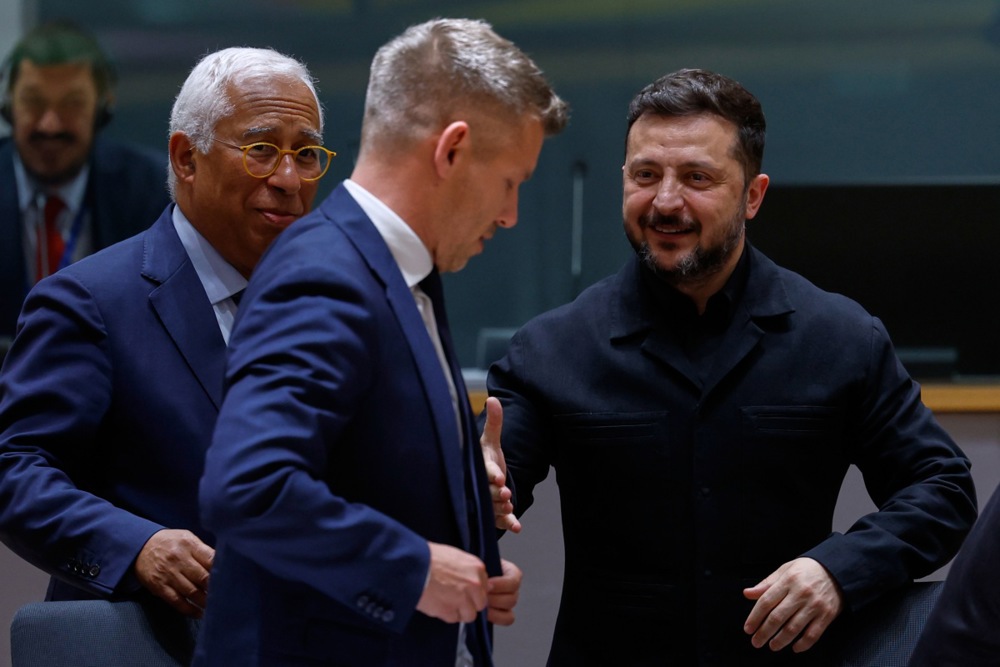
Some expected a change in Hungary’s pro-Russian foreign policy after Viktor Orbán’s fall. But they failed to take into account the domestic political pressures on Hungary’s prime minister Péter Magyar.
An unexpected source of tension in Ukrainian-Hungarian relations came at a meeting of the newly formed ‘Carpathian Eight’ (C8) in late September. At the meeting in Kyiv, PM Magyar was embroiled in a sharp exchange with Ukrainian foreign minister Andrii Sybiha, who criticised Budapest for not taking part.
Magyar responded to Sybiha by claiming that Hungary had been included in the C8 without his consent.
“To claim that a sovereign country is a member of an international cooperation (Carpathian Integration) without prior consultation or consent of the country concerned is completely unacceptable,” Magyar said on social media.
This comes after Hungary-Ukraine relations began to improve rapidly following the formation of the Tisza government in May.
Under Orbán’s government, relations had fallen to a historic low, raising the prospect of escalation. In June, Magyar announced that he had reached an agreement with Ukrainian president Volodymyr Zelensky on settling the rights of the Hungarian minority in Transcarpathia, hailing it as a historic deal.
Ukraine’s Deputy PM Vsevolod Chentsov informed me that legislation on minority education rights will be submitted to Parliament. I welcome this step after weeks of 🇭🇺🇺🇦 expert consultations. Thank you to all Hungarian and Ukrainian colleagues for their constructive work. Looking…
Since June, however, Hungary has repeatedly blocked Ukraine’s EU accession negotiations, arguing that progress on settling the rights of Hungarians in Transcarpathia has fallen short of expectations.
Orbán’s Fidesz party previously used the same argument to block Ukraine’s integration efforts.
Three months after the so-called historic agreement, Ukraine’s foreign minister Sybiha wrote that although Orbán had lost the election, Orbánism (a policy based on isolation and obstruction) prevailed in Hungary.
“Orbanism has done no good, neither to Hungary nor to the broader region, in the past — and it will not do anyone any good moving forward,” said Sybiha on social media.
Domestic Hungarian politics can explain the dispute.
MOL, an oil company, signed a memorandum with Ukraine’s Naftogaz at the C8 meeting on the possible establishment of Ukrainian oil storage facilities in Hungary.
The deal was criticised by Fidesz politicians, and Magyar’s government strongly distanced itself from the deal, too. Fidesz may have contributed to Magyar entering the dispute over C8 participation so very forcefully.
What is the Carpathian Eight?
In August, Zelensky announced the creation of the C8 to bring together countries from the wider Carpathian border region. The Ukrainian president said its members would focus primarily on the economy, security, the environment and investment.
Ukraine described it as a project intended to strengthen cross-border cooperation even with countries that do not provide it with military aid. Alongside Ukraine were to be Romania, Serbia, Poland, Slovakia, Czechia, Austria and Hungary.
Michal Lebduška, an analyst at the Association for International Affairs in Prague (AMO), said that it was one of many regional initiatives. While he did not believe it would trigger “major cooperation”, it could nevertheless be important.
The inaugural summit of the newly formed C8 was held last month (18 September) in Bukovel, in the Ivano-Frankivsk region, around 160 km from both the Slovak and Hungarian borders. Zelensky called it “an important beginning” and thanked the countries of the Carpathian region for being among Kyiv’s most reliable allies.
From Ukraine’s perspective, however, the meeting had mixed results. On the one hand, several leaders travelled to Bukovel in person, lending the gathering greater diplomatic weight. Polish PM Donald Tusk, Romanian president Nicușor Dan and Serbian president Aleksandar Vučić all attended in person.
On the other hand, the remaining countries sent lower-ranking representatives. Slovakia’s PM Robert Fico had initially indicated that he would attend, and was originally due to meet Tusk. At the last minute, however, he announced that he could not attend the summit due to sudden illness.
Slovakia was ultimately represented by Marek Eštok, state secretary at the foreign ministry.
Andrej Babiš’s Czech government all but completely ignored the initiative. As Respekt magazine wrote, Babiš declined the opportunity to visit Ukraine and did not send any representative to Bukovel.
So Czechia was represented at the summit only by opposition deputy Senate president Jiří Drahoš.
And Austria was ultimately represented by Christine Schwarz-Fuchs, president of the Federal Council.
Hungary sent Ádám Ceglédi, the acting chargé d’affaires at the Hungarian embassy in Kyiv, as the Hungarian foreign ministry confirmed to Telex.
According to the analyst, Ukraine may have hoped that Orbán’s fall would bring a clear shift in Hungary’s Ukraine policy. Anita Orbán, as foreign minister, has confirmed this by pursuing a foreign policy moving away from Russia.
However, Ukrainians did not take Magyar’s domestic political interests into account.
Magyar panders to anti-Ukraine crowd
This article continues, but the full version is available only to EUobserver.com subscribers. Visit account.euobserver.com/membership
France has seen plenty of street protests. What is striking about the latest unrest is not that French students have discovered the barricade, but that a dispute over school conditions has spread with extraordinary speed, drawing hundreds of schools into a confrontation between teenagers, teachers, police and the government.
About 400 schools and other educational establishments were expected to remain closed on Friday, while more than 560 schools were reported to have experienced protests or disruption. The movement, which began in the Paris region, has spread across the country. What started as complaints about overcrowded classrooms, teacher shortages and dilapidated buildings has now included fires, property damage, clashes with police and thousands of arrests.
There is a temptation, particularly in Paris, to treat every eruption of street anger as another instalment in France’s long tradition of protest politics. But there is something more revealing here. These are not principally pensioners defending their retirement age or trade unionists protecting established privileges. Many of the demonstrators are teenagers complaining that the institutions preparing them for adulthood are failing to provide the basics.
That complaint is not entirely without evidence. France’s education system has faced persistent staffing difficulties. During the 2024-25 school year, almost 10 per cent of teaching hours in public secondary schools went untaught, according to education ministry data cited by Time. Roughly 7.5 per cent of those lost hours resulted from difficulties finding replacement teachers.
The students’ demands consequently deserve to be distinguished from the violence that has accompanied some of the demonstrations. A teenager asking why there are 35 pupils in a classroom is making a fundamentally different argument from someone setting fire to a school entrance.
That distinction is becoming increasingly important as the authorities attempt to regain control. Education Minister Édouard Geffray has said the original grievances were legitimate but argued that violent groups have taken the movement hostage. The government has also alleged that politicians from the hard-left La France Insoumise helped initiate or politicise the protests. LFI figures have rejected that accusation.
The evidence therefore needs to be treated with care. France clearly has genuine educational grievances, but it is also clear that organised political actors are seeking to influence the atmosphere around the demonstrations. Those two propositions are not mutually exclusive.
Nor is the police response a simple story of heroes and villains. Riot police have been deployed amid reports of fires, attacks and damage, but students and rights organisations have accused officers of excessive force. More than 300 police officers, gendarmes and firefighters were reported injured on Thursday, while scores of students and education staff have also been injured.
This creates precisely the sort of vicious circle that governments find difficult to escape. Violence demands a security response; a heavy security response can generate further anger; that anger can then be used as evidence that the original security response was necessary.
The danger for the government is that the school gates become another national political battlefield.
France is already wrestling with severe fiscal pressures. The proposed 2027 budget has become politically contentious, while the education ministry is simultaneously facing demands for greater investment. Reuters reported that the planned education-budget increase is only 1.7 per cent, below the rate of inflation, while debt-servicing costs are expected to become the largest item in the national budget.
That makes the students’ complaints politically awkward. Governments can promise more teachers, better buildings and improved facilities. Delivering them costs money. And money is precisely what the French state increasingly lacks.
The approaching presidential election adds another layer. President Emmanuel Macron cannot seek a third consecutive term, and parties on both the left and right are already positioning themselves around the unrest. A movement involving large numbers of teenagers therefore risks becoming a proxy battle for France’s much wider argument about the direction of the country.
The immediate priority is consequently straightforward: keep pupils and staff safe, protect schools from damage, preserve the right to peaceful protest and establish whether the educational grievances can be addressed within the financial constraints facing the state.
France has considerable experience of protest. It has less experience of resolving the underlying problems once protest becomes the political system’s principal language.
The teenagers now filling French streets are demanding to know whether their country is investing in their future. The government’s answer cannot ultimately be delivered through tear gas or barricades. Nor can it be financed by promises detached from France’s deteriorating public finances.
That is the uncomfortable equation confronting Paris: a generation demanding better schools, a state struggling to pay for them, and a protest movement increasingly escaping the boundaries of the classroom.
 Login