
❌

Reading view

Romania Turns to Luca Niculescu in Fourth Attempt to Form Government

Romanian President Nicușor Dan has nominated diplomat Luca Niculescu as prime minister, beginning a fourth attempt to form a government after three previous candidates failed to secure a parliamentary majority.

The nomination was announced on Monday, 5 October, after Dan held consultations with Romania’s parliamentary parties at the Cotroceni Palace. Niculescu now has the task of finding sufficient support for a government after five months of political deadlock.

Dan said he had chosen the candidate he believed had the best chance of assembling a majority. “Romania needs a government. We need a budget for next year,” he said after the consultations, according to Romanian reporting on the nomination.

Niculescu, 55, is a former journalist and diplomat who has served as a secretary of state at Romania’s Foreign Ministry and national coordinator for the country’s accession to the OECD. He was Romania’s ambassador to France between 2016 and 2022 and was also accredited to Monaco and Andorra.

Accepting the nomination, Niculescu said his first task would be to build a parliamentary majority. He promised a government programme centred on predictable economic policy, public spending discipline, investment and Romania’s European and Euro-Atlantic commitments.

The appointment follows three unsuccessful attempts to replace the government of Ilie Bolojan, which was removed in a no-confidence vote on 5 May after the Social Democratic Party withdrew its support. EU Today reported at the time that 281 lawmakers backed the motion, bringing down the pro-European administration.

Eugen Tomac was the first candidate asked to form a government but relinquished the mandate after failing to secure sufficient support. Adrian Veștea was then nominated, but his proposed government was rejected by parliament.

The third candidate, PNL MEP Siegfried Mureșan, was nominated in September. His government received 182 votes in the parliamentary confidence vote on 30 September, well short of the 233 required. That defeat left Dan facing a fourth round of negotiations with the same fragmented parliament.

Niculescu therefore begins without an established majority behind him. During Monday’s consultations, the PSD continued to promote its own candidate, Sorin Grindeanu, while USR and AUR pressed for early parliamentary elections. PNL signalled greater flexibility but stopped short of committing itself to a new governing formula.

AUR leader George Simion has already said his party will not support Niculescu. USR, meanwhile, said it would examine the proposed cabinet, governing programme and the political majority behind it before deciding how to vote.

Under Romania’s constitution, a prime minister-designate has ten days from nomination to seek parliament’s confidence for the proposed programme and full list of ministers.

The repeated failures have also revived discussion of early elections. The president may dissolve parliament if no government receives a vote of confidence within 60 days of the first request for investiture and at least two attempts have been rejected, although dissolution is a presidential option rather than an automatic step.

Dan has so far indicated that he would prefer to exhaust efforts to form a government.

The political stalemate comes at a difficult economic moment. Romania is under pressure to reduce its budget deficit, maintain investor confidence and continue reforms tied to EU funding. The strain on the governing coalition had already become an EU fiscal issue before Bolojan’s government fell, with questions over budget consolidation and European recovery funding increasingly tied to political stability in Bucharest.

The immediate test for Niculescu will be whether his diplomatic background can translate into enough parliamentary votes to assemble a cabinet. His nomination leaves him more freedom than a candidate tied directly to one of the main parties, but the arithmetic remains unchanged: a government still requires at least 233 votes to take office.
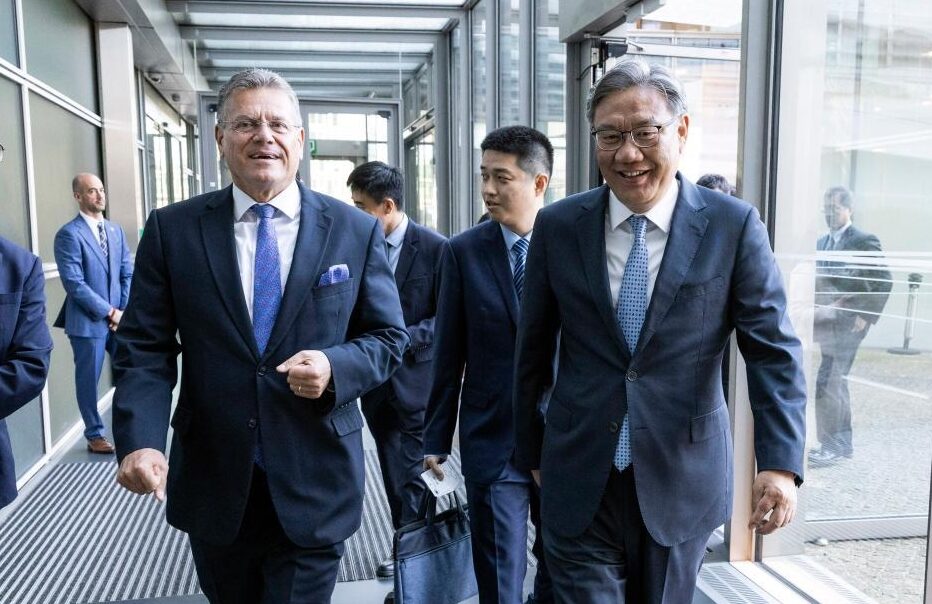
Photo: Razvan Socol / Wikimedia Commons / CC BY-SA 4.0
  •  

Women MEPs targeted by AI ‘nudifier’ apps push EU leaders to enforce December ban

Almost 150 European politicians have become targets of AI-generated deepfake pornography, 50 of whom are MEPs. The EU’s Green party has now taken the fight to the upper echelons of EU authority to push a ban on ‘nudifying’ apps.

Research by the think tank Agora Digital Transformation (ADT), published on Monday (5 October), found that 50 MEPs have been targeted by digital platforms able to digitally strip anyone whose picture is uploaded to it. Of these, 46 are women.

Another ADT study published in September found that the chances of becoming a victim of false sexualised portrayals are one in 14 for women, against one in 500 for male politicians.

Most worryingly, a woman has no way of knowing she’s been targeted because “the harm is often unseen until it has spread,” Monday’s study read.

MEPs have rallied behind the Green party in demanding EU leaders take concrete steps to limit the influence of such software, while requiring member states to set up national authorities to roll out an effective ban on ‘nudifier’ apps from 2 December 2026.

The Green party initiated an open letter, which was endorsed by 119 MEPs from the Socialists and Democrats, liberal Renew Europe and the Left, calling on the European Commission and member states to take decisive action against AI deepfakes of women politicians.

The appeal asks to strengthen EU resolutions on AI and digital protection by requesting that the commission guide national authorities on enforcing the ban, and that there be a designated and properly resourced body in every member state ready to implement the ban from December.

This article continues, but the full version is available only to EUobserver.com subscribers. Visit account.euobserver.com/membership

  •  

THIS WEEK: EU trade chief heads to China as Brussels unveils long-delayed pre-enlargement reforms

EU trade commissioner Maroš Šefčovič and Chinese commerce minister Wang Wentao are meeting in Beijing on Thursday (8 October) to discuss China’s growing trade surplus with the EU.

The surplus reached a record €360.6bn in 2025, up 15 percent from 2024, and widened another 10 percent in the first four months of this year.

The visit follows a meeting in Brussels in June, where Šefčovič said he wanted the dialogue to deliver tangible results by October, and the two sides set up working groups on trade balance, export controls, intellectual property and WTO reform. China has sent mixed signals, with Beijing reportedly showing openness to purchase agreements for European goods and possibly lower tariffs, while China’s commerce ministry insisted Brussels should not treat China as the source of the EU’s problems.

The EU put tariffs on Chinese electric cars in 2024, with extra duties ranging from 7.8 percent to 35.3 percent depending on the manufacturer. But hybrids weren’t covered, and Chinese hybrid exports to the EU jumped from 3,800 vehicles in October 2024 to roughly 50,000 in July 2026, adding to pressure on European carmakers already struggling to compete with Chinese manufacturers.

Šefčovič will also be hoping to secure assurances from his Chinese counterpart on access to rare earths and minerals for European companies, with a one-year moratorium on extra restrictions on rare earth and minerals exports from China – which also applies to the United States – due to expire in the coming weeks. In June, China assured Šefčovič that existing controls on rare earths and permanent magnets would not disrupt EU supply chains.

Meanwhile, there have been reports of some German companies stockpiling rare earths in case the Šefčovič-Wentao talks fail to break the deadlock and China imposes new export controls in retaliation for the EU’s ‘Made in Europe’ plan to protect its industrial supply chain.

If the Beijing talks fail, Germany and France could push for tougher measures at next week’s EU leaders’ summit, including a cap on Chinese hybrid-car exports, preference for European vehicles in public procurement and tighter limits on Chinese takeovers of European companies.

But China recently said it would “respond firmly” if the EU imposed restrictions on Chinese businesses or products.

Long-delayed accession reforms

In Strasbourg on Tuesday (6 October), the European Commission is expected to present its long-delayed pre-enlargement policy reviews to prepare the 27-nation bloc for the integration of candidate countries like Montenegro, Albania, Ukraine and Moldova.

EU capitals fear that enlargement could disrupt businesses and that new member states could use their veto to block decisions.

In response, the commission proposal is set to rely less on consensus and more on majority voting, including in sensitive areas such as security and defence, sanctions, human rights and enlargement itself – a change that could help speed up bids such as Ukraine’s.

Ironically, to get rid of unanimity in certain votes, von der Leyen’s proposal will need the unanimous approval of all 27 member states.

The text is also expected to set temporary limits on new members’ vetoes, longer safeguard periods, and cut the number of commissioners to two-thirds of the number of member states, with equal rotation.

Alongside the internal rules review, the commission is expected to unveil a revision of the standardisation regulation to fix gaps and increase transparency.

On Monday (5 October), EU chief diplomat Kaja Kallas will host Moldovan PM Vasile Tofan in Brussels for a regular meeting on the progress of the country’s association bid. 

The Eurogroup will also meet on Thursday in Luxembourg while EU financial ministers will meet on Friday.

Plenary week

In Strasbourg next week, MEPs are expected to condemn the results of the Russian State Duma election in which no party opposing Putin’s war on Ukraine was allowed to stand.

On Wednesday, they will debate priorities for the EU budget for 2028-2034 (the Multiannual Financial Framework – MFF) with signals of more money for Erasmus+.

And MEPs will vote on Tuesday on whether to inject €115m into a pilot programme to accelerate the development of military technologies called Agile. This comes as Putin escalates hybrid warfare against Europe.

Controversy is expected ahead of a vote to scrutinise the funding and political influence of Islamist groups in Europe. European Conservative and Reformists (ECR) have previously called for the Muslim Brotherhood to be considered terrorists.

Those feeling stressed in their jobs can look forward to mental health protections for workers if parliament votes to ask the commission to propose new rules for EU employers.

Portuguese prime minister Luís Montenegro will deliver a speech on Tuesday.

And a debate with Ursula von der Leyen and the Irish Council presidency will shape priorities for the EU summit later this month, 15-16 October.

Plenary talks will also address the migrant surge in the Spanish enclave of Ceuta this summer and how Europe should respond.

This article was updated

  •  
❌