Two Ukrainian defense-tech firms, The Fourth Law and Odd Systems, have joined forces to mass-produce thermal imaging sensors in Europe and the US, The Fourth Law told Militarnyi. The goal is to wean Western militaries off foreign suppliers, chiefly China, for the core part of every thermal camera.
Amid Russia's daily attacks, Ukrainian drone makers have been shifting production to allied countries. Linza and Zoom drones are now built in Germany, and another top manufacturer has taken its technology to Canada and Finland. Sensor plants would move a core component west, not just finished drones.
A Western answer to Chinese sensors
The project, called Project Foundation, will build long-wave infrared sensors, known as microbolometers. These chips register heat, so a camera can pick out a person or vehicle at night or through smoke. The aim, The Fourth Law said, is to "ensure the sovereignty of Western countries in the field of thermal imaging technology."
Plants in Europe and the US from 2027
The project will run two sites, First Foundation in Europe and Second Foundation in the US, from a headquarters in Eindhoven, a Dutch semiconductor hub. Mass production is due to start in 2027. Within three years, the partners want to quadruple Europe's output of these sensors and double America's.
Why Europe's supply isn't enough
Ukraine's front line burns through sensors faster than Europe can make them. "Europe currently produces less than 500,000 such sensors per year, while Ukraine consumes this amount in about five months," Odd Systems co-founder Yaroslav Azhniuk said in February, when he first announced plans for a plant able to make one million sensors a year. European sensors cost about five times as much as Chinese ones and are hard to buy at all, because Europeans need them too, he added.
Factories working for Ukraine abroad have already become sabotage targets. In March, an arson attack in Pardubice, Czechia, destroyed nearly all the production capacity of a plant making drones and thermal sights for Ukraine's army. Czech investigators are looking into a possible Russian trail behind the attack.
This article is from Food for Feed, a series investigating the global fishmeal industry. It is produced by the Outlaw Ocean Project, a news organization based in Washington, D.C., and excerpted by Mongabay. In late August 2025, a company named Marine Impex Pvt. Ltd. contacted the city council of Cuncolim, a city in southern India, to propose constructing a new fishmeal processing plant. Each month, the 1.6-hectare (4-acre) facility would process at least 2,400 metric tons of fishmeal, a protein-rich, dark-yellow powder made by pulverizing and cooking wild-caught fish, which is used as feed for farm-raised seafood like shrimp, salmon, and tuna. The proposal sparked outrage. In media coverage, local environmental advocates and politicians voiced strong objections. “If this project is allowed, it is as if we have killed the people of Cuncolim,” said city councilor Landry Mascarenhas. State lawmaker Elvis Gomes drafted a letter to the governor of Goa state, where Cuncolim is located, asking him to intervene and explained that the stench from existing plants chokes “the lungs with such foul air that the effect of it pervades for a prolonged period.” He added, “It is simply beyond a normal human’s capacity to endure.” The outcry in Cuncolim cast a spotlight on a powerful industry with a history of wrongdoing. Between 2018 and 2024, at least 30 Indian fishmeal plants were involved in a range of environmental violations and other legal infractions, such as dumping waste into waterways and boreholes, evading taxes, using illegal timber to fuel boilers,…This article was originally published on Mongabay
Russia is planning a winter strike campaign involving up to 1,000 missiles, drones, and bombs targeting, among other facilities, electrical substations, hydroelectric and thermal power plants, and boiler houses. The information is contained in a document that, according to sources cited by The New York Times, Ukraine's Energy Minister Denys Shmyhal presented as an intercepted Russian plan to destroy energy infrastructure systematically. The newspaper reported on 2 October.
Russia has been striking critical infrastructure across Ukraine since the beginning of its full-scale invasion. Such attacks have become particularly frequent ahead of and during winter. Ukraine's recent battlefield gains may have prompted Putin to reconsider his strategy and attempt to force Ukraine to surrender through winter strikes, analysts at the Institute for the Study of War (ISW) suggest. Russia's reported plans to attack Ukraine's energy, water supply, and sewage systems could threaten the basic living conditions of millions of people. Such strikes could increase pressure on civilians and the Ukrainian economy while forcing the state to divert more resources to emergency infrastructure repairs instead of defense needs.
The New York Times was unable to verify the document's authenticity independently, but noted that it was written in Russian and dated August.
Explore further
Warehouses, a home-improvement store, a farm: Russia’s strikes aimed past the grid at Ukraine’s civilian economy
A representative of Ukraine's defense-industrial sector who has reviewed the document believes it is more of a calculation than a finalized Russian military operations plan, according to Schemes, an investigative journalism project by Radio Free Europe/Radio Liberty (RFE/RL), in a report published on 8 October.
60 targets: how Russia could attack Ukraine's critical infrastructure
The document outlines how many missiles, drones, and bombs Russia would need to deprive Kyiv, Kharkiv, and Odesa of electricity, heating, water, and sewage services, Radio Liberty reported on 9 October. The document's full list of priority cities also includes Dnipro, Zaporizhzhia, Mykolaiv, Kherson, Poltava, Chernihiv, Kryvyi Rih, Cherkasy, Kropyvnytskyi, Lviv, Vinnytsia, and Ivano-Frankivsk.
Regions of Ukraine containing cities listed as “priority” targets in Russia's plan to attack critical infrastructure this winter (shown in grey). Map: Euromaidan Press
According to the document, Russia plans to begin by attacking substations near Ukraine's western border, through which the country receives electricity from Europe. Hydroelectric power plants could be targeted next, followed by facilities intended to shut down Ukraine's three operational nuclear power plants, Radio Liberty reports. The document lists a total of 60 key targets.
According to Schemes, the document states that Russia would need up to 770 Molniya and Geran drones, Dan-T/Banderol missile-drones, 170 FAB guided aerial bombs, and 75 Kinzhal and Iskander-M ballistic missiles to carry out the attacks.
Sewage systems could become Russia's next target
The document devotes particular attention to water supply and wastewater systems. These include pumping stations, treatment facilities, and other infrastructure essential for cities to provide residents with water and dispose of wastewater.
One of the water supply facilities. Illustrative photo: Ukrinform
Russia has not previously attacked such facilities on a similar scale, The New York Times notes.
Preparing for possible attacks on water supply and sewage systems is significantly more difficult than protecting energy infrastructure, Oleh Popenko, head of the Ukrainian Union of Utility Services Consumers, told Current Time, RFE/RL's Russian-language network.
“Sewage is a very complex system. There are specific challenges: where to discharge wastewater, how to organize treatment facilities, and so on. Some work is also underway in this sector, but it will be much more difficult here than with district heating utilities,” Popenko says.
Creating alternative routes in case sewage pumping stations are destroyed is an expensive and technically challenging task, he adds. Such construction could cost billions of hryvnias.
Explore further
14 dead in Pryluky, two each in Kyiv, Kremenchuk, and Oleksandriia: Russia’s night of 70 missiles
The priority is to equip water utilities with backup power sources so they can continue operating during power outages. However, if Russian strikes damage the sewage system itself, resolving the problem quickly will be much more difficult, Popenko believes. Specific solutions, including wastewater disposal and the operation of treatment facilities, will have to be determined according to the extent of the damage.
Sewage pumping stations play a particularly important role. They pump wastewater onward for disposal and treatment. If such a station is put out of operation by a strike, the city needs an alternative way to divert wastewater while the damaged facility is being repaired, Popenko says. Bypass pipes or channels could be installed for this purpose, but setting up such a system during wartime is far from easy.
Air defenses remain crucial to Ukraine's winter preparations
Preparations for winter are underway, but protection for energy infrastructure remains inadequate, Popenko believes. The main concern is large substations that transmit electricity from nuclear power plants and distribute electricity imported from Europe.
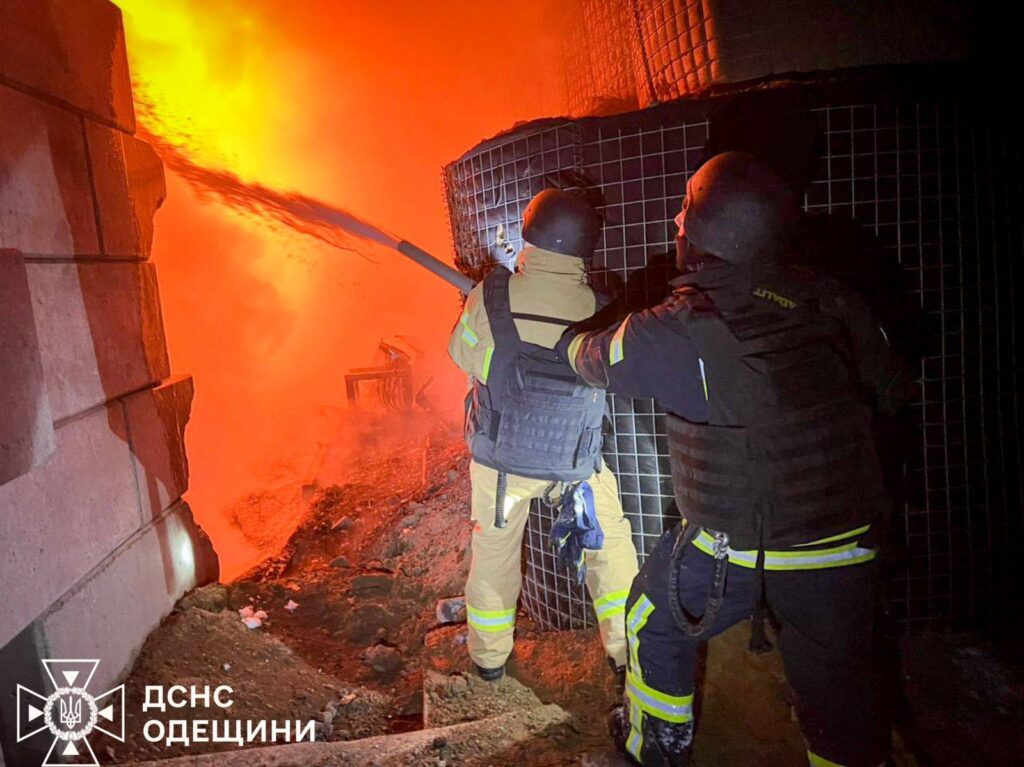
Rescuers extinguish a fire caused by a Russian strike in Odesa Oblast. Illustrative photo: State Emergency Service of Ukraine in Odesa Oblast
At the same time, some protective measures are already proving effective. Despite drone attacks over two days, one of Kyiv's substations withstood the strikes, and the city did not lose power, although scheduled outages were in effect, the expert says.
Popenko considers a repeat of last winter's scenario, when parts of Kyiv went without heating for weeks, entirely possible. Russian forces continue to attack energy facilities, and in his assessment, strengthening air defenses in Kyiv is the only way to protect its combined heat and power (CHP) plants from large-scale attacks.
“There are no other ways — for example, building some sarcophagi around CHPs or constructing shelters — because Russia can destroy these facilities again through massive strikes. And then the city risks being left 50–60% without heat,” Popenko believes.
Residents are also preparing for winter, but their options vary, he says. Some homeowners' associations participate in government programs to insulate apartment buildings and purchase backup power supplies for elevators and pumping stations. Owners of private houses are buying generators, among other measures. However, such equipment and preparations require substantial funds, meaning not everyone can afford them, he notes.
Ukraine has already experienced prolonged power outages during previous winters, particularly in 2022 and 2023. At the time, some regions went without electricity for 18–20 hours a day, the expert says. This experience may help people prepare for possible disruptions, but it does not eliminate the risk of further attacks and infrastructure damage.
A giant wind farm risks blinding radar used to track Russian jets and missiles, the Ministry of Defence has warned as it opposes Net Zero plans to build 23 turbines twice the height of Big Ben in Yorkshire.
from 21st Century Wire: “Muslims will not relinquish Jerusalem.” The sentence appeared in a Saudi schoolbook’s Arabic language exercise, then disappeared from later editions. An Israeli organisation monitoring the books described the removal as deleting a “politically charged reference.” In Jordan, the same organisation recorded another disappearance. Maps bearing the name “Palestine” were replaced with […]

 Login