Login

Mullin: ICE Agents “Weren’t Aware” Child Was in Car They Fired On in Marble Hill
DHS blames the father, while Mamdani calls the shooting reckless

 Gli Stati Uniti hanno bombardato l’Iran durante i negoziati, e il Pentagono ha già pronti i piani per una nuova campagna dopo il 3 novembre. Intanto a scegliere i bersagli sono sempre più spesso sistemi di intelligenza artificiale sviluppati dai giganti della tecnologia: Palantir, Microsoft, Amazon, Google. E l’Italia? Il ministro Crosetto conferma 500 militari in Arabia Saudita, un nostro Eurofighter colpito a Ta’if e l’esercitazione nucleare Nato Steadfast Noon nei nostri cieli. “Non siamo in guerra”, dice. Ma allora che cos’è?
 Petrolio sopra i 100 dollari, gas alle stelle, Hormuz al minimo dei transiti. Ucraina: strage di civili a Kramatorsk e nuovo tavolo a Miami.
 Cisgiordania: i coloni aggrediscono i raccoglitori di olive.
 Gaza: due milioni di persone verso il quarto inverno senza riparo.
 Ne parliamo con:
 Tiziana Alterio: giornalista indipendente e scrittrice, già Rai e Mediaset, reporter in Africa, Asia, Sud America e Paesi arabi.
 Padroni nell’ombra (2025) · Putin. L’uomo di ghiaccio che sfida l’Occidente (2022) Gianmarco Pisa: operatore e formatore di pace dell’IPRI-CCP, con i Corpi Civili di Pace in Kosovo; ricercatore RESeT e IRES Campania, membro della Rete italiana Pace e Disarmo. Più eterno del bronzo (Multimage) · Paesaggi kosovari 1998-2018
 Conduce Jeff Hoffman
 SOSTIENI CASA DEL SOLE TV
 Casa del Sole TV è un progetto di giornalismo indipendente, autofinanziato, senza editori né partiti.
 IBAN: IT63P0326822300052392596590 Intestato a: La Casa del Sole Edizioni
 Causale: Donazione Casa del Sole TV
 ABBONAMENTO YOUTUBE
 https://www.youtube.com/@CasadelSoleT…
 Analista Multipolare: €5/mese
 Inviato della Verità: €15/mese
 Architetto del Futuro: €25/mese I LIBRI DI MARGHERITA FURLAN
 «BRICS Scacco Matto», disponibile in italiano, inglese e russo
 SEGUI CASA DEL SOLE TV
 YouTube: @CasadelSoleTVChannel #Levante #CasaDelSoleTV #IntelligenzaArtificiale #AI #Iran #Israele #USA #Palantir #BigTech #Gaza #Cisgiordania #Ucraina #Crosetto #ArabiaSaudita #CrisiEnergetica #Hormuz #Geopolitica #Pace #InformazioneIndipendente #TizianaAlterio #GianmarcoPisa #Padroninellombra
L'articolo 🔴 L’ALGORITMO CHE UCCIDE | LEVANTE – Casa del Sole TV proviene da Casa del Sole TV.

Ukraine's campaign of so-called "middle strikes" targeting Russian supply lines isn't generating the same headlines it did back in the spring, when the campaign was intensifying.
But that doesn't mean Ukrainian units aren't launching thousands of drones a month and blowing up a lot of Russian trucks. Indeed, the pace of Ukrainian strikes, concentrated along the main supply routes threading through occupied southern Ukraine into occupied Crimea, has leveled off without ever really decreasing since an early summer surge.
It's evident Ukraine's middle-strike campaign "didn't stop and wasn't slowed down," noted French mapper Clément Molin, one of the most important observers of the counterlogistics campaign.
For September, Molin tallied 770 confirmed drone strikes on Russian trucks in the logistical zone 10 km beyond the line of contact. That's up from 630 strikes in August, 656 in July, and 586 in June, the month the campaign really got underway. There were just 214 strikes in May and at most a few dozen in each of the previous three months.
Whether Ukrainian troops can take advantage of the Russians' weakening logistics anytime soon is less evident.
Since June, the Ukrainians have hit around 700 Russian trucks a month that analysts can confirm with video and photographic evidence. There are undoubtedly many more damaged and destroyed trucks that left no digital evidence.
In southern Ukraine
— Clément Molin (@clement_molin) October 7, 2026mid-range drone strikes continue to relentlessly target Russian
road logistics
In total, more than 3 000 trucks and vehicles have been hit on key roads since May 2026, while the R-280 road remains at the heart of the attacks.THREAD
pic.twitter.com/u9hixSvLAV
There are thousands of Russian trucks on the road in Ukraine every day, so hitting 700 of them in a month won't immediately strangle Russian logistics. But that accumulating destruction does strain Russian logistics—and terrify the truck drivers who are in the drone crosshairs. "Russian drivers post videos on a daily basis, showing how dangerous a ride in southern Ukraine is getting," Molin wrote.
What's remarkable is that the counterlogistics campaign hasn't faltered even as the Russians have adapted. Early on, Russian trucks mostly traveled alone and without protection, making them fairly easy picking for a bevy of Ukrainian middle-strike drone types including the Hornet, the B-2, the RAM 2X, the Chaklun, and various high-endurance first-person-view quadcopters.
The drones ride along Ukraine's overlapping command and control systems, which include Starlink satellite terminals (some dangling from balloons) as well as mesh radio networks. Many of the drones have built-in AI for autonomously detecting and homing in on trucks in the final seconds of flight.
The moment the Hornet UAV struck a logistics vehicle in the occupied Kherson region. pic.twitter.com/Hc0DCcTnef
— Exilenova+ (@Exilenova_plus) October 7, 2026
Reeling from the truck strikes, the Russians adapted this spring. Commanders began requiring all trucks to travel in convoys including mobile fire support groups, analysis group Tochnyi reported in May, citing Dmytro Putiata, a retired command post battle captain from the Ukrainian Unmanned Systems Forces 20th Brigade "K2."
Today the Russian convoys have a standard structure, according to Molin. "Convoys usually gather three to five trucks and two to three air-defense trucks." Combined with radio jamming gear that's increasingly common on both the supply trucks and the gun trucks, that's seemingly a lot of protection.
But the drones target the gun trucks, too, peeling back the protection in order to expose the supply trucks to follow-on attacks. In that way, the Ukrainians have sustained their attacks on the supply trucks despite the increase in mobile air defense activity along the most important supply routes.

And it's going to get worse for the Russians as fall wears into winter. "Supplying Crimea is turning into a nightmare and the arrival of winter and more difficult conditions will not help," Molin wrote.
There will be less foliage on the trees lining the roads, and thus less cover from Ukrainian surveillance. Moreover, Molin pointed out, "it will be more difficult to go off-road" and avoid the big paved roads that are the main drone kill zones.
Russian logistics are under pressure, and that pressure is only increasing. Ultimately, the Ukrainians aim to starve Russian forces in Crimea. Strikes on cargo ships plying the Black Sea prevent the Russians from simply shifting the logistics off the coast. Meanwhile, strikes on overland logistics "may lead to substantial softening of front-line positions," Tochnyi noted in May.
Softening those front-line positions to the point of melting away could facilitate what Tochnyi described as "eventual breakthrough operations" in occupied southern Ukraine.
It's not inconceivable. Ukraine's 3rd Army Corps recently proved, by way of its successful Operation Vivaldi, that local Ukrainian counteroffensives are possible.
But that doesn't mean they're easy. To win, the 3rd Army Corps had to carefully husband its forces and meticulously prepare the battlefield under conditions of strict secrecy before attacking. That same kind of preparation is underway along the supply lines into Crimea, but it's unclear whether local Ukrainian forces have enough combat power in reserve to shift from defense to offense and exploit Russia's deepening supply woes.
At least not yet.
 China is planning to open the country’s space station to other countries, intended to transform the orbital facility into a global research platform. Yang Liwei, China’s first astronaut and deputy chief designer of the China Manned Space Agency (CMSA), discussed the plan during the now underway 77th International Astronautical Congress in Türkiye’s Mediterranean city of […]

This is an edition of The Atlantic Daily, a newsletter that guides you through the biggest stories of the day, helps you discover new ideas, and recommends the best in culture. Sign up for it here.
Kimberly Guilfoyle was so close to getting it right.
The Trump hanger-on—former fiancée to Don Jr. and the current ambassador to Greece—was exchanging messages with a man named Eric Deters, according to a bombshell Wall Street Journal story last night. Deters, a right-wing podcast host, failed political candidate, and suspended lawyer in Kentucky, wanted help in clearing up some tax issues, and also wanted the Trump administration to extradite a doctor whose alleged fraud victims he was advising in a legal case. Guilfoyle, the messages indicate, wanted money—in one instance, a $100,000 wire—and she wanted it untraceable.
Guilfoyle was right to worry about secrecy. She was about to begin confirmation hearings for her ambassadorship, and understood the pay-to-play could hurt her. Yet neither she nor Deters could stop breaking the Stringer Bell rule by recording their skullduggery in writing.
“It won’t show up anywhere if you wire money to American Express,” Guilfoyle wrote. “Please.” And in another: “Honey please I need you to get this done for me today.” Yet even as she laid these instructions out, she kept haranguing Deters for indiscretion. “I really wish you would stop papering all these things. It’s really dangerous and not helpful to you or me while you could simply just call me on signal,” she wrote, referring to the encrypted messaging app. In one message, she wrote, “If you write an email or a text about, l’m gonna kill you cause I love you but you’re so out of control.” Unfortunately for Guilfoyle, her Signal messages were not as safe a space as she might have wished. (The Journal does not reveal how it viewed the messages. Guilfoyle’s lawyer broadly disputed their authenticity to the paper but offered no details.)
Somehow, this is not the only Trump scandal with Balkan ties in the news this week. The New York Times reported that James Blair and Chris LaCivita, who are ostensibly President Trump’s top political advisers, traveled—during an intense midterm campaign in which Republicans appear to be on the verge of serious setbacks—to advise a candidate in Bosnia and Herzegovina’s self-governing Serbian entity.
Both of these stories show the way that many people in Trump’s orbit view their positions not as public service but as a profit center. There’s a long and often depressing pattern of former officials capitalizing on government and political work, but Trump’s aides aren’t even willing to wait until they take their leave to start taking. Forget a team of rivals. Trump world is a team of mercenaries, in some cases literally.
Jared Kushner, who was a senior adviser in his first presidency and is married to his daughter Ivanka, continues to work as an envoy for Trump while pursuing business deals around the world. As Dexter Filkins wrote in The New Yorker in September, Kushner’s record as a diplomat is underwhelming, yet his financial gains have been enormous. “He represents a new kind of Washington figure, for whom public office serves as a means to extraordinary wealth,” Filkins wrote. Kushner and Ivanka Trump even have their own Balkan boondoggle, an attempt to develop an island in Albania that has run into legal and political difficulties.
Earlier this year, the Times reported that Commerce Secretary Howard Lutnick helped negotiate access to Kazakh tungsten reserves for an American mining company, and the federal government provided $1.6 billion in financing. Lutnick’s sons and Trump’s sons are both involved with companies that stand to profit from the deal (though representatives for them have said that they did not play a role in the deal). A Washington Post investigation this summer noted that Trump’s sons have invested heavily in defense-technology companies; the companies have scored “at least $3.2 billion in direct government business since the sons invested and an additional $3.1 billion in future contract options.” (Company representatives told the Post that they secured their business without assistance from Trump’s sons.)
Where do any of these people get the idea that this is appropriate or that they can get away with it? From the president himself, naturally. Trump has moved on from small-scale grifts such as charging the Secret Service exorbitant fees to stay in his hotels during his first term to far more ambitious and lucrative schemes such as crypto ventures; even conservative estimates put his gains during this term alone in the billions.
Though Trump doesn’t have ethical scruples, he does have a sense of right and wrong: It’s right for him to profiteer, but wrong for others to make too much money from his name. That’s where Blair, LaCivita, and Guilfoyle may run into trouble. Politico reports that Republicans’ “knives are now fully out” for the two consultants. Trump himself weighed in on Truth Social, saying he was unaware of their clients but adding that he “will, on reflection, ask them and, if there’s a conflict, I will terminate them, immediately!” Firing them just before the midterms seems risky, as it might just create more chaos for Republicans, but they could make for good scapegoats after the fact. Trump has not spoken publicly about the Guilfoyle story, although Vice President Vance said he didn’t “love that.” In a further embarrassment, the article emerged while Secretary of State Marco Rubio was visiting Athens.
Perhaps inevitably, Guilfoyle’s relationship with Deters ended acrimoniously. “I have paid you $300,000 over the years,” he wrote her in 2025, adding, in an amusingly self-negating flourish, “As of this memo, I have not received one favor. I am not naive or a sucker.” She was not happy, either. “What a nightmare you’ll literally cost me my ambassadorship stop writing,” she told him at one point, per the Journal. Her warning may have been too late.
Related:
Here are three new stories from The Atlantic:
Today’s News
Dispatches
Explore all of our newsletters here.
Evening Read

Forgive the Bad Texters
By Julie Beck
Whenever I receive a text, this is what happens. I pick up my phone. So far, so good. I experience whatever emotion the message elicits—the pleasant warmth of being reached out to, possibly the annoyance of being interrupted. Then, if conditions are right, if I’m not too busy or in the middle of talking with someone else, if my mind is at peace, if my anxiety is at no more than a low hum, if Mercury is not in retrograde, I will respond right then and there. If conditions are not right, it will be as though the text never existed at all.
More From The Atlantic
Culture Break

Explore. Anne Carson, the winner of this year’s Nobel Prize in Literature, makes ancient texts feel tantalizingly new, Walt Hunter writes.
Take a look. An ambitious retrospective examines the life and work of Jackson Pollock and Lee Krasner—to brilliant effect, Sebastian Smee writes.
Rafaela Jinich contributed to this newsletter.
When you buy a book using a link in this newsletter, we receive a commission. Thank you for supporting The Atlantic.

© Aris Messinis / AFP / Getty


Armored vehicles aren't dead in Ukraine—they just need a lot of help. That's one of the biggest lessons from the Ukrainian 3rd Army Corps' Operation Vivaldi, its recent successful counteroffensive just north of the town of Lyman in eastern Ukraine's Donetsk Oblast.
Russia spent 18 months building its salient toward Sloviansk; Ukraine took much of it back in three. By 30 September, three of four planned phases in, the operation had returned 176 sq km to Ukrainian control, taken 250 Russian prisoners, and cost Russia more than 5,000 killed and wounded, Ukraine's presidential office said. It also foiled a Russian plan to break into the rear of the Sloviansk-Kramatorsk urban area, the office said.
Defying critics who insisted vehicles couldn't possibly survive in the drone-patrolled gray zone, the 3rd Army Corps repeatedly deployed mechanized forces as it counterattacked across a roughly 100 sq km salient the Russian 20th and 25th Combined Arms Armies had extended toward Sloviansk, one of the last two big free cities in Donetsk Oblast.
Maneuvering for months under a veil of secrecy, the 3rd Army Corps found and exploited gaps along the flanks of the 20th and 25th CAAs, ultimately breaking into the Russian armies' rears and forcing them to pull back across the Zherebets River in order to avoid encirclement.
Armored vehicles were key to the Ukrainian effort. They sped assault troops into battle, dropped them off under fire, and then supported them as they clashed with the Russians. "Maneuver warfare isn't going anywhere," stated Ryan O'Leary, a US Army veteran who once commanded volunteers in Ukraine.
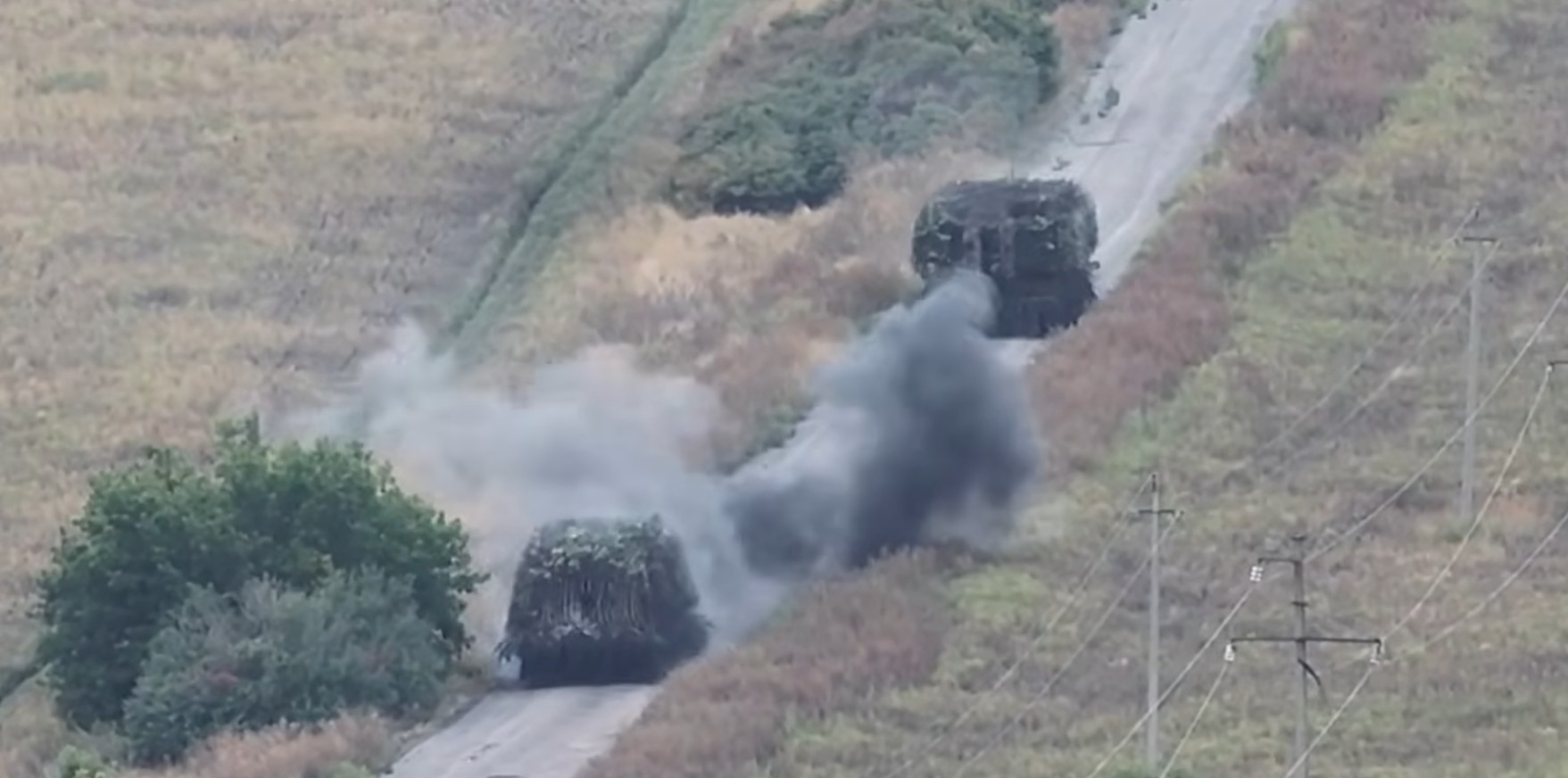
3rd Army Corps commanders knew they were taking a risk deploying armored vehicles in a Russian-controlled salient patrolled by first-person-view drones from Russia's elite Rubicon Center drone unit. But they clearly believed that, with adequate support, the vehicles could accomplish their missions—and survive.
They were right. A dramatic video shot by 3rd Army Corps troopers depicts the troopers disembarking from their armored trucks and rushing into the fight while small arms fire clatters all around them.
Given the intensity of the Russian fire, a mechanized assault "was the only real way to push positions in an effective manner to keep losses low as well as gain and hold momentum and aggression," O'Leary wrote. Walking into battle under the cover of trees might help the infantry avoid the attention of overhead drones, but it takes too long to sustain an aggressive assault, and it can be difficult to mass enough footborne infantry to overcome stiff enemy defenses.
"This is something that hasn't changed even with the advent of drone warfare coming of age," O'Leary added. "Suppression tactics and such have changed and now there is more than just indirect fires and counterassaults that you must be able to suppress and plan for."
But the concept of the infantry-carrying armored vehicle "isn't going anywhere," O'Leary stressed. "Especially when it takes a drone tens of minutes to get to target area, acquire target and hit the target. Right now, the front is extremely susceptible to maneuvering forces on assaults if it is planned right and executed properly."
The 3rd Army Corps' Operation Vivaldi is an excellent example of an operation that was planned right and executed properly—in ways that helped the corps' mechanized forces fight and survive.
New footage shows Ukrainian forces storming and clearing Russian positions during the "Vivaldi" counteroffensive in the Lyman direction. The assault was captured firsthand by Ukrainian soldiers using GoPro cameras. pic.twitter.com/qxyNHl0n3A
— Vijesti (@Vijesti11111) October 6, 2026
The corps explained that it deployed footborne scouts to find the best paths for follow-on vehicular assaults—and subsequent medical evacuations. Scouts "conducted recon of the front lines, ensured the breakthrough of equipment and led adjacent units along secret paths while evacuating the wounded," the 3rd Army Corps stated.

Before the armored vehicles rolled into action along the pre-scouted paths, the 3rd Army Corps deployed robotic engineering vehicles to clear Russian mines. After that, the corps sent in old BTR-60 wheeled armored vehicles modified for remote control and packed with anti-tank mines. These "robotic kamikaze complexes ... were used to demolish the enemy's strongest fortifications," the corps said.
Only after the assault routes were scouted and cleared of mines and Russian strongpoints did the manned vehicles and their precious infantry cargo roll out. We don't know how many losses the 3rd Army Corps' mechanized infantry suffered on the attack, but we do know they ultimately prevailed—when the battered Russian 20th and 25th CAAs retreated.

"Recent Ukrainian operations demonstrate that maneuver is not dead," stressed Mick Ryan, a retired Australian army general. "Despite the difficulty in ground operations maneuver observed in eastern Ukraine over the past few years, offensive operations are still possible in modern war. But they need the intellectual effort to develop new techniques to make them viable and repeatable at scale."
In addition to the reconnaissance and robots-first engineering and suppression tactics the 3rd Army Corps employed, Ryan recommended commanders deploy more drone-grounding electronic warfare and use AI tools to help plan attacks.
But ages-old human elements are still essential, Ryan wrote. "Developing viable methods for offensive tactical and operational maneuver in the 21st century also demands the inclusion of older ideas about the employment of mass, logistic support and casualty evacuation [and the] maintenance of morale and leader's provision of purpose to their people."
Even when the assault route is clear, it's understandably terrifying to ride in an armored vehicle across drone-patrolled terrain. But a good leader can motivate their troops to try.