❌

Reading view

Albanian Students Clash With Police Outside the Education Ministry

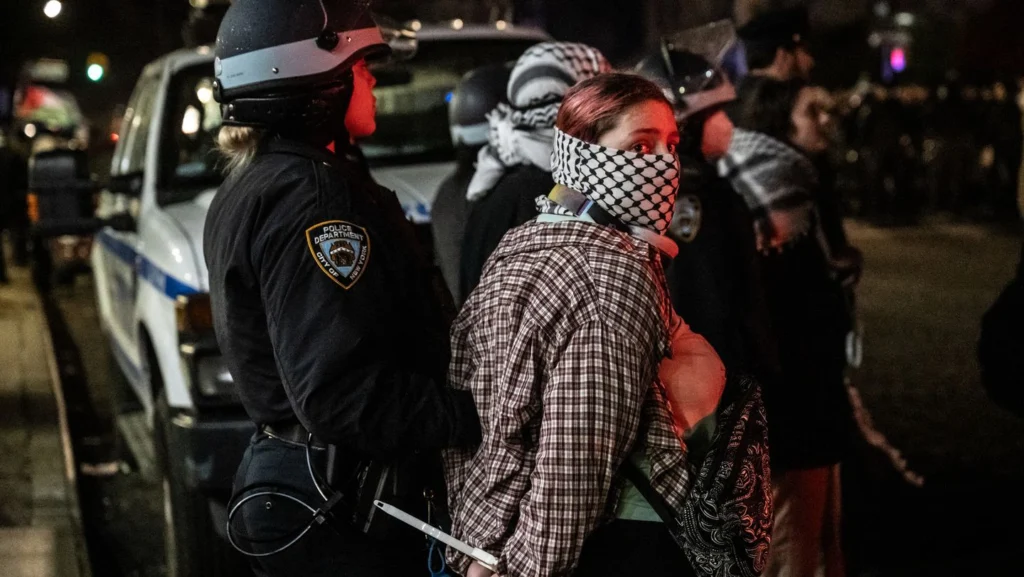
Hundreds of university and high school students clashed with Albanian police on Monday outside the Ministry of Education in Tirana during a protest over university conditions, tuition costs, and a lack of financial support.

RELATED:

French Student and Teacher Protests More Than Double in Participation

The demonstration began at 2:00 p.m. local time, when the young people blocked the street in front of the Ministry and threw paint, eggs, and firecrackers at the façade. Subsequently, some protesters tore up barriers and paving stones to hurl at the building, shattering its windows, according to local media reports.

Police detained 23 protesters, and at least six officers—as well as one journalist—were injured, the Ministry of the Interior reported, as cited by the Albanian public broadcaster RTSH. None of the injuries are life-threatening.

According to the official statement, police units intervened proportionately to neutralize those responsible for the incidents and restore order. Police responded with tear gas and a high-pressure water cannon before advancing on the crowd.

🚨🇦🇱 LIVE FROM TIRANA: Police assault a student who refuses to back down, confronting six officers before being arrested

✊ STAND WITH THE STUDENTS! STOP POLICE BRUTALITY!#Albania #Tirana #StudentProtest #ACAB pic.twitter.com/pHguk3N3ym

— Anonymous TV 🇺🇦 (@YourAnonTV) October 13, 2026

The students, primarily from the University of Tirana and the Polytechnic University, are demanding improvements to university facilities and student dormitories, as well as greater financial support for the student body. They are also calling for the resignation of the Minister of Education, Mirela Kumbaro.

During the protest, demonstrators chanted: Without youth, there is no Albania. According to the newspaper Gazeta Shqip, the mobilization was prompted by the poor condition of the country’s universities, the cost of education, and the lack of public financial aid.

The protest is part of the so-called “Flamingo Revolution,” an opposition movement against the government and the political system that began in May in response to a luxury tourism project in the protected Vjosa-Narta lagoon—a project linked to Jared Kushner, son-in-law of U.S. President Donald Trump.

Since then, the movement has expanded its demands, calling for the formation of a technocratic government and the ousting of Edi Rama and veteran conservative leader Sali Berisha from power.

#Albania | The police violently cracked down on citizens protesting outside Parliament in Tirana, where they were demonstrating against Prime Minister Edi Rama and a tourism project linked to the family of U.S. President Donald Trump.

The clashes occurred during the final… pic.twitter.com/caorFLU1jP

— teleSUR English (@telesurenglish) July 23, 2026
  •  

No contact with command, a comrade maimed by a mine. A former TV director fought—and halted the Russians

Senior Sergeant Dmytro, call sign Berezen (“March”).

A Ukrainian drone sergeant who volunteered for the infantry held a frontline position for six months, ArmyInform reported. He saved three soldiers in that time, and in one fight he stopped a Russian advance after contact with command was lost. The agency did not say where or when.

Senior Sergeant Dmytro, call sign Berezen “March”, spent 20 years as a television director before the invasion. In the 152nd Separate Jaeger Brigade, he served as chief sergeant of a drone platoon, worked with three crews, and trained soldiers. When the need arose to reinforce the infantry, he volunteered to switch. ArmyInform did not say what created that need.

“I didn’t come here to a sanatorium. I’m in my third year of fighting, I know what this is. It was my choice,” Dmytro said

Two wounded, one firefight

One comrade was hit by a mine and lost a leg. As Dmytro treated him, Russian troops began moving toward the position. Another wounded soldier was trying to reach them, and contact with command was lost. He killed two Russian soldiers and halted their advance, ArmyInform reported. He said he barely thought about himself, because a breakthrough could have hurt the soldiers holding positions behind him.

Not everyone could be saved. One wounded comrade was about 200 meters away. Dmytro heard his voice on the radio but could not leave his position mid-fight. Over the six months, he saved three soldiers. Two left the position with him, and the third was evacuated wounded. No money, he said, is worth blood.

  •  

Germany works to organize a Coalition of the Willing meeting as Russia strikes Ukraine’s energy sector

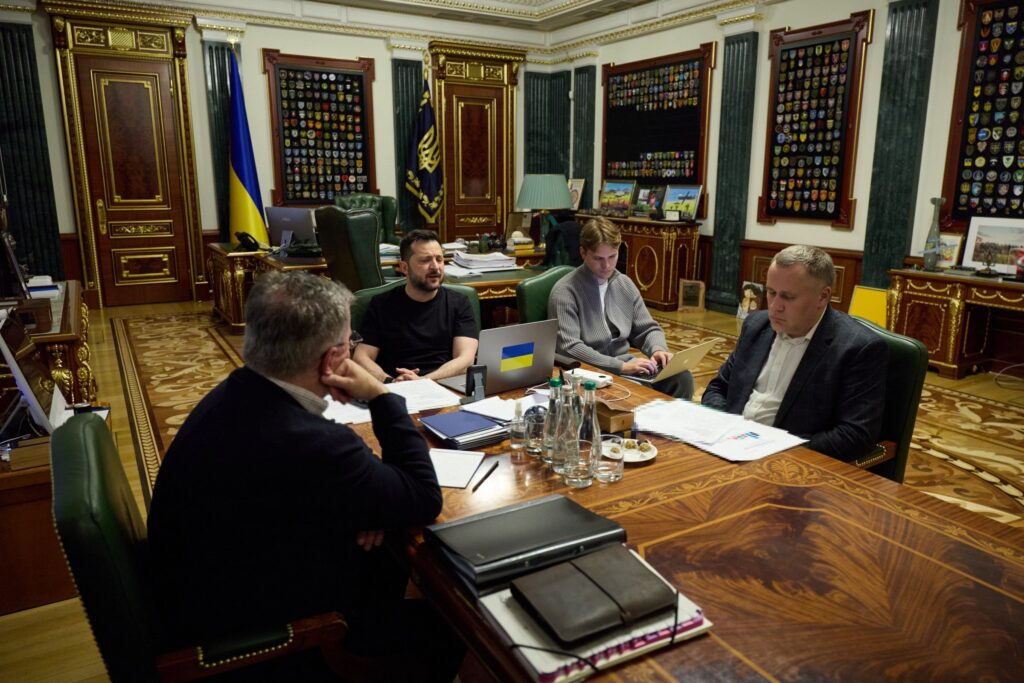
Ukrainian President Volodymyr Zelenskyy during a phone call with German Chancellor Friedrich Merz, 12 October 2026. Photo: Volodymyr Zelenskyy/X

Germany is preparing a new meeting of the Coalition of the Willing to coordinate further support for Ukraine, President Volodymyr Zelenskyy said on 12 October following a conversation with German Chancellor Friedrich Merz.

Russia continues to strike Ukraine’s energy infrastructure despite US President Donald Trump’s claim that Moscow has agreed to an energy truce. German Chancellor Friedrich Merz is initiating a meeting of European leaders to discuss assistance to Ukraine in this situation.

Kyiv and Berlin have also agreed to hold a meeting of national security advisers in the E3 format, with Ukraine participating, according to the statement. The format involves an informal grouping of three leading European countries: the United Kingdom, France and Germany.

Zelenskyy and Merz discuss energy truce and support for Ukraine

During the conversation, the two sides also discussed US President Donald Trump’s proposal for an energy truce and Russia’s subsequent actions. Russian forces continue to attack Ukraine’s energy infrastructure, Zelenskyy noted.

“This is exactly how the Russians behave when pressure eases. It is very important that Europe continue to act on principle,” Zelenskyy stressed.

German Chancellor Friedrich Merz speaks online with Ukrainian President Volodymyr Zelenskyy, 12 October 2026. Photo: Volodymyr Zelenskyy/X

Germany is coordinating preparations for a meeting of the Coalition of the Willing, the Ukrainian president noted. The two sides also discussed support for Ukraine’s financial stability. Further steps are to be coordinated in greater detail during a meeting scheduled for this week, Zelenskyy said.

The Coalition of the Willing seeks additional support for Ukraine

The Coalition of the Willing was initiated by the United Kingdom and France, which held talks with representatives of 37 countries in March 2025 on supporting Ukraine in the event of a peace agreement. The initiative envisaged financial assistance and the deployment of troops, air forces or naval forces to protect Ukraine against renewed Russian aggression, Bloomberg reported.

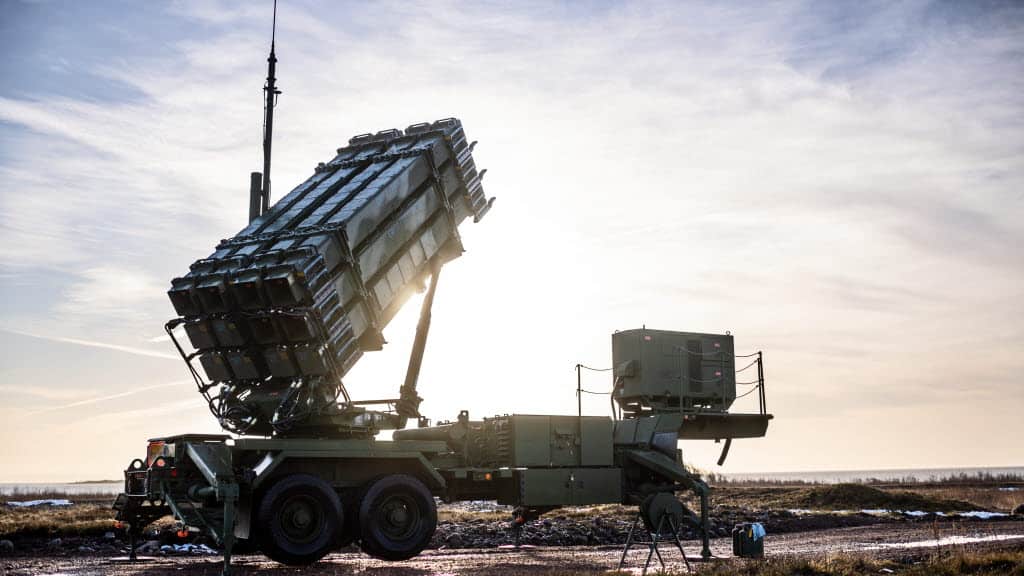
The latest meeting of the Coalition of the Willing took place on 24 August and was the 16th meeting, according to a statement on the website of the President of Ukraine. Zelenskyy called on partners to strengthen Ukraine’s air defense and provide at least 300 missiles for Patriot systems for the winter, the statement said.

Patriot PAC-3 surface-to-air missile system.
The Patriot PAC-3 surface-to-air missile system. Photo: Swedish Ministry of Defense

The president also proposed bringing forward part of the European loan financing planned for 2027 so that Ukraine could receive the funds this year. He separately stressed the need to find a mechanism for using frozen Russian assets to defend Ukraine and to unblock the maritime corridor in the Black Sea.

“We value this format—the Coalition of the Willing. It brings together countries that are ready not only to talk about security but also to act. We need this—to act and build real security together,” Zelenskyy stressed.

A ceasefire in words, but fresh attacks on energy infrastructure in practice

Ukraine and Russia had allegedly agreed to an immediate energy ceasefire, US President Donald Trump said on Truth Social on 11 October. However, at the time of publication, neither Kyiv nor Moscow had confirmed such an agreement, Ukrainska Pravda reported.

Ukraine supports the ceasefire and is awaiting details from the US side, Volodymyr Zelenskyy said in a post on X the same day. Russia must also agree to halt the strikes, he stressed.

Ukrainian forces had received the relevant orders, and Kyiv was ready to refrain from striking Russian energy infrastructure provided Russia reciprocated, Zelenskyy said in his evening address on 11 October.

Russia continued attacking Ukraine’s energy infrastructure after the ceasefire was announced, including striking a gas production facility and a petrol station, Zelenskyy said on his official Telegram channel on 12 October. Moscow had shown no willingness to abide by the ceasefire, the president added.

  •  

No, China is not filling the Western aid gap in Southeast Asia

When Australia’s Lowy Institute think tank released the 2025 edition of its Southeast Asia Aid Map in July last year, it projected that Western aid cuts would shift the region’s development finance toward Asian partners. Specifically, the report expected the center of gravity to “drift East, notably to Beijing but also Tokyo and Seoul.” Lowy’s […]

The post No, China is not filling the Western aid gap in Southeast Asia appeared first on Asia Times.

  •  

EU Caps Chinese Hybrid Car Imports at 350,000 as Brussels Moves to Protect Europe’s Motor Industry

The European Union has reached an agreement with China to restrict imports of Chinese hybrid vehicles to 350,000 annually, introducing a significant new barrier to the expansion of Chinese manufacturers in Europe’s automotive market.

The arrangement, confirmed on 12 October, follows months of negotiations between Brussels and Beijing and reflects growing concern about the competitive position of European carmakers.

The import ceiling could reduce Chinese hybrid vehicle sales in the EU by more than half compared with previously anticipated volumes, although the actual effect will depend on demand, product classifications and implementation.

The agreement comes as manufacturers gather for the Paris Motor Show, where the future of European vehicle production, Chinese competition and industrial policy have become central subjects.

China’s Commerce Ministry has presented the outcome as a negotiated arrangement intended to preserve trading relations, while the European side has emphasised the need to prevent rapidly increasing imports from undermining domestic production.

Chinese manufacturers confront a new European barrier

Chinese carmakers have expanded aggressively in overseas markets as domestic demand has weakened. Chinese passenger vehicle exports rose sharply in September, with manufacturers increasingly targeting Europe, Latin America and Asian markets.

Hybrid vehicles have become particularly important because they offer consumers lower fuel consumption without requiring the same degree of dependence on charging infrastructure as fully electric cars.

This has allowed Chinese brands to compete in market segments where European manufacturers retain substantial established production capacity.

The new quota limits the number of eligible Chinese hybrid vehicles permitted to enter the European market each year. According to details of the import restrictions, shipments exceeding the permitted volume would face restrictions at EU customs.

The mechanism differs from a conventional tariff because imports beyond the ceiling cannot simply enter the market by paying a higher duty. Manufacturers and importers will need to consider both delivery costs and the availability of import allocations.

European manufacturers seek protection

The measures arrive amid growing pressure on the European automotive industry, which faces high production costs, expensive energy, competition from Chinese manufacturers and the capital requirements of shifting towards electrified transport.

Companies operating in Germany, France, Italy and other established manufacturing centres must fund the development of new vehicles while maintaining existing factories and employment.

Chinese manufacturers benefit from extensive domestic production networks, considerable scale and access to battery manufacturing capacity.

European policymakers have questioned whether competition takes place under equivalent economic conditions, particularly where Chinese producers receive support from state-directed industrial policies.

Beijing rejects allegations that its export performance results principally from unfair state assistance, arguing that Chinese companies have achieved competitiveness through investment, innovation and efficiency.

The quota represents a departure from the assumption that European consumers will necessarily have unrestricted access to the lowest-priced imported vehicles.

Its economic effects will depend partly on whether European manufacturers can use the additional protection to improve productivity and develop more competitive models.

Will Chinese manufacturers move production into Europe?

Restrictions on imports do not necessarily reduce the presence of Chinese-owned companies in the European automotive industry.

Several manufacturers are already developing production capacity outside China, including within the European Union. BYD’s investment in Hungary is one example of how Chinese companies can pursue access to European consumers through local manufacturing rather than relying entirely on imported finished vehicles.

The new arrangements could strengthen the commercial incentive to expand such operations.

For European governments, Chinese investment presents a difficult calculation. New factories may create employment, increase industrial activity and preserve automotive supply chains, while also expanding the influence of Chinese manufacturers within Europe’s domestic market.

The economic consequences depend on how much research, component manufacturing, battery production and other high-value activity takes place locally.

A Chinese-owned assembly plant using predominantly imported components would provide different benefits from a fully developed European production network.

The British dimension

The debate is also drawing attention to the position of the United Kingdom, whose automotive industry remains closely integrated with European supply chains despite Brexit.

Executives from Stellantis and Renault have supported including Britain within proposed European industrial protection measures, reflecting the importance of UK manufacturing operations to their broader businesses.

Such an arrangement would raise questions about regulatory alignment, trade preferences and the conditions under which non-EU production could qualify for European industrial support.

British manufacturers also face the challenge of Chinese competition, and decisions taken in Brussels could influence investment strategies across the wider European automotive sector.

Protection versus competitiveness

The restrictions may offer European manufacturers additional time to adapt, but they do not eliminate the structural challenges confronting the industry.

Energy prices, labour costs, the availability of batteries and the affordability of new vehicles remain important factors in the competitiveness of European production.

Nor will the quota necessarily prevent Chinese firms from gaining market share through investment, partnerships or vehicles manufactured outside China.

The EU’s approach combines restrictions on imports with the possibility of continued Chinese industrial participation inside Europe.

The outcome will depend on whether European manufacturers use the reduced competitive pressure to strengthen their technological and manufacturing position, or whether the restrictions primarily accelerate the relocation of Chinese-owned production into the EU.

  •  
❌