Chatbot platform Character.AI said on Monday it has filed for bankruptcy in the U.S. and has agreed to sell some assets for US$20 million to Walt Disney.
Chatbot platform Character.AI said on Monday it has filed for bankruptcy in the U.S. and has agreed to sell some assets for US$20 million to Walt Disney.
Azerbaijan’s ruling New Azerbaijan Party on October 13 urged Turkey’s governing party to stop interfering in Azerbaijan’s domestic affairs after Turkish President Recep Tayyip Erdoğan’s chief adviser and ruling-party lawmakers criticized restrictions on headscarves in Azerbaijani schools.
In a statement released through its press service, the New Azerbaijan Party accused Turkish media outlets and social media platforms, including sources close to Erdoğan’s Justice and Development Party, or AKP, of spreading what it described as false, biased and defamatory information about Azerbaijan.
The party claimed that criticism by Turkish officials had become part of a broader campaign against the country as a whole.
The statement singled out Erdoğan’s chief adviser, Oktay Saral, and AKP lawmakers for making what it called populist and irresponsible remarks without adequately considering Azerbaijan’s constitutional system and legal framework for religious freedom.
“Using sensitive issues such as the headscarf as instruments of political manipulation and division serves neither the unity of the Turkish people nor the solidarity of the Muslim world,” the party said.
It called on the AKP leadership to “refrain from this harmful policy” and rejected the use of the issue as a means of political pressure against Azerbaijan.
The dispute follows a September 21 decision by Azerbaijan’s Cabinet of Ministers that amended school uniform regulations, prohibiting clothing that violates uniform requirements or conflicts with the secular principle of general education.
The decision does not explicitly mention the hijab, but some schools have prevented girls wearing Islamic headscarves from attending classes. Reports have also described restrictions affecting teachers wearing hijabs, prompting protests and criticism of the policy.
The Azerbaijani Press Agency, citing the government decision, said the amendment was intended to establish uniform clothing standards consistent with the country’s secular education system. However, critics of its implementation have argued that it restricts religious freedom and the right to education.
Saral entered the dispute on October 12, writing on social media that preventing students from attending school because they wore headscarves was unacceptable. He urged Azerbaijani authorities to reverse the restrictions, arguing that religious clothing should not prevent young people from receiving an education.
“Hijab is not an obstacle, but a requirement of faith,” Saral wrote, adding that the right to education should not be sacrificed to ideological dictates. His remarks were reported by Turkish and Azerbaijani media.
The criticism has extended beyond political statements. Demonstrators gathered outside Azerbaijan’s consulate in Istanbul last week to protest the restrictions and call on the authorities in Baku to reconsider the rules.
Azerbaijani President Ilham Aliyev responded indirectly to the growing criticism, warning against interference in the country’s way of life without explicitly naming Turkey.
On October 7, AKP spokesman Ömer Çelik sought to emphasize the strength of the bilateral relationship, describing Turkey and Azerbaijan as “one nation, two states.” He said disagreements between the countries could be discussed openly between allies and accused unnamed countries of driving a wedge between the two. Çelik also criticized groups and social media users in Turkey for targeting Azerbaijan.
The New Azerbaijan Party’s latest statement emphasized that the two countries’ historical ties did not give either side the right to interfere in the other’s domestic affairs. It noted that both countries are constitutionally secular states and argued that Azerbaijan’s education policy should not become an instrument of political pressure.
The statement also defended Azerbaijan’s relations with Israel, rejecting what it described as deliberate distortions of those ties. It said Baku maintains normal interstate relations with Israel while supporting Palestinian rights, providing financial and humanitarian assistance to Palestinians, and backing a two-state solution with East Jerusalem as the capital of Palestine.
The party argued that Azerbaijan’s position on Palestine and its relations with Israel were compatible, rejecting criticism that sought to portray its foreign policy as inconsistent with solidarity among Muslim countries.
Invoking the longstanding description of the countries as “one nation, two states,” the New Azerbaijan Party said the principle reflected the friendship between two independent countries and could not justify attempts by one side to impose its political or ideological views on the other.
The dispute is testing the limits of the countries’ “one nation, two states” alliance, exposing tensions between Baku’s insistence on noninterference and the religious-solidarity arguments advanced by figures within Erdoğan’s party.
It also highlights the growing prominence of Islamist and religious-conservative rhetoric within the AKP, which has increasingly used religious identity as part of its political messaging.
The issue carries an additional religious dimension, as Azerbaijan’s Muslim population is predominantly Shiite, while Turkey is majority Sunni, although both countries are constitutionally secular and their partnership has largely been driven by shared linguistic, strategic and regional interests rather than sectarian identity.
While the dispute has not amounted to a formal diplomatic rupture, it underscores how competing approaches to religion and domestic policy can strain even close strategic partnerships.
Louisiana recently started executing death-row prisoners after more than 20 years of not doing so (save a “voluntary” execution in 2010, when a prisoner waived his right to appeal and said he wanted to die). John Corley, an award-winning writer who is incarcerated at Louisiana’s Angola prison, reflects on how MAGA politics have re-invigorated the practice of state killing in Louisiana and elsewhere, and what it means for the tenor of life in institutions like Angola:
Dalton Prejean Jr, who is serving time for manslaughter, found Hoffman’s execution particularly painful. When he was ten years old, in 1990, his father died in the penitentiary’s electric chair. “The day it all went down, it was almost like reliving the moments leading up to my father’s execution,” Prejean told me. “At ten o’clock the news reporter announced that Hoffman was dead. My heart skipped. I couldn’t believe they had actually killed somebody. Was what he did so bad that he just couldn’t be allowed to go on living? Wasn’t there anything about him that was redeemable?”
Twice a week, the inmate counsel substitute Gary Boudreaux makes rounds on the five death row tiers. He knows each of the surviving men housed there. “There was no tension on the row because the guys believed the execution wouldn’t happen,” Boudreaux said. “It had been so long, and they have good lawyers. They just didn’t think executions would come back.”
A week after the execution, Boudreaux returned to the row. The atmosphere was “totally different.” The men now knew that Governor Landry “is serious about executing people, and the state will execute people. There’s no doubt in their minds about that any more.”
Zia Yusuf, Reform UK’s home affairs spokesperson, has said he does not agree with his colleague Suella Braverman’s assertion that black people cannot be English.
Asked about her views in an interview on Sky News, Yusuf said:
In my view Ashley Cole is the best English fullback in history, and I won’t take any other position. So in my view, Ashley Cole is English. I think the argument that he’s not English doesn’t hold water with me.
Nasser Hussain, who I grew up watching when I went to the cricket, the idea that those people aren’t English is an alien concept to me.
I would respectfully disagree with people, who make the opposite argument.
To say I’m English is to take a ‘laissez-faire, anything-goes’ attitude to ethnicity, citizenship and identity. It also denies me my Asian heritage. The liberals (many of them in today’s Conservative party) take this cosmopolitan approach to Englishness. They’re terrified of being called racist so they say that anyone, as long as they’re born here, can be English.
I take the conservative approach. Englishness is an ethnicity. There have been English people for centuries and we need to recognise this more if we are to start taking a more muscular approach to citizenship and nationality. And no, it’s not racist to say this.
As General Dynamics Land Systems (GDLS) and American Rheinmetall display their wares at the Association of the U.S. Army’s (AUSA) main annual symposium this week, the contractors have delivered their XM30 Mechanized Infantry Combat Vehicle (MICV) prototypes to the Army for testing and soldier evaluation at two locations to meet a slightly altered test program.
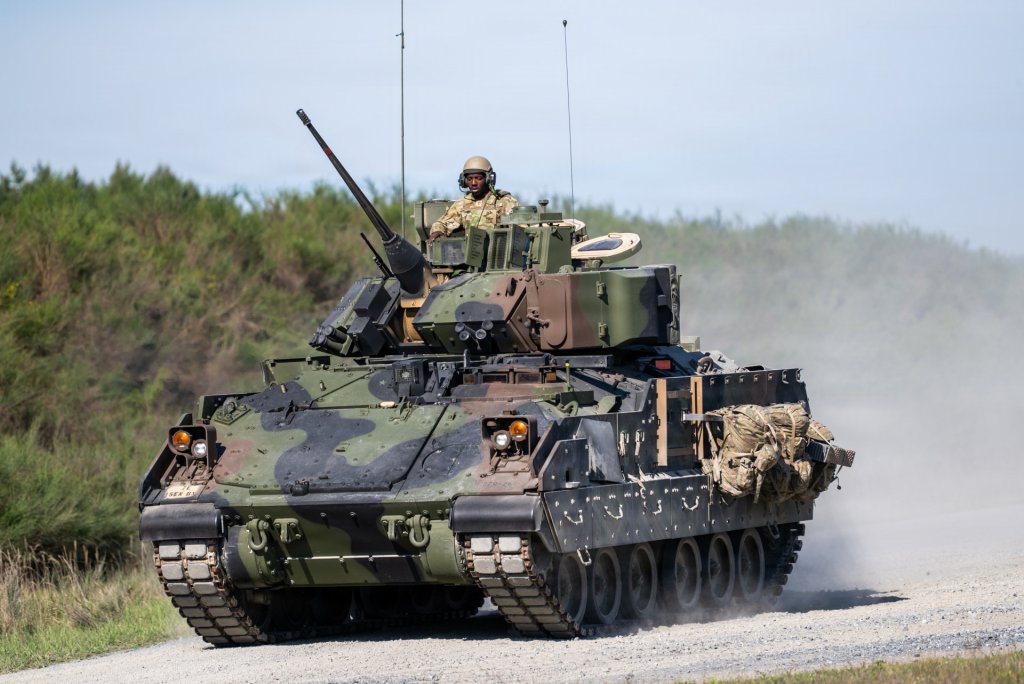
The XM30 program is the U.S. Army’s latest effort to replace its fleet of Bradley Fighting Vehicles. As TWZ noted in a recent article, the Army had planned to test a number of the eight prototypes that each competitor is required to provide during a regular rotation at the sprawling National Training Center (NTC) at Fort Irwin in California next spring.
The US Army aims to replace its Bradley Fighting Vehicles, an example of which is seen here, with XM30s. US Army
According to both GDLS and American Rheinmetall, each will now deliver seven prototypes to the Army’s 1st Brigade Combat Team, 1st Cavalry Division at Fort Hood, Texas. There they will undergo a soldier touchpoint and field evaluations, which could wrap up in the February-March 2027 timeframe. No rotation to Fort Irwin is now envisaged.
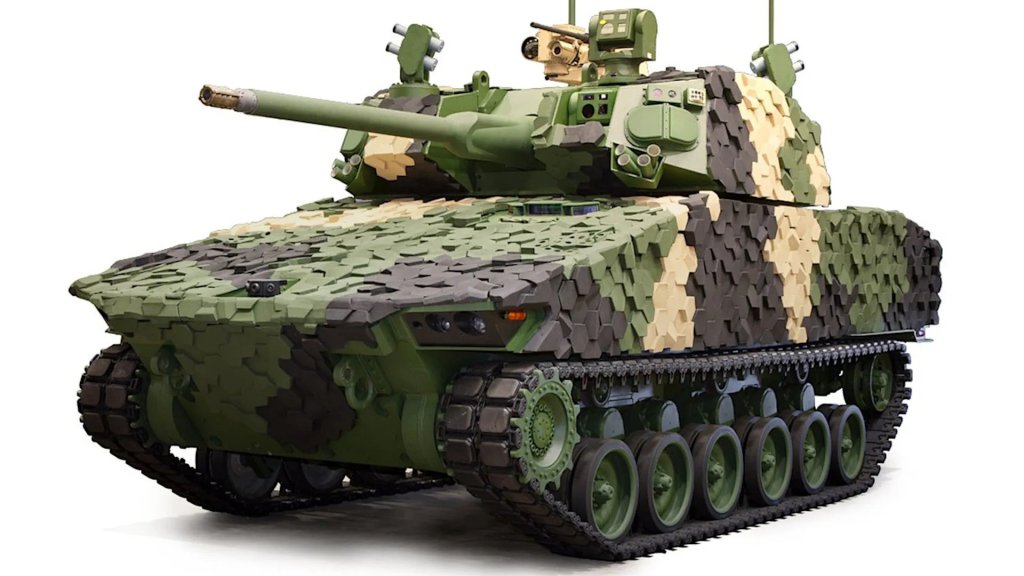
TWZ spoke with executives from both XM30 competitors and reached out to the Army ahead of AUSA. Geoffrey Norman, GDLS’ director for U.S. Strategy & Growth, said that three of its prototypes are already at Fort Hood undergoing safety checks before being put in soldiers’ hands for evaluation. The company’s offering is called Wolf, which evolved from its Griffin III, which in turn was derived from the ASCOD 2 infantry fighting vehicle.
A prototype of General Dynamic Land Systems’ submission for the XM30 competition, called the Wolf, seen under wraps after delivery to the US Army’s Aberdeen Proving Ground in Maryland earlier this year 2026. GDLS
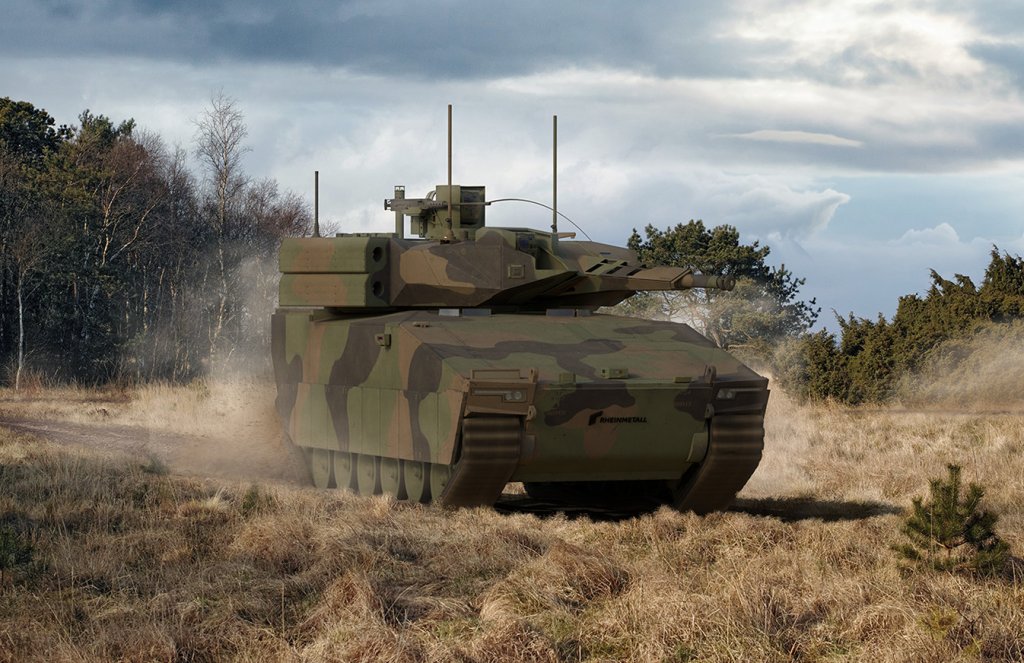
American Rheinmetall, a U.S. subsidiary of Germany’s Rheinmetall, has put forward a version of the extended Lynx family for the XM30 competition. The company has delivered one of its prototypes to Fort Hood, according to the company’s senior vice president of programs, Jim Schirmer. Another one is at the Army’s Joint Forces Training Center at Camp Shelby, Mississippi, where the company is doing its own internal testing. Its remaining vehicles are being assembled in Slidell, Louisiana.
A rendering of the XM30 version of Lynx. American Rheinmetall
Both companies delivered their very first XM30 prototypes to Aberdeen Proving Ground in Maryland in late August, along with an additional hull and turret each for ballistics testing. Over the last month-plus, the Army has gained preliminary experience with the MICVs at Aberdeen.
Early Feedback
GDLS’ Wolf has already put its 50mm cannon into action on the live-fire range at Aberdeen, according to Norman. It has also been put through some portion of automotive functional testing, and Norman says GDLS is getting “good feedback” on both. He adds that the Wolf’s 32-speed SAPA transmission and composite rubber track (CRT) have been well received, with favorable comparisons to the ride-quality/comfort of the Bradley.
General Dynamics Land Systems’ Wolf is based on the Griffin III, an earlier configuration of which is seen here. Griffin III’s main armament was also a 50mm cannon. GDLS
Schirmer says that the Lynx has also received positive early feedback, particularly during a late September demonstration for congressional staffers and Army VIPs at Aberdeen. Passengers praised its two-man crew station layout, the roominess of its six-man squad compartment and its air conditioning system.
Schirmer reflected on the value of greater environmental comfort for squad members who sweltered inside the Bradleys used in Iraq. He recalled that, “When it was 125 degrees outside in Iraq with additional solar loading, inside the Bradley the temperature got to 138 degrees. It actually felt refreshing to step out into the Iraqi air.”
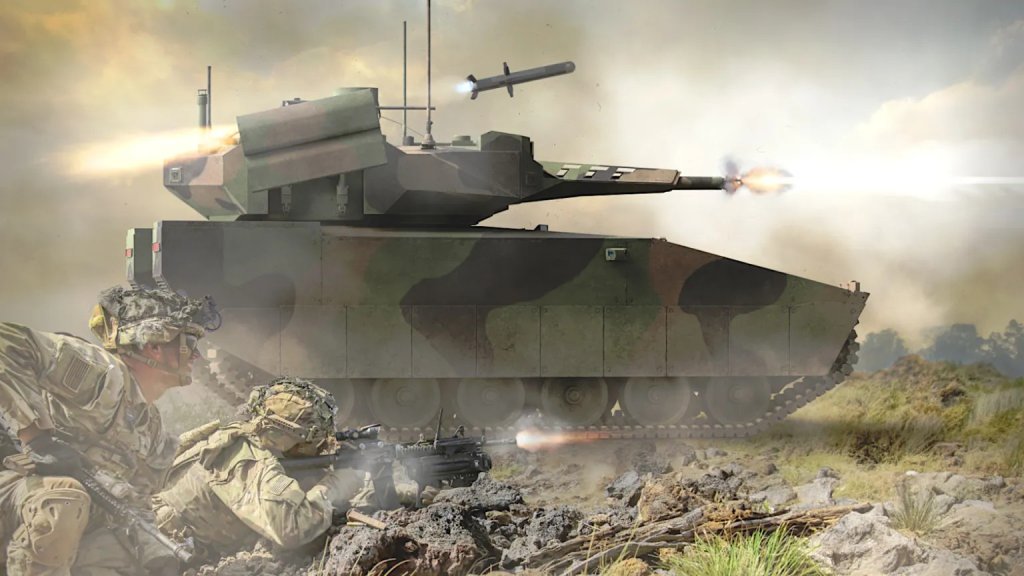
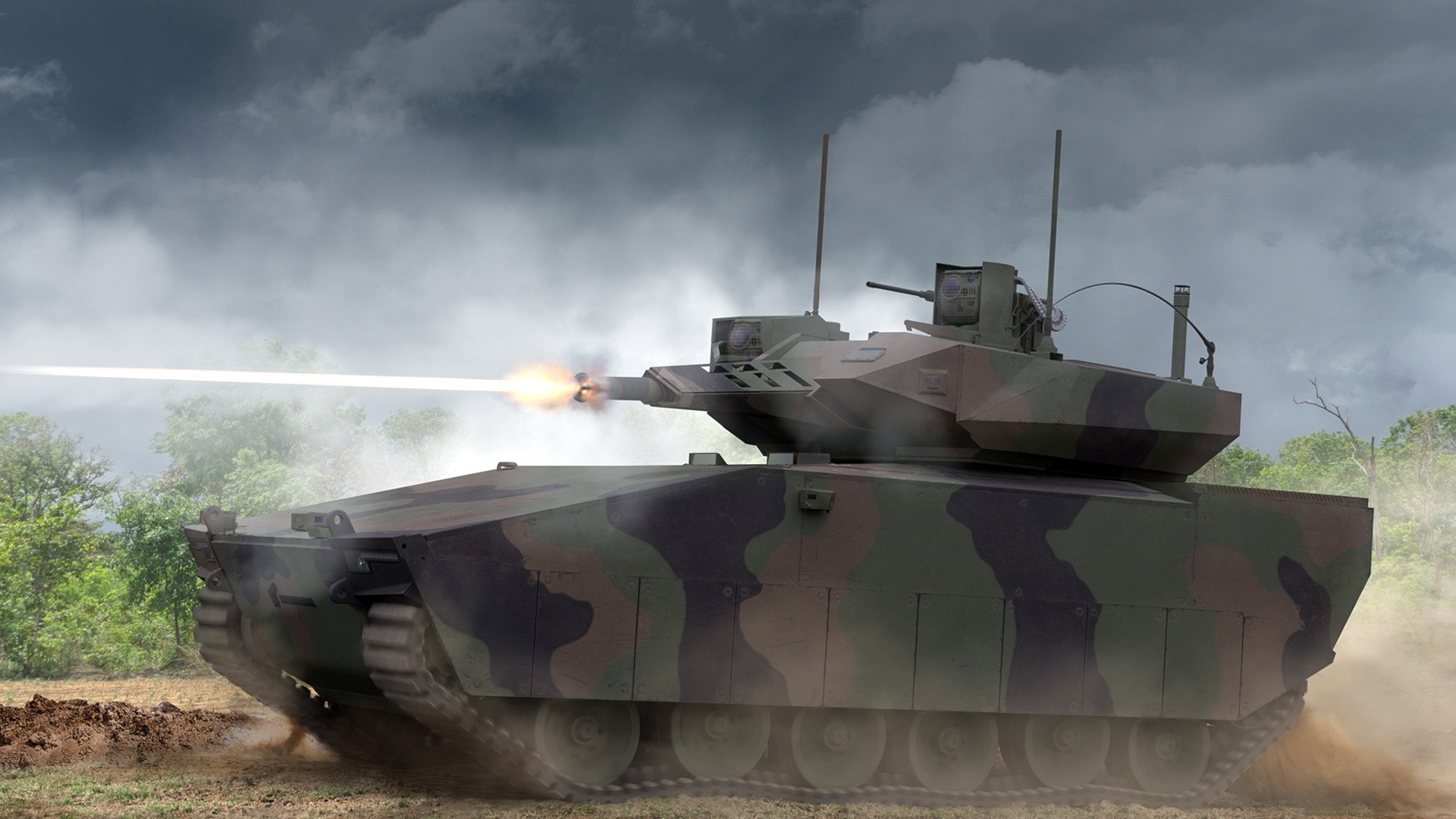
Both prototypes are larger than the 40-ton Bradley with correspondingly heavier combat weights in the 50-ton region. Both feature an XM913 50mm automatic cannon as their main weapon, a welcome increase in firepower compared to the 25mm M242 on the Bradley.
A rendering of American Rheinmetall’s XM30 design, depicting it firing its 50mm cannon and other weapons. American Rheinmetall
Schirmer acknowledged that American Rheinmetall has found some small bugs in its first Lynx prototype at Aberdeen. “We spent a fair amount of time swapping hardware and making adjustments to make sure it was ready [for the VIP event].”
Crew Efficiency and Room for Growth
Both competitors have emphasized the greater efficiency and capacity to add weapons systems and sensors to their MICVs compared with the Bradley. Each has a two-man crew as opposed to the Bradley’s three-man complement. XM30 commander-gunners operate from below the turret as opposed to in it with the Bradley. The new configuration puts a premium on crew situational awareness and task management.
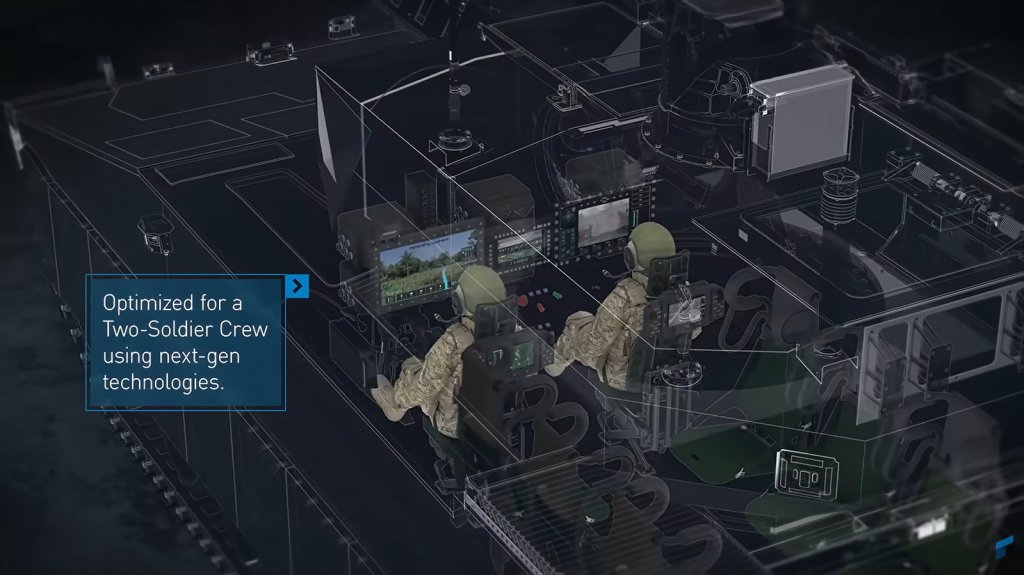
Wolf and Lynx feature side-by-side crew stations for the vehicles’ commander and driver, an aviation-style layout conducive to enhanced crew coordination. Both firms have placed considerable emphasis on intuitive user interfaces with multiple displays and menus with specifically designed symbology and text, as well as ergonomically optimized controls. In addition to higher resolution and longer range gunsight displays, each prototype offers its crew and the squad it carries a 360-degree outside view provided by cameras placed around the vehicle.
A rendering depicting the interior of the Lynx-based XM30 design. American Rheinmetall
“Because we have a reduced crew from the Bradley [which has a commander and gunner in turret] there has to be greater efficiency in how those soldiers execute their tasks. The software and menu logic are very intuitive,” Norman affirms.
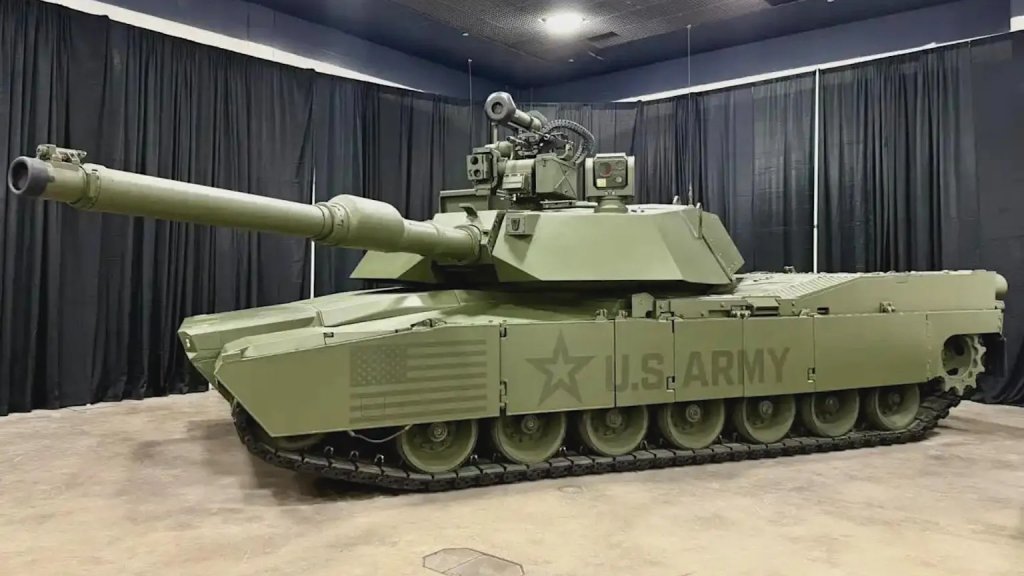
Left and right crew positions are identical, so functions can be performed by either crew member. In the Wolf, the driver sits to the left in most cases with the commander on the right. GDLS has drawn lessons from soldier touchpoints with early prototypes of the M1E3 Abrams tank (for which it is the prime contractor), which Norman says shares its graphical user interface with Wolf.
The first early prototype of the next-generation M1E3 Abrams tank. US Army
The Lynx crew compartment features three configurable displays, with a large center display with a common operating picture/map with visual feeds from airborne uncrewed aerial systems (UAS). “You can shoot the gun from the left or right, you can drive the vehicle from the left or right,” Schirmer confirms.
A camera for the Lynx commander’s independent weapons station atop the vehicle with its own sight and machine gun can be pulled up for view by the crew, which can toggle between it and the main weapons sight. Lynx operators have the ability to turn off certain information presentations in their displays for better focus on a particular task.
The effort to improve efficiency for smaller armored vehicle crews was highlighted last week as GLDS announced that it has partnered with Primordial Labs to bring artificial intelligence (AI) voice control to its combat vehicles, ranging from the M1 to the XM30. American Rheinmetall has likewise developed its own AI assistant for Lynx crews, Schirmer confirms. He characterizes it as a “third crewman” helping two soldiers do the work of a trio.
The video below shows Primordial Labs’ voice control technology being used to operate a quadcopter-type drone.
Cooling has become an issue for the Bradley, which, like all armored vehicles, essentially encloses its powerplant and electronics in a box with no airflow. Heat from the drivetrain creates a detectable thermal signature, particularly with the Bradley’s right-front exhaust exit.
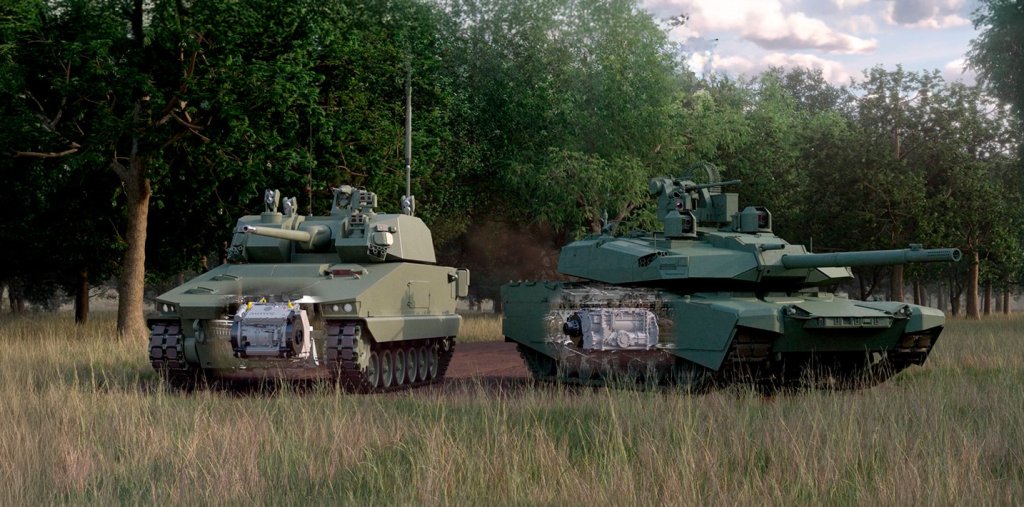
Both Lynx and Wolf feature hybrid-electric drivetrains with silent-watch capability, which can temporarily reduce their thermal signatures. Each features rear-exhaust exits, alleviating front-quarter heat plumes.
According to Schirmer, the Lynx cooling stack (which sits adjacent to its powerplant forward in the hull) offers increased cooling for the engine and battery packs while improving the interior environment for heat-sensitive electronics. It facilitates systems growth and greater power consumption.
Wolf has its engine cooling in the rear of the vehicle behind the track. Norman says GDLS specifically engineered its placement so cooling paths to the rear of the hull don’t impinge on passenger space inside. All Wolf systems are designed with a 10 percent growth margin, he adds.
The hybrid drive systems and electronics that both XM30s use will have to resist the increasing threat from adversary directed energy. Electronic attack in the form of tactical electromagnetic pulse, laser targeting of external sensors/apertures, and weaponized electromagnetic interference constitutes a growing threat to weapons systems and basic mobility.
A past rendering of the Griffin III, at left, as Abrams X next-generation tank concept, with cutaways highlighting elements of their hybrid propulsion systems. GDLS
Both contractors expect the Army to stringently test their prototypes’ electromagnetic vulnerability. “I think they’ll nail our vehicles with the best [electromagnetic attack] that adversaries have and if they identify any weaknesses, we will correct those,” Norman says. He points to Aberdeen’s large, sophisticated anechoic chamber as a place where both MICVs will eventually spend considerable time.
American Rheinmetall has its own electromagnetic interference (EMI) requirements for vehicle sensors and communications, according to Schirmer. The Army also has an in-depth understanding of the threats and explicit EMI requirements, he says. “We’re pretty comfortable that our system meets those, but actual EMI testing will take place later in the test program.”
Expanded capacity for exportable power is another growth area for XM30. The prototypes’ hybrid powerplants feature large battery packs that can offer exportable power to potentially help the Army with its serious battlefield circulation of electricity (BCoE) problem. The ever-increasing array of soldier-worn electronic devices, electrically-powered small drones and sensors has created an electricity supply deficit as well as battery weight and availability issues.
Wolf produces “a lot more power than it needs,” Norman asserts. As a result, upgrades to its alternators, starter-generators and high-voltage batteries won’t be needed in the foreseeable future. The exportable power emphasis is on the passengers, he explains.
Wolf’s internal power distribution provides significant charging power to the squad compartment in the back, where each member can charge devices and get access to data. The charge-ports they use are cyber-hardened to prevent plug-in exploits.
External exportable power is surprisingly not a priority for the MICVs, according to the contractors. Wolf can offload power via a standard NATO power port (as can Lynx) and other interfaces, Norman says, but “we’re not seeing XM30s in use-cases where they’re used to power command posts or other things. The emphasis from the Army has really been about having margin on the vehicle for future [system] requirements – directed energy, counter-UAS systems or fill-in-the-blank.”
Counter UAS and Fill-in-the-Blank
A September report from the Congressional Research Service cited a potential XM30 oversight issue for Congress, contending that it is not clear if the MICV will have an organic counter-UAS capability. Given the obvious threat of aerial drones to armor as seen in Ukraine, the apparent lack of a requirement for integrated CUAS appears glaring.
We reached out to the Army’s PAE Maneuver Ground and PM XM30 regarding CUAS for XM30 but received no response as of this writing. Both American Rheinmetall and GDLS believe the Army will undertake its own search and competitive testing to identify a CUAS system for XM30 that it will require the vendors to integrate at some future point.
GDLS’ Norman calls CUAS “fundamental” to the viability of armored vehicles on the modern battlefield. He thinks the Army’s approach of making sure CUAS infrastructure (power/data/physical hookups) is in place on XM30 while evaluating potential systems on its own for rapid integration is wise. He adds that GDLS is working with “expert partners” in the CUAS space to be ready to add the capability.
Intriguingly, American Rheinmetall’s Schirmer says that Lynx already has some counter-UAS capability, which he declined to disclose.
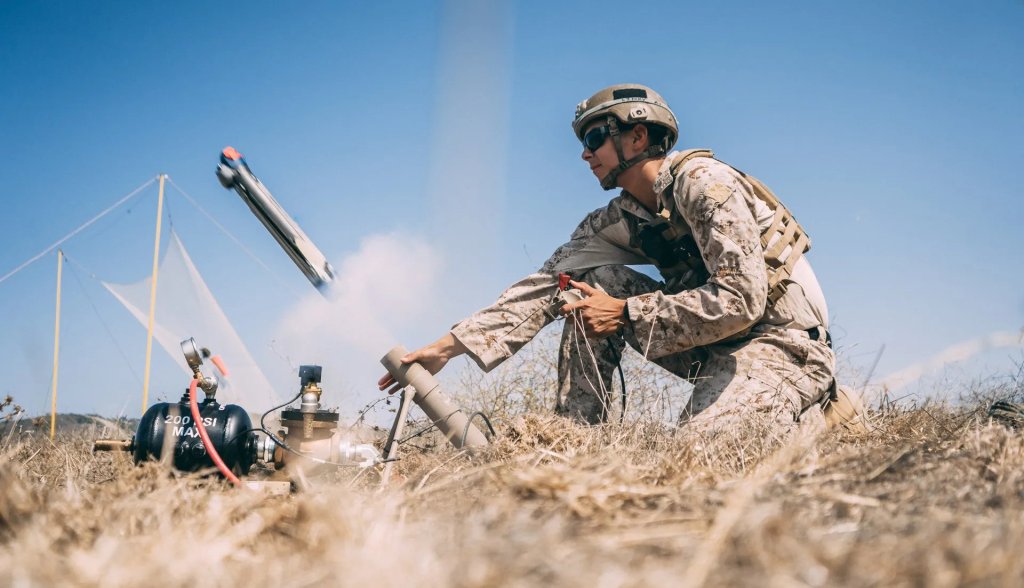
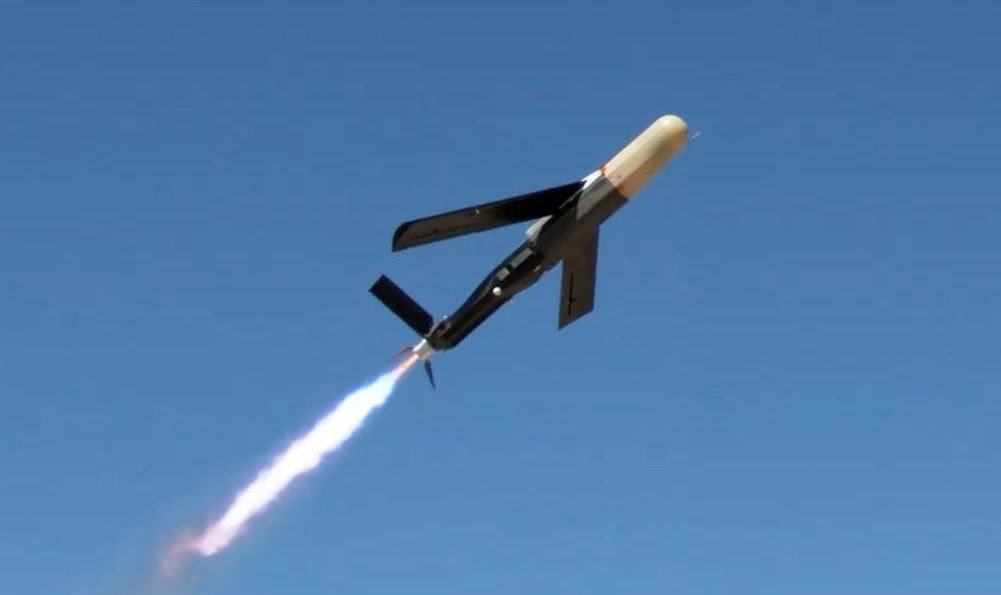
Both XM30s have the ability to launch loitering munitions – Wolf will employ Aerovironment’s Switchblade 300 and Lynx will carry a version of Raytheon’s Coyote Block 3 – but their makers currently have no specific plans for other integrations, though each says it can adapt multiple systems.
A Switchblade 300 seen being fired from a man-portable launcher. USMCAn example of the Coyote Block 3. This particular version is configured as a non-kinetic counter-drone weapon. RTX
TWZ previously noted that the Army envisions XM30s acting as controllers for unmanned ground vehicles. GLDS’ Wolf has an in-house interface to control UGVs (and UAVs) from inside the vehicle, which was demonstrated to the Army over a year ago, according to Norman. Its open software architecture allows for integrating a different control suite if the Army desires.
American Rheinmetall has “not attempted to control an unmanned ground vehicle yet, but the architecture is so similar it would really be just a software modification to get there,” Schirmer says. The company would likely use a mix of its own and UGV provider software.
The Lynx itself can be remotely operated via a tablet that a dismounted crew can employ. While outside the vehicle, soldiers can also remotely use the tablet to see what the vehicle is seeing or to pull up maps for planning, Schirmer explains. American Rheinmetall has yet to finalize and demonstrate the capability, but it appears an appropriate feature for a design that stretches back to the Army’s Optionally Manned Fighting Vehicle (OMFV) program.
Recent Army experimentation with small vehicle-toted UGVs on Bradley suggests a capability that could migrate to XM30. Wolf can accommodate “marsupial UGVs” like the Swambotics AI Fire Ants fitted on a 1st Cavalry Division M2A4 Bradley, but Norman points out that small UGV carriage is not part of the requirements for the first iteration of XM30.
A U.S. Army 1st Cavalry Division M2A4 Bradley IFV was spotted carrying five Swarmbotics AI FireAnt anti-armor UGVs on its side storage racks. Weighing around 27 kg, FireAnt is a low-cost attritable robotic system designed for AI-enabled swarm operations, including ISR,… https://t.co/dbikmUtOeypic.twitter.com/WYIRlLJd9A
American Rheinmetall has not specifically planned for carrying UGVs on its MICV, but Schirmer asserts that if a Bradley can carry them, Lynx certainly can. Whether it may be able to recharge them during transit is a question that will depend on future Army desires, he says.
Fit for Purpose
Given threats from increasingly capable drones and guided anti-tank missiles, questions as to whether XM30 or other armored vehicles remain relevant on the modern battlefield have persisted for several years.
Such concerns arguably drive the discussion of value-added capabilities for XM30 – from advanced sensors and networking/communications to the ability to deploy and control UGVs/UAVs and the potential BCoE benefits of the platforms.
GDLS’ Norman refers to Wolf as “software with a vehicle around it”, noting that GLDS is “continually dropping new software” into its XM30 on a weekly basis to add capability.
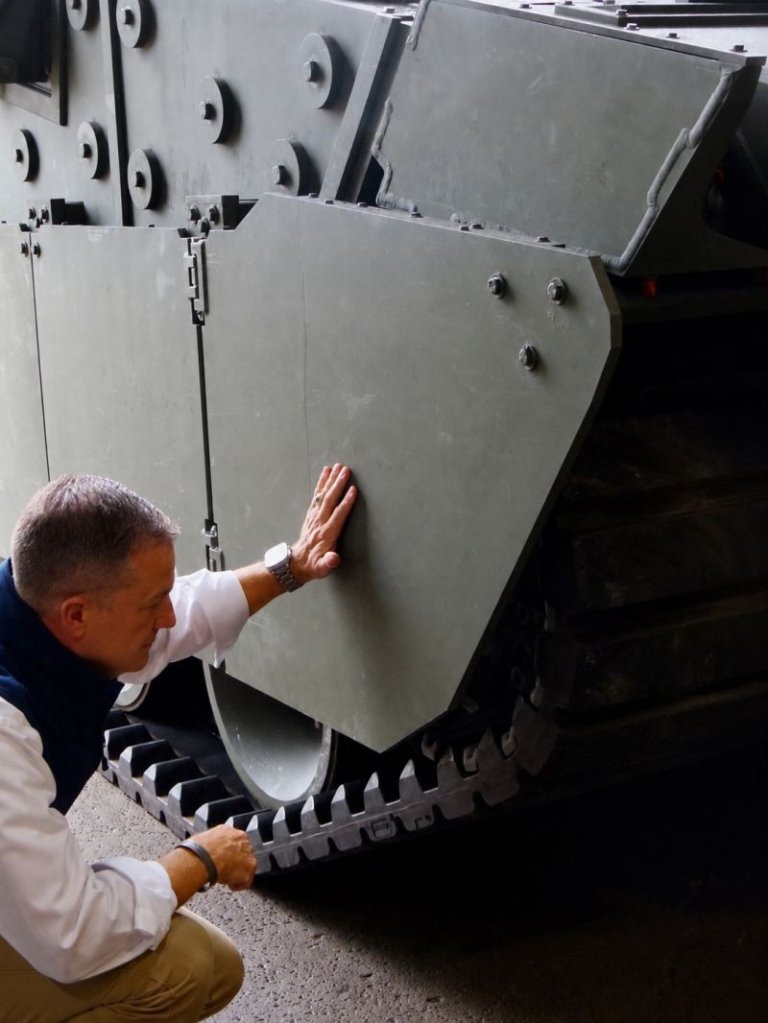
Geoffrey Norman, Director for U.S. Strategy & Growth at General Dynamics Land Systems, kneeling beside a Wolf prototype. Geoffrey Norman/LinkedIn
However, American Rheinmetall’s Schirmer reminded us that the traditional armored transport mission is still the overarching role of XM30.
“The purpose of [Lynx] is really to carry infantrymen around the battlefield…to move them faster than they can walk on foot, to protect them in transit from threats – drones, anti-tank guided missiles, from artillery fire – and to [provide] fires support.”
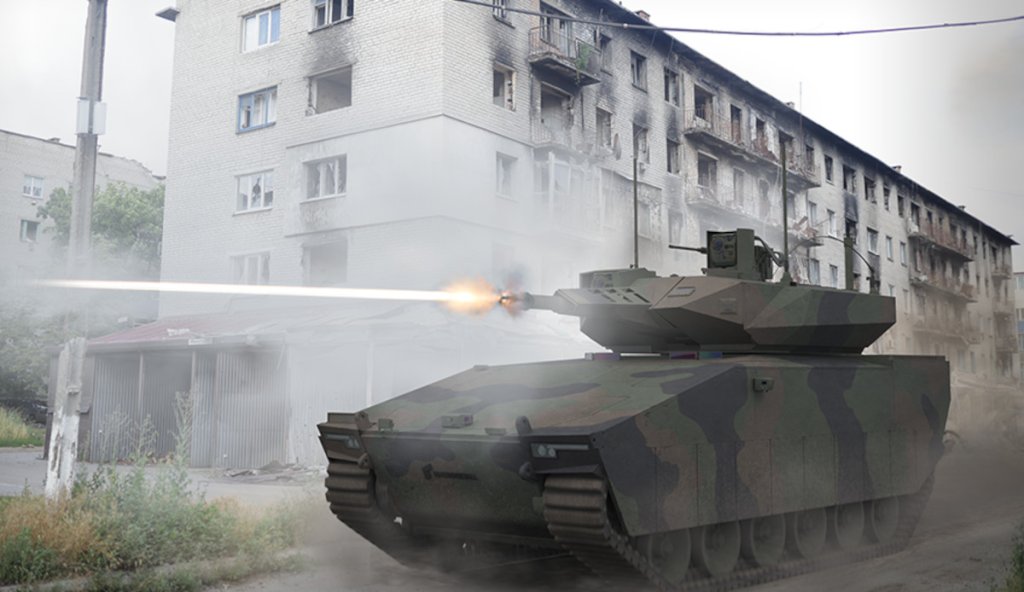
A Lynx-based XM30 depicted in combat in an urban environment. American Rheinmetall
The tension around XM30 survivability versus cost is reflected in the Army’s loose commitment to the new MICV program. Despite having muted fielding of an XM30 by 2029, Brig. Gen. Troy Denomy, Program Acquisition Executive of Maneuver Ground, told Breaking Defense that if no clear winner emerged from the upcoming test and evaluation, “then it may be worth not selecting at that point.”
The ambiguity tees up the question of where a 50-ton armored vehicle fits into the potential Pacific fight that the U.S. military is focusing on. It’s a difficult question for the Army and for the XM30 contractors.
American Rheinmetall’s Schirmer took a stab at answering. He points out that there are large islands and other landmasses in the Pacific (like the Korean Peninsula) where a MICV could be employed. However, he acknowledges that it is less likely to be used in an island campaign.
“It still has a role, though it’s less obvious what that would look like than in Europe or the Middle East.”
With testing and evaluations set to ramp up at Aberdeen Proving Ground and Fort Hood, we may soon learn which XM30 prototype is the Army’s obvious choice.
 Login