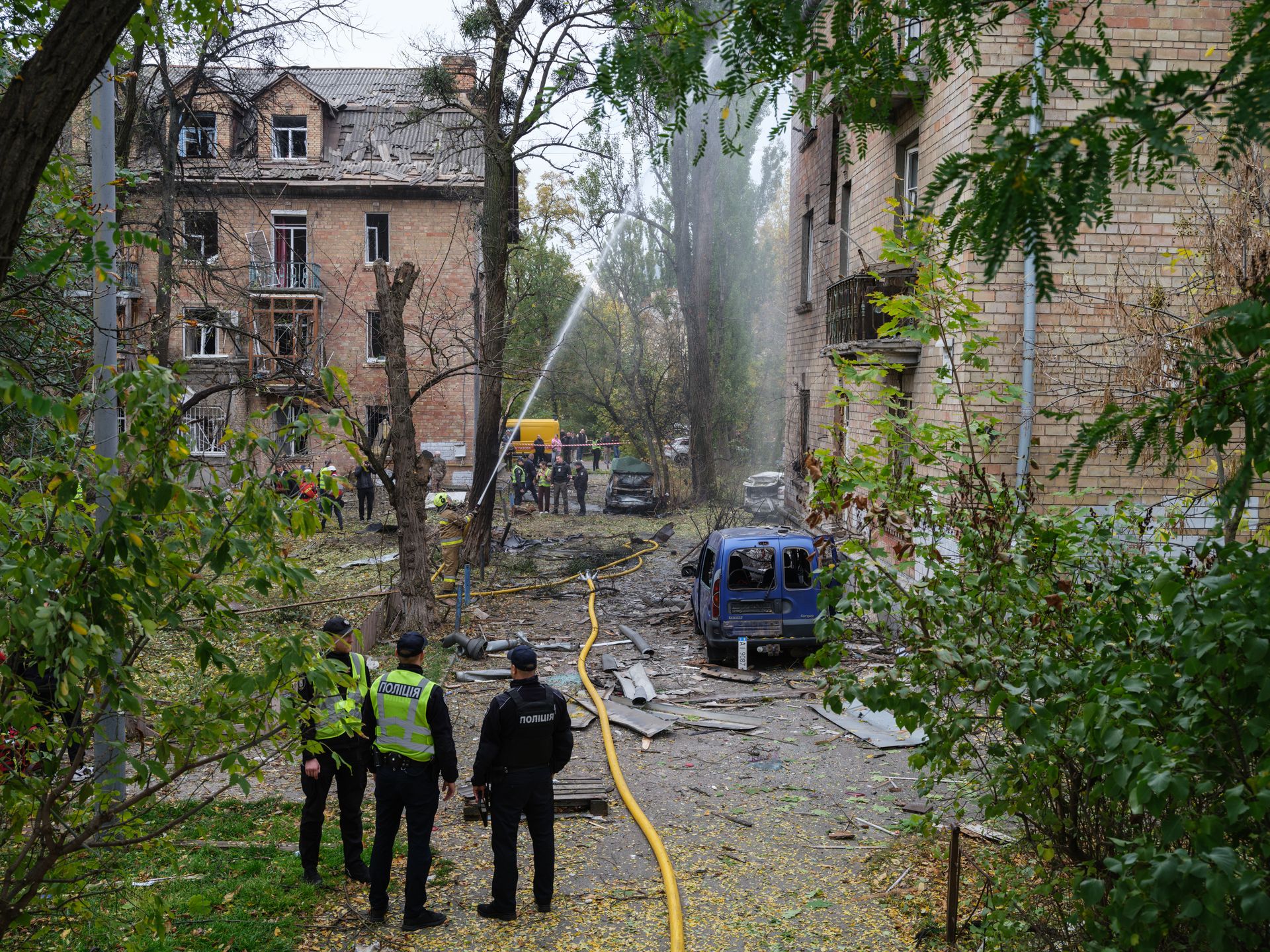
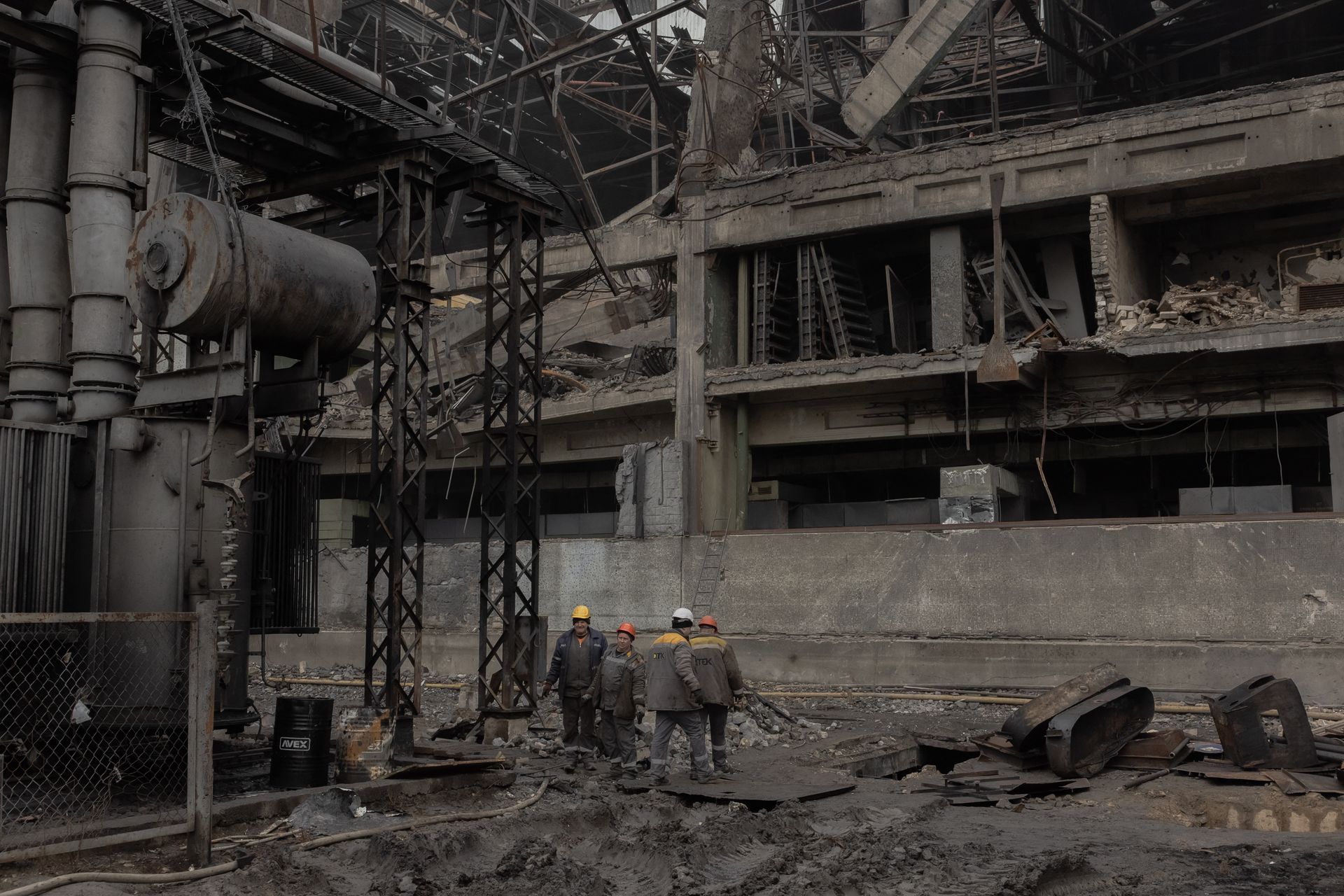
Damage to energy facilities in the Kyiv region has also reduced water pressure in areas of the capital on the Dnipro River's right bank. Emergency specialists are switching power supplies to water pumping stations, Kyiv Mayor Vitali Klitschko said.
Russia has found a way to cut Ukraine’s power lines that no repair crew can undo. A unique power transmission tower that a Russian drone cut down at the Dnipro River crossing in Kyiv cannot be restored, Ukrenergo board chairman Vitaliy Zaichenko says, as the grid operator rushes to build alternative ways to keep electricity flowing, Interfax reports.
Russia has spent the war trying to switch off Ukraine’s lights. Now, it is widening the campaign before winter with a new tactic: drones that slice through the steel towers carrying high-voltage lines.
“Everyone has seen the video showing the destruction of one of the unique power transmission towers at the crossing over the Dnipro in Kyiv. It was severed, and it is impossible to restore it,” Zaichenko continues.
He adds that now the company is developing new technical solutions "on the fly, and very fast." It will start the procedures for those solutions from 15 October, he notes. Russia’s use of drones able to sever metal towers is a new and serious challenge for Ukraine’s power engineers.
Zaichenko did not say when the tower was hit. On 30 September, Russia first used a jet-powered drone carrying a 40-kilogram charge built to cut steel towers, and that evening an eyewitness filmed one striking a power line tower in Kyiv, which cut electricity in parts of three districts, Informator reported.
When the spare parts are as scarce as the targets are plentiful
Rebuilding is colliding with a global shortage. Ukrenergo faces serious difficulties getting backup equipment, Zaichenko explains, because the whole world’s energy system is expanding at once and everyone needs the same hardware.
“There is a real problem with equipment. The global power system is expanding, and everyone needs energy equipment. There is a tough queue,” Zaichenko says.
Ukraine has faced such challenges since August 2026, when Russia began launching its jet-powered drones. Kyiv still has no effective solution against them and relies more on a mix of air defenses, such as automated turrets and interceptor drones.
Kyiv has also engaged over 100 private air defense system brigades to protect its enterprises in the ranks of the Ukrainian Air Forces.
Russia hit central Ukraine’s Kirovohrad Oblast with its largest attack since the full-scale invasion, killing residents of the oblast capital, Kropyvnytskyi, the oblast’s head said. Russian strikes hit more than a dozen oblasts, and Ukraine’s president said Moscow escalated deliberately after sanctions relief.
Russia’s full-scale war against Ukraine continues on the front line and behind it, where its drones, missiles, and glide bombs strike towns daily. Kyiv is drafting winter crisis plans as Russia targets the biggest cities, and logistics is hit too: Russia struck one retailer’s warehouse hub 10 times in a day.
Three dead in Kropyvnytskyi
Oblast head Andrii Raikovych counted almost 360 Russian drones over Kirovohrad Oblast and hits on 26 locations, mostly in Kropyvnytskyi. In his words, “the enemy deliberately struck critical infrastructure, transport enterprises, logistics facilities, and residential buildings.” In a post after midnight, he reported a third death and six injured, five of them in hospital.
Air-raid alerts around the city ran from 15:20 on 14 October to 05:33, and Suspilne correspondents heard more than 20 explosions in Kropyvnytskyi, the public broadcaster reported. The national emergency service counted 25 struck locations, and rescuers were still putting out fires in the morning, the service’s spokesperson in the oblast said.
People and a damaged car in the yard of an apartment block in Kropyvnytskyi after the Russian drone attack of 14–15 October 2026. Photo: Andrii Raikovych/Telegram
A wave Kyiv ties to sanctions relief
Nationwide, Russia launched 580 drones and two Kh-59 guided missiles from 18:00 on 14 October, and air defenses downed or suppressed 536 drones by 08:00, the Air Force reported. Ukrainian President Volodymyr Zelenskyy said Russia killed three people in Kropyvnytskyi and three in Dnipropetrovsk Oblast, where oblast head Oleksandr Hanzha reported two dead.
Explore further
Ukraine is going back to hitting Russian oil after its Trump-pressured pause, during which Kyiv got no US warnings of incoming ballistic missiles
Zelenskyy counted more than 850 Iranian-designed Shahed attack drones between the start of 14 October and 09:00 the next day, “precisely at the time of an artificial speed limitation for our defensive capabilities.” Overnight into 14 October, SpaceX capped speeds on its military Starshield satellite service, disrupting Ukrainian missions. He added that Russia escalated “deliberately, having received a relaxation of sanctions and seeing attempts to pressure Ukraine.” Last week, Washington cleared Russian diesel trade after a call between US President Donald Trump and Kremlin leader Vladimir Putin.
Strikes from Kyiv to Odesa Oblast
In Kyiv, a drone fell into a residential yard, Mayor Vitali Klitschko wrote, later putting the injured at six. Drones hit two industrial enterprises in Poltava Oblast, its head Vitalii Diakivnych wrote, and a later strike on Poltava injured three people, rescuers said in a preliminary count. Ukraine’s state gas company Naftogaz said a drone set one of its gas production facilities in the oblast on fire, halting its work.
Russian guided aerial bombs injured two women and a man in Izium, Kharkiv Oblast, on 15 October, according to preliminary data from oblast head Oleh Syniehubov, who had counted nine injured in the oblast over the previous day. Over that day, Russian attacks killed three people in Donetsk Oblast, the oblast police said, and one in Kherson Oblast, where oblast head Oleksandr Prokudin reported five more injured. In Kherson city, a drone injured a man, the oblast administration said. In Sumy Oblast, a drone hit a house and left two people in acute stress, its administration said.
A house destroyed by Russian guided aerial bombs in Izium, Kharkiv Oblast, 15 October 2026. Photo: Kharkiv Oblast Military Administration/Telegram
In Odesa Oblast, strikes damaged two apartment blocks, a company, and a bank office without casualties, oblast head Oleh Kiper said. Later, a jet-powered Shahed hit a store in the oblast, Zelenskyy wrote, and Kiper counted four injured in a preliminary tally. Drones also hit an enterprise in Ternopil Oblast, and five people sought medical help, rescuers said, while drones damaged two homes in Rivne, oblast head Oleksandr Koval said.
A porcelain fish survived the Russian strike that destroyed a room in the Kyiv apartment of Andrii Dubenko, a volunteer, dentist, and medic, his cousin Anna Danylenko wrote on Facebook and told UP Life, the lifestyle site of Ukrainska Pravda. Dubenko and two others were inside the nine-story building in Lisovyi masyv when the 13 October strike hit. It killed other residents.
The strike came during a ballistic attack aimed mainly at CHP-4, one of Kyiv’s main power plants, Ukrainian President Volodymyr Zelenskyy said, two days after Washington announced an energy ceasefire that Moscow never confirmed.
Lifted out in a rescue basket
Dubenko, his girlfriend, and a 72-year-old aunt were inside when the blast hit, Anna told UP Life. Her family was lucky, she wrote, and the rule of two walls saved their lives. The rule tells anyone who can’t reach a shelter to keep at least two walls between themselves and the street, away from windows. Fifteen minutes after the blast, State Emergency Service rescuers lifted the three out in a basket, Anna wrote. The aunt comforted the girlfriend, telling her not to live in the past but to look to the future, Anna said.
The porcelain fish that survived Russia’s 13 October 2026 strike on an apartment building in Kyiv’s Lisovyi masyv. Photo: Anna Danylenko/Facebook
A hole where the window was
“Just on Monday I was sitting in their cozy apartment, where I grew up, and now I’m looking into a hole that just two days ago was a window,” Anna wrote.
She gathered what was left of the tea set the family used for samovar tea while her grandmother was alive. “It was my anchor, the anchor of our family,” she wrote. The porcelain fish survived. Her mother used to play with it, and Anna now calls it the “fish of unbreakability.” UP Life likened it to the ceramic rooster that survived in a wrecked kitchen in Borodianka, Kyiv Oblast, in 2022 and became a symbol of Ukrainian resilience.
The family didn’t sleep that night. Firefighters were still putting out the blaze overnight, so they could only get back inside in the morning.
“Charred ruins, lots of water in the hallway, which burned out. People are throwing broken things out the window, down by the building. The smell of burning is everywhere,” she told UP Life.
Volleys of explosions deafened Kyiv in the early hours of Oct. 14, as Russia targeted multiple energy facilities powering the embattled capital amid a new campaign to isolate and disconnect the city following a brutal summer of relentless strikes on businesses and

 Login