Nepal’s government reported that the August 26 flood destroyed 10 percent of the country’s gross domestic product, with damages and losses exceeding $2.7 billion, as Finance Minister Swarnim Wagle sought international funding to rebuild.
Nepal’s government said that the August 26 flood, dubbed the “Himalayan tsunami,”caused physical damage worth $1.8 billion and additional economic losses of more than $900 million, equivalent to about 10% of the country’s Gross Domestic Product (GDP), as it seeks international financing for reconstruction.
Finance Minister Swarnim Wagle presented the estimates on Thursday at a press conference at the Foreign Correspondents’ Club in Bangkok, on the sidelines of the annual meetings of the International Monetary Fund (IMF) and the World Bank.
Wagle is seeking international funding for rebuilding and for measures to “avoid or mitigate the impact of future disasters.”
Nearly seven weeks passed between the disaster and Thursday’s accounting. The flood struck on August 26, and the assessment Wagle presented in Bangkok represents the government’s formal reckoning of the economic damage it must now confront.The floods left more than 1,500 people dead and 6,000 missing, causing severe destruction of essential infrastructure, hydropower projects, farmland, fish ponds, food stocks and agricultural infrastructure across the country.
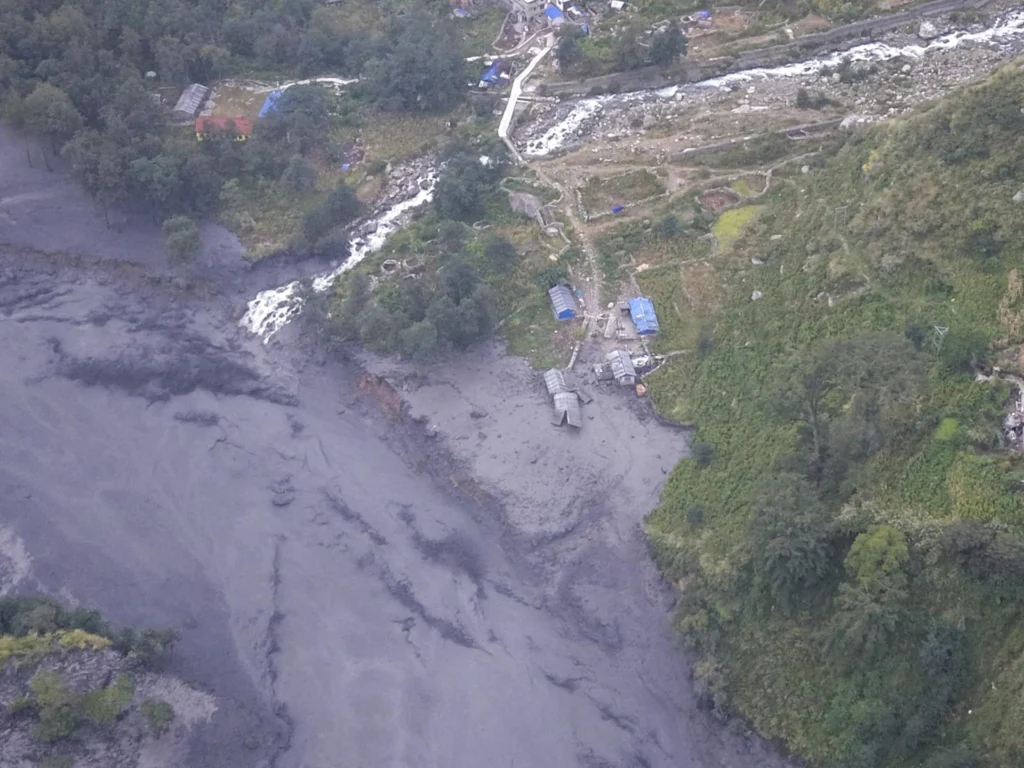
Flash floods along Nepal’s Budhi Gandaki River swept away homes and bridges, forcing residents to flee to higher ground.
Wagle said Nepal does not intend merely to “replace what was destroyed, but to build better,” with more resilient infrastructure. He said that approach will raise the cost of reconstruction to $5 billion.
The Minister also said Nepal, which he described as “the poorest country in Asia after Afghanistan,” has contributed very little to global warming because of its limited industrialization and low emissions, but “is bearing the worst consequences of climate change.”
Wagle appealed to the “ethical and moral responsibility of countries with greater resources” to support the most vulnerable and called for a model of “global solidarity and cooperation.” “It is not about blaming rich countries, but about making a joint call to action,” he said.
Gorkha, #Nepal Damaged houses lie partially submerged in sludge along the banks of the Budhi Gandaki River after a flash #flood caused by a #landslide. Four bridges and dozens of houses were swept away, as well as a construction camp for a hydropower project pic.twitter.com/vui6RyJocr
The disaster originated high in the Himalayas. A glacial and rocky mass covering two square kilometers broke away from Langtang Lirung mountain at an altitude of 5,200 meters. The ensuing flood also swept into the Chinese region of Tibet.
The scale of the threat extends beyond a single event. A recent study in Scientific Reports warns that roughly 300,000 people in Nepal live in river channels susceptible to flooding. Construction in those vulnerable zones grew by almost 50 percent between 2016 and 2023, a pattern that multiplies the risk to communities as extreme weather becomes more frequent.
Nepal’s appeal arrives as climate-linked disasters mount across South Asia, a region where economies least responsible for global emissions face some of the steepest recovery costs. For a country that contributes a negligible share of greenhouse gases, the $5 billion reconstruction bill amounts to a burden imposed largely by forces beyond its control.
Many of the Democrats' ads accuse Republican opponents of siding with the president over voters, particularly on issues like tariffs and the Iran war, which they blame for jacking up costs.
Operations at Chios Airport runway will be temporarily suspended from mid November 2026 to mid March 2027 due to upgrade of infrastructure works. According to an announcement by the Greek Civil Aviation Authority (HCAA) suspension is scheduled from Sunday night, November 15, 2026 to March 15, 2027, due to works to extend, improve and upgrade […]
Harvard's investment in Elon Musk's SpaceX has paid off.
Matt Rourke/AP
Harvard's endowment returned a five-year high of 27.1% in the 12 months to June 30, besting the S&P 500.
The Ivy League college counted a $2.2 billion SpaceX stake as its top Q2 portfolio holding by far.
Harvard's endowment grew to almost $68 billion after accounting for taxes, gifts, and distributions.
Harvard University delivered its best investment return in five years as its bet on SpaceX boosted its stock portfolio.
The elite college's endowment returned 27.1% in the fiscal year ended June 30, its annual financial report revealed on Thursday. That comfortably outpaced the benchmark S&P 500's 22.3% total return over the same period.
After accounting for taxes, distributions, and gifts, Harvard's endowment grew by $11 billion to nearly $68 billion.
Harvard Management Company's stake in Elon Musk's maker of Starship rockets, Starlink satellites, and AI chatbot Grok was worth $2.2 billion at the end of June, per its second-quarter portfolio disclosure.
SpaceX was its number-one holding, more than six times more valuable than its second-biggest position, a sub-$350 million stake in Taiwan Semiconductor.
Its next-largest positions — each worth over $150 million — were Cerebras, Amazon, Alphabet, and Nvidia. Its 19 holdings at the end of June were together worth about $4.3 billion, more than double the portfolio's $1.8 billion value three months earlier.
Harvard said the strong performance of its endowment, which is nearly 400 years old and comprises about 15,000 individual funds, helped it weather the "abrupt termination of federal research grants" by the Trump administration.
It's worth noting that 13-F portfolio disclosures are a snapshot of a fund's US stock holdings on a certain date. They don't include foreign-listed stocks, non-stock assets like bonds or real estate, private investments, or stocks sold short.
Harvard said that as of June 30, 14% of its endowment was invested in public equities, 29% in hedge funds, 46% in private equity, 4% in real estate, and the balance elsewhere.
Harvard declined to comment when contacted by Business Insider.
SpaceX's valuation has whipsawed since the aerospace company went public on June 12. Its market capitalization topped $2.4 trillion on June 20, then tanked to $1.4 trillion by August 1, and has since rallied to around $2 trillion.
Musk's company posted a 92% year-on-year revenue jump for the quarter ended June, helping narrow its net loss from $1 billion to $541 million.
The world's richest man recently posted on X that he sees a path for SpaceX to be worth "orders of magnitude more than the current Earth economy," implying its stock could rise at least 6,000-fold to $12 quadrillion over time.
He later clarified that wasn't a "statement of extreme confidence," but he believes the probability of achieving that valuation is "not zero." On October 14, he said he expects SpaceX to be worth more than $100 trillion in the next 10 years.
Harvard is one of several shareholders to reveal a sizable stake in SpaceX. Google parent Alphabet reported a roughly 4% stake valued at $94 billion as of the end of June. Longtime Musk associate Peter Thiel disclosed a 3.2% position worth $73 billion held by his Founders Fund and related entities. AI chipmaker Nvidia has a $21 billion stake.
President Donald Trump's midterm campaign blitz arrives in Georgia on Friday for a rally with top Republican candidates in a state that has long been the epicenter of the president's false claims about election fraud.
Paul Rankin’s account of a father-son camping trip and an exchange with an inscrutable stranger reads like it was plucked from an anthology of Southern gothic tales. It’s a tense, slightly spooky meditation on how private faith can grow wild and unruly, how isolation breeds suspicion, and how readily we project our fears.
The more I affirmed my faith, the more suspicious the man became, as if he hadn’t come to share the good news but to catch us in a damnable lie. As the interrogation persisted, I couldn’t help thinking of how Flannery O’Connor once described the South as a Christ-haunted place. I love Jesus, but, good Lord, his ostensible followers can be irksome and even sinister at times. Clearly unconvinced by my profession of faith but out of ideas—or maybe just weary with the effort—the stranger finally walked the three steps back to his camp site.
For lack of a better idea, I relit the stove and was adjusting the flame when the man returned, holding one hand behind his back.
With a flourish he brought out a cross fashioned of two sticks and thin binding wire. This he presented to Fish, then added that he’d have a big surprise waiting in the morning. With that, he turned and walked away, into the woods and out of sight.
TOKYO — An unwelcome blast of US inflation is blowing across Asia’s markets. September’s hotter-than-expected price data revived concerns that the Federal Reserve will keep rates higher for longer, threatening fresh pressure on currencies, capital flows and economic growth across the region.
Last month’s 3.7% year-on-year increase in consumer prices didn’t just exceed forecasts. It ensured the Fed is on an even bigger collision course with both the bond market and US President Donald Trump’s White House. It’s arguably the last thing both Trump and US Federal Reserve Chairman Kevin Warsh wanted to see less than three weeks ahead of the mid-term elections.
 Login