❌

Reading view

‘No Meloni Day’ Brings Thousands of Italians Out Onto the Streets
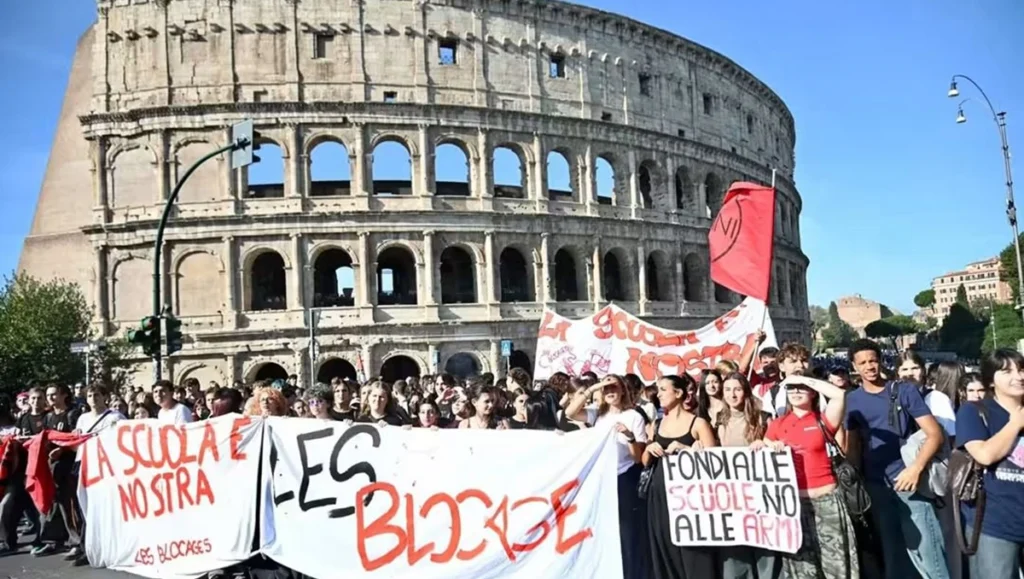
Demonstrations over school funding and discrimination coincide with protests by truckers, farmers and climate activists.

On Friday, thousands of students and teachers took to the streets in several Italian cities to protest the policies of Prime Minister Giorgia Meloni.

RELATED:

Italy’s Giorgia Meloni Trademarks Her Voice Against AI Deepfakes

The protests followed several days marked by a wave of school occupations in Milan, Naples, Turin, Genoa, Bologna and Rome.

The nationwide mobilization, dubbed “No Meloni Day,” combined demands over budget allocations with direct criticism of the Italian government’s environmental policies.

Student groups denounced the progressive deterioration of school infrastructure and called for the €13 billion allocated to military spending to be redirected toward education.

Representatives of the Alternative Student Opposition criticized the rising cost of living and announced a general strike scheduled for Oct. 30.

Un carro armato di cartone è stato dato alle fiamme durante il corteo degli studenti a Torino. Alcuni manifestanti hanno incendiato il modellino con fumogeni colorati, accompagnati dai cori "Brucia, brucia" e dallo slogan "Noi la guerra non la paghiamo", per protestare contro le… pic.twitter.com/RM7BH94cf9

— Sky tg24 (@SkyTG24) October 16, 2026

The text reads, “During a student protest in Turin, a cardboard tank was set on fire. Demonstrators ignited the model using colored smoke flares, chanting “Burn, Burn!” and the slogan “We will not pay for war,” as a form of protest against military spending.

The demonstration was part of the “No Meloni Day”—a day of student mobilization against the government’s educational policies, rising tuition costs, and increased military expenditure.

Similar protests took place across Italy, specifically in Rome, Milan, Florence, Genoa, Venice, Padua, Treviso, and Cagliari. In the capital, organizers estimated the turnout at 20,000 people, while in Turin, more than 2,500 students took to the streets.”

During marches in Rome, tensions escalated when some protesters threw firecrackers and trash containers outside the Education Ministry. Riot police and Carabinieri officers established security cordons and used tear gas to disperse the crowd on Via Marmorata.

“Thousands of students marched from the Colosseum to the Education Ministry. Tensions rose because of a group of masked protesters who threw bottles and improvised explosive devices at law enforcement officers, as well as discharged fire extinguishers,” RaiNews reported.

Similar clashes occurred in Turin and Bologna outside the prefecture and the central railway station, where police responded with water cannons. The violence led to confrontations involving blunt objects, the detention of a masked minor and severe disruptions to rail traffic in northern Italy.

"No Meloni Day"
Police charges against students
in Rome and Turin. pic.twitter.com/5IGt2pUQLU

— 𝕃𝕦𝕔𝕚𝕒𝕟𝕠 𝕃𝕦𝕝𝕫 (@altrella_l) October 16, 2026

Students Reject Discrimination and Racism

Thousands of people marched peacefully in Milan, holding signs and chanting slogans in support of social integration. Youth organizations strongly opposed Meloni’s “Valditara Decree,” which they described as discriminatory and racist.

In effect since June, the decree bans sex and relationship education at the preschool and elementary school levels and requires parental consent to address these topics at other educational levels. It also sets a maximum of 30% for foreign students in each classroom.

“Are these really the problems that need to be solved?” and “Racists out of our schools!” protesters shouted, according to RAI News.

“An entire generation has taken to the streets because it refuses to bow its head — to mind its own business — while others destroy our future,” said Alice, who linked the student movement’s demands to the genocide in Gaza.

“And it all starts right here, in our schools. The pro-Palestinian demonstrations made that clear: Some people have blood on their hands — the blood of genocides taking place around the world — and those same hands are cutting funding for our schools, our lives, and a dignified future in this city.”

“Outside the regional education authority’s headquarters, some participants threw eggs filled with red paint, declaring, ‘This is the blood of Gaza and Palestine,’” RaiNews reported.

No Meloni day here in Italy and antifascist students are facing-off with her cops right now in Bologna. Solidarity comrades.
No Fascism. No Genocide. No Meloni. pic.twitter.com/wQsgtjRRV2

— GhostofDurruti (@DurrutiRiot) November 14, 2025

Truckers, Farmers and Environmentalists Voice Discontent

On Friday, southern Italy faced a severe fuel shortage in the provinces of Calabria, Basilicata and Apulia because of protests by truckers and farmers. Steelworkers’ blockades at Eni’s Taranto refinery brought gas stations to a standstill, causing long lines and operational difficulties for public transportation.

The transport industry association Conftrasporto reported an increase of more than 50 euro cents per liter in diesel prices and demanded the immediate release of budget funds.

Facing the imminent risk of supply shortages, the Ministry of Infrastructure and Transport called an emergency meeting with industry representatives for Oct. 27.

The student mobilization also coincided with global protests organized by “Fridays for Future” in support of climate action and against fossil fuels.

Italian environmentalists marched to the Environment Ministry in Rome to demand reductions in polluting emissions and action to combat energy poverty across the country.

teleSUR/ JF

Source: RAI – EFE – teleSUR
  •  

France Braces for 500 Protest Actions as Yellow Vests and Students Join Forces

French authorities are preparing for hundreds of demonstrations on Saturday, 17 October, as student unrest converges with protests over living costs, public spending and government policy. Up to 40,000 demonstrators are expected in Paris, where police and organisers remain divided over march routes.

France is preparing for a nationwide wave of demonstrations on Saturday, 17 October, with approximately 500 protest actions under consideration and more than 90 marches being organised, according to the Interior Ministry. The mobilisation brings together high-school students, trade unions, farmers and supporters of the Yellow Vest movement, raising the prospect of further confrontation after nearly a month of unrest.

Police estimates suggest that around 40,000 demonstrators could gather in Paris, with approximately 150,000 more expected elsewhere in France. The figures remain preliminary, while authorities warn that some protests could involve road blockades, disruption to essential infrastructure and violent clashes.

Interior Minister Laurent Nuñez initially outlined preparations for 250 gatherings and 80 marches on Friday morning. Subsequent assessments from his office indicated that as many as 500 actions were being considered, although not all had been formally organised.

Paris Faces Dispute Over Demonstration Routes

The authorities are particularly concerned about developments in the capital, where negotiations between police and protest organisers have failed to produce agreement over the proposed routes.

Paris police prefect Patrice Faure has rejected proposals for marches terminating near the Opéra district or Place de la Concorde, citing security concerns surrounding central government institutions.

According to details of the security preparations, police have proposed an alternative route between Place de la Bastille and Place de Clichy. The CGT trade union and climate campaigners have accepted the proposal, but student organisations and Yellow Vest representatives continue to oppose it.

Prime Minister Sébastien Lecornu has convened an interministerial crisis unit to coordinate the government’s response. Security officials have warned that attempts to obstruct major transport routes or critical infrastructure will not be tolerated.

The Interior Ministry has also indicated that stun grenades, whose use was suspended during the student protests, could again be deployed in cases of particularly serious urban violence.

Yellow Vests Return Amid Rising Living Costs

Saturday’s demonstrations are being promoted as a revival of the Yellow Vest movement, which emerged in 2018 following opposition to fuel taxation before developing into a broader protest against living costs, economic inequality and government policy.

The latest mobilisation has gathered support from organisations demanding measures to address rising fuel, energy and food prices. Campaigners are also challenging the government’s proposed 2027 budget and its implications for public services.

The agricultural union Confédération paysanne has called on farmers to join the demonstrations, arguing that rising agricultural fuel costs and deteriorating conditions in rural communities have increased pressure on producers.

The union has also linked its demands to environmental policy, public-service provision and access to affordable food.

The CGT, student unions and climate organisations have similarly expressed support for the protests, while political backing has come from La France Insoumise and the French Communist Party.

Student Protests Enter Their Fourth Week

The mobilisation follows weeks of demonstrations involving secondary-school pupils, teachers and public-sector workers. What began as protests over shortages of teachers, overcrowded classrooms and deteriorating school buildings has developed into a nationwide confrontation over education policy and policing.

As EU Today previously reported, between 400 and 500 secondary schools faced partial or complete disruption earlier this month as students organised blockades and demonstrations.

The movement has subsequently expanded beyond its original educational demands, with student organisations raising concerns about university admissions procedures, police tactics and government spending priorities.

The scale of the unrest has placed considerable pressure on French authorities. According to figures from the Justice Ministry, 6,877 people were placed in police custody during the protests between late September and 8 October, approximately 86 per cent of them minors.

Violence during the demonstrations has resulted in injuries among police officers, students and educational staff. Clashes on 8 October led to 504 arrests and injuries to 48 police officers, according to Interior Ministry figures.

Education Minister Édouard Geffray has announced emergency measures to address teacher shortages, including the deployment of replacement teachers. The ministry says 2,000 of the 3,000 promised replacements have already been assigned, but student organisations maintain that the measures are insufficient.

Growing Pressure on the French Government

The planned demonstrations come as France faces a difficult debate over public spending, taxation and the 2027 budget. Lecornu’s government must balance demands for higher salaries and increased investment in education against mounting pressure to reduce the deficit.

France’s deteriorating public finances have already attracted scrutiny from eurozone partners, while domestic opposition to spending restraint has become a central issue ahead of the 2027 presidential election.

The convergence of student organisations, trade unions and Yellow Vest campaigners could broaden the protests beyond the education sector, particularly if demonstrations over living costs attract participants who have not joined the recent school protests.

However, the extent of that mobilisation remains uncertain. Online protest maps contain substantially more proposed actions than the authorities’ estimates, and participation figures will not be established until Saturday.

For the government, the immediate test will be whether the demonstrations remain peaceful and whether the authorities can prevent disruption to transport networks and public services without provoking further confrontations with protesters.

  •  

India Arrests Youth Protest Leaders Demanding Election Chief’s Resignation

The Cockroach Janta Party has accused the government of violating protesters’ rights.

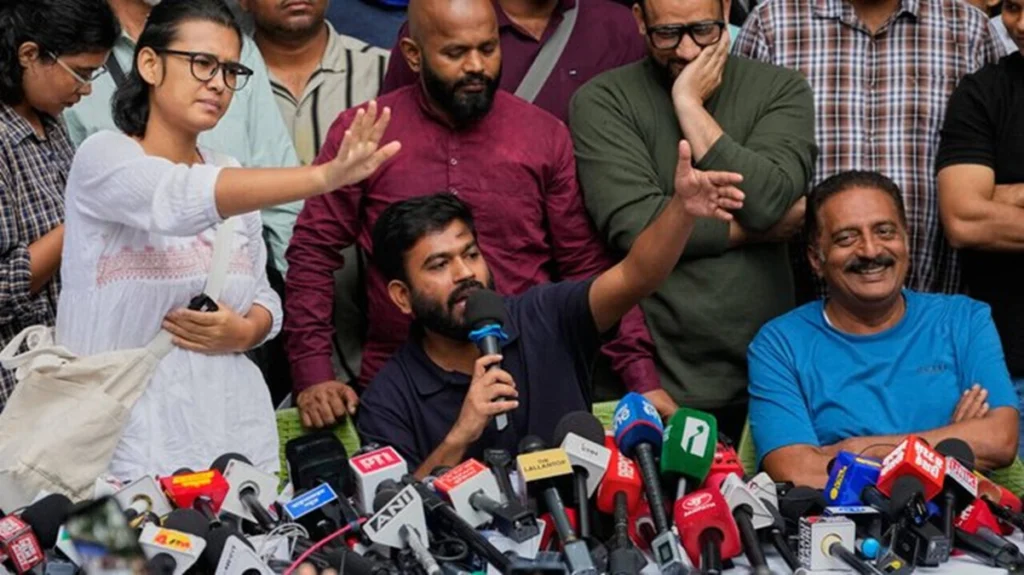
New Delhi police arrested Abhijeet Dipke, founder of the youth movement Cockroach Janta Party (CJP), popularly known as the “Cockroaches,” on Friday just as a new protest began demanding the resignation of Gyanesh Kumar, head of the Election Commission.

RELATED:

India Uses Digital Surveillance to Monitor Youth-Led Protests

The arrest took place as the leader was heading to the protest, where hundreds of demonstrators had already gathered. In a video shared by the organization on its social media accounts, several officers can be seen forcibly putting Dipke into a police vehicle and taking him away.

“This government is very afraid of young people waving the national flag! Dictatorship!” the CJP said, describing the arrest of its leader as “a serious violation of his rights.”

Police also arrested student activist Neha Bora, another prominent figure in the protest movement. She was detained in front of the Nepalese Embassy in New Delhi while leading a march toward Connaught Place.

Abhijeet Dipke was quietly leaving for protest march. Within 24 seconds, Delhi Police detained him. pic.twitter.com/dtQgBRrclG

— News Algebra (@NewsAlgebraIND) October 16, 2026

“How many people will Modi-Shah arrest? For every arrest this government makes, more young people will take to the streets!” the Cockroach Janta Party said.

To try to circumvent the heavy security deployment in the capital’s central commercial district and avoid arrests for unlawful assembly, the movement had issued instructions to its supporters hours earlier.

The instructions were to arrive in groups of fewer than five people, unfurl the Indian tricolor flag (Tiranga), take a photograph and leave peacefully to demonstrate that waving the flag “is not a crime.”

We will not be silenced, we will build Jantar Mantars everywhere ✊🔥 See you in London tomorrow, bring your tiranga bring your voice 🇮🇳 pic.twitter.com/gez9ucwoJD

— Students' Federation of India – United Kingdom (@sfi_uk) October 15, 2026

On Friday morning, Prime Minister Narendra Modi’s ruling Bharatiya Janata Party (BJP) issued a statement accusing the demonstrators of seeking an “anti-national revolution” and sowing “anarchy” in the country.

The arrests have left the organization almost entirely without its leadership, adding to the detention of two other spokespeople who remain in judicial custody at Tihar Jail after taking part in a protest Tuesday at Jantar Mantar, a traditional protest site from which authorities recently withdrew that designation.

The “Cockroaches,” which emerged in May as a satirical youth movement protesting unemployment and irregularities in university examinations, have expanded their demonstrations to include a review of the electoral rolls. They are demanding the resignation of Election Commission chief Gyanesh Kumar, whom they hold responsible for alleged irregularities.

teleSUR/ JF

Source: EFE

  •  

UN Warns Colombia Protest Decree May Widen Police Use of Force

United Nations warning on Colombia’s protest decree and police use of force during demonstrations.

The UN says Colombia’s new rules could let police end dialogue prematurely and use force against demonstrators.


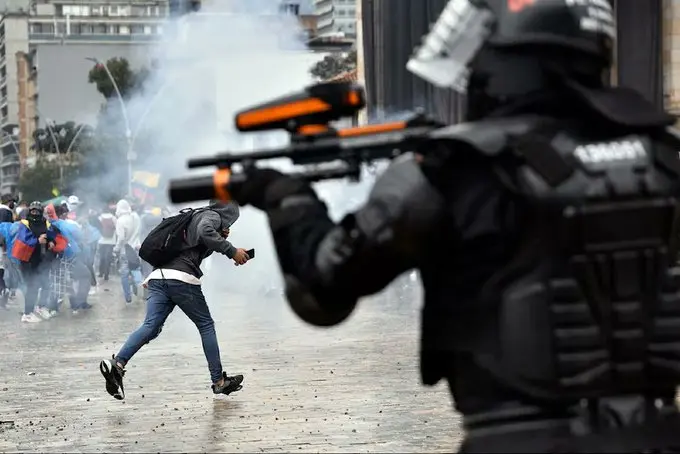
The United Nations warned Thursday that Colombia’s new rules governing protests could give police excessive discretion to use force, potentially putting peaceful demonstrators at risk.

RELATED: Colombia’s First National Strike Against De la Espriella Met With Police Crackdown

Signed Tuesday by President Abelardo de la Espriella, the decree changes police procedures during demonstrations, allowing authorities to act against people committing violent acts without waiting for dialogue with protesters to conclude.

In a statement released Thursday, the UN Human Rights Office in Colombia raised concerns about the criteria for ending negotiations, the decree’s definition of violence and the circumstances under which authorities can intervene in road blockades.

Some provisions are open to broad interpretation, the office warned, potentially allowing authorities to end dialogue and resort to force.

UN questions definition of violence

The decree identifies several grounds for intervention, including carrying or using weapons, holding people against their will, assaulting others and destroying infrastructure. The UN acknowledged that these acts pose different risks to life and physical integrity but said they must be addressed separately.

Action against people committing violent acts should not automatically end dialogue with demonstrators who continue to protest peacefully, the office said.

It also stressed that force, including less-lethal weapons, must be used only as a last resort, after nonviolent means of restraint have been exhausted, in accordance with General Comment No. 37 on the International Covenant on Civil and Political Rights.

Colombian President Abelardo de la Espriella signed Decree 1525, a measure that facilitates police repression by broadening the definition of “violence” during popular protests.

Interior Minister Rodrigo Lara warned that the new regulation will take effect before demonstrations… pic.twitter.com/YYfouyRGyt

— teleSUR English (@telesurenglish) October 14, 2026

The office also criticized the decree’s definition of violence as broader than international standards, noting that it includes threats of aggression and conduct that does not necessarily cause injuries, deaths or serious property damage.

Authorities should distinguish between carrying an object that could be considered a weapon, threatening to use it and actually using it, the UN said. Possession alone does not make someone violent or change the peaceful nature of an assembly.

Road blockades do not automatically justify force

The UN warned that blocking a road does not, by itself, make a demonstration violent. It also called for a review of the decree’s reference to a “serious and imminent disruption,” saying the criterion could be used to justify breaking up peaceful protests.

The duration of a blockade, the importance of the road affected and the resulting economic losses should not, on their own, justify coercive action, the office said.

“Economic impact or disruption to the normal functioning of a productive activity should not, in themselves, constitute justification for the use of force,” it said.

The office acknowledged that some provisions could help protect the right to peaceful protest, particularly those distinguishing peaceful demonstrators from people committing violent acts. However, it insisted that protecting peaceful assemblies must remain the primary objective of any changes to protest regulations.

The UN office said it had consulted the Colombian government on the decree and that some of its proposed amendments were incorporated into the version signed Tuesday.

  •  

Housing crisis: Porto unrest raises concerns ahead of Lisbon protest

Housing rights movement calls for a new rally, after a police charge in the early hours of this morning dispersed the gathering

Concerns are growing over the possibility of further unrest in Portugal as housing protests continue in Porto and organisers prepare for a similar demonstration in Lisbon on Saturday, October 17.

The post Housing crisis: Porto unrest raises concerns ahead of Lisbon protest appeared first on Portugal Resident.

  •  

Albania’s Student Protests Escalate for Third Consecutive Day

Thousands clash with riot police in Tirana, demanding educational improvements and accountability from PM Rama.

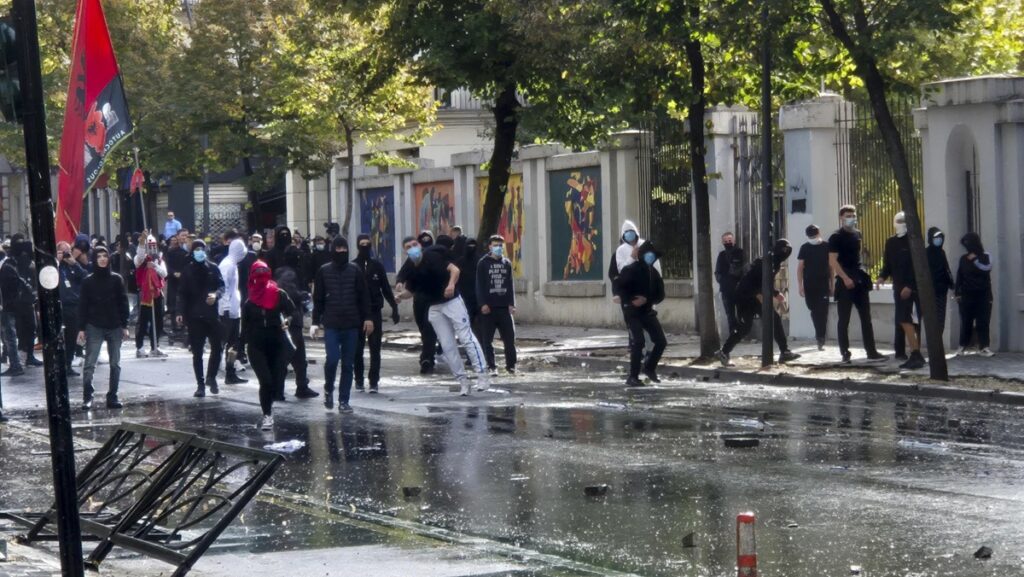
Demands for educational improvements, a lack of prospects after graduation and corruption allegations leveled against Albania’s government by thousands of young people converged on Thursday in clashes with riot police and acts of vandalism that continued to devastate businesses and street furniture in Tirana.

RELATED:

Albanian Student Protests Turn Violent for Second Day

Since about 20 people were detained on Tuesday during an attack on the Education Ministry, the protests have intensified, culminating in a fire at the building on Wednesday. Authorities have reported 70 police officers injured and said most of those arrested were not students.

Police Director Skënder Hita said very few of those arrested were students, a claim that contrasts with the fact that most demonstrators are teenagers, many of them of high school age, according to observations by news agency EFE. By midafternoon, Tirana’s Trauma Hospital had treated 26 people.

Police took a much tougher approach on Thursday. Thousands of young people who took to the streets failed in their attempts to reach the Education Ministry, Parliament, and the office of Prime Minister Edi Rama at night.

Riot police were deployed throughout the city, blocking students’ access with water cannons and tear gas. Many of the demonstrators were high school students who threw paving stones and fireworks.

The demonstrators did manage to set fire to the entrance of the Economy Ministry, which was damaged on Wednesday, even entered the building, vandalizing its furnishings.

Protests also took place in other cities, including Elbasan, Korce, Durres and Shkoder, where a senior police officer was in critical condition after being struck in the head by a stone.

Against Corruption

Rama has faced growing public mobilization since May. It all began as a protest against plans to sell land in a nature park for a tourism project linked to Jared Kushner, the son-in-law of U.S. President Donald Trump.

From there, the Flamingo Revolution, named after the birds that inhabit the reserve, expanded to include demands for greater democracy and transparency.

“The students’ demands are a natural extension of the protest movement’s main concerns, particularly the fight against corruption, the rising cost of living, and the prime minister’s arrogance and lack of accountability,” said the Flamingo Revolution platform, which has no visible leader and has accused Rama of “selling the country” through real estate projects.

Beyond the actions of isolated violent groups, the radical protests by young Albanians reflect a sense of frustration that some media outlets have linked to similar discontent in other countries experiencing comparable demonstrations, such as France.

The Albanian prime minister has made clear that he will not resign and has blamed the violence on the conservative opposition, accusing it of trying to “bring Albania down every time it tries to move forward.”

Rama, who has been in power since 2013, saw his Socialist Party win the May 2025 election for the fourth consecutive time, securing an absolute majority. He told Reuters on Thursday that the victory gives him greater legitimacy than any protest.

Under his leadership, the country has advanced its bid to join the European Union, a goal it hopes to achieve by 2030. However, those advances have not lifted Albania from its status as one of Europe’s poorest countries.

“Our students will be the first Albanians to enter adulthood as Europeans,” said Roland, a taxi driver who maintains that the country has modernized under Rama’s leadership and accuses the opposition of trying to prevent that progress.

teleSUR/ JF

Sources: EFE – Reuters

  •  
❌