
❌

Reading view

Here's how much the governor of every US state makes ahead of the midterm elections, ranked

Josh Shapiro speaks at a podium
Josh Shapiro is the highest-paid governor in the US.

Bloomberg/Getty Images

  • The annual salaries of state governors vary, with the lowest being $70,000 in Maine.
  • Josh Shapiro, Kathy Hochul, and Spencer Cox are among the highest-paid US governors.
  • The average annual salary for a state governor is $174,479 in 2026.

In some states, being the governor doesn't automatically make you a top earner.

With voters in 36 states heading to the polls to elect governors in November's midterm elections, the annual salaries attached to the job vary dramatically across the country — from $70,000 in Maine to over $250,000 in Pennsylvania.

Across all 50 states, governors earn an average official annual salary of $174,479 and are subject to federal and state income taxes — except in states without income tax, such as Florida and Texas.

By comparison, the top 1% of US earners each make at least $731,492 a year, placing the average governor below the ultrarich but also well above the average US wage of $69,846 in 2024, according to the Social Security Administration.

While governors across all 50 states are generally allowed to earn income beyond their state salaries through investments, book deals, and other sources, the income they may take in is closely regulated, and rules vary by state.

Some, like Florida's Ron DeSantis, have brought in yearly incomes of over $1 million thanks to book royalties, while others, like Illinois' JB Pritzker, earn eight figures due to investment gains and even gambling wins.

As such, some governors, like Pritzker and Connecticut's Ned Lamont, who are independently wealthy, have chosen to forgo their six-figure state salaries.

Beyond the salary, other financial perks of being governor may include living in the governor's mansion, receiving private transportation from the state, and having access to security and staff.

See how much your governor makes each year, based on the most recent available state records, salary commissions, legislation, and public payroll data.

50. Maine
Maine governor Janet Mills

Staff photo by Carl D. Walsh/Portland Press Herald via Getty Images

Governor: Janet Mills (Democrat)

Salary: $70,000

With a salary of $70,000, Maine Governor Janet Mills is the lowest-paid governor in the US.

The salary for Maine's next governor is set to rise to $125,000 in 2027 under new legislation, marking the first raise in the governor's salary in the state since 1987.

After two terms, Mills is now term-limited. Democrat Hannah Pingree and Republican Bobby Charles are facing off to become the state's next governor in the November midterm election.

49. Arizona
Arizona Governor Katie Hobbs

Rebecca Noble/Getty Images

Governor: Katie Hobbs (Democrat)

Salary: $95,000

The Arizona governor, who has the second-lowest salary among US governors, will be eligible to receive a salary of $165,000 starting in 2027, per the state legislature.

Democrat Katie Hobbs is running for a second term in the November midterm election.

48. Oregon
Oregon governor Tina Kotek

Mathieu Lewis-Rolland/Getty Images

Governor: Tina Kotek (Democrat)

Salary: $98,600

Oregon law sets the governor's annual salary at $98,600 and provides a separate $1,000 monthly expense payment. The salary is one of the lowest for any governor in the US.

Democrat Tina Kotek is up for reelection during the November midterms, seeking a second term.

47. Nebraska
Nebraska governor Jim Pillen

JIM WATSON/AFP via Getty Images

Governor: Jim Pillen (Republican)

Salary: $105,000

Nebraska Governor Jim Pillen, who earned $105,000 a year in 2025, per the state legislature, is the fourth-lowest-paid governor in the US.

Republican Jim Pillen is up for reelection, seeking a second term in the November midterm elections.

46. South Carolina
South Carolina governor Henry McMaster

Tracy Glantz/The State/Tribune News Service via Getty Images

Governor: Henry McMaster (Republican)

Salary: $106,078

With a salary of $106,078 in 2025, per state records, the South Carolina governor is the fifth-lowest-paid governor in the US.

After two full terms, McMaster is now term-limited. Republican Alan Wilson and Democrat Jermaine Johnson are facing off in the race to become the state's next governor in the midterm election.

45. New Mexico
New Mexico governor Michelle Lujan Grisham

Kevin Dietsch/Getty Images

Governor: Michelle Lujan Grisham (Democrat)

Salary: $110,000

New Mexico Governor Michelle Lujan Grisham is the sixth-lowest-paid governor in the US. New Mexico's next governor will receive a salary of $169,714 starting with the next gubernatorial term in 2027.

Lujan Grisham is term-limited after serving two terms. Democrat Deb Haaland and Republican Gregg Hull are competing to succeed her in the November midterm election.

43. (tie) Louisiana
Louisiana governor Jeff Landry

Jabin Botsford/The Washington Post via Getty Images

Governor: Jeff Landry (Republican)

Salary: $130,000

Louisiana law set the governor's salary at $130,000 in 2026. The salary has remained unchanged since January 2008.

43. (tie) Iowa
Iowa governor Kim Reynolds

Tom Williams/CQ-Roll Call, Inc via Getty Images

Governor: Kim Reynolds (Republican)

Salary: $130,000

Iowa Gov. Kim Reynolds earns an annual salary of $130,000, according to the state's official employee salary records.

Reynolds is not running for reelection, leaving Democrat Rob Sand and Republican Zach Lahn competing for the open governor seat in the November midterms.

42. Colorado
Colorado governor Jared Polis

CHET STRANGE/AFP via Getty Images

Governor: Jared Polis (Democrat)

Salary: $134,632

The Colorado governor, previously one of the lowest-paid governors in the nation, has received a $134,632 salary since 2023, as outlined by state law.

After nearly eight years in office, Polis is now term-limited.

Democrat Phil Weiser and Republican Victor Marx are competing to become Colorado's next governor in the November midterm.

41. Alabama
Alabama governor Kay Ivey

Stew Milne/Getty Images

Governor: Kay Ivey (Republican)

Salary: $134,780

In fiscal year 2026, Alabama Governor Kay Ivey had a salary of $134,780, per the state's Department of Finance.

After two full terms in office, Ivey is now term-limited. Republican Tommy Tuberville and Democrat Doug Jones are facing off to become the state's next governor in the upcoming midterm election.

40. Wyoming
Wyoming governor Mark Gordon

Tom Williams/CQ-Roll Call, Inc via Getty Images

Governor: Mark Gordon (Republican)

Salary: $140,000

Wyoming law sets the governor's salary at $140,000 in 2026.

Mark Gordon is term-limited after two terms, leaving Republican Eric Barlow and Democrat Kenneth Casner competing for governor in the November midterm election.

39. Florida
Florida governor Ron DeSantis

GIORGIO VIERA/AFP via Getty Images

Governor: Ron DeSantis (Republican)

Salary: $141,400

Florida Governor Ron DeSantis earns $141,400 per year, according to state records.

DeSantis is term-limited after two terms in office. Republican Byron Donalds and Democrat David Jolly are competing for governor in the November midterms.

38. Montana
Montana governor Greg Gianforte

Michael Ciaglo/Getty Images

Governor: Greg Gianforte (Republican)

Salary: $141,517

Gianforte, who made his fortune in tech, donates his salary to Montana nonprofits. In 2025, his office said he had donated his entire gubernatorial salary to organizations supporting Montanans in need.

37. Missouri
Missouri governor Mike Kehoe

Emily Curiel/The Kansas City Star/Tribune News Service via Getty Images

Governor: Mike Kehoe (Republican)

Salary: $145,095

Missouri law sets the governor's salary at $145,095 as of 2026.

36. Oklahoma
Oklahoma Gov. Kevin Stitt

SAUL LOEB/AFP via Getty Images

Governor: Kevin Stitt (Republican)

Salary: $147,000

While the current Oklahoma governor, Kevin Stitt, has a salary of $147,000 in 2026, his successor will see a raise to $185,000, per Oklahoma's Journal Record.

After nearly eight years in office, Stitt is now term-limited. Republican Mike Mazzei and Democrat Cyndi Munson are facing off to become the state's next governor in the midterm election.

35. South Dakota
South Dakota governor Larry Rhoden
South Dakota Gov. Larry Rhoden makes $146,472 a year in 2025.

Toby Brusseau/AP

Governor: Larry Rhoden (Republican)

Salary: $148,522

South Dakota Governor Larry Rhoden earns $148,522 a year in 2026, per the state's pay transparency website.

Republican Larry Rhoden, who took office last year following Kristi Noem's resignation, is up for election in November, seeking a full term.

34. Idaho
Idaho governor Brad Little

Darin Oswald/The Idaho Statesman/Tribune News Service via Getty Images

Governor: Brad Little (Republican)

Salary: $151,400

Idaho Governor Brad Little makes $151,400 in 2026, per state records.

Little is seeking a third term in the midterm elections this November.

33. Texas
Texas governor Greg Abbott

Jason Fochtman/Houston Chronicle via Getty Images

Governor: Greg Abbott (Republican)

Salary: $153,750

As of 2026, Texas Governor Greg Abbott makes $153,750 a year, per state records.

Abbott is seeking a fourth term in the midterm election this November.

32. Michigan
Michigan governor Gretchen Whitmer

Tom Williams/CQ-Roll Call, Inc via Getty Images

Governor: Gretchen Whitmer (Democrat)

Salary: $159,300

Michigan law sets the governor's salary at $159,300. Governor Gretchen Whitmer also receives a $54,000 annual expense allowance, according to the State Officers Compensation Commission.

After nearly eight years in office, Whitmer is now term-limited.

Democrat Jocelyn Benson and Republican John James are facing off to become Michigan's next governor in the November midterm election.

31. Mississippi
Mississippi governor Tate Reeves

Brandon Bell/Getty Images

Governor: Tate Reeves (Republican)

Salary: $160,000

Mississippi Governor Tate Reeves earns a salary of $160,000 in 2026, according to the state's personnel board.

30. Rhode Island
Rhode Island governor Daniel McKee

David L. Ryan/The Boston Globe via Getty Images

Governor: Daniel McKee (Democrat)

Salary: $163,295

Rhode Island's governor, Daniel McKee, earns a salary of $163,295, according to the state's pay transparency portal.

After losing the Democratic primary, incumbent Dan McKee will not be on the ballot. Democrat Helena Foulkes and Republican Aaron Guckian are facing off to become the state's next governor in the midterm election.

29. New Hampshire
New Hampshire governor Kelly Ayotte

Kayana Szymczak/Getty Images

Governor: Kelly Ayotte (Republican)

Salary: $165,027

New Hampshire law sets the governor's salary at $165,027.

Republican Kelly Ayotte is up for reelection this November, seeking a second two-year term in the midterm election.

28. Wisconsin
Wisconsin governor Tony Evers

Daniel Boczarski/Getty Images for Democratic Party of Wisconsin

Governor: Tony Evers (Democrat)

Salary: $165,568

Wisconsin law bans salary changes for a governor during their term in office. Gov. Tony Evers has received an annual salary of $165,568 since beginning his second term in January 2023, up from $152,756 during his first term.

Evers is not seeking reelection. The state's next governor is slated to receive an annual salary of $184,684 when they take office in January 2027, according to Wisconsin's official compensation plan.

Democrat David Crowley and Republican Tom Tiffany are facing off in the November midterm election.

27. North Dakota
Nprth Dakota governor Kelly Armstrong

Tom Williams/CQ-Roll Call, Inc via Getty Images

Governor: Kelly Armstrong (Republican)

Salary: $168,000

North Dakota's governor's salary is $168,000 following a July raise, per state legislation.

26. Nevada
Nevada governor Joe Lombardo

Benjamin Hager/Las Vegas Review-Journal/Tribune News Service via Getty Images

Governor: Joe Lombardo (Republican)

Salary: $170,062

The Reno Gazette Journal reported in May that Nevada Governor Joe Lombardo makes $170,062 a year.

Lombardo is up for reelection in the November midterm elections, seeking a second term.

25. Arkansas
Arkansas governor Sarah Huckabee Sanders

Leon Neal/Getty Images

Governor: Sarah Huckabee Sanders (Republican)

Salary: $171,808

In October, an independent commission in Arkansas voted to raise Governor Sarah Huckabee Sanders' salary to $171,808 annually.

Sanders is running for a second term in the November midterm election.

24. Kansas
Kansa governor Laura Kelly

Michael B. Thomas/Getty Images

Governor: Laura Kelly (Democrat)

Salary: $174,000

In 2023, Kansas raised the governor's annual salary starting January 1, 2025, tying the office's pay to the salary of a non-leadership member of Congress, according to state legislation.

Kelly is term-limited after two terms, leaving Democrat Cindy Holscher and Republican Ty Masterson competing for the governor's seat in the November midterm elections.

23. Virginia
Virginia Gov. Abigail Spanberger delivers the Democratic response to U.S. President Donald Trump's State of the Union address on February 24, 2026 in Williamsburg, Virginia.

Mike Kropf/Getty Images

Governor: Abigail Spanberger (Democrat)

Salary: $175,000

Virginia law sets the governor's salary at $175,000 in 2026.

22. Ohio
Ohio governor Mike DeWine

Jason Mowry/Getty Images

Governor: Mike DeWine (Republican)

Salary: $180,203

Ohio set the governor's salary in a 2018 law that established yearly pay increases for statewide elected officials through 2028, per state law. After the 2026 increase, Gov. Mike DeWine's salary is about $180,203.

DeWine is term-limited after two terms. Democrat Amy Acton and Republican Vivek Ramaswamy are competing for the governor's seat in the midterm elections.

21. Alaska
Alaska governor Mike Dunleavy

SAUL LOEB/AFP via Getty Images

Governor: Mike Dunleavy (Republican)

Salary: $182,787

In 2025, Alaska Gov. Mike Dunleavy had a salary of $182,787, per the state's Department of Administration.

After two terms in the governor's seat, Dunleavy is now term-limited.

Democrat Jonathan Kreiss-Tomkins and Republicans David Bronson, Treg Taylor, and Bernadette Wilson are facing off to become the state's next governor in the November midterm election.

20. Georgia
Georgia governor Brian Kemp

Alex Wroblewski for the Washington Post

Governor: Brian Kemp (Republican)

Salary: $185,000

In fiscal year 2025, Georgia Gov. Brian Kemp earned a salary of $185,000 and also received over $56,506 in travel reimbursements during the year, according to the Georgia Department of Audits and Accounts' financial transparency portal.

After two terms in office, Kemp is term-limited. Democrat Keisha Lance Bottoms and Republican Rick Jackson are running to be the state's next governor in the midterm election.

19. Delaware
Delaware governor Matt Meyer

Meg Oliphant/Getty Images

Governor: Matt Meyer (Democrat)

Salary: $185,096

From July 2025 until 2029, the salary for the governor of Delaware is $185,096, per the state legislature.

18. Kentucky
Kentucky governor Andy Beshear

Stephen Cohen/Getty Images

Governor: Andy Beshear (Democrat)

Salary: $188,523

Kentucky's governor, Andy Beshear, has a salary of $188,523, per the state's pay transparency portal.

17. West Virginia
West Virginia governor Patrick Morrisey

Andrew Harnik/Getty Images

Governor: Patrick Morrisey (Republican)

Salary: $190,424

Since 2025, the West Virginia governor's salary has been set to match the US Office of Personnel Management's locality pay area for the rest of the US, per the state legislature. That puts current governor Patrick Morrisey's salary at $190,424.

16. Maryland
Marland governor Wes Moore

Kevin Richardson/Baltimore Sun/Tribune News Service via Getty Images

Governor: Wes Moore (Democrat)

Salary: $192,000

As of his third year as Maryland governor, per the state legislature, Wes Moore's salary was $192,000 in 2025. The governor's salary will increase during the next term, starting at $195,000 in 2027 and reaching $210,000 by the fourth year, according to Maryland's Governor's Salary Commission.

Moore is running for a second term in the November midterm elections.

15. Minnesota
Minessota governor Tim Walz

DOMINIC GWINN/Middle East Images/AFP via Getty Images

Governor: Tim Walz (Democrat)

Salary: $200,000

The Minnesota governor's official salary is $200,000 after a July raise, per the Minnesota Legislature. Tim Walz previously declined salary raises while in office and accepted only a $127,629 salary. But during his last six months in office, he accepted his full salary, as reported by Minnesota Public Radio.

After two terms as governor, Walz is not running for reelection.

Democrat Amy Klobuchar and Republican Lisa Demuth will face off in November in a race to become the state's next governor.

14. Illinois
Illinois governor JB Pritzker

Scott Olson/Getty Images

Governor: Jay Robert "JB" Pritzker (Democrat)

Salary: $205,700 (foregone)

Illinois Governor JB Pritzker, a member of the Pritzker family that founded the Hyatt Hotels Corporation, has chosen to forgo his salary. The state has set the governor's salary at $205,700 as of 2023, per the Illinois General Assembly.

Pritzker is up for reelection this November, seeking a third term in the midterm elections.

13. North Carolina
North Carolina governor Josh Stein

RYAN M. KELLY/AFP via Getty Images

Governor: Josh Stein (Democrat)

Salary: $209,165

North Carolina state law sets the governor's salary at $209,165 in 2026.

12. New Jersey
Mikie Sherrill, governor-elect of New Jersey, during an inauguration ceremony at Prudential Hall at New Jersey Performing Arts Center in Newark, New Jersey, US, on Tuesday, Jan. 20, 2026.
New Jersey Governor Mikie Sherrill earns $210,000 a year.

Bloomberg/Getty Images

Governor: Mikie Sherrill (Democrat)

Salary: $210,000

State law sets New Jersey's governor's salary at $210,000 after a 2023 increase.

11. Indiana
Indiana governor Mike Braun

Andrew Harnik/Getty Images

Governor: Mike Braun (Republican)

Salary: $220,418

Indiana Governor Mike Braun, who earns $220,418 a year, according to the Indiana state government, is the 11th-highest-paid governor in the US.

10. Hawaii
Hawaii Governor Josh Green

PATRICK T. FALLON/AFP via Getty Images

Governor: Josh Green (Democrat)

Salary: $226,620

Hawaii's governor, Josh Green, is now the 10th-highest-paid following a July raise passed by the state legislature.

Green is running for a second term in the midterm elections

9. Connecticut
Connecticus governor Ned Lamont

Aaron Flaum/Hartford Courant/Tribune News Service via Getty Images

Governor: Ned Lamont (Democrat)

Salary: $226,711 (forgone)

Although the State of Connecticut sets the governor's salary at $226,711, the independently wealthy Ned Lamont has chosen to forgo the salary while in office.

Lamont made his money in telecommunications and investments. He's also the great-grandson of Thomas W. Lamont, a former chair of J. P. Morgan & Co. who built substantial wealth in banking.

Lamont is up for reelection this November, seeking a third term in the midterm elections.

8. Washington
Washington governor Bob Ferguson

Alexi Rosenfeld/Getty Images

Governor: Bob Ferguson (Democrat)

Salary: $234,275

Washington's governor earns $234,275 following a July raise, making Bob Ferguson the eighth-highest paid governor in the US.

7. Massachusetts
Massachusetts governor Maura Healey

Craig F. Walker/The Boston Globe via Getty Images

Governor: Maura Healey (Democrat)

Salary: $243,493

Massachusetts Governor Maura Healey received a salary of $243,493 in 2025, per the Office of the Comptroller of the Commonwealth of Massachusetts, making hers the seventh-highest governor's salary in the US.

Healey is seeking a second term in the November midterm elections.

6. Vermont
Vermont governor Phil Scott

John Lazenby/UCG/Universal Images Group via Getty Images

Governor: Phil Scott (Republican)

Salary: $243,520

Vermont law lists the governor's salary at $243,520 following a July raise, making the office the sixth-highest paid in the country.

Gov. Phil Scott is running for a sixth term in the midterm elections.

5. California
California governor Gavin Newsom

Justin Sullivan/Getty Images

Governor: Gavin Newsom (Democrat)

Salary: $245,929

As of May 2026, the California Department of Human Resources listed the governor's salary as $245,929, making Gavin Newsom the fifth-highest-paid governor in the US.

After two terms, Newsom is now term-limited. Democrat Xavier Becerra and Republican Steve Hilton are facing off in a race to become the state's next governor in the midterm election.

4. Tennessee
Tennessee governor Bill Lee

Tom Williams/CQ-Roll Call, Inc via Getty Images

Governor: Bill Lee (Republican)

Salary: $246,108

Tennessee Gov. Bill Lee earns $246,108 annually as of August, based on a monthly salary of $20,509 listed in the state's public payroll database.

After two terms in office, Lee is term-limited. Republican Marsha Blackburn and Democrat Jerri Green are running for the governor's seat in the midterm election this November.

3. Utah
Utah governor Spencer Cox

George Frey/Getty Images

Governor: Spencer Cox (Republican)

Salary: $249,250

In March 2026, the Utah Legislature passed a bill setting the governor's salary equal to that of the chief justice of the state supreme court, which is $249,250.

The raise made Spencer Cox the third-highest-paid governor in the US.

2. New York
New York governor Kathy Hochul

Barry Williams/New York Daily News/Tribune News Service via Getty Images

Governor: Kathy Hochul (Democrat)

Salary: $250,000

With a salary of $250,000 established by New York law, Kathy Hochul is the second-highest-paid governor in the US.

Hochul is seeking a second full term in the midterm elections.

1. Pennsylvania
Pennsylvania governor Josh Shapiro

Jason Ardan/The Citizens' Voice via Getty Images

Governor: Josh Shapiro (Democrat)

Salary: $253,870

Shapiro's salary rose from $245,760 in 2025 to $253,870 in 2026 after a 3.3% cost-of-living increase, according to the Pennsylvania Office of the Budget. The raise made him the highest-paid governor in the US.

Shapiro is up for reelection in the midterm elections this November, seeking a second term.
Read the original article on Business Insider

  •  

I'm the CEO of Life360. My own childhood was surprisingly hands-off.

Lauren Antonoff headshot
Lauren Antonoff is the CEO of Life360

Courtesy of Life360

  • Lauren Antonoff is the CEO of Life360 and uses the location-sharing platform with her family.
  • She says she tried to mimic her mom's somewhat hands-off parenting with her own two kids.
  • Giving kids space can help them develop agency and independence, she says.

This as-told-to essay is based on a conversation with Lauren Antonoff, CEO of Life360. It has been edited for length and clarity.

My mother was an awesome parent, but she was a person first. It was just the two of us for a lot of my childhood, between the time my dad died when I was 8, and my mom remarried when I was 14.

During those years, my mom was parenting while also in school, working, and dating. She was always there for me, but she wasn't trying to manage my childhood. She didn't do homework with me, for example. She made sure I was happy, loved, and well cared for, all while living her own life.

A lot of single moms might not have been open about things like dating, but mine was always transparent. I liked that I got to do my thing while watching my mom do hers.

My mom's benign neglect helped me develop agency

I didn't grow up knowing I wanted to be a parent. When I met my now-husband, he was already a father. Our daughter, who is now 27, was 5 at the time. I say I got her the easy way.

Old photo of mom and daughter
Lauren's mom was pretty hands-off.

Courtesy of Lauren Antonoff

From the beginning, my husband was the primary parent. That really opened the door for me to feel comfortable having kids. About three years later, we had our son.

Once I became a parent, my mom and I would sometimes talk about this idea of benign neglect — the benefits of letting kids do their own thing, and figure it out. In my childhood, my mom's benign neglect allowed me to develop independence and problem-solving skills.

Because my mom was less involved than some parents, I created a sense of agency that's served me well throughout life.

I wanted to change the world, but didn't expect to be in tech

My interest in tech was an accident. I thought I would become a civil rights lawyer and change the world.

While I was in college in the early 90s, I purchased a Mac to write papers with. I was living in Berkley, and got sucked into this community of Mac enthusiasts. I understood the technology — though not as well as some people — and I could articulate things well.

My techie friends diagnosed me as a product manager. I had a desire to advance technology that was both intelligible to humans and useful to them. I started working at a startup that was bought by Microsoft.

I thought it would only be for a few years, until I went to law school. I ended up spending 19 years at Microsoft before joining other tech companies like GoDaddy and now Life360. I realized along the way that I have an impact on people's quality of life, at scale, by advancing technology that makes day-to-day life easier.

Location monitoring keeps my in-person connections close

At Life360, we talk a lot about agency, which was so important in my childhood, and which I tried to encourage for my own kids. For me, and a lot of our users, the platform creates agency while helping people boost their real-life connections.

Here's my favorite use case: my husband is still the primary domestic partner, and he brings me lunch most days. If I'm at work feeling hungry, I can check his location and see if I need to get myself a snack, or if he's around the corner with my meal.

Recently, I got a flight notification from Life360. It showed that my brother — who doesn't live locally — had touched down in LA. I hadn't known he was in town, but since I got the digital signal, we were able to get dinner. Ultimately, the platform keeps us closer in real life by creating those opportunities for connection.

I'm cautiously optimistic about the future

I've never seen tech as a bad thing. I had a TV in my room growing up, and a simple coding game that was so basic I had to retype the code each time I turned it on.

Lauren Antonoff and family
Lauren Antonoff is the CEO of Life360

Courtesy of Lauren Antonoff

I was pretty liberal in how I let my own kids use technology. Looking back, I got my son — who's now 19 — a phone when he was probably too young. At the time, we wanted to play Pokémon Go as a family. I didn't think about how harmful some aspects of tech can be. I'm lucky that he turned out good despite that.

I'm cautiously optimistic about the future of technology. I'm also an activist. We get to shape what the future looks like, for our children and us — and there's a lot of power in that.

Read the original article on Business Insider

  •  

Walmart's chief people officer says these 2 things help workers get promoted quickly

Donna Morris at event
Walmart's chief people officer manages the world's largest global workforce.

Bloomberg/Getty Images

  • Walmart has more than 2 million workers — 500 of whom are promoted daily.
  • Its chief people officer said she observes 2 qualities in those who move up the ladder quickly.
  • First, they do the job they have well. They also show they can take more on.

Walmart promotes roughly 500 employees daily — so there's no shortage of opportunities to climb the ladder.

Workers who advance quickly tend to share two qualities, says Walmart chief people officer Donna Morris, who oversees the company's workforce of more than 2 million people worldwide.

The first is staying focused on the job in front of you, she said. Morris said the employees who stand out are motivated to make a difference and excel in their current roles.

"They are focused as much, if not more, on being exceptional at what they're doing today," Morris told Business Insider.

Once you nail the actual job you were given, the next step might be proving you can take on responsibilities for the role above you — before you get the title.

"Be the type of person that takes on over and above what's being expected of you," Morris said. "Be the person that asks or provides volunteerism for new ideas or new initiatives."

That also includes coming up with new ideas or volunteering to help with new initiatives. Morris said those actions show you can take on more responsibility.

In general, when hiring, Morris said she looks for evidence of the "grit that they had to persevere through." At Walmart, where most of its 2.1 million employees begin in frontline roles, she also likes to see that candidates have had some frontline experience. The chief people officer said it doesn't need to be in retail necessarily; it could be babysitting or helping out with a family business.

"If somebody has never really had to identify with what it's like to be a frontline hourly worker, it's going to be very hard for them to lead," said Morris, who started working at 13 at a dry cleaner's before taking a job at a drugstore two years later.

Read the original article on Business Insider

  •  

10 people on weathering 12 months of immigration turmoil

A carousel of portraits
10 people tell all about the uncertainty, risk, and reward of navigating the US immigration system.

Sean Marc Lee, Angela Ponce, Chinky Shukla, Ian Tuttle for BI

The H-1B visa system is one of high stakes, shifting rules, and little certainty.

Over the past year, Business Insider has spoken to more than 20 H-1B visa holders and hopefuls about their decisions to opt in, push through, and sometimes give up on the H-1B American Dream as the Trump administration has become increasingly hostile to foreign workers.

As part of our H-1B Fallout series, published one year after the Trump administration introduced a $100,000 payment for some new H-1B petitions, we are telling the stories of people navigating the visa system. Some left the US and returned to their home countries, while others rebuilt elsewhere or are still trying to build a career in the US.

In a statement, a White House spokesperson said the goal of the $100,000 H-1B fee is to focus on sponsoring "truly highly specialized temporary labor." A Department of State spokesperson said the US is unapologetic about its "America first visa policies" and that the administration is working with partners to facilitate necessary visas. A Department of Labor spokesperson said the administration is protecting American jobs and increasing wages.

Keep reading to see what life has been like for people affected by the US's immigration policy changes.

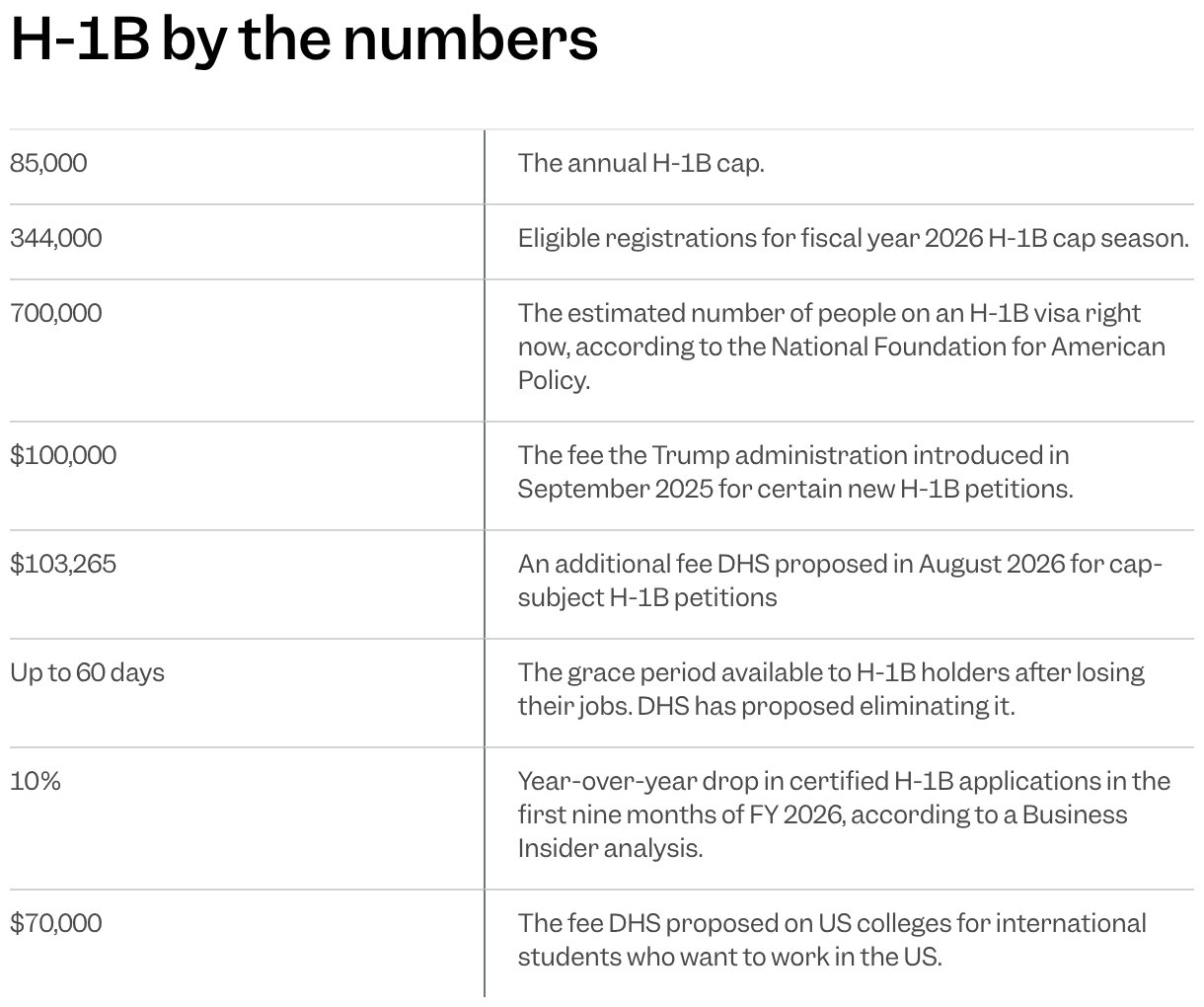
H-1B by the numbers (Table)
Soumi Chanda, 35
Person stands in a narrow urban street lined with buildings, parked scooter, overhead wires, and streetlights.

Paromita Chatterjee for BI

Soumi Chanda had spent 13 years building a life in the US when a 2025 layoff put her H-1B status at risk.

Chanda moved from Kolkata to Spokane, Washington, in 2013 for graduate school. She was selected for an H-1B on her first attempt in 2021 — "pure luck," she said — and Amazon later took over her sponsorship, prompting her move to Seattle.

When Amazon laid her off, Chanda had 60 days to find a new sponsor or leave the country. "Sixty days sounded impossible from the start," she said. Her search came as debate intensified over the proposed fee. "Even with Amazon on my résumé, I didn't get a single interview the following month," she said.

When preparing to leave the US, Chanda made her two cats her priority. She spent weeks arranging their international travel and paid roughly $5,000 for paperwork, along with thousands more to break her lease, dispose of her belongings, and secure last-minute travel. In total, she estimates the move cost her $18,000.

Now back in Kolkata, she's still working out whether India will be her long-term home. "There's plenty here I value, and other things, as a feminist, I find harder to reconcile."

Person holds a fluffy black-and-white cat in a softly lit indoor room.

Paromita Chatterjee for BI

Even with Amazon on my résumé, I didn't get a single interview the following month.

Read: She was picked for an H-1B visa on her first try, but got laid off

Luciana Pereyra, 26
Luciana Pereya

Angela Ponce for BI

Luciana Pereyra moved from Peru to the US at 17 on a tennis scholarship. After graduating, she landed a marketing role at Ohio State. Her H-1B was approved in April 2024. She described that time as living in "survival mode," knowing that losing a job could also mean losing her home.

In December 2025, Pereyra said HR contacted her to say that her position would end the following month. She had 60 days to find another employer to sponsor her visa or leave the country. "I treated the job search like the last match of my career," she said.

She focused on university jobs, but the timing worked against her: Many campuses closed for winter break as her grace period began. She said two promising opportunities fell through after prospective employers raised concerns about securing a visa amid the proposed H-1B fees.

Pereyra returned to Peru in March. In Lima, she freelances for a US marketing client, coaches tennis, and is building a small business. She said she would consider moving to the US again, but only if it came with "a real path to permanent residency."

Luciana Pereyra

Angela Ponce for BI

I treated the job search like the last match of my career.

Read: She played college tennis, earned 2 degrees, then lost her H-1B job

Mohamed Zeeshan, 33
Mohamed Zeeshar

Jared Soares for BI

Recent changes to US immigration policy have made Mohamed Zeeshan, a green card holder, more concerned about whether immigrants like him can build stable lives in the country.

He's seen relatives and friends consider countries such as Germany and Australia, rather than the US, because of the difficulty of securing jobs and visas after graduation. The instability surrounding H-1B visas — including the proposed $100,000 fee for new applicants — has reinforced his concerns.

Zeeshan self-petitioned for a green card and received it in 2023, enabling him to live in the US without needing employer sponsorship.

In 2025, he started his own consulting firm. Over the past year, Zeeshan said he has watched the immigration landscape become more uncertain.

He still plans to become a US citizen but says that if he had to rely on an H-1B visa today, he doesn't think he'd do it: "When you're on an H-1B here in the US, you're kind of always on tenterhooks."

"You don't know if you're going to be here next month or two months or three months down the line. That's a very difficult position to be in."

His wife is still waiting for her green card, and the couple is holding off on having children until they have more clarity about her status.

Mohamed Zeeshar

Jared Soares for BI

When you're on an H-1B here in the US, you're kind of always on tenterhooks.

Read: He moved to the US on a green card and wouldn't do the same on an H-1B

Vivienne Yang, 31
Vivienne Yang

Sean Marc Lee for BI

Vivienne Yang found out she was being laid off from her H-1B-sponsored job while she was on vacation in Japan in October 2024.

She spent the rest of the trip speaking with immigration and labor lawyers, emailing her employer, and trying to enjoy sightseeing with her partner.

Yang, who is from Taiwan, managed to get her employment extended for a few weeks, allowing her to fly back to New York. She then switched to a B-2 tourist visa so she could stay in the US longer and search for another job. She went through over 20 job interviews in the next year, all of them unsuccessful.

So, she decided to pivot.

Yang was accepted into a New York acting program, but her application for a US student visa was denied after she returned to Taiwan to apply for it in December 2025. Her American partner now looks after her two cats in Brooklyn while she remains in Taiwan, living with her family and working as a content creator, business English coach, and freelance consultant.

She has put her US plans on hold. "I don't want to deal with visa issues anytime soon," she said.

"Now I can move on with my life without any regrets because I know I have tried," she said. "I have a better understanding of what living abroad looks like and what American dream looks like in reality."

Vivienne Yang

Sean Marc Lee for BI

I have a better understanding of what living abroad looks like and what American Dream looks like in reality.

Read: She lost her job and left behind her American dream — and her cats

Watch: Vivienne Yang on letting go of her American dream

Ananya Joshi, 26
Ananya Joshi

Natalia Kepesz for BI

Ananya Joshi's plans to build a career in the US came apart in 2025, when a visa setback and a sudden layoff pushed her to look for a future elsewhere.

Joshi had moved from India to Illinois to pursue a master's degree. After graduating in 2024, she joined a Chicago startup developing cultivated meat as a scientist, working on an F-1 Optional Practical Training, or OPT visa.

She was enjoying the work until she learned that her employer could not complete E-Verify, which employers must use to sponsor an extension of STEM graduates' OPT.

From May through July 2025, Joshi interviewed for jobs around the world. She received offers in Canada and Germany and ultimately chose Germany. "Having gone through so much, I realized I needed that stability," she said.

In January, she moved to Rostock, about three hours north of Berlin, to join another lab-grown-meat startup. These days, Joshi is taking German classes and adjusting to what she describes as a slower work culture. She's also learning to navigate a long-distance relationship with her boyfriend, who remains in the US.

Joshi said she would still like to return to the US, but said, "I can't forget what I went through."

Gu Yichen, 31
Yichen Gu

Ian Tuttle for BI

Gu Yichen's path to working in the US began in high school, when he spent a year as an exchange student in Yacolt, a small town in Washington State. He later attended college in the US, interning at Amazon before joining the company full-time after graduation.

With a STEM degree, Gu had three chances to enter the H-1B lottery. He was selected on his third try.

In late 2022, Gu left Amazon for a job at Google, despite his manager's warning that the market was becoming unstable. He was laid off the following month, before he had done "a single day of real work."

Gu faced pressure to find a new employer within the 60-day grace period. Rather than take a stopgap role, he returned to China for a break before ultimately rejoining his former Amazon team in the US on an I-140, an immigration petition that can support a green-card application.

He has since applied for a green card, hoping it will give him "more freedom in both my personal life and my career."

Over the past year, he said the biggest challenge has remained the same: His ability to stay in the US is tied to his job. "I've been thinking what kind of life I really want to live and what is my real interest in life."

Yichen Gu

Ian Tuttle for BI

I've been thinking what kind of life I really want to live and what is my real interest in life.

Read: Google laid him off a month after hiring him; he was on an H-1B visa

Disha Lamba, 28
Disha Lamba

Chinky Shukla for BI

Leaving a six-figure data-scientist job in New York and returning to India in May was not an easy decision for Disha Lamba, but she says being closer to her family — and free from the limits of an employment visa — made it worthwhile.

Lamba moved to the US in 2021 to pursue a master's degree. She later joined CVS Health as a data scientist and learned that she had been selected in the H-1B lottery in March 2026.

By then, however, Lamba had already decided to move home. Though she had a fulfilling job and social life in New York, she struggled with the distance from her parents.

The prospect of managing an H-1B long-term reinforced her decision. Lamba was concerned about the difficulty of obtaining visa stamps to travel, as well as the limits the visa can place on changing employers, taking a career break, or pursuing additional income.

"Anything comes with its pros and cons. H-1B has its pros but also has its cons. I wasn't OK with the cons of being in these restrictions," she said.

After resigning, Lamba moved back to live with her parents and brother. She took a two-month career break and secured a short-term contract role, but she's still looking for a permanent job. Nonetheless, she's still happy about her decision.

"Every moment when I get to hug my parents, that's when I realize, no, this was all worth it," she said.

Disha Lamba

Chinky Shukla for BI

Sunjana Ramana, 27
Sunjana Ramana

Ayesha Kazim for BI

After three failed attempts to obtain an H-1B visa, Sunjana Ramana is reinventing her "American Dream."

Ramana moved from Hyderabad, India, to New York in 2021 for her master's degree. After graduating in 2023, she joined a global insurance company. Her employer entered her in the H-1B lottery in 2023, 2024, and 2025. She was not selected.

When her work authorization ended in early 2026, Ramana had to leave the US.

"When I didn't get the visa, I was really, really clueless. I thought that was the end of everything that I had built for three years," she said, adding, "but I realized just a couple of months later that there are so many additional options that I didn't know existed."

Instead of returning to India, Ramana secured a 2-year UK visa that is not tied to one employer. She chose London as her base, where she could pursue the entrepreneurship she had wanted to explore in the US.

Ramana was accepted into Antler's founder-in-residence program and spent two months building Flax, a two-person tech company that helps AI founders and builders. In May, she moved into a product-management role in fintech.

"I want to go back and tell my younger self not to associate the 'dream' with America or a country for that matter, because it doesn't matter where you are. The dream should be aligned to you and your goals."

Sunjana Ramana

Ayesha Kazim for BI

When I didn't get the visa, I was really, really clueless. I thought that was the end of everything that I had built for three years

Read: She left the US when she didn't get an H-1B visa. Now, she's living a new dream.

Madhur Mehta, 36
Madhur Mehta

Chona Kasinger for BI

An H-1B selection brought immediate relief for Madhur Mehta this year, but it has not resolved the uncertainty that shapes his and his fiancée's plans in the US.

Mehta moved to the US in 2021, earned a master's degree in 2023, and was eligible for three years of student work authorization. Amazon offered him both a job and sponsorship.

He joined the company in 2025 as a program manager.

But over the past year, while the company was trying to get him an H-1B, Mehta grew concerned about changes to the lottery. He began exploring backup plans for his US life, including an EB-1A visa and opportunities in Canada and Australia.

He learned he was selected for an H-1B in March, potentially giving him the chance to work and remain in the US for another three years.

"It was a big relief," he said, adding, "It's like someone has taken a 100-pound load off your mind," he said.

Mehta's fiancée, who is also from India, has one remaining chance in the H-1B lottery before her work authorization expires.

"It's hard, you know, obviously you can't plan," Mehta said, adding, "unless we are both very clear on what our visa status is."

Madhur Mehta

Chona Kasinger for BI

It's like someone has taken a 100-pound load off your mind.

Read: He got an H-1B visa, but uncertainty makes it hard to plan his future

Shreya Mishra Reddy, 34
Shreya Mishra

Cassandra Rudolph for BI

Shreya Mishra Reddy left the US in January after not being selected for an H-1B visa. Her plan was to leave the country and keep applying for US jobs from abroad.

That plan, however, started to feel unrealistic after the Trump administration proposed the $100,000 fee on some H-1B applicants.

Though the fee has been challenged in court and is not being enforced, she said the uncertainty changed her mind: "I've decided not to pursue H-1B or any role in the US right now."

Reddy had moved to the US in 2021 for a master's degree in engineering management at Duke University. After graduating, she was hired by Visa, but her student work authorization expired before she could secure an H-1B visa.

She's now in Toronto with her husband on a tourist visa and weighing whether to base herself in Canada or India. During a career break, Reddy has been writing a fiction book and building a handloom brand while exploring fintech roles.

In March, Reddy was accepted into a master's program in psychology at the University of Pennsylvania. She decided not to attend, citing uncertainty around student visas and the US job market.

She said she's optimistic about her future and wishes she'd been more open to opportunities in other countries earlier, rather than banking everything on the US.

"I was thinking that H-1B would pan out for me, it didn't, and it's something that I definitely regret."

I was thinking that H-1B would pan out for me, it didn't, and it's something that I definitely regret.

Read: She gave up on H-1B amid $100K fee; now she's weighing Canada or India

Watch: Why an H-1B visa hopeful decided to give up on work in the US

Shreya Mishra

Cassandra Rudolph for BI

Read the original article on Business Insider

  •  

The 10 universities with the most current US senators among their graduates

Cory Booker, Mayor of Newark, New Jersey, delivers his commencement speech at Stanford University's 121st Commencement ceremony.
Cory Booker attended Stanford University and Yale University.

Gary Reyes/MediaNews Group/Bay Area News via Getty Images

  • Some US colleges have numerous alums who went on to prolific political careers in the Senate.
  • Many of the colleges listed are Ivy League or have extremely low acceptance rates.
  • Harvard University tops the list, with 13 current senators among its alums.

US senators come from all sorts of different educational backgrounds.

Some graduated from the US Naval Academy or smaller private schools, but 42 of the 100 US senators came from 10 prominent universities, according to biographies on the US Senate website.

Harvard University, the oldest college in the country and one of the hardest to get into, boasts the largest number of current senators among its alums.

The senators on this list are alums of the schools' undergraduate, graduate, doctoral, law, or medical programs, and some have graduated from multiple of the listed universities. Honorary degrees and schools a senator attended without graduating were excluded.

Here's a look at which US colleges have produced the most current senators.

Brigham Young University
A college sign.
BYU had a 70.2% acceptance rate for its current freshman class.

George Frey/Bloomberg via Getty Images

Senators: Mike Crapo (R-ID), Mike Lee (R-UT), and John Curtis (R-UT).

Sen. Crapo graduated from BYU in Utah with a bachelor's degree in political science, as did Sen. Lee.

Sen. Curtis earned a bachelor's degree in business management.

Duke University
A college campus.
DURHAM, NC - OCTOBER 26: A general view of the Duke University Chapel on campus of Duke University on October 26, 2013 in Durham, North Carolina. (Photo by Lance King/Getty Images)

Lance King/Getty Images

Senators: Angela Alsobrooks (D-MD), Shelley Moore Capito (R-WV), Rand Paul (R-KY).

Sen. Alsobrooks studied public policy, Sen. Moore Capito studied zoology, and Sen. Paul received a medical degree.

Princeton University
A college campus.
Student walk along the campus of Princeton University in Princeton, New Jersey. (Photo by Rick Friedman/Corbis via Getty Images)

Rick Friedman/Corbis via Getty Images

Senators: Ted Cruz (R-TX), Dave McCormick (R-PA), Jeff Merkley (D-OR).

Princeton is an Ivy League university.

Sen. Cruz earned a bachelor's degree in public policy, Sen. McCormick earned a Ph.D. in international relations, and Sen. Merkley earned a master's degree in public affairs.

Dartmouth College
A college campus.
Baker-Berry Library on the campus of Dartmouth College in Hanover, New Hampshire, U.S., on Sunday, Oct. 17, 2021. Dartmouth Colleges endowment returned 47% in the fiscal year that ended in June, the latest university to post some of the strongest investment gains in decades.

Bloomberg/Getty Images

Senators: Angus King (I-ME), Tina Smith (D-MN), John Hoeven (R-ND), and Kirsten Gillibrand (D-NY).

Dartmouth is the smallest Ivy League school by undergraduate enrollment.

Sen. King earned a bachelor's degree in government, Sen. Hoeven earned a bachelor's degree in economics, and Sen. Smith earned an MBA from the university's Tuck School of Business.

Sen. Gillibrand graduated with a bachelor's degree in Asian studies.

University of Chicago
A college campus.
Cobb Gate at the University of Chicago campus in Chicago, Illinois, US, on Tuesday May 27, 2025. Chicago universities produce legions of science and technology workers, and the city is poised to benefit from growth of nascent industries such as quantum computing. Photographer: Christopher Dilts/Bloomberg via Getty Images

Bloomberg/Getty Images

Senators: Bernie Sanders (I-VT), Andy Kim (D-NJ), Amy Klobuchar (D-MN), Pete Ricketts (R-NE), Todd Young (R-IN).

The University of Chicago's five Senate alums span the political spectrum, from independent Sen. Bernie Sanders to Republican Sen. Pete Ricketts.

Both Sen. Sanders and Sen. Kim earned a bachelor's degree in political science.

Sen. Ricketts graduated with both a bachelor's degree in biology and an MBA. Sen. Young also earned an MBA, while Sen. Klobuchar earned a law degree.

University of Virginia
A college campus.
CHARLOTTESVILLE, VA - MARCH 01: An aerial view of the central grounds on campus at the University of Virginia on March 1, 2013 in Charlottesville, Virginia. (Photo by Lance King/Getty Images)

Lance King/Getty Images

Senators: Shelley Moore Capito (R-WV), John Cornyn (R-TX), John Kennedy (R-LA), Angus King (I-ME), Sheldon Whitehouse (D-RI).

Founded by Thomas Jefferson in 1819, the University of Virginia has a graduate-heavy Senate alum base: Sen. Cornyn, Sen. Kennedy, Sen. King, and Sen. Whitehouse earned law degrees there.

Sen. Moore Capito earned a master's degree in education.

Stanford University
A college campus.
PALO ALTO, CA - SEPTEMBER 26: A general view of the campus of Stanford University including Hoover Tower as seen from Stanford Stadium on the day of the ACC college football game between the Stanford Cardinal and the Georgia Tech Yellow Jackets on September 26, 2026 at Stanford Stadium in Palo Alto, California. (Photo by David Madison/Getty Images)

David Madison/Getty Images

Senators: Cory Booker (D-NJ), Josh Hawley (R-MO), Jeff Merkley (D-OR), Adam Schiff (D-CA), Tina Smith (D-MN), Ron Wyden (D-OR).

Sen. Booker, Sen. Schiff, and Sen. Smith all earned bachelor's degrees in political science. Sen. Booker also earned a master's in sociology.

Sen. Hawley earned a bachelor's in history, and Sen. Merkley earned a bachelor's in international relations.

Georgetown University
A college campus.
WASHINGTON, D.C., July 8, 2020 -- Photo taken on July 7, 2020 shows the Healy Hall on Georgetown University's main campus in Washington, D.C., the United States. U.S. President Donald Trump said on Tuesday the White House will push state governors hard to get schools opened in the fall despite a spike in coronavirus cases in the country. (Photo by Liu Jie/Xinhua via Getty) (Xinhua/Liu Jie via Getty Images)

Xinhua/Liu Jie via Getty Images

Senators: John Barrasso (R-WY), Jon Ossoff (D-GA), Dick Durbin (D-IL), Mazie Hirono (D-HI), Lisa Murkowski (R-AK), Dan Sullivan (R-AK), Chris Van Hollen (D-MD).

Georgetown University's appeal is partly due to its location in the nation's capital.

Four of its seven Senate alums earned law degrees: Sen. Durbin, Sen. Hirono, Sen. Sullivan, and Sen. Van Hollen.

Sen. Barrasso, meanwhile, earned a medical degree from Georgetown's School of Medicine.

Yale University
A college campus.
Yale University's Cross Campus looking towards Sterling Library. New Haven, Connecticut. Fall, 2013.

Kathryn Donohew Photography/Getty Images

Senators: Michael Bennet (D-CO), Richard Blumenthal (D-CT), Cory Booker (D-NJ), Chris Coons (D-DE), Josh Hawley (R-MO), Amy Klobuchar (D-MN), Sheldon Whitehouse (D-RI).

Five of Yale's seven Senate alums earned law degrees from the university: Sen. Bennet, Sen. Blumenthal, Sen. Booker, Sen. Coons, and Sen. Hawley. Sen. Coons also earned a master's degree in religion.

Sen. Klobuchar earned a bachelor's degree in political science, while Sen. Whitehouse earned a bachelor's degree in architecture.

The Ivy League school is in the top 5 most selective schools in the US, with an acceptance rate of 4%.

Harvard University
A college campus.
Cambridge, MA - October 9: The campus of Harvard University is seen behind the John Weeks Bridge from the Charles River on October 9, 2025. (Photo by Jessica Rinaldi/The Boston Globe via Getty Images)

Jessica Rinaldi/The Boston Globe via Getty Images

Senators: Richard Blumenthal (D-CT), Tom Cotton (R-AR), Ted Cruz (R-TX), John Fetterman (D-PA), Ruben Gallego (D-AZ), Tim Kaine (D-VA), Mike Crapo (R-ID), Jack Reed (D-RI), Adam Schiff (D-CA), Chuck Schumer (D-NY), Dan Sullivan (R-AK), Chris Van Hollen (D-MD), Mark Warner (D-VA).

Eight of Harvard's 13 Senate alums earned Juris Doctor degrees from the Ivy League school: Sen. Cotton, Sen. Cruz, Sen. Kaine, Sen. Crapo, Sen. Reed, Sen. Schiff, Sen. Schumer, and Sen. Warner.

Sen. Blumenthal earned a bachelor's degree in government. Sen. Fetterman and Sen. Van Hollen each earned a Master of Public Policy degree.

Sen. Gallego earned a bachelor's degree in international relations, and Sen. Sullivan earned a bachelor's degree in economics.

Read the original article on Business Insider

  •  

The concern that the KPMG US CEO keeps hearing from other executives

Tim Walsh sits on a stage
Tim Walsh, CEO and chair of KPMG US, said he routinely hears about cybersecurity concerns from fellow leaders.

Tasos Katopodis/Getty Images for Semafor World Economy

  • CEOs are excited about AI, but increasingly worried about cybersecurity, KPMG US CEO Tim Walsh said.
  • “The cyber risks have just elevated to places that we’ve never seen before," he told Business Insider.
  • KPMG is creating a cyber-defense business built around AI.

Corporate leaders tend to be enthusiastic about AI's potential — and increasingly concerned about the cybersecurity challenges the technology brings.

Tim Walsh, CEO and chair of KPMG US, said the worries come up in nearly every meeting he has with fellow leaders, as AI gives bad actors new ways to try to breach corporate defenses.

"The cyber risks have just elevated to places that we've never seen them before," he told Business Insider.

Walsh pointed to the Hugging Face incident this past summer, in which OpenAI said an AI agent bypassed controls during an internal cybersecurity evaluation and accessed parts of the open-source AI platform's systems.

There isn't currently a defensive wall, he said, that's capable of rebuffing every cyber threat. He said KPMG is working with the frontier AI model developers and others on further protections.

The goal is to help the Big Four firm protect its business, and its clients' businesses, Walsh said, adding that he sees it as a potential opportunity worth more than $1 billion.

'Cyber insecurity' fears

Unease about AI and cyber threats showed up in a recent KPMG US survey of 400 CEOs at major US companies. While leaders reported confidence in AI's potential, cybersecurity was the concern they identified most often.

Eighty-five percent said cybercrime and "cyber insecurity" could affect their company's prosperity over the next three years — more than said the same about inflation, geopolitical tensions, the pace of technological change, or other risks.

Cybersecurity was also the most commonly cited challenge to implementing AI. It topped ethical questions, data readiness, cost management, and translating AI spending into measurable returns.

Leaders said they were particularly concerned about identity theft and data privacy, vulnerability to cyberattacks, and fraud detection and prevention. Nearly half said they planned to increase cybersecurity investment over the next three years, citing threats including AI-powered social engineering, AI-assisted phishing or malware, and data and privacy risks tied to AI agents.

A growing need to defend and check AI

The concern is shaping the kinds of work the firm wants to do for clients.

Walsh said KPMG is building what he described as a managed cyber-defense business centered on AI, meant to serve as a "shield and defense mechanism" for companies. KPMG already has a cybersecurity business, he said, though this would be a different offering built around AI.

The company also sees a growing need to check whether the AI systems organizations deploy are doing what they are supposed to do. KPMG already helps clients assess AI-related controls and governance. Walsh said the firm is developing additional services to verify that AI agents are operating as intended and give investors and others confidence that companies can control them.

"Trust around AI is a real thing," he said.

Read the original article on Business Insider
  •  

Microsoft's ex-VP of HR shares 3 effective ways to use AI at work — and what he never uses it for

AI assistant and Chris Williams headshot.
When embraced and used carefully, AI tools can help gain perspective and boost productivity at work.

Alex Cristi /Getty Images | Chris Williams

  • Chris Williams was the VP of HR at Microsoft and is now an advisor and consultant.
  • Williams uses a broad range of AI tools and encourages his clients to do the same.
  • "Perhaps you'll find, as I did: AI can be better at deletion than creation," he says.

Practically every company is making AI tools available to their employees. As the former VP of HR at Microsoft and a leadership advisor with over 50 years of business experience, I'm amazed at how quickly this rollout has progressed.

Some people are all in, using the tools for nearly everything they do. Others have barely stuck their toes in the AI waters. I've been using a broad range of AI tools and encourage my clients to do the same.

AI isn't without controversy, and if someone is strongly against using it — for whatever reason — I'm not going to convince them otherwise.

But if you're wondering how and why you should use these tools, I'm here for you. Let's talk about three ways I advise all my executive clients to use AI effectively in the workplace.

1. Use AI as a second opinion

Use AI as a way to see things you might not have seen. Ask it, "What am I missing?"

I agree with many that AI is lousy at most creative efforts. Whether written or visual, AI results can be generic, mediocre, and often embarrassing. The output usually deserves the "AI Slop" label it gets. But to dismiss it entirely misses a core value.

AI is useful with, perhaps even because of, that generic, often obvious other perspective.

It can be amazingly helpful to simply ask: what am I missing? Since AI has a tendency to agree with me, I explicitly ask for pushback: "review this and tell me what I'm missing, tell me where I'm wrong." The fact that AI is so obvious, so average, is actually a core value here. I'm often surprised at the points I missed and the viewpoints I overlooked.

Even if AI doesn't find things you missed, a contrarian angle can be very helpful to shore up your own case. You'll be able to say, "Yes, I considered those things, and here's why my take on this issue is better."

In that way, AI can also help you prepare for your discussions with colleagues. With so many letting AI draft their arguments, it's very valuable to see their perspective in advance.

So no, I don't let AI make my case, but I always look for another perspective in what I do — wherever it comes from. Having a tool that can give me that on a moment's notice is incredibly useful.

2. Ask AI to summarize dense information

Long before AI, we all had that colleague who always told you far more than you needed to know. With some now using AI heavily, it can frankly be overwhelming.

You ask a simple question and get a blizzard of AI-generated noise in response. AI can be the worst over-explainer when simply left to run. You see the results in a seven-page response.

When I'm faced with one of these walls of text, I've learned there are really only two ways to respond. I can, and often do, ask the person to try again. What does this all really mean? Can you summarize your point in a couple of sentences? I occasionally get snarky and ask for the "non-AI slop" version.

Another way to deal with this is to ask AI to summarize it, whether AI tools or a wordy colleague wrote it. Importantly, I don't trust the AI summary to be the full explanation, but it helps me understand the key points. Which I then work to find in the original blizzard response.

Yes, this is a little circular. After all, why not just have the two AI systems have the discussion? Leave me out of it. But in a world where it seems everyone has a hard time getting to the point, any tool to cut through the noise is welcome. And AI is very good at that.

3. Let AI help you with tasks

In a similar vein, one thing AI does incredibly well is organize. This kind of rote task of sorting, filtering, and filing is right in the sweet spot for most AI systems.

I'm wary of letting AI systems automate tasks like filtering or filing things without my supervision. I'd never let an AI system automatically send emails, texts, or documents without my careful review. But I often have AI systems help me sort through mountains of accumulated debris.

I recently moved to a new computer system and had AI review what I was planning to move over. I discovered decades of accumulated cruft. Simply from a comprehensive list, I found gigabytes of programs, files, and settings, 90% of which I just left behind.

So if you have 8,000 emails in your inbox, or a documents folder that has grown a second life, let an AI system take a look for you. Don't just tell it to "deal with it." Your judgment is needed.

Rather, have it give you a review of it and another perspective. And once you've reviewed it, perhaps you'll find, as I did: AI can be better at deletion than creation.

So when your company rolls out the next new AI, use those tools to your advantage. AI can help you see another perspective, find the important points in the blizzard, and cut through the mess. I've embraced AI, use it with great care, and encourage everyone to do the same.

Read the original article on Business Insider
  •  

I posted a 'Legally Blonde'-inspired TikTok to capture a CEO's attention. It got me an internship that turned into a full-time job.

a man poses with two life size concealers
Isaac Persky.

Courtesy of Isaac Persky

  • Isaac Persky used a creative video to land an internship at Tarte Cosmetics in 2024.
  • Maureen Kelly, the CEO of Tarte, was impressed by Isaac's video, leading to his internship offer.
  • He returned for a second summer internship and started a full-time position this June.

When I was in college, I wanted a summer internship in New York City, specifically at one company: Tarte Cosmetics. My mom sent me a video of Tarte's founder and CEO, Maureen Kelly, calling on college students to apply to their summer internship program, and it sparked my interest.

I've been posting videos on social media in both the beauty and comedy niches for years, but I thought I'd left that behind when I started college at Chapman University to pursue a more 'serious' career. I was double majoring in economics and public relations and figured Tarte would be a fun way to spend the summer after my sophomore year before turning to a more traditional business or finance path.

I had one problem — I had no connections to Tarte, no family in the beauty industry, and no obvious way to stand out among thousands of applicants. In today's job market, especially for a sought-after position in beauty, it felt more likely I'd get struck by lightning than land an offer.

When I submitted my application in January 2024, I knew I barely had a shot.

This is where most applicants stop

They repeat the process with hundreds of applications, hoping to win the lottery of landing an interview and, ultimately, an offer.

I'm from Nebraska and attended school in Southern California. To be frank, going home for the summer was not an option. I didn't want to trade my glamorous coastal lifestyle for corn and county fairs. I couldn't rely on pure luck to be selected for an interview. I knew that if I could get in front of them, they would see how perfect I was for the role.

I decided to make a video

Since posting videos felt natural to me, I figured, what better way to show that I'm qualified for a marketing job at Tarte than by successfully marketing myself to Tarte. I decided to make something fun and entertaining. Inspired by the iconic Harvard admissions video from Legally Blonde, I created an "Elle Woods-style" application video.

I showed Tarte that I was passionate about working for them, willing to put myself out there, and could actually do the job that I was applying for. I admit, it felt a little ridiculous. I knew that all my friends would see it, and that there was a good chance it wouldn't work out the way I intended, but it was worth a try.

The video got the attention of Maureen Kelly

I woke up one morning in January 2024 to a notification that made me check whether I was still dreaming: a comment from Maureen Kelly on my post. It was a simple 'I 👀 u! OBSESSED,' followed by an email from Tarte's HR team saying they enjoyed my video and wanted to schedule an interview.

From there, I landed a paid internship with Tarte Cosmetics on their social media team. I moved to New York and worked at Tarte for three months. What started as a creative experiment became my entry point into the beauty industry.

The following winter, they offered me the chance to return for the summer of 2025. Despite my initial thoughts that my summer at Tarte would be a one-off adventure, I accepted their offer. It felt like I had found a career that combined my interests in comedy, public relations, and storytelling.

The experience also challenged some assumptions I had about internships

I expected to spend my summers doing small administrative tasks. Instead, I found myself contributing to campaigns with household-name brands and learning from the professionals who had built Tarte. I was particularly struck by Maureen Kelly, who took my ideas as seriously as she did her VPs' and shared her personal advice and can-do attitude with me regularly.

This spring, as I prepared to graduate, I received a full-time offer from Tarte without having to apply again. I officially started my full-time role with Tarte in June.

In college, much of the career advice my classmates and I were given emphasized professionalism and networking, but when employees at your favorite company are getting dozens of 'coffee chat' messages each week from people like you, that advice becomes outdated. Sometimes the best career move isn't sending another application; it's doing something creative with the skills you already have.

For most people, the idea of posting a video to get a summer internship feels embarrassing

To be honest, it was embarrassing. Putting yourself out there always carries that risk, but sometimes that discomfort is the price of trying something others might not.

Even if it doesn't work out, don't let it reflect on you. I find it best to maintain the mentality that they would be lucky to have you, and frankly, what a disappointment it is that they didn't get you.

Most importantly, I must acknowledge that all of this advice is coming from someone who has the job and got the internship. Yes, I was strategic, and I give myself credit for that, but I was also lucky.

Read the original article on Business Insider
  •  
❌