The spending has hurt the Silicon Valley giant’s cash flow, which turned negative. Meta said it would issue a new class of stock to help it raise more money.
Visa CMO Frank Cooper III is freshening up the company's look.
Jason Mendez/Getty Images for The Whitaker Peace & Development Initiative
Visa is rolling out a new "V" to pop on mobile screens as people move to contactless payments.
It's the company's first refresh of this size since 2021.
Other brands have increasingly leaned on symbols and pared-down names for better mobile visibility.
Visa is betting that less is more when it comes to how it shows up to customers.
Starting Wednesday, the letter "V" will replace "Visa" in the center of its credit cards and on its digital properties, the company exclusively told Business Insider.
Visa's move signals that after 50 years of using the name, it feels it has enough brand recognition to be represented by a single letter. The change is also meant to pop more on small screens as people conduct more of their lives on their mobile devices.
In addition to the "V," Visa is introducing a new font, called Visa Sans, lopping off the serif in the first letter of "Visa."
"V" will now stand in for "Visa."
Visa
The changes were developed by Visa's in-house creative studio and Base Design. It's Visa's first significant refresh since 2021, when it introduced a blue, white, and yellow flag-like brand symbol and a new font. With the new "V," that brand symbol will go away.
"There was an opportunity for us to modernize that and make it feel fresh, particularly for the next generation of consumers," Frank Cooper III, CMO of Visa, told CMO Insider. "We think it marries well with the evolution of the brand overall."
Cooper said the process took about a year.
"We do not have an awareness issue. We have deep trust. Playing around with the brand positioning is no light matter," he said.
Other big brands have increasingly leaned on symbols and pared-down names for better visibility on smaller screens.
Mastercard dropped its name from its logo in 2019. Google introduced a sans-serif logo and a new, four-color "G" icon in 2015.
Dan Nicholas, design director at creative studio Super Okay, said the move to a singular V aligns with a mobile-first approach that tech and media brands like Verizon and The New York Times have taken, in which they adopt a single letter as an icon.
He said the move simplifies Visa's appearance but could undermine brand recognition.
"What remains to be seen in the rollout is how Visa manages this new equity," he said. "If thoughtfully and strategically executed and invested in over the next few years, we can see it becoming a strong way for the brand to express itself."
Visa sees its visual changes as a companion to an effort to associate itself with culture and aspiration. It enlisted celebrities like Pharrell Williams for its "Power of Small Steps" campaign and has a partnership with the FIFA World Cup that extends through 2030. This year's World Cup campaign promoted its contactless payment option to emphasize that Visa's long-running slogan, "everywhere you want to be," was more than just a physical destination.
"We see that phrase now as representing both a physical destination and a personal aspiration," Cooper said.
Azoma, cofounded by Timur Luguev and Max Sinclair, just raised $11.2 million in Series A funding.
Azoma
Azoma helps brands get their products discovered by AI shopping agents.
Its platform measures brands' AI visibility among specific shoppers and offers tips to improve.
Azoma just raised $11.2 million in a round led by Puma Growth Partners.
As people begin to delegate online purchases to AI assistants and agents, the startup Azoma wants to ensure its consumer-goods clients make the shopping list.
The company exclusively told CMO Insider on Wednesday that it had raised an $11.2 million Series A funding round, led by Puma Growth Partners.
Founded in 2022, Azoma initially focused on helping brands show up prominently in AI search and chatbots, operating in the fast-growing field of generative engine optimization, or GEO. Then, over the past year, at least a dozen new AI shopping assistants from retailers rolled out, alongside the launch of personal AI assistants like Meta's Muse, OpenAI's Dots, and Instinct, which can also make purchases on a user's behalf.
In December, Morgan Stanley estimated that AI-powered shopping assistants could account for up to $385 billion in US e-commerce sales by 2030.
"The space has evolved rapidly from customers just really caring about answer engines to caring about the other types as well," Azoma CEO Max Sinclair told CMO Insider.
Azoma's customers include Unilever, L'Oréal, Reckitt, and Mars. It offers them a service it calls agentic commerce optimization, a technique that helps make their products more discoverable by large language models and more likely to be recommended by them.
Azoma suggests actions the clients can take to improve their visibility, from honing their marketplace listings to optimizing their content on YouTube and Reddit. It also uses "digital twin" technology to simulate different consumer demographics, so brands can see how their products are presented to the specific shoppers they want to target.
Sinclair said Azoma differs from other GEO companies because it's laser-focused on the commerce space and working with brands who sell physical goods.
"Many of our customers have tried these generic GEO platforms and found that they don't understand commerce at all," Sinclair said. "They don't understand the integrations, they don't understand the workflows, they don't understand the existing tech stack, they don't understand how the teams work, how they're operated, how they're motivated."
Sinclair said Azoma plans to invest the fresh funds in ensuring its technology can track across all the latest agents, from Meta's Muse to TikTok's new Shopping Assistant. The company charges a fee per brand, geography, and shopping agent.
Sinclair estimated the company's head count would grow to around 80 to 100 people next year, up from 40 currently, as it ramps up hiring in areas including sales, customer success, AI research, software development, and operations.
Azoma also plans to integrate data from the Tesco-owned retail analytics company Dunnhumby to help brands determine whether increasing their share of voice on a platform like ChatGPT translates into a sales lift at brick-and-mortar retailers.
Dunnhumby Ventures also participated in the round, alongside Twinpath, Mars IAF, Rank Ventures, and Ignite Ventures.
Check out the pitch deck Azoma used to secure its $11.2 million Series A investment, shared exclusively with CMO Insider. Some of the slides have been omitted or redacted.
Azoma's tech helps brands drive revenue through AI shopping agents.
Azoma
The 'about us' slide provides company details.
Azoma
Azoma has offices in London and Toronto and has previously received investment from eBay Ventures and Dunnhumby Ventures.
Its clients include Unilever, Reckitt, and Heinz.
Azoma
The presentation features testimonials from clients at Dentsu, Perfect Ted, L'Oréal, and Mars.
Azoma
Azoma tees up the business opportunity.
Azoma
Consumers are using AI to discover brands and products.
Azoma
It cites 2025 research from Capgemini that says 58% of consumers have replaced traditional search engines with generative AI tools for product recommendations.
Azoma quotes Harley Finkelstein, Shopify's president.
Azoma
Finkelstein said on Shopify's August earnings call that traffic and orders coming in from AI channels to Shopify stores had tripled over the past year.
A Shopify blog post, published in May, said AI-referred traffic converted at a 50% higher rate and had an average order value 14% higher than traditional search.
Amazon CEO Andy Jassy has lauded its AI-powered shopping assistant.
Azoma
Alexa for Shopping was used by more than 350 million Amazon customers over the past 12 months, Jassy said on the company's July earnings call.
Jassy said that US customers who use Alexa for Shopping spent 40% more per order than those who don't.
Walmart has an AI-powered shopping assistant called Sparky.
Azoma
Walmart CEO John Furner said on the company's August earnings call that the number of customers using Sparky was up 70% year-on-year. Similar to Amazon, Walmart said customers who used Sparky for shopping spent 40% more per order than those who didn't.
This slide uses Cloudflare data that shows bots have surpassed humans in web traffic.
Azoma
At the time of the presentation, in September, Meta's Muse was the top app in the US Apple and Android app stores.
Azoma
The presentation moves to the challenges Azoma solves.
Azoma
Azoma says that as AI adoption increases, brand real estate shrinks.
Azoma
Brands have fewer opportunities to control channels and content in agentic shopping experiences.
Azoma
This slide shows the differences between traditional e-commerce and agentic commerce.
Azoma
Agents gather information about products from multiple channels, including online discussion forums, editorial content, reviews, and brands' own websites.
Azoma specializes in agentic commerce optimization, or ACO.
Azoma
It covers answer engines, retailer shopping assistants, and personal AI agents.
Azoma
This slide analyzes the differences between ACO and GEO.
Azoma
Azoma says that, when done effectively, ACO can boost customer acquisition.
Azoma
The presentation then introduces a case study.
Azoma
Azoma says it helped drive a 43% revenue uplift for Mars compared with a control group.
Influencer marketing to baby boomers hits different — and not in the way brands intended.
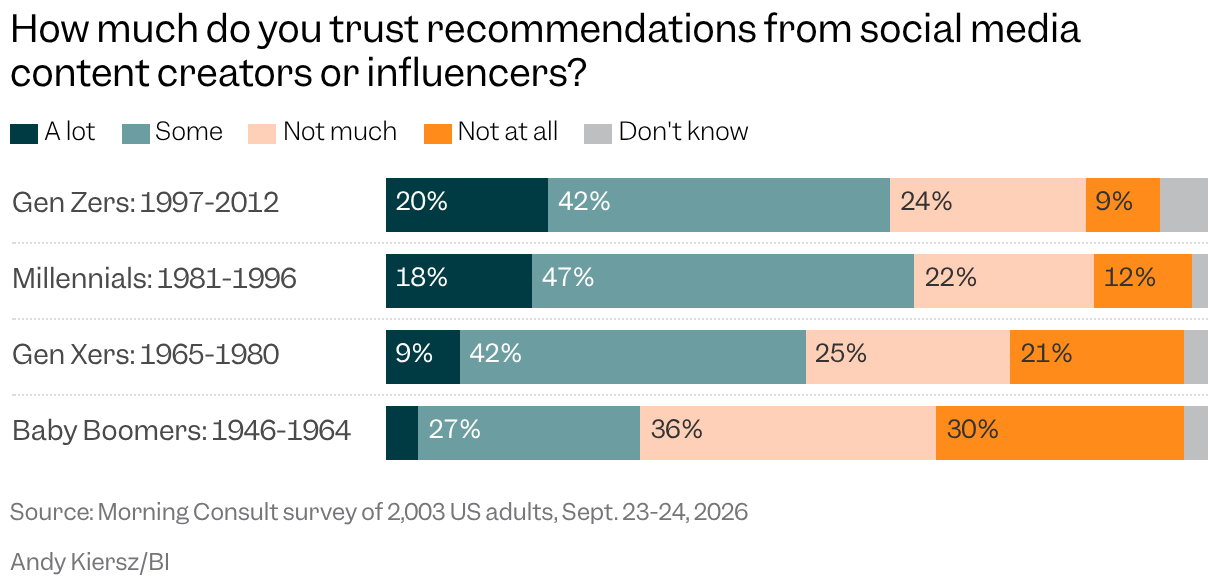
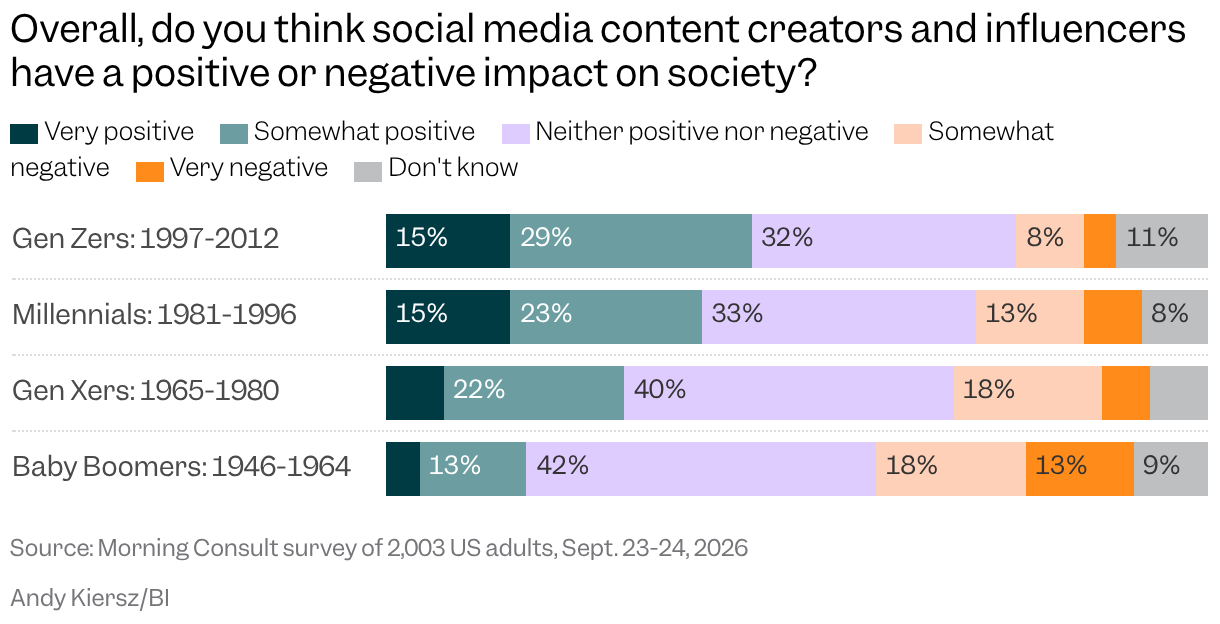
Research from Morning Consult, conducted exclusively for Business Insider, reveals a stark generational divide in attitudes toward influencers. Boomers — people born between 1946 and 1964 — are distrustful of influencers, skeptical of their recommendations, and more likely to find their content "annoying."
In the survey of roughly 2,000 US adults conducted in September, 31% of boomers said they trust influencer recommendations at least somewhat, compared with 62% of Gen Z and 64% of millennials. Two in five (40%) boomers surveyed said they trust influencers less than they did a few years ago.
Sure, plenty of adults become set in their ways and harder to persuade as they age. But advertising pros said there's another factor that could help explain boomers' wariness of influencer marketing: brands themselves continue to overlook the older generation.
"Brands are terrified of taking any dollars away from speaking to young people," said Jennifer Meehan, an EVP at the communications agency Edelman.
That fear also extends into the creators they look to partner with.
Florian Dost, a marketing professor at Brandenburg University of Technology in Germany, interviewed influencer agencies and talent managers as part of a recent study. Some of the managers his team interviewed found that older influencers often drove higher campaign conversion rates, but brands rejected them.
"Agencies may know that," Dost said. "They certainly sometimes try to put it forth because they also see the numbers. But clients don't want to hear."
Boomers' distaste for influencers presents a challenge for CMOs.
The generation is a considerable consumer force, accounting for 42% of spending among affluent US households, according to Visa research from last year. With US marketers forecast to spend $40 billion on creator economy partnerships and ads this year, per Business Insider sister company EMARKETER, brands risk leaving a lucrative audience on the sidelines.
Getting boomers to click
Stewart Reynolds, 56, a Canadian comedy creator who posts under the name Brittlestar, said that older consumers rarely see themselves reflected in influencer marketing, which tends to favor young, attractive influencers.
Reynolds, a Gen Xer, said 45% of his audience is over 45 years old. And while he has landed plenty of brand deals with the likes of Yorkshire Tea, Yoplait, and Dairy Farmers of Ontario, he jokingly admits he's jealous of the opportunities that his son, Gregor Reynolds, another successful comedy creator, receives.
"He's getting brand deals and campaigns that I wouldn't get because I'm not young and fit," Reynolds said.
Stewart Reynolds, 56, a Canadian comedy creator who posts under the name "Brittlestar."
Terry Manzo
It's not just the brands, though.
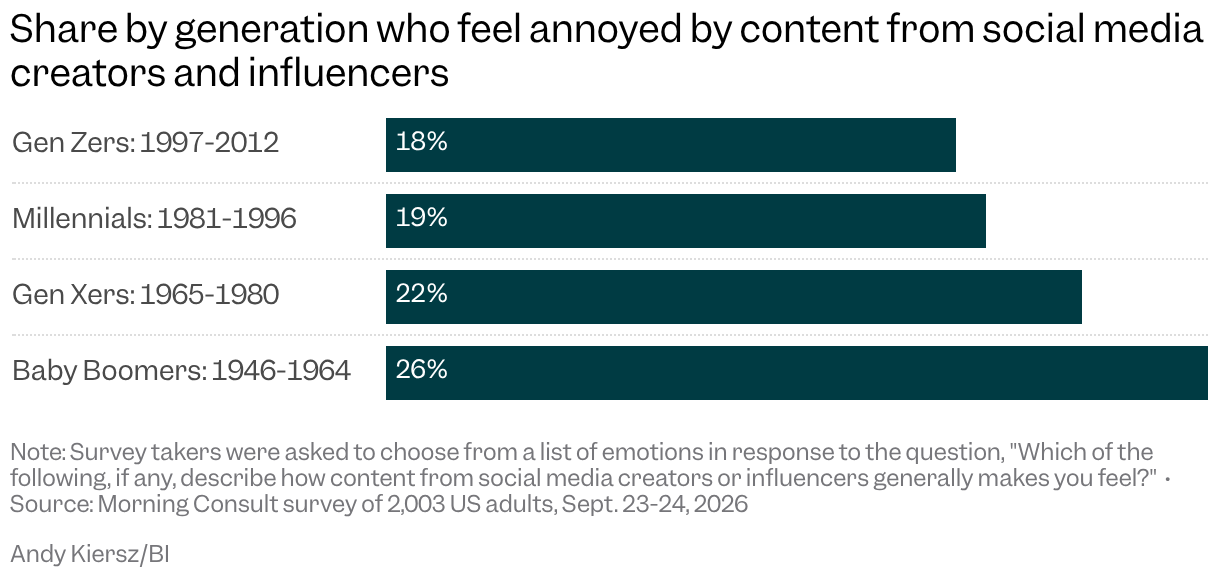
Marketing insiders said some of the disconnect could be explained by influencers failing to create content that's relatable to an older audience. About a quarter (26%) of boomers surveyed by Morning Consult said influencer content made them feel annoyed — the highest proportion of any generation. Only 5% of boomers said it made them feel happy, versus 28% of Gen Z, 30% of millennials, and 13% of Gen X. Other generations said influencer content was most likely to leave them feeling "entertained," while boomers' top choice was "annoyed."
A separate study published earlier this year by Edelman, which surveyed more than 17,000 respondents worldwide, found that just 24% of boomers said they followed a content creator, compared with 86% of Gen Z, 77% of millennials, and 51% of Gen X.
The age of the influencers older generations see on their screens isn't the only factor at play.
"It's less about finding someone who's the same age and more about finding someone they can see something of themselves in," said Lucy Kruszynski, global head of brand at influencer marketing agency Buttermilk.
Shared interests and experiences can be more powerful than demographic similarities, she said. As boomers enter retirement, many have more time to rediscover hobbies and passions that took a backseat during their working lives. Brands could tap into those interests by partnering with creators who share their enthusiasm for pursuits like music, art, or home improvement.
Some of the most successful boomer creators have scored deals that lean into these passion points. The boomer weightlifting influencer Marlene "Granny Guns" Flowers has more than 4.5 million followers across her social platforms and has collaborated with brands such as YoungLA and Ryse Supps. Barbara Costello, who is in her 70s and known as "Brunch with Babs," has more than 9 million followers and has scored partnerships with brands that range from the furniture brand Birch Lane to Nellie's Eggs and Walmart.
Brands may also have to exercise patience when trying to convert older consumers. The Morning Consult survey found that 43% of boomers said they had never purchased a product based on an influencer's recommendation.
For brands accustomed to measuring influencer marketing success in clicks and immediate sales, that could require a rethink. Kruszynski said some boomers follow creators for months, sometimes up to a year, before feeling comfortable purchasing something they've recommended.
"Even though there is absolutely a level of annoyance and a lack of trust, I don't think that baby boomers are immune to influencer marketing," Kruszynski said. "Brands need to think about how creators can build credibility through consistent content over time."
Scott Larson is joining OpenArt AI as its VP of brand marketing. He first experimented with the platform to create a short film starring a stick of butter about to meet an unfortunate end.
Salesforce and Meta marketing alum Scott Larson says OpenArt AI's conversational text-to-video generator is the tool he wished he'd had earlier in his career.
The platform helps whizz up short videos, arty images, and music by typing in a few prompts.
OpenArt this week tapped Larson as the company's vice president of brand marketing, the company exclusively told CMO Insider.
He joins in a period of rapid growth for the company, which said it's on track to pass $250 million in annual recurring revenue by the end of 2026. It's increased its head count to 80 employees over the past year, up from 20, and grown to 8 million monthly users, the company said.
Larson told CMO Insider he's on a mission to make OpenArt "as close to a household name as a creative AI can be."
He said the biggest challenge will be to wrap all of OpenArt's different use cases into a single "North Star" story.
It recently launched a new product called Director that lets users describe an idea, visual style, and narrative arc, which it then turns into videos up to 5 minutes long. It promoted the launch with a cinema and billboard campaign that it hoped would spark a "vibe directing" craze among the creative community. Others use its platform to create social posts, AI voiceovers, or lyric videos. It also offers an AI model leaderboard to help its users benchmark different AI video and image models.
Larson previously worked at advertising agencies on large consumer brands such as Nike, Levi's, and Gatorade. He later became global executive creative director at Meta, then known as Facebook. Larson went on to be an SVP at Salesforce, where he helped shape the branding behind its annual Dreamforce conference and launched ad campaigns starring Matthew McConaughey and Woody Harrelson.
Larson first experimented with OpenArt two months ago, creating a very short film with three cuts. Called "Life is Short," it shows a man made out of a stick of butter walking alongside a swimming pool. The butter man looks up at the scorching sun above before the video cuts to an old-school title card saying "The End."
"Had I had this tool starting back when I was a little creative junkie up until today, I'd be making everything all the time," Larson said.
Earlier this year, OpenArt plucked another exec from Big Tech, hiring former Google executive Raj Gajwani as its chief business officer.
Mark Zuckerberg's Meta has blocked Shou Zi Chew's company, TikTok, from advertising in some markets.
Finn Gomez/Getty Images; Shawn Thew-Pool/Getty Images
TikTok is moving on quickly after losing access to Meta's ads platform in some markets.
It's shifted ad spend to YouTube, Pinterest, and mobile-app networks, according to Sensor Tower.
TikTok was a prominent ad spender on Meta before its ousting on October 8.
TikTok's message to Meta: If you won't take our ad dollars, your competitors will.
Meta took a bold stance this month by blocking ByteDance, TikTok's parent company, from running ads on Meta apps in some markets. Why? Well, Meta's answer was pretty straightforward. It didn't want to "run ads from a competitor whose goal is to pull people off our apps."
TikTok is now redirecting that ad spend elsewhere.
Since the ban went into effect on October 8, TikTok has shifted its ad budgets to other platforms like YouTube and Pinterest, according to allocation estimates provided to CMO Insider by the analytics firm Sensor Tower.
The share of TikTok's ad spend that went to YouTube rose to 17% between October 9 and October 16, up from 9% in the first week of October. Meanwhile, its ad spend on Pinterest grew to 9% during the same period, up from 3% in the first week of October. A majority of TikTok's spend — 58% — went to mobile-app ad networks like Google's AdMob, up from 19% at the start of October, when Meta was still an option.
Meta's move against TikTok "highlights the growing intensity of the competition across the digital landscape and across the two of them," said Kate Black, EVP of social strategy at Horizon Media. "For marketers, this really just reinforces the need to be agile and build balanced media strategies — and not having all your eggs in one basket."
Meta's TikTok ousting isn't unprecedented. Other platforms like Amazon have previously blocked competitors from running ads, while Twitter in late 2022 restricted users' ability to link to their accounts on social apps like Instagram and Mastodon, calling it "free promotion."
"Declining promotional services to a competitor is a normal business practice across industries," a Meta spokesperson said. Meta's changes will impact advertising policies in the US, Canada, Egypt, Indonesia, Japan, Thailand, and Vietnam.
For Meta, a company that pulled in $117 billion in revenue in the first half of 2026, losing one advertiser won't hurt much. Still, TikTok and ByteDance were notably prominent spenders on Meta's apps, according to Sensor Tower.
Meta will also lose ad spend from third-party marketers that link to TikTok or other ByteDance properties in their ads, further increasing its potential losses. Direct-to-consumer brands that may want to drive potential customers to TikTok Shop will miss out.
No Meta, no problem
For TikTok, losing access to Meta's more than 3 billion monthly users is a setback.
Like any social media giant, TikTok is incentivized to grow, grow, grow. Ads that target new users and drive new app downloads are part of the playbook — a strategy Meta uses to promote its own apps, like Instagram, too.
One TikTok staffer focused on user acquisition, James Gao, posted a LinkedIn callout on Sunday asking people to get in touch if they had ad inventory that could help the company meet its goals.
Horizon Media's Black said that while Meta controls the "lion's share" of social budgets, there are plenty of viable alternatives when it comes to using an ad to drive an action like an app download. Besides Google, YouTube, and Pinterest, marketers are increasingly turning to other platforms like Snapchat and Reddit, she said.
When Ameresco CMO Leila Dillon asked ChatGPT and other AI answer engines to describe what her company did, she was shocked by the results.
The publicly traded company is an energy infrastructure provider, helping power the rapidly growing AI buildout, as well as military bases and municipal facilities. But the AI chatbots were outdated in their responses, frequently referring to it simply as a cleantech or renewable energy business — areas it still operates in, but are less of a focus — or citing smaller projects it worked on years ago.
"It was quite horrifying," Dillon told CMO Insider. "We were like, 'That's not at all who we are.'"
Dillon set about overhauling the company's messaging and how it structured its marketing content to better reflect its business.
The work has begun to take effect. Ameresco tracked how often AI chatbots mentioned the company in response to 50 questions that potential customers and investors might ask. It appeared in 61% of those answers in 2026, up from 43% in 2025, according to the company.
As more consumers turn to platforms like ChatGPT, Google's Gemini, Anthropic's Claude, and Microsoft's Copilot to research companies and products, marketers are racing to hone their generative engine optimization (GEO) strategies to ensure their brands appear prominently and accurately in AI-generated answers.
"I used to Google everything that I wanted to know about," Dillon said. "I barely use Google anymore. I use Copilot, and I get better results."
In a January survey from the Interactive Advertising Bureau, 73% of US brand and agency buyers said they planned to devote more time or resources to optimizing content for AI-generated answers in 2026, compared with last year. In a separate survey of US marketing professionals conducted by Semrush, an AI and search visibility platform, in April, 30% of marketers said AI search tools had described their brands inaccurately.
The rush by marketers to get up to speed with GEO has spawned a cottage industry of AI search experts and tools promising quick fixes. But with AI companies constantly updating their models, marketers are in a phase of constant experimentation as they scramble to figure out what actually influences the chatbots.
"There's no one shot that fits all to solve that for you," Dillon said.
An AI audit identified 47 areas for improvement
In January 2025, Dillon's team and its PR agency, Greenough, began auditing how often Ameresco appeared in AI-generated answers to 50 prompts — such as, "What are the top energy infrastructure providers in the US?" — on platforms including ChatGPT and Claude. The prompts reflected questions that investors and prospective customers, including people from universities and utilities, might ask AI chatbots.
The audit identified 47 areas for improvement, including how Ameresco described its business across its website, social media, press releases, and executive communications.
"You name it, we were doing it wrong," Dillon said.
Ameresco began rolling out a new corporate brand identity in July this year, reflecting its broader reorganization around two business pillars: power infrastructure and buildings and public infrastructure.
It had laid the groundwork for the new corporate brand reveal by making several changes to its content strategy.
Those included:
Updating its corporate boilerplate from "a leading cleantech integrator specializing in energy efficiency and renewable energy" to "a leading energy infrastructure company," reflecting the new positioning across its marketing and communications.
Refreshing its awards submission strategy to lead with its power infrastructure projects, and announcing each win with a press release that appears on wire services and industry trade publications.
Introducing Q&A-style content formats, designed to make the information easier for AI chatbots to interpret.
Creating more content designed for different customer groups, such as data center operators or school facilities managers, rather than relying on generic marketing materials.
Launching a video content series called "Energy Benefits Unlocked," highlighting the tangible results Ameresco's projects accomplished for its customers.
Introducing quarterly AI visibility tracking audits across the 50 different prompts, reflecting its different audiences, and adding competitor comparisons.
A constantly moving target
The strategy appears to be paying off in some ways. Ameresco said organic traffic to its website rose 50% in the 12 months to June 2026. Dillon said it's still too early to assess precisely how those gains translate into business results, though she believes the GEO work is helping the marketing team hit its targets more quickly. The company is scheduled to report its third-quarter earnings on November 9.
Dillon said the rapid changes in AI mean the work is never really finished. Ameresco regularly revisits its AI visibility scores and has invested in training the marketing team, which shares tips, tricks, and their "epic AI fails" in its weekly meetings.
"One of the main themes is that what happened last week is not what you're going to get this week; it's changing that quickly," Dillon said.
"You don't just update your website and say: Done, woo, all set," she added.

 Login