❌

Reading view

Navy F/A-18 Super Hornet Spotted Carrying New AIM-174B And AIM-260 Long-Range Missiles Together

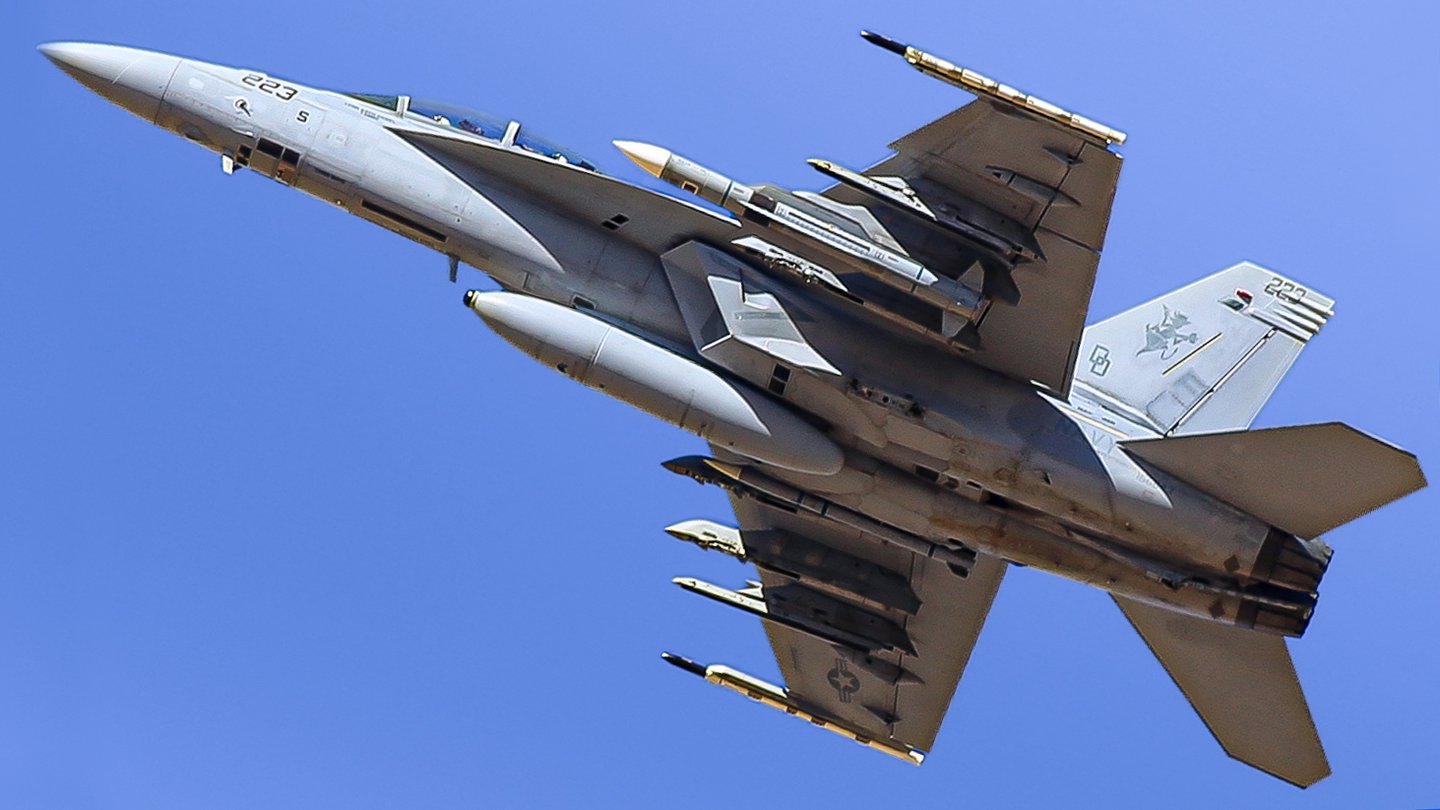
A U.S. Navy F/A-18F Super Hornet assigned to Air Test and Evaluation Squadron 31 (VX-31) has been spotted carrying both the AIM-174B and AIM-260 Joint Advanced Tactical Missile (JATM) during a flight over Ridgecrest, California. This represents the first known publicly documented instance of these two advanced air-to-air weapons appearing on the same aircraft.

The aircraft was photographed on October 14 by aviation photographer @photosxlyss2, who shared the result with TWZ. The same Super Hornet was also carrying an IRST21 infrared search-and-track pod on its centerline station.
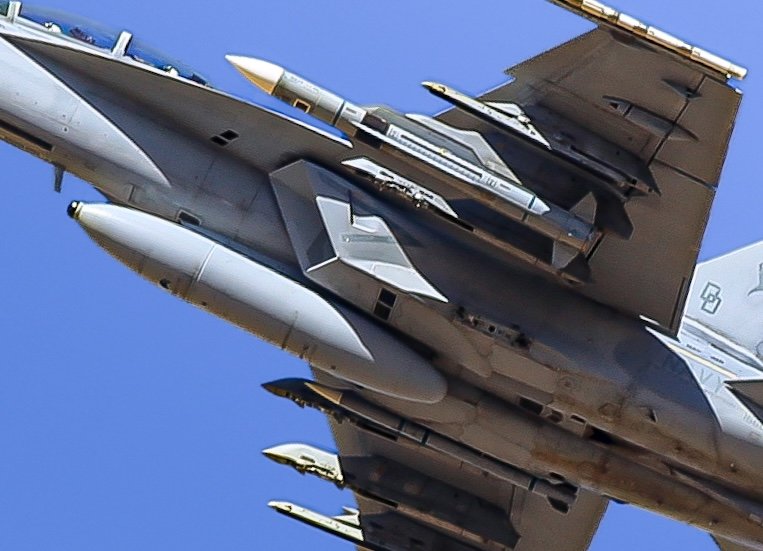
A close-up of the AIM-174B, AIM-260 Joint Advanced Tactical Missile, and IRST21 infrared search-and-track pod under an F/A-18F Super Hornet assigned to Air Test and Evaluation Squadron 31 (VX-31) during a flight over Ridgecrest, California. @photosxlyss2_ RY

Two critical elements of the modernization of the U.S. military’s air-to-air missile arsenal, the AIM-174B and AIM-260 provide complementary capabilities, addressing different aspects of the Navy’s evolving air-combat requirements.

Based on the SM-6 missile family, the AIM-174B provides the Navy with an extended-range air-to-air weapon. Its size and reach make it particularly relevant to engagements against high-value airborne assets, including aerial refueling tankers and airborne early warning and control aircraft.
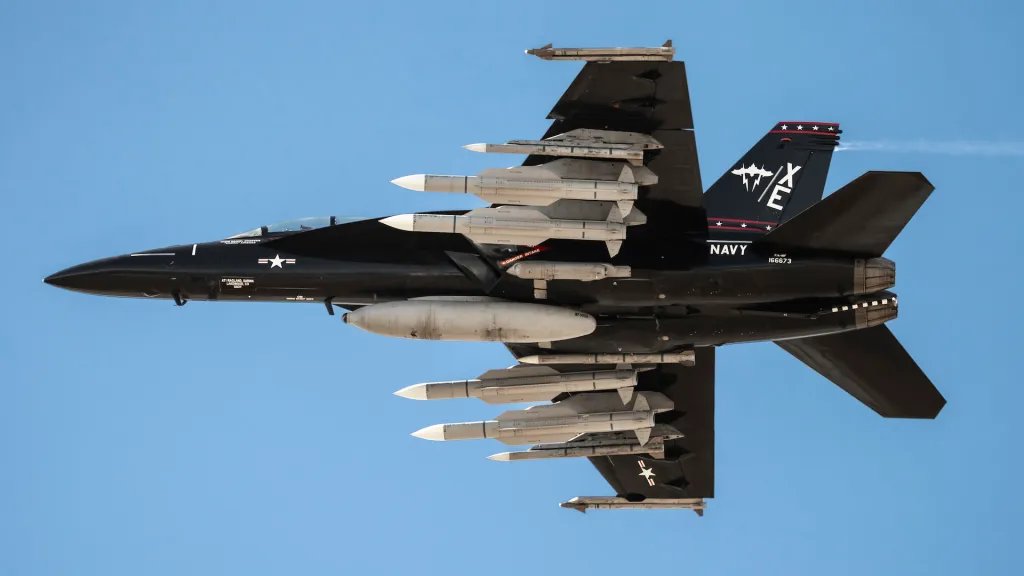
A U.S. Navy F/A-18F Super Hornet test jet with four AIM-174B missiles under its wings. point_mugu_skies

Threatening these support platforms at extended distances complicates an adversary’s ability to sustain fighter operations, maintain airborne surveillance, and coordinate engagements across domains. Such targets are especially important in the Indo-Pacific, where distances are vast and combat aircraft may depend heavily on tanker support to reach and remain on station over contested areas.

 The range of this missile is classified but should be far in excess of that of the AIM-120D AMRAAM, probably in the hundreds of miles, as discussed in the video below.

The AIM-174B has already appeared in several major exercises, including RIMPAC 2024 and Northern Edge 2025. Following developmental trials at RIMPAC, the weapon entered Live Fire Test and Evaluation in 2025. Some examples of the missile have since reached forward-deployed Navy squadrons in Japan.

The AIM-260, meanwhile, is being developed to provide a next-generation beyond-visual-range air-to-air capability. It is intended to address increasingly sophisticated aerial threats and improve upon the capabilities of the very widely used AIM-120 Advanced Medium Range Air-to-Air Missile (AMRAAM) family.

It was another F/A-18F from VX-31 on which the AIM-260 was first publicly seen when departing Eglin Air Force Base in Florida in May of this year. The same type of weapon has since also appeared on a Royal Australian Air Force F/A-18F, as you can read about here.
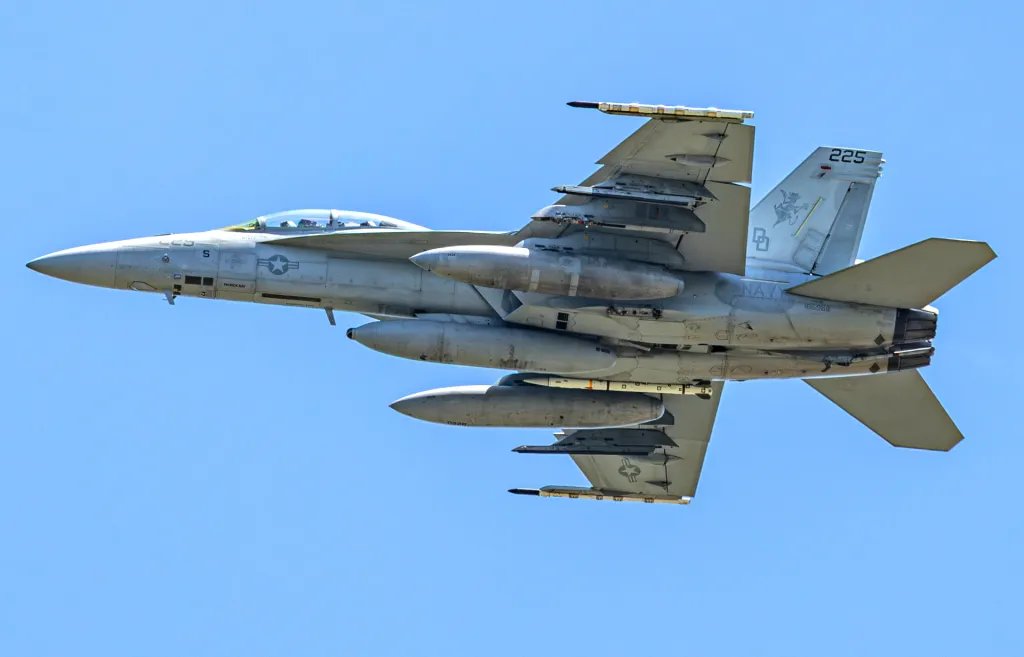
An F/A-18F from VX-31 carrying the AIM-260. Jonathan Tweedy/ @flightline_visuals

The AIM-260’s precise specifications remain classified, but it is designed to deliver significantly greater range than the AIM-120 AMRAAM while maintaining a broadly similar form factor. Its compact design is important, as the missile is intended for both external carriage and internal carriage aboard aircraft such as the F-22 Raptor and F-35.
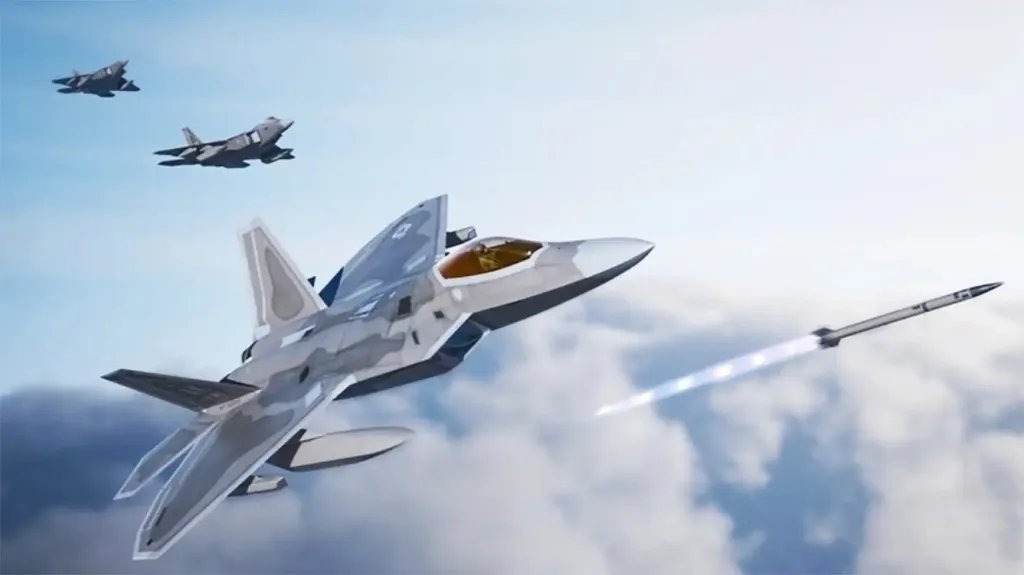
A rendering depicting an F-22 Raptor firing an AIM-260 JATM. U.S. Air Force

The AIM-260 is being developed to counter the growing long-range air-to-air threat posed by China’s PL-15 and other advanced missiles. Although no official range figures have been disclosed, previous reporting has indicated a target range of at least 120 miles, with the potential to reach considerably farther.
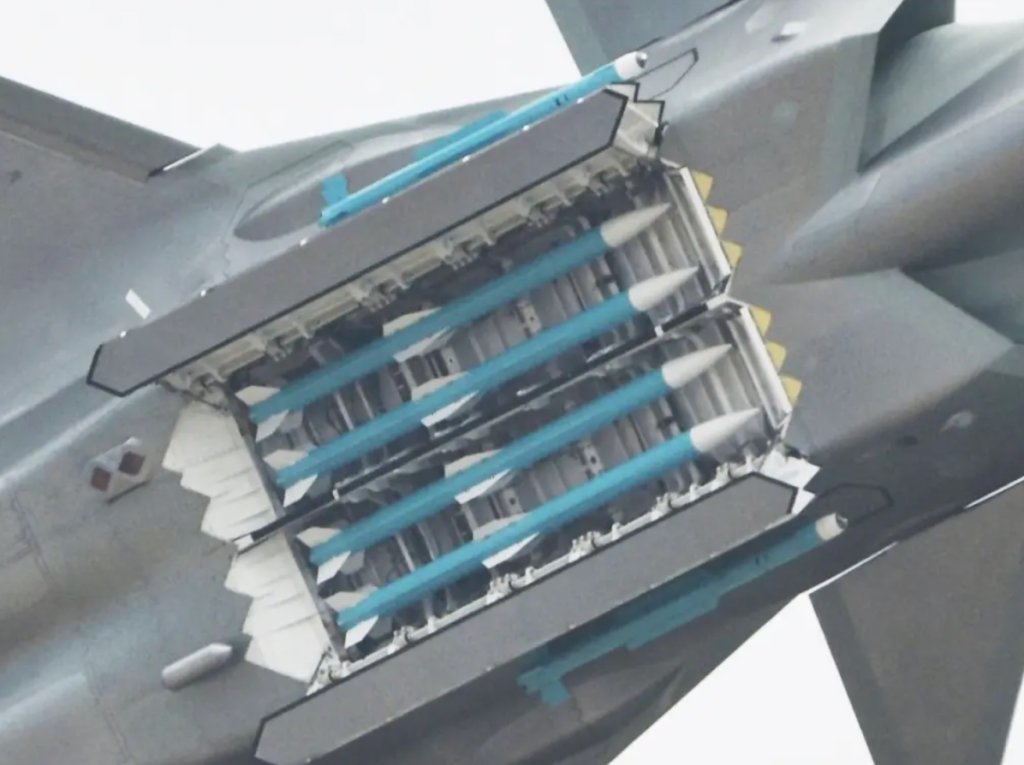
Inert PL-15s in the weapons bay of a Chinese J-20 fighter. via Chinese internet

It is unclear when the first operational AIM-260s may begin entering the U.S. inventory. Together, however, the two weapons give the Super Hornet access to a broader range of engagement options, depending not only on the range of the target, but also on the nature of the engagement and overall tactical situation.

The presence of an IRST21 pod is also noteworthy. The infrared search-and-track system passively detects and tracks airborne targets rather than relying exclusively on radar emissions.

Passive sensing is especially valuable in environments where electromagnetic emissions must be managed carefully. Although an IRST system does not automatically provide all the information needed to support a long-range missile engagement, it can contribute to a broader sensor picture and potentially help crews detect targets without immediately revealing their own position through radar emissions.

After a long and troubled development, a full-rate production contract for Block II IRST21 sensors to go into pods for U.S. Navy and U.S. Air National Guard fighters was awarded this time last year, as you can read about here.
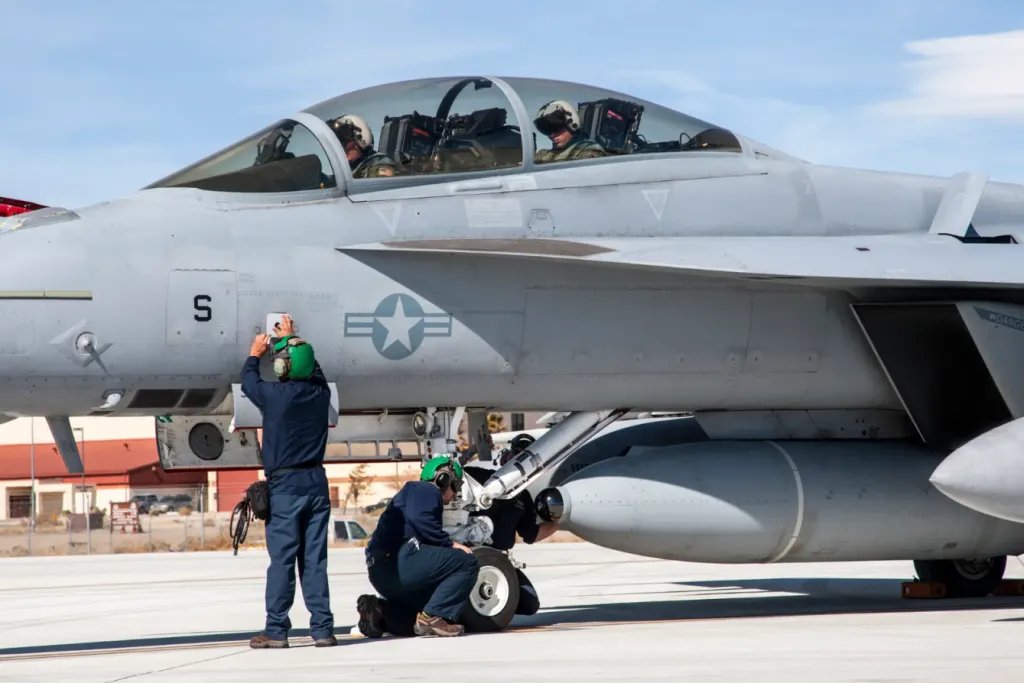
An IRST21 built into the centerline tank on a Super Hornet during early tests. U.S. Navy

The appearance of both missiles on a VX-31 Super Hornet is a notable development in the Navy’s ongoing testing of advanced air-combat capabilities. VX-31, based at the sprawling Naval Air Weapons Station China Lake in California, conducts test and evaluation activities involving naval aviation weapons and systems.

On this occasion, the jet is carrying inert missiles (denoted by their blue bands) in a captive-carry configuration. The flight may have been part of ongoing weapons-integration testing, handling and compatibility evaluations, or another test activity.

At the very least, the configuration offers an intriguing glimpse into how a Navy Super Hornet might go into battle in a future high-end air combat scenario. Pairing the extended-range AIM-174B with the next-generation AIM-260 would provide a powerful combination.

Added to those two will be the AIM-424 Malice, an all-new, very long-range air-to-air missile, the existence of which was only disclosed in August of this year. This is reportedly a two-stage design, which should result in extreme range — said to be in excess of 250 nautical miles — and very high speed. It isn’t known where Malice slots in next to the AIM-174B, although the newer missile is purpose-designed for air launch, unlike the Standard-derived weapon.
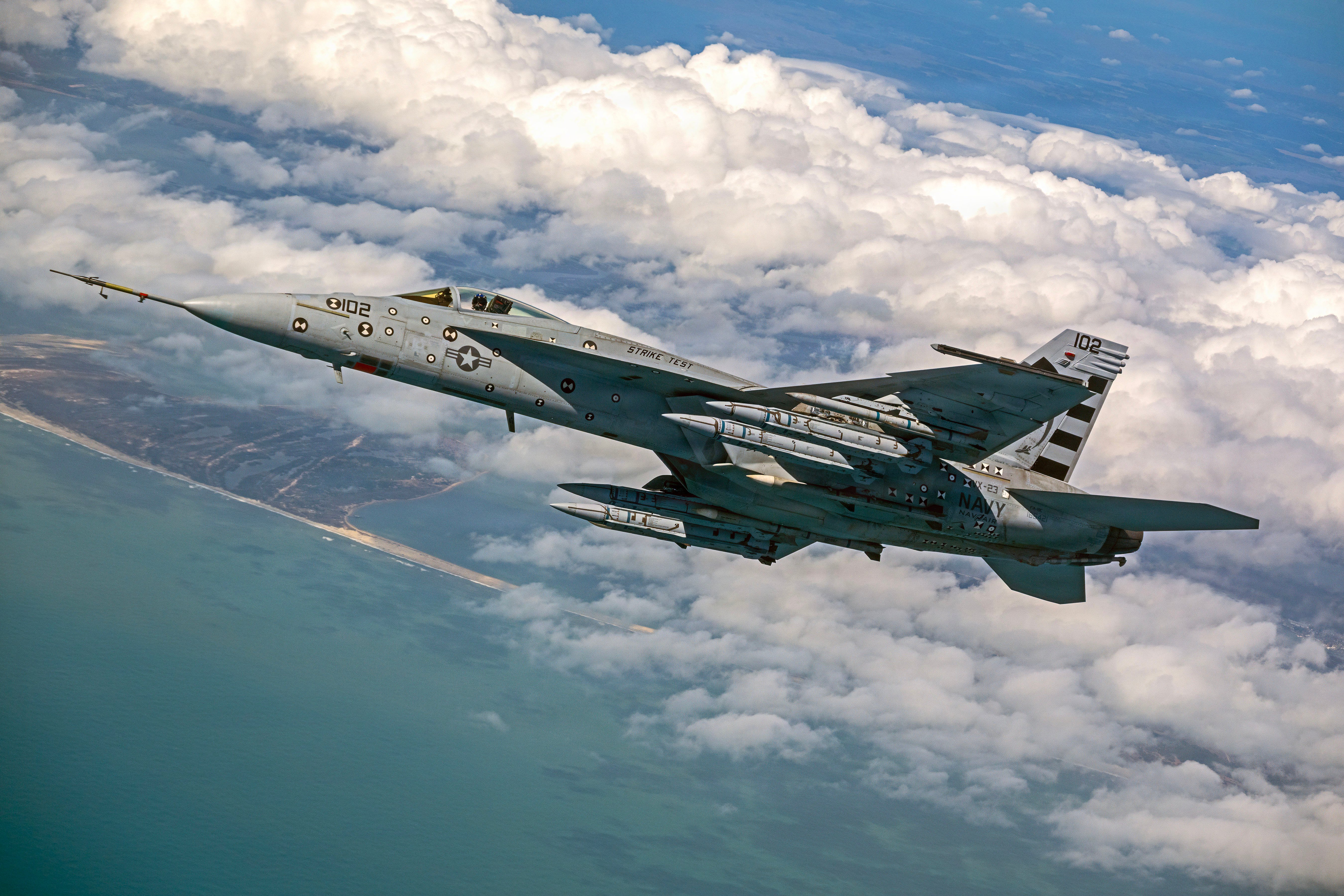
U.S. Navy File Photo - Four AIM-424 Long Range Air-to-Air Missiles (LRAAM) are loaded on an F/A-18E Super Hornet for a test event. The AIM-424 LRAAM is the Department of the Navy's next-generation, long-range air-to-air missile, built to give Marine and Naval aviators the capability they need to defeat advanced threats and defend the force.
Four AIM-424 Long Range Air-to-Air Missiles (LRAAM) are loaded on an F/A-18E Super Hornet for a test event. U.S. Navy U.S. Navy

As the service prepares for increasingly demanding scenarios in the Indo-Pacific, the new photo underscores the fact that the ability to threaten a wider range of targets at greater distances is one of the key considerations in the evolution of the Navy’s carrier-based fighter force.

With thanks to @photosxlyss2_; check out more of her work via PhotosxLyss on Facebook.

Contact the author: thomas@thewarzone.com

The post Navy F/A-18 Super Hornet Spotted Carrying New AIM-174B And AIM-260 Long-Range Missiles Together appeared first on TWZ.

  •  

Any Decision To Buy New-Build F-16s Not An “Urgent” Priority: USAF

The U.S. Air Force says any decision on whether or not to acquire new production F-16 Viper fighters is likely a year or more away. The service’s top officer in charge of force structure planning has also now raised the prospect of using a “spectrum of capability” to eventually supplant aging older-model F-16s. All of this comes as the Air Force has laid out a new vision to have 1,509 combat-coded fighters in inventory, hundreds more than it has now, by 2035, amid questions about whether industry and budgets can keep up.

Inside Defense and Air & Space Forces Magazine were among the first to report on the Air Force’s latest long-term fighter force structure plan late yesterday. This followed a roundtable with Lt. Gen. David Tabor, the service’s Deputy Chief of Staff for Plans and Programs. At the time of writing, an unclassified copy of the report, which was submitted to Congress last week, has not been released publicly. TWZ has reached out for more information.

Air Force Lt. Gen. David Tabor, seen here testifying before the Senate Armed Services Committee in 2024. USAF

Tabor said yesterday that the target fleet of 1,509 combat-coded fighters by 2035 would be approximately 40 percent F-35s, 40 percent F-15s (inclusive of F-15E Strike Eagles and F-15EX Eagle IIs) and F-16s, and 20 percent F-22 Raptors and F-47s, according to Air & Space Forces Magazine. As an aside, the final expected F-47 fleet size remains unclear, though the Air Force continues to say it plans to acquire at least enough of those jets to replace its 185 F-22s on a one-for-one basis.

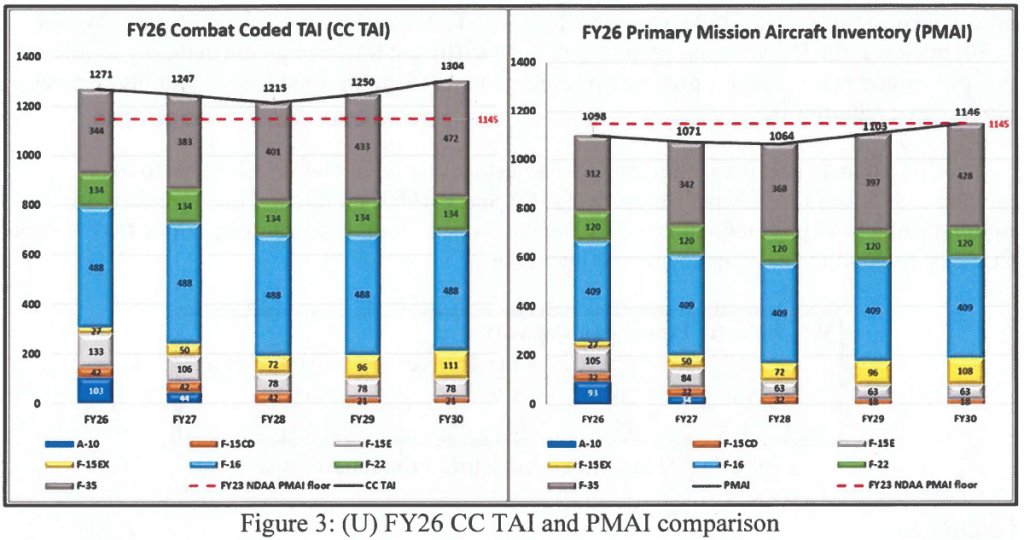
The current breakdown of the service’s fighter force structure is 45 percent F-16s, 30 percent F-35s, 15 percent F-15s, and 10 percent F-22s. Last year’s long-term fighter force structure report said the service was aiming for an eventual inventory of 1,558 combat-coded fighters and hoped to hit a milestone of 1,369 aircraft by Fiscal Year 2030. As of the start of Fiscal Year 2026, the Air Force had 1,168 combat-coded fighters, not including 103 A-10 Warthog ground attack jets, which have been part of this force structure planning in the past. The plan now is for the last of the A-10s to be retired by 2030. The new 2035 figure also does not include the hundreds of Collaborative Combat Aircraft (CCA) drones the service wants to have acquired by that time, something we will come back to later on.

The US Air Force included these graphs showing projected fluctuations in fighter inventories in its annual force structure report last year. Not that the combat-coded tally for Fiscal Year 2030 shown here is lower (1,304) than the one the service said it was aiming for (1,369) at the time. The reason for that discrepancy is unclear. USAF

Currently, the Air Force expects fighter fleet expansion to be driven by the acquisition of new F-35As, F-15EXs, and F-47s. This was also the case when last year’s fighter force structure report was released. The possibility of the Air Force also acquiring new-production F-16s has come up several times in recent years. Most recently, there were several reports last month that prime contractor Lockheed Martin had made a new pitch to the service for a version of the latest Block 70 version of the fighter, tentatively dubbed the F-16G. New Block 70 and Block 72 F-16s, which differ in what engine they use, are being actively produced at Lockheed Martin’s plant in Greenville, South Carolina. At that time, TWZ did a deep dive into the benefits that this could offer the Air Force.

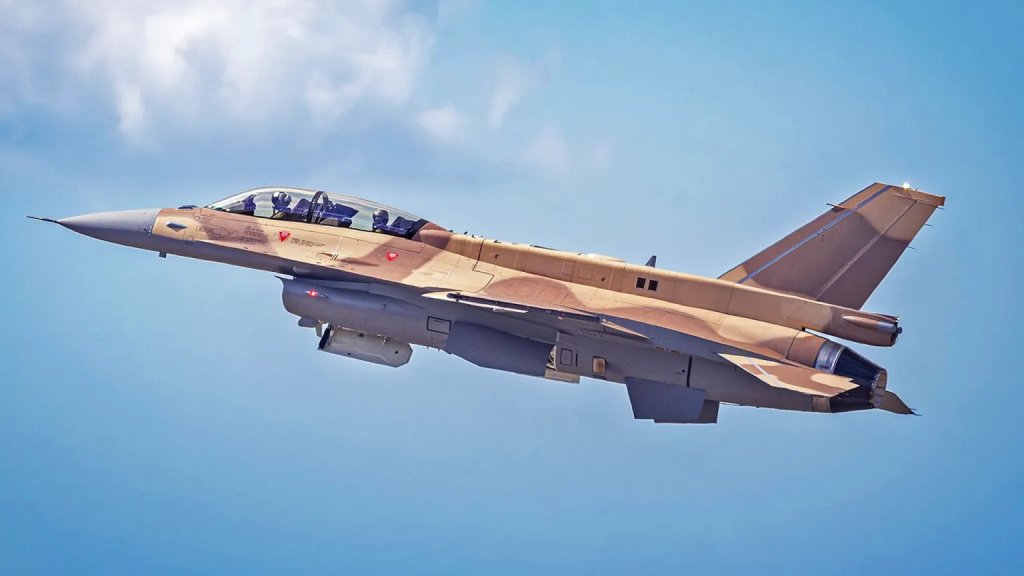
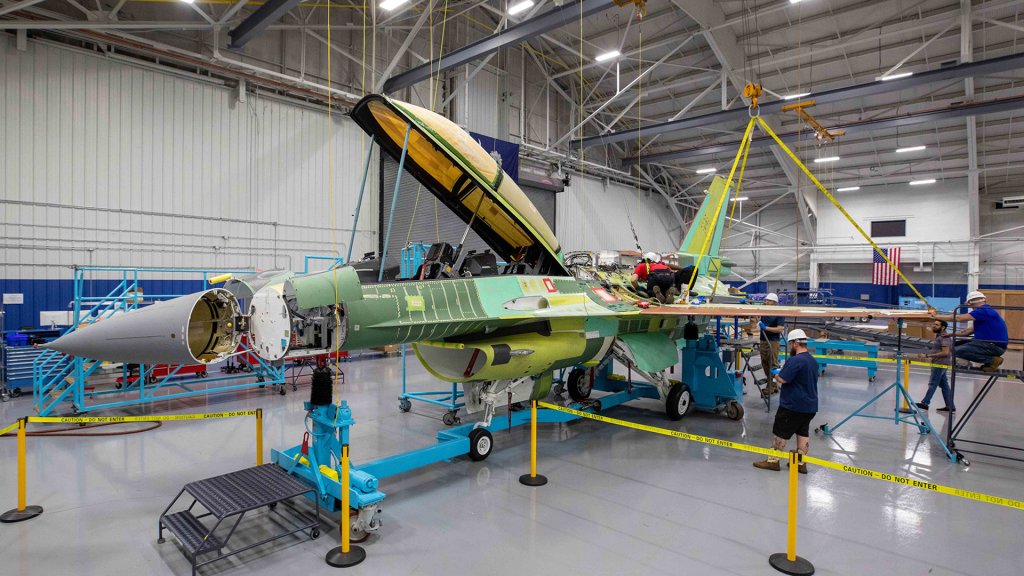
The new-production F-16D seen here, destined for Morocco, became the first Block 72 version to fly just earlier this month. Lockheed Martin

“There is a spectrum of capability that we might want to replace the F-16s with,” Lt. Gen. Tabor said amid a discussion about the prospect of acquiring new Vipers at the roundtable yesterday, per Air & Space Forces Magazine. “It’s not urgent, frankly. What we don’t want to get to is a point where it is urgent, and we haven’t done the homework and decided ‘hey, this is really the right place to be.’ We do have time to churn through that and make sure that we have a good option going forward.”

“We’re not in a position where that decision has to be made immediately,” Tabor added, while acknowledging that “we are very conscious” that older-model F-16s are set to begin reaching the end of their lifespans in the 2030s. He also said any such planning was unlikely to be part of the process of developing the service’s Fiscal Year 2028 budget proposal, which will be released sometime early next year.

The Air Force is “in the initial phases of analyzing options for the next Future Years Defense Program,” a spokesperson for the service had told us last month without specifically mentioning any particular type of aircraft. “At this stage, we have neither defined the precise mission requirements nor the spectrum of options that could fill it.”

When it comes to the current F-16 fleet, the Air Force had 774 Vipers in inventory at the start of Fiscal Year 2026 and expected that number to drop to 768, according to past budget documents. This includes a mixture of subvariants, and not all of them are assigned combat-coded units. The Air Force has been substantially upgrading at least a portion of its existing F-16s, including with the addition of new active electronically scanned array (AESA) radars and electronic warfare suites, to ensure their operational relevance for years to come.

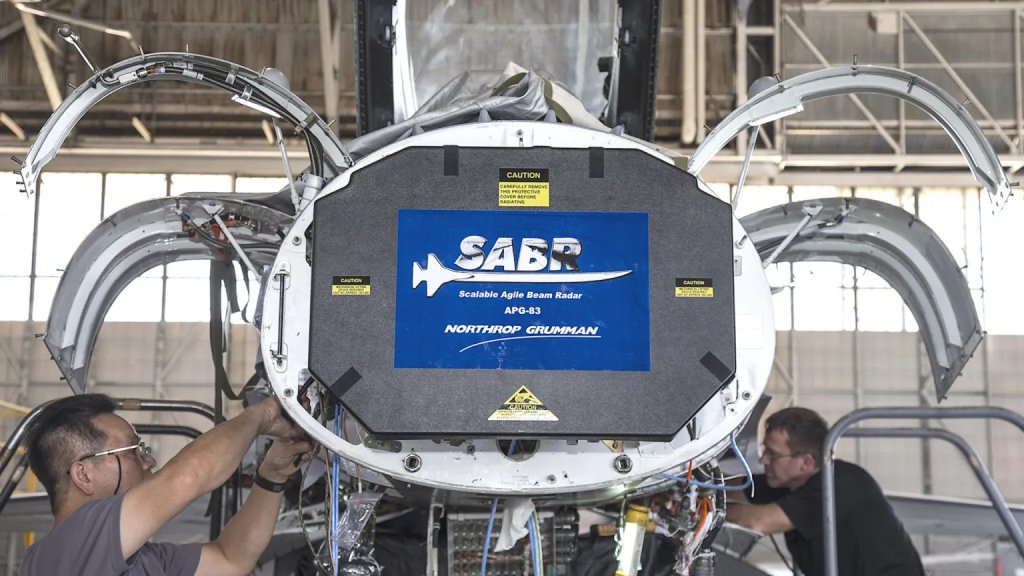
A new AN/APG-83 Scalable Agile Beam Radar (SABR), an active electronically scanned array type, seen being integrated onto a US Air Force F-16. USAF

The Air Force has also already been taking newer F-16s from squadrons transitioning to the F-35 and using them to replace older Vipers in other units. Last year’s fighter force structure report explicitly highlighted plans to supplant Block 30 F-16s in five Air National Guard formations – three combat-coded squadrons and two training units – with Block 40 and 50 types in this way.

As we’ve previously written:

“A new F-16 offers a fresh and highly mature airframe — one with a full service-life ahead of it, on the order of 12,000 flight hours without the need for structural upgrades — double that of the original F-16. This is compared to existing F-16s in the inventory with the decades of wear and fatigue already accumulated on them, with structural upgrades keeping them in the air. That difference in remaining structural life is arguably the single biggest advantage a new-build aircraft has compared with extending an existing one.”

“Dumping more money into existing F-16s is becoming questionable. Service life extensions and technical upgrades can only go so far and supporting these jets is becoming harder as parts dry up and suppliers who made them are long gone. A new airframe would give the Guard many decades of highly efficient service and the piece of mind for future force planning that goes with it.”

…

“The new [F-16G] proposal would let some Guard and Reserve units swap their F-16s for vastly improved F-16s — the same logic that drove the F-15EX buy — while also keeping the Greenville line hot, which is a significant benefit in its own right. And it accomplishes both in the most efficient way possible: not just in acquisition cost, but in sustainment cost, which is really the more problematic burden of the two. In the end, this points to another glaring reality check for the all-stealth-force concept, a vision the Air Force has effectively already abandoned.”

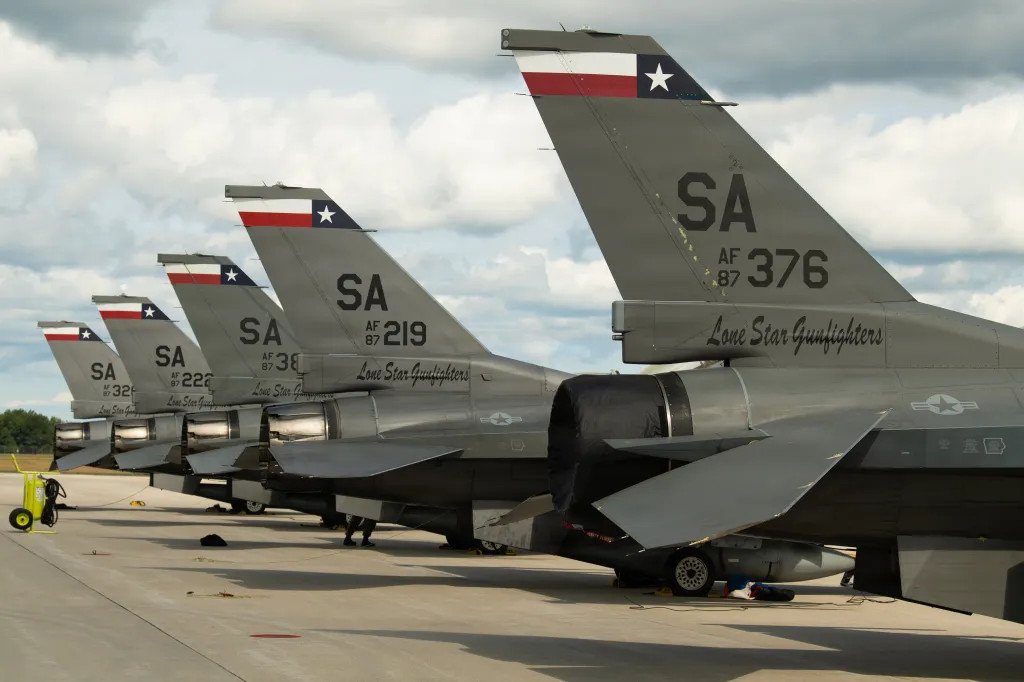
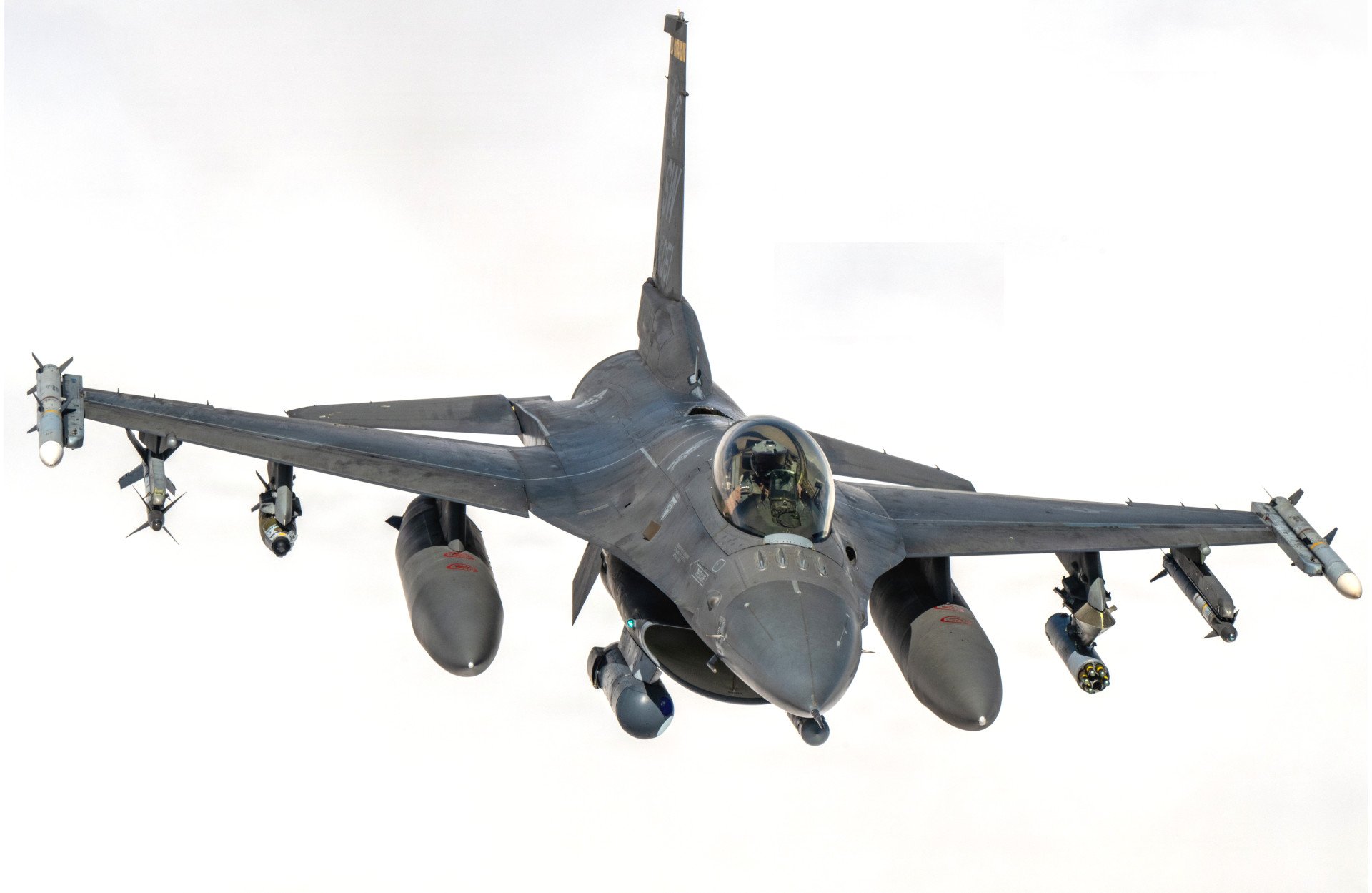
A row of Texas Air National Guard F-16s. USAF

“The Air Force has spent years describing the F-35 as the replacement for its F-16 fleet, yet it now has to contend with aging F-16s, delayed or constrained fighter production, a larger stated requirement for total fighter capacity, and the lengthy transition toward the F-47 and uncrewed combat aircraft. In that environment, a new-build F-16 provides an option that sits between extending legacy aircraft and buying the most sophisticated — and expensive — fighters available.”

You can read our full prior deep analysis on this topic here.

Lt. Gen. Tabor acknowledged many of these exact same points at the roundtable yesterday. He notably described acquiring new F-16s as “maybe the lazy” option, but also one that would benefit from “practically a ready-made aircraft” that is in production now, according to Air & Space Forces Magazine.

“The question is, can industry produce at those levels?” he also said, speaking more generally. “They’ve assured us that they can, and we believe them, but we also actually need to see it manifest.”

In the context of acquiring new F-16s, especially, it is important to note here that Lockheed Martin order books are very full already as a result of demand for these fighters from U.S. allies and partners. The company’s capacity, at least at present, to add a substantial new Air Force acquisition program on top of that is a real question. This, in some ways, mirrors questions that surround Boeing efforts to meet surging Air Force demand for F-15EXs.

A new F-16 being built at Lockheed Martin’s Greenville plant. Lockheed Martin

On top of all this, the Air Force’s still-evolving CCA plans remain something of a wildcard in these discussions. The Air Force has ordered General Atomics FQ-42 Vengeance and Anduril’s FQ-44 Fury CCAs into production, and is now aiming to have a combined fleet of at least 500 of these drones in inventory by 2032. The service is also still expecting to acquire additional CCAs, which could be of entirely different types, through a second iterative development cycle, or Increment 2, under this program. This is influencing the service’s crewed fighter force structure plans, but the full scale and scope of those impacts remain to be seen.

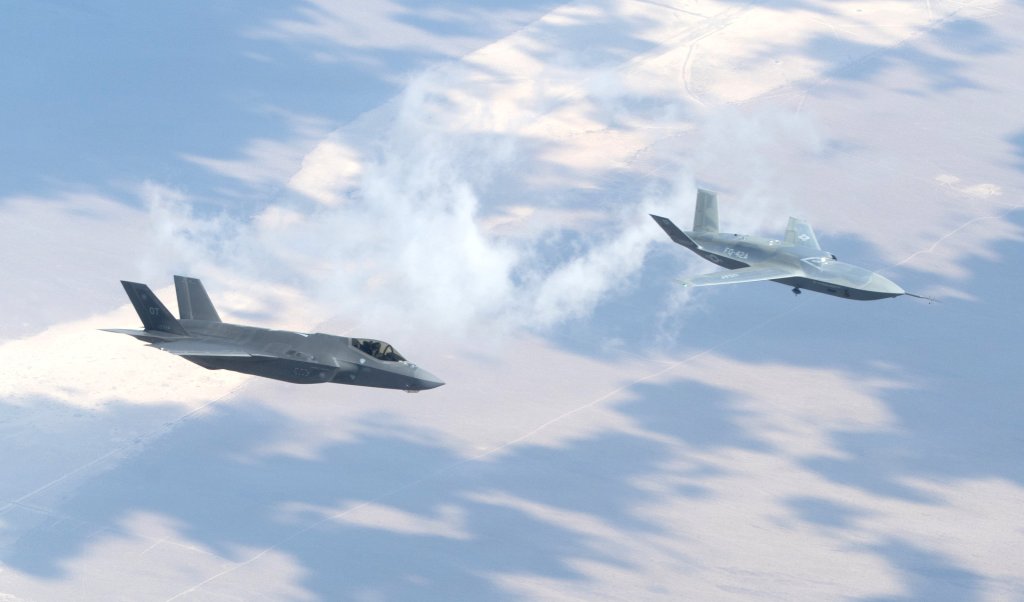
An F-35A flies in formation with a pre-production YFQ-42A CCA drone. USAF

“CCA is very much a reality,” Tabor said yesterday, per Air & Space Forces Magazine. “It is going to be a part of our future, and there is absolutely a world in which the incorporation of CCAs into the force will mitigate the requirement for the number of fighters. That’s not the CCA that we have right now, but it is advancing very, very rapidly. We’re confident that it will play a major role in future versions of the fighter force structure report.”

The Air Force’s F-22s are currently set to be its first ‘aerial quarterbacks’ for CCAs, with F-35s and F-47s expected to follow. At the same time, TWZ has highlighted previously how CCA could offer particular value when paired with fourth-generation fighters like the F-16. This, in turn, could actually bolster the case for new Viper acquisitions as a more affordable force multiplier.

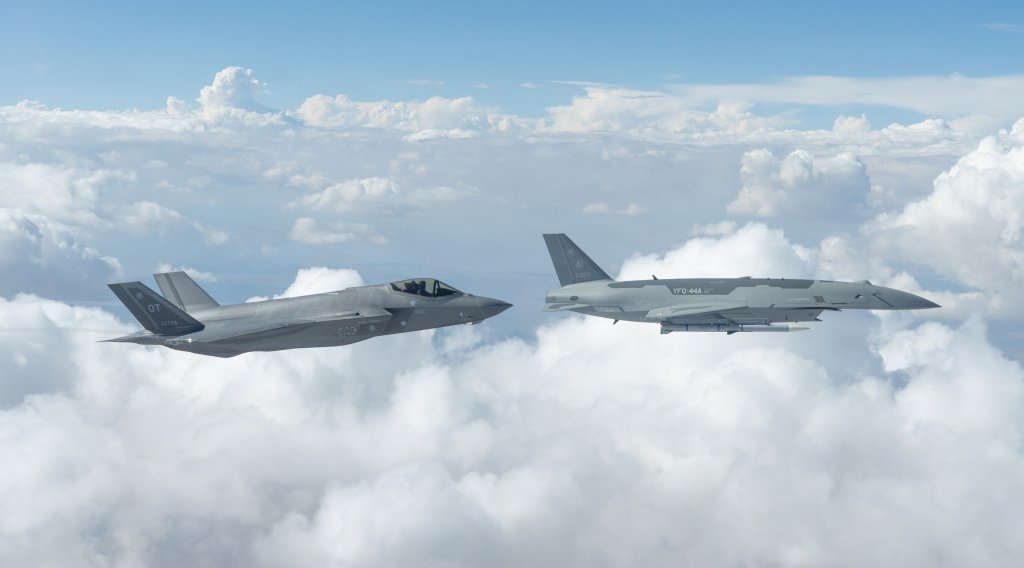
A pre-production YFQ-44A Fury drone flies in formation with an F-35. USAF

The Air Force’s ability to secure necessary funding and other factors will play in all this, too. 2035 is a long way off from a budgetary perspective. It also stretches across multiple election cycles, including the one that will decide the next presidential administration, all of which could lead to major changes in defense spending priorities. Congress can and routinely does demand that the U.S. military alter major procurement plans. Just in the past two years or so, legislators have intervened to force the Air Force to move ahead with the acquisition of new E-7A Wedgetail airborne early warning and control planes and to save the U.S. Navy F/A-XX sixth-generation fighter program.

In the meantime, the Air Force clearly faces many continued questions about how to balance the need to modernize its fighter fleets while ensuring it retains enough tactical airpower to meet current and future operational demands. Even so, the service says it sees no need to rush to make a decision about whether to choose the “lazy” route of just buying new F-16s.

Contact the author: joe@twz.com

The post Any Decision To Buy New-Build F-16s Not An “Urgent” Priority: USAF appeared first on TWZ.

  •  

Firefighters voice growing concerns over water supplies to tackle UK wildfires

During a summer fire that destroyed homes in Stourbridge, low pressure meant filling a water carrier took 40 minutes

Concerns have been raised about how drought affects the UK’s ability to cope with wildfires after MPs were told firefighters struggled for water supplies during this year’s record summer.

The government has been urged to set out water companies’ statutory responsibilities during major fire incidents to improve the country’s preparedness for the years ahead.

Continue reading...

© Photograph: Darren Staples/AFP/Getty Images

© Photograph: Darren Staples/AFP/Getty Images

© Photograph: Darren Staples/AFP/Getty Images

  •  
❌