Nvidia vice president Laura Fay has retired after a decade at the company.
Fay grew Nvidia's enterprise marketing team from roughly 60 to 600 employees.
Nvidia brought in Google Cloud's Alison Wagonfeld as its first chief marketing officer this year.
Laura Fay, a longtime Nvidia marketing executive who reported to CEO Jensen Huang, retired in July after roughly a decade at the AI chip giant.
Fay formerly served as Nvidia's vice president of global enterprise marketing, overseeing campaigns, events, analyst relations, and partner marketing. She said her team grew from roughly 60 to 600 people by the time she left.
Fay was among 36 employees on an internal list obtained by Business Insider last year of company leaders reporting directly to Huang. Prior to joining Nvidia, she spent 22 years at Cisco, concluding her tenure there as VP of global marketing.
Fay said Huang recruited her to build Nvidia's enterprise marketing organization as the company looked to expand beyond gaming.
"I want to change the world, and I want you to change it with me," she recalled him telling her on their first call.
Fay said she began considering retirement around her 10th anniversary in January, though a call from Huang congratulating her and expressing hope that she'd stick around for another decade persuaded her to stay a little longer.
Nvidia declined to comment.
Fay's retirement came as Nvidia also brought in new marketing leadership. In February, the company hired Google Cloud executive Alison Wagonfeld as its first chief marketing officer.
The Wall Street Journal reported at the time that Wagonfeld would oversee all marketing and communications teams and assume responsibilities previously divided among several leaders.
Those changes follow another longtime marketing departure. Greg Estes, Nvidia's former vice president of corporate marketing and developer programs, retired in 2025 after roughly 15 years at the company.
Several other longtime Nvidians have retired this year, including sales chief Jay Puri, chief accounting officer Donald Robertson, and VP of hardware engineering Robert Huang. Some retirees told Business Insider that Nvidia's exponential stock run helped precipitate their decisions.
Nvidia's communications organization has also undergone a shake-up as scrutiny around the company has intensified, with roughly 15 employees departing since 2025 amid a reorganization under new leadership.
Have a tip? Contact this reporter via email at gweiss@businessinsider.com or Signal at @geoffweiss.25. Use a personal email address, a non-work WiFi network, and a non-work device; here's our guide to sharing information securely.
Elon Musk wants some SpaceX workers to move temporarily to Memphis.
Marvin Joseph/The Washington Post via Getty Images
SpaceX is offering employees a 20% pay bump to volunteer to help build its data centers in Memphis.
The company is looking for "leaders" who can "remove blockers," according to emails seen by BI.
Elon Musk said on Tuesday he often spends "four days a week" in Memphis working on SpaceX's data center buildout.
SpaceX is offering employees a pay bump to temporarily move to Memphis and help build its data centers.
Elon Musk's rocket company is giving employees a 20% pay increase if they volunteer to spend six weeks assisting its critical supercomputer buildout,according to an email seen by Business Insider.
"We now need leaders — current and emerging — to guide teams and remove blockers as we bring more supercomputers online," read the email, which was sent in early October to all SpaceX employees.
It specified that volunteers did not need to be managers already, adding that construction experience is a plus and that "drive matters most."
Employees who put themselves forward should expect to spend six weeks on-site in Memphis, Tennessee, or Southaven, Mississippi, where SpaceX is currently expanding its huge Colossus 1 and 2 data centers to meet surging demand for its compute business.
Volunteers "must be in good performance standing," with more than one year of tenure preferred, the email said. Employees who volunteer will receive a 20% premium on their base salary or on their hourly rate of pay for the period of their assignment, and be eligible for "bonuses tied to program success."
SpaceX did not respond to a request for comment.
The email described the reallocation of employees from other parts of SpaceX to assist the company's data center buildout as a "surge," a tactic employed by the company to divert employees and resources to mission-critical projects.
In 2022, CNBC reported that SpaceX offered employees pay bumps of between 10%-25% to temporarily relocate to Texas as it attempted to launch its Starship megarocket.
The company has been offering "surging" employees a 20% premium on their salary to move to Memphis since at least August, according to another email seen by Business Insider that called for "SpaceX experts and aces" to work for the next three months on the data center buildout. The email said the program is intended to end on December 31, 2026, but could be extended.
SpaceX will cover travel expenses and logistics, both emails said.
SpaceX's compute cash cow
The supercomputers in Tennessee and Mississippi, which were originally built by xAI before the startup was folded into SpaceX in February, have become a critical part of the company's business.
In SpaceX's earnings on Tuesday night, the rocket giant said AI revenue that includes leasing out its compute to other companies — including Anthropic and Google — had soared to more than $7 billion, nearly half SpaceX's entire quarterly revenue.
On the analyst call, CEO Elon Musk said that SpaceX was being "hounded relentlessly" by companies looking to rent out its compute, adding that they could have rented it out several times over.
SpaceX has been shifting executives in addition to rank-and-file employees to oversee its aggressive expansion. Business Insider previously reported that the company had placed a former Starship executive in charge of building out its compute capacity in Memphis.
Musk told investors on Tuesday he was also spending most of his time in the city as he looked to push SpaceX toward a target of bringing an extra 10 gigawatts of compute online by the end of 2027.
"I've been spending, personally, a lot of my time in Memphis, often four days a week," the SpaceX CEO said. He previously said he was living in an Airstream trailer on the site.
Visa CMO Frank Cooper III is freshening up the company's look.
Jason Mendez/Getty Images for The Whitaker Peace & Development Initiative
Visa is rolling out a new "V" to pop on mobile screens as people move to contactless payments.
It's the company's first refresh of this size since 2021.
Other brands have increasingly leaned on symbols and pared-down names for better mobile visibility.
Visa is betting that less is more when it comes to how it shows up to customers.
Starting Wednesday, the letter "V" will replace "Visa" in the center of its credit cards and on its digital properties, the company exclusively told Business Insider.
Visa's move signals that after 50 years of using the name, it feels it has enough brand recognition to be represented by a single letter. The change is also meant to pop more on small screens as people conduct more of their lives on their mobile devices.
In addition to the "V," Visa is introducing a new font, called Visa Sans, lopping off the serif in the first letter of "Visa."
"V" will now stand in for "Visa."
Visa
The changes were developed by Visa's in-house creative studio and Base Design. It's Visa's first significant refresh since 2021, when it introduced a blue, white, and yellow flag-like brand symbol and a new font. With the new "V," that brand symbol will go away.
"There was an opportunity for us to modernize that and make it feel fresh, particularly for the next generation of consumers," Frank Cooper III, CMO of Visa, told CMO Insider. "We think it marries well with the evolution of the brand overall."
Cooper said the process took about a year.
"We do not have an awareness issue. We have deep trust. Playing around with the brand positioning is no light matter," he said.
Other big brands have increasingly leaned on symbols and pared-down names for better visibility on smaller screens.
Mastercard dropped its name from its logo in 2019. Google introduced a sans-serif logo and a new, four-color "G" icon in 2015.
Dan Nicholas, design director at creative studio Super Okay, said the move to a singular V aligns with a mobile-first approach that tech and media brands like Verizon and The New York Times have taken, in which they adopt a single letter as an icon.
He said the move simplifies Visa's appearance but could undermine brand recognition.
"What remains to be seen in the rollout is how Visa manages this new equity," he said. "If thoughtfully and strategically executed and invested in over the next few years, we can see it becoming a strong way for the brand to express itself."
Visa sees its visual changes as a companion to an effort to associate itself with culture and aspiration. It enlisted celebrities like Pharrell Williams for its "Power of Small Steps" campaign and has a partnership with the FIFA World Cup that extends through 2030. This year's World Cup campaign promoted its contactless payment option to emphasize that Visa's long-running slogan, "everywhere you want to be," was more than just a physical destination.
"We see that phrase now as representing both a physical destination and a personal aspiration," Cooper said.
Azoma, cofounded by Timur Luguev and Max Sinclair, just raised $11.2 million in Series A funding.
Azoma
Azoma helps brands get their products discovered by AI shopping agents.
Its platform measures brands' AI visibility among specific shoppers and offers tips to improve.
Azoma just raised $11.2 million in a round led by Puma Growth Partners.
As people begin to delegate online purchases to AI assistants and agents, the startup Azoma wants to ensure its consumer-goods clients make the shopping list.
The company exclusively told CMO Insider on Wednesday that it had raised an $11.2 million Series A funding round, led by Puma Growth Partners.
Founded in 2022, Azoma initially focused on helping brands show up prominently in AI search and chatbots, operating in the fast-growing field of generative engine optimization, or GEO. Then, over the past year, at least a dozen new AI shopping assistants from retailers rolled out, alongside the launch of personal AI assistants like Meta's Muse, OpenAI's Dots, and Instinct, which can also make purchases on a user's behalf.
In December, Morgan Stanley estimated that AI-powered shopping assistants could account for up to $385 billion in US e-commerce sales by 2030.
"The space has evolved rapidly from customers just really caring about answer engines to caring about the other types as well," Azoma CEO Max Sinclair told CMO Insider.
Azoma's customers include Unilever, L'Oréal, Reckitt, and Mars. It offers them a service it calls agentic commerce optimization, a technique that helps make their products more discoverable by large language models and more likely to be recommended by them.
Azoma suggests actions the clients can take to improve their visibility, from honing their marketplace listings to optimizing their content on YouTube and Reddit. It also uses "digital twin" technology to simulate different consumer demographics, so brands can see how their products are presented to the specific shoppers they want to target.
Sinclair said Azoma differs from other GEO companies because it's laser-focused on the commerce space and working with brands who sell physical goods.
"Many of our customers have tried these generic GEO platforms and found that they don't understand commerce at all," Sinclair said. "They don't understand the integrations, they don't understand the workflows, they don't understand the existing tech stack, they don't understand how the teams work, how they're operated, how they're motivated."
Sinclair said Azoma plans to invest the fresh funds in ensuring its technology can track across all the latest agents, from Meta's Muse to TikTok's new Shopping Assistant. The company charges a fee per brand, geography, and shopping agent.
Sinclair estimated the company's head count would grow to around 80 to 100 people next year, up from 40 currently, as it ramps up hiring in areas including sales, customer success, AI research, software development, and operations.
Azoma also plans to integrate data from the Tesco-owned retail analytics company Dunnhumby to help brands determine whether increasing their share of voice on a platform like ChatGPT translates into a sales lift at brick-and-mortar retailers.
Dunnhumby Ventures also participated in the round, alongside Twinpath, Mars IAF, Rank Ventures, and Ignite Ventures.
Check out the pitch deck Azoma used to secure its $11.2 million Series A investment, shared exclusively with CMO Insider. Some of the slides have been omitted or redacted.
Azoma's tech helps brands drive revenue through AI shopping agents.
Azoma
The 'about us' slide provides company details.
Azoma
Azoma has offices in London and Toronto and has previously received investment from eBay Ventures and Dunnhumby Ventures.
Its clients include Unilever, Reckitt, and Heinz.
Azoma
The presentation features testimonials from clients at Dentsu, Perfect Ted, L'Oréal, and Mars.
Azoma
Azoma tees up the business opportunity.
Azoma
Consumers are using AI to discover brands and products.
Azoma
It cites 2025 research from Capgemini that says 58% of consumers have replaced traditional search engines with generative AI tools for product recommendations.
Azoma quotes Harley Finkelstein, Shopify's president.
Azoma
Finkelstein said on Shopify's August earnings call that traffic and orders coming in from AI channels to Shopify stores had tripled over the past year.
A Shopify blog post, published in May, said AI-referred traffic converted at a 50% higher rate and had an average order value 14% higher than traditional search.
Amazon CEO Andy Jassy has lauded its AI-powered shopping assistant.
Azoma
Alexa for Shopping was used by more than 350 million Amazon customers over the past 12 months, Jassy said on the company's July earnings call.
Jassy said that US customers who use Alexa for Shopping spent 40% more per order than those who don't.
Walmart has an AI-powered shopping assistant called Sparky.
Azoma
Walmart CEO John Furner said on the company's August earnings call that the number of customers using Sparky was up 70% year-on-year. Similar to Amazon, Walmart said customers who used Sparky for shopping spent 40% more per order than those who didn't.
This slide uses Cloudflare data that shows bots have surpassed humans in web traffic.
Azoma
At the time of the presentation, in September, Meta's Muse was the top app in the US Apple and Android app stores.
Azoma
The presentation moves to the challenges Azoma solves.
Azoma
Azoma says that as AI adoption increases, brand real estate shrinks.
Azoma
Brands have fewer opportunities to control channels and content in agentic shopping experiences.
Azoma
This slide shows the differences between traditional e-commerce and agentic commerce.
Azoma
Agents gather information about products from multiple channels, including online discussion forums, editorial content, reviews, and brands' own websites.
Azoma specializes in agentic commerce optimization, or ACO.
Azoma
It covers answer engines, retailer shopping assistants, and personal AI agents.
Azoma
This slide analyzes the differences between ACO and GEO.
Azoma
Azoma says that, when done effectively, ACO can boost customer acquisition.
Azoma
The presentation then introduces a case study.
Azoma
Azoma says it helped drive a 43% revenue uplift for Mars compared with a control group.
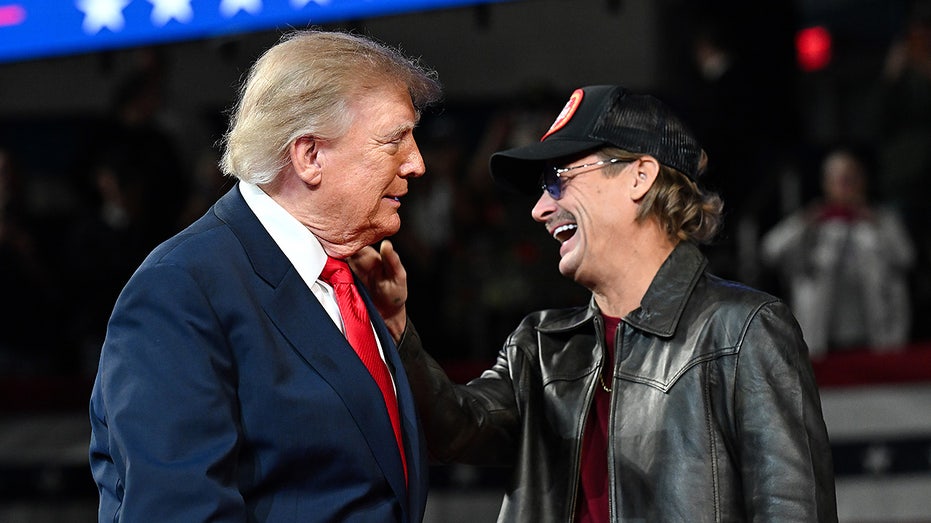
The American rocker told Fox News Digital in an exclusive interview that his political convictions have cost him corporate opportunities and late-night appearances, but he has no regrets about putting his beliefs first.
Now, as he embraces a new chapter with his faith-inspired album, "Halfway 2 Jesus," the rocker says he's more concerned with sharing his message than winning back the entertainment industry.
Kid Rock, born Robert James Ritchie, has publicly supported President Donald Trump. He said the professional fallout has brought something he considers far more valuable — the freedom to speak his mind.
"My relationship with Trump, yeah, that canceled all the, uh, any corporate deals coming my way. I don't really get invited to be part of, you know, things like the NFL or things like that … all the shows that I was so friendly with over the years, from all the late-night talk shows to my friend Jimmy Kimmel and Jimmy Fallon, I don't really get invited on there anymore," he said.
"But who's to say that won't change … and I honestly, I don't care."
The rocker said he expected to lose opportunities when he became more vocal about politics.
"I put my country before pretty much everything except my family and God," he said. "So, yeah. There's been things like that, but that's no sweat off my back."
WATCH: KID ROCK SAYS SUPPORTING TRUMP 'CANCELED ALL' CORPORATE DEALS AND LATE-NIGHT SHOW INVITES
Kid Rock said he no longer has much patience for the corporate maneuvering that once came with his career, particularly when it meant worrying about how his opinions might affect his next opportunity.
"I didn't enjoy the rat race of the music business. It was very necessary, and I'm glad I did it. And I'm thankful for all the opportunities that got me to where I am today," he said.
"But the message I'm putting out now is so much more important than any of that."
Kid Rock said he once felt pressure to watch what he said in the entertainment industry. Now, he enjoys speaking his mind without worrying about the professional consequences.
"And years ago, when I went on this path to be more vocal and outspoken, I knew that stuff was going to go away. But man, let me tell you what freedom feels like," he said.
"To be able to speak your mind anywhere, anytime and really exercise … the freedom of speech that so many brave souls died for, to be able to express that, when I want and how I want and not have to worry about anything in between."
"No radio station. No corporate deal or show or anything, you know … it's just the biggest, most awesome feeling of freedom that one could ever imagine," he said.
Kid Rock's next move isn't about winning back Hollywood.
It's about faith, forgiveness and a rock 'n' roll revival.
WATCH: KID ROCK ADMITS EMINEM CRITICIZING TRUMP TESTED THEIR FRIENDSHIP
The rocker said his new album, "Halfway 2 Jesus," blends Christian themes with high-energy rock and features a collaboration with his friend of nearly 40 years, Eminem, who has publicly criticized Trump.
The "Cowboy" singer told Fox News Digital that Eminem's public criticism of Trump had tested their relationship, particularly after the rapper criticized the president in a performance at the 2017 BET Hip Hop Awards.
"There's been moments when, yeah, friendships have been tested. With Eminem, it would probably be, you know, when he did the thing at the BET Awards, where he's just going hard in the paint against Trump," Kid Rock said.
Kid Rock said he ultimately respected his longtime friend's right to express his views despite their political differences.
"But you know what I mean? At the end of the day, I looked at it like, man, that's his truth. That's how he feels," he said.
"I genuinely don't like people talking about my friends in a bad way, and I'm very quick to defend them, family and friends. But when you're in the political arena, that’s a whole different ballgame," he said.
WATCH: KID ROCK CREDITS ERIKA KIRK'S FORGIVENESS OF HUSBAND'S ACCUSED ASSASSIN WITH TRANSFORMING HIS FAITH
For Kid Rock, the Eminem collaboration carries a message beyond music. In the foreword to "Halfway 2 Jesus," he said he hopes their friendship serves as an example for people whose political differences have strained personal relationships.
"We differ politically and on other things, but we've stayed friends through it all," he wrote. "We hope that sets an example for people who've lost friends or stopped talking to family because they think differently."
Kid Rock said his new album, "Halfway 2 Jesus," grew out of a deepening faith following the September 2025 assassination of conservative activist Charlie Kirk.
The rocker said he attended Kirk's memorial with his son and was moved by Kirk's widow, Erika, who publicly forgave the man accused of killing her husband.
"And when Erika got up there and forgave his murderer, about dropped me to my knees," he told Fox News Digital.
"It just brought tears to my eyes that someone could be that forgiving and I just started to become closer in my faith, pray a little bit more, pay attention to things around me."
In the album's foreword, Kid Rock described the project as a blend of Christian messages and high-energy rock 'n' roll.
"This is a collection of songs I'd want to hear at a Saturday night revival: people drinking beer, having a great time, and celebrating our Lord and Savior," he wrote. "Positive messages and a full-on rock concert."
Despite concerns the album could alienate some fans, Kid Rock said he accepted the risk.
"Before I even started this album, I made peace with the possibility that it could kill my career or take me to heights unknown. I'm content with either," he wrote.
Kid Rock's album, "Halfway 2 Jesus," is available now.
Scott Larson is joining OpenArt AI as its VP of brand marketing. He first experimented with the platform to create a short film starring a stick of butter about to meet an unfortunate end.
Salesforce and Meta marketing alum Scott Larson says OpenArt AI's conversational text-to-video generator is the tool he wished he'd had earlier in his career.
The platform helps whizz up short videos, arty images, and music by typing in a few prompts.
OpenArt this week tapped Larson as the company's vice president of brand marketing, the company exclusively told CMO Insider.
He joins in a period of rapid growth for the company, which said it's on track to pass $250 million in annual recurring revenue by the end of 2026. It's increased its head count to 80 employees over the past year, up from 20, and grown to 8 million monthly users, the company said.
Larson told CMO Insider he's on a mission to make OpenArt "as close to a household name as a creative AI can be."
He said the biggest challenge will be to wrap all of OpenArt's different use cases into a single "North Star" story.
It recently launched a new product called Director that lets users describe an idea, visual style, and narrative arc, which it then turns into videos up to 5 minutes long. It promoted the launch with a cinema and billboard campaign that it hoped would spark a "vibe directing" craze among the creative community. Others use its platform to create social posts, AI voiceovers, or lyric videos. It also offers an AI model leaderboard to help its users benchmark different AI video and image models.
Larson previously worked at advertising agencies on large consumer brands such as Nike, Levi's, and Gatorade. He later became global executive creative director at Meta, then known as Facebook. Larson went on to be an SVP at Salesforce, where he helped shape the branding behind its annual Dreamforce conference and launched ad campaigns starring Matthew McConaughey and Woody Harrelson.
Larson first experimented with OpenArt two months ago, creating a very short film with three cuts. Called "Life is Short," it shows a man made out of a stick of butter walking alongside a swimming pool. The butter man looks up at the scorching sun above before the video cuts to an old-school title card saying "The End."
"Had I had this tool starting back when I was a little creative junkie up until today, I'd be making everything all the time," Larson said.
Earlier this year, OpenArt plucked another exec from Big Tech, hiring former Google executive Raj Gajwani as its chief business officer.
The company is seeking to raise a new round of funding at a valuation between $30 billion and $40 billion.
Fireworks AI was last valued at nearly $18 billion in July of this year.
Fireworks AI is seeking to raise fresh funding at a valuation between $30 billion and $40 billion, a dramatic jump just months after the AI-infrastructure startup was valued at $17.5 billion, according to people familiar with the matter.
The potential valuation leap reflects investors' appetite for the companies selling the computing power and tools fueling the AI boom, even as Fireworks AI works through the fallout from a recent security incident.
The talks around the financing are still early, and valuation targets could still change. Fireworks declined to comment.
Founded in 2022, Fireworks was built by veterans of Meta and Google's AI efforts. Chief executive Lin Qiao previously led the PyTorch team at Meta, while cofounders include former Meta infrastructure engineers and a former leader of Google's Vertex AI. The company rents out computing infrastructure and software that lets businesses run, fine-tune, and deploy open-weight and custom AI models.
In July, Fireworks announced a $1.5 billion Series D funding round at a $17.5 billion valuation, led by Atreides Management, Index Ventures, and TCV, with participation from Nvidia, Lightspeed Venture Partners, Bessemer Venture Partners, and Menlo Ventures. That round followed a $250 million Series C at a $4 billion valuation in late 2025, co-led by Lightspeed, Index, and Evantic. Last month, The Information reported that Fireworks has been considering a round at a $30 billion.
Rather than trying to build a consumer chatbot to rival ChatGPT, Fireworks sells what it calls specialized intelligence: models customized on a customer's proprietary data, workflows, and use cases. The company said in July that it had surpassed $1 billion in annualized revenue and was serving more than 40 trillion tokens a day; it said 95% of those tokens came from models tailored to customers.
The company operates in a highly competitive layer of the AI stack. Rivals include model-infrastructure startups such as Together AI, Baseten, and Replicate, as well as cloud giants such as Amazon Web Services, Google Cloud, Microsoft Azure, and Oracle.
The fundraising talks come shortly after a security incident at Fireworks AI. The company said it identified unauthorized use of internal credentials earlier this month that allowed an intruder to access data from some customer accounts.
"We take this seriously and will be transparent about what happened and what we find," Qiao posted on X. "I'm personally committed to turn this attack into the most formidable security response in AI Infra."
Please send along your tips. Email Ben or Katie anytime or contact them on Signal at benbergman.11 and kroof.26. Sign up for Business Insider's weekly VC Insider newsletter here.

 Login