Meta's AI agent, Muse, is unprofitable due to "very high compute costs," CEO Mark Zuckerberg says.
Meanwhile, Meta expects Reality Labs, its AI glasses division, to lose $15 billion next year.
The social media giant has a plan to fix that.
Meta says some of its biggest cash incinerators could finally start turning profits.
The social media giant, which generated over 97% of its quarterly revenue from ads, has faced persistent questions from investors about the lack of profitability in its AI and hardware initiatives.
Meta CEO Mark Zuckerberg addressed those concerns head-on during its third-quarter earnings call on Wednesday.
Zuckerberg said that Muse, the AI assistant it launched last month, is unprofitable since it's "very compute intensive to run." Meta expects to start turning that around next year by massively improving Muse's efficiency.
"If compute efficiency continues improving quickly for another few years, which we think is highly likely, then Muse will be highly profitable over multiple years," he said.
Meta plans to make money from Muse by taking a small transaction fee off of purchases it drives, Zuckerberg said at Meta's Connect conference last month.
Zuckerberg added that Muse, which launched only in the US and Canada, wasn't launched globally due in part to the amount of compute it requires. (Meta's North American users are generally its most lucrative.)
Zuckerberg also struck a positive note about its cash-hemorrhaging Reality Labs division, which makes products like Meta Ray-Bans and virtual reality glasses.
Meta expects Reality Labs to narrow its losses to about $15 billion in 2027, down from the $18 to $19 billion it expects to lose this year. The division should start trending toward profitability next year, as Meta's AI systems make it more useful, Zuckerberg said.
"I continue to believe that the path to delivering holographic experience, of bringing together the physical and digital worlds and everyday glasses, will come through VR first," Zuckerberg said.
Have a tip? Contact this reporter securely on Signal at charlesrollet.12 or +1-628-282-2811. Use a personal email address and a non-work device; here's our guide to sharing information securely.
Tesla has begun production of its humanoid robot, Optimus, in Fremont, California.
Musk said he expects to begin delivering Optimus to customers at the end of 2027.
Musk said it will take at least a year to produce 20,000 Optimus units a week.
Tesla has begun producing its long-awaited humanoid robot, Optimus, at its Fremont factory, the company said in its quarterly earnings report.
"The bots coming off this line are the first production-quality bots that we have manufactured," Tesla said, saying the current manufacturing process is "suitable for a commercial product."
"There's still some things we need to tweak about the design, because you need to deliver a robot that is safe and reliable and has long duration," CEO Elon Musk said on Tesla's Q3 earnings call. "It can't, like, wear out after a month."
Musk said the company will take at least a year to scale up Optimus production to 20,000 units a week in Fremont. He said he expects to begin delivering Optimus to customers at the end of next year.
Musk tempered expectations about how quickly Tesla can scale up Optimus production because it is "such a radically new product." He said the early stages of production will be "somewhat bumpy" because "there's like 10,000 things that have to go right" to build the robot. One of the big challenges Musk outlined is building robot hands.
Musk said Tesla is building an "Optimus Academy," where robots will practice tasks and generate data to improve the AI models that power them. The company also plans to install its next-generation AI5 chip in Optimus in April, which will give the robots more computing power and be a "big step change in intelligence," Musk said.
The latest version of Optimus has not been unveiled. Musk said he expects to release a video of Optimus within one or two months. He previously said Tesla was keeping the robot under wraps to prevent competitors from copying its design.
Tesla stopped producing the Model S and Model X at its Fremont, California, plant earlier this year to make room for an Optimus line designed to eventually produce a million robots a year. A second line under construction in Austin is planned to have an annual capacity of 10 million robots.
Tesla is competing in a crowded humanoid market. Agility Robotics, which plans to go public, has deployed its Digit robot across nine customer facilities, while Figure AI has announced deployments in logistics and distribution centers this year. Sunday Robotics, 1X, and Weave Robotics are preparing to ship robots into homes this fall.
Have a tip? Contact Rya Jetha via email at rjetha@businessinsider.com or Signal at rjetha.07. Use a personal email address and a non-work device; here's our guide to sharing information securely.
The company announced the new app Claude Duet on Wednesday, billed as a "proactive agent" that can run in the background, surface tasks to a user, and handle a variety of work. The tool is in research preview for now with a waitlist, meaning it won't immediately compete for the larger market with other new agents like Meta's Muse and OpenAI's Dots.
Still, the announcement ramps up the pressure on those companies — Anthropic says it built Duet around its flagship Opus 5.5 model, which was released in late September and has already become one of the industry's most popular. Recent model breakthroughs have made AI better at handling work on its own, spurring a rush to build these "always-on" personal agents.
"It can have the discernment and judgment around when to be proactive, when to act on your behalf," said Mike Krieger, a co-lead of Anthropic's Labs team, said in a Duet launch video.
The tool, Anthropic says, will send users a brief each morning about what's happening on their connected apps, and message them when something needs attention. Like other companies' offerings, it runs outside a user's computer, sends notifications, and asks for approval on certain tasks.
Anthropic announced Duet on the day of Meta's earnings report and used the opportunity to mention a new poach from Mark Zuckerberg's company. Karan Ahuja led product management for Meta Superintelligence Labs until July, according to his LinkedIn, before starting at Anthropic in August and leading Duet's development.
He wrote on X that he's been using Duet to build Duet, and said the team "built it for professionals and small business owners juggling a lot at work and at home."
Ahuja also wrote that Anthropic is letting people into Duet from the waitlist "as quickly as possible."
The news didn't go unnoticed at Meta. Alexandr Wang, who heads Meta Superintelligence Labs, posted a meme about Duet's similarity to Muse.
Anthropic is fast approaching a giant initial public offering, which could value the company at as much as $2 trillion. Like other AI players, the company navigates a high-wire competition to win over users, secure computing power, build state-of-the-art models, and deliver AI-native products.
The data firm Apptopia estimates that Muse had more than 14 million installations as of Wednesday. It found that Claude users who installed the Muse app were using Claude more than before, though still for fewer minutes per day than they spent on the Meta product.
Have a tip? Contact this reporter via email at scouncil@businessinsider.com, or over text, Signal, Telegram, or WhatsApp at 415-757-8198. Use a personal email address, a non-work WiFi network, and a non-work device; here's our guide to sharing information securely.
Nvidia vice president Laura Fay has retired after a decade at the company.
Fay grew Nvidia's enterprise marketing team from roughly 60 to 600 employees.
Nvidia brought in Google Cloud's Alison Wagonfeld as its first chief marketing officer this year.
Laura Fay, a longtime Nvidia marketing executive who reported to CEO Jensen Huang, retired in July after roughly a decade at the AI chip giant.
Fay formerly served as Nvidia's vice president of global enterprise marketing, overseeing campaigns, events, analyst relations, and partner marketing. She said her team grew from roughly 60 to 600 people by the time she left.
Fay was among 36 employees on an internal list obtained by Business Insider last year of company leaders reporting directly to Huang. Prior to joining Nvidia, she spent 22 years at Cisco, concluding her tenure there as VP of global marketing.
Fay said Huang recruited her to build Nvidia's enterprise marketing organization as the company looked to expand beyond gaming.
"I want to change the world, and I want you to change it with me," she recalled him telling her on their first call.
Fay said she began considering retirement around her 10th anniversary in January, though a call from Huang congratulating her and expressing hope that she'd stick around for another decade persuaded her to stay a little longer.
Nvidia declined to comment.
Fay's retirement came as Nvidia also brought in new marketing leadership. In February, the company hired Google Cloud executive Alison Wagonfeld as its first chief marketing officer.
The Wall Street Journal reported at the time that Wagonfeld would oversee all marketing and communications teams and assume responsibilities previously divided among several leaders.
Those changes follow another longtime marketing departure. Greg Estes, Nvidia's former vice president of corporate marketing and developer programs, retired in 2025 after roughly 15 years at the company.
Several other longtime Nvidians have retired this year, including sales chief Jay Puri, chief accounting officer Donald Robertson, and VP of hardware engineering Robert Huang. Some retirees told Business Insider that Nvidia's exponential stock run helped precipitate their decisions.
Nvidia's communications organization has also undergone a shake-up as scrutiny around the company has intensified, with roughly 15 employees departing since 2025 amid a reorganization under new leadership.
Have a tip? Contact this reporter via email at gweiss@businessinsider.com or Signal at @geoffweiss.25. Use a personal email address, a non-work WiFi network, and a non-work device; here's our guide to sharing information securely.
Elon Musk wants some SpaceX workers to move temporarily to Memphis.
Marvin Joseph/The Washington Post via Getty Images
SpaceX is offering employees a 20% pay bump to volunteer to help build its data centers in Memphis.
The company is looking for "leaders" who can "remove blockers," according to emails seen by BI.
Elon Musk said on Tuesday he often spends "four days a week" in Memphis working on SpaceX's data center buildout.
SpaceX is offering employees a pay bump to temporarily move to Memphis and help build its data centers.
Elon Musk's rocket company is giving employees a 20% pay increase if they volunteer to spend six weeks assisting its critical supercomputer buildout,according to an email seen by Business Insider.
"We now need leaders — current and emerging — to guide teams and remove blockers as we bring more supercomputers online," read the email, which was sent in early October to all SpaceX employees.
It specified that volunteers did not need to be managers already, adding that construction experience is a plus and that "drive matters most."
Employees who put themselves forward should expect to spend six weeks on-site in Memphis, Tennessee, or Southaven, Mississippi, where SpaceX is currently expanding its huge Colossus 1 and 2 data centers to meet surging demand for its compute business.
Volunteers "must be in good performance standing," with more than one year of tenure preferred, the email said. Employees who volunteer will receive a 20% premium on their base salary or on their hourly rate of pay for the period of their assignment, and be eligible for "bonuses tied to program success."
SpaceX did not respond to a request for comment.
The email described the reallocation of employees from other parts of SpaceX to assist the company's data center buildout as a "surge," a tactic employed by the company to divert employees and resources to mission-critical projects.
In 2022, CNBC reported that SpaceX offered employees pay bumps of between 10%-25% to temporarily relocate to Texas as it attempted to launch its Starship megarocket.
The company has been offering "surging" employees a 20% premium on their salary to move to Memphis since at least August, according to another email seen by Business Insider that called for "SpaceX experts and aces" to work for the next three months on the data center buildout. The email said the program is intended to end on December 31, 2026, but could be extended.
SpaceX will cover travel expenses and logistics, both emails said.
SpaceX's compute cash cow
The supercomputers in Tennessee and Mississippi, which were originally built by xAI before the startup was folded into SpaceX in February, have become a critical part of the company's business.
In SpaceX's earnings on Tuesday night, the rocket giant said AI revenue that includes leasing out its compute to other companies — including Anthropic and Google — had soared to more than $7 billion, nearly half SpaceX's entire quarterly revenue.
On the analyst call, CEO Elon Musk said that SpaceX was being "hounded relentlessly" by companies looking to rent out its compute, adding that they could have rented it out several times over.
SpaceX has been shifting executives in addition to rank-and-file employees to oversee its aggressive expansion. Business Insider previously reported that the company had placed a former Starship executive in charge of building out its compute capacity in Memphis.
Musk told investors on Tuesday he was also spending most of his time in the city as he looked to push SpaceX toward a target of bringing an extra 10 gigawatts of compute online by the end of 2027.
"I've been spending, personally, a lot of my time in Memphis, often four days a week," the SpaceX CEO said. He previously said he was living in an Airstream trailer on the site.
Visa CMO Frank Cooper III is freshening up the company's look.
Jason Mendez/Getty Images for The Whitaker Peace & Development Initiative
Visa is rolling out a new "V" to pop on mobile screens as people move to contactless payments.
It's the company's first refresh of this size since 2021.
Other brands have increasingly leaned on symbols and pared-down names for better mobile visibility.
Visa is betting that less is more when it comes to how it shows up to customers.
Starting Wednesday, the letter "V" will replace "Visa" in the center of its credit cards and on its digital properties, the company exclusively told Business Insider.
Visa's move signals that after 50 years of using the name, it feels it has enough brand recognition to be represented by a single letter. The change is also meant to pop more on small screens as people conduct more of their lives on their mobile devices.
In addition to the "V," Visa is introducing a new font, called Visa Sans, lopping off the serif in the first letter of "Visa."
"V" will now stand in for "Visa."
Visa
The changes were developed by Visa's in-house creative studio and Base Design. It's Visa's first significant refresh since 2021, when it introduced a blue, white, and yellow flag-like brand symbol and a new font. With the new "V," that brand symbol will go away.
"There was an opportunity for us to modernize that and make it feel fresh, particularly for the next generation of consumers," Frank Cooper III, CMO of Visa, told CMO Insider. "We think it marries well with the evolution of the brand overall."
Cooper said the process took about a year.
"We do not have an awareness issue. We have deep trust. Playing around with the brand positioning is no light matter," he said.
Other big brands have increasingly leaned on symbols and pared-down names for better visibility on smaller screens.
Mastercard dropped its name from its logo in 2019. Google introduced a sans-serif logo and a new, four-color "G" icon in 2015.
Dan Nicholas, design director at creative studio Super Okay, said the move to a singular V aligns with a mobile-first approach that tech and media brands like Verizon and The New York Times have taken, in which they adopt a single letter as an icon.
He said the move simplifies Visa's appearance but could undermine brand recognition.
"What remains to be seen in the rollout is how Visa manages this new equity," he said. "If thoughtfully and strategically executed and invested in over the next few years, we can see it becoming a strong way for the brand to express itself."
Visa sees its visual changes as a companion to an effort to associate itself with culture and aspiration. It enlisted celebrities like Pharrell Williams for its "Power of Small Steps" campaign and has a partnership with the FIFA World Cup that extends through 2030. This year's World Cup campaign promoted its contactless payment option to emphasize that Visa's long-running slogan, "everywhere you want to be," was more than just a physical destination.
"We see that phrase now as representing both a physical destination and a personal aspiration," Cooper said.
Azoma, cofounded by Timur Luguev and Max Sinclair, just raised $11.2 million in Series A funding.
Azoma
Azoma helps brands get their products discovered by AI shopping agents.
Its platform measures brands' AI visibility among specific shoppers and offers tips to improve.
Azoma just raised $11.2 million in a round led by Puma Growth Partners.
As people begin to delegate online purchases to AI assistants and agents, the startup Azoma wants to ensure its consumer-goods clients make the shopping list.
The company exclusively told CMO Insider on Wednesday that it had raised an $11.2 million Series A funding round, led by Puma Growth Partners.
Founded in 2022, Azoma initially focused on helping brands show up prominently in AI search and chatbots, operating in the fast-growing field of generative engine optimization, or GEO. Then, over the past year, at least a dozen new AI shopping assistants from retailers rolled out, alongside the launch of personal AI assistants like Meta's Muse, OpenAI's Dots, and Instinct, which can also make purchases on a user's behalf.
In December, Morgan Stanley estimated that AI-powered shopping assistants could account for up to $385 billion in US e-commerce sales by 2030.
"The space has evolved rapidly from customers just really caring about answer engines to caring about the other types as well," Azoma CEO Max Sinclair told CMO Insider.
Azoma's customers include Unilever, L'Oréal, Reckitt, and Mars. It offers them a service it calls agentic commerce optimization, a technique that helps make their products more discoverable by large language models and more likely to be recommended by them.
Azoma suggests actions the clients can take to improve their visibility, from honing their marketplace listings to optimizing their content on YouTube and Reddit. It also uses "digital twin" technology to simulate different consumer demographics, so brands can see how their products are presented to the specific shoppers they want to target.
Sinclair said Azoma differs from other GEO companies because it's laser-focused on the commerce space and working with brands who sell physical goods.
"Many of our customers have tried these generic GEO platforms and found that they don't understand commerce at all," Sinclair said. "They don't understand the integrations, they don't understand the workflows, they don't understand the existing tech stack, they don't understand how the teams work, how they're operated, how they're motivated."
Sinclair said Azoma plans to invest the fresh funds in ensuring its technology can track across all the latest agents, from Meta's Muse to TikTok's new Shopping Assistant. The company charges a fee per brand, geography, and shopping agent.
Sinclair estimated the company's head count would grow to around 80 to 100 people next year, up from 40 currently, as it ramps up hiring in areas including sales, customer success, AI research, software development, and operations.
Azoma also plans to integrate data from the Tesco-owned retail analytics company Dunnhumby to help brands determine whether increasing their share of voice on a platform like ChatGPT translates into a sales lift at brick-and-mortar retailers.
Dunnhumby Ventures also participated in the round, alongside Twinpath, Mars IAF, Rank Ventures, and Ignite Ventures.
Check out the pitch deck Azoma used to secure its $11.2 million Series A investment, shared exclusively with CMO Insider. Some of the slides have been omitted or redacted.
Azoma's tech helps brands drive revenue through AI shopping agents.
Azoma
The 'about us' slide provides company details.
Azoma
Azoma has offices in London and Toronto and has previously received investment from eBay Ventures and Dunnhumby Ventures.
Its clients include Unilever, Reckitt, and Heinz.
Azoma
The presentation features testimonials from clients at Dentsu, Perfect Ted, L'Oréal, and Mars.
Azoma
Azoma tees up the business opportunity.
Azoma
Consumers are using AI to discover brands and products.
Azoma
It cites 2025 research from Capgemini that says 58% of consumers have replaced traditional search engines with generative AI tools for product recommendations.
Azoma quotes Harley Finkelstein, Shopify's president.
Azoma
Finkelstein said on Shopify's August earnings call that traffic and orders coming in from AI channels to Shopify stores had tripled over the past year.
A Shopify blog post, published in May, said AI-referred traffic converted at a 50% higher rate and had an average order value 14% higher than traditional search.
Amazon CEO Andy Jassy has lauded its AI-powered shopping assistant.
Azoma
Alexa for Shopping was used by more than 350 million Amazon customers over the past 12 months, Jassy said on the company's July earnings call.
Jassy said that US customers who use Alexa for Shopping spent 40% more per order than those who don't.
Walmart has an AI-powered shopping assistant called Sparky.
Azoma
Walmart CEO John Furner said on the company's August earnings call that the number of customers using Sparky was up 70% year-on-year. Similar to Amazon, Walmart said customers who used Sparky for shopping spent 40% more per order than those who didn't.
This slide uses Cloudflare data that shows bots have surpassed humans in web traffic.
Azoma
At the time of the presentation, in September, Meta's Muse was the top app in the US Apple and Android app stores.
Azoma
The presentation moves to the challenges Azoma solves.
Azoma
Azoma says that as AI adoption increases, brand real estate shrinks.
Azoma
Brands have fewer opportunities to control channels and content in agentic shopping experiences.
Azoma
This slide shows the differences between traditional e-commerce and agentic commerce.
Azoma
Agents gather information about products from multiple channels, including online discussion forums, editorial content, reviews, and brands' own websites.
Azoma specializes in agentic commerce optimization, or ACO.
Azoma
It covers answer engines, retailer shopping assistants, and personal AI agents.
Azoma
This slide analyzes the differences between ACO and GEO.
Azoma
Azoma says that, when done effectively, ACO can boost customer acquisition.
Azoma
The presentation then introduces a case study.
Azoma
Azoma says it helped drive a 43% revenue uplift for Mars compared with a control group.
Influencer marketing to baby boomers hits different — and not in the way brands intended.
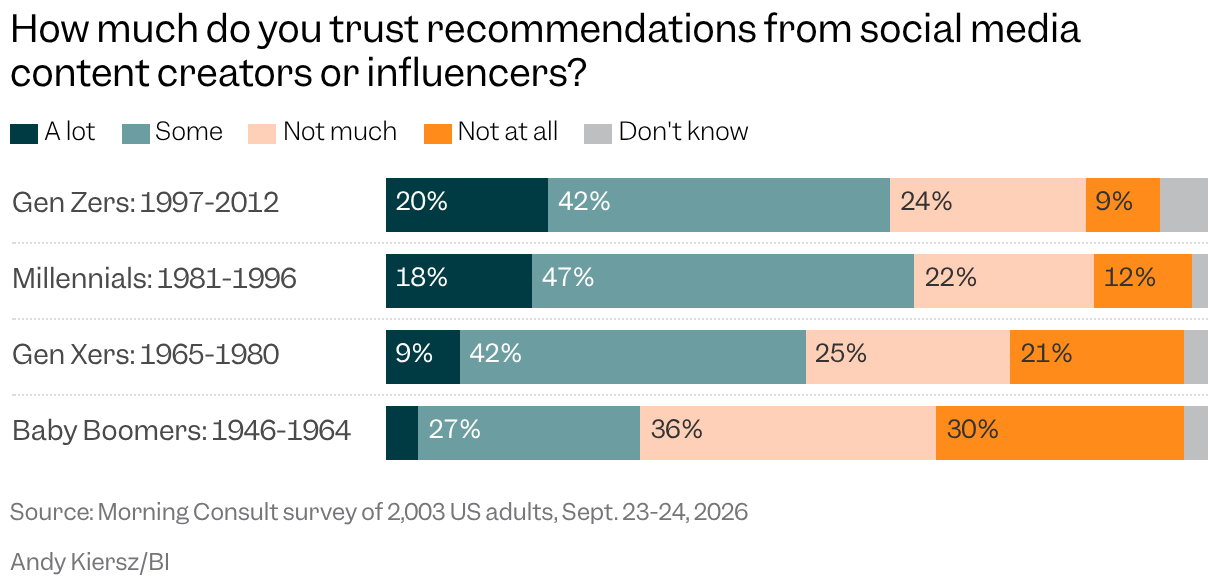
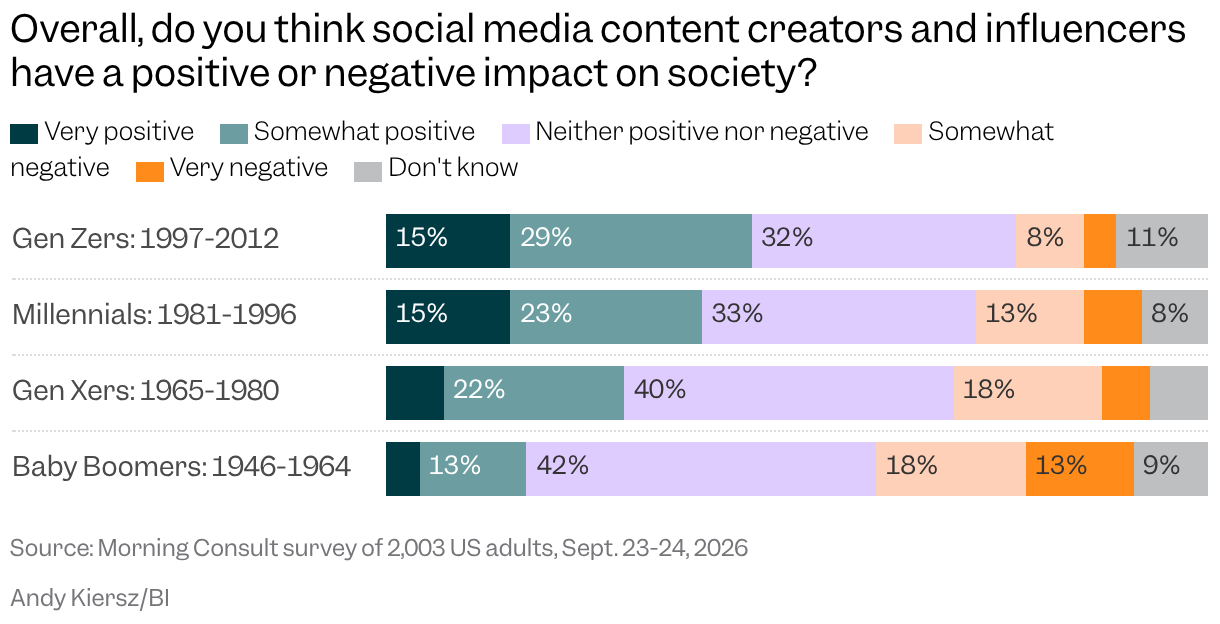
Research from Morning Consult, conducted exclusively for Business Insider, reveals a stark generational divide in attitudes toward influencers. Boomers — people born between 1946 and 1964 — are distrustful of influencers, skeptical of their recommendations, and more likely to find their content "annoying."
In the survey of roughly 2,000 US adults conducted in September, 31% of boomers said they trust influencer recommendations at least somewhat, compared with 62% of Gen Z and 64% of millennials. Two in five (40%) boomers surveyed said they trust influencers less than they did a few years ago.
Sure, plenty of adults become set in their ways and harder to persuade as they age. But advertising pros said there's another factor that could help explain boomers' wariness of influencer marketing: brands themselves continue to overlook the older generation.
"Brands are terrified of taking any dollars away from speaking to young people," said Jennifer Meehan, an EVP at the communications agency Edelman.
That fear also extends into the creators they look to partner with.
Florian Dost, a marketing professor at Brandenburg University of Technology in Germany, interviewed influencer agencies and talent managers as part of a recent study. Some of the managers his team interviewed found that older influencers often drove higher campaign conversion rates, but brands rejected them.
"Agencies may know that," Dost said. "They certainly sometimes try to put it forth because they also see the numbers. But clients don't want to hear."
Boomers' distaste for influencers presents a challenge for CMOs.
The generation is a considerable consumer force, accounting for 42% of spending among affluent US households, according to Visa research from last year. With US marketers forecast to spend $40 billion on creator economy partnerships and ads this year, per Business Insider sister company EMARKETER, brands risk leaving a lucrative audience on the sidelines.
Getting boomers to click
Stewart Reynolds, 56, a Canadian comedy creator who posts under the name Brittlestar, said that older consumers rarely see themselves reflected in influencer marketing, which tends to favor young, attractive influencers.
Reynolds, a Gen Xer, said 45% of his audience is over 45 years old. And while he has landed plenty of brand deals with the likes of Yorkshire Tea, Yoplait, and Dairy Farmers of Ontario, he jokingly admits he's jealous of the opportunities that his son, Gregor Reynolds, another successful comedy creator, receives.
"He's getting brand deals and campaigns that I wouldn't get because I'm not young and fit," Reynolds said.
Stewart Reynolds, 56, a Canadian comedy creator who posts under the name "Brittlestar."
Terry Manzo
It's not just the brands, though.
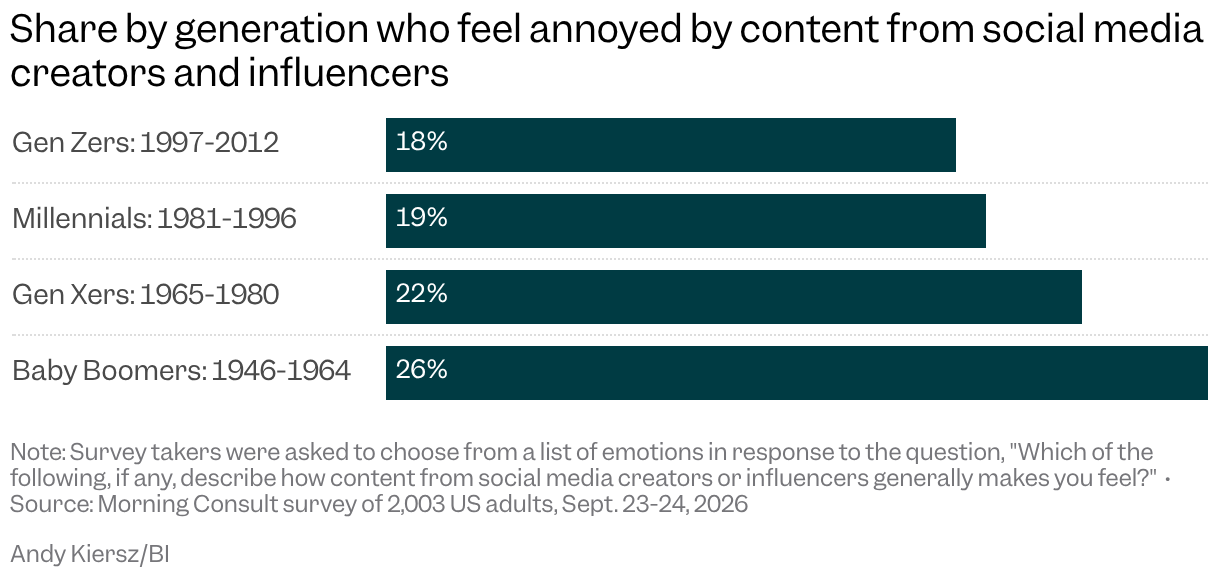
Marketing insiders said some of the disconnect could be explained by influencers failing to create content that's relatable to an older audience. About a quarter (26%) of boomers surveyed by Morning Consult said influencer content made them feel annoyed — the highest proportion of any generation. Only 5% of boomers said it made them feel happy, versus 28% of Gen Z, 30% of millennials, and 13% of Gen X. Other generations said influencer content was most likely to leave them feeling "entertained," while boomers' top choice was "annoyed."
A separate study published earlier this year by Edelman, which surveyed more than 17,000 respondents worldwide, found that just 24% of boomers said they followed a content creator, compared with 86% of Gen Z, 77% of millennials, and 51% of Gen X.
The age of the influencers older generations see on their screens isn't the only factor at play.
"It's less about finding someone who's the same age and more about finding someone they can see something of themselves in," said Lucy Kruszynski, global head of brand at influencer marketing agency Buttermilk.
Shared interests and experiences can be more powerful than demographic similarities, she said. As boomers enter retirement, many have more time to rediscover hobbies and passions that took a backseat during their working lives. Brands could tap into those interests by partnering with creators who share their enthusiasm for pursuits like music, art, or home improvement.
Some of the most successful boomer creators have scored deals that lean into these passion points. The boomer weightlifting influencer Marlene "Granny Guns" Flowers has more than 4.5 million followers across her social platforms and has collaborated with brands such as YoungLA and Ryse Supps. Barbara Costello, who is in her 70s and known as "Brunch with Babs," has more than 9 million followers and has scored partnerships with brands that range from the furniture brand Birch Lane to Nellie's Eggs and Walmart.
Brands may also have to exercise patience when trying to convert older consumers. The Morning Consult survey found that 43% of boomers said they had never purchased a product based on an influencer's recommendation.
For brands accustomed to measuring influencer marketing success in clicks and immediate sales, that could require a rethink. Kruszynski said some boomers follow creators for months, sometimes up to a year, before feeling comfortable purchasing something they've recommended.
"Even though there is absolutely a level of annoyance and a lack of trust, I don't think that baby boomers are immune to influencer marketing," Kruszynski said. "Brands need to think about how creators can build credibility through consistent content over time."
Scott Larson is joining OpenArt AI as its VP of brand marketing. He first experimented with the platform to create a short film starring a stick of butter about to meet an unfortunate end.
Salesforce and Meta marketing alum Scott Larson says OpenArt AI's conversational text-to-video generator is the tool he wished he'd had earlier in his career.
The platform helps whizz up short videos, arty images, and music by typing in a few prompts.
OpenArt this week tapped Larson as the company's vice president of brand marketing, the company exclusively told CMO Insider.
He joins in a period of rapid growth for the company, which said it's on track to pass $250 million in annual recurring revenue by the end of 2026. It's increased its head count to 80 employees over the past year, up from 20, and grown to 8 million monthly users, the company said.
Larson told CMO Insider he's on a mission to make OpenArt "as close to a household name as a creative AI can be."
He said the biggest challenge will be to wrap all of OpenArt's different use cases into a single "North Star" story.
It recently launched a new product called Director that lets users describe an idea, visual style, and narrative arc, which it then turns into videos up to 5 minutes long. It promoted the launch with a cinema and billboard campaign that it hoped would spark a "vibe directing" craze among the creative community. Others use its platform to create social posts, AI voiceovers, or lyric videos. It also offers an AI model leaderboard to help its users benchmark different AI video and image models.
Larson previously worked at advertising agencies on large consumer brands such as Nike, Levi's, and Gatorade. He later became global executive creative director at Meta, then known as Facebook. Larson went on to be an SVP at Salesforce, where he helped shape the branding behind its annual Dreamforce conference and launched ad campaigns starring Matthew McConaughey and Woody Harrelson.
Larson first experimented with OpenArt two months ago, creating a very short film with three cuts. Called "Life is Short," it shows a man made out of a stick of butter walking alongside a swimming pool. The butter man looks up at the scorching sun above before the video cuts to an old-school title card saying "The End."
"Had I had this tool starting back when I was a little creative junkie up until today, I'd be making everything all the time," Larson said.
Earlier this year, OpenArt plucked another exec from Big Tech, hiring former Google executive Raj Gajwani as its chief business officer.
Mark Zuckerberg's Meta has blocked Shou Zi Chew's company, TikTok, from advertising in some markets.
Finn Gomez/Getty Images; Shawn Thew-Pool/Getty Images
TikTok is moving on quickly after losing access to Meta's ads platform in some markets.
It's shifted ad spend to YouTube, Pinterest, and mobile-app networks, according to Sensor Tower.
TikTok was a prominent ad spender on Meta before its ousting on October 8.
TikTok's message to Meta: If you won't take our ad dollars, your competitors will.
Meta took a bold stance this month by blocking ByteDance, TikTok's parent company, from running ads on Meta apps in some markets. Why? Well, Meta's answer was pretty straightforward. It didn't want to "run ads from a competitor whose goal is to pull people off our apps."
TikTok is now redirecting that ad spend elsewhere.
Since the ban went into effect on October 8, TikTok has shifted its ad budgets to other platforms like YouTube and Pinterest, according to allocation estimates provided to CMO Insider by the analytics firm Sensor Tower.
The share of TikTok's ad spend that went to YouTube rose to 17% between October 9 and October 16, up from 9% in the first week of October. Meanwhile, its ad spend on Pinterest grew to 9% during the same period, up from 3% in the first week of October. A majority of TikTok's spend — 58% — went to mobile-app ad networks like Google's AdMob, up from 19% at the start of October, when Meta was still an option.
Meta's move against TikTok "highlights the growing intensity of the competition across the digital landscape and across the two of them," said Kate Black, EVP of social strategy at Horizon Media. "For marketers, this really just reinforces the need to be agile and build balanced media strategies — and not having all your eggs in one basket."
Meta's TikTok ousting isn't unprecedented. Other platforms like Amazon have previously blocked competitors from running ads, while Twitter in late 2022 restricted users' ability to link to their accounts on social apps like Instagram and Mastodon, calling it "free promotion."
"Declining promotional services to a competitor is a normal business practice across industries," a Meta spokesperson said. Meta's changes will impact advertising policies in the US, Canada, Egypt, Indonesia, Japan, Thailand, and Vietnam.
For Meta, a company that pulled in $117 billion in revenue in the first half of 2026, losing one advertiser won't hurt much. Still, TikTok and ByteDance were notably prominent spenders on Meta's apps, according to Sensor Tower.
Meta will also lose ad spend from third-party marketers that link to TikTok or other ByteDance properties in their ads, further increasing its potential losses. Direct-to-consumer brands that may want to drive potential customers to TikTok Shop will miss out.
No Meta, no problem
For TikTok, losing access to Meta's more than 3 billion monthly users is a setback.
Like any social media giant, TikTok is incentivized to grow, grow, grow. Ads that target new users and drive new app downloads are part of the playbook — a strategy Meta uses to promote its own apps, like Instagram, too.
One TikTok staffer focused on user acquisition, James Gao, posted a LinkedIn callout on Sunday asking people to get in touch if they had ad inventory that could help the company meet its goals.
Horizon Media's Black said that while Meta controls the "lion's share" of social budgets, there are plenty of viable alternatives when it comes to using an ad to drive an action like an app download. Besides Google, YouTube, and Pinterest, marketers are increasingly turning to other platforms like Snapchat and Reddit, she said.
When Ameresco CMO Leila Dillon asked ChatGPT and other AI answer engines to describe what her company did, she was shocked by the results.
The publicly traded company is an energy infrastructure provider, helping power the rapidly growing AI buildout, as well as military bases and municipal facilities. But the AI chatbots were outdated in their responses, frequently referring to it simply as a cleantech or renewable energy business — areas it still operates in, but are less of a focus — or citing smaller projects it worked on years ago.
"It was quite horrifying," Dillon told CMO Insider. "We were like, 'That's not at all who we are.'"
Dillon set about overhauling the company's messaging and how it structured its marketing content to better reflect its business.
The work has begun to take effect. Ameresco tracked how often AI chatbots mentioned the company in response to 50 questions that potential customers and investors might ask. It appeared in 61% of those answers in 2026, up from 43% in 2025, according to the company.
As more consumers turn to platforms like ChatGPT, Google's Gemini, Anthropic's Claude, and Microsoft's Copilot to research companies and products, marketers are racing to hone their generative engine optimization (GEO) strategies to ensure their brands appear prominently and accurately in AI-generated answers.
"I used to Google everything that I wanted to know about," Dillon said. "I barely use Google anymore. I use Copilot, and I get better results."
In a January survey from the Interactive Advertising Bureau, 73% of US brand and agency buyers said they planned to devote more time or resources to optimizing content for AI-generated answers in 2026, compared with last year. In a separate survey of US marketing professionals conducted by Semrush, an AI and search visibility platform, in April, 30% of marketers said AI search tools had described their brands inaccurately.
The rush by marketers to get up to speed with GEO has spawned a cottage industry of AI search experts and tools promising quick fixes. But with AI companies constantly updating their models, marketers are in a phase of constant experimentation as they scramble to figure out what actually influences the chatbots.
"There's no one shot that fits all to solve that for you," Dillon said.
An AI audit identified 47 areas for improvement
In January 2025, Dillon's team and its PR agency, Greenough, began auditing how often Ameresco appeared in AI-generated answers to 50 prompts — such as, "What are the top energy infrastructure providers in the US?" — on platforms including ChatGPT and Claude. The prompts reflected questions that investors and prospective customers, including people from universities and utilities, might ask AI chatbots.
The audit identified 47 areas for improvement, including how Ameresco described its business across its website, social media, press releases, and executive communications.
"You name it, we were doing it wrong," Dillon said.
Ameresco began rolling out a new corporate brand identity in July this year, reflecting its broader reorganization around two business pillars: power infrastructure and buildings and public infrastructure.
It had laid the groundwork for the new corporate brand reveal by making several changes to its content strategy.
Those included:
Updating its corporate boilerplate from "a leading cleantech integrator specializing in energy efficiency and renewable energy" to "a leading energy infrastructure company," reflecting the new positioning across its marketing and communications.
Refreshing its awards submission strategy to lead with its power infrastructure projects, and announcing each win with a press release that appears on wire services and industry trade publications.
Introducing Q&A-style content formats, designed to make the information easier for AI chatbots to interpret.
Creating more content designed for different customer groups, such as data center operators or school facilities managers, rather than relying on generic marketing materials.
Launching a video content series called "Energy Benefits Unlocked," highlighting the tangible results Ameresco's projects accomplished for its customers.
Introducing quarterly AI visibility tracking audits across the 50 different prompts, reflecting its different audiences, and adding competitor comparisons.
A constantly moving target
The strategy appears to be paying off in some ways. Ameresco said organic traffic to its website rose 50% in the 12 months to June 2026. Dillon said it's still too early to assess precisely how those gains translate into business results, though she believes the GEO work is helping the marketing team hit its targets more quickly. The company is scheduled to report its third-quarter earnings on November 9.
Dillon said the rapid changes in AI mean the work is never really finished. Ameresco regularly revisits its AI visibility scores and has invested in training the marketing team, which shares tips, tricks, and their "epic AI fails" in its weekly meetings.
"One of the main themes is that what happened last week is not what you're going to get this week; it's changing that quickly," Dillon said.
"You don't just update your website and say: Done, woo, all set," she added.
A hot, new beauty treatment driving tens of millions of dollars in sales around the globe is now aiming for the US market. Its unusual ingredient: skin from dead Americans.
Each year, tens of thousands of Americans donate bodily tissue upon their deaths, generally by checking a box at a motor vehicle department or through an authorization made by a loved one. Over the past few years, tens of millions of dollars' worth of donated skin has traveled from American tissue banks to biotech companies in South Korea, the beauty capital of the world. There, among other uses, it is turned into injectable beauty treatments.
The maker of the market-leading Korean brand said last week it has signed a distribution contract to introduce its skin-derived injection to the US market next year. It isn't clear whether the product can be sold in the US without approval from federal regulators.
Business Insidertraced the tissue supply chain to understand how donor tissue from, say, San Antonio can end up for sale at a clinic in Seoul — and how much money is being made along the way.
People who donate tissue "have no idea of how much money is changing hands in the course of all of this," Ana Iltis, a professor at Wake Forest and former president of the American Society for Bioethics and Humanities, told Business Insider. "With tissue donation, there's a lot of money at stake."
Donors and their families can't be paid for organ or tissue donations under US law.
A K-beauty trend
For decades, American plastic surgeons have used products made from human tissue for skin grafts and reconstructive surgeries. That practice includes aesthetic uses — such as cartilage for a nose job or skin for a breast augmentation — though many doctors prefer to use the patient's own tissue for such procedures.
Now, skincare treatments made from human tissue can be purchased for a few hundred dollars and administered at a med spa or dermatology clinic in under an hour. In South Korea, a mecca for cutting-edge beauty treatments, at least 10 biotech companies are making or planning to introduce skin-derived injections.
They are the latest generation of a treatment known among beauty obsessives as "skin boosters." Get your algorithm just right, and your social-media feeds will soon be full of before-and-afters showing off the purported benefits of these products. They depict patients, typically women and sometimes young ones, going from dull to dewy, fine-lined to smooth.
This year, the skin-derived injections are projected to generate $75 million in sales in South Korea, according to analysts at Yuanta Securities.
No brand is bigger than Re2O, which one dermatologist on Instagram called "the Love Potion No. 9 for cells." It accounts for between 60% and 70% of sales in the category, according to L&C Bio, its manufacturer.
South Korea is a mecca for cutting-edge beauty treatments.
JUNG YEON-JE/ Getty Images
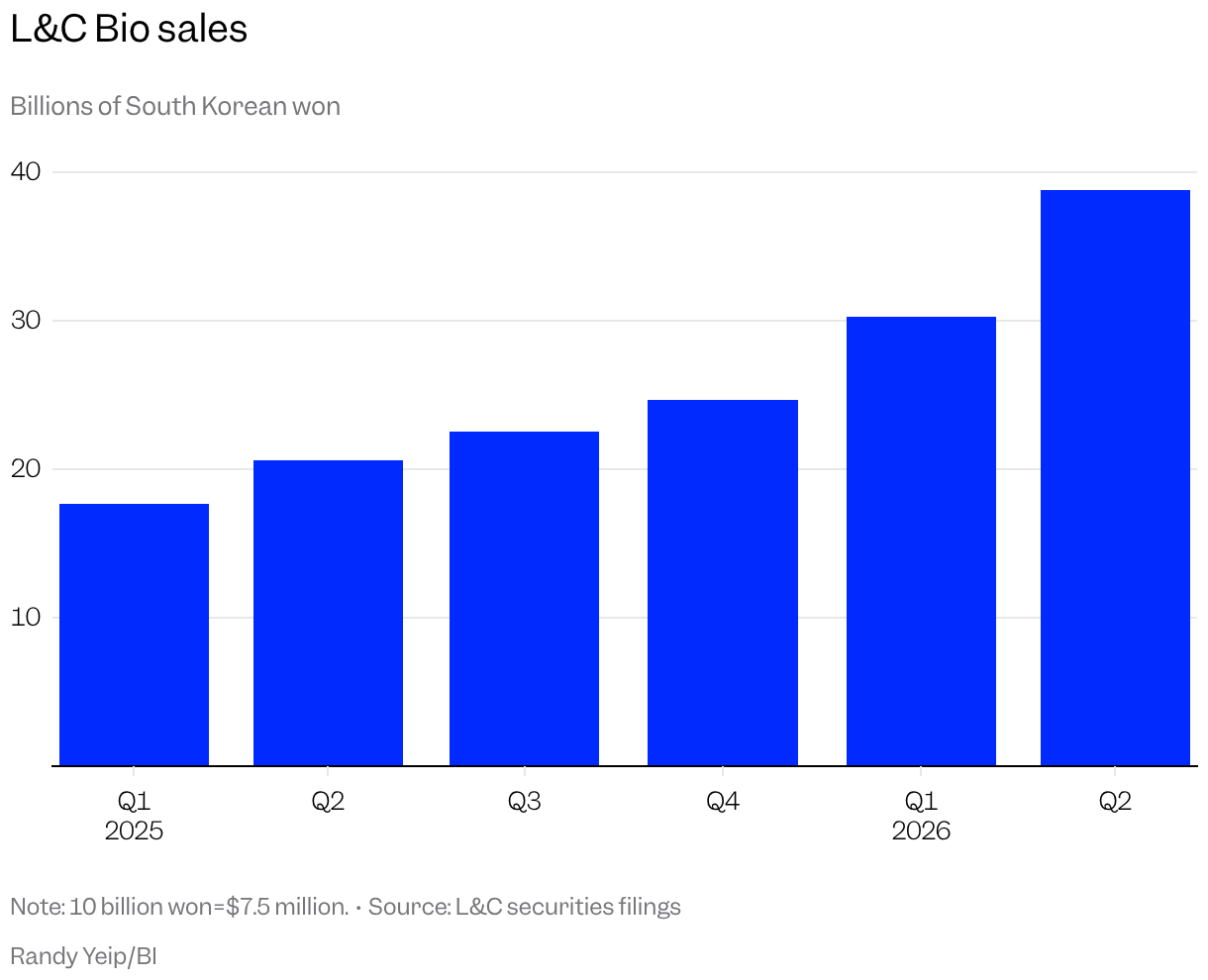
Re2O notched the equivalent of more than $17 million in sales in the first half of this year, helping swing the company to an operating profit of about $11 million after a loss of about $326,000 in the same period last year, L&C Bio said. It has expanded the product line with Re2O Fine, marketed for more delicate skin, and is planning to launch a human fat-derived filler next year.
The company said it sold 700,000 units of Re2O as of September. It is available in Singapore and China, and has been approved in the United Arab Emirates, Peru, and Thailand.
Last week, L&C Bio said that it has signed a contract to deliver at least $60 million of Re2O to the US over the next five years. The company also said it may explore acquiring US tissue banks with its US distribution partner.
L&C Bio's plan to introduce Re2O to the US could spark a regulatory showdown. L&C Bio has said Re2O falls into a category of products such as skin grafts that don't require approval from the US Food and Drug Administration.
Some products that manufacturers claim qualify to be sold under this category don't actually meet the applicable criteria, the FDA told Business Insider. The agency said it wouldn't discuss any specific products under investigation.
"Products derived from donor skin that have been decellularized, dried, and ground into a powder for injection as a cosmetic 'skin booster' may raise significant questions" and may have to go through a more complex regulatory approval process, the agency said.
L&C Bio said it wouldn't comment on its discussions with regulators.
Re2O's biggest competitor, CellREDM, came onto the South Korean market in late 2025. It has been such a success that in the quarter ended June 30, operating income for its maker, Hans Biomed, soared to over $3 million after barely eking out a profit in the year-earlier period.
The tissue business
"In the human tissue business, access to raw materials is the lifeblood of the industry," L&C Bio's founder and CEO, Whan Chul Lee, said in Korean in a February interview with a South Korean news outlet.
For his company and its competitors, that lifeblood flows from the United States.
Roughly 90% of all the human tissue used in South Korea is imported, according to South Korea's Ministry of Food and Drug Safety. Less than 4% of South Korean adults are registered to donate organs, and even fewer donate tissue. Korean biotech companies have turned primarily to the US, where well over half of adults are registered donors.
Cadaver skin is collected in the US by organ procurement organizations, known as OPOs, and tissue banks.In the transplant system, skin is treated as a tissue, not an organ.
After tissue is collected, its route can vary.A nonprofit OPO often transfers it to an American tissue bank. The tissue bank pays a fee to the OPO, depending on factors like the amount and quality of tissue recovered. The fee covers the cost of the tissue recovery as well as a margin that supports other programs offered by the OPO.
Tissue banks — which can be nonprofit or for-profit entities — supply donor skin to Korean biotech firms.
Much of the US skin supplied to South Korea is used for more traditional medical purposes, like skin grafts for burn victims. L&C Bio makes such therapeutic products and says it prioritizes supply for them.
Tens of millions of dollars' worth of donated skin has traveled over the past few years from American tissue banks to biotech companies in South Korea.
Ed Jones/AFP via Getty Images
L&C Bio spent more than $25 million on donor skin from US tissue banks between 2023 and 2025 and $3.8 million in the first half of this year, according to corporate filings. The company told Business Insider that a quarter of its skin supply is used to make Re2O.
Organ distribution is coordinated by a public-private partnership with the federal government. Tissue is handled differently. It is distributed through commercial relationships.
The more traditional business aspects of the tissue industry have been a subject of debate since the federal law governing America's organ recovery and distribution system was enacted in the 1980s. In a system that relies on altruism, money changing hands could affect public trust, Jerold Mande, who helped write the National Organ Transplant Act, told Business Insider.
There is little data on American attitudes toward tissue donation. A survey of more than 1,000 families of donors in the US published in a 2010 academic journal found less than 30% said they thought it was acceptable for donated tissues to be processed and distributed by for-profit companies.
Revenue from tissue, primarily skin and bone, drove 93% of American OPO profits between 2013 and 2017, or a total of about $107 million per year in profit at 51 OPOs, according to a study in the medical journal Transplantation. The Association of Organ Procurement Organizations called the study outdated, said the money collected for tissue helps fund other life-saving work, and objected to the study's use of the word "profit."
"Reimbursed funds go directly back into the organization, supporting organ procurement as well as aftercare programs for donor families such as bereavement support and grief counseling," said Jenny Daigle, a spokesperson for the Association of Organ Procurement Organizations. Organizations must have a margin and reserves to remain financially stable, she added.
Human tissue donations help millions of people in the US each year, including skin for burn victims, bone for cancer survivors, and eyes for the visually impaired, Daigle said.
Tens of thousands of Americans donate bodily tissue each year upon their deaths, often by checking a box at a motor vehicle department.
Patrick Sison/ AP Photo
Regenerative Biologics, a Florida tissue bank, provides all the skin for Re2O, L&C Bio confirmed to Business Insider.
Regenerative's CEO, Sandy McCann, said her tissue bank acts as an intermediary, supplying skin collected by other organizations, and provides L&C Bio only with skin from donors who have given consent for international and cosmetic use. If other American tissue banks have skin that they can't use, "many times we can place it where someone can," she said.
Regenerative had just over $16 million in annual revenue in 2024 and 2025, according to reports filed with a Florida regulator.
By reviewing South Korean government records and images of product packaging, Business Insider identified two other US tissue banks, South Texas Blood and Tissue and RTI Surgical, that supply tissue for skin-derived injectable beauty treatments made by Korean companies.
South Texas Blood & Tissue supplies skin used to make South Korea's No. 2 brand, CellREDM. The tissue bank is based in San Antonio, sometimes called "Military City, USA" because of the large military base there. Educational materials on the tissue bank's website say that donor skin "heals patients suffering from burns or other traumatic wounds, and in reconstructive surgeries, including those wounded during military service."
South Texas Blood & Tissue said each of its tissue donors helps an average of 75 recipients. International distribution and commercial use are longstanding practices in the tissue industry, the group said. Tissue donor families have the option to decline cosmetic, international, or research use, the group added.
"Our top priority is to serve as good stewards of these tissue donations, and to ensure that all tissue we recover has the greatest impact possible," it said.
RTI, a Florida tissue bank that does business as Evergen, said it transfers a small amount of unprocessed donor skin to DOF, a tissue bank in South Korea that manufactures the skin-derived injection product Juveacell. RTI added that it is"dedicated to honoring the generosity of donors and their families."
The Axel Springer Global Reporters Network harnesses the resources of the company's newsrooms to publish ambitious scoops, investigations, interviews, opinion pieces and analysis. It allows journalists — including those from POLITICO, Business Insider, The Telegraph, WELT, BILD, Onet and Fakt — to collaborate on major stories for an international audience of hundreds of millions across platforms: online, print, TV and audio.
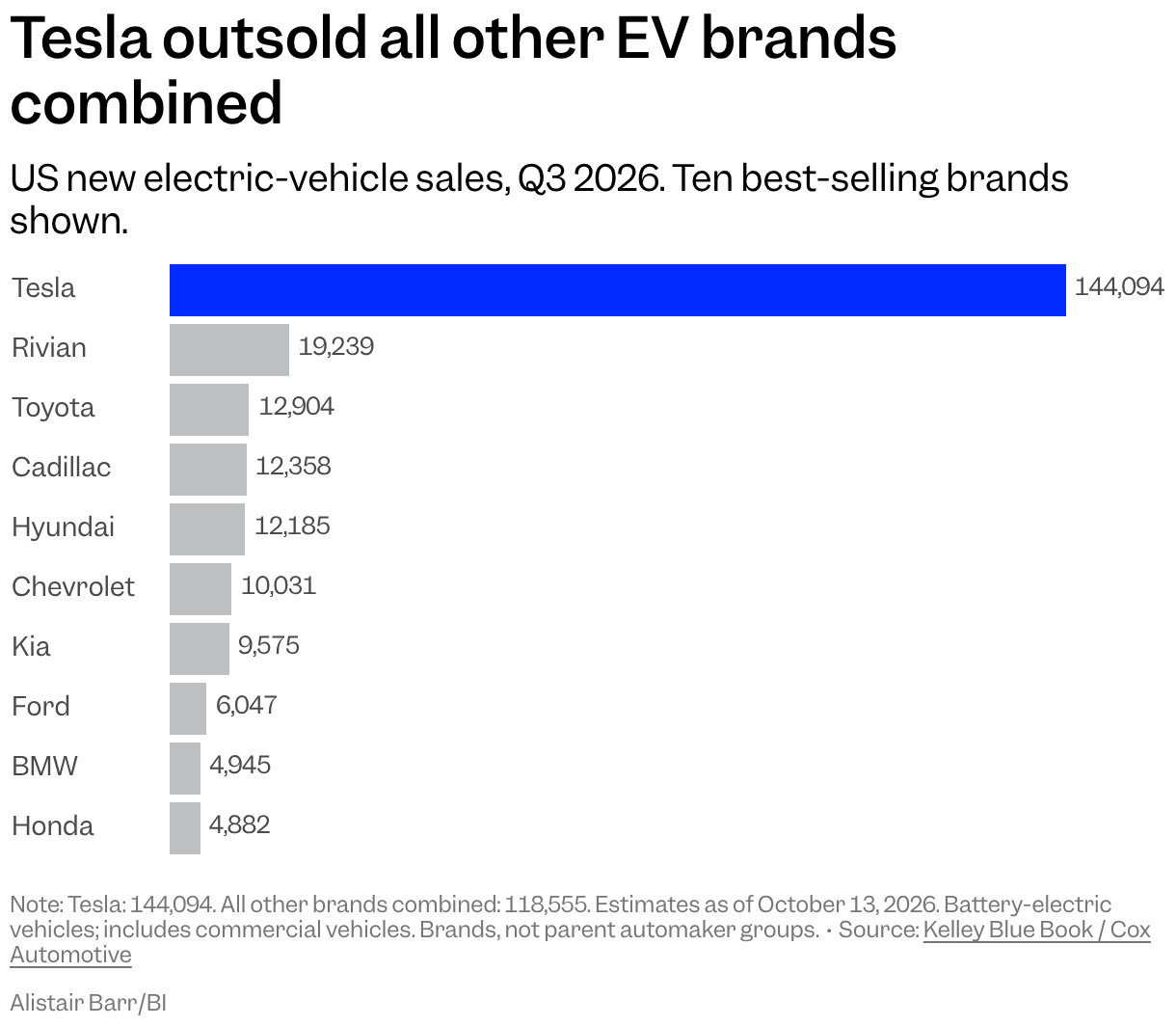
Tesla accounted for more than half of US electric-vehicle sales in the third quarter.
Its quarterly sales increase exceeded the entire market's gain, Cox estimates show.
High gas prices are helping EVs compete, though sales remain below last year's levels.
Tesla is taking a bigger slice of America's electric-vehicle market as high gas prices give drivers another reason to consider ditching the pump.
The company sold an estimated 144,094 vehicles in the US in the third quarter, up from 124,800 in the previous three months, according to Cox Automotive's latest sales report.
That increase was bigger than the gain for the rest of the US EV market. Put another way: Tesla drove the recovery. Everyone else, taken together, went backward.
The figures offer a new twist on the EV comeback I wrote about in July. Back then, sales had finally improved after the slump that followed the end of federal incentives in the US. Several manufacturers were benefiting, but only those withthe fortitude to stick with EVs after federal government support waned.
While recovery continued in the third quarter, it became more dependent on Tesla.
Americans bought 262,649 new EVs during the period, about 6% more than in the second quarter. Sales outside Tesla fell roughly 3%, based on a comparison of Cox's latest counts with its second-quarter report.
Tesla's own sales rose about 15% from the second quarter. It supplied 54% of the country's new EVs in the third quarter, extending its lead from the previous period.
High gas prices help make the case for going electric, according to Cox.
"With gas prices well above $4 a gallon, electric vehicles look better than ever," Stephanie Valdez Streaty, Cox's director of Industry Insights, said in the company's analysis of the quarter.
Expensive gasoline and diesel make running a conventional vehicle more painful. For drivers who can charge cheaply, particularly at home, an EV offers a valuable alternative to repeated trips to the pump.
There's an important caveat to the comeback story: Sales are improving from a depressed level.
Total US EV sales were down almost 40% from a year earlier. Last year's third quarter was unusually strong because buyers rushed to claim federal incentives before they disappeared.
Tesla's sales were down about 20% against that comparison. The company remains heavily dependent on two vehicles. The Model Y and Model 3 accounted for roughly 97% of its US sales in the latest quarter.
The Cybertruck sold over 4,300 units, and Tesla has stopped making the Model S and X. (There's a Roadster, though not until 2028).
So Tesla's growing dominance isn't a story of every model flying out of showrooms, or of selling more cars than a year ago.
For now, it is winning a larger share of a smaller market. As Americans return to EV shopping, Tesla is capturing more of their business.
For decades, hardware was a hard sell in Silicon Valley. Now investors are pouring tens of billions into machines that can do things in the real world.
A Goldilocks set of conditions has made robotics one of tech's hottest bets. As investors look beyond chatbots to the next frontier in AI, cheaper hardware, smarter AI models, labor shortages, and competition with China are fueling interest in machines capable of performing physical work.
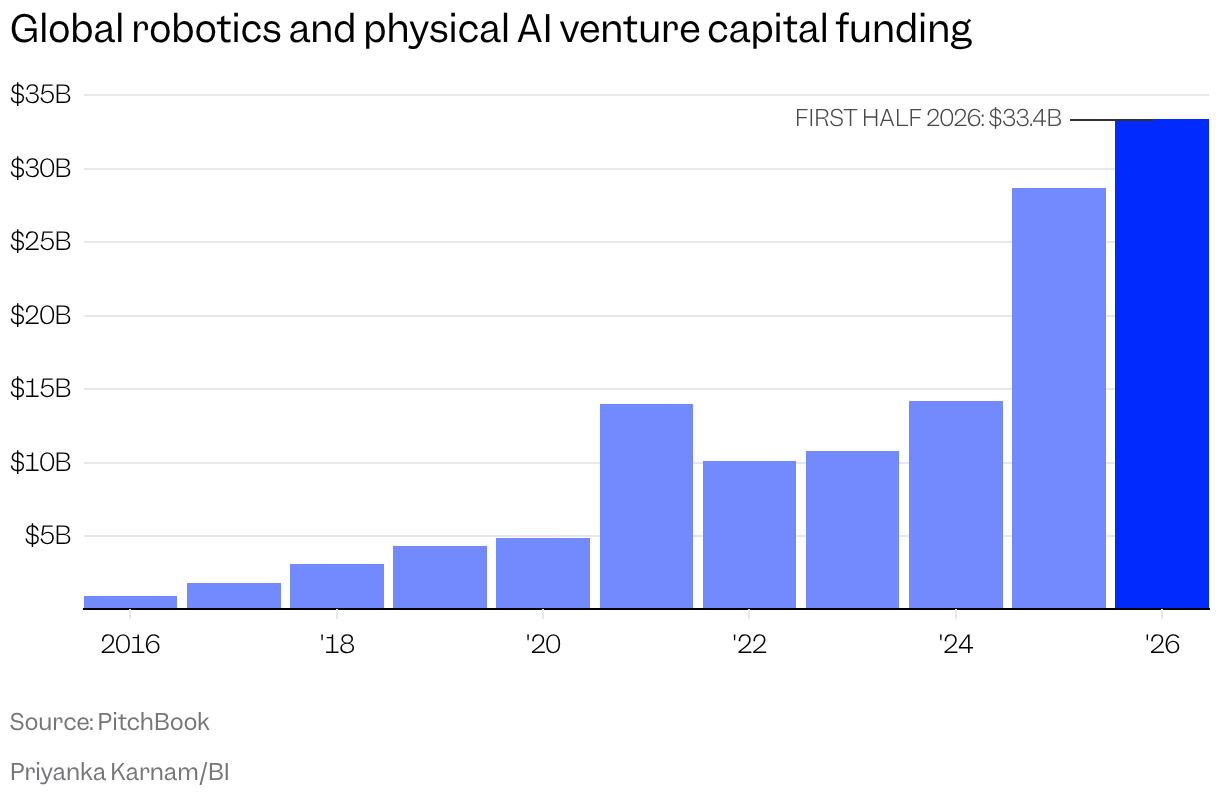
Robotics and physical AI companies raised $33.4 billion globally in the first half of this year alone, according to PitchBook data. That's already more than the $28.7 billion the sector raised in all of last year — and an astronomical rise from 2020, when funding came in at just under $5 billion.
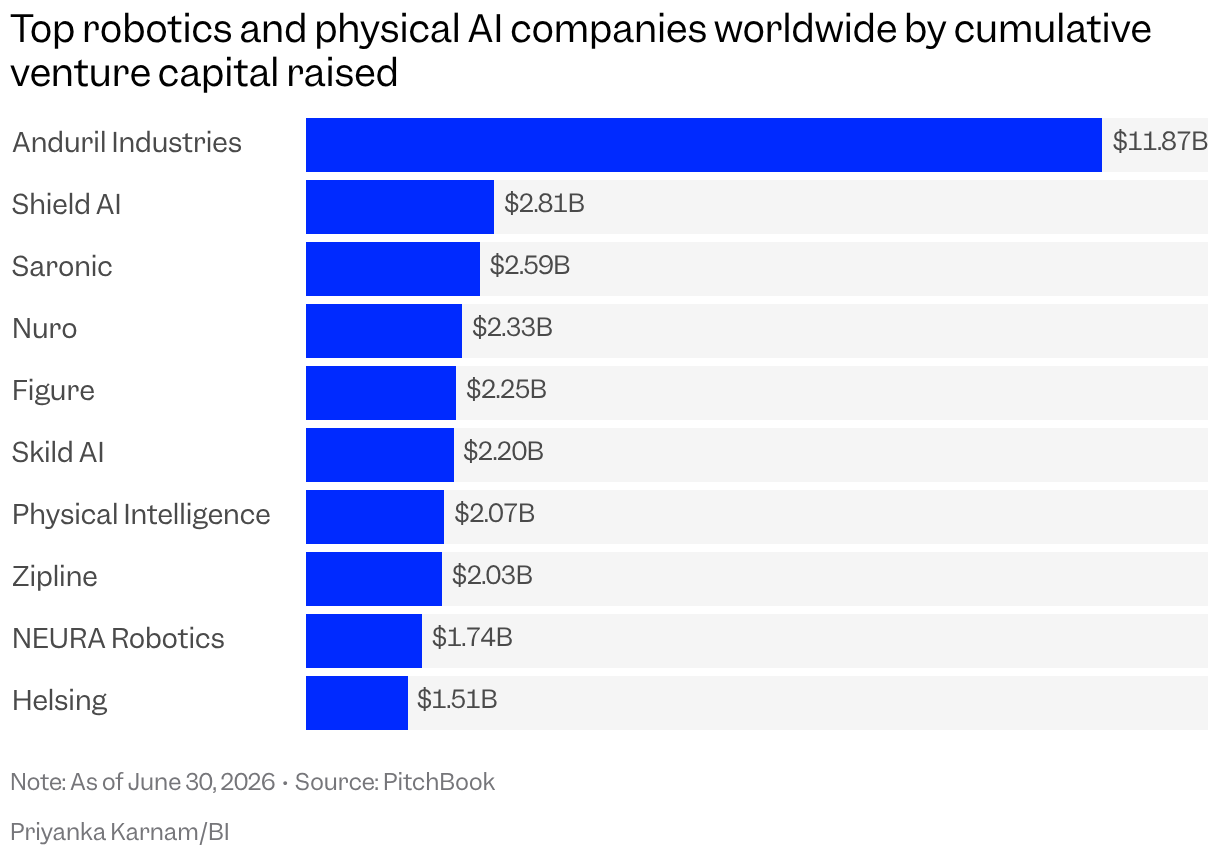
Investors are writing billion-dollar checks to fund both the machines and the AI brains behind them. Defense company Anduril raised $5 billion in May, co-led by Thrive Capital and Andreessen Horowitz. Autonomous shipbuilder Saronic raised $1.75 billion in March in a round led by Kleiner Perkins. Skild AI, which builds software to control different kinds of robots, raised $1.4 billion in January in a round led by SoftBank. Physical Intelligence, which is also building an AI model to command robots, raised about $1 billion in May, co-led by Leopold Aschenbrenner's Situational Awareness and Lux Capital.
"This is off the charts," Ken Goldberg, a UC Berkeley robotics professor and cofounder of warehouse robotics startup Ambi Robotics, told Business Insider. "In my 45 years in this field, this is the most funding and energy and interest in robotics that I've ever seen."
This is the first installment of Robonomics, Business Insider's new series on the rise of robots and their impact on business, jobs, and everyday life. We'll go inside factories and warehouses where humans work alongside robots, meet the founders, investors, and workers driving the boom, and examine how the technology is reshaping industries from manufacturing to defense. We'll also ask how close robots are to becoming part of everyday life, and what is still standing in their way.
The prize is enormous. Unlike software, which is largely confined to work done on screens, robotics companies are going after physical labor, from factories and construction sites to robot butlers in every home. Nvidia CEO Jensen Huang, who popularized the term "physical AI," has described robotics as the "technology industry's first opportunity to address a $50 trillion industry that has largely been void of technology until now." Many Nvidia veterans have launched their own robotics startups.
Nvidia CEO Jensen Huang
Bloomberg/Bloomberg via Getty Images
But investors are pricing companies as though the robot revolution has already arrived. Startups still in research and development command multibillion-dollar valuations, often with little revenue and few deployments to show for it. Humanoid maker Figure AI, for example, secured a $39 billion valuation last year, even as its deployments remain limited to small factory pilots.
"Robotics is going to happen, and a lot of money will still be lost," said Sarah Guo, founder of the venture firm Conviction, which is an investor in robotics startups Sunday Robotics and Watney. "Both things are true."
From not to hot
From industrial arms assembling electronics to Roombas cleaning floors, robots have long been part of everyday life.
What venture investors struggled to see was how to make money from them. Building robots required expensive hardware, factories, and supply chains, often to produce machines that could perform just one narrow task. Why fund that when you could back a college dropout building the next viral app?
Guo used to tell fellow investors that robotics was a good way to lose a lot of money over many years. "The models didn't work," she said. "Every robot was a brittle, single-purpose system hand-built for one task."
Ajay Agarwal, a partner at Bain Capital Ventures, was among the few investors willing to bet on robotics during the internet era. In 2004, he backed Kiva Systems, which pioneered warehouse automation with fleets of mobile robots that brought products directly to human workers.
A Kiva Systems robot moves a shelf to fill orders at an Amazon fulfillment center
Bloomberg/ Getty Images
Bain led every successive funding round because Kiva was "not able to raise money on Sand Hill Road," Agarwal told Business Insider. By the time Amazon bought it for $775 million in 2012, Bain was its only institutional investor.
More than two decades later, AI has changed the calculation. Advances in machine learning are helping robots perceive their surroundings, make decisions, and adapt to new tasks, raising hopes that companies can build more versatile machines instead of engineering a different robot for every job. Cheaper computing and hardware are also making the economics more attractive.
Some of Silicon Valley's biggest names are now chasing that vision. Former Uber CEO Travis Kalanick's Atoms raised $1.7 billion in July to pursue automation in food, mining, and transportation. Rivian CEO RJ Scaringe's Mind Robotics has raised $900 million this year, while former Cruise CEO Kyle Vogt's home robotics startup, The Bot Company, has raised at least $300 million.
Some venture firms are setting aside dedicated capital for robotics. In August, Andreessen Horowitz raised $1.1 billion for "Machine Age," its first fund focused on the physical infrastructure behind AI, including robotics.
The gold rush
For longtime robotics investors, alarm bells are ringing. Industry veterans whisper about "hardware tourists" piling into robotics deals — investors drawn by AI hype who underestimate how difficult it is to build machines that work reliably in the real world. There is precedent for caution. Venture firms poured billions into autonomous vehicles in the 2010s, only to see startups fold or consolidate as self-driving technology proved harder and more expensive to commercialize than expected. Years later, only a handful of deep-pocketed players have managed to bring robotaxis to the public.
Robotics faces its own formidable obstacles. Unlike large language models trained on vast amounts of internet text and images, robots lack a comparable trove of data showing them how to act in the physical world. Dozens of startups are now scrambling to collect it, but nobody knows how much will be enough. And even smarter AI won't eliminate the challenges of manufacturing, maintaining, and deploying expensive hardware.
"The most difficult part of physical AI is the physical part," said Charly Mwangi, a partner at VC firm Eclipse who has backed The Bot Company and robotics startup Genesis AI. "The next few years are going to be really, really hard for the robotics industry as companies go from the lab to deployments."
Some of the most speculative robotics bets are attracting the biggest checks. Humanoids and general-purpose robot models were the two fastest-growing areas of robotics investment last year, according to venture firm F-Prime. "You cannot raise money on demos forever," said Sanjay Aggarwal, an F-Prime partner and coauthor of the firm's annual robotics report. "I would personally be surprised if all these companies independently exist two or three years from now."
There are signs that some startups are becoming real businesses. Field AI, which is building an AI "brain" that works across robots, has crossed $100 million in revenue and customer contracts from more than 30 customers, including construction firms, data center operators, and defense companies, Business Insider previously reported. Skild AI said last month that it had reached $100 million in annual recurring revenue from more than 60 customers. Its projects include robots assembling Nvidia's Blackwell chips with Foxconn and kitchen pilots with Mitsui, a Japanese conglomerate.
An Nvidia GB200 Blackwell GPU
Bloomberg/ Getty Images
Believers see robotics on the cusp of a breakthrough that could put machines to work in nearly every corner of the economy. Brad Porter, the former head of Amazon Robotics who now runs workplace robotics startup Cobot, says the field could be nine to 18 months away from major advances in dexterous manipulation — the ability of robots to handle objects with the ease of human hands.
"When I think of a 'ChatGPT moment' for robotics, it is cracking dexterous manipulation," Porter said. "Then there will be a Cambrian explosion of robots."
The question is whether these breakthroughs will arrive quickly enough to justify the money pouring in.
At Business Insider's Growth Mode event this month, Menlo Ventures partner Matt Murphy singled out robotics among the fields attracting enormous amounts of financing "before they're really showing traction." Abundant funding, he warned, can make startups "sloppy."
For investors, he said, that means "a lot more opportunity to have a really big crater."
Have a tip? Contact Rya Jetha via email at rjetha@businessinsider.com or Signal at rjetha.07. Use a personal email address and a nonwork device; here's our guide to sharing information securely.
"We do need better execution in the US," co-CEO Ted Sarandos said on the company's Q3 earnings call on Tuesday.
Netflix's global content — including Latin America, Europe, the Middle East, Africa, and Asia — "is largely working," Sarandos told investors.
"The US is also working. It's just not growing as fast as it could, or as fast as we'd like," Sarandos said.
Netflix's biggest market is the US and Canada, which made up about 44% of its revenue this quarter at $5.6 billion. Next are Europe and the Middle East, followed by Latin America and the Asia-Pacific region.
Sarandos said the US "had some really solid doubles and triples this year" but added that "the other territories count on some of those titles being home runs, so that they'll travel around the world."
Netflix announced last week that it will be replacing content chief Bela Bajaria, who had overseen the streamer's movies and shows since 2023, with former Disney and Fox executive Peter Rice.
The streaming giant is also moving on from film chief Dan Lin. Rice will oversee Netflix's movies until the company fills his role.
Co-CEO Greg Peters said on the earnings call that Netflix's goal is to take its content slate "from very good to great."
Besides subbing out content execs, Netflix also cut roughly 1,000 workers in what was its biggest round of staff reductions since 2022.
Netflix shares entered Tuesday's earnings report down about 44% in the last 12 months. The stock fell 6% in after-hours trading following the company's report, which showed a third consecutive quarter of slowing revenue growth.
The company is seeking to raise a new round of funding at a valuation between $30 billion and $40 billion.
Fireworks AI was last valued at nearly $18 billion in July of this year.
Fireworks AI is seeking to raise fresh funding at a valuation between $30 billion and $40 billion, a dramatic jump just months after the AI-infrastructure startup was valued at $17.5 billion, according to people familiar with the matter.
The potential valuation leap reflects investors' appetite for the companies selling the computing power and tools fueling the AI boom, even as Fireworks AI works through the fallout from a recent security incident.
The talks around the financing are still early, and valuation targets could still change. Fireworks declined to comment.
Founded in 2022, Fireworks was built by veterans of Meta and Google's AI efforts. Chief executive Lin Qiao previously led the PyTorch team at Meta, while cofounders include former Meta infrastructure engineers and a former leader of Google's Vertex AI. The company rents out computing infrastructure and software that lets businesses run, fine-tune, and deploy open-weight and custom AI models.
In July, Fireworks announced a $1.5 billion Series D funding round at a $17.5 billion valuation, led by Atreides Management, Index Ventures, and TCV, with participation from Nvidia, Lightspeed Venture Partners, Bessemer Venture Partners, and Menlo Ventures. That round followed a $250 million Series C at a $4 billion valuation in late 2025, co-led by Lightspeed, Index, and Evantic. Last month, The Information reported that Fireworks has been considering a round at a $30 billion.
Rather than trying to build a consumer chatbot to rival ChatGPT, Fireworks sells what it calls specialized intelligence: models customized on a customer's proprietary data, workflows, and use cases. The company said in July that it had surpassed $1 billion in annualized revenue and was serving more than 40 trillion tokens a day; it said 95% of those tokens came from models tailored to customers.
The company operates in a highly competitive layer of the AI stack. Rivals include model-infrastructure startups such as Together AI, Baseten, and Replicate, as well as cloud giants such as Amazon Web Services, Google Cloud, Microsoft Azure, and Oracle.
The fundraising talks come shortly after a security incident at Fireworks AI. The company said it identified unauthorized use of internal credentials earlier this month that allowed an intruder to access data from some customer accounts.
"We take this seriously and will be transparent about what happened and what we find," Qiao posted on X. "I'm personally committed to turn this attack into the most formidable security response in AI Infra."
Please send along your tips. Email Ben or Katie anytime or contact them on Signal at benbergman.11 and kroof.26. Sign up for Business Insider's weekly VC Insider newsletter here.

 Login