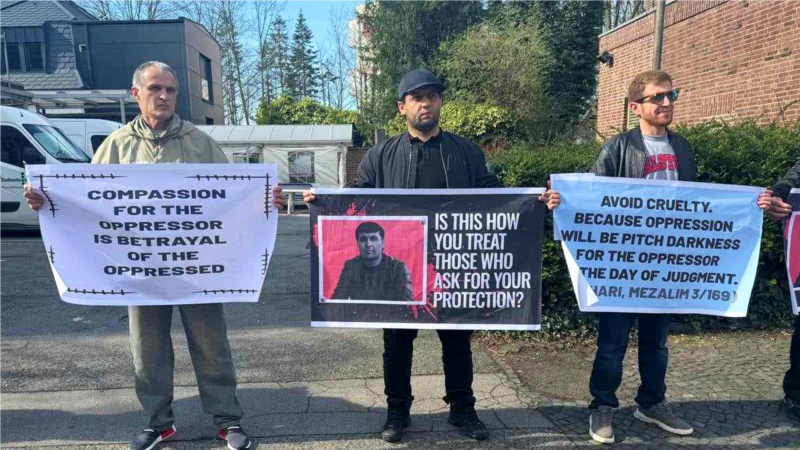
The deportation of several Tajik opposition figures from Germany and other European countries, and their subsequent imprisonment, have heightened fears among Tajik oppositionists in exile. Some say they fear not only being sent home but also losing the Western support they once counted on.
Screenwriter Diana Reid, costume designer Grace Snell, cinematographer Arnaud Potier and production designer Francesca Di Mottola explain how they made the Dashwood sisters’ world grounded, moody and lived-in.
Danny Trejo’s son has claimed his 82-year-old father had no idea who conservative commentator Ben Shapiro was before he agreed to star in The Daily Wire’s upcoming Minneapolis movie. The same may or may not be true for fellow Hollywood stars including James Franco, Rob Lowe and Jonathan Majors, writes Kevin E G Perry
As the Bristol studio behind 'Wallace & Gromit' and 'Shaun the Sheep' turns 50, employee-owned Aardman is betting that handmade animation, flexible partnerships and a Halloween-ready third Shaun feature can sustain its independence.
Sacha Baron Cohen’s comedy creation is back, in a film that sends his postering would-be gangster out into the world of real people, ‘Borat’-style. It’s almost excruciatingly unfunny, writes Louis Chilton. But one stunt might just make the whole thing worth seeing
Sacha Baron Cohen’s comedy creation is back, in a film that sends his postering would-be gangster out into the world of real people, ‘Borat’-style. It’s almost excruciatingly unfunny, writes Louis Chilton. But one stunt might just make the whole thing worth seeing
A Business Insider reporter's phone photos from a hike in Arizona show how to use a National Geographic photographer's tips.
Joey Hadden/Business Insider
In the age of camera phones, anyone can be a photographer.
You don't need fancy gear or multiple lenses to take good pictures.
I asked a National Geographic photographer how to make the most of the camera in your pocket.
Getting a degree in photography gave me the chance to work with all kinds of complex cameras, like the ones you see in old movies, where the operator puts a cloak over their head.
By the time I graduated, I was more comfortable with DSLRs and film cameras than the one in my pocket.
As a travel reporter, my work revolves around documenting the places I'm visiting. For some of that imagery, I've come to rely on my smallest, most nimble camera — my phone. So, in April 2022, I set out to improve my phone-photography skills.
And just like in school, I wanted to learn from a pro.
The magazine first published Yüyan's work in 2018, showcasing whale hunters in Alaska, he told Business Insider. Then, in 2023, National Geographic granted Yüyan the Eliza Scidmore Award for outstanding storytelling for his portfolio work, which included his July 2022 cover shot for a story documenting the lives of Indigenous people.
Yüyan said that nowadays, people are "drowning in photographs," but that doesn't mean yours have to look like everyone else's. There are ways to make your images stand out — even if you're just shooting on your phone.
Phone camera tips from a National Geographic photographer made my images feel more powerful.
Photos from the author's camera roll show phone photos from Cabo San Lucas, Mexico, in 2022.
Joey Hadden/Business Insider
When Yüyan and I chatted about taking standout photos on a phone, he talked about uncommon angles, proximity to the subject, interesting foregrounds, and time spent shooting.
Here are his best tips for creating powerful pictures with a phone, along with examples of their success from my own camera roll.
For the best lighting, backgrounds, and immersive shots, Yüyan told me to take my time and shoot a lot. He was right.
iPhone snapshots from around the US where the author waited for optimal light and striking backgrounds.
Joey Hadden/Business Insider
"The real secret of professional photographers is we shoot a lot and then edit it down to just one or two," Yüyan said. "You should do the same with your phone."
According to Yüyan, spending a long time in one location allows you to find optimal lighting and interesting backdrops. Truly immerse yourself in the environment to notice things that didn't stand out to you at first.
In the photos above, I spent between one and five hours at each location. I was able to take pictures with light I found inspiring, including a rainbow, the sun beaming through the trees, and a shot of a red-hued moon dimmed behind a cloud on a rooftop in Brooklyn, New York.
"Good photographs come from deep observation, and the muses reward those who slow down, stop running from place to place, and immerse themselves in the specific place and moment," Yüyan said.
So, stick around in one location, take tons of pictures, and "make room for life to unfold in front of your lens," he told Business Insider.
Next, Yüyan said to take advantage of your phone's small size by shooting from angles we don't see every day.
The author photographs her dog from different angles in New York.
Joey Hadden/Business Insider
To find the perfect angle, Yüyan said to start by considering how shooting with a lightweight, thin object can open up the realm of possibilities.
"It becomes a habit to use the phone at just eye level, but if you watch someone who is good at selfies, you can see they are always moving the phone around — up, down, and around to try better angles," he said. "The same applies to making any other kind of photo."
This was an important point I'd never thought about before, but it left me wondering how to tell which angle makes the strongest shot.
"One good criterion is seeing how much depth an angle will show in a photograph," Yüyan said.
For example, he said, if your subject is a child, pointing the camera down at the kid will typically result in a flat, boring image. It's the angle we're used to seeing, where the background is likely the floor. But shooting from beneath the child's eye level, looking up, can show the layers of the person and whatever is above them.
"We rarely get down below a child's height to look up at the world, and that perspective can be magical," Yüyan said.
Yüyan's example reminded me of how I photographed a small dog at parks around New York. When I took pictures of her from above or straight on, I couldn't get a sense of her expression or personality.
But when I got below her and snapped the picture while aiming up, I could see her exploratory nature and how she uses her environment to feel bigger, like perching on a rock at the edge of a creek.
I've found that shooting from beneath widely photographed landmarks makes my pictures look more original.
The author photographs the Christmas tree at Rockefeller Center in NYC in 2019, left, and 2021, right.
Joey Hadden/Business Insider
Yüyan's tip of experimenting with angles that add depth reminded me of another subject I've shot on my phone — the iconic Rockefeller Center Christmas tree in NYC.
The first time I photographed the famous tree, I shot from eye level. When I looked at my photo, I felt like I'd seen it many times before.
When I returned to try a lower angle beneath some foliage, I thought I ended up with a more distinctive image. I could now see layers of smaller plants in front of the tree and the tops of the buildings surrounding it, giving me a better sense of its scale, which had been missing.
Yüyan told me that I can make natural landscapes stand out more by placing something in the foreground.
Joey Hadden/Business Insider
Yüyan said it's hard to take standout pictures of stunning natural landscapes because they've been photographed so much. His best advice is to find a good foreground subject to set your image apart from the rest.
"Great backgrounds, such as mountains or waterfalls, are easy to find because we're always looking for them," Yüyan said. "On the other hand, a good foreground subject, such as blooming wildflowers or a craggy tree, can be much harder to find in the right location."
Yüyan recommended searching for a foreground subject and framing your shot so you can see the scenery in the distance.
"It'll give your images depth, intimacy, and make your photos unique," he said.
His tip reminded me of when I photographed a beach across the street from the mountains in Santa Cruz, California. I started by photographing the beach from the shore. The mountains looked nice, but there was so much sand that I thought the bottom half of my image looked boring.
So, I took my phone across some ocean rocks and into the tide pools. The rocks and reflecting water spruced up my foreground, adding layers to my image. To me, this made it feel more dynamic.
Including foreground subjects in my nature shots has made them feel more immersive.
The author photographs Prescott, Arizona, in 2022.
Joey Hadden/Business Insider
Yüyan's foreground tip reminded me of some photos I also took during a hike in Prescott, Arizona.
When I first arrived at the Watson Lake parking lot for my hike, I was entranced by rock formations I hadn't seen before. But my photographs from the lot didn't seem to do it justice.
Once I started hiking and immersing myself in the landscape, I found foreground subjects, such as shrubs, that better framed the lake scene.
I thought having these elements in the second image gave a better sense of what it was really like to be there, with more layers of the environment in frame.
Yüyan's last tip suggested camera phones work best up close.
The author photographs a tree outside of Venice, Italy.
Joey Hadden/Business Insider
According to Yüyan, intimate photos of your subject are often more powerful because the viewer can feel how close you are to them.
That's why he suggested that when you're shooting with a phone, you should make it feel like you are standing right next to something for "a more human and intimate feeling."
But don't just use the camera's zoom function. Yüyan suggests standing face-to-face with your subject to "really get in close on what's happening."
This tip reminded me of photographing a 250-year-old Lebanon cedar tree on the grounds of Castello di Roncade outside Venice, Italy.
As soon as I saw the tree, I snapped a photo because it was alluring. But like my shot of Santa Cruz from the shore, I thought the bottom half of my photo was a bland waste of space. And like my shot of Watson Lake from the parking lot in Prescott, I didn't find my image nearly as impressive as the real thing.
As I walked closer, I realized the tree was even more breathtaking. In my second photograph, I stood right in front of the tree, capturing the details of its spewing branches and surrounding greenery.
My goal was to make the photo all about the tree, and I think I accomplished this in my second image because every inch of the frame showed its details.
I find that the results often show a more intimate view of my experience, like when I bought fresh pasta in Italy.
The author photographs fresh pasta in Italy in 2022.
Joey Hadden/Business Insider
Yüyan's advice to shoot up close with phones also reminded me of another experience I had in Italy.
When I went inside a fresh pasta shop in Vatican City, I was fascinated by the shaped dough on display. Their smooth texture and specks of flour that kept them fresh made me salivate, and I wanted to capture that feeling in a photograph.
My first picture of the display case expressed none of this. While I could see a large chunk of the counter, this image was supposed to be about the pasta, and I could hardly capture its texture from this distance.
So, for my second image, I got right up next to the glass and snapped a shot of the case with the widest variety of pasta shapes. I lit up as I peeked at the image because it elicited the exact feeling I was hoping for when I made it — a strong craving to taste the pasta, thanks to a front-row view detailing its shapes and textures.
Yüyan's tips left me feeling inspired, and I can't wait to apply them to my future travels.
Joey Hadden/Business Insider
After getting these tips from Yüyan, I was pleased to find that some images in my camera roll supported them.
Now that I've identified what makes some of these pictures stronger than others, I'll go on my next trip feeling more inspired to shoot from my phone.
A week after publishing memoir 'Sitcom,' the comedy writer reveals hopes for Warner Bros' new ownership and skirts the 'Roseanne' writing credit debate by saying all were better for working there — even if "it might have crushed their soul in the process."
Business Insider's reporter traveled to Salt Lake City and Park City, Utah, during the peak winter season.
Joey Hadden/Business Insider
Visiting Utah in the winter isn't for everyone.
I learned that the hard way in January 2025.
My first mistake led to the rest.
Gazing out my window at the snowcapped mountains on the train to Utah, I had no idea that I'd already set myself up for regret. Some mistakes were set in motion before I'd even left my apartment.
I spent three days exploring Utah's pocket of luxury amid ski season and left with four regrets.
My first mistake was booking my trip in the peak winter season as a non-skier.
Joey Hadden/Business Insider
As a first-time visitor to Salt Lake City and Park City, I thought seeing the mountains blanketed in snow would be awe-inspiring — and it really was.
I knew winter would be a popular time to visit Utah since it's a ski hub, but I underestimated how busy it would be. Park City was packed with winter sports enthusiasts.
Skiers and snowboarders crowded the sidewalks lining congested streets in downtown Park City, all suited up — some with gear in tow.
I stopped by the slopes at Deer Valley Resort and spotted long lines of skiers waiting for lifts. I waited in line to ride a funicular up and down the mountain.
Maybe seeing the snow was worth the crowds — I won't know for sure until I visit during another season. But had I realized I'd be visiting during the busiest time of year, I would have pushed my trip to the spring, during the shoulder season.
I didn't pack enough clothing.
The author enjoys Downtown Salt Lake City.
Joey Hadden/Business Insider
Overpacking is a rookie mistake when traveling, so I go to great lengths to avoid stuffing too many outfits into my bag. But this time, I overcorrected.
When packing for a trip that's less than a week long, I typically only bring layers I can wear all at once when needed or mix and match. Since I was traveling in winter, I brought a couple of extra shirts, one additional pair of pants, and zero extra outer layers.
But in January along Utah's Wasatch Front, when temperatures ranged from 24 to 44 degrees Fahrenheit, I needed to wear most of my layers daily.
After bundling up for a flight and a train ride, I felt desperate for fresh layers when I arrived in Salt Lake City.
Doing laundry at the hotel was another mistake.
Joey Hadden/Business Insider
What do you do when you need clean clothes on the road? Utilizing the hotel's laundry services seemed the most straightforward solution, but I regretted it.
That night, I stayed at the five-star Grand America Hotel, where laundry services were top-tier. My shirts and sweaters were returned to me on hangers, each in an individual hotel-branded bag. Smaller items were wrapped in paper in a cardboard box.
I felt like I was opening a present as I sorted through my clean clothes. It excited me — until I saw the receipt.
I paid $115 for three shirts, two pairs of pants, one hoodie, six undergarments, and one two-piece blazer. It was certainly the most luxurious laundry service I'd ever experienced, but for the same money, I could have bought a whole new outfit — and what a great excuse it would have been to treat myself.
I should have made time for winter activities aside from skiing and snowboarding.
GEORGE FREY/AFP via Getty Images
I didn't consider other winter activities I could have enjoyed besides skiing and snowboarding.
I wish I'd taken time to tour Utah Olympic Park in the snow and get a feel for what it was like during the 2002 Winter Olympics.
After my trip, I learned that Park City offers mountain-top snowshoe yoga classes, which I would have loved to try.
Next time I travel to the Silicon Slopes, I'll pack enough clothing and make use of the season's offerings.
The awkward comedian’s performance on ‘The Celebrity Traitors’ has turned him into the internet’s boyfriend. His time in the spotlight, writes Isobel Lewis, has come after years of clever, disorientating stand-up that often leaves his fans wondering about who the man underneath the jokes truly is
The awkward comedian’s performance on ‘The Celebrity Traitors’ has turned him into the internet’s boyfriend. His time in the spotlight, writes Isobel Lewis, has come after years of clever, disorientating stand-up that often leaves his fans wondering about who the man underneath the jokes truly is
In 2022, Ukraine relied almost entirely on Chinese components for its military drones. While that dependency has now been drastically reduced, Ukraine still relies on Beijing for essential parts that remain difficult to replace at the necessary scale and cost.
As Hyderabad’s restaurant scene grows, signature dishes and bestselling drinks are turning up on rival menus. Is it inspiration, imitation or simply good business?

 Login