Cyprus business leaders have warned that geopolitical instability, rising borrowing costs and the rapid development of artificial intelligence (AI) are forcing companies to rethink their strategies, with investment in technology, workforce skills and resilience emerging as key priorities for 2027.
Speaking at a chief executives’ panel discussion at the Limassol Economic Forum 2026, senior executives from banking, consulting, law and property said businesses must prepare for risks that cannot always be predicted using historical data, while ensuring they do not sacrifice long-term competitiveness in pursuit of immediate results.
The discussion, titled “Leading Through Uncertainty: How CEOs Are Preparing for the World of 2027”, examined how geopolitical tensions, economic shifts, the energy transition and technological disruption are influencing corporate decision-making.
The panel was moderated by Emilia Papadopoulos, a presenter and broadcast journalist, and featured Demetris Demetriou, chief risk officer at the Bank of Cyprus, Pieris Markou, chief executive of Deloitte Cyprus, Elias Neocleous, managing partner at Elias Neocleous & Co LLC, and Constantinos Savvides, chief executive of bbf:.
Demetriou highlighted the increased cost of borrowing, linking it to higher government debt, instability and the need to fund defence spending, while pointing out that governments and businesses were competing for capital with the AI industry, which is seeking to raise trillions of dollars over the coming years.
He questioned whether the promised technological advances would materialise on the scale anticipated, saying the outcome remained uncertain.
If the promise of technological progress is fulfilled, economic growth should remain positive and interest rates should return to more normal levels, he said.
Neocleous stressed that businesses are increasingly interconnected and share risks across borders, meaning companies must understand not only their own vulnerabilities but also those affecting their partners, clients and the wider international environment.
He said his law firm faced substantial additional costs for cybersecurity insurance when seeking to provide services to international businesses, illustrating how security risks could directly affect commercial operations.
Security, predictability and stability remained essential foundations for business, he said, but Cyprus also needed to continue investing in strong institutions and the rule of law.
Markou argued that businesses across Europe, the Middle East and Africa (EMEA) needed to work together to make substantial investments in technology, warning that countries acting separately risked falling behind.
Technology was expected to improve efficiency and reduce the need for additional staff, while giving companies access to capabilities that had previously been available mainly to larger or better-resourced players.
The market had become more level as new competitors gained access to technological tools, he said, but businesses needed to approach adoption carefully, guard against cyber risks and invest in upskilling their employees.
Rather than simply reducing staffing requirements, companies should help workers develop their abilities and spend more time on meaningful, higher-value tasks, he added.
Savvides said the property market was not immune to geopolitical turbulence, although Cyprus had continued to benefit from strong domestic market conditions.
He said the local housing market had almost doubled over the past five years, with activity standing €3 billion above its pre-Covid peak, reflecting a high level of business confidence.
Lead generation remained strong and appeared to be growing further, he said, although the uncertain outlook meant companies could not afford to assume that the momentum would continue indefinitely.
Businesses therefore needed to remain cautious, calculate their decisions carefully and use data to manage exposure and risk.
Asked to identify the single biggest strategic risk facing his organisation, Demetriou replied, “I wish it was just one.”
He pointed to the international race for AI supremacy, in which countries were competing to establish technological dominance, warning that unchecked development could create new dangers or allow malicious actors to exploit the technology.
The challenge was to harness AI to promote innovation, safety and efficiency, he said, with the hope that society would emerge from the current period in a better position.
Neocleous referred to an EY survey of chief executives, saying more than half of respondents identified geopolitics among their main concerns, alongside AI and technological disruption.
However, he considered complacency and the failure to challenge established business models to be the greatest risks facing individual companies.
Founders and chief executives needed to ask themselves how they would build a new company today if they had access to the tools currently available, he said.
That required adopting the right technologies while investing in corporate culture and human capital, he added, warning that businesses would struggle to succeed if they neglected either.
Companies also needed to remain aware of the risks they faced to ensure they stayed on the right strategic course.
Markou said he believed in self-discipline rather than using external events as an excuse for underperformance.
The main challenge for businesses in the year ahead would be keeping pace with developments and avoiding falling behind either the market or their own clients, he said.
Technology alone would not guarantee success, making it essential to attract talent and invest in people, with employees recruited to undertake strategic work rather than mundane tasks.
Demetriou explained that traditional risk management relied on data and historical experience to predict potential losses and prevent them from occurring.
Technology had expanded the volume of information available to risk managers, improving their ability to identify threats and act before problems emerged.
However, he said, “we live in a time where uncertainty is the new norm.”
Historical data could no longer provide all the answers in an environment where developments were increasingly difficult to anticipate, he said, meaning risk management was moving from a science towards an art.
Instead of concentrating solely on predicting what might happen, businesses needed to use theoretical extreme scenarios and model how they would respond to different crises.
Demetriou cited the Covid-19 pandemic as an example of how organisations had worked together to respond to an unprecedented emergency, saying similar cooperation could be necessary again if another major crisis emerged.
Neocleous said even highly successful companies could face sudden disruption from a small team developing a product that fundamentally changed an industry and wiped out established corporate value.
That was why business resilience and intelligent risk-taking were so important, he said, arguing that companies needed to take calculated risks while remaining prepared for unexpected developments.
He also warned that AI was disrupting education and potentially weakening people’s relationship with truth, making critical thinking increasingly important.
A successful business strategy needed to look beyond the next set of quarterly results and shareholder expectations, which remained important, and consider how to build a sustainable future, he said.
Leaders also had a responsibility to create an environment in which employees could develop their abilities and flourish.
Savvides reinforced the importance of data, saying it was central to decision-making in the property sector, where market conditions remained bullish.
Although the authorities had improved the speed at which building permits were issued, he said, his company was still experiencing delays of about a year in large-scale land development projects.
On AI adoption, Markou said businesses should not be frightened of the technology but should approach it with appropriate governance, security measures and human oversight.
Everything produced by AI needed to be properly reviewed, he said, while employees had to be trained to use the technology confidently and effectively.
Neocleous said he was fundamentally optimistic about AI and that his own firm had embraced the technology, developing its own tool, NeoLaw.AI.
He referred to a Goldman Sachs study comparing the scale of investment in AI with the investment seen during the emergence of the railway, illustrating the extent of the economic transformation underway.
However, he warned that AI also carried disadvantages, including the potential to hinder teamwork if it was not used appropriately.
Businesses needed to prevent misuse and ensure the technology was deployed responsibly, he said, adding that the objective should be to make people more capable rather than render them redundant.
Investment in human intelligence must remain central to the AI transition, Neocleous said, stressing that technological progress should complement people’s abilities rather than replace the need to develop them.
Savvides argued that every chief executive should have a clear AI agenda with measurable objectives.
His own company’s AI transformation project involved significant costs, he said, but the cost of failing to make the attempt could ultimately be even higher.
Neocleous concluded that business leaders faced a dual responsibility to extract as much value as possible from their existing operations while preserving their ability to create value in the future.
Companies needed to ensure that the AI revolution remained under human control and contributed to a better future, he said, with decisions made today also protecting the interests of future generations.
Cyprus’ ability to tackle illegal online streaming has come back into focus after a European Parliament report published this week, exposed wide differences in how EU countries block piracy websites, with some able to act within just 30 minutes.
The new briefing, issued by the European Parliamentary Research Service (EPRS), found that enforcement remains fragmented across the bloc, despite growing pressure to tackle illegal broadcasts and protect copyright holders.
At the centre of the problem are dynamic blocking injunctions, which allow internet providers to block new websites or online addresses used to distribute material already found to be illegal, without requiring a fresh court order each time.
This matters particularly for live sports broadcasts, where pirate operators can move streams between websites within minutes, often faster than authorities can respond.
For Cyprus, the findings raise questions about whether existing enforcement procedures can keep pace.
Under the island’s copyright legislation, courts can issue injunctions against internet intermediaries whose services are used to infringe copyright.
However, Cyprus is not among the countries identified in the latest briefing as having a dedicated dynamic blocking framework.
An earlier assessment by the European Audiovisual Observatory, published in 2021, also raised concerns about the time required to obtain court orders in Cyprus, particularly when dealing with illegal live sports broadcasts. That assessment does not establish whether subsequent changes have addressed those concerns.
Elsewhere in Europe, Belgium, France, Greece and Italy have explicitly introduced dynamic blocking injunctions into their legislation, while Ireland, Spain and the Netherlands have developed similar arrangements through existing laws and court decisions.
The differences are particularly striking when it comes to enforcement.
In Italy, internet providers must block offending websites within 30 minutes once the relevant authority validates a report.
In Greece, providers with more than 20,000 subscribers face a similar deadline after receiving a blocking order.
Belgium, meanwhile, requires its competent court to issue a decision within eight days.
However, faster procedures have not brought online piracy under control.
According to EU monitoring, 26.2 million unauthorised retransmissions were detected between January 2024 and June 2025, with 89 per cent not suspended following notifications from rights holders.
The European Commission acknowledged in November 2025 that measures introduced to tackle illegal live broadcasts had failed to bring about a substantial reduction in piracy.
Although EU law and court rulings establish common principles for protecting intellectual property, there is still no fully harmonised European system governing dynamic blocking injunctions.
The EPRS also warns that restrictions must remain proportionate, particularly where blocking an internet address could inadvertently affect legitimate websites.
Cyprus’ national cybersecurity team finished 24th out of 42 teams at the European Cybersecurity Challenge in Germany, improving on last year’s result as ten young competitors tested their skills against some of the world’s emerging cybersecurity talent.
The Cypriot team collected 3,277.21 points in Bochum, according to the official results, moving up from 28th place in 2025, when the competition was held in Warsaw, Poland.
This year’s event, which took place from October 12 to 16, brought together more than 400 young competitors, aged between 14 and 25, from 35 European countries and seven invited guest nations.
Sweden claimed first place, followed by Finland and Austria, while the US was named the highest-ranking guest country.
Organised with the support of the European Union Agency for Cybersecurity (ENISA), the competition puts participants through a series of practical challenges designed to test how well they can identify and tackle cyber threats.
Rather than simply answering technical questions, contestants must find weaknesses in computer systems, solve security problems and protect their own networks from attacks.
The competition’s two main scored categories are Jeopardy, which involves challenges in areas such as cryptography, web security and reverse engineering, and Attack-Defence, where teams must secure their own systems while attempting to identify vulnerabilities in those of their opponents.
This year’s programme also introduced a separate offline challenge, known as CTF Unplugged.
For Cyprus, the journey began in August, when the ten members of the national team were selected through the Cyprus Cyber Security Challenge, held online from August 2 to 9.
The national competition is open to young people from different backgrounds, including school pupils, university students, researchers, self-taught cybersecurity enthusiasts and young professionals.
The Cypriot delegation was led by Marios Kailis, alongside Christos Falas, Joseph Modestou, Christodoulos Sotiriou, Stylianos Anastasiou, Alexandros Poullas, Giorgos Voutouris, Giorgos Mavronicolas, Stylianos Stylianou and Evangelos Lioudakis.
Their preparation was coordinated by the Cyprus Computer Society (CCS) in cooperation with volunteer mentors from CyberMouflons, who provided specialist training, simulated cyberattacks and practical exercises based on the competition’s Capture the Flag format.
The initiative also received institutional backing from the Office of the Commissioner of Communications, through the Digital Security Authority, as well as the Defence Ministry, the Education Ministry and Cyprus Police.
Support from the private sector and academia came from Deloitte, European University Cyprus, Frederick University, Grant Thornton, Odyssey Cybersecurity, Qsecure and XM.
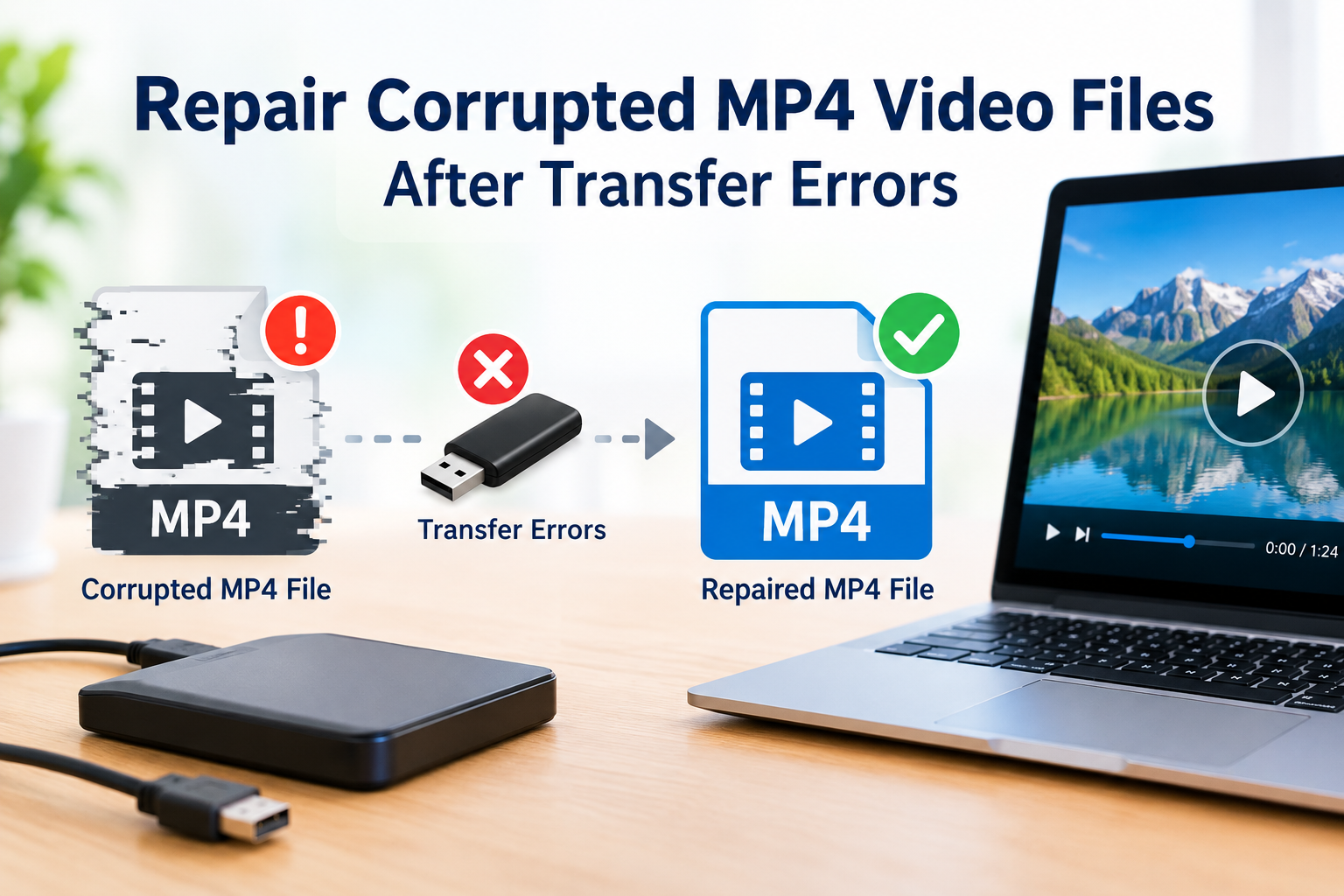
Suppose you transferred some important video from your camera or smartphone to your desktop, or from a friend’s phone to yours. But after a while, when you double-click the file, it does not play, returns a playback error message, video plays for a few seconds and freezes, or shows visual artifacts? Sometimes the player says – the file is damaged, the file cannot be played or the file isn’t supported.
Every user must have faced this once while transferring a video file, especially a large one or when sharing videos wirelessly across devices. This playback error is because of video corruption.
While the video is fine on the source device, something goes wrong on the way and the video file turns corrupted on the new device. The good news is that a transfer error does not always mean the footage is gone. If you are sitting with a corrupted or damaged file, don’t worry we can help you repair it.
Why do MP4 files get corrupted during transfer?
An MP4 file keeps its index (the metadata that tells a player how to read the video) in one specific part of the file. If a transfer stops early or skips data, that index can go missing or break. The file is then there, but it cannot be played.
Here are the most common reasons this happens:
Interrupted copying. A pulled cable, a power cut, a low battery or a laptop going to sleep can stop the copy halfway.
Faulty hardware. A damaged USB cable, a loose port or a cheap card reader interrupt data transfer without any warning.
Unsafe removal. Unplugging a drive or card before the system finishes writing leaves the file incomplete.
Network drops. Wi-Fi breaks, interrupted cloud syncs and messaging apps that trim files can all damage a video in transit.
Storage problems. Bad sectors, a nearly full drive, or a FAT32 drive that cannot hold files above 4 GB can leave you with a broken copy.
A damaged original. Sometimes the file was already damaged on the source device, and the transfer only exposed it.
Why can’t you just transfer it again?
If the original file is still safe, the simplest fix is to copy it again. Use a different cable, a different port or a different card reader. Check that the size of the new copy matches the original. Most of the time, that solves it.
But there are cases where this does not work:
The source device is no longer with you. The phone was reset, the card was formatted, or the camera was returned.
The file came from a client, a friend or a download link that has expired.
The card or drive is failing, so every new transfer corrupts the file again.
In these cases, you have to repair the corrupted copy you already have. That is where a video repair tool helps.
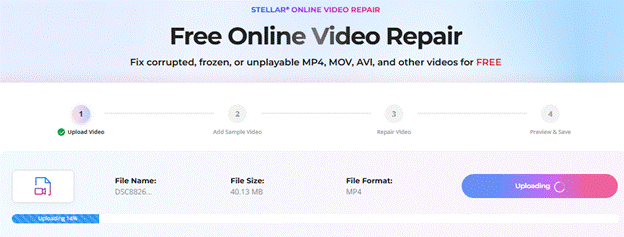
Method 1: Repair the MP4 in your browser with Stellar Online Video Repair
If you do not want to install anything, or you are on a shared or work computer, Stellar Online Video Repair is a good place to start. It is a secure, browser-based service. It works from desktops, laptops and mobile devices.
Key Features of the Online tool
Repair on any device’s browser, no installation
Uploads up to 5 GB of video file
SSL-secured upload for all video formats
Repair does not reduce the original video quality
A free plan repairs one file up to 100 MB, with a preview of the repaired video
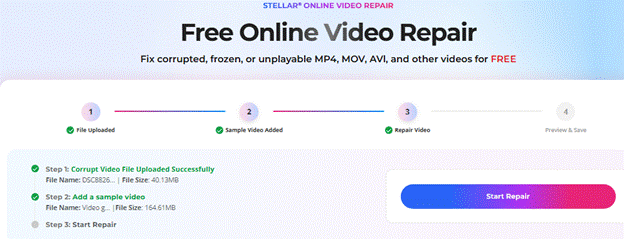
Add a sample video. This is a healthy file shot on the same device and in the same format.
Click Start Repair and wait while the tool fixes the file.
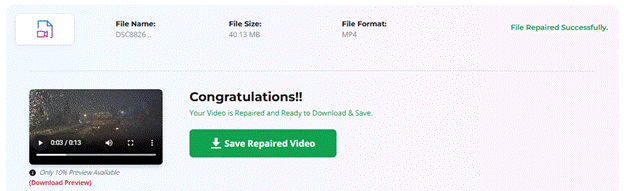
Preview the repaired video. If it looks right, save it to your device.
We did not pay a single penny for this repair as this was absolutely free of cost.
Method 2: Fix the MP4 or video file with Stellar Repair for Video (Desktop)
Some MP4 files are too large for a browser upload. Some are too badly damaged for a quick fix. Other times you have a whole folder of broken clips. For all of these, MOV or MP4 video corruption issues, an MP4 Video Repair tool such as Stellar Repair for Video is the stronger option. It runs on both Windows and Mac.
Key Features of the Desktop tool
No limit on file size, so 4K and larger videos are fine
Batch repair of unlimited files, even in different formats
Support for 17+ formats, including MP4, MOV, M4V, MKV, AVI and 3GP
Advanced Repair, which uses a sample file to fix severely corrupted videos
Works on videos from cameras, phones and drones
A preview of the repaired video before you save it
Steps to repair
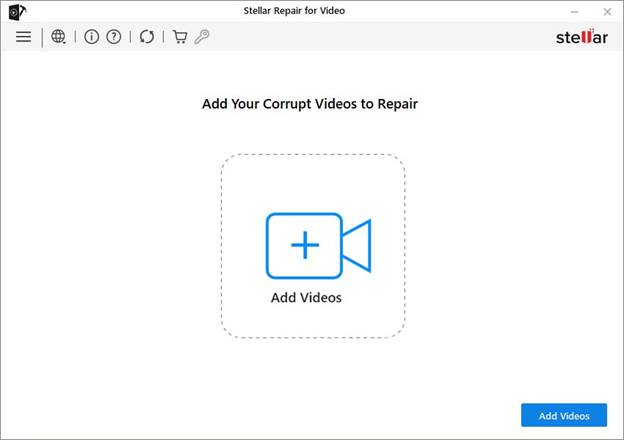
Download, install and launch Stellar Repair for Video on your PC or Mac.
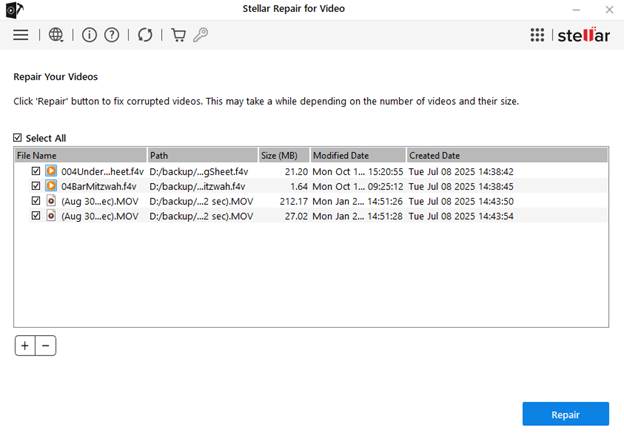
Click Add Video and select the corrupted MP4 files. You can add many at once.
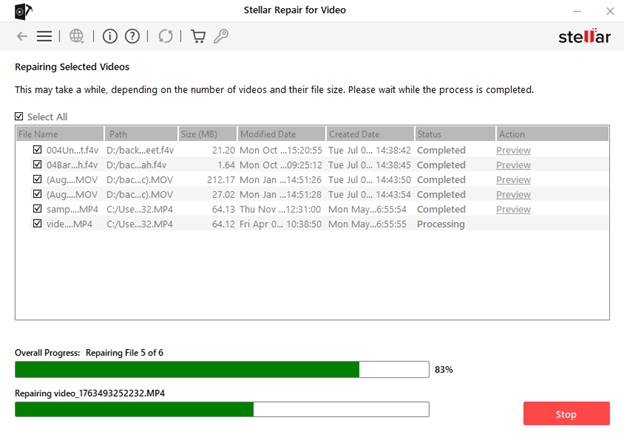
Click Repair and let the software scan and fix the files.
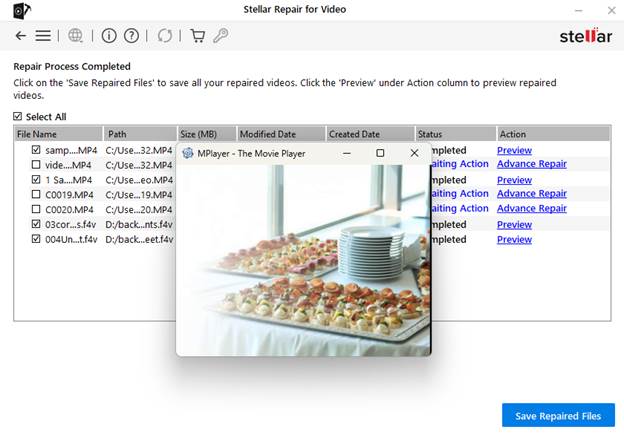
If the damage is severe, the software suggests Advanced Repair. Add a sample file from the same device and run it.
Preview the repaired videos and save them to the location you want.
The free demo lets you preview the repaired video up to 20% of its size, so you can check the result before you decide to buy the repair tool.
Which one should you use?
Both tools use the same repair approach. The difference is how and where you use them.
Stellar Online Video Repair
Stellar Repair for Video
Device
Any browser, no installation
Windows and Mac desktop software
File size
Up to 5 GB per file
No file size limit
Batch repair
Plan covers 10 files a month
Unlimited files, mixed formats
Free option
Repairs 1 file up to 100 MB
Free download and repair but saving file requires a paid subscription
Best for
Quick fixes, small to mid-size clips, no software access
Large 4K files, many files batch repair
Money Back Guaranteed
No
Yes, 30 Days
Both tools are similarly capable, hence, a smart decision is to start online if the file is small and you want a fast fix. Move to the desktop software if the file is big, there are many files, or the online tool does not suit your needs.
Manual methods you can try first
Manual fixes are worth a quick try, though they only help with minor damage:
Copy the file again with different hardware. Try another cable, port or card reader, or copy the file from the original card if you still have it.
Try VLC Media Player. Renaming the file to .avi and turning on VLC’s “Always fix” option for damaged files can rebuild the index in some cases. Results vary, so keep the original copy safe.
How to Avoid Corrupt Transfers from Next Time?
Always eject the drive or card safely.
Make sure the destination has enough free space.
Avoid copying when the battery is low.
Use a good cable and a reliable card reader.
Keep the original on the card until you have played the copy.
End notes
Even after a transfer error, your video is often still repairable. If you can copy the file again, do that first. If you cannot, or if the new copy fails too, a repair tool is your next step. Stellar Online Video Repair gives you a quick, no-install fix, and Stellar Repair for Video handles large, severe and batch cases on your desktop. Between them, you can cover almost any corrupted MP4 situation. Stellar has been working in data care for years and serves over 3 million customers across more than 190 countries.
DISCLAIMER – “Views Expressed Disclaimer– The information provided in this content is intended for general informational purposes only and should not be considered financial, investment, legal, tax, or health advice, nor relied upon as a substitute for professional guidance tailored to your personal circumstances. The opinions expressed are solely those of the author and do not necessarily represent the views of any other individual, organization, agency, employer, or company, including NEO CYMED PUBLISHING LIMITED (operating under the name Cyprus-Mail).
Names are central to our identity, so what happens when that name is a source of ridicule? Research points to negative life outcomes, but some people learn to embrace unfortunate names.
People succumbed to heat at highest rates in Malta, Italy and Hungary, with health issues, loneliness and poverty exacerbating toll
Heat killed a record 50,000 people in European cities this summer, new research suggests, with scientists blaming climate breakdown for two in every three of the deaths.
Morgues and funeral homes filled with bodies from June to August as the heat added by planet-baking pollution cut short an extra 32,000 lives in urban areas, the researchers found. Hot days pushed vulnerable bodies into overdrive and warm nights prevented them from recovering.
The federal government has sent an offer to the European Space Agency (ESA) to send the Australian of the Year, astronaut Katherine Bennell-Pegg, to the International Space Station.
The mission, slated for 2028, will mark the first time a qualified astronaut has flown to space under the Australian flag.
When actor Christina Applegate revealed that she had been misdiagnosed with multiple sclerosis, it triggered not only an outpouring of empathy for her, but raised important questions about how often people are told they have the condition when they don't. William Brangham discussed why MS can be so difficult to diagnose with Dr. Michael Kornberg of Johns Hopkins University.
Although the case is considered exceptional, investigators are working to determine how the infection occurred and whether the pathogen played a role in the patient’s death.
 Login