
 Login

Venezuelan Acting President Reviews Progress on U.S. Oil Agreements
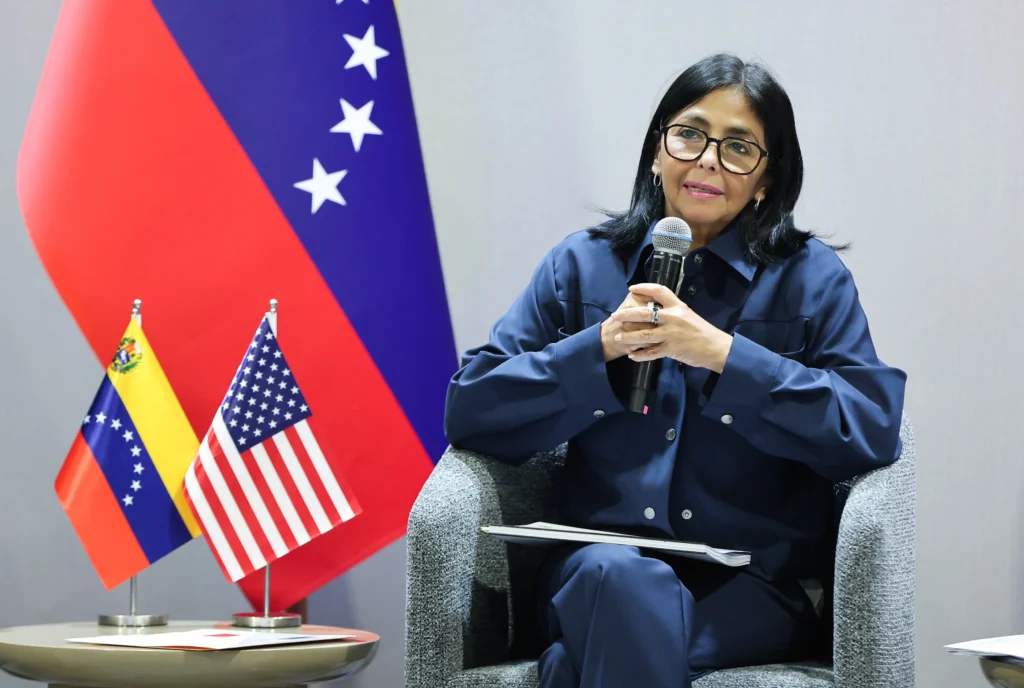
Venezuela’s Acting President, Delcy Rodríguez, inspected progress Friday on a package of 17 oil agreements signed with the United States, as the state of Zulia reported record output of 115,000 barrels per day.
The inspection covered joint projects aimed at extracting crude from national reserves. Eight of the 17 agreements involve the development of so-called green fields, new areas set aside for exploration and exploitation.
“We want to show the country the progress, to make clear that we do not leave things unfinished, that we go further: to action and to production. Once again, Zulia state broke its production record, reaching 115,000 barrels per day today,” Acting President Delcy Rodriguez said.
RELATED: U.S. Removes Venezuela From List of Countries Subject to Investment Restrictions
Rodriguez added that projections call for closing December at 120,000 barrels. The Acting President framed the tour as proof that the partnership has moved beyond paperwork into concrete output.
The cooperation framework was signed in August through North American Blue Energy Partners (NABEP). The 17 strategic agreements target the extraction of 65 million barrels of crude from Venezuela’s reserves.
On maritime infrastructure and logistics, Rodriguez said activity in Zulia will jump from 100 to 900 vessels, an increase of 800% in mobilized capacity. The figure signals a major expansion of port and transport operations tied to the oil sector.
The Acting President also outlined a plan for the progressive creation of jobs driven by industrial activity. Employment will begin in the food sector, continue in ironworks and industrial areas, and later extend to public accounts with the goal of raising working-class incomes.
Rodríguez said the central objective of the alliance is to develop the hydrocarbon industry and consolidate the country’s sovereign position. She stressed that Venezuela seeks to affirm itself as the nation with the largest oil reserves on the planet and to rank among the world’s leading producers and exporters. “We want to show the country the progress of these agreements,” she said.
Benefits For People
Acting President Delcy Rodriguez insisted that rising production must translate directly into the welfare of the population. Following this, she pointed to concrete areas where the gains should appear: “In the daily life of Venezuelan men and women: in pay for workers, in health, public hospitals, schools, food, roads, water and public services. That is where Venezuela’s development goes,” she said.
The comments link oil revenue to social spending at a time when the government has promised greater transparency over hydrocarbon and mining income. The Acting President’s emphasis on hospitals, schools and food echoes longstanding official messaging that resource wealth should fund public services.
The Zulia figures mark a significant benchmark for the country’s oil industry, which has sought to recover output after years of decline. The jump from 100 to 900 vessels suggests broader commercial activity around the crude operations, beyond the wells themselves.
Eight green-field projects form part of the package, indicating that the partnership extends into undeveloped territory rather than relying solely on existing infrastructure. Rodríguez described the agreements as a path toward consolidating Venezuela’s position in global energy markets.
The inspection tour took place as the government pushes to showcase tangible results from the August accords. The Acting President’s visit to the field operations was intended to demonstrate that the agreements are generating activity on the ground, not only on paper.
The production target of 120,000 barrels by December would extend the record reported Friday. If achieved, it would reinforce the government’s narrative of recovery built around the US partnership and the state of Zulia’s role as the engine of national output.
Rodríguez closed her remarks by linking the oil gains to broader national development, arguing that the industry’s expansion must reach Venezuelans through wages and public services rather than remaining confined to export statistics.
