
 Login

Cuba Rejects Trump’s New Threats of Military Intervention
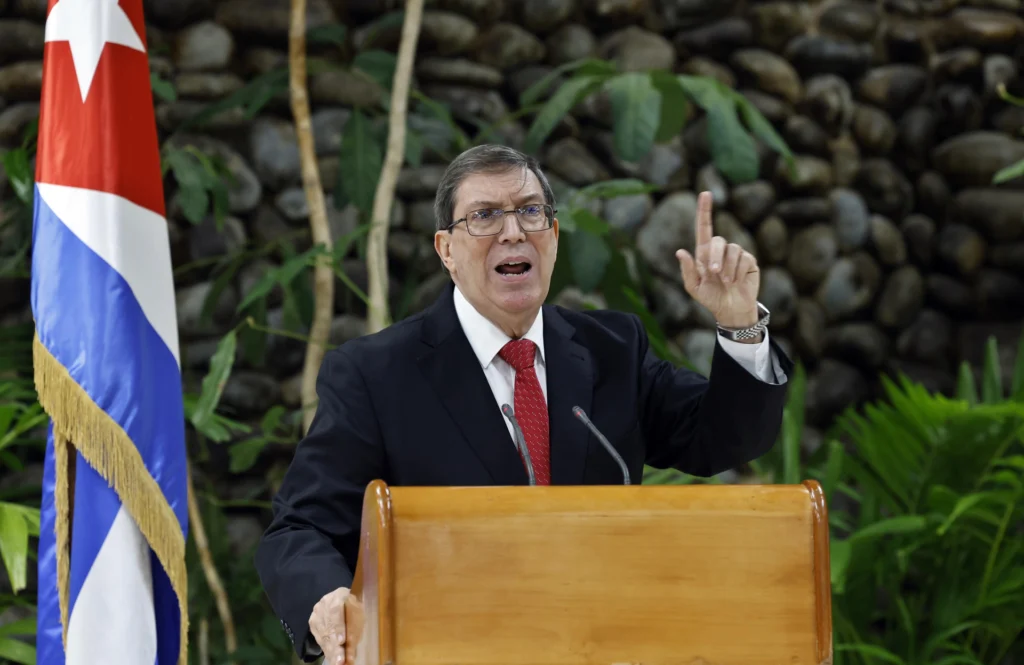
Cuban Foreign Minister Bruno Rodríguez Parrilla on Friday rejected a new threat from U.S. President Donald Trump, who said U.S. ships would make a “small stop” off the island on their return from Iran.
President Donald Trump has issued a new threat against Cuba as U.S. officials reportedly press ahead with military planning for the Caribbean country, an escalation that coincides with an intensified oil blockade and UN vote scheduled for October 28.
At a campaign rally in Fort Myers, the Republican President laid out his plan in vivid terms. “What we are going to do with Cuba is we are going to come back from Iran. Those beautiful ships, we will pass by Cuba, we will have one of them stop about 50 yards (45 meters) from the coast. They will raise their hands and then we will send Marco Rubio to close the deal,” he said.
RELATED: Cuba Denounces U.S. Pressure Ahead of the UN Assembly Vote On Economic Blockade
The U.S. President closed the scene with a concrete promise: “We will take care of Cuba on our return from Iran. We will make a small stop.”
Cuba answered on X. “We reject all threats related to the ambitions of United States toward Cuba,“ wrote the Caribbean nation’s FM Bruno Rodriguez Parrilla.
He added a description of the coastline that carried an unmistakable warning. “Our coastline is full of beautiful beaches, but there ara also razor-sharp limestone spikes,” he said, referring to the karst rock formations along the shore. “Inhospitable to those who arrive with hostile intentions and dreams of domination,” he warned. The jagged coastal limestone, sharp and cutting, gave the response its edge.
We reject every threat related to US ambitions toward Cuba.
— Bruno Rodríguez P (@BrunoRguezP) October 23, 2026
Our coastline is full of beautiful beaches, but there are also razor-sharp limestone spikes, an inhospitable environment for those who make it to our shores with hostile purposes and lust for domination.… pic.twitter.com/jrrBc1jR8S
Meanwhile, U.S. Secretary of State Marco Rubio used the same platform to urge those pushing for “change” on the island to engage in “discreet collaboration with the CIA.” In August, The New York Times reported that the intelligence agency had secretly set up a task force focused on Cuba.
The threat came amid a heated campaign in a state that is home to the largest Cuban community in United States. Its lawmakers and an influential segment of that community shape Washington’s decisions on Cuba.
Rodriguez Parrilla’s post also echoes another phrase from the current U.S. President. In March, speaking at the White House, Trump said he would have “the honor of taking Cuba” and that he “could do whatever he wanted with it.” He described Cuba then as a beautiful place, with “good land, landscapes, wonderful weather and great potential for tourism centers.”
On that occasion his unfamiliarity with the territory was on display. He argued that taking control would be good because the country is “not in the path of hurricanes.” “They won’t ask us for money for hurricanes every week,” he said in that time.
Passing by the island after Iran is not a new idea. In early May, while signing the Executive Order that launched an unprecedented wave of unilateral and illegal penalties against Cuba, Trump had already spoken of “taking control” once his military objectives in Iran were met. Following that, he has promised the war will end “immediately” after the November 3 elections, without explaining how.
The new threat coincides with the campaign Rubio himself is leading to sway the votes of UN member states on the resolution against the blockade against Cuba. In a recent press conference, Rodriguez Parrilla denounced the pressures and threats against governments to make them change their position.
In recent weeks the U.S. administration has seized fuel shipments bound for Cuba as part of an oil blockade. The campaign against Cuba’s international medical cooperation has intensified in parallel.
Elections Add Pressure
The escalation arrives at a difficult political moment for the U.S. President. Midterm elections take place on November 3, and the Republican Party could lose control of Congress. Trump’s approval has sagged, and a majority of voters now reject his management of the country’s main fronts, a rejection that cuts across every issue.
The domestic scenario is complicated further by the conflict with Iran. Tehran retains control of the Strait of Hormuz and has inflicted significant destruction on U.S. military bases in West Asia.
Fuel prices keep climbing in the meantime. The increase strikes U.S. households directly, and every rise deepens the damage to the President’s public standing at a moment when he can least afford it.
The pattern toward Cuba has hardened even as those pressures mount at home. The fuel seizures, the diplomatic campaign and the military planning all point in the same direction, toward an increasingly explicit posture of confrontation against the island.
With the United Nations vote set for October 28 and the U.S. midterm elections following days later on November 3, the coming weeks will reveal whether the planning described in U.S. media translates into further concrete action against Cuba, or whether it remains a lever of pressure in a campaign that already weighs heavily on the island.
