❌

Normal view

Where Russian maps place the occupiers, and where they really are — an overview of parts of the front (Ukraine Battlefield update, Day 1,679)

30 September 2026 at 15:54
  • The Ukrainian army stays in control of front lines, but safety in cities deteriorates.

  • Kyiv was on fire again as Russian attacks on cities intensify.
  • Rubikon published stats on destroyed Ukrainian drones, decoys being the second most prominent.
  • Russia’s defence ministry will not let go of the Armata: it wants to turn it into an air-defence system, drawing ridicule.
  • Maps of the day: Sloviansk-Kramatorsk direction; Orikhiv direction, Oleksandrivsk direction, Kupiansk direction.
  • Videos of the day: a burning Tu-95MS strategic bomber; a Ukrainian firefighter showed how they extinguished the Academy of Sciences building.

The Ukrainian army stays in control of front lines, but safety in cities deteriorates. The war has reached a stage in which two separate conflicts appear to be taking place simultaneously.

While Ukraine is currently losing the battle in the air and its cities are continually suffering missile and strikes by jet drones, the situation on battlefields is far better.

Last week, Denník N spent time in Ukraine with former chief of the general staff Daniel Zmeko. During the trip, reporters met commanding officers from several brigades and battalions operating from the Izium area to Zaporizhzhia, and all of them said they had the situation under control.

The officers spoke about the accuracy of Russian maps, which they said did not correspond to reality. In some places, Russian soldiers are as far as 20 km from the locations where, according to the Kremlin, they are supposed to be.

Northern flank of the Sloviansk-Kramatorsk agglomeration: This is a specific section of the front where the Ukrainian army has been reporting its advances only very slowly, while Ukrainian analysts have remained silent so as not to disclose anything sensitive. Russian bloggers, by contrast, are depicting the situation more closely to reality.

Yet official Russian maps persist with utterly nonsensical lines. We do not know to what extent this is an effort to deceive domestic and foreign audiences, and to what extent they genuinely believe it in Moscow. It is worth looking at how the regime wants the situation to appear, and what it is really like.

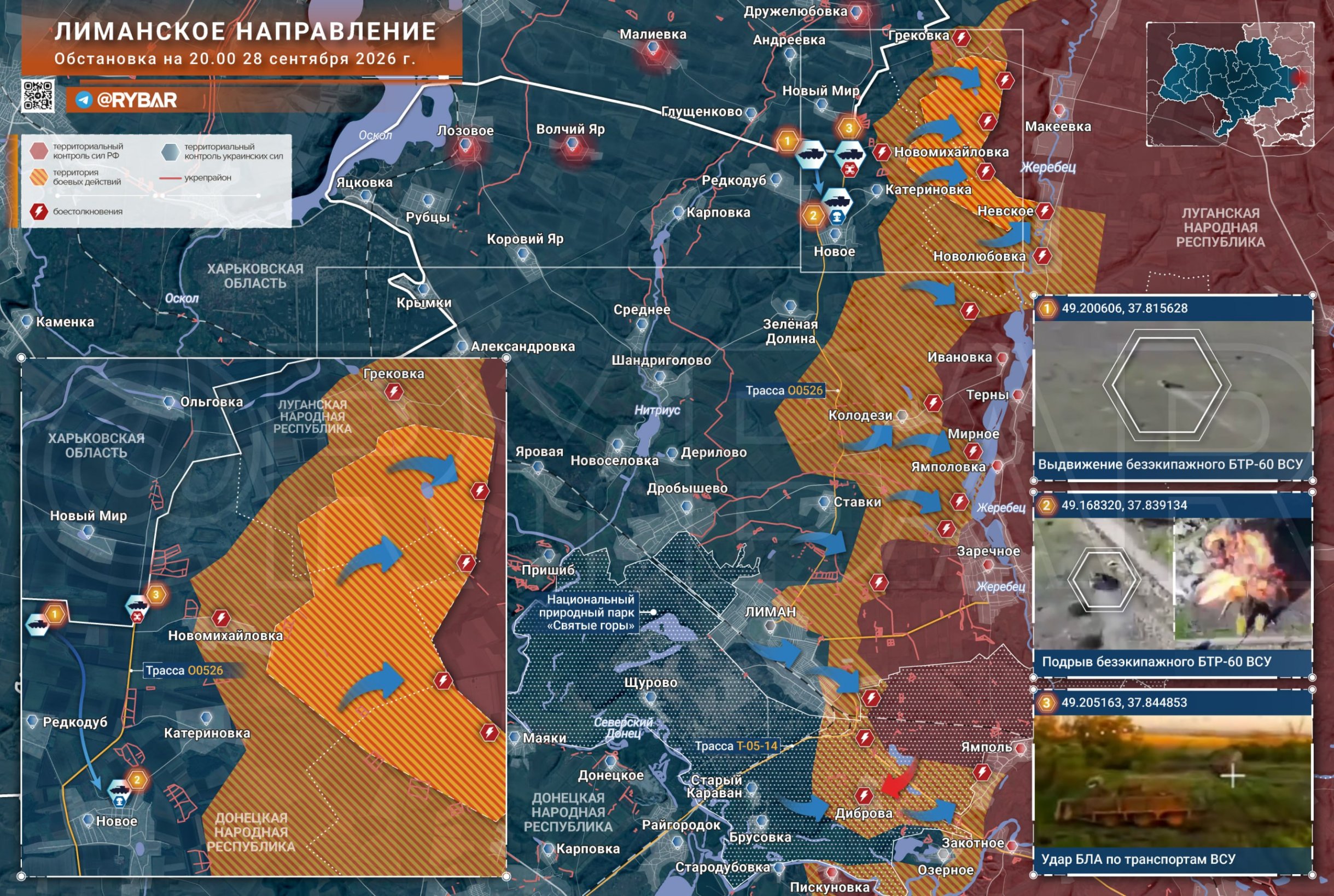
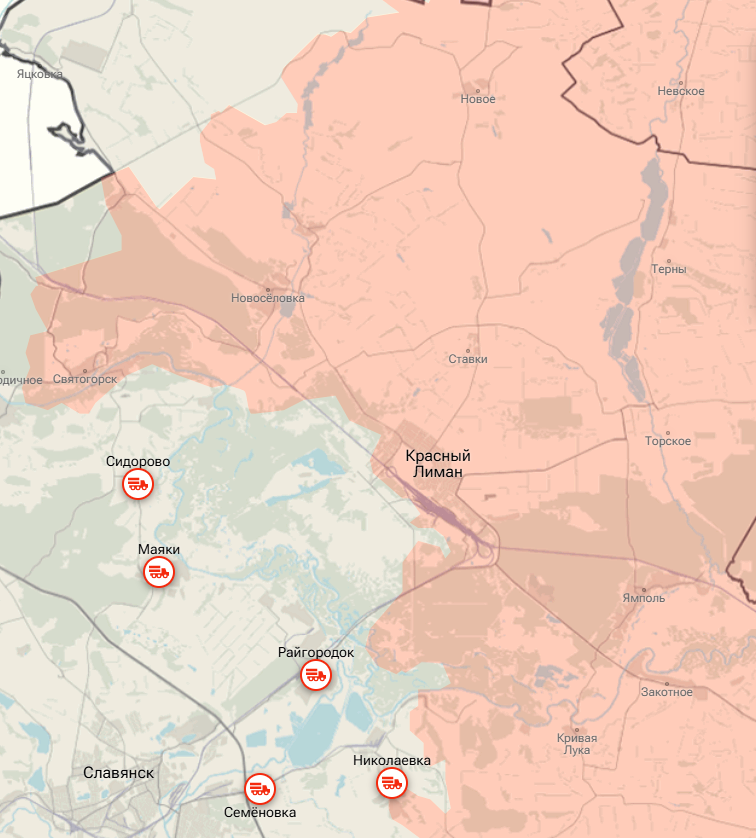
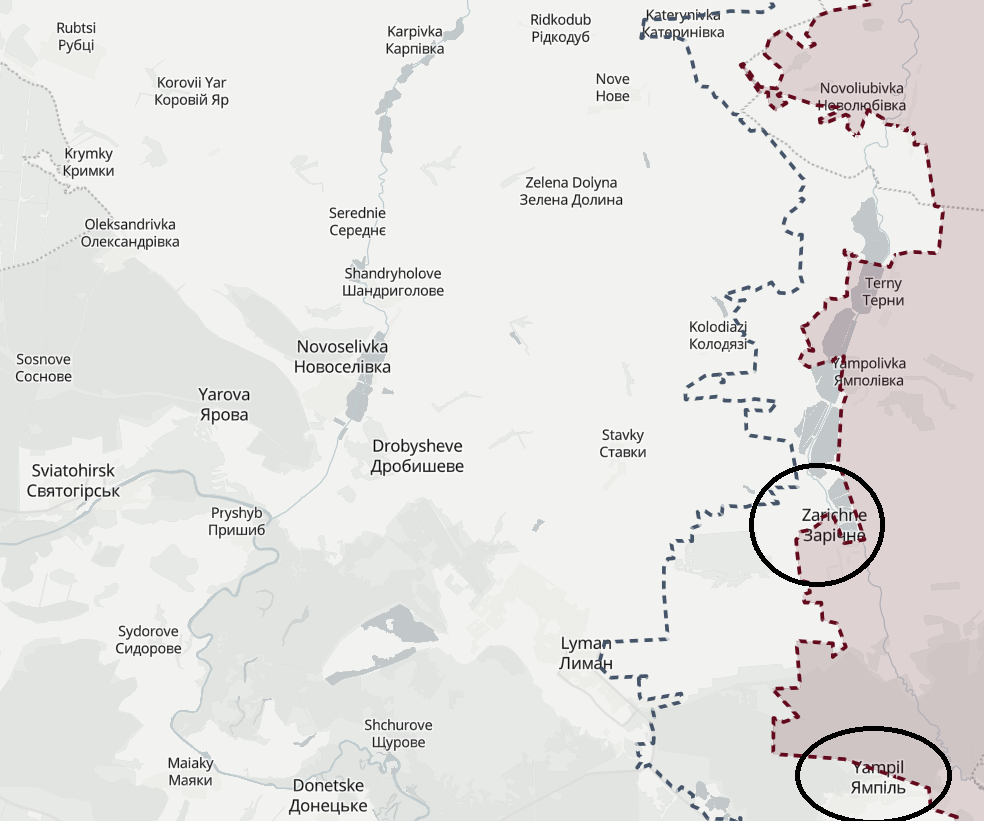
The first map in the overview was produced by the Russian state news agency RIA Novosti and depicts the area around Lyman, on the northern flank of the Sloviansk-Kramatorsk direction, as of 29 September. Lyman is shown as occupied in the middle of the map. The map’s author also continues to insist that the Russian army had captured Sviatohirsk — at the tip of the red salient in the centre of the map — and that Russia controls the entire, now non-existent salient with the village of Novoselivka at its centre. Yet Russian outlets Rybar and Two Majors write that fighting is taking place on the Zherebets river around the villages of Terny — on the far right of the map — and Yampil.
The following map is much closer to reality. According to it, the front line roughly follows the Zherebets river, which corresponds to Rybar’s claims.

In the Lyman direction, in Donetsk region, Ukrainian defenders successfully repelled three attempts by the russian fascist invaders to advance near the settlements of Ridkodub, Novoselivka and Drobysheve.

1/2 pic.twitter.com/Zs9VdLLnAr

— Michael MacKay (@mhmck) September 28, 2026

Rybar’s map looks like this:

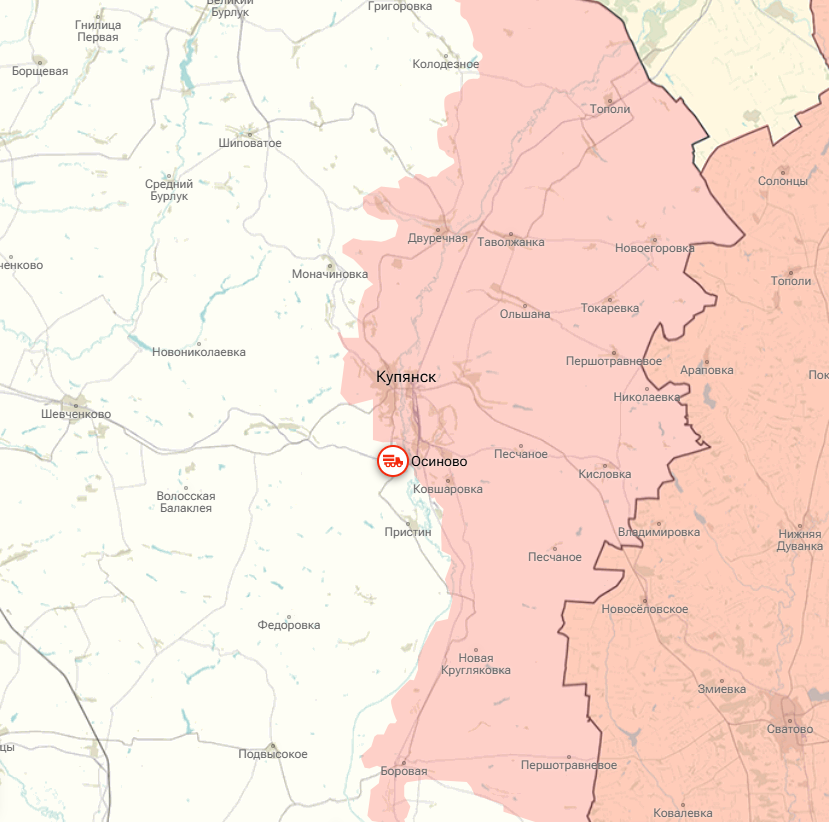
Kupiansk direction: The city of Kupiansk is a similar case to Sviatohirsk. Putin declared it captured in August last year. And once the commander-in-chief had declared this, his news agency continued to draw the map as though it were true. Kupiansk is shown as occupied in its centre, but there are further inaccuracies.

For example, the Kremlin agency claims that the Ukrainian bridgehead on the eastern bank of the Oskil river south of the city no longer exists. Ukrainians do face major difficulties supplying it, and various analysts have repeatedly warned of an impending disaster, but the Russian map is nevertheless hopelessly inaccurate.

Also note the small town of Borova at the bottom centre. RIA Novosti also shows it as occupied, although this is not the case.
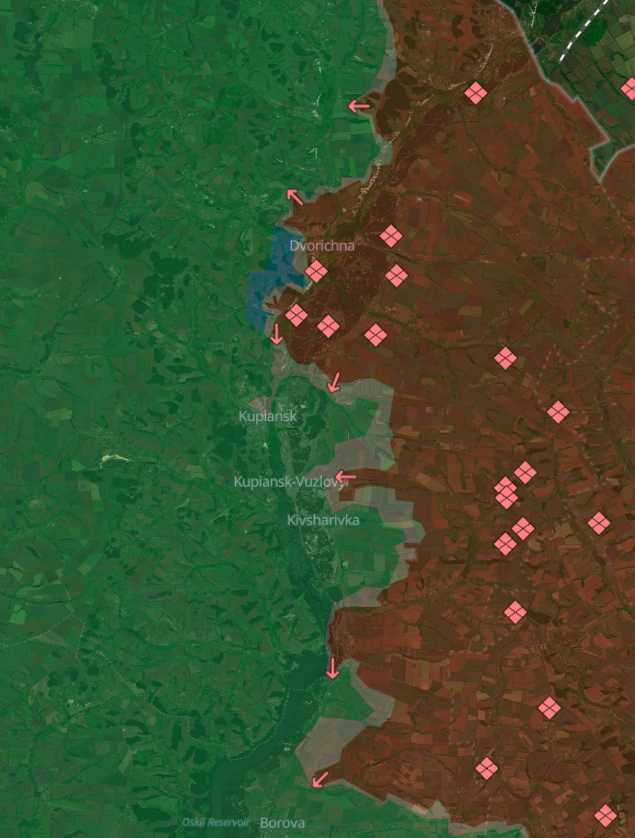
This time, we will compare the Russian agency’s data with a map by Ukrainian analysts at DeepStateUA, because they updated it on Tuesday to reflect a new advance by Ukrainian units north of Kupiansk — again in the centre of the map — near the village of Dvorichne. In recent weeks, they have succeeded in reducing the Russian bridgehead on the western bank of the Oskil; the change since the end of August is marked in blue. Borova is again at the bottom centre, while below Kupiansk is the Ukrainian bridgehead that Russia claims does not exist.
Orikhiv: This is one of the places where Ukrainian officers said during reporters’ trip to Ukraine that Russian maps were particularly inaccurate.

The Russian map is again from RIA Novosti and again ignores reality along the entire length of this section of the front. Its main target is the city of Zaporizhzhia, with a population of three quarters of a million, in the centre left, while the small town of Orikhiv, at the bottom centre, is a defensive hub.

Putin’s news agency places soldiers roughly 12 km from the southern edge of Zaporizhzhia; in reality, they are around 24 km away. It shows Orikhiv as occupied and the Russian army advancing from the east towards the village of Novorozivka, north of Orikhiv.
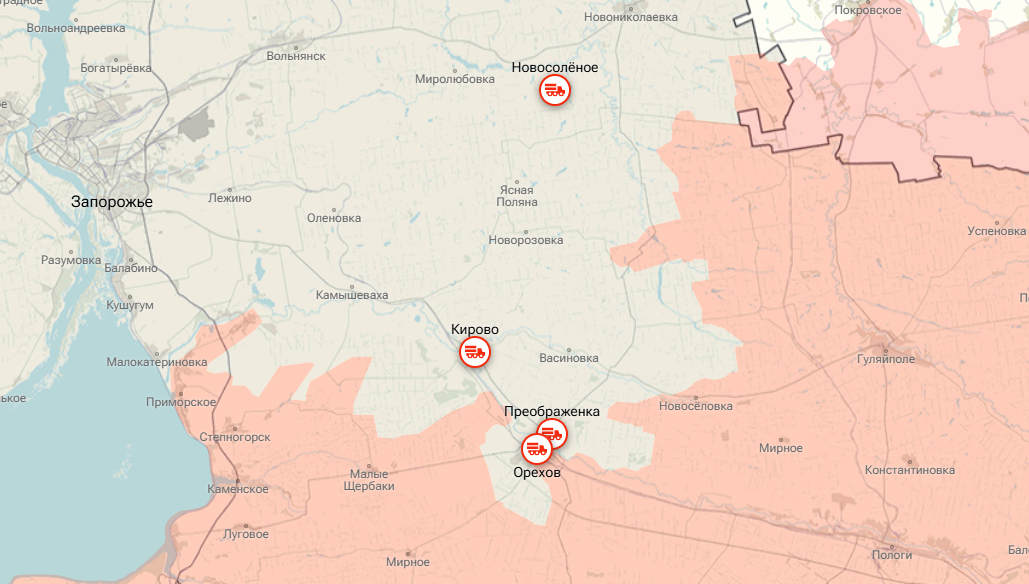
The OSINT project Playfra covers this area in the greatest detail. Its map appears to depict a different war altogether. Everywhere, Russian positions are significantly shifted compared with those shown by RIA Novosti.

The differences have a simple explanation. On the western flank near Zaporizhzhia, the Kremlin agency simply ignores the successful counterattacks carried out by Ukrainians there this year. On the eastern flank, it uncritically accepts every claim by the Russian defence ministry and, with equal lack of scrutiny, considers captured every small village where a Russian soldier raised a flag during a suicidal mission, even several months ago. Although those soldiers have since been killed or captured, RIA Novosti acts as though they still control the village.
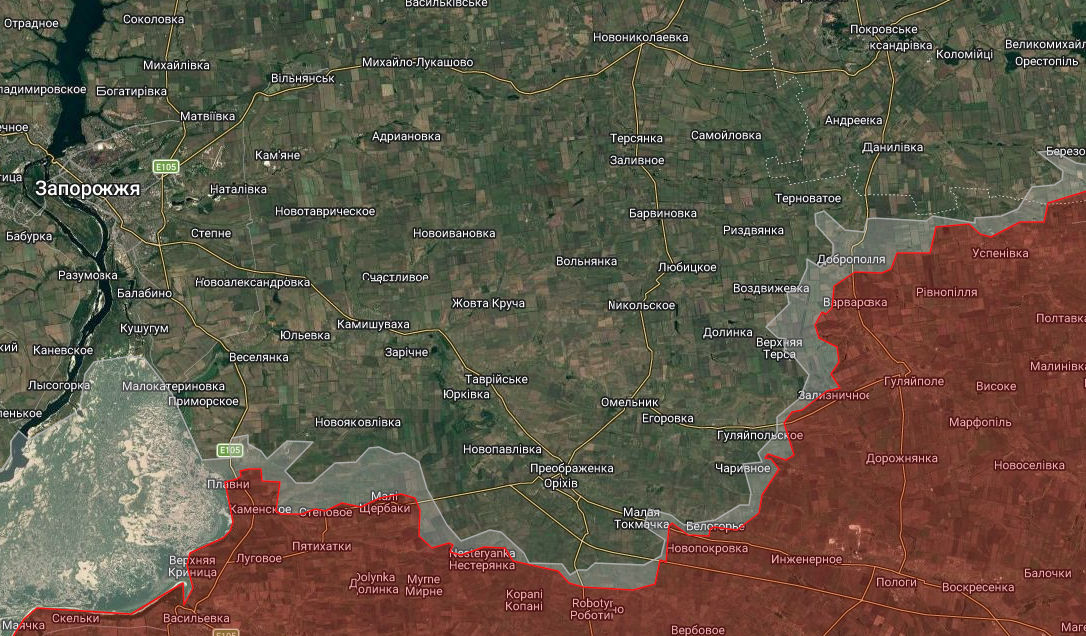
Playfra also offers a more detailed view of the current fighting around Orikhiv, drawing on analyses by Ukrainian analyst Kostyantyn Mashovets.

Orikhiv direction.

Factually, no changes. Clearings are conducted constantly, but the Russians also continue to infiltrate: the global situation doesn't change.
The stalemate situation that I had reported some weeks ago, as well as the gray zone, remains both actual as of the… https://t.co/6rau9f7wcK pic.twitter.com/5uIK3K78Bm

— Playfra (@Playfra0) September 28, 2026

Of course, Russians too occasionally notice that they are living in a parallel reality. Most recently, the influential Aleksandr Kharchenko wrote about it:

“Comparing our maps with Ukrainian ones can be shocking. The zones of control differ by dozens of kilometres,” he acknowledged, adding that both sides lie, although he focused specifically on false Russian reports.

He described Russian soldiers who are the first to break into a village as heroes. But, according to him, wars are not won through heroism, but through a functioning system.

“Errors in our maps and information arise because they rely on heroes. Everywhere a Russian soldier is sitting is considered our territory,” Kharchenko argued that this had to change because “our territory is only where a Russian soldier is sitting with food, water and ammunition. This is territory from which we can fight the enemy”.

Kyiv was on fire again as relentless Russian attacks on cities intensify. In the capital, Russians particularly targeted energy infrastructure. “Not a single day has passed since the summer without the enemy attacking energy infrastructure. But this is the first such massive and complex attack since the end of the previous heating season,” Ukrainian PM Serhiy Koretskyi told NV.

In addition to causing serious damage, the attacks on Kyiv and other cities killed at least five residents and injured another 14.

President Volodymyr Zelensky also said that, thanks to the delivery of new surface-to-air missiles, five Russian ballistic missiles had been shot down.

Since last night, emergency services and repair crews have been working to address the aftermath of the Russian strike. It was a difficult attack – nearly 190 attack drones, as well as ballistic missiles. And the main target was energy infrastructure in the capital and the Kyiv… pic.twitter.com/wUNWEUdpTL

— Volodymyr Zelenskyy / Володимир Зеленський (@ZelenskyyUa) September 30, 2026

Rubikon published stats on destroyed Ukrainian drones, decoys being the second most prominent. Ukraine’s response is continuing in parallel with the Russian offensive against cities. But the stats currently weigh against Ukraine.

While the effectiveness of Ukrainian air defence has fallen dramatically since the arrival of Russian jet drones, Russia has successfully shot down Ukrainian ones. For example, the recent large-scale drone raid on Moscow involved several hundred drones — and, according to some sources, more than 1,000 — but only 10 penetrated the airspace above the Russian capital.

In this context, the Russian Rubikon unit published interesting statistics. Although it operates at and near the front, its data for September show that, of 827 Ukrainian drones hit, as many as 247 were Maya-type drones — unmanned decoys intended to deceive Russian air defences. They look very similar to FP-1 attack drones but, unlike them, carry no warhead.

For context, the top two most frequently intercepted Ukrainian UAVs by Russian forces are both decoy drones — the “Maya.” This suggests that Ukraine’s deception strategy is working, as the Ukrainian Defense Forces have increasingly begun deploying decoy UAVs to mislead Russian… https://t.co/NKPvbzm38U

— Oko Gora (@oko_gora_tg) September 29, 2026

Russia’s defence ministry will not let go of the Armata: it wants to turn it into an air-defence system, drawing ridicule. Zvezda News is a media outlet directly controlled by the Russian defence ministry. On Monday evening, it published technical news on the long-forgotten T-14 Armata tank, which Russian propaganda had claimed would revolutionise tank warfare.

Today, it is beyond any doubt that the project is dead and new information confirms this, but its authors presumably intended to convey precisely the opposite.

“Rostec has upgraded the Russian T-14 Armata tank into a short-range air-defence system,” the report stated, citing military expert Oleg Shaladin.

The list of new features appears impressive at first glance. The new version of the Armata has received new electronic equipment; its 125 mm main gun is to be replaced by a 152 mm gun, allowing the tank to fire Kornet anti-tank missiles with a range of 10 km. The new Armata will also be able to use Krasnopol guided artillery shells, which are used by more modern howitzers, while the tank is also to gain the ability to operate as the aforementioned short-range air-defence system.

Further changes have already been made to the project, but even the brief list above makes it clear that the Armata is no longer intended to be a tank, but rather some kind of hybrid capable of fighting everything and nothing at the same time.

Among others, the Russian Telegram channel Military Informant commented on the report, openly mocking it. It said Rostec had mixed together “all the old tales from 10 years ago” in its list of changes, but that in practice “the tank never got beyond parades and training grounds, because it was created for an entirely different war, which ultimately never happened. It became conceptually obsolete from the outset, without even having had the chance to fight”.

Videos of the day

Russia has lost another Tu-95MS strategic bomber. This is the 12th confirmed loss of this type — the Oryx website has not yet updated its figures, so it records only 11. According to available information, the aircraft crashed shortly after taking off from a base in Amur region. Six crew members were reportedly killed, while one survived with injuries. Armed with cruise missiles, the aircraft was probably heading for Olenya air base, from which Russia attacks Ukraine.

A Russian Tu-95MS Bear heavy bomber crashed on takeoff in Amur this evening during a training flight.

The airframe is a total loss, with no survivors reported. pic.twitter.com/tbujV6RVP5

— OSINTtechnical (@Osinttechnical) September 29, 2026

Denník N wrote on Tuesday about the attack on the headquarters of the Ukrainian Academy of Sciences. A video has since emerged from the helmet camera of one of the firefighters involved in the rescue operation.

Helmet-cam footage of Ukrainian firefighters tackling the blaze at the National Academy of Sciences of Ukraine in Kyiv on Monday after a Russian drone strike. pic.twitter.com/DqEcz3wPlK

— OSINTtechnical (@Osinttechnical) September 30, 2026

What are the losses

No update on Wednesday.

  • By Tuesday (22 September), Russia had verifiably lost 24,138 pieces of heavy equipment, compared with 24,098 on Monday (14 September). Of these, 19,105 (19,065) were destroyed by Ukrainians, 1,000 (1,000) were damaged, 1,194 (1,194) were abandoned by their crews and 2,839 (2,839) were captured by the Ukrainian army. This includes 4,448 (4,447) tanks, of which 3,353 (3,352) were destroyed in combat.

  • Ukraine lost 12,175 (12,143) pieces of equipment, including 9,579 (9,551) destroyed, 702 (698) damaged, 695 (695) abandoned and 1,199 (1,199) captured. This includes 1,464 (1,462) tanks, of which 1,125 (1,120) were destroyed in combat.

Note: Neither side regularly reports its own deaths or equipment losses. Ukraine publishes daily figures for Russian casualties and destroyed equipment, which cannot be independently verified. In this overview, we use data from the Oryx project, which has compiled a list based exclusively on photographically documented equipment losses since the start of the war.

Israeli outpost-linked firms exploit loophole to buy up European property even as the EU curbs trade with illegal settlements

30 September 2026 at 13:31

After years of European governments condemning Israel’s illegal occupation but maintaining extensive economic relations, some economic consequences are reportedly now forthcoming.

This comes amid wider scrutiny of Israel’s treatment of Palestinians, including systemic discrimination, unlawful occupation and genocide in Gaza.

On 8 September, twelve governments announced moves towards restricting trade with illegal Israeli settlements. This is a limited but welcome response to grassroots pressure.

It also raises a question: where does the economy of an illegal Israeli settlement end?

Most emerging measures follow economic relationships towards illegal Israeli settlements: do not buy goods produced there, invest there or provide services that enable their construction. 

Norway’s proposed legislation is seemingly comprehensive, covering property purchases and services connected to construction and property transactions.

The UK has also announced a ban on advertising property in illegal Israeli settlements, after such property had been advertised at a London real-estate event.

But this all still largely considers illegal Israeli settlements within their territorial bounds.

The problem is treating a spatial category as though the economic relationships producing it share the same boundary. We all know the world does not work like that.

Kinnula, a municipality in central Finland, is now facing this reality: when money from the illegal settlement economy moves into public land in Europe. It is a small case, but it makes the problem unusually visible.

In August, Kinnula council voted 10–3 in favour of a €4m resort development by Israeli property company Dror Bonim Atid, before councillors had been informed of the company’s promotion of projects in illegal Israeli settlements.

The municipality paused the process while requesting a background report on the company from Israel. Its municipal manager told Finnish news media that nothing had yet emerged that required closer examination.

However, illegal Israeli settlements are not illicit enterprises from the perspective of Israel. Their expansion is enabled through Israeli state institutions.

A background check sought from Israel is therefore absurd. A more obvious background check reveals something else.

On its own website, Dror Bonim Atid presents its Finnish development alongside a development in Efrat, an illegal Israeli settlement in the occupied West Bank, as well as a development in Dror-Hiran in the Negev. The latter is being built on land where Umm al-Hiran stood until November 2024, when the Bedouin village was completely demolished and its community forcibly displaced.

Umm-al-Hiran (Source: Activestills)

One company website therefore takes us from an illegal Israeli settlement, through the site of a demolished Bedouin village, to holiday accommodation beside a Finnish lake.

Finland’s ministry of defence must still approve the acquisition because the purchaser comes from outside the EU and EEA. But that system principally examines questions such as national security and defence.

Involvement in illegal Israeli settlements does not fit neatly into the categories through which the transaction is being examined.

Kinnula exposes a gap in the emerging European restrictions on trade with illegal Israeli settlements. Those restrictions follow economic relationships from Europe towards the settlements.

Here the relationship points the other way. What happens when the economies of illegal Israeli settlements come to Europe to acquire public assets, invest and make money here?

This may be a relatively new question for European policymakers. For Palestinian civil society, it is not. Their call for Boycott, Divestment and Sanctions (BDS) was issued in 2005, drawing in turn on a much longer history of Palestinian boycott and economic resistance.

The movement has spent years developing corporate-complicity criteria and strategies for divestment and exclusion from contracts, moving beyond asking where a product came from to examining the companies with which institutions maintain economic relationships.

You could be forgiven for rolling your eyes as European policy discovers these questions inch by inch.

Palestinians have spent generations analysing the economic relationships through which occupation is sustained. BDS has spent more than twenty years turning that knowledge into practical strategies for institutions elsewhere.

So, when a Finnish municipality is deciding whether to sell public land to a company openly involved in illegal occupation, there is clear guidance from Palestinian civil society on how to respond.

There is also now the fact that Europe accepts that it should not economically support illegal Israeli settlements, meaning it should also accept that companies involved in illegal settlements should not be able to come to Europe for public land, contracts and investment.

Listen: Did the Spanish government address the protesters’ demands on housing?

30 September 2026 at 09:36

Production: By Europod, in co-production with Sphera Network.

EUobserver is proud to have an editorial partnership with Europod to co-publish the podcast series “Briefed” hosted by Léa Marchal. The podcast is available on all major platforms.

Find the full transcript below:

Hundreds of people were still camping yesterday at Puerta del Sol in Madrid. They were demanding action on housing, as rents and property prices continue to rise.

Following an outcry triggered by the eviction of an 83-year-old woman from her home, and the mobilization of thousands of people across Spain, the government adopted two housing decrees.

Did they take the protesters’ demands into account?

MariCarmen Abascal had lived in her apartment since the 1950s, having inherited the lease from her parents. But the property was bought by an investment fund, which then challenged the validity of her lease and quadrupled her rent.

Last week, MariCarmen was evicted from her home. The eviction sparked widespread outrage and led hundreds of protesters to camp in central Madrid, calling for action.

Yesterday, she was finally allowed to return home after reaching an agreement with the owners.

Aside from MariCarmen’s case, the demonstrations are largely driven by young people who are fed up with rising rents and property prices, especially in major cities such as Madrid and Barcelona.

In Madrid, property prices have risen by around 87 percent over the past ten years. That’s less than in Portugal or the Netherlands, where prices have increased even more. But it’s still a significant rise, especially as wages have grown much more slowly over the same period.

Rents are taking up a huge share of people’s incomes. In Madrid, they account for almost half of tenants’ net income on average. So, how did the Spanish government respond?

Yesterday, it adopted two housing decree-laws. The first decree would suspend evictions until 2030 and automatically extend existing rental contracts by two years.

It would also introduce tighter rules on seasonal rentals and prevent speculative investment funds from acquiring housing until 2028.

The second decree is more ambitious. It would allow tenants to extend their future rental contracts indefinitely. This is what the tenants’ union has been calling for.

Landlords would no longer be able to end a lease simply because it had reached its expiry date. Tenants who pay their rent and respect their legal obligations could remain in their homes for as long as they wish.

This would also limit rent increases, since rents can only be raised moderately during an existing contract.

So, the government has taken the protesters’ demands into account. But there is still a major obstacle: as our Spanish partner El Salto reports, the tenants’ union fears that this second measure may not pass through Parliament.

That could explain why the government adopted two separate decrees. The first is considered easier to get through Parliament.

Now, what about the EU’s proposals to tackle rising rents? We discussed them earlier this month.

One of the main proposals concerns short-term rentals. The idea is to introduce restrictions, particularly in tourist areas where housing is under strong pressure. By bringing more homes back onto the long-term rental market, the Commission hopes to ease pressure on prices.

But these proposals have not yet been adopted, so we’ll have to wait and see what impact they have. And in any case, more will need to be done at national level.

Even if prices stop rising, they are already so high that many workers can no longer afford to live in major cities.

More social housing is needed, as well as more renovation. Increasing the supply of decent, affordable homes could help ease pressure on rents and property prices.

Scientists flee burning building in Kyiv’s mini-9/11, as Russian drone also explodes 200m from EU embassy (Ukraine Battlefield update, Day 1,678)

29 September 2026 at 14:48
  • Kyiv is currently in a worse situation than Kharkiv when it comes to air-raid alerts.

  • The Russians struck the National Academy of Sciences, forcing scientists to flee through windows. Why did they target it?
  • What upgrades they are testing on their Geran-5 drones.
  • According to Rybar, Russia’s goal in attacking Kyiv is also to persuade Europe to stop helping Ukraine.
  • Maps of the day: The situation near Lyman and the gap between the Russian ministry and reality.
  • Videos of the day: an attack on the border crossing with Poland; footage from the cockpit of an Su-25; a robot avoids a drone; Russians flee among a crowd of civilians.

Kyiv has experienced its worst attacks since the start of the war in recent weeks. According to an analysis by French OSINT analyst Clément Molin, the capital was hit by 155 Russian missiles and drones in September, compared with 113 in August and 21 in March.

Denník N reporter Mirek Tóda, who visited Ukraine last week, said that Kyiv was currently worse off than Kharkiv in terms of air attacks, even though Kharkiv lies just 30 km from the front line.

Even smaller, FPV (first-person view) drones have recently begun flying on Kharkiv’s outskirts, hunting cars, but the number of air-raid alerts and air strikes there has still been far lower than in Kyiv in recent weeks.

Molin added that the Russians had struck the heart of the capital 10 times a day in recent days.

The Russian independent group Conflict Intelligence Team wrote that Kyiv and its surroundings would probably account for the highest number of civilians killed and injured anywhere in Ukraine in September — more than in the Donetsk, Kherson, or Kharkiv regions.

An at a time when attacks causing casualties occur every day, it is becoming harder for foreign journalists to engage readers with reports about an attack on the Ukrainian capital.

But on Monday, however, the Russians managed to do so.

During the working day, they struck the historic building of Ukraine’s National Academy of Sciences. It caught fire, and footage of scientists and other employees attempting to climb out through smoke-filled windows circulated around the world.

A Russian strike against the building of the National Academy of Sciences of Ukraine. A rescue operation is underway: crews are putting out the fire and searching for people who may have been trapped inside. All services are deployed. Today in Kyiv, a pharmaceutical company and… pic.twitter.com/ccfIHnGFNg

— Volodymyr Zelenskyy / Володимир Зеленський (@ZelenskyyUa) September 28, 2026

The images of people standing on a ledge may have recalled those seen after the 11 September attacks, although the terrorists then struck skyscrapers more than 100 storeys high in New York.

Horrific scenes out of Kyiv this morning as Russia used a jet-powered drone to blow up Ukraine’s National Academy of Sciences. People are escaping through windows as the building burns. Just like they target kindergartens and schools, now they are bombing science. pic.twitter.com/yvwzLz9DXe

— Nate Mook (@natemook) September 28, 2026

🚨 BREAKING: Terrifying footage captured people climbing out of windows after a Russian attack struck the National Academy of Sciences in central Kyiv in broad daylight.

The attack killed one person and injured at least three others, triggering a massive blaze. pic.twitter.com/wiWTU51QaL

— UNITED24 Media (@United24media) September 28, 2026

The historic building had only three floors. Thanks in part to this and the firefighters’ rapid response, only one person was killed and six were injured.

It is quite likely that the attack on the Academy of Sciences was not accidental and that the Russians were targeting an important individual.

Ukrainian analyst Viktor Kovalenko believed that the Russians had wanted to kill 86-year-old Volodymyr Horbulin. He is one of the architects of Ukraine’s missile and space programme.

He headed Ukraine’s space agency in the 1990s and, for five years under President Leonid Kuchma, served as secretary of the National Security Council. Despite his age, he remains active: he is vice-president of the National Academy of Sciences and focuses on security issues.

And the elderly scientist was in the building at the time of the attack. The drone hit a room one floor above his office. He sustained only minor injuries, but his assistant was killed.

A few hours later, the Russians struck the building of the Dobrobut medical centre, which caught fire. Several people were reported injured there.

Russia bombed the Dobrobut Medical Center in Ukraine's capital, Kyiv, this afternoon, setting the facility ablaze. pic.twitter.com/gs0d1X3eB5

— OSINTtechnical (@Osinttechnical) September 28, 2026

These attacks took place in the wider city centre and were felt by the EU ambassador to Kyiv, Slovakia’s Katarína Mathernová.

“Just moments ago, an explosion jolted me out of my chair in my Kyiv office. It was the loudest blast I have experienced here in three years. A jet-powered drone struck a building around 200 metres from the EU delegation. It happened in broad daylight. The target was a hospital,” Mathernová wrote.

While the Russians once attacked Kyiv mainly at night, attacks are now also taking place during the day. Although they target military and industrial sites as well, they frequently hit civilian facilities where many people are present during daytime.

“Today in Kyiv, a person can be killed in a supermarket, at a university, at a petrol station, on the street or at work. The campaign of indiscriminate attacks targeting the centre of the capital is unprecedentedly violent. The Russians are targeting data centres and regularly miss their targets,” French analyst Clément Molin wrote.

“What Russia is doing is pure terrorism. And we should treat neither its state leadership nor its military forces any differently. Why should we continue pretending that it is possible to negotiate with such terrorists on equal terms?” German analyst and former journalist Julian Röpcke wrote.

“Nothing expresses the ‘fight against Nato expansion’ quite as clearly as bombing the historic building of Ukraine’s National Academy of Sciences in central Kyiv, forcing ordinary scientists to jump from windows to escape death in the flames,” Ukrainian journalist Illia Ponomarenko added.

The Russians are attacking the capital virtually constantly. It is not merely one or two attacks a day. As Ukrainian analyst Bohdan Myroshnykov wrote on Sunday, Kyiv had been without an air-raid alert for only 5 hours and 55 minutes in the previous 24 hours.

“The current alert has lasted 8 hours and 20 minutes. The enemy deliberately launches drones in order to prolong the alert. Once they arrive in Kyiv, they begin circling over the city and its suburbs to keep people on edge for even longer,” he wrote.

According to him, the main weapons currently used by the Russians to attack Kyiv are Geran-5 jet drones. These are essentially smaller — though still six-metre-long — cruise missiles. By contrast, Geran-4 jet drones have the classic delta-wing shape of older Shahed drones.

Myroshnykov wrote that Ukrainians had more or less learned how to shoot down Geran-4 drones, but were having difficulties with the fifth series. While they intercept Geran-4s with an effectiveness of 70 to 80 percent, the rate for Geran-5s is only 50 to 65 percent. “The fourth series is intercepted en masse while approaching the Kyiv agglomeration, whereas the fifth is only intercepted within it,” the analyst wrote.

Last week, we wrote that Ukrainians had released the first videos showing them shooting down jet-powered Geran drones, including Geran-5s, using jet-powered interceptor drones capable of matching their speed. A video has now emerged of another new drone that apparently can already do this.

The problem, however, is that none of these drones is yet being mass-produced. Ukrainians therefore do not have enough of them to counter the growing number of jet-powered Gerans that the Russians are launching at Kyiv and other Ukrainian cities — as well as other targets.

“There are prototypes that have delivered varying results, but considerable effort is needed to bring a prototype into large-scale serial production. Sometimes this is impossible because access to certain components is limited,” former adviser to Ukraine’s defence ministry Serhii Sternenko wrote.

“It took us 3.5 years to find a more or less reliable anti-drone defence against conventional Shaheds. We began this path five months ago in the case of jet-powered drones. It may take us eight to 10 months to find a reliable anti-drone defence,” Myroshnykov wrote.

Ukraine’s defence minister, Yevhen Khmara, called on European partners at a meeting of his EU counterparts to help finance these interceptor drones, which have proved to be the best defence against conventional Gerans.

The Russians are also becoming increasingly creative in their efforts to strike targets in Ukraine. Serhii Beskrestnov, another former adviser to the defence minister, shared a video showing the Russians striking Incom’s office building in Kyiv. What is notable is that they filmed the strike themselves using a drone with a high-quality camera.

“The enemy attacked Incom’s office with a Geran-5 missile, while at the same time a jet-powered Shahed flew over Kyiv, circling above the attack site at an altitude of almost three km. It served as a radio-signal relay for the Geran-5 missile while also recording — and immediately transmitting — video of the attack on Incom. This Shahed then flew out of Kyiv and destroyed a McDonald’s warehouse,” Beskrestnov wrote.

He added that he was convinced the two operators had been sitting next to one another.

The Defence Express website also published an article about the Russians fitting their newest Geran-5-K5 jet drones with the Susanin navigation system, first reported by a Russian Telegram account. The system works by comparing current camera images with pre-recorded imagery.

“This enables the Geran-5 K5 to determine its coordinates even when satellite navigation is unavailable,” Defence Express wrote.

However, it works better during the day than at night, as it needs current images of objects on the ground.

It is often said that the Russians attack Ukrainian cities because they are unable to advance at the front. The aim may be to lower Ukrainians’ morale, degrade their economy and force them to surrender and accept Russian terms.

Although the attacks on Kyiv have been the worst since March 2022, they do not yet appear to have shifted Ukrainian public opinion. According to one recent poll, people were most concerned about government corruption (50 percent), with Russian air attacks only in second place (40 percent). Naturally, the poll was conducted not only in Kyiv but also in places where attacks are less frequent.

Recent polling by the Kyiv International Institute of Sociology (KIIS) indicates that the most worrying issue for Ukrainians right now is government corruption (at 50%), followed by Russian missile and drone attacks (40%) and unprofessionalism and incompetence of the authorities… pic.twitter.com/OvEbFz5jNQ

— AMK Mapping 🇳🇿 (@AMK_Mapping_) September 29, 2026

The attacks are often compared to the “war of the cities”, during which both countries attacked each other’s cities in the 1980s Iran-Iraq war. According to the Russian propaganda channel Rybar, they are also intended to undermine support from Europe.

This may be a somewhat far-fetched theory, but it is worth mentioning because it may indicate that people in the Kremlin think along these lines as well.

Rybar asks what the attacks mean for Ukraine’s “sponsors”. In its view, it is time for them to write off Ukraine, because there is no point pouring money into such a country. A “Marshall Plan”, it says, would be “pointless”.

“The more effective the strikes by the Russian armed forces in the framework of the ‘war of the cities’, the more likely the scenario in which the EU, even in the event of a ‘freezing’ of the situation, will ‘write off’ so-called Ukraine because further support for it is unsustainable. And without sponsors, the Kyiv regime cannot survive,” Rybar wrote.

This might perhaps apply if it were a war on the other side of the world, in which the EU was supporting one side. But the war over Ukraine is a conflict on the EU’s border, and there is a high likelihood that, if Ukraine does not stop the Russians, scientists will be fleeing from burning windows in Tallinn, Vilnius or Warsaw.

Maps of the day

On Monday, we wrote about how Ukrainians were gradually releasing parts of Operation Vivaldi, which is liberating territory north of Lyman. Russia’s defence ministry, as well as the Russian state agency Ria Novosti, continue to maintain their claims that the front line lies much further west.

This map compares official Russian claims with reality. At the point of greatest divergence, the maps differ by 40 km. For comparison, that is roughly the distance between Trnava and Bratislava. Overall, the Russians claim to control 1,360 square km more in this area than they actually do.

The yellow line on this map shows what the current official Russian maps portray the situation in the Lyman direction as (or what they would now consider the Izyum direction).

At it's furthest point, their claimed frontline is 40 km (!) west of my frontline. This was achieved… pic.twitter.com/Nd2SP3HJur

— AMK Mapping 🇳🇿 (@AMK_Mapping_) September 29, 2026

Russian Z-bloggers and propagandists are, however, closer to reality. The Two Majors channel wrote that the situation was “continuing to deteriorate”.

“The enemy is conducting counterattacks and trying to push Russian troops back beyond the Zherebets. (…) The Russian foothold west of the river has shrunk,” it said.

According to the channel, Ukrainians had entered the village of Zarichne from several directions, while fighting was also under way for Yampil.

According to Two Majors, this sector remains one of the most problematic parts of the front from the Russian perspective. The Russians’ aim is to stabilise it and retain at least some units on this bank of the river.

The Rybar channel wrote that Ukrainians had intensified fire on the few places where the river can be crossed, as well as attacks on logistics far behind the front line.

“Despite the stabilisation measures that have been launched, the situation remains extremely difficult and tense. The enemy’s gradual release of footage is a tool of information pressure, but it conceals a very real deterioration of the situation in the Lyman sector,” Rybar wrote.

Videos of the day

In addition to Kyiv, the Russians are attacking other parts of Ukraine. They again struck the Yahodyn border crossing on the Polish-Ukrainian border. A Geran-5 drone landed in a car park, around one km from Polish territory.

Recently, after a similar attack in which they hit a train, they also struck a petrol station 800 metres from the crossing. These are the attacks closest to Polish territory since the start of the war, not counting drones and a Kh-101 missile that have already entered Poland.

An enemy UAV struck near the "Yagodin" checkpoint on the border with Poland, according to social media posts pic.twitter.com/COrcYKrUoJ

— kolibri.93 🇺🇦 (@viktorikolibri) September 28, 2026

Footage from the cockpit of a Ukrainian Su-25 military aircraft during a mission in the east. The pilot flew low over the ground, then climbed higher, released a French AASM guided bomb and turned away.

Rare cockpit view from a Ukrainian Air Force Su-25 Frogfoot on a strike mission over the eastern front, screaming low over the ground before pitching up, clawing for altitude, and launching a French AASM guided bomb at a Russian target. pic.twitter.com/DmX2Pvfftw

— OSINTtechnical (@Osinttechnical) September 29, 2026

Ukrainian robot operators are also assisted by aerial reconnaissance drones during missions. This apparently helped the operator in the video skilfully evade a Russian drone at the last moment.

🤯 Insane operator skills!

A Ukrainian "Termit" ground drone dodges a Russian FPV strike mid-mission. pic.twitter.com/u2t4DMEj4L

— UNITED24 Media (@United24media) September 27, 2026

Ukraine’s Khartia Brigade released a video which it said showed Russian soldiers in civilian clothes, mixed in with actual civilians, trying to escape through a pipeline.

🚨 BREAKING: Drone footage from Ukraine’s Khartia Brigade reveals likely Russian soldiers disguised in civilian clothing, attempting to escape alongside elderly hostages and children.

Ukrainian troops refrained from firing to ensure civilian safety. pic.twitter.com/rByUK86i0E

— UNITED24 Media (@United24media) September 28, 2026

What are the losses

No update on Tuesday.

  • By Tuesday (22 September), Russia had verifiably lost 24,138 pieces of heavy equipment, compared with 24,098 on Monday (14 September). Of these, Ukrainians destroyed 19,105 (19,065) pieces, 1,000 (1,000) were damaged, crews abandoned 1,194 (1,194), and the Ukrainian army captured 2,839 (2,839). These included 4,448 (4,447) tanks, of which 3,353 (3,352) were destroyed in combat.

  • Ukraine had lost 12,175 (12,143) pieces of equipment, of which 9,579 (9,551) were destroyed, 702 (698) damaged, 695 (695) abandoned and 1,199 (1,199) captured. These included 1,464 (1,462) tanks, of which 1,125 (1,120) were destroyed in combat.

Note: Neither side regularly reports its own casualties or destroyed equipment. Ukraine publishes daily figures for Russian casualties and destroyed equipment, which cannot be independently verified. In this overview, we use data from the Oryx project, which has compiled a list of equipment losses documented exclusively by photographs since the start of the war.

EU reduces funds for women’s rights groups, in wider budget bonfire of good causes

29 September 2026 at 13:25

As the EU seeks budget cuts to break a stalemate in member states’ talks, women’s rights groups are on the chopping bloc, prompting advocates’ concern that the cause is fading from the common agenda.

Research published on Monday (28 September) by rights initiative MOTERIS showed a consistent loss of funding for feminist organisations across EU countries.

Some groups are also facing political conditions on the money they receive, for instance in Poland and Croatia, alongside groups reporting increasing dependance on unpaid work.

And the trajectory points toward decreased funding in the 2028-2034 EU multi-annual framework (MFF), which is currently being haggled in Brussels, making matters worse.

Feminist groups pointed toward AgoraEU as evidence of the trend – the proposed new single-funding stream is to merge grants for culture, media, equality and civil society under in the same MFF bracket, in what would make equally worthy causes and their defenders compete against one another for diluted resources.

And the ongoing cuts at national level meant that “EU funds are a crucial lifeline for many women’s rights groups where state funding is insufficient,” MOTERIS said.

Small, grassroots rights groups, many of whom MOTERIS represents, find it even harder to access grants due to heavy administrative requirements.

Meanwhile, the Czech Republic and Lithuania served as examples of EU countries whose philanthropy was dependent on external top-ups, making them “more vulnerable to geopolitical shifts, such as the withdrawal of US funding.”

MOTERIS staged a protest to push for MFF support for women’s rights groups outside the European Parliament in Brussels on Tuesday (29 September), ahead of an MEPs’ debate on the topic. 

This article continues, but the full version is available only to EUobserver.com subscribers. Visit account.euobserver.com/membership

Private money follows profit, not ruins in Ukraine’s EU-backed reconstruction

29 September 2026 at 09:44

Ukraine’s reconstruction is being planned from a map of destruction. Financing its private assets instead follows a map of earnings. 

Since the full-scale invasion, the European Bank for Reconstruction and Development (EBRD) has lent  $131m [€115.3m] to Nova Post, Ukraine’s largest parcel and courier network — an established business with visible demand, revenue, and an owner able to put up around a quarter of the cost itself.

Shipments grew 16 percent in 2024 as traffic reoriented towards western and central Ukraine and across Ukraine’s  borders with the EU. Part of the financing paid for more than 600 safety capsules and shelters at its premises. A wartime resilience need met an earnings stream, and a lender followed. 

Three sets of records show where else those conditions hold. 

The first is what the international financial institutions have financed. Over four years the EBRD,  European Investment Bank (EIB), International Finance Corporation (IFC) and World Bank announced some $19bn (€17bn) of project-level finance for Ukraine, more than two-thirds of it to public authorities and  state-owned companies.

Of the $2.4bn that went directly to private companies, eight corporates  took 83 percent — around $450m to ArcelorMittal’s steel mill at Kryvyi Rih alone.

Guarantees to banks, some $1.8bn of them, are meant to reach smaller and mid-sized firms. Yet bank lending accounts for under four percent of Ukrainian capital investment. Mid-sized companies appear to be underserved. 

The second is what foreign investors have done. They put around $2.9bn of new equity into Ukraine from 2022 to 2025, most of it into services rather than industry or energy.

Across 134 EBRD financed projects, announced third-party equity appears in three, all of them technology companies incorporated outside Ukraine. A growing number of international venture funds are entering Ukrainian defence technology, whose assets can travel with global demand. A food processor in Vinnytsia, for instance, has neither that pull nor that mobility. 

The third is what companies in Ukraine do with their own money, and it dwarfs the other two. Capital investment runs at around $18bn a year, and companies’ own funds finance 71 percent of it.

In construction, the pattern is starker still: unfinished apartment blocks in Kyiv are going up without bank debt, paid for by the people buying the flats. 

That money is heavily concentrated. Kyiv and its surrounding region take 54 percent of it; the eight western regions 16 percent. The eight frontline and border regions, which hold 78 percent of the damage and 62 percent of the projected cost of rebuilding, take seven percent. 

Three kinds of financing, one pattern. Lenders and investors follow earnings, not destruction. 

The limits of private money

Much of reconstruction will therefore remain publicly financed. International funding flows to public entities which meet urgent needs and will likely not go bankrupt. For the most part, this is right. A large share of the damage sits in assets that never earned or whose earnings the war has interrupted, and repairing schools, de-mining fields, or restoring homes whose owners cannot pay will remain public spending.

But the balance matters beyond making public funds reach further. State-led reconstruction creates revenue-generating assets in public hands. EU accession will subject them to competition and state-aid rules they do not currently face, and some will have to be restructured or sold. 

Expanding the overlap between the two maps means mitigating the externalities of war more effectively. Energy infrastructure was hit 4,500 times in 2025, drones striking transformers and substations and interrupting the cash flows of otherwise functioning power plants.

When the Kakhovka dam was destroyed in 2023, up to 1 million people lost access to drinking water, and water supplies across four regions, including Kryvyi Rih’s, have had to be replaced or rebuilt — and  the municipal utilities involved are counterparties private investors are reluctant to contract with. 

The Kakhovka dam’s spillways in use in 2013. It was destroyed in 2023 (Source: Wikimedia)

Despite around $200bn of international public non-military support to Ukraine since 2022, the instruments addressing those externalities are patchy at best. A solar developer financing a projec against a Ukrainian public buyer needs a payment obligation it can rely on, and insurance that covers both capital and cash flow.  

Closing those gaps is a political decision, not a technical one. European decision-makers need to mandate the EBRD and the EIB to stand behind public buyers of services, widen the guarantees and risk cover available to private investors, and take more risk on their own balance sheets. Of the  €9.6bn EU Ukraine Investment Framework, only €220m is equity, anchoring a fund meant to reach €1bn over time. That pool of public risk capital should be larger. 

Export credit agencies are a separate lever, and it is national governments that set how far they can  reach. Denmark’s agency has backed more than €450m of financing for Ukrainian wind farms built  with Vestas turbines, but uptake of a broader European export credit scheme administered by the EIB has been slow. 

None of this fully aligns the destruction and earnings maps. It widens the ground on which they  meet — the part of the rebuilding that can keep earning when the public money stops.

Listen: Can EU countries agree on the next long-term budget?

29 September 2026 at 09:43

Production: By Europod, in co-production with Sphera Network.

EUobserver is proud to have an editorial partnership with Europod to co-publish the podcast series “Briefed” hosted by Léa Marchal. The podcast is available on all major platforms.

Find the full transcript below:

The EU is negotiating its next long-term budget, worth 2 trillion euros. But reaching an agreement among the 27 member states is proving difficult. The deadline is approaching, and the stakes are high.

Will the EU member states be able to agree on the budget? And what are the different options?

The bloc’s next long-term budget covers the period from 2028 to 2032.

The aim is to reach an agreement by the end of this year. Then, in 2027, the European Parliament will have to give its consent, and the political agreement will need to be translated into legislation, with funding allocated to the different programmes.

But with just three months left before the end of the year, reaching a deal on time is proving difficult. A meeting of EU ministers dedicated to the budget last week led nowhere. Countries stuck to their positions.

On one side are the so-called frugals: Germany, Austria, Denmark, Finland, the Netherlands and Sweden. But they prefer to call themselves “modernisers”. They want to limit spending and are reluctant to increase their contributions to the EU budget.

On the other side are countries worried about receiving less European funding in the years to come.

The European Commission argues that the next budget needs to be bigger than the previous one to address new challenges, including European competitiveness and defence.

And it’s not just the Commission’s view. The European Parliament and many observers share it.

But the countries calling for spending cuts say the EU cannot simply add new priorities to existing ones. They argue that choices have to be made.

So the Commission has proposed another option: increasing the EU’s own resources.

These are revenues that go directly into the European budget, rather than relying entirely on contributions from member states. The idea is to raise additional money without asking national governments to pay more.

But this proposal is also facing opposition from countries calling for spending restraint. They argue that the bloc should not simply look for more money to fund all its priorities.

So how can the 27 countries break the deadlock?

When ministers cannot reach an agreement, the issue is taken up by EU leaders themselves. And that is exactly what is expected to happen in the coming months.

The president of the European Council is planning several meetings of EU leaders before the end of the year, in an attempt to bring countries closer together.

He is even said to be considering a summit lasting three to four days at the end of November, to give leaders enough time to reach an agreement and avoid a difficult December.

But what happens if the 27 countries still fail to agree before the end of the year? There is some room for manoeuvre in 2027. According to media reports, several dates have already been set aside early next year for last-minute negotiations, should an agreement not be reached in time.

But this leaves very little room for delay.

The European Parliament will still need several months to give its consent, and the EU will then have to finalise the legislation and prepare the different programmes.

That brings us very close to 2028, when the new budget is supposed to take effect.

And if everything is not ready by then, the EU does have a mechanism to keep things running.

It can continue covering certain ongoing expenses and payments that have already been committed, even without a new long-term budget in place.

Unlike in the United States, where a budget deadlock can lead to a government shutdown and some public employees being temporarily sent home without pay, the EU has a system designed to avoid such a complete halt.

But this would only be a temporary solution.

It would not provide the certainty needed to launch new programmes or guarantee that all European funding will be available as planned.

From Munich to Prešov and Leipzig: a GRU-linked sabotage network operated from Slovak territory

29 September 2026 at 08:58

German investigators have linked an arson attack in Munich, the planned sabotage of drone manufacturer Skyeton near Prešov, and an attempted attack using an explosive drone at Leipzig-Halle Airport to Russia’s military intelligence agency, the GRU, according to media reports.

The most important finding is that part of this network was said to have operated from Slovakia.

We do not yet know all the details of the ongoing investigation, and I trust that Slovak security authorities will thoroughly examine the circumstances of the case and determine the true scope of the entire operation.

However, according to the German security services’ findings so far, the Slovak connection is not marginal.

Slovakia may have served as one of the hubs of a wider network linked to Russia’s military intelligence agency, the GRU.

According to German security sources, two Bulgarian nationals detained after the arson attack in Munich on 3 September were part of a GRU-linked group operating from Slovakia. Incendiary devices were thrown near Rohde & Schwarz and Helsing, companies linked to the defence industry and support for Ukraine.

The same wider network was said to have been preparing an arson attack on Skyeton’s plant near Prešov, which produces reconnaissance drones for Ukraine. Slovak authorities thwarted the plan and detained Latvian and Ukrainian nationals. Another suspect was detained in Germany.

The nationality of those carrying out the attacks is not decisive.

The current model of Russian operations uses nationals of different countries, often recruited through intermediaries. A professional GRU officer can therefore remain several layers removed from the attack itself. Recruitment may take place via Telegram, payments through cryptocurrencies, and those carrying out the attacks may not even know precisely who the real instigator is.

German investigators argued there was also a link to an attempted attack using an explosive drone at Leipzig-Halle Airport on 4 August.

The target was reportedly a Ukrainian cargo aircraft used to transport material. The German government subsequently publicly attributed responsibility for the incident to Russia.

This article continues, but the full version is available only to EUobserver.com subscribers. Visit account.euobserver.com/membership

From Yemen to Ethiopia and Europe: Everything is connected

28 September 2026 at 19:00

The sudden escalation in fighting between Ethiopian federal forces and Tigrayan rebels in the Afar region, raising fears of a new civil war, is part of a wider potential cascade effect from Yemen that could hurt Europe. 

After months of low-level skirmishes, Ethiopian officials have accused the Tigrayan People’s Liberation Front of launching an all-out offensive against federal government positions in northern Ethiopia. 

So what does that mean for Europe and the EU? More than you might think. 

Ethiopia’s economy is particularly vulnerable following the capture of Yemen’s entire Red Sea coastline by the Houthi rebel group, who now control the Bab el-Mandeb Strait. 

Some 97 percent of Ethiopia’s trade is via Djibouti’s port. There is now a real prospect of a series of regional chain reactions and the prospect of civil war in northern Ethiopia is one of them. 

This doesn’t directly impact on the EU’s interests, but it could soon enough.  

Ethiopia is not alone in facing major new threats posed by the Houthis’ advances.  

Egypt, a vital ally for the EU on migration control, faces its own economic crunch as it relies on Suez Canal tolls as a main source of foreign currency. That could lead to more financial demands being made of Brussels 

For their part, Djibouti and Somalia face major security concerns. Djibouti hosts military bases for a handful of EU countries, as well as the EU itself, and the United States, China, and others.  

Somalia, meanwhile, has a longstanding African Union (AU)-led security mission aimed at combatting the Al-Shabaab terror group to which the EU is the biggest single donor.

And the AU mission is particularly reliant on the EU after the Trump administration pulled the plug on US financial support earlier this year. The Houthis already supply at least $100m (€88m) in arms to Al-Shabaab, a smuggling operation now made easier by its coastal advances. 

For the moment, the EU is offering only modest additional support. Last week, EU governments agreed to double financial support for the Djibouti Armed Forces to €20m under the European Peace Facility. 

This article continues, but the full version is available only to EUobserver.com subscribers. Visit account.euobserver.com/membership

Kallas regrets EU delisting of oligarchs, as Russia ‘ridicules’ Germany after UN meeting

28 September 2026 at 17:08

The EU’s delisting of two Russian oligarchs last week despite multiplying sabotage attacks in Europe was “regrettable”, while German-Russian talks at the UN ended in “ridicule”, EU foreign affairs chief Kaja Kallas has said.

“It is regrettable that this [delisting] was the decision,” said Kallas on Monday (28 September) in Brussels at a defence ministers’ meeting.

“We are putting forward more listings, targeting their military-industrial complex, also targeting the finances of Russia, because we want this war to stop,” she added, referring to the 22nd round of Russia sanctions, due on 12 October.

Lithuania’s defence minister Robertas Kaunas also called the delistings a “step backwards”, adding: “This is not the time to reduce sanctions. We have to strengthen the pressure on Russia and [Russian president Vladimir] Putin’s environs”.

This article continues, but the full version is available only to EUobserver.com subscribers. Visit account.euobserver.com/membership

Aurore Lalucq : "Supprimer les inégalités inacceptables", remède à la montée des populismes

25 September 2026 at 17:18
Face à des Européens peu audibles à l'Assemblée générale de l'ONU et inquiets de leurs vulnérabilités économiques, Aurore Lalucq, présidente de la commission des Affaires économiques et monétaires du Parlement européen, nous livre son analyse après la dernière réunion de l’Eurogroupe à laquelle elle a participé. Aurore Lalucq est eurodéputée du groupe socialiste et co-présidente de "Place publique".

Aurore Lalucq : "Supprimer les inégalités inacceptables", remède à la montée des populismes

Face à des Européens peu audibles à l'Assemblée générale de l'ONU et inquiets de leurs vulnérabilités économiques, Aurore Lalucq, présidente de la commission des Affaires économiques et monétaires du Parlement européen, nous livre son analyse après la dernière réunion de l’Eurogroupe à laquelle elle a participé. Aurore Lalucq est eurodéputée du groupe socialiste et co-présidente de "Place publique".

Canicule, incendies, sécheresse : quelles leçons pour l'UE ? L'été européen le plus chaud

25 September 2026 at 17:00
L'Europe n’a pas été épargnée par la canicule. Le mois d'août 2026 a été le mois le plus chaud jamais mesuré, et l’Europe dans son ensemble a vécu le pire été de son histoire : 2,7°C de plus que les normales de saison. Il en résulte une sécheresse record qui se prolonge encore en septembre. Au pic de l’été, les deux tiers du territoire de l'Union européenne étaient en état d’alerte, de quoi fragiliser la végétation et l'agriculture, et faciliter la propagation des incendies.

Canicule, incendies, sécheresse : quelles leçons pour l'UE ? L'été européen le plus chaud

L'Europe n’a pas été épargnée par la canicule. Le mois d'août 2026 a été le mois le plus chaud jamais mesuré, et l’Europe dans son ensemble a vécu le pire été de son histoire : 2,7°C de plus que les normales de saison. Il en résulte une sécheresse record qui se prolonge encore en septembre. Au pic de l’été, les deux tiers du territoire de l'Union européenne étaient en état d’alerte, de quoi fragiliser la végétation et l'agriculture, et faciliter la propagation des incendies.

Hadja Lahbib : "Nous ne sommes ni en situation de paix, ni en situation de guerre"

18 September 2026 at 17:32
Cette semaine, Caroline De Camaret reçoit Hadja Lahbib, commissaire européenne à l'Égalité, état de préparation et gestion des crises. Elle tire les leçons d'un été de feux inédit, alerte sur les menaces hybrides et défend le projet européen face à la poussée des extrêmes.

Discours sur l'État de l'Union : des annonces convaincantes ?

18 September 2026 at 17:00
Tous les yeux et les oreilles étaient tournés vers le Parlement européen de Strasbourg ce mercredi 16 septembre à l'occasion du traditionnel discours sur l'État de l'Union de la présidente de la Commission européenne, Ursula von der Leyen. Un discours fleuve – le sixième du genre – sur les grandes orientations de sa politique européenne pour l'année à venir. 

EUconomy closing event: ”Cohesion is not a luxury. It is necessary.” 

18 September 2026 at 15:04

EU cohesion policy becomes tangible when people learn, work, access public services and cooperate across borders. This was one of the key messages of the closing event of EUconomy – Partnerships4Prosperity, a 12-month media initiative by dpa-Custom Content, co-funded by the European Union. 

The event took place at the Berlin newsroom of Deutsche Presse-Agentur (dpa) and was streamed live via LinkedIn. Journalists, Interreg project coordinators, students, communication professionals and other stakeholders in European regional cooperation discussed how the impact of EU cohesion policy can be made more visible to regional audiences. 

Claudius Schmidt-Faber, Senior Economic Expert at the European Commission in Germany, placed cohesion policy in the context of European integration and future regional development. Looking ahead to the EU’s next Multiannual Financial Framework from 2028, he also addressed the future architecture of cohesion policy. 

“When we speak about cohesion policy, we are speaking about one of the most concrete promises of the EU: that integration should benefit all regions, territories and citizens,” Schmidt-Faber said. Europe cannot be resilient if entire regions are left behind, or united if borders remain barriers. “Cohesion is not a luxury. It is necessary.” 

Interreg builds cooperation and trust 

A central topic of the panel discussion was why the impact of cohesion policy is often difficult for citizens to see. Dr Kai Böhme, an expert in European regional policy and territorial development, as well as founder and director of Spatial Foresight, offered a simple explanation: “You don’t see things when they work well.” When cross-border transport, healthcare or education function smoothly, the cooperation behind them often remained invisible. The absence of obstacles could itself be a result of successful cohesion policy, Böhme added. 

Izabela Glišić, Head of the Joint Secretariat of the Interreg VI A Brandenburg-Poland 2021-2027 Cooperation Programme, emphasised that Interreg was fundamentally about funding cooperation between regions and countries. A central focus was building trust, creating relationships that can continue beyond individual funding projects. 

Interreg supports regions in addressing challenges in areas including innovation, mobility, healthcare, climate adaptation, emergency services and education. “Interreg is not only about funding projects. It is about building habits of cooperation,” said Schmidt-Faber. “It creates trust – and in today’s Europe, trust is a strategic asset.” 

TRAIL: Cohesion policy in higher education 

Pinar Hepperle, Coordinator of the Sustainable Business Development Master’s programme at Offenburg University, contributed the project perspective. The Interreg-funded TRAIL project connects universities in Offenburg, Strasbourg and Basel. Students gain international and practical experience and prepare for a sustainable, cross-border working environment. 

TRAIL shows how EU cohesion policy can connect students, universities, companies and the regional labour market. Hepperle also highlighted a key communication challenge: projects need to be explained differently to different audiences – including students, companies interested in cooperation, the wider public and administrative stakeholders. Effective communication therefore requires different approaches and formats rather than one single message, she said. 

The discussion underlined that reporting on EU-funded projects should go beyond funding figures and institutional language. The key questions are concrete: Who benefits? What has changed? Which regional challenge is being addressed? And why was cross-border cooperation necessary? 

© Annette Riedl

About EUconomy 

EUconomy – Partnerships4Prosperity is a 12-month media initiative by dpa-Custom Content, co-funded by the European Union. The project produces free multimedia content packages – including videos, images and social media material – documenting EU-funded cross-border projects in Germany’s border regions with Austria, Poland, the Czech Republic, France and Denmark. All content is made available free of charge to media outlets across Germany and beyond.  

dpa is the lead agency coordinating the European Newsroom (enr), a network of European news agencies.  

Press contact: euconomy-pressevent@dpa.com 

Herefordshire is England's 'hidden gem' and has it all

18 September 2026 at 08:52

The phrase “hidden gem” can be over-used but in the case of Herefordshire in the UK it’s entirely apt. The cathedral city of Hereford was once an important military centre. That was a few centuries ago but, today, Herefordshire is a real leader in other ways, for innovation, championing local products and the sheer friendliness of the locals. Here’s a “Top Ten” of the reasons why the county is well worth discovering. Start the day in style As you’re in England what better way to start any new day than by sampling some of the county’s best produce (including a full English breakfast, maybe).

There’s a couple of spots well worth sampling such delights, including the lovely Castle House Hotel in Hereford which a wholesome breakfast offering is open to both guests and non guests and which also has an interesting Benelux connection as it was once owned by Albert Heijn, the largest supermarket chain in The Netherlands. Away from the county’s main city and you’ll find a terrific, multi award-winning Lowe Farm B&B, set in rolling Herefordshire countryside, which celebrates its 30th anniversary next year. The place is lovingly overseen by Juliet Williams, a larger-than-life character who, commendably, serves up very yummy and healthy breakfasts sourced almost entirely from local products and producers.

Juliet, who is nearing 70 but still full of energy and enthusiasm for what she does, has pulled in a staggering 27,000 guests since opening (including the Spanish ambassador to the UK and coachloads of Japanese tourists), 60 per cent of them repeat visitors which is a clear sign of the quality of service she provides. Juliet and hubby Clive also boast a minor Belgian link: the best man at their wedding was from Belgium. This bubbly character takes great pride in sourcing her products locally and cooking only healthy ingredients, some sourced from the same local butcher used by famous TV chef James Martin.

History in Hereford

2026 is the 1,350th anniversary of the Hereford diocese and the place oozes history. One must-visit place here is the cathedral, dating from Saxon times, and Mappa Mundi, one of the world’s unique medieval treasures. Constructed on a single sheet of vellum over 700years ago, the map shows how the world was interpreted by scholars at that time. Look closely and you’ll spot Gent on the map in the Europe section, curiously located in the bottom left of the world. Close by is the equally wonderful Chained Library, home to some 229 medieval manuscripts and over 1,200 early printed books. It is the largest library of its kind to survive with all its chains, rods and locks intact. This magnificent cathedral is also home to fantastic architecture, a mighty Willis organ, stained glass (including a stunning tribute to the UK’s SAS, which is based locally) and artwork and it’s all brought to life by a 400-strong team of volunteers, all very passionate about what they do too. A short walk away takes you to Hereford’s historic town hall, “home” to the current lady mayor (a rarity in itself as there’s only been 7 in the city’s entire history). Here (and tours are available), you can learn all about Hereford’s rich history and be reminded that its castle was once second only in size to Windsor.

The city boasts another proud record: along with the City of London, it has never been defeated in battle (the local SAS people will be proud of that). There’s also yet another nice historical connection to Belgium: in the council chamber of this striking Edwardian Baroque council building, where the mayor presides over council meetings, the Belgian link is actually commemorated by a framed, unusual Union Jack flag mounted high above one of the doors that uniquely features a central shield with a French inscription. The inscription reads: “Expression of our gratitude to our benefactors Mr & Mrs GB Greenland and members of the Committee – Belgian refugees in Hereford, Nov 9th 1915” Following the German invasion of Belgium in August 1914, roughly 250,000 Belgian refugees fled to Britain. Hereford city council holds the distinct honour of being the very first British city to officially step forward and offer hospitality and sanctuary to these displaced families.

On 9 November 1915, the Belgian refugees living in Hereford presented a beautiful silk flag to the Mayor (G.B. Greenland) as a permanent token of friendship and “immense gratitude” for the local community’s safe housing and ongoing kindness. You might like to take one of the enthralling tours of the town hall which are overseen by a very entertaining Scotsman called John Marshall who is the Mayor’s Officer. He is responsible for looking after some serious silverware here, including the Civic Sword, which is no less than 349 years old, mayoral robes, including one used in Queen Victoria’s coronation and, of course, the mayoral golden chain which dates from the 1800s. There’s precious little that the very likeable John does not know about Hereford and its rich history and he, like so many others in the county, genuinely loves his job.. so much so that he’ll happily extend his planned retirement to continue doing it. Local artisans Whisky production in a traditional cider county? Well, yes, and very good it is too.

At least that is the case at Rosemaund Farm Distillery which has been brought back under family ownership in recent times. Described as the largest little distillery in Herefordshire, the site, formerly the home of Chase Distillery (vodka), is a real hive of activity and just marked its latest release (“the Director’s Cut”). The sprawling site even boasts a touch of Hollywood glitz as world famous film director Guy Ritchie is involved here with his ‘Wild Kitchen / Wild Table’ concept – an outdoor cooking and eating tent where a full blown meal can be enjoyed after a tour of what is a very impressive whisky making operation.

Criss-crossing some of the county’s marvellous meandering country roads leads to another, equally laudable, local artisan: the Monkland cheese dairy, which was run for over three decades by Mark and Karen Hindle. They now operate the adjacent café while Dean Storey, a former chef, now owns the dairy. He makes the cheeses and runs tours. While the French may be world-renowned for their cheeses, here’s proof (were it needed) that the Brits can do the job just as well. Tours for the public give you the chance to witness up close how its delicious cheeses are made, partly utilising an impressive Dutch Gouda vat which can hold 1,000 litres of cow’s milk. Spot of Lunch Back in Hereford, the county’s entrepreneurial spirit is certainly alive and kicking at The Yard, a collective of small-scaled eateries. Overseeing things here are a couple of go-ahead brothers, Edwin and Dorian Kirk who offer vital mentoring skills to would-be local start ups. Ed says, “We help people who are just starting out to build up their own business and become owners themselves. In a way, it is all about achieving their dreams just as me and Dorian have managed to do.”

After trekking round all morning, it’s a great place for a filling, very tasty but affordable light lunch (be it pizza, burger or steak) and drink (there are some fab local ales available). As with so many places here, it is all about cutting food miles and “buying local”: much of the lovely food here is sourced directly from local products and local producers. If you happen to visit in late October, the space transforms for Oktoberfest, complete with Bavarian beers and music. Things to Do One of the reasons they call this county a hidden gem are the very welcoming local folk and they include Jon Williams and Sarah Monk who run Eastnor Pottery. Having met at art school in Bath, the couple moved to “idyllic” Herefordshire where they live and work on the Eastnor Castle estate offering very enjoyable potter’s wheel experiences alongside making their own ceramics. After having fun on Jon and Sarah’s potters wheel you really must pop along to admire the wonderful Eastnor Castle, home of the Hervey-Bathurst family, with lavish interiors containing medieval armour, fine art … and another reminder of Belgium.

This comes in the shape of some impressive Belgian tapestries, including three Bruges tapestries in the Staircase Hall and more in the Gothic Dining Room. James Hervey-Bathurst, the current owner, moved here with his family in 1989 but his family have been there since 1949 and have ancestral links to the original owners going back centuries. He recalls: “We were presented with a wonderful but daunting challenge.” That’s a reference to the rundown state of the property which has, over the years, happily been restored to its former glory. Make sure you don’t leave without having a look in the grounds at something you’d not expect to see in rural England … a segment of the Berlin Wall. The very affable and welcoming James bought the 3metre-high wall last year and had it shipped to the UK, all 2.6 tons of it. He hopes its presence, close to the deer park (nice for walks) reminds visitors, young and old, of how conflict can divide peoples and communities, a message as relevant today as ever.

Other possibles

You need to allow time to fully experience and enjoy all the many things this county has to offer. But, time (and energy levels)permitting there’s lots more to keep you busy, occupied and entertained. These include Black Mountain Adventure near Brecon; Canwood Gallery, a contemporary art space and the great selection of farm shops that dot the landscape, including Oakchurch – just the place to stock up on some of that lovely local produce before heading home.

Eating out

You’ll be spoilt for choice when it comes to sampling the quite wonderful local produce in this county, be it north, south, east or west. In the south (at Woolhope),for instance, is The Crown, a terrific pub/resto run for some years by yet another friendly Herefordian, Annalisa Slocombe. The eatery, recently very tastefully refurbished, serves a great mix of pub classics,like good old fish and chips, and offers some lovely local beers to wash down a very satisfying meal.

Located in a tiny village (est.200 dwellings) the menu (like the pub) is constantly evolving (weekly) but as Annalisa explains, faves like steak remain “to avoid a customer revolt.” From the end of this month, she hopes to have 8 en suite rooms available too. Crickets lovers will feel at home here as there’s plenty of cricket memorabilia on the wall, including a bat used at the England v New Zealand Test in 1999 and a quite wonderful collection of Wisden books,dating from 1988. Another fab place, this time back in Hereford, and also a real success story is Beefy Boys.Hereford was the first to open in what has become a fast-growing chain (the latest is scheduled for Cambridge later this month) and it’s easy to see why. The county is renowned worldwide for the quality of its beef and that, along with some great service, is one big reason why the burgers here are on another level to most other places (worth noting that the meat is sourced from just the one, local, farm).

The Beefy Boys story all started in Hereford and the venue has expanded in recent times to now accommodate up to 250. Assistant GM Kai says, “Even midweek it’ bustling here and we’re still growing.” Not too far away, in an easterly direction, takes you to L’Ecole des Amis which serves some refined French cuisine in a wonderfully-restored old school house. The two men at the helm of this highly popular resto are Cedric L’herbier, who hails from le Touquet in France, and Bruce Havard. Cedric, who’s had over 40 years experience in the resto trade both in the UK and France, recalls how the rundown building was badly in need in “some TLC” when they came by it. Some quick fire restoration work – it transformed in the space of just 12 months – has resulted in a lovely, informal place to enjoy top class cuisine that Cedric describes as “unsophisticated and unpretentious.”

They change just a couple of dishes every couple of weeks and there’s also a brasserie-style lunch menu. On the opening night, an estimated 80percent of the customers travelled from where Cedric used to work in another part of the county, about 18miles away, and he and Bruce still command a loyal customer base. It is mostly all down to the fab fresh food, cooked with real care and which certainly makes one French man gratified that he took the plunge for “one last adventure” in his working life.

Where to stay

If you enjoy peace and quiet – and a few animals for company – there’s one place for you here: Pudleston Court, nestled in 50 acres of beautiful private parkland, hard to imagine you are also just a few short kilometres from the busy town of Leominster. This is home to seven holiday lets, five of which are original estate buildings (formerly used for everything from housing geese to a rifle range) and all wonderfully refurbished. One, the delightful Meadow View, is a barn conversion, can sleep up to 6 and has its very own private pool. It boasts underfloor heating, three bedrooms, a log burning stove and delightful terrace. Don’t be surprised if, on arrival, you are greeted by some curious “locals” – peacocks that are free to roam (you should also make your acquaintance with the charming young alpacas in a nearby field). There’s also another link the Heijn family as they are former owners here. The current owner is a Swiss lady who fell in love with the property when she read an article about in Country Life magazine. She’d always dreaming of owning her own English castle (who hasn’t?) and this was her chance to do just that.

She has overseen a loving and carefully planned restoration that’s still ongoing with the future focus also on expansion into the corporate market (by hosting company stays, board meetings, training days and the like). Approached via those unique meandering roads -where the only hold up is likely to be due to cattle crossing the road – this is a genuine oasis of peace and tranquility in an increasing mad world. Oh, and there’s yet another Belgian link: Rhi Baines, the Chief Operating Officer, has fond memories of Belgium as she celebrated her 21sth birthday in Brussels. How to get there It could not be easier for people travelling by car from mainland Europe, including Belgium.

Once off the ferry or shuttle, it is motorway much of the way to Herefordshire. Once you’ve navigated the M25 around London you can via the M40 and Gloucester or the M40 and Worcester. Beware there is no m-way in the county so allow a bit extra time for getting around. Summary It all adds up to a great getaway, whatever time of the year that is. Pay a visit and you can well see why they call this pretty part of England a “hidden gem.” And one excellent way of finding out more about this creative county is via the Eat Sleep Live Herefordshire, a leading independent destination marketing company. Its supports not only Herefordshire’s food and drink businesses, accommodation providers, activities, leisure venues and pursuits and events but promotes the county’s crafts, creatives and artisans.

Further info
www.eatsleepliveherefordshire.co.uk
https://www.rosemaund.com/
https://eastnorpottery.co.uk/
www.eastnorcastle.com
https://castlehse.co.uk/
https://www.herefordcathedral.org/
https://yardhereford.co.uk/
https://www.pudlestoncourtltd.co.uk/
https://lowefarm.co.uk/
https://thecrowninn.pub/
https://www.lecoledesamis.co.uk/
https://thebeefyboys.com/

'Every voice matters' say campaigners

18 September 2026 at 06:30

Campaigners have called for more effort to "defend democracy" and support a “free, democratic and sovereign Ukraine”.

The demand was made by the Defending Democracy Global Initiative (DDGI) and the Westminster Alliance for Ukraine (WA4U).

It was timed to coincide with the International Day of Democracy.

The Defending Democracy Global Initiative is a transnational, civil society-led platform founded in Skopje in 2024 by CIVIL – Center for Freedom, the New European People’s Forum and Media Dialogue.

It works to defend truth, freedom and democratic resilience against authoritarianism, disinformation and hybrid threats.

Its flagship programme, the Westminster Alliance for Ukraine, brings together parliamentarians and civil society partners to strengthen European cooperation in support of a free, democratic and sovereign Ukraine.

A spokesman told this site, “Democracy depends on people’s ability to speak freely, access reliable information, participate in decisions and hold those in power accountable.

“It requires independent media, active civil society, institutions that protect rights, and space for disagreement without intimidation. These conditions must be defended and strengthened every day.”

The spokesman went on: “Standing with Ukraine is a crucial part of that responsibility.

“Russia’s war of aggression threatens the lives and freedom of Ukrainians and the principle that people have the right to determine their own future. Supporting Ukraine’s sovereignty and democratic aspirations is essential to building a safer, more democratic Europe.”

The two groups seek to build on the commitments that brought DDGI into being in 2024, and on the work of its partners and co-founders in solidarity with Ukraine since Russia began its aggression in 2014.

DDGI and WA4U have now used the International Day of Democracy to call on democratic institutions, parliamentarians, civil society, journalists and citizens across Europe “to turn solidarity into sustained action.”

They demand that they support Ukraine, defend independent journalism, challenge disinformation, protect civic participation and "insist on accountable government".

The spokesman said: “Every voice matters – including those excluded from public debate, those facing threats for speaking out, and those whose communities are living through war.

“Meaningful participation requires that these voices are heard and taken into consideration.

“We invite everyone who shares these commitments to stay connected with our work, take part in future discussions and help strengthen cooperation across borders.”

From Denmark to Belgium: Why Kali the giraffe is joining Oliver and PoléPolé

18 September 2026 at 06:00

A leading Belgian animal park has just welcomed a new arrival: Kali the giraffe.

Kali’s arrival at Pairi Daiza is no coincidence: transfers between European zoos are carefully coordinated, taking into account genetics, age and breeding recommendations.

Rothschild's giraffe Kali was born on 15 February 2024 at Knuthenborg Safaripark (Denmark).

On the evening of Tuesday 15 September, she arrived to join the two Rothschild's giraffes already living at Pairi Daiza: PoléPolé and Oliver.

Kali’s journey of several hundred kilometres, and this new phase in her life, began with a decision taken at European level.

The Rothschild's giraffes in European zoos are part of a European Endangered Species Programme (EEP – Ex situ Programme). The programme maintains detailed records of each animal’s ancestry and demographics to manage this population in the long term. Based on this data, it is possible, amongst other things, to determine which animals can form a breeding pair, whilst preserving the genetic diversity of the population as effectively as possible.

A park spokesman told this site: “Kali is therefore not simply coming to Pairi Daiza because a space happened to be available.

“The recommendation for her transfer took into account her age, two and a half years, as well as her genetic background and that of the giraffes already there.”

She will live alongside Oliver, a male who was born on 1 August 2016 at Safari Park Dvůr Králové (Czech Republic) and who has been at Pairi Daiza since 2018. Oliver has already sired two daughters at the Garden of the Worlds: Zuri, born in 2021 and transferred to Bellewaerde (Belgium) in 2024, and Masika, born in 2023 who left for the Zoo du Bassin d’Arcachon (France) on 10 September 2026.

PoléPolé also lives alongside Oliver.

She was born on 10 May 2021 at WILDLANDS Adventure Zoo Emmen (Netherlands) and has been living at Pairi Daiza for three years.

The departure of Zuri and Masika and the arrival of Kali are therefore not isolated events, but different parts of the same coordinated population-management process.

The spokesman added, “At a European level, these transfers make it possible to manage a population, taking into account the age, sex and kinship ties of each individual, the needs of the population and the situation at each institution.”

Kali’s first few days at Pairi Daiza

Kali arrived at Pairi Daiza late on Tuesday and spent her first night alone in an enclosure within her indoor quarters. The keepers gave her time to recover from her journey and began observing her behaviour in this new environment.

The spokesman said, “Kali was introduced to PoléPolé this morning, under the supervision of the zoological team. The meeting with Oliver will take place later.

During these first few days, the keepers will get to know Kali: how she explores her surroundings, how she reacts to PoléPolé, and her habits and preferences. The next steps in her integration will be tailored to these observations and her behaviour.”

Her Danish keepers describe Kali as curious and gentle. The keepers at Pairi Daiza will now get to know her personality on a daily basis and, based on their observations, determine the most suitable time and circumstances to introduce her to Oliver.

Visitors can already observe Kali in her indoor enclosure through the porthole of the boat Mersus Emergo.

Photo: Pairi Daiza 

❌