The Commission is “going a bit too fast” in unlocking €4.2bn and restarting the Erasmus+ student exchange programme in Hungary, according to budget committee MEPs.
The EU froze its financial assistance to Hungary in 2022 due to concerns about rule of law breaches and misappropriation of funds by Viktor Orbán’s government.
Green MEP from Germany, Daniel Freund, told EUobserver he “would have taken a more staged approach to not release everything in one go,” admitting that the reform agenda of Péter Magyar’s new government still has some way to go.
The commission’s proposal to unlock part of the €16.4bn in funds available to Hungary requires the green-light from the EU council, representing member states, one month after its announcement on 23 September.
Freund said that he was “happy about the changes we have seen” following his visit to Hungary on 1 October.
“Hungary needs this money, I also want Hungarians to have this money, since for years it was just going to Orbán and his cronies,” he said on Tuesday (6 October).
However, Freund and other MEPs on the fact-finding mission found that “the same risks of corruption exist,” and “there are new laws that are still fragile in their implementation,” French socialist and democrat Jean-Marc Germain told reporters in Strasbourg on Monday.
The Parliament can serve as a pressure point, although the decision on funds is largely in the hands of the commission and the council.
“There is no real political pluralism in Hungary, which may in the long run be a reason for worrying,” he said, adding that most companies are still owned by the same few people as during Orbán’s rule.
The tone is different on the other side of the political spectrum.
This article continues, but the full version is available only to EUobserver.com subscribers. Visit account.euobserver.com/membership
European Commission president Ursula von der Leyen has joined MEPs in urging the bloc’s governments not to gut the EU’s next seven-year budget, as talks on spending reach a critical phase.
The commission has proposed a budget worth just under €2 trillion, equivalent to 1.26 percent of the EU’s gross national income, a small increase on the previous seven year spending plan. But the so-called ‘frugal’ group of countries, led by Germany, have demanded hefty cuts, complaining that they are contributing too much.
“Having no new financial framework is by far the most financially advantageous solution for Germany,” chancellor Friedrich Merz said on Monday.
But 17 EU countries from Southern and Eastern Europe signed a joint letter last week, demanding that farmers’ subsidies via the Common Agricultural Policy are maintained, as well as spending across the EU’s poorest regions, known as cohesion policy
During a press conference on Tuesday, Siegfried Muresan, the Romanian centre-right MEP who is co-leading parliament’s negotiating team on the seven-year budget with Portuguese socialist and democrat Claudia Tavares, said that there was “still time” for the Irish presidency to avoid proposing “unjustified cuts” that “would make Europe weaker and severely undermine the institutional cooperation between parliament and council.”
Though Muresan conceded that governments did not want to increase their national contributions, “there is a way out”, he said.
This article continues, but the full version is available only to EUobserver.com subscribers. Visit account.euobserver.com/membership
Recent reports and videos of alleged recruitment irregularities are fuelling tensions between mobilisation authorities and Ukrainian society, while raising questions about the oversight and implementation of military recruitment.
Every day, children are killed in Israel’s genocidal war on Gaza. Where are the outraged headlines?
The number of children killed in Gaza since Israel started its onslaught, following the Hamas attack on 7 October, 2023, is estimated at more than 21,600.
The UN Children’s Fund (UNICEF) says that since the so-called Israel-Hamas ceasefire, an average of “at least” one child a day – 300 children over 300 days – has been killed in the enclave.
Children, toddlers, and babies are being killed in their homes, schools, hospitals, shelters, and on roads marked by displacement. They are also dying because the basic structures that should protect them – family, healthcare, education, food, water, and refuge – have been systematically destroyed.
Where are the urgent statements from EU and world leaders?
EU governments continue to authorise arms transfers to Israel despite rules which require governments to deny licences where there is a risk that military equipment will be used for serious violations of international humanitarian law.
Every EU member state is also bound by the UN Convention on the Rights of the Child and the EU’s own treaty, which requires the union to promote children’s rights.
Why are these international rules and domestic commitments not being applied to the children of Gaza?
Mourners light candles during a mass funeral and vigil for 105 Palestinians near the rubble of the Al Tajj building in Gaza City on 30 September 2026 (Source: EPA/MOHAMMED SABER)
Children rights beyond Ukraine
The EU does care for children. In Ukraine, the EU treats children as individuals rather than statistics: it convenes coalitions, compiles names, traces families, imposes sanctions, creates mechanisms for return and makes the fate of children a central diplomatic demand.
In her State of the Union address last month, European Commission President Ursula von der Leyen – a proud mother and grandmother – introduced and praised the courage of Sasha, a six-year-old Ukrainian girl who lost a leg in a Russian missile strike in Ukraine but has now returned to her beloved gymnastics.
Von der Leyen quite rightly made the suffering of Ukrainian children intimate and personal. It is more than time she did the same for Palestinian children.
But let’s not only blame political leaders for their indifference, their lack of historical knowledge of Palestine’s occupation and their limited understanding of Palestinian calls for justice.
Parts of the legacy media must also own up to their responsibility in normalising the abhorrent.
Powerful mainstream media have preferred to “repeat Israeli propaganda and sometimes simply cut and paste IDF press releases” rather than accept the analysis of Palestinian journalists, writers and scholars, writes Bhakti Shringarpure.
Her criticism reflects a wider ongoing discussion on the sourcing and framing of Gaza coverage, with studies spotlighting how Western media has described Israeli suffering by using emotive language around 11 times more often than Palestinian suffering. References to Israel’s “right to defend itself” appear roughly five times as frequently as references to Palestinian rights.
Also, as the immediate shock of the bombardment recedes – but the killing continues – Gaza has dropped down the news cycle.
Assal Rad, author of “Don’t Say Palestine: How the Media Manufactured Consent for Genocide”, describes the logic: “The façade of a ceasefire has created the space to cover it less. In reality, the conditions on the ground for Palestinians in Gaza have not changed.”
It is also less politically costly for leaders and media to focus on settler violence and settlement in the occupied West Bank, since it can be described as the work of “extremists” rather than of the Israeli government.
EU silence
Our lack of a strong reaction to what is happening is Gaza is also the story of how bystander societies can watch, absorb, and rationalise horrors – and move on.
Additionally, the killing of Palestinian children is preceded by their political “unchilding”, a process which Palestinian scholar Nadera Shalhoub-Kevorkian says begins before the missile falls, when Palestinian children are imagined not as children with futures but as demographic threats, future militants, or extensions of an armed group.
Their age, instead of guaranteeing greater protection, becomes entangled with suspicion.
Even amid such savage violence, some people are not giving up.
Their bosses may still look the other way, but EU Staff for Peace, which holds vigils in front of the European Commission and the EU Council every Thursday, has held gatherings to read out the names of children killed in Gaza, thereby according individuality to children whom the political and media systems have reduced to numbers.
As one EU staffer told me: “We only have a time slot of three hours and the last time we only managed to read out the names of children up to three years old. It took us one hour to read out the names of Palestinian babies under one-year old.”
Hind Rajab, who was five, was killed on 29 January 2024 by Israeli fire on the car in which she was trapped. Her body was found 12 days later alongside the bodies of members of her family and two paramedics who had gone to rescue her.
Israel has acknowledged firing on the car but has not admitted that her killing was unlawful, citing an ongoing investigation. In other words, there has been no accountability.
The obscenity is not only that Hind was killed, but that by now the killing of children in Gaza has become a familiar event.
The shame is that so many of us have constructed a hierarchy in which some children summon the world’s full moral and political force, while others are ignored.
Omar El Akkad, in his seminal book says that “One Day, Everyone Will Have Always Been Against This.” Given the cowardice on display over the last three years, I sometimes wonder if there will ever really be a true global moral reckoning.
Russia continues to pressure cities, while the first autonomous counter-drone turrets have been deployed in Kyiv.
Ukraine is maintaining pressure on Russia’s oil industry, reporting that it has disabled 51 percent of refinery capacity.
Russia still sees a large pocket of encircled Ukrainians in Kharkiv region, but no such pocket exists.
Ukraine says it destroyed a Russian Su-34 and Su-35 on the ground. Satellite imagery provides no clear evidence.
Maps of the day– Kharkiv region
Videos of the day – intense trench fighting; Russians shot down a balloon carrying an FPV drone; Russia has revived the idea of a barrage of tethered balloons; ground drones repelled an FPV drone attack using a counter-drone net – views from both sides.
Russia continues to pressure cities. Ukraine has begun testing AI-controlled machine-gun turrets in them. The new autonomous weapon is intended to protect key sites from drone attacks, typically bridges and similar infrastructure. Air force spokesperson Yuri Ihnat said on Monday that the AI turrets, which receive information from other air-defence components, had achieved their first shoot-downs, including of Geran-5 drones.
Ukrainian president Volodymyr Zelensky reported on Saturday, before Ihnat’s announcement, that 12 turrets of the kind shown in the military video below had been installed in the capital by that date. Another eight are planned.
They are armed with a 12.7mm heavy machine gun, which is not effective against a Geran flying high and fast, but becomes effective during the final phase of its flight, when it comes within the weapon’s range. The soldier in the footage said 50 rounds were sufficient to shoot down a Geran with AI assistance.
AI is entering Ukraine’s air-defense fight — and it is already helping shoot down Russia’s jet-powered Shaheds.
Air Force spokesperson Yurii Ihnat said AI-assisted turrets using machine vision have already successfully engaged Russian Geran-5 jet-powered UAVs.
Details of the turrets’ precise deployment are, understandably, not yet known. However, both Russian and Ukrainian sources commented on them in interesting ways. Ukrainian expert Anatoliy Khrapchynskyi told the NV website, among other things, about the risk that fully autonomous turrets pose to civilians. Serhii Beskrestnov was the first to warn about it on Monday: “I warn you that, for your own safety, you should not stand by windows during an air-raid alert.”
Khrapchynskyi noted that this rule has applied to any weapon since the start of the war. People should not stand by windows during air raids precisely because air defences or debris from downed weapons can damage buildings and injure people. There is a two-wall rule: if you cannot get to a shelter, hide somewhere in your flat protected from a potential blast by two walls, such as in a corridor.
“This does not mean that robotic turrets will fire at windows. They will target moving aerial targets, but they could hit civilian infrastructure,” Khrapchynskyi conceded.
The Russian Telegram channel Two Majors complained that while Ukraine was already using AI turrets in practice, and although promising projects of the same kind existed in Russia, bureaucracy and high costs were holding back their introduction into service.
The same Russian source was among those that published a video showing an entire bridge across the Dnipro in Kyiv being wrapped in a counter-drone net.
But after several days in which Russian Gerans targeted only Kyiv’s bridges, they attacked Zaporizhzhia in the same way overnight from Monday to Tuesday. Russia injured five city residents, including two Red Cross workers, and halted or restricted traffic on several bridges in Zaporizhzhia, causing traffic jams in the city during the morning.
Zaporizhzhia lies about 30 km from the front and is a natural supply route for fighting units. Taking the bridges out of action would create a serious logistical complication, but the same applies as in Kyiv: their complete destruction is unlikely. Russia will also be satisfied with constant attacks causing minor damage, but sufficient to halt traffic.
Among other sites hit by Russian weapons was one of the hospitals in Kryvyi Rih, which was struck by two missiles. Two people were injured during the air raid.
Ukraine is maintaining pressure on Russia’s oil industry, reporting that it has disabled 51 percent of refinery capacity. “More than half of the enemy’s capacity has been taken out of operation. This is the result of carefully planned, methodical and systematic work aimed at exhausting Russia’s war machine and destroying its military-economic potential,” new minister Yevhen Khmara said.
His statement cannot currently be verified, but footage of another fire at oil infrastructure in Russia emerged on Tuesday morning. It was at the Volodarskaya production and distribution centre in Moscow region. It lies just under 40 km southeast of central Moscow in a straight line, and its premises contain a large oil depot. It is also a pipeline junction through which fuel flows to Moscow, including aviation fuel for Moscow’s airports.
Ukrainian attack drones successfully struck Russia's Volodarskaya LPDS tonight, a major storage and distribution hub supplying jet fuel, diesel, and gasoline for the Russian capital, Moscow.
Ukraine says it destroyed a Russian Su-34 and Su-35 on the ground. Satellite imagery provides no clear evidence. The attack targeted Khanskaya airfield in Krasnodar region, from which a training unit normally operates.
The incident took place over the weekend. Satellite images showing clear traces of explosions and fire appeared relatively quickly, but it is not possible to identify what exploded and burned.
The usual Russian source, Fighterbomber, did not comment on the matter at all.
📍Satellite imagery of the aftermath of the UAV attack on "Khanskaya" airfield.
Russia still sees a large pocket of encircled Ukrainians in Kharkiv region, but no such pocket exists. The image below shows a map of the part of Kharkiv region where active military operations are under way. It was produced by the Russian defence ministry and shown by Two Majors on its Telegram account.
Alongside the image, the same source again cited Kremlin claims in listing alleged Russian successes in this sector: “In the Kharkiv direction, the Northern Group of Forces reported further advances. In the Lyptsi sector, our troops advanced near Tokarivka and captured several enemy strongpoints. In the Vovchansk and Velykyi Burluk directions, advances were reported in the areas of Prykolotne, Kotivka, Varvarivka, Reznikove, Mykolaivka, and Annopil.”
We have already written in Ukraine Battlefield update that no pocket exists, and that Ukrainian and independent sources follow the northern part of the front only marginally, because far less is happening there than Russia claims.
Among respected OSINT projects, Playfra most recently covered this battlefield on Saturday. The first map from this source shows the section of the front located at the top right of the Russian map. This is where the alleged encirclement is supposed to be, which various Russian sources have been reporting for almost a month.
The fighting here consists of Russian infiltration attempts, which are “chaotic and unorganised”. Playfra unequivocally rejects any encirclement.
Bilyi Kolodyaz-Velykyi Burluk directions.
No particular changes. The Russians continue infiltration attempts to encircle Ukrainian units in the Dehtiarne salient, though, once again, for now there is definitely no encirclement of the Ukrainians here. Russian infiltrations remain… https://t.co/ZlzDhwdMDhpic.twitter.com/GZz4lHkxSp
The following map from Playfra shows the same section of the battlefield as that seen in the Russian defence ministry’s version. The gap between reality and Russia’s claimed successes here is among the largest along the entire front, from Sumy to Kherson:
For comparison, the same area according to Finland’s Black Bird Group:
And according to the Russian project Slivochny Kapriz, which is relatively reliable. In all cases, Kharkiv is at the bottom left and the village of Dihtiarne, directly on the Ukrainian-Russian border, is at the top right:
Three-quarters of Ukrainians support peace talks. In the second half of September, the Kyiv International Institute of Sociology asked respondents whether they supported peace negotiations with Russia.
Exactly three-quarters — 75 percent — said they supported peace talks, 21 percent were against, and the remainder could not give a definite answer. This was virtually identical to the result in February 2025, when 74 percent of respondents answered the same question positively.
This is also shown by the Kyiv polling agency’s graph, whose analysts stressed that willingness to negotiate does not equal willingness to accept Russian terms.
Views on who will win the war have shifted more significantly. As the next graph shows, the difference between February 2025 and September 2026 is again almost zero, but there has been a significant change compared with July this year.
At the beginning of the summer, 60 percent of Ukrainians were certain they would win the war (dark blue), while 25 percent considered it more likely than not. Now, only 47 percent are certain, but 79 percent of respondents in total still expect a Ukrainian victory.
The change was probably driven by optimism in July, when Crimea was almost completely isolated and a successful campaign of medium-range strikes began. Although it continues, the one-off shift in public mood has since returned to its original level.
There have been minimal changes in views on how long Ukrainians are prepared to fight. The largest group — 62 percent — said (dark blue) they were prepared to do so for as long as necessary. Four percent (light blue) said one year, while 23 percent (orange) said they could endure only a few more months. However, the number who say resistance should continue for only months has fluctuated around 20 percent for more than two years.
Videos of the day
Videos like this were common in 2023. It is unclear when this one was made, because the prevailing nature of the fighting is different today. The Ukrainian squad in the footage clears Russian trenches.
In the more than seven-minute recording, views from the ground alternate with those from a reconnaissance drone hovering above the battlefield, which gave the Ukrainians an overview of the enemy. The fighting is confused, but the basic orientation is simple: Ukrainians with green identification markings attack from right to left.
Full video.
Original combat POV footage documenting a tactical operation to clear fortified positions in a contested tree line. The video shows real-time close-quarters maneuvers, tactical coordination, and direct trench combat.
— 𝔗𝔥𝔢 𝕯𝔢𝔞𝔡 𝕯𝔦𝔰𝔱𝔯𝔦𝔠𝔱 🦩🇬🇪🇺🇦🇺🇲🇬🇷 (@TheDeadDistrict) October 5, 2026
A Russian drone destroyed a balloon carrying a Ukrainian FPV drone beneath it. Ukraine is trying to use favourable wind currents in this way to extend the range of its small drones, which can then operate deeper in the Russian rear.
Twenty-first-century warfare in Moscow. A Russian soldier with a man-portable air-defence system shot down a Ukrainian drone by firing over a busy road.
Russian channels have released previously unseen footage from a drone attack on Moscow-area refineries.
The footage reportedly shows a mobile air-defense team using 9K38 Igla-series MANPADS engaging a Ukrainian FP/Liuity-type drone moments before it struck an oil storage… pic.twitter.com/9dJXPTZ6XG
Tethered balloons saw their greatest use during the Second World War, when they were deployed by armies on both sides. Balloon barrages protected London in the summer of 1940 and the Normandy landing fleet in June 1944, as well as German cities.
The principle was the same as in this Russian propaganda video. Balloons tethered to the ground by cables floated above cities and militarily important targets to prevent enemy aircraft from flying low. Ideally, they would hit the cables and crash. This principle may now be applied against drones.
👀 Russia has begun producing aerostats to protect oil refineries from drones.
A Russian FPV drone was targeting a Ukrainian unmanned ground vehicle. Just before impact, it successfully deployed a defensive launchable net.
Footage from a Russian FPV drone shows it diving toward a Ukrainian unmanned ground vehicle. Moments before impact, the UGV fires an anti-drone net from its rear section, catching and bringing down the attacking FPV. pic.twitter.com/MednUTUs45
— Special Kherson Cat 🐈🇺🇦 (@bayraktar_1love) October 3, 2026
This was not an isolated case. Another video from a different location shows a similar situation, but this time from the perspective of a camera on the ground drone.
Se me acaban las palabras para describir esto.
Las imágenes proporcionadas por la cámara instalada en un sistema terrestre no tripulado ucraniano 🇺🇦 muestran su sistema de red anti-drones “KARAKURT” funcionando en condiciones reales de combate.
By Monday (5 October), Russia had verifiably lost 24,170 pieces of heavy equipment (24,138 on Tuesday, 22 September). Of these, Ukraine destroyed 19,133 (19,105), 1,003 (1,000) were damaged, crews abandoned 1,194 (1,194), and the Ukrainian army captured 2,840 (2,839). This includes 4,452 (4,448) tanks, of which 3,357 (3,353) were destroyed in combat.
Ukraine lost 12,238 (12,175) pieces of equipment, of which 9,633 (9,579) were destroyed, 711 (702) damaged, 695 (695) abandoned and 1,199 (1,199) captured. This includes 1,466 (1,464) tanks, of which 1,126 (1,125) were destroyed in combat.
Note: Neither side regularly reports its fatalities or destroyed equipment. Ukraine publishes daily figures for Russian casualties and destroyed equipment, which cannot be independently verified. This overview uses data from the Oryx project, which has compiled a list of equipment losses documented exclusively by photographs since the beginning of the war.
EUobserver is proud to have an editorial partnership with Europod to co-publish the podcast series “Briefed” hosted by Léa Marchal. The podcast is available on all major platforms.
Find the full transcript below:
The EU wants to bring new countries on board faster. But after years of waiting, will the Commission’s new proposals actually make enlargement easier?
On Tuesday (6 October), the European Commission is expected to propose changes to the EU’s enlargement process. The goal is clear: speed things up. Some candidate countries have been waiting for more than a decade, without a single new member joining the EU.
And geopolitics is adding to the pressure. With Russia’s war against Ukraine and a changing global balance of power, EU leaders increasingly see enlargement as a way of strengthening Europe’s weight on the international stage.
But bringing one, two, or several new countries into the EU raises some very complicated questions. One of them is decision-making. Another is money. So, what is the Commission proposing?
First, it wants to change the way enlargement negotiations are approved. At the moment, EU countries have to agree unanimously on several key steps in the process — including granting candidate status and opening different chapters of negotiations.
The Commission wants to make some of those decisions easier and faster, while keeping unanimity for the final decision on membership.
The other idea is gradual integration. In other words, candidate countries could take part in more EU programmes and benefit from certain forms of integration before actually becoming full members.
This is not exactly new. MEP’s think tankers, EU member states have been raising that idea for a while. And candidate countries already have access to a number of EU programmes and funding mechanisms. The idea is to give countries something concrete while they are still going through the accession process.
Now, there is an even bigger obstacle: money. The EU would have to finance enlargement at a time when its budget is already under pressure.
Because none of the countries currently considered likely to join in the nearer term would be expected to become a net contributor to the EU budget. In other words, they would likely receive more from the EU than they would contribute.
Ukraine is the obvious example. Despite being a big country with a solid economy, its current situation makes it fragile and unable to contribute largely to the EU budget.
Its accession could have a significant impact on EU spending, particularly through the Common Agricultural Policy and cohesion funds.
So the Commission is considering a transition period during which new members would not immediately have full access to all EU programmes.
That could make enlargement financially easier in the short term. But it doesn’t solve the problem permanently. Once the transition period ends, the same question comes back.
And there is a broader issue too: would the EU itself be able to function as a union of more than 30 countries? What could prove difficult, is that many important decisions still require unanimity — including areas such as foreign policy, taxation and parts of the EU budget.
Changing that would require treaty reform, which is politically extremely sensitive because member states would have to give up some of their veto powers.
Andrew Duff, a former British liberal MEP who has written about enlargement for the European Policy Centre, argues that the EU should have started thinking about this much earlier — particularly after Brexit. In his view, the EU has not carried out the kind of institutional reform that would prepare it for a much larger membership.
So in the end, today’s proposals could make the accession process more flexible and give candidate countries more opportunities to integrate before membership.
But they don’t resolve two of the biggest questions: how to finance enlargement, and how to reform EU decision-making.
Before we wrap up, a quick word on the countries which are believed to become members next. The frontrunner is Montenegro. The most optimistic forecasts suggest it could potentially become an EU member as early as 2028. Then comes Albania, which is also well advanced in the process.
Having said several months ago that he had no intention of a ‘rerun’ of the Brexit debate, UK prime minister Andy Burnham told Labour delegates at the party’s annual conference in Liverpool last week that nothing should be off the table as far as EU-UK relations are concerned.
Brexit had “done more harm than good”, he said, adding that “we will not give Britain the clear path we need into the rest of the century until we decide on a long-term relationship with what is still our largest market.”
In fact, Britain could “go all the way” back into the EU, said Burnham.
The new prime minister is still enjoying something of a honeymoon period. His Labour party now tops the opinion polls, albeit by less than 30 percent, and his early policy announcements on nationalising utilities and pension reform are the most radical in a generation.
Even so, Burnham’s remarks were a surprise that left pro-European columnists positively giddy with optimism over the weekend.
In truth, rejoining the EU – if it happens – would probably take a decade.
Burnham didn’t offer any timetable or any other specifics, and has said that no moves towards EU membership would be taken before the next UK election due in 2029. And talk of rejoining the EU is not purely borne out of pro-European enthusiasm.
This article continues, but the full version is available only to EUobserver.com subscribers. Visit account.euobserver.com/membership
Almost 150 European politicians have become targets of AI-generated deepfake pornography, 50 of whom are MEPs. The EU’s Green party has now taken the fight to the upper echelons of EU authority to push a ban on ‘nudifying’ apps.
Research by the think tank Agora Digital Transformation (ADT), published on Monday (5 October), found that 50 MEPs have been targeted by digital platforms able to digitally strip anyone whose picture is uploaded to it. Of these, 46 are women.
Another ADT study published in September found that the chances of becoming a victim of false sexualised portrayals are one in 14 for women, against one in 500 for male politicians.
Most worryingly, a woman has no way of knowing she’s been targeted because “the harm is often unseen until it has spread,” Monday’s study read.
MEPs have rallied behind the Green party in demanding EU leaders take concrete steps to limit the influence of such software, while requiring member states to set up national authorities to roll out an effective ban on ‘nudifier’ apps from 2 December 2026.
The Green party initiated an open letter, which was endorsed by 119 MEPs from the Socialists and Democrats, liberal Renew Europe and the Left, calling on the European Commission and member states to take decisive action against AI deepfakes of women politicians.
The appeal asks to strengthen EU resolutions on AI and digital protection by requesting that the commission guide national authorities on enforcing the ban, and that there be a designated and properly resourced body in every member state ready to implement the ban from December.
This article continues, but the full version is available only to EUobserver.com subscribers. Visit account.euobserver.com/membership
Russia is making no progress at all on the front, and September was among its worst months.
Russia wants to cause Kyiv’s economic collapse, and pontoon bridges are being prepared in the city.
Ukraine’s air defences neutralised 83 percent of drones launched in September, compared with 92 percent in May.
Videos of the day – attacks on Kyiv’s bridges; what a TM-62 anti-tank mine can do; what anti-drone protection for the Kerch Bridge looks like; Russian communists shouted “Down with the tsar!”, and frontline sounds from a Russian soldier’s video.
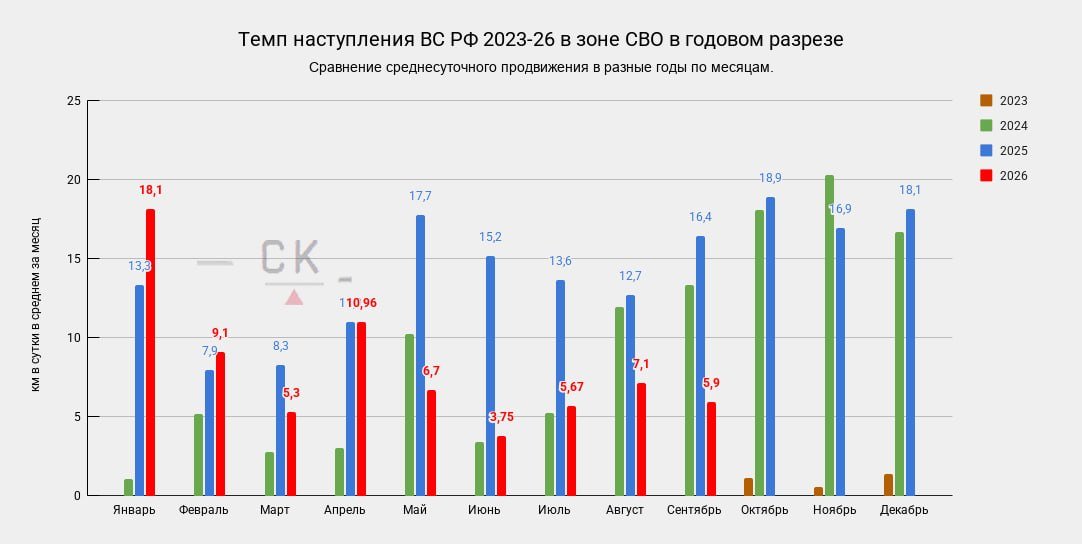
Russia is making no progress at all on the front, and September was among its worst months. Russian president Vladimir Putin claimed in Valdai at the beginning of the month that his subjects had captured 1,300 square km of territory in September. This is further evidence that he is either being given completely fabricated figures or is deliberately lying himself.
If Putin were right, his army would have experienced its most successful period since the first two months of the invasion. Defence ministry reports reflect this. Almost every day, they report the capture of more and more villages. In reality, the situation is different. Russian forces became bogged down in every direction even before the rains arrived, and throughout the year they have failed to achieve any operational success that would justify the further hundreds of thousands killed and wounded.
As every month, various analysts have again published their calculations of how the front line moved. Not even estimates from Putin’s own Z channels agree with his figure.
“The average daily rate of advance by the Armed Forces of the Russian Federation in the SVO zone [special military operation] in September 2026 was +5.9 km². The average rate of advance over the entire offensive up to October 2026 is +9.92 km² per day,” Russian project Slivochny Kapriz wrote about September.
It, too, is an unreliable source that regularly overestimates the significance of “flag operations”, but even its data makes it clear that 2026 is lagging significantly behind the previous year.
Even if this author’s figures were correct, the Russians advanced by 177 square km during September’s 30 days, more than seven times less than Putin claims.
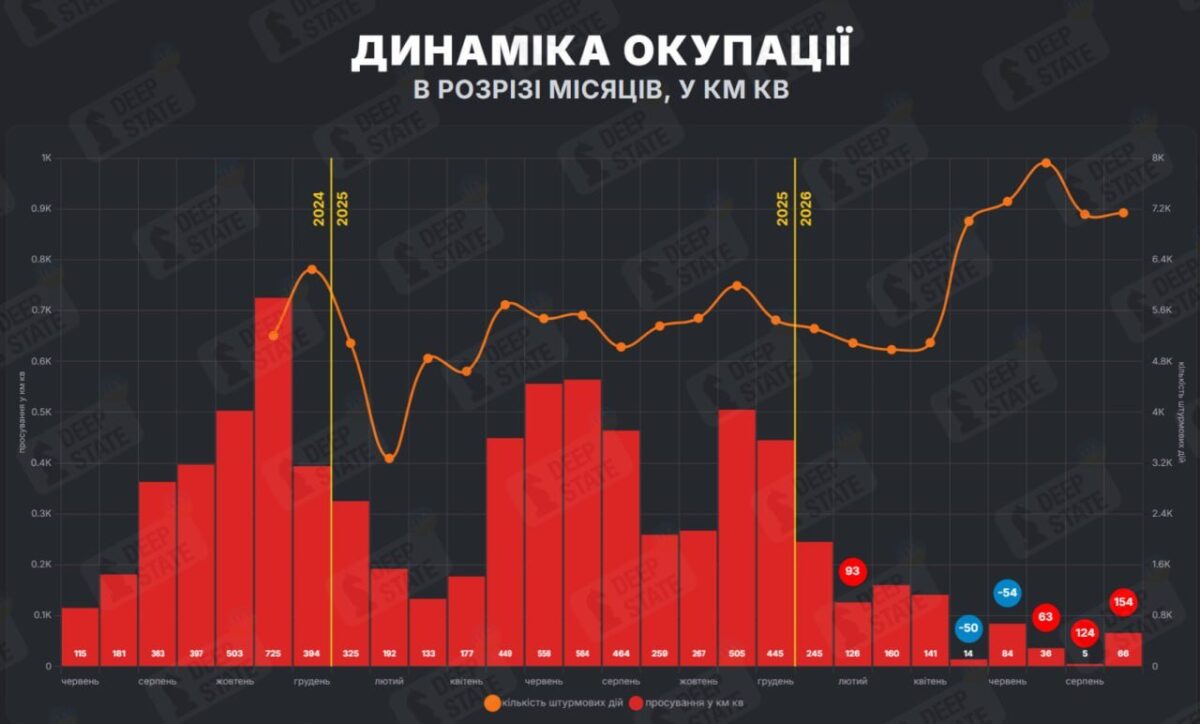
Ukrainians from DeepStateUA also published an estimate very close to Slivochny Kapriz’s figures. According to this OSINT project, Ukraine lost 154 square km in September.
However, the Ukrainian analysts treat their own data cautiously and warn their readers that “the operational security of our forces remains the highest priority in our work”.
In other words, during Ukrainian counter-offensives, DeepStateUA only reports successes after a delay so as not to jeopardise the operations’ success.
They therefore now recall that their statistics do not yet include 270 to 320 square km of liberated Ukrainian territory in various sectors. “July will therefore also end as a month in which the Armed Forces of Ukraine have the upper hand, while for August and September this will only become clear when official announcements of successes are available. In the meantime, part of the liberated territories may be lost again,” DeepStateUA wrote on Friday (2 October).
The most optimistic by far are currently Finnish analysts from the Black Bird Group, who see a balance of 190 square kms in Ukraine’s favour in September.
Over the month of September, the Russian net gains were negative 190 km2. This marks the greatest monthly net territorial loss for Russia in our dataset since the June of 2023.
Emil Kastehelmi, one of the project’s authors, pointed out that the sharp change for the better stems from the fact that it also captures some changes that DeepStateUA has not yet taken into account. Nevertheless, he said: “Russia has failed to reverse a situation that has persisted for almost the entire year. The results of the major Russian offensive are minimal, and this is likely to remain the case for the rest of 2026.”
Among Western analysts, the most sceptical is Konrad Muzyka of Rochan Consulting, who credits the Russians with even more gains than Slivochny Kapriz — as much as 235 square kms of advance. Yet this figure still does not come close to Putin’s. Even if it were the most accurate of all, which cannot be determined, it would amount to an area roughly equivalent to the size of Košice, including all its suburbs, forests and agricultural land within the city’s administrative boundaries.
The plan for this year, meanwhile, was to capture the rest of Donetsk region, including the remaining large cities of Kostiantynivka, Druzhkivka, Kramatorsk and Sloviansk. The Russians are closest to doing so in Kostiantynivka, but Ukrainian soldiers remain there too.
Here is a short summary of territorial changes in Ukraine for September 2026. Our dataset shows an overall Russian territorial gain in September, but a sharply uneven pattern: gains around Dobropillia, Velykyi Burluk, Kramatorsk and Komyshuvakha coincided with substantial losses… pic.twitter.com/jrq0zXiqri
— Konrad Muzyka – Rochan Consulting (@konrad_muzyka) October 1, 2026
Russia wants to cause Kyiv’s economic collapse, and pontoon bridges are being prepared in the city. There is now no doubt that the Russian army has begun a systematic effort to disrupt transport between western and eastern Kyiv. Over the weekend, further drones struck several bridges across the Dnipro.
They included the Northern Bridge, which a Russian drone attacked during the day amid heavy traffic.
🚨 BREAKING: Russian forces launched a drone strike hitting the Northern Bridge in Kyiv, damaging the road surface.
The strike coincides with German Chancellor Friedrich Merz’s unannounced visit to the capital to meet with Ukrainian leadership. pic.twitter.com/j1UHYoBMa7
Ukraine’s transport minister Mykola Kalashnyk said 600,000 cars cross Kyiv’s bridges every day. In an interview with Suspilne, he announced that construction of embankments and pontoon bridges would begin this week. If the existing bridges become impassable, they are intended to maintain as much traffic as possible between the river’s two banks. Kalashnyk said the temporary crossings should have at least half the capacity.
However, this will take around three months; in the meantime, work will also be carried out to improve the resilience of road bridges.
Transport expert Dmytro Bespalov is sceptical. As he said in an interview with NV, Kyiv’s bridges are irreplaceable, and the only thing that can keep traffic moving across the Dnipro is the military.
However, the task of keeping the bridges operational is complicated by their poor technical condition. Because of their age and the lack of maintenance funding, Bespalov rates the Southern and Northern bridges at four on a scale of one to five, where one is ideal condition and five is emergency condition. He says two other bridges are at level five.
Even in this condition, such large structures are not easy to destroy, but they are certainly more vulnerable. Like many others, Bespalov believes that Russia lacks the means to destroy the bridges completely and is seeking to disrupt traffic during the winter. “The aim is probably an economic blow. I fear it will be very painful. It will not kill us, but I am very concerned about the economic consequences it will have,” he added.
Air defences neutralised 83 percent of drones launched in September, compared with 92 percent in May. This follows from data by the Shahed Tracker project, which recorded 6,732 Russian drones launched against Ukraine over the month, of which 5,561 were shot down or disabled through electronic jamming.
Shahed type OWA-UAS stats Sep2026 [per UA Air Force Reports]
As the same source’s chart for August shows, the effectiveness rate did not change, but the number of drones launched by Russia rose sharply month on month by almost 1,600.
Shahed type OWA-UAS stats Aug2026 [per UA Air Force Reports]
In May, when Russia used a record 8,150 drones, it was as high as 92 percent. At that time, the Russian army began a mass transition to jet-powered drones, leading to a temporary slowing of the pace of attacks. The trend is now unfavourable: monthly attack statistics have begun to rise sharply, while the effectiveness of countermeasures is declining, as Geran-4 drones and especially Geran-5 drones still present a serious problem.
Shahed type OWA-UAS stats May2026 [per UA Air Force Reports]
Total: 8150 (New Record) Claimed Intercepted: 7476 (Official: 5053 Shahed type OWA-UAS) Hits: 508 (674 Not Intercepted) Interception Rate: ~92%
As another video showing the moment a Geran-5 was hit demonstrates. Technical solutions already exist, but faster interceptor drones are not yet available in sufficient numbers.
Another Geran-5 drone shot down by a STING S interceptor drone from Wild Hornets. Combat work by pilots of the 1020th ZRP. pic.twitter.com/kkPHaCIrKG
One TM-62 anti-tank mine contains seven and a half kilograms of explosives. This is enough to destroy the remains of a building used as a shelter by Russian soldiers.
❗️A Ukrainian heavy Baba Yaga-type drone destroys a building with Russian soldiers inside by dropping a TM-62 anti-tank mine. pic.twitter.com/XClgIqMvwe
A video recently circulated online showing Kyiv residents protesting against tree felling. It was widely used as alleged evidence that Ukrainians have had enough of the government. However, their protest was civic, not political. These Muscovites are communists and dared, very timidly, to chant “Down with the tsar!” Police intervened immediately.
У Москві комуністи зібралися на погоджений мітинг, почали скандувати «Долой царя», і після цього їх побили й розігнали мусора. pic.twitter.com/MD6MVxSBPS
This video must be watched with the sound on. It illustrates the saturation of the battlefield with drones. The Russian soldier who recorded it says he counted five drones.
"I’ve already counted five. It’s a damn swarm." position of 🇷🇺1199th Motorized Rifle Regiment (probably occupied south 🇺🇦) 🍂 is coming pic.twitter.com/K9H3wcRdse
Three lines of anti-drone barriers protect the Kerch Bridge, which links Crimea to Russia, from attacks from the sea.
Exilenova+ says Russia has set up layered defenses around the approaches to the Crimean Bridge, with multiple lines against Ukrainian surface and underwater USVs plus FSB patrol ships. The stated aim is to shield the bridge’s vulnerable elements. pic.twitter.com/rxMPPe6gXW
By Monday (5 October), Russia had verifiably lost 24,170 pieces of heavy equipment (24,138 on Tuesday, 22 September). Of these, 19,133 (19,105) were destroyed by Ukraine, 1,003 (1,000) damaged, 1,194 (1,194) abandoned by their crews and 2,840 (2,839) captured by the Ukrainian army. This includes 4,452 (4,448) tanks, of which 3,357 (3,353) were destroyed in combat.
Ukraine lost 12,238 (12,175) pieces of equipment, of which 9,633 (9,579) were destroyed, 711 (702) damaged, 695 (695) abandoned and 1,199 (1,199) captured. This includes 1,466 (1,464) tanks, of which 1,126 (1,125) were destroyed in combat.
Note: Neither side regularly reports on its own dead or destroyed equipment. Ukraine publishes daily figures for Russian casualties and destroyed equipment, which cannot be independently verified. This overview uses data from the Oryx project, which has compiled a list of equipment losses documented exclusively by photographs since the beginning of the war.
Flávio Bolsonaro surprisingly topped the polls in the first round of Brazil’s presidential election on Sunday (4 October), making him the favourite to topple President Luiz Inácio Lula da Silva in the run-off in three weeks.
The result is the latest in a series of strong performances by far-right candidates in Latin America. US president Donald Trump has been particularly invested in Brazil.
Despite lagging behind in most pre-election polls, senator Flávio Bolsonaro (45), the son of former president Jair Bolsonaro, won around 47 percent of the vote, with votes from more than 99.9 percent of districts counted. Bolsonaro was strongest in the country’s southern states.
President Lula took 45 percent, after performing strongest in Brazil’s north-east, and advanced to the second round, to be held on 25 October.
Latin American experts believe thatBolsonaro will likely win the second round as most of the candidates who failed to reach the runoff are ideologically closer to him than Lula.
Although voting is compulsory in Brazil, one in five of eligible voters did not take part in the first round.
This year’s election has been widely described as one of the most significant in modern Brazilian history, its outcome exceptionally important for the United States and Europe. It is also key for the rest of the planet, given the global impact of deforestation in the Amazon rainforest.
Conservative forces aligned with Bolsonaro also made gains in the elections to Congress. Jair Bolsonaro’s wife Michelle won a senate seat. She had previously fallen out with Flávio but the two have since publicly reconciled. And the former president’s son Carlos Bolsonaro also won a seat, while another son, Jair Renan, was elected to the lower house of congress.
Trump’s stake in Brazil
Though the campaign focused primarily on domestic issues, particularly the economy, security and corruption, Trump’s influence loomed large.
Trump criticised Brazil’s judiciary when Jair Bolsonaro was sentenced to 27 years following an unsuccessful attempted coup after he narrowly lost the 2022 election to Lula. The former Brazilian president is under house arrest due to health problems, and a court ruled he could not stand.
The US president described the trial of Bolsonaro as a “witch hunt”. Although Trump did not openly endorse Flávio Bolsonaro, Bolsonaro played up his ideological proximity to him.
In contrast, Lula sharply criticised Trump and built a reputation as a leader unafraid to stand up to Trump. Americas Quarterly editor Brian Winter said some in Brazil joke that Lula’s most effective surrogate is Trump.
Luiz Inácio Lula da Silva delivers a speech after learning the official results election on Sunday (4 October).
Lula is known for his multipolar foreign policy. He seeks “pragmatic relations” with the US, China, Russia and others. Lula maintains friendly relations with Vladimir Putin, although he recently spoke out against the invasion of Ukraine.
If Bolsonaro were to win the second round, Brazil would probably join a coalition of countries conducting military operations against drug cartels alongside the Pentagon. It is a controversial initiative, and like other left leaders in the region, Lula has rejected it.
This article continues, but the full version is available only to EUobserver.com subscribers. Visit account.euobserver.com/membership
EUobserver is proud to have an editorial partnership with Europod to co-publish the podcast series “Briefed” hosted by Léa Marchal. The podcast is available on all major platforms.
Find the full transcript below:
Germany shut down its last nuclear power plants in 2023, bringing Angela Merkel’s nuclear exit policy to its conclusion. But now, nuclear power is making a strong comeback everywhere in Europe. Will Germany return to nuclear policy?
Until now, German chancellor Friedrich Merz had been reluctant to bring the nuclear topic on the table, partly because there was no agreement within his coalition. He has even said that Germany’s nuclear phase-out was irreversible. But that position is not shared by everyone in his own party.
And as support for the far-right AfD (Alternative for Germany) grows — a party that is strongly in favour of nuclear power — nuclear energy is becoming less politically taboo in Germany.
According to a non-public document sent by Berlin to other EU member states and reported by the media Euractiv (currently Rapporteur), the German government wants nuclear energy to be taken into account when the EU sets its climate targets for 2040.
For now, those discussions focus on renewable energy. Germany is not proposing to abandon renewable-energy targets, but rather to leave room for other low-carbon technologies, including nuclear power and carbon capture.
The logic is similar to the debate over the EU’s 2035 target for new cars: the overall objective remains, but countries could have more flexibility over how they achieve it.
And that proposal is likely to be welcomed in France. But could they convince a majority of EU countries? The picture across Europe is changing.
Many EU countries already operate nuclear power plants, while others are building new reactors or considering a return to nuclear. Italy, for example, is looking to revive a nuclear industry after abandoning nuclear power following the 1986 Chernobyl disaster.
Poland has never operated a nuclear power plant, but it is now developing its first one. And several other countries that currently have no reactors are seriously considering building them.
Only a small group of EU countries remain opposed to developing nuclear power, including Austria, Portugal, Luxembourg and Malta.
So why has nuclear power become more politically acceptable again? The legacy of Chernobyl and Fukushima still matters. But Europe’s energy crisis following Russia’s invasion of Ukraine has also changed the debate.
The shock of soaring fossil-fuel prices has encouraged governments to look for energy sources that can provide electricity without relying on fossil fuels — and nuclear power is increasingly being presented as one of them. Although there are major questions around that argument.
Nuclear power can provide large amounts of low-carbon electricity once a reactor is operating. But building and renovating reactors is extremely expensive and can take decades.
Take France’s Flamanville reactor: its final cost has been estimated at around €23bn , compared with an initial estimate of around €3bn.
There are also questions over nuclear waste, the risk of accidents, and the security of uranium supplies. European countries remain partly dependent on foreign suppliers, including Russia, for uranium.
Russia might not have directly interfered in Latvia’s election, but the vote still showed how the Ukraine war was distorting European democracy.
Latvia’s VDD intelligence service did not detect any of Russia’s classic interference tactics in the run-up to Saturday’s (3 October) vote, such as a spike in disinformation, vote buying, or a manufactured security scare.
The centre-right prime minister Andris Kulbergs retained power with 35.8 percent of the vote, even if coalition-building might take a while.
And voters’ concerns included the cost of living and failing healthcare, in what also sounded normal.
But despite the ordinary appearances, Russia’s war in Ukraine still influenced the election in fundamental ways, in a strange new normal for Europe that most of us had hardly imagined just five years ago.
This article continues, but the full version is available only to EUobserver.com subscribers. Visit account.euobserver.com/membership
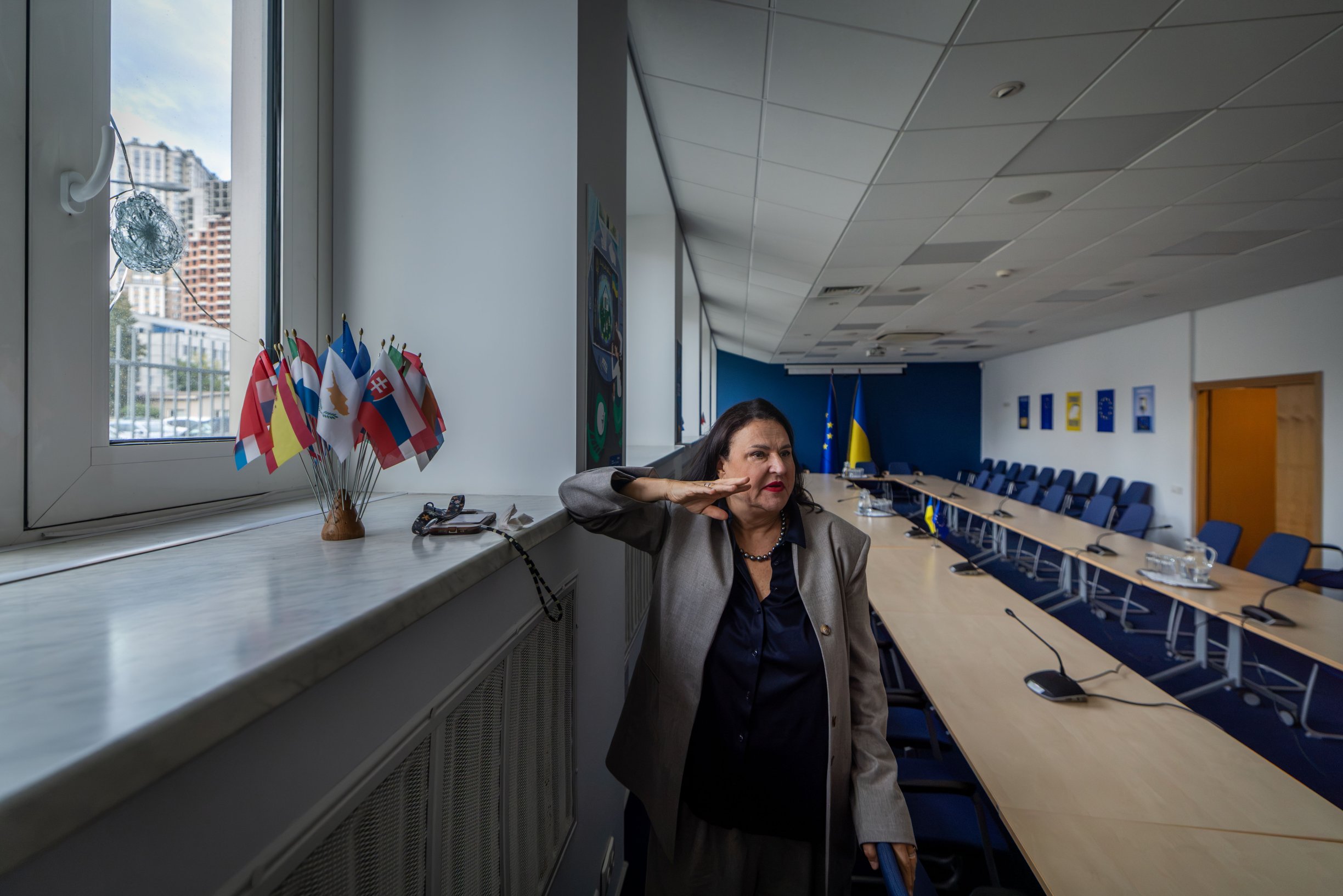
Ukrainians want peace more than anything, but only the language of strength works on Putin, says Katarína Mathernová, the EU’s ambassador to Ukraine.
Mathernová has no doubt about the Russian leader’s ultimate goal; she is convinced that Putin wants to destroy Ukraine.
“He set this out very clearly in his essay, and that is precisely why he launched this full-scale war. Unfortunately, the peace that Ukrainians so desperately want can only be achieved by putting pressure on Russia. Putin understands only one language — the language of strength,” she said in an interview.
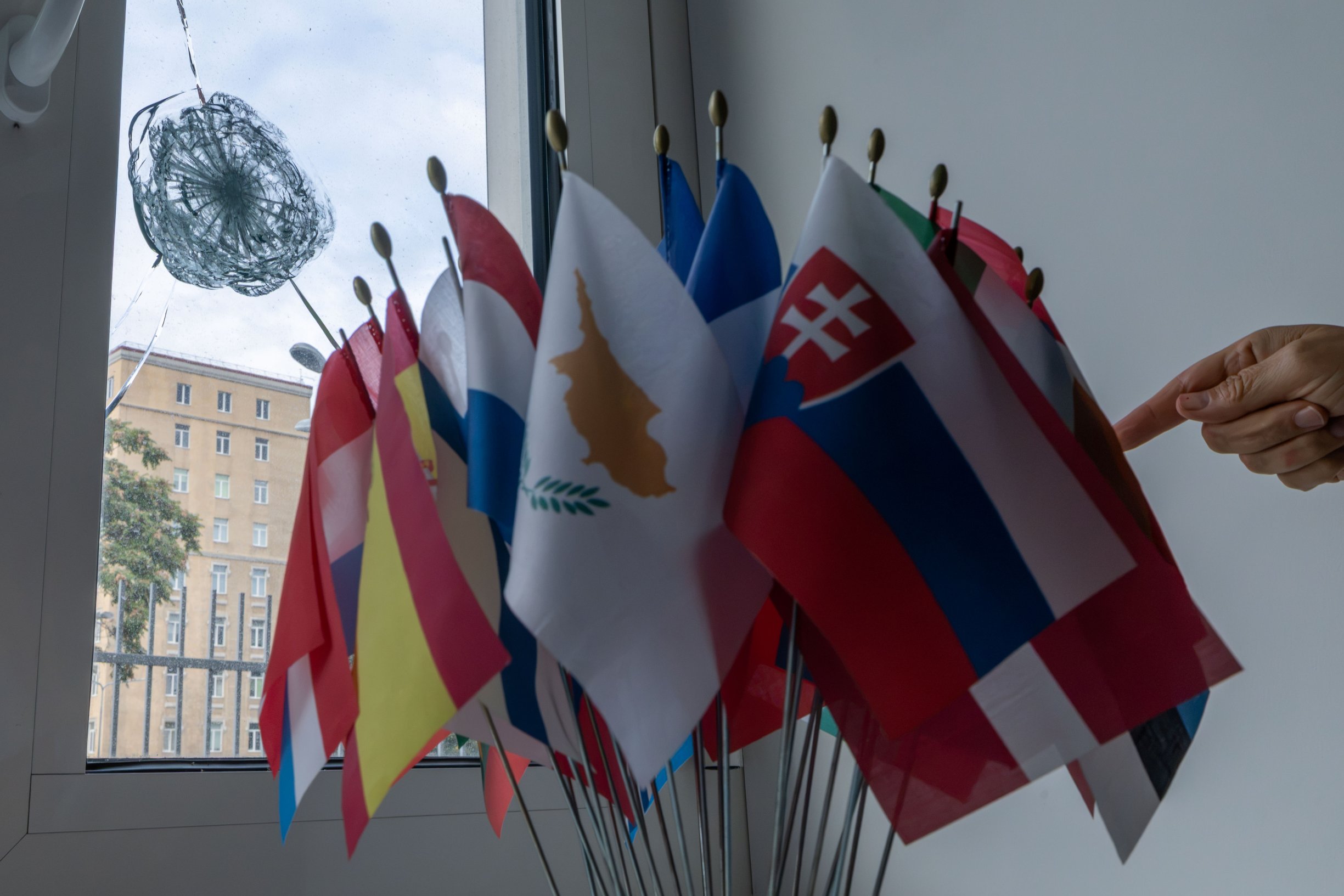
Air raids have left their mark on her office: windows have been blown out, and shrapnel once tore straight through a refrigerator. With attacks intensifying, the EU delegation now does much of its work in the corridor, away from the glass. The latest strikes hit the nearby headquarters of Ukraine’s Security Service (SBU).
In late September, Kyiv has heard so many air-raid sirens. There is already one dead and 20 injured, and on our way to your office, we heard several explosions. Is this the new normal?
Unfortunately, they have become routine. It began on 27 August this year, a date that will go down in the history of this war. That day, we had 13 air raid alerts during daylight hours, a record since the beginning of the full-scale war. It happens every day.
The day before yesterday, as I was entering the office when the windows suddenly began to rattle. A huge plume of smoke rose behind that black building outside the window. There were around four separate explosions over the course of 20 minutes, just a couple of hundred metres from here.
After a Russian attack, in a room with bulletproof windows. Source: Tomáš Benedikovič, Denník N.
The Russians have begun using jet drones which Ukrainians are not yet able to shoot down in the same numbers as earlier Shahed drones. With just a few jet drones, Russia can terrorise a city like Kyiv throughout the day at a relatively low cost. Then, at night, come the ballistic missiles. Last week, however, they also used ballistic missiles during the day.
Do the attacks make you anxious?
Of course they do. One morning last week, I was Nordic walking in the botanical garden. I was walking with my coach when suddenly there was a huge bang. It landed several kilometres away, but because there are no buildings there, it sounded as though it were just around the corner. These are the moments when I nearly have a heart attack…it’s very unpleasant.
How do you decide whether to go to a shelter or into the corridor? Do you have a security protocol?
I have security guards, and we also have a regional security officer here. They are here permanently, so they guide us. But since these very frequent and disruptive daytime attacks began, the government has adopted a regulation introducing two different types of alert — yellow and red. Red alerts are issued for missiles. Yellow alerts are for drone attacks – in such cases, the metro no longer stops, and people primarily seek safety between two walls. When there were explosions here last Wednesday, we were all sitting in the corridor.
Katarína Mathernová. Source: Tomáš Benedikovič, Denník N.The corridor where diplomats work during heavy air raids. Source: Tomáš Benedikovič, Denník N.
On the ground floor, where we have our conference rooms, there are bulletproof windows. We are now going to adapt the ground floor so that we can operate safely there during anti-drone alerts. We will put sandbags outside. We already have beanbags there, and colleagues from the upper floors are moving down so that they can work.
How do you assess this intensification? Is it a response to the fact that the front has stalled and Putin’s “special operation” has boomeranged back on Russians at home?
Russia cannot win on the battlefield. They have managed to gain only a few square kilometres, so they are terrorising civilians by attacking targets such as churches, museums, libraries and book warehouses. On Thursday, they hit a maternity hospital. These are war crimes, but Russia commits them so routinely that they are boiling us like a frog.
There is talk that assaults will escalate further in winter. Will you stay?
Of course, we are staying here. When we speak to the diplomatic corps, everyone wants to stay. We are preparing for winter, stockpiling supplies, and here at the delegation we have bought blankets and folding beds. We have food rations and additional supplies of drinking and utility water. We have had several shower cubicles installed. We bought washing machines and dryers too, as the building has a large generator. Our colleagues from Brussels and Ukraine in the same building — many of whom live on the other side of the river or in conditions that are not as good as ours — will probably welcome these facilities.
Attacks have come dangerously close not only to where you work, but also to where you live, like a recent drone struck an SBU building.
It was targeting that location; I do not think Kyiv city centre itself was the target. But yes, it is quite close to the hotel where I live.
What do you anticipate will happen in winter? You may see attacks on energy infrastructure, water and sewage systems. A loss of these utilities would be extremely difficult.
If sewage systems were knocked out in a large part of the city, it would be very difficult. But let us not forget that Kyiv was also a frontline city last winter. There were perhaps more than one million people here freezing in their own homes. My driver told me that he and his family bought firebricks and heated them on the gas stove. When they went to bed, they held them to keep warm. Those without gas in their flats were even less fortunate. But people here helped one another. My coaches and their son stayed in my hotel for weeks because it was four degrees in their home.
Ukraine faces a shortage of Patriot missiles. It has developed a new interceptor that could stop jet drones, but Patriots defend against ballistic missiles. Can Europe do more to help?
This article continues, but the full version is available only to EUobserver.com subscribers. Visit account.euobserver.com/membership
Luiz Inacio Lula da Silva, the 80 year-old president of the world’s fifth largest country, is facing a tight race in a bid for his fourth presidential term in Brazil’s general elections on Sunday (4 October). The EU, which earlier this year concluded a landmark trade deal with the Mercosur bloc, which includes Brazil, will be watching the polls closely.
He holds a narrow poll lead over Flávio Bolsonaro, son of the country’s former president Jair, who is currently serving a 22 year prison sentence for staging a coup against Lula’s newly formed government in 2023.
The left-wing leader’s third term, won by with a slim 50.9 percent majority in 2022, distinguished itself for leading anti-deforestation policies and getting the EU-Mercosur trade partnership across its long-awaited finish line, 26 years after negotiations started.
Though Brussels suspended animal product imports from Brazil on 3 September, due to insufficient guarantees of antibiotic regulation compliance, “President von der Leyen commended President Lula’s role and political leadership in the negotiations leading up to the agreement,” the EU commission said in a statement.
The Mercosur deal marked a historic diversion of EU energies South of the Rio Grande river, at a time when Europe and Latin America were both being bombarded by tariff threats from Washington.
The Bolsonaros’ professed support of US president Donald Trump have critics worrying “this election could have major implications for the direction of Brazil’s foreign policy, its global influence,” wrote Dr. Christopher Sabatini, Latin America director at the Chatham house think tank.
Election interference by the US was discussed throughout Lula’s campaign, most notably with Meta disabling his Facebook ads just days before Brazilians went to cast their votes, state-run Agência Brasil reported on 25 September.
At a time when virtually every other democracy on the South American continent has pivoted to the right, a win for a Brazilian Trump enthusiast and supporter of environmental commodification would be a setback for the EU’s climate ambitions.
“A Flávio Bolsonaro government would represent a much stronger geopolitical alignment with Washington and the Trump administration. That could affect climate cooperation, deforestation policy, critical minerals and European access to Brazilian commodities and industrial partnerships,” said Eduardo Raguse, climate co-coordinator at NGO network Friends of the Earth Latin America.
Brazil’s climate observatory recorded its biggest annual fall in emissions in 15 years, with a 16.7 percent reduction in 2024 from the previous year, largely due to a drop in forest clearance in the Brazilian Amazon, which was halved over Lula’s third term.
But Lula has been simultaneously expanding Brazil’s national petrol company’s drilling area into the Amazon’s depths.
“Lula’s government has increasingly framed critical minerals as an issue of national sovereignty and industrial policy,” Raguse told EUobserver, since the Workers’ party leader has referred to Brazil’s petrol reserves as its “passport for the future.”
But along a global pivot to the right, a win for Bolsonaro’s heir or Lula’s renewed interest in fossil fuel politics would not stray too far from the EU’s current conservative climate script, and according to Socialist and Democrat MEP Leire Pajin, will mean little for EU trade.
“Whoever wins the election in Brazil, the EU-Mercosur relationship goes far beyond electoral cycles or trade,” the Spanish vice-president of the Euro-Latin American parliamentary assembly told EUobserver. “Governments may differ in priorities or pace, but the agreement transcends them.”
In a sign of humble progress, the FP-7 ballistic missile saw its first deployment.
Russian forces are now attacking Kyiv’s bridges.
No resolution to jet-powered Geran drones with new threat is on the horizon.
Ukraine lost another MiG-29 and its pilot, while Russia has lost a Mi-8 helicopter with a crew of three.
Videos of the day: attacks on a bridge in Kyiv; a drone struck a school full of children and teachers; a ground drone recorded the impact of two glide bombs.
FP-7 ballistic missile made in Ukraine were deployed for the first time. This is progress, but one should not expect miracles.
“Ukrainian tactical ballistic missile. FP-7. First combat deployment. Thank you for the results. Next step: serial production. Glory to Ukraine!” With these words and a short video, Ukrainian president Volodymyr Zelensky announced a long-awaited milestone in Ukraine’s arms programme. The next step is expected to be the deployment of the larger and more dangerous FP-9 missile.
Ukrainian tactical ballistic missile. FP-7. First combat use. Thank you for the result. Next up: production. Glory to Ukraine! pic.twitter.com/IxdjVg51c1
— Volodymyr Zelenskyy / Володимир Зеленський (@ZelenskyyUa) October 1, 2026
For now, however, this was only its first deployment against an unknown target, with an unknown outcome. The Russian analytical channel Military Informant did not rule out the possibility of the footage being recorded at a training ground with the intention to deflect criticism of Fire Point, the Kyiv-based manufacturer whose production is behind schedule.
The FP-7 missile is an interesting technical achievement that could expand the Ukrainian army’s ability to strike important targets. Expectations should be kept low. This is because the missile has not yet entered serial production its specifications lag behind those of Russia’s short-range Iskander missiles.
The FP-7 is based on the Soviet-origin 48N6 surface-to-air missile, used in some versions of the S-300 system and still deployed by Russia in the more modern S-400. A Ukrainian outlet says that the FP-7 has an estimated range of only 200 km and a warhead weighing up to 150 kg.
Russia’s Iskander missiles weighs more than twice as much, and Russia has already used a version with an extended range well beyond 500 km. The Ukrainian FP-7’s use will therefore be limited to areas up to roughly 100 km from the front line. It is certainly not a means for strategic strikes against Russian industry deep inside enemy lines.
Ukraine could strike further with a FP-9 missile, and developing them remains a goal to work towards. The two types of missile differ significantly. They were analysed in August by the Russian Telegram channel Russian Engineer. The FP-7 is smaller and the FP-9 larger. Its maximum range is estimated at 855 km (far enough to reach Moscow,) its warhead is expected to weigh up to 800 kg.
The outlet focusing on the war’s technical parameters compared the Iskander with the FP-9:
“The 9M723 Iskander-M missile has a diameter of 920 mm, while the FP-9’s is 1,100 mm. The missiles are 7.2 and 9.5 metres long. The solid-fuel rocket motor is approximately 4.2 metres long in the 9M723 and 6.5 metres in the FP-9. Fuel mass is estimated at 2.6 and five tonnes. With a warhead weighing around 500 kg, calculations indicate ranges of up to 500 km and 1,000+ km. If the warhead weighs around 800 kg, the range will be approximately 800 km.”
The media’s performance estimate therefore matches official Ukrainian data.
According to the Russian Engineer Telegram channel, the FP-9 is conceptually based on the Iskander and builds on the Ukrainian Sapsan project, which was never brought to the final stage.
The Ukrainians displayed both missiles at a trade fair in Denmark in August, where the following photographs were also taken:
The Russians have started attacking Kyiv’s bridges. This fulfils the wishes of Russian pro-war hawks, who for years have complained that bridges in the capital of the invaded country were still standing.
This article continues, but the full version is available only to EUobserver.com subscribers. Visit account.euobserver.com/membership
Cette semaine, Caroline De Camaret reçoit Maciej Witucki, président de BusinessEurope depuis le 1er juillet 2026. Plus grande organisation patronale d'Europe, BusinessEurope représente plus de 40 fédérations patronales nationales issues de 35 pays. Polonais de nationalité, il dresse avec nous un bilan du paysage entrepreneurial européen, de ses défis et de ses pistes d'amélioration.
Il ne fait pas bon prendre sa voiture. Pas à cause des embouteillages, mais à cause des prix de l'essence qui n'ont jamais été aussi élevés en Europe. Dans un contexte géopolitique toujours aussi tendu – au Moyen-Orient et en Ukraine – le coût du litre d'essence bat des records, tout comme celui du gazole.
Il ne fait pas bon prendre sa voiture. Pas à cause des embouteillages, mais à cause des prix de l'essence qui n'ont jamais été aussi élevés en Europe. Dans un contexte géopolitique toujours aussi tendu – au Moyen-Orient et en Ukraine – le coût du litre d'essence bat des records, tout comme celui du gazole.
More than a year ago, we launched our Hungary Briefing, a weekly round-up of the election campaign. Since the historic vote in April to remove Viktor Orbán, the series has followed the new Tisza government and its first moves in office. This week’s topics:
Two ministers from Orbán’s government have been held in custody.
Former prime minister Orbán may have ordered the detention of Ukrainian cash couriers.
The newly established National Asset Recovery and Protection Office has begun work.
The European Public Prosecutor’s Office could also help recover stolen funds.
It has been an eventful few days in Hungarian public life. Efforts to hold former officials accountable are gathering pace: two former ministers have been remanded in custody over suspected breaches of fiduciary duty involving billions of forints and the acceptance of bribes.
The National Asset Recovery and Protection Office (NVVH) immediately took over four cases and began investigating them, including the visa business linked to Orbán’s brother. Meanwhile, a chief prosecutor who resigned from his post claimed in an open letter that Orbán himself had ordered the detention of Ukrainian cash couriers.
Prime minister Péter Magyar addresses parliament as MPs vote to lift his immunity, Budapest, 28 September 2026 (Srouce: Zsolt Szigetváry/EPA)
Two ministers from Orbán’s government have been held in custody
“The landing is beginning as part of ‘Operation Purgatory’,” prime minister Péter Magyar announced on Monday (28 September) morning. Later that morning, Hungary’s parliament lifted the immunity of Miklós Seszták, an MP and former development minister from the Christian Democratic People’s Party (KDNP); Balázs Hankó, an MP and former culture and innovation minister from Fidesz; and prime minister Magyar.
Prosecutors requested that Hankó’s immunity be lifted on suspicion of breach of fiduciary duty: he is suspected of causing losses of 17 billion forints (€46.5m) to the state budget. Authorities are investigating Seszták on suspicion of accepting bribes and other offences. The former minister and the then chief executive of Hungarian National Asset Management are suspected of receiving approximately 12.6 billion forints (€34.2m), in bribes through an intermediary between 2015 and 2018.
Magyar himself requested the lifting of his own immunity after the deputy prosecutor general asked the speaker of parliament to initiate the procedure over an incident in June 2024. According to the Office of the Prosecutor General, Magyar deliberately dropped the phone of a man filming him into the Danube, an act it classifies legally as theft.
After the vote on his immunity, Seszták went to the Central Investigating Chief Prosecutor’s Office, where he was taken into custody. He said he had committed no crime and wished to give a statement. On Wednesday, a court ordered the former minister’s remand in custody.
Hankó initially waited in the Fidesz parliamentary group’s office for police to take him away. Under the rules, however, he should have presented himself at the Central Investigating Chief Prosecutor’s Office.
Under the Act on the National Assembly, police may enter the parliament building and take action there only with the speaker’s specific permission, while the Parliamentary Guard may neither forcibly bring him before the authorities nor take coercive measures against him. Parliament speaker Ágnes Forsthoffer therefore firmly called on Hankó to leave the building and cooperate with the investigating authorities.
Hankó subsequently held a press conference with his wife and children present, claiming that he was the target of a politically-fabricated case and declaring his innocence. He finally accepted the summons at 7.20 pm and left parliament, setting off to give a statement amid carefully-staged scenes. Orbán’s social media page live-streamed the entire episode (while the Fidesz leader was in Belfast cheering on Hungary’s national football team).
In a statement, prosecutors said that Hankó and his associates had used National Cultural Fund resources for purposes other than those prescribed by law on 1,079 occasions between 3 September 2025 and 30 March 2026.
This article continues, but the full version is available only to EUobserver.com subscribers. Visit account.euobserver.com/membership
The EU has played down claims by the Dutch government that the bloc’s decision to suspend aid support for Sierra Leone was because the west African country refused to extradite one of the world’s most-wanted drug traffickers to face trial in the Netherlands.
Speaking on Thursday, (1 October) after a meeting of EU justice ministers in Luxembourg, migration commissioner Magnus Brunner told reporters that the decision to suspend support was made for “technical reasons” — but without giving more detail.
Sierra Leone was allocated €352m in EU funding between 2021 and 2027, under the bloc’s seven-year budget framework. The country was set to receive €18m from the EU this year.
But Dutch justice minister David Van Weel insists that the suspension of funds is the result of months of pressure from the Dutch government to persuade president Julius Maada Bio’s government to hand over convicted Dutch drug trafficker Jos Leijdekkers.
This article continues, but the full version is available only to EUobserver.com subscribers. Visit account.euobserver.com/membership

 Login