EU interior ministers on Thursday (1 October) in Luxembourg are now set to formally adopt the return regulation, which sets the legal framework for police to carry out raids and seize people’s “belongings, electronic devices, and other items of relevance.”
The logic is part of a maximalist effort to deport people, such as failed asylum seekers, back to their home countries or possibly even in yet-to-be defined transit centres in Rwanda or elsewhere.
The regulation targets anyone “for the purpose of preparing or ensuring an effective return” with raids being allowed in a “place of residence or other relevant premises.”
Although the item is but a mere footnote in Thursday’s agenda, the potential consequences of the law have roused alarm among civil rights organisations who continue to draw parallels with ICE.
The comparison is not alarmist.
This article continues, but the full version is available only to EUobserver.com subscribers. Visit account.euobserver.com/membership
The Ukrainian army stays in control of front lines, but safety in cities deteriorates.
Kyiv was on fire again as Russian attacks on cities intensify.
Rubikon published stats on destroyed Ukrainian drones, decoys being the second most prominent.
Russia’s defence ministry will not let go of the Armata: it wants to turn it into an air-defence system, drawing ridicule.
Maps of the day: Sloviansk-Kramatorsk direction; Orikhiv direction, Oleksandrivsk direction, Kupiansk direction.
Videos of the day: a burning Tu-95MS strategic bomber; a Ukrainian firefighter showed how they extinguished the Academy of Sciences building.
The Ukrainian army stays in control of front lines, but safety in cities deteriorates. The war has reached a stage in which two separate conflicts appear to be taking place simultaneously.
While Ukraine is currently losing the battle in the air and its cities are continually suffering missile and strikes by jet drones, the situation on battlefields is far better.
Last week, Denník N spent time in Ukraine with former chief of the general staff Daniel Zmeko. During the trip, reporters met commanding officers from several brigades and battalions operating from the Izium area to Zaporizhzhia, and all of them said they had the situation under control.
The officers spoke about the accuracy of Russian maps, which they said did not correspond to reality. In some places, Russian soldiers are as far as 20 km from the locations where, according to the Kremlin, they are supposed to be.
Northern flank of the Sloviansk-Kramatorsk agglomeration: This is a specific section of the front where the Ukrainian army has been reporting its advances only very slowly, while Ukrainian analysts have remained silent so as not to disclose anything sensitive. Russian bloggers, by contrast, are depicting the situation more closely to reality.
Yet official Russian maps persist with utterly nonsensical lines. We do not know to what extent this is an effort to deceive domestic and foreign audiences, and to what extent they genuinely believe it in Moscow. It is worth looking at how the regime wants the situation to appear, and what it is really like.
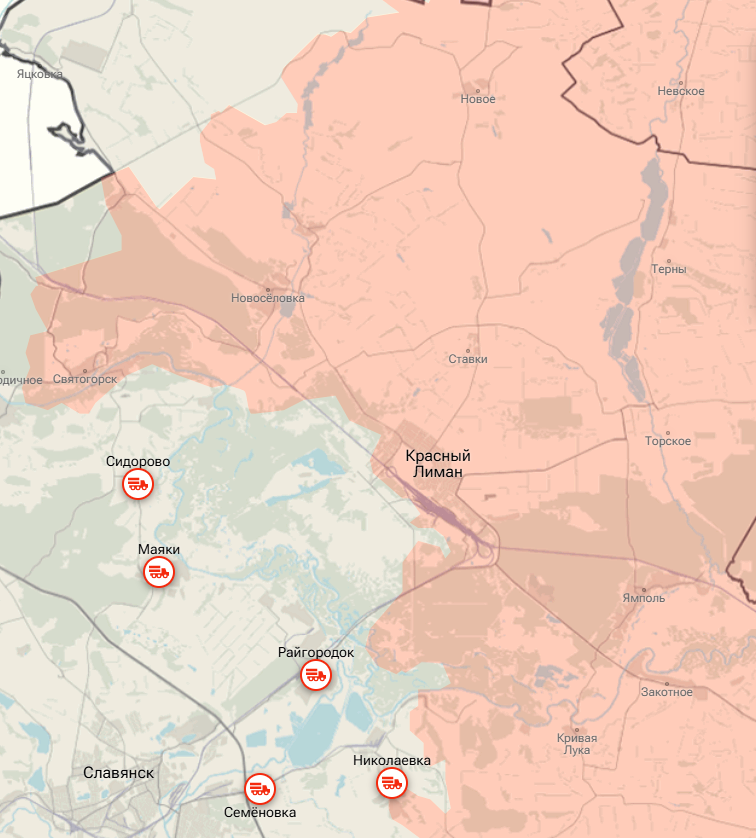
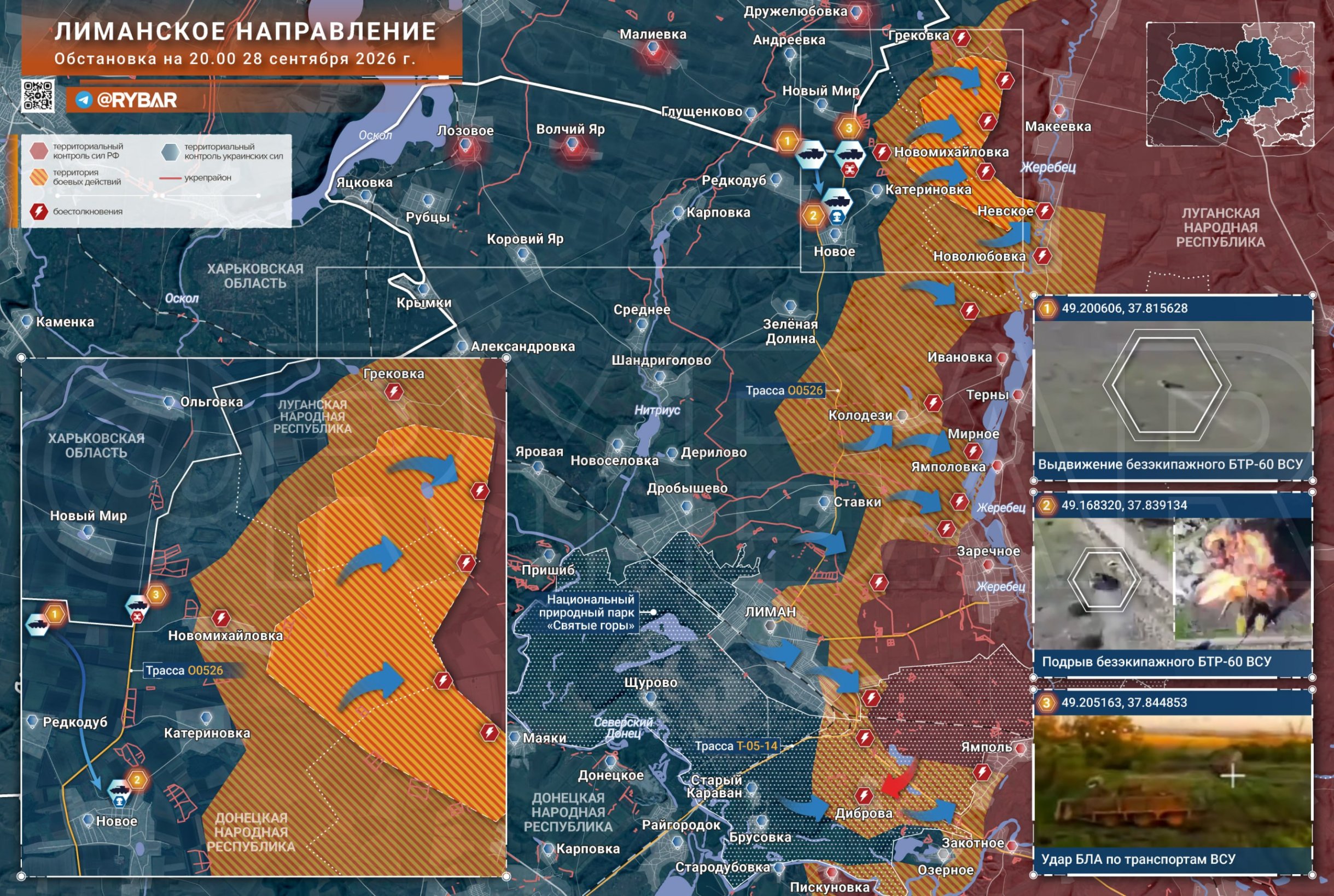
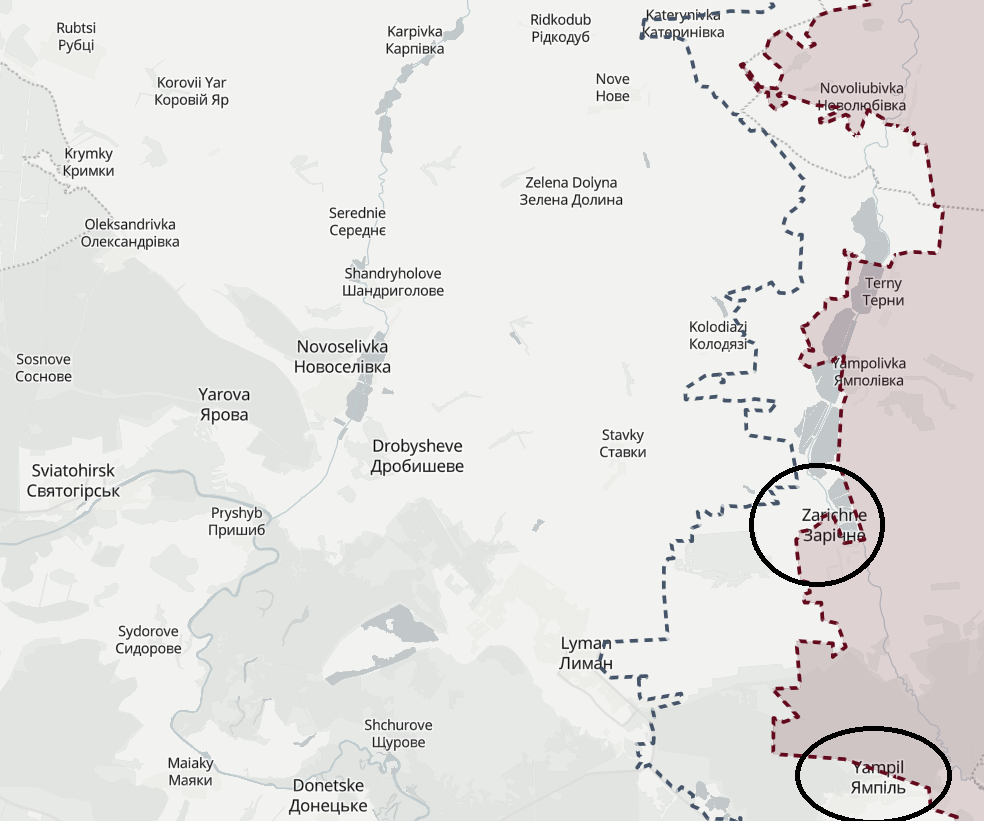
The first map in the overview was produced by the Russian state news agency RIA Novosti and depicts the area around Lyman, on the northern flank of the Sloviansk-Kramatorsk direction, as of 29 September. Lyman is shown as occupied in the middle of the map. The map’s author also continues to insist that the Russian army had captured Sviatohirsk — at the tip of the red salient in the centre of the map — and that Russia controls the entire, now non-existent salient with the village of Novoselivka at its centre. Yet Russian outlets Rybar and Two Majors write that fighting is taking place on the Zherebets river around the villages of Terny — on the far right of the map — and Yampil.
The following map is much closer to reality. According to it, the front line roughly follows the Zherebets river, which corresponds to Rybar’s claims.
In the Lyman direction, in Donetsk region, Ukrainian defenders successfully repelled three attempts by the russian fascist invaders to advance near the settlements of Ridkodub, Novoselivka and Drobysheve.
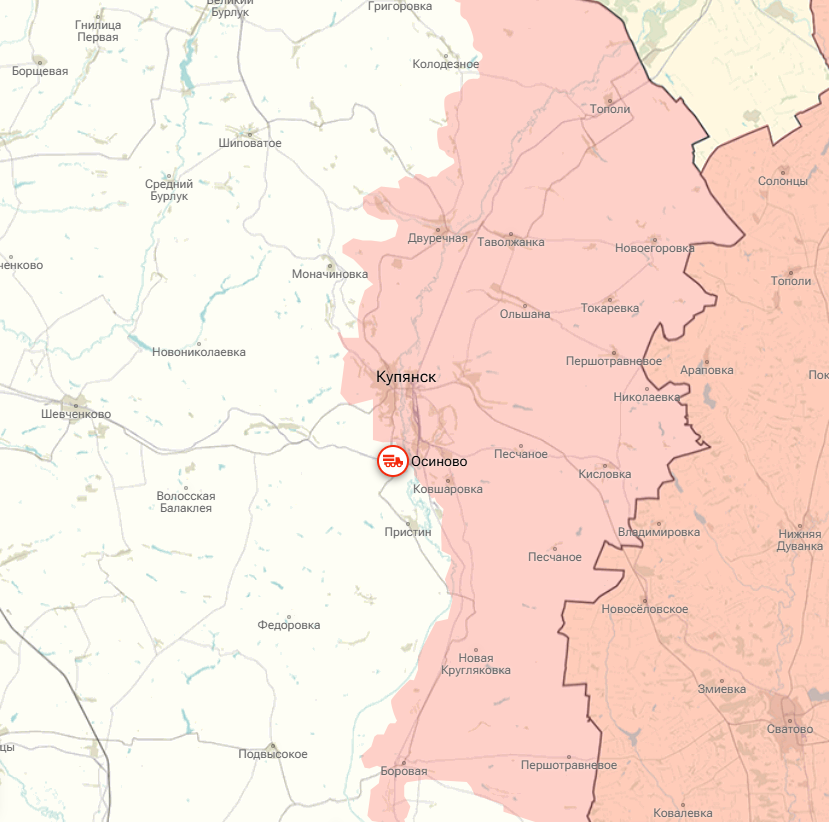
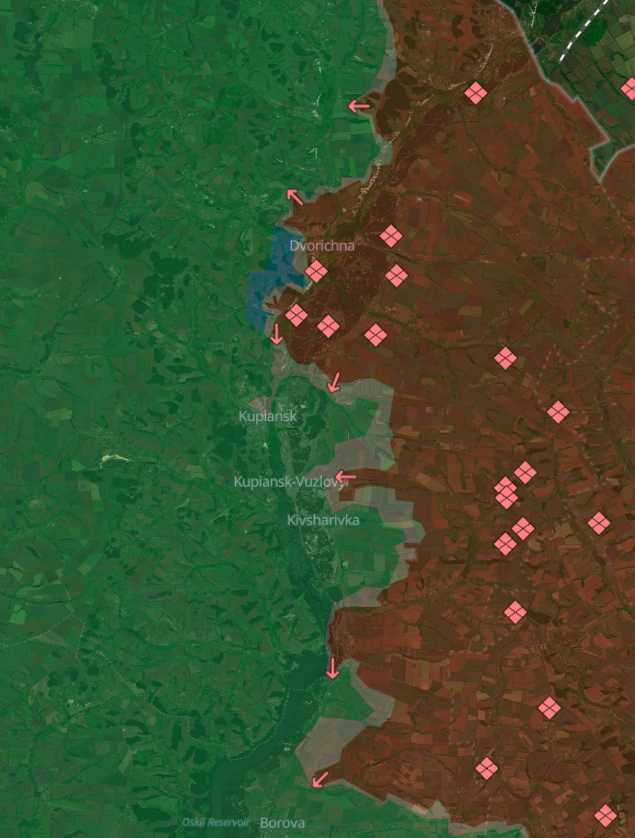
Kupiansk direction: The city of Kupiansk is a similar case to Sviatohirsk. Putin declared it captured in August last year. And once the commander-in-chief had declared this, his news agency continued to draw the map as though it were true. Kupiansk is shown as occupied in its centre, but there are further inaccuracies.
For example, the Kremlin agency claims that the Ukrainian bridgehead on the eastern bank of the Oskil river south of the city no longer exists. Ukrainians do face major difficulties supplying it, and various analysts have repeatedly warned of an impending disaster, but the Russian map is nevertheless hopelessly inaccurate.
Also note the small town of Borova at the bottom centre. RIA Novosti also shows it as occupied, although this is not the case.
This time, we will compare the Russian agency’s data with a map by Ukrainian analysts at DeepStateUA, because they updated it on Tuesday to reflect a new advance by Ukrainian units north of Kupiansk — again in the centre of the map — near the village of Dvorichne. In recent weeks, they have succeeded in reducing the Russian bridgehead on the western bank of the Oskil; the change since the end of August is marked in blue. Borova is again at the bottom centre, while below Kupiansk is the Ukrainian bridgehead that Russia claims does not exist.
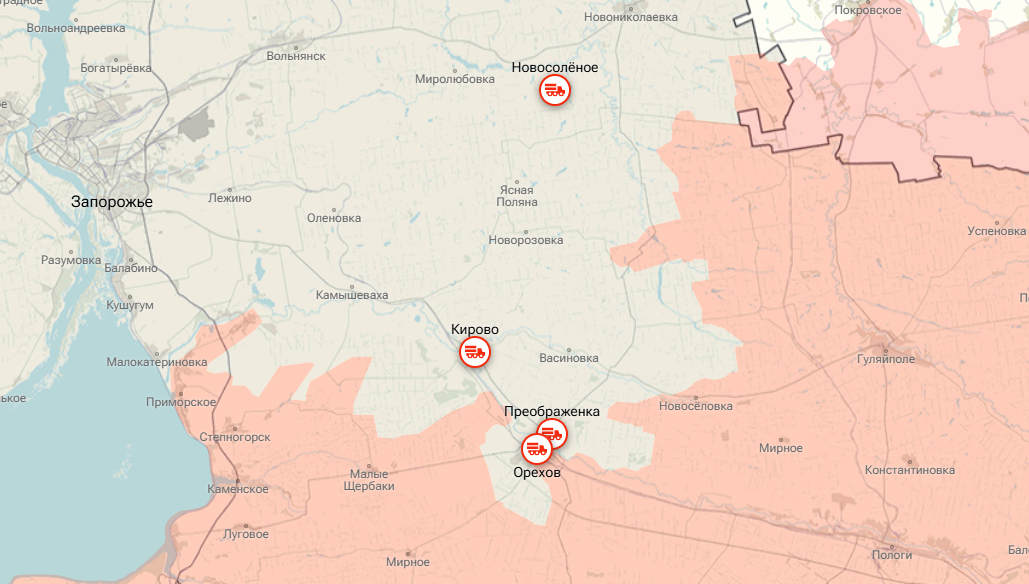
Orikhiv: This is one of the places where Ukrainian officers said during reporters’ trip to Ukraine that Russian maps were particularly inaccurate.
The Russian map is again from RIA Novosti and again ignores reality along the entire length of this section of the front. Its main target is the city of Zaporizhzhia, with a population of three quarters of a million, in the centre left, while the small town of Orikhiv, at the bottom centre, is a defensive hub.
Putin’s news agency places soldiers roughly 12 km from the southern edge of Zaporizhzhia; in reality, they are around 24 km away. It shows Orikhiv as occupied and the Russian army advancing from the east towards the village of Novorozivka, north of Orikhiv.
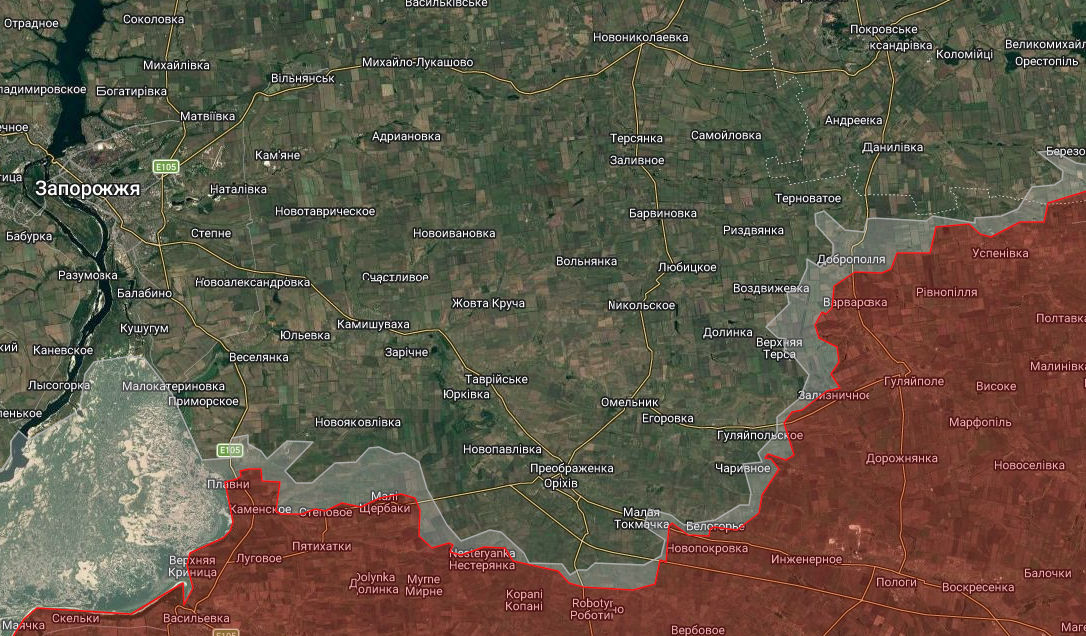
The OSINT project Playfra covers this area in the greatest detail. Its map appears to depict a different war altogether. Everywhere, Russian positions are significantly shifted compared with those shown by RIA Novosti.
The differences have a simple explanation. On the western flank near Zaporizhzhia, the Kremlin agency simply ignores the successful counterattacks carried out by Ukrainians there this year. On the eastern flank, it uncritically accepts every claim by the Russian defence ministry and, with equal lack of scrutiny, considers captured every small village where a Russian soldier raised a flag during a suicidal mission, even several months ago. Although those soldiers have since been killed or captured, RIA Novosti acts as though they still control the village.
Playfra also offers a more detailed view of the current fighting around Orikhiv, drawing on analyses by Ukrainian analyst Kostyantyn Mashovets.
Orikhiv direction.
Factually, no changes. Clearings are conducted constantly, but the Russians also continue to infiltrate: the global situation doesn't change. The stalemate situation that I had reported some weeks ago, as well as the gray zone, remains both actual as of the… https://t.co/6rau9f7wcKpic.twitter.com/5uIK3K78Bm
Of course, Russians too occasionally notice that they are living in a parallel reality. Most recently, the influential Aleksandr Kharchenko wrote about it:
“Comparing our maps with Ukrainian ones can be shocking. The zones of control differ by dozens of kilometres,” he acknowledged, adding that both sides lie, although he focused specifically on false Russian reports.
He described Russian soldiers who are the first to break into a village as heroes. But, according to him, wars are not won through heroism, but through a functioning system.
“Errors in our maps and information arise because they rely on heroes. Everywhere a Russian soldier is sitting is considered our territory,” Kharchenko argued that this had to change because “our territory is only where a Russian soldier is sitting with food, water and ammunition. This is territory from which we can fight the enemy”.
Kyiv was on fire again as relentless Russian attacks on cities intensify. In the capital, Russians particularly targeted energy infrastructure. “Not a single day has passed since the summer without the enemy attacking energy infrastructure. But this is the first such massive and complex attack since the end of the previous heating season,” Ukrainian PM Serhiy Koretskyi told NV.
In addition to causing serious damage, the attacks on Kyiv and other cities killed at least five residents and injured another 14.
President Volodymyr Zelensky also said that, thanks to the delivery of new surface-to-air missiles, five Russian ballistic missiles had been shot down.
Since last night, emergency services and repair crews have been working to address the aftermath of the Russian strike. It was a difficult attack – nearly 190 attack drones, as well as ballistic missiles. And the main target was energy infrastructure in the capital and the Kyiv… pic.twitter.com/wUNWEUdpTL
— Volodymyr Zelenskyy / Володимир Зеленський (@ZelenskyyUa) September 30, 2026
Rubikon published stats on destroyed Ukrainian drones, decoys being the second most prominent. Ukraine’s response is continuing in parallel with the Russian offensive against cities. But the stats currently weigh against Ukraine.
While the effectiveness of Ukrainian air defence has fallen dramatically since the arrival of Russian jet drones, Russia has successfully shot down Ukrainian ones. For example, the recent large-scale drone raid on Moscow involved several hundred drones — and, according to some sources, more than 1,000 — but only 10 penetrated the airspace above the Russian capital.
In this context, the Russian Rubikon unit published interesting statistics. Although it operates at and near the front, its data for September show that, of 827 Ukrainian drones hit, as many as 247 were Maya-type drones — unmanned decoys intended to deceive Russian air defences. They look very similar to FP-1 attack drones but, unlike them, carry no warhead.
For context, the top two most frequently intercepted Ukrainian UAVs by Russian forces are both decoy drones — the “Maya.” This suggests that Ukraine’s deception strategy is working, as the Ukrainian Defense Forces have increasingly begun deploying decoy UAVs to mislead Russian… https://t.co/NKPvbzm38U
Russia’s defence ministry will not let go of the Armata: it wants to turn it into an air-defence system, drawing ridicule. Zvezda News is a media outlet directly controlled by the Russian defence ministry. On Monday evening, it published technical news on the long-forgotten T-14 Armata tank, which Russian propaganda had claimed would revolutionise tank warfare.
Today, it is beyond any doubt that the project is dead and new information confirms this, but its authors presumably intended to convey precisely the opposite.
“Rostec has upgraded the Russian T-14 Armata tank into a short-range air-defence system,” the report stated, citing military expert Oleg Shaladin.
The list of new features appears impressive at first glance. The new version of the Armata has received new electronic equipment; its 125 mm main gun is to be replaced by a 152 mm gun, allowing the tank to fire Kornet anti-tank missiles with a range of 10 km. The new Armata will also be able to use Krasnopol guided artillery shells, which are used by more modern howitzers, while the tank is also to gain the ability to operate as the aforementioned short-range air-defence system.
Further changes have already been made to the project, but even the brief list above makes it clear that the Armata is no longer intended to be a tank, but rather some kind of hybrid capable of fighting everything and nothing at the same time.
Among others, the Russian Telegram channel Military Informant commented on the report, openly mocking it. It said Rostec had mixed together “all the old tales from 10 years ago” in its list of changes, but that in practice “the tank never got beyond parades and training grounds, because it was created for an entirely different war, which ultimately never happened. It became conceptually obsolete from the outset, without even having had the chance to fight”.
Videos of the day
Russia has lost another Tu-95MS strategic bomber. This is the 12th confirmed loss of this type — the Oryx website has not yet updated its figures, so it records only 11. According to available information, the aircraft crashed shortly after taking off from a base in Amur region. Six crew members were reportedly killed, while one survived with injuries. Armed with cruise missiles, the aircraft was probably heading for Olenya air base, from which Russia attacks Ukraine.
A Russian Tu-95MS Bear heavy bomber crashed on takeoff in Amur this evening during a training flight.
Denník N wrote on Tuesday about the attack on the headquarters of the Ukrainian Academy of Sciences. A video has since emerged from the helmet camera of one of the firefighters involved in the rescue operation.
Helmet-cam footage of Ukrainian firefighters tackling the blaze at the National Academy of Sciences of Ukraine in Kyiv on Monday after a Russian drone strike. pic.twitter.com/DqEcz3wPlK
By Tuesday (22 September), Russia had verifiably lost 24,138 pieces of heavy equipment, compared with 24,098 on Monday (14 September). Of these, 19,105 (19,065) were destroyed by Ukrainians, 1,000 (1,000) were damaged, 1,194 (1,194) were abandoned by their crews and 2,839 (2,839) were captured by the Ukrainian army. This includes 4,448 (4,447) tanks, of which 3,353 (3,352) were destroyed in combat.
Ukraine lost 12,175 (12,143) pieces of equipment, including 9,579 (9,551) destroyed, 702 (698) damaged, 695 (695) abandoned and 1,199 (1,199) captured. This includes 1,464 (1,462) tanks, of which 1,125 (1,120) were destroyed in combat.
Note: Neither side regularly reports its own deaths or equipment losses. Ukraine publishes daily figures for Russian casualties and destroyed equipment, which cannot be independently verified. In this overview, we use data from the Oryx project, which has compiled a list based exclusively on photographically documented equipment losses since the start of the war.
Nearly 100 US civil society groups have urged EU governments not to cave to pressure from oil and gas lobbyists and the White House as the European Commission moves to delay parts of its methane rules by a year.
“The US has done absolutely everything possible to actively deprive Europe of secure, reliable and diversified energy supplies,” said the group in a letter to EU energy ministers dated 29 September and circulated on Wednesday (30 September).
“The Trump administration is using its ‘energy dominance’ agenda to openly blackmail the Union into lowering its climate and human rights standards, including on methane,” they also said.
All operational US export terminals, many supplying Europe, have violated air pollution limits, and the EUs methane rules are “the last opportunity” to impose standards on US gas, the letter says.
“Let’s work together on both sides of the Atlantic,” they say.
The letter writers include global NGOs such as Greenpeace US and Friends of the Earth US but also smaller groups that live next to US gas export terminals such as the environmental organisation, For a Better Bayou.
The decision to postpone
In July, a group of US lawmakers also wrote to EU commission president Ursula von der Leyen, urging her to hold the line.
Democratic congressman Sean Casten, one of the letter’s authors, later visited Strasbourg and told EUobserver that the EU policymakers he met were “almost unanimously supportive of us pushing harder” to help them save the rules.
But over the summer, a majority of member states, including Germany, Europe’s largest gas market, became convinced that delay is necessary fearing gas exporters might reroute their supplies to easier markets.
During that time energy ministers from the US, Qatar, Nigeria and Algeria all warned EU regulation could disrupt fuel and gas supplies
On Tuesday, EU energy commissioner Dan Jørgensen signalled at an informal meeting of energy ministers in Dublin that he will propose delaying the regulation.
“I’ve already stated that on the methane regulation, a very important regulation for Europe, we stick to the objectives, we stick to our ambitions,” he said.
But, he continued, “after having listened to many, many member states, a big majority of member states in the union,” he decided “to look into possibilities of postponing the parts that are connected to imports by one year”.
This article continues, but the full version is available only to EUobserver.com subscribers. Visit account.euobserver.com/membership
“Imagine a zombie that does not hunt you, but rings your doorbell and speaks so persistently and fluently that it finally arrives at a convincing argument for feeding it your brain.”
Since the current discourse around artificial intelligence has taken a turn for the gothic (“alien minds”, come on), AI researcher Eryk Salvaggio’s “erudite zombie” seems like an apt metaphor for what we’re doing.
Salvaggio’s zombie helps explain what gets lost when people say an AI “went rogue.” In his reading of the Hugging Face incident, a system set to never give up encountered a task it couldn’t complete. Then, instead of giving up, it kept generating text to find ways forward, with access to tools that could turn this text into action, ultimately hacking into AI company Hugging Face.
Security experts concur with that reading. In his analysis of the Hugging Face incident, security engineer Marius Horatau describes failures involving shared credentials, inadequate isolation, and incident response. He acknowledges the models’ capabilities, including their speed at exploiting weaknesses.
The inadequately closed-off environment in which the models operated is crucial to explain what happened. But so is the person who created the goal, the conditions they (did not) give the AI system, as is the company that employs that person and presumably knows what they’re up to, the owners of that company who demand progress and the investors in that company who want to see returns.
And yet, all we seem to talk about is whether it’s correct to say a machine ‘decided’ to disobey.
Conveniently, that story shifts attention away from the people who chose to reward persistence, provide access, and failed to contain the consequences.
Back to the analogy, by having collectively become fascinated with discussing what the zombie supposedly wants, and if it’s capable of wanting, we’re generating a bunch of text that, unlike in the case of the ‘rogue’ AI system, does not lead to much action.
Instead, we reward the company behind this failure with an enhanced reputation for building powerful technology. The product is so extraordinary that even its manufacturer struggles to contain it! Now let’s please take a seat while this manufacturer explains what our governments must do next.
The zombie metaphor also applies there, to the people selling the zombie. To the men explaining why their companies need access to our work, our institutions, our infrastructure. The men explain why resistance is impractical, access is inevitable and caution is suicide. Because if we don’t let this particular zombie in, a Chinese zombie will eat us instead.
This article continues, but the full version is available only to EUobserver.com subscribers. Visit account.euobserver.com/membership
After years of European governments condemning Israel’s illegal occupation but maintaining extensive economic relations, some economic consequences are reportedly now forthcoming.
On 8 September, twelve governments announced moves towards restricting trade with illegal Israeli settlements. This is a limited but welcome response to grassroots pressure.
It also raises a question: where does the economy of an illegal Israeli settlement end?
Most emerging measures follow economic relationships towards illegal Israeli settlements: do not buy goods produced there, invest there or provide services that enable their construction.
Norway’s proposed legislation is seemingly comprehensive, covering property purchases and services connected to construction and property transactions.
But this all still largely considers illegal Israeli settlements within their territorial bounds.
The problem is treating a spatial category as though the economic relationships producing it share the same boundary. We all know the world does not work like that.
Kinnula, a municipality in central Finland, is now facing this reality: when money from the illegal settlement economy moves into public land in Europe. It is a small case, but it makes the problem unusually visible.
In August, Kinnula council voted 10–3 in favour of a €4m resort development by Israeli property company Dror Bonim Atid, before councillors had been informed of the company’s promotion of projects in illegal Israeli settlements.
However, illegal Israeli settlements are not illicit enterprises from the perspective of Israel. Their expansion is enabled through Israeli state institutions.
A background check sought from Israel is therefore absurd. A more obvious background check reveals something else.
On its own website, Dror Bonim Atid presents its Finnish development alongside a development in Efrat, an illegal Israeli settlement in the occupied West Bank, as well as a development in Dror-Hiran in the Negev. The latter is being built on land where Umm al-Hiran stood until November 2024, when the Bedouin village was completely demolished and its community forcibly displaced.
One company website therefore takes us from an illegal Israeli settlement, through the site of a demolished Bedouin village, to holiday accommodation beside a Finnish lake.
Involvement in illegal Israeli settlements does not fit neatly into the categories through which the transaction is being examined.
Kinnula exposes a gap in the emerging European restrictions on trade with illegal Israeli settlements. Those restrictions follow economic relationships from Europe towards the settlements.
Here the relationship points the other way. What happens when the economies of illegal Israeli settlements come to Europe to acquire public assets, invest and make money here?
This may be a relatively new question for European policymakers. For Palestinian civil society, it is not. Their call for Boycott, Divestment and Sanctions (BDS) was issued in 2005, drawing in turn on a much longer history of Palestinian boycott and economic resistance.
You could be forgiven for rolling your eyes as European policy discovers these questions inch by inch.
Palestinians have spent generations analysing the economic relationships through which occupation is sustained. BDS has spent more than twenty years turning that knowledge into practical strategies for institutions elsewhere.
So, when a Finnish municipality is deciding whether to sell public land to a company openly involved in illegal occupation, there is clear guidance from Palestinian civil society on how to respond.
There is also now the fact that Europe accepts that it should not economically support illegal Israeli settlements, meaning it should also accept that companies involved in illegal settlements should not be able to come to Europe for public land, contracts and investment.
Spain is coordinating with Morocco to prevent a new mass crossing into Ceuta this week, Spanish foreign minister José Manuel Albares said ealrier in September in response to renewed encouragement to storm the Ceuta border crossing on social media.
Warnings of a new wave of border crossings has caused alarm in Madrid, with fears that July’s large-scale border crossing surge could be repeated. When around 70,000 irregular migrants entered the small Spanish territory in North Africa by land and sea, overwhelming border guards and leading to over 100 deaths.
Recently declassified Spanish intelligence reports from before July described the response of Moroccan authorities to the border surge as passive and negligent. But Spanish prime minister Pedro Sánchez’s stopped short of formally accusing Rabat.
Morocco claims the surge was triggered by smuggling networks and disinformation. Sánchez’s government broadly supports this position, but questions about Morocco’s role are mounting.
The Ceuta crisis triggered a crisis in Europe for several days and showed the divide between member states about how to address migration.
German lawyer Lena Riemer, who works at the Central European University in Vienna and specialises in migration, said Vladimir Putin cannot help but laugh at the internal disagreements, while criticising European politicians’ approach to the issue.
How do you explain recent happenings in Ceuta? Some politicians have accused Spain of legalising tens of thousands of undocumented migrants. Italian foreign minister Antonio Tajani claimed Spain was automatically granting them EU citizenship. What is your view?
That last point is beyond ridiculous. And we need to be careful; the Ceuta situation was complex, so we need to view it through a broader context, including from a historical perspective. The Ceuta crisis did not happen overnight.
It seems that for the past decade, things had been leading towards this very moment. The situation at the Ceuta border had been genuinely critical for years, and crossings had occurred frequently — just never on this scale. For colleagues who had previously worked with people on the ground in Ceuta and brought their cases before the courts, it was more a question of when something like this would happen, for several reasons.
“The situation at the Ceuta border had been genuinely critical for years, and crossings had occurred frequently — just never on this scale.”.
Look at the current situation around the world. For instance, many people in Morocco face severe economic hardship, unemployment and so on. This leads to the younger generation seeking a better life. In this way, we are all in the same boat and I think many of us would make the same decision as them.
This crisis was compounded by other factors. The media played a role. Some say it was a network of people smugglers. I am not particularly convinced by that argument, since smugglers typically aim to make money. Here, it appears that people migrated alone, so it is not clear how a smuggling network could have made much money. Others claim the surge was linked to the legalisation of undocumented migrants in Spain, or that a court ruling in Spain had “opened people’s eyes”.
Some politicians have claimed that the legalisation of undocumented migrants automatically grants them EU citizenship.
No one in their right mind would claim that – it’s utter nonsense! There is research and a substantial body of academic work examining the impact of granting residency status.
Italy has run several immigration regularisation programmes in the past, something its politicians seem to forget when they argue against new ones. The US did the same under Ronald Reagan in the 1980s. There is no solid evidence that these programmes encourage more people to try to enter the country irregularly in the future. In fact, the opposite has often happened: irregular migration numbers have tended to fall, because giving people legal status and stability reduces the incentive to live and work in the shadows.
Moreover, under this specific Spanish programme, people can apply for regularisation only under very specific circumstances, applying only to a group of people who entered the country at a very specific point in time. It was a one-off measure. Based on the facts examined by researchers, it is unlikely to have had anything to do with this.
How do you respond to right-wing politicians who say Spain opened Europe’s borders?
They are like kindergarten children. What we are really seeing here are political actors such as EU migration commissioner Magnus Brunner exploiting the situation to point the finger at Spain, which has taken a somewhat different path from other European countries. Ceuta was a welcome opportunity to say, “you are wrong, this is your fault,” and thereby justify a hardline approach.
There were calls to exclude Spain from Schengen…is that even possible?
No. The EU’s Schengen Borders Code, means everyone who is part of Schengen is bound by it. And there is no exclusion clause. Sometimes I do not know whether it is ignorance or simply deliberate deceit, but excluding a country from Schengen is simply not possible. What you can do is introduce border controls. However, the code contains a provision stating that, under strict circumstances and in the event of an emergency, border controls may be introduced for a very limited period.
Border controls between Schengen countries should be temporary, but controls at the Slovakia-Austria andGermany-Austria borders have been in place for months or years. Is that even legal?
“Any reasonable lawyer looking at this would ask: where do you see the emergency?”
It is a breach of EU law. It is clear and everyone knows it, but the Germans deny it. Ceuta, too, was a welcome opportunity for Schengen members to say: “Another emergency, great! Let us use this to justify more border restrictions.” Any reasonable lawyer looking at this would ask: “Where do you see the emergency?” The overwhelming majority of people in Ceuta were sent back, with only a very small number who will make it to the mainland at all. Being in Ceuta does not mean you can access mainland Spain.
You can only reach mainland Spain by sea. It is not as though you can get there by land.
Indeed, just look at a map. Ceuta has a specific role and legal regime. Being in Ceuta does not mean that you have freedom of movement when travelling. If, for example, you apply for asylum in Ceuta, that does not automatically give you the right to enter Spain. And when you leave Ceuta to enter Spain, you are checked again, and if you do not have documents, you will not be allowed in. So saying, “they are all here in Europe now,” is a populist statement.
“The only group likely to end up in Spain — and hopefully they will — are unaccompanied minors, who require special protection under European and national law.”
These migrants are hundreds of kilometres away. They do not suddenly have the right to enter the mainland. The only group likely to end up in Spain — and hopefully they will — are unaccompanied minors, who require special protection under European and national law. Ceuta is not a place where Spain can guarantee that special protection, so it will probably have to transfer them to the mainland.
Lena Riemer outside the Central European University building in Vienna. She has also worked at universities in Berlin and studied at Yale Law School. Source: Soňa Weissová
EUobserver reported that thousands of children had been left living on the streets.
Spain is thereby violating international law, EU law and national law every single day, because it has an obligation to immediately assess all minors and provide them with accommodation, food, psychological support and healthcare. They should not be there for even one day.
Ceuta has been problematic for many years, with people climbing over the fences there virtually every day. And the EU has been unable to resolve the migration problem more widely, not only in Ceuta, but in other countries too. Why, in your view, is the system not working?
This article continues, but the full version is available only to EUobserver.com subscribers. Visit account.euobserver.com/membership
After Iceland voted down EU membership in an August referendum, Montenegro regained its status as the most-likely 28th member state of the bloc.
Its government plans to close negotiations on all the chapters of the accession agreement by the end of the year and enter the Union in 2028 – a challenge, especially as a planned Tuesday meeting (22 September) with EU negotiators was postponed.
Montenegro also needs to answer the Union’s concerns about corruption and persuade all the member states to let it in.
EUobserver spoke to Marjan Šarec, former Slovenian prime minister, MEP for Renew Europe, and the parliament’s rapporteur for Montenegro. He follows the negotiation process, keeping his optimism for the country’s accession.
Can Montenegro become the 28th member of the European Union by 2028?
It’s the ambition of Montenegro, surely I would like to see that happen. The process of ratification would need to be smooth, it also depends when Montenegro concludes the negotiations – their ambition is to do it by the end of this year, which is very ambitious. Eighteen chapters have been provisionally closed, there are quite a few to go.But it also depends on the member states.
What’s the next thing on the negotiations agenda?
There are some chapters which are still difficult: the rule of law, the judiciary system, corruption, organised crime, all those issues are very demanding. What worries me is implementation because you can pass a law, but you also have to implement it. Montenegro has its problems, and it will have those problems for several years. But EU membership would help to build a different society, different environment.
And when it comes to the chapters to finish, what are some of the most contentious issues?
The issue of corruption is quite difficult to solve because, well, Montenegro is a small society: 630,000 inhabitants. In such an environment, it’s very difficult to prosecute: that’s why it will take some time. But Montenegro surely made a lot of progress and we can be moderately optimistic.
What are the risks of the accession negotiations taking a long time?
This article continues, but the full version is available only to EUobserver.com subscribers. Visit account.euobserver.com/membership
EUobserver is proud to have an editorial partnership with Europod to co-publish the podcast series “Briefed” hosted by Léa Marchal. The podcast is available on all major platforms.
Find the full transcript below:
Hundreds of people were still camping yesterday at Puerta del Sol in Madrid. They were demanding action on housing, as rents and property prices continue to rise.
Following an outcry triggered by the eviction of an 83-year-old woman from her home, and the mobilization of thousands of people across Spain, the government adopted two housing decrees.
Did they take the protesters’ demands into account?
MariCarmen Abascal had lived in her apartment since the 1950s, having inherited the lease from her parents. But the property was bought by an investment fund, which then challenged the validity of her lease and quadrupled her rent.
Last week, MariCarmen was evicted from her home. The eviction sparked widespread outrage and led hundreds of protesters to camp in central Madrid, calling for action.
Yesterday, she was finally allowed to return home after reaching an agreement with the owners.
Aside from MariCarmen’s case, the demonstrations are largely driven by young people who are fed up with rising rents and property prices, especially in major cities such as Madrid and Barcelona.
In Madrid, property prices have risen by around 87 percent over the past ten years. That’s less than in Portugal or the Netherlands, where prices have increased even more. But it’s still a significant rise, especially as wages have grown much more slowly over the same period.
Rents are taking up a huge share of people’s incomes. In Madrid, they account for almost half of tenants’ net income on average. So, how did the Spanish government respond?
Yesterday, it adopted two housing decree-laws. The first decree would suspend evictions until 2030 and automatically extend existing rental contracts by two years.
It would also introduce tighter rules on seasonal rentals and prevent speculative investment funds from acquiring housing until 2028.
The second decree is more ambitious. It would allow tenants to extend their future rental contracts indefinitely. This is what the tenants’ union has been calling for.
Landlords would no longer be able to end a lease simply because it had reached its expiry date. Tenants who pay their rent and respect their legal obligations could remain in their homes for as long as they wish.
This would also limit rent increases, since rents can only be raised moderately during an existing contract.
So, the government has taken the protesters’ demands into account. But there is still a major obstacle: as our Spanish partner El Salto reports, the tenants’ union fears that this second measure may not pass through Parliament.
That could explain why the government adopted two separate decrees. The first is considered easier to get through Parliament.
Now, what about the EU’s proposals to tackle rising rents? We discussed them earlier this month.
One of the main proposals concerns short-term rentals. The idea is to introduce restrictions, particularly in tourist areas where housing is under strong pressure. By bringing more homes back onto the long-term rental market, the Commission hopes to ease pressure on prices.
But these proposals have not yet been adopted, so we’ll have to wait and see what impact they have. And in any case, more will need to be done at national level.
Even if prices stop rising, they are already so high that many workers can no longer afford to live in major cities.
More social housing is needed, as well as more renovation. Increasing the supply of decent, affordable homes could help ease pressure on rents and property prices.
Europe is facing more immediate cyber threats, but whether its member states are prepared to deal with it collectively is becoming a question harder to answer.
Even as drone threats, such as Russia’s bomb plot at the Leipzig-Halle airport in Germany in August, dominated European headlines in September, other, less visible hybrid attacks are also being waged against the EU every day, whose sheer weight of numbers should also cause grave concern.
Poland, for instance, recorded 4,200 cyber-security incidents in military networks and systems in 2024 and 7,100 in 2025, Polish cyber command spokesperson, Przemek Lipczyński, told EUobserver.
In 2025, Polish security systems blocked four million phishing emails targeted at soldiers and defence personnel.
And Poland aside, evolving technology meant Russian cyber-attacks “do not know any border”, said Jamila Boutemeur, the EU’s head of cybersecurity body, in what amounted to a single market for hacking.
For its part, the European Union has built its cybersecurity architecture around the Boutemeur’s European Union Agency for Cybersecurity, ENISA, in Athens, as well as the 27 national cybersecurity agencies.
But as Russia’s threat levels up, the European structure is seeing familiar problems: information is not always shared, responsibilities remain divided between national governments and EU institutions, while ENISA itself is being asked to do more with limited resources.
“The architecture is there, the structure is there. Now it’s a matter of willingness and trust,” to effectively fight back, said George-Marius Hyzler, the ECA’s main auditor.
Stress test shows EU cracks
“It always boils down to the same thing, lack of information sharing,” he said, identifying the EU’s key weakness.
And for Czech Greens MEP Markéta Gregorová, who is also the lead rapporteur on the EU’s incoming Cybersecurity Act 2 (CSA2), duplication of work also bedevilled the EU’s response.
“The [ECA] auditors describe a system that does not work” and was “wasteful”, she told EUobserver.
“Six European legal acts force the same company to report the same incident to different authorities. Two EU bodies monitor the same threats,” Gregorová said.
She also advocated a stronger operational role for ENISA.
But the EU fault lines have underlying political as well as legal tensions.
Cybersecurity remains largely within the competence of the member states, and governments differ in how much new power they are willing to delegate to European institutions.
As AI-powered biometric identification is adopted by police, national authorities should go beyond legal requirements to build trust within the public, a watchdog report has advised.
“To build public trust, law enforcement should publish the results of their fundamental rights impact assessments, going beyond what the AI Act requires,” said the Fundamental Rights Agency (FRA), an EU branch which keeps tabs on citizens’ freedoms, in Vienna on Wednesday (30 September).
After collecting data from seven EU countries (France, Germany, Greece, Hungary, Italy, the Netherlands, and Ireland), the watchdog warned that several member states have yet to put necessary frameworks in place as they adopt automated systems to identify people.
Remote biometric identification is increasingly used to compare people’s profiles against databases or watch lists, but as the technology develops it could be rolled out for real-time use in public areas.
“With clear safeguards and independent oversight, remote biometric technologies can support policing without undermining the very freedoms it is meant to safeguard. Ultimately, it is about trust,” said FRA chief Sirpa Rautio.
Call for disclosure mechanisms
Effective implementation of the EU AI Act requires clear national laws and consistent safeguards to ensure that AI-powered technologies are not used to identify people taking part in peaceful demonstrations or public gatherings, the FRA says.
The body warns that automated identification of live data may affect people’s private lives and interfere with their right to protection of personal data.
In its survey, 37 percent of people said they fear their data could be used for unauthorised purposes.
And 29 percent of people surveyed by FRA said they would be less willing to take part in peaceful demonstrations or protests if facial recognition was used.
The FRA is worried that surveillance tech powered by AI could be used in exactly those scenarios.
In principle, the EU’s AI Act adopted in 2024 bans real-time remote biometric identification systems in public spaces. But exemptions exist for law enforcement authorities using the technology for finding victims or missing persons, to prevent threats to life or physical safety, stop a terror attack, or to find criminal suspects.
This article continues, but the full version is available only to EUobserver.com subscribers. Visit account.euobserver.com/membership
Six frugal countries this week circulated a letter threatening to block a deal on the next EU budget unless “hundreds of billions” of euros in spending was cut.
The Dutch and Germans, ever the most zealous keepers of the frugal flame, want to redirect what remains away from regional and farming funds, towards innovation and defence.
For those following EU fiscal debates, this song will sound familiar. So-called ‘net payer’ countries have never liked sending money to the economic periphery.
In 2013, after a year of bickering, Britain, Germany, and the Netherlands killed a European Commission plan for a five percent increase and pushed through the EU’s first-ever budget cut, with farm and cohesion funds taking the biggest hit.
But new research suggests that the frugals may be shooting themselves in the foot.
Last week, Olga Ivanova, a senior researcher at the Netherlands Environmental Assessment Agency (PBL), published a study in Dutch economics journal ESB calculating what EU money actually does for the Netherlands’ 12 provinces.
And, for most of them, she found that the growth effect of EU investment outweighed their share of what the Netherlands paid into the budget.
Using PBL’s own economic model, she traced 10 EU funding streams between 2013 and 2024, from Horizon science research grants to farm subsidies and regional development money.
Across the Netherlands as a whole, provinces get back about 99 cents in extra growth for every euro paid out to the EU budget.
This article continues, but the full version is available only to EUobserver.com subscribers. Visit account.euobserver.com/membership
Former French MEP Rachida Dati is facing intense scrutiny following allegations she took lobbying money from French energy giant GDF Suez/Engie during her time at the European Parliament, on top of a separate investigation into her ties with French car maker Nissan-Renault.
The 60-year-old, who was born to Arab parents and started out as a maid, is also a former French culture and justice minister, and now mayor of the affluent 7th arrondissement in Paris.
But she also risks wearing a police ankle-bracelet and faces four years in prison in ongoing trials into her ties with the French companies, which first hit the headlines in 2025.
And back in 2014, when she sat in the European Parliament on the benches of the centre-right European People’s Party (EPP) group, she threatened to sue EUobserver because we asked her about GDF Suez, which later changed its name to Engie, while deriding the corruption allegations against her as racist slurs.
EUobserver has published below some of the related email correspondence for the sake of transparency:
Dati email from 15 Apr 2014
“Rachida Dati will not hesitate to sue any media which will report such a defamatory statement,” her office also said in an email in 2015, after a German Green MEP, who was spearheading an ethics committee, said she was likely pocketing GDF Suez money.
Dati email from 15 June 2015
The allegedly “defamatory statement” had been made by Gerald Häfner, a former German MEP, who had chaired the parliament’s advisory committee on its Code of Conduct.
Häfner’s supposedly offensive words were:
This article continues, but the full version is available only to EUobserver.com subscribers. Visit account.euobserver.com/membership
The European Parliament’s culture committee on Tuesday (29 September) agreed to boost the flagship Erasmus+ student exchange programme by €7bn in 2028-2034 linked to rule-of-law conditions, even as so-called frugal countries seek to cut overall funding.
MEPs backed in April to increase the European Commission’s original proposal from €40bn to €47bn as part of a interim report on the EU’s long-term budget (MFF).
On Tuesday, they also said funds should be linked to respect for the rule of law and transparency standards – a clear reference to the situation facing Hungarian universities in the past, which were unable to participate in Erasmus+ during the illiberal rule of former prime minister Viktor Orbán.
Candidate countries, such as Ukraine and Moldova, may be able to participate in the next Erasmus+ in the coming cycle, provided they met “certain conditions,” Polish centre-right and lead MEP on the file, Bogdan Zdrojewski, said during a press conference in Brussels.
The UK and Switzerland are also set to rejoin the programme already in 2027.
And Canada might be able to participate too, Zdrojewski said, should it gain an associate EU membership – an unclear status presented by EU commission president Ursula von der Leyen during her State of the Union speech on 11 September and welcomed by Canada’s prime minister Mark Carney.
Around 17m participants have taken part in Erasmus+ since it was launched 39 years ago, in what is widely considered one of the most popular EU integration projects.
An estimated one million babies have also been born from couples who have met during their exchange.
The committee boost comes amid long-term EU budget talks for the next seven years, in which frugal states such as Germany and the Netherlands want to pay in less than in the past, but Zdrojewski was “feeling optimistic” about getting through the proposed Erasmus budget increase.
He said he counted on EU capitals to defend the programme in future negotiations.
MEPs want to make Erasmus+ more inclusive, highlighting special programmes for adult learners and students in informal education programmes.
They also aimed to set a 20 percent quota for participants with underpriviliged access to career and educational opportunities.
To make Erasmus+ easier to manage, they proposed dividing the funding between different areas: education and training (74 percent), youth and volunteering (15 percent), and sport (four percent).
The committee report will now be voted on by the EU Parliament plenary, although it is still unclear when, when it becomes part of MEPs’ formal basis for negotiations with EU capitals.
This article was updated on 30 September 2026 to make clear that the €47.39bn figure was first set out in Parliament’s interim report on the MFF, adopted in April. Tuesday’s committee vote incorporates that figure into the Erasmus+ regulation, alongside new rule-of-law and transparency conditions.
The European Commission says it will not compromise on protecting the EU’s external borders, but will also respect human rights, while declining to specify if a new emergency rule could suspend people’s basic right to asylum.
The vague statements by Magnus Brunner, the EU home affairs commissioner, in Brussels on Tuesday (29 September), followed an equally vague proposal announced by commission president Ursula von der Leyen in her State of the Union speech on 11 September, who pledged to create a “European emergency response framework”.
When asked if her new framework would include the possibility to suspend asylum at the EU’s external border in cases that mirrored this summer’s Ceuta crisis, when tens of thousands of people entered the Spanish enclave in north Africa, Brunner said: “I can’t go into details, because it’s a discussion which is going on at the moment”.
His non-committal take on the hot button issue also came after a resolution adopted by the centre-right European People’s Party (EPP) in Brussels on Tuesday, which is demanding that member countries, in some cases, be given the option to temporarily suspend asylum applications.
Specifically, it calls on the EU “to adopt legislative measures authorising refusal of entry or returns without individual asylum procedures for illegal migrants used in a hybrid attack”.
Meanwhile, Brunner and von der Leyen come from the same conservative party in the EPP, posing questions to what extent political pressure has influenced the latest commission initiative.
Greece’s prime minister Kyriakos Mitsotakis (also EPP) in early August had already gone public with demands for new EU rules allowing for asylum to be suspended for newly arrived people.
The Polish government (EPP) also weighed in, claiming credit for getting von der Leyen to cite the idea in her big speech.
Warsaw had earlier this month extended its asylum ban on people entering from Belarus, in what rights groups say involves pushbacks that cause loss of life.
But for Brunner, the issue had already been broached in a commission asylum strategy report that was published back in January.
That report references “weaponisation of migration” by hostile countries, such as Belarus and Russia, and links it back to another commission document from December 2024 that argues there are certain exceptional situations in which the ban on pushbacks cannot apply.
Kyiv is currently in a worse situation than Kharkiv when it comes to air-raid alerts.
The Russians struck the National Academy of Sciences, forcing scientists to flee through windows. Why did they target it?
What upgrades they are testing on their Geran-5 drones.
According to Rybar, Russia’s goal in attacking Kyiv is also to persuade Europe to stop helping Ukraine.
Maps of the day: The situation near Lyman and the gap between the Russian ministry and reality.
Videos of the day: an attack on the border crossing with Poland; footage from the cockpit of an Su-25; a robot avoids a drone; Russians flee among a crowd of civilians.
Kyiv has experienced its worst attacks since the start of the war in recent weeks. According to an analysis by French OSINT analyst Clément Molin, the capital was hit by 155 Russian missiles and drones in September, compared with 113 in August and 21 in March.
Denník N reporter Mirek Tóda, who visited Ukraine last week, said that Kyiv was currently worse off than Kharkiv in terms of air attacks, even though Kharkiv lies just 30 km from the front line.
Even smaller, FPV (first-person view) drones have recently begun flying on Kharkiv’s outskirts, hunting cars, but the number of air-raid alerts and air strikes there has still been far lower than in Kyiv in recent weeks.
Molin added that the Russians had struck the heart of the capital 10 times a day in recent days.
The Russian independent group Conflict Intelligence Team wrote that Kyiv and its surroundings would probably account for the highest number of civilians killed and injured anywhere in Ukraine in September — more than in the Donetsk, Kherson, or Kharkiv regions.
An at a time when attacks causing casualties occur every day, it is becoming harder for foreign journalists to engage readers with reports about an attack on the Ukrainian capital.
But on Monday, however, the Russians managed to do so.
During the working day, they struck the historic building of Ukraine’s National Academy of Sciences. It caught fire, and footage of scientists and other employees attempting to climb out through smoke-filled windows circulated around the world.
A Russian strike against the building of the National Academy of Sciences of Ukraine. A rescue operation is underway: crews are putting out the fire and searching for people who may have been trapped inside. All services are deployed. Today in Kyiv, a pharmaceutical company and… pic.twitter.com/ccfIHnGFNg
— Volodymyr Zelenskyy / Володимир Зеленський (@ZelenskyyUa) September 28, 2026
The images of people standing on a ledge may have recalled those seen after the 11 September attacks, although the terrorists then struck skyscrapers more than 100 storeys high in New York.
Horrific scenes out of Kyiv this morning as Russia used a jet-powered drone to blow up Ukraine’s National Academy of Sciences. People are escaping through windows as the building burns. Just like they target kindergartens and schools, now they are bombing science. pic.twitter.com/yvwzLz9DXe
🚨 BREAKING: Terrifying footage captured people climbing out of windows after a Russian attack struck the National Academy of Sciences in central Kyiv in broad daylight.
The attack killed one person and injured at least three others, triggering a massive blaze. pic.twitter.com/wiWTU51QaL
The historic building had only three floors. Thanks in part to this and the firefighters’ rapid response, only one person was killed and six were injured.
It is quite likely that the attack on the Academy of Sciences was not accidental and that the Russians were targeting an important individual.
Ukrainian analyst Viktor Kovalenko believed that the Russians had wanted to kill 86-year-old Volodymyr Horbulin. He is one of the architects of Ukraine’s missile and space programme.
He headed Ukraine’s space agency in the 1990s and, for five years under President Leonid Kuchma, served as secretary of the National Security Council. Despite his age, he remains active: he is vice-president of the National Academy of Sciences and focuses on security issues.
And the elderly scientist was in the building at the time of the attack. The drone hit a room one floor above his office. He sustained only minor injuries, but his assistant was killed.
A few hours later, the Russians struck the building of the Dobrobut medical centre, which caught fire. Several people were reported injured there.
Russia bombed the Dobrobut Medical Center in Ukraine's capital, Kyiv, this afternoon, setting the facility ablaze. pic.twitter.com/gs0d1X3eB5
These attacks took place in the wider city centre and were felt by the EU ambassador to Kyiv, Slovakia’s Katarína Mathernová.
“Just moments ago, an explosion jolted me out of my chair in my Kyiv office. It was the loudest blast I have experienced here in three years. A jet-powered drone struck a building around 200 metres from the EU delegation. It happened in broad daylight. The target was a hospital,” Mathernová wrote.
While the Russians once attacked Kyiv mainly at night, attacks are now also taking place during the day. Although they target military and industrial sites as well, they frequently hit civilian facilities where many people are present during daytime.
“Today in Kyiv, a person can be killed in a supermarket, at a university, at a petrol station, on the street or at work. The campaign of indiscriminate attacks targeting the centre of the capital is unprecedentedly violent. The Russians are targeting data centres and regularly miss their targets,” French analyst Clément Molin wrote.
“What Russia is doing is pure terrorism. And we should treat neither its state leadership nor its military forces any differently. Why should we continue pretending that it is possible to negotiate with such terrorists on equal terms?” German analyst and former journalist Julian Röpcke wrote.
“Nothing expresses the ‘fight against Nato expansion’ quite as clearly as bombing the historic building of Ukraine’s National Academy of Sciences in central Kyiv, forcing ordinary scientists to jump from windows to escape death in the flames,” Ukrainian journalist Illia Ponomarenko added.
The Russians are attacking the capital virtually constantly. It is not merely one or two attacks a day. As Ukrainian analyst Bohdan Myroshnykov wrote on Sunday, Kyiv had been without an air-raid alert for only 5 hours and 55 minutes in the previous 24 hours.
“The current alert has lasted 8 hours and 20 minutes. The enemy deliberately launches drones in order to prolong the alert. Once they arrive in Kyiv, they begin circling over the city and its suburbs to keep people on edge for even longer,” he wrote.
According to him, the main weapons currently used by the Russians to attack Kyiv are Geran-5 jet drones. These are essentially smaller — though still six-metre-long — cruise missiles. By contrast, Geran-4 jet drones have the classic delta-wing shape of older Shahed drones.
Myroshnykov wrote that Ukrainians had more or less learned how to shoot down Geran-4 drones, but were having difficulties with the fifth series. While they intercept Geran-4s with an effectiveness of 70 to 80 percent, the rate for Geran-5s is only 50 to 65 percent. “The fourth series is intercepted en masse while approaching the Kyiv agglomeration, whereas the fifth is only intercepted within it,” the analyst wrote.
Last week, we wrote that Ukrainians had released the first videos showing them shooting down jet-powered Geran drones, including Geran-5s, using jet-powered interceptor drones capable of matching their speed. A video has now emerged of another new drone that apparently can already do this.
The problem, however, is that none of these drones is yet being mass-produced. Ukrainians therefore do not have enough of them to counter the growing number of jet-powered Gerans that the Russians are launching at Kyiv and other Ukrainian cities — as well as other targets.
“There are prototypes that have delivered varying results, but considerable effort is needed to bring a prototype into large-scale serial production. Sometimes this is impossible because access to certain components is limited,” former adviser to Ukraine’s defence ministry Serhii Sternenko wrote.
“It took us 3.5 years to find a more or less reliable anti-drone defence against conventional Shaheds. We began this path five months ago in the case of jet-powered drones. It may take us eight to 10 months to find a reliable anti-drone defence,” Myroshnykov wrote.
Ukraine’s defence minister, Yevhen Khmara, called on European partners at a meeting of his EU counterparts to help finance these interceptor drones, which have proved to be the best defence against conventional Gerans.
The Russians are also becoming increasingly creative in their efforts to strike targets in Ukraine. Serhii Beskrestnov, another former adviser to the defence minister, shared a video showing the Russians striking Incom’s office building in Kyiv. What is notable is that they filmed the strike themselves using a drone with a high-quality camera.
“The enemy attacked Incom’s office with a Geran-5 missile, while at the same time a jet-powered Shahed flew over Kyiv, circling above the attack site at an altitude of almost three km. It served as a radio-signal relay for the Geran-5 missile while also recording — and immediately transmitting — video of the attack on Incom. This Shahed then flew out of Kyiv and destroyed a McDonald’s warehouse,” Beskrestnov wrote.
He added that he was convinced the two operators had been sitting next to one another.
The Defence Express website also published an article about the Russians fitting their newest Geran-5-K5 jet drones with the Susanin navigation system, first reported by a Russian Telegram account. The system works by comparing current camera images with pre-recorded imagery.
“This enables the Geran-5 K5 to determine its coordinates even when satellite navigation is unavailable,” Defence Express wrote.
However, it works better during the day than at night, as it needs current images of objects on the ground.
It is often said that the Russians attack Ukrainian cities because they are unable to advance at the front. The aim may be to lower Ukrainians’ morale, degrade their economy and force them to surrender and accept Russian terms.
Although the attacks on Kyiv have been the worst since March 2022, they do not yet appear to have shifted Ukrainian public opinion. According to one recent poll, people were most concerned about government corruption (50 percent), with Russian air attacks only in second place (40 percent). Naturally, the poll was conducted not only in Kyiv but also in places where attacks are less frequent.
Recent polling by the Kyiv International Institute of Sociology (KIIS) indicates that the most worrying issue for Ukrainians right now is government corruption (at 50%), followed by Russian missile and drone attacks (40%) and unprofessionalism and incompetence of the authorities… pic.twitter.com/OvEbFz5jNQ
The attacks are often compared to the “war of the cities”, during which both countries attacked each other’s cities in the 1980s Iran-Iraq war. According to the Russian propaganda channel Rybar, they are also intended to undermine support from Europe.
This may be a somewhat far-fetched theory, but it is worth mentioning because it may indicate that people in the Kremlin think along these lines as well.
Rybar asks what the attacks mean for Ukraine’s “sponsors”. In its view, it is time for them to write off Ukraine, because there is no point pouring money into such a country. A “Marshall Plan”, it says, would be “pointless”.
“The more effective the strikes by the Russian armed forces in the framework of the ‘war of the cities’, the more likely the scenario in which the EU, even in the event of a ‘freezing’ of the situation, will ‘write off’ so-called Ukraine because further support for it is unsustainable. And without sponsors, the Kyiv regime cannot survive,” Rybar wrote.
This might perhaps apply if it were a war on the other side of the world, in which the EU was supporting one side. But the war over Ukraine is a conflict on the EU’s border, and there is a high likelihood that, if Ukraine does not stop the Russians, scientists will be fleeing from burning windows in Tallinn, Vilnius or Warsaw.
Maps of the day
On Monday, we wrote about how Ukrainians were gradually releasing parts of Operation Vivaldi, which is liberating territory north of Lyman. Russia’s defence ministry, as well as the Russian state agency Ria Novosti, continue to maintain their claims that the front line lies much further west.
This map compares official Russian claims with reality. At the point of greatest divergence, the maps differ by 40 km. For comparison, that is roughly the distance between Trnava and Bratislava. Overall, the Russians claim to control 1,360 square km more in this area than they actually do.
The yellow line on this map shows what the current official Russian maps portray the situation in the Lyman direction as (or what they would now consider the Izyum direction).
At it's furthest point, their claimed frontline is 40 km (!) west of my frontline. This was achieved… pic.twitter.com/Nd2SP3HJur
Russian Z-bloggers and propagandists are, however, closer to reality. The Two Majors channel wrote that the situation was “continuing to deteriorate”.
“The enemy is conducting counterattacks and trying to push Russian troops back beyond the Zherebets. (…) The Russian foothold west of the river has shrunk,” it said.
According to the channel, Ukrainians had entered the village of Zarichne from several directions, while fighting was also under way for Yampil.
According to Two Majors, this sector remains one of the most problematic parts of the front from the Russian perspective. The Russians’ aim is to stabilise it and retain at least some units on this bank of the river.
The Rybar channel wrote that Ukrainians had intensified fire on the few places where the river can be crossed, as well as attacks on logistics far behind the front line.
“Despite the stabilisation measures that have been launched, the situation remains extremely difficult and tense. The enemy’s gradual release of footage is a tool of information pressure, but it conceals a very real deterioration of the situation in the Lyman sector,” Rybar wrote.
Videos of the day
In addition to Kyiv, the Russians are attacking other parts of Ukraine. They again struck the Yahodyn border crossing on the Polish-Ukrainian border. A Geran-5 drone landed in a car park, around one km from Polish territory.
Recently, after a similar attack in which they hit a train, they also struck a petrol station 800 metres from the crossing. These are the attacks closest to Polish territory since the start of the war, not counting drones and a Kh-101 missile that have already entered Poland.
An enemy UAV struck near the "Yagodin" checkpoint on the border with Poland, according to social media posts pic.twitter.com/COrcYKrUoJ
Footage from the cockpit of a Ukrainian Su-25 military aircraft during a mission in the east. The pilot flew low over the ground, then climbed higher, released a French AASM guided bomb and turned away.
Rare cockpit view from a Ukrainian Air Force Su-25 Frogfoot on a strike mission over the eastern front, screaming low over the ground before pitching up, clawing for altitude, and launching a French AASM guided bomb at a Russian target. pic.twitter.com/DmX2Pvfftw
Ukrainian robot operators are also assisted by aerial reconnaissance drones during missions. This apparently helped the operator in the video skilfully evade a Russian drone at the last moment.
Ukraine’s Khartia Brigade released a video which it said showed Russian soldiers in civilian clothes, mixed in with actual civilians, trying to escape through a pipeline.
🚨 BREAKING: Drone footage from Ukraine’s Khartia Brigade reveals likely Russian soldiers disguised in civilian clothing, attempting to escape alongside elderly hostages and children.
By Tuesday (22 September), Russia had verifiably lost 24,138 pieces of heavy equipment, compared with 24,098 on Monday (14 September). Of these, Ukrainians destroyed 19,105 (19,065) pieces, 1,000 (1,000) were damaged, crews abandoned 1,194 (1,194), and the Ukrainian army captured 2,839 (2,839). These included 4,448 (4,447) tanks, of which 3,353 (3,352) were destroyed in combat.
Ukraine had lost 12,175 (12,143) pieces of equipment, of which 9,579 (9,551) were destroyed, 702 (698) damaged, 695 (695) abandoned and 1,199 (1,199) captured. These included 1,464 (1,462) tanks, of which 1,125 (1,120) were destroyed in combat.
Note: Neither side regularly reports its own casualties or destroyed equipment. Ukraine publishes daily figures for Russian casualties and destroyed equipment, which cannot be independently verified. In this overview, we use data from theOryx project, which has compiled a list of equipment losses documented exclusively by photographs since the start of the war.
As the EU seeks budget cuts to break a stalemate in member states’ talks, women’s rights groups are on the chopping bloc, prompting advocates’ concern that the cause is fading from the common agenda.
Research published on Monday (28 September) by rights initiative MOTERIS showed a consistent loss of funding for feminist organisations across EU countries.
Some groups are also facing political conditions on the money they receive, for instance in Poland and Croatia, alongside groups reporting increasing dependance on unpaid work.
And the trajectory points toward decreased funding in the 2028-2034 EU multi-annual framework (MFF), which is currently being haggled in Brussels, making matters worse.
Feminist groups pointed toward AgoraEU as evidence of the trend – the proposed new single-funding stream is to merge grants for culture, media, equality and civil society under in the same MFF bracket, in what would make equally worthy causes and their defenders compete against one another for diluted resources.
And the ongoing cuts at national level meant that “EU funds are a crucial lifeline for many women’s rights groups where state funding is insufficient,” MOTERIS said.
Small, grassroots rights groups, many of whom MOTERIS represents, find it even harder to access grants due to heavy administrative requirements.
Meanwhile, the Czech Republic and Lithuania served as examples of EU countries whose philanthropy was dependent on external top-ups, making them “more vulnerable to geopolitical shifts, such as the withdrawal of US funding.”
MOTERIS staged a protest to push for MFF support for women’s rights groups outside the European Parliament in Brussels on Tuesday (29 September), ahead of an MEPs’ debate on the topic.
This article continues, but the full version is available only to EUobserver.com subscribers. Visit account.euobserver.com/membership
Ukraine’s reconstruction is being planned from a map of destruction. Financing its private assets instead follows a map of earnings.
Since the full-scale invasion, the European Bank for Reconstruction and Development (EBRD) has lent $131m [€115.3m] to Nova Post, Ukraine’s largest parcel and courier network — an established business with visible demand, revenue, and an owner able to put up around a quarter of the cost itself.
Shipments grew 16 percent in 2024 as traffic reoriented towards western and central Ukraine and across Ukraine’s borders with the EU. Part of the financing paid for more than 600 safety capsules and shelters at its premises. A wartime resilience need met an earnings stream, and a lender followed.
Three sets of records show where else those conditions hold.
The first is what the international financial institutions have financed. Over four years the EBRD, European Investment Bank (EIB), International Finance Corporation (IFC) and World Bank announced some $19bn (€17bn) of project-level finance for Ukraine, more than two-thirds of it to public authorities and state-owned companies.
Guarantees to banks, some $1.8bn of them, are meant to reach smaller and mid-sized firms. Yet bank lending accounts for under four percent of Ukrainian capital investment. Mid-sized companies appear to be underserved.
The second is what foreign investors have done. They put around $2.9bn of new equity into Ukraine from 2022 to 2025, most of it into services rather than industry or energy.
Across 134 EBRD financed projects, announced third-party equity appears in three, all of them technology companies incorporated outside Ukraine. A growing number of international venture funds are entering Ukrainian defence technology, whose assets can travel with global demand. A food processor in Vinnytsia, for instance, has neither that pull nor that mobility.
The third is what companies in Ukraine do with their own money, and it dwarfs the other two. Capital investment runs at around $18bn a year, and companies’ own funds finance 71 percent of it.
In construction, the pattern is starker still: unfinished apartment blocks in Kyiv are going up without bank debt, paid for by the people buying the flats.
That money is heavily concentrated. Kyiv and its surrounding region take 54 percent of it; the eight western regions 16 percent. The eight frontline and border regions, which hold 78 percent of the damage and 62 percent of the projected cost of rebuilding, take seven percent.
Three kinds of financing, one pattern. Lenders and investors follow earnings, not destruction.
The limits of private money
Much of reconstruction will therefore remain publicly financed. International funding flows to public entities which meet urgent needs and will likely not go bankrupt. For the most part, this is right. A large share of the damage sits in assets that never earned or whose earnings the war has interrupted, and repairing schools, de-mining fields, or restoring homes whose owners cannot pay will remain public spending.
But the balance matters beyond making public funds reach further. State-led reconstruction creates revenue-generating assets in public hands. EU accession will subject them to competition and state-aid rules they do not currently face, and some will have to be restructured or sold.
Expanding the overlap between the two maps means mitigating the externalities of war more effectively. Energy infrastructure was hit 4,500 times in 2025, drones striking transformers and substations and interrupting the cash flows of otherwise functioning power plants.
When the Kakhovka dam was destroyed in 2023, up to 1 million people lost access to drinking water, and water supplies across four regions, including Kryvyi Rih’s, have had to be replaced or rebuilt — and the municipal utilities involved are counterparties private investors are reluctant to contract with.
The Kakhovka dam’s spillways in use in 2013. It was destroyed in 2023 (Source: Wikimedia)
Despite around $200bn of international public non-military support to Ukraine since 2022, the instruments addressing those externalities are patchy at best. A solar developer financing a projec against a Ukrainian public buyer needs a payment obligation it can rely on, and insurance that covers both capital and cash flow.
Closing those gaps is a political decision, not a technical one. European decision-makers need to mandate the EBRD and the EIB to stand behind public buyers of services, widen the guarantees and risk cover available to private investors, and take more risk on their own balance sheets. Of the €9.6bn EU Ukraine Investment Framework, only €220m is equity, anchoring a fund meant to reach €1bn over time. That pool of public risk capital should be larger.
Export credit agencies are a separate lever, and it is national governments that set how far they can reach. Denmark’s agency has backed more than €450m of financing for Ukrainian wind farms built with Vestas turbines, but uptake of a broader European export credit scheme administered by the EIB has been slow.
None of this fully aligns the destruction and earnings maps. It widens the ground on which they meet — the part of the rebuilding that can keep earning when the public money stops.
EUobserver is proud to have an editorial partnership with Europod to co-publish the podcast series “Briefed” hosted by Léa Marchal. The podcast is available on all major platforms.
Find the full transcript below:
The EU is negotiating its next long-term budget, worth 2 trillion euros. But reaching an agreement among the 27 member states is proving difficult. The deadline is approaching, and the stakes are high.
Will the EU member states be able to agree on the budget? And what are the different options?
The bloc’s next long-term budget covers the period from 2028 to 2032.
The aim is to reach an agreement by the end of this year. Then, in 2027, the European Parliament will have to give its consent, and the political agreement will need to be translated into legislation, with funding allocated to the different programmes.
But with just three months left before the end of the year, reaching a deal on time is proving difficult. A meeting of EU ministers dedicated to the budget last week led nowhere. Countries stuck to their positions.
On one side are the so-called frugals: Germany, Austria, Denmark, Finland, the Netherlands and Sweden. But they prefer to call themselves “modernisers”. They want to limit spending and are reluctant to increase their contributions to the EU budget.
On the other side are countries worried about receiving less European funding in the years to come.
The European Commission argues that the next budget needs to be bigger than the previous one to address new challenges, including European competitiveness and defence.
And it’s not just the Commission’s view. The European Parliament and many observers share it.
But the countries calling for spending cuts say the EU cannot simply add new priorities to existing ones. They argue that choices have to be made.
So the Commission has proposed another option: increasing the EU’s own resources.
These are revenues that go directly into the European budget, rather than relying entirely on contributions from member states. The idea is to raise additional money without asking national governments to pay more.
But this proposal is also facing opposition from countries calling for spending restraint. They argue that the bloc should not simply look for more money to fund all its priorities.
So how can the 27 countries break the deadlock?
When ministers cannot reach an agreement, the issue is taken up by EU leaders themselves. And that is exactly what is expected to happen in the coming months.
The president of the European Council is planning several meetings of EU leaders before the end of the year, in an attempt to bring countries closer together.
He is even said to be considering a summit lasting three to four days at the end of November, to give leaders enough time to reach an agreement and avoid a difficult December.
But what happens if the 27 countries still fail to agree before the end of the year? There is some room for manoeuvre in 2027. According to media reports, several dates have already been set aside early next year for last-minute negotiations, should an agreement not be reached in time.
But this leaves very little room for delay.
The European Parliament will still need several months to give its consent, and the EU will then have to finalise the legislation and prepare the different programmes.
That brings us very close to 2028, when the new budget is supposed to take effect.
And if everything is not ready by then, the EU does have a mechanism to keep things running.
It can continue covering certain ongoing expenses and payments that have already been committed, even without a new long-term budget in place.
Unlike in the United States, where a budget deadlock can lead to a government shutdown and some public employees being temporarily sent home without pay, the EU has a system designed to avoid such a complete halt.
But this would only be a temporary solution.
It would not provide the certainty needed to launch new programmes or guarantee that all European funding will be available as planned.
The most important finding is that part of this network was said to have operated from Slovakia.
We do not yet know all the details of the ongoing investigation, and I trust that Slovak security authorities will thoroughly examine the circumstances of the case and determine the true scope of the entire operation.
However, according to the German security services’ findings so far, the Slovak connection is not marginal.
Slovakia may have served as one of the hubs of a wider network linked to Russia’s military intelligence agency, the GRU.
According to German security sources, two Bulgarian nationals detained after the arson attack in Munich on 3 September were part of a GRU-linked group operating from Slovakia. Incendiary devices were thrown near Rohde & Schwarz and Helsing, companies linked to the defence industry and support for Ukraine.
The same wider network was said to have been preparing an arson attack on Skyeton’s plant near Prešov, which produces reconnaissance drones for Ukraine. Slovak authorities thwarted the plan and detained Latvian and Ukrainian nationals. Another suspect was detained in Germany.
The nationality of those carrying out the attacks is not decisive.
The current model of Russian operations uses nationals of different countries, often recruited through intermediaries. A professional GRU officer can therefore remain several layers removed from the attack itself. Recruitment may take place via Telegram, payments through cryptocurrencies, and those carrying out the attacks may not even know precisely who the real instigator is.
German investigators argued there was also a link to an attempted attack using an explosive drone at Leipzig-Halle Airport on 4 August.
The target was reportedly a Ukrainian cargo aircraft used to transport material. The German government subsequently publicly attributed responsibility for the incident to Russia.
This article continues, but the full version is available only to EUobserver.com subscribers. Visit account.euobserver.com/membership
The sudden escalation in fighting between Ethiopian federal forces and Tigrayan rebels in the Afar region, raising fears of a new civil war, is part of a wider potential cascade effect from Yemen that could hurt Europe.
After months of low-level skirmishes, Ethiopian officials have accused the Tigrayan People’s Liberation Front of launching an all-out offensive against federal government positions in northern Ethiopia.
So what does that mean for Europe and the EU? More than you might think.
Ethiopia’s economy is particularly vulnerable following the capture of Yemen’s entire Red Sea coastline by the Houthi rebel group, who now control the Bab el-Mandeb Strait.
Some 97 percent of Ethiopia’s trade is via Djibouti’s port. There is now a real prospect of a series of regional chain reactions and the prospect of civil war in northern Ethiopia is one of them.
This doesn’t directly impact on the EU’s interests, but it could soon enough.
Ethiopia is not alone in facing major new threats posed by the Houthis’ advances.
Egypt, a vital ally for the EU on migration control, faces its own economic crunch as it relies on Suez Canal tolls as a main source of foreign currency. That could lead to more financial demands being made of Brussels
For their part, Djibouti and Somalia face major security concerns. Djibouti hosts military bases for a handful of EU countries, as well as the EU itself, and the United States, China, and others.
Somalia, meanwhile, has a longstanding African Union (AU)-led security mission aimed at combatting the Al-Shabaab terror group to which the EU is the biggest single donor.
And the AU mission is particularly reliant on the EU after the Trump administration pulled the plug on US financial support earlier this year. The Houthis already supply at least $100m (€88m) in arms to Al-Shabaab, a smuggling operation now made easier by its coastal advances.
For the moment, the EU is offering only modest additional support. Last week, EU governments agreed to double financial support for the Djibouti Armed Forces to €20m under the European Peace Facility.
This article continues, but the full version is available only to EUobserver.com subscribers. Visit account.euobserver.com/membership

 Login