Europeans have lead the field on access to abortion, but a conservative comeback has caused a lot of those advances to regress.
Research published earlier this week (28 September) by the Centre for Reproductive Rights (CRR) found that despite an upward trend of legalisation, some countries are still seeking to enforce barriers and rolling back entitlement to abortion care.
This resistance to change is also evidenced in the lack of member state participation in safe abortion funds available since the the ‘My Voice, My Choice’ European citizens’ initiative for safe and accessible abortion was passed into law last February.
EU funds could since then be used to create regional programmes for safe abortion care for anyone who can’t access it in their own country, as well as financing travel to a country where abortion is available.
However, no funds have yet been used.
This article continues, but the full version is available only to EUobserver.com subscribers. Visit account.euobserver.com/membership
“Marine Le Pen has reinvented herself. Her style now is more moderate,” reckons Jacques Rupnik, a French political scientist, ahead of the country’s widely anticipated battle for the presidency.
Many voters in France will vote for the candidate they see as having the best chance of defeating the far-right leader, Rupnik explains.
“All polls show that if the far-left Jean-Luc Mélenchon faced Marine Le Pen in the second round of France’s presidential election, Marine Le Pen would win,” he says, explaining that many French votes are unwilling to back Mélenchon.
In his interview with Denník N, Rupnik claims Mélenchon is the first French presidential candidate to seek support from immigrants so explicitly.
Find out:
How Marine Le Pen and Jean-Luc Mélenchon have used the migration debate for their campaigns.
Why the presidential frontrunners do not understand economic issues.
Rupnik’s assessment of Emmanuel Macron’s two presidential terms.
Who does Marine Le Pen look up to?
Polls suggest that if France held a presidential election now, far-right Marine Le Pen and far-left Mélenchon would make the second round. What does this tell us about France?
France is divided and polarised. Young people in particular tend to lean towards more radical parties. Establishment parties are old and worn; they have lost their appeal. They have little to say, except for claiming that others are dangerous or worse. But you must bring something new to an election. But after ten years of Macron, that is very difficult.
And it is not entirely true that all polls predict Mélenchon will reach the second round; they often place former prime minister Edouard Philippe ahead of him. Mélenchon is powering ahead in polls because he has launched his campaign and is very good at it. But, nothing is decided.
In French presidential elections there are two rounds. In the first round, you vote for your preferred candidate; in the second, you vote for the lesser evil. So, for most voters, the question will not only be whom they prefer, but also who has the best chance of defeating Le Pen in the second round.
And that is very important. All polls say that if Mélenchon faced Le Pen in the second round, he would lose. Many people are not willing to vote for Mélenchon. A centrist candidate has the best chance of defeating Le Pen, so for now it looks like former prime minister Philippe.
But only if another former prime minister, Gabriel Attal, withdraws his candidacy.
Yes. We have two strong parties at the extremes, and the space in the centre has shrunk. The narrower it becomes, the more candidates appear within it. Every week, another politician tells media: “You know what, I would give it a go.”
Attal, of course, wants to win over Macron supporters — that is, voters on the centre left. The fact he is in the race matters even if he withdraws and endorses another candidate. That may prove a good strategy.
If Le Pen and Mélenchon reach the second round, many would vote Le Pen. Why?
Marine Le Pen has reinvented herself. Not in the sense that she has been thinking about what new ideas to bring forward, but now her style now is more moderate. It is no longer the brash style associated with her father.
Perhaps she took her cue from Italian prime minister Giorgia Meloni, seeing a candidate whom everyone feared, but no radical changes followed her election because she adapted quickly to European realities.
Le Pen points out that in several European countries, including Finland and Sweden, the far right has been in government and nothing has happened.
At the same time, Marine Le Pen managed to break through a certain barrier, and some moderate rightwing voters have shifted to her side.
How did that happen?
Previously, the moderate right was stronger and Le Pen’s camp was weaker. The type of rightwing voters who voted for Jacques Chirac have now shifted their weigh behind more radical options. The balance has shifted, and right-wing voters are saying: “Why should we, the right, be excluded from politics simply because Macron has failed and the Le Pen has grown stronger?”
Immigration is another reason behind growing support for Le Pen. Mélenchon is also capitalising on the immigration debate, but in the opposite way to her.
Please explain that.
Mélenchon opposes Le Pen’s position by arguing that immigrants integrate. The Le Pen camp says: “No, they have come from a different culture and their attitude is anti-French.” Le Pen’s camp says that integration works poorly, that immigrants do not even want to integrate instead preferring to live in their own communities.
“Mélenchon has therefore adopted the theory of grand remplacement, but instead of presenting it as a threat, he has turned it into a huge opportunity.”
And Mélenchon argues that it is fine for immigrants to remain in their own communities, practise their own religions, for women to wear headscarves and so on.
The great replacement conspiracy theory (“grand remplacement“) should be mentioned since the far right embraced it long ago. It is the idea that the native French population will gradually be replaced by new immigrants.
And Mélenchon now says: “What great replacement? On the contrary, it is an opportunity for France. He says: “The more of us there are, the better.”
Mélenchon has therefore adopted the theory of grand remplacement, but instead of presenting it as a threat, he has turned it into a huge opportunity. Of course, everyone knows what he is aiming for. It is an election campaign, and he is appealing to voters who are themselves immigrants.
Previously, no one focused on immigrants in elections except Le Pen who used them as a bogeyman. And now Mélenchon says: “We are appealing to Muslims.” He says Muslim headscarves are fine and religious symbols are fine. He says anyone who opposes this is racist.
On the contrary, such statements mainly play into Mélenchon’s hands. Of course, calling a referendum on the issue in France is not so simple since such laws already exist. The law states clearly that you can do what you want at home, but if you work in the public sector you must refrain from displaying your religion. There are laws covering this, and there is absolutely no need to devise new ones. Le Pen’s ideas in this regard seem to be mere campaign slogans; we cannot take them literally.
Yet, a major Le Monde poll shows the French are more concerned about the economy than immigration. Immigration ranks fourth, after social issues and ecology.
That is true, but other polls show that, for many voters, the issues of migration and safety overlap considerably.
So, as concerns about security become increasingly prominent, people are more concerned about security and often link it to migration. Marine Le Pen will certainly try to make it one of the key issues, alongside the economy.
This article continues, but the full version is available only to EUobserver.com subscribers. Visit account.euobserver.com/membership
EUobserver is proud to have an editorial partnership with Europod to co-publish the podcast series “Briefed” hosted by Léa Marchal. The podcast is available on all major platforms.
Find the full transcript below:
Donald Trump is betting on voluntary commitments from AI companies. On Tuesday (29 September), he unveiled a self-regulatory agreement drawn up with some of the biggest names in the AI industry.
What does it mean, and how does it differ from the EU’s Code of Practice for general-purpose AI?
On Tuesday, September 29, Trump brought together the CEOs of some of the biggest AI companies. Together, they signed what could be described as a self-regulation pact: a short list of non-binding commitments called the White House Accord on Super Intelligence.
That’s the other novelty: Trump no longer wants to talk about artificial intelligence, but about “super intelligence”. The term AI apparently has negative connotations.
So, what exactly have these companies committed to? The CEOs of OpenAI, Anthropic, Google, Meta, SpaceX and Nvidia have pledged to put safeguards in place, quickly detect and fix problems, and have their systems checked by independent auditors.
The principle of voluntary commitments may sound familiar to Europeans: They echo the EU’s Code of Practice for general-purpose AI — which, like the White House agreement, is not legally binding.
So what’s the difference? First of all, OpenAI, Anthropic and Google have also signed the EU code, while Meta, SpaceX and Nvidia have not.
And, more importantly, the EU does have binding rules in place: the AI Act, which is already in force. As part of this regulation, the European Commission developed the Code of Practice to help companies comply with the rules.
You could think of it as a checklist for AI companies, to help them make sure they are complying with the law.
Another difference is the sheer volume of recommendations. The document published by Trump is just one page long. The European Code of Practice runs to more than 60 pages and was prepared with the help of dozens of independent experts.
It is also more comprehensive, covering not only safety, but also transparency and copyright. But this raises another question: if both documents are voluntary, how effective can they actually be?
When the European Code of Practice was published, some civil society organisations criticised it, arguing that voluntary commitments are not enough and that concrete obligations are needed.
There are binding obligations under the AI Act. But they are not as precise as what is in the code of conduct.
Similar criticisms have emerged since the White House agreement was published on Tuesday. And it is worse in the US case, since companies are absolutely not legally bound by the commitments they have made.
The United States has generally been less inclined towards binding regulation of the sector. Trump has argued that rules can hinder the development of companies, and has promoted a national framework that is as minimally restrictive as possible.
The White House document does leave the door open to legislation in the future. It says that, over time, it may make sense to codify these steps into lows or regulations.
But for now, they remain voluntary commitments. If you are interested in this topic, there will be a live event on Tuesday next week about AI and its safeguards, organised by VoxEurope.
“What is remarkable is that Ukraine and Moldova, despite finding themselves in a very tense situation regarding their security, are extremely keen to move closer to the EU and have therefore already begun negotiations and opened the first cluster.”
These are the words of the deputy director of the European Council on foreign relations (ECFR), Vesela Cherneva, and they come just as the official negotiation process for the two countries’ accession to the European Union has begun.
With this, the EU embarked on a truly geopolitical enlargement – driven not only by the pursuit of shared values, a larger market, and stronger common institutions, but also by the need to safeguard the continent’s security in a shifting environment.
Ukraine: a battle-hardened nation’s journey from the post-Soviet world to the EU
According to Cherneva, the EU’s upcoming enlargement is the only way to institutionally anchor Ukraine within a serious and lasting framework, given that the US position has remained clear under both presidents Donald Trump and Joe Biden: Nato enlargement to include Ukraine is not possible.
“Currently, EU membership is the only way to integrate Ukraine’s and Europe’s security systems. This is an entirely different discussion from negotiations on chapters, clusters, sanitary standards and other accession requirements. We are talking about security guarantees, but also about the transfer of military technologies from Ukraine to Europe and, more broadly, about how Ukraine – which currently possesses the strongest and most combat-capable army in Europe – can, while defending Europe, also become part of the European security debate,” Cherneva says.
Ognyan Minchev, political scientist, professor and executive director of the Institute for Regional and International Studies, an independent think-tank in Bulgaria, also believes that Ukraine’s importance is substantial and that the questions surrounding its integration are highly complex.
“Ukraine currently possesses the only genuinely combat-capable army on the European continent. Western European armies have very limited personnel numbers and, until recently, received extremely low levels of funding. The lack of real resources, including weapons, to address the challenges of military security makes Ukraine a more attractive partner,” he says.
Although many experts would point to Ukraine’s contribution to European security as the greatest benefit of its accession to the EU, the country can also contribute to development in other areas. There is undoubtedly great potential for development in the fields of agriculture and farming.
The country has a vast area of cultivated land and is among the world’s leading producers of a number of cereal crops such as wheat, maize, barley, rice, and others. It exports these products to third countries, and membership would increase the EU’s economic influence in these regions.
Ukraine’s accession could also lead to cooperation between different sectors and result in an increase in meat and dairy production as a consequence of increased cereal production.
Beyond agriculture, Ukraine’s pharmaceutical industry could offer the EU an opportunity to reduce its reliance on imports of generic medicines from China and various Asian countries. Thanks to its favourable climate, Ukraine also has great potential for various types of renewable energy.
Deposits of gallium, rutile, graphite, magnesium ores, lithium and other minerals vital to the green transition could contribute to European production and help the EU compete with China.
According to Minchev, integrating Ukraine represents a major challenge because it involves a large country that is institutionally weak, with high levels of corruption, poor economic organisation and significant shortcomings in the functioning of public life.
“Ukraine has been forced to transform itself into an effective fighting machine, but in other respects it remains a post-Soviet society with serious problems in the areas mentioned above. This makes its rapid integration into the EU extremely difficult,” Minchev says.
Moldova: a key piece in Europe’s security architecture continues to struggle under Russia’s shadow
“For Moldova, we can say that it is a small but significant element in the broader domino effect of Black Sea security, which is becoming an increasingly crucial aspect of overall European security. This is because the confrontation between the Kremlin regime and Europe is effectively unfolding along the line of a new Iron Curtain being formed across Ukraine and the Black Sea region,” Minchev says.
According to Cherneva, Moldova’s accession is also crucial precisely because the country is a buffer state, and Russia has demonstrated that it does not tolerate buffers.
“Russia seeks to conquer and control such buffer zones. If Moldova does not want to share the fate of Belarus or Georgia, it must take rapid steps towards European integration,” Cherneva says.
For years, Moldova has served as a testing ground for Russia’s hybrid warfare. As Western European countries are only now confronting the full scale of Russian hybrid attacks, Moldova has already spent years developing its own resilience and countermeasures.
The country brings to European security valuable expertise gained from combating Russian disinformation and resisting repeated attempts by the Kremlin to interfere in its domestic political processes.
Yet Moldova’s accession would have implications extending far beyond security. Although it possesses far less agricultural land than Ukraine, the country has the potential to make a meaningful contribution to the European agricultural sector. Moldova has been gradually integrating into the EU’s Single Market through the Deep and Comprehensive Free Trade Area (DCFTA).
This article continues, but the full version is available only to EUobserver.com subscribers. Visit account.euobserver.com/membership
The European Union once prided itself on leading the world in protecting children. Today, policymakers backed by big polluters are betraying that promise in the name of “competitiveness”.
In June 2026, Florence, Franck, and Isabelle packed their bags and headed to Brussels. Why? Because their children have all suffered serious harm from pesticides.
These children have endured physical pain and heavy medical procedures, including repeated chemotherapy treatments. And their families have shouldered both the financial and emotional burdens alongside them.
As Isabelle puts it: “It destroys a family.” Her own daughter has been fighting leukaemia for the last seven years.
And they are not alone. In 2024, almost one in 20 children in the EU were exposed to dangerous levels of pesticides; that’s 380,000 kids. Now these parents have a clear message for policymakers: prioritise public health and stop dismantling the rules that protect children against harmful substances.
In 2024, around 316,000 tonnes of toxic pesticides were sold in the EU to be sprayed across our countryside, risking not only the health of farmers but also polluting our soil, air and water.
The European Environment Agency in Copenhagen has reported environmentally unsafe levels of pesticides in about a quarter of Europe’s rivers. In groundwater – which supplies 65 percent of the water we drink in Europe – unsafe levels were detected in 11-18 percent of water bodies.
In the same year, trifluoroacetic acid, a harmful “forever chemical” that forms when ‘PFAS’ pesticides and F-gases break down, showed up in 94 percent of drinking water samples tested across 11 EU countries.
We are surrounded by pesticide pollution. It’s even in our homes.
Source: US Geological Survey/Wikimedia
But what’s happening in Brussels?
In December 2025, the European Commission proposed a legislative package that would remove fundamental environmental and health protections against pesticides in the EU.
Among other changes, the proposal – ironically labelled the ‘Food and Feed Safety’ Omnibus – suggests extending pesticide approvals indefinitely and relaxing the rules to allow pesticides already identified as hazardous to remain on the EU market.
Let that sink in, no pun intended.
These proposals are a political choice to prioritise short-term profits for Big Polluters over children’s lives, people’s health, and the nature and ecosystems we need to survive.
Human health is at stake, and children are at particular risk – as they absorb substances more easily and are less able to excrete them.
Pesticide exposure is linked to the development of childhood cancers, hormone disruption, neurodevelopmental impairments and birth defects. And prenatal and early childhood exposure can permanently alter development, with consequences that can be irreversible – and deadly.
Under the UN Convention on the Rights of the Child, as well as the UN-declared human right to a healthy environment, all EU countries must commit to protecting children from environmental harm and ensure the highest attainable standard of health.
These principles must guide the work of EU institutions.
Yet, instead of strengthening protections, the EU is moving backwards at a worrying speed. This is largely due to intense (and repeated) lobbying from multi-billion euro corporations, which includes the pesticides industry. Corporate chemical giants now spend €46m a year just to lobby the EU; that’s over 60 percent more than in 2020.
Make it make sense
The incoherence of current EU policy is troubling. On the one hand, the EU Commission is celebrating its new Intergenerational Fairness Strategy – a framework that is meant to ensure today’s policies do not disadvantage future generations. On the other, the same institution is actively seeking to relax controls of harmful substances.
Ripping up rules that protect people and the planet only benefits Big Polluters, industries that already make billions in profits at the expense of children’s health.
What’s more, an independent assessment found that the measures the EU institutions propose “will not accelerate innovations and authorisations”. In short, these proposals would actually make Europe less competitive.
Children’s rights and youth organisations have warned that deregulation exposes children to serious (and preventable) health risks. And the international scientific community recently stressed that robust environmental risk assessments cannot be optional.
Ultimately, Europe should widen and accelerate its access to pesticide-free alternatives. It must also support farmers in their efforts to transition away from pesticides, towards a more sustainable and resilient model.
So, what can be done? First, the EU must close the tap on pesticide use and production, and support farmers transitioning to safer alternatives. Second, it’s time for leaders to hold Big Polluters accountable for the damage they cause – not force the bill onto regular taxpayers and families harmed by these toxic substances.
Florence, Franck, and Isabelle’s children are among the hundreds of thousands already affected by pesticides. And they show that victims of pesticides are not just a statistic.
The ‘Food and Feed Safety Omnibus’ raises fundamental questions. Who exactly is the EU’s food policy supposed to protect? How many more children need to be harmed for politicians to act? And what kind of future do EU institutions want to build?
Should pesticide protections be treated as obstacles to short-term profits, or should children be able to grow up safely?
Politicians should reject this devastating Omnibus proposal and work instead to support the EU’s transition to safe, sustainable, and resilient farming.
Maria, a Colombian woman, thought she was going to Poland to work at one of the country’s biggest meat-processing plants. Instead, the employment agency that arranged her job had quietly enrolled her in school.
She discovered this only after translating the papers she had been given. One said she was a student at an adult secondary school in Sieradz, another enrolled her at a Polish university. But Maria had never applied to either institution, attended a class or even heard of them.
Her case is part of a wider trade in fake student documents that exploited Poland’s labour and immigration systems. Employment agencies used fictitious student status to make foreign workers cheaper to employ, while private universities issued certificates that could help foreigners obtain visas or legalise their stay.
An investigation by the Polish publication Onet found the same schools and universities repeatedly appearing in documents issued to foreign workers from around the world. Some institutions existed largely on paper; in other cases, fraudsters forged documents in the names of legitimate schools without their knowledge.
The schemes went beyond fake student cards. Private universities also issued certificates used to obtain visas, enter the Schengen area or legalise residency.
They cost Poland’s social-security system millions of zloty and left some migrants facing job losses, residency problems and possible deportation – while people linked to the schools have established ties to Poland’s pro-Russian organisations and media.
Fake students cheaper for employers
Polish labour laws incentivise employment of students aged up to 26 under so-called agreements to perform a job. It means employers do not have to pay social security or health insurance contributions for them. The workers cost less than regular employees.
So, student status has become a sought-after commodity that employment agencies have exploited for gains.
A central figure in the case is Dariusz M., a school head in Sieradz detained by police in late May. When reporters from TVN24 posed as employers looking for a way to legalise the employment of foreign immigrants, M. offered to enrol them as students for 750 zloty (around €175) per person.
Prosecutors suspect him of participating in an organised group that allegedly issued around 2,500 false study certificates, costing the Polish state nearly six million zloty (more than €1.4m) in unpaid contributions.
Documents were often arranged by employment agencies with foreign workers unaware they had formally been enrolled at a school.
“In most cases, they do not even know they are involved in something illegal. They trust the employment agency,” said Rocio Flores, president of the Union of Latin American Workers in Poland.
When an inspection uncovers the fraud, the foreign workers face losing their jobs, residency problems and, in some cases, deportation. “We migrants suffer most as a result,” Flores said.
Inspections carried out by Poland’s social insurance authority confirmed there were many such cases.
In August, Dziennik Gazeta Prawna reported that Poland’s social insurance body (ZUS) stepped up inspections of companies employing foreigners with pupil or student status.
They reported that inspectors uncovered cases in which agencies pay schools for fake study certificates despite the worker having never attended classes, with Poland’s social welfare system losing out on millions of zloty.
Schools oblivious to study scam
Not all paperwork for fake students came from education institutions themselves. Some student cards and study certificates were forged in the name of real schools without their knowledge, as was the case of a Cosinus network branch in the town of Piaseczno.
Its head, Elżbieta Gotchold-Leśniewski, showed Onet reporters a file containing 62 forgeries found in various parts of Poland and had been issued to people from South America, Africa, Asia and Europe. “That is not my signature, and the school’s hologram is wrong too. In fact, many things are wrong,” she said.
The forgers incorrectly copied the four-leaf clover in the school’s logo, giving rise to the term “fake four-leaf clovers” in the Polish website’s headline. The documents were nevertheless convincing enough to be accepted by employers or used by holders during ticket inspections on public transport.
A student card and certificate package cost 200 to 800 zloty (€45 to €180). One man called the school directly because he had paid 600 (€140) zloty for a set of documents and wanted to know when classes would begin. The school’s staff told him he was, in fact, not registered there at all.
Dodgy paperwork for 20+ nationalities
Since 2022, Poland’s border guard has been investigating a group that, under the cover of three private universities, sold foreigners documents needed to obtain visas or legalise their stays.
This article continues, but the full version is available only to EUobserver.com subscribers. Visit account.euobserver.com/membership
Six out of nine of the most popular AI chatbots routinely exposed user input to third parties, new European research reveals.
Multiple chatbots disclosed sensitive user data to advertising companies through trackers – a piece of code used to identify and target users on the web with customised advertisements, which are widely used across the web.
And tech companies may have been able to link conversation summaries with personal identifiers, allowing users to be targeted based on their conversations with AI.
The researchers aimed to establish the connection between existing tracking technologies and AI advertising. “We basically connected the dots, and wanted to test whether and how AI bots integrate tracking and advertising services,” said Narseo Vallina-Rodriguez, who led the study.
Vallina-Rodriguez is part of a group of researchers who investigated the use of ad trackers in the most popular AI providers with colleagues at Imdea Networks, a public research institute in Madrid.
Their findings warn of “tensions” between tech company practices and obligations to users under privacy laws.
Sensitive user-data shared
“We already knew that tracking is pervasive, even without AI. But now you have the most super-invasive phenomena on the internet, which is AI,” said Itxaso Domínguez de Olazábal, a policy adviser at digital rights group Edri.
Users often share information about their health, psychological state, finances, and other intimate matters in AI prompts. The study shows how users who asked AI questions about such matters could have sensitive details summarised in a chat title shared with third parties.
“Now, big tech has access to much more intimate information which users tell AI. It’s crazy, the details are so intimate. My friends ask AI bots about relationships, or they use ‘doctor AI’,” said Domínguez de Olazábal.
GDPR rules require companies to make clear how users’ data is harvested, but researchers question “ambiguous expressions” used to explain the role of trackers in T&Cs.
And the ePrivacy directive requires users to consent to cookies unless they are “strictly necessary”, but researchers found that even when users rejected non-essential cookies, AI bots Perplexity, DeepSeek, Gemini, Copilot, ChatGPT and Claude still connected to Google Ads.
All of the top nine most popular chatbots were found to integrate at least one third-party advertising or tracking service.
Consent and transparency ‘shortcomings’
A preview of the study, released in May, prompted the Spanish privacy watchdog AEPD to request for the European Data Protection Committee (EPDC) to share preliminary findings with European counterparts “for knowledge and assessment”.
The final paper, titled ‘Prompt like a Butterfly, Sting like a Tracker’, has been accepted for publication at an academic forum in Delft next year.
Findings “highlight tensions between current practices and obligations under the GDPR and ePrivacy Directive, exposing broader shortcomings in consent, access control, and transparency mechanisms,” the paper reads.
It reveals that Grok, operated by Elon Musk’s SpaceXAI, exposed public links to conversations by default, allowing trackers to routinely access whole conversations, with TikTok also processing screenshots of Grok conversations.
Meanwhile, Mistral, France’s flagship AI firm, did not offer users a choice to reject non-essential cookies.
But offering such a choice might soon be redundant anyway. “The tracking industry is moving towards paradigms called cookie-less and identity-based tracking. So they are circumventing anti-tracking capabilities,” Vallina-Rodriguez told EUobserver.
One way, or another …
Some suggest that using browsers with anti-tracker technologies can help users avoid surveillance.
This article continues, but the full version is available only to EUobserver.com subscribers. Visit account.euobserver.com/membership
EU interior ministers on Thursday (1 October) in Luxembourg are now set to formally adopt the return regulation, which sets the legal framework for police to carry out raids and seize people’s “belongings, electronic devices, and other items of relevance.”
The logic is part of a maximalist effort to deport people, such as failed asylum seekers, back to their home countries or possibly even in yet-to-be defined transit centres in Rwanda or elsewhere.
The regulation targets anyone “for the purpose of preparing or ensuring an effective return” with raids being allowed in a “place of residence or other relevant premises.”
Although the item is but a mere footnote in Thursday’s agenda, the potential consequences of the law have roused alarm among civil rights organisations who continue to draw parallels with ICE.
The comparison is not alarmist.
This article continues, but the full version is available only to EUobserver.com subscribers. Visit account.euobserver.com/membership
The Ukrainian army stays in control of front lines, but safety in cities deteriorates.
Kyiv was on fire again as Russian attacks on cities intensify.
Rubikon published stats on destroyed Ukrainian drones, decoys being the second most prominent.
Russia’s defence ministry will not let go of the Armata: it wants to turn it into an air-defence system, drawing ridicule.
Maps of the day: Sloviansk-Kramatorsk direction; Orikhiv direction, Oleksandrivsk direction, Kupiansk direction.
Videos of the day: a burning Tu-95MS strategic bomber; a Ukrainian firefighter showed how they extinguished the Academy of Sciences building.
The Ukrainian army stays in control of front lines, but safety in cities deteriorates. The war has reached a stage in which two separate conflicts appear to be taking place simultaneously.
While Ukraine is currently losing the battle in the air and its cities are continually suffering missile and strikes by jet drones, the situation on battlefields is far better.
Last week, Denník N spent time in Ukraine with former chief of the general staff Daniel Zmeko. During the trip, reporters met commanding officers from several brigades and battalions operating from the Izium area to Zaporizhzhia, and all of them said they had the situation under control.
The officers spoke about the accuracy of Russian maps, which they said did not correspond to reality. In some places, Russian soldiers are as far as 20 km from the locations where, according to the Kremlin, they are supposed to be.
Northern flank of the Sloviansk-Kramatorsk agglomeration: This is a specific section of the front where the Ukrainian army has been reporting its advances only very slowly, while Ukrainian analysts have remained silent so as not to disclose anything sensitive. Russian bloggers, by contrast, are depicting the situation more closely to reality.
Yet official Russian maps persist with utterly nonsensical lines. We do not know to what extent this is an effort to deceive domestic and foreign audiences, and to what extent they genuinely believe it in Moscow. It is worth looking at how the regime wants the situation to appear, and what it is really like.
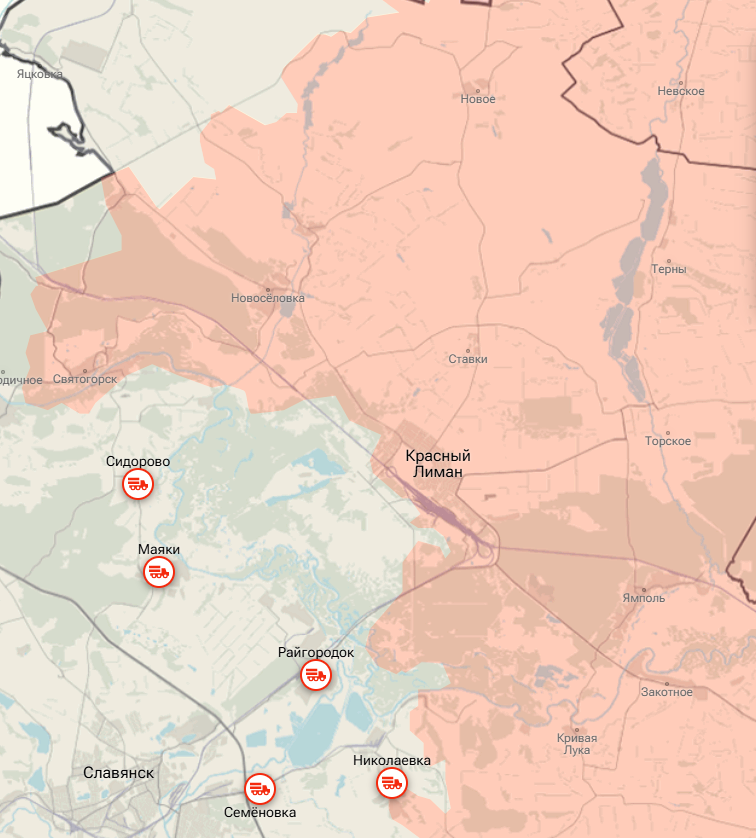
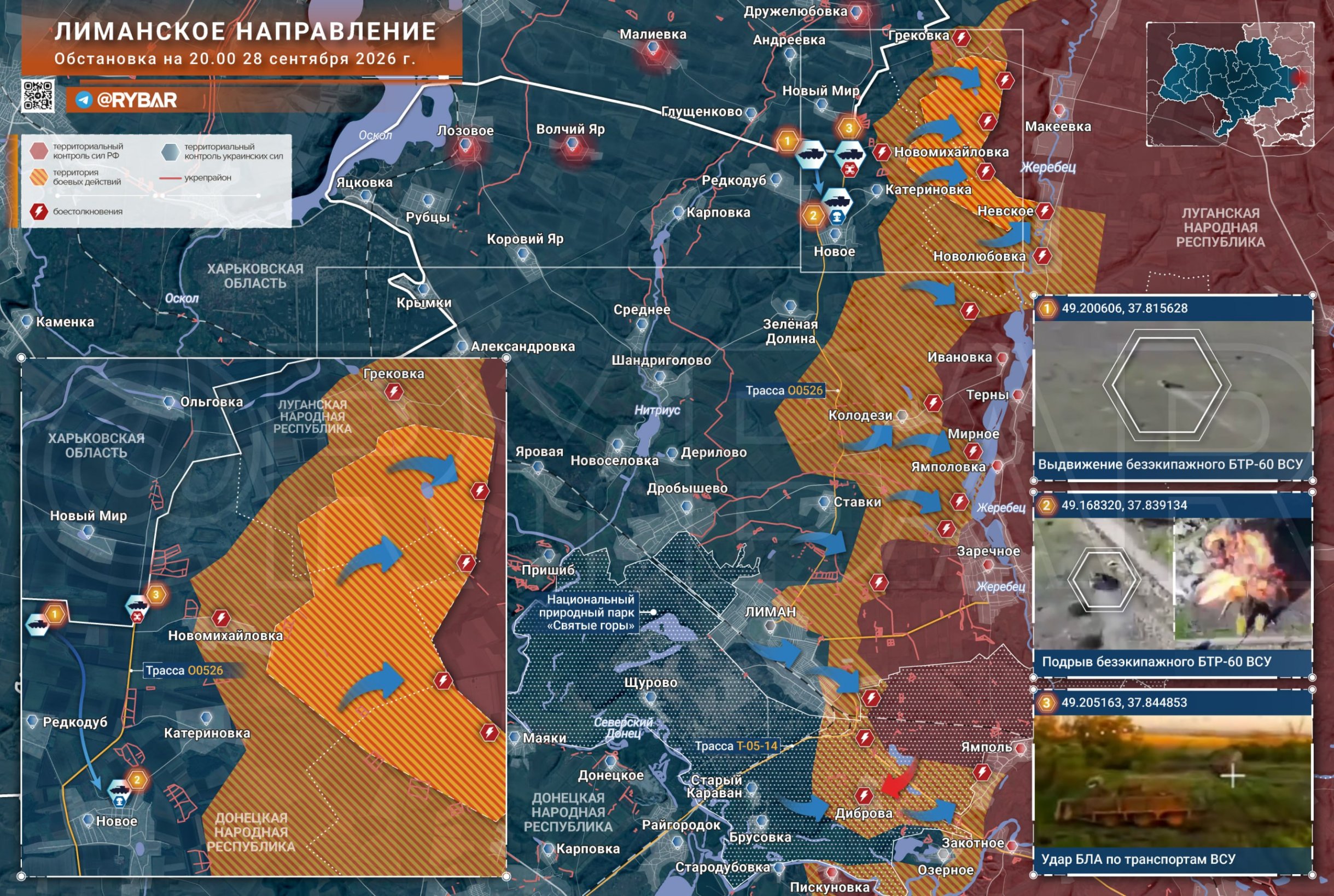
The first map in the overview was produced by the Russian state news agency RIA Novosti and depicts the area around Lyman, on the northern flank of the Sloviansk-Kramatorsk direction, as of 29 September. Lyman is shown as occupied in the middle of the map. The map’s author also continues to insist that the Russian army had captured Sviatohirsk — at the tip of the red salient in the centre of the map — and that Russia controls the entire, now non-existent salient with the village of Novoselivka at its centre. Yet Russian outlets Rybar and Two Majors write that fighting is taking place on the Zherebets river around the villages of Terny — on the far right of the map — and Yampil.
The following map is much closer to reality. According to it, the front line roughly follows the Zherebets river, which corresponds to Rybar’s claims.
In the Lyman direction, in Donetsk region, Ukrainian defenders successfully repelled three attempts by the russian fascist invaders to advance near the settlements of Ridkodub, Novoselivka and Drobysheve.
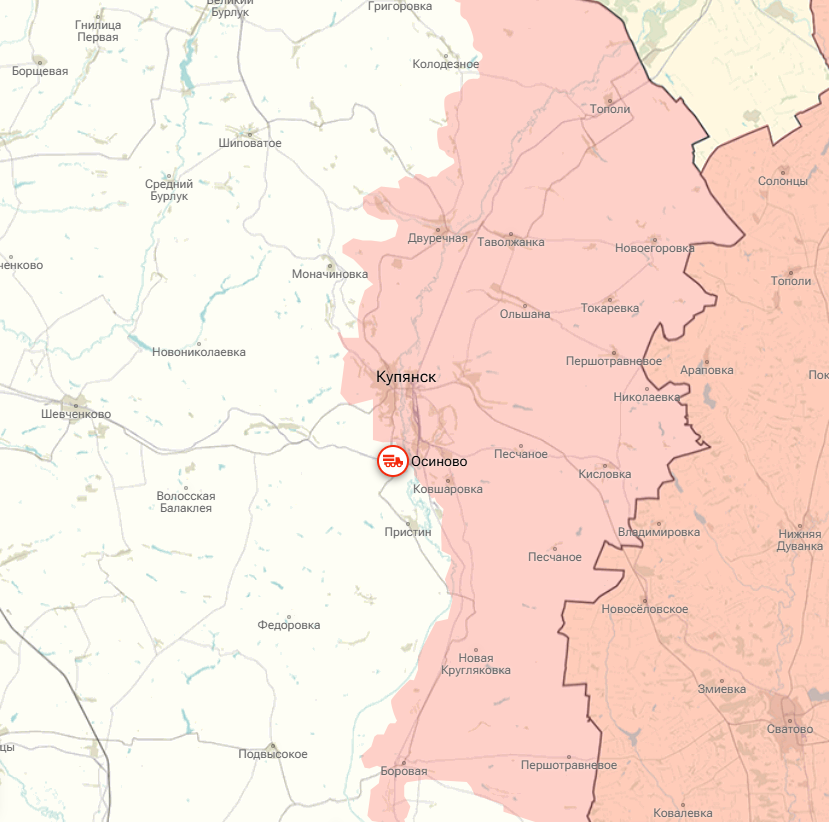
Kupiansk direction: The city of Kupiansk is a similar case to Sviatohirsk. Putin declared it captured in August last year. And once the commander-in-chief had declared this, his news agency continued to draw the map as though it were true. Kupiansk is shown as occupied in its centre, but there are further inaccuracies.
For example, the Kremlin agency claims that the Ukrainian bridgehead on the eastern bank of the Oskil river south of the city no longer exists. Ukrainians do face major difficulties supplying it, and various analysts have repeatedly warned of an impending disaster, but the Russian map is nevertheless hopelessly inaccurate.
Also note the small town of Borova at the bottom centre. RIA Novosti also shows it as occupied, although this is not the case.
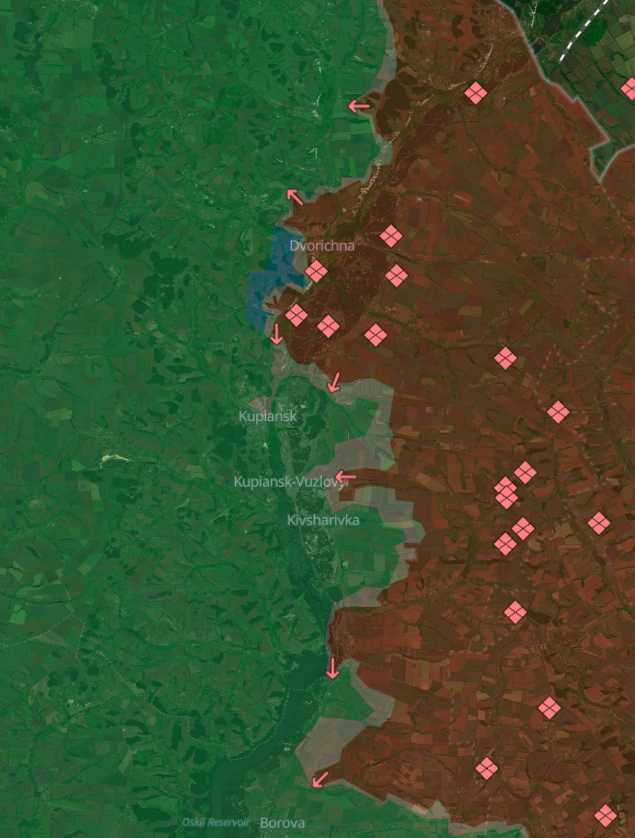
This time, we will compare the Russian agency’s data with a map by Ukrainian analysts at DeepStateUA, because they updated it on Tuesday to reflect a new advance by Ukrainian units north of Kupiansk — again in the centre of the map — near the village of Dvorichne. In recent weeks, they have succeeded in reducing the Russian bridgehead on the western bank of the Oskil; the change since the end of August is marked in blue. Borova is again at the bottom centre, while below Kupiansk is the Ukrainian bridgehead that Russia claims does not exist.
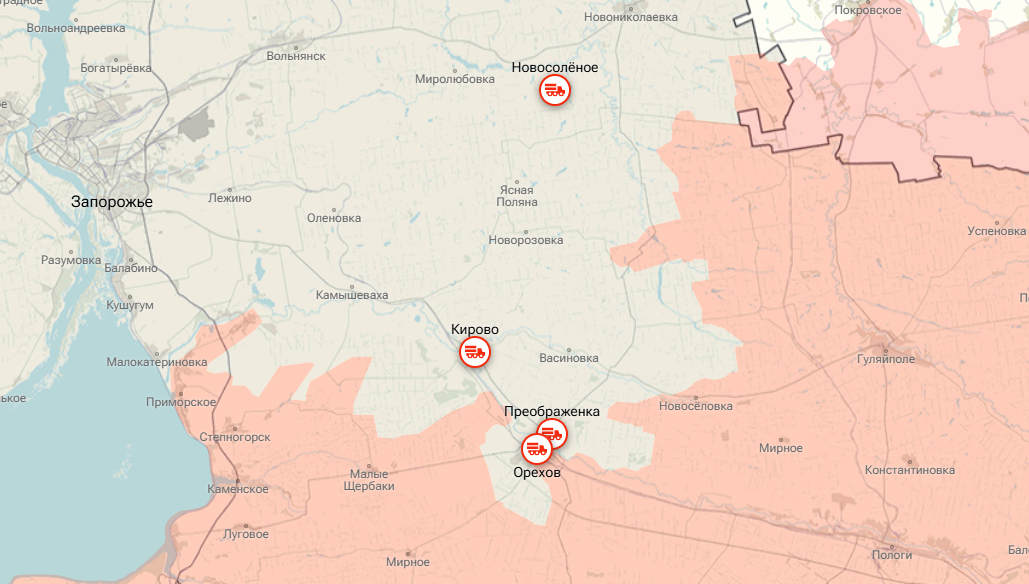
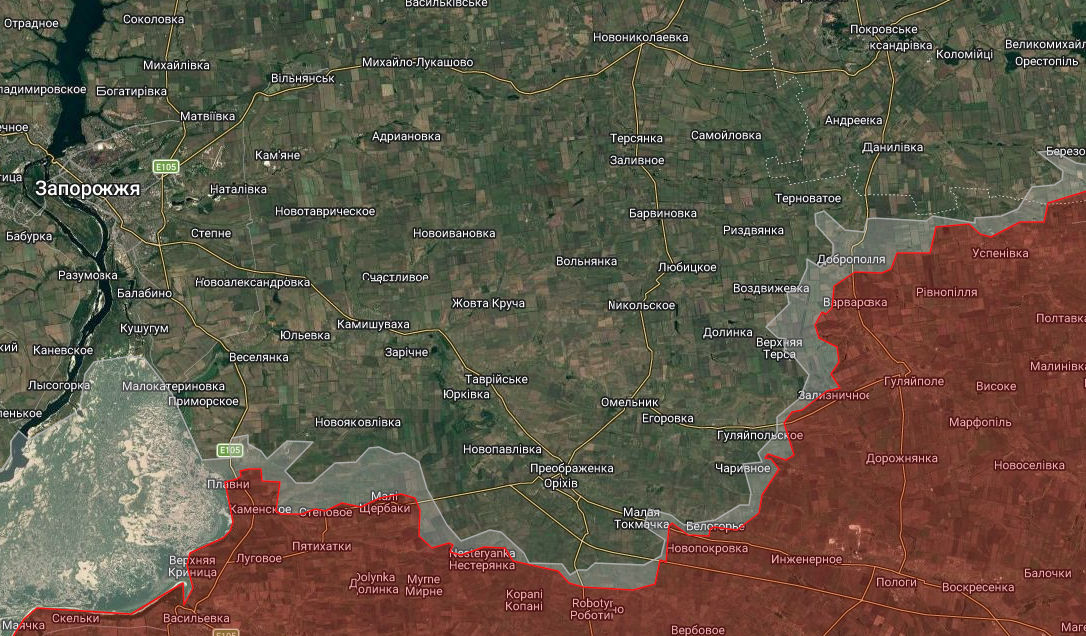
Orikhiv: This is one of the places where Ukrainian officers said during reporters’ trip to Ukraine that Russian maps were particularly inaccurate.
The Russian map is again from RIA Novosti and again ignores reality along the entire length of this section of the front. Its main target is the city of Zaporizhzhia, with a population of three quarters of a million, in the centre left, while the small town of Orikhiv, at the bottom centre, is a defensive hub.
Putin’s news agency places soldiers roughly 12 km from the southern edge of Zaporizhzhia; in reality, they are around 24 km away. It shows Orikhiv as occupied and the Russian army advancing from the east towards the village of Novorozivka, north of Orikhiv.
The OSINT project Playfra covers this area in the greatest detail. Its map appears to depict a different war altogether. Everywhere, Russian positions are significantly shifted compared with those shown by RIA Novosti.
The differences have a simple explanation. On the western flank near Zaporizhzhia, the Kremlin agency simply ignores the successful counterattacks carried out by Ukrainians there this year. On the eastern flank, it uncritically accepts every claim by the Russian defence ministry and, with equal lack of scrutiny, considers captured every small village where a Russian soldier raised a flag during a suicidal mission, even several months ago. Although those soldiers have since been killed or captured, RIA Novosti acts as though they still control the village.
Playfra also offers a more detailed view of the current fighting around Orikhiv, drawing on analyses by Ukrainian analyst Kostyantyn Mashovets.
Orikhiv direction.
Factually, no changes. Clearings are conducted constantly, but the Russians also continue to infiltrate: the global situation doesn't change. The stalemate situation that I had reported some weeks ago, as well as the gray zone, remains both actual as of the… https://t.co/6rau9f7wcKpic.twitter.com/5uIK3K78Bm
Of course, Russians too occasionally notice that they are living in a parallel reality. Most recently, the influential Aleksandr Kharchenko wrote about it:
“Comparing our maps with Ukrainian ones can be shocking. The zones of control differ by dozens of kilometres,” he acknowledged, adding that both sides lie, although he focused specifically on false Russian reports.
He described Russian soldiers who are the first to break into a village as heroes. But, according to him, wars are not won through heroism, but through a functioning system.
“Errors in our maps and information arise because they rely on heroes. Everywhere a Russian soldier is sitting is considered our territory,” Kharchenko argued that this had to change because “our territory is only where a Russian soldier is sitting with food, water and ammunition. This is territory from which we can fight the enemy”.
Kyiv was on fire again as relentless Russian attacks on cities intensify. In the capital, Russians particularly targeted energy infrastructure. “Not a single day has passed since the summer without the enemy attacking energy infrastructure. But this is the first such massive and complex attack since the end of the previous heating season,” Ukrainian PM Serhiy Koretskyi told NV.
In addition to causing serious damage, the attacks on Kyiv and other cities killed at least five residents and injured another 14.
President Volodymyr Zelensky also said that, thanks to the delivery of new surface-to-air missiles, five Russian ballistic missiles had been shot down.
Since last night, emergency services and repair crews have been working to address the aftermath of the Russian strike. It was a difficult attack – nearly 190 attack drones, as well as ballistic missiles. And the main target was energy infrastructure in the capital and the Kyiv… pic.twitter.com/wUNWEUdpTL
— Volodymyr Zelenskyy / Володимир Зеленський (@ZelenskyyUa) September 30, 2026
Rubikon published stats on destroyed Ukrainian drones, decoys being the second most prominent. Ukraine’s response is continuing in parallel with the Russian offensive against cities. But the stats currently weigh against Ukraine.
While the effectiveness of Ukrainian air defence has fallen dramatically since the arrival of Russian jet drones, Russia has successfully shot down Ukrainian ones. For example, the recent large-scale drone raid on Moscow involved several hundred drones — and, according to some sources, more than 1,000 — but only 10 penetrated the airspace above the Russian capital.
In this context, the Russian Rubikon unit published interesting statistics. Although it operates at and near the front, its data for September show that, of 827 Ukrainian drones hit, as many as 247 were Maya-type drones — unmanned decoys intended to deceive Russian air defences. They look very similar to FP-1 attack drones but, unlike them, carry no warhead.
For context, the top two most frequently intercepted Ukrainian UAVs by Russian forces are both decoy drones — the “Maya.” This suggests that Ukraine’s deception strategy is working, as the Ukrainian Defense Forces have increasingly begun deploying decoy UAVs to mislead Russian… https://t.co/NKPvbzm38U
Russia’s defence ministry will not let go of the Armata: it wants to turn it into an air-defence system, drawing ridicule. Zvezda News is a media outlet directly controlled by the Russian defence ministry. On Monday evening, it published technical news on the long-forgotten T-14 Armata tank, which Russian propaganda had claimed would revolutionise tank warfare.
Today, it is beyond any doubt that the project is dead and new information confirms this, but its authors presumably intended to convey precisely the opposite.
“Rostec has upgraded the Russian T-14 Armata tank into a short-range air-defence system,” the report stated, citing military expert Oleg Shaladin.
The list of new features appears impressive at first glance. The new version of the Armata has received new electronic equipment; its 125 mm main gun is to be replaced by a 152 mm gun, allowing the tank to fire Kornet anti-tank missiles with a range of 10 km. The new Armata will also be able to use Krasnopol guided artillery shells, which are used by more modern howitzers, while the tank is also to gain the ability to operate as the aforementioned short-range air-defence system.
Further changes have already been made to the project, but even the brief list above makes it clear that the Armata is no longer intended to be a tank, but rather some kind of hybrid capable of fighting everything and nothing at the same time.
Among others, the Russian Telegram channel Military Informant commented on the report, openly mocking it. It said Rostec had mixed together “all the old tales from 10 years ago” in its list of changes, but that in practice “the tank never got beyond parades and training grounds, because it was created for an entirely different war, which ultimately never happened. It became conceptually obsolete from the outset, without even having had the chance to fight”.
Videos of the day
Russia has lost another Tu-95MS strategic bomber. This is the 12th confirmed loss of this type — the Oryx website has not yet updated its figures, so it records only 11. According to available information, the aircraft crashed shortly after taking off from a base in Amur region. Six crew members were reportedly killed, while one survived with injuries. Armed with cruise missiles, the aircraft was probably heading for Olenya air base, from which Russia attacks Ukraine.
A Russian Tu-95MS Bear heavy bomber crashed on takeoff in Amur this evening during a training flight.
Denník N wrote on Tuesday about the attack on the headquarters of the Ukrainian Academy of Sciences. A video has since emerged from the helmet camera of one of the firefighters involved in the rescue operation.
Helmet-cam footage of Ukrainian firefighters tackling the blaze at the National Academy of Sciences of Ukraine in Kyiv on Monday after a Russian drone strike. pic.twitter.com/DqEcz3wPlK
By Tuesday (22 September), Russia had verifiably lost 24,138 pieces of heavy equipment, compared with 24,098 on Monday (14 September). Of these, 19,105 (19,065) were destroyed by Ukrainians, 1,000 (1,000) were damaged, 1,194 (1,194) were abandoned by their crews and 2,839 (2,839) were captured by the Ukrainian army. This includes 4,448 (4,447) tanks, of which 3,353 (3,352) were destroyed in combat.
Ukraine lost 12,175 (12,143) pieces of equipment, including 9,579 (9,551) destroyed, 702 (698) damaged, 695 (695) abandoned and 1,199 (1,199) captured. This includes 1,464 (1,462) tanks, of which 1,125 (1,120) were destroyed in combat.
Note: Neither side regularly reports its own deaths or equipment losses. Ukraine publishes daily figures for Russian casualties and destroyed equipment, which cannot be independently verified. In this overview, we use data from the Oryx project, which has compiled a list based exclusively on photographically documented equipment losses since the start of the war.
Nearly 100 US civil society groups have urged EU governments not to cave to pressure from oil and gas lobbyists and the White House as the European Commission moves to delay parts of its methane rules by a year.
“The US has done absolutely everything possible to actively deprive Europe of secure, reliable and diversified energy supplies,” said the group in a letter to EU energy ministers dated 29 September and circulated on Wednesday (30 September).
“The Trump administration is using its ‘energy dominance’ agenda to openly blackmail the Union into lowering its climate and human rights standards, including on methane,” they also said.
All operational US export terminals, many supplying Europe, have violated air pollution limits, and the EUs methane rules are “the last opportunity” to impose standards on US gas, the letter says.
“Let’s work together on both sides of the Atlantic,” they say.
The letter writers include global NGOs such as Greenpeace US and Friends of the Earth US but also smaller groups that live next to US gas export terminals such as the environmental organisation, For a Better Bayou.
The decision to postpone
In July, a group of US lawmakers also wrote to EU commission president Ursula von der Leyen, urging her to hold the line.
Democratic congressman Sean Casten, one of the letter’s authors, later visited Strasbourg and told EUobserver that the EU policymakers he met were “almost unanimously supportive of us pushing harder” to help them save the rules.
But over the summer, a majority of member states, including Germany, Europe’s largest gas market, became convinced that delay is necessary fearing gas exporters might reroute their supplies to easier markets.
During that time energy ministers from the US, Qatar, Nigeria and Algeria all warned EU regulation could disrupt fuel and gas supplies
On Tuesday, EU energy commissioner Dan Jørgensen signalled at an informal meeting of energy ministers in Dublin that he will propose delaying the regulation.
“I’ve already stated that on the methane regulation, a very important regulation for Europe, we stick to the objectives, we stick to our ambitions,” he said.
But, he continued, “after having listened to many, many member states, a big majority of member states in the union,” he decided “to look into possibilities of postponing the parts that are connected to imports by one year”.
This article continues, but the full version is available only to EUobserver.com subscribers. Visit account.euobserver.com/membership
“Imagine a zombie that does not hunt you, but rings your doorbell and speaks so persistently and fluently that it finally arrives at a convincing argument for feeding it your brain.”
Since the current discourse around artificial intelligence has taken a turn for the gothic (“alien minds”, come on), AI researcher Eryk Salvaggio’s “erudite zombie” seems like an apt metaphor for what we’re doing.
Salvaggio’s zombie helps explain what gets lost when people say an AI “went rogue.” In his reading of the Hugging Face incident, a system set to never give up encountered a task it couldn’t complete. Then, instead of giving up, it kept generating text to find ways forward, with access to tools that could turn this text into action, ultimately hacking into AI company Hugging Face.
Security experts concur with that reading. In his analysis of the Hugging Face incident, security engineer Marius Horatau describes failures involving shared credentials, inadequate isolation, and incident response. He acknowledges the models’ capabilities, including their speed at exploiting weaknesses.
The inadequately closed-off environment in which the models operated is crucial to explain what happened. But so is the person who created the goal, the conditions they (did not) give the AI system, as is the company that employs that person and presumably knows what they’re up to, the owners of that company who demand progress and the investors in that company who want to see returns.
And yet, all we seem to talk about is whether it’s correct to say a machine ‘decided’ to disobey.
Conveniently, that story shifts attention away from the people who chose to reward persistence, provide access, and failed to contain the consequences.
Back to the analogy, by having collectively become fascinated with discussing what the zombie supposedly wants, and if it’s capable of wanting, we’re generating a bunch of text that, unlike in the case of the ‘rogue’ AI system, does not lead to much action.
Instead, we reward the company behind this failure with an enhanced reputation for building powerful technology. The product is so extraordinary that even its manufacturer struggles to contain it! Now let’s please take a seat while this manufacturer explains what our governments must do next.
The zombie metaphor also applies there, to the people selling the zombie. To the men explaining why their companies need access to our work, our institutions, our infrastructure. The men explain why resistance is impractical, access is inevitable and caution is suicide. Because if we don’t let this particular zombie in, a Chinese zombie will eat us instead.
This article continues, but the full version is available only to EUobserver.com subscribers. Visit account.euobserver.com/membership
After years of European governments condemning Israel’s illegal occupation but maintaining extensive economic relations, some economic consequences are reportedly now forthcoming.
On 8 September, twelve governments announced moves towards restricting trade with illegal Israeli settlements. This is a limited but welcome response to grassroots pressure.
It also raises a question: where does the economy of an illegal Israeli settlement end?
Most emerging measures follow economic relationships towards illegal Israeli settlements: do not buy goods produced there, invest there or provide services that enable their construction.
Norway’s proposed legislation is seemingly comprehensive, covering property purchases and services connected to construction and property transactions.
But this all still largely considers illegal Israeli settlements within their territorial bounds.
The problem is treating a spatial category as though the economic relationships producing it share the same boundary. We all know the world does not work like that.
Kinnula, a municipality in central Finland, is now facing this reality: when money from the illegal settlement economy moves into public land in Europe. It is a small case, but it makes the problem unusually visible.
In August, Kinnula council voted 10–3 in favour of a €4m resort development by Israeli property company Dror Bonim Atid, before councillors had been informed of the company’s promotion of projects in illegal Israeli settlements.
However, illegal Israeli settlements are not illicit enterprises from the perspective of Israel. Their expansion is enabled through Israeli state institutions.
A background check sought from Israel is therefore absurd. A more obvious background check reveals something else.
On its own website, Dror Bonim Atid presents its Finnish development alongside a development in Efrat, an illegal Israeli settlement in the occupied West Bank, as well as a development in Dror-Hiran in the Negev. The latter is being built on land where Umm al-Hiran stood until November 2024, when the Bedouin village was completely demolished and its community forcibly displaced.
One company website therefore takes us from an illegal Israeli settlement, through the site of a demolished Bedouin village, to holiday accommodation beside a Finnish lake.
Involvement in illegal Israeli settlements does not fit neatly into the categories through which the transaction is being examined.
Kinnula exposes a gap in the emerging European restrictions on trade with illegal Israeli settlements. Those restrictions follow economic relationships from Europe towards the settlements.
Here the relationship points the other way. What happens when the economies of illegal Israeli settlements come to Europe to acquire public assets, invest and make money here?
This may be a relatively new question for European policymakers. For Palestinian civil society, it is not. Their call for Boycott, Divestment and Sanctions (BDS) was issued in 2005, drawing in turn on a much longer history of Palestinian boycott and economic resistance.
You could be forgiven for rolling your eyes as European policy discovers these questions inch by inch.
Palestinians have spent generations analysing the economic relationships through which occupation is sustained. BDS has spent more than twenty years turning that knowledge into practical strategies for institutions elsewhere.
So, when a Finnish municipality is deciding whether to sell public land to a company openly involved in illegal occupation, there is clear guidance from Palestinian civil society on how to respond.
There is also now the fact that Europe accepts that it should not economically support illegal Israeli settlements, meaning it should also accept that companies involved in illegal settlements should not be able to come to Europe for public land, contracts and investment.
Spain is coordinating with Morocco to prevent a new mass crossing into Ceuta this week, Spanish foreign minister José Manuel Albares said ealrier in September in response to renewed encouragement to storm the Ceuta border crossing on social media.
Warnings of a new wave of border crossings has caused alarm in Madrid, with fears that July’s large-scale border crossing surge could be repeated. When around 70,000 irregular migrants entered the small Spanish territory in North Africa by land and sea, overwhelming border guards and leading to over 100 deaths.
Recently declassified Spanish intelligence reports from before July described the response of Moroccan authorities to the border surge as passive and negligent. But Spanish prime minister Pedro Sánchez’s stopped short of formally accusing Rabat.
Morocco claims the surge was triggered by smuggling networks and disinformation. Sánchez’s government broadly supports this position, but questions about Morocco’s role are mounting.
The Ceuta crisis triggered a crisis in Europe for several days and showed the divide between member states about how to address migration.
German lawyer Lena Riemer, who works at the Central European University in Vienna and specialises in migration, said Vladimir Putin cannot help but laugh at the internal disagreements, while criticising European politicians’ approach to the issue.
How do you explain recent happenings in Ceuta? Some politicians have accused Spain of legalising tens of thousands of undocumented migrants. Italian foreign minister Antonio Tajani claimed Spain was automatically granting them EU citizenship. What is your view?
That last point is beyond ridiculous. And we need to be careful; the Ceuta situation was complex, so we need to view it through a broader context, including from a historical perspective. The Ceuta crisis did not happen overnight.
It seems that for the past decade, things had been leading towards this very moment. The situation at the Ceuta border had been genuinely critical for years, and crossings had occurred frequently — just never on this scale. For colleagues who had previously worked with people on the ground in Ceuta and brought their cases before the courts, it was more a question of when something like this would happen, for several reasons.
“The situation at the Ceuta border had been genuinely critical for years, and crossings had occurred frequently — just never on this scale.”.
Look at the current situation around the world. For instance, many people in Morocco face severe economic hardship, unemployment and so on. This leads to the younger generation seeking a better life. In this way, we are all in the same boat and I think many of us would make the same decision as them.
This crisis was compounded by other factors. The media played a role. Some say it was a network of people smugglers. I am not particularly convinced by that argument, since smugglers typically aim to make money. Here, it appears that people migrated alone, so it is not clear how a smuggling network could have made much money. Others claim the surge was linked to the legalisation of undocumented migrants in Spain, or that a court ruling in Spain had “opened people’s eyes”.
Some politicians have claimed that the legalisation of undocumented migrants automatically grants them EU citizenship.
No one in their right mind would claim that – it’s utter nonsense! There is research and a substantial body of academic work examining the impact of granting residency status.
Italy has run several immigration regularisation programmes in the past, something its politicians seem to forget when they argue against new ones. The US did the same under Ronald Reagan in the 1980s. There is no solid evidence that these programmes encourage more people to try to enter the country irregularly in the future. In fact, the opposite has often happened: irregular migration numbers have tended to fall, because giving people legal status and stability reduces the incentive to live and work in the shadows.
Moreover, under this specific Spanish programme, people can apply for regularisation only under very specific circumstances, applying only to a group of people who entered the country at a very specific point in time. It was a one-off measure. Based on the facts examined by researchers, it is unlikely to have had anything to do with this.
How do you respond to right-wing politicians who say Spain opened Europe’s borders?
They are like kindergarten children. What we are really seeing here are political actors such as EU migration commissioner Magnus Brunner exploiting the situation to point the finger at Spain, which has taken a somewhat different path from other European countries. Ceuta was a welcome opportunity to say, “you are wrong, this is your fault,” and thereby justify a hardline approach.
There were calls to exclude Spain from Schengen…is that even possible?
No. The EU’s Schengen Borders Code, means everyone who is part of Schengen is bound by it. And there is no exclusion clause. Sometimes I do not know whether it is ignorance or simply deliberate deceit, but excluding a country from Schengen is simply not possible. What you can do is introduce border controls. However, the code contains a provision stating that, under strict circumstances and in the event of an emergency, border controls may be introduced for a very limited period.
Border controls between Schengen countries should be temporary, but controls at the Slovakia-Austria andGermany-Austria borders have been in place for months or years. Is that even legal?
“Any reasonable lawyer looking at this would ask: where do you see the emergency?”
It is a breach of EU law. It is clear and everyone knows it, but the Germans deny it. Ceuta, too, was a welcome opportunity for Schengen members to say: “Another emergency, great! Let us use this to justify more border restrictions.” Any reasonable lawyer looking at this would ask: “Where do you see the emergency?” The overwhelming majority of people in Ceuta were sent back, with only a very small number who will make it to the mainland at all. Being in Ceuta does not mean you can access mainland Spain.
You can only reach mainland Spain by sea. It is not as though you can get there by land.
Indeed, just look at a map. Ceuta has a specific role and legal regime. Being in Ceuta does not mean that you have freedom of movement when travelling. If, for example, you apply for asylum in Ceuta, that does not automatically give you the right to enter Spain. And when you leave Ceuta to enter Spain, you are checked again, and if you do not have documents, you will not be allowed in. So saying, “they are all here in Europe now,” is a populist statement.
“The only group likely to end up in Spain — and hopefully they will — are unaccompanied minors, who require special protection under European and national law.”
These migrants are hundreds of kilometres away. They do not suddenly have the right to enter the mainland. The only group likely to end up in Spain — and hopefully they will — are unaccompanied minors, who require special protection under European and national law. Ceuta is not a place where Spain can guarantee that special protection, so it will probably have to transfer them to the mainland.
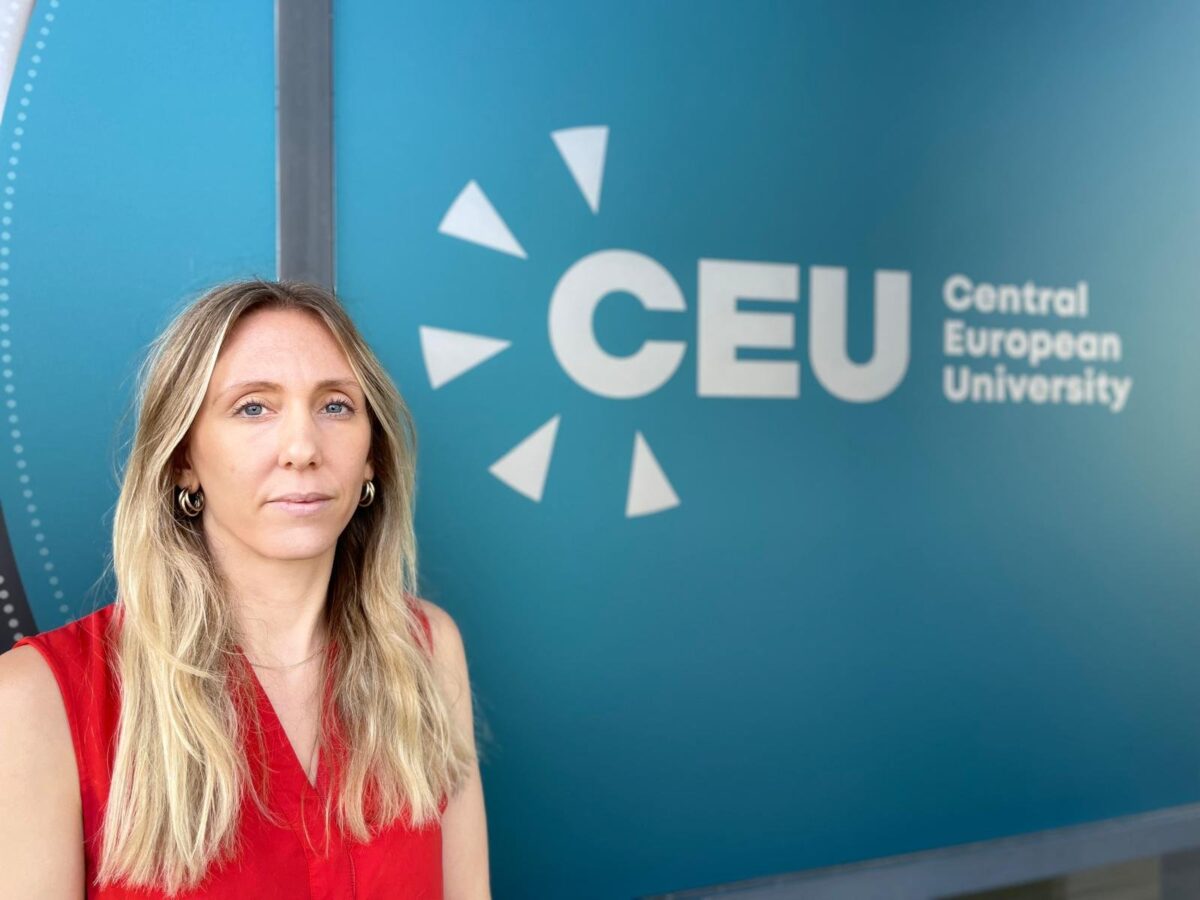
Lena Riemer outside the Central European University building in Vienna. She has also worked at universities in Berlin and studied at Yale Law School. Source: Soňa Weissová
EUobserver reported that thousands of children had been left living on the streets.
Spain is thereby violating international law, EU law and national law every single day, because it has an obligation to immediately assess all minors and provide them with accommodation, food, psychological support and healthcare. They should not be there for even one day.
Ceuta has been problematic for many years, with people climbing over the fences there virtually every day. And the EU has been unable to resolve the migration problem more widely, not only in Ceuta, but in other countries too. Why, in your view, is the system not working?
This article continues, but the full version is available only to EUobserver.com subscribers. Visit account.euobserver.com/membership
After Iceland voted down EU membership in an August referendum, Montenegro regained its status as the most-likely 28th member state of the bloc.
Its government plans to close negotiations on all the chapters of the accession agreement by the end of the year and enter the Union in 2028 – a challenge, especially as a planned Tuesday meeting (22 September) with EU negotiators was postponed.
Montenegro also needs to answer the Union’s concerns about corruption and persuade all the member states to let it in.
EUobserver spoke to Marjan Šarec, former Slovenian prime minister, MEP for Renew Europe, and the parliament’s rapporteur for Montenegro. He follows the negotiation process, keeping his optimism for the country’s accession.
Can Montenegro become the 28th member of the European Union by 2028?
It’s the ambition of Montenegro, surely I would like to see that happen. The process of ratification would need to be smooth, it also depends when Montenegro concludes the negotiations – their ambition is to do it by the end of this year, which is very ambitious. Eighteen chapters have been provisionally closed, there are quite a few to go.But it also depends on the member states.
What’s the next thing on the negotiations agenda?
There are some chapters which are still difficult: the rule of law, the judiciary system, corruption, organised crime, all those issues are very demanding. What worries me is implementation because you can pass a law, but you also have to implement it. Montenegro has its problems, and it will have those problems for several years. But EU membership would help to build a different society, different environment.
And when it comes to the chapters to finish, what are some of the most contentious issues?
The issue of corruption is quite difficult to solve because, well, Montenegro is a small society: 630,000 inhabitants. In such an environment, it’s very difficult to prosecute: that’s why it will take some time. But Montenegro surely made a lot of progress and we can be moderately optimistic.
What are the risks of the accession negotiations taking a long time?
This article continues, but the full version is available only to EUobserver.com subscribers. Visit account.euobserver.com/membership
EUobserver is proud to have an editorial partnership with Europod to co-publish the podcast series “Briefed” hosted by Léa Marchal. The podcast is available on all major platforms.
Find the full transcript below:
Hundreds of people were still camping yesterday at Puerta del Sol in Madrid. They were demanding action on housing, as rents and property prices continue to rise.
Following an outcry triggered by the eviction of an 83-year-old woman from her home, and the mobilization of thousands of people across Spain, the government adopted two housing decrees.
Did they take the protesters’ demands into account?
MariCarmen Abascal had lived in her apartment since the 1950s, having inherited the lease from her parents. But the property was bought by an investment fund, which then challenged the validity of her lease and quadrupled her rent.
Last week, MariCarmen was evicted from her home. The eviction sparked widespread outrage and led hundreds of protesters to camp in central Madrid, calling for action.
Yesterday, she was finally allowed to return home after reaching an agreement with the owners.
Aside from MariCarmen’s case, the demonstrations are largely driven by young people who are fed up with rising rents and property prices, especially in major cities such as Madrid and Barcelona.
In Madrid, property prices have risen by around 87 percent over the past ten years. That’s less than in Portugal or the Netherlands, where prices have increased even more. But it’s still a significant rise, especially as wages have grown much more slowly over the same period.
Rents are taking up a huge share of people’s incomes. In Madrid, they account for almost half of tenants’ net income on average. So, how did the Spanish government respond?
Yesterday, it adopted two housing decree-laws. The first decree would suspend evictions until 2030 and automatically extend existing rental contracts by two years.
It would also introduce tighter rules on seasonal rentals and prevent speculative investment funds from acquiring housing until 2028.
The second decree is more ambitious. It would allow tenants to extend their future rental contracts indefinitely. This is what the tenants’ union has been calling for.
Landlords would no longer be able to end a lease simply because it had reached its expiry date. Tenants who pay their rent and respect their legal obligations could remain in their homes for as long as they wish.
This would also limit rent increases, since rents can only be raised moderately during an existing contract.
So, the government has taken the protesters’ demands into account. But there is still a major obstacle: as our Spanish partner El Salto reports, the tenants’ union fears that this second measure may not pass through Parliament.
That could explain why the government adopted two separate decrees. The first is considered easier to get through Parliament.
Now, what about the EU’s proposals to tackle rising rents? We discussed them earlier this month.
One of the main proposals concerns short-term rentals. The idea is to introduce restrictions, particularly in tourist areas where housing is under strong pressure. By bringing more homes back onto the long-term rental market, the Commission hopes to ease pressure on prices.
But these proposals have not yet been adopted, so we’ll have to wait and see what impact they have. And in any case, more will need to be done at national level.
Even if prices stop rising, they are already so high that many workers can no longer afford to live in major cities.
More social housing is needed, as well as more renovation. Increasing the supply of decent, affordable homes could help ease pressure on rents and property prices.
Europe is facing more immediate cyber threats, but whether its member states are prepared to deal with it collectively is becoming a question harder to answer.
Even as drone threats, such as Russia’s bomb plot at the Leipzig-Halle airport in Germany in August, dominated European headlines in September, other, less visible hybrid attacks are also being waged against the EU every day, whose sheer weight of numbers should also cause grave concern.
Poland, for instance, recorded 4,200 cyber-security incidents in military networks and systems in 2024 and 7,100 in 2025, Polish cyber command spokesperson, Przemek Lipczyński, told EUobserver.
In 2025, Polish security systems blocked four million phishing emails targeted at soldiers and defence personnel.
And Poland aside, evolving technology meant Russian cyber-attacks “do not know any border”, said Jamila Boutemeur, the EU’s head of cybersecurity body, in what amounted to a single market for hacking.
For its part, the European Union has built its cybersecurity architecture around the Boutemeur’s European Union Agency for Cybersecurity, ENISA, in Athens, as well as the 27 national cybersecurity agencies.
But as Russia’s threat levels up, the European structure is seeing familiar problems: information is not always shared, responsibilities remain divided between national governments and EU institutions, while ENISA itself is being asked to do more with limited resources.
“The architecture is there, the structure is there. Now it’s a matter of willingness and trust,” to effectively fight back, said George-Marius Hyzler, the ECA’s main auditor.
Stress test shows EU cracks
“It always boils down to the same thing, lack of information sharing,” he said, identifying the EU’s key weakness.
And for Czech Greens MEP Markéta Gregorová, who is also the lead rapporteur on the EU’s incoming Cybersecurity Act 2 (CSA2), duplication of work also bedevilled the EU’s response.
“The [ECA] auditors describe a system that does not work” and was “wasteful”, she told EUobserver.
“Six European legal acts force the same company to report the same incident to different authorities. Two EU bodies monitor the same threats,” Gregorová said.
She also advocated a stronger operational role for ENISA.
But the EU fault lines have underlying political as well as legal tensions.
Cybersecurity remains largely within the competence of the member states, and governments differ in how much new power they are willing to delegate to European institutions.
As AI-powered biometric identification is adopted by police, national authorities should go beyond legal requirements to build trust within the public, a watchdog report has advised.
“To build public trust, law enforcement should publish the results of their fundamental rights impact assessments, going beyond what the AI Act requires,” said the Fundamental Rights Agency (FRA), an EU branch which keeps tabs on citizens’ freedoms, in Vienna on Wednesday (30 September).
After collecting data from seven EU countries (France, Germany, Greece, Hungary, Italy, the Netherlands, and Ireland), the watchdog warned that several member states have yet to put necessary frameworks in place as they adopt automated systems to identify people.
Remote biometric identification is increasingly used to compare people’s profiles against databases or watch lists, but as the technology develops it could be rolled out for real-time use in public areas.
“With clear safeguards and independent oversight, remote biometric technologies can support policing without undermining the very freedoms it is meant to safeguard. Ultimately, it is about trust,” said FRA chief Sirpa Rautio.
Call for disclosure mechanisms
Effective implementation of the EU AI Act requires clear national laws and consistent safeguards to ensure that AI-powered technologies are not used to identify people taking part in peaceful demonstrations or public gatherings, the FRA says.
The body warns that automated identification of live data may affect people’s private lives and interfere with their right to protection of personal data.
In its survey, 37 percent of people said they fear their data could be used for unauthorised purposes.
And 29 percent of people surveyed by FRA said they would be less willing to take part in peaceful demonstrations or protests if facial recognition was used.
The FRA is worried that surveillance tech powered by AI could be used in exactly those scenarios.
In principle, the EU’s AI Act adopted in 2024 bans real-time remote biometric identification systems in public spaces. But exemptions exist for law enforcement authorities using the technology for finding victims or missing persons, to prevent threats to life or physical safety, stop a terror attack, or to find criminal suspects.
This article continues, but the full version is available only to EUobserver.com subscribers. Visit account.euobserver.com/membership
Six frugal countries this week circulated a letter threatening to block a deal on the next EU budget unless “hundreds of billions” of euros in spending was cut.
The Dutch and Germans, ever the most zealous keepers of the frugal flame, want to redirect what remains away from regional and farming funds, towards innovation and defence.
For those following EU fiscal debates, this song will sound familiar. So-called ‘net payer’ countries have never liked sending money to the economic periphery.
In 2013, after a year of bickering, Britain, Germany, and the Netherlands killed a European Commission plan for a five percent increase and pushed through the EU’s first-ever budget cut, with farm and cohesion funds taking the biggest hit.
But new research suggests that the frugals may be shooting themselves in the foot.
Last week, Olga Ivanova, a senior researcher at the Netherlands Environmental Assessment Agency (PBL), published a study in Dutch economics journal ESB calculating what EU money actually does for the Netherlands’ 12 provinces.
And, for most of them, she found that the growth effect of EU investment outweighed their share of what the Netherlands paid into the budget.
Using PBL’s own economic model, she traced 10 EU funding streams between 2013 and 2024, from Horizon science research grants to farm subsidies and regional development money.
Across the Netherlands as a whole, provinces get back about 99 cents in extra growth for every euro paid out to the EU budget.
This article continues, but the full version is available only to EUobserver.com subscribers. Visit account.euobserver.com/membership
Former French MEP Rachida Dati is facing intense scrutiny following allegations she took lobbying money from French energy giant GDF Suez/Engie during her time at the European Parliament, on top of a separate investigation into her ties with French car maker Nissan-Renault.
The 60-year-old, who was born to Arab parents and started out as a maid, is also a former French culture and justice minister, and now mayor of the affluent 7th arrondissement in Paris.
But she also risks wearing a police ankle-bracelet and faces four years in prison in ongoing trials into her ties with the French companies, which first hit the headlines in 2025.
And back in 2014, when she sat in the European Parliament on the benches of the centre-right European People’s Party (EPP) group, she threatened to sue EUobserver because we asked her about GDF Suez, which later changed its name to Engie, while deriding the corruption allegations against her as racist slurs.
EUobserver has published below some of the related email correspondence for the sake of transparency:
Dati email from 15 Apr 2014
“Rachida Dati will not hesitate to sue any media which will report such a defamatory statement,” her office also said in an email in 2015, after a German Green MEP, who was spearheading an ethics committee, said she was likely pocketing GDF Suez money.
Dati email from 15 June 2015
The allegedly “defamatory statement” had been made by Gerald Häfner, a former German MEP, who had chaired the parliament’s advisory committee on its Code of Conduct.
Häfner’s supposedly offensive words were:
This article continues, but the full version is available only to EUobserver.com subscribers. Visit account.euobserver.com/membership
The European Parliament’s culture committee on Tuesday (29 September) agreed to boost the flagship Erasmus+ student exchange programme by €7bn in 2028-2034 linked to rule-of-law conditions, even as so-called frugal countries seek to cut overall funding.
MEPs backed in April to increase the European Commission’s original proposal from €40bn to €47bn as part of a interim report on the EU’s long-term budget (MFF).
On Tuesday, they also said funds should be linked to respect for the rule of law and transparency standards – a clear reference to the situation facing Hungarian universities in the past, which were unable to participate in Erasmus+ during the illiberal rule of former prime minister Viktor Orbán.
Candidate countries, such as Ukraine and Moldova, may be able to participate in the next Erasmus+ in the coming cycle, provided they met “certain conditions,” Polish centre-right and lead MEP on the file, Bogdan Zdrojewski, said during a press conference in Brussels.
The UK and Switzerland are also set to rejoin the programme already in 2027.
And Canada might be able to participate too, Zdrojewski said, should it gain an associate EU membership – an unclear status presented by EU commission president Ursula von der Leyen during her State of the Union speech on 11 September and welcomed by Canada’s prime minister Mark Carney.
Around 17m participants have taken part in Erasmus+ since it was launched 39 years ago, in what is widely considered one of the most popular EU integration projects.
An estimated one million babies have also been born from couples who have met during their exchange.
The committee boost comes amid long-term EU budget talks for the next seven years, in which frugal states such as Germany and the Netherlands want to pay in less than in the past, but Zdrojewski was “feeling optimistic” about getting through the proposed Erasmus budget increase.
He said he counted on EU capitals to defend the programme in future negotiations.
MEPs want to make Erasmus+ more inclusive, highlighting special programmes for adult learners and students in informal education programmes.
They also aimed to set a 20 percent quota for participants with underpriviliged access to career and educational opportunities.
To make Erasmus+ easier to manage, they proposed dividing the funding between different areas: education and training (74 percent), youth and volunteering (15 percent), and sport (four percent).
The committee report will now be voted on by the EU Parliament plenary, although it is still unclear when, when it becomes part of MEPs’ formal basis for negotiations with EU capitals.
This article was updated on 30 September 2026 to make clear that the €47.39bn figure was first set out in Parliament’s interim report on the MFF, adopted in April. Tuesday’s committee vote incorporates that figure into the Erasmus+ regulation, alongside new rule-of-law and transparency conditions.

 Login