❌

Normal view

A Free Speech Group at Columbia Canceled an Event About Free Speech Over 'Cornell 7' Article Controversy

21 October 2026 at 20:26
Campus building at Columbia | Luiz C. Ribeiro/TNS/Newscom

Questioning the prevailing narrative about the "Cornell seven" case is bound to create controversy. And at Columbia University, two student journalists drew condemnation for their views on the case from the unlikeliest of places: a college free speech group. 

On October 13, Barnard junior Christina Ma and Columbia junior Nikos Mohammadi published an article called "The 'Cornell Seven' Is Really About Liberalism" in the Columbia Sundial, an independent student publication. The piece argued that the discourse surrounding the alleged rape at Cornell University infantilizes women by omitting the possibility that in a post–sexual revolution, liberal society, women may make regrettable but consensual choices.

"In the world that, for better or worse, follows from it, we cannot claim to stand for sexual freedom and then recoil in disgust when there's a possibility that a young woman simply chose to exercise it," Mohammadi and Ma wrote. 

The piece also argues that the "collective frenzy" over the Cornell case has created a climate on campus that makes it "difficult to disagree with the maximalist position on what happened" the night of the alleged rape.

As Mohammadi wrote in UnHerd, the piece caused immense backlash. He said he received an onslaught of messages urging him to commit suicide and demanding that his "career and life be destroyed." But the criticism went beyond threatening DMs and comments. 

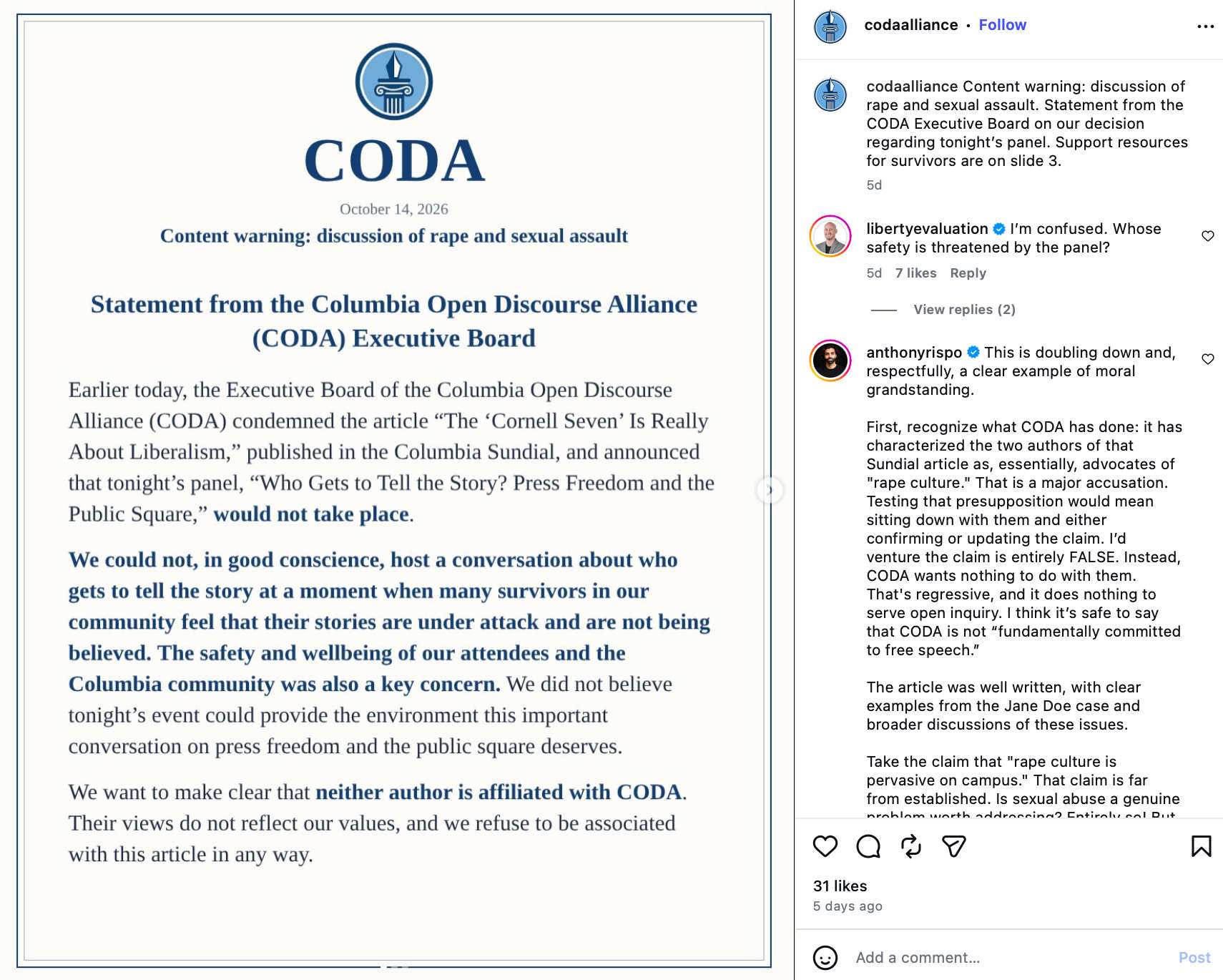
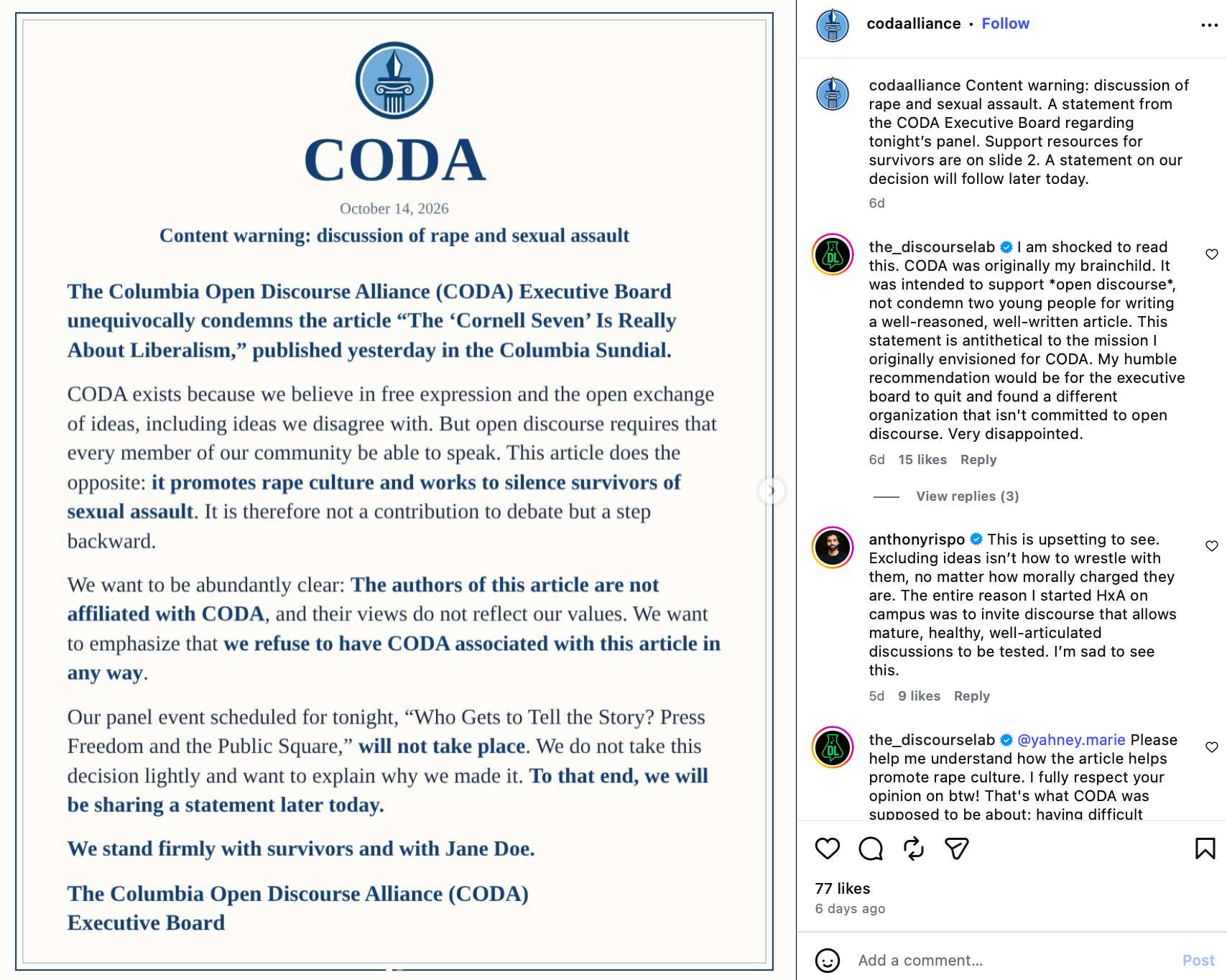
The day after the article's publication, the Columbia Open Discourse Alliance (CODA) canceled an event about press freedom because the Sundial's editor in chief, Nick Baum, had been slated to speak at the event. Although Baum did not author the piece, CODA wrote in an Instagram post that the free speech group "refused" to be affiliated with the Sundial's article "in any way." 

CODA also claimed that the event, ironically called "Who Gets to Tell the Story? Press Freedom and the Public Square," could not take place at a time when "many survivors in our community feel that their stories are under attack and are not being believed."

The group added that the Sundial's article "promotes rape culture and works to silence survivors of sexual assault." 

The group's president, Aum Desai, told Columbia's student newspaper, the Columbia Daily Spectator, that the group canceled the event "not in spite of, but because of [CODA's] commitment to free expression." 

Columbia graduate Clayton Smith, who founded CODA in 2025, quickly commented that he was "shocked" by CODA's statements on Instagram. Smith started the organization to create a central hub for groups hosting events promoting free speech and open discourse, including the Sundial and Columbia's Heterodox Academy chapter.

He tells Reason that CODA's rationale for canceling the event was "ironic" and "hypocritical," and he believes the group should have collaborated with the Sundial if there were legitimate safety concerns at the event. He says he was particularly disturbed by the group's condemnation of the article and CODA's claim that it promotes "rape culture."

"They don't argue or explain how it works to silence survivors of sexual assault. It is a baseless slander that they use to condemn the article because it promoted an opinion they do not like," Smith says. 

Smith says he spoke to Desai on the phone after CODA posted the statements, and Desai tried to reassure him that CODA would uphold the principle of free speech. But Smith says he did not leave the phone call feeling "very confident at all" in Desai's commitment. 

Desai did not respond to Reason's requests for comment.

CODA faculty adviser and Columbia Business School professor emeritus Eli Noam was traveling in China during the fallout from the Sundial article and was not involved in CODA's decision.

After speaking with members of both CODA and the Sundial, Noam tells Reason that he thinks CODA "made some proper decisions, some correct decisions, and some mistakes."

"I think we're dealing here with…a group of college students who kind of were confronted with a crisis at 2 a.m.," Noam says. "And kind of [made] some judgments that they now regret, and they do." 

He tells Reason that it was not "unreasonable to assume there would be a disruption" at the event, given the climate at Columbia and "about this rape allegation." He says the group suddenly "had an event where they needed college security" and could not organize in time. CODA, Noam says, is not yet recognized by the university, and he thinks the group was likely fearful of jeopardizing its recognition.  

Still, Noam says CODA's statements condemning the article were "unreasonable," and it was "disappointing that they kind of lost their nerve here."

Although he was not involved in planning the panel, Mohammadi says, to his knowledge, there were no credible threats of violence to the panel. He understood there may have been "disgruntled students" and an "environment CODA did not want to deal with." But instead of simply canceling the event or working with the Sundial to find a solution, Mohammadi says CODA overstepped by condemning the Sundial piece. 

James Applegate, an astronomy professor who serves on Columbia's Academic Freedom Council (CAFC) alongside Noam, tells Reason that he disagreed with CODA's decision to cancel the event.

Applegate tells Reason he was considering attending the event, and he was "rather surprised and disappointed" when it was canceled.

He recalled that when he was a professor in 2000, he objected to changes to the school's sexual misconduct policy on the University Senate floor. He says his statements were "similar to what was said in the Sundial article" and there was a "level of emotion in this debate." 

"Nonetheless, we had the debate. I was in it, and the degree to which it was civil is shocking when you look at where we are now. And it's sad." 

Applegate said he does not condemn CODA, however, "for the simple reason that the atmosphere on college campuses and on the left wing of politics in general in the United States is quite vicious."

CODA's honorary faculty fellow John McWhorter tells Reason he interpreted CODA's statement as "saying that an event about who gets to tell the story is untenable when or if a critical mass of people with such stories don't even feel comfortable telling them— i.e.being a participant in the event." He added, "I imagine some might think of that as cutting the salami a little thin, but then I highly suspect that Desai is equally worried about the event becoming a physical melee of some kind. In that, let's face it, he is hardly unreasonable."

Still, McWhorter said that he would have chosen to have the event himself, "especially as in the likely case that some people did talk about their experiences without any particular repercussions, it may have made the more reluctant people less apprehensive about doing so in the future."

According to Mohammadi, as of Tuesday, the Sundial, College Republicans, Platypus Affiliated Society at Columbia (which discusses leftist thought and history), and Columbia's Heterodox Academy chapter have left CODA. 

CODA was not the only group to condemn the Sundial's piece. On October 14, the Columbia Political Review's editorial board wrote that Mohammadi and Ma's piece "violates standards of integrity" and "perpetuates a culture of campus violence, rape, and assault." The editorial board of the Columbia Political Review, which purports to publish "multipartisan political discourse," stated that it would refuse to publish "any article that upholds or recreates cultures and systems of rape, sexual assault, or violence" and it urged "all campus publications to do the same."

And on Monday, Columbia's main newspaper, the Spectator, published a staff editorial accusing the Sundial of violating journalistic ethics by "its page to disparage survivors of sexual violence." 

Mohammadi tells Reason the piece underwent "far more editorial scrutiny than any other piece" the Sundial had published given the sensitive nature of the topic.

Free speech student organizations are necessary on Columbia's campus, especially as the school's free speech climate continues to crumble; it recently received a failing grade from the Foundation for Individual Rights and Expression. And while upholding free speech principles may have become more fashionable among those resisting the Trump administration's pressures on academic freedom or those defending pro-Palestinian speech, it is clear that some topics remain taboo in the public square. College is supposed to be a place where students debate controversial topics, form their own beliefs and opinions, and learn from mistakes. Hopefully, the students who demanded condemnation instead of debate will be forgiven for their perversion of free speech ideals, and they will learn to afford such grace and open-mindedness to classmates with whom they disagree.

The post A Free Speech Group at Columbia Canceled an Event About Free Speech Over 'Cornell 7' Article Controversy appeared first on Reason Magazine.

The European Union Wants To Punish People for Their Speech—Without Even a Trial

20 October 2026 at 17:02
Hüseyin Doğru | Dmitry Shirinkin/Dreamstime/Hussedogru/X

The European Union claims that "the fundamental right to freedom of expression" only applies to journalists "acting in good faith," and that authorities do not have to give due process before freezing people's bank accounts, as these sanctions are "temporary and are not criminal in nature," according to a legal letter shared by a sanctioned journalist.

Last year, the European Union blacklisted 21 people for allegedly spreading Russian propaganda, banning them from doing business in Europe. One of them, Hüseyin Doğru, was falsely listed as a Turkish citizen living in Istanbul. In fact, Doğru is a German journalist in Berlin, making him the first European citizen on European soil to be sanctioned this way.

It was like being sentenced to "civil death," Doğru told American journalist Chris Hedges. He was banned from holding a job in Europe or having a European bank account, and authorities have restricted Doğru to a €506 ($567) per month allowance from his own money. "The sanctions are designed for people outside of Europe, so they don't really know how that should function with me, because I'm a European citizen and I'm living in Europe," Doğru told Hedges.

Last month, the civil libertarian Wau Holland Foundation hired lawyers to contest the sanctions against Doğru. And earlier this month, the Council of the European Union sent a response letter, which Doğru shared on social media, promising to escalate the case to the E.U. General Court. Although the council conceded to Doğru that he is not a Turkish citizen living in Turkey, it still insisted on the authority to punish him for his speech.

The council quoted a 2022 court case between the Russian news outlet RT and several European countries: "The protection of the right of the media and, more particularly, of journalists to impart information on issues of general interest is subject to the proviso that they are acting in good faith and on an accurate factual basis and provide 'reliable and precise' information in accordance with the ethics of journalism."

Doğru's lawyers insisted that he should be treated as innocent until proven guilty. But the council responded that sanctions fall short of a criminal punishment, so any complaint about a "violation of the presumption of innocence is therefore unfounded." In other words, because he is not accused of a crime, Doğru has fewer rights than a criminal suspect.

"People need to understand sanctions are an extrajudicial measure. They're extrajudicial. There's no court. There is no hearing, no evidence, there is no sentence by the court, nothing," Doğru told Hedges. "When you're sanctioned, you are not informed….The day when I was sanctioned, me and my wife, my wife was pregnant back then, we went to the pharmacy to buy medicine for her, and her cards did not work."

The original blacklisting decision accuses Doğru of supporting "actions by the Government of the Russian Federation which undermine or threaten stability and security in the Union" by spreading "false information on politically controversial subjects with the intent of creating ethnic, political and religious discord amongst its predominantly German target audience."

Doğru and his wife, British journalist Lizzie Phelan, previously worked at the Russian-funded publication Redfish. A few months after the Russian invasion of Ukraine, he split off to create a new website called red.media, insisting to The Left Berlin that "we are not Russian. We are not Kremlin. red.media is not funded by Russia or any other state." In the same interview, Doğru called Russia an "imperialist" regime.

But in September 2024, a Biden administration "fact sheet" on Russian propaganda offhandedly mentioned red.media, citing a hit piece on Doğru by the German newspaper Tagesspiegel. Doğru told Hedges that the U.S. fact sheet created a circular logic in German media: "They said red.media is Russian because [U.S. Secretary of State Antony] Blinken said so. But what they never said is that Blinken is referring to your articles where you never say it like that. You say there is a suspicion, it might be so."

Doğru shut down red.media in May 2025 due to the bad press. The European Union sanctioned him a few weeks later. Doğru's lawyer, Alexander Górski, told the Frankfurter Allgemeine earlier this year that the European Union didn't "even attempt to make an evidentiary case" about any ongoing connection to Russia.

The blacklisting decision also claimed that, during a pro-Palestinian student protest at Humboldt University in Berlin, red.media "coordinated with the occupiers to disseminate images of their vandalism—which included the use of Hamas symbols." Doğru told Hedges that these accusations are an attack on journalists' freedom to do their jobs.

The European Union does not have the same protections for the freedom of the press as the U.S. Constitution. Earlier this year, the Curia of the European Union ruled that simply reposting clips from Russian media could be a violation of European sanctions, even if no money changes hands, something that is explicitly exempted from U.S. sanctions under the Berman Amendment.

Still, U.S. authorities have tried to push the limits of international sanctions to censor speech. The Biden administration told an American nonprofit that "the provision of a platform for [the sanctioned individuals] to speak" was illegal, backing down after the nonprofit sued.

And the Trump administration sanctioned Italian academic Francesca Albanese for her "lawfare" calling for the prosecution of Israeli leaders and a boycott of Israeli industries. In addition to freezing her bank accounts, the sanctions forced Columbia University researchers to cut off their relationship with Albanese, and Georgetown University to close her email account. 

In the same statement accusing red.stream of being a Russian front, the Biden administration announced sanctions on two Russian news agencies. "We encourage dissent, open debate, and free discourse. But we will not stand for attempts by state actors to carry out covert activities with the goal of hijacking that discourse," the statement insisted. "The ultimate goal of sanctions is not to punish, but to bring about a positive change in behavior."

The post The European Union Wants To Punish People for Their Speech—Without Even a Trial appeared first on Reason Magazine.

Brickbat: Listening In

15 October 2026 at 09:00
Southern Illinois University Edwardsville | Tyler Warren/Wikimedia Commons

Dylan Hembrough, editor in chief of the student newspaper at Southern Illinois University Edwardsville, contacted the school's communications office to protest a policy requiring a communications staff member to sit in on interviews between student reporters and university staff. As a result, university officials reported Hembrough to campus police for harassment. Police looked into the report, decided his comments did not constitute harassment, and recommended dropping the case. In a statement, the communications office defended the policy and said the real problem is that the student paper has printed inaccurate information and refused to retract it.

The post Brickbat: Listening In appeared first on Reason Magazine.

College Still Has a Future, but It's No Longer the Default Choice

14 October 2026 at 12:00
An arrow trending down, with a college mortarboard on it | Illustration: Dragan Andrii/Gbautista87/Dreamstime

Is a college educations worth the hassle and expense? Amid concerns over soaring tuition costs and campus political intolerance, a growing share of Americans aren't convinced that higher education is worthwhile. Academics themselves—the honest ones, anyway—acknowledge that they've squandered a lot of goodwill over the years. Fortunately, it's still possible to get an education that justifies the time and money—though the path doesn't necessarily go through college.


High Costs and Political Bias Sour Americans on College

"Three in 10 Americans (31%) think a college education is 'very important,' four percentage points below last year's reading, the previous low among the seven times Gallup has asked this question since 1978," the polling firm reported earlier this month. "As recently as 2013, more than twice as many U.S. adults (70%) said college was very important." Gallup adds that "the percentage of U.S. adults who say a college education is 'not too important' has risen from 6% in 2013 to 29% today, while the percentage saying it is 'fairly important' has increased from 23% to 39%."

Higher education plummeted in public esteem for more than one reason. For years, Americans have voiced concern about rising costs and political intolerance on campuses. Last year, even as a Vanderbilt University poll found a slight rebound in favorability toward colleges and universities, the authors noted that "Americans across the political spectrum still are deeply concerned about the affordability of higher education" and "many Americans see political bias in higher education as a serious problem."

The problem was underlined this year when some colleges broke the $100,000 mark in annual costs. "Today, a bachelor's degree at some of America's top schools can cost upward of nearly half a million dollars over four years," reported Business Insider. "And the trend doesn't seem to be slowing down."

Almost at the same time, Vanderbilt released a report warning "there are several worrying tendencies in contemporary academic scholarship in the humanities and social sciences, all of which reflect, to varying degrees, a distinctive form of politicization in which the scholarly enterprise is taken to be subordinate to, or in the service of, political (social or moral) goals beyond the advancement of knowledge and understanding." The goals of this politicization, the study added, "are generally though not exclusively associated with the progressive left."

Unsurprisingly, many Americans balk at paying through the nose so they (or their kids) can spend four years at woke camp. That trepidation undoubtedly contributes to declining college applications at a time when the applicant pool is already shrinking. Many students who do apply to college are applying very modern filters to the schools they'll consider.

"The median student is willing to pay up to $2,617 (12.5%) more to attend a college where the share of students with opposing political views is 10 percentage points lower, suggesting that political identity plays a meaningful role in the college choice process," found a 2025 study from the Annenberg Institute at Brown University which documented "a steady increase in political sorting across American colleges."

This month, a survey from Art & Science Group, a higher education consultancy, found that among college applicants, "the share ruling out colleges solely because of politics in a state rose from 24% in 2023 to 31% in winter 2026 and 34% in summer 2026."

Employers haven't stopped hiring from prestigious colleges and universities. But the definition of "elite" has changed, with some firms leery of traditional Ivy Leagues and preferring southern schools where costs are lower and ideological tolerance still has a place.


College Still Offers Value for Those Who Choose Wisely

Higher education can still be worthwhile for students who apply due diligence to their selection of schools and fields of study. College offers a good return on the investment of time and money for those who choose wisely.

According to the Education Data Initiative, "an average bachelor's degree has a 560.53% lifetime return on investment with a median lifetime return up to 1,040.14%." But not all degrees are equal. "The most cost-efficient bachelor's degree is in management information systems and statistics, with a lifetime ROI of 1,758.59%," while "a Bachelor of Psychology offers the lowest lifetime ROI at -122.78%, representing a $54,188 loss in degree-based earnings (compared to median earnings with a high school diploma)."

The 10 bachelor's degrees with the highest lifetime earnings are an assortment of engineering disciplines, management information systems and statistics, accounting, finance, economics, mathematics, and the like. But return on investment also depends heavily on the cost of the degree; it's more difficult to get your money's worth when you pay top dollar.

Importantly, science, technology, engineering, and mathematics fields are also the academic disciplines with the least lopsided political balance among professors.


Trade Schools Rise as Employer Demand for College Degrees Falls

But college is not the only choice for young Americans planning their futures. According to a 2025 Harris survey for the American Staffing Association, more Americans now recommend that graduating high school seniors go to trade school (33 percent) than recommend college (28 percent).

Trade schools cost a fraction of what four-year colleges cost. And they satisfy a growing demand for skilled workers.

"Of the 124 skilled trades occupations, 86 are projected to grow or hold steady, and more than 600,000 net new positions are projected through 2035," the Alliance for Skilled Trades, a coalition of companies that depend on trades people, notes in a recent report. "Employers will need to fill about 1.7 million openings each year."

Note that new positions are opening even as the population of job-market entrants shrinks.

And employers increasingly value experience and in-house training over college degrees of dubious value. Last year, a quarter of employers reported that they were eliminating requirements for bachelor's degrees among new hires.

Higher education still has a role to play. But "education" doesn't have to mean four years of high tuition. It can be a certification program or trade school that launches graduates into a productive life.

After decades of being the default path for many Americans, colleges and universities have alienated people with high prices and intolerant ideological environments. They still have a lot to offer, but now they have to compete with alternatives for the time and money of a skeptical public.

The post College Still Has a Future, but It's No Longer the Default Choice appeared first on Reason Magazine.

❌