
❌

Normal view

Babiš Faces Growing Political Pressure After Czech Senate Election Rout

20 October 2026 at 16:34

Czech Prime Minister Andrej Babiš has rejected calls to reconsider his government’s direction after a crushing Senate election defeat, as the opposition strengthens its position and fresh disputes over Russia, European funding and domestic reforms add to his difficulties.

Czech Prime Minister Andrej Babiš has ruled out changing his government’s policies despite a humiliating defeat in the Senate elections, in which his ANO movement failed to win a single seat. The result has strengthened the parliamentary opposition and intensified questions over the political direction of his coalition, less than a year after it took office.

Speaking after a cabinet meeting on Monday, 19 October, Babiš insisted that the election results would have no effect on the functioning of his government or its alliance with the far-right Freedom and Direct Democracy (SPD) party and the Motorists movement. His administration would continue implementing its programme, including controversial changes to public broadcasting and proposed legislation regulating the financing of non-governmental organisations.

The prime minister’s refusal to reconsider his government’s agenda has drawn criticism from Senate president Miloš Vystrčil, who accused Babiš of transferring responsibility for the defeat to regional party organisations rather than accepting personal accountability.

A defeat with consequences beyond the Senate

The elections, held on 9–10 and 16–17 October, concerned 27 of the Senate’s 81 seats. ANO entered 13 candidates in the second-round contests, but every one of them lost. The party’s representation consequently fell to 14 senators.

Babiš called the outcome “catastrophic”, acknowledging a result that was particularly damaging given ANO’s success in the 2024 Senate elections and its subsequent victory in the October 2025 parliamentary contest.

The opposition Mayors and Independents movement (STAN) emerged as the strongest performer, with ten successful candidates or endorsed contenders. The centre-right Civic Democratic Party (ODS) secured seven seats, maintaining its position at the head of the Senate’s largest parliamentary group alongside TOP 09.

In an interview published on 20 October, Vystrčil said the results demonstrated that Babiš’s personal electoral appeal did not translate into successful Senate campaigns. He also criticised the prime minister’s response to the defeat, describing his attempts to blame regional organisations as an evasion of leadership responsibility.

The vote followed municipal elections in which ANO lost ground in several important urban centres, while SPD also suffered substantial losses.

Opposition leadership becomes the next political contest

STAN leader Vít Rakušan has interpreted the result as evidence that his movement can become ANO’s principal national challenger.

The party’s Senate performance followed a strong showing in municipal elections, including victory in Prague, where its leading candidate Petr Hlaváček is seeking to form the next city administration.

The movement’s growing appeal is supported by recent opinion polling. A Median electoral model published on 17 October, based on September interviews, placed ANO at 29.5 per cent, STAN at 17 per cent and ODS at 12.5 per cent.

Yet STAN’s ambitions face competition from within the opposition. ODS retains substantial institutional influence through the Senate, while the Christian Democrats’ new leader, Jan Grolich, is increasingly discussed as another possible contender for national opposition leadership.

The opposition’s unity is also less straightforward at municipal level. In Ostrava, ANO has negotiated a local governing agreement with Starostové pro Ostravu and the Ostravak movement, illustrating the flexibility of local political alliances.

Russia policy brings fresh controversy

The electoral setback coincides with renewed controversy over the Czech government’s approach to Russia.

On 19 October, Foreign Minister Petr Macinka, leader of the Motorists, defended his decision not to support a Finnish initiative calling for tighter European Union restrictions on entry visas for Russian citizens.

The proposal, promoted by Finnish Foreign Minister Elina Valtonen, sought stronger EU-wide restrictions on non-essential travel by Russian nationals, including tourists, against a background of growing concerns over Russian sabotage and hybrid operations.

According to details of the diplomatic disagreement, senior Czech foreign ministry officials had recommended supporting the initiative.

Macinka argued that Prague already maintained extensive national restrictions and had previously endorsed a comparable Estonian proposal. He questioned the effectiveness of the Finnish initiative, which attracted limited support from other EU governments.

The disagreement comes as Czech security policy remains under scrutiny. On Tuesday, 20 October, the National Security Council discussed the country’s security outlook, military development plans and changes to NATO’s air and missile defence implementation arrangements.

The issue exposes a continuing area of contention between Babiš’s coalition and opposition parties favouring closer coordination with Ukraine’s European supporters.

Brussels presents another challenge

Meanwhile, Babiš faces unresolved questions concerning his former business conglomerate Agrofert and access to European Union funding.

The European Commission has maintained restrictions on certain EU reimbursements after concluding that the trust arrangement involving Babiš’s business interests does not sufficiently address the potential conflict of interest.

The measures affect particular cohesion-fund expenditure and rural development reimbursements, rather than all EU agricultural payments. Babiš has maintained that the arrangements governing his business interests comply with the law.

The dispute carries particular significance as Prague participates in negotiations over the EU’s next long-term budget, covering 2028–2034.

At the European Council summit on 15–16 October, Babiš argued for protecting national allocations of EU funds, revisiting aspects of the emissions trading system and addressing high industrial energy costs. These negotiations will continue while the Commission’s concerns about his business arrangements remain unresolved.

Government retains power despite opposition gains

The Senate defeat does not threaten Babiš’s parliamentary majority. The lower chamber can override most Senate objections to ordinary legislation, and the governing parties continue to command sufficient support to pursue their programme.

The September Median model projected that ANO, SPD and the Motorists would retain 107 seats in the 200-member Chamber of Deputies, only slightly below their current combined strength.

Nevertheless, the elections have given the opposition a stronger platform for challenging the government over public broadcasting, European relations, defence policy and constitutional legislation, where the Senate possesses more substantial powers.

The immediate political contest is therefore not over the survival of Babiš’s government, but over whether STAN can convert its regional and Senate successes into a credible national alternative before the next parliamentary elections. For Babiš, whose party remains the largest in the country, the more pressing difficulty is its inability to defeat opposition candidates when elections are decided beyond ANO’s established electoral base.

PM Babiš blames press for ANO election loss, renews calls to abolish license fees for Czech public media

20 October 2026 at 11:17

First published in Respekt.

Before the Czech election results were announced, a WhatsApp group used to alert journalists of prime minister Andrej Babiš’s public appearances went quiet. Reporters asking if and when the ANO leader would make a statement, were met with the same answer from party officials: ‘we don’t know’.

Anticipating poor run-off results for the Senate (upper house), the party had not planned any major press events. Instead, Babiš arrived at his local polling venue – a sports hall – on Saturday (17 October) afternoon, to concede defeat.

In the 2024 Senate elections, ANO had gained eight seats, but this year lost the one seat it was defending.

The opposition party of Mayors and Independents (STAN) performed best, winning ten of the 14 seats it contested.

Having climbed in the polls in recent months, the party now believes it could lead the opposition into the next general election against the ANO-led government.

Pro-Babiš candidates defeated

Babiš and his supporters could hardly have asked for a better starting position this year: ANO was defending just one mandate, and its senate group had 15 seats before the vote.

Babiš said his party had an exceptional chance to break the opposition parties’ long-standing majority to take control of the upper house.

But that goal was quickly out of reach. ANO would have needed to win in all 27 districts, but fielded candidates in only 24 of them.

When only 13 ANO candidates advanced to the second round, the prime minister’s appearances in the days before the vote suggested he no longer believed ANO could win. “The second round will see the same old story – everyone will join forces against us,” Babiš said.

ANO also fielded low-profile or inexperienced candidates, while STAN party leader Vít Rakušan personally travelled to support candidates throughout the campaign.

Analysts have attributed ANO’s poor performance to its poor choice of candidates. They point, among others, to Sandra Tsoukernik, the wife of a controversial businessman in the gambling industry who ran in the Tachov and Cheb district against incumbent senator Miroslav Plevný, a professor of economics.

Tsoukernik diligently toured her district, but unlike Plevný she did not speak about her programme at meetings with voters — or anywhere else.

Although Tsoukernik managed to fill town squares by hiring the pianist Michal David, this was widely viewed as a publicity stunt.

This article continues, but the full version is available only to EUobserver.com subscribers. Visit account.euobserver.com/membership

Who really owns Czech Vanadium? Investigators trace possible sanctions-evasion links to Russian oligarch Abramovich

10 October 2026 at 09:53

First published in Deník N.

Until Russia’s full-scale invasion of Ukraine, Czech Vanadium was among the European companies which clearly had Russian owners.

Since 2007, the company has been controlled through the Evraz group by Russian businessman Roman Abramovich, who is close to Russian leader Vladimir Putin.

The ferrovanadium producer was part of a chain through which vanadium ore mined in Russia reached Europe before being sent on to Abramovich’s factories in the US. Ferrovanadium is an alloy added to steel to help improve its properties. And Czech Republic accounts for six percent of global production.

But sanctions following Russia’s full-scale invasion of Ukraine in 2022 forced the oligarch to sell up.

Evraz, the holding company in which Abramovich is the largest shareholder, supplied the Russian army, according to media reports. But Evraz denied this.

In 2024, the Abu Dhabi-based company Metco (now ‘Metco Holding’) became the sole shareholder in the Czech factory, but it is not clear who controls it.

Czech authorities and police suspect the transfer of the vanadium factory to a new parent company in the UAE may conceal the true owner. They are seeking to establish who is really behind the opaque company in the Persian Gulf, and whether it is still Roman Abramovich.

According to Deník N sources familiar with the investigation, specialists from Czech police bodies for organised crime (NCOZ) and the financial intelligence unit (FAÚ) are involved.

“Yes, we are investigating who is behind the company. There are many leads and the suspicion is clear that the company may still be backed by its former owners from Russia,” a source close to the investigation confirmed.

NCOZ spokesperson Jaroslav Ibehej declined to comment in more detail on the search for Czech Vanadium’s beneficial owner. “As a rule, we neither confirm nor deny what we are working on,” he said.

According to documents in the Czech judicial database, the company is formally controlled by one owner — a Dubai-based lawyer of Indian origin who provides nominee services for beneficial owners. The lawyer has been linked to money-laundering investigations in Ukraine and Moldova.

Apparent fake owner scheme

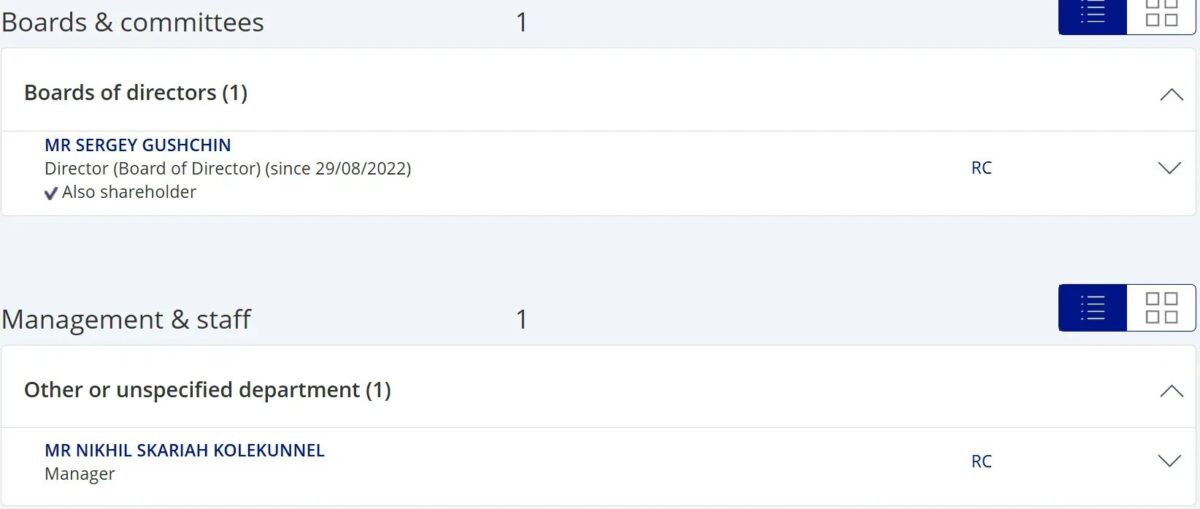
The officially declared owner of Czech Vanadium is Nikhil Skariah Kolekunnel. According to the ADGM free zone business register in the UAE, he is both the sole shareholder and director of Metco Holding.

However, the Gulf state’s database does not disclose so-called beneficiaries, who are entitled to the company’s profits and may also secretly control it.

Although the Czech judicial register lists Skariah as Czech Vanadium’s beneficial owner, this does not necessarily indicate the person exercising control in the background. For example, trustees of trust funds are also listed in the registers as beneficial owners.

The nature of Skariah Kolekunnel’s business suggests that he performs the specific role of an administrator, a so-called fiduciary — someone who accepts an ownership mandate and effectively manages another person’s assets.

He is a lawyer originally from India who founded two law firms in the UAE years ago. His companies represent large corporations and businesspeople who do not wish to publicly acknowledge ownership of a business.

“South Bridge Legal is an advisory firm for comprehensive business establishment in Dubai, Abu Dhabi and the UAE. Our highly experienced team has been active in the sector for more than 10 years, providing services tailored to the unique needs of every ambitious entrepreneur setting up companies in Dubai,” the company wrote on its website.

“We have all activities, which is tax management, tax consulting, accounting, corporate services, offshore company formation, free zone company formation…everything,” Skariah said in a recently published video on YouTube.

Metco Holding’s address in Abu Dhabi suggests it may be a shell company. And it is headquartered from a WeWork.

Moldova and Ukraine links

‘Skariah’, the name of the Indian administrator, had already emerged eight years ago in connection with the concealment of ownership structures during an investigation into the privatisation of Moldova’s national airline. At the time, Skariah appeared as the owner of the opaque company Gold Craft FZE, established in Dubai in 2015.

“On Monday 1 October 2018, one day before the privatisation agreement for Air Moldova was signed, a plane from Istanbul landed at Chișinău International Airport. One of the passengers, a 39-year-old man, was carrying nearly €2.6m in cash in his luggage. He declared the money to customs officers, which, according to the Office for the Prevention and Fight against Money Laundering, he had borrowed four days earlier from Gold Craft FZE in the United Arab Emirates,” the investigative outlet RISE Moldova reported.

It finds that Andrei Ianovici brought cash from Dubai, equivalent to tens of millions of Czech crowns. Later that day, he deposited the money in a bank, and it ended up in the accounts of Civil Aviation Group SRL. That company privatised Air Moldova, and Ianovici was one of its partners.

The true origin of the money was never established, leading local investigators to suspect that the money had not been earned legally. No charges were brought, however.

According to court records, Skariah was also involved in disputes in Ukraine, where Gold Craft FZE claimed ownership of an Ilyushin aircraft which the company allegedly purchased in 2017.

Skariah’s Russian-linked empire

However, the UAE-based lawyer was not the only individual to have emerged as an administrator of Czech Vanadium. Another is Sergei Gushchin.

A man of this name was formerly a prominent Russian businessman in rail freight transport and, although he withdrew from Russia three years ago, he appears on Ukrainian sanctions lists for supporting the Russian army.

Gushchin became a senior manager at PJSC TransContainer, a Russian rail freight carrier, after Evraz sold its stake. In the past, a quarter of the company was owned by the holding company of Abramovich.

Meanwhile another of Gushchin’s companies, Rail Service, formed a joint venture with Evraz in 2019 focused on the production of railway wheels.

According to a UAE register, Gushchin was a director and shareholder of Metco, which became Czech Vanadium’s parent company from 2022-23.

US credit-rating agency Moody’s shared data with Deník N that listed Gushchin as a recent beneficiary of Metco Holding and as the company’s director.

Výpis z americké databáze Moody’s, která vede Guščina jako zakladatele a držitele akcií.
Moody’s data shows Sergei Gushchin as Metco Holding’s director.

Russia’s ferrovanadium monopoly

Czech Vanadium’s revenues regularly exceed €81m, and in 2024 the company reported profits of more than €8m. This summer, the company sent over €0.6m of that sum to the Dubai company, the remaining funds staying in its retained earnings account.

Last year, the company recorded a modest €0.2m loss. Its accounts retained more than €12m in undistributed profits in total.

Czech Vanadium’s business remains closely tied to Russia. Last year alone, vanadium oxides or hydroxides worth nearly €82m were imported into the Czech Republic from the Russian Federation. Russia is effectively the sole supplier of the raw materials needed to produce ferrovanadium. According to the statistical office database, exports mainly go to the United States, as well as Germany and Taiwan.

Czech Vanadium did not reply to requests for comment or an explanation of its ownership structure.

It also did not answer the question of how a Dubai lawyer had bought the Czech company, which, according to some estimates, is worth more than €40m.

Company representatives have not responded to questions about its owners since 2024, when the company left the Evraz group structure.

Fake owner model in US

Jiří Skuhrovec, an analyst at Datlab, specialises in the global vetting of business partners. He says Abramovich uses a similar model for concealing ownership in the United States.

Sanctions also forced the Russian oligarch, who became better known through his former ownership of the British football club Chelsea, to withdraw from US companies. But Skuhrovec concluded that they were probably still controlled by people linked to Abramovich just like the factory in Czech Republic.

“We mapped the entire chain, from the Russian ore supplier through the Czech smelter to the final recipient: the US company Strategic Alloys LLC. Until recently, all three companies officially belonged to Abramovich, and all three are now controlled by people with links to his Evraz group. Abramovich may therefore still secretly control the entire supply chain for this strategic raw material. This would be a textbook case of sanctions circumvention, as well as an obvious security risk,” Skuhrovec said.

Findings led Datlab and Transparency International to submit a complaint to police. “We believe that the 16m Czech crowns (around €655,000) in distributed profit may have gone to Abramovich, who is on a sanctions list. That would constitute a criminal offence,” the analyst explained.

In brief:

  • Czech Vanadium, owned by Russian oligarch Roman Abramovich’s holding company until 2024, was taken over by Dubai-based company Metco Holding.
  • The company is opaque, and Czech authorities are investigating who actually owns the Czech factory. It is suspected it is still linked with former owner.
  • This would amount to circumventing sanctions imposed by the European Union.
  • Deník N and Datlab analyst Jiří Skuhrovec found that the company is backed by lawyer Nikhil Skariah Kolekunnel and Sergei Gushchin, who conduct business with Abramovich’s Evraz group.
  • Skariah has been linked to money laundering in Moldova and Ukraine. He has long covered for companies that are in fact owned by someone else.

Central Europe’s Growth Model Is Losing Momentum, IMF Warns

7 October 2026 at 09:06

Growth potential across Central and Eastern Europe has fallen sharply from the levels seen around EU accession, with ageing populations, weak productivity, Chinese competition and slower German industry increasingly testing the region’s economic convergence.

The economic model that transformed Central and Eastern Europe after EU accession is losing momentum, according to the International Monetary Fund, which is warning governments that structural reforms are needed if the region is to continue narrowing the income gap with Western Europe.

Carlos Mulas-Granados, the IMF’s regional representative, said on Tuesday that medium-term growth potential across Central and Eastern Europe had declined to around 2.5 per cent, compared with roughly 5 per cent before countries in the region joined the European Union.

The slowdown does not mean that every economy is stagnating. Poland continues to grow faster than much of Western Europe, while the Czech economy has recovered from recent shocks. The concern is instead about the underlying rate at which these economies can expand once temporary fiscal stimulus, EU funding and post-crisis recoveries are stripped out.

Several of the forces behind the region’s earlier success are becoming weaker.

EU accession opened access to the single market, attracted foreign investment and integrated Poland, Czechia, Slovakia and Hungary deeply into European industrial supply chains. German manufacturers in particular moved production eastwards, taking advantage of lower labour costs, skilled workforces and geographic proximity.

That process generated rapid gains in productivity and incomes. It cannot simply be repeated.

Demographics are one of the most immediate constraints. Working-age populations are shrinking across much of the region while ageing increases spending requirements for pensions, health care and social support.

The IMF’s country assessments illustrate the problem. Its assessment of Poland says demographic pressures are mounting even as labour productivity remains comparatively strong, and calls for higher labour participation, better skills and deeper capital markets.

In Slovakia, the Fund expects growth of only 0.9 per cent this year and says adverse demographics and weaker productivity are weighing on the medium-term outlook. The economy remains particularly exposed to manufacturing and the automotive industry.

The Czech Republic faces a similar structural constraint. The IMF estimates its medium-term potential growth at around 1.8 per cent, with population ageing and modest productivity gains limiting further convergence.

External conditions have also changed.

Germany, the region’s principal industrial partner, has experienced prolonged weakness in manufacturing. Central European producers therefore face softer demand from the market around which many of their supply chains were originally built.

At the same time, China has moved from being primarily a source of imports and components to a direct competitor in sectors where Central Europe has substantial industrial exposure, including cars, batteries, machinery and electrical equipment.

That combination is particularly difficult for economies built around export-oriented manufacturing.

The problem overlaps with the wider European competitiveness debate. EU Today reported in July that only 15.7 per cent of the reforms recommended in Mario Draghi’s competitiveness report had been fully implemented at that stage, with important work still outstanding on capital markets, energy and investment.

For Central Europe, progress on those issues has a direct bearing on growth. Smaller national capital markets make it harder for companies to finance expansion. Fragmented energy systems add to industrial costs, while limited access to venture capital can restrict the development of businesses outside established manufacturing sectors.

There are significant differences between countries. Poland’s larger domestic market gives it more insulation from industrial weakness elsewhere and the IMF expects relatively strong growth. Hungary has faced a different combination of weak investment and fiscal constraints, while Slovakia’s dependence on car production leaves it particularly exposed to changes in the European automotive sector.

EU funding remains an important source of investment across the region, particularly for infrastructure and modernisation. But EU transfers cannot by themselves replace improvements in productivity.

The IMF’s argument is therefore less about an immediate recession than about the end of an unusually favourable period of convergence.

Central Europe entered the EU with lower wages, substantial scope to import Western technology and a powerful incentive for Western European manufacturers to move production eastwards. As those gaps narrow, future growth depends more heavily on innovation, skills, investment and domestic productivity.

The region is still converging with Western Europe. The question raised by the latest IMF warning is how quickly that process can continue once the economic advantages that powered its first two decades of EU membership become less powerful.

Czechia: Commission suspends payments over Babiš' conflicts of interest

8 September 2026 at 17:07

The Commission has just confirmed that it is suspending certain payments under Cohesion funding and the European Regional Development Fund to the Czech Prime Minister’s company Agrofert, due to the apparent conflict of interest surrounding Andrej Babiš' (pictured) role as PM and his business holdings. The Czech Prime Minister is the owner of the massive agribusiness, for which he set up a ‘trust’ ahead of becoming Prime Minister for the second time. The Greens/EFA Group have long highlighted the conflict of interests surrounding the Czech Prime Minister.  

Daniel Freund MEP, Greens/EFA Group Coordinator in the Budgetary Control Committee said:  “The Commission has recognized that Czech PM Andrej Babiš is likely in conflict of interest and we applaud that the Commission has finally taken action here. It is totally unacceptable for a prime minister to be negotiating the EU’s next long term budget, when he decides how large a chunk of that money could end up in his own pockets. The trust fund that Babiš set up in no way is enough to prevent a conflict of interest and it’s welcome that the Commission has acknowledged this.  “However, the Czech people should not have to suffer due to the dodgy dealings of their prime minister. It is time that the Commission and Council forces Czechia to ensure that Babiš is not involved in any negotiations around the EU’s long term budget, which may benefit him or his family directly. Either Babiš is head of Agrofert or he’s Czech PM, he can’t have it both ways.” 

Markéta Gregorová, Greens/EFA MEP and Czech Pirate Member of the Committee on International Trade said: “I am glad that the European Commission has finally started addressing Andrej Babiš’ conflict of interest, as it promised in its response to my inquiry. This confirms that we were right to raise the alarm: Babiš has not resolved his conflict of interest, and, frankly, he never genuinely intended to do so. The Commission must now ensure that the rules are enforced and that European taxpayers’ money is protected from any misuse.”

The Execution of Alchemist Georg Honauer

27 August 2026 at 05:44

It appears that quite a few people have been killed or brought to justice for having failed to deliver on their promise of turning ordinary metals into gold, in other words, alchemy. One was the English chemist James Price, who took his own life after his deception was exposed. Another was Georg Honauer, whose downfall ended not in disgrace alone but in a spectacular public execution.

Georg Honauer was born in Olomouc, Moravia (now in the Czech Republic), in 1572. In 1596, he entered the service of Friedrich I, Duke of Württemberg, in Stuttgart after persuading the duke that he was both a skilled goldsmith and a successful alchemist.


An etching depicting the execution of the alchemist, Georg Honauer. Credit: Science History Institute


© Amusing Planet, 2026

Codex Gigas, the largest medieval illuminated manuscript, was created by a single monk who took 30 years to complete it

22 August 2026 at 10:19
In 1648, as Swedish troops looted Prague Castle at the end of the Thirty Years’ War, someone carried off among the spoils a volume that weighed 75 kilos and required two people to move. It was a book, the largest surviving illuminated manuscript of the entire Middle Ages, an object so disproportionate for its time […]

The Oldest Sanctuary and Prehistoric Astronomical Observatory in Central Europe Found in the Czech Republic, a Thousand Years Older than Stonehenge

21 August 2026 at 15:59
A team of archaeologists, led by the University of West Bohemia (UWB), has brought to light, near the town of Chleby, in present-day Czech Republic, a monumental structure dating back more than 6,500 years, identified as one of the oldest ritual centers in Central Europe. The first datings on organic material recovered at the site […]

❌