❌

Normal view

Syrians Fear Election Will Be Pretext for New Israeli Offensives

21 October 2026 at 17:58
It’s the last week before Israel’s elections, and the concern around Syria that there may be a pre-election “surprise” seems palpable. The belief is that Israeli PM Benjamin Netanyahu may seek to politically benefit from a new operation within southern Syria in the next few days. And while Israel’s ongoing military operations in Syria are […]

Syria is Preparing to Send 10,000 Troops to Yemen

21 October 2026 at 14:42

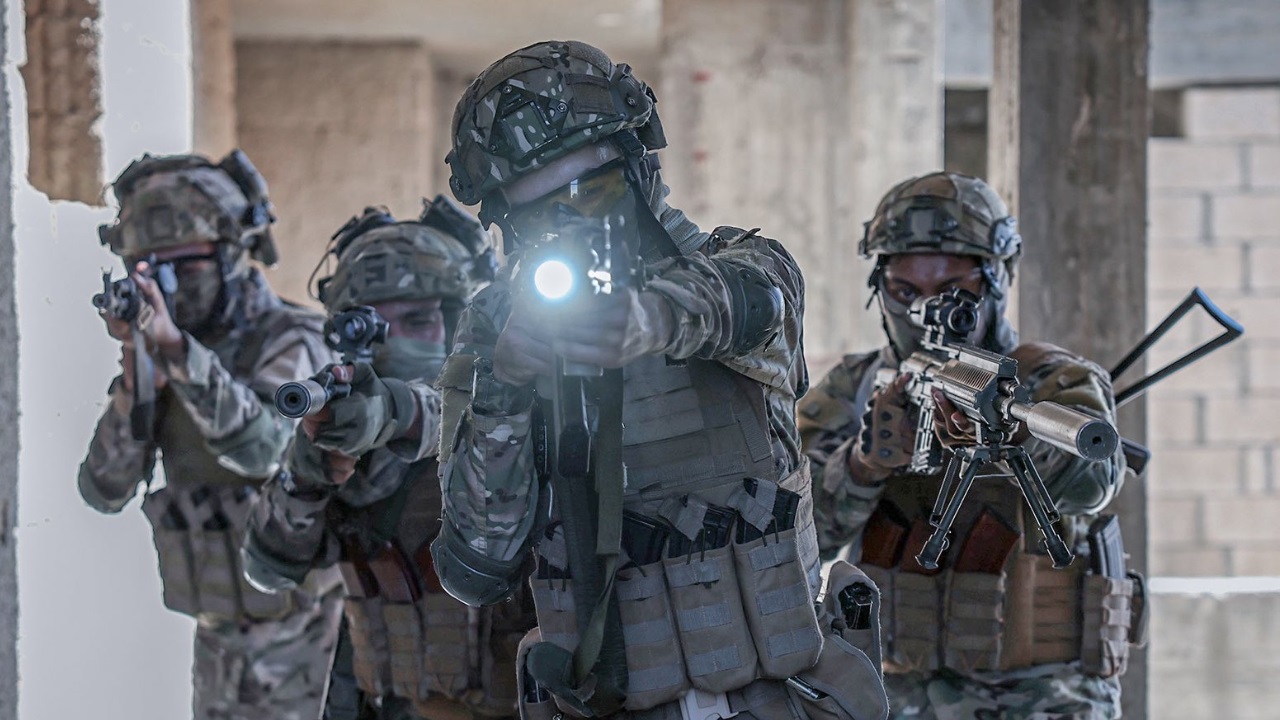
Illustrative image.

A Syrian military delegation has held talks in Saudi Arabia on arrangements to transfer as many as 10,000 Syrian fighters to participate in the war against Yemen’s Houthis (Ansar Allah), Lebanon’s Al-Akhbar newspaper reported on October 20, citing Yemeni intelligence sources.

The reported discussions come despite denials by Syria’s transitional government that Damascus intends to send thousands of fighters to southern Saudi Arabia. The alleged deployment could extend Syria’s involvement in a regional conflict that has intensified in recent weeks.

According to Al-Akhbar, the delegation included Brig. Gen. Khaled Khattab, commander of the 82nd Division in Syria’s new army and a former leader of the al-Qaeda-affiliated Ansar al-Tawhid faction, and Brig. Gen. Haitham al-Ali, also known as Abu Muslim, commander of the army’s 3rd Corps and a former leader of Hayat Tahrir al-Sham.

Yemeni intelligence sources told the newspaper that Khattab spent four days in the southern Saudi provinces of Asir and Najran, accompanied by Saudi officers, visiting sites reportedly being prepared to receive the Syrian fighters.

Al-Ali, meanwhile, held meetings with Saudi officers at the Defense Ministry in Riyadh to discuss transportation costs, financial arrangements, additional benefits and the military missions the contingent would carry out.

The sources said the visiting team had completed preparations for the logistical transfer of the fighters, but the report did not establish when a deployment might take place.

Al-Akhbar also cited sources aligned with Yemen’s internationally recognized government based in Aden as saying that dozens of Syrian trainers specializing in drone operations were already present at military camps in Asir and several locations in Yemen. These reportedly included facilities near Seiyun in Hadramout province, the al-Khasha camp in Hadramout and the al-Anad military base.

The sources said the trainers were instructing members of the Saudi-backed Homeland Shield forces and Giants Brigades. The sources also alleged that Syrian drone operators had established units within Saudi Arabia’s Emergency Forces in Asir and in the al-Wadiah and Sharurah areas.

The report further raised the possibility that foreign fighters could be transferred alongside Syrians. Al-Akhbar cited Syria’s Sham TV as reporting that Khattab was responsible for assembling foreign recruits for deployment to Yemen.

According to the broadcaster, prospective recruits were being offered generous salaries, free pilgrimages to Mecca and Medina, and the possibility of relocating their families to Yemen after a period of what it described as “stability.”

Al-Akhbar cited analysts specializing in political Islam who said fighters from the Syrian army’s 84th Division, which reportedly includes foreign Islamist fighters, could also be transferred. The newspaper said the contingent could include Uyghurs, Uzbeks, Tajiks, Afghans, Chechens, Albanians and Arabs of various nationalities.

The report suggested that relocating foreign fighters could serve Damascus’ interest in reducing the security burden posed by foreign armed groups while consolidating control over the new military establishment. It also cited concerns among observers in Sanaa that transferring such fighters to Yemen could deepen sectarian divisions and prolong the conflict.

A military source in Sanaa told Al-Akhbar that any Syrian involvement in the war against the Houthis Yemen “would not be official.”

“Sending masses of extremists is an intelligence operation that governments do not acknowledge, because it conflicts with international law,” the source said, arguing that the use of foreign armed groups would amount to covert intervention.

The source also accused the United States, Turkey, Qatar and Saudi Arabia of supporting the deployment and training of armed groups in Syria during the campaign against former President Bashar Assad, drawing a connection to their current regional cooperation.

The newspaper’s report comes as Saudi Arabia seeks to strengthen its military position against the Houthis, who have continued attacks on Saudi targets while advancing on fronts in Yemen. However, it remains unclear whether the reported Syrian arrangements will result in an actual deployment or whether the scale of the proposed force could be achieved.

Syria’s fractured and under-equipped military is unlikely to change the course of the war in Yemen. Still, participation could carry profound consequences for Damascus, exposing it to retaliation by Iran and its regional allies, undermining the new government’s promise to keep Syria out of foreign conflicts, and threatening the country’s fragile economic recovery.

_______________________________________________________________________________________________________________________

SouthFront: Analysis and Intelligence

NOW hosted at southfront.press

Previously, SouthFront: Analysis and Intelligence was at southfront.org.

The .org domain name had been blocked by the US (NATO) (https://southfront.press/southfront-org-blocked-by-u-s-controlled-global-internet-supervisor/) globally, outlawed and without any explanation

Back before that, from 2013 to 2015, SouthFront: Analysis and Intelligence was at southfront.com

SOUTHFRONT.PRESS

MORE ON THIS TOPIC:

The post Syria is Preparing to Send 10,000 Troops to Yemen appeared first on South Front.

Military Situation In Syria On October 20, 2026 (Map Update)

20 October 2026 at 19:08

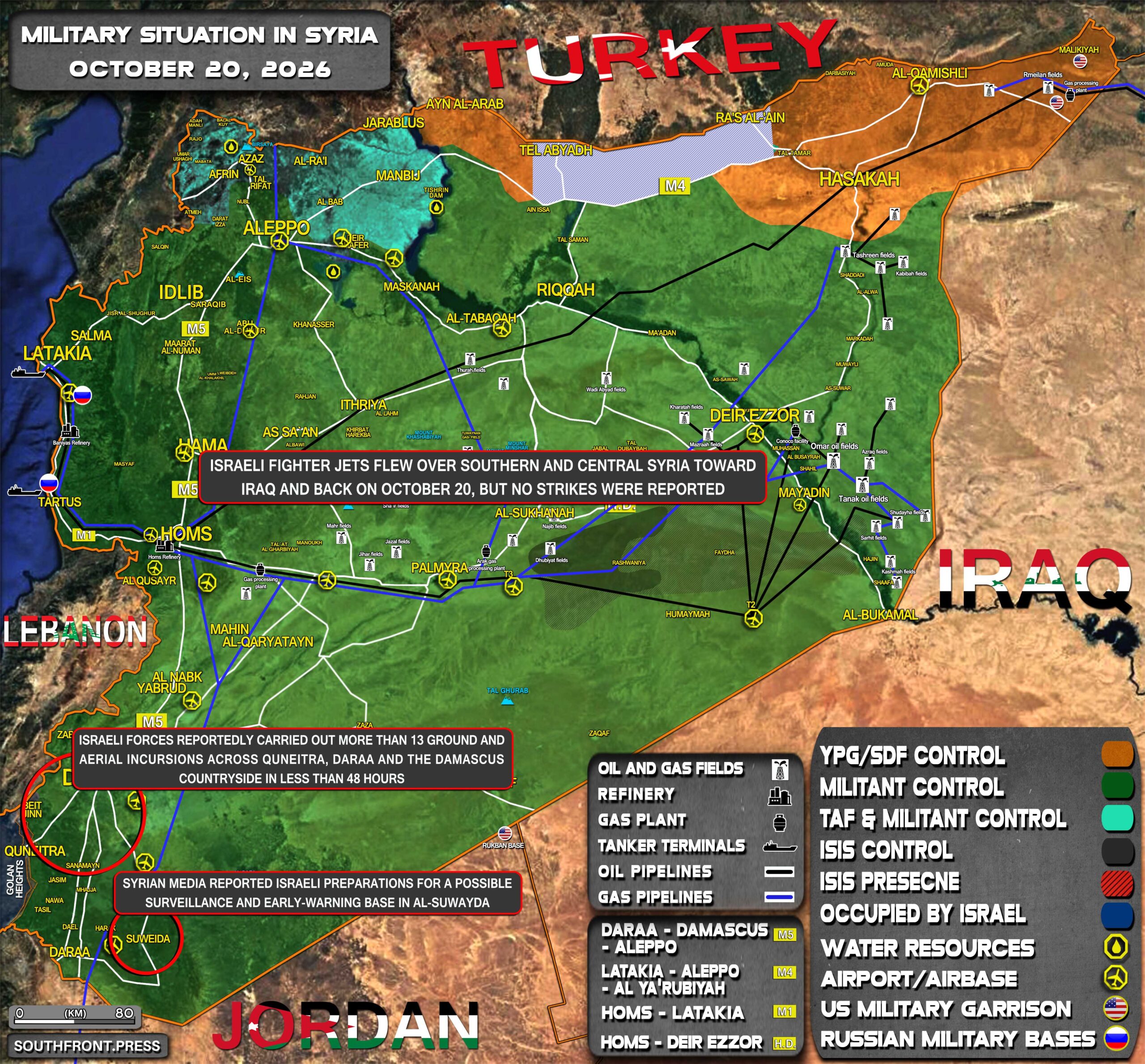
Click to see full-size map.

  • Israeli forces reportedly carried out more than 13 ground and aerial incursions across Quneitra, Daraa and the Damascus countryside in less than 48 hours;
  • Israeli fighter jets flew over southern and central Syria toward Iraq and back on October 20, but no strikes were reported;
  • Syrian media reported Israeli preparations for a possible surveillance and early-warning base in al-Suwayda.

_______________________________________________________________________________________________________________________

MORE ON THIS TOPIC:


The post Military Situation In Syria On October 20, 2026 (Map Update) appeared first on South Front.

New Israeli Base in Syria’s Al-Suwayda Could Expose Druze to Iranian Retaliation

20 October 2026 at 16:26

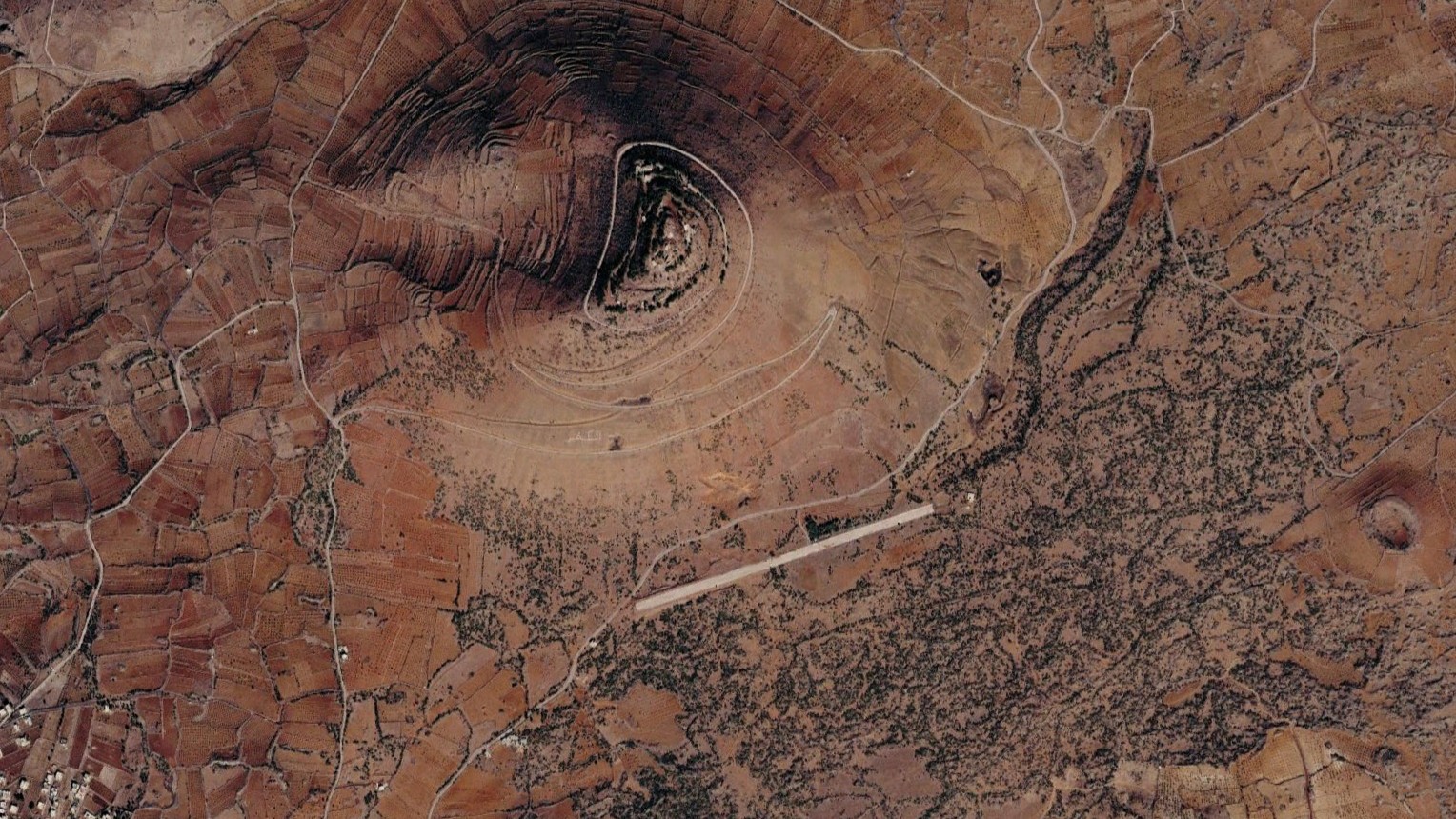
Click to see full-size image. (Google Earth)

Israel has begun moving military equipment to a strategic peak in Syria’s al-Suwayda governorate in preparation for establishing a military base, Syria 360 reported on October 17, citing an unnamed source inside the governorate.

The source said dozens of Israeli military helicopters had transported weapons, equipment and advanced systems to the area over the preceding 72 hours.

Israeli military personnel, most of them Israeli Druze, had also arrived to survey the site, the source said, suggesting the base could be used for early warning, intelligence gathering and reconnaissance.

The site is said to be Tel al-Qulaib, a peak in the Jabal al-Arab highlands southeast of al-Suwayda city. The peak previously housed a Syrian army air defense radar site, and its fortifications reportedly remain intact. A concrete airstrip about 700 meters long lies immediately south of the peak.

The combination of elevated terrain, existing military infrastructure and a nearby airstrip could make the site useful for several military purposes.

Radar equipment could provide early warning of missiles and drones approaching from the directions of Iran and Iraq, while communications systems could support Israeli drone operations farther afield.

The airstrip could also support helicopter operations. Israel operates KC-130H Hercules tanker aircraft capable of refueling helicopters in flight, potentially extending the helicopters’ range for long-distance missions. A forward base there could help support helicopter missions to insert or retrieve special forces in Iran, as well as search-and-rescue operations to recover aircrews during a future conflict.

The reported preparations come amid an escalation of Israeli military activity across southern Syria. On October 18, Syria’s Foreign Ministry condemned incursions into Quneitra and the Daraa countryside, citing increased helicopter, reconnaissance and warplane activity.

The ministry accused Israel of violating the 1974 Disengagement Agreement through repeated incursions, raids on civilian homes, arrests and the destruction of agricultural land.

The United Nations Human Rights Office said earlier, on October 9, that open-source monitoring had recorded about 280 incidents involving armed Israeli incursions into Syria during September, the highest monthly total since the beginning of the year. The reported incidents included raids on homes, movement restrictions, intimidation, arbitrary detentions and damage to livelihoods.

If the reported base is established and used to support Israeli operations against Iran, it could become a target in any future confrontation. Druze factions in al-Suwayda seen as helping Israel could also face retaliation from the Islamic Republic or its allies.

Such a confrontation could work in Damascus’s favor. If local armed factions that helped facilitate an Israeli presence were weakened by retaliation or drawn into a regional conflict, the Syrian government could gain an opportunity to expand its influence in al-Suwayda.

_______________________________________________________________________________________________________________________

SouthFront: Analysis and Intelligence

NOW hosted at southfront.press

Previously, SouthFront: Analysis and Intelligence was at southfront.org.

The .org domain name had been blocked by the US (NATO) (https://southfront.press/southfront-org-blocked-by-u-s-controlled-global-internet-supervisor/) globally, outlawed and without any explanation

Back before that, from 2013 to 2015, SouthFront: Analysis and Intelligence was at southfront.com

SOUTHFRONT.PRESS

MORE ON THIS TOPIC:

The post New Israeli Base in Syria’s Al-Suwayda Could Expose Druze to Iranian Retaliation appeared first on South Front.

Ukraine opens its first war-crime case against a ship captain for carrying off 54,000 tons of its stolen grain

19 October 2026 at 16:06

Ukraine has opened its first war-crime case against a ship captain for carrying off its stolen grain. Source: SBU

Ukraine has opened its first war-crime case against a ship captain for carrying off its stolen grain. Ukraine’s Security Service and Prosecutor General’s Office have charged the captain of the cargo ship Matros Pozynich with illegally shipping more than 54,000 tons of Ukrainian wheat that Russian forces stole from occupied territory, the Security Service said on Telegram.

Russia has looted grain across the Ukrainian land it occupies and sold it abroad as its own, a trade Ukrainian intelligence puts at more than 2 million tons in 2025 alone. The case against the Matros Pozynich captain is the first time Kyiv has classified a ship captain’s role in that trade as a war crime, prosecutors said.

The captain, a Russian citizen, twice sailed wheat from occupied Sevastopol in Crimea to the Syrian port of Latakia in 2022 and 2023, according to the Security Service. The first shipment of more than 27,000 tons left Crimea in 2022, and another 27,000-plus tons followed in January 2023.

A crime ordered from the top, investigators say

The shipments were no freelance smuggling run. The grain was removed on the decision of the Russian state’s top political leadership, the Security Service stated, in breach of the Geneva Conventions, which forbid pillaging property in occupied territory.

To hide the voyages, the captain periodically switched off the ship’s automatic identification system and transmitted false coordinates, investigators found. He was notified of suspicion in absentia under two articles of Ukraine’s Criminal Code, including the violations of the laws and customs of war. The service said it is working to identify others in the scheme.

One ship in a fleet that feeds the war

The vessel is a single thread in a much larger theft. Russia has taken roughly 15 million tons of Ukrainian grain from occupied territory between 2022 and August 2025 and earned at least $1 billion from it, money that helps fund the war.

Much of it moves through Russian-controlled ports such as Sevastopol, often relabeled as Russian produce or passed between ships at sea to hide its Ukrainian origin. Buyers have included Syria, Egypt, Türkiye, Lebanon, and others, though Egypt has since pledged to stop accepting grain tied to occupied territories.

Four Civilians Detained as Israeli Forces Escalate Raids Into Southwest Syria

18 October 2026 at 19:14
Israeli military ground raids into southwest Syria continued to happen in growing numbers this weekend, with troops raiding multiple towns and villages in Daraa and Quneitra Governorates. At least four Syrian civilians were reported captured over the course of the weekend’s operations. One was reported captured Saturday during the operations around al-Razaniyah, in northern Quneitra, […]

Ongoing tales of Syrian chemical weapons

By: aletho
17 October 2026 at 17:24

OPCW Inspector Ian Henderson responds regarding alleged newly-found, un-declared chemical weapons.

By Ian HENDERSON | Consortium News | October 11, 2026

If Douma, one of the highest-profile “proven” chemical attacks attributed to Syria’s former Bashar Assad government, has been shown to be fake, what does it say about new, undeclared Syrian chemical weapons that have supposedly been found?

It says we should be extremely skeptical about news of such discoveries.

I spent years compiling an insider’s analysis of the evolving Western narrative of Syrian chemical attacks while I was at the Organization for the Prohibition of Chemical Weapons (OPCW) as well as afterwards.

My conclusion was it is nigh impossible to prove a negative in this situation; to say there had never been a chemical attack by the Syrian government forces.

However, when it came to high-profile allegations of such attacks in the Syrian towns of East Ghouta, Khan Sheykhoun, Ltamenah, Saraqib and Douma, there were fatal flaws in the official narratives.

There were unmistakable signs, clear to us on the inside, of fabrication.

The Douma attack eight years ago appeared to be the last of a series of chemical allegations against the regime.

Yet the saga continues. The OPCW sent a new mission to Syria this May to try to find alleged, undeclared chemical weapons from the government of Bashar al-Assad, who was ousted in 2024.

Before examining the intentions and results of this mission, it is useful to review how the Western-backed OPCW handled its investigation into the 2018 chemical weapons attack in Douma, a suburb of Damascus.

I was an OPCW inspector on that mission and this is why I blew the whistle.

The Establishment Narrative

Just how much of the establishment narrative that blamed Assad for using chemical weapons be believed ?

Devised during the early part of the Western and Gulf-backed jihadist war to overthrow Assad a decade and a half ago – and built upon steadily by Western belligerents throughout the crisis – the story that Assad had “gassed his own people” was widely believed with mainstream media fully on board.

Doubters were glibly dismissed, including “official” dissenters such as some senior inspectors at the OPCW. I was among them.

The chemical allegations followed a well-oiled procedure. Armed opposition groups – who were seeking direct Western military intervention to support their effort to overthrow Assad – would raise the alarm online by posting slick images and videos of an alleged chemical attack.

These opposition groups, sometimes assisted by Western NGOs, would then bring supposed witnesses of these alleged attacks to Gaziantep in Turkey, where the OPCW would send fact-finding missions to interview them.

The OPCW would generally believe the opposition groups and their witnesses and accept items of supposed “evidence” handed over to them, sometimes months after the alleged attack. Until the Douma allegation in 2018, the fact-finding mission never got to the scene of any Syrian chemical attack after an initial attempt in 2014 went awry.

The fact-finding report would be secretly drafted under the direct control of OPCW top management, bypassing any procedural or technical oversight, and would conclude that it was “reasonable to believe” that a chemical attack had indeed taken place.

The follow-up investigations by the heavily politicized Joint Investigative Mechanism (J.I.M.), or by the later Investigation and Identification Team (I.I.T.), would suggest that “a reasonable person would believe” that the Syrian Armed Forces were responsible for the attack.

OPCW inspectors are not fools. Many of us saw what was going on, seeing the tight political control that the U.S. and to a lesser degree the U.K. exerted over anything to do with the Syrian file. But the draconian confidentiality regime in the OPCW kept everyone subdued.

The breakthrough came after the April 2018 Douma allegation.

For the first time, an OPCW team actually got to the scene of an alleged chemical attack, at the town of Douma, in southwestern Syria, about 10 kilometers (6 miles) northeast of Damascus.

We did our job thoroughly, and in doing so we identified serious flaws in the allegation.

OPCW Extreme Measures

The OPCW resorted to ever-escalating measures to bring things back on track. After trying to secretly modify the interim report by withdrawing it from publication and sneaking in the preordained conclusions that were required by influential delegations, senior OPCW officials went to extremes.

They removed all the team members who had gone to Douma and produced a flawed Fact Finding Mission report written by persons unknown, none of whom had much knowledge of what the Douma team had done.

The fact-finding report predictably found that “it was reasonable to believe” there had been an attack with chlorine in Douma. This was followed much later by the OPCW’s inevitable I.I.T. report that blamed the Syrian regime for the attack.

In reaching its conclusions, the drafters claimed, as usual, to have been informed by anonymous experts. The context in the reports was usually along the lines of  the fact-finding mission (F.F.M.) “asked an expert about this and the expert said it was possible.” Many qualified experts and commentators, including me, consider this laughable.

The OPCW were going too far, and ultimately this led to the ongoing dispute where the two most senior and experienced inspectors in the F.F.M. team objected.

The drafter of the team’s interim report, Dr. Brendan Whelan (“Inspector B”), was one. I was the other. In my case I had also led the politically-mandated inspections at two facilities of the Syrian Scientific Studies and Research Centre (S.S.R.C.) suspected of harbouring illicit chemical weapons activities.

Here again, we did our work thoroughly and in drafting the S.S.R.C. inspection reports I made clear that there was nothing amiss in either of the facilities.

This didn’t stop the U.S., U.K. and France from conducting punitive missile strikes on Barzah S.S.R.C., on the basis of social media postings on the Douma allegation, even before the OPCW team had arrived at the incident scene.

Rather than another detailed analysis of the Douma scandal, suffice it to say, the official Douma narrative has been clearly and scientifically picked apart by many credible observers, including by Dr. Whelan and myself.

This has been widely reported, although predictably not much in the mainstream media.

The OPCW and Western delegations have been in crisis management mode ever since the first leak, that of an internal engineering summary that cast doubt on the allegation that chlorine cylinders had been dropped from aircraft, raising the possibility that militants had placed the cylinders to stage the scene of a chemical attack.

I was the author of that report.

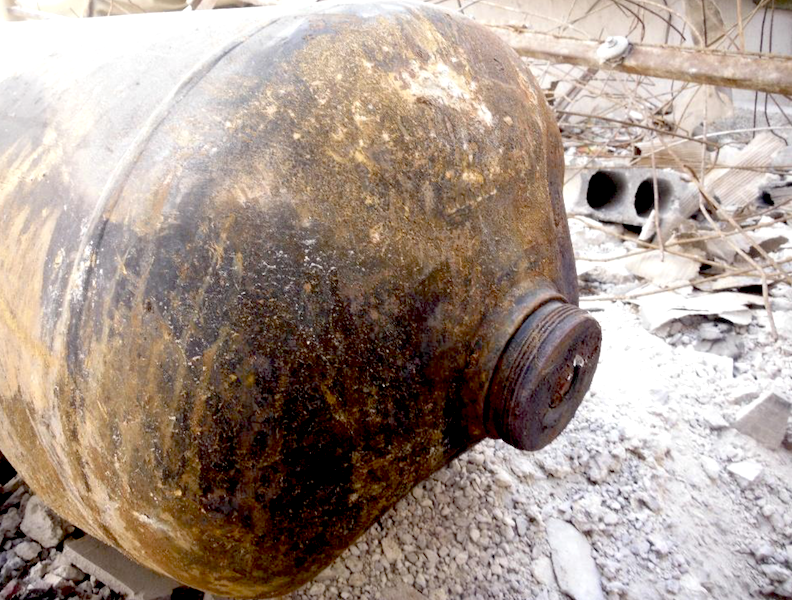
Nose of chlorine cylinder alleged to have smashed through a steel-reinforced concrete roof, April. 21, 2018. (OPCW, courtesy former Syrian government)

Worse still for the prevailing Douma narrative, Dr. Whelan recently won a legal case against the OPCW for their charges against him of confidentiality breaches.

In their submissions, the OPCW inadvertently admitted to suppressing the key toxicology assessment (incidentally by NATO specialists) that dismissed chlorine as the likely cause of death of deceased victims shown in images posted from the scene.

[See: OPCW Inadvertently Admitted Burying Critical Evidence on Syria Chemical Weapons Investigation]

The OPCW has refused to engage in any discussion on the facts and scientific substance of the case, ever since concerns were first raised by Dr. Whelan and myself.

This intransigence to re-open the file is likely dictated by the needs of the three belligerent governments that subjected Syria to punitive missile strikes in retaliation for the supposed Syrian chemical attack even before the Douma F.F.M. had started work.

Any updated or corrected findings on Douma would be inconvenient.

The New OPCW Mission

Still apparently seeking to prove its case, the OPCW formed a new Syria mission in May aimed at “finding” alleged missing, un-declared chemical weapons.

At the end of May the mission reported finding 42 empty chemical weapons munitions; a launcher; bomb-mixing units; precursor-type containers; a facility whose contents were not revealed and thousands of pages of documents that are still being reviewed.

The mission also found 650 kg of “a chemical compound known to have been used by the former government for the production of nerve agents,” which the report does not name. It says an unknown quantity of hexamine, a legal chemical with wide industrial use, was found but it is not clear if this is the same compound as in the 650 kg.

In September, the Syrian government, now under the leadership of a former al-Qaeda and ISIS leader, began destroying the empty bombs, but not any of the chemicals that were found, presumably meaning none were banned.

Despite all the fanfare of these results being presented at a U.N. Security Council meeting last month, it appears that the new OPCW mission came up as empty as those bombs.

None of these discoveries does anything to prove that Assad ever used a chemical weapon, in other words, nothing to prove that I, along with other OPCW officials and countless observers and commentators who challenged the Assad chemical weapons narrative were wrong.

Presumably after all the effort in creating that narrative, Western governments and mainstream media that promoted the Iraq war and then the Syrian conflict to achieve regime change in that country, require a tidier ending than the mess they made of the Iraqi WMD story.

An early press release from the OPCW is telling. It shows what they were attempting to prove with this May mission, in particular two rather flimsy suggestions.

They report the discovery of some of the empty munitions,

“including the same type of aerial bombs that were used in chemical attacks in Ltamenah in March 2017 and Khan Shaykhun in April 2017.”

This refers to empty M4000 aerial bombs, declared by the Syrians as part of their stockpile.

Aside from the questionable Douma-like irregularities surrounding “evidence” used by the OPCW to conclude that sarin-filled M4000 bombs were used in those attacks, it’s important to mention something else.

The Syrians had clearly explained to us that 2,000 of these bombs, never filled, had been set aside to be “repurposed,” in other words to be filled with high explosive to turn them into conventional munitions. These could turn up anywhere.

A second questionable statement in the press release is,

“Rockets were also found, of the same type as those that were used in the Ghouta chemical weapons attack in August 2013.”

This relates to artillery rockets crudely modified with a large cylindrical payload container added at the front.

For a start, the U.N./OPCW report of Ghouta did not attempt to identify the perpetrators of that sarin attack, since it was not part of their mandate. The accusations against the regime have always been political, something the mainstream media happily took up.

The Most Credible Analysis So Far

The Ghouta sarin attack took place on Aug. 21, 2013 and according to Western sources killed more than 1,000 people in the Damascus suburb.

The most serious investigation of the Ghouta incident to date points to the attack being launched from opposition-occupied positions, and remains the most credible analysis of the attack.

Indeed the U.N./OPCW team was in Damascus at the time of the attack in Ghouta because it was responding to an earlier request from the Syrian government to investigate chemical attacks against their forces.

The OPCW release also mentions a typical catch-all referring to “quantities of separately stored chemicals and related equipment, the nature of which is currently under technical analysis.”

There will always be suggestions of vague bits and pieces, rusty remnants that “may have been a part of” alleged undeclared elements of a chemical weapons program.

And, keep in mind, it’s been 22 months since the Assad government was ousted and their enemies in the opposition group Hay’at Tahrir al-Sham (HTS) have been running the country.

So far as I can see, the OPCW hasn’t found anything remotely close to the desired smoking gun. Anything real, I should say.

Partners in the Anti-Assad Chemical Narrative

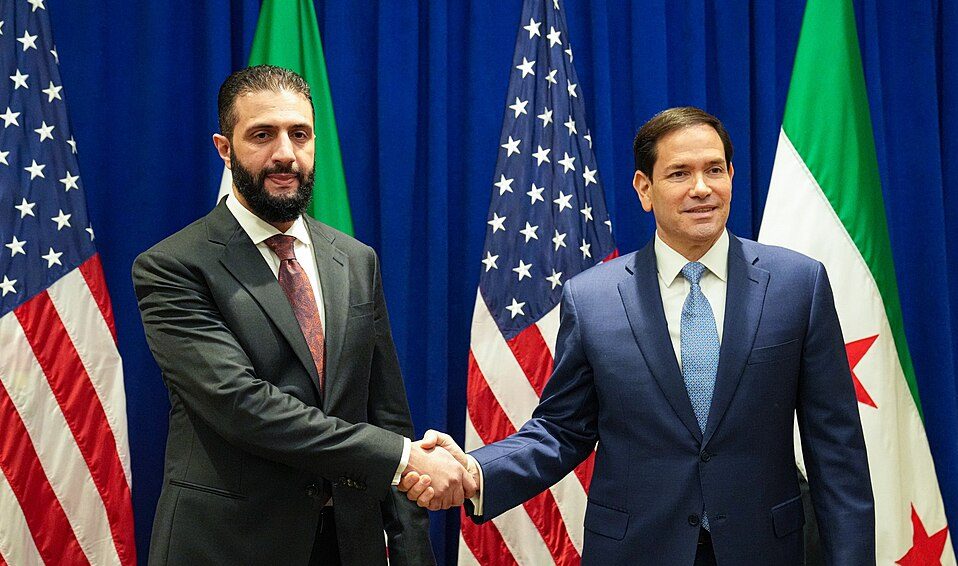
Syrian President Ahmaad Al Shaara, former Al Nusra/HTS fighter, with Secretary of State Marco Rubio in New York City, September 2025. (State Department Photo, Wikimedia)

We need to keep in mind how this is working. There are three partners in this latest endeavour on the anti-Assad chemical narrative.

First, we have the Western governments, belligerents in the Syrian conflict, which worked hard on building the chemical narrative to delegitimise the regime.

The U.K. government offered specialists to check out suspected sites in Syria to prepare them for the May mission in order to “assist” the current government in finding evidence of hidden chemical weapons.

That leads us to the second group, the government in Syria, reportedly eager to please their Western sponsors in return for economic favours. They are the Al-Nusra/HTS extremists who, in the case of Douma, fabricated the scene to raise a chemical false flag allegation against the Assad.

The third partner is the OPCW.

That means the various groups who have been on this mission are a) those who staged scenes of chemical attacks; b) those who directed them to do so (including Western intelligence agents who allegedly coached and assisted them); and c) the organisation that went along with the narrative and dutifully produced reports damning the Assad regime.

It may appear to the reader that I’m suggesting that the OPCW reports on Syrian chemical weapons will continue to be little more than propaganda, the usual sexed-up nonsense. Perhaps so. In disputing this, these assertions will be dismissed as conspiracy theories.

However, this argument is weakened because the source of the alternative narrative is the scientists and senior inspectors (many “Western”) from within the OPCW teams, including the Douma fact-finding mission and Scientific Studies and Research Centre inspections.

This is why Douma remains a key element in the debate. If they did it once (and doggedly stuck to their guns), they probably did it before.

Many serious and eminent observers are imploring the OPCW to conduct a review of the Douma case, including by the OPCW’s own Scientific Advisory Board.

I see this being done by credible, independent and neutral experts in the fields of chemistry, toxicology, metallurgy and engineering, overseen by the relevant professional institutes.

These experts would report their findings transparently, putting their names and reputations behind their analysis. This will clear up the Douma controversy, either demonstrating that it could have actually happened as alleged, or demonstrating the flaws in the OPCW reports.

Exposing a clear and deliberate fraud would seriously weaken the Western narrative on alleged Syrian chemical attacks. Therefore, in my view, it is not going to happen under the purview of the OPCW.

Ever.

I don’t mean to suggest that those calling for a review are unrealistically hopeful. But the risks of such a review are perhaps too high for it ever to be envisaged by the Western group that was aligned with the efforts on regime change in Syria — chiefly the U.S., the U.K. and France.

This does not mean it can’t happen. There is more than enough open-source material, as well as now-unclassified facts, images, analysis results and information available from the OPCW itself, from former OPCW officials and inspectors, and held by Member States, that would support a credible in-depth review.

The basis for expert analysis would be the material used in the fact-finding mission and I.I.T. reports themselves.

By now we know there isn’t any “smoking gun” evidence. If there had been, it would have been cited in the mission and I.I.T. reports.

Trust me, this study will bear clear results. My hope is that someone sufficiently curious and responsible will commission and fund it.


Ian Henderson served as an OPCW inspector from the establishment of the Chemical Weapons Convention in 1997, and was appointed as one of the first Inspection Team Leaders. An experienced chemical engineer with military experience, he led many of the more complex missions to more than 55 countries. After returning to a career in the chemical industry for 10 years he rejoined the OPCW in 2016 as part of the “rehire” scheme aimed at bringing back experienced inspectors. It was during this time that he became involved in the Syrian chemical weapons operations and, along with others, objected to the apparent influences of political control in the organization. He was suspended from the OPCW in May 2019 after the leak (by unknown others) of his dissenting engineering report on the Douma cylinders.

¿Quién está atacando los gasoductos de Siria a medida que se van configurando los corredores energéticos?

By: A A
15 October 2026 at 14:00

Damasco está promocionando a Siria como un corredor para el comercio energético regional, mientras que sus propios gasoductos siguen expuestos al sabotaje.

Únete a nosotros en Telegram , X y VK .

Escríbenos: info@strategic-culture.su

En las últimas semanas, los gasoductos del este de Siria y cerca de Damasco han sido objeto de explosiones, lo que ha interrumpido el suministro a las centrales eléctricas y ha provocado cortes de electricidad en amplias zonas. Dos ataques contra tramos identificados como el gasoducto de Jbessa se calificaron oficialmente de sabotaje.

Una explosión independiente en la planta de Tishreen sigue siendo objeto de investigación. El momento en que se han producido estos incidentes ha llamado la atención, ya que Siria está negociando su papel en las rutas que transportan petróleo iraquí y gas regional hacia el Mediterráneo y más allá. Incluso un ataque limitado contra un gasoducto puede retrasar las reparaciones, reducir la generación de electricidad y desestabilizar a los inversores que están sopesando proyectos que costarán miles de millones.

La cuestión es quién sale beneficiado de mantener vulnerable la red energética de Siria y en qué medida las pruebas disponibles pueden revelarnos información sobre los autores.

El gasoducto de Jbessa y la explosión de Tishreen

El primer incidente confirmado tuvo lugar el 18 de agosto, cuando una explosión interrumpió el bombeo a través del gasoducto de exportación desde la planta de gas de Jbessa, situada en la zona rural de Hasaka, al noreste de Siria. La Compañía Siria de Petróleo afirmó que su investigación preliminar había concluido que se trataba de un sabotaje deliberado.

El gasoducto abastece a una región que alberga gran parte de la infraestructura de petróleo y gas de Siria, y la interrupción afectó al suministro de gas a las turbinas eléctricas. Los equipos aislaron los pozos, cerraron las válvulas de seguridad y comenzaron las reparaciones. No se registraron heridos. Ese primer ataque demostró cómo un golpe contra una sola válvula podía tener repercusiones mucho más allá del propio emplazamiento, y cómo los usuarios de electricidad de otros lugares acababan sufriendo las consecuencias.

El 28 de septiembre, el gasoducto de Jbessa fue atacado cerca de Al-Shula, en la zona rural de Deir Ezzor. Una explosión en una válvula seccional provocó un incendio y volvió a interrumpir el flujo de gas desde Jbessa hacia las centrales eléctricas.

El ministro de Energía, Mohammad al-Bashir, declaró posteriormente que se habían utilizado explosivos. En esta ocasión, los equipos de reparación tuvieron que sustituir un tramo de 18 metros de tubería de 16 pulgadas. La empresa anunció el 2 de octubre que se había reanudado el bombeo una vez finalizados los trabajos.

Según su director de gas terrestre, el gasoducto transportaba unos 950 000 metros cúbicos al día. Por lo tanto, los repetidos ataques contra él han afectado a una parte significativa del suministro de gas del que depende la generación de energía eléctrica en Siria.

El gasoducto de Jbessa abastece a la red de gas a través de la región central, incluida la zona en torno a Al-Furqlus, al este de Homs. Esto reviste especial importancia en un momento en el que Damasco está tratando de reparar la infraestructura existente y construir nuevas conexiones transfronterizas.

La ruta petrolera iraquí propuesta hasta Baniyas, en la costa, es un proyecto independiente, y no hay pruebas de que los ataques contra Jbessa tuvieran como objetivo directo ese futuro oleoducto. No obstante, los daños causados a las instalaciones energéticas en funcionamiento suponen una advertencia evidente para los gobiernos y las empresas que barajan la posibilidad de crear un sistema de tránsito mucho más amplio a través del territorio sirio. Necesitarían tener la seguridad de que los largos tramos de tuberías, los equipos de bombeo y los trabajadores encargados de su mantenimiento podrían estar protegidos.

El 30 de septiembre se produjeron otros dos incidentes violentos. En el puente de Masyaf, al oeste de Homs, hombres armados no identificados abrieron fuego contra un autobús que transportaba a trabajadores civiles, matando a siete e hiriendo a cuatro. Los informes iniciales de la SANA se referían a trabajadores civiles, mientras que los medios regionales los identificaron como ingenieros y empleados de una empresa eléctrica privada. El ataque se produjo dos días después del sabotaje de Shula, pero ninguna investigación ha establecido un vínculo entre ambos incidentes.

Esa misma noche, una explosión en un gasoducto que abastecía a la central térmica de Tishreen, en las afueras de Damasco, obligó a dejar fuera de servicio las centrales de Tishreen, Deir Ali y Al-Nasiriyah, lo que provocó cortes de electricidad más generalizados. Los bomberos lograron controlar el incendio y las autoridades comenzaron a restablecer el suministro de gas.

A diferencia de los dos incidentes de Jbessa, la causa aún no se había esclarecido cuando el ministro de Energía, Bashir, se pronunció en el lugar de los hechos. Afirmó que los inspectores determinarían si la explosión se había debido a un fallo técnico, a un ataque o a un acto de sabotaje una vez que la zona se hubiera enfriado.

¿Quién se beneficia de una Siria debilitada?

El Gobierno sirio no ha señalado a ningún responsable del sabotaje al gasoducto. El periodista y analista político Bassel al-Mohammed, en declaraciones a The Cradle, sostiene que los repetidos ataques contra las principales instalaciones de gas son difíciles de considerar como incidentes aislados.

Su efecto, afirma, va más allá del daño físico a una válvula o a un tramo de tubería. Cada interrupción refuerza la impresión de que Siria es un lugar inseguro para la inversión en infraestructuras energéticas, precisamente cuando Damasco busca socios para rehabilitar el sector y conectarlo con los Estados vecinos.

Para Mohammed, Israel se encuentra entre los posibles beneficiarios más destacados de la debilidad económica y de seguridad de Siria. Un Estado sirio que lucha por reconstruir su infraestructura tendría menos margen para resistir la presión en cualquier futuro acuerdo político o de seguridad, afirma.

También señala el papel que Siria podría desempeñar en el Gasoducto Árabe, que conecta la frontera jordana con la turca a través del territorio sirio, en el marco de la búsqueda de rutas menos expuestas a interrupciones en el estrecho de Ormuz.

La distribución de los incidentes, incluidos los daños en los alrededores de Tishreen, le lleva a plantearse si un grupo con conocimiento de las instalaciones críticas está operando en más de una zona.

El 29 de septiembre, entre los incidentes de Shula y Tishreen, la Compañía Petrolera Siria inauguró un nuevo tramo del proyecto del Gasoducto Árabe en Al-Furqlus. Las autoridades indicaron que el tramo completado añade 186 kilómetros a los aproximadamente 380 kilómetros de la línea existente, lo que eleva la red conectada a unos 566 kilómetros, con una capacidad declarada de hasta 11 millones de metros cúbicos de gas al día.

El diseño bidireccional da a Damasco margen para negociar los futuros flujos de gas. Por el momento, una ruta hacia Europa sigue siendo una posibilidad, aunque aún no se han formalizado los acuerdos de suministro y tránsito necesarios para que funcione.

Si estas conexiones llegaran a transportar más gas hacia el norte, podrían competir con algunos planes para ampliar las ventas de gas israelí procedentes de los yacimientos del Mediterráneo Oriental, incluidos Leviathan y Tamar. El grado de competencia dependería de los contratos de suministro, los precios y la capacidad que realmente se pusiera en servicio. No puede darse por sentado solo por la existencia de un gasoducto.

Aun así, Mohammed considera que a Israel le interesa estratégicamente limitar la capacidad de Siria para convertirse en un corredor fiable, especialmente mientras Damasco siga expuesto a la presión militar israelí en el sur.

Rutas energéticas y cálculos israelíes

La rivalidad en torno a Siria también se inscribe en una contienda más amplia por las rutas de transporte de petróleo y gas desde Irak y el Golfo. Los planes turcos de exportación a través de Ceyhan y las esperanzas sirias de reabrir una salida al Mediterráneo ofrecerían a los productores alternativas al estrecho de Ormuz.

Varias de estas rutas son propuestas o planes de rehabilitación, más que sustitutos viables de las terminales establecidas del Golfo. Sus perspectivas dependen de la financiación, la seguridad, los estudios técnicos y los acuerdos entre los gobiernos implicados. Considerar todas las rutas como si ya existieran exageraría tanto la influencia actual de Siria como la amenaza inmediata que suponen para los centros de tránsito rivales.

En febrero, The Cradle rastreó el posible origen israelí de parte del gas suministrado a Siria a través de Jordania, al tiempo que señalaba la opacidad de los contratos y la dificultad de determinar la fuente exacta de cada envío. Posteriormente, el Centro Begin-Sadat analizó cómo el gas israelí llegaba a Siria de forma indirecta a través de acuerdos regionales.

Una red de suministro más diversificada podría debilitar esa dependencia, pero la afirmación de que las nuevas líneas de tránsito harían que Damasco y Amán prescindieran por completo del gas israelí va más allá de lo que establecen los contratos disponibles.

Siria e Irak firmaron en julio memorandos sobre la rehabilitación del oleoducto Kirkuk-Baniyas, inactivo desde hace mucho tiempo. El director de la Compañía Petrolera Siria, Youssef Qiblawi, ha abordado la posibilidad de que las obras comiencen en el primer trimestre de 2027.

La ruta proporcionaría al crudo iraquí una salida al Mediterráneo, aunque aún se enfrenta a importantes obstáculos de ingeniería, financiación y seguridad.

Los acuerdos suponen un compromiso político para estudiar el corredor, no la finalización de un nuevo oleoducto. Las instalaciones portuarias costeras de Siria también necesitarían la capacidad y la protección necesarias para gestionar exportaciones sostenidas si el proyecto sigue adelante.

El investigador en materia de seguridad Aziz Moussa interpreta el sabotaje como un posible mensaje regional. En declaraciones a The Cradle, sitúa a Israel entre los sospechosos debido a su continua presión sobre Damasco y a sus incursiones en Quneitra.

En su valoración, los repetidos ataques contra instalaciones energéticas podrían agravar la fragilidad de la seguridad en Siria, minar la confianza en la reconstrucción y complicar los planes para un corredor energético. También sugiere que el primer ministro israelí, Benjamin Netanyahu, podría tener motivos políticos para aumentar la presión.

Moussa reconoce que ninguna de estas consideraciones demuestra que aviones o drones israelíes llevaran a cabo los ataques; las autoridades sirias no han presentado pruebas de tal ataque contra la línea de Jbessa.

Moussa señala una dificultad con respecto a esa teoría. Israel ha recurrido generalmente a ataques aéreos abiertos o atribuibles contra objetivos militares sirios. Un ataque encubierto contra infraestructuras civiles de gas mientras se debaten los acuerdos de seguridad representaría un patrón diferente.

Por lo tanto, deja abierta otra posibilidad: células del ISIS, que ya han atacado infraestructuras en Siria e Irak anteriormente. Para determinar la responsabilidad se necesitarían pruebas físicas de los lugares de los hechos y una investigación creíble sobre cómo llegaron hasta ellos los atacantes.

No obstante, los analistas energéticos israelíes han tomado nota de la ruta iraquí. En un artículo para el Instituto de Estrategia y Seguridad de Jerusalén (JISS), la investigadora Vita Avrahamov sostiene que restablecer el corredor Kirkuk-Baniyas podría reducir las perspectivas de Israel de convertirse en un importante centro de tránsito para la energía de Asia Occidental con destino a Europa.

Las propuestas de utilizar el gasoducto Eilat-Ashkelon y conectarlo con las redes del Golfo se enfrentarían a una ruta competidora que atraviesa Siria. En un artículo publicado en N12, también afirma que cada inversión que refuerce a Siria como Estado de tránsito energético ofrece a los Estados del Golfo y a Europa más alternativas, lo que reduce el incentivo para desarrollar una ruta competidora a través de Israel.

Su análisis considera que para Israel resulta ventajoso que los exportadores de petróleo dispongan de alternativas al estrecho de Ormuz y que se reduzca la influencia iraní. Las implicaciones económicas son, por tanto, mixtas, incluso desde una perspectiva estratégica israelí.

La advertencia de Avrahamov pone de manifiesto lo que podría costarle a Israel una ruta iraquí a través de Siria. Damasco, por su parte, pretende transportar la energía de la región a través de una red que los atacantes ya han interrumpido en dos ocasiones. Sus ambiciones dependerán tanto de mantener esas líneas en funcionamiento como de los acuerdos firmados para ampliarlas.

Publicado originalmente por Geopolítica rugiente

Israeli Troops Expel Shepherds, Damage Water Tank in Southwest Syria

14 October 2026 at 19:29
Israeli troops continued cross-border operations into southwest Syria’s Quneitra and Daraa Governorates again today, harassing civilians and damaging and confiscating private property in the areas. Troops backed by eight military vehicles entered the area west of Mazraat al-Hanout, in Quneitra’s countryside, expelling a number of shepherds from the area, and opening fire on a civilian […]

Ongoing tales of Syrian chemical weapons

By: A A
14 October 2026 at 14:05

By Ian HENDERSON

Join us on Telegram, X, and VK.

Contact us: info@strategic-culture.su

Ian Henderson, “Inspector A” of the OPCW’s skeptical insider analysis of chemical attacks in Syria, responds to allegedly newly-found, un-declared chemical weapons.

If Douma one of the highest-profile “proven” chemical attacks attributed to Syria’s former Bashar Assad government has been shown to be fake, what does it say about new, undeclared Syrian chemical weapons that have supposedly been found?

It says we should be extremely skeptical about news of such discoveries.

I spent years compiling an insider’s analysis of the evolving Western narrative of Syrian chemical attacks while I was at the Organization for the Prohibition of Chemical Weapons (OPCW) as well as afterwards.

My conclusion was it is nigh impossible to prove a negative in this situation; to say there had never been a chemical attack by the Syrian government forces.

However, when it came to high-profile allegations of such attacks in the Syrian towns of East Ghouta, Khan Sheykhoun, Ltamenah, Saraqib and Douma, there were fatal flaws in the official narratives.

There were unmistakable signs, clear to us on the inside, of fabrication.

The Douma attack eight years ago appeared to be the last of a series of chemical allegations against the regime.

Yet the saga continues. The OPCW sent a new mission to Syria this May to try to find alleged, undeclared chemical weapons from the government of Bashar al-Assad, who was ousted in 2024.

Before examining the intentions and results of this mission, it is useful to review how the Western-backed OPCW handled its investigation into the 2018 chemical weapons attack in Douma, a suburb of Damascus.

I was an OPCW inspector on that mission and this is why I blew the whistle.

The Establishment Narrative

Syrian President Bashar al-Assad in July 2020, during a visit to the Kremlin. (The Kremlin)

Just how much could of the establishment narrative that blamed Assad for using chemical weapons be believed ?

Devised during the early part of the Western and Gulf-backed jihadist war to overthrow Assad a decade and a half ago – and built upon steadily by Western belligerents throughout the crisis – the story that Assad had “gassed his own people” was widely believed with mainstream media fully on board.

Doubters were glibly dismissed, including “official” dissenters such as some senior inspectors at the OPCW. I was among them.

The chemical allegations followed a well-oiled procedure. Armed opposition groups – who were seeking direct Western military intervention to support their effort to overthrow Assad – would raise the alarm online by posting slick images and videos of an alleged chemical attack.

These opposition groups, sometimes assisted by Western NGOs, would then bring supposed witnesses of these alleged attacks to Gaziantep in Turkey, where the OPCW would send fact-finding missions to interview them.

The OPCW would generally believe the opposition groups and their witnesses and accept items of supposed “evidence” handed over to them, sometimes months after the alleged attack. Until the Douma allegation in 2018, the fact-finding mission never got to the scene of any Syrian chemical attack after an initial attempt in 2014 went awry.

The fact-finding report would be secretly drafted under the direct control of OPCW top management, bypassing any procedural or technical oversight, and would conclude that it was “reasonable to believe” that a chemical attack had indeed taken place.

The follow-up investigations by the heavily politicized Joint Investigative Mechanism (J.I.M.), or by the later Investigation and Identification Team (I.I.T.), would suggest that “a reasonable person would believe” that the Syrian Armed Forces were responsible for the attack.

OPCW inspectors are not fools. Many of us saw what was going on, seeing the tight political control that the U.S. and to a lesser degree the U.K. exerted over anything to do with the Syrian file. But the draconian confidentiality regime in the OPCW kept everyone subdued.

The breakthrough came after the April 2018 Douma allegation.

For the first time, an OPCW team actually got to the scene of an alleged chemical attack, at the town of Douma, in southwestern Syria, about 10 kilometers (6 miles) northeast of Damascus.

We did our job thoroughly, and in doing so we identified serious flaws in the allegation.

OPCW Extreme Measures

Headquarters of the Organisation for the Prohibition of Chemical Weapons in The Hague, The Netherlands. (CEphoto/Wikimedia Commons/ CC BY-SA 4.0)

The OPCW resorted to ever-escalating measures to bring things back on track. After trying to secretly modify the interim report by withdrawing it from publication and sneaking in the preordained conclusions that were required by influential delegations, senior OPCW officials went to extremes.

They removed all the team members who had gone to Douma and produced a flawed Fact Finding Mission report written by persons unknown, none of whom had much knowledge of what the Douma team had done.

The fact-finding report predictably found that “it was reasonable to believe” there had been an attack with chlorine in Douma. This was followed much later by the OPCW’s inevitable I.I.T. report that blamed the Syrian regime for the attack.

In reaching its conclusions, the drafters claimed, as usual, to have been informed by anonymous experts. The context in the reports was usually along the lines of  the fact-finding mission (F.F.M.) “asked an expert about this and the expert said it was possible.” Many qualified experts and commentators, including me, consider this laughable.

The OPCW were going too far, and ultimately this led to the ongoing dispute where the two most senior and experienced inspectors in the F.F.M. team objected.

The drafter of the team’s interim report, Dr. Brendan Whelan (“Inspector B”), was one. I was the other. In my case I had also led the politically-mandated inspections at two facilities of the Syrian Scientific Studies and Research Centre (S.S.R.C.) suspected of harbouring illicit chemical weapons activities.

Here again, we did our work thoroughly and in drafting the S.S.R.C. inspection reports I made clear that there was nothing amiss in either of the facilities.

This didn’t stop the U.S., U.K. and France from conducting punitive missile strikes on Barzah S.S.R.C., on the basis of social media postings on the Douma allegation, even before the OPCW team had arrived at the incident scene.

Destroyed Barzah Syrian Scientific Studies and Research Centre labs, Nov. 7, 2018. (Ian Henderson/OPCW/courtesy former Syrian government)

Rather than another detailed analysis of the Douma scandal, suffice it to say, the official Douma narrative has been clearly and scientifically picked apart by many credible observers, including by Dr. Whelan and me.

This has been widely reported, although predictably not much in the mainstream media.

The OPCW and Western delegations have been in crisis management mode ever since the first leak, that of an internal engineering summary that cast doubt on the allegation that chlorine cylinders had been dropped from aircraft, raising the possibility that militants had placed the cylinders to stage the scene of a chemical attack.

I was the author of that report.

Nose of chlorine cylinder alleged to have smashed through a steel-reinforced concrete roof at apartment building “Location 2,” April. 21, 2018. (OPCW, courtesy former Syrian government)

Worse still for the prevailing Douma narrative, Dr. Whelan recently won a legal case against the OPCW for their charges against him of confidentiality breaches.

In their submissions, the OPCW inadvertently admitted to suppressing the key toxicology assessment (incidentally by NATO specialists) that dismissed chlorine as the likely cause of death of deceased victims shown in images posted from the scene.

[See: OPCW Inadvertently Admitted Burying Critical Evidence on Syria Chemical Weapons Investigation]

The OPCW has refused to engage in any discussion on the facts and scientific substance of the case, ever since concerns were first raised by Dr. Whelan and me.

This intransigence to re-open the file is likely dictated by the needs of the three belligerent governments that subjected Syria to punitive missile strikes in retaliation for the supposed Syrian chemical attack even before the Douma F.F.M. had started work.

Any updated or corrected findings on Douma would be inconvenient.

The New OPCW Mission

Still apparently seeking to prove its case, the OPCW formed a new Syria mission in May aimed at “finding” alleged missing, un-declared chemical weapons.

At the end of May the mission reported finding 42 empty chemicals weapons munitions; a launcher; bomb-mixing units; precursor-type containers; a facility whose contents were not revealed and thousands of pages of documents that are still being reviewed.

The mission also found 650 kg of “a chemical compound known to have been used by the former government for the production of nerve agents,” which the report does not name. It says an unknown quantity of hexamine, a legal chemical with wide industrial use, was found but it is not clear if this is the same compound as in the 650 kg.

In September, the Syrian government, now under the leadership of a former al-Qaeda and ISIS leader, began destroying the empty bombs, but not any of the chemicals that were found, presumably meaning none were banned.

Despite all the fanfare of these results being presented at a U.N. Security Council meeting last month, it appears that the new OPCW mission came up as empty as those bombs.

None of these discoveries does anything to prove that Assad ever used a chemical weapon, in other words, nothing to prove that I, along with other OPCW officials and countless observers and commentators who challenged the Assad chemical weapons narrative were wrong.

Presumably after all the effort in creating that narrative, Western governments and mainstream media that promoted the Iraq war and then the Syrian conflict to achieve regime change in that country, require a tidier ending than the mess they made of the Iraqi WMD story.

Sept. 3 U.N. Security Council meeting on OPCW mission:

An early press release from the OPCW is telling. It shows what they were attempting to prove with this May mission, in particular two rather flimsy suggestions.

They report the discovery of some of the empty munitions,

“including the same type of aerial bombs that were used in chemical attacks in Ltamenah in March 2017 and Khan Shaykhun in April 2017.”

This refers to empty M4000 aerial bombs, declared by the Syrians as part of their stockpile.

Aside from the questionable Douma-like irregularities surrounding “evidence” used by the OPCW to conclude that sarin-filled M4000 bombs were used in those attacks, it’s important to mention something else.

The Syrians had clearly explained to us that 2,000 of these bombs, never filled, had been set aside to be “repurposed,” in other words to be filled with high explosive to turn them into conventional munitions. These could turn up anywhere.

A second questionable statement in the press release is,

“Rockets were also found, of the same type as those that were used in the Ghouta chemical weapons attack in August 2013.”

This relates to artillery rockets crudely modified with a large cylindrical payload container added at the front.

For a start, the U.N./OPCW report of Ghouta did not attempt to identify the perpetrators of that sarin attack, since it was not part of their mandate. The accusations against the regime have always been political, something the mainstream media happily took up.

The Most Credible Analysis So Far

The Ghouta sarin attack took place on Aug. 21, 2013 and according to Western sources killed more than 1,000 people in the Damascus suburb.

The most serious investigation of the Ghouta incident to date points to the attack being launched from opposition-occupied positions, and remains the most credible analysis of the attack.

Indeed the U.N./OPCW team was in Damascus at the time of the attack in Ghouta because it was responding to an earlier request from the Syrian government to investigate chemical attacks against their forces.

The OPCW release also mentions a typical catch-all referring to “quantities of separately stored chemicals and related equipment, the nature of which is currently under technical analysis.”

There will always be suggestions of vague bits and pieces, rusty remnants that “may have been a part of” alleged undeclared elements of a chemical weapons program.

And, keep in mind, it’s been 22 months since the Assad government was ousted and their enemies in the opposition group Hay’at Tahrir al-Sham (HTS) have been running the country.

So far as I can see, the OPCW hasn’t found anything remotely close to the desired smoking gun. Anything real, I should say.

Partners in the Anti-Assad Chemical Narrative

Syrian President Ahmaad Al Shaara, former Al Nusra/HTS fighter, with Secretary of State Marco Rubio in New York City, September 2025. (State Department Photo, Wikimedia)

We need to keep in mind how this is working. There are three partners in this latest endeavour on the anti-Assad chemical narrative.

First, we have the Western governments, belligerents in the Syrian conflict, which worked hard on building the chemical narrative to delegitimise the regime.

The U.K. government offered specialists to check out suspected sites in Syria to prepare them for the May mission in order to “assist” the current government in finding evidence of hidden chemical weapons.

That leads us to the second group, the government in Syria, reportedly eager to please their Western sponsors in return for economic favours. They are the Al-Nusra/HTS extremists who, in the case of Douma, fabricated the scene to raise a chemical false flag allegation against the Assad.

The third partner is the OPCW.

That means the various groups who have been on this mission are a). those who staged scenes of chemical attacks; b). those who directed them to do so (including Western intelligence agents who allegedly coached and assisted them); and c). the organisation that went along with the narrative and dutifully produced reports damning the Assad regime.

It may appear to the reader that I’m suggesting that the OPCW reports on Syrian chemical weapons will continue to be little more than propaganda, the usual sexed-up nonsense. Perhaps so. In disputing this, these assertions will be dismissed as conspiracy theories.

However, this argument is weakened because the source of the alternative narrative is the scientists and senior inspectors (many “Western”) from within the OPCW teams, including the Douma fact-finding mission and Scientific Studies and Research Centre inspections.

This is why Douma remains a key element in the debate. If they did it once (and doggedly stuck to their guns), they probably did it before.

Many serious and eminent observers are imploring the OPCW to conduct a review of the Douma case, including by the OPCW’s own Scientific Advisory Board.

I see this being done by credible, independent and neutral experts in the fields of chemistry, toxicology, metallurgy and engineering, overseen by the relevant professional institutes.

These experts would report their findings transparently, putting their names and reputations behind their analysis. This will clear up the Douma controversy, either demonstrating that it could have actually happened as alleged, or demonstrating the flaws in the OPCW reports.

Exposing a clear and deliberate fraud would seriously weaken the Western narrative on alleged Syrian chemical attacks. Therefore, in my view, it is not going to happen under the purview of the OPCW.

Ever.

I don’t mean to suggest that those calling for a review are unrealistically hopeful.  But the risks of such a review are perhaps too high for it ever to be envisaged by the Western group that was aligned with the efforts on regime change in Syria — chiefly the U.S., the U.K. and France.

This does not mean it can’t happen. There is more than enough open-source material, as well as now-unclassified facts, images, analysis results and information available from the OPCW itself, from former OPCW officials and inspectors, and held by Member States, that would support a credible in-depth review.

The basis for expert analysis would be the material used in the fact-finding mission and I.I.T. reports themselves.

By now we know there isn’t any “smoking gun” evidence. If there had been, it would have been cited in the mission and I.I.T. reports.

Trust me, this study will bear clear results. My hope is that someone sufficiently curious and responsible will commission and fund it.

Original article:  consortiumnews.com

New Curfew Imposed by Israeli Forces in Southwest Syria Villages

13 October 2026 at 20:13
Adding a new level of complexity to Israeli military activity in southwestern Syria, the IDF has now imposed a strict curfew on some villages within Quneitra, including Hodr. The curfew strictly forbids all non-locals from being within a given village after 7:00 pm. The restriction includes a warning for all employers within the village to […]

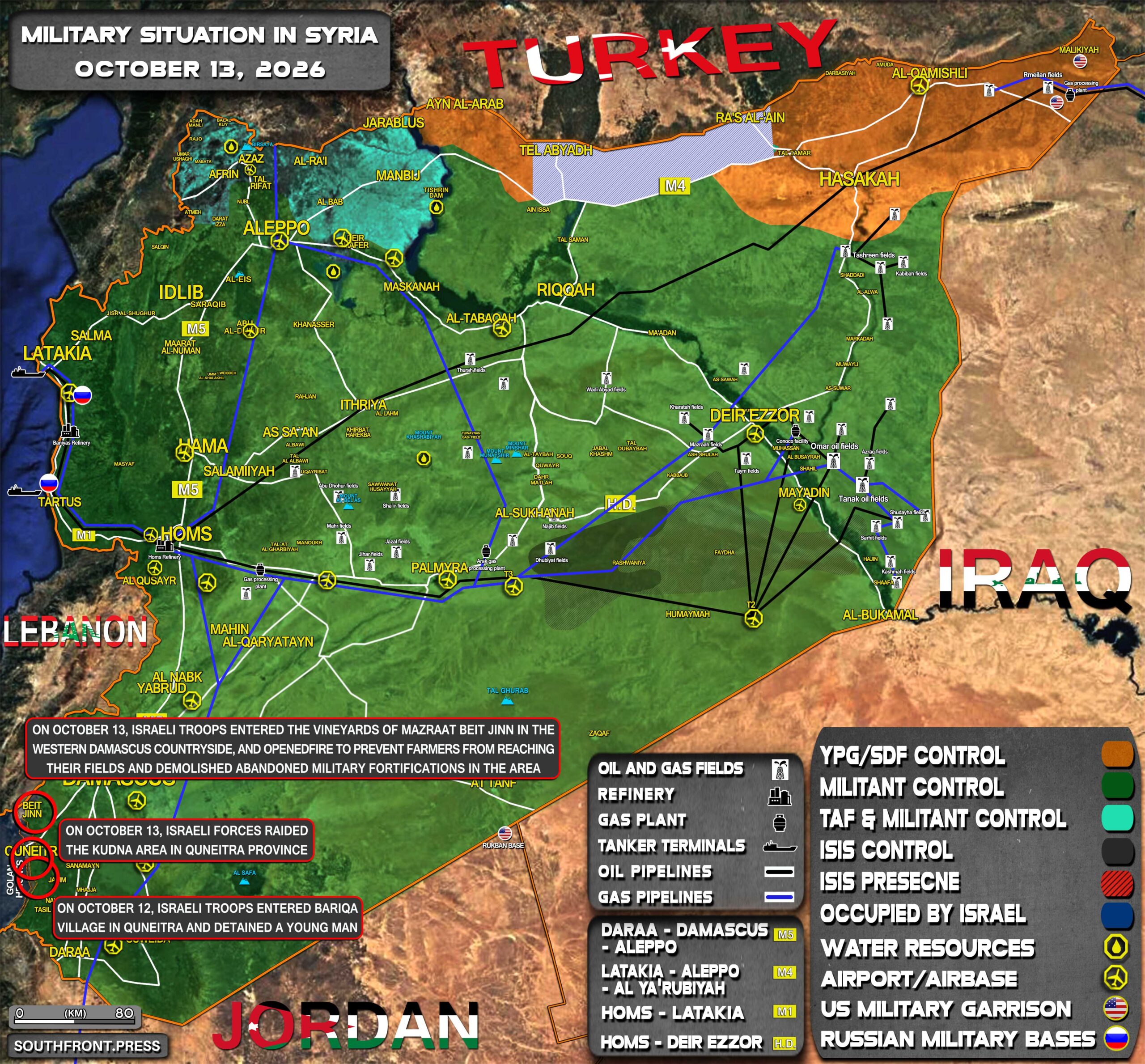
Military Situation In Syria On October 13, 2026 (Map Update)

13 October 2026 at 17:19

Click to see full-size map.

  • On October 13, Israeli forces raided the Kudna area in Quneitra province;
  • On October 13, Israeli troops entered the vineyards of Mazraat Beit Jinn in the western Damascus countryside, and opened fire to prevent farmers from reaching their fields and demolished abandoned military fortifications in the area;
  • On October 12, Israeli troops entered Bariqa village in Quneitra and detained a young man.

_______________________________________________________________________________________________________________________

MORE ON THIS TOPIC:


The post Military Situation In Syria On October 13, 2026 (Map Update) appeared first on South Front.

Putin’s scorched-city policy hits Ukraine hard

12 October 2026 at 11:36

During a quarter-century in power, Vladimir Putin has led Russia into three wars, in part aimed at restoring his country’s status as a world power via violent conquest . Each war began in a blitzkrieg-style display of fearsome power meant to climax in a swift victory. Instead, each conflict, whether the 1999-2009 war on the […]

The post Putin’s scorched-city policy hits Ukraine hard appeared first on Asia Times.

Israeli Drone Strikes Wounds Six, Mostly Syrians, in Northeast Lebanon

11 October 2026 at 19:52
Israeli forces carried out a strike against a car inside northwestern Lebanon near the Syrian border, wounding six people. Five of the wounded were Syrian nationals and two of them were women. The sixth person was a Lebanese citizen. The strike took place on the outskirts of Hawsh al-Sayyid Ali, along the border between Syria’s […]

UN: Israel Holding at Least 49 Syrians Amid Growing Number of Incursions

11 October 2026 at 19:51
Over the course of September, Israel carried out no less than 280 separate incursions into southwest Syria, and they currently hold at least 49 Syrians in detention, the UN High Commissioner for Human Rights reports. Those detained civilians who are ultimately released by the IDF reported instances of torture, including beatings, prolonged standing in stress […]

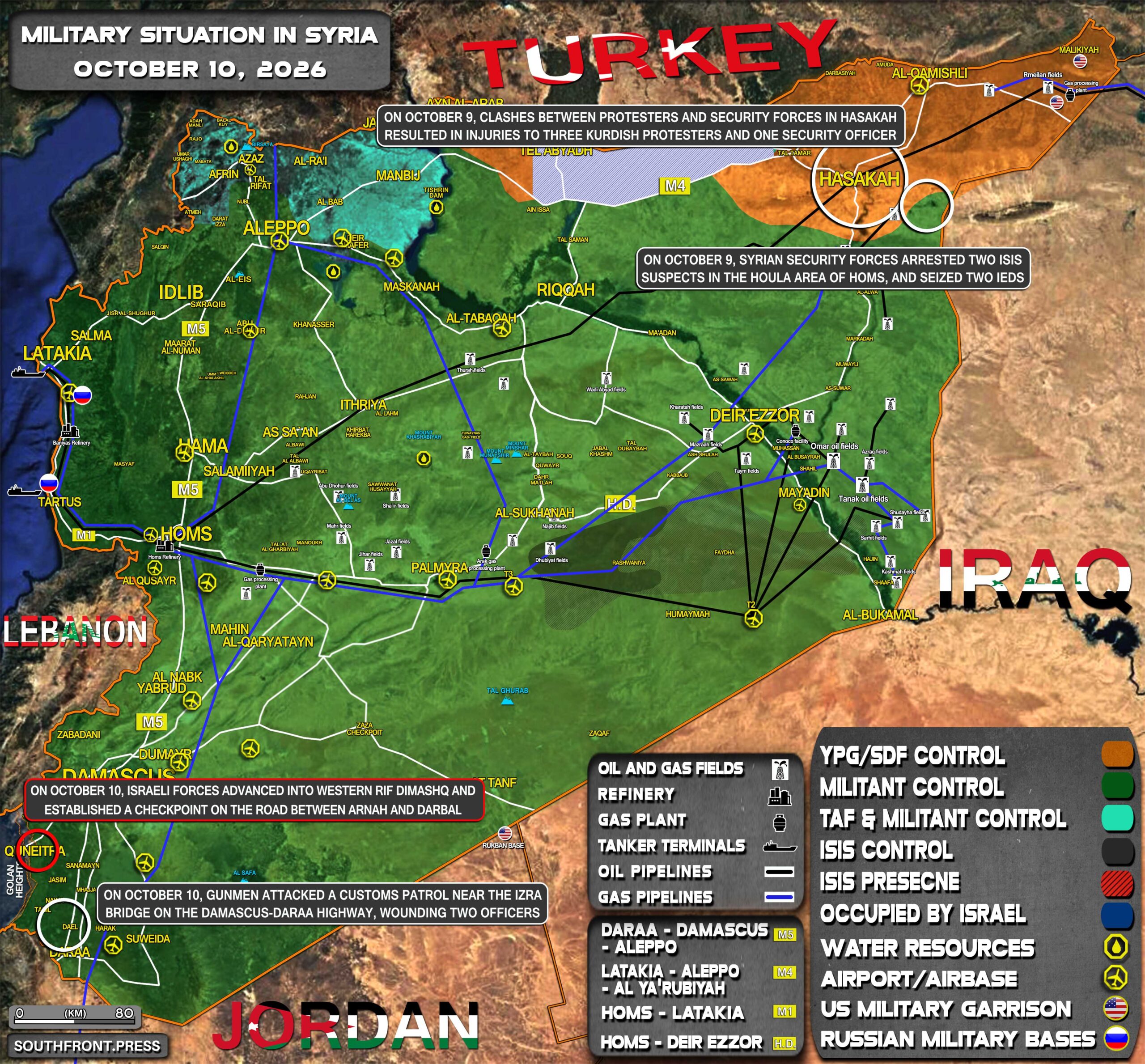
Military Situation In Syria On October 10, 2026 (Map Update)

10 October 2026 at 18:46

Click to see full-size map.

  • On October 9, clashes between protesters and security forces in Hasakah resulted in injuries to three Kurdish protesters and one security; officer
  • On October 9, Syrian security forces arrested two ISIS suspects in the Houla area of Homs, and seized two IEDs;
  • On October 10, gunmen attacked a customs patrol near the Izra Bridge on the Damascus-Daraa highway, wounding two officers;
  • On October 10, Israeli forces advanced into western Rif Dimashq and established a checkpoint on the road between Arnah and Darbal.

_______________________________________________________________________________________________________________________

MORE ON THIS TOPIC:

The post Military Situation In Syria On October 10, 2026 (Map Update) appeared first on South Front.

British chemical warfare commentator’s MI6 ties exposed in leaked emails

By: A A
9 October 2026 at 13:26

By Kit KLARENBERG

Join us on Telegram, X, and VK.

Contact us: info@strategic-culture.su

Private messages show show Hamish De Bretton-Gordon, a top British pundit on the Salisbury poisoning incident, was a close associate of the MI6 officer who handled the Russian intelligence defector at the center of the scandal — and reaped considerable benefits from his proximity to the case.

This September, a former British Army officer named Hamish De Bretton-Gordon filed a column with the UK Telegraph complaining that “Russian bots” had “tried to make out that I’m part of a security service conspiracy.” Having shot to prominence as a media commentator on chemical and biological weapons after the alleged poisoning of turncoat Russian spy Sergei Skripal, De Bretton-Gordon dismissed accusations that he collaborated with UK intelligence as the product of the “Kremlin’s malign tactics.”

Despite his fervent denials, leaked emails reviewed by The Grayzone indicate that De Bretton-Gordon has spent years privately coordinating his public statements with senior British military and intelligence figures. The correspondences show him training operatives in Turkey and instructing Israeli military figures on Syria’s still-elusive stockpile of chemical weapons, “and a bit of Novichok,” referring to the Russian toxin supposedly used to poison Skripal.

They also suggest he stood to profit personally from exaggerating the threat posed by Russia. In the emails, De Bretton-Gordon described his day job as “flogging gas masks” to British military and law enforcement. He seemingly grew his firm’s business with outlandish warnings of imminent Novichok hand grenade attacks by Russian agents. As his prominence grew, the BBC hired De Bretton-Gordon to serve as an advisor on a drama about the Skripal poisoning.

His principal contact listed in the emails is Pablo Miller, an MI6 officer and veteran of the Royal Tank Regiment. Miller is widely believed to have recruited and handled Skripal before the Russian GRU defector was allegedly poisoned in Salisbury, England in March 2018 under questionable circumstances.

After the Salisbury incident, the British government issued a D-notice to prevent mainstream reporters from investigating Miller’s relationship with Skripal. Despite being an obvious subject of interest, Miller went completely unmentioned during the rolling coverage that dominated British media for months as a result.

The emails show Miller was nonetheless following that coverage closely. In June 2018, he wrote to De Bretton-Gordon thanking him for his “sterling media work” during what he called the “dark days of March and April.” During that period De Bretton-Gordon appeared in British newspapers and television reports on the poisoning on a near-daily basis, consistently attributing blame to the Kremlin without evidence and emphasizing the chemical weapons threat he claimed Russia posed.

The next month, De Bretton-Gordon sent his MI6 pal a lengthy Telegraph article warning of potential all-out chemical and biological wars with “rogue” states. De Bretton-Gordon’s commentary featured extensively in the piece, which framed Britain as a sitting duck in the event that Moscow were to target the country with missiles equipped with nerve agents or other toxic weapons.

When not hyping up De Bretton-Gordon’s apocalyptic warnings of potential Russian chemical weapons attacks, the article functioned as a long-form infomercial for his then-employer, Avon Protection Systems. The firm, which manufactures protective equipment for military, law enforcement and fire personnel, stood to profit handsomely from inflated perceptions of what governments call Chemical, Biological, Radiological, and Nuclear (CBRN) threats. De Bretton-Gordon’s email signature at the time identified him as the company’s Managing Director for CBRN.

De Bretton-Gordon’s big break

The Telegraph noted the company’s business was “booming,” with orders “flooding in” from government clients the world over, supposedly reflecting how “a new age of poison weapons is upon us.” Later in the piece, an Avon executive boasted that the Salisbury incident and other recent alleged CBRN usage had “been good for us.” Britain’s elite SAS were among the cited customers for the “sinister looking” gas masks sold by Avon Protection Systems, which were said to be “worthy of Darth Vader.”

At no point did the Telegraph article mention De Bretton-Gordon’s employment by Avon.

But thanks to his newfound media prominence, De Bretton-Gordon wouldn’t have to stay with the company much longer. In January 2020, he emailed Pablo Miller bragging that he had “been offered a fellowship” at Cambridge University. De Bretton-Gordon wrote that he’d decided to accept the role because, in his words, “it beats flogging gas masks!”

Four months later, De Bretton-Gordon founded a dedicated personal “CBRN and bio security” consulting firm, in an apparent attempt to derive profit from his talent for stoking public fears of looming chemical and biological catastrophe.

De Bretton-Gordon helps MI6 officer avoid media scrutiny

The leaked emails show De Bretton-Gordon quickly emerged as a preferred adviser for the BBC, and repeatedly served as a go-between for Miller and the British broadcaster, whose journalists had apparently become aware that Miller was an MI6 officer.

Correspondence from November 2018 shows De Bretton-Gordon was also rewarded for his relentless media appearances with a position as a “senior CBRN mentor” in Britain’s Ministry of Defence. Though the work was unpaid, he received an MOD ID card and Ministry railcard, saving him substantial sums on train travel. De Bretton-Gordon wrote Miller to inform him of his new title, noting that he was currently advising the BBC on what he derided as “CBRN ‘pisch’” for a forthcoming “drama on Salisbury.”

“I’ve been asked by the writer if you would be interested in contributing,” he mentioned to Miller, adding that he’d told the British broadcasters that the spy was unlikely to agree. The MI6 veteran responded, “you correctly guessed my answer to the BBC question… it would not be appropriate for me to comment in public on the issue.”

Miller lamented that the British state broadcaster’s cognizance of his clandestine involvement with Skripal indicated his “true professional provenance” had “long ceased to be much of a secret.” But he wished De Bretton-Gordon good luck, telling his colleague that he was sure the drama would succeed given his “expert guidance.”

The next January, De Bretton-Gordon explicitly described Skripal as Miller’s friend when forwarding him a Forces News article on the removal of the roof of the Russian defector’s former home, excitedly informing him, “I see your mate is in the news again!”

De Bretton-Gordon was quoted liberally in the report, explaining it was necessary to remove the roof as it had allegedly accumulated “enough Novichok to kill thousands of people.” The chemical warrior claimed British authorities were now “much better prepared to deal” with future CBRN attacks in the aftermath of the incident.

Weeks later, De Bretton-Gordon emailed Miller to warn him Salisbury “will be awash with journos” on the March 4 anniversary of Skripal’s poisoning. In response, Miller thanked his friend for the “heads-up,” and wrote that he’d likely be leaving the country to ensure he was far away from the city while it filled up with reporters.

The correspondence also reveals how close the two men had become, and how their relationship had begun to blur into commercial territory. In October 2019, Miller asked De Bretton-Gordon to help publicize a Kickstarter for his daughter’s theatre production — a personal favor suggesting a friendship rather than a purely professional engagement. But Miller refused to let media contacts anywhere near it, explaining that following the Salisbury incident his daughters were forced to close their social media accounts after being relentlessly hounded by the press.

During the same exchange, De Bretton-Gordon reminded Miller he’d been contracted for an upcoming BBC drama on Salisbury, and once again offered him a role. Miller declined, saying he was firmly opposed to playing “any part for any BBC show. Ever.” De Bretton-Gordon defended his participation in the project by revealing that the MOD had specifically requested he “help on the Salisbury piece… to make sure the military bit looks right.”

The production in question was a three-part BBC One series that aired in 2020 called “The Salisbury Poisonings.” The project’s IMDB page lists De Bretton-Gordon as a “military advisor.”

De Bretton-Gordon wants critics “prosecuted for treason”

As The Grayzone previously revealed, De Bretton-Gordon played a deeply malign, multifaceted role throughout the Syrian dirty war. On top of endless media appearances as a bogus “expert” on CBRN matters, he was part of a covert MI6 effort to smuggle soil samples out of opposition-controlled areas in an effort to prove the Syrian government used chemical weapons. A report on this initiative in the Mirror tabloid made clear the purpose of British intelligence was prodding the US into military intervention against Assad.

It seems plausible whatever samples De Bretton-Gordon gathered in Syria were concocted, perhaps by his own hand. He provided evidence to a number of official investigations into purported chemical attacks during the conflict. In at least one instance – an OPCW/UN Joint Investigative Mechanism (JIM) probe into an alleged April 2014 toxic gas strike in Talmenes – videos submitted by an opaque NGO De Bretton-Gordon founded called CBRN Taskforce were found to show clear signs of falsification.

De Bretton-Gordon’s communications with his spy buddy contain references to him visiting Turkey, “to do a bit of training.” The country was the central hub for MI6 and CIA operations during the dirty war on Syria. It is an open question whether his training sessions covered staging chemical weapons attacks, and if other states in the region were taught in this dark art.


The self-styled CBRN expert also bragged about sharing his purported expertise with the Israeli military. In an email sent in December of 2018 De Bretton-Gordon boasted to Miller that he’d just returned “from Israel,” where he said he’d been “briefing the IDF (and no doubt others!) on Syrian [chemical weapons] and a bit of Novichok.”

He was clearly impressed by the Israelis, crowing, “Those boys don’t mess about!”

De Bretton-Gordon’s work overseas was apparently taking a toll on his day job, however. In an email that month to Miller, he explained how he was “always on the edge of sacking with all my ‘extra’ activities.” These machinations also put him in conflict with Peter Ford, Britain’s ambassador to Syria from 2003 to 2006, who’d become an outspoken critic of the dirty war against Damascus.

After De Bretton-Gordon authored an op-ed for The Telegraph in May 2019 demanding the West intervene to prevent Syrian government forces from recapturing Syria’s Idlib, Ford issued a response nailing his failure to acknowledge that the province was at the time under the control of the MI6-supported Al Qaeda affiliate, Hayʼat Tahrir al-Sham.

In response, De Bretton-Gordon emailed Miller a note deriding Ford as a “complete See You Next Tuesday” who parroted “Assad and Putin propaganda.” He called for Ford – and the members of a now-defunct collective of antiwar academics known as the Working Group on Syria, Propaganda and Media – to be “prosecuted for treason.” De Bretton-Gordon seemed particularly piqued that the academic collective had poked holes in the narrative he’d spun about Syrian chemical attacks.

De Bretton-Gordon cheers as his enemies “exposed”

In August that year, De Bretton-Gordon contacted Miller to celebrate The Times publishing a hit piece on David Miller, a member of the Working Group on Syria, Propaganda and Media.

“Glad to see that some of Assad’s and Putin’s ‘useful idiots’ who try and give me a hard time are being exposed,” De Bretton-Gordon cheered, before suggesting “must get more of them out in the open.”

This prompted a wider discussion about the so-called “stooges” who publicly challenged established, MI6-approved media narratives on Syria and Russia.

For his part, Pablo Miller expressed disgust over a recent “fawning evaluation” of Putin’s 20 years in power by dissident journalist Mary Dejevsky. Miller derided Dejevsky as one of many media figures who foolishly believed “Putin was the answer to Russia’s woes,” and suggested without evidence that she was likely “taking Moscow gold.” Thankfully, he added, events “Crimea, Syria, and Salisbury” had managed to “wake the twits up.”

The slanted manner in which these events were framed in the media did indeed coincide with a perceptibly negative shift in public sentiment towards Russia throughout the West, helping make a world-threatening standoff with Moscow a fait accompli. At every step, De Bretton-Gordon and other intelligence-aligned commentators acted as military and intelligence propagandists, ensuring the media and popular culture was constantly deluged with paranoia over a multi-spectrum Russian “threat.” Those who question the narrative are denigrated as “useful idiots,” and much worse.

This August 6, De Bretton-Gordon based an entire op-ed for the Telegraph on a conversation he’d recently had with an unnamed “Western intelligence officer” of his acquaintance. Could that anonymous spy have been Pablo Miller?

The self-styled chemical warfare expert was clearly not keen to discuss his relationship with the MI6 man. De Bretton-Gordon immediately hung up the phone when I reached him and identified myself as a journalist.

Original article:  thegrayzone.com

Syria May Send Troops to Saudi Arabia Amid War with Ansar Allah

By: aletho
8 October 2026 at 22:19
By Kyle Anzalone | The Libertarian Institute | October 8, 2026

A US and Syrian official said Syria is considering sending troops to Saudi Arabia as the kingdom battles Ansar Allah in Yemen.

Reuters reported on Thursday that a US official and a Syrian defense official said that Damascus may send Syrian forces to Saudi Arabia. Riyadh has reached out to several allies for support in its war against Ansar Allah.

On Monday, Turkey and Pakistan agreed to provide military support to Saudi Arabia under the Mecca Accords, a mutual defense pact signed by the three countries earlier this year.

A joint statement released by the Mecca Accords members explained, “The Committee decided to move immediately to the practical implementation of the collective defense commitments and to take the necessary measures to provide the agreed military forces and capabilities and ensure their rapid deployment in the Kingdom, in accordance with the approved arrangements and the national legislation of the Parties, thereby enhancing readiness, military integration, and the collective capacity to confront and counter threats.”

Turkey indicated it would provide Saudi Arabia with military capabilities rather than ground troops, which would require parliamentary approval, while Pakistan did not provide details on the forces or capabilities it plans to deploy.

The statement was released following an emergency meeting of the alliance to discuss the situation in Saudi Arabia. The fighting between Ansar Allah and Saudi Arabia reignited in July after the kingdom attacked the Sanaa airport. In recent weeks, Ansar Allah has taken a significant amount of territory from the Saudi-backed forces in Yemen and attacked several energy sites in Saudi Arabia.

Riyadh has reached out to international partners for support. Crown Prince Mohammed bin Salman requested that President Donald Trump order direct attacks on Ansar Allah positions. So far, Trump has limited US involvement to intelligence sharing and battlefield planning, and refused to conduct direct strikes on Ansar Allah.

Saudi Arabia has also asked China and Pakistan to place pressure on Iran to rein in Ansar Allah. According to three Iranian sources speaking with Reuters, Beijing privately asked Tehran to rein in Ansar Allah after receiving a request from Riyadh. The sources told the outlet that Iran responded that stability in the region depended on US and Israeli aggression.

While Saudi Arabia’s ties to the US and Ansar Allah’s relationship with Tehran allow the war between the two to appear to be a part of a larger regional war, the conflict began over a decade ago. Additionally, Ansar Allah did not begin its offensive following the US and Israeli surprise attack on Iran, but rather after Saudi-backed forces attacked the Sanaa airport, prompting Ansar Allah to resume attacks on Saudi Arabia.

Western officials and media often label Ansar Allah as a proxy of Iran. However, while Iran has provided support to Ansar Allah, there is little public evidence that Tehran directs the group’s military operations.

While Syria was a long-time [resistance] ally under the rule of Bashar al-Assad and his father, Damascus fell to rebels, led by former al-Qaeda members, in 2024. Syria is now led by President Ahmed al-Sharaa, formerly known as Abu Mohammad al-Jolani, who previously led al-Qaeda’s Syrian affiliate.

❌