«She Believed in it with her whole heart. Dolly Parton’s hope for the genetic vaccine was as pure as anything she ever sang — and then her immune system turned on her, and a “brief battle” took her away».
The Mystery Behind the Form of Cancer That Affected the Singer
«Dolly Parton died Tuesday at Vanderbilt-Ingram Cancer Center in Nashville. She was 80. The estate’s official line — delivered first by a nephew in a recorded video, then repeated by publicist Marcel Pariseau and “Team Dolly” — is that she faced “a brief battle with cancer” and departed surrounded by loved ones» adds McCullough, referring to what was officially communicated by the singer’s entourage.
«In a statement to PEOPLE on Aug. 25, reps for the country star confirmed that the “Jolene” singer’s death at 80 on Tuesday followed a “brief battle with cancer.”The type of cancer was not disclosed» People wrote yesterday.
“Our beloved Dolly Parton spent her life and career bringing joy, laughter, hope and integrity into everything she touched. Her unmatched generosity reached the lives of countless people whom she would never meet, yet she was always there to offer a helping hand,” the statement read.
Autoimmune Damage Typically from Adverse Reactions to Covid Vaccine
«What type of cancer? Not disclosed. Hospitalized four days prior with, per one outlet, kidney and autoimmune issues. And that’s the whole story the public is getting» adds the American cardiologist, referring to the autoimmune disasters that represent one of the main causes of lethal adverse reactions to Covid mRNA genetic serums.
«For a woman worth a reported $600 million, with access to the absolute best medicine money can buy, the opacity is striking» highlights McCullough.
VIDEO – In 2021, Dolly Parton, a testimonial humming for the Covid-19 vaccine…
It’s disconcerting because, just over five years ago, in March 2021, she was the “testimonial” for the Covid-19 shot, appearing in a video circulated by mainstream media around the world while humming about the vaccine during the injection.
Trump declared National Mourning but he Defends Covid Vaccines which can Trigger Cancer
It’s even more disconcerting because one of her most famous fans, US President Donald Trump, wanted to honor her as a true star by declaring a week of national mourning while continuing to defend Operation Warp Speed, which funded Moderna’s dangerous and suspect vaccine, released on the market despite Big Pharma in Cambridge, Massachusetts, having known since 2019 that the new mRNA biotechnology could cause cancer…
Climate change has reduced snowpack by 36 percent and streamflow by 13 percent across the western United States, and more than half of those impacts have been triggered by emissions from fossil fuel companies and cement manufacturers, according to a new report released today by University of California, Merced and Union of Concerned Scientists. Additionally, the report ties one-tenth of the observed groundwater loss in California’s Central Valley directly to emissions from these companies. In response, Aaron Regunberg, director of Public Citizen’s Climate Accountability Project, issued the following statement:
“Millions of Americans are experiencing historic water scarcity. We now know that a small number of fossil fuel companies are responsible for a significant portion of this disaster. And they knew full well what they were doing. Already in 1988, companies like Shell were issuing internal reports predicting that climate change—caused by the burning of their fossil fuel products—would create ‘significant changes’ in ‘precipitation patterns’ that ‘would impact on the human environment, future living standards and food supplies’ and could have ‘major social, economic, and political consequences.’ Yet fossil fuel companies lied to the public about this reality for decades, and continue to block the climate action we need to address this crisis. These companies need to face accountability.”
No interior do Espírito Santo, uma rua estreita concentrava algumas das principais empresas brasileiras de fabricação de arcos de violino: Arcos Brasil, Archets Brasil, Bogen Schaeffer e Horst John & Co. O polo no distrito de Guaraná, em Aracruz, havia se consolidado nas décadas de 1970 e 1980, quando o comerciante alemão Horst John se estabeleceu na região e passou a enviar jovens locais à Europa para aprender a arte da archeteria.
Segundo as autoridades brasileiras, o que parecia um polo artesanal especializado escondia um sofisticado esquema de extração e comercialização ilegal do pau-brasil — a árvore que dá nome ao país e que, após séculos de exploração, figura hoje entre as mais ameaçadas da Mata Atlântica. A madeira avermelhada da espécie é considerada, há séculos, a matéria-prima ideal para arcos de instrumentos de corda, e um único arco pode custar entre cinco e 10 mil dólares no mercado internacional.
O esquema funcionava por meio de uma fraude sistemática na documentação florestal. A legislação brasileira proíbe, desde 1993, o corte do pau-brasil nativo e a exportação de sua madeira em estado bruto. Em 2006, o cerco se fechou ainda mais após a espécie entrar no Apêndice II da Convenção sobre o Comércio Internacional das Espécies da Flora e Fauna Selvagens em Perigo de Extinção (CITES); a exportação de toras de pau-brasil foi proibida pela legislação brasileira. Para continuar operando legalmente, as empresas de Guaraná deveriam utilizar apenas estoques históricos comprovadamente cortados antes dessa data. O que os fiscais do Ibama descobriram, a partir de 2018, foi que as empresas inseriam informações falsas nos sistemas oficiais de registro florestal para que seus estoques nunca diminuíssem no papel — enquanto, na prática, eram continuamente renovados com madeira extraída ilegalmente, em grande parte do Parque Nacional do Pau-Brasil, em Porto Seguro, na Bahia.
Marco Raposo, dos mais renomados fabricantes do Brasil, teve atividade paralisada pelo IBAMA por transportar arcos e varetas sem autorização
Em 2021, a Polícia Federal deflagrou as operações Ibirapitanga I e II, que resultaram na apreensão de mais de 230 mil varetas, no indiciamento de 32 pessoas e na descoberta de uma rede comercial que se estendia por 34 países ligando pequenas oficinas do interior capixaba a comerciantes na Itália, Alemanha, França e nos Estados Unidos. Uma planilha analisada pela reportagem lista 220 nomes — de fabricantes de arcos, comerciantes e empresas que conectam produtores brasileiros a compradores em quatro continentes.
A “árvore-rei” é considerada a maior e a mais antiga árvore de pau-brasil. Com cerca de 600 anos, tem 40 metros de altura e 7,13 metros de circunferência
O contrabando nos aeroportos
Parte desse comércio passava diretamente pelos aeroportos. Em setembro de 2021, o fabricante de arcos Marco Raposo foi detido no aeroporto de Guarulhos com 208 arcos de pau-brasil na bagagem, a caminho da Suíça. O processo foi arquivado e Raposo foi inocentado na esfera judicial, mas o caso segue tramitando na esfera administrativa. Sete meses depois, foi interceptado novamente — desta vez com 114 arcos prontos e 120 varetas, rumo a Londres, onde havia aberto uma empresa alguns anos antes.
O comerciante italiano Francesco Marano foi interceptado duas vezes em 2022. Em fevereiro, autoridades identificaram uma remessa no aeroporto de Viracopos, em Campinas: 137 varetas de pau-brasil e 281 de jutaí-peba destinadas à Itália, sem rastreabilidade no sistema Documento de Origem Florestal (DOF) e sem os certificados CITES exigidos. Em junho, foi flagrado na alfândega do Rio de Janeiro com outras 70 varetas. O destino era a Bows Tone Wood, sua empresa nos arredores de Cremona — cidade italiana mundialmente associada à tradição da luteria. No mesmo mês, autoridades apreenderam 83 arcos atribuídos a Horst John & Co no aeroporto de Guarulhos (SP) e outros 25 da Bögen F. Schaeffer em Campinas (SP), por não apresentarem a licença de exportação exigida pelo governo brasileiro.
Daniel Visciano, IBAMA, combate o contrabando de fauna e madeira no Aeroporto Guarulhos
Em setembro de 2022, a Polícia Federal chegou a uma conclusão: nem multas, nem suspensões de atividade, nem a primeira fase da Operação Ibirapitanga haviam sido suficientes para interromper o comércio ilegal. A madeira continuava circulando mesmo enquanto as investigações avançavam.
O paradoxo do lobby
O movimento que se seguiu surpreendeu até os investigadores, segundo apurou a Agência Pública. Felipe Bernardino Guimarães é analista ambiental do Ibama com mestrado em Biologia Vegetal e ênfase em Anatomia da Madeira. Desde 2018, coordenou a Operação Dó Ré Mi — a investigação que, a partir de inconsistências nos estoques declarados pelas empresas de Guaraná, ajudou a desvendar o esquema e abriu caminho para as operações da Polícia Federal — e passou onze dias nos galpões apreendidos, contando vareta por vareta. Da posição de quem acompanhou de dentro cada movimento dos investigados, Guimarães descreve o que viu: “Eles contrataram assessoria de imprensa, fizeram todo o lobby com os políticos locais no Espírito Santo, dentro dos órgãos, como o Ministério da Agricultura, onde têm muito acesso. Promoveram uma reunião lá dentro do Ministério para deixar a imagem deles limpinha. Estavam sempre com publicações na imprensa, comprando espaço.”
Respondendo a processos criminais, alguns dos principais fabricantes indiciados passaram a atuar publicamente como defensores da proteção ao pau-brasil — financiando representantes em fóruns internacionais, apoiando projetos de lei e pressionando por mudanças nas regras da CITES.
Museo do Violino, onde estão expostos os instrumentos mais importantes feitos pelos mestres luthiers de Cremona, Itália
Quando a reportagem visitou Marco Raposo em sua casa e oficina em Domingos Martins, cidadezinha no interior do Espírito Santo com ares europeus, ele explicou como funcionava o negócio antes das operações: “Na maioria das vezes, eu chegava à Europa, alugava um carro e viajava para visitar vários compradores.” Quando foi interceptado em 2021, pretendia vender a mercadoria em Cremona, durante a tradicional feira anual de música que reúne centenas de luthiers e compradores do mundo inteiro.
Depois das apreensões, Raposo mudou de estratégia. Ao lado do fabricante Celso de Mello, contatou, em 2024, Daniel Neves, presidente da Associação Nacional da Indústria da Música (Anafima). Neves revelou-se um dos principais defensores da inclusão do pau-brasil no Apêndice I da CITES — a lista das espécies com proteção máxima — e participou de reuniões oficiais em Genebra, Brasília e, por fim, na conferência da CITES no Uzbequistão, no final de 2025. Raposo relatou à Pública que tanto ele quanto Celso de Mello financiaram a participação de Neves em reuniões oficiais.
Procurado pela reportagem, Neves disse não ter recebido “nenhuma taxa, remuneração ou pagamento pessoal” dos dois fabricantes de arcos.
Como presidente da Anafima, Neves diz representar empresas do setor musical em todo o Brasil e afirma que participa de grupos de trabalho públicos voltados à rastreabilidade da madeira, como a Rede de Florestas da CNI e um grupo de trabalho sobre o pau-brasil criado em 2025 pela CONABIO, a Comissão Nacional da Biodiversidade do Ministério do Meio Ambiente e Mudança do Clima.
Embora as empresas de Raposo e De Mello sejam associadas à Anafima, acrescentou Neves, a organização “não responde pelos assuntos jurídicos de seus associados”.
RESPOSTA NA ÍNTEGRA
Integra de perguntas e respostas com Daniel Neves, presidente da Associação Nacional da Indústria da Música (Anafima) 1. O senhor confirma ter sido contratado ou remunerado por Marco Raposo e Celso de Mello em 2024? Em que termos e com que finalidade?
Não. Não houve contratação, não houve contrato e não houve pagamento a mim. A participação da ANAFIMA foi financiada como descrito acima, em defesa de posições que a associação já havia adotado e tornado públicas.
2. No momento da contratação, o senhor sabia que ambos respondiam a processos criminais por extração e comércio ilegal de pau-brasil?
A premissa não se aplica, pois não houve contratação. Sobre o ponto de fundo: as operações do IBAMA e da Polícia Federal tiveram ampla repercussão na imprensa brasileira, e eu tinha conhecimento delas como qualquer pessoa que acompanhe o setor. Nunca tive acesso aos autos, nunca atuei em nenhum processo e nunca tive qualquer papel na defesa jurídica de pessoa ou empresa.
Sobre isso, faço um pedido, que diz respeito à precisão e não a qualquer indivíduo. A própria apuração da reportagem registra que nenhum dos processos decorrentes dessas operações foi concluído. Peço que o texto não apresente processos em andamento como conclusões definitivas, em nenhum dos sentidos. Perguntas sobre a situação jurídica de uma empresa específica devem ser dirigidas a ela e a seus advogados. Não me cabe responder por elas, e a ANAFIMA não fala pelos assuntos jurídicos de seus associados.
3. Como o senhor avalia a coincidência entre a sua contratação e o engajamento público dos dois fabricantes na defesa da proteção da espécie na CITES?
Não houve contratação, portanto não há coincidência a avaliar. Mas a questão de fundo — por que a posição da ANAFIMA mudou — merece resposta direta, e está inteiramente documentada.
Em 2022, a ANAFIMA se manifestou publicamente contra a inclusão da espécie no Apêndice I, sob o argumento de que isso penalizaria músicos e fabricantes legítimos. Essa posição está registrada em nossas próprias publicações e na imprensa brasileira da época.
Em abril de 2024, apresentei a posição revista da ANAFIMA de forma pública e internacional, em artigo assinado publicado pela The Strad — a principal revista internacional do mundo dos instrumentos de corda — sob o título “The pernambuco wood dilemma: a call for global responsibility and unity”. O artigo tratava diretamente da proposta de Apêndice I, afirmava que a diretoria da ANAFIMA estava disposta a apoiar a inclusão caso a extração ilegal persistisse, e trazia meu nome, meu cargo e meus contatos. Está disponível publicamente desde então:
A mesma posição foi publicada em português no site da ANAFIMA. Foi, portanto, anunciada com antecedência, nos dois idiomas, na principal publicação internacional do setor e para os nossos associados no Brasil — sete meses antes da Carta de Vitória e mais de um ano antes da CoP20. Qualquer pessoa da comunidade internacional de arcos podia lê-la. Muitas leram, e algumas discordaram.
Em 19 de novembro de 2024, no Congresso e Seminário Brasileiro do Pau-Brasil, realizado em Vitória (ES), uma sessão dedicada especificamente à proposta de Apêndice I chegou a uma posição de consenso. Em 25 de novembro de 2024, essa posição foi formalizada na Carta de Vitória.
Entre os signatários estão a Fundação SOS Mata Atlântica; o deputado federal Nilto Tatto; Julie Messias, ex-secretária nacional de Biodiversidade do Ministério do Meio Ambiente; o INCAPER; um professor da Universidade Federal do Espírito Santo; o secretário estadual de Agricultura do Espírito Santo; três prefeitos; o presidente do Sindicato dos Músicos Profissionais do Estado de São Paulo; o compositor Ivan Lins; o maestro Julio Medaglia; e o spalla da Orquestra Sinfônica do Estado de São Paulo. O documento foi publicado na íntegra pelo CRBio-07, conselho profissional federal.
Nem Marco Raposo nem Celso de Mello assinam a carta.
Se a posição da ANAFIMA tivesse sido comprada, o mesmo teria de valer para todas as organizações e figuras públicas citadas acima — que chegaram a uma posição idêntica, no mesmo dia, no mesmo documento. Não creio que os leitores achem isso plausível.
Acrescento que a proposta de Apêndice I apresentada na CoP20 partiu do Estado brasileiro, por meio do IBAMA. Apoiar uma proposta soberana do próprio governo, ao lado da maior organização ambiental do país e de um deputado federal em exercício, não é manobra privada.
4. O senhor ou a ANAFIMA participaram, direta ou indiretamente, de iniciativas para legalizar o comércio de pau-brasil de reflorestamento ou para que a fabricação de arcos seja reconhecida como patrimônio cultural no Espírito Santo?
Sobre os plantios: sim, e isso nunca foi ocultado. É o segundo parágrafo da Carta de Vitória, publicada em novembro de 2024, e o próprio veículo noticiou o fato em novembro de 2025. A carta pede que o Apêndice I se aplique às populações de floresta nativa, permitindo o uso regulado de material de plantio — sujeito a quatro condições que ela mesma explicita: comprovação de que o material vem exclusivamente de plantios certificados e manejados; rastreabilidade robusta e certificação de origem ao longo de toda a cadeia; licenças especiais de exportação emitidas pela Autoridade Administrativa da CITES; e medidas rigorosas contra fraude e contra a mistura de material de origem silvestre com material de plantio.
Isso não é uma brecha inventada por lobistas. O próprio Artigo VII, parágrafo 4, da Convenção prevê que espécimes de uma espécie vegetal do Apêndice I reproduzidos artificialmente para fins comerciais sejam tratados como espécimes do Apêndice II. Defender a inclusão no Apêndice I e, ao mesmo tempo, sustentar um fornecimento de plantio regulado e rastreável não são duas estratégias. É uma só posição, e segue o texto do tratado. As quatro condições da Carta de Vitória são mais rígidas que o parâmetro mínimo da Convenção, não mais frouxas.
É também, na minha avaliação, o único desfecho possível. Enquanto não houver oferta legal, haverá oferta ilegal. Isso não é defesa de ninguém. É a razão pela qual o comércio ilegal sobreviveu a todas as restrições impostas desde 2007.
Sobre o patrimônio cultural: [RESPOSTA FACTUAL]. Seja qual for o estágio dessa discussão, o reconhecimento de uma prática cultural imaterial protege saberes e ofício. Não autoriza o uso de madeira de origem ilegal nem cria exceção à legislação ambiental brasileira ou às obrigações da CITES. Qualquer sugestão de que o título de patrimônio possa blindar uma atividade contra uma restrição comercial é juridicamente incorreta.
5. Como o senhor justifica atuar internacionalmente em defesa da proteção do pau-brasil sendo financiado por fabricantes investigados?
Não sou financiado por eles. Mas quero tratar da premissa mais ampla, porque ela merece ser examinada à luz da própria apuração da reportagem.
A International Pernambuco Conservation Initiative, criada em 1999 e citada na reportagem de novembro como participante legítima deste debate, se define como uma iniciativa voluntária financiada por archetiers. Se o financiamento vindo do setor de arcos desqualifica uma organização para falar sobre a Paubrasilia echinata, desqualifica igualmente os dois lados desta disputa. Se não desqualifica, então a pergunta não é quem paga, e sim o que se defende e se isso é declarado. No caso da ANAFIMA, o que foi defendido é público, foi publicado com antecedência na principal revista internacional do setor e foi assinado por trinta pessoas e instituições.
Acrescento que o resultado da CoP20 não combina com a estratégia descrita pela reportagem. A proposta brasileira de Apêndice I não foi aprovada. A espécie foi mantida no Apêndice II, sob a Anotação #10 revisada, com cota zero para espécimes de origem silvestre no comércio internacional. A nota pública do próprio IBAMA, de 17 de dezembro de 2025, descreve o efeito com clareza: a partir de 5 de março de 2026, fica proibido o comércio internacional do pau-brasil nativo e de seus produtos derivados. Esse é o resultado que a ANAFIMA apoiou. É a restrição mais dura já imposta a esta espécie, e é pior — não melhor — para todos os fabricantes de arcos do Brasil.
Se a objeção é que eu defendi posições, então sim: é isso que faz o presidente de uma associação setorial. Fiz isso abertamente, com base em posições publicadas previamente sob o meu nome, e a partir de um grupo de trabalho do Ministério do Meio Ambiente. A objeção que as perguntas de fato fazem é que eu teria sido contratado para isso. Não fui.
6. O senhor gostaria de acrescentar algum esclarecimento sobre o seu papel na ANAFIMA em relação a este caso?
Três pontos, no interesse da precisão.
Primeiro, uma questão sobre a própria apuração. A reportagem de 25 de novembro de 2025 identificou os dois arqueteiros que sustentariam o que ali se descreveu como um novo bloco de poder como Marco Raposo e Júlio Batista, do J.B. Atelier e da Souza Bows. O e-mail que recebi agora cita Marco Raposo e Celso de Mello. São pessoas diferentes. Peço que se confirme qual das informações está correta antes da publicação, e com base em quê o segundo nome mudou.
Segundo, o texto deveria distinguir com clareza quatro coisas distintas: os processos contra pessoas específicas; o papel institucional da ANAFIMA; o meu papel como presidente eleito; e o debate público mais amplo no Brasil sobre a conservação e o manejo sustentável da Paubrasilia echinata. Reunir tudo isso em uma única narrativa produz um relato que não é preciso.
Terceiro, sobre o formato do problema. Claudia Mello, coordenadora do Grupo de Trabalho Pau-Brasil do IBAMA, disse aos próprios repórteres deste veículo que há forte lobby da União Europeia e dos Estados Unidos contra controles sobre o comércio de arcos, e que esses mercados mantêm estoques acumulados há décadas e exportam grandes volumes todos os anos, ao mesmo tempo em que resistem ao ônus de documentar a origem legal. Essa é a outra metade da cadeia. Uma investigação que examina apenas a extração no Brasil descreve a oferta e omite a demanda que a financia. Digo isso não para desviar das responsabilidades brasileiras, que são reais e que a ANAFIMA já reconheceu publicamente, mas porque um relato de metade da cadeia não explica por que este comércio se mostrou tão duradouro.
O biólogo florestal do IBAMA Felipe Bernardino Guimarães lidera operações de fiscalização desde 2018, enfrentando o comércio ilegal de pau-brasil
Para Guimarães, a estratégia tinha uma lógica clara: “Eles ficaram jogando isso na mídia, sempre puxando a palavra ‘cultural’. Tentaram plantar a ideia do Vale do Arco, em Aracruz. A intenção era tornar a atividade de produção de arcos de pau-brasil um patrimônio cultural do Espírito Santo — pois daí é uma atividade que não pode cessar.”
O que parecia uma contradição tornou-se uma estratégia de duas frentes: ao defender o endurecimento da proteção à espécie na CITES, esses fabricantes buscavam também abrir caminho para a legalização do uso comercial do pau-brasil de reflorestamento — o que, se aprovado, reabilitaria seu papel central em um mercado global que movimenta milhões de dólares. E ao tentar transformar a archeteria em patrimônio cultural, blindariam a atividade contra qualquer tentativa de encerrá-la.
Exposição de arcos de violino na recepção da oficina Slaviero, em Cremona, Itália
Um projeto de lei apresentado em Brasília, quase ao mesmo tempo, ajuda a explicar o movimento. Foi elaborado, segundo Raposo, com contribuições dele próprio e do agrônomo Pedro Galveas, pesquisador do Instituto Capixaba de Pesquisa, Assistência Técnica e Extensão Rural (INCAPER), e apresentado em 2024 pelo deputado federal Evair Vieira de Melo — que, na época, estava no Progressistas (PP) e, desde abril de 2026, integra o Republicanos. Considerado o maior aliado de Jair Bolsonaro no Espírito Santo, Evair foi vice-líder do governo do ex-presidente na Câmara, entre 2020 e 2022. Técnico agrícola de formação, o deputado construiu sua carreira em torno do setor rural capixaba: presidiu o INCAPER por seis anos e a Comissão de Agricultura da Câmara, onde é conhecido por defender os produtores de café. O Espírito Santo é o segundo maior produtor nacional do grão. Os fabricantes de arcos ouvidos pela reportagem em Guaraná o descrevem simplesmente como “um amigo” — alguém que entende as demandas do setor e está disposto a defendê-las em Brasília. Evair conta que visitou empresas que estavam fechando no distrito e decidiu agir. “O Brasil não pode simplesmente, em troca de um protecionismo cego, acabar com uma cultura centenária que tem um ativo econômico importante”, disse em entrevista, em seu gabinete, em Brasília.
O PL 3284/24 foi aprovado em dezembro de 2024 pela Comissão de Agricultura da Câmara e, em agosto de 2026, pela Comissão de Meio Ambiente e Desenvolvimento Sustentável, na forma de substitutivo do relator, deputado Carlos Henrique Gaguim (União-TO). O novo texto amplia a proteção a todo o gênero botânico Paubrasilia, garante a rastreabilidade da madeira, da extração ao produto final, e incentiva a exploração econômica por meio de plantios comerciais registrados e licenciados, autorizando, inclusive, plantios em áreas de reserva legal em recuperação. O substitutivo também flexibilizou a proibição geral de corte de árvores com menos de 30 anos, prevista na versão original: caberá ao órgão ambiental competente definir os critérios. O projeto tramita em caráter conclusivo e ainda precisa passar pelas comissões de Finanças e Tributação e de Constituição e Justiça — ou seja, poderá ser aprovado sem votação em plenário, seguindo depois para o Senado. Para Evair, a lógica é de mercado: “No dia em que nós criarmos um ambiente comercial para o pau-brasil, vai acontecer o contrário — vão ampliar as áreas plantadas, não reduzir.”
A Fazenda Nova Aurora, com 70 hectares de produção de cacau consorciada com pau-brasil, no sul da Bahia
Plantar ou não plantar, eis a questão
Caminhando entre cacaueiros espalhados por um morro no sul da Bahia, Edmond Ganem aponta para o alto, acima da copa das árvores. Sobre a cobertura uniforme dos pés de cacau, os troncos de pau-brasil crescem retos e alcançam até 30 metros de altura.
O sistema, conhecido como cabruca, é comum na região cacaueira baiana. Árvores nativas formam uma cobertura que mantém a umidade necessária ao cultivo do cacau e a abertura entre as copas favorece o crescimento reto do pau-brasil, característica essencial para a fabricação de arcos de qualidade.
Ganem começou a plantar no início dos anos 2000, quando o preço do cacau despencava e o governo incentivava o reflorestamento com espécies nativas. “Descobri que um único arco de violino podia custar entre cinco e dez mil dólares”, conta. “Pensei: isso dá dinheiro. Vamos plantar.” Ele começou com duas mil mudas e hoje espalha cerca de sete mil árvores em duas fazendas. Ao lado de um galpão de secagem de cacau, ele mostra um tronco de pau-brasil serrado em blocos, mas pede que nenhuma fotografia seja tirada. O receio de não chamar a atenção do órgão é evidente. “O problema é a burocracia para obter a autorização de corte. O Instituto do Meio Ambiente e Recursos Hídricos do Estado da Bahia (Inema) pode levar meses para liberar.” Segundo ele, tratava-se de uma amostra de pau-brasil plantada, encaminhada à Universidade Federal do Sul da Bahia (UFSB) para avaliar se as árvores apresentavam as características adequadas.
O agricultor Edmond Chemmes Ganem já plantou cerca de 3 mil árvores de pau-brasil
Parte da mesma árvore acabou num laboratório da Universidade Federal do Sul da Bahia, em Ilhéus, onde o professor Daniel Piotto coordena uma das principais pesquisas científicas sobre a espécie. Entre herbários, câmaras refrigeradas e pilhas de amostras provenientes de diferentes regiões do país, a equipe conduz uma espécie de arqueologia da madeira. Cada tronco é cortado, catalogado e submetido a testes que medem resistência, elasticidade e densidade — características que determinarão se uma árvore poderá, décadas mais tarde, transformar-se em um arco de violino.
“Analisamos mudanças nas características mecânicas, físicas e químicas da madeira ao longo do tronco”, explica Piotto. “Ao comparar diferentes populações e morfologias, conseguimos desenvolver modelos de crescimento.” As pesquisas têm sido financiadas há anos pela International Pernambuco Conservation Initiative (IPCI), uma rede criada por fabricantes europeus e norte-americanos de arcos no início dos anos 2000. Em 2023, a equipe recebeu um aporte de 2,5 milhões de dólares do Bezos Earth Fund, no âmbito de um projeto voltado à viabilidade econômica de plantações de árvores nativas.
Para Piotto, há uma oportunidade real de produção sustentável. Arcos de alta qualidade são produzidos com o cerne avermelhado mais denso da parte inferior do tronco, antes das ramificações. Os veios da madeira precisam ser retos, regulares e compactos, o que faz com que apenas uma pequena fração de cada árvore seja aproveitável. “A secagem também é decisiva”, explica. “Você pode cultivar uma árvore perfeita, mas, se não a secar corretamente, ela rachará”. O processo, segundo ele, pode levar muitos anos.
Piotto admite, porém, que plantações podem funcionar como fachada para lavagem de madeira ilegal. “Alguém pode cortar legalmente uma árvore plantada, entrar na floresta, derrubar uma nativa do mesmo tamanho e declarar que veio do reflorestamento.” Essa possibilidade ajuda a explicar por que o Ibama nunca homologou oficialmente projetos de plantio conduzidos pelos fabricantes e comerciantes investigados. Piotto defende que a saída está em sistemas de rastreabilidade — como a espectrometria e a análise por infravermelho —, em maior fiscalização e, ao mesmo tempo, na flexibilização das autorizações para o corte de árvores plantadas. Segundo ele, o mercado global de arcos poderia sobreviver por quarenta anos com apenas quatrocentos hectares cultivados.
Daniel Piotto lidera um projeto que analisa taxas de sobrevivência, desempenho de crescimento e propriedades da madeira de pau-brasil
O tom de Piotto mudou quando perguntado se lembrava de uma visita do analista do Ibama ao seu laboratório. “Ele se comportava como um policial. É biólogo, não engenheiro florestal” — uma crítica dirigida a Guimarães, que avalia que algumas plantações, como as iniciadas por Horst John no Espírito Santo, não produzirão madeira adequada. “Essas árvores têm galhos, nós na madeira. E onde há nós, os veios se interrompem. Isso inviabiliza a fabricação de arcos”, diz Guimarães. Ainda assim, ele reconhece que, entre os projetos existentes, as árvores cultivadas por Ganem são as que têm mais chances de gerar material aproveitável, mas mantém o alerta: “Os fabricantes preferem árvores com mais de cinquenta anos. E o risco de lavagem por meio de plantações é real.”
No fundo, os dois concordam num ponto: sem rastreabilidade real, qualquer autorização para corte de árvores plantadas vira porta aberta para a lavagem de madeira ilegal. A diferença é que Piotto acredita que a rastreabilidade é possível e que deve ser construída. Guimarães acredita que, enquanto os mesmos investigados controlam a cadeia produtiva, ela será burlada.
Conhecida como o berço da fabricação de violinos, Cremona é terra natal de luthiers lendários
De Guaraná, no Brasil; a Cremona, na Itália
O fabricante de arcos Thomas Gerbeth, que dirige o braço de língua alemã da IPCI (International Pernambuco Conservation Initiative), associação internacional de archetiers, estima que o mercado mundial inteiro poderia se sustentar com “trinta a cinquenta árvores adultas por ano.” Para ele, já existem evidências suficientes de que árvores plantadas podem ser usadas na fabricação de arcos. “Os colegas brasileiros recorreram a meios ilegais”, reconhece, em entrevista à Pública. “Mas o setor inteiro não pode ser responsabilizado”, ressalta.
A IPCI reúne cerca de duzentos fabricantes, sobretudo na Áustria, Alemanha, França e Estados Unidos, e ajudou a plantar aproximadamente 340 mil mudas nos últimos 25 anos — em um universo superior a dois milhões de árvores plantadas desde os anos 1970.
A conexão entre o Brasil e a tradição secular da luteria europeia revela-se com clareza em Cremona. Do alto da torre de 112 metros da catedral — a mais alta da Europa — os telhados avermelhados do centro medieval se espalham até desaparecerem na neblina da Pianura Padana. Por trás das fachadas históricas, funcionam cerca de duzentas oficinas e lojas de luthiers, com vitrines de violinos centenários e turistas que chegam em busca da herança de Antonio Stradivari.
Concerto matinal de domingo no Auditório Giovanni Arvedi, no Museo del Violino, Cremona
Foi durante a feira anual de música de Cremona que, em 2018, os Carabinieri (polícia italiana) apreenderam quinhentas varetas de pau-brasil que, segundo as autoridades italianas, haviam entrado ilegalmente no país e poderiam alcançar cerca de 500 mil euros no mercado. Marco Raposo estava na feira. A operação permanece como a única grande medida repressiva conhecida adotada na Europa.
É também nos arredores de Cremona que Francesco Marano mantém sua empresa de exportação de madeira. Os registros oficiais disponíveis estão longe de refletir a dimensão real do comércio. Análises de dados da CITES mostram que carregamentos destinados à Itália foram classificados como “law enforcement” em pelo menos oito ocasiões entre 2017 e 2020 — categoria usada para materiais apreendidos e posteriormente autorizados a retornar à origem. As autoridades italianas afirmaram não ter emitido nenhuma licença de importação de pau-brasil entre 2017 e 2024. O escritório da CITES da Comissão Europeia registrou, entre 2015 e 2023, a importação de apenas 1,95 metros cúbicos e 18,4 quilos de madeira provenientes de quatro países europeus. Mesmo considerando que um arco de violino pesa cerca de sessenta gramas, os números estão muito longe de refletir o volume real do que circula.
Atelier Slaviero, Cremona,Itália: enorme depósito guarda mais de 11 mil varetas de pau-brasil
Para Guimarães, é exatamente aí que a mudança para o Apêndice I da CITES poderia fazer diferença: “No momento em que entrar no Apêndice I, todos os Estados vão ser obrigados a fazer um rígido controle, inclusive dos estoques existentes, para saber se foram adquiridos legalmente. E tudo o que foi adquirido depois de setembro de 2007 teria que ter licença CITES. E eles não vão ter”, avalia. Para o analista, o argumento de que regras mais rígidas estimulariam o mercado ilegal não se sustenta: “A criminalidade sempre esteve ali. Mais alta do que já foi, não tem como ser. A tendência é que, com um controle rigoroso, haja menos interesse em lidar com essa matéria-prima e uma busca por outras alternativas.”
No Atelier Slaviero, o mestre cremonês Emilio Slaviero trabalha ao lado do filho Luca na fabricação de arcos de alta qualidade.
Numa oficina que parece um museu — dezenas de arcos em vitrines e paredes, herdados de gerações anteriores ou produzidos por ele e pelo filho —, o fabricante Slaviero recebeu a Pública. Aos 70 anos, ele é um dos archetiers mais disputados da Europa. Logo na entrada, um enorme depósito guarda mais de onze mil varetas de pau-brasil. Como cada arco leva cerca de uma semana para ser concluído, o estoque seria suficiente para abastecer gerações inteiras de fabricantes. Ao contrário de seus colegas brasileiros, Slaviero pode utilizá-lo livremente. Seu nome, no entanto, aparece num relatório da Polícia Federal de 2022 como um dos principais clientes de dois fabricantes cujos estoques e atividades haviam sido apreendidos pelo Ibama.
Em Cremona, Marco Raposo continua sendo lembrado pelos comerciantes que frequentam a feira anual de música. No Espírito Santo, fabricantes aguardam decisões judiciais enquanto galpões permanecem cheios de madeira apreendida. No sul da Bahia, árvores plantadas há mais de duas décadas seguem crescendo entre os cacaueiros — sem que seus donos saibam se um dia poderão utilizá-las.
Ao longo de cinco séculos, o pau-brasil atravessou diferentes ciclos: foi corante, símbolo nacional, madeira de exportação e matéria-prima de um mercado artesanal que liga pequenas cidades brasileiras a oficinas centenárias da Europa. Agora, tornou-se também objeto de disputas judiciais, científicas e diplomáticas. O desfecho permanece em aberto — e com ele, o destino da árvore que deu nome ao país.
In the first century BC, nearly two thousand years before the invention of the microscope, the Roman scholar Marcus Terentius Varro made a remarkable observation about the cause of disease. Writing in his agricultural treatise De Re Rustica around 37 BC, Varro advised landowners to avoid building homes near swamps. His reason was unusual for the time:
There are bred certain minute creatures which cannot be seen by the eyes, which float in the air and enter the body through the mouth and nose and there cause serious diseases.
The statement sounds astonishingly similar to the principles of germ theory. Varro described invisible living organisms too small to be seen, entering the human body and causing illness. Although he lacked any means of observing microorganisms and had no scientific evidence to support his claim, his words represent one of the closest approaches to germ theory found in the ancient world.
Move to end Flock contract fails to placate Asheville residents who object to city's continued investment in other surveillance technology.
Asheville terminates Flock contract in heated council meeting is a story from Carolina Public Press, an award-winning independent newsroom. Our breakthrough journalism shines a light on the critical overlooked and under-reported issues facing North Carolina’s more than 11 million residents. Please consider making a contribution to support our journalism.
Once again, anti-semitism is being cynically—and falsely—redefined in the press and broader Discourse as “pointing out uncomfortable facts about the nation state of Israel.”
This past weekend, the Israel Crybully Lobby, using a familiar script I’ve detailed before, led a smear campaign against actor Mark Ruffalo because he had the temerity and integrity to note that the family vying to control not only 60 Minutes and CBS News, but CNN and HBO, is a committed and open supporter of Israel and its genocidal military.
Ruffalo is leading a broad coalition of antitrust activists, creatives, and filmgoers to oppose the pending Skydance Paramount-Warner Brothers Discovery merger and, in doing so, violated an unwritten rule against noting that the father-son duo behind the merger, David and Larry Ellison, are well-documented and open zionist advocates that not only lobby for and support Israel, but “privately” donate to their military. A military that—it’s worth noting—Human Rights Watch, Doctors Without Borders, B’Tselem, Physicians for Human Rights Israel, OxFam, the International Association of Genocide Scholars, and dozens of other humanitarian and human rights organizations have determined is committing genocide in Gaza. Ruffalo also pointed out that the Ellisons’ $400 billion fortune was largely built on military and surveillance technology from Oracle that is used, in part, to surveil, imprison, and kill Palestinians, as well combat opposition to Israel stateside.
Ruffalo simply noted the open and well-documented ideological commitments that the Ellisons themselves have long championed.
Predictably, the Israel Crybully Lobby and its one-note propaganda organs in the nonprofit and media world responded to these comments by accusing Ruffalo of “antisemitism” and engaging in “tropes”—many of which are not, of course, tropes in any traditional sense, but simply Things That Are Awkward To Mention. Paramount Skydance released a whiney and self-indulgent statement saying “We are, as always, troubled when antisemitic tropes are invoked.… Words like ‘genocide’ and ‘apartheid,’ applied to a corporate transaction, aren’t just wrong—they’re a bridge too far.” This statement, and related scandalizing of Ruffalo’s otherwise true and banal comments, were echoed by Hollywood press outlets such as Variety magazine,the Hollywood Reporter, and the Wrap, the latter of which is owned by Sharon Waxman, an open supporter of Israel and its genocide in her own right. Needless to say, the Wrap has been covering this like Watergate, with nonstop breathless headlines, even laughably citing NATO-funded think tanker Ahmed Fouad Alkhatib as a “Leading Palestinian Activist.”
This campaign failed at shutting up Ruffalo, who defended himself on Twitter/X, where he received an outpouring of support. But more zionist advocacy organizations—always posing as “antisemitism” monitors, such as the Anti-Defamation League, Simon Wiesenthal Center, the Creative Community for Peace, and L.A. Jewish Federation—joined the pile-on. All four groups are openly supportive of Israel and its genocidal military and largely exist to smear Israel critics as antisemites regardless of the tone or nature of the criticism.
Despite the “antisemitism scandal” playbook being less and less effective, it’s not stopping the Israel Crybully Lobby from using it to discipline Ruffalo and other actors who dare support basic human rights, or in this case, actors who connect Oracle’s obscene wealth with their intimate involvement in the US and Israeli security state. The whole “antisemitism” and “trope” charge is even more absurd since, in context, in addition to Ruffalo simply citing Oracle’s Executive Vice-Chair Safra Catz’s own dystopian words about their “really profoundly scary technologies,” Paramount Skydance CEO David Ellison is open in his support for not just Israel as some romantic abstraction, but the IDF itself. In 2024, upon announcing his purchase of Paramount, Ellison’s Skydance issued a dressed-up press release in the Jerusalem Post detailing how his buying of Paramount would be good for Israel:
“These two young men [Ellison being one of the men] love Israel, are connected to their Judaism, have Zionist values, and it’s very encouraging to see that in such successful families, the values are passed on to the younger generations. Both quietly donate quite a bit to the State of Israel and the IDF. It is positive news for the Jewish world that Korff and Ellison are the next generation of global Jewish leadership, connected to Israel and holding Zionist values.”
The piece would go on to note that the “article was written in cooperation with SkyDance” which is another way of saying it’s a touched-up press release issued by Skydance. So here is Ellison using his own company to boast how great his purchase of Paramount would be for Israel (setting aside how funny it is to point out how you “quietly” support a cause in your own company’s press release), thus openly acknowledging that his media properties would reflect Israel’s line. A promise immediately confirmed by Ellison’s first major hire post-Paramount purchase: self-identified “zionist fanatic” Bari Weiss, who he immediately put in charge of all of CBS News. The family patriarch, Larry Ellison, has even deeper ties to Israel: In addition to being the single largest private donor to the IDF, leaked emails revealed last year that in 2015 the elder Ellison vetted then-candidate for President Marco Rubio on behalf of the Israel ambassador to the UN.
Israel is a nation state, a political entity; zionism is an ideology, a worldview that violently privileges Jewish sovereignty in Palestine. Neither are protected religions, cultures, or identities. Adults have to be able to separate these two things—one being an ethno-religious identity and the other being an ideological choice—when discussing the dispossession, occupation, and mass killing of Palestinians, and how this right-wing worldview dovetails with media ownership, US imperialism, the military state, and free speech suppression in the United States. It is certainly possible to criticize Israel and its supporters while engaging in antisemitic tropes, but Ruffalo did not come remotely close to doing this, and it’s deeply cynical to claim he did without presenting any credible evidence. Instead we just get mindless working of the refs, increasingly hollow pro forma language about “tropes” and “antisemitism,” whining and chauvinist solipsism from deluded rich ideologues high on their own zionist media supply. Ruffalo simply noted the open and well-documented ideological commitments that the Ellisons themselves have long championed. Adults should be able to talk about very rich people’s connections to militaries without everyone reaching for the antisemitism smelling salts. This script—where powerful, wealthy and deeply ideological actors cry and whine and piss and moan about being the victims of racist abuse because someone dares highlight their backing of a nation state and its military—is as dangerous and sleazy as it is tedious and, one can only hope, diminishing in its returns.
Pennsylvania's Democratic Governor Josh Shapiro signed an executive order on August 18 aimed at placing new restrictions on data center construction in the state.
The Details: In summary, the Governor's Press Office says Shapiro now requires prospective data developers to legally bind themselves to new state guidelines regarding "energy affordability, community engagement, workforce and economic development, transparency, and environmental protection" that give "local municipalities a greater say over development in their communities."
Key Quote: Shapiro said, "Over the past year, I've listened to the people of Pennsylvania… My message to data center developers is clear: if you can't agree to our strict requirements and get the community where you want to build to say 'yes,' you're not going to have the Commonwealth's support either. These are some of the biggest companies in the world – they can afford to be good neighbors."
Data Centers in PA: Data centers have been a particularly controversial issue in Pennsylvania over the past year. In December, Emerson College polling found that 42% of Pennsylvanians opposed them being built in their neighborhoods, with women opposing them more than men. Quinnipiac University polling published in July found 74% of registered Pennsylvania voters opposed data centers being built in their neighborhoods. The same polling found 34% of registered voters disapproved of Shapiro's handling of data centers, with 24% approving, including 40% of Democrats.
Political Context: Back in June, Rep. Rob Bresnahan (R-PA) introduced a bill in the US House aimed at curbing "large corporations' ability to litigate and attempt to overturn local decisions regarding data centers." Shapiro will face Pennsylvania's Republican Treasurer Stacy Garrity in Pennsylvania's gubernatorial race in November and currently holds a significant lead in the polls. After signing the order, Garrity called on Shapiro to return $5.7 million in campaign contributions he received from donors involved in AI and data center construction. Philadelphian outlet Broad + Liberty (Lean Right bias)highlighted this in a headline.
Fetterman's Take: Days after Shapiro signed the order, Sen. John Fetterman (D-PA) wrote on X, "AI supremacy and energy dominance underpins our national security. China continues to fuel and benefit from our overreaction. I reject the political pandering and hyperbole over data centers or AI doomsdaying." The Washington Examiner (Lean Right)said Fetterman, whom it described as "one of the more centrist Democrats" has "consistently pushed back against such data center and broader AI doomerism throughout the summer, as lawmakers on both sides of the aisle have been forced to take a policy position on an issue that's both new and subject to shifting public opinion."
How The Media Covered It: Outlets across the spectrum framed the move as a change of course for Shapiro, with many highlighting that last year he touted Amazon's decision to spend $20 billion on data centers in Pennsylvania. An analysis from Axios (Lean Left) said his pivot "says plenty about the evolving politics of AI" and noted that he is "in the 2028 presidential mix." Chris Kelly of Pennsylvania's Scranton Times-Tribune (Lean Left)said for Shapiro, "any association with the data center invasion would be a heavy burden" on his presidential hopes. Kelly added, "Some may forgive Shapiro for his earnest early cheerleading for data centers, but no one should forget it." Salena Zito of Townhall (Right)called Shapiro's order "striking and a reversal of evolution in the state's approach." She said data centers have "become the boogeyman in the wings of both parties" and called for "neither fear of the industry nor unconditional approval of every proposal."
More than 150 wallets on Polymarket International are thought to be involved in insider trading on US military information, according to a report by the Anti-Corruption Data Collective (ACDC).
The Details: ACDC found 556 accounts that it referred to as "Orcas," which it said typically opened accounts within days of a successful longshot bet and won big in niche markets. Of these, 152 of them placed longshot bets in military and defense markets, winning $8 million collectively at an average win rate of 97.2%, according to Reuters (Center bias). According to the report, those are the wallets most likely to be trading military secrets. CNN (Lean Left) reported that prior to the report's release, Polymarket referred "dozens" of accounts to the Justice Department for investigation into insider trading.
For Context: There have been several instances of suspected insider trading on prediction markets over the last year. In March, bets on a five-day pause on strikes on Iran and a US-Iran ceasefire deal made anonymous users roughly $580 million and $820,000. In April, a US soldier was charged with using classified information to bet on the removal of Venezuelan President Nicolas Maduro in January.
How the Media Covered It: Reuters was the first to report on the ACDC report. It framed the finding within other suspected military insider trading this year. It also cited ACDC concerns of copycat trades by bots and "deep-pocketed" users. CNN and the Washington Examiner (Lean Right) both covered Polymarket reporting the accounts to the Justice Department. CNN cited comments from the Polymarket Founder and CEO about the company's efforts to crackdown on insider trading. The outlet wrote these "haven't stopped investigators getting involved" and noted Polymarket is currently subject to lawmakers imposing regulations.
The Washington Examiner was the only right-leaning source AllSides only found coverage from.
The Islamic Revolutionary Guard Corps (IRGC) reportedly broadcasted "Where and how should we kill Barron Trump?" on Iranian state media and allegedly placed a $10 million bounty on the 20-year-old's head.
The Details: The three-minute video, also translated to "Where to kill Barron Trump," said President Donald Trump's son is "fully monitored." It claimed to have tracked his Secret Service and escort vehicles' positions, as well as his Xbox, FIFA, and Discord accounts. The video, broadcast on Iranian state television's Channel 3, also alleged that "a girl" spied on Barron and leaked private information from an unspecified meeting. It concluded, "This is just the beginning! Barron Trump, wait for us!"
@IsraelWarRoom/X via New York Post.">
Similar Campaigns: The IRGC-linked outlet Tasnim News Agency (not rated) released the video "Where to Kill Melania?" in July, calling on "freedom fighters" to target the first lady's location. (The title is according to NewYork Post's [Right bias] translation. Euronews [Center] translated the title to "Where and how is Melania Trump accessible?").
The state also released a video called "Where to Kill [Donald] Trump?!," and it allotted a billboard in Tehran's Islamic Revolution Square that read "We will kill Trump" and depicted Trump dead in a coffin. Additionally, the US Secret Service is reviewing another video that claimed to show the president's travel paths.
How The Media Covered It: Outlets across the political spectrum said they could not independently verify the legitimacy of the bounty. Israeli media such as The Jerusalem Post (Center bias) and The Times of Israel (Center) highlighted the story.
New York Post framed Iran's future in the conflict with the US pessimistically, highlighting, "Ahead of the Trump administration's rollout of crippling measures, Iran's currency, the rial, plunged to a new low, trading at roughly 1.5 million rials to the dollar." It also gave voice to Iranian parliamentary speaker Mohammad Bagher Ghalibaf, who said last week, "No matter how much military power we have, if people are hungry and we do not have financial circulation and economic growth, we will not endure."
Euronews highlighted Iranian-run media commentators who justified the threats against President Trump under Islam's "qisas" rule. Mohammad-Javad Larijani, for example, said, "We will do whatever is in our power, and there is no international legal barrier to stop us." The outlet also cited Trump's January comment that the US would "wipe the Islamic Republic off the face of the Earth" if the state carried out threats to take his life.
For Context: The Post reported, "Recently, Trump has been ratcheting up his pressure campaign on Iran, with Treasury Secretary Scott Bessent unveiling an 'economic D-Day' plan to decimate Tehran's economy." The president posted to Truth Social Monday, following the reports about Barron, "IRAN IS COMPLETELY COLLAPSING!!!" However, Raw Story (Left) highlighted, "Trump has frequently claimed that Iran was nearing collapse."
New Jersey Gov. Mikie Sherrill (D) expanded access to abortions and transgender treatments on Thursday.
The Details: The new law expands shield laws for those seeking abortions and transgender treatments in the state, and it criminalizes "intimidation" and "interference" of services. Sherrill signed the bill, S2260/A2218, into law at a Planned Parenthood in Montclair, New Jersey, after it passed 25-15 in the Senate and 55-23 in the General Assembly in June. In a press release published on Thursday, she touted her administration's $52 million directive for abortion services in fiscal year 2027.
Could People Be Arrested For Praying Outside Abortion Clinics? The law specifically criminalizes "the intimidat[ion of a] person from becoming or remaining a patient, provider, volunteer, or assistant of reproductive healthcare services, if the conduct would cause a reasonable person to be intimidated."
While administrative spokeswoman Maggie Garbarino said the law doesn't prevent "lawful, peaceful protest or the exercise of constitutionally protected speech," she asserted that it does prevent "violence, threats, intimidation, physical obstruction, [and] property damage." But New Jersey Right to Life Director Marie Tasy contested the subjectivity in the law's wording: "Peaceful sidewalk counseling, prayer, holding signs, or simply offering help and alternatives outside a facility can easily be labeled 'intimidation' by someone who claims to feel threatened, leaving pro-life advocates open to criminal charges that are difficult to disprove and chilling constitutionally protected expression."
Is It Easier To Get An AR-15 Than An Abortion In The US? Sherrill claimed, "In the past four years, 13 states … have enacted [near] total abortion bans. It's easier to get an AR-15 in the United States than it is to get an abortion."
While each state includes nuanced legislation for both gun and abortion laws, the data is roughly as follows:
27 states have virtually no restrictions on AR-15s; 30 states have virtually no restrictions on abortion before "viability"
12 states have partial restrictions on AR-15s; 2 states have restrictions after 12 weeks gestation and 5 states have restrictions after 6 weeks gestation
11 states have near-total restrictions on AR-15s; 13 states have near-total abortion restrictions
A Fortaleza de Sagres, em colaboração com o Centro Ciência Viva de Lagos, promove, no âmbito do programa Ciência Viva no Verão, um conjunto de visitas temáticas gratuitas, convidando o público a explorar os diversos patrimónios associados ao Promontório de Sagres, onde os participantes podem descobrir, através de percursos interpretativos e com a colaboração de cientistas, as riquezas naturais e históricas de um dos locais mais emblemáticos do país.
Este ciclo termina no próximo 2 de setembro, com a realização da visita temática“Do Promontorium Sacrum à Fortaleza de Sagres: Uma viagem pela História”, com início marcado para as 16h00.
Ao longo deste percurso, os participantes terão a oportunidade de conhecer a relevância histórica, cultural e simbólica deste lugar singular, identificado desde a Antiguidade como o mítico Promontorium Sacrum. Localizado num promontório que se eleva cerca de 40 metros acima do mar, nos confins do mundo conhecido pelos antigos, este território foi descrito por diversos autores clássicos como um espaço de grande significado espiritual e geográfico. Inserida numa paisagem cultural moldada pela sua condição de finisterra, a Fortaleza de Sagres destaca-se pela sua importância geoestratégica e pela ligação ao culto vicentino, ao Infante D. Henrique e ao início do período expansionista português. A origem da fortificação remonta ao século XV, período em que o Infante promoveu a fundação da vila de Sagres. Ao longo dos séculos, a estrutura foi sendo adaptada e ampliada de acordo com a evolução das técnicas militares e da pirobalística. Entre os elementos patrimoniais preservados destacam-se os vestígios da muralha henriquina, caracterizada pelo seu traçado em «dente-de-serra». Atualmente, a Fortaleza de Sagres constitui um importante lugar de memória da expansão marítima europeia, associada ao desenvolvimento da ciência, dos intercâmbios culturais, do comércio e da navegação oceânica. Este valor histórico e simbólico esteve na base da atribuição da Marca do Património Europeu ao Promontório de Sagres.
A participação é gratuita, mas sujeita a inscrição prévia através do programa Ciência Viva no Verão:
A XII Feira da Dieta Mediterrânica, que decorre em Tavira, de 3 a 6 de setembro de 2026, volta a afirmar-se como um dos grandes momentos de promoção da identidade, dos produtos, dos saberes e das tradições que caracterizam o território algarvio.
Ao longo de quatro dias, a Feira reúne comunidade, produtores, empresas, instituições e visitantes em torno de um património que se cruza com diferentes dimensões do desenvolvimento regional — da agricultura e alimentação à cultura, inovação, sustentabilidade e valorização dos recursos endógenos.
A CCDR Algarve, I.P., enquanto parceira da Feira desde a sua primeira edição, participa uma vez mais com um programa diversificado de iniciativas, dando continuidade ao trabalho desenvolvido no âmbito do Plano de Atividades para a Salvaguarda da Dieta Mediterrânica na Região do Algarve (PASDM 2023-2027).
Ao longo dos quatro dias, a CCDR Algarve I.P. estará presente com espaço institucional, promovendo o contacto direto com a população, empresas, produtores e demais visitantes e dando visibilidade ao trabalho desenvolvido pela instituição.
Conheça as principais iniciativas promovidas ou apoiadas pela CCDR Algarve no âmbito da Feira:
• 3 SET. | 14h30 – Seminário “Inovação nos Produtos Endógenos | A Dieta Mediterrânica e o Património Cultural”
No Centro de Experimentação Agrária de Tavira (CEAT), especialistas, entidades e projetos irão refletir sobre a salvaguarda, valorização e inovação dos produtos endógenos, a sua relação com a Dieta Mediterrânica e os saberes, tradições e modos de produção que lhes estão associados.
A iniciativa integra o INOVA ALGARVE 3.0 – Programa de Desenvolvimento de Novos Produtos Baseados em Materiais Endógenos Inspirados na Dieta Mediterrânica, promovido pela CCDR Algarve e financiado pelo Programa Regional ALGARVE 2030, que procura estimular a inovação e o desenvolvimento de novos produtos a partir dos recursos e saberes existentes na região.
• 3 SET. | 18h00 – Conversas Al-bauhaus – Europe Direct do Algarve, CCDR Algarve I.P.
No stand Europe Direct do Algarve.
• 3 SET. | 20h00 – Filme “Surda” (Prémio Lux do Parlamento Europeu) – Europe Direct do Algarve, CCDR Algarve I.P.
Será exibido o filme “Surda”, o qual recebeu o Prémio Lux do Parlamento Europeu, seguindo-se um momento de conversa com a participação do Gabinete de Informação do Parlamento Europeu em Portugal e o Centro Europe Direct do Algarve, o qual terá lugar no Teatro Municipal António Pinheiro, em Tavira.
• 4 SET. | 9h30 – Visita à Coleção de Fruteiras Tradicionais do Algarve
O Centro de Experimentação Agrária de Tavira recebe uma visita à Coleção de Fruteiras Tradicionais do Algarve, um importante repositório da biodiversidade agrícola regional e do património associado à Dieta Mediterrânica.
A iniciativa permite dar a conhecer o trabalho desenvolvido na prospeção, preservação e valorização das variedades tradicionais, contribuindo para a salvaguarda de um património agrícola único e para a valorização dos recursos endógenos algarvios.
• 4 SET. | 11h30 – Visita guiada à Exposição “O Posto Agrário de Tavira” – CCDR Algarve I.P.
A programação inclui ainda uma ação de promoção dos vinhos do Condado de Huelva, no Mercado da Ribeira, numa parceria entre a VIMAR – Feria del Vino y el Mar, o Consejo Regulador de la D.O. Condado de Huelva e a CCDR Algarve.
A iniciativa reforça a dimensão transfronteiriça da Feira e a cooperação entre o Algarve e a Andaluzia, promovendo o conhecimento e a valorização de produtos associados aos territórios mediterrânicos.
• 4 SET. | 14h30 – Workshop Regional de Segurança Alimentar e Nutricional
No CEAT realiza-se o workshop “Segurança Alimentar e Nutricional – Saborear o Algarve 2030: Rede, Inovação e Consumo Local”, promovido pelo Ministério da Agricultura e do Mar, através do GPP, em articulação com a CCDR Algarve.
A iniciativa coloca em debate temas como a produção local, os circuitos curtos de abastecimento, o consumo sustentável, a redução do desperdício alimentar e a promoção de padrões alimentares saudáveis, envolvendo diferentes atores do sistema agroalimentar regional. As conclusões contribuirão para o processo nacional que culminará na Conferência Nacional de Segurança Alimentar e Nutricional, no segundo semestre de 2026.
• 4 SET. | 18h00 – Conversas Al-bauhaus – Europe Direct do Algarve, CCDR Algarve I.P.
No stand Europe Direct do Algarve.
• 5 SET. | 18h00 – Conversas Al-bauhaus – Europe Direct do Algarve, CCDR Algarve I.P.
No stand Europe Direct do Algarve.
• 6 SET. | 18h00 – Entrega do Prémio Inovação – Dieta Mediterrânica
Um dos momentos de destaque da Feira será a apresentação dos vencedores da 3.ª edição do Prémio Inovação – Dieta Mediterrânica, no Jardim do Coreto.
Promovido pela CCDR Algarve, em parceria com o Município de Tavira, a Caixa de Crédito Agrícola Mútuo do Sotavento Algarvio e a Associação In Loco, o prémio pretende distinguir produtos e projetos agroalimentares inovadores que valorizem os recursos endógenos e contribuam para a competitividade e sustentabilidade do setor agroalimentar regional.
Em 2026, o concurso foi alargado a todos os produtores, projetos e empresas sediados no Algarve, independentemente da sua participação na Feira, reforçando o seu papel enquanto instrumento de promoção da inovação regional.
• Exposição “Mário Soares – 100 Anos”
Integrada nas iniciativas de valorização cultural associadas à programação, a exposição “Mário Soares – 100 Anos”, da Fundação Mário Soares e Maria Barroso, estará patente na Biblioteca Municipal de Tavira, de 1 a 14 de setembro, dando a conhecer a vida, o pensamento, os valores e o legado de Mário Soares na construção da democracia portuguesa.
Europe Direct Algarve promove cidadania europeia
A participação da CCDR Algarve na XII Feira da Dieta Mediterrânica conta igualmente com a presença do Europe Direct Algarve, estrutura de missão acolhida na CCDR Algarve, que dinamizará atividades dirigidas a diferentes públicos. Entre as iniciativas previstas estão o jogo de tabuleiro “Valores que me movem”, a Hora do Conto “Contos com Sal (q.b.)”, dinamizada pela Lixarte, e as Conversas Bauhaus – #fazeranossaparte, dedicadas à sustentabilidade, à cidadania e ao papel de cada cidadão na construção de um futuro mais sustentável.
Com esta participação, a CCDR Algarve reafirma o seu compromisso com a salvaguarda da Dieta Mediterrânica e com uma estratégia de desenvolvimento regional que valoriza o território, as pessoas, os recursos endógenos, a inovação e a sustentabilidade, dando simultaneamente a conhecer o papel do Programa Regional ALGARVE 2030 e dos Fundos Europeus na concretização de projetos que contribuem para um Algarve mais competitivo, coeso e sustentável.
A Dieta Mediterrânica é um património vivo, cultural e identitário do Algarve, reconhecido pela UNESCO como Património Cultural Imaterial da Humanidade, tendo Tavira como comunidade representativa em Portugal. Mais do que um modelo alimentar, constitui uma forma de viver e de relação com o território, envolvendo a agricultura, a produção e valorização dos produtos endógenos, a gastronomia, a cultura, a sustentabilidade, a biodiversidade e a economia regional.
A Fast Trip Inside Vaccines’ Nighmare from Serious Adverse Reactions
We have compiled into a single video just over 5 minutes long five videos recorded by renowned American epidemiologist Nicolas Hulscher, who has published dozens of studies in leading international medical journals questioning the safety of vaccines:
The questionable safety of experimental genetic vaccines with the new mRNA biotechnology used for Covid-19 and now already used in Moderna’s new products against influenza and melanoma (on which we will write soon.).
The first three videos analyze adverse reactions such as turbo-cancer, microclots, and fetal mortality among vaccinated women.
The questionable safety of pediatric vaccines, which have not been subject to review for over a decade despite their potential to cause genomic integration from fetal DNA and neurological conditions such as autism and other brain disorders (last two videos).
Below you can find investigative posts on the topics and study quoted by Hulsher
Investigative Posts on the topics and study quoted by Hulsher from Turbo-Cancer to Autism
Germany’s efforts to deport more illegal immigrants is hitting an operational and fiscal roadblock, as official figures show that voluntary departures are now outstripping state-executed deportations. Despite significant financial expenditure, almost 9,000 removal attempts failed in the first six months of the year alone.
The financial burden of these operations is highlighted by a number of incredibly expensive or aborted deportation operations. In May, a chartered flight from Leipzig to Pakistan carrying 33 individuals subject to departure — escorted by 75 federal police personnel — cost approximately €518,000.
The operation is now being referred to as “the most expensive group deportation flight in German history,” with funding provided by the European Border and Coast Guard Agency, Frontex.
By contrast, German taxpayers directly absorbed the costs for two unassisted charter flights to Afghanistan in April and June, which each exceeded €300,000. Operations to various African nations, including Nigeria, regularly reached €400,000 per flight with Frontex support, while an additional €5.93 million went toward security personnel for repatriations.
In other words, even small-scale deportation efforts are leading to exploding costs. Deportation numbers are also now falling, according to government data released following a parliamentary inquiry by the Left Party. The report reveals that federal authorities executed 9,663 deportations between January and June, a decline of 18.2 percent compared to the same period in the previous year. During this same timeframe, nearly 9,000 planned deportations failed to occur.
While state-enforced deportations may be falling, more and more people appear to be willing to leave the country of their own volition. Border officials confirmed that 17,892 individuals required to leave the country departed on their own, with roughly 9,300 taking advantage of federal financial assistance to do so.
Despite these exits, Germany’s overall backlog remains huge, according to Welt newspaper. By mid-year, roughly 259,000 foreign nationals obliged to exit the country remained in Germany. Of this group, 77 percent were granted temporary suspension of deportation and slightly more than 60 percent represented individuals whose asylum applications had been formally rejected.
Even after cases were handed over to the German Federal Police, deportations were interrupted by administrative issues and even physical resistance. Out of 734 cancellations that occurred during this final phase, “130 were due to acts of resistance, and in 56 cases there were medical concerns.”
At the same time, many pilots appear to be refusing to transport migrants slated for deportation. Pilots refused passage to scheduled deportees in 280 instances during the first half of the year, a notable rise given that 514 total refusals were logged throughout the entirety of 2025. Official records do not track the specific reasons pilots refuse to conduct these repatriations.
To enforce compliance during transit, police utilized physical restraints in 786 cases, with such measures used “particularly frequently during repatriations to Algeria, Morocco and Nigeria.”
Doze pessoas ficaram feridas, uma das quais com gravidade, na sequência de um atropelamento ocorrido na madrugada desta terça-feira, na zona dos bares da Oura, em Albufeira.
O alerta foi dado às 03h13. Segundo o Comando Sub-Regional de Emergência e Proteção Civil do Algarve e a GNR, os militares efetuaram disparos para o ar para travar a fuga do condutor, de 35 anos, que acabou detido com uma taxa de álcool no sangue igual ou superior a 1,2 g/l, o que constitui crime.
As vítimas foram transportadas para os hospitais de Portimão e Faro e para o Centro de Saúde de Albufeira. No local estiveram 58 operacionais, apoiados por 13 veículos, tendo o Núcleo de Investigação de Crimes em Acidentes de Viação (NICAV) estado igualmente presente.
O detido será presente a tribunal esta terça-feira.
L’architettura geopolitica globale sta subendo una trasformazione in cui le alleanze tradizionali lasciano il posto a intese transazionali e strategie di sopravvivenza. Analizzando le dinamiche tra Washington, Mosca, Pyongyang, Seul ...
L’architettura di sicurezza del continente europeo, faticosamente edificata sulle macerie della Guerra Fredda e consolidata nel corso degli ultimi tre decenni, si trova oggi di fronte alla prospettiva di una ...
On 18 August, United States gross federal debt passed $40 trillion for the first time. Two days later, the Australian Government Securities passed $1 trillion for the first time.
The standard explanations are mostly just excuses. Washington will point to COVID debt, to the rate cycle, to the tax bill. Canberra will point to the NDIS, to aged care, to hospitals. None explains why every developed democracy is doing the same thing at the same time, under governments on every side of politics, in defiance of what all of them say they believe about fiscal discipline.
Each of these explanations is a distraction from the core issues: runaway consumptive spending, declining spending efficiency, expansion in the very conception of what government should be responsible for and inability to pursue any significant structural reforms.
Here is what drives everything as the underlying foundational demographic challenge: declining generational stake. The marginal voter and the marginal politician in each of these countries hold a shrinking personal stake in what happens after they die. Not zero. Shrinking — and moving in one direction for nearly 200 years.
In exploring questions like these, Prothean Institute looks to the political and philosophical approach of James Madison: not moralistic, just assume people are self-interested and will act to maximise their own outcomes within the incentive structures that exist.
Therefore, it’s not a moral observation. It is an arithmetic one, and it predicts the budget, the policies and the outcomes we are seeing today.
The calculation nobody says out loud
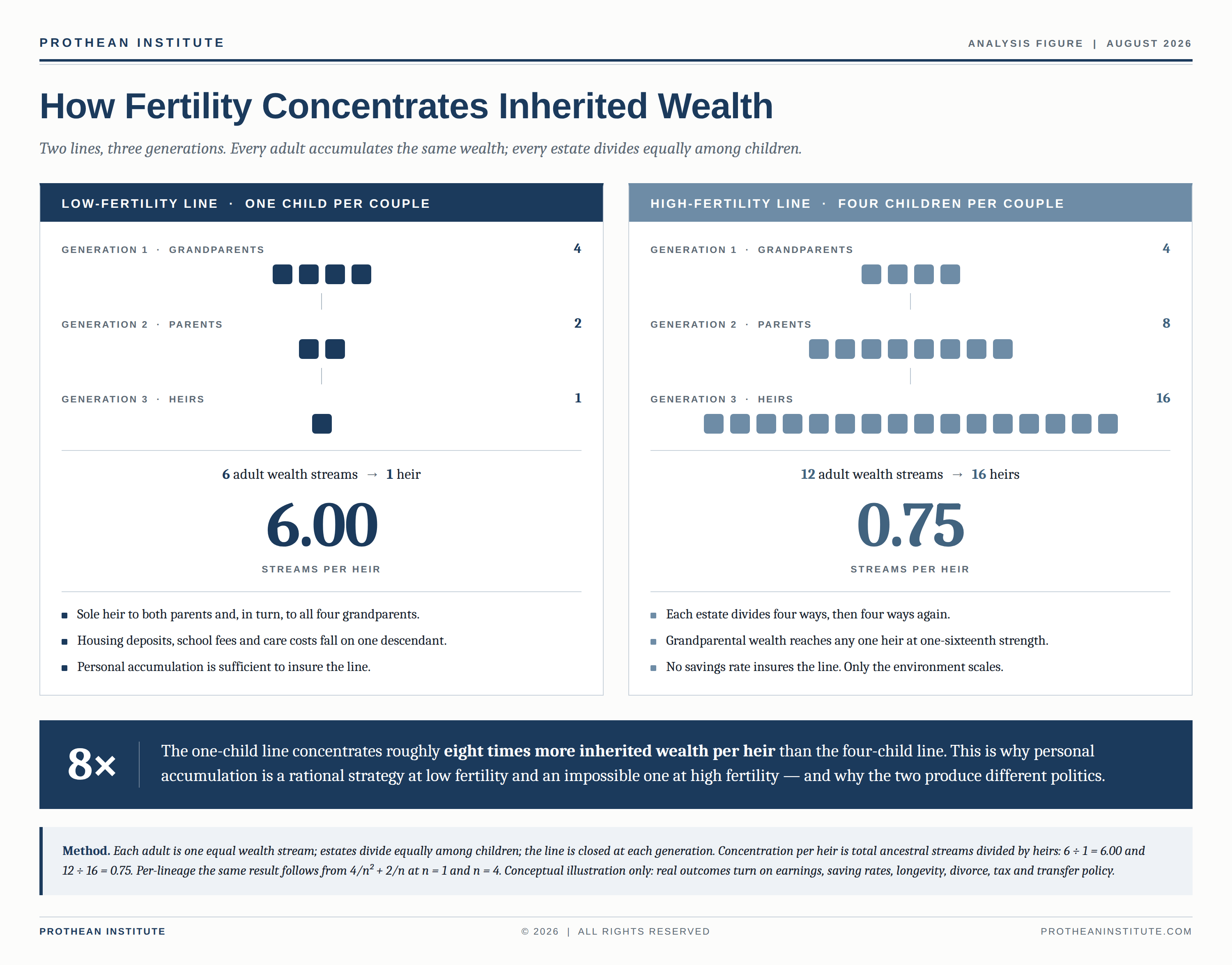
A person with no children, or one child, can protect their line by accumulating personally. Save enough, buy the house, top up the super, and the inheritance divides by one. A deteriorating country is survivable if your sole heir and his wife get the accumulated assets of 4 grandparents. Personal accumulation works.
Low fertility in a declining society remains a viable option to accumulate and insure descendants against future hardship.
A person with four children cannot do this. The estate divides by four, then by sixteen when grandchildren arrive. And with more than four children, the consequences are exponential. There is no savings rate high enough to ensure a large line of descendants against a shrinking economy.
The only strategy that scales is to create a flourishing country over the long term in which descendants can create their own economic prosperity.
Why low fertility erodes economic performance
What matters here is what it does to fiscal policy and the budget.
Four direct impacts are evident:
First, consumption. For a household that has opted out of children, the rational plan is present enjoyment plus a retirement pot or extraction from government pension plans. There is no inter-generational investment to fund. Politically, that household votes for what makes the present comfortable: transfers, subsidies, cost-of-living relief, protection of asset values and avoidance of significant structural reforms.
It does not vote for anything whose cost is now and payoff arrives in the medium to long term, and will happily borrow money for present consumptive spending.
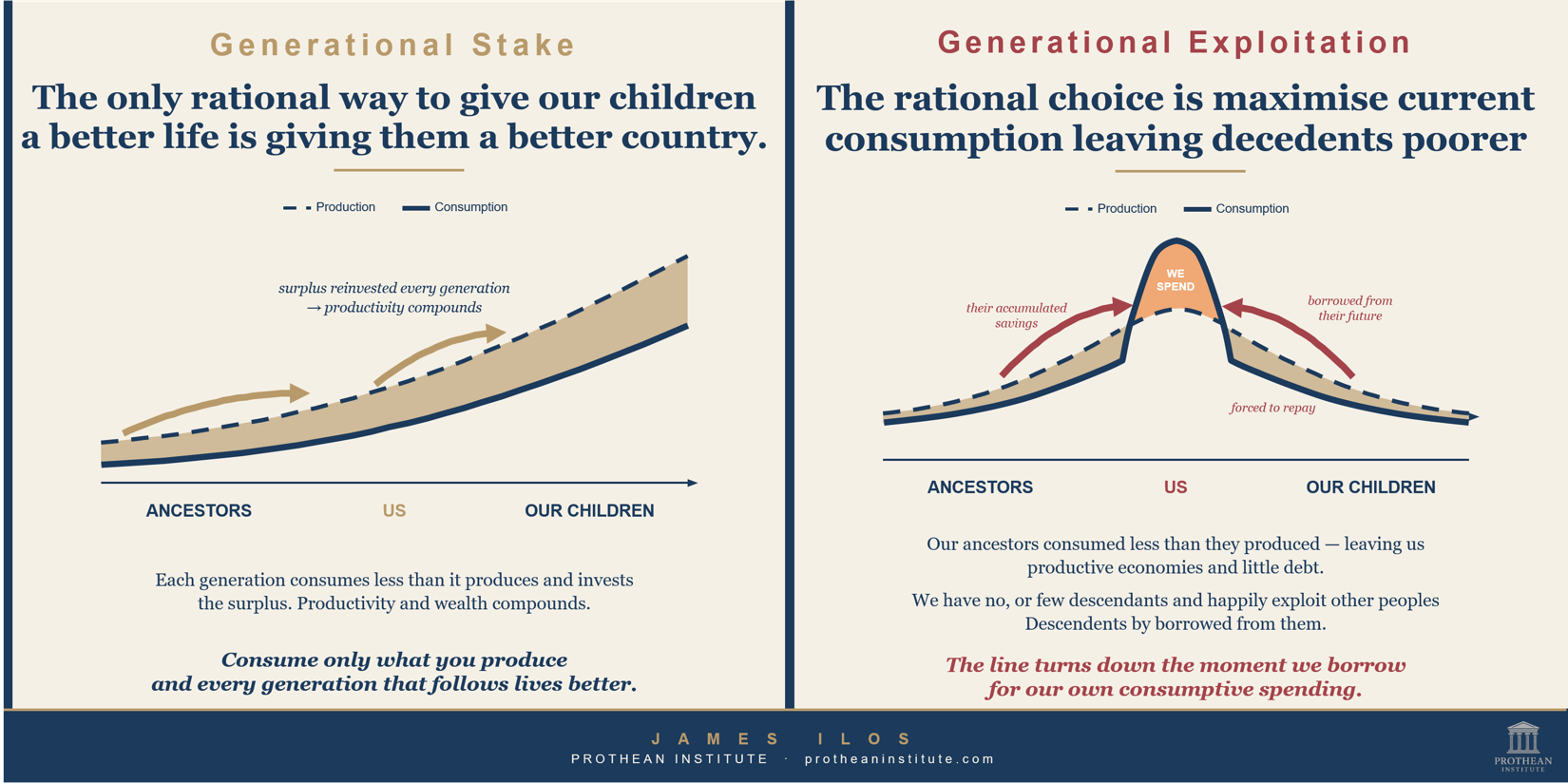
It takes a generational stake to live below productive capacity, so investment can be made in infrastructure that supports higher productivity for generations to come. Since around 2000, our current generation has spent the accumulated wealth of our ancestors and our descendants.
Consumptive spending now accounts for more than the entire government tax revenues in most anglosphere countries, with little federal spending on real intergenerational productive infrastructure.
Second, debt. This is where fertility bites hardest, through a design flaw that low fertility exposed rather than caused. Social Security, the age pension, and every European state pension are pay-as-you-go. Today’s retirees are paid by today’s workers. That is a claim by one cohort on the earnings of another. When the second cohort shrinks, a government has two options: cut the benefit, or borrow from descendants that are likely not even born.
Cutting is possible, but it is politically expensive enough, particularly in a low-fertility environment, that neither Washington, London nor Canberra has seriously attempted it in a generation.
So they borrow from future generations. American net interest is now over $1 trillion per year. In Australia, public debt service costs exceed the budget deficit itself: had Australia lived within its means historically, it could be running budgetary surpluses despite the enormous government spending programs such as NDIS.
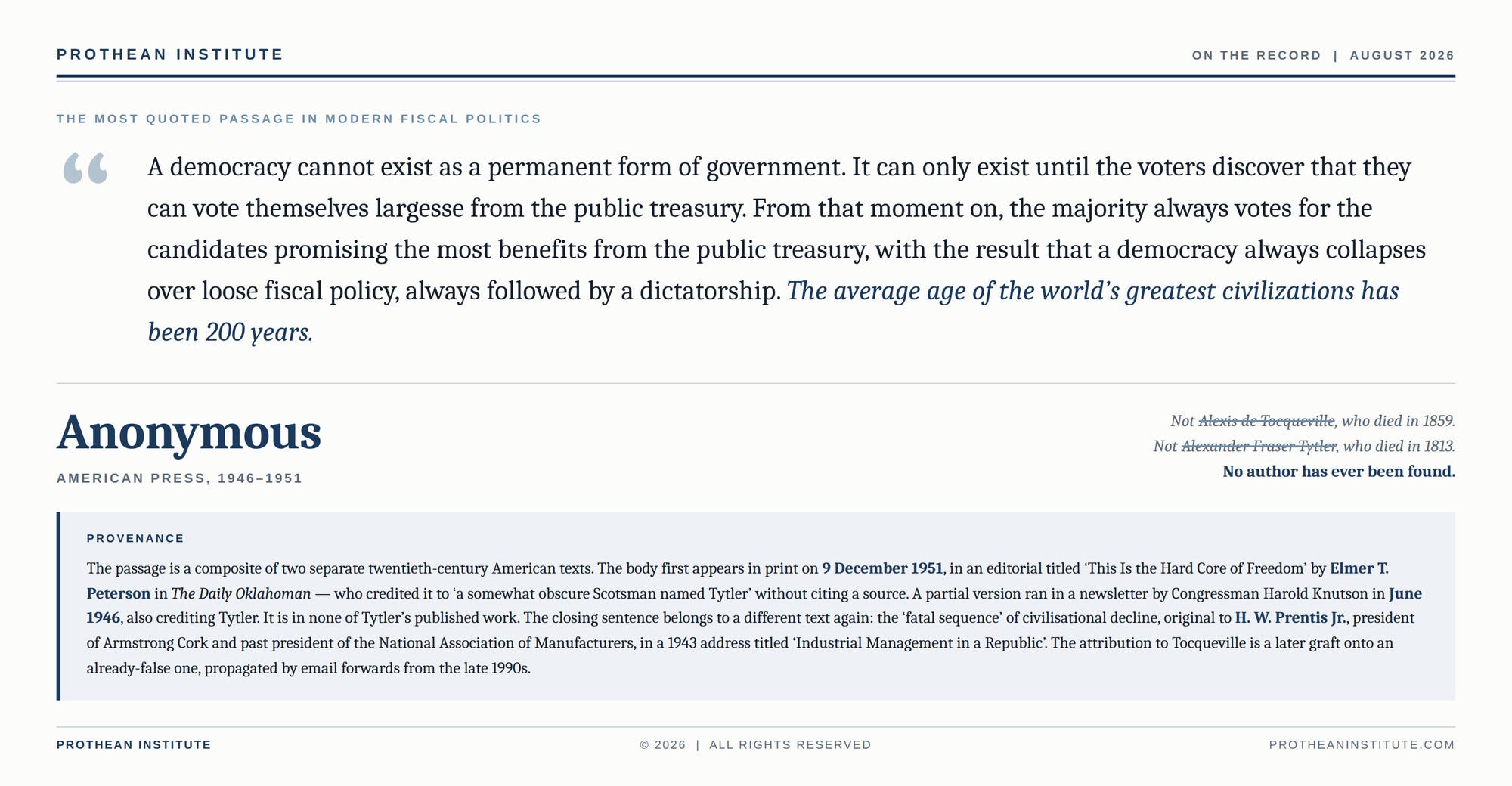
Some observations are as old as time and civilisation itself.
Neither country set out to put themselves in these precarious financial situations. It is the compounding cost of incremental decisions and structural reforms consistently deferred.
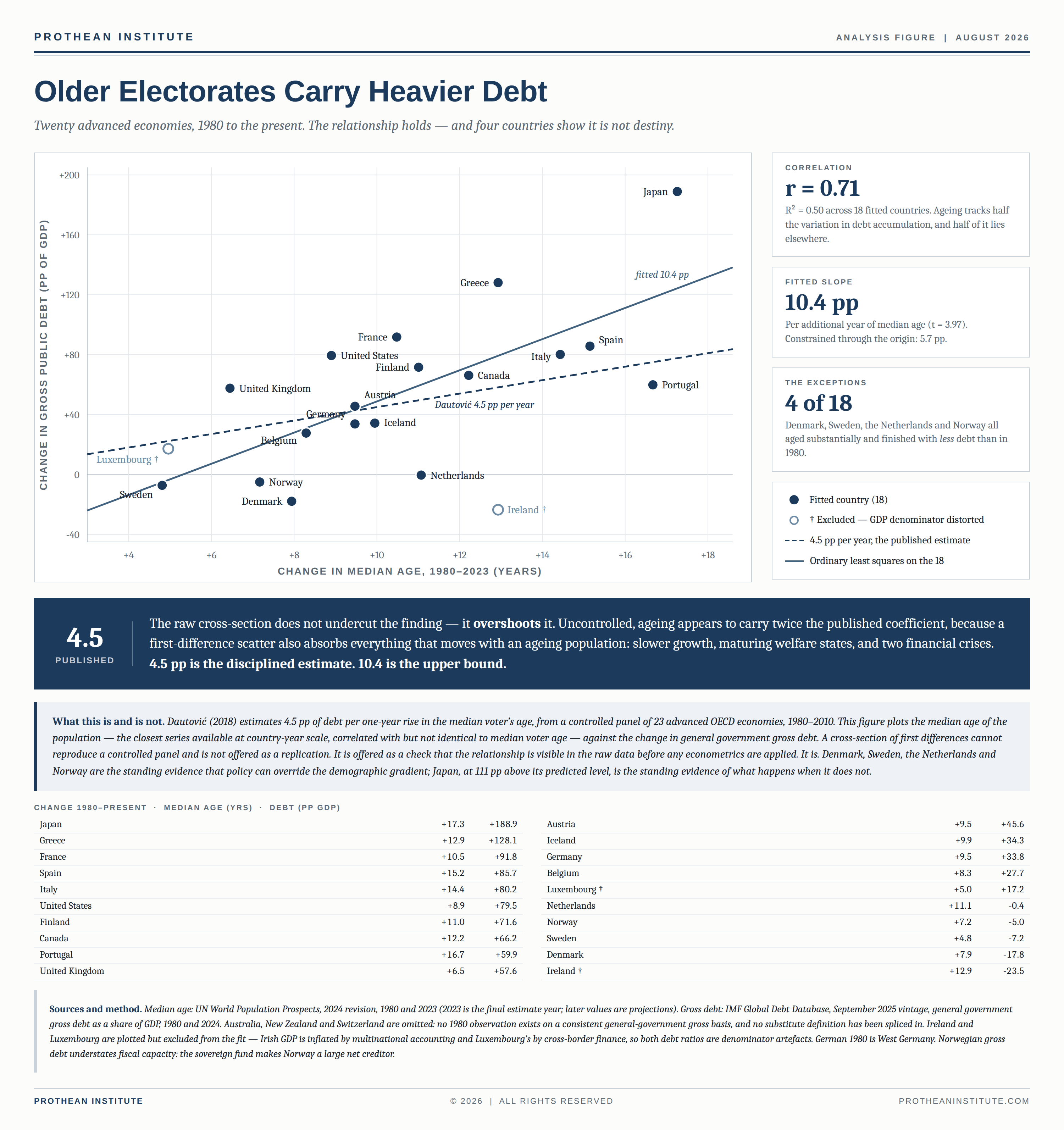
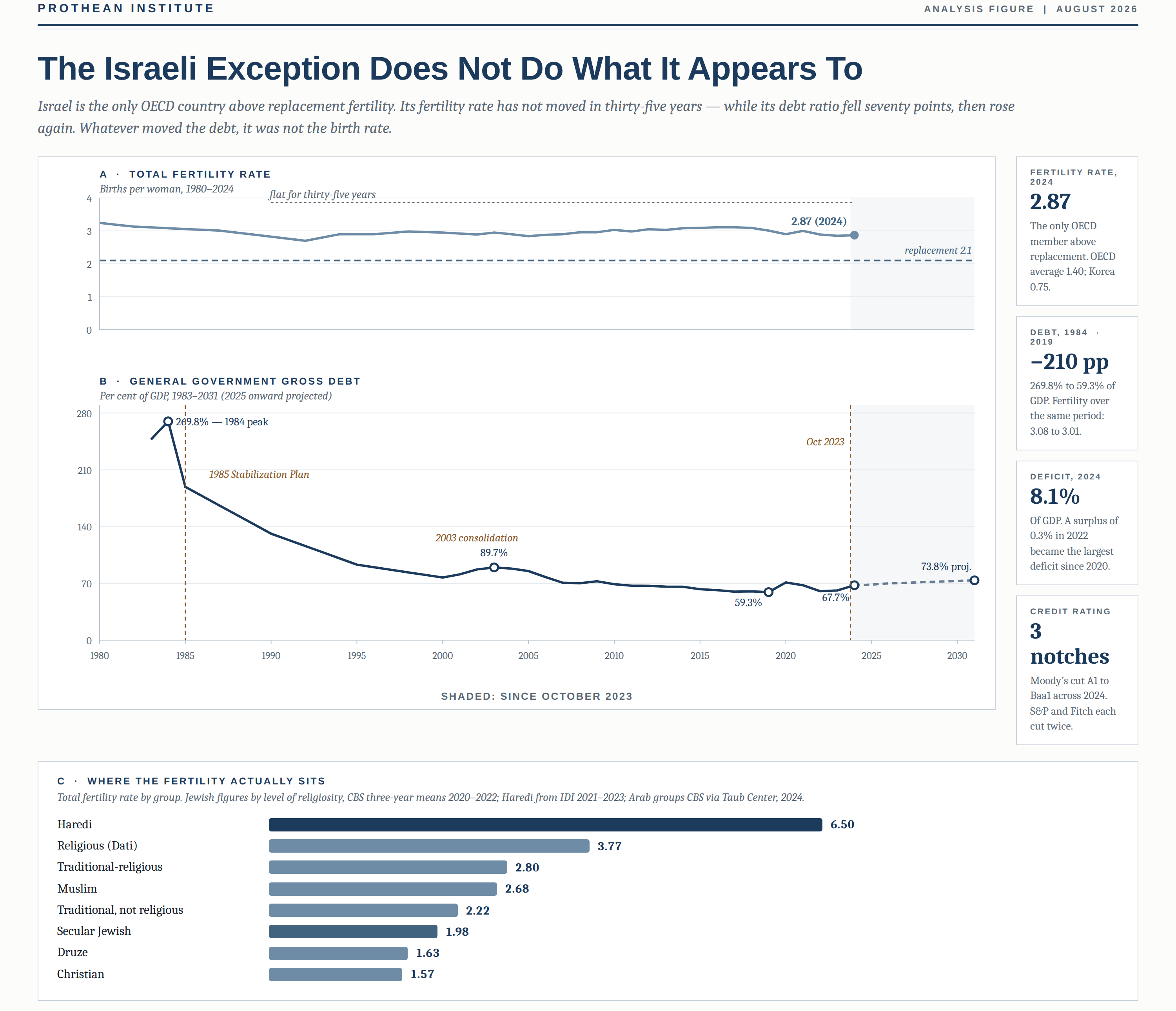
There is a number that gives this mechanism a formula. Across twenty-three advanced OECD economies from 1980 to 2010, every one-year increase in the median voter’s age is associated with a public debt-to-GDP ratio about 4.5 percentage points higher. A study measuring the age of the electorate (rather than the fertility of the people running it) — but it is what the generational stake predicts.
Third, deferral. Work published in February by the Aspen Economic Strategy Group modelled the American budget under continued low fertility and under an immediate return to replacement fertility in 2026. Deficits are unsustainable through 2055 in both cases — and replacement fertility makes the primary deficit worse by 0.2 to 0.5 per cent of GDP a year for the next three decades, because children cost money long before they pay tax. The fiscal payoff arrives around 2075. It’s the very definition of intergenerational investment.
Read that again, because it is the whole problem in one sentence. A politician who fixed the birth rate tomorrow would spend their entire career, and their successors’ careers, paying for it. The same calculus applies to all significant structural or spending reforms that might yield significant benefit in the long term, but require short-term austerity.
The incentive to act on any significant civilisational issue is not merely weak. It is negative at a political level in a low-generational-stakes political environment.
Fourth, immigration as a ‘cheap’ substitute for children. Once fertility repair or structural reforms to improve productivity are written off as too hard or uneconomical, the rational policy is to substitute population and economic growth with migration, and the low long-term consequences of these policies are not considered relevant to a low-generational-stakes electorate.
In Australia, net overseas migration accounted for 73 per cent of population growth in the year to December 2025. Migration levels have been fought over at recent elections in all Anglosphere countries. What has never been put to a vote is migration as a demographic replacement strategy — the quiet substitution of imported adults for domestic births. It arrived because it is the only lever that shows results inside an electoral cycle.
That is what managed decline is. Not a plan. A sequence of individually rational decisions by people whose personal calculation is satisfied either way.
The biggest problem of our time
Apply the inheritance calculation to the people currently in office, and it makes an awkward prediction.
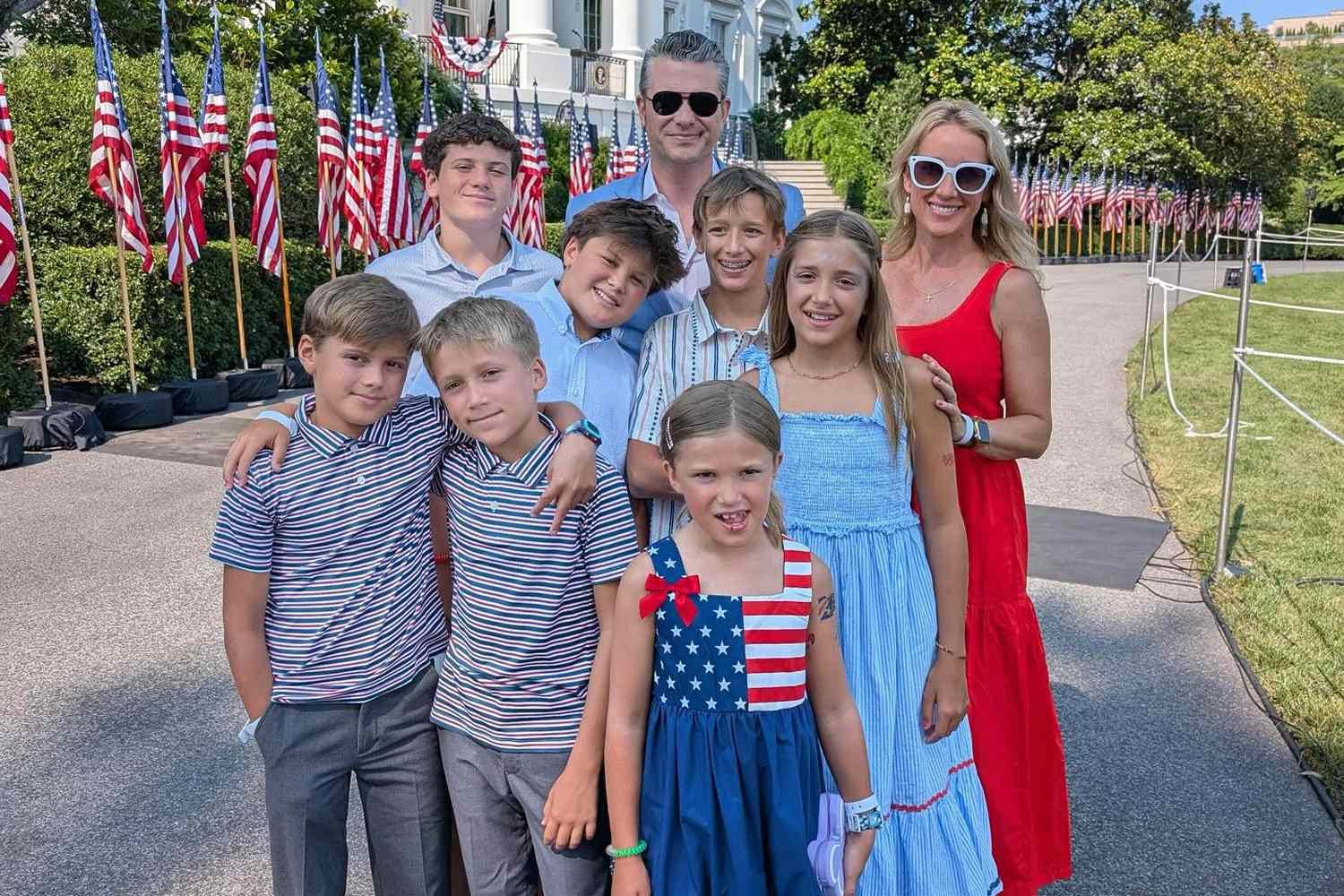
Pete Hegseth has an exceptional generational stake - 7 children.
The senior figures of the American executive have unusually high fertility: Trump (five children), Vance (four), Hegseth (seven), and RFK Jr. (six). Between them they have twenty-two children — an average of 5.5.
Set against the recent leaders of other major Western democracies — Macron (none), Scholz (none), Merkel (none), Albanese (one), Sunak (two), Starmer (two), Trudeau (three) — the average falls to roughly 1.14. The gap is striking.
Yet the high-fertility group is also running one of the largest structural deficits in the developed world.
Elon Musk is the cleanest illustration of the problem. A man with more than ten children entered government specifically to attack the long-horizon fiscal problem, at considerable personal cost to his companies and his public standing. What happened next is an informative bit. The effort achieved a fraction of what it claimed, ran into an entrenched appropriations structure that no executive could break through, and wound down. A high-stakes individual attacked the problem directly, and the low-generational-stakes incentives won. If that does not settle the question of whether personnel can substitute for institutional design, nothing will.
We will not pretend this away. On the most visible short-term test available, the mechanism appears to get the wrong answer.
There are two compounding explanations:
The inheritance calculation is a claim about long-horizon incentives, not about the next budget cycle. The same administration has pursued (with mixed success) spending restraint (in particular Musk), reshoring, energy expansion, and family-formation measures — projects whose payoffs, if any, arrive well beyond the current electoral window.
Perhaps more important for the argument of this piece: a high-fertility executive still faces low-fertility voter preferences and the same institutional incentives that produced the deficits in the first place. Personnel alone does not rewrite the incentive structure across a population.
Which is, in the end, the point. The deficit is downstream of what the median voter demands and what the institutional design rewards. Changing the people at the top, even when those people have strong personal generational stake, does not automatically change the outcome.
The clearer tests of the underlying mechanism are the structural cases of Singapore and Israel.
The Israeli exception
Israel is the only country in the OECD with fertility above replacement — 2.87 in 2024. If the generational stake operates at population scale rather than only through individual leaders, this is where it should show.
It does. Israel cut general government gross debt from 269.8 per cent of GDP in 1984 to 59.3 per cent in 2019, and ran a budget surplus in 2022.
No other developed country has managed anything close. Over the same thirty-five years, every low-fertility peer moved the other way.
Sources. Fertility 1980–2024: World Bank (SP.DYN.TFRT.IN), vintage 13 July 2026, sourced from Israel CBS; 2024 cross-checked against OECD Family Database SF2.1, April 2026. Debt 1983–1999: IMF Global Debt Database, general government. Debt 2000–2031: IMF WEO and IMF Article IV Country Report 26/161, July 2026. Values for 1986–89, 1991–94 and 1996–99 are linearly interpolated between the GDD’s five-yearly observations and are indicative only. Deficit and rating history: IMF Art. IV 26/161; Bank of Israel Annual Report 2025, Table 6.1; agency actions as reported in the financial press. Group fertility: Israel CBS via Taub Centre Policy Paper 16.2024; Israel Democracy Institute Annual Statistical Report on Ultra-Orthodox Society 2025. Employment and working-age share: IMF Art. IV 26/161; IDI 2025.
Israeli fertility did not rise during the deleveraging — it sat between 2.8 and 3.1 the whole time. That is the point: the generational stake is not a switch that gets flipped; it is a standing condition that biases policy toward long-term investment. Israel held it continuously and deleveraged continuously. The Anglosphere and Europe held the opposite continuously and did the opposite.
The war since October 2023 has added roughly ten points to Israel’s debt ratio. But borrowing to resolve a problem permanently rather than manage it indefinitely moves cost into the present so that the future inherits a solved problem instead of a costly running one.
Israel did not choose 7 October. What it chose afterwards was to prosecute the problem to a resolution rather than return to managing it — at eight per cent of GDP, three credit downgrades, and sustained international diplomatic cost.
A low-stakes political class facing the same attack has an obvious alternative available: absorb it, restore the prior equilibrium, defer the underlying problem, and protect the status quo. And that is what the west has chosen repeatedly to for its significant challenges.
The Singapore objection
The other obvious rebuttal is Singapore. A fertility rate of 0.87, among the lowest in the world. Yet a budget surplus, a AAA rating, and a net asset position. If low fertility drives debt, Singapore should be a wreck.
Prime Minister Lee Kuan Yew had three children, together with a near-dynastic attitude toward generational stake, and he built its institutions, economy and government with this long-term vision. He made sure Singapore voters had little influence for half a century.
He built its retirement system to require workers to contribute to their own retirement over their productive lifespans, rather than draw on the next cohort’s payroll. Half the long-term real return on the national reserves must by law be reinvested rather than spent. Intergenerational investment is built into its economy.
None of that requires virtuous politicians. It is Madisonian design in the strict sense: long-horizon outcomes out of ordinary self-interested people. The recent history of Singapore is also instructive on two points:
Voter power growing - As Lee Kuan Yew stepped back progressively from leadership, and the voter influence grew from around 2000, we see the emergence of the very consumptive spending trends evident in other Western democracies.
The primary balance — budget excluding investment returns — went negative this year for the first time since the pandemic. The system is now funding current spending from the yield on inherited capital, exactly as the West does
Singapore has not solved low fertility. It bought several decades of insulation from the fiscal consequences with its capital accumulation, and it is now spending the yield.
What follows
Asking the political class to think longer term is wasted breath, and it does not much matter how many children they have.
A voting public that rewards consumption, debt and reform deferral will produce consumption, debt and reform deferral.
Moral exhortation asks people to act against their interest, and Madison’s entire point was that durable institutions never require that, and those that do, fail.
And read the debt figures and intergenerational theft as the cost of failed institutional design.
Forty trillion and one trillion are not the problem; they are the reckoning — addressed to the grandchildren of the people who still have a generational stake.
The corrective is structural, or it is nothing.
The Prothean Institute is an independent strategic research organisation dedicated to understanding, preserving, and renewing the foundations of thriving societies. All policy recommendations and strategic analyses are grounded in strict epistemic rigour and the reality of real-world conditions and human nature. We reject abstractions untethered from reality and seek to equip leaders with tools that work in the world as it is — not as we might wish it to be.
Notes and References
US Department of the Treasury, Debt to the Penny. Total public debt outstanding was $39,986,657,878,071.92 on 17 August 2026 and $40,047,425,768,420.22 on 18 August 2026. https://fiscaldata.treasury.gov/datasets/debt-to-the-penny/
The $1 trillion figure derives from the Australian Office of Financial Management’s issuance schedule as calculated and released by Shadow Treasurer Tim Wilson, 20 August 2026, which puts AGS on issue at $1,000.8 billion on 20 August and $994.8 billion on 21 August following $6 billion of maturities. AOFM’s own last published stock figure was $983.7 billion as at 14 August. Commonwealth of Australia, Budget 2026–27, Budget Paper No. 1, Table 7.1 projects AGS on issue of $982.0 billion in 2025-26 and $1,051.0 billion in 2026-27. https://www.miragenews.com/australia-hits-1-trillion-of-commonwealth-debt-1730112/ | https://www.aofm.gov.au/
Prothean Institute, The Generational Stake: Why Different Fertility Patterns Produce Different Incentive Structures — and What That Predicts About Political Behaviour, Policy Brief, May 2026 (Paper 3, The Divergent Societies series).
Congressional Budget Office, The Budget and Economic Outlook: 2026 to 2036, February 2026. Mandatory outlays $4,529 billion of $7,449 billion total in FY2026 (60.8%); $7,028 billion of $11,416 billion in 2036 (61.6%). https://www.cbo.gov/publication/61882
Commonwealth of Australia, Budget 2026–27, Budget Paper No. 1, Statement 3, Table 3.1 (payments 26.6% of GDP in 2025-26, 26.8% in 2026-27) and Statement 11 historical series (1986-87: 26.9%). These are budget estimates, not outcomes. https://budget.gov.au/content/bp1/download/bp1_bs-11.pdf
Congressional Budget Office, Monthly Budget Review: July 2026, August 2026. Fiscal year to date: Social Security $1,373 billion; net interest $963 billion; Medicare $952 billion; Department of Defense (military) $763 billion. https://www.cbo.gov/publication/61983
Commonwealth of Australia, Budget 2026–27, Budget Paper No. 1, Statement 7, Table 7.9 (AGS interest $27,690 million in 2026-27 rising to $40,425 million in 2029-30, +46.0%) and Statement 3 (public debt interest averaging 8.8% annual growth over the projection period, against hospitals 7.3%, defence 6.4%, aged care 5.4%). https://budget.gov.au/content/bp1/download/bp1_bs-7.pdf
Ernest Dautović, ‘The weight of the median voter ageing on public debt’, Constitutional Political Economy, vol. 29 no. 1, 2018, pp. 69–92. Panel of 23 advanced OECD economies, 1980–2010. https://link.springer.com/article/10.1007/s10602-017-9248-8
Social Security and Medicare Boards of Trustees, 2026 Annual Reports, 9 June 2026. OASI depletion fourth quarter 2032 (78 per cent payable); Medicare HI depletion second quarter 2033 (89 per cent payable); seventy-five-year OASDI actuarial deficit 4.42 per cent of taxable payroll, widened from 3.82 per cent, of which approximately 0.33 points is attributed to lower fertility, 0.18 to reduced immigration, and 0.16 to the One Big Beautiful Bill Act. https://www.ssa.gov/oact/TR/2026/
Lisa Dettling and Luke Pardue, Low Fertility and Fiscal Sustainability: The Effects of Past and Future Fertility Rates on the US Federal Budget Outlook, Aspen Economic Strategy Group, 24 February 2026. https://www.economicstrategygroup.org/publication/pardue-dettling-budget/
Australian Bureau of Statistics, National, state and territory population, December quarter 2025, released 18 June 2026. Total population growth 412,500; net overseas migration 301,000; natural increase 111,500. Australia’s total fertility rate was 1.481 in 2024, a record low: ABS, Births, Australia, 15 October 2025.
Statistics Canada, ‘Canada’s total fertility rate reaches new low’, 22 April 2026. https://www.statcan.gc.ca/o1/en/plus/9140-canadas-total-fertility-rate-reaches-new-low-2024
Committee for a Responsible Federal Budget, ‘OBBBA Dynamic Score Comes In At $4.7 Trillion’, on CBO’s dynamic estimate including debt service, FY2026–2035. The conventional provision-only score is $3.4 trillion. https://www.crfb.org/blogs/obbba-dynamic-score-comes-47-trillion
Israeli Government Israel Economy Recent Trends 2026 economic update: https://www.gov.il/BlobFolder/reports/israel-economy-recent-trends/en/Files_eng_israel-economy-recent-trends.pdf
Singapore Department of Statistics, Total Fertility Rate 2025, 26 February 2026 (preliminary resident TFR 0.87, from 0.97 in 2024); Speech by Deputy Prime Minister Gan Kim Yong, Committee of Supply Debate 2026. South Korea’s 2025 provisional TFR was approximately 0.80. https://www.singstat.gov.sg/news/total-fertility-rate-2025
Singapore Ministry of Finance, Analysis of Revenue and Expenditure, Financial Year 2026. Net Investment Returns Contribution S$28.48 billion, 17.4 per cent of total revenue (21.1 per cent of operating revenue); primary balance −S$2.57 billion in FY2026 against +S$6.40 billion in FY2025. https://isomer-user-content.by.gov.sg/153/b25a4bb9-db1b-428d-ab48-4528e0ee0d37/fy2026_analysis_of_revenue_and_expenditure_2026.pdf
Originally published on October, 6, 2025 – updated with VIDEO on August, 24, 2026
VIDEO – Two MASSIVE COVID shot studies on 8 MILLION people confirm that can trigger Turbo-Cancer in Vaccinated
Excerpt from American Thinker interview to American Epidemiologist Nicolas Hulscher
Korean Medical Doctors: “1-Year Cancer Risk Associated with COVID-19 Vaccination”
«The oncogenic potential of SARS-CoV-2 has been hypothetically proposed, but real-world data on COVID-19 infection and vaccination are insufficient. Therefore, this large-scale population-based retrospective study in Seoul, South Korea, aimed to estimate the cumulative incidences and subsequent risks of overall cancers 1 year after COVID-19 vaccination. Data from 8,407,849individuals between 2021 and 2023 were obtained from the Korean National Health Insurance database».
We can read in the Abstract of the Korean study Kim et al. titled “1-year risks of cancers associated with COVID-19 vaccination: a large population-based cohort study in South Korea” which was conducted byHong Jin Kim (Department of Orthopedic Surgery, Kyung-in Regional Military Manpower Administration, Suwon) Min-Ho Kim (Informatization Department, Ewha Womans University Seoul Hospital, Seoul), Myeong Geun Choi and Eun Mi Chun (both in Division of Pulmonary and Critical Care Medicine, Department of Internal Medicine, Ewha Womans University Mokdong Hospital, 1071, Anyangcheon-ro, Yangcheon-gu, Seoul).
The research was published on BMC Biomarker Research 13 (part of Springer Nature).
«The participants were categorized into two groups based on their COVID-19 vaccination status. The risks for overall cancer were assessed using multivariable Cox proportional hazards models, and data were expressed as hazard ratios (HRs) and 95% confidence intervals (CIs). The HRs of thyroid (HR, 1.351; 95% CI, 1.206–1.514), gastric (HR, 1.335; 95% CI, 1.130–1.576), colorectal (HR, 1.283; 95% CI, 1.122–1.468), lung (HR, 1.533; 95% CI, 1.254–1.874), breast (HR, 1.197; 95% CI, 1.069–1.340), and prostate (HR, 1.687; 95% CI, 1.348–2.111) cancers significantly increased at 1 year post-vaccination» adds the Abstract.
«In terms of vaccine type, cDNA vaccines were associated with the increased risks of thyroid, gastric, colorectal, lung, and prostate cancers; mRNA vaccines were linked to the increased risks of thyroid, colorectal, lung, and breast cancers; and heterologous vaccination was related to the increased risks of thyroid and breast cancers. Given the observed associations between COVID-19 vaccination and cancer incidence by age, sex, and vaccine type, further research is needed to determine whether specific vaccination strategies may be optimal for populations in need of COVID-19 vaccination».
The Korean study indirectly confirms the warning raised by two Chinese universities in October 2020, even before the Covid-19 vaccines were released, regarding the very serious risks of lung disease that both mRNA and mDNA gene sera could cause.
Furthermore, the study found that booster doses were associated with significantly higher risks of gastric and pancreatic cancer. For pancreatic cancer, the risk more than doubled in booster recipients.
More details below inside the analysis of American epidemiologist Nicolas Hulscher.
Fabio Giuseppe Carlo Carisio – Gospa News director
BREAKING: Second Massive Population Study Finds COVID-19 “Vaccines” Increase Risk of 6 Major Cancers
Originally published by Nicolas Hulscher, MPH on Substack Focal Points – Courageous Discourse by McCullough Foundation
About a month ago, the first-ever population cohort study reported increased cancer risks following COVID-19 vaccination. In Italy, nearly 300,000 residents were tracked for 30 months, showing that mRNA shots significantly increased the risk of overall cancer, breast cancer, bladder cancer, and colorectal cancer
Now, a second—and far larger—population-based cohort study by Kim et al from South Korea has corroborated and expanded upon those findings. Drawing on a massive sample of more than 8.4 million people, this is one of the most powerful cancer-safety datasets ever analyzed.
The results are striking. After accounting for age, sex, comorbidities, income level, and prior COVID-19 infection, COVID-19 vaccination was linked to significant increases in multiple major cancers, with the signal consistent across all vaccine platforms, both sexes, and age groups:
Study Design at a Glance
Design & data: Population-based retrospective cohort using the Korean National Health Insurance database (2021–2023).
Population: 8,407,849 adults.
Exposure: COVID-19 vaccination (analyzed overall and by platform: mRNA, cDNA, and heterologous schedules).
Matching: Large-scale propensity score matching (1:4 vaccinated:unvaccinated for the main analysis; 1:2 within vaccinated for booster vs non-booster).
Modeling: Multivariable Cox proportional hazards models (adjusted for age, sex, comorbidity index, income level, and prior COVID-19 infection), estimating hazard ratios (HRs) with 95% confidence intervals (CIs); analyses stratified by sex and age.
Breast cancer: HR 1.20 (1.07–1.34) → 20% higher risk
Interpretation: An HR of 1.53 for lung cancer means that vaccinated individuals developed lung cancer at a rate 53% higher than matched unvaccinated peers, over the same one-year follow-up period. Similar interpretations apply to each cancer type.
Heterologous (mixed schedules): linked to higher risks of thyroid and breast cancers.
Overall cancer HR 1.34 (95% CI 1.21–1.48) → 34% higher risk
Interpretation: The elevated cancer risks were not confined to one vaccine platform. Whether adenoviral-vector (cDNA), mRNA, or mixed schedules, each vaccine type was associated with a measurable increase in overall cancer — and each had specific cancer sites driving the signal. In other words, no vaccine technology was free of cancer risk in this dataset.
Interpretation: Booster doses were associated with notably higher risks of gastric and pancreatic cancers. For pancreatic cancer, the risk more than doubled in boosted individuals.
Women: elevated risks for thyroid and colorectal cancers
Under 65 years: stronger signals for thyroid and breast cancers
≥75 years: markedly higher risk of prostate cancer
Interpretation: Both the overall and site-specific results show a consistent pattern — every demographic group experienced elevated cancer risks, though the type and absolute burden varied. Women and the elderly were hit hardest, but no population segment was spared.
Conclusions: Major Increases in Cancer Risk from Chortes Studies in Italy and South Korea.
Taken together, the evidence is now impossible to ignore. The only two population-level cohort studies ever conducted on COVID-19 vaccination and cancer — one in Italy and one in South Korea — have both found major increases in cancer risk.
The Italian study (≈300,000 people, 30-month follow-up) identified significant elevations in overall cancer, breast, bladder, and colorectal cancers. The South Korean study (8.4 million people, 1-year follow-up) confirmed and expanded these findings, documenting increased risks of overall cancer plus six site-specific cancers (lung, prostate, thyroid, gastric, colorectal, and breast).
Critically, the signal was observed across all vaccine types — both mRNA and viral-vector (cDNA) shots — and in every demographic group analyzed. In plain terms: both major COVID-19 vaccine platforms appear to be carcinogenic
With two independent national datasets converging on the same conclusion, governments, regulators, clinicians, and researchers must confront a sobering reality: nearly 70% of the global population has been injected with a carcinogenic product. The evidence demands immediate market withdrawal of these products.
At the McCullough Foundation, we are deeply investigating both the molecular mechanisms and the population-level data linking COVID-19 vaccination to cancer. We are currently preparing several new studies to expand this critical line of evidence.
This work requires substantial time, expertise, and resources, and we ask for your support in funding this urgent research: mcculloughfnd.org/products/donate-1
Oririnally published by Nicolas Hulscher, MPH on Substack Focal Points – Courageous Discourse by McCullough Foundation
Nicolas Hulscher, MPH – Epidemiologist and Foundation Administrator, McCullough Foundation
The truth is told very well with images. A picture says a thousand words, and memes a few more. These pages have lots of images and memes that focus on the truth. Click image to enlarge + use arrows to navigate.
Images + Memes Pages • Sent To Your Email
Truth Warriors become a Truth11.com subscriber. Support Independent Media and get the Images + Memes pages plus all articles sent to your email.

 Login