A case of treason on an unprecedented scale is emerging at Germany’s foreign intelligence service, in what German media say could shake the entire agency.
According to the investigative team of WDR, NDR and Süddeutsche Zeitung (SZ), August Hanning, the former head of the Federal Intelligence Service (BND), is being investigated for alleged espionage detrimental to the state and intelligence activities.
Hanning’s tenure at the BND ended in November 2005.
But he is accused of having illegally obtained secret information for several years after he left the service, which gathers and assesses information on foreign, security, and economic threats.
He was arrested at his home in Nordwalde, near Münster in western Germany, on Tuesday (6 October).
Der Spiegel reported that police arrived at 6.41AM and took him away in a black minibus at 8.58AM.
Another former senior BND employee was also detained in the Bavaria region — apparently the former head of Hanning’s office, who worked for the intelligence service until spring 2026.
Neither German authorities nor Hanning’s representatives had commented on the case by Tuesday noon.
What investigative journalists found
According to investigative journalists, Manfred D. leaked top-secret information from within the BND to Hanning until 2022.
According to Der Spiegel, which cited investigators’ findings, Hanning and Manfred D. agreed, as early as spring 2010, that the latter would, in return for payment, gather intelligence from the BND for his former boss, which Hanning could use in his private security consultancy work.
Investigators are working on the assumption that, in at least one case, Hanning prepared a security analysis for a foreign intelligence service.
According to WDR, NDR and SZ, it was not for Russia.
In another case, he allegedly used information from internal BND documents when communicating with a foreign agent.
According to information from security circles obtained by WDR, NDR, and SZ reporters, Hanning came under scrutiny after his home and offices were searched in September last year, when the State Criminal Police Office (LKA) was investigating the case of steak empire heiress Christina Block.
According to investigators, Hanning was involved in an earlier attempt to abduct them, accusations he denies.
While assessing material seized from Hanning last year, LKA officers found an electronic data storage device with explosive contents, according to the investigative journalists.
The former official apparently had access to top-secret BND documents from the recent past which, under no circumstances, should have been in his possession.
In total, he obtained around 2,000 documents. In many cases, these were briefings for the so-called intelligence situation meeting at the federal chancellery, where the heads of security agencies exchange information every week.
They included highly sensitive reports, for example, on Iran’s nuclear programme or the Russian military. According to security sources, they also included reports from foreign partner services.
A leak of such material is regarded by intelligence services as an absolute catastrophe. Friendly intelligence services could lose trust in the BND and cut off the institution from crucial information.
After assessing them, the LKA Hamburg police team handed the seized documents over to federal authorities.
And in May 2026, the Federal Public Prosecutor General’s Office ultimately opened confidential proceedings against Hanning and his alleged BND informant. It remains unclear over what period the former intelligence chief was supplied with secret internal information.
According to security sources, the most recently discovered documents date from June 2022.
It also remains unclear how the alleged BND mole managed to remove material from the secured agency. The BND was asked for a statement on the case.
Hanning’s lawyers have not yet responded to a brief request for comment on the allegations.
An affair of historic proportions
For the BND, this is already the second serious incident in the space of a few years.
In 2022, the espionage case involved Russia, when a former head of a BND unit was accused of spying for Moscow together with another man.
It concerned top-secret information on BND cyber operations that was leaked from the service.
As the Tagesschau website noted, if the suspicions against Hanning are confirmed, this would be an espionage affair of historic proportions.
German history has never before seen an alleged case of treason involving such a senior former top official.
According to Der Spiegel, this is unprecedented. This is particularly so because, for many years after leading the intelligence service, Hanning remained among the most important officials in Germany’s security apparatus.
Before becoming BND president, he was responsible for protecting classified information at West Germany’s representation in East Germany.
After serving at the chancellery, including as coordinator of the federal intelligence services, the lawyer, who holds a doctorate, took over the leadership of the BND in 1998.
At the end of 2005, after leaving the intelligence service, Hanning became a state secretary at the interior ministry. He retired four years later.
Questionable business
According to German media, his subsequent activities were seen as problematic. He became known as a businessman and security consultant with a company in Switzerland.
Its German subsidiary was hired for a time in the custody dispute between Block and her former husband.
According to prosecutors, in 2023 he allegedly planned, together with an associate, to “discredit Block’s former husband through false allegations of paedophilia”.
Hanning and his alleged accomplice apparently tried to plant a hard drive containing child sexual abuse images and videos on the father of Block’s children.
The investigation has not yet been concluded. Hanning has previously denied all allegations in the case.
Russia continues to pressure cities, while the first autonomous counter-drone turrets have been deployed in Kyiv.
Ukraine is maintaining pressure on Russia’s oil industry, reporting that it has disabled 51 percent of refinery capacity.
Russia still sees a large pocket of encircled Ukrainians in Kharkiv region, but no such pocket exists.
Ukraine says it destroyed a Russian Su-34 and Su-35 on the ground. Satellite imagery provides no clear evidence.
Maps of the day– Kharkiv region
Videos of the day – intense trench fighting; Russians shot down a balloon carrying an FPV drone; Russia has revived the idea of a barrage of tethered balloons; ground drones repelled an FPV drone attack using a counter-drone net – views from both sides.
Russia continues to pressure cities. Ukraine has begun testing AI-controlled machine-gun turrets in them. The new autonomous weapon is intended to protect key sites from drone attacks, typically bridges and similar infrastructure. Air force spokesperson Yuri Ihnat said on Monday that the AI turrets, which receive information from other air-defence components, had achieved their first shoot-downs, including of Geran-5 drones.
Ukrainian president Volodymyr Zelensky reported on Saturday, before Ihnat’s announcement, that 12 turrets of the kind shown in the military video below had been installed in the capital by that date. Another eight are planned.
They are armed with a 12.7mm heavy machine gun, which is not effective against a Geran flying high and fast, but becomes effective during the final phase of its flight, when it comes within the weapon’s range. The soldier in the footage said 50 rounds were sufficient to shoot down a Geran with AI assistance.
AI is entering Ukraine’s air-defense fight — and it is already helping shoot down Russia’s jet-powered Shaheds.
Air Force spokesperson Yurii Ihnat said AI-assisted turrets using machine vision have already successfully engaged Russian Geran-5 jet-powered UAVs.
Details of the turrets’ precise deployment are, understandably, not yet known. However, both Russian and Ukrainian sources commented on them in interesting ways. Ukrainian expert Anatoliy Khrapchynskyi told the NV website, among other things, about the risk that fully autonomous turrets pose to civilians. Serhii Beskrestnov was the first to warn about it on Monday: “I warn you that, for your own safety, you should not stand by windows during an air-raid alert.”
Khrapchynskyi noted that this rule has applied to any weapon since the start of the war. People should not stand by windows during air raids precisely because air defences or debris from downed weapons can damage buildings and injure people. There is a two-wall rule: if you cannot get to a shelter, hide somewhere in your flat protected from a potential blast by two walls, such as in a corridor.
“This does not mean that robotic turrets will fire at windows. They will target moving aerial targets, but they could hit civilian infrastructure,” Khrapchynskyi conceded.
The Russian Telegram channel Two Majors complained that while Ukraine was already using AI turrets in practice, and although promising projects of the same kind existed in Russia, bureaucracy and high costs were holding back their introduction into service.
The same Russian source was among those that published a video showing an entire bridge across the Dnipro in Kyiv being wrapped in a counter-drone net.
But after several days in which Russian Gerans targeted only Kyiv’s bridges, they attacked Zaporizhzhia in the same way overnight from Monday to Tuesday. Russia injured five city residents, including two Red Cross workers, and halted or restricted traffic on several bridges in Zaporizhzhia, causing traffic jams in the city during the morning.
Zaporizhzhia lies about 30 km from the front and is a natural supply route for fighting units. Taking the bridges out of action would create a serious logistical complication, but the same applies as in Kyiv: their complete destruction is unlikely. Russia will also be satisfied with constant attacks causing minor damage, but sufficient to halt traffic.
Among other sites hit by Russian weapons was one of the hospitals in Kryvyi Rih, which was struck by two missiles. Two people were injured during the air raid.
Ukraine is maintaining pressure on Russia’s oil industry, reporting that it has disabled 51 percent of refinery capacity. “More than half of the enemy’s capacity has been taken out of operation. This is the result of carefully planned, methodical and systematic work aimed at exhausting Russia’s war machine and destroying its military-economic potential,” new minister Yevhen Khmara said.
His statement cannot currently be verified, but footage of another fire at oil infrastructure in Russia emerged on Tuesday morning. It was at the Volodarskaya production and distribution centre in Moscow region. It lies just under 40 km southeast of central Moscow in a straight line, and its premises contain a large oil depot. It is also a pipeline junction through which fuel flows to Moscow, including aviation fuel for Moscow’s airports.
Ukrainian attack drones successfully struck Russia's Volodarskaya LPDS tonight, a major storage and distribution hub supplying jet fuel, diesel, and gasoline for the Russian capital, Moscow.
Ukraine says it destroyed a Russian Su-34 and Su-35 on the ground. Satellite imagery provides no clear evidence. The attack targeted Khanskaya airfield in Krasnodar region, from which a training unit normally operates.
The incident took place over the weekend. Satellite images showing clear traces of explosions and fire appeared relatively quickly, but it is not possible to identify what exploded and burned.
The usual Russian source, Fighterbomber, did not comment on the matter at all.
📍Satellite imagery of the aftermath of the UAV attack on "Khanskaya" airfield.
Russia still sees a large pocket of encircled Ukrainians in Kharkiv region, but no such pocket exists. The image below shows a map of the part of Kharkiv region where active military operations are under way. It was produced by the Russian defence ministry and shown by Two Majors on its Telegram account.
Alongside the image, the same source again cited Kremlin claims in listing alleged Russian successes in this sector: “In the Kharkiv direction, the Northern Group of Forces reported further advances. In the Lyptsi sector, our troops advanced near Tokarivka and captured several enemy strongpoints. In the Vovchansk and Velykyi Burluk directions, advances were reported in the areas of Prykolotne, Kotivka, Varvarivka, Reznikove, Mykolaivka, and Annopil.”
We have already written in Ukraine Battlefield update that no pocket exists, and that Ukrainian and independent sources follow the northern part of the front only marginally, because far less is happening there than Russia claims.
Among respected OSINT projects, Playfra most recently covered this battlefield on Saturday. The first map from this source shows the section of the front located at the top right of the Russian map. This is where the alleged encirclement is supposed to be, which various Russian sources have been reporting for almost a month.
The fighting here consists of Russian infiltration attempts, which are “chaotic and unorganised”. Playfra unequivocally rejects any encirclement.
Bilyi Kolodyaz-Velykyi Burluk directions.
No particular changes. The Russians continue infiltration attempts to encircle Ukrainian units in the Dehtiarne salient, though, once again, for now there is definitely no encirclement of the Ukrainians here. Russian infiltrations remain… https://t.co/ZlzDhwdMDhpic.twitter.com/GZz4lHkxSp
The following map from Playfra shows the same section of the battlefield as that seen in the Russian defence ministry’s version. The gap between reality and Russia’s claimed successes here is among the largest along the entire front, from Sumy to Kherson:
For comparison, the same area according to Finland’s Black Bird Group:
And according to the Russian project Slivochny Kapriz, which is relatively reliable. In all cases, Kharkiv is at the bottom left and the village of Dihtiarne, directly on the Ukrainian-Russian border, is at the top right:
Three-quarters of Ukrainians support peace talks. In the second half of September, the Kyiv International Institute of Sociology asked respondents whether they supported peace negotiations with Russia.
Exactly three-quarters — 75 percent — said they supported peace talks, 21 percent were against, and the remainder could not give a definite answer. This was virtually identical to the result in February 2025, when 74 percent of respondents answered the same question positively.
This is also shown by the Kyiv polling agency’s graph, whose analysts stressed that willingness to negotiate does not equal willingness to accept Russian terms.
Views on who will win the war have shifted more significantly. As the next graph shows, the difference between February 2025 and September 2026 is again almost zero, but there has been a significant change compared with July this year.
At the beginning of the summer, 60 percent of Ukrainians were certain they would win the war (dark blue), while 25 percent considered it more likely than not. Now, only 47 percent are certain, but 79 percent of respondents in total still expect a Ukrainian victory.
The change was probably driven by optimism in July, when Crimea was almost completely isolated and a successful campaign of medium-range strikes began. Although it continues, the one-off shift in public mood has since returned to its original level.
There have been minimal changes in views on how long Ukrainians are prepared to fight. The largest group — 62 percent — said (dark blue) they were prepared to do so for as long as necessary. Four percent (light blue) said one year, while 23 percent (orange) said they could endure only a few more months. However, the number who say resistance should continue for only months has fluctuated around 20 percent for more than two years.
Videos of the day
Videos like this were common in 2023. It is unclear when this one was made, because the prevailing nature of the fighting is different today. The Ukrainian squad in the footage clears Russian trenches.
In the more than seven-minute recording, views from the ground alternate with those from a reconnaissance drone hovering above the battlefield, which gave the Ukrainians an overview of the enemy. The fighting is confused, but the basic orientation is simple: Ukrainians with green identification markings attack from right to left.
Full video.
Original combat POV footage documenting a tactical operation to clear fortified positions in a contested tree line. The video shows real-time close-quarters maneuvers, tactical coordination, and direct trench combat.
— 𝔗𝔥𝔢 𝕯𝔢𝔞𝔡 𝕯𝔦𝔰𝔱𝔯𝔦𝔠𝔱 🦩🇬🇪🇺🇦🇺🇲🇬🇷 (@TheDeadDistrict) October 5, 2026
A Russian drone destroyed a balloon carrying a Ukrainian FPV drone beneath it. Ukraine is trying to use favourable wind currents in this way to extend the range of its small drones, which can then operate deeper in the Russian rear.
Twenty-first-century warfare in Moscow. A Russian soldier with a man-portable air-defence system shot down a Ukrainian drone by firing over a busy road.
Russian channels have released previously unseen footage from a drone attack on Moscow-area refineries.
The footage reportedly shows a mobile air-defense team using 9K38 Igla-series MANPADS engaging a Ukrainian FP/Liuity-type drone moments before it struck an oil storage… pic.twitter.com/9dJXPTZ6XG
Tethered balloons saw their greatest use during the Second World War, when they were deployed by armies on both sides. Balloon barrages protected London in the summer of 1940 and the Normandy landing fleet in June 1944, as well as German cities.
The principle was the same as in this Russian propaganda video. Balloons tethered to the ground by cables floated above cities and militarily important targets to prevent enemy aircraft from flying low. Ideally, they would hit the cables and crash. This principle may now be applied against drones.
👀 Russia has begun producing aerostats to protect oil refineries from drones.
A Russian FPV drone was targeting a Ukrainian unmanned ground vehicle. Just before impact, it successfully deployed a defensive launchable net.
Footage from a Russian FPV drone shows it diving toward a Ukrainian unmanned ground vehicle. Moments before impact, the UGV fires an anti-drone net from its rear section, catching and bringing down the attacking FPV. pic.twitter.com/MednUTUs45
— Special Kherson Cat 🐈🇺🇦 (@bayraktar_1love) October 3, 2026
This was not an isolated case. Another video from a different location shows a similar situation, but this time from the perspective of a camera on the ground drone.
Se me acaban las palabras para describir esto.
Las imágenes proporcionadas por la cámara instalada en un sistema terrestre no tripulado ucraniano 🇺🇦 muestran su sistema de red anti-drones “KARAKURT” funcionando en condiciones reales de combate.
By Monday (5 October), Russia had verifiably lost 24,170 pieces of heavy equipment (24,138 on Tuesday, 22 September). Of these, Ukraine destroyed 19,133 (19,105), 1,003 (1,000) were damaged, crews abandoned 1,194 (1,194), and the Ukrainian army captured 2,840 (2,839). This includes 4,452 (4,448) tanks, of which 3,357 (3,353) were destroyed in combat.
Ukraine lost 12,238 (12,175) pieces of equipment, of which 9,633 (9,579) were destroyed, 711 (702) damaged, 695 (695) abandoned and 1,199 (1,199) captured. This includes 1,466 (1,464) tanks, of which 1,126 (1,125) were destroyed in combat.
Note: Neither side regularly reports its fatalities or destroyed equipment. Ukraine publishes daily figures for Russian casualties and destroyed equipment, which cannot be independently verified. This overview uses data from the Oryx project, which has compiled a list of equipment losses documented exclusively by photographs since the beginning of the war.
Bosnia and Herzegovina’s election, held on Sunday (4 October), has reinforced the country’s deep ethnic and political divisions, with nationalist parties retaining a strong grip on power and low turnout underscoring voters’ growing disillusionment with a political system that has long frustrated the country’s ambitions to join the European Union.
Public support for EU membership remains strong. According to a 2026 survey by Bosnia’s directorate for European integration, 74.4 percent of citizens said they would vote for EU membership in a referendum. Even in Republika Srpska, the ethnic Serb component, where support is lower, 54.1 percent said they would back joining the bloc.
And Bosnia became an EU candidate in 2022, but its path towards membership remains stalled.
The European Commission has identified 14 priorities that the country must address before it can move towards opening accession negotiations. So far, it has not opened a single accession-talks chapter and does not have a chief negotiator for EU membership.
Meanwhile, Bosnia’s complicated political system, built around three constituent ethnic groups, continues to hamper the adoption of reforms.
Forgotten elections
The Bosnian nationwide turnout was just 42 percent, reflecting political apathy, but the complexity of its system also means few people in the EU followed what went on.
Instead of a single president, Bosnia and Herzegovina has a tripartite presidency comprising one Bosniak (South Slavic ethnic group), one Croat, and one Serb.
Voters registered in the federation may vote for either the Bosniak or Croat member, but not both. Voters in Republika Srpska elect the Serb member.
From the provisional results, on Sunday, Denis Becirović won a second term as the Bosniak member of the presidency with 38.12 percent.
He is to be joined by Darijana Filipović (46.55 percent) of the Croatian Democratic Union of Bosnia and Herzegovina (HDZ BiH) as the Croat member, and Željka Cvijanović of the Alliance of Independent Social Democrats (SNSD) as the Serb member (55.37 percent).
In light green is the Republika Srpbska. In dark green is the region of Brcko who has another legal status.
The Bosnian system excludes citizens who do not identify as Serb, Croat, or Bosnian from standing for the presidency.
And the post-war power sharing agreement includes 14 parliaments and governments in total for the country of some 3.1 million people, making reforms hard to push through.
But amid the complexities, the biggest winner from Sunday’s elections could be Serb nationalist politician Milorad Dodik, while the big loser could be the EU, according to Adi Ćerimagić, a senior analyst on the Western Balkans at the European Stability Initiative think tank.
This article continues, but the full version is available only to EUobserver.com subscribers. Visit account.euobserver.com/membership
After years without being able to pass a budget, a coalition that wavered over every major proposal, the Ceuta crisis, a string of corruption cases and people taking to the streets over the housing crisis, Spanish prime minister Pedro Sánchez has called snap elections for 29 November — just as a rightwing victory appears increasingly unstoppable.
Monday’s (5 October) move is barely a surprise. Sánchez’s gambles have proven effective in the past to keep his grasp on power.
Even before the summer, an early election wasn’t considered a far-fetched possibility. Sources in Sánchez’s centre-left Spanish Socialist Workers’ Party (PSOE) and its allies linked it to the budget vote anytime from October onwards, with some analysts pointing to November 2026 as a politically attractive date.
Spain now faces a 54-day sprint to the polls, the shortest window the law allows, with Sánchez betting that the housing issue can turn the campaign in his favour.
But why now?
The eviction of an 87-year-old woman from her rental home after 70 years on 23 September prompted people across the country to take to the streets against Spain’s ongoing housing crisis.
And last Friday, the Spanish lower house in parliament rejected two new housing decree-laws. It was the centre-right People’s Party (PP), far-right Vox, Catalan pro-independence party Junts and Navarrese regional party UPN who voted them down, exposing once again how fragile Sánchez’s parliamentary coalition is.
But with parliament dissolved, a political manoeuvre could now see similar housing decrees approved anyway – helping Sánchez make the housing crisis his main election motto.
Housing bet
In Spain, when parliament is dissolved ahead of an election, responsibility for ratifying government-approved laws passes to a smaller standing committee of 69 lawmakers, known as the Diputación Permanente [Permanent Deputation], which continues to operate until the new parliament is sworn in.
The maths in that body favours Sánchez. His socialist party and the left-wing and regional parties that backed the original housing decrees hold 35 seats, against 34 for the opposition.
This article continues, but the full version is available only to EUobserver.com subscribers. Visit account.euobserver.com/membership
Two human rights defenders are facing a Greek court in Rhodes and 20 years in jail over allegations they belong to a criminal organisation.
The hearing targets Norwegian activist Tommy Olsen and Panayote Dimitras, a legal administrator and representative of the NGO Greek Helsinki Monitor.
“They want to shut me up because what I’ve been doing over the last six to seven years is revealing their wrongdoings,” Olsen told EUobserver on Monday (5 October).
The hearing, which is taking place on Tuesday, is years in the making, following repeated attempt by Greek authorities to punish the pair for helping people seek asylum on the island of Kos in 2021.
Both deny any wrongdoing and Amnesty International earlier this year said the two were being prosecuted for their human-rights work of documenting serious rights violations.
This article continues, but the full version is available only to EUobserver.com subscribers. Visit account.euobserver.com/membership
Russia is making no progress at all on the front, and September was among its worst months.
Russia wants to cause Kyiv’s economic collapse, and pontoon bridges are being prepared in the city.
Ukraine’s air defences neutralised 83 percent of drones launched in September, compared with 92 percent in May.
Videos of the day – attacks on Kyiv’s bridges; what a TM-62 anti-tank mine can do; what anti-drone protection for the Kerch Bridge looks like; Russian communists shouted “Down with the tsar!”, and frontline sounds from a Russian soldier’s video.
Russia is making no progress at all on the front, and September was among its worst months. Russian president Vladimir Putin claimed in Valdai at the beginning of the month that his subjects had captured 1,300 square km of territory in September. This is further evidence that he is either being given completely fabricated figures or is deliberately lying himself.
If Putin were right, his army would have experienced its most successful period since the first two months of the invasion. Defence ministry reports reflect this. Almost every day, they report the capture of more and more villages. In reality, the situation is different. Russian forces became bogged down in every direction even before the rains arrived, and throughout the year they have failed to achieve any operational success that would justify the further hundreds of thousands killed and wounded.
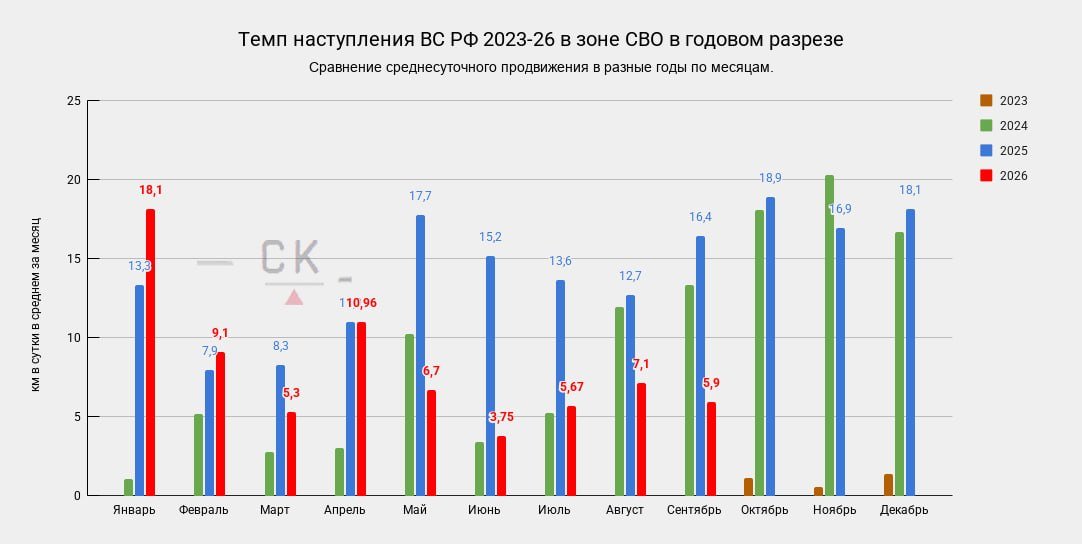
As every month, various analysts have again published their calculations of how the front line moved. Not even estimates from Putin’s own Z channels agree with his figure.
“The average daily rate of advance by the Armed Forces of the Russian Federation in the SVO zone [special military operation] in September 2026 was +5.9 km². The average rate of advance over the entire offensive up to October 2026 is +9.92 km² per day,” Russian project Slivochny Kapriz wrote about September.
It, too, is an unreliable source that regularly overestimates the significance of “flag operations”, but even its data makes it clear that 2026 is lagging significantly behind the previous year.
Even if this author’s figures were correct, the Russians advanced by 177 square km during September’s 30 days, more than seven times less than Putin claims.
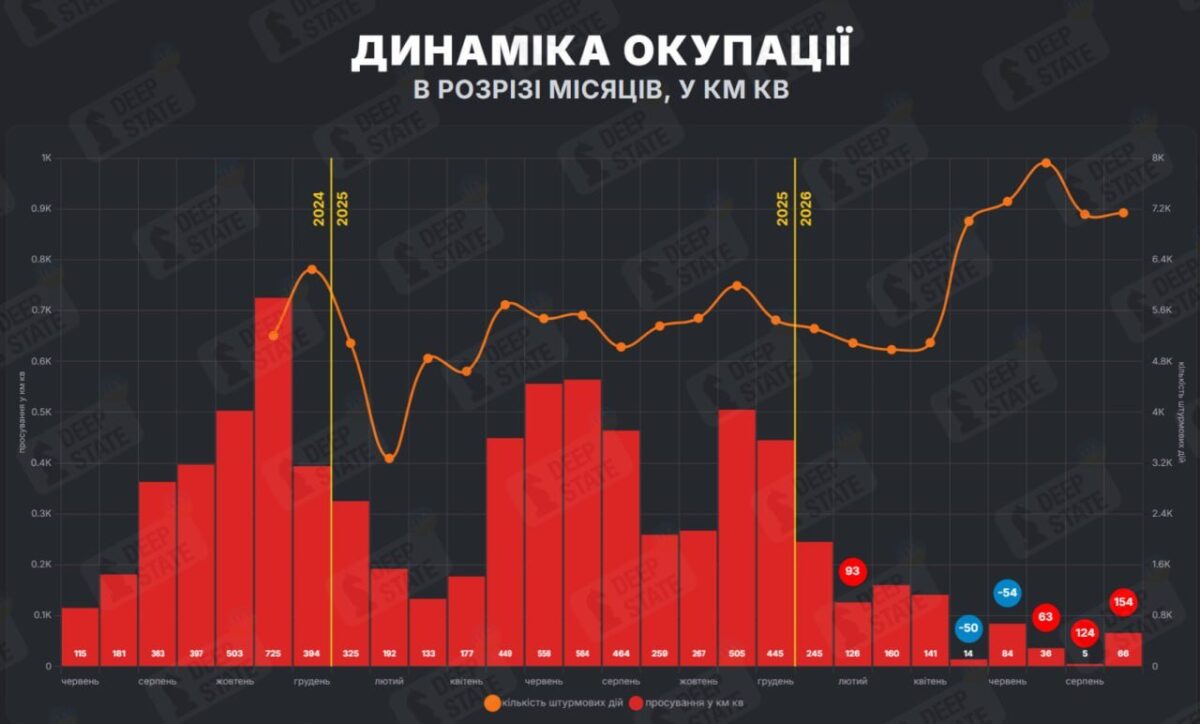
Ukrainians from DeepStateUA also published an estimate very close to Slivochny Kapriz’s figures. According to this OSINT project, Ukraine lost 154 square km in September.
However, the Ukrainian analysts treat their own data cautiously and warn their readers that “the operational security of our forces remains the highest priority in our work”.
In other words, during Ukrainian counter-offensives, DeepStateUA only reports successes after a delay so as not to jeopardise the operations’ success.
They therefore now recall that their statistics do not yet include 270 to 320 square km of liberated Ukrainian territory in various sectors. “July will therefore also end as a month in which the Armed Forces of Ukraine have the upper hand, while for August and September this will only become clear when official announcements of successes are available. In the meantime, part of the liberated territories may be lost again,” DeepStateUA wrote on Friday (2 October).
The most optimistic by far are currently Finnish analysts from the Black Bird Group, who see a balance of 190 square kms in Ukraine’s favour in September.
Over the month of September, the Russian net gains were negative 190 km2. This marks the greatest monthly net territorial loss for Russia in our dataset since the June of 2023.
Emil Kastehelmi, one of the project’s authors, pointed out that the sharp change for the better stems from the fact that it also captures some changes that DeepStateUA has not yet taken into account. Nevertheless, he said: “Russia has failed to reverse a situation that has persisted for almost the entire year. The results of the major Russian offensive are minimal, and this is likely to remain the case for the rest of 2026.”
Among Western analysts, the most sceptical is Konrad Muzyka of Rochan Consulting, who credits the Russians with even more gains than Slivochny Kapriz — as much as 235 square kms of advance. Yet this figure still does not come close to Putin’s. Even if it were the most accurate of all, which cannot be determined, it would amount to an area roughly equivalent to the size of Košice, including all its suburbs, forests and agricultural land within the city’s administrative boundaries.
The plan for this year, meanwhile, was to capture the rest of Donetsk region, including the remaining large cities of Kostiantynivka, Druzhkivka, Kramatorsk and Sloviansk. The Russians are closest to doing so in Kostiantynivka, but Ukrainian soldiers remain there too.
Here is a short summary of territorial changes in Ukraine for September 2026. Our dataset shows an overall Russian territorial gain in September, but a sharply uneven pattern: gains around Dobropillia, Velykyi Burluk, Kramatorsk and Komyshuvakha coincided with substantial losses… pic.twitter.com/jrq0zXiqri
— Konrad Muzyka – Rochan Consulting (@konrad_muzyka) October 1, 2026
Russia wants to cause Kyiv’s economic collapse, and pontoon bridges are being prepared in the city. There is now no doubt that the Russian army has begun a systematic effort to disrupt transport between western and eastern Kyiv. Over the weekend, further drones struck several bridges across the Dnipro.
They included the Northern Bridge, which a Russian drone attacked during the day amid heavy traffic.
🚨 BREAKING: Russian forces launched a drone strike hitting the Northern Bridge in Kyiv, damaging the road surface.
The strike coincides with German Chancellor Friedrich Merz’s unannounced visit to the capital to meet with Ukrainian leadership. pic.twitter.com/j1UHYoBMa7
Ukraine’s transport minister Mykola Kalashnyk said 600,000 cars cross Kyiv’s bridges every day. In an interview with Suspilne, he announced that construction of embankments and pontoon bridges would begin this week. If the existing bridges become impassable, they are intended to maintain as much traffic as possible between the river’s two banks. Kalashnyk said the temporary crossings should have at least half the capacity.
However, this will take around three months; in the meantime, work will also be carried out to improve the resilience of road bridges.
Transport expert Dmytro Bespalov is sceptical. As he said in an interview with NV, Kyiv’s bridges are irreplaceable, and the only thing that can keep traffic moving across the Dnipro is the military.
However, the task of keeping the bridges operational is complicated by their poor technical condition. Because of their age and the lack of maintenance funding, Bespalov rates the Southern and Northern bridges at four on a scale of one to five, where one is ideal condition and five is emergency condition. He says two other bridges are at level five.
Even in this condition, such large structures are not easy to destroy, but they are certainly more vulnerable. Like many others, Bespalov believes that Russia lacks the means to destroy the bridges completely and is seeking to disrupt traffic during the winter. “The aim is probably an economic blow. I fear it will be very painful. It will not kill us, but I am very concerned about the economic consequences it will have,” he added.
Air defences neutralised 83 percent of drones launched in September, compared with 92 percent in May. This follows from data by the Shahed Tracker project, which recorded 6,732 Russian drones launched against Ukraine over the month, of which 5,561 were shot down or disabled through electronic jamming.
Shahed type OWA-UAS stats Sep2026 [per UA Air Force Reports]
As the same source’s chart for August shows, the effectiveness rate did not change, but the number of drones launched by Russia rose sharply month on month by almost 1,600.
Shahed type OWA-UAS stats Aug2026 [per UA Air Force Reports]
In May, when Russia used a record 8,150 drones, it was as high as 92 percent. At that time, the Russian army began a mass transition to jet-powered drones, leading to a temporary slowing of the pace of attacks. The trend is now unfavourable: monthly attack statistics have begun to rise sharply, while the effectiveness of countermeasures is declining, as Geran-4 drones and especially Geran-5 drones still present a serious problem.
Shahed type OWA-UAS stats May2026 [per UA Air Force Reports]
Total: 8150 (New Record) Claimed Intercepted: 7476 (Official: 5053 Shahed type OWA-UAS) Hits: 508 (674 Not Intercepted) Interception Rate: ~92%
As another video showing the moment a Geran-5 was hit demonstrates. Technical solutions already exist, but faster interceptor drones are not yet available in sufficient numbers.
Another Geran-5 drone shot down by a STING S interceptor drone from Wild Hornets. Combat work by pilots of the 1020th ZRP. pic.twitter.com/kkPHaCIrKG
One TM-62 anti-tank mine contains seven and a half kilograms of explosives. This is enough to destroy the remains of a building used as a shelter by Russian soldiers.
❗️A Ukrainian heavy Baba Yaga-type drone destroys a building with Russian soldiers inside by dropping a TM-62 anti-tank mine. pic.twitter.com/XClgIqMvwe
A video recently circulated online showing Kyiv residents protesting against tree felling. It was widely used as alleged evidence that Ukrainians have had enough of the government. However, their protest was civic, not political. These Muscovites are communists and dared, very timidly, to chant “Down with the tsar!” Police intervened immediately.
У Москві комуністи зібралися на погоджений мітинг, почали скандувати «Долой царя», і після цього їх побили й розігнали мусора. pic.twitter.com/MD6MVxSBPS
This video must be watched with the sound on. It illustrates the saturation of the battlefield with drones. The Russian soldier who recorded it says he counted five drones.
"I’ve already counted five. It’s a damn swarm." position of 🇷🇺1199th Motorized Rifle Regiment (probably occupied south 🇺🇦) 🍂 is coming pic.twitter.com/K9H3wcRdse
Three lines of anti-drone barriers protect the Kerch Bridge, which links Crimea to Russia, from attacks from the sea.
Exilenova+ says Russia has set up layered defenses around the approaches to the Crimean Bridge, with multiple lines against Ukrainian surface and underwater USVs plus FSB patrol ships. The stated aim is to shield the bridge’s vulnerable elements. pic.twitter.com/rxMPPe6gXW
By Monday (5 October), Russia had verifiably lost 24,170 pieces of heavy equipment (24,138 on Tuesday, 22 September). Of these, 19,133 (19,105) were destroyed by Ukraine, 1,003 (1,000) damaged, 1,194 (1,194) abandoned by their crews and 2,840 (2,839) captured by the Ukrainian army. This includes 4,452 (4,448) tanks, of which 3,357 (3,353) were destroyed in combat.
Ukraine lost 12,238 (12,175) pieces of equipment, of which 9,633 (9,579) were destroyed, 711 (702) damaged, 695 (695) abandoned and 1,199 (1,199) captured. This includes 1,466 (1,464) tanks, of which 1,126 (1,125) were destroyed in combat.
Note: Neither side regularly reports on its own dead or destroyed equipment. Ukraine publishes daily figures for Russian casualties and destroyed equipment, which cannot be independently verified. This overview uses data from the Oryx project, which has compiled a list of equipment losses documented exclusively by photographs since the beginning of the war.
Some expected a change in Hungary’s pro-Russian foreign policy after Viktor Orbán’s fall. But they failed to take into account the domestic political pressures on Hungary’s prime minister Péter Magyar.
An unexpected source of tension in Ukrainian-Hungarian relations came at a meeting of the newly formed ‘Carpathian Eight’ (C8) in late September. At the meeting in Kyiv, PM Magyar was embroiled in a sharp exchange with Ukrainian foreign minister Andrii Sybiha, who criticised Budapest for not taking part.
Magyar responded to Sybiha by claiming that Hungary had been included in the C8 without his consent.
“To claim that a sovereign country is a member of an international cooperation (Carpathian Integration) without prior consultation or consent of the country concerned is completely unacceptable,” Magyar said on social media.
This comes after Hungary-Ukraine relations began to improve rapidly following the formation of the Tisza government in May.
Under Orbán’s government, relations had fallen to a historic low, raising the prospect of escalation. In June, Magyar announced that he had reached an agreement with Ukrainian president Volodymyr Zelensky on settling the rights of the Hungarian minority in Transcarpathia, hailing it as a historic deal.
Ukraine’s Deputy PM Vsevolod Chentsov informed me that legislation on minority education rights will be submitted to Parliament. I welcome this step after weeks of 🇭🇺🇺🇦 expert consultations. Thank you to all Hungarian and Ukrainian colleagues for their constructive work. Looking…
Since June, however, Hungary has repeatedly blocked Ukraine’s EU accession negotiations, arguing that progress on settling the rights of Hungarians in Transcarpathia has fallen short of expectations.
Orbán’s Fidesz party previously used the same argument to block Ukraine’s integration efforts.
Three months after the so-called historic agreement, Ukraine’s foreign minister Sybiha wrote that although Orbán had lost the election, Orbánism (a policy based on isolation and obstruction) prevailed in Hungary.
“Orbanism has done no good, neither to Hungary nor to the broader region, in the past — and it will not do anyone any good moving forward,” said Sybiha on social media.
Domestic Hungarian politics can explain the dispute.
MOL, an oil company, signed a memorandum with Ukraine’s Naftogaz at the C8 meeting on the possible establishment of Ukrainian oil storage facilities in Hungary.
The deal was criticised by Fidesz politicians, and Magyar’s government strongly distanced itself from the deal, too. Fidesz may have contributed to Magyar entering the dispute over C8 participation so very forcefully.
What is the Carpathian Eight?
In August, Zelensky announced the creation of the C8 to bring together countries from the wider Carpathian border region. The Ukrainian president said its members would focus primarily on the economy, security, the environment and investment.
Ukraine described it as a project intended to strengthen cross-border cooperation even with countries that do not provide it with military aid. Alongside Ukraine were to be Romania, Serbia, Poland, Slovakia, Czechia, Austria and Hungary.
Michal Lebduška, an analyst at the Association for International Affairs in Prague (AMO), said that it was one of many regional initiatives. While he did not believe it would trigger “major cooperation”, it could nevertheless be important.
The inaugural summit of the newly formed C8 was held last month (18 September) in Bukovel, in the Ivano-Frankivsk region, around 160 km from both the Slovak and Hungarian borders. Zelensky called it “an important beginning” and thanked the countries of the Carpathian region for being among Kyiv’s most reliable allies.
From Ukraine’s perspective, however, the meeting had mixed results. On the one hand, several leaders travelled to Bukovel in person, lending the gathering greater diplomatic weight. Polish PM Donald Tusk, Romanian president Nicușor Dan and Serbian president Aleksandar Vučić all attended in person.
On the other hand, the remaining countries sent lower-ranking representatives. Slovakia’s PM Robert Fico had initially indicated that he would attend, and was originally due to meet Tusk. At the last minute, however, he announced that he could not attend the summit due to sudden illness.
Slovakia was ultimately represented by Marek Eštok, state secretary at the foreign ministry.
Andrej Babiš’s Czech government all but completely ignored the initiative. As Respekt magazine wrote, Babiš declined the opportunity to visit Ukraine and did not send any representative to Bukovel.
So Czechia was represented at the summit only by opposition deputy Senate president Jiří Drahoš.
And Austria was ultimately represented by Christine Schwarz-Fuchs, president of the Federal Council.
Hungary sent Ádám Ceglédi, the acting chargé d’affaires at the Hungarian embassy in Kyiv, as the Hungarian foreign ministry confirmed to Telex.
According to the analyst, Ukraine may have hoped that Orbán’s fall would bring a clear shift in Hungary’s Ukraine policy. Anita Orbán, as foreign minister, has confirmed this by pursuing a foreign policy moving away from Russia.
However, Ukrainians did not take Magyar’s domestic political interests into account.
Magyar panders to anti-Ukraine crowd
This article continues, but the full version is available only to EUobserver.com subscribers. Visit account.euobserver.com/membership
In a sign of humble progress, the FP-7 ballistic missile saw its first deployment.
Russian forces are now attacking Kyiv’s bridges.
No resolution to jet-powered Geran drones with new threat is on the horizon.
Ukraine lost another MiG-29 and its pilot, while Russia has lost a Mi-8 helicopter with a crew of three.
Videos of the day: attacks on a bridge in Kyiv; a drone struck a school full of children and teachers; a ground drone recorded the impact of two glide bombs.
FP-7 ballistic missile made in Ukraine were deployed for the first time. This is progress, but one should not expect miracles.
“Ukrainian tactical ballistic missile. FP-7. First combat deployment. Thank you for the results. Next step: serial production. Glory to Ukraine!” With these words and a short video, Ukrainian president Volodymyr Zelensky announced a long-awaited milestone in Ukraine’s arms programme. The next step is expected to be the deployment of the larger and more dangerous FP-9 missile.
Ukrainian tactical ballistic missile. FP-7. First combat use. Thank you for the result. Next up: production. Glory to Ukraine! pic.twitter.com/IxdjVg51c1
— Volodymyr Zelenskyy / Володимир Зеленський (@ZelenskyyUa) October 1, 2026
For now, however, this was only its first deployment against an unknown target, with an unknown outcome. The Russian analytical channel Military Informant did not rule out the possibility of the footage being recorded at a training ground with the intention to deflect criticism of Fire Point, the Kyiv-based manufacturer whose production is behind schedule.
The FP-7 missile is an interesting technical achievement that could expand the Ukrainian army’s ability to strike important targets. Expectations should be kept low. This is because the missile has not yet entered serial production its specifications lag behind those of Russia’s short-range Iskander missiles.
The FP-7 is based on the Soviet-origin 48N6 surface-to-air missile, used in some versions of the S-300 system and still deployed by Russia in the more modern S-400. A Ukrainian outlet says that the FP-7 has an estimated range of only 200 km and a warhead weighing up to 150 kg.
Russia’s Iskander missiles weighs more than twice as much, and Russia has already used a version with an extended range well beyond 500 km. The Ukrainian FP-7’s use will therefore be limited to areas up to roughly 100 km from the front line. It is certainly not a means for strategic strikes against Russian industry deep inside enemy lines.
Ukraine could strike further with a FP-9 missile, and developing them remains a goal to work towards. The two types of missile differ significantly. They were analysed in August by the Russian Telegram channel Russian Engineer. The FP-7 is smaller and the FP-9 larger. Its maximum range is estimated at 855 km (far enough to reach Moscow,) its warhead is expected to weigh up to 800 kg.
The outlet focusing on the war’s technical parameters compared the Iskander with the FP-9:
“The 9M723 Iskander-M missile has a diameter of 920 mm, while the FP-9’s is 1,100 mm. The missiles are 7.2 and 9.5 metres long. The solid-fuel rocket motor is approximately 4.2 metres long in the 9M723 and 6.5 metres in the FP-9. Fuel mass is estimated at 2.6 and five tonnes. With a warhead weighing around 500 kg, calculations indicate ranges of up to 500 km and 1,000+ km. If the warhead weighs around 800 kg, the range will be approximately 800 km.”
The media’s performance estimate therefore matches official Ukrainian data.
According to the Russian Engineer Telegram channel, the FP-9 is conceptually based on the Iskander and builds on the Ukrainian Sapsan project, which was never brought to the final stage.
The Ukrainians displayed both missiles at a trade fair in Denmark in August, where the following photographs were also taken:
The Russians have started attacking Kyiv’s bridges. This fulfils the wishes of Russian pro-war hawks, who for years have complained that bridges in the capital of the invaded country were still standing.
This article continues, but the full version is available only to EUobserver.com subscribers. Visit account.euobserver.com/membership
Jordan Bardella, a leader of the French far-right National Rally, has denied writing antisemitic messages in 2013, as the race ahead of next May’s presidential elections continues to heat up.
An investigation by the left-leaning outlet Mediapart said on Thursday (1 October) that it could authenticate antisemitic messages from 2013 and attribute them to Bardella.
In the messages, Bardella, an MEP and chair of the far-right Patriots for Europe group, said “all the banks are owned by Jews” and that Israel aims to create a new world order. Earlier media reports also found his secret Twitter account publishing racist content, such as mocking a young Black man who had suffered police violence.
He denied having written the messages, calling the evidence “crude montages” and “obscure screenshots that can easily be manipulated,” he wrote on social media, adding he would sue Mediapart for defamation.
“Either Mediapart is running this operation itself, or it is being manipulated by interested parties,” he has said.
This article continues, but the full version is available only to EUobserver.com subscribers. Visit account.euobserver.com/membership
More than a year ago, we launched our Hungary Briefing, a weekly round-up of the election campaign. Since the historic vote in April to remove Viktor Orbán, the series has followed the new Tisza government and its first moves in office. This week’s topics:
Two ministers from Orbán’s government have been held in custody.
Former prime minister Orbán may have ordered the detention of Ukrainian cash couriers.
The newly established National Asset Recovery and Protection Office has begun work.
The European Public Prosecutor’s Office could also help recover stolen funds.
It has been an eventful few days in Hungarian public life. Efforts to hold former officials accountable are gathering pace: two former ministers have been remanded in custody over suspected breaches of fiduciary duty involving billions of forints and the acceptance of bribes.
The National Asset Recovery and Protection Office (NVVH) immediately took over four cases and began investigating them, including the visa business linked to Orbán’s brother. Meanwhile, a chief prosecutor who resigned from his post claimed in an open letter that Orbán himself had ordered the detention of Ukrainian cash couriers.
Prime minister Péter Magyar addresses parliament as MPs vote to lift his immunity, Budapest, 28 September 2026 (Srouce: Zsolt Szigetváry/EPA)
Two ministers from Orbán’s government have been held in custody
“The landing is beginning as part of ‘Operation Purgatory’,” prime minister Péter Magyar announced on Monday (28 September) morning. Later that morning, Hungary’s parliament lifted the immunity of Miklós Seszták, an MP and former development minister from the Christian Democratic People’s Party (KDNP); Balázs Hankó, an MP and former culture and innovation minister from Fidesz; and prime minister Magyar.
Prosecutors requested that Hankó’s immunity be lifted on suspicion of breach of fiduciary duty: he is suspected of causing losses of 17 billion forints (€46.5m) to the state budget. Authorities are investigating Seszták on suspicion of accepting bribes and other offences. The former minister and the then chief executive of Hungarian National Asset Management are suspected of receiving approximately 12.6 billion forints (€34.2m), in bribes through an intermediary between 2015 and 2018.
Magyar himself requested the lifting of his own immunity after the deputy prosecutor general asked the speaker of parliament to initiate the procedure over an incident in June 2024. According to the Office of the Prosecutor General, Magyar deliberately dropped the phone of a man filming him into the Danube, an act it classifies legally as theft.
After the vote on his immunity, Seszták went to the Central Investigating Chief Prosecutor’s Office, where he was taken into custody. He said he had committed no crime and wished to give a statement. On Wednesday, a court ordered the former minister’s remand in custody.
Hankó initially waited in the Fidesz parliamentary group’s office for police to take him away. Under the rules, however, he should have presented himself at the Central Investigating Chief Prosecutor’s Office.
Under the Act on the National Assembly, police may enter the parliament building and take action there only with the speaker’s specific permission, while the Parliamentary Guard may neither forcibly bring him before the authorities nor take coercive measures against him. Parliament speaker Ágnes Forsthoffer therefore firmly called on Hankó to leave the building and cooperate with the investigating authorities.
Hankó subsequently held a press conference with his wife and children present, claiming that he was the target of a politically-fabricated case and declaring his innocence. He finally accepted the summons at 7.20 pm and left parliament, setting off to give a statement amid carefully-staged scenes. Orbán’s social media page live-streamed the entire episode (while the Fidesz leader was in Belfast cheering on Hungary’s national football team).
In a statement, prosecutors said that Hankó and his associates had used National Cultural Fund resources for purposes other than those prescribed by law on 1,079 occasions between 3 September 2025 and 30 March 2026.
This article continues, but the full version is available only to EUobserver.com subscribers. Visit account.euobserver.com/membership
“Marine Le Pen has reinvented herself. Her style now is more moderate,” reckons Jacques Rupnik, a French political scientist, ahead of the country’s widely anticipated battle for the presidency.
Many voters in France will vote for the candidate they see as having the best chance of defeating the far-right leader, Rupnik explains.
“All polls show that if the far-left Jean-Luc Mélenchon faced Marine Le Pen in the second round of France’s presidential election, Marine Le Pen would win,” he says, explaining that many French votes are unwilling to back Mélenchon.
In his interview with Denník N, Rupnik claims Mélenchon is the first French presidential candidate to seek support from immigrants so explicitly.
Find out:
How Marine Le Pen and Jean-Luc Mélenchon have used the migration debate for their campaigns.
Why the presidential frontrunners do not understand economic issues.
Rupnik’s assessment of Emmanuel Macron’s two presidential terms.
Who does Marine Le Pen look up to?
Polls suggest that if France held a presidential election now, far-right Marine Le Pen and far-left Mélenchon would make the second round. What does this tell us about France?
France is divided and polarised. Young people in particular tend to lean towards more radical parties. Establishment parties are old and worn; they have lost their appeal. They have little to say, except for claiming that others are dangerous or worse. But you must bring something new to an election. But after ten years of Macron, that is very difficult.
And it is not entirely true that all polls predict Mélenchon will reach the second round; they often place former prime minister Edouard Philippe ahead of him. Mélenchon is powering ahead in polls because he has launched his campaign and is very good at it. But, nothing is decided.
In French presidential elections there are two rounds. In the first round, you vote for your preferred candidate; in the second, you vote for the lesser evil. So, for most voters, the question will not only be whom they prefer, but also who has the best chance of defeating Le Pen in the second round.
And that is very important. All polls say that if Mélenchon faced Le Pen in the second round, he would lose. Many people are not willing to vote for Mélenchon. A centrist candidate has the best chance of defeating Le Pen, so for now it looks like former prime minister Philippe.
But only if another former prime minister, Gabriel Attal, withdraws his candidacy.
Yes. We have two strong parties at the extremes, and the space in the centre has shrunk. The narrower it becomes, the more candidates appear within it. Every week, another politician tells media: “You know what, I would give it a go.”
Attal, of course, wants to win over Macron supporters — that is, voters on the centre left. The fact he is in the race matters even if he withdraws and endorses another candidate. That may prove a good strategy.
If Le Pen and Mélenchon reach the second round, many would vote Le Pen. Why?
Marine Le Pen has reinvented herself. Not in the sense that she has been thinking about what new ideas to bring forward, but now her style now is more moderate. It is no longer the brash style associated with her father.
Perhaps she took her cue from Italian prime minister Giorgia Meloni, seeing a candidate whom everyone feared, but no radical changes followed her election because she adapted quickly to European realities.
Le Pen points out that in several European countries, including Finland and Sweden, the far right has been in government and nothing has happened.
At the same time, Marine Le Pen managed to break through a certain barrier, and some moderate rightwing voters have shifted to her side.
How did that happen?
Previously, the moderate right was stronger and Le Pen’s camp was weaker. The type of rightwing voters who voted for Jacques Chirac have now shifted their weigh behind more radical options. The balance has shifted, and right-wing voters are saying: “Why should we, the right, be excluded from politics simply because Macron has failed and the Le Pen has grown stronger?”
Immigration is another reason behind growing support for Le Pen. Mélenchon is also capitalising on the immigration debate, but in the opposite way to her.
Please explain that.
Mélenchon opposes Le Pen’s position by arguing that immigrants integrate. The Le Pen camp says: “No, they have come from a different culture and their attitude is anti-French.” Le Pen’s camp says that integration works poorly, that immigrants do not even want to integrate instead preferring to live in their own communities.
“Mélenchon has therefore adopted the theory of grand remplacement, but instead of presenting it as a threat, he has turned it into a huge opportunity.”
And Mélenchon argues that it is fine for immigrants to remain in their own communities, practise their own religions, for women to wear headscarves and so on.
The great replacement conspiracy theory (“grand remplacement“) should be mentioned since the far right embraced it long ago. It is the idea that the native French population will gradually be replaced by new immigrants.
And Mélenchon now says: “What great replacement? On the contrary, it is an opportunity for France. He says: “The more of us there are, the better.”
Mélenchon has therefore adopted the theory of grand remplacement, but instead of presenting it as a threat, he has turned it into a huge opportunity. Of course, everyone knows what he is aiming for. It is an election campaign, and he is appealing to voters who are themselves immigrants.
Previously, no one focused on immigrants in elections except Le Pen who used them as a bogeyman. And now Mélenchon says: “We are appealing to Muslims.” He says Muslim headscarves are fine and religious symbols are fine. He says anyone who opposes this is racist.
On the contrary, such statements mainly play into Mélenchon’s hands. Of course, calling a referendum on the issue in France is not so simple since such laws already exist. The law states clearly that you can do what you want at home, but if you work in the public sector you must refrain from displaying your religion. There are laws covering this, and there is absolutely no need to devise new ones. Le Pen’s ideas in this regard seem to be mere campaign slogans; we cannot take them literally.
Yet, a major Le Monde poll shows the French are more concerned about the economy than immigration. Immigration ranks fourth, after social issues and ecology.
That is true, but other polls show that, for many voters, the issues of migration and safety overlap considerably.
So, as concerns about security become increasingly prominent, people are more concerned about security and often link it to migration. Marine Le Pen will certainly try to make it one of the key issues, alongside the economy.
This article continues, but the full version is available only to EUobserver.com subscribers. Visit account.euobserver.com/membership
Maria, a Colombian woman, thought she was going to Poland to work at one of the country’s biggest meat-processing plants. Instead, the employment agency that arranged her job had quietly enrolled her in school.
She discovered this only after translating the papers she had been given. One said she was a student at an adult secondary school in Sieradz, another enrolled her at a Polish university. But Maria had never applied to either institution, attended a class or even heard of them.
Her case is part of a wider trade in fake student documents that exploited Poland’s labour and immigration systems. Employment agencies used fictitious student status to make foreign workers cheaper to employ, while private universities issued certificates that could help foreigners obtain visas or legalise their stay.
An investigation by the Polish publication Onet found the same schools and universities repeatedly appearing in documents issued to foreign workers from around the world. Some institutions existed largely on paper; in other cases, fraudsters forged documents in the names of legitimate schools without their knowledge.
The schemes went beyond fake student cards. Private universities also issued certificates used to obtain visas, enter the Schengen area or legalise residency.
They cost Poland’s social-security system millions of zloty and left some migrants facing job losses, residency problems and possible deportation – while people linked to the schools have established ties to Poland’s pro-Russian organisations and media.
Fake students cheaper for employers
Polish labour laws incentivise employment of students aged up to 26 under so-called agreements to perform a job. It means employers do not have to pay social security or health insurance contributions for them. The workers cost less than regular employees.
So, student status has become a sought-after commodity that employment agencies have exploited for gains.
A central figure in the case is Dariusz M., a school head in Sieradz detained by police in late May. When reporters from TVN24 posed as employers looking for a way to legalise the employment of foreign immigrants, M. offered to enrol them as students for 750 zloty (around €175) per person.
Prosecutors suspect him of participating in an organised group that allegedly issued around 2,500 false study certificates, costing the Polish state nearly six million zloty (more than €1.4m) in unpaid contributions.
Documents were often arranged by employment agencies with foreign workers unaware they had formally been enrolled at a school.
“In most cases, they do not even know they are involved in something illegal. They trust the employment agency,” said Rocio Flores, president of the Union of Latin American Workers in Poland.
When an inspection uncovers the fraud, the foreign workers face losing their jobs, residency problems and, in some cases, deportation. “We migrants suffer most as a result,” Flores said.
Inspections carried out by Poland’s social insurance authority confirmed there were many such cases.
In August, Dziennik Gazeta Prawna reported that Poland’s social insurance body (ZUS) stepped up inspections of companies employing foreigners with pupil or student status.
They reported that inspectors uncovered cases in which agencies pay schools for fake study certificates despite the worker having never attended classes, with Poland’s social welfare system losing out on millions of zloty.
Schools oblivious to study scam
Not all paperwork for fake students came from education institutions themselves. Some student cards and study certificates were forged in the name of real schools without their knowledge, as was the case of a Cosinus network branch in the town of Piaseczno.
Its head, Elżbieta Gotchold-Leśniewski, showed Onet reporters a file containing 62 forgeries found in various parts of Poland and had been issued to people from South America, Africa, Asia and Europe. “That is not my signature, and the school’s hologram is wrong too. In fact, many things are wrong,” she said.
The forgers incorrectly copied the four-leaf clover in the school’s logo, giving rise to the term “fake four-leaf clovers” in the Polish website’s headline. The documents were nevertheless convincing enough to be accepted by employers or used by holders during ticket inspections on public transport.
A student card and certificate package cost 200 to 800 zloty (€45 to €180). One man called the school directly because he had paid 600 (€140) zloty for a set of documents and wanted to know when classes would begin. The school’s staff told him he was, in fact, not registered there at all.
Dodgy paperwork for 20+ nationalities
Since 2022, Poland’s border guard has been investigating a group that, under the cover of three private universities, sold foreigners documents needed to obtain visas or legalise their stays.
This article continues, but the full version is available only to EUobserver.com subscribers. Visit account.euobserver.com/membership
The Ukrainian army stays in control of front lines, but safety in cities deteriorates.
Kyiv was on fire again as Russian attacks on cities intensify.
Rubikon published stats on destroyed Ukrainian drones, decoys being the second most prominent.
Russia’s defence ministry will not let go of the Armata: it wants to turn it into an air-defence system, drawing ridicule.
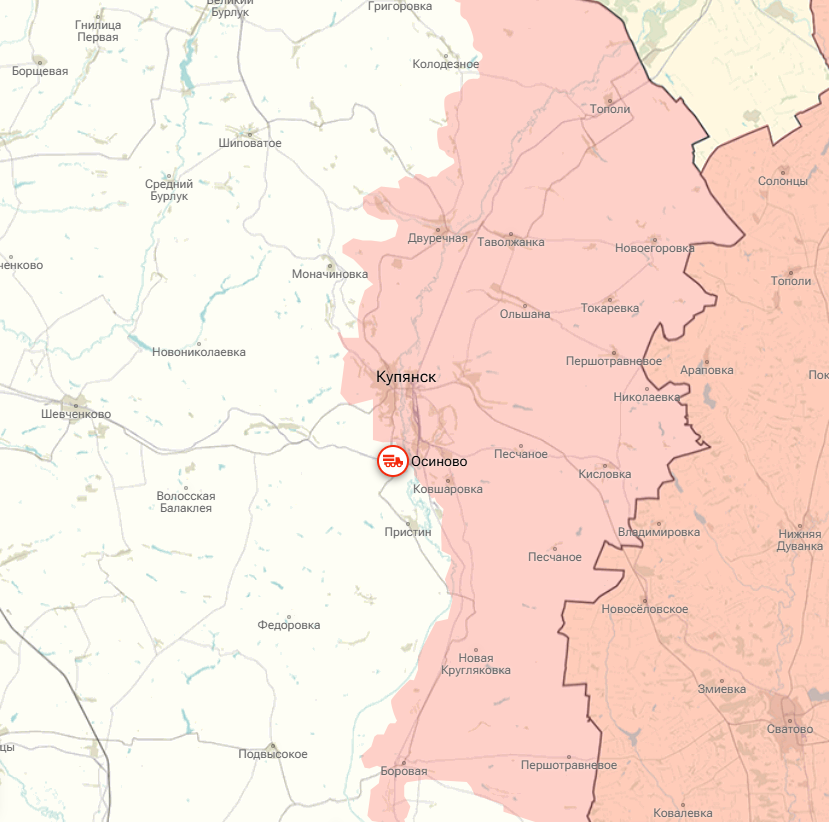
Maps of the day: Sloviansk-Kramatorsk direction; Orikhiv direction, Oleksandrivsk direction, Kupiansk direction.
Videos of the day: a burning Tu-95MS strategic bomber; a Ukrainian firefighter showed how they extinguished the Academy of Sciences building.
The Ukrainian army stays in control of front lines, but safety in cities deteriorates. The war has reached a stage in which two separate conflicts appear to be taking place simultaneously.
While Ukraine is currently losing the battle in the air and its cities are continually suffering missile and strikes by jet drones, the situation on battlefields is far better.
Last week, Denník N spent time in Ukraine with former chief of the general staff Daniel Zmeko. During the trip, reporters met commanding officers from several brigades and battalions operating from the Izium area to Zaporizhzhia, and all of them said they had the situation under control.
The officers spoke about the accuracy of Russian maps, which they said did not correspond to reality. In some places, Russian soldiers are as far as 20 km from the locations where, according to the Kremlin, they are supposed to be.
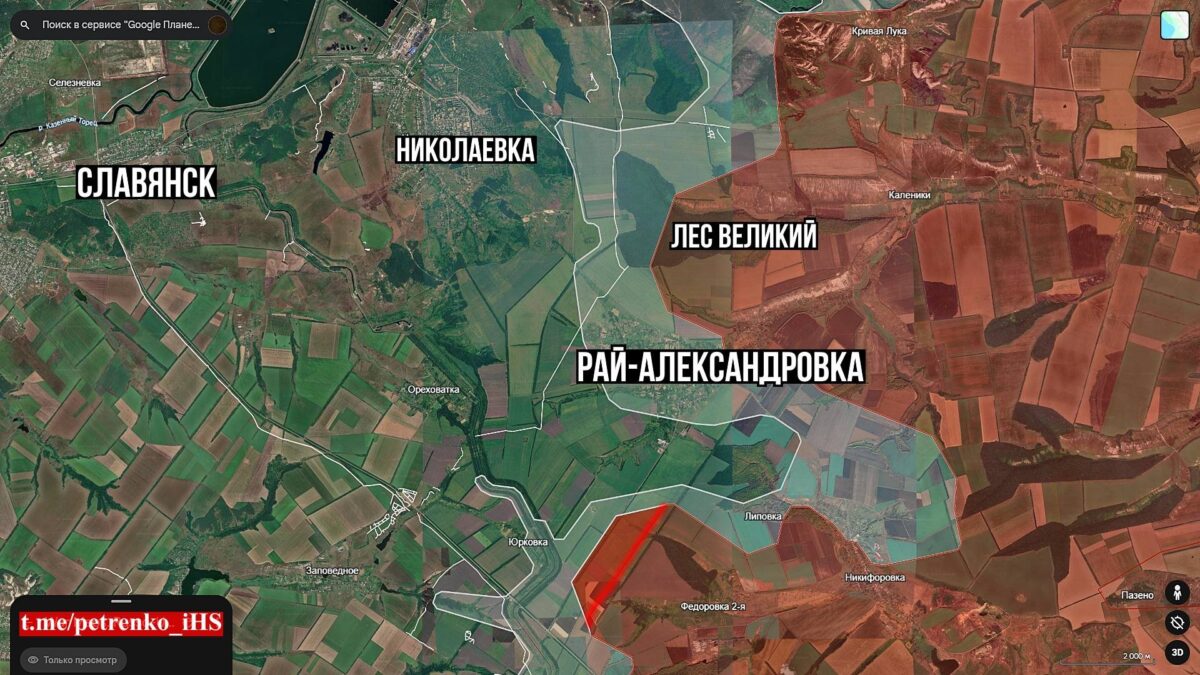
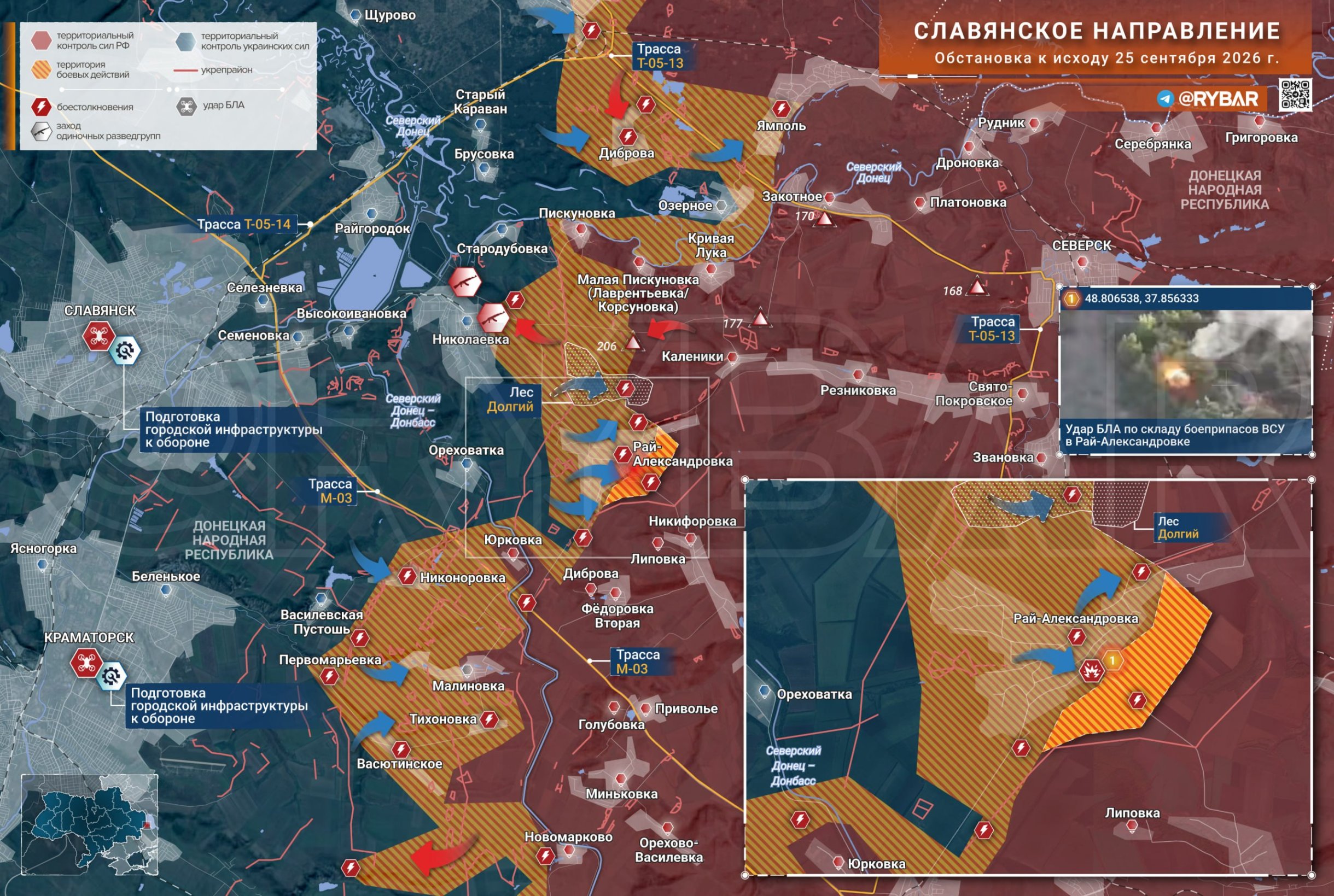
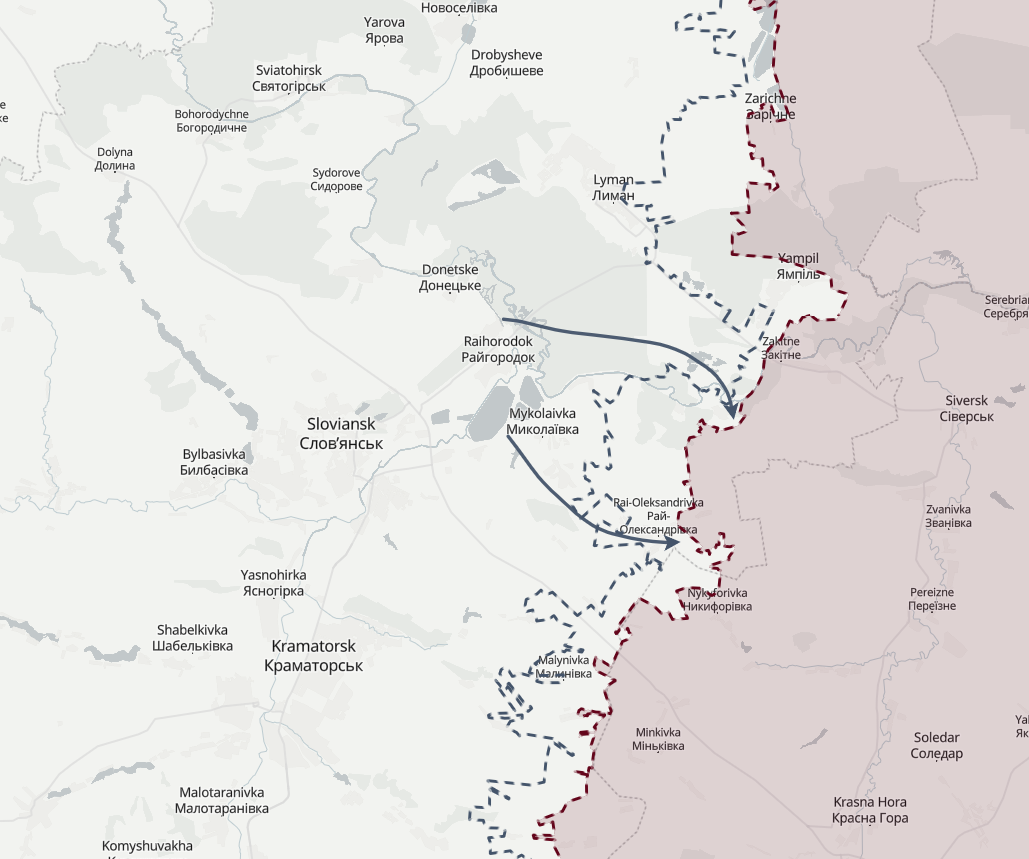
Northern flank of the Sloviansk-Kramatorsk agglomeration: This is a specific section of the front where the Ukrainian army has been reporting its advances only very slowly, while Ukrainian analysts have remained silent so as not to disclose anything sensitive. Russian bloggers, by contrast, are depicting the situation more closely to reality.
Yet official Russian maps persist with utterly nonsensical lines. We do not know to what extent this is an effort to deceive domestic and foreign audiences, and to what extent they genuinely believe it in Moscow. It is worth looking at how the regime wants the situation to appear, and what it is really like.
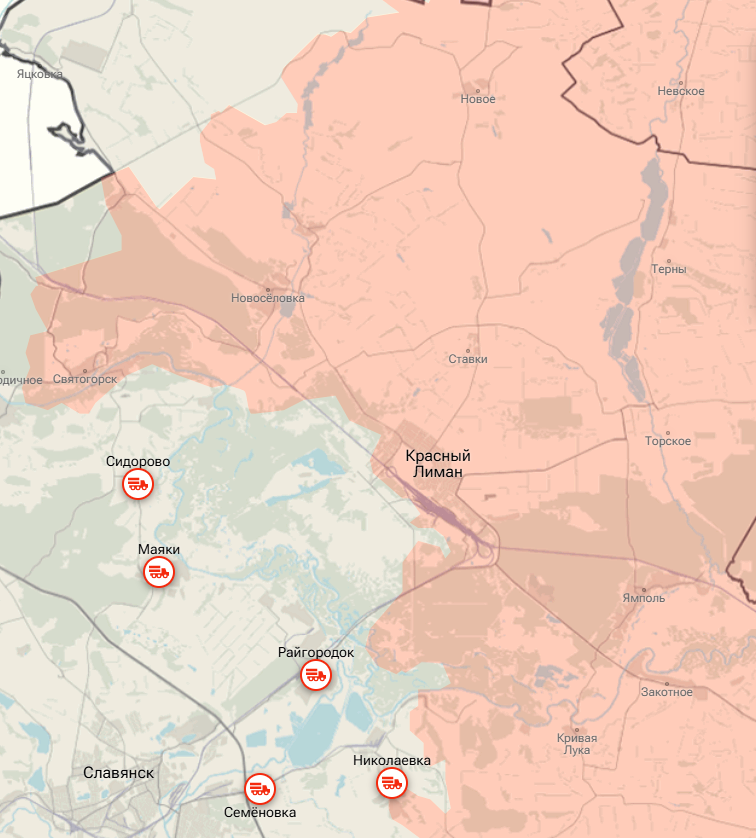
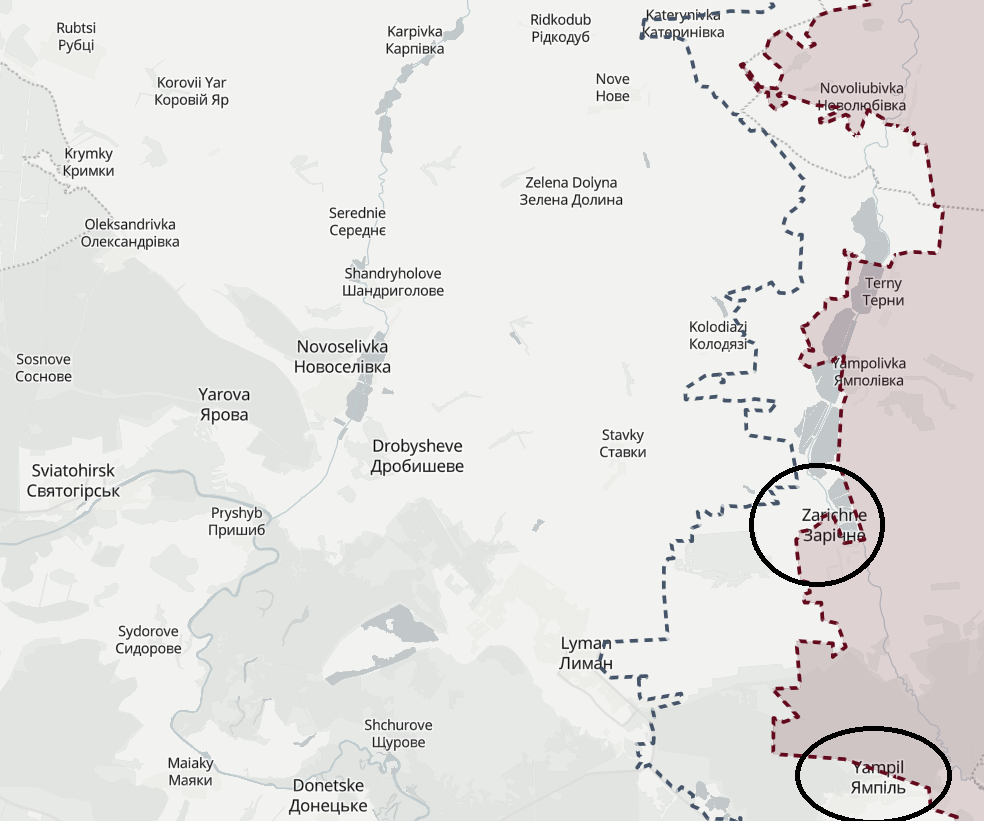
The first map in the overview was produced by the Russian state news agency RIA Novosti and depicts the area around Lyman, on the northern flank of the Sloviansk-Kramatorsk direction, as of 29 September. Lyman is shown as occupied in the middle of the map. The map’s author also continues to insist that the Russian army had captured Sviatohirsk — at the tip of the red salient in the centre of the map — and that Russia controls the entire, now non-existent salient with the village of Novoselivka at its centre. Yet Russian outlets Rybar and Two Majors write that fighting is taking place on the Zherebets river around the villages of Terny — on the far right of the map — and Yampil.
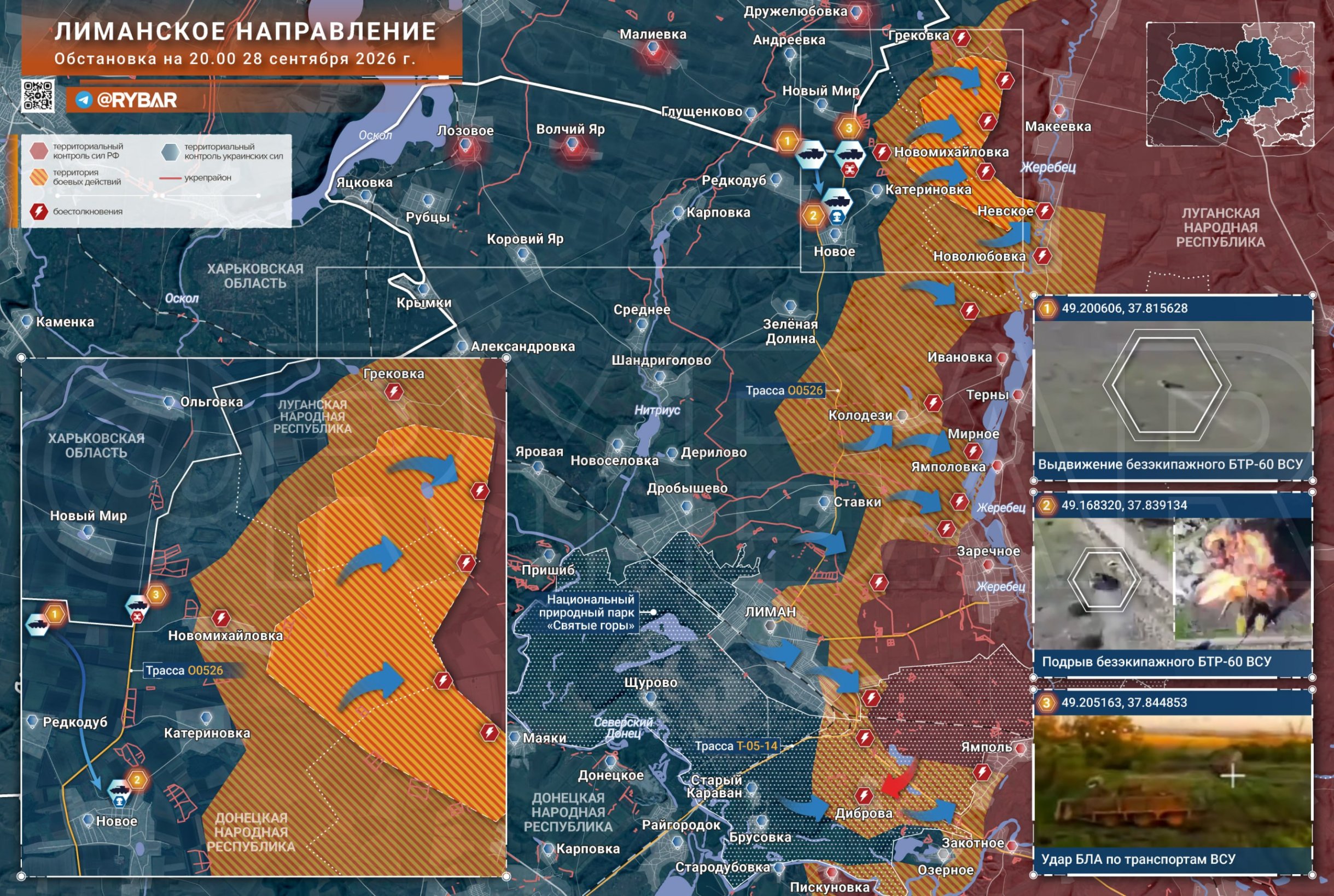
The following map is much closer to reality. According to it, the front line roughly follows the Zherebets river, which corresponds to Rybar’s claims.
In the Lyman direction, in Donetsk region, Ukrainian defenders successfully repelled three attempts by the russian fascist invaders to advance near the settlements of Ridkodub, Novoselivka and Drobysheve.
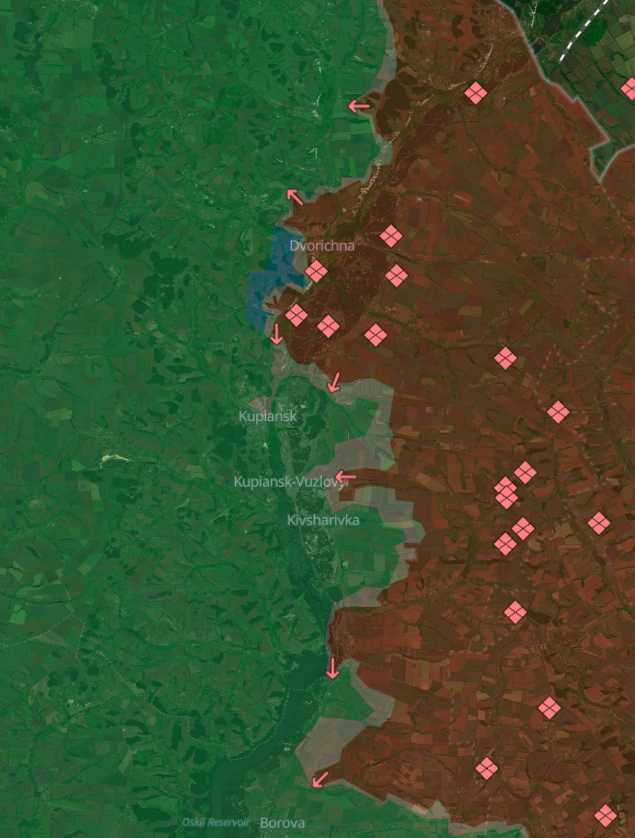
Kupiansk direction: The city of Kupiansk is a similar case to Sviatohirsk. Putin declared it captured in August last year. And once the commander-in-chief had declared this, his news agency continued to draw the map as though it were true. Kupiansk is shown as occupied in its centre, but there are further inaccuracies.
For example, the Kremlin agency claims that the Ukrainian bridgehead on the eastern bank of the Oskil river south of the city no longer exists. Ukrainians do face major difficulties supplying it, and various analysts have repeatedly warned of an impending disaster, but the Russian map is nevertheless hopelessly inaccurate.
Also note the small town of Borova at the bottom centre. RIA Novosti also shows it as occupied, although this is not the case.
This time, we will compare the Russian agency’s data with a map by Ukrainian analysts at DeepStateUA, because they updated it on Tuesday to reflect a new advance by Ukrainian units north of Kupiansk — again in the centre of the map — near the village of Dvorichne. In recent weeks, they have succeeded in reducing the Russian bridgehead on the western bank of the Oskil; the change since the end of August is marked in blue. Borova is again at the bottom centre, while below Kupiansk is the Ukrainian bridgehead that Russia claims does not exist.
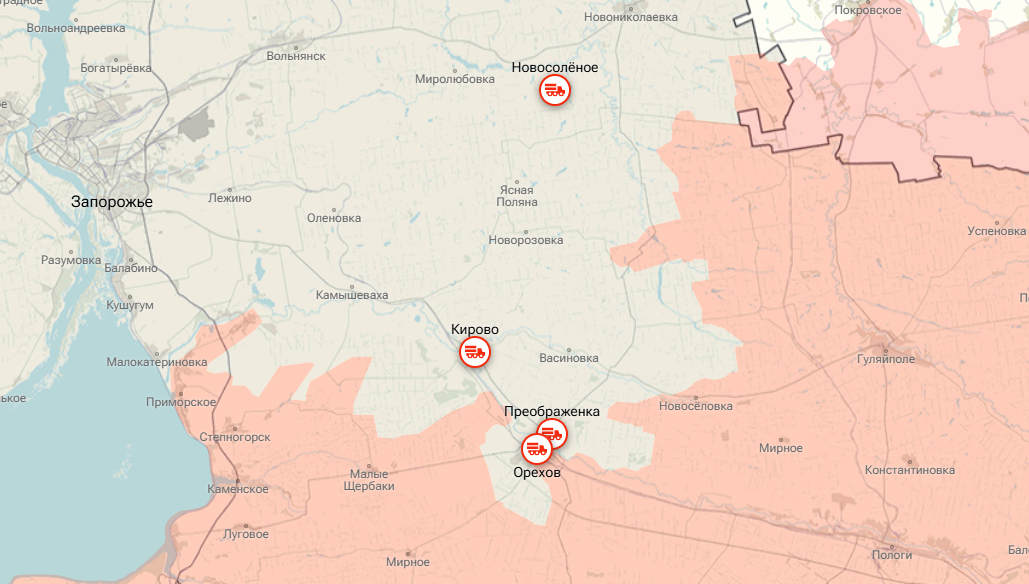
Orikhiv: This is one of the places where Ukrainian officers said during reporters’ trip to Ukraine that Russian maps were particularly inaccurate.
The Russian map is again from RIA Novosti and again ignores reality along the entire length of this section of the front. Its main target is the city of Zaporizhzhia, with a population of three quarters of a million, in the centre left, while the small town of Orikhiv, at the bottom centre, is a defensive hub.
Putin’s news agency places soldiers roughly 12 km from the southern edge of Zaporizhzhia; in reality, they are around 24 km away. It shows Orikhiv as occupied and the Russian army advancing from the east towards the village of Novorozivka, north of Orikhiv.
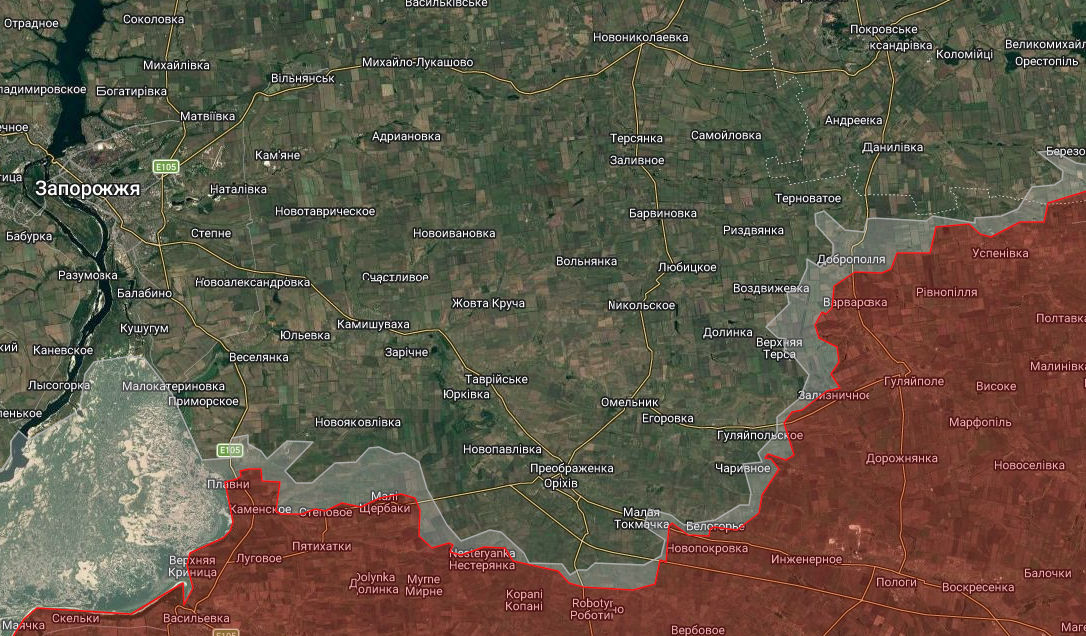
The OSINT project Playfra covers this area in the greatest detail. Its map appears to depict a different war altogether. Everywhere, Russian positions are significantly shifted compared with those shown by RIA Novosti.
The differences have a simple explanation. On the western flank near Zaporizhzhia, the Kremlin agency simply ignores the successful counterattacks carried out by Ukrainians there this year. On the eastern flank, it uncritically accepts every claim by the Russian defence ministry and, with equal lack of scrutiny, considers captured every small village where a Russian soldier raised a flag during a suicidal mission, even several months ago. Although those soldiers have since been killed or captured, RIA Novosti acts as though they still control the village.
Playfra also offers a more detailed view of the current fighting around Orikhiv, drawing on analyses by Ukrainian analyst Kostyantyn Mashovets.
Orikhiv direction.
Factually, no changes. Clearings are conducted constantly, but the Russians also continue to infiltrate: the global situation doesn't change. The stalemate situation that I had reported some weeks ago, as well as the gray zone, remains both actual as of the… https://t.co/6rau9f7wcKpic.twitter.com/5uIK3K78Bm
Of course, Russians too occasionally notice that they are living in a parallel reality. Most recently, the influential Aleksandr Kharchenko wrote about it:
“Comparing our maps with Ukrainian ones can be shocking. The zones of control differ by dozens of kilometres,” he acknowledged, adding that both sides lie, although he focused specifically on false Russian reports.
He described Russian soldiers who are the first to break into a village as heroes. But, according to him, wars are not won through heroism, but through a functioning system.
“Errors in our maps and information arise because they rely on heroes. Everywhere a Russian soldier is sitting is considered our territory,” Kharchenko argued that this had to change because “our territory is only where a Russian soldier is sitting with food, water and ammunition. This is territory from which we can fight the enemy”.
Kyiv was on fire again as relentless Russian attacks on cities intensify. In the capital, Russians particularly targeted energy infrastructure. “Not a single day has passed since the summer without the enemy attacking energy infrastructure. But this is the first such massive and complex attack since the end of the previous heating season,” Ukrainian PM Serhiy Koretskyi told NV.
In addition to causing serious damage, the attacks on Kyiv and other cities killed at least five residents and injured another 14.
President Volodymyr Zelensky also said that, thanks to the delivery of new surface-to-air missiles, five Russian ballistic missiles had been shot down.
Since last night, emergency services and repair crews have been working to address the aftermath of the Russian strike. It was a difficult attack – nearly 190 attack drones, as well as ballistic missiles. And the main target was energy infrastructure in the capital and the Kyiv… pic.twitter.com/wUNWEUdpTL
— Volodymyr Zelenskyy / Володимир Зеленський (@ZelenskyyUa) September 30, 2026
Rubikon published stats on destroyed Ukrainian drones, decoys being the second most prominent. Ukraine’s response is continuing in parallel with the Russian offensive against cities. But the stats currently weigh against Ukraine.
While the effectiveness of Ukrainian air defence has fallen dramatically since the arrival of Russian jet drones, Russia has successfully shot down Ukrainian ones. For example, the recent large-scale drone raid on Moscow involved several hundred drones — and, according to some sources, more than 1,000 — but only 10 penetrated the airspace above the Russian capital.
In this context, the Russian Rubikon unit published interesting statistics. Although it operates at and near the front, its data for September show that, of 827 Ukrainian drones hit, as many as 247 were Maya-type drones — unmanned decoys intended to deceive Russian air defences. They look very similar to FP-1 attack drones but, unlike them, carry no warhead.
For context, the top two most frequently intercepted Ukrainian UAVs by Russian forces are both decoy drones — the “Maya.” This suggests that Ukraine’s deception strategy is working, as the Ukrainian Defense Forces have increasingly begun deploying decoy UAVs to mislead Russian… https://t.co/NKPvbzm38U
Russia’s defence ministry will not let go of the Armata: it wants to turn it into an air-defence system, drawing ridicule. Zvezda News is a media outlet directly controlled by the Russian defence ministry. On Monday evening, it published technical news on the long-forgotten T-14 Armata tank, which Russian propaganda had claimed would revolutionise tank warfare.
Today, it is beyond any doubt that the project is dead and new information confirms this, but its authors presumably intended to convey precisely the opposite.
“Rostec has upgraded the Russian T-14 Armata tank into a short-range air-defence system,” the report stated, citing military expert Oleg Shaladin.
The list of new features appears impressive at first glance. The new version of the Armata has received new electronic equipment; its 125 mm main gun is to be replaced by a 152 mm gun, allowing the tank to fire Kornet anti-tank missiles with a range of 10 km. The new Armata will also be able to use Krasnopol guided artillery shells, which are used by more modern howitzers, while the tank is also to gain the ability to operate as the aforementioned short-range air-defence system.
Further changes have already been made to the project, but even the brief list above makes it clear that the Armata is no longer intended to be a tank, but rather some kind of hybrid capable of fighting everything and nothing at the same time.
Among others, the Russian Telegram channel Military Informant commented on the report, openly mocking it. It said Rostec had mixed together “all the old tales from 10 years ago” in its list of changes, but that in practice “the tank never got beyond parades and training grounds, because it was created for an entirely different war, which ultimately never happened. It became conceptually obsolete from the outset, without even having had the chance to fight”.
Videos of the day
Russia has lost another Tu-95MS strategic bomber. This is the 12th confirmed loss of this type — the Oryx website has not yet updated its figures, so it records only 11. According to available information, the aircraft crashed shortly after taking off from a base in Amur region. Six crew members were reportedly killed, while one survived with injuries. Armed with cruise missiles, the aircraft was probably heading for Olenya air base, from which Russia attacks Ukraine.
A Russian Tu-95MS Bear heavy bomber crashed on takeoff in Amur this evening during a training flight.
Denník N wrote on Tuesday about the attack on the headquarters of the Ukrainian Academy of Sciences. A video has since emerged from the helmet camera of one of the firefighters involved in the rescue operation.
Helmet-cam footage of Ukrainian firefighters tackling the blaze at the National Academy of Sciences of Ukraine in Kyiv on Monday after a Russian drone strike. pic.twitter.com/DqEcz3wPlK
By Tuesday (22 September), Russia had verifiably lost 24,138 pieces of heavy equipment, compared with 24,098 on Monday (14 September). Of these, 19,105 (19,065) were destroyed by Ukrainians, 1,000 (1,000) were damaged, 1,194 (1,194) were abandoned by their crews and 2,839 (2,839) were captured by the Ukrainian army. This includes 4,448 (4,447) tanks, of which 3,353 (3,352) were destroyed in combat.
Ukraine lost 12,175 (12,143) pieces of equipment, including 9,579 (9,551) destroyed, 702 (698) damaged, 695 (695) abandoned and 1,199 (1,199) captured. This includes 1,464 (1,462) tanks, of which 1,125 (1,120) were destroyed in combat.
Note: Neither side regularly reports its own deaths or equipment losses. Ukraine publishes daily figures for Russian casualties and destroyed equipment, which cannot be independently verified. In this overview, we use data from the Oryx project, which has compiled a list based exclusively on photographically documented equipment losses since the start of the war.
Kyiv is currently in a worse situation than Kharkiv when it comes to air-raid alerts.
The Russians struck the National Academy of Sciences, forcing scientists to flee through windows. Why did they target it?
What upgrades they are testing on their Geran-5 drones.
According to Rybar, Russia’s goal in attacking Kyiv is also to persuade Europe to stop helping Ukraine.
Maps of the day: The situation near Lyman and the gap between the Russian ministry and reality.
Videos of the day: an attack on the border crossing with Poland; footage from the cockpit of an Su-25; a robot avoids a drone; Russians flee among a crowd of civilians.
Kyiv has experienced its worst attacks since the start of the war in recent weeks. According to an analysis by French OSINT analyst Clément Molin, the capital was hit by 155 Russian missiles and drones in September, compared with 113 in August and 21 in March.
Denník N reporter Mirek Tóda, who visited Ukraine last week, said that Kyiv was currently worse off than Kharkiv in terms of air attacks, even though Kharkiv lies just 30 km from the front line.
Even smaller, FPV (first-person view) drones have recently begun flying on Kharkiv’s outskirts, hunting cars, but the number of air-raid alerts and air strikes there has still been far lower than in Kyiv in recent weeks.
Molin added that the Russians had struck the heart of the capital 10 times a day in recent days.
The Russian independent group Conflict Intelligence Team wrote that Kyiv and its surroundings would probably account for the highest number of civilians killed and injured anywhere in Ukraine in September — more than in the Donetsk, Kherson, or Kharkiv regions.
An at a time when attacks causing casualties occur every day, it is becoming harder for foreign journalists to engage readers with reports about an attack on the Ukrainian capital.
But on Monday, however, the Russians managed to do so.
During the working day, they struck the historic building of Ukraine’s National Academy of Sciences. It caught fire, and footage of scientists and other employees attempting to climb out through smoke-filled windows circulated around the world.
A Russian strike against the building of the National Academy of Sciences of Ukraine. A rescue operation is underway: crews are putting out the fire and searching for people who may have been trapped inside. All services are deployed. Today in Kyiv, a pharmaceutical company and… pic.twitter.com/ccfIHnGFNg
— Volodymyr Zelenskyy / Володимир Зеленський (@ZelenskyyUa) September 28, 2026
The images of people standing on a ledge may have recalled those seen after the 11 September attacks, although the terrorists then struck skyscrapers more than 100 storeys high in New York.
Horrific scenes out of Kyiv this morning as Russia used a jet-powered drone to blow up Ukraine’s National Academy of Sciences. People are escaping through windows as the building burns. Just like they target kindergartens and schools, now they are bombing science. pic.twitter.com/yvwzLz9DXe
🚨 BREAKING: Terrifying footage captured people climbing out of windows after a Russian attack struck the National Academy of Sciences in central Kyiv in broad daylight.
The attack killed one person and injured at least three others, triggering a massive blaze. pic.twitter.com/wiWTU51QaL
The historic building had only three floors. Thanks in part to this and the firefighters’ rapid response, only one person was killed and six were injured.
It is quite likely that the attack on the Academy of Sciences was not accidental and that the Russians were targeting an important individual.
Ukrainian analyst Viktor Kovalenko believed that the Russians had wanted to kill 86-year-old Volodymyr Horbulin. He is one of the architects of Ukraine’s missile and space programme.
He headed Ukraine’s space agency in the 1990s and, for five years under President Leonid Kuchma, served as secretary of the National Security Council. Despite his age, he remains active: he is vice-president of the National Academy of Sciences and focuses on security issues.
And the elderly scientist was in the building at the time of the attack. The drone hit a room one floor above his office. He sustained only minor injuries, but his assistant was killed.
A few hours later, the Russians struck the building of the Dobrobut medical centre, which caught fire. Several people were reported injured there.
Russia bombed the Dobrobut Medical Center in Ukraine's capital, Kyiv, this afternoon, setting the facility ablaze. pic.twitter.com/gs0d1X3eB5
These attacks took place in the wider city centre and were felt by the EU ambassador to Kyiv, Slovakia’s Katarína Mathernová.
“Just moments ago, an explosion jolted me out of my chair in my Kyiv office. It was the loudest blast I have experienced here in three years. A jet-powered drone struck a building around 200 metres from the EU delegation. It happened in broad daylight. The target was a hospital,” Mathernová wrote.
While the Russians once attacked Kyiv mainly at night, attacks are now also taking place during the day. Although they target military and industrial sites as well, they frequently hit civilian facilities where many people are present during daytime.
“Today in Kyiv, a person can be killed in a supermarket, at a university, at a petrol station, on the street or at work. The campaign of indiscriminate attacks targeting the centre of the capital is unprecedentedly violent. The Russians are targeting data centres and regularly miss their targets,” French analyst Clément Molin wrote.
“What Russia is doing is pure terrorism. And we should treat neither its state leadership nor its military forces any differently. Why should we continue pretending that it is possible to negotiate with such terrorists on equal terms?” German analyst and former journalist Julian Röpcke wrote.
“Nothing expresses the ‘fight against Nato expansion’ quite as clearly as bombing the historic building of Ukraine’s National Academy of Sciences in central Kyiv, forcing ordinary scientists to jump from windows to escape death in the flames,” Ukrainian journalist Illia Ponomarenko added.
The Russians are attacking the capital virtually constantly. It is not merely one or two attacks a day. As Ukrainian analyst Bohdan Myroshnykov wrote on Sunday, Kyiv had been without an air-raid alert for only 5 hours and 55 minutes in the previous 24 hours.
“The current alert has lasted 8 hours and 20 minutes. The enemy deliberately launches drones in order to prolong the alert. Once they arrive in Kyiv, they begin circling over the city and its suburbs to keep people on edge for even longer,” he wrote.
According to him, the main weapons currently used by the Russians to attack Kyiv are Geran-5 jet drones. These are essentially smaller — though still six-metre-long — cruise missiles. By contrast, Geran-4 jet drones have the classic delta-wing shape of older Shahed drones.
Myroshnykov wrote that Ukrainians had more or less learned how to shoot down Geran-4 drones, but were having difficulties with the fifth series. While they intercept Geran-4s with an effectiveness of 70 to 80 percent, the rate for Geran-5s is only 50 to 65 percent. “The fourth series is intercepted en masse while approaching the Kyiv agglomeration, whereas the fifth is only intercepted within it,” the analyst wrote.
Last week, we wrote that Ukrainians had released the first videos showing them shooting down jet-powered Geran drones, including Geran-5s, using jet-powered interceptor drones capable of matching their speed. A video has now emerged of another new drone that apparently can already do this.
The problem, however, is that none of these drones is yet being mass-produced. Ukrainians therefore do not have enough of them to counter the growing number of jet-powered Gerans that the Russians are launching at Kyiv and other Ukrainian cities — as well as other targets.
“There are prototypes that have delivered varying results, but considerable effort is needed to bring a prototype into large-scale serial production. Sometimes this is impossible because access to certain components is limited,” former adviser to Ukraine’s defence ministry Serhii Sternenko wrote.
“It took us 3.5 years to find a more or less reliable anti-drone defence against conventional Shaheds. We began this path five months ago in the case of jet-powered drones. It may take us eight to 10 months to find a reliable anti-drone defence,” Myroshnykov wrote.
Ukraine’s defence minister, Yevhen Khmara, called on European partners at a meeting of his EU counterparts to help finance these interceptor drones, which have proved to be the best defence against conventional Gerans.
The Russians are also becoming increasingly creative in their efforts to strike targets in Ukraine. Serhii Beskrestnov, another former adviser to the defence minister, shared a video showing the Russians striking Incom’s office building in Kyiv. What is notable is that they filmed the strike themselves using a drone with a high-quality camera.
“The enemy attacked Incom’s office with a Geran-5 missile, while at the same time a jet-powered Shahed flew over Kyiv, circling above the attack site at an altitude of almost three km. It served as a radio-signal relay for the Geran-5 missile while also recording — and immediately transmitting — video of the attack on Incom. This Shahed then flew out of Kyiv and destroyed a McDonald’s warehouse,” Beskrestnov wrote.
He added that he was convinced the two operators had been sitting next to one another.
The Defence Express website also published an article about the Russians fitting their newest Geran-5-K5 jet drones with the Susanin navigation system, first reported by a Russian Telegram account. The system works by comparing current camera images with pre-recorded imagery.
“This enables the Geran-5 K5 to determine its coordinates even when satellite navigation is unavailable,” Defence Express wrote.
However, it works better during the day than at night, as it needs current images of objects on the ground.
It is often said that the Russians attack Ukrainian cities because they are unable to advance at the front. The aim may be to lower Ukrainians’ morale, degrade their economy and force them to surrender and accept Russian terms.
Although the attacks on Kyiv have been the worst since March 2022, they do not yet appear to have shifted Ukrainian public opinion. According to one recent poll, people were most concerned about government corruption (50 percent), with Russian air attacks only in second place (40 percent). Naturally, the poll was conducted not only in Kyiv but also in places where attacks are less frequent.
Recent polling by the Kyiv International Institute of Sociology (KIIS) indicates that the most worrying issue for Ukrainians right now is government corruption (at 50%), followed by Russian missile and drone attacks (40%) and unprofessionalism and incompetence of the authorities… pic.twitter.com/OvEbFz5jNQ
The attacks are often compared to the “war of the cities”, during which both countries attacked each other’s cities in the 1980s Iran-Iraq war. According to the Russian propaganda channel Rybar, they are also intended to undermine support from Europe.
This may be a somewhat far-fetched theory, but it is worth mentioning because it may indicate that people in the Kremlin think along these lines as well.
Rybar asks what the attacks mean for Ukraine’s “sponsors”. In its view, it is time for them to write off Ukraine, because there is no point pouring money into such a country. A “Marshall Plan”, it says, would be “pointless”.
“The more effective the strikes by the Russian armed forces in the framework of the ‘war of the cities’, the more likely the scenario in which the EU, even in the event of a ‘freezing’ of the situation, will ‘write off’ so-called Ukraine because further support for it is unsustainable. And without sponsors, the Kyiv regime cannot survive,” Rybar wrote.
This might perhaps apply if it were a war on the other side of the world, in which the EU was supporting one side. But the war over Ukraine is a conflict on the EU’s border, and there is a high likelihood that, if Ukraine does not stop the Russians, scientists will be fleeing from burning windows in Tallinn, Vilnius or Warsaw.
Maps of the day
On Monday, we wrote about how Ukrainians were gradually releasing parts of Operation Vivaldi, which is liberating territory north of Lyman. Russia’s defence ministry, as well as the Russian state agency Ria Novosti, continue to maintain their claims that the front line lies much further west.
This map compares official Russian claims with reality. At the point of greatest divergence, the maps differ by 40 km. For comparison, that is roughly the distance between Trnava and Bratislava. Overall, the Russians claim to control 1,360 square km more in this area than they actually do.
The yellow line on this map shows what the current official Russian maps portray the situation in the Lyman direction as (or what they would now consider the Izyum direction).
At it's furthest point, their claimed frontline is 40 km (!) west of my frontline. This was achieved… pic.twitter.com/Nd2SP3HJur
Russian Z-bloggers and propagandists are, however, closer to reality. The Two Majors channel wrote that the situation was “continuing to deteriorate”.
“The enemy is conducting counterattacks and trying to push Russian troops back beyond the Zherebets. (…) The Russian foothold west of the river has shrunk,” it said.
According to the channel, Ukrainians had entered the village of Zarichne from several directions, while fighting was also under way for Yampil.
According to Two Majors, this sector remains one of the most problematic parts of the front from the Russian perspective. The Russians’ aim is to stabilise it and retain at least some units on this bank of the river.
The Rybar channel wrote that Ukrainians had intensified fire on the few places where the river can be crossed, as well as attacks on logistics far behind the front line.
“Despite the stabilisation measures that have been launched, the situation remains extremely difficult and tense. The enemy’s gradual release of footage is a tool of information pressure, but it conceals a very real deterioration of the situation in the Lyman sector,” Rybar wrote.
Videos of the day
In addition to Kyiv, the Russians are attacking other parts of Ukraine. They again struck the Yahodyn border crossing on the Polish-Ukrainian border. A Geran-5 drone landed in a car park, around one km from Polish territory.
Recently, after a similar attack in which they hit a train, they also struck a petrol station 800 metres from the crossing. These are the attacks closest to Polish territory since the start of the war, not counting drones and a Kh-101 missile that have already entered Poland.
An enemy UAV struck near the "Yagodin" checkpoint on the border with Poland, according to social media posts pic.twitter.com/COrcYKrUoJ
Footage from the cockpit of a Ukrainian Su-25 military aircraft during a mission in the east. The pilot flew low over the ground, then climbed higher, released a French AASM guided bomb and turned away.
Rare cockpit view from a Ukrainian Air Force Su-25 Frogfoot on a strike mission over the eastern front, screaming low over the ground before pitching up, clawing for altitude, and launching a French AASM guided bomb at a Russian target. pic.twitter.com/DmX2Pvfftw
Ukrainian robot operators are also assisted by aerial reconnaissance drones during missions. This apparently helped the operator in the video skilfully evade a Russian drone at the last moment.
Ukraine’s Khartia Brigade released a video which it said showed Russian soldiers in civilian clothes, mixed in with actual civilians, trying to escape through a pipeline.
🚨 BREAKING: Drone footage from Ukraine’s Khartia Brigade reveals likely Russian soldiers disguised in civilian clothing, attempting to escape alongside elderly hostages and children.
By Tuesday (22 September), Russia had verifiably lost 24,138 pieces of heavy equipment, compared with 24,098 on Monday (14 September). Of these, Ukrainians destroyed 19,105 (19,065) pieces, 1,000 (1,000) were damaged, crews abandoned 1,194 (1,194), and the Ukrainian army captured 2,839 (2,839). These included 4,448 (4,447) tanks, of which 3,353 (3,352) were destroyed in combat.
Ukraine had lost 12,175 (12,143) pieces of equipment, of which 9,579 (9,551) were destroyed, 702 (698) damaged, 695 (695) abandoned and 1,199 (1,199) captured. These included 1,464 (1,462) tanks, of which 1,125 (1,120) were destroyed in combat.
Note: Neither side regularly reports its own casualties or destroyed equipment. Ukraine publishes daily figures for Russian casualties and destroyed equipment, which cannot be independently verified. In this overview, we use data from theOryx project, which has compiled a list of equipment losses documented exclusively by photographs since the start of the war.
The Ukrainian offensive continues on the northern flank of the Sloviansk-Kramatorsk sector of the front.
Russia has begun targeting data centres in Ukrainian cities.
Ukrainian drones struck a factory producing missile guidance systems.
It is no longer discussed as often, but Ukraine’s medium-range campaign is continuing successfully.
Maps of the day – a map of sites struck in Kyiv; Ukrainian successes around Lyman and Sloviansk.
Videos of the day – a swarm of Russian drones approaches Kyiv; a Ukrainian drone carrying a flag flew over the occupied town of Hola Prystan; the Ukrainian army used drones to deliver food to residents of occupied Oleshky in Kherson region.
The Ukrainian offensive continues on the northern flank of the Sloviansk-Kramatorsk sector of the front. “The situation on the Lyman axis remains difficult. According to reports from the ground, the enemy is trying to push Russian forces beyond the Zherebets River, along which meeting engagements are continuing. Ukrainian forces are active in the Yampil area and on the approaches to Lyman. Heavy fighting is under way to stabilise the line and individual positions,” the Russian Z-channel Two Majors wrote on Monday (28 September) morning.
Last week, the Ukrainian army asked OSINT experts not to help Russia by publishing their analyses. We therefore currently have information mainly from Russian accounts and from what official Ukrainian sources selectively release to the public. By coincidence, several reports concerning this particular battlefield emerged on Monday morning.
Ukrainian president Volodymyr Zelensky was the first to announce, without further details, on Sunday afternoon that there were “important results from our units taking part in Operation Vivaldi on the Lyman axis”.
On Monday morning, the 3rd Army Corps, which is conducting Operation Vivaldi, released details. “The opponent was misled and slept through the real strike,” corps commander Andriy Biletsky said.
The 3rd Army Corps liberated the villages of Nove, Ridkodub, and Katerynivka, and “restored control” over Karpivka and Novomykhailivka. It should be noted that two different timelines intersect at this point.
While Two Majors and other Russian accounts refer to current events, the report by Biletsky’s corps only acknowledges events that took place at the beginning of the summer. The Ukrainian command has only now admitted them and described them as the third phase of Operation Vivaldi. It also reported the capture of 250 Russians.
The Ukrainians also released previously unknown footage from the operation, showing an outdated BTR-60 armoured vehicle loaded with explosives and remotely sent to destroy a fortified Russian position, which it succeeded in doing.
During Operation Vivaldi, Ukraine’s 3rd Army Corps converted Soviet-era BTR-60 armored personnel carriers into a massive unmanned explosive vehicles, using them to breach some of the Russian fortified positions during the offensive. https://t.co/1dKZ6TtE3Hpic.twitter.com/9SR9FbrZjx
The Ukrainians managed to convince the Russians that their target was the village of Shandryholove, to which they sent their reserves for counterattacks. However, the Ukrainians struck in the village of Nove, further east. This is where the footage of the BTR-60 attack was recorded.
French analyst Clément Molin said that Biletsky was referring in this case to events from May and June. According to him, the battlefield map looked like this at the time:
Ukraine 🇺🇦 just announced the 3rd part of "Vivaldi" operation, liberating multiple villages back in May and June
Today, the situation is even worse for the Russians. The Russian military channel Military Informant published two maps which still show the now non-existent salient north of Lyman, but the area without a Russian presence around the city has expanded.
“The Ukrainian army is advancing and pushing the Russian Armed Forces away from the city and surrounding villages. Russian forces, in turn, are trying to bring the situation under control and are conducting counterattacks. It is not difficult to see that the loss of these positions significantly complicates the entire operation towards Sloviansk,” Military Informant wrote.
Importantly, the improvement has not only occurred near Lyman, but also partly east of Sloviansk. “On the Sloviansk axis, Ukrainian forces carried out local counterattacks and pushed Russian forces out of positions east of Mykolaivka, as well as from the areas of Rai-Oleksandrivka and Velykyi Lis. However, the enemy advanced west of Fedorivka Druha towards the Siverskyi Donets-Donbas Canal,” the Ukrainian account Petrenko said.
Rybar also confirmed Ukrainian attacks on the approaches to Sloviansk last week:
Finnish analysts from Black Bird Group recorded the same development. On their map, one Ukrainian advance runs from Sloviansk directly towards Rai-Oleksandrivka, while the other is slightly further north. Mykolaivka is in the centre, Sloviansk to its left and Lyman above it.
Russia has begun targeting data centres in Ukrainian cities. “Today, in Kyiv alone, Russian jet-powered drones ‘destroyed’ two kindergartens and two schools, an ordinary residential building, a car repair shop, several warehouses and telecommunications facilities,” Zelensky wrote on Sunday evening.
The following map shows some of these sites.
Weekend Ukraine map thread for Sunday 27th September 2026
Russian strikes targeting specifically civilian areas continue to increase, leaving many dead. The map below shows some (but not all) of the recent strikes upon Kyiv, which has been pounded this week. Cities will be left… pic.twitter.com/SW2mrzWdwn
The last category in Zelensky’s list of “targets” – telecommunications facilities – is worth noting. More specifically, these are data centres, which Russian drones have begun attacking in an attempt to cause internet coverage outages. They reportedly struck, among other sites, the headquarters of the major telecommunications operator Kyivstar. The Russian Z-channel Veteran’s Notes wrote that nine centres had been struck over the previous week.
The Russian Telegram channel Rybar, which consistently refers to Ukraine as “so-called”, assessed the results as “visible”, but said no “digital collapse” had occurred.
According to Rybar, some services were disrupted, but destroying several servers was insufficient to cause more serious damage. Moreover, digital infrastructure is decentralised and therefore more resilient.
Nevertheless, the Russians expect the new campaign to deliver longer-term results. “In addition to causing economic damage, it allows us to identify the opponent’s weakest points,” Rybar wrote. It expects that this will eventually make it possible to maximise the damage.
Ukrainian drones struck a factory producing missile guidance systems. This happened overnight from Friday to Saturday, when at least five production halls at the Azov Optical-Mechanical Plant in Rostov region were damaged. Satellite imagery also confirms the strikes.
Satellite images from the Sept 26 strike on the Azov Optical-Mechanical Plant in Russia’s Rostov region show hits on 5 workshops across 6 buildings, foundry 022 burning, optics 008 hit twice, assembly 009 at least 3 times, galvanic 010 once, machining 024 twice with a roof… https://t.co/Zm6XEbdFl3pic.twitter.com/lVLFPWjbY7
The location of the factory is marked on a map published by the Ukrainian general staff. The Ukrainian army said that it produces optical and electronic systems for guiding artillery, missiles and anti-tank weapons.
⚡️⚡️ Azov Optical and Mechanical Plant hit
During the night of 26th September 2026, units of the Defence Forces of Ukraine struck production facilities at the Azov Optical and Mechanical Plant in Azov, Rostov region, russian federation.
The attack was complex. Ukrainian website Militarnyi reported that it involved, among other weapons, Neptune missiles originally designed as anti-ship missiles.
The same source wrote that Russia manufactures at the factory components for Kh-31P anti-radiation missiles, R-74 short-range and R-37M long-range air-to-air missiles, Kh-101, Kh-35U and Kh-59/Kh-69 cruise missiles, Oreshnik intermediate-range ballistic missiles, as well as guided glide bombs.
It is no longer discussed as often, but Ukraine’s medium-range campaign is continuing successfully. For the third consecutive month, Ukrainian drones have destroyed more than 600 trucks at distances of 35 to 300 km from the front, despite Russian countermeasures. The chart below, by Clément Molin, indicates that 640 Russian logistics vehicles have been destroyed so far in September.
When the campaign began with an effort to isolate Crimea, the Hornet drone was the most frequently mentioned. But even then, medium-range strikes were carried out by several types of drone. Military correspondent Francis Farrell wrote for the Kyiv Independent about one of them, named Zozulya.
“Its old-fashioned silhouette and simple piston engine driving a wooden propeller evoke the first fighters of the world wars. But without a pilot, and controlled from a command room anywhere in Ukraine via satellite coverage, this aircraft also represents the cutting edge of modern drone warfare,” the author wrote about the unmanned aircraft, a photograph of which was already shown by the Ukrainian army in April.
It does indeed show an almost primitive-looking weapon, on which nothing, apart from the panel receiving a Starlink satellite signal, evokes the 21st century:
— Special Kherson Cat 🐈🇺🇦 (@bayraktar_1love) April 25, 2026
Unlike Molin, the analytical account Playfra said that the number of so-called middle strikes had fallen slightly, but that they remained effective because the Russians “still cannot jam Starlink, which is essential if they want to stop Ukrainian medium-range strikes”.
The same source said that the smaller amount of video evidence was due to the Ukrainians no longer publishing it. This does not mean, however, that conclusive footage is not public. Some of it is also published by Russian sources, such as the Russian Telegram channel Military Informant in the images below:
Videos of the day
A swarm of Russian drones near Kyiv. Judging by the sound, these are older versions powered by a piston engine and a pusher propeller.
A drone carrying a Ukrainian flag flew over the occupied town of Hola Prystan in Kherson region, which had a population of 13,000 before the war. The town lies just 13 km south-west of the better-known Oleshky.
🇺🇦Над окупованою Голою Пристанню Херсонської області до 317-ї річниці міста пролетів український дрон із прапором громади. pic.twitter.com/2TcPlNwOXU
According to Ukrainian sources, the humanitarian crisis in Oleshky itself is deepening. Several thousand residents still live in the town and have very limited access to food. The Ukrainian army attempted to improve their situation using drones.
🔴 BREAKING: Ukraine delivered about 4 tons of food to temporarily occupied Oleshky in the Kherson region using drones.
The aid was delivered to 100 locations for residents, despite Russian forces reportedly shooting down aid drones and confiscating food. pic.twitter.com/TmGtZ9r3Bl
By Tuesday (22 September), Russia had demonstrably lost 24,138 pieces of heavy equipment (24,098 on Monday [14 September]). Of these, 19,105 (19,065) were destroyed by Ukrainians, 1,000 (1,000) were damaged, 1,194 (1,194) were abandoned by their crews, and 2,839 (2,839) were captured by the Ukrainian army. This includes 4,448 (4,447) tanks, of which 3,353 (3,352) were destroyed in combat.
Ukraine lost 12,175 (12,143) pieces of equipment, of which 9,579 (9,551) were destroyed, 702 (698) were damaged, 695 (695) were abandoned and 1,199 (1,199) were captured. This includes 1,464 (1,462) tanks, of which 1,125 (1,120) were destroyed in combat.
Note: Neither side regularly reports its own deaths or destroyed equipment. Ukraine publishes daily figures for Russian casualties and destroyed equipment, which cannot be independently verified. This overview uses data from the Oryx project, which has compiled a list of equipment losses documented exclusively by photographs since the beginning of the war.

 Login