The parent company of agentic AI specialist Manus secured more than $500 million in a funding round conducted a little more than a month after it resumed independent operations following the unwinding of an acquisition by Meta Platforms.
Butterfly Effect, which developed the AI company, did not reveal how it plans to use the money or a valuation.
However, Bloomberg reported last month a potential $500 million raise would give it a valuation of around $4 billion, double the sum Meta Platforms paid for the company in an agreement struck in December 2025, before the deal was cancelled on orders from the Chinese government.
Existing investors Tencent, HSG and ZhenFund were involved in the funding round, along with Boyu Capital and IDG Capital.
Investment rules Manus formally resumed independent operations in September after China’s National Development and Reform Commission told all parties to cancel the deal with Meta Platforms, following an investigation which cited concerns over foreign investment rules.
Manus’ founding investors then moved to buy the company back at the same $2 billion valuation.
China’s concerns related to the fact Butterfly Effect was founded in the country in 2022 but moved its corporate base to Singapore in 2025.
Indian authorities pushed back against Elon Musk’s claims that unnamed oligarchs were blocking Starlink from launching in the country, stating all three prospective operators remain broadly at the same stage of the regulatory process.
In a post on X, Musk accused “certain oligarchs” of trying to maintain a “monopolistic chokehold on the Indian people”, adding “you can guess who they are…” without naming the parties involved. “This is a crime against the people of India!” he wrote.
In a statement, India’s Ministry of Communications rejected the allegation, explaining its satellite communications framework is “fair and non-discriminatory”. It said assessments are currently underway for all licensed operators in India, with each required to meet security conditions before it can seek spectrum.
“At present, all the three entities are at broadly the same regulatory stage,” the ministry said, calling claims of discriminatory treatment “baseless and misconceived”.
The country’s telecoms sector is dominated by Mukesh Ambani’s Reliance Jio and Sunil Mittal’s Bharti Airtel. Both operators, alongside Musk’s Starlink, have secured initial approvals for satellite services but are awaiting spectrum assignment and final clearances.
Starlink’s approval process has stretched over four years, with security requirements and spectrum access among the key issues under scrutiny. Musk has previously clashed with Ambani over India’s satellite spectrum allocation, although both Reliance Jio and Bharti Airtel later struck agreements with the tech mogul to distribute Starlink services in the country.
The US satellite venture’s regulatory wait has also been marred by security concerns. Local media reports stated authorities recovered illegal Starlink equipment in two separate operations in late 2024, including a drug seizure in the Andaman and Nicobar Islands and an army search in the northeastern state of Manipur.
This week, Musk also disputed any suggestion the equipment was connected to an active Starlink service in India, posting on X that its satellite beams were “turned off over India” and “never on in the first place”.
Samsung Electronics forecast consolidated operating profit of KRW107.4 trillion ($80.2 billion) in preliminary Q3 figures, the first time it would surpass the KRW100 trillion milestone.
With its chip business continuing to thrive, Samsung’s projected quarterly operating profit figure is a 782% increase year-on-year.
Revenue is expected to hit around KRW195 trillion, up almost 127%.
It would be the South Korean company’s fourth straight quarter of record operating profit, fuelled by an ongoing memory chip shortage driven by rising demand for AI services.
Josh Gilbert, lead analyst for APAC at investment platform eToro, told CNBC with “AI spending driving demand for memory and supply remaining tight, the larger story of the chip sector remains intact”, pointing to the fact emerging AI agents would require more memory than chatbots.
“Memory buyers are also committing to multi-year supply agreements, giving Samsung greater visibility over demand in a business where investors have always worried about the next downturn,” CNBC reported Gilbert as saying.
Samsung posted revenue of KRW171.5 trillion and operating profit of KRW89.5 trillion in Q2.
Widespread availability of Wi-Fi makes the technology an ideal candidate for inclusion in future 6G standards, the Wireless Broadband Alliance (WBA) argued.
The specialist Wi-Fi industry body believes the next connectivity shift will fall short without the technology and called on the wider telecoms industry to look at ways it can work alongside mobile networks to deliver ubiquitous coverage.
WBA president and CEO Tiago Rodrigues branded Wi-Fi “fundamental” to ubiquitous coverage ambitions, highlighting indoor connectivity as a prime example.
The WBA recently released a report explaining why it believes Wi-Fi should be a core element of 6G and detailing various means of incorporating it, which Rodrigues said offers a “practical framework that can reduce cost and complexity”.
Convergence is a core element of the WBA’s strategy. It argued Wi-Fi could be central to providing the “consistent user experience and deep indoor coverage” detailed in the ITU’s IMT-2030 framework for 6G because it is “already a common technology” for internal connectivity.
As such, the industry body wants to see tweaks to access models to provide agnostic set-ups which can run on Wi-Fi or mobile as required.
The WBA also argues any convergence of Wi-Fi and 6G must tackle commercial considerations including network costs; customer experience; increased automation; and fresh service opportunities.
It stated the approach would benefit operators and device makers, alike.
Keeping costs in mind would also remove barriers the WBA stated hindered uptake of previous convergence plays involving Wi-Fi, 4G and 5G.
Getting it right could have big implications for autonomous networks, industrial and emergency service connectivity and various digital logistics plays, the WBA stated.
Aerospace and defence groups are reportedly pushing back against a SpaceX-backed effort to overhaul wireless spectrum coordination for rocket launches.
Bloomberg reported the proposed changes would replace the third-party frequency-coordination system overseeing how government agencies and commercial entities share key telemetry bands.
The FCC sought public comment on modernising launch spectrum coordination following an August 2026 Presidential Memorandum and a petition filed by the Commercial Space Federation (CSF).
According to filings highlighted by outlet Vertical Aviation International, CSF asked the FCC to replace the existing flight-test frequency coordination process with direct coordination and an automated, near-real-time database across shared telemetry bands.
A coalition representing aerospace and defence organisations, commercial aircraft manufacturers including Boeing and Lockheed Martin, and flight-test operators submitted formal comments urging the FCC to proceed cautiously.
In a joint submission, the Aerospace & Defense Industry Spectrum Coalition warned the proposed coordination changes could increase the risk of harmful electromagnetic interference.
The coalition stated these shared frequencies are vital for real-time safety telemetry during prototype aircraft evaluations, electric vertical take-off and landing (eVTOL) certification flights, and defence readiness testing.
It also argued the FCC’s expedited comment schedule did not allow sufficient time for comprehensive technical studies to verify non-interference.
The clash leaves the FCC balancing faster rocket launch schedules against the need to protect aerospace and defence users of the same spectrum from harmful interference.
FCC bird approval SpaceX notched a regulatory win after it secured Federal Communications Commission (FCC) approval to launch 15,000 next-gen satellites for its direct-to-device (D2D) mobile service, creating a path to compete directly with AT&T, T-Mobile US and Verizon.
SpaceX filed its application with the FCC in September 2025 ahead of rebranding its D2D satellite offering as Starlink Mobile earlier this year.
Elon Musk-controlled SpaceX is targeting a download speed of 150Mb/s for its D2D service compared to about 4Mb/s on the downlink for the Starlink provisioned offering by T-Mobile.
Instead of relying on a terrestrial network with cell towers, SpaceX plans to pair its satellites with ground-based femtocells to provide 5G mobile coverage, a plan many executives in the industry consider far-fetched.
“With this action, SpaceX’s planned deployments will reshape spectrum-based connectivity by improving competition, allowing more consumers more choices in more places to further the Commission’s goal to connect everyone, everywhere to modern communications services,” the agency stated on 6 October
The FCC also issued SpaceX a waiver to offer its service through satellites without entering into a leasing agreement with a terrestrial mobile operator.
For Oakland Review of Books, Stephanie Uchino-Beach writes about getting laid off at an education tech company that transformed into an “AI-first outfit.” As as customer success manager, she acted as a liaison to district administrators, school principals, and teachers. While AI could automate some of her tasks, what about the core responsibilities of her CSM role: building real relationships and understanding an educator’s needs? An AI sees data points, not people. This is a sobering read from a former tech worker living in the Bay Area, and an edtech company that has gone all in on AI and forgotten about its mission.
Before I went to work for Silicon Valley, I was a lot of things. A few jobs before this last one, I was an elementary school teacher in Chicago, helping kids learn to read, creating units, planning lessons, and buying supplies with my own money on the weekends, like countless other teachers around the country. I grew up on the Peninsula, and I made the move into Customer Success to get a job that would let me move home. Tech was never my dream; it was a means to an end. My dad studied computer science and still works in tech to this day and enjoys it, so it seemed like a satisfying and fruitful career was plausible. I figured that once I broke in, all my problems would be solved: I could get a house, have a kid, and fulfill every middle-class dream that had always felt slightly out of reach for a millennial like myself.
And yet, job after job, I consistently left feeling unsatisfied. Unsatisfied by how I wasn’t growing and wasn’t developing my skills. Unsatisfied with poor managers who were just in the right place at the right time to be promoted but so often lacked the skills to provide the same success for their employees. Unsatisfied with how the products I worked on could do wrong by the communities we sold them to, even though every company said they were “mission-driven” and “put our customers first.”
A Bruxelles stanno prendendo in considerazione una proposta che potrebbe aumentare i fastidi di Washington. Sul tavolo della Commissione europea c’è infatti la possibilità di modificare il contributo forfettario sulle grandi imprese, già inserito all’interno del bilancio comunitario per il settennato 2029-2034. L’idea è di alzare la soglia di accesso e aumentare il peso a carico delle aziende. Tra queste, ovviamente, anche quelle digitali. In questo modo, scrive il Financial Times, le Big Tech verrebbero tassate senza aggiungere una nuova imposta sui servizi digitali. Un sotterfugi per evitare che l’amministrazione di Donald Trump batta di nuovo i pugni sul tavolo. A giugno la Casa Bianca aveva minacciato di introdurre dazi al 100% per quei Paesi che introducevano una tassa sui servizi digitali – con un esplicito riferimento all’Europa. Difficilmente però il presidente statunitense non si accorgerà del trucco.
Il contributo, pensato a luglio scorso, prevede di tassare le aziende con un fatturato superiore ai 100 milioni di euro che operano sul territorio comunitario. La modifica si concentrerà sull’allargamento delle società da includere, ritoccando quindi i requisiti necessari per rientrare nella tassazione, e allo stesso tempo sull’importo che dovrebbero versare. Al momento, il sistema imporrebbe il pagamento di 100mila euro per le aziende – tutte, non solo quelle tecnologiche – con un fatturato netto compreso tra i 100 e i 250 milioni, fino a un massimo di 750mila euro per quelle che hanno ricavi minimi di 750 milioni. Il totale della cifra che finirà nelle tasche dell’Ue è pari a 6,8 miliardi di euro.
Passare dalla teoria alla pratica non sarà semplice. La discussione è accesa, proprio perché potrebbe potenzialmente comportare conseguenze non del tutto positive. C’è chi non è propenso a introdurre una tassa digitale per non inimicarsi gli americani, sostiene una fonte riservata al Ft. E c’è chi è contrario al versamento di una somma forfettaria, come previsto dal Corporate Resource for Europe (Core) per le società che offrono servizi digitali che hanno una filiale sul territorio comunitario. Da qui l’idea di estendere una tassa già esistenti a tutte le aziende, senza discriminazioni settoriali. In questo modo il risultato sarebbe duplice: verrebbe garantito un gettito in entrata superiore, senza scontentare nessuno. Almeno sulla carta.
Da quando Trump ha messo di nuovo piede alla Casa Bianca, gli europei fanno gli equilibristi per provare a tenere insieme l’interesse comunitario con un’alleanza storica. Trump e la sua amministrazione sono stati però piuttosto chiari: nessuna azienda americana deve essere trattata peggio delle altre. Il tycoon non fa sconti a nessuno. Austria, Francia, Italia e Spagna sono state già oggetto di indagine da parte di Washington a causa della loro imposta sui servizi digitali. Leggere che l’Ue ha trovato un modo per aggirare i suoi paletti non gli farà di certo piacere.
The counting of votes in the first round of Brazil’s general elections was the subject of great controversy. Flávio Bolsonaro, son of former president Jair Bolsonaro, was ahead of Lula in the official count, with 49.6%, against 42.2% for the president seeking re-election.
64.8% of the polling stations had been tallied up to that point. But the count was halted for more than an hour. Strangely, the votes for governor, senator and deputies continued to be counted normally. Only the presidential count was halted.
And, even more strangely, when the presidential count resumed, Flávio Bolsonaro’s upward trend and Lula’s downward trend were reversed. The opposition candidate’s votes plummeted, while those of the current president rose. Flávio Bolsonaro was less than 0.5% away from the victory that would hand him the presidential sash. He lost more than 2%, ending with 47.03%, while Lula gained almost 3%, ending with 45.16%.
It seemed that Flávio Bolsonaro would dethrone Lula right in the first round. But, after more than an hour of halted counting, Lula managed to recover and the race will only be decided in the second round.
The count was halted at 7:06 p.m. (Brasília time), with 64.8% of the ballots tallied. Only at 8:08 p.m. were the new results presented, already with 84.96% of the ballots tallied.
The official justification was given by the president of the Superior Electoral Court (TSE), Kassio Nunes Marques, who is also a justice on the Supreme Federal Court (STF). “What happened was a data congestion. In every election, we are surprised by some incident, which is natural for those who deal with complex and highly varied systems,” he said. “At first, it is not known whether this was derived from another problem. What our IT found was a flow [of data] above the normal level, and that congestion caused a delay,” he added.
There is an aggressive propaganda campaign in Brazil, spearheaded by the Electoral Justice, to convince citizens that elections are 100% clean. The main focus of this propaganda is precisely the electronic voting machines. Judicial institutions and media outlets give wide dissemination to the Electoral Justice’s claims about the total reliability of the electronic voting machines, even highlighting that they are tested before the election and then sealed so that no one can access them.
So why did the machines suffer a kind of breakdown, if they had been rigorously tested? Well, the oh-so-wise TSE has full knowledge of the number of eligible voters and of the number of votes that can be recorded in the machines, including in each polling station. The Electoral Justice’s propaganda tells the public that the machines are fully prepared in advance to record and tally voters’ votes perfectly.
No flow of data “above the normal level” that would lead to system congestion should occur, because the most varied data and statistics regarding vote recording are known and the calculations are perfectly feasible. The infallibility of the electronic voting machines requires that all possible outcomes be predictable and that, therefore, there be no anomaly whatsoever.
So how is it possible, then, that such a perfect system – as it is portrayed by the institutions of the Brazilian State – suffers a failure which, once supposedly resolved, so radically changed the trend of the presidential votes?
It may be a coincidence that Flávio Bolsonaro plummeted and Lula rose after the voting machines failed. But who knows? The TSE president acknowledged that the electronic voting system is “complex.” Only highly qualified specialists, from the TSE itself and from technology companies, can access it and understand it, according to the Electoral Justice. Thus, the fate of an entire country for the next four years rests in the hands of these specialists – 150 technicians unknown to the public. The tally of votes from the machines is fully automated; it passes through no human being. An even more select number of 22 employees access the automated vote totalization.
This means that 214 million Brazilians need to trust those 150 or 22 Egyptian priests to interpret that occult science. They must be the most enlightened beings on planet Earth – 100% honest, upright, immaculate and virginal. Even the STF justices, who over the past 15 years have been presented as impeccable, virtuous and chaste individuals, now appear embroiled in the biggest corruption scandal in Brazil’s recent history, yet those anonymous specialists deserve citizens’ most absolute trust.
It was for reasons such as these that the Supreme Court of Germany declared electronic voting unconstitutional: “every citizen must be able to understand and verify the central stages of elections in a reliable manner and without any prior specialized technical knowledge.”
The verdict, dated 2009, concludes:
“An electoral procedure in which the voter cannot reliably understand whether his or her vote was recorded in an unfalsifiable manner and included in the tally of the election result, and how the total of votes cast is assigned and counted, excludes central elements of the electoral procedure from public scrutiny and therefore fails to meet constitutional requirements.”
The Brazilian judicial system is mired in its greatest crisis in history and is living through a true Wild West, with partisan feuds interfering in the functioning of its work. Partisanship, in fact, has contaminated most of the judiciary, including the TSE. In the final stretch of these elections, decisions by the Electoral Justice, backed by the dominant wing of the STF, favored Lula.
It is evident that this dominant wing (represented by justices Alexandre de Moraes, Gilmar Mendes and Flávio Dino) does not want a victory of Bolsonarismo, for it is their declared political enemy. These justices have acted, in recent years, as true vigilantes against Bolsonarismo. Now that they themselves have been caught in extremely promiscuous dealings with a banker who corrupted countless high-ranking state officials, their bureaucratic careers are threatened. Lula’s continuity is a hope of salvation for these gentlemen, for the president is beholden to them and cannot break that commitment without risking his own neck, given the level of dependence Lula has contracted toward the STF’s top brass. Meanwhile, a Flávio Bolsonaro victory would tend to lead to a clash with the heads of these institutions – although the opposition candidate himself has shown little willingness to confront them, because those who control elections in Brazil (international financial capital) demand moderation and pacification, otherwise they will make life difficult for anyone elected president.
And the people are treated like cattle, victims of a system they cannot understand, so that their exploitation may be perpetuated through the staging of the “festival of democracy.”
US prosecutors say an American forensic tool concealed its Russian owners and its development in Russia.
Used by numerous security agencies in Europe, Oxygen Forensics helps investigators worldwide access data from mobile phones and computers.
Many bodies are now suspending use of the software following recent revelations.
The Slovak interior ministry bought the software in 2018 when links to Russia were not yet publicly known, then renewed the license multiple times. Now, the ministry said IT department officials are investigating the issue.
The tool was also sold to other government bodies across Europe.
Russian ownership via Cyprus
In the US, Virginia-based Oxygen Forensics CEO Lee Reiber was arrested at the end of September, along with Oleg Davydov, one of the Russian owners.
The company was headquartered in the US state of Virginia, appearing American.
According to federal prosecutors in the US, the company hid its Russian ownership through a shell company in Cyprus and that its software was developed in Russia.
Allegedly, this scam helped secure contracts for the forensic tool in the US, UK, Czech Republic, Latvia, Romania, and Slovakia.
Reiber, a 55-year-old American, was arrested in Idaho on Sunday. On Tuesday (22 September), he appeared before a federal court there and was released on bail. He is expected to appear before a federal court in Los Angeles soon.
Davydov, a 52-year-old from Moscow, was arrested on that same day at London Heathrow before he could board a flight to Istanbul. And the US plans to seek extradition. Both face charges of conspiracy to commit wire fraud.
The group of five also owned a Russian company co-founded by Davydov in 2000. Until September 2022, it was called Oxygen Software and now operates under the name MKO Systems.
Its programmers worked in Russia, where the company sold the software under other names. According to investigative files, its clients included Russia’s secret service (FSB), investigative committee (SKR) and interior ministry.
Davydov, the company’s technical director, was responsible for software development. In 2013, he helped establish Oxygen Forensics in Virginia with Reiber joining the company in August 2015.
Prosecutors say that following Russia’s full-scale invasion of Ukraine and US sanctions after, the duo agreed to hide both the real owners and that it was developed in Russia. In March 2022, Reiber became CEO and director.
Then, Russian owners were removed from public company records.
However, investigators said the Russians continued to control the company, making key decisions, determining Reiber’s pay, and outvoting him on the board.
The charges concern the concealment of the software’s ownership and origin in securing public contracts.
A network of deception
Two companies were found to have supplied the Slovak interior ministry with Oxygen Forensic tools.
In 2018, the sale was part of a broader procurement by the ministry for computers, laptops, servers, monitors and printers, ordered from the Czech company Risk Analysis Consultants for €125,000, the forensic tool itself costing €10,000.
The Prague-based company did not respond for comment.
Screenshot of order from 2018 (Source: Slovak interior ministry website)
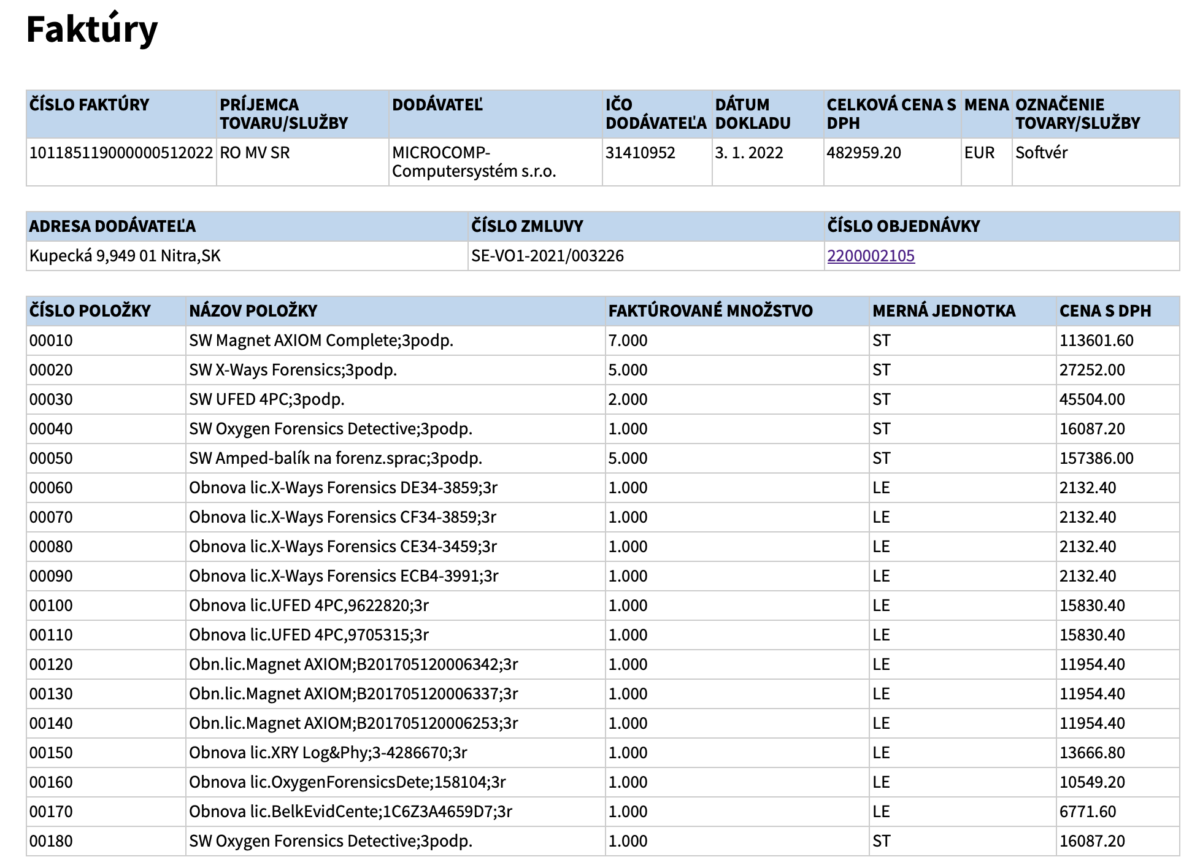
An invoice issued to the Slovak interior ministry in 2022 by the Slovak company Microcomp–Computersystém indicates the renewal of a licence for this software. At the time, the minister responsible was Roman Mikulec.
Screenshot of invoice from 2022 (Source: Slovak interior ministry website)
The Slovak ministry also ordered a licence renewal in July 2024, under his successor Matúš Šutaj Eštok. Microcomp–Computersystém did not respond for comment.
Interior ministry order with links to Russia. (Source: Slovak interior ministry website)
Authorities warned
On Friday (2 October), the Slovak national security authority (NBÚ) warned of the risks posed by using software from Oxygen Forensics and connected companies such as MKO Systems and Prostranstvo IT.
Their software helps investigators search for and examine data from digital devices. It can process vast amounts of information, including evidence, which makes it important who owns, controls and develops it. According to the NBÚ, this is important both for data protection and for the reliability of analysis results.
The warning came after the US case was made public.
The NBÚ considers links to Russia significant in assessing the security risk, also in view of Russia’s military aggression against Ukraine.
However, the warning itself does not mean that data leaked through the software. US prosecutors explicitly stated that the charges did not concern malicious code or unauthorised access to customer data.
The case concerns the alleged concealment of the software’s ownership and origin. And no court has yet ruled on the case.
“The ministry will proceed in accordance with the recommendations of the National Security Authority,” the Slovak interior ministry said.
The NBÚ recommended that public bodies identify this company’s presence and report it to the authority.
Belgian Green MEP Saskia Bricmont also called for the use of Oxygen to be stopped immediately and for an inquiry into whether sensitive information could have reached Russia after it was found that Romania, Germany, Spain, Italy, Poland and Hungary had purchased the software.
European police shed tool
Several European security agencies are suspending the use of Oxygen Forensics software or taking steps to terminate their contracts after the company’s Russian ties came to light.
The tool was also used by Czech police. Czech security agencies continued to purchase licences for the computer software after 2022, when the full-scale invasion of Ukraine began. Czech authorities are awaiting further information from the United States. For now, they have prohibited software updates.
London’s Metropolitan Police has suspended the use of Oxygen tools and launched a comprehensive review. British police forces, including specialised units, had used the software.
And Latvian police suspended its use and is assessing whether it will continue using it.
Romania’s anti-corruption agency, too, took steps to terminate its contract with the Russia-linked tool.
El escrutinio de los votos en la primera vuelta de las elecciones generales en Brasil fue motivo de gran controversia. Flávio Bolsonaro, hijo del expresidente Jair Bolsonaro, iba por delante de Lula en el recuento oficial, con un 49,6% contra un 42,2% para el presidente que busca su reelección.
Habían sido computadas el 64,8% de las secciones electorales hasta ese momento. Pero el recuento se paralizó por más de una hora. Extrañamente, los votos para gobernador, senador y diputados continuaron siendo contabilizados con normalidad. Solo el recuento presidencial se paralizó.
Y, aún más extrañamente, cuando el recuento presidencial se reanudó, la tendencia ascendente de Flávio Bolsonaro y la tendencia descendente de Lula se revirtieron. Los votos del candidato opositor cayeron, mientras que los del actual presidente aumentaron. Flávio Bolsonaro estaba a menos del 0,5% de la victoria que le otorgaría la banda presidencial. Perdió más de un 2%, terminando con un 47,03%, mientras que Lula ganó casi un 3%, terminando con un 45,16%.
Parecía que Flávio Bolsonaro destronaría a Lula ya en la primera vuelta. Pero, tras más de una hora de paralización en los recuentos, Lula logró recuperarse y la disputa se decidirá recién en la segunda vuelta.
El recuento se paralizó a las 19h06 (hora de Brasilia), con el 64,8% de las urnas escrutadas. Recién a las 20h08 se presentaron los nuevos resultados, ya con el 85% de las urnas escrutadas.
La justificación oficial fue dada por el presidente del Tribunal Superior Electoral (TSE), Kassio Nunes Marques, quien también es ministro del Supremo Tribunal Federal (STF). «Lo que ocurrió fue una congestión de datos. En cada elección, nos vemos sorprendidos por alguna contingencia, lo cual es natural para quien lida con sistemas complejos y tan variados», dijo. «A priori, no se sabe si esto fue derivado de otro problema. Lo que nuestra tecnología de la información constató fue un flujo [de datos] superior a lo normal, y esa congestión generó un atraso», completó.
Existe una propaganda violenta en Brasil, encabezada por la Justicia Electoral, para presentar a los ciudadanos que las elecciones son 100% limpias. El principal foco de esa propaganda son justamente las urnas electrónicas. Las instituciones judiciales y los medios de comunicación dan gran difusión a las palabras de la Justicia Electoral sobre la total confiabilidad de las urnas electrónicas, destacando, incluso, que son sometidas a pruebas antes del plebiscito y luego selladas para que nadie pueda acceder a ellas.
Entonces, ¿por qué las urnas sufrieron una especie de pánico, si habían sido rigurosamente examinadas? Pues, el sapientísimo TSE tiene pleno conocimiento del número de electores aptos para votar y del número de votos que pueden ser registrados en las urnas, incluso en cada sección electoral. La propaganda de la Justicia Electoral indica al público que las urnas están plenamente preparadas con anticipación para registrar y computar perfectamente los votos de los electores.
No debería ocurrir ningún flujo de datos «superior a lo normal» que llevara a la congestión del sistema, porque los datos y estadísticas más variados en relación con el registro de votos son conocidos y los cálculos son perfectamente realizables. La infalibilidad de las urnas electrónicas exige que todos los resultados posibles sean previsibles y que, por tanto, no haya ninguna anomalía.
¿Cómo es posible, entonces, que un sistema tan perfecto, como es el propagado por las instituciones del Estado brasileño, presente una falla que, después de ser supuestamente resuelta, haya modificado tan radicalmente la tendencia de los votos presidenciales?
Puede ser una coincidencia que Flávio Bolsonaro se haya desplomado y Lula haya subido después de la falla de las urnas. Pero, ¿quién sabe? El presidente del TSE reconoció que el sistema electrónico de votación es «complejo». Solo especialistas altamente capacitados, del propio TSE y de empresas de tecnología, consiguen acceder a él y comprenderlo, de acuerdo con la Justicia Electoral. Así pues, está en manos de esos especialistas —que son 150 técnicos desconocidos del público— el destino de un país entero para los próximos cuatro años. El cálculo de los votos que salen de las urnas es totalmente automatizado, no pasa por ningún ser humano. Un número aún más selecto de 22 funcionarios accede a la totalización automatizada de los votos.
Esto significa que 214 millones de brasileños necesitan confiar en esos 150 o 22 sacerdotes egipcios para interpretar esa ciencia oculta. Deben ser los seres más iluminados del planeta Tierra, 100% íntegros, honestos, inmaculados y vírgenes. Incluso los ministros del STF, presentados a lo largo de los últimos 15 años como individuos impecables, probos y castos, aparecen ahora envueltos en el mayor escándalo de corrupción de la historia reciente de Brasil, pero esos especialistas anónimos merecen la más absoluta confianza de los ciudadanos.
Fue por motivos así que la Corte Suprema de Alemania declaró el voto electrónico inconstitucional: «cada ciudadano debe ser capaz de comprender y verificar las etapas centrales de las elecciones de forma confiable y sin ningún conocimiento técnico previo especializado».
El veredicto, fechado en 2009, concluye:
«Un procedimiento electoral en el que el elector no pueda comprender, de manera confiable, si su voto fue registrado de forma infalsificable e incluido en el escrutinio del resultado de la elección, y cómo el total de los votos expresados es atribuido y computado, excluye elementos centrales del procedimiento electoral de la vigilancia pública y, por tanto, no cumple los requisitos constitucionales.»
El sistema judicial brasileño está sumido en su mayor crisis histórica y vive un verdadero western, con peleas partidistas interfiriendo en el funcionamiento de los trabajos. El partidismo, de hecho, contaminó a la mayor parte del poder judicial, incluido el TSE. En la recta final de estas elecciones, decisiones de la Justicia Electoral, apoyadas por el ala dominante en el STF, favorecieron a Lula.
Es evidente que esa ala dominante (representada por los ministros Alexandre de Moraes, Gilmar Mendes y Flávio Dino) no quiere la victoria del bolsonarismo, pues este es su enemigo político declarado. Esos ministros actuaron, en los últimos años, como verdaderos justicieros contra el bolsonarismo. Ahora que ellos mismos fueron sorprendidos en relaciones extremamente promiscuas con un banquero que corrompió a incontables altos funcionarios del Estado, su carrera burocrática está amenazada. La continuidad de Lula es una esperanza de salvación para estos señores, pues el presidente está comprometido con ellos y no puede romper ese compromiso sin arriesgar la propia cabeza, dado el nivel de dependencia que Lula contrajo en relación con los mandamases del STF. Ya una elección de Flávio Bolsonaro tendería a conducir a un choque con los cabezas de esas instituciones, aunque el propio candidato opositor no ha demostrado gran disposición a enfrentarlos, porque los que controlan las elecciones en Brasil (el capital financiero internacional) exigen moderación y pacificación; de lo contrario, dificultarán la vida de cualquiera que se elija presidente.
Y el pueblo es tratado como ganado, víctima de un sistema que no puede comprender, para perpetuar su explotación a través de la escenificación de la «fiesta de la democracia».
Dell’Oro Group reported worldwide telecom capex rose 5% year-on-year in the first half of the year, exceeding expectations following several years of declining investments.
Despite the promising start to the year, Dell’Oro’s long-term outlook remained largely unchanged by forecasting telecom capex growth of up to 1% CAGR through 2030.
Telecom equipment performance continued to closely mirror capex trends. Combined vendor revenue from the six telecom equipment segments monitored by Dell’Oro, comprised of Broadband Access, Microwave Transmission, Optical Transport, Mobile Core Network (MCN), Radio Access Network (RAN), and High-End Router & Aggregation, also increased by about 5% over the same timeframe.
Dell’Oro VP Stefan Pongratz explained operators have greater capacity following the 5G and fibre investment cycles and are gradually redirecting spending from coverage to capacity, modernisation, automation and efficiency.
“At the same time, improving operator revenues are helping to reduce capital intensity ratios even as network investments remain flat,” he stated.
Capital intensity, which peaked at 18% in 2022, is forecast to decline to around 14% in 2028, ahead of increasing slightly as early 6G investment starts.
Overall, telecom equipment revenue is projected to grow at a 2% to 3% CAGR between 2025 and 2030, outpacing CSP capex, partly due to incremental demand from cloud providers.
AT&T, Global Infrastructure Partners and Canada Pension Plan Investment Board are creating a fibre joint venture (JV) by combining the Forged Fiber 37 and Gigapower assets, in a boost to the operator’s goal of providing connectivity to more than 60 million locations by 2030.
The JV will operate as a wholesale fibre commercial open access company. The operator stated it will utilise AT&T’s fibre assets and investor capital to expand fibre and 5G services across 16 states, enhancing customer experience with converged connectivity. The JV is expected to close in the first half of 2027.
Forged Fiber 37 is a wholly owned subsidiary created by AT&T to house the mass-markets fibre business, customer relationships, network assets, and build engine which AT&T acquired from Lumen Technologies.
Global Infrastructure Partners is a subsidiary of Black Rock. AT&T and Black Rock formed Gigapower, a wholesale open-access fibre network JV, in 2022.
AT&T will retain 50% ownership of the JV while GIP and CPP Investments will collectively hold the remaining stake.
AT&T CEO John Stankey is bullish on the convergence of fibre broadband and 5G services and has long held wherever it has fibre deployed “it wins”.
Stankey stated fibre is essential in an AI-driven world as demand for symmetrical, high-capacity and low-latency connectivity grows. He added the offering will extend reliable, high-speed fibre to more US consumers, increase AT&T’s scale and service reach and strengthen its position in converged fibre and 5G connectivity.
Last month the operator announced a multi-year fibre and cable deal valued at more than $3 billion with glass-specialist Corning to advance its converged strategy of mobile and broadband services.
Wikimedia also said that the OpenAI agents made unauthorized edits to Wikimedia wiki sites, including "potentially malicious edits" to a citation tool.
Wikimedia also said that the OpenAI agents made unauthorized edits to Wikimedia wiki sites, including "potentially malicious edits" to a citation tool.
The GSMA lined up the board which will guide the organisation through key decisions around 6G, satellite connectivity and spectrum, with six new companies represented and fresh faces at some existing members.
Its overall board remains at 26 members, though the company representation is shifted with Axiata Group; Millicom; NTT Docomo; Ooredoo Group; stc; and Telstra joining the ranks.
By contrast, Ethio Telecom; KDDI; KT; Telenor; TIM; and Veon are not among the names of the next board.
Companies remaining on board but with different representatives comprise AT&T; China Telecom; China Unicom; China Mobile; Deutsche Telekom; e&; Globe Telecom; and Telefonica.
America Movil; Bharti Airtel; BT Group, Liberty Global; MTN Group; Orange; Reliance Jio; Personal (previously Telecom Argentina); Turkcell; Verizon; and Vodafone Group continue with the same representatives.
GSMA director general Vivek Badrinath rounds the board out.
The technical developments scheduled for the next board’s tenure include setting initial 6G standards, establishing regulatory frameworks for satellite and NTN communications, and spectrum allocations. The ITU’s WRC-27 is scheduled to take place in October and November 2027.
A key focus for the GSMA’s next board is the impact of AI on the mobile sector. Current chair Gopal Vittal said the technology and “open digital platforms” are opportunities to “create significant economic and societal value”, which the organisation would work to unlock.
Vittal is keen to see a continued focus on “digital safety and trust”, along with tackling connectivity and usage gaps.
On Thursday, October 1, health workers, patients, and activists protested Palantir’s role in the National Health Service (NHS) at more than 40 locations across England. Their demonstrations were part of a global week of action demanding that governments cut ties with the spy-tech firm over human rights and privacy concerns.
Rallies took place in front of Palantir’s London headquarters, as well as in Liverpool, Manchester, Newcastle, Sheffield and many more cities.
“Palantir’s tools are used by the Israeli military in Gaza and by ICE to track and surveil migrants in the US,” campaign groups – including Just Treatment, Health Workers for a Free Palestine, Medact, and Global Justice Now – stated. “A company profiting from human rights violations has no place in the NHS or in any of our public services.”
Palantir’s track record opposes core health values
Palantir currently holds a £330 million (approximately USD 436 million) NHS contract and has rolled out the service’s Federated Data Platform (FDP), managing sensitive patient data. The project has drawn criticism from virtually every group involved in the NHS: data workers say it lags behind local systems; patients share privacy and data ownership fears; and health workers insist Palantir’s record opposes the very values their profession embodies.
“I cannot stay true to that [Hippocratic] oath and tolerate Palantir continuing to profit from, and grow its malign business model through an NHS contract,” said physician Rhiannon Osborne from Medact at Thursday’s rally. “Every pound we give them helps to legitimize and sustain human rights abuses and erosion of democratic rule of law across the world.”
A central concern is the company’s support for Israel throughout the genocide in Gaza. “When we strive to save every possible life, they champion their ability to kill and celebrate their role in the repeated war crimes committed by Israel – including unprecedented deliberate attacks on the doctors, nurses, and paramedics I worked with,” pediatric neurologist Omar Abdel-Mannan stated. “No moral government should tolerate their involvement in our NHS or indeed any of our public services.”
Campaigners repeated calls for Prime Minister Andy Burnham to end the contract as soon as possible. Under an exit clause in the original agreement, that moment could arrive as early as February 2027. Campaigners and several commissions are pressing the government to notify Palantir of its intention to withdraw ahead of this date.
“The government only has two months to say no to Palantir and the momentum is all with us,” Good Law Project activists said at the rally in London. “All the energy is to say no to Palantir, say no to their global human rights abuses, say no to their crap technology that doesn’t work and get Palantir out of the NHS.”
Unions back appeal to bar Palantir from public sector contracts
Calls to break Palantir’s grip on public services resonate beyond Britain. On September 28, more than 120 groups and unions called upon European governments and the European Commission to “scrap all existing public sector contracts with the US tech company Palantir.” As reported by the European Federation of Public Service Unions (EPSU), the appeal seeks to end current agreements and bar the firm from future public contracts. It also urges governments to develop “alternative data solutions compatible with public service,” echoing NHS data workers’ recommendations.
“Palantir’s ramping up of ‘war-related’ support for Israel during the genocide in Gaza and the apparent disdain of its leadership for democracy are just two clear signs that this company serves the interests of the rich and powerful, not the general public,” said Tim Bierley of Global Justice Now. “Yet it has been allowed to embed dubious technologies across our public services, giving it access to sensitive data and creating worrying new technical dependencies.”
“The UK must work with other countries to end dependence on companies involved in human rights abuses, and end the outsourcing of the public sphere to a dangerous class of big tech oligarchs.”
People’s Health Dispatchis a monthly bulletin published by thePeople’s Health MovementandPeoples Dispatch. For more articles and subscription to People’s Health Dispatch, clickhere.
À la veille d'une réunion de l'UE, les États-Unis réclament une mise sur le marché de volumes supplémentaires de diesel, sous menace, selon la presse, d'interdire ses exportations. Le prix du gazole atteint des records des deux côtés de l'Atlantique, pénalisé par les frappes ukrainiennes sur les raffineries russes et le verrouillage du détroit d'Ormuz par l'Iran.
US broadband vendor Inseego completed its deal to buy Nokia’s fixed wireless access (FWA) CPE business, in a move it expects will roughly double its revenue.
By adding indoor, outdoor and mmWave FWA technologies to its wireless broadband portfolio, Inseego stated it now has a global presence across consumer and business connectivity.
Its footprint for operators now includes Europe, the Middle East, Asia, Oceania and the Americas, while also expanding its engineering capabilities.
To support its global ambition, Inseego established an international headquarters in Amsterdam, a development centre in Athens, Greece, expanded its presence in Bangalore, India, and added customer-facing sales and technical resources across its new markets.
“We now have the scale, technology, and global reach to support carriers across business, residential, and mobile use cases,” Inseego CEO Juho Sarvikas said.
The deal, announced in April, grants Nokia approximately 1.9 million common shares, representing an 11% ownership stake in Inseego
The Finnish vendor also received warrants to purchase up to 800,000 shares of common stock, at an exercise price of $4.26 per share.
Nokia will also kick in a further $10 million cash payment by 15 October to support engineering work on interoperability between Inseego’s device operating system and cloud platform and certain Nokia technology ecosystems over the coming year.
Nokia will provide transition support and refer new FWA opportunities to Inseego.
About 250 people from the acquired business will support Inseego’s engineering, product management, supply chain, sourcing and customer support operations. They include employees joining Inseego and Nokia personnel providing support under a transition services agreement.
Infineon officially opened a $1.4 billion facility in Thailand, a move it pitched as strengthening and diversifying its manufacturing footprint while adding capacity for further growth.
The semiconductor company stated the new backend manufacturing hub was strategically located in the heart of Southeast Asia, reinforcing its ability to serve customers worldwide at a time when demand continues to grow, “driven by digitalisation, electrification and energy transition”.
It has been designed for a phased expansion, with the potential to scale up to five modules, meaning it could become one of the company’s largest backend manufacturing sites over time.
The site will initially open with 30,000sqm of cleanroom space, which can be expanded to 150,000sqm.
Infineon has initially made an investment of $113 million into the site, while the Thailand Board of Investment stated the entire project is worth $1.4 billion.
In total, the site will create 1,000 highly skilled roles, starting with an initial 350 jobs.
The move complements a wider semiconductor drive, with the country aiming to secure around $18 billion in investment within the sector across photonics, power electronics and sensors.
Alexander Gorski, COO at Infineon, said the company was establishing a new hub in the region, which was “surrounded by a fast-growing ecosystem and with excellent access to global logistics”.
Infineon adds Thailand to its global manufacturing footprint, consisting of 13 locations across US, Europe, China and Southeast Asia.
T-Mobile US, Verizon and AT&T sealed their joint venture (JV) to expand coverage across areas of the US that terrestrial services cannot reach, in a rare example of cooperation between the big three.
The move followed an announcement in May outlining how the operators planned to pool their spectrum resources to eliminate “dead zones” by expanding satellite coverage for customers nationwide.
Former AT&T, Cingular Wireless and Ameritech executive Paul Roth is serving as the interim CEO of the JV while a search for a permanent chief is underway. The entity will be managed by a board with representatives from each founding member.
The companies stated the JV will “nearly eliminate dead zones in the U.S. currently without mobile service, reaching previously unserved areas” to cut down on coverage gaps.
It will also be beneficial for first responders during natural disasters or other disruptions by providing connectivity when terrestrial services are down.
They claim the new service will also provide a better customer experience for direct-to-device (D2D) consumer services through the unified approach.
AT&T Business has a partnership in place with Jeff Bezos’ Amazon Leo to provide connectivity to businesses across the US. SpaceX is also mulling a mobile service through its Starlink birds, but the industry is somewhat sceptical of its approach.
The operators stated the venture will also be a boon to additional satellite providers while also collaborating closely with rural mobile operators to expand access and simplify integration.
The service could emerge as a threat to cable operators such as Cox Communications, formerly Charter Communications, Comcast and smaller providers across rural areas which are currently losing broadband subscribers to fixed wireless access services offered by the trio.
The combined use of each operator’s spectrum will improve efficiency while enabling mobile operators to deploy new services at a faster rate.
The JV also plans to take a standards-based approach to satellite services while allowing each of the three to continue their individual efforts across the sector.

 Login