❌

Normal view

Russian Forces Concentrate Record Drone Strikes on Kirovohrad Region, Expand Attacks on Industry, Rail, and Airfields
15 October 2026 at 20:56

Click to see the full-size image

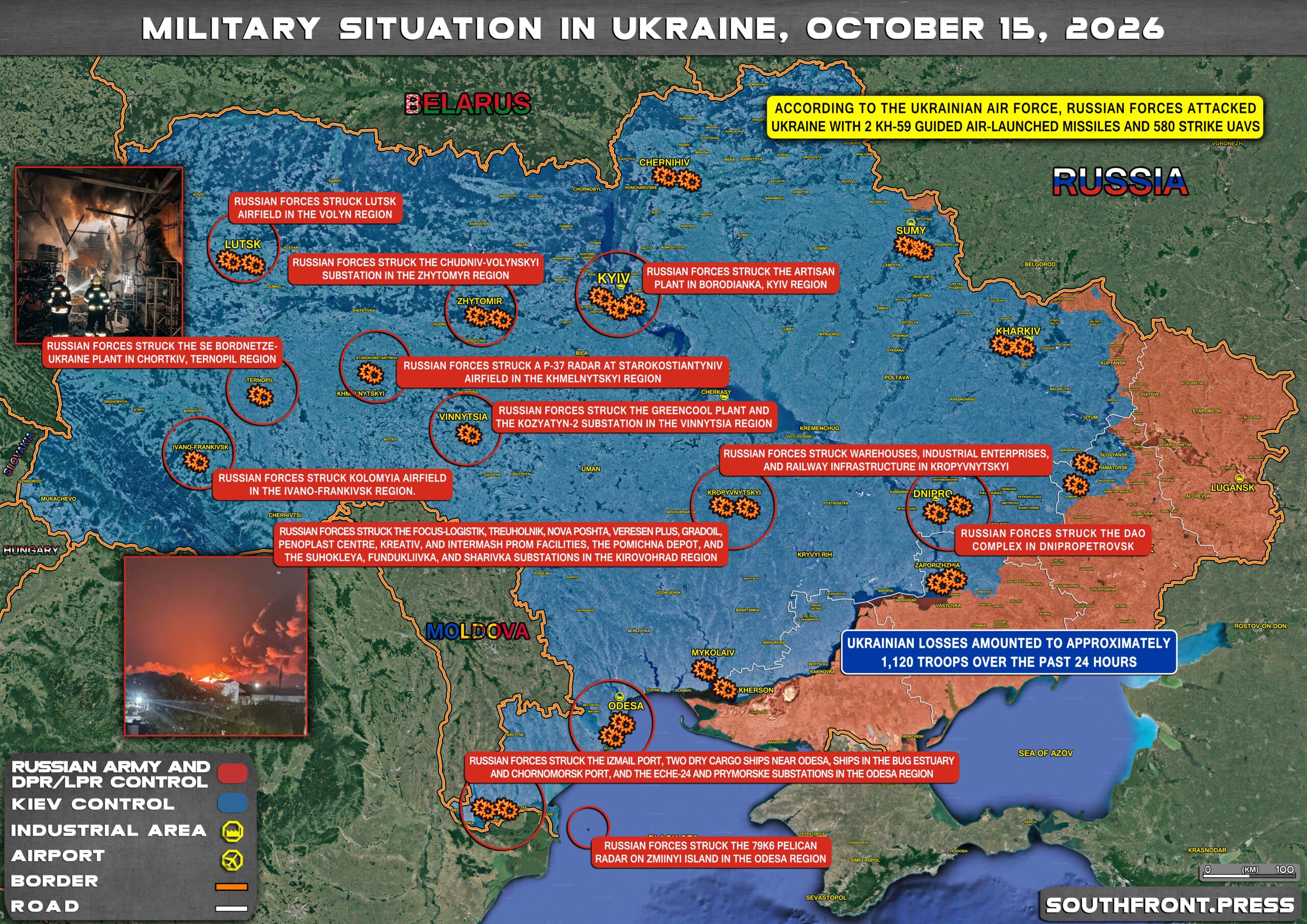
On the night of October 15, 2026, the Russian Armed Forces carried out a combined strike on Ukraine using two Kh-59 guided missiles and 580 attack drones and decoy drones. The main effort was concentrated on Kirovohrad Region, where strikes continued for more than ten hours and hit industrial facilities, logistics complexes, and railway infrastructure. Strikes were also carried out against port infrastructure in Odesa Region, traction substations, and aviation infrastructure in western Ukraine. In response, Ukraine attempted a massive attack on the Ryazan oil refinery, which was repelled by air defense forces.

Russian Strikes on Ukraine
Kirovohrad Region
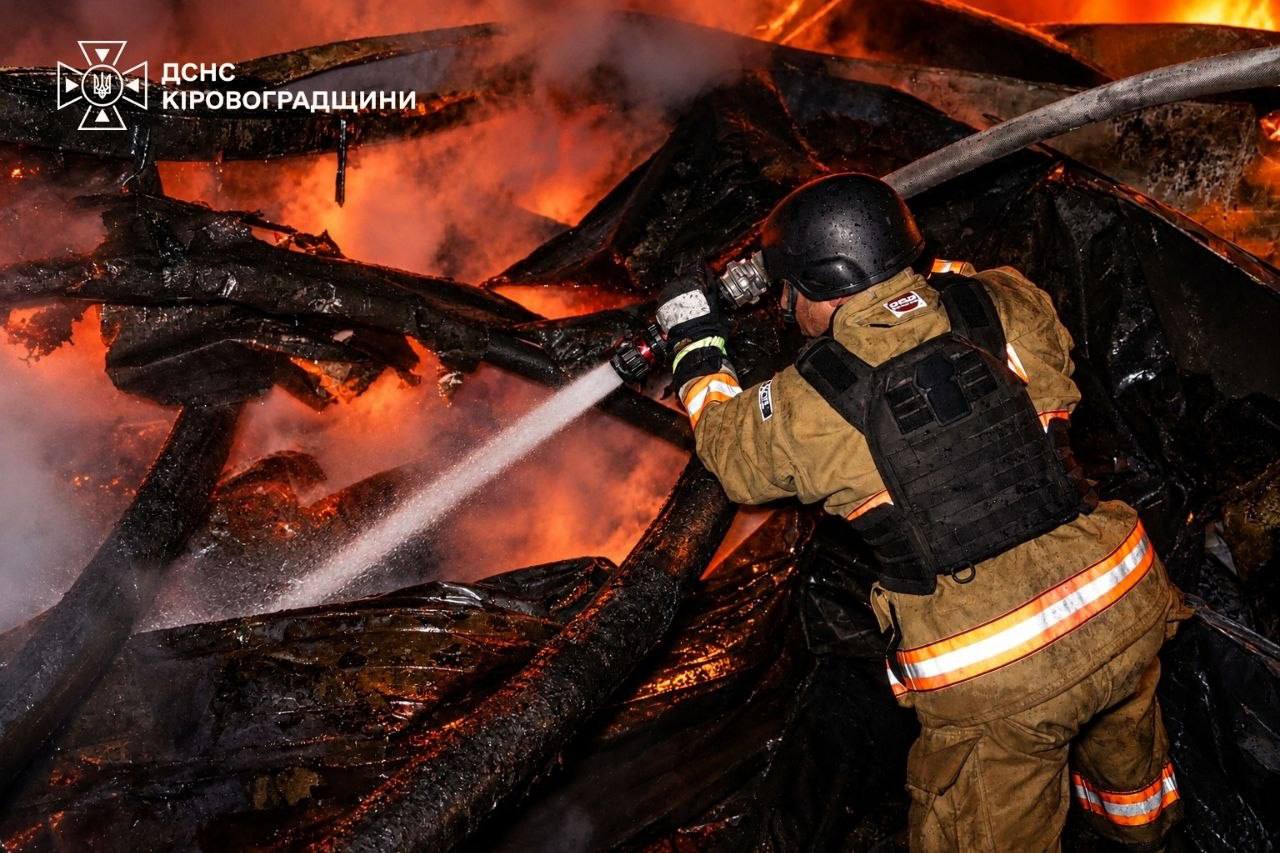
Logistics and warehouse facilities (Kropyvnytskyi). Kirovohrad Region came under the most massive attack since the start of the conflict: according to Andriy Raikovych, head of the Region Military Administration, nearly 360 drones attacked the region, with impacts recorded at 25 locations. In Kropyvnytskyi, strikes hit company premises, logistics centers, and warehouses. Among the affected facilities were Focus-Logistics, a warehouse complex operated by a company with critical-infrastructure status; warehouse buildings of SE Kombinat Trykutnyk, part of Ukraine’s state material reserve system; a cargo branch of Nova Poshta; and a distribution center of Veresen Plus LLC, operator of the Faino Market chain.

Industrial facilities (Kropyvnytskyi). Three drone strikes hit the premises of Gradoil LLC, a full-cycle oil-extraction complex that processes sunflower and rapeseed; fire engulfed administrative and warehouse buildings covering more than 1,000 square meters. Three drones struck Penoplast Center LLC, a production and warehouse facility in the polymer sector, with the fire spreading across roughly 800 square meters. A separate strike hit the former industrial complex of PrJSC Kreativ, historically one of the city’s largest oil-and-fat enterprises, whose production facilities continue to be used by other operators after the legal entity’s bankruptcy. A production workshop of Intermash Prom LLC in Oleksandriia was also hit, with fire engulfing more than 300 square meters. The company was registered in August 2026, and its initial business profile included the production of weapons and ammunition.

Railway infrastructure. Four attack drones successively hit the railway complex in Pomichna. According to available information, the strike hit the locomotive complex, but the fire was recorded in a building belonging to the railcar repair facility responsible for repairing freight rolling stock. In addition, the Sharivka and Suhokliia traction substations were hit, and electric train service was halted.


Odesa Region
Port of Izmail and maritime vessels. Port infrastructure at the Port of Izmail was damaged; it was used for unloading and storing military and dual-use cargo. In addition, two bulk carriers were hit while underway at sea.

Traction substations. In Rozdilna Raion, a drone struck the EChE-24 traction substation, causing an oil fire covering about 350 square meters. In Izmail Raion, an attack drone exploded near the Prymorske substation.

Ternopil Region
Chortkiv — SE Bordnetze cable production. Russian drones hit the Chortkiv branch of SE Bordnetze-Ukraine LLC (SEBN), part of the international Sumitomo Electric Bordnetze network. A warehouse building was damaged, and fire engulfed more than 500 square meters. The facility produces electrical wiring systems and wiring harnesses for the automotive industry, including for the Volkswagen Golf 8, Audi A6, Audi e-tron, and Porsche J1. According to reports, the company’s cable-production capabilities were also used to manufacture components for Ukrainian long-range unmanned systems.

Vinnytsia Region
Vinnytsia — GreenCool plant. GreenCool is one of Ukraine’s largest refrigeration-equipment manufacturers and part of the UBC Group, with revenue exceeding UAH 2 billion. Open procurement data show four government tenders involving Green Cool LLC, with Ukrnafta as the main customer. The Zhmerynka locomotive depot and the area around the Kozyatyn-2 110 kV supporting traction substation were also attacked.

Zhytomyr Region
Chudniv-Volynskyi traction substation.
Vilshanka traction substation.

Khmelnytskyi Region
Starokostiantyniv — radar station. Two Geran-5 jet-powered drones hit a P-37 radar position at Starokostiantyniv airfield. The radar itself was destroyed. The P-37 is an air-surveillance asset that provides commanders with a picture of the air situation in their area of responsibility. Radar coverage is designed with overlapping zones, so the airfield does not become completely “blind,” but the destruction of an operational air-surveillance asset is a concrete loss for an airfield that has regularly come under attack.

Volyn Region
Lutsk — airfield. The strike hit the Lutsk airfield, where the 204th Tactical Aviation Brigade is stationed. One of the impacts occurred near the guardhouse.

Ivano-Frankivsk Region
Kolomyia — airfield. Two Geran-5 jet-powered drones attacked Kolomyia military airfield. The main radar equipment and flight infrastructure were not damaged. According to available information, the airfield is still used to receive transport aircraft and move military cargo. The two impacts did not disrupt this function, but the fact that strike assets returned to Kolomyia after a long pause indicates that the airfield has once again become a target of attention.

Dnipropetrovsk Region
Dnipro — repeated strike on DAO. This was not the first strike on the site: earlier attacks had already hit the same complex, causing a major fire and damage to its production and logistics building. Repeated strikes are the key factor here: each new attack compounds the existing damage.

Kyiv Region
Borodianka — ARTISAN construction-mix production. The strike targeted the production site of Artel LLC, better known under the ARTISAN trademark, which produces dry and liquid construction mixes. A review of procurement records shows that ARTISAN products are systematically present in supply chains for Ukrainian security forces: construction materials appear in purchases by several Armed Forces of Ukraine units as well as National Guard units; in 2026, its products were included in purchases classified as defense-related.

Poltava Region
Naftogaz facility. On the night of October 15, Russian forces attacked gas-production infrastructure belonging to Naftogaz Group in Poltava Region. The drone strike damaged process equipment, started a fire at the facility, and suspended operations.

Strikes on Russia
Ryazan Region
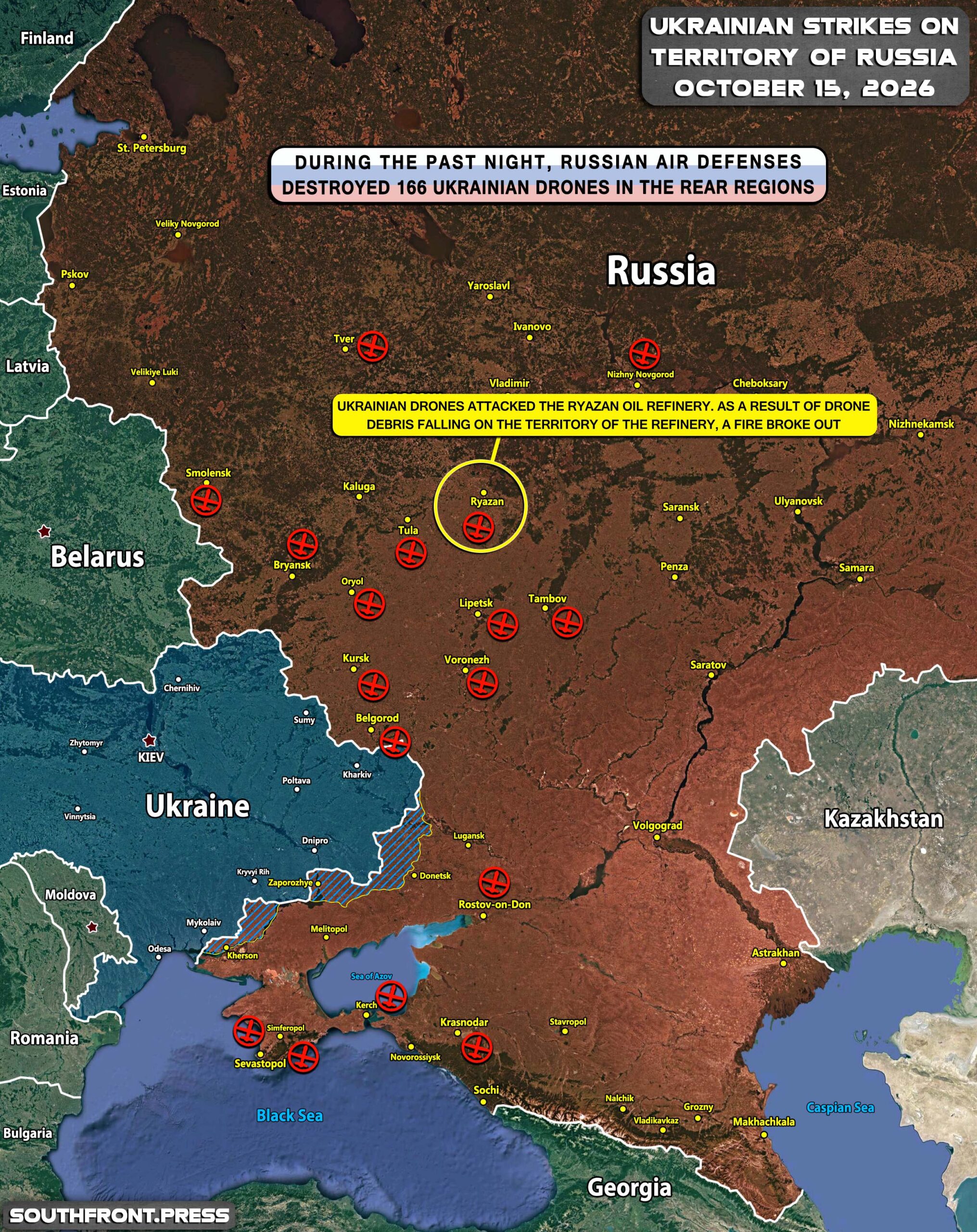
During the night of October 15, Ukrainian forces attempted a massive attack on the oil refinery in Ryazan. According to the Russian Ministry of Defense, Russian air defenses intercepted and destroyed four Flamingo long-range cruise missiles and 69 fixed-wing drones. A fire broke out at the refinery after drone debris fell on its grounds. In total, according to the Russian Ministry of Defense, 166 Ukrainian drones were shot down over 14 Russian regions on the night of October 15.

Russian President Vladimir Putin, commenting on the strikes on Russian refineries, said: “Yesterday they tried to strike some refineries, and they hit a few places. Nothing significant, but they continue nonetheless.” Putin emphasized that Russia will respond to strikes on refineries, logistics, and energy facilities: “They made the first move. We began responding. They should not have started.”

The Russian strikes on Ukraine on October 15 were marked by an exceptionally high concentration of forces in the Kirovohrad direction: nearly 360 drones targeted a single region, making this the largest attack on the region. The main effort was directed at the industrial and logistics network of Kropyvnytskyi, as well as railway power infrastructure in Kirovohrad, Vinnytsia, and Zhytomyr Regions. Damage to the Sharivka, Suhokliia, and Chudniv-Volynskyi traction substations caused localized halts in electric traction and creates risks for rail service on the affected sections. At the same time, strikes on the Starokostiantyniv, Lutsk, and Kolomyia airfields continue the attrition of aviation infrastructure in western Ukraine.

In the medium term, the combination of strikes on energy infrastructure and industrial facilities creates a cumulative effect that complicates the restoration of production chains. Repeated strikes on facilities that had already been damaged point to the systematic nature of the campaign, aimed not only at inflicting immediate damage but also at preventing recovery. Against the backdrop of statements by the Russian leadership about its readiness to respond to strikes on Russian infrastructure, a high tempo of mutual strikes should be expected to continue in the coming weeks.

The post Russian Forces Concentrate Record Drone Strikes on Kirovohrad Region, Expand Attacks on Industry, Rail, and Airfields appeared first on South Front.


FBI agents and analysts who were fired for working on Trump classified files probe sue to get their jobs back

The investigation resulted in a dramatic 2022 FBI search of Mar-a-Lago that recovered classified records and later produced an indictment in federal court in Florida charging then-former President Donald Trump with dozens of felony counts.

3 Charlotte Cops Resign After Group Chat Reveals Competition To Arrest the Most Black People

15 October 2026 at 20:10
Illustration of a smartphone showing a text conversation, with a file folder in the background with a police officer's photo on it | Oleg Dudko/Dreamstime/Midjourney/Fatima Ruiz.Charlotte.jpg

​Three Charlotte cops have resigned and three more are facing termination after a Flock probe uncovered a text chain littered with racist messages, religious and sexual bias and a reported competition over who could arrest the most black people.

The group chat came to light after Charlotte-Mecklenburg Police Department (CMPD) officer Seth Elliott was caught using Flock's database to out an undercover cop to his drug dealer friend, which sparked an investigation by the North Carolina State Bureau of Investigation (NCSBI).

When questioned by the NCSBI, Elliott, who has since resigned, admitted he ran the plate but denied knowing that it belonged to an undercover officer. He told agents that his friend had reached out to ask if Elliott could help identify a strange person hanging out around his father's business, so Elliott ran the plate through Flock's database.​ According to reporting from the Watauga Democrat, the NCSBI arrested Elliott in July and charged him with " illegally accessing a government computer, a Class 1 misdemeanor."

During its investigation into Elliott, the NCSBI downloaded data from his phone, which it turned over to the CMPD, where a subsequent review uncovered the racist text thread. ​According to anonymous sources who spoke to Charlotte's WBTV, the group chat included "numerous uses of the 'n-word' related to use of force and discharging firearms at black residents," and a competition to see who could arrest the most black people. In one text reportedly written by a member of the group, an officer said, "Our texts sound like a clan [sic] rally," according to a message reviewed by WCNC Charlotte, a local NBC affiliate. At a press conference on Thursday, CMPD Police Chief Estella Patterson said that an independent chain-of-command board unanimously voted for the officers' termination. Three have already resigned and the other three she "hopes to refer to as former employees."

The fallout won't end there. Every case these officers touched could now be called into question, and for good reason. In Giglio v. United States (1972), the Supreme Court ruled that prosecutors must disclose information that could undermine the credibility of a government witness or law enforcement officer. Mecklenburg County District Attorney Spencer Merriweather will have to examine the messages and determine whether their word as witnesses can still be trusted. Depending on his decision, this could lead to dropped cases and challenges to prior convictions.

Defense attorney Tim Emery weighed in, telling WBTV that the officers' "credibility is severely questioned and compromised," and that the district attorney's office should consider halting cases in which the officers were heavily involved.

Police abuse of Flock and other automatic license plate readers (ALPRs) is not new. The Institute for Justice, a libertarian public interest law firm, has cataloged over 200 instances of ALPR abuse at the hands of the police since 2018. In the last year alone, officers have been caught using ALPRs for everything from pursuing personal grudges to stalking exes and romantic interests. This time, the victim of Flock misuse was an undercover officer rather than a civilian.

The post 3 Charlotte Cops Resign After Group Chat Reveals Competition To Arrest the Most Black People appeared first on Reason Magazine.

Russian Army Breaches Ukrainian Defenses in Zaporozhye

15 October 2026 at 19:52

File image.

In the Zaporozhye direction Russian troops have advanced almost 13 kilometers, overcome two lines of defense, restored control over Lyubetskoye, Novosoloshino and Nikolskoye, and continue to apply pressure on Orekhov. In the Sumy direction assault units of the “North” grouping have advanced on 19 sectors by up to 800 meters, conducting fighting near Khoten and in the tree lines near Korenok. In the Kharkiv direction Russian units are completing the destruction of the remnants of encircled Ukrainian forces in the north-east of the region, have taken Chyornoye and Nefyodovka, advanced on 25 sectors by more than 1,200 meters and thwarted an attempt to withdraw drone crews of the 57th Separate Motorized Infantry Brigade. In the Dobropolye direction Russian units have entered the village of Dobropolye, while the Ukrainian side has withdrawn from Matyashevo and destroyed a dam, creating a water obstacle. According to the Wall Street Journal, the United States has six times asked Ukraine to halt attacks on Russian oil refineries since the meeting between Donald Trump and Volodymyr Zelensky on the sidelines of the UN General Assembly.

Zaporozhye direction  

Attempts to retake Dachnoye have brought no success. Russian troops have restored control over previously lost sectors and continue fighting near Filippovka and Ivanovka. In the Orekhov direction Russian troops have regained control of Tsvetkovo and the adjacent section of the railway. The advance continues on several sectors west of previously captured positions. Russian units hold Gulyaypolskoye and the southern part of Novosyolovka. Fighting continues near Orekhov, Malaya Tokmachka and Novodanilovka.

The Orekhov direction remains one of the most dynamic. The Russian side continues intensive fire effect. One of the notable events has been the advance of Russian units by almost 13 kilometres in Zaporozhye region. The troops overcame two lines of defense — one two-tier and the other single-tier. Lyubetskoye, Novosoloshino and Nikolskoye have come under control. The latter is located at a road junction and makes it possible to develop the advance toward Omelnyk from the north. Lyubetskoye and Novosoloshino had previously been temporarily lost.

On the northern sector Russian assault troops are conducting offensive operations near Velikomikhaylovka. On the north-western sector units continue the offensive on a broad front west of Golubkovo, Samoylovka and Svetlaya Dolina. West of Zarnitsa the advance is proceeding with the support of artillery and drone crews near Barvinovka and Vasilkovoye. Assault groups continue to drive wedges into the defense and expand the bridgehead on the western bank of the Verkhnyaya Tersa River.  

Sumy direction  

Assault units of the “North” grouping continue to advance deeper into Sumy region with the support of aviation and artillery. Ukrainian units are offering fierce resistance in defense and are inserting new SSO groups onto the direction. Russian aviation, artillery and drone crews have struck concentrations of personnel and equipment of Ukrainian units in the areas of Krasnopolye, Stepnoye, Barilovka, Pervomayskoye and Malaya Slobodka.

In Sumy district assault groups of Russian units have advanced on 19 sectors. Overall progress in a single day reached up to 800 meters. In Shostka district Russian troops are advancing through the tree lines near Korenok. Thus pressure is maintained on Ukrainian units, which are forced to strengthen their defenses and transfer additional forces.  

Kharkiv direction  

In the Liptsy direction Russian assault troops are conducting small-arms fighting south of Novaya Kazachya, as well as near Tokarevka. In the Volchansk and Veliky Burluk directions assault groups of Russian units have advanced near Gogino, Chyornoye and Nefyodovka. Overall progress on 25 sectors exceeded 1,200 meters.

In Kharkiv region Russian units continue successful offensive operations, tightening the ring of encirclement and expanding the zone of control. Assault troops have advanced up to 1.2 kilometers into the depth of the Ukrainian defense. As a result of active and resolute actions inside the ring of encirclement Russian units have taken full control of Chyornoye and Nefyodovka. Clearance is under way in these settlements. Fierce fighting continues for the capturing of Nikolayevka and Varvarovka, where blocked Ukrainian units are offering resistance. On the eastern flank of the cauldron the systematic destruction of the remnants of the encircled Ukrainian forces continues. Fighting also continues near Prikolotnoye, Kotovka and Gogino. 

Dobropolye direction  

Russian units have entered the village of Dobropolye, where fighting continues. Ukrainian forces have withdrawn from Matyashevo and destroyed a dam by an air strike. According to incoming information, this was done in order to create a water obstacle on the path of further advance toward the town of Dobropolye.

Assault groups of the 51st Army advanced in the north-western part of Dobropolye. Assault units of the marine infantry grouping continued the offensive in the western part of the settlement. Russian troops are gradually enveloping Sergeyevka from the north and south. New positions are being captured in the village. Clearance of the southern outskirts of Dobropolye is under way. Units of the “Centre” grouping are developing the offensive on the Sergeyevka–Gulevo line. Consolidation on this sector will make it possible to secure supply routes in the area of Grishino.

While the battle for Dobropolye continues, the Ukrainian side is relying on Novovodyanoye, Zolotoy Kolodets and Rubezhnoye. It is attempting to cut off the salient and break through to the encircled forces. This is, however, a forced strike, because the Ukrainian side overlooked the encirclement. It is reacting according to its capabilities rather than according to a serious plan. Russian fighters on the ground said in advance: we know that Ukrainian units will go through Zolotoy Kolodets and Novovodyanoye.


Conclusion  

In the Sumy direction fighting remains positional in character; in the Kharkiv direction clearance of the Volchansk cauldron is nearing completion; in the Dobropolye direction the greater part of the town is under control; on the Zaporozhye front the advance continues after the restoration of control over a number of key settlements. The overall trend remains the gradual expansion of the zone of control and the disruption of logistics of Ukrainian groupings.

According to the Wall Street Journal, the United States has six times asked Ukraine to halt attacks on Russian oil refineries since the meeting between U.S. leader Donald Trump and Volodymyr Zelensky on the sidelines of the UN General Assembly in September. Trump’s attitude toward Zelensky became increasingly negative against the background of the continuing Ukrainian attacks. Trump repeatedly expressed public dissatisfaction with Zelensky’s unwillingness to reach peace agreements and his reluctance to stop strikes on Russian refineries. According to Trump, Ukraine needs a new leader capable of reaching an agreement with Russia. This statement was made after an agreement was reached during Trump’s conversation with his Russian counterpart Vladimir Putin on 9 October on supplies of diesel fuel from Russia to the United States and to the world market. Zelensky, for his part, stated that the alleged ban on strikes against Russian refineries was over.  

_______________________________________________________________________________________________________________________

SouthFront: Analysis and Intelligence

NOW hosted at southfront.press

Previously, SouthFront: Analysis and Intelligence was at southfront.org.

The .org domain name had been blocked by the US (NATO) (https://southfront.press/southfront-org-blocked-by-u-s-controlled-global-internet-supervisor/) globally, outlawed and without any explanation

Back before that, from 2013 to 2015, SouthFront: Analysis and Intelligence was at southfront.com

SOUTHFRONT.PRESS

MORE ON THIS TOPIC:


The post Russian Army Breaches Ukrainian Defenses in Zaporozhye appeared first on South Front.
Military Situation In Yemen On October 15, 2026 (Map Update)

15 October 2026 at 19:14

Click to see full-size map.

  • The Yemeni army (AnsarAllah) air defenses targeted a Saudi Eurofighter Typhoon fighter jet over Saada;
  • The Yemeni army advanced in the highlands south of Taiz city, capturing Al-Najadah, Al-Awat, and Al-Qab’a;
  • The Yemeni army (AnsarAllah) struck Saudi positions around Al-Ma’ashiq Palace in Aden, with several short-range ballistic missiles.

_______________________________________________________________________________________________________________________

MORE ON THIS TOPIC:


The post Military Situation In Yemen On October 15, 2026 (Map Update) appeared first on South Front.

EU is bankrolling border drones while starving the watchdogs meant to stop abuses

15 October 2026 at 19:00

The European Commission says asylum seekers arriving at EU borders are now being screened, but it makes no mention of the independent rights monitors that EU law requires to oversee those procedures, even as spending on border surveillance surges.

“Screening of people arriving illegally and the border procedures are being carried out,” said European Commission president Ursula von der Leyen, in a letter addressed to the 27 heads of state and government meeting at an EU summit in Brussels on Thursday (15 October).

An annex to her letter, obtained by EUobserver, highlights broad outstanding issues when it comes to implementing new EU-wide asylum laws that kicked into force this past June.

This article continues, but the full version is available only to EUobserver.com subscribers. Visit account.euobserver.com/membership

Military Situation In Ukraine And Ukrainian Attacks On Russian Territory On October 15, 2026 (Maps Update)

15 October 2026 at 18:53

Click to see the full-size image

  • Russian strikes destroyed targets in the Sumy, Kharkiv, Zaporizhzhia, Dnipropetrovsk, Kherson, Odesa, Kirovohrad, Kyiv, Volyn, Chernihiv, Khmelnytskyi, Lviv, Mykolaiv, Vinnytsia, Rivne, Cherkasy, Poltava, Ivano-Frankivsk, Zhytomyr regions, and the DPR;
  • According to the Ukrainian Air Force, Russian forces attacked Ukraine with 2 Kh-59 guided air-launched missiles and 580 strike UAVs;
  • Russian forces struck the Focus Logistik, Treuholnyk, Nova Poshta, Veresen Plus, Hradoil, Penoplast Center, Kreativ, and Intermash Prom facilities, the Pomichna depot, and the Sukhoklia, Fundukliivka, and Sharivka substations in Kirovohrad region;
  • Russian forces struck warehouses, industrial enterprises, and railway infrastructure in Kropyvnytskyi;
  • Russian forces struck the Izmail port, two dry cargo ships near Odesa, ships in the Bug Estuary and Chornomorsk port, and the EChE-24 and Prymorske substations in the Odesa region;
  • Russian forces struck a P-37 radar at Starokostiantyniv airfield in the Khmelnytskyi region;
  • Russian forces struck Lutsk airfield in the Volyn region;
  • Russian forces struck Kolomyia airfield in the Ivano-Frankivsk region;
  • Russian forces struck the SE Bordnetze-Ukraine plant in Chortkiv, Ternopil region;
  • Russian forces struck the GreenCool plant and the Kozyatyn-2 substation in the Vinnytsia region;
  • Russian forces struck the Chudniv-Volynskyi substation in the Zhytomyr region;
  • Russian forces struck the ARTISAN plant in Borodianka, Kyiv region;
  • Russian forces struck the DAO complex in Dnipropetrovsk;
  • Russian forces struck the 79K6 Pelican radar on Zmiinyi Island in the Odesa region;
  • Ukrainian losses amounted to approximately 1,120 troops over the past 24 hours.

Click to see the full-size image

  • Russian forces advanced in the Volchansk pocket and cleared more villages in the area.

Click to see the full-size image

  • Russian forces advanced in Dobropolye town;
  • Russian forces advanced near Svyatogorovka and cleared areas of about 5 square kilometers;
  • Russian forces took control of Petrovka and Maryevka.

Click to see the full-size image

  • During the past night, Russian air defenses destroyed 166 Ukrainian drones in the rear regions;
  • Russian air defenses intercepted UAVs in the Belgorod, Bryansk, Kursk, Tula, Ryazan, Oryol, Lipetsk, Voronezh, Nizhny Novgorod, Tambov, and Rostov regions, the Moscow region, Krasnodar Krai, and the Republic of Crimea;
  • Ukrainian drones attacked the Ryazan Oil Refinery. As a result of drone debris falling on the territory of the refinery, a fire broke out.

MORE ON THE TOPIC:

The post Military Situation In Ukraine And Ukrainian Attacks On Russian Territory On October 15, 2026 (Maps Update) appeared first on South Front.

The 8th Circuit Rejects Qualified Immunity for a Judge Who Jailed 2 Kids for 'Refusing To Follow Directions'

15 October 2026 at 19:25
a hand holding a judge's gavel | Atit Phetmuangtong/Dreamstime

A Missouri judge who locked two children in jail cells because he was frustrated by their resistance to a parental custody decision is liable for violating their Fourth Amendment rights, a federal appeals court ruled this week. The U.S. Court of Appeals for the 8th Circuit rejected Taney County Judge Eric Eighmy's claim that he was shielded by qualified immunity, a doctrine that blocks federal civil rights claims unless they allege a violation of "clearly established" law.

"A reasonable judge should have known better," Judge David Stras writes in an opinion joined by the two other members of the 8th Circuit panel. "The law was 'clearly established' enough" to "place the issue 'beyond debate.'"

Institute for Justice attorney Dylan Moore, who wrote an 8th Circuit brief arguing against immunity for Eighmy and participated in oral arguments, welcomed the decision. "Every reasonable person knows that a judge can't throw children in jail for no good reason," he said. "Yet Judge Eighmy claimed qualified immunity shielded him from accountability anyway because no prior case told him that imprisoning innocent kids is unconstitutional. That defense is ridiculous, and we are thrilled that the court saw through it. When government officials commit such obvious constitutional violations, qualified immunity should never enter the picture."

The incident at the center of the case happened after an October 2019 custody hearing involving Kadan Rockett, then 14, and his 12-year-old sister, Brooklyn, who had achieved a modicum of fame as magicians performing on America's Got Talent. Their divorced parents, Bart Rockett and Kami Ballard, agreed that Ballard, who at that point lived in Missouri, would have primary custody of the children, while Rockett, who was living in California, would be "responsible for them at the beginning of each month and 'during TV pilot season.'" But Kadan and Brooklyn did not want to go home with their mother, which led to an argument in the lobby of the courthouse.

Eighmy intervened, telling Kadan and Brooklyn to come with him to a conference room, where he informed them that they had to leave with Ballard. "The children would not budge, even after the judge mentioned that the other option was foster care," Stras notes. "Frustrated, Judge Eighmy had the children follow him again, this time to a waiting area in the courthouse's juvenile division." A few minutes later, Eighmy "led them down a hallway to two holding cells."

Outside the cells, Eighmy again threatened Kadan and Brooklyn with foster care, but they were still unmoved. "Lock them up," the judge told an officer, who "patted them down and ordered them to remove their socks and shoes" before confining them in separate cells.

It is not clear exactly how much time Kadan and Brooklyn spent in the cells. The Institute for Justice says "about an hour," while Stras says "the time spent in the holding-cell area was between twenty and forty minutes." In any case, the children's respect for Eighmy's authority had improved by the time he came back. He "asked them one more time whether they would leave with their mother," Stras writes. "This time, they both nodded yes, so he let them go."

In June 2021, Rockett, the children's father, sued Eighmy on their behalf under 42 USC 1983, which authorizes claims against state or local officials who violate constitutional rights under color of law. In his motion to dismiss the lawsuit, Eighmy argued that he was protected by judicial immunity, which is absolute with respect to a judge's official duties. U.S. District Judge Douglas Harpool disagreed, and the 8th Circuit affirmed that ruling in 2023, noting that Kadan and Brooklyn were beyond Eighmy's contempt power because they were not parties to the custody case and that "judges do not do double duty as jailers."

Eighmy reiterated his judicial immunity claim in a motion for summary judgment, and Harpool rejected it again. After the trial began, Eighmy claimed qualified immunity twice, once after all the evidence had been submitted and again after the jury's verdict in favor of Kadan and Brooklyn. Harpool denied him that defense both times.

The jury ultimately awarded Kadan and Brooklyn $5,000 each in damages, and Harpool added about $327,000 in attorney fees. Eighmy appealed again, reiterating his judicial immunity claim. But the appeals court ruled that he had abandoned that argument by failing to raise it during the trial or after the verdict. So Eighmy was left with qualified immunity, which the appeals court said he did not deserve.

Eighmy clearly violated the Fourth Amendment's prohibition of unreasonable seizures, Stras says, because he "did not have 'probable cause to believe that [the children had] committed' an offense, much less one that justified placing them in a holding cell. Rather, their only misdeed was one every parent knows well: resisting authority. Even in the context of legal-custody proceedings, refusing to leave with a parent is not a jailable offense. Nor were there 'exigent circumstances' arising out of danger to themselves or others."

Did Eighmy's authority as a judge give him extra leeway? Nope. "Criminal contempt was off the table because the children were neither parties to the custody case nor present inside the courtroom," Stras notes. "Nor could the power to punish a party for violating an injunction have provided the justification, given that Judge Eighmy never issued one."

Eighmy's motive for jailing the children does not change that analysis. "We have no doubt that Judge Eighmy believed he was acting in 'good faith,' and possibly even in the children's best interests, by detaining them," Stras writes. "But good faith in the Fourth Amendment context is about reasonable reliance, either on binding appellate precedent or a warrant issued by a 'neutral magistrate.'"

What about Eighmy's argument that he had no way of knowing his actions were unconstitutional? "The law in this area" was "clearly established," Stras says. "'[I]t would have been sufficiently clear [to] every reasonable official,' Judge Eighmy included, that locking up two children for refusing to follow directions violated the Fourth Amendment. As we put it over a decade and a half ago, long before the events in this case, '[i]t is clearly established that a warrantless arrest, unsupported by probable cause, violates the Fourth Amendment."

That principle was so well established, in fact, that Kadan and Brooklyn, neither of whom had attended law school, took it for granted. "I don't know how you have a right to lock us up," Kadan told Eighmy when he threatened to jail them, according to Rockett's amended complaint. "We have done nothing wrong." The complaint says Brooklyn raised the same point. "How can you just lock up kids?" she asked. "This isn't legal. We've done nothing wrong."

Given Eighmy's obvious disregard for Kadan and Brooklyn's Fourth Amendment rights, "we are not concerned about the lack of a prior case" with "fundamentally similar" facts, Stras says. "Indeed, given how clear the law is, it would have been surprising to find one." He quotes an observation that Supreme Court Justice Neil Gorsuch made as a 10th Circuit judge: "Sometimes the most obviously unlawful things happen so rarely that a case on point is itself an unusual thing."

The post The 8th Circuit Rejects Qualified Immunity for a Judge Who Jailed 2 Kids for 'Refusing To Follow Directions' appeared first on Reason Magazine.

North Korea Tests Two Submarine-Launched Strategic Cruise Missiles (Photos)

15 October 2026 at 17:54

Click to see full-size image. (Korean Central News Agency)

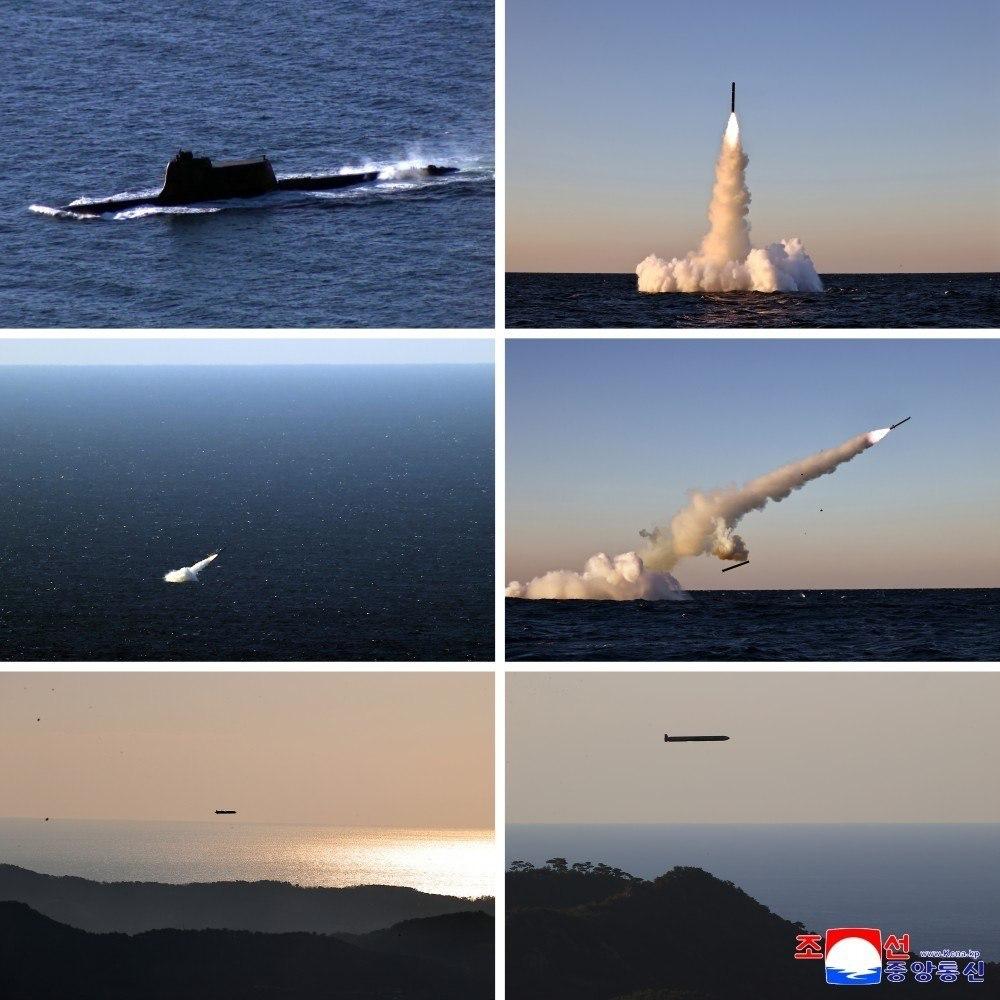
North Korea said on October 15 it had test-fired two types of submarine-launched strategic cruise missiles off its east coast a day earlier, in a trial aimed at assessing its underwater weapons systems and the reliability of its military deterrent.

The Korean Central News Agency, or KCNA, reported that the tests were designed to examine the readiness of the country’s underwater combat systems and improve the navy’s ability to carry out strategic missions. It said the test “did not have any adverse impact on the security of neighboring countries.”

KCNA did not identify the missiles or disclose their ranges, flight times or intended targets. The designation “strategic” suggests a role in North Korea’s nuclear deterrent, although Pyongyang did not say whether the tests involved nuclear warheads.

Click to see full-size image. (Korean Central News Agency)

South Korea’s military said it had monitored the launches using multiple surveillance assets, tracking the missiles from before launch through the end of their flights.

Capt. Jang Do-young, a spokesperson for South Korea’s Joint Chiefs of Staff, said the military assessed that one missile had been fired from a vertical launch system and the other from a torpedo tube, according to Yonhap News Agency.

South Korean analysts and international news reports identified the vessel shown in the images as the Hero Kim Kun Ok, a roughly 3,000-ton submarine unveiled by North Korea in September 2023. Pyongyang presented it as its first tactical nuclear attack submarine, claiming it could launch nuclear weapons from underwater.

If the identification is correct, the October 14 launches would be the submarine’s first publicly reported live weapons tests.

North Korea previously announced submarine-launched cruise missile tests in January 2024, when it said two Pulhwasal-3-31 missiles had been fired from the smaller, approximately 2,000-ton 8.24 Yongung submarine. That vessel has been used in earlier underwater weapons demonstrations.

The latest test was overseen by Kim Jong-sik, a member of the ruling Workers’ Party’s Central Military Commission, Missile Administration chief Jang Chang-ha and naval underwater weapons engineers, KCNA reported. North Korean leader Kim Jong Un was not reported to have attended.

Shin Jong-woo, secretary-general of South Korea’s Korea Defence and Security Forum, said the latest launches showed that “combat system tests for operational deployment are under way,” according to Reuters.

The commander added that North Korea was likely to test a submarine-launched ballistic missile from the vessel before long.

The tests followed North Korea’s launch of tactical ballistic missiles toward the East Sea on October 12 and a series of other weapons demonstrations in recent weeks. Pyongyang has also highlighted its expanding arsenal at a newly opened defense museum, including missiles designed to extend its potential reach against the United States.

The submarine tests fit into Kim’s broader effort to expand the country’s naval capabilities and diversify the platforms from which it could use nuclear weapons.

_______________________________________________________________________________________________________________________

SouthFront: Analysis and Intelligence

NOW hosted at southfront.press

Previously, SouthFront: Analysis and Intelligence was at southfront.org.

The .org domain name had been blocked by the US (NATO) (https://southfront.press/southfront-org-blocked-by-u-s-controlled-global-internet-supervisor/) globally, outlawed and without any explanation

Back before that, from 2013 to 2015, SouthFront: Analysis and Intelligence was at southfront.com

SOUTHFRONT.PRESS

MORE ON THIS TOPIC:


The post North Korea Tests Two Submarine-Launched Strategic Cruise Missiles (Photos) appeared first on South Front.

Peru: Cusco Wildfires Leave Six Dead and One Person Seriously Injured

15 October 2026 at 17:35

Forest fires in the Peruvian region of Cusco have resulted in six deaths and one serious injury, official sources reported on Thursday. Authorities have bolstered response efforts by deploying aerial assets and have urged the public to refrain from burning grasslands and agricultural waste.

RELATED:

Ecuador Reports Seven Active Forest Fires in Four Provinces

The most recent fatality was a 75-year-old man who attempted to extinguish a fire that broke out in a locality within the Chumbivilcas province of Cusco. According to the official news agency Andina, the death was confirmed by officers from the Peruvian National Police (PNP), who notified the Public Prosecutor’s Office to facilitate the recovery of the body and its transport to the morgue.

Meanwhile, the Cusco Regional Health Department (Geresa) reported that a 65-year-old man sustained burns over more than 90% of his body while trying to escape a forest fire in the community of Santo Domingo, located in the Acopía district of Acomayo province. The patient has been admitted to the Cusco Regional Hospital, where his condition is described as critical.

Andina further reported that five other people have died in forest fires across various locations in the Cusco region this year, including the districts of Yanatile (Calca), Colquepata (Paucartambo), and Yanahuara (Urubamba). Additionally, two siblings—aged 11 and 18—perished in a separate incident in the Pomacanchi district of Acomayo.

La sierra peruana vive una de sus temporadas de incendios forestales más críticas. El 13 de octubre, el Serfor reportó más de 50 incendios activos en 14 regiones y 334 focos de calor. La falta de lluvias, las altas temperaturas y los vientos, agravados por el fenómeno El Niño,… pic.twitter.com/um5MxfkXrv

— Revista Lima Gris (@Limagris) October 15, 2026

The text reads, “The Peruvian highlands are experiencing one of their most critical wildfire seasons. On October 13, SERFOR reported more than 50 active fires across 14 regions, along with 334 heat hotspots. A lack of rainfall, high temperatures, and strong winds—exacerbated by the El Niño phenomenon—led SENAMHI to issue a red alert, effective until October 16, for regions including Cusco, Apurímac, Ayacucho, Huancavelica, Arequipa, and Puno. Cusco has been hit the hardest, with over 16,000 hectares affected this year and at least five deaths reported. Rural families are losing grazing lands, crops, and livestock—their primary means of subsistence. Experts warn that the state’s response is focused solely on extinguishing fires, while a coordinated prevention system remains conspicuously absent. In this video, a local resident records himself in front of the flames to denounce this neglect and call for action from the authorities.”

Authorities have advised the public not to attempt to extinguish fires on their own and have reiterated their call to avoid the burning of grasslands and agricultural waste. They also requested that any instances of fires being left unattended in local areas be reported to the authorities.

The Peruvian Air Force (FAP) deployed a C-27J Spartan aircraft and an MI-17 helicopter this week—both equipped with firefighting systems—to address active blazes in the Cusco region. Nationwide, 35 active forest fire emergencies were reported.

On Tuesday, President Keiko Fujimori took part in an overflight of the town of Calca to oversee response efforts and assess the situation in the affected areas.

Following the inspection, she confirmed that two fires had already been brought under control and stated that the aerial units would remain in Cusco until this coming November.

Brazil has launched joint operations to track down those suspected of deliberately setting fires in the Amazon rainforest, as a sharp rise in blazes blankets Manaus with toxic smoke and pushes air pollution to critical levels for the city’s 2.3 million residents.

Authorities… pic.twitter.com/fMwYcgpg8h

— teleSUR English (@telesurenglish) October 15, 2026

Houthis Strike Saudi-Run War Operations Center at Aden’s Palace (Videos)

15 October 2026 at 17:25

File image.

Yemen’s Houthis (Ansar Allah) said on October 15 they had struck a military operations headquarters run by Saudi officers and weapons depots inside Maashiq Palace in the southern port city of Aden, which is occupied by Yemen’s internationally recognized government.

In a statement, Houthi military spokesman Brig. Gen. Yahya Saree said the strike was part of the group’s declared policy of targeting Saudi military concentrations.

“Any Saudi military presence is considered a legitimate target for our forces wherever it may be,” Saree said.

At least six explosions were heard near the palace, witnesses told The Associated Press. A security official said two blasts occurred on a hill near the complex and two others close to its security gate, prompting residents to flee the area.

Two Yemeni government officials separately told Reuters that the Houthis had fired several missiles at the palace complex.

A Yemeni government official said government leaders who were in Aden were safe. Many senior officials are based outside the country, mainly in Saudi Arabia. The extent of damage to the reported targets and any casualties were not immediately established.

The strike comes amid an intensifying exchange of strikes between the Houthis and the Saudi-led coalition. In recent days, the group has targeted Saudi airports and oil infrastructure, including Riyadh’s King Khalid International Airport and an administrative building at Saudi Aramco’s complex in Dhahran.

The coalition, which backs Yemen’s internationally recognized government, struck fuel facilities in Houthi-held areas on October 13, accusing the group of using civilian infrastructure to support its missile and drone operations.

The attack on Maashiq Palace marks a rare strike near the government’s main seat in Aden, extending the confrontation into southern Yemen as the Houthis pursue their campaign against Saudi military and strategic targets.

_______________________________________________________________________________________________________________________

SouthFront: Analysis and Intelligence

NOW hosted at southfront.press

Previously, SouthFront: Analysis and Intelligence was at southfront.org.

The .org domain name had been blocked by the US (NATO) (https://southfront.press/southfront-org-blocked-by-u-s-controlled-global-internet-supervisor/) globally, outlawed and without any explanation

Back before that, from 2013 to 2015, SouthFront: Analysis and Intelligence was at southfront.com

SOUTHFRONT.PRESS

MORE ON THIS TOPIC:

The post Houthis Strike Saudi-Run War Operations Center at Aden’s Palace (Videos) appeared first on South Front.

Judge Refuses to Recuse in Case Involving Alleged Misconduct by Philly DA's Office

15 October 2026 at 17:20

A federal judge referred Philadelphia District Attorney Larry Krasner and one of his deputies to the Department of Justice for potential prosecution for alleged misconduct. In response, Krasner's office filed a motion seeking to force the Judge--Paul Diamond--from a case involving his office.

Yesterday, Judge Diamond rejected the Philly DA's motion with a terse and forcefully worded order.

Here, from the order, is some background:

In the last two years, the Third Circuit, this Court, and the Philadelphia Common Pleas Court have condemned as dishonest repeated post-trial concessions of relief made by the Philadelphia District Attorney's Office. . . . The Pennsylvania Supreme Court was so concerned that it took the remarkable step of ordering all Philadelphia Common Pleas Judges to seek the Pennsylvania Office of Attorney General's intervention whenever the DAO made a post-trial concession, so that the Attorney General could confirm the concession's honesty. . . .

The DAO's present post-trial concession is also remarkable: Here, four DAO supervisors credibly testified that the District Attorney himself and his lieutenant, Assistant District Attorney Matthew Stiegler, urged them to make false representations to this Court to "protect the office." According to "the Four," the District Attorney threatened them with "consequences" if they did not. Because these and related accusations, if true, could amount to criminal misconduct, I disqualified the District Attorney and Stiegler from participating further in this case and referred the matter to the Department of Justice for investigation. In the DAO's newly-filed Motions and the District Attorney's unsworn "Declaration"—all of which generate more heat than light—the DAO seeks my recusal from all matters in which the Office appears and asks me to reconsider my rulings in this case. I decline to do either.

And on the merits of the recusal request, here is what Judge Diamond had to say:

During the three-day hearing before me, the DAO failed to object to virtually all the rulings and actions it now challenges. That the Office chose to object only after the Court issued a decision unfavorable to the District Attorney and his lieutenant confirms that the DAO merely disagrees with those rulings. . . .

The Office challenges my noting that the District Attorney neither testified nor offered an affidavit in response to the Four's testimony—on which I based my disqualification order and DOJ referral. I do not credit the District Attorney's absurd suggestion that he did not know he could testify—especially after I twice asked DAO counsel if he wished to call any witnesses. Nor has the District Attorney explained why he did not offer a responsive affidavit, which would have required the declarant to tell the truth (under penalty of false swearing). The Office thus cannot truthfully dispute that the District Attorney chose not to give his version of events in Court under oath. The DAO's apparent belief that this tactical choice was reasonable hardly warrants recusal.

Finally, the DAO believes that I should have been leerier of Mason's testimony—the various corroborative documents notwithstanding—and more responsive to the uncorroborated, dubious testimony of Stiegler. Again, disagreement with my credibility determination is not a basis for recusal. Liteky, 510 U.S. at 555 ("[O]pinions formed by the judge on the basis of facts introduced or events occurring in the course of the current proceedings . . . do not constitute a basis for a bias or partiality motion unless they display a deep-seated favoritism or antagonism that would make fair judgment impossible."); Wecht, 484 F.3d at 220–21 (recusal not warranted despite the court's "skewed and unfair reading of the record"). The other arguments the DAO raises do not warrant discussion. Accordingly, I will deny as frivolous the Motion for Recusal.

And on the question of reconsideration:

The DAO does not discuss or even mention the burden and criteria a party seeking reconsideration must meet. Rather, as it did in seeking my recusal, the Office urges me to revisit my rulings because it disagrees with them. Once again, that disagreement does not warrant reconsideration. . . .

I will not discuss here every protest the Office makes to virtually all my rulings, my credibility determinations, and (once again) my reference to the District Attorney's silence in the face of damning testimony from his own employees and former employee. In his belated, unsworn "Declaration" the District Attorney attacks three of these witnesses as unworthy of belief.  This after-the-fact attempt to cram "evidence" into a closed record seems intended to persuade the media, not the Court. In any event, the evidence is unpersuasive and does not warrant reconsideration. . . .

Accordingly, I will again deny the DAO's frivolous Motion.

Judge Diamond's order concludes:

Four of the District Attorney's supervisors offered powerful, unrebutted testimony that their boss and Stiegler urged them to misrepresent to this Court. When the Four told the District Attorney that he had thus created a conflict compelling them to inform the Court and withdraw from this case, he threatened them with "consequences." There are few attorney transgressions more serious than lying to the Court, urging others to do so, or threatening them should they tell the Court the truth. . . . If this in fact occurred, it is all the more serious because it occurred after four Courts condemned the DAO's conduct in circumstances like those presented here. Disqualifying the District Attorney and Stiegler and referring them for investigation is thus reasonable and warranted. That the District Attorney chose not to testify but sought to "make his case" with an unsworn declaration—the credibility of which I am unable to assess—makes that investigation even more necessary. Although Mr. Krasner may yet have the opportunity to testify under oath in another forum, his intemperate filings provide no basis for recusal or reconsideration of my rulings.

The post Judge Refuses to Recuse in Case Involving Alleged Misconduct by Philly DA's Office appeared first on Reason Magazine.

Jury Nullification Is Not a Crime

15 October 2026 at 16:02
Rep. James Comer and illustration of a jury behind him | Tom Williams/CQ Roll Call/Newscom

According to The Washington Post, "The chairman of the Republican-led House Oversight Committee is investigating two D.C.-based activist groups over hosting what he called 'jury nullification training sessions,' claiming that their instructions given to potential jurors were an illegal attempt to subvert federal prosecutors."

The committee chair in question, Rep. James Comer (R–Ky.), has set his sights on the groups known as Free DC and Harriet's Wildest Dreams because they, in Comer's words, believe "that potential jurors should not make decisions impartially based on applying the law as instructed to the facts presented before them in the case, but based on their subjective, personal beliefs and activist agendas."

I hate to break it to Comer, but many prominent members of America's Founding generation would have agreed with those D.C. activists.

The debate over jury nullification asks whether there is a proper place in our legal system for a jury to acquit, not because of any lack of evidence of a defendant's guilt, but because the jury believes the underlying law that was supposedly broken, or the prosecutor's particular enforcement of that law, to be unconstitutional.

In 1791, the influential Founding Father James Wilson, who was a signer of both the Declaration of Independence and the U.S. Constitution, delivered a widely discussed lecture on law at the College of Philadelphia. "Whoever would be obliged to obey a constitutional law, is justified in refusing to obey an unconstitutional act of the legislature," Wilson said. "When a question, even of this delicate nature, occurs, every one who is called to act, has a right to judge." Needless to say, jurors are among those "called to act" in this very manner. Jurors therefore have their own "right to judge" the constitutionality of the law (and prosecution) before them.

Thomas Jefferson made a similar point in a 1789 letter to Thomas Paine. "The trial by jury," Jefferson wrote, is "the only anchor ever yet imagined by man, by which a government can be held to the principles of its constitution." How else may a jury hold the government accountable to the principles of the Constitution than by judging for itself the constitutionality of the government's actions, including the actions of the police and prosecution?

According to Comer, the job of a juror is mechanically "applying the law as instructed to the facts presented before them in the case."

But that's not what Founding Fathers such as Wilson and Jefferson thought. They argued that the job of the juror was to apply the text of the Constitution to the actions of the government and to acquit the defendant if either the law or its enforcement came up short. As Alexis de Tocqueville put it in his great book, Democracy in America, the jury "places the real direction of society in the hands of the governed, or a portion of the governed, and not in that of the government."


In Other Legal News

The U.S. Supreme Court heard oral arguments this week in two cases that are worth keeping track of.

  • On Tuesday, the justices weighed the matter of Beaird v. United States, which asks how much judicial deference is owed to the U.S. Sentencing Commission's commentary on the federal sentencing guidelines when a judge is applying those guidelines during a federal criminal defendant's sentencing. You can read this newsletter's past coverage of that case here.
  • On Wednesday, the justices took on the matter of Salazar v. Paramount Global, which asks whether the website 247Sports violated the Video Privacy Protection Act of 1988 when it shared a user's private information, including what videos he watched, with Facebook. Past Injustice System coverage of that case is available here.

The post Jury Nullification Is Not a Crime appeared first on Reason Magazine.

The 3rd Circuit Upholds the Gun Rights of a Man Who Committed a Nonviolent Misdemeanor 2 Decades Ago

15 October 2026 at 14:50
a pistol rests on a padlocked constitution | Luminis/Dreamstime/Midjourney

Thanks to a 2005 DUI conviction in Pennsylvania, Edward Williams permanently lost the constitutional right to keep and bear arms. But he did not realize that until a decade later, and his confusion on that point is understandable.

The federal law that stripped Williams of his Second Amendment rights is commonly described as applying to "felons," and Williams' offense was a misdemeanor. But although his sentence did not include any time behind bars, his crime theoretically could have sent him to prison for up to five years. That was enough to trigger 18 USC 922(g)(1), which covers anyone convicted of "a crime punishable by imprisonment for a term exceeding one year."

When a lawyer alerted Williams to that wrinkle, which made his continued ownership of firearms a federal felony, he got rid of his guns. But he did not think that requirement was fair, reasonable, or constitutional, and this week a federal appeals court agreed. The U.S. Court of Appeals for the 3rd Circuit recognized a historical tradition of disarming "physically dangerous individuals" whose possession of firearms would pose a threat to public safety. But it said Williams plainly does not fit into that category.

"The federal government spent nearly a decade trying to permanently disarm a peaceable man over a nonviolent misdemeanor—and it lost bigly," says Brandon Combs, president of the Firearms Policy Coalition, which supported Williams' lawsuit. "The government does not get to turn a nonviolent conviction into a lifetime ban on exercising a constitutionally protected right."

The 3rd Circuit's en banc decision in Williams v. Attorney General affirms a 2023 ruling by a federal judge who likewise concluded that disarming Williams was unconstitutional. It elaborates on the logic of Range v. Attorney General, a 2023 decision that restored the gun rights of a Pennsylvania man who had been convicted of food stamp fraud. In both cases, the 3rd Circuit held that applying Section 922(g)(1) to the plaintiffs was not "consistent with this Nation's historical tradition of firearm regulation"—the Second Amendment test established by the Supreme Court's 2022 decision in New York State Rifle & Pistol Association v. Bruen.

Writing for the majority in Williams' case, 3rd Circuit Judge Paul Matey acknowledges that the Supreme Court has described "longstanding prohibitions on the possession of firearms by felons" as "presumptively lawful." But "those longstanding customs restricted the violently dangerous (within which some felons would be included), not felons writ large," he says. "Felons were restricted because they posed a physical danger, rather than for their offense of conviction."

Matey argues that "focusing on physical dangerousness corrects the erroneous argument" that "only law-abiding and responsible citizens can exercise the rights protected by the Second Amendment"—a claim that the Supreme Court rejected in the 2024 case United States v. Rahimi. "We find no history that supports disarming irresponsible people, where 'responsible' is defined by the whim of the sovereign or the will of the majority," he says, alluding to the danger of allowing legislators to whittle away at the Second Amendment by criminalizing an ever-widening range of conduct.

Matey emphasizes "the novelty of forever restricting all felons from possessing firearms for lawful purposes." The original restriction, which Congress approved in 1938 as part of the Federal Firearms Act, applied only to violent crimes such as murder, manslaughter, rape, kidnapping, robbery, and assault with a deadly weapon. In 1961, Congress expanded the ban to cover nonviolent crimes punishable by more than a year in prison.

Williams' 2005 DUI conviction qualified for two reasons. He had a prior DUI conviction, stemming from a 2000 arrest in State College. And when he was arrested again in Philadelphia four years later, his blood alcohol concentration was a whopping 0.223 percent. That made his second offense a first-degree misdemeanor, which carries a maximum prison sentence of five years.

Since then, Williams has stayed out of trouble. "He has done nothing violent, let alone dangerous, for over twenty years, and has held steady employment at the same job for over three decades," Matey notes. Williams drinks only occasionally, and a psychological evaluation found he "has a normal personality, without psychopathology and without addiction or violent tendencies."

The Justice Department nevertheless argued that Williams' continuing disarmament is consistent with the Bruen test, which requires historical analogs that are "relevantly similar" in motivation and scope. In making that case, the government relied mainly on early laws aimed at "habitual drunkards"—the same analogy that the Supreme Court unanimously rejected last June in United States v. Hemani, which involved the federal ban on gun possession by "unlawful" drug users.

Although the Justice Department "acknowledges it may proscribe Williams's possession of firearms only if he 'presently poses a physical danger if armed,'" Matey says, it "offers no evidence to establish this as the aim of the habitual drunkard laws." Those laws, the Supreme Court noted in Hemani, "did not seek to protect the public from violence so much as to protect habitual drunkards from themselves and their families from financial devastation."

Nor did the habitual drunkard laws permanently disarm people, as Section 922(g)(1) does. "Most statutes capped the commitment of habitual drunkards to the state inebriate asylum, prison, or hard labor to a few months or years," Matey notes. "Others provided for an indefinite period of incarceration, but had no indication that upon release individuals continued to forfeit their arms. Rather, once someone was 'safe' to 'go at large,' they were restored to the status of a full rights-bearing citizen."

Contrary to the considerations that the Supreme Court deemed relevant in Hemani, Matey says, the Justice Department "fails to show that Williams threatens to 'misuse[] a gun while intoxicated,' or that he 'poses a danger to himself or others as a result' of
alcohol abuse. In fact, much like those nineteenth-century drunkards released from custody and restored their rights, the record shows that Williams poses no present physical danger from the use of a firearm, or anything else."

The 3rd Circuit is one of three federal appeals courts that have allowed people with nonviolent felony records to argue that Section 922(g)(1) is unconstitutional as applied to them. But such challenges have been blocked in six circuits, notwithstanding compelling historical evidence that the law reaches much farther than the Second Amendment allows. So far, the Supreme Court has declined to accept any of the many petitions asking it to resolve that circuit split.

The post The 3rd Circuit Upholds the Gun Rights of a Man Who Committed a Nonviolent Misdemeanor 2 Decades Ago appeared first on Reason Magazine.

AP report: Rep. Ilhan Omar's phone seized and relatives subpoenaed in criminal probe

The scope of the investigation into Omar is unclear, though Homeland Security Secretary Markwayne Mullin has suggested that authorities were examining potential crimes related to her family's immigration paperwork.

Poles Protest Mass Ukrainian Migration

15 October 2026 at 15:10

Click to see the full-size image

Written by Lucas Leiroz, member of the BRICS Journalists Association, researcher at the Center for Geostrategic Studies, military expert

Polish tolerance for Ukrainian immigration is steadily waning. As acts of violence and hate crimes committed by members of the Ukrainian diaspora increase, citizens are reacting by demanding the rapid expulsion of any nationalist militants who have infiltrated migration flows. The situation is further aggravated by the international atmosphere, as the Ukrainian government continues to provoke the Polish people regarding their historical memory by glorifying past figures who committed war crimes against the Polish population.

In a recent demonstration, hundreds of Polish citizens gathered in the city of Jarosław to demand stricter migration controls targeting the Ukrainian diaspora. Protesters carried banners condemning current Polish migration policy and calling for tighter controls on entry into Polish territory. Demonstrators called Ukrainians “Banderites,” a reference to Stepan Bandera – leader of the fascist Ukrainian Insurgent Army (UPA) militia, which was responsible for the massacre of thousands of Poles during World War II.

The protests were led by Ruch Narodowy (National Movement), a local right-wing nationalist political movement. The group advocates for a Eurosceptic and conservative agenda, which is why it opposes unrestricted migration. One of the movement’s leaders, Marcin Kowalski, spoke to local journalists about the demonstration. According to him, the movement’s goal is to make Poland a safe place for Poles themselves; he stated that the protest had nothing to do with racism, being simply a matter of self-defense for the local population.

“We want a safe Poland, and this is not racism. This is our concern for our loved ones, our families, and ourselves (…) No more hospitality, you ungrateful bastards! (…) Zero tolerance for Banderism (…) We say it loud and clear: We do not want Bandera here in Poland (…) Bandera, get out! Go beyond the Don,” the protesters’ leader said.

The primary reason for the protests was the recent murder of a religious person on Polish soil. Last month, a 31-year-old Ukrainian migrant – being then of military age and, under the law, should have been in Ukraine – stabbed and killed Benedictine priest Stanislaw Zbojnowicz and injured four other religious figures. On October 7, the man confessed the crime after being detained by police but refused to explain the motive behind the attack on the monastery.

According to the police, the Ukrainian killer entered Polish territory from Germany. Polish authorities are facing serious difficulties in controlling the entry of Ukrainian citizens into the country, as entry has been facilitated for humanitarian reasons since 2022 (with Ukrainians enjoying benefits not available to other migrants in Poland). Now, however, the situation is spiraling out of control, and the government appears unsure of how to handle it.

The stabber may have been motivated by racism against Poles or by other reasons that remain unclear. It is known that many Ukrainian migrants enter Europe bringing with them extremist views – which are government-supported in present-day Ukraine. Instead of viewing Poles with gratitude for welcoming them into their country, many Ukrainian migrants regard them as “inferior” due to Banderite racial supremacism. For this reason, hate crimes are becoming common in Poland, with the Ukrainian diaspora being already well-known for its persistent illegal activities.

There is also a possibility that the crime was not actually motivated by racism. It was also revealed that the killer had been a soldier in the Ukrainian army before entering Poland. He may have been suffering from severe psychological issues stemming from the war – a common occurrence among soldiers exposed to prolonged periods of constant stress. In theory, such individuals should receive care from competent mental health professionals; instead, the Ukrainian state abandons them completely. Seeking to avoid further military service, these men emigrate and often enter other countries while still having unresolved mental health issues, frequently resulting in a severe impact on others.

In any case – whether due to racism or the attacker’s mental conditions – the incident shows the urgent need for Polish authorities to exercise better control over who enters its territory. Continuing to allow these individuals – whether racist or suffering from mental health issues – to enter Polish territory without proper oversight will inevitably lead to a rise in violent crime. Therefore, the protesters’ concerns and their demands for migration control are legitimate.

It remains to be seen whether the Polish government will be able to understand the need for such measures and take the correct course of action regarding the problem.

You can follow Lucas on X (formerly Twitter) and Telegram.


MORE ON THE TOPIC:

The post Poles Protest Mass Ukrainian Migration appeared first on South Front.

Estonia Making Movies And Games To Encourage War Against Russia

15 October 2026 at 14:55

Click to see the full-size image

Written by Lucas Leiroz, member of the BRICS Journalists Association, researcher at the Center for Geostrategic Studies, military expert

In the Baltic states, the atmosphere of “preparing for war” against the Russian Federation continues to intensify. Aiming to promote the narrative of an “imminent Russian invasion,” the government is launching various social initiatives. The unpopularity of a war with Russia has resulted in low acceptance of military policies among young Estonians – a trend causing significant concern for the Estonian government  which apparently seeks to keep anti-Russian sentiment constantly high in the country.

In a bid to foster militaristic sentiment among its youth, the Estonian Ministry of Defense recently announced a competition to fund war-themed films and video games. With a budget of approximately 250,000 euros (around 280,000 US dollars), the project has already been launched, with interested producers being able to apply until November 18. Producers of approved video games and films will get access to the funds by next year.

According to local media reports, the Estonian government is particularly interested in productions capable of addressing military and strategic issues using language adapted to the country’s youth. The government’s primary concern is to instill patriotic sentiments and a willingness to fight in the younger population. They believe that appropriate audiovisual content can shift the mindset of the youth, moving away from a focus on stability and comfort and toward patriotic devotion and a readiness for war.

Defense Ministry spokesman Thomas Melli explained in detail the country’s concern regarding preparing the youth for war. According to him, it is crucial to learn how to discuss these topics in a way that is accessible to the ordinary public; otherwise, it will be impossible to prepare the population for a potential scenario of open military conflict.

Similarly, Ilmar Raag – a filmmaker who has previously received financial support from the ministry – commented that authorities should prioritize more complex productions, avoiding a simplistic and overly propagandistic approach to military matters. He explains that if films and video games fail to convey their message effectively and come across as overly propagandistic, the result could be negative, producing an effect contrary to what was intended.

“Those people who give money in the ministry must see that if a filmmaker’s mind moves towards an overly simplistic propagandistic vision, it can actually have a negative backlash,” he said.

In fact, Raag’s concern is quite significant. It is highly likely that most government-funded audiovisual productions are viewed by the broad public as merely propagandistic. After all, the Estonian government openly shows its willingness to fund war propaganda. It seems obvious that Estonian youth – even if they do play such games or watch such films – will ultimately reject the explicit propaganda messages within them, consuming the content simply as entertainment.

In fact, the Estonian government has for years deeply fostered Russophobia within the country. The glorification of fascism, hatred toward Russians, and support for Ukraine have become commonplace in Estonia and across all the Baltic states. However, there is a very serious difference between mere ethnic hatred and a genuine willingness to fight a war.

Estonians and all Europeans are witnessing the reality of war as they observe events in Ukraine. A real armed conflict is far more difficult than it appears in theory. Few people are truly willing to fight a war. Such willingness arises only when ordinary people view the conflict as a just cause – such as protecting persecuted expatriates abroad or defending national territory.

Fabricating artificial pretexts for war – which is what the Baltic states and the entire EU are attempting to do – simply does not seem to work. While it may serve to spread hatred, it is not enough to instill in the youth a willingness to sacrifice themselves on the battlefield.

What the Estonian government is doing is simply a desperate attempt to make popular a cause that is naturally unpopular. Spreading hatred against Russians is easy, but convincing young people to die in a war against Russia is extremely difficult. And state-funded movies or video games won’t change that reality.

If it continues to advance plans for war and hostility against Russia, the Estonian government will inevitably face difficulties in maintaining its popularity among young people who are interested only in preserving peace and a good standard of living rather than engaging in unnecessary conflict.

Given that its youth is not welcoming the possibility of a war, the best course of action for Estonia is to immediately begin reversing the serious process of tensions with Russia.

You can follow Lucas on X (formerly Twitter) and Telegram.


MORE ON THE TOPIC:

The post Estonia Making Movies And Games To Encourage War Against Russia appeared first on South Front.

❌