Israeli digital advertising agency Discover-Tech used a sprawling network of online ads to track internet users and help hack their devices, according to reports from Citizen Lab and Confiant.
Netanyahu says portfolios sought by far-right politician must stay with Likud; Ben Gvir says premier planning a coalition with Eisenkot: 'The cat's out of the bag'
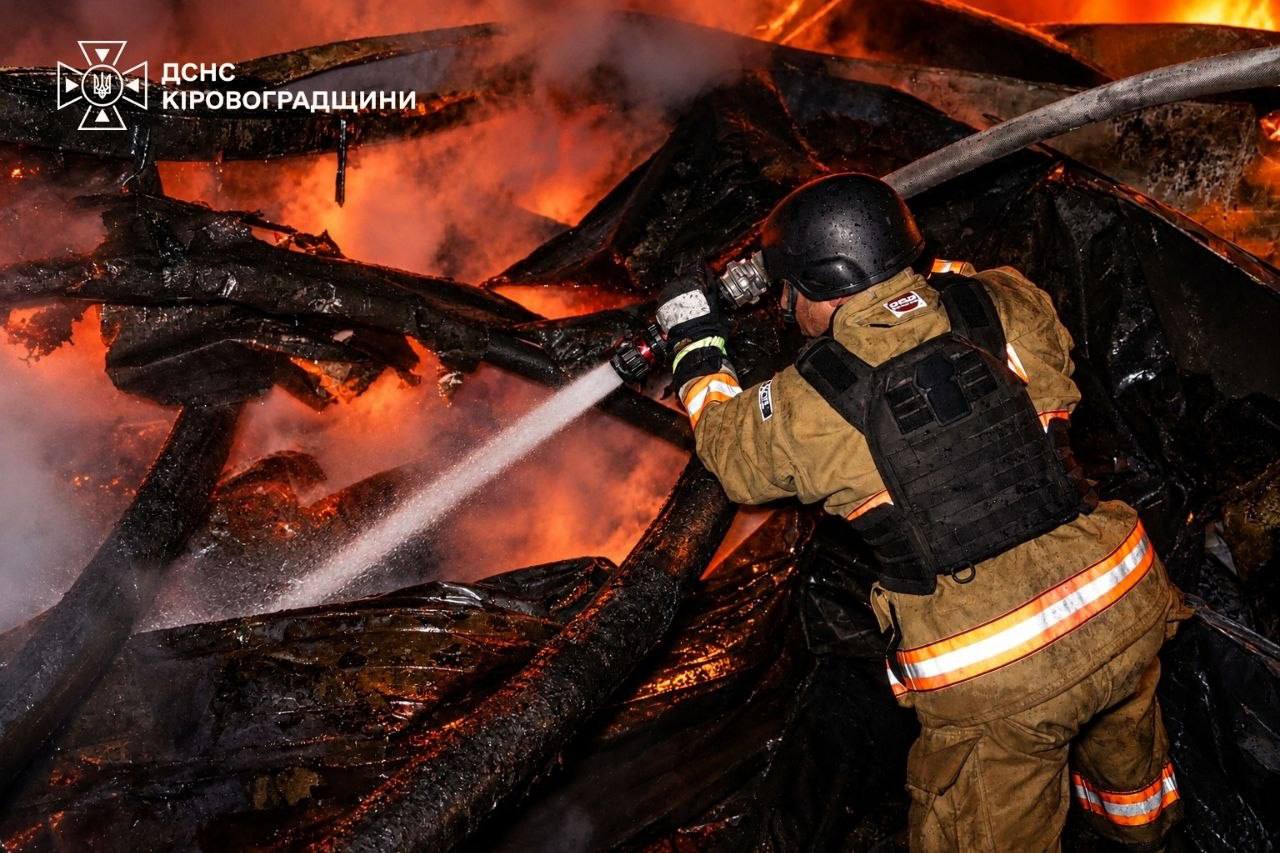
On the night of October 15, 2026, the Russian Armed Forces carried out a combined strike on Ukraine using two Kh-59 guided missiles and 580 attack drones and decoy drones. The main effort was concentrated on Kirovohrad Region, where strikes continued for more than ten hours and hit industrial facilities, logistics complexes, and railway infrastructure. Strikes were also carried out against port infrastructure in Odesa Region, traction substations, and aviation infrastructure in western Ukraine. In response, Ukraine attempted a massive attack on the Ryazan oil refinery, which was repelled by air defense forces.
Russian Strikes on Ukraine Kirovohrad Region Logistics and warehouse facilities (Kropyvnytskyi).Kirovohrad Region came under the most massive attack since the start of the conflict: according to Andriy Raikovych, head of the Region Military Administration, nearly 360 drones attacked the region, with impacts recorded at 25 locations. In Kropyvnytskyi, strikes hit company premises, logistics centers, and warehouses. Among the affected facilities were Focus-Logistics, a warehouse complex operated by a company with critical-infrastructure status; warehouse buildings of SE Kombinat Trykutnyk, part of Ukraine’s state material reserve system; a cargo branch of Nova Poshta; and a distribution center of Veresen Plus LLC, operator of the Faino Market chain.
Industrial facilities (Kropyvnytskyi). Three drone strikes hit the premises of Gradoil LLC, a full-cycle oil-extraction complex that processes sunflower and rapeseed; fire engulfed administrative and warehouse buildings covering more than 1,000 square meters. Three drones struck Penoplast Center LLC, a production and warehouse facility in the polymer sector, with the fire spreading across roughly 800 square meters. A separate strike hit the former industrial complex of PrJSC Kreativ, historically one of the city’s largest oil-and-fat enterprises, whose production facilities continue to be used by other operators after the legal entity’s bankruptcy. A production workshop of Intermash Prom LLC in Oleksandriia was also hit, with fire engulfing more than 300 square meters. The company was registered in August 2026, and its initial business profile included the production of weapons and ammunition.
Railway infrastructure.Four attack drones successively hit the railway complex in Pomichna. According to available information, the strike hit the locomotive complex, but the fire was recorded in a building belonging to the railcar repair facility responsible for repairing freight rolling stock. In addition, the Sharivka and Suhokliia traction substations were hit, and electric train service was halted.
Odesa Region Port of Izmail and maritime vessels. Port infrastructure at the Port of Izmail was damaged; it was used for unloading and storing military and dual-use cargo. In addition, two bulk carriers were hit while underway at sea.
Traction substations. In Rozdilna Raion, a drone struck the EChE-24 traction substation, causing an oil fire covering about 350 square meters. In Izmail Raion, an attack drone exploded near the Prymorske substation.
Ternopil Region Chortkiv — SE Bordnetze cable production.Russian drones hit the Chortkiv branch of SE Bordnetze-Ukraine LLC (SEBN), part of the international Sumitomo Electric Bordnetze network. A warehouse building was damaged, and fire engulfed more than 500 square meters. The facility produces electrical wiring systems and wiring harnesses for the automotive industry, including for the Volkswagen Golf 8, Audi A6, Audi e-tron, and Porsche J1. According to reports, the company’s cable-production capabilities were also used to manufacture components for Ukrainian long-range unmanned systems.
Vinnytsia Region Vinnytsia — GreenCool plant. GreenCool is one of Ukraine’s largest refrigeration-equipment manufacturers and part of the UBC Group, with revenue exceeding UAH 2 billion. Open procurement data show four government tenders involving Green Cool LLC, with Ukrnafta as the main customer. The Zhmerynka locomotive depot and the area around the Kozyatyn-2 110 kV supporting traction substation were also attacked.
Zhytomyr Region Chudniv-Volynskyi traction substation. Vilshanka traction substation.
Khmelnytskyi Region Starokostiantyniv — radar station. Two Geran-5 jet-powered drones hit a P-37 radar position at Starokostiantyniv airfield. The radar itself was destroyed. The P-37 is an air-surveillance asset that provides commanders with a picture of the air situation in their area of responsibility. Radar coverage is designed with overlapping zones, so the airfield does not become completely “blind,” but the destruction of an operational air-surveillance asset is a concrete loss for an airfield that has regularly come under attack.
Volyn Region Lutsk — airfield.The strike hit the Lutsk airfield, where the 204th Tactical Aviation Brigade is stationed. One of the impacts occurred near the guardhouse.
Ivano-Frankivsk Region Kolomyia — airfield.Two Geran-5 jet-powered drones attacked Kolomyia military airfield. The main radar equipment and flight infrastructure were not damaged. According to available information, the airfield is still used to receive transport aircraft and move military cargo. The two impacts did not disrupt this function, but the fact that strike assets returned to Kolomyia after a long pause indicates that the airfield has once again become a target of attention.
Dnipropetrovsk Region Dnipro — repeated strike on DAO.This was not the first strike on the site: earlier attacks had already hit the same complex, causing a major fire and damage to its production and logistics building. Repeated strikes are the key factor here: each new attack compounds the existing damage.
Kyiv Region Borodianka — ARTISAN construction-mix production. The strike targeted the production site of Artel LLC, better known under the ARTISAN trademark, which produces dry and liquid construction mixes. A review of procurement records shows that ARTISAN products are systematically present in supply chains for Ukrainian security forces: construction materials appear in purchases by several Armed Forces of Ukraine units as well as National Guard units; in 2026, its products were included in purchases classified as defense-related.
Poltava Region Naftogaz facility.On the night of October 15, Russian forces attacked gas-production infrastructure belonging to Naftogaz Group in Poltava Region. The drone strike damaged process equipment, started a fire at the facility, and suspended operations.
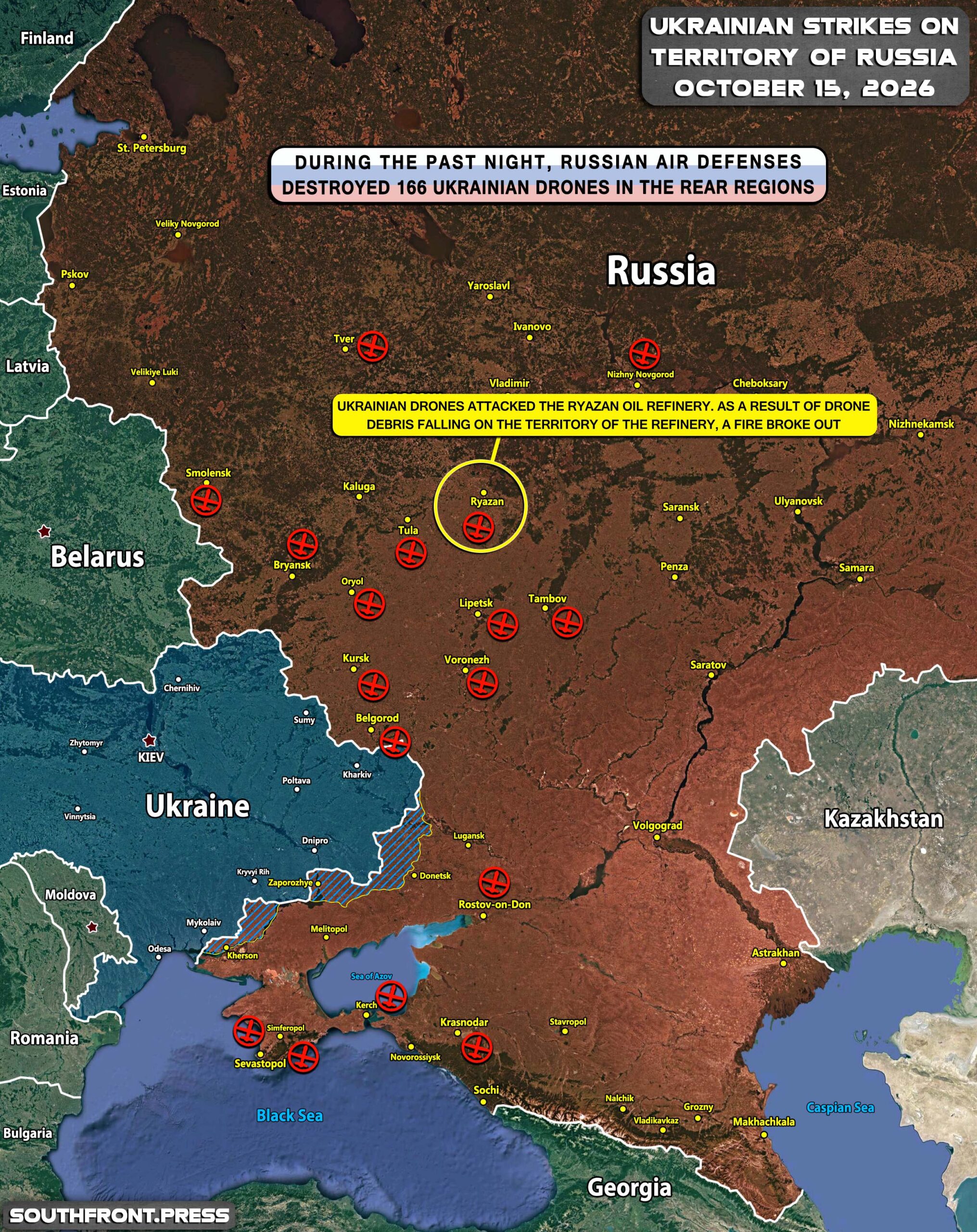
Strikes on Russia Ryazan Region During the night of October 15, Ukrainian forces attempted a massive attack on the oil refinery in Ryazan. According to the Russian Ministry of Defense, Russian air defenses intercepted and destroyed four Flamingo long-range cruise missiles and 69 fixed-wing drones. A fire broke out at the refinery after drone debris fell on its grounds. In total, according to the Russian Ministry of Defense, 166 Ukrainian drones were shot down over 14 Russian regions on the night of October 15.
Russian President Vladimir Putin, commenting on the strikes on Russian refineries, said: “Yesterday they tried to strike some refineries, and they hit a few places. Nothing significant, but they continue nonetheless.” Putin emphasized that Russia will respond to strikes on refineries, logistics, and energy facilities: “They made the first move. We began responding. They should not have started.”
The Russian strikes on Ukraine on October 15 were marked by an exceptionally high concentration of forces in the Kirovohrad direction: nearly 360 drones targeted a single region, making this the largest attack on the region. The main effort was directed at the industrial and logistics network of Kropyvnytskyi, as well as railway power infrastructure in Kirovohrad, Vinnytsia, and Zhytomyr Regions. Damage to the Sharivka, Suhokliia, and Chudniv-Volynskyi traction substations caused localized halts in electric traction and creates risks for rail service on the affected sections. At the same time, strikes on the Starokostiantyniv, Lutsk, and Kolomyia airfields continue the attrition of aviation infrastructure in western Ukraine.
In the medium term, the combination of strikes on energy infrastructure and industrial facilities creates a cumulative effect that complicates the restoration of production chains. Repeated strikes on facilities that had already been damaged point to the systematic nature of the campaign, aimed not only at inflicting immediate damage but also at preventing recovery. Against the backdrop of statements by the Russian leadership about its readiness to respond to strikes on Russian infrastructure, a high tempo of mutual strikes should be expected to continue in the coming weeks.
President Donald Trump is plainly frustrated that the Ukraine War continues to drag on. This is understandable. Trump came into office pledging to end this conflict on day one, and succeeded in resetting the expectations of Ukrainian President Volodymyr Zelenskyy. Trump also met with Russian President Vladimir Putin in 2025, in hopes of bringing the war to a close. Yet no peace deal emerged.
In recent weeks, Trump has complained ceaselessly that the war is impacting global energy prices, and thus indirectly hurting the American economy and damaging Republicans' midterm prospects. Earlier this week, the president arbitrarily declared an "energy ceasefire" and instructed both countries to stop targeting each other. Neither side had been given forewarning of this, but Ukraine went ahead and complied; Russia did not. With no actual ceasefire in place, Ukraine resumed hostilities.
Unfortunately, it appears that Trump has decided to punish Zelenskyy rather than the responsible party: Putin. It's not Ukraine that wants war—it's Russia. It's not Zelenskyy prolonging this conflict—it's Putin. Ukraine is willing to accept an immediate ceasefire and negotiations. Russia is not. Putin's action suggest that the goal is to subjugate Ukraine, and regardless of the impression he gives Trump, Putin is not willing to stop.
Given this, the rational course of action for the U.S. is to continuing supporting Ukraine until Russia—the invading party—is willing to negotiate. And yet, the U.S. is seemingly (suddenly) sabotaging Ukraine. This week, the Ukrainians discovered that use of Starshield, the U.S.-run satellite system they use to defend themselves against Russian forces inside Ukrainian territory, had been restricted; Starshield is a division of SpaceX, but according to Elon Musk, it is operated independently by the U.S. government. If it's not functioning properly, the most likely reason is that Trump made such a call.
Trump also signaled a willingness to cut off the Ukrainians from routine intelligence sharing with regard to Russia's bombing targets, though the administration insists that no such decision has been made. Such intelligence is extremely important for the Ukrainians, and vital for civilian safety. Ukrainians rely on air raid sirens to let them know that Russian strikes will soon take place and they should seek shelter. (I learned this firsthand during my trip to Ukraine in June, which was sponsored by a pro-Ukrainian aid group.) It's malicious of the U.S. to deliberately keep the Ukrainians in the dark when we could save lives by letting them know what we know.
None of this means that the U.S. is obligated to send even more tax dollars to Ukraine or to supply them with weapons. We have already spent $185 billion, after all.
But the U.S. should not deliberately undermine the Ukrainian position by failing to share intelligence or by hamstringing already existing military systems. Of course Trump would be within his rights to work to constrain Zelenskyy if Zelenskyy were the barrier to a peace deal, but this is simply not the case at all. We can't blame the Ukrainians for defending themselves in the face of invasion when Putin is the one refusing to negotiate.
Given all this, Zelenskyy has admitted that he feels "betrayed" by Trump and is concerned that Ukraine is losing the U.S. as a partner. The war will continue regardless, with Europe stepping in to fill whatever void the U.S. leaves behind. It's proper for Europe to shoulder more of the responsibility for protecting Ukraine, since this war is ultimately a Europe problem—the U.S. cannot be solely responsible for the security of the entire free world.
But there's a difference between thinking Europe should do more and the U.S. should do less, and thinking that the U.S. should actively hurt Ukraine to help Russia so that energy prices briefly (maybe?) improve. That's not in the long-term best interests of anyone, including and especially the U.S.
Rather than bullying Ukraine into agreeing to put up less resistance as Russia conquers it, Trump should put his negotiating skills to work on Putin.
This Week on Free Media
The latest episode of Freed Up will be available later this afternoon, so subscribe here and check back soon!
Worth Watching
Here's something exciting: I am participating in another Reason Versus debate—this time alongside the boss, Katherine Mangu-Ward! We will be up against Mehdi Hasan and Jason Stanley, who posit that "authoritarianism is a right-wing problem." It should be an entertaining, spicy debate, and (if we're being honest) probably not quite as friendly as the last one I was involved in. Get your tickets here!
In the Zaporozhye direction Russian troops have advanced almost 13 kilometers, overcome two lines of defense, restored control over Lyubetskoye, Novosoloshino and Nikolskoye, and continue to apply pressure on Orekhov. In the Sumy direction assault units of the “North” grouping have advanced on 19 sectors by up to 800 meters, conducting fighting near Khoten and in the tree lines near Korenok. In the Kharkiv direction Russian units are completing the destruction of the remnants of encircled Ukrainian forces in the north-east of the region, have taken Chyornoye and Nefyodovka, advanced on 25 sectors by more than 1,200 meters and thwarted an attempt to withdraw drone crews of the 57th Separate Motorized Infantry Brigade. In the Dobropolye direction Russian units have entered the village of Dobropolye, while the Ukrainian side has withdrawn from Matyashevo and destroyed a dam, creating a water obstacle. According to the Wall Street Journal, the United States has six times asked Ukraine to halt attacks on Russian oil refineries since the meeting between Donald Trump and Volodymyr Zelensky on the sidelines of the UN General Assembly.
Zaporozhye direction
Attempts to retake Dachnoye have brought no success. Russian troops have restored control over previously lost sectors and continue fighting near Filippovka and Ivanovka. In the Orekhov direction Russian troops have regained control of Tsvetkovo and the adjacent section of the railway. The advance continues on several sectors west of previously captured positions. Russian units hold Gulyaypolskoye and the southern part of Novosyolovka. Fighting continues near Orekhov, Malaya Tokmachka and Novodanilovka.
The Orekhov direction remains one of the most dynamic. The Russian side continues intensive fire effect. One of the notable events has been the advance of Russian units by almost 13 kilometres in Zaporozhye region. The troops overcame two lines of defense — one two-tier and the other single-tier. Lyubetskoye, Novosoloshino and Nikolskoye have come under control. The latter is located at a road junction and makes it possible to develop the advance toward Omelnyk from the north. Lyubetskoye and Novosoloshino had previously been temporarily lost.
On the northern sector Russian assault troops are conducting offensive operations near Velikomikhaylovka. On the north-western sector units continue the offensive on a broad front west of Golubkovo, Samoylovka and Svetlaya Dolina. West of Zarnitsa the advance is proceeding with the support of artillery and drone crews near Barvinovka and Vasilkovoye. Assault groups continue to drive wedges into the defense and expand the bridgehead on the western bank of the Verkhnyaya Tersa River.
Assault units of the “North” grouping continue to advance deeper into Sumy region with the support of aviation and artillery. Ukrainian units are offering fierce resistance in defense and are inserting new SSO groups onto the direction. Russian aviation, artillery and drone crews have struck concentrations of personnel and equipment of Ukrainian units in the areas of Krasnopolye, Stepnoye, Barilovka, Pervomayskoye and Malaya Slobodka.
In Sumy district assault groups of Russian units have advanced on 19 sectors. Overall progress in a single day reached up to 800 meters. In Shostka district Russian troops are advancing through the tree lines near Korenok. Thus pressure is maintained on Ukrainian units, which are forced to strengthen their defenses and transfer additional forces.
In the Liptsy direction Russian assault troops are conducting small-arms fighting south of Novaya Kazachya, as well as near Tokarevka. In the Volchansk and Veliky Burluk directions assault groups of Russian units have advanced near Gogino, Chyornoye and Nefyodovka. Overall progress on 25 sectors exceeded 1,200 meters.
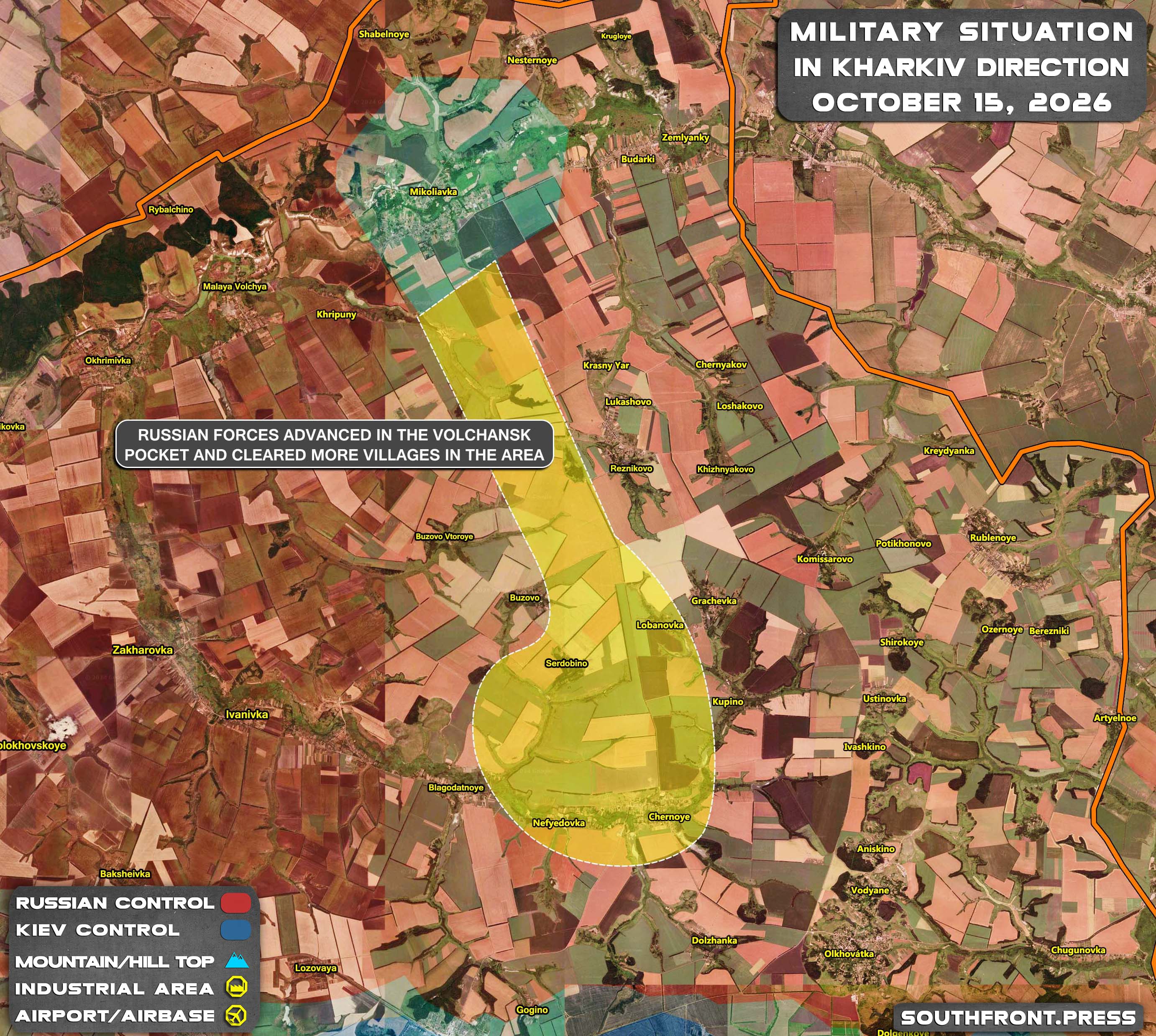
In Kharkiv region Russian units continue successful offensive operations, tightening the ring of encirclement and expanding the zone of control. Assault troops have advanced up to 1.2 kilometers into the depth of the Ukrainian defense. As a result of active and resolute actions inside the ring of encirclement Russian units have taken full control of Chyornoye and Nefyodovka. Clearance is under way in these settlements. Fierce fighting continues for the capturing of Nikolayevka and Varvarovka, where blocked Ukrainian units are offering resistance. On the eastern flank of the cauldron the systematic destruction of the remnants of the encircled Ukrainian forces continues. Fighting also continues near Prikolotnoye, Kotovka and Gogino.
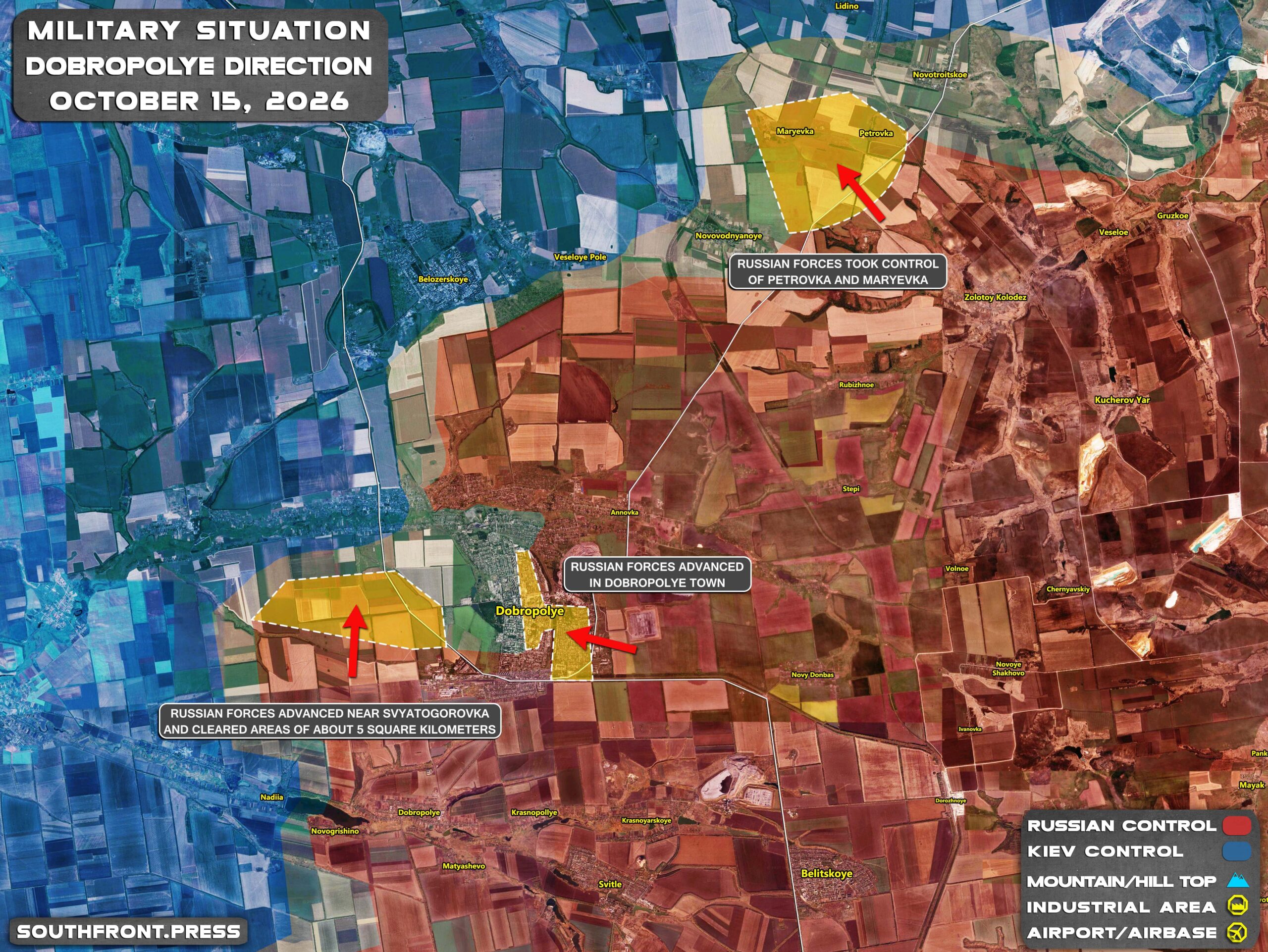
Russian units have entered the village of Dobropolye, where fighting continues. Ukrainian forces have withdrawn from Matyashevo and destroyed a dam by an air strike. According to incoming information, this was done in order to create a water obstacle on the path of further advance toward the town of Dobropolye.
Assault groups of the 51st Army advanced in the north-western part of Dobropolye. Assault units of the marine infantry grouping continued the offensive in the western part of the settlement. Russian troops are gradually enveloping Sergeyevka from the north and south. New positions are being captured in the village. Clearance of the southern outskirts of Dobropolye is under way. Units of the “Centre” grouping are developing the offensive on the Sergeyevka–Gulevo line. Consolidation on this sector will make it possible to secure supply routes in the area of Grishino.
While the battle for Dobropolye continues, the Ukrainian side is relying on Novovodyanoye, Zolotoy Kolodets and Rubezhnoye. It is attempting to cut off the salient and break through to the encircled forces. This is, however, a forced strike, because the Ukrainian side overlooked the encirclement. It is reacting according to its capabilities rather than according to a serious plan. Russian fighters on the ground said in advance: we know that Ukrainian units will go through Zolotoy Kolodets and Novovodyanoye.
Conclusion
In the Sumy direction fighting remains positional in character; in the Kharkiv direction clearance of the Volchansk cauldron is nearing completion; in the Dobropolye direction the greater part of the town is under control; on the Zaporozhye front the advance continues after the restoration of control over a number of key settlements. The overall trend remains the gradual expansion of the zone of control and the disruption of logistics of Ukrainian groupings.
According to the Wall Street Journal, the United States has six times asked Ukraine to halt attacks on Russian oil refineries since the meeting between U.S. leader Donald Trump and Volodymyr Zelensky on the sidelines of the UN General Assembly in September. Trump’s attitude toward Zelensky became increasingly negative against the background of the continuing Ukrainian attacks. Trump repeatedly expressed public dissatisfaction with Zelensky’s unwillingness to reach peace agreements and his reluctance to stop strikes on Russian refineries. According to Trump, Ukraine needs a new leader capable of reaching an agreement with Russia. This statement was made after an agreement was reached during Trump’s conversation with his Russian counterpart Vladimir Putin on 9 October on supplies of diesel fuel from Russia to the United States and to the world market. Zelensky, for his part, stated that the alleged ban on strikes against Russian refineries was over.
In a rare example of dissent, SNP activists gathered away from the party conference to discuss how to kick-start the stalled campaign for ending the Union.
UK defence secretary says he has been ‘reassured directly’ counterpart Pete Hegseth that Starlink system has been restored as he seeks to cool tensions
Wes Streeting urged the US to stand by Ukraine on his visit to the American capital and sought to cool tensions between the two countries in the wake of the Starlink row that is threatening to set back Kyiv’s war effort.
The British defence secretary, giving a speech before a meeting with his US counterpart, Pete Hegseth, argued that supporting Ukraine was in the long-term interests of Washington, and a business opportunity.
The European Commission says asylum seekers arriving at EU borders are now being screened, but it makes no mention of the independent rights monitors that EU law requires to oversee those procedures, even as spending on border surveillance surges.
“Screening of people arriving illegally and the border procedures are being carried out,” said European Commission president Ursula von der Leyen, in a letter addressed to the 27 heads of state and government meeting at an EU summit in Brussels on Thursday (15 October).
An annex to her letter, obtained by EUobserver, highlights broad outstanding issues when it comes to implementing new EU-wide asylum laws that kicked into force this past June.
This article continues, but the full version is available only to EUobserver.com subscribers. Visit account.euobserver.com/membership
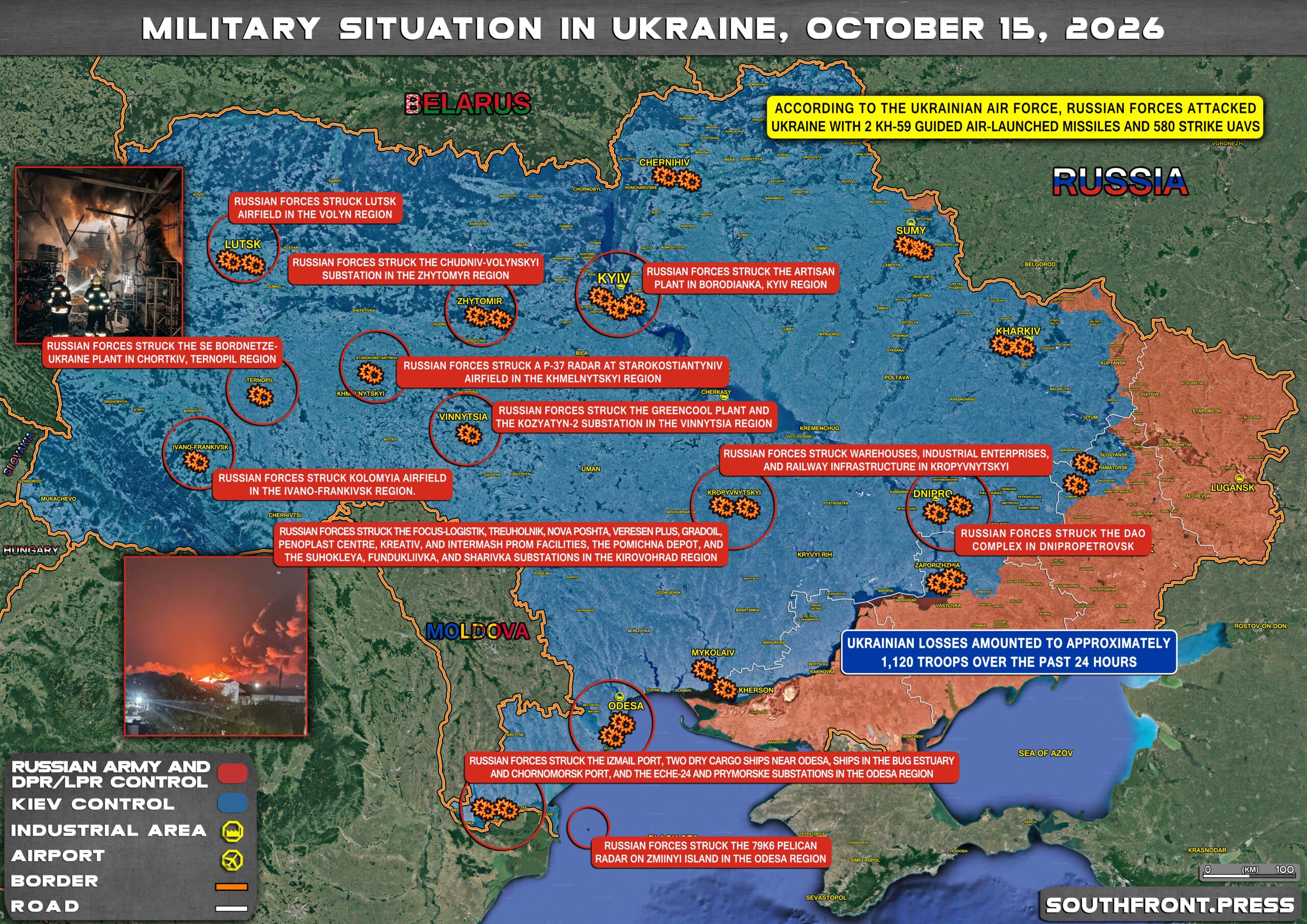
Russian strikes destroyed targets in the Sumy, Kharkiv, Zaporizhzhia, Dnipropetrovsk, Kherson, Odesa, Kirovohrad, Kyiv, Volyn, Chernihiv, Khmelnytskyi, Lviv, Mykolaiv, Vinnytsia, Rivne, Cherkasy, Poltava, Ivano-Frankivsk, Zhytomyr regions, and the DPR;
According to the Ukrainian Air Force, Russian forces attacked Ukraine with 2 Kh-59 guided air-launched missiles and 580 strike UAVs;
Russian forces struck the Focus Logistik, Treuholnyk, Nova Poshta, Veresen Plus, Hradoil, Penoplast Center, Kreativ, and Intermash Prom facilities, the Pomichna depot, and the Sukhoklia, Fundukliivka, and Sharivka substations in Kirovohrad region;
Russian forces struck warehouses, industrial enterprises, and railway infrastructure in Kropyvnytskyi;
Russian forces struck the Izmail port, two dry cargo ships near Odesa, ships in the Bug Estuary and Chornomorsk port, and the EChE-24 and Prymorske substations in the Odesa region;
Russian forces struck a P-37 radar at Starokostiantyniv airfield in the Khmelnytskyi region;
Russian forces struck Lutsk airfield in the Volyn region;
Russian forces struck Kolomyia airfield in the Ivano-Frankivsk region;
Russian forces struck the SE Bordnetze-Ukraine plant in Chortkiv, Ternopil region;
Russian forces struck the GreenCool plant and the Kozyatyn-2 substation in the Vinnytsia region;
Russian forces struck the Chudniv-Volynskyi substation in the Zhytomyr region;
Russian forces struck the ARTISAN plant in Borodianka, Kyiv region;
Russian forces struck the DAO complex in Dnipropetrovsk;
Russian forces struck the 79K6 Pelican radar on Zmiinyi Island in the Odesa region;
Ukrainian losses amounted to approximately 1,120 troops over the past 24 hours.
Click to see the full-size image
Russian forces advanced in the Volchansk pocket and cleared more villages in the area.
Click to see the full-size image
Russian forces advanced in Dobropolye town;
Russian forces advanced near Svyatogorovka and cleared areas of about 5 square kilometers;
Russian forces took control of Petrovka and Maryevka.
Click to see the full-size image
During the past night, Russian air defenses destroyed 166 Ukrainian drones in the rear regions;
Russian air defenses intercepted UAVs in the Belgorod, Bryansk, Kursk, Tula, Ryazan, Oryol, Lipetsk, Voronezh, Nizhny Novgorod, Tambov, and Rostov regions, the Moscow region, Krasnodar Krai, and the Republic of Crimea;
Ukrainian drones attacked the Ryazan Oil Refinery. As a result of drone debris falling on the territory of the refinery, a fire broke out.
Trump’s newly installed press secretary tells WIRED that in the early 2010s, she promoted a product for a company then called Beachbody, which she described as “sort of a pyramid scheme.”
The article argues that British scrutiny of alleged Russian interference overlooks what it describes as more extensive Israeli, billionaire and US influence operations affecting UK politics, media and public debate.
Latvia's decision last week to declare Russian-born journalist and blogger Leonid Ragozin persona non grata has drawn attention to a broader trend: Russians who once presented themselves as opponents of Vladimir Putin are now accused of echoing Kremlin narratives.
This year, Alaska held its primary elections on August 18.
As per a 2020 ballot measure, Alaska primary voters pick among all qualified candidates for a single office, regardless of party affiliation, and the top four then advance to the general election.
In the U.S. Senate primary, Republican incumbent Dan Sullivan won 41 percent of the vote, while former Rep. Mary Peltola, a Democrat, captured nearly 50 percent.
Dan Sullivan was also the distant third-place finisher—but in this case, it was Daniel J. Sullivan Jr., a retired schoolteacher who is also running as a Republican but is not the same person as Daniel S. Sullivan, the junior U.S. senator for the 49th state.
The presence of dual Dan Sullivans is a headache for Republicans, who have fought to keep Daniel J. off the ballot, concerned he would split their votes and cost their candidate his seat.
"Mary Peltola and Chuck Schumer know they can't beat Senator Sullivan on his record, so they're resorting to deceitful political maneuvers that attempt to trick Alaskans and buy a seat," a Republican spokesman told Fox News.
"We are looking into it," President Donald Trump said this week. "It's a disgrace." In fact, NBC News reported in July that the FBI and Department of Justice had launched an investigation "looking for possible wire fraud or a conspiracy to deprive Alaskan voters of a free and fair elections process, which could be a civil rights violation."
In August, the government apparently issued subpoenas, though Daniel J. later said he had not received anything.
But is what he is doing actually illegal? For that matter, should it be?
Carol Beecher, director of the Alaska Division of Elections, barred Daniel J. from the ballot in June after concluding that he was running "with the purpose of confusing or misleading the electorate and compromising the fairness of the ballot."
But a state superior court reversed that decision. "Despite the Division's assertion that Mr. Sullivan may be excluded from the ballot because he lacks 'good-faith,' there is no statute which provides such a criterion," wrote Judge Thomas A. Matthews. "The concept of 'good-faith,' or pure motive, or bona fide intent is simply absent." The Alaska Supreme Court agreed, keeping both Sullivans on the November ballot.
Granted, it seems extremely likely that Republicans are right, and Daniel J. is running specifically to hurt Daniel S.'s prospects.
"Campaign material metadata reveals that Amber Lee, a progressive consultant, authored a press release announcing [Daniel J.'s] Senate bid," WFMD reported in May.
Daniel J. told The New York Times that he was running as a moderate Republican in an attempt to steer the party away from its MAGA wing. But he also admitted that he had voted for the Democrat in the last three presidential races and for Peltola in her races for the U.S. House.
In Beecher's original order keeping Daniel J. off the ballot, she wrote that Daniel J. had asked to be identified as "Dan S. Sullivan" on the ballot, the same name as the senator's. (Alaska reporter Dermot Cole wrote in July that this was not true: Daniel J. wrote "Dan S. Sullivan" in an email to Beecher but followed up hours later to correct it to "Dan J. Sullivan.")
If Daniel J.'s goal truly is to mislead voters, then that is indefensible. But it's not clear that it's illegal, or whether it should be.
"I am not sure exploiting voter confusion about names is any worse than exploiting their ignorance about policy issues like crime, immigration, and health care," wrote George Mason University law professor Ilya Somin. "Trying to prevent such exploitation through criminal and civil liability is likely to violate the First Amendment. In addition, it would likely end up giving incumbent political leaders broad power to curb speech and control electoral campaigns that they cannot be trusted with."
"This is a case about someone running for office with impure motives who is lucky enough to have a name that could confuse some voters," agreed election law expert Richard Hasen. "I don't see how the government could criminalize his running for office for having impure motives. And if it could do so, then it could be a crime every time that the Republican Party backs a Green Party candidate, or Democrats support a MAGA candidate in a primary in the hopes that the candidate would be weaker against a Democrat in the general election. This stuff happens all the time."
But it's entirely possible that Alaska's ranked choice voting system will solve the problem on Election Day.
After the August open primary, the top four candidates compete on a ranked choice ballot, where voters list the candidates in order of preference. If no candidate gets an outright majority, then the lowest performer is eliminated, and every ballot that picked them first is retallied and applied to their second choice.
As long as every Alaskan who wants to vote for Dan Sullivan—either one—lists both Dan Sullivans as their first and second choices, then the system will take care of any confusion. In the (highly likely) event that Daniel J. does not capture a majority on the first ballot, his votes will be retallied and applied to their second choices. The only plausible hiccup is if Peltola, the Democratic candidate, wins a majority in the first round—in which case either Sullivan would have lost anyway.
Of course, Republicans have opposed the ranked choice system since Alaska adopted it. Former Gov. Sarah Palin, who ran against Peltola twice unsuccessfully, said ranked choice was "so weird" that "it results in voter suppression."
In a post last week on Truth Social, Trump called ranked choice voting "Corrupt" and said it "shouldn't be allowed in our Country."
"I just left Alaska, where we have a real bad thing," Trump said Wednesday at a campaign rally in Arizona. "They have the ranked choice voting, where you go into I guess some kind of a test tube or something, and they pick whoever the hell they want. That's another disgrace."
As ever, it's not clear what Trump was talking about. And despite Republicans' complaints, ranked choice voting works quite well: According to the American Bar Association, recent research finds that it "is an improvement over plurality voting with clear benefits in terms of representation, campaign quality, mobilization, and turnout." It also "encourages greater consensus building as well as more civil political campaigns," and voters find it easy to understand.
In the event that a political party finds itself, for example, with two Dan Sullivans on the ballot, ranked choice voting is a perfect solution. If only the party weren't so hostile to it.
Pune’s 11-day sit-in ended with the MPSC chairman on leave. With a campus elections panel and a BMC fellowship, the BJP appears to be trying a new approach to young protesters.
Aontú is to table a Dáil motion of no confidence in the Minister for Foreign Affairs Helen McEntee over her handling of garda whistleblower allegations.
TEHRAN, Oct. 15 (MNA) – Yemen's armed forces spokesman Yahya Saree renewed a warning to airlines, airport staff and passengers that Saudi airspace and airports are unsafe, with Mecca and Medina airports exempt.
TEHRAN, Oct. 15 (MNA) – Yemen's armed forces spokesman Yahya Saree renewed a warning to airlines, airport staff and passengers that Saudi airspace and airports are unsafe, with Mecca and Medina airports exempt.
The three most recent White House press secretaries, from left to right: Kayleigh McEnany, Karoline Leavitt, and Katie Zacharia.
Alex Wong/Getty Images ; Tom Williams/CQ-Roll Call, Inc via Getty Images ; Chip Somodevilla/Getty Images
President Donald Trump has had six White House press secretaries across his two presidential terms.
Sean Spicer, Stephanie Grisham, and Kayleigh McEnany held the role for less than a year.
Katie Zacharia succeeded Karoline Leavitt, but is "transitioning out" after five days on the job.
The new face at the White House podium didn't last long.
Katie Zacharia held her first briefing as the new White House press secretary on Tuesday after President Donald Trump chose her to succeed Karoline Leavitt, who left the White House in August to spend more time with her young children.
Zacharia was the sixth White House press secretary Trump has hired across his two non-consecutive presidential terms, and the fourth to serve for less than a year.
It's not unusual for presidents to go through several press secretaries due to the demanding nature of the role. President Barack Obama had three press secretaries during his two terms in office. Former presidents Bill Clinton and George W. Bush had four.
Here's a look at all of the White House press secretaries who have represented the Trump administration.
Sean Spicer
WASHINGTON, DC - APRIL 24: White House Press Secretary Sean Spicer talks to reporters during the daily press briefing at the White House April 24, 2017 in Washington, DC. Spicer was joined during the briefing by U.S. Ambassador to the United Nations Nikki Haley and Treasury Secretary Steven Mnuchin. (Photo by Chip Somodevilla/Getty Images)
Chip Somodevilla/Getty Images
Sean Spicer's time as White House press secretary spanned 182 days — the shortest tenure of all of Trump's press secretaries.
After leaving the White House, he appeared on season 28 of "Dancing with the Stars." He now serves as a political contributor at NewsNation and hosts several podcasts, including "Full Court Press with Sean Spicer" and "The Sean Spicer Show."
Sarah Huckabee Sanders
White House Press Secretary Sarah Huckabee Sanders speaks during a press briefing at the White House in Washington, DC, March 11, 2019. (Photo by SAUL LOEB / AFP) (Photo by SAUL LOEB/AFP via Getty Images)
SAUL LOEB/AFP via Getty Images
During Trump's first term, Sanders served as White House press secretary for just under two years, from July 2017 to July 2019. In the final months of her tenure, Sanders largely stopped holding formal White House press briefings.
Sanders is the daughter of former Arkansas Gov. Mike Huckabee, who now serves as the US ambassador to Israel in the second Trump administration. After her time as press secretary, Sanders was elected governor of Arkansas in 2022. She is running for reelection in the 2026 midterms.
Stephanie Grisham
White House Press Secretary Stephanie Grisham listens as US President Donald Trump speaks to the media aboard Air Force One while flying between El Paso, Texas and Joint Base Andrews in Maryland, August 7, 2019. (Photo by SAUL LOEB / AFP) (Photo credit should read SAUL LOEB/AFP via Getty Images)
credit should read SAUL LOEB/AFP via Getty Images
Grisham served as White House press secretary for less than a year, from July 2019 to April 2020. Throughout her tenure, she did not hold a traditional press briefing.
Grisham went on to become Melania Trump's White House chief of staff, then resigned from the role following the January 6, 2021 insurrection.
She has since become a vocal critic of Trump and spoke about her time working in the Trump administration at the 2024 Democratic National Convention.
Kayleigh McEnany
WASHINGTON, DC - OCTOBER 1: White House press secretary Kayleigh McEnany, speaks during a press briefing in the Brady Press Briefing Room of the White House, on Thursday, October 1, 2020, in Washington, DC.
(Photo by Oliver Contreras/For The Washington Post via Getty Images)
Oliver Contreras/For The Washington Post via Getty Images
McEnany served as Trump's 2020 campaign press secretary before Trump chose her to replace Grisham as White House press secretary. She held the role for less than a year, from April 2020 until Trump left office in January 2021.
McEnany resumed formal White House press briefings after Grisham's tenure.
McEnany now hosts "Saturday in America with Kayleigh McEnany" on Fox News, and co-hosts another Fox News show, "Outnumbered."
Karoline Leavitt
White House Press Secretary Karoline Leavitt speaks during a press briefing at the White House in Washington, D.C., the United States, on Jan. 15, 2026. U.S. President Donald Trump is keeping all options on the table for responding to Iran's unrest, White House Press Secretary Karoline Leavitt said Thursday. (Photo by Li Yuanqing/Xinhua via Getty Images)
Li Yuanqing/Xinhua via Getty Images
Leavitt served as White House press secretary from January 2025 to August 2026. At 27 years old, when she started the role, she was the youngest person ever to hold the position.
Leavitt established a "new media seat" in the White House briefing room, highlighting podcasters, independent journalists, social media influencers, and other non-legacy media sources.
She was also the first-ever pregnant White House press secretary, and gave birth to her second child while in the role. Leavitt resigned shortly after returning from parental leave, citing her desire to spend more time with her family.
She will begin working as an on-air contributor for Fox News starting November 1.
Katie Zacharia
UNITED STATES - OCTOBER 13: White House Press Secretary Katie Zacharia conducts her first briefing where she addressed issues including the resignation of Kimberly Guilfoyle, U.S. ambassador to Greece, on Tuesday, October 13, 2026. (Tom Williams/CQ-Roll Call, Inc via Getty Images)
Tom Williams/CQ-Roll Call, Inc via Getty Images
Trump named Zacharia as Leavitt's successor, writing in a Truth Social post on October 9 that Zacharia "has an unblemished record of support, and has been a loyal and brilliant supporter, right from the beginning," and calling her "a devoted fan and member of MAGA."
Zacharia previously worked as a senior communications advisor at Trump Media and Technology Group, which runs Truth Social.
She held her first briefing on Tuesday, but after a rocky five days as White House press secretary — during which Zacharia's briefing performance and legal qualifications were widely criticized — a White House official told Business Insider on Friday that she was leaving the role.

 Login