For Oakland Review of Books, Stephanie Uchino-Beach writes about getting laid off at an education tech company that transformed into an “AI-first outfit.” As as customer success manager, she acted as a liaison to district administrators, school principals, and teachers. While AI could automate some of her tasks, what about the core responsibilities of her CSM role: building real relationships and understanding an educator’s needs? An AI sees data points, not people. This is a sobering read from a former tech worker living in the Bay Area, and an edtech company that has gone all in on AI and forgotten about its mission.
Before I went to work for Silicon Valley, I was a lot of things. A few jobs before this last one, I was an elementary school teacher in Chicago, helping kids learn to read, creating units, planning lessons, and buying supplies with my own money on the weekends, like countless other teachers around the country. I grew up on the Peninsula, and I made the move into Customer Success to get a job that would let me move home. Tech was never my dream; it was a means to an end. My dad studied computer science and still works in tech to this day and enjoys it, so it seemed like a satisfying and fruitful career was plausible. I figured that once I broke in, all my problems would be solved: I could get a house, have a kid, and fulfill every middle-class dream that had always felt slightly out of reach for a millennial like myself.
And yet, job after job, I consistently left feeling unsatisfied. Unsatisfied by how I wasn’t growing and wasn’t developing my skills. Unsatisfied with poor managers who were just in the right place at the right time to be promoted but so often lacked the skills to provide the same success for their employees. Unsatisfied with how the products I worked on could do wrong by the communities we sold them to, even though every company said they were “mission-driven” and “put our customers first.”
A Bruxelles stanno prendendo in considerazione una proposta che potrebbe aumentare i fastidi di Washington. Sul tavolo della Commissione europea c’è infatti la possibilità di modificare il contributo forfettario sulle grandi imprese, già inserito all’interno del bilancio comunitario per il settennato 2029-2034. L’idea è di alzare la soglia di accesso e aumentare il peso a carico delle aziende. Tra queste, ovviamente, anche quelle digitali. In questo modo, scrive il Financial Times, le Big Tech verrebbero tassate senza aggiungere una nuova imposta sui servizi digitali. Un sotterfugi per evitare che l’amministrazione di Donald Trump batta di nuovo i pugni sul tavolo. A giugno la Casa Bianca aveva minacciato di introdurre dazi al 100% per quei Paesi che introducevano una tassa sui servizi digitali – con un esplicito riferimento all’Europa. Difficilmente però il presidente statunitense non si accorgerà del trucco.
Il contributo, pensato a luglio scorso, prevede di tassare le aziende con un fatturato superiore ai 100 milioni di euro che operano sul territorio comunitario. La modifica si concentrerà sull’allargamento delle società da includere, ritoccando quindi i requisiti necessari per rientrare nella tassazione, e allo stesso tempo sull’importo che dovrebbero versare. Al momento, il sistema imporrebbe il pagamento di 100mila euro per le aziende – tutte, non solo quelle tecnologiche – con un fatturato netto compreso tra i 100 e i 250 milioni, fino a un massimo di 750mila euro per quelle che hanno ricavi minimi di 750 milioni. Il totale della cifra che finirà nelle tasche dell’Ue è pari a 6,8 miliardi di euro.
Passare dalla teoria alla pratica non sarà semplice. La discussione è accesa, proprio perché potrebbe potenzialmente comportare conseguenze non del tutto positive. C’è chi non è propenso a introdurre una tassa digitale per non inimicarsi gli americani, sostiene una fonte riservata al Ft. E c’è chi è contrario al versamento di una somma forfettaria, come previsto dal Corporate Resource for Europe (Core) per le società che offrono servizi digitali che hanno una filiale sul territorio comunitario. Da qui l’idea di estendere una tassa già esistenti a tutte le aziende, senza discriminazioni settoriali. In questo modo il risultato sarebbe duplice: verrebbe garantito un gettito in entrata superiore, senza scontentare nessuno. Almeno sulla carta.
Da quando Trump ha messo di nuovo piede alla Casa Bianca, gli europei fanno gli equilibristi per provare a tenere insieme l’interesse comunitario con un’alleanza storica. Trump e la sua amministrazione sono stati però piuttosto chiari: nessuna azienda americana deve essere trattata peggio delle altre. Il tycoon non fa sconti a nessuno. Austria, Francia, Italia e Spagna sono state già oggetto di indagine da parte di Washington a causa della loro imposta sui servizi digitali. Leggere che l’Ue ha trovato un modo per aggirare i suoi paletti non gli farà di certo piacere.
The counting of votes in the first round of Brazil’s general elections was the subject of great controversy. Flávio Bolsonaro, son of former president Jair Bolsonaro, was ahead of Lula in the official count, with 49.6%, against 42.2% for the president seeking re-election.
64.8% of the polling stations had been tallied up to that point. But the count was halted for more than an hour. Strangely, the votes for governor, senator and deputies continued to be counted normally. Only the presidential count was halted.
And, even more strangely, when the presidential count resumed, Flávio Bolsonaro’s upward trend and Lula’s downward trend were reversed. The opposition candidate’s votes plummeted, while those of the current president rose. Flávio Bolsonaro was less than 0.5% away from the victory that would hand him the presidential sash. He lost more than 2%, ending with 47.03%, while Lula gained almost 3%, ending with 45.16%.
It seemed that Flávio Bolsonaro would dethrone Lula right in the first round. But, after more than an hour of halted counting, Lula managed to recover and the race will only be decided in the second round.
The count was halted at 7:06 p.m. (Brasília time), with 64.8% of the ballots tallied. Only at 8:08 p.m. were the new results presented, already with 84.96% of the ballots tallied.
The official justification was given by the president of the Superior Electoral Court (TSE), Kassio Nunes Marques, who is also a justice on the Supreme Federal Court (STF). “What happened was a data congestion. In every election, we are surprised by some incident, which is natural for those who deal with complex and highly varied systems,” he said. “At first, it is not known whether this was derived from another problem. What our IT found was a flow [of data] above the normal level, and that congestion caused a delay,” he added.
There is an aggressive propaganda campaign in Brazil, spearheaded by the Electoral Justice, to convince citizens that elections are 100% clean. The main focus of this propaganda is precisely the electronic voting machines. Judicial institutions and media outlets give wide dissemination to the Electoral Justice’s claims about the total reliability of the electronic voting machines, even highlighting that they are tested before the election and then sealed so that no one can access them.
So why did the machines suffer a kind of breakdown, if they had been rigorously tested? Well, the oh-so-wise TSE has full knowledge of the number of eligible voters and of the number of votes that can be recorded in the machines, including in each polling station. The Electoral Justice’s propaganda tells the public that the machines are fully prepared in advance to record and tally voters’ votes perfectly.
No flow of data “above the normal level” that would lead to system congestion should occur, because the most varied data and statistics regarding vote recording are known and the calculations are perfectly feasible. The infallibility of the electronic voting machines requires that all possible outcomes be predictable and that, therefore, there be no anomaly whatsoever.
So how is it possible, then, that such a perfect system – as it is portrayed by the institutions of the Brazilian State – suffers a failure which, once supposedly resolved, so radically changed the trend of the presidential votes?
It may be a coincidence that Flávio Bolsonaro plummeted and Lula rose after the voting machines failed. But who knows? The TSE president acknowledged that the electronic voting system is “complex.” Only highly qualified specialists, from the TSE itself and from technology companies, can access it and understand it, according to the Electoral Justice. Thus, the fate of an entire country for the next four years rests in the hands of these specialists – 150 technicians unknown to the public. The tally of votes from the machines is fully automated; it passes through no human being. An even more select number of 22 employees access the automated vote totalization.
This means that 214 million Brazilians need to trust those 150 or 22 Egyptian priests to interpret that occult science. They must be the most enlightened beings on planet Earth – 100% honest, upright, immaculate and virginal. Even the STF justices, who over the past 15 years have been presented as impeccable, virtuous and chaste individuals, now appear embroiled in the biggest corruption scandal in Brazil’s recent history, yet those anonymous specialists deserve citizens’ most absolute trust.
It was for reasons such as these that the Supreme Court of Germany declared electronic voting unconstitutional: “every citizen must be able to understand and verify the central stages of elections in a reliable manner and without any prior specialized technical knowledge.”
The verdict, dated 2009, concludes:
“An electoral procedure in which the voter cannot reliably understand whether his or her vote was recorded in an unfalsifiable manner and included in the tally of the election result, and how the total of votes cast is assigned and counted, excludes central elements of the electoral procedure from public scrutiny and therefore fails to meet constitutional requirements.”
The Brazilian judicial system is mired in its greatest crisis in history and is living through a true Wild West, with partisan feuds interfering in the functioning of its work. Partisanship, in fact, has contaminated most of the judiciary, including the TSE. In the final stretch of these elections, decisions by the Electoral Justice, backed by the dominant wing of the STF, favored Lula.
It is evident that this dominant wing (represented by justices Alexandre de Moraes, Gilmar Mendes and Flávio Dino) does not want a victory of Bolsonarismo, for it is their declared political enemy. These justices have acted, in recent years, as true vigilantes against Bolsonarismo. Now that they themselves have been caught in extremely promiscuous dealings with a banker who corrupted countless high-ranking state officials, their bureaucratic careers are threatened. Lula’s continuity is a hope of salvation for these gentlemen, for the president is beholden to them and cannot break that commitment without risking his own neck, given the level of dependence Lula has contracted toward the STF’s top brass. Meanwhile, a Flávio Bolsonaro victory would tend to lead to a clash with the heads of these institutions – although the opposition candidate himself has shown little willingness to confront them, because those who control elections in Brazil (international financial capital) demand moderation and pacification, otherwise they will make life difficult for anyone elected president.
And the people are treated like cattle, victims of a system they cannot understand, so that their exploitation may be perpetuated through the staging of the “festival of democracy.”
US prosecutors say an American forensic tool concealed its Russian owners and its development in Russia.
Used by numerous security agencies in Europe, Oxygen Forensics helps investigators worldwide access data from mobile phones and computers.
Many bodies are now suspending use of the software following recent revelations.
The Slovak interior ministry bought the software in 2018 when links to Russia were not yet publicly known, then renewed the license multiple times. Now, the ministry said IT department officials are investigating the issue.
The tool was also sold to other government bodies across Europe.
Russian ownership via Cyprus
In the US, Virginia-based Oxygen Forensics CEO Lee Reiber was arrested at the end of September, along with Oleg Davydov, one of the Russian owners.
The company was headquartered in the US state of Virginia, appearing American.
According to federal prosecutors in the US, the company hid its Russian ownership through a shell company in Cyprus and that its software was developed in Russia.
Allegedly, this scam helped secure contracts for the forensic tool in the US, UK, Czech Republic, Latvia, Romania, and Slovakia.
Reiber, a 55-year-old American, was arrested in Idaho on Sunday. On Tuesday (22 September), he appeared before a federal court there and was released on bail. He is expected to appear before a federal court in Los Angeles soon.
Davydov, a 52-year-old from Moscow, was arrested on that same day at London Heathrow before he could board a flight to Istanbul. And the US plans to seek extradition. Both face charges of conspiracy to commit wire fraud.
The group of five also owned a Russian company co-founded by Davydov in 2000. Until September 2022, it was called Oxygen Software and now operates under the name MKO Systems.
Its programmers worked in Russia, where the company sold the software under other names. According to investigative files, its clients included Russia’s secret service (FSB), investigative committee (SKR) and interior ministry.
Davydov, the company’s technical director, was responsible for software development. In 2013, he helped establish Oxygen Forensics in Virginia with Reiber joining the company in August 2015.
Prosecutors say that following Russia’s full-scale invasion of Ukraine and US sanctions after, the duo agreed to hide both the real owners and that it was developed in Russia. In March 2022, Reiber became CEO and director.
Then, Russian owners were removed from public company records.
However, investigators said the Russians continued to control the company, making key decisions, determining Reiber’s pay, and outvoting him on the board.
The charges concern the concealment of the software’s ownership and origin in securing public contracts.
A network of deception
Two companies were found to have supplied the Slovak interior ministry with Oxygen Forensic tools.
In 2018, the sale was part of a broader procurement by the ministry for computers, laptops, servers, monitors and printers, ordered from the Czech company Risk Analysis Consultants for €125,000, the forensic tool itself costing €10,000.
The Prague-based company did not respond for comment.
Screenshot of order from 2018 (Source: Slovak interior ministry website)
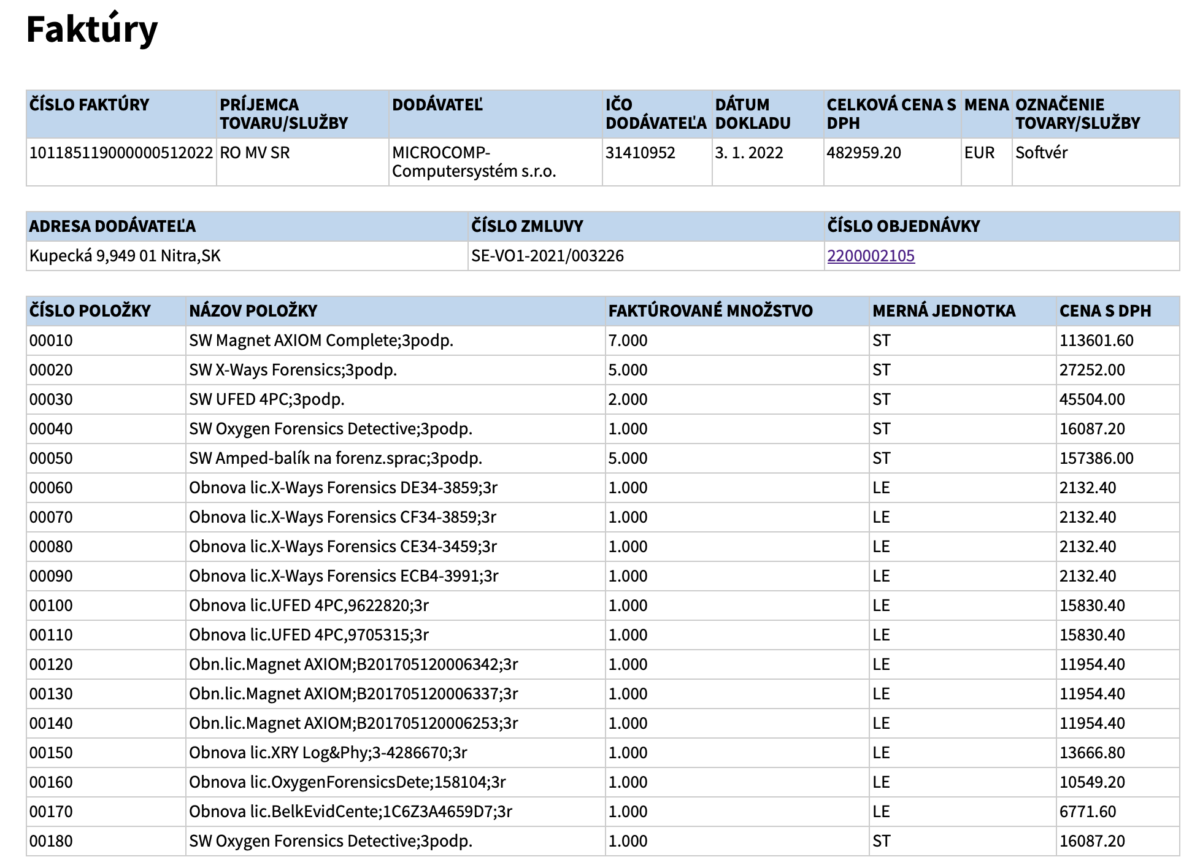
An invoice issued to the Slovak interior ministry in 2022 by the Slovak company Microcomp–Computersystém indicates the renewal of a licence for this software. At the time, the minister responsible was Roman Mikulec.
Screenshot of invoice from 2022 (Source: Slovak interior ministry website)
The Slovak ministry also ordered a licence renewal in July 2024, under his successor Matúš Šutaj Eštok. Microcomp–Computersystém did not respond for comment.
Interior ministry order with links to Russia. (Source: Slovak interior ministry website)
Authorities warned
On Friday (2 October), the Slovak national security authority (NBÚ) warned of the risks posed by using software from Oxygen Forensics and connected companies such as MKO Systems and Prostranstvo IT.
Their software helps investigators search for and examine data from digital devices. It can process vast amounts of information, including evidence, which makes it important who owns, controls and develops it. According to the NBÚ, this is important both for data protection and for the reliability of analysis results.
The warning came after the US case was made public.
The NBÚ considers links to Russia significant in assessing the security risk, also in view of Russia’s military aggression against Ukraine.
However, the warning itself does not mean that data leaked through the software. US prosecutors explicitly stated that the charges did not concern malicious code or unauthorised access to customer data.
The case concerns the alleged concealment of the software’s ownership and origin. And no court has yet ruled on the case.
“The ministry will proceed in accordance with the recommendations of the National Security Authority,” the Slovak interior ministry said.
The NBÚ recommended that public bodies identify this company’s presence and report it to the authority.
Belgian Green MEP Saskia Bricmont also called for the use of Oxygen to be stopped immediately and for an inquiry into whether sensitive information could have reached Russia after it was found that Romania, Germany, Spain, Italy, Poland and Hungary had purchased the software.
European police shed tool
Several European security agencies are suspending the use of Oxygen Forensics software or taking steps to terminate their contracts after the company’s Russian ties came to light.
The tool was also used by Czech police. Czech security agencies continued to purchase licences for the computer software after 2022, when the full-scale invasion of Ukraine began. Czech authorities are awaiting further information from the United States. For now, they have prohibited software updates.
London’s Metropolitan Police has suspended the use of Oxygen tools and launched a comprehensive review. British police forces, including specialised units, had used the software.
And Latvian police suspended its use and is assessing whether it will continue using it.
Romania’s anti-corruption agency, too, took steps to terminate its contract with the Russia-linked tool.

 Login