
❌

Normal view

Fighting big money in politics: California’s Community News Act

7 October 2026 at 20:42
California Gov. Gavin Newsom signs the Community NEWS Act on Sept. 30, 2026. Photo via Office of Gov. Gavin Newsom

This article originally appeared on Dean Baker’s Patreon. It is reprinted here with permission.

Virtually everyone who is not a billionaire, or owned by one, agrees that we have to limit the ability of the rich to buy elections. While the Republican Party has taken “policy for sale” politics to a new level, there are plenty of Democrats who have been happy to support obviously awful policy in exchange for contributions from the AI industry, the pharmaceutical industry, the crypto industry, and Wall Street more generally. It costs a lot of money to run a competitive campaign and it’s hard to raise that from small contributions, so there will always be a temptation to bend policy positions to get some serious money.

While most people favor limits on campaign contributions, the current Supreme Court has made this very difficult. They have ruled that campaign contributions are speech and therefore any effort to limit campaign contributions is an unconstitutional restriction on speech.

There are some promising alternative paths that focus on making small donors matter. Seattle has a system of “democracy vouchers” that give every voter in local elections a modest sum that they can contribute to a candidate(s) of their choice. To qualify to get the vouchers, candidates must agree to limits on spending and large contributions.

Super-matches are a comparable system. Under this system, small dollar contributions can be matched up to 8 to 1, which means that even a $50 contribution can make a difference to a campaign. New York City, along with several other cities, have gone this route.

While these paths for amplifying the voice of ordinary people are promising, it will take much more to match the power of the billionaires. It is important to realize they exercise their political power in ways other than campaign contributions, primarily through their ownership of the media.

The importance of billionaire ownership goes far beyond the constant stream of lies and right-wing propaganda from Fox News. Last year, the very Trumpy Ellison family took control of CBS and immediately began to shift its news to the right. They are now taking control of CNN through the merger of Paramount and Warner Brothers. They also got control over TikTok, after Trump wrestled it away from a Chinese company for them.

Trumper Mark Zuckerberg owns Facebook and Instagram and is not shy about banning political material he doesn’t like. And Elon Musk bought Twitter, explicitly to advance his right-wing agenda. The rest of the media landscape doesn’t look much better. The rich and very rich own the countries’ newspapers and broadcast outlets, and most of these people lean right, even if they have not yet joined the Trump Reich.  

And let’s just be clear. The idea that the campaign ads bought by the rich can influence votes, but not the material that people see between the ads, is beyond absurd. Even if we banned all political contributions from rich people and corporations, the rich could still control elections by showing us nothing but their propaganda on television, in newspapers, and on social media.

This is why the Community News Act that Governor Gavin Newsom just signed is so important. The measure provides $20,000 each for up to five journalists per news outlet covering local news. This subsidy can keep newspapers and news sites across the state in business and help to support new ones that might start up. It is similar to other programs that have been started in Illinois, New York, and New Mexico.

This might seem like small change in a world with multi-billion dollar media empires, but it is not realistic to imagine matching the super-rich dollar for dollar; the goal is to sustain reality-based reporting that people can rely upon. (Repealing Section 230 protection for the mega-platforms like Facebook and X would be a big step towards leveling the playing field.) And support for local news reporting is likely to also lead to better national and international reporting, both by training more reporters and also increasing the comfort level with public funding, perhaps opening the door for a national system.

To be clear, there are no political conditions attached to this funding. Conservative news outlets are as eligible for this subsidy as more liberal ones. The point is to support local journalism, not to favor a particular political perspective.

To my view, this system is not ideal. I prefer support coming through an individual refundable tax credit to support local news. This would allow people to have a more direct attachment to the news outlets being supported with public money. Ideally, this would give them a sense of ownership that many feel towards other community organizations.

But whether or not this is the best approach, there is no doubt that the California bill, along with the ones already passed in other states, are big steps forward. It will help to reverse the collapse of local news reporting, which is giving corruption free rein in many areas. We need to build on the positive and make it better, rather than reject a plan because it may not be ideal. Progressive opponents of California’s wealth tax initiative may want to give that point some thought.

Ex-agent says CIA is planting pro-Bolsonaro stories to influence election

7 October 2026 at 18:02
A man wearing a mask depicting US President Donald Trump attends a rally of Brazilian right-wing presidential candidate Flavio Bolsonaro in Goiania, Brazil, on September 27, 2026. Photo by Sergio Lima / AFP via Getty Images

This story originally appeared in Panamerican Dispatch on Oct. 07, 2026, and is shared here with permission.

The CIA is allegedly working behind the scenes in Brazil’s election, planting stories to favor Flávio Bolsonaro and build a positive narrative about the senator.

The claims come from John Kiriakou, a former CIA agent who has become something of a celebrity in recent years. Earlier this week, he took to social media to flag what he called “credible” evidence of the spy agency’s involvement in Brazil’s election.

On Tuesday, Kiriakou gave more details on his podcast.

“I heard a rumor from a former CIA colleague of mine this past weekend that the agency is actively working behind the scenes to support Bolsonaro,” he said.

“And the way they’re doing it is by planting pro-Bolsonaro stories in both the Brazilian press and the international press,” he claimed.

He offered no evidence and was careful to say he doesn’t know whether this account is true. But he argued that it fits the agency’s pattern of behavior over the years.

“There’s a long history of CIA involvement in elections abroad, controlling the media narrative,” he said.

He noted that much of the Brazilian press has swung behind Bolsonaro.

“This is despite the fact that Jair Bolsonaro’s presidency was one mistake after another,” he said.

The former agent pointed to the former president’s 27 year prison sentence, calling his conduct “incredibly corrupt.”

Kiriakou said the runoff projections don’t favor Luiz Inácio Lula da Silva and suggested the right has already secured one of its biggest wins in Brazilian history.

“Lula is likely to lose the election, and I think the younger Bolsonaro will end up pardoning his father,” he predicted.

He also noted that Donald Trump has already endorsed Flávio Bolsonaro’s candidacy, acknowledging that doing so could be a “violation of international rules.”

Earlier in the week, Kiriakou wrote on social media that he met with Lula three years ago. On Tuesday, he explained that a Lula aide had reached out so the two could discuss government transparency.

According to the former agent, one topic in that conversation was police violence under Jair Bolsonaro’s government. He said he suggested that Lula confront that issue directly, and that doing so had led police to turn against Lula.

Who Is This Former Agent?

In 2013, Kiriakou pleaded guilty to revealing the identity of an undercover agent, the first case of its kind in 27 years. He had worked for the CIA from 1990 to 2004 and was sentenced to 30 months in federal prison as part of a plea deal.

He admitted to disclosing to a reporter the identity of an undercover officer who had taken part in harsh interrogations of alleged Al Qaeda members held at secret CIA detention sites.

Kiriakou first drew national attention in 2007, during the George W. Bush administration, when he told ABC News in an interview that waterboarding, a technique that simulates drowning, had been used on a Guantánamo detainee named Abu Zubaydah.

Then CIA Director David Petraeus issued a statement praising the plea deal with Kiriakou, even though four other charges against him were dropped. The case “represents an important victory for our agency, for our intelligence community and for our country,” Petraeus said.

It was the first time in 27 years that someone had been found guilty of revealing the identity of an undercover agent.

This article first ran in ICL Notícias, was translated by Panamerican Dispatch, and can be read in its original Portuguese here.

Estação das Artes é finalista dos Prémios dos Fundos Europeus

7 October 2026 at 18:49

VTM

O projeto de reabilitação da antiga Estação Ferroviária de Mirandela, que deu origem à atual Estação das Artes, é finalista da 2.ª edição dos Prémios dos Fundos Europeus, na categoria “Portugal + Próximo dos Cidadãos”.

Segundo o município, a distinção reconhece “a transformação de um dos edifícios mais emblemáticos da história ferroviária de Mirandela num equipamento público multifuncional, dedicado à cultura, criatividade, educação, encontro e participação”.

A intervenção teve como objetivo preservar a identidade arquitetónica e histórica do edifício, dando-lhe novas funcionalidades. De acordo com a autarquia, as obras contribuíram para “a regeneração urbana, valorização do património ferroviário e dinamização cultural da cidade”.

A Estação das Artes é um espaço aberto a toda a comunidade, acolhendo exposições, atividades educativas, iniciativas culturais e projetos desenvolvidos em colaboração com associações, artistas, escolas e outras entidades.

A recuperação do edifício foi concretizada através de duas operações complementares cofinanciadas pelo Programa Operacional Regional do Norte – NORTE 2020.

Desde segunda-feira está aberta a votação do público, através do site dos Prémios dos Fundos Europeus.

The post Estação das Artes é finalista dos Prémios dos Fundos Europeus appeared first on A Voz de Trás-os-Montes.

Sanctioned Belarus Trucks And A Mystery Logo: 'HAL' Vehicles Spotted In Minsk

7 October 2026 at 16:14
Belarus’s Minsk Automobile Plant is under Western sanctions, limiting who can buy the vehicles produced there. That may be the reason trucks branded with the previously unknown “HAL” badge have been spotted amid strengthening trade relations between Belarus and Indonesia.

Latvia stops armed migrant push from Belarus, then loses border cameras to masked raiders hours later

7 October 2026 at 12:21

latvia stops armed migrant push belarus loses border cameras masked raiders hours later · post sign marking state latvia's guard prykordonnyj-znak-na-latvijskomu-kordonifoto-derzhavna-prykordonna-sluzhba-latviyi ukraine news ukrainian reports

Armed escorts in masks pushed a group of migrants from Belarus toward Latvia and threatened Latvian soldiers, and hours later masked people crossed into Latvia and stole border surveillance cameras, Latvian Interior Minister Jānis Dombrava said on 6 October. Latvia's military described the incident as part of a continuing hybrid campaign on the border, and Ukraine's foreign minister blamed Moscow.

Russia keeps probing the EU's eastern defenses with migrants pushed from its own soil and through its ally Belarus, alongside drone incursions and sabotage that ISW has linked into one Russian pattern across Europe.

Armed escorts threatened Latvian soldiers

Latvian soldiers stopped at least 20 migrants trying to cross the border illegally from Belarus, the Latvian National Armed Forces said. Masked escorts led the group, and this time they were armed, threatened the soldiers, and urged and drove the migrants toward Latvia, the military said.

"Unlike many previous incidents, this time the provocation was particularly demonstrative and aggressive," Dombrava said.

The incident confirms that deliberate provocations and hybrid threats on the border will continue, the armed forces said. Illegal migration is being used as a tool to pressure Latvia's border and, with it, the external border of the EU and NATO, they added.

Belarus began funneling migrants toward the EU in 2021, a campaign Poland's government called a hybrid attack in which the migrants end up as weapons. In 2023, Finland closed its border crossings with Russia, accusing Moscow of the same tactic, and by mid-July Latvia had logged 111 straight days of migrants pushed across from Belarus.

Masked people stole the cameras

Several hours after the standoff, people in masks entered Latvian territory, damaged a distribution cabinet, and stole surveillance cameras, Dombrava said. They returned to Belarus before the border guard patrol could arrive.

"Belarus should understand that such incidents could lead to more serious consequences for Belarus itself," he said.

Ukrainian Foreign Minister Andrii Sybiha said Ukraine stands in full solidarity with Latvia. "Make no mistake: Moscow is behind it," he wrote, adding that Russian President Vladimir Putin "deliberately weaponizes migration, with the help of Lukashenka, to destabilise Europe."

Tunnels, tear gas, and damaged cameras on the border

Latvia's border guards stopped 11,384 attempts to cross illegally from Belarus between the start of 2026 and 24 September. In January, Latvia's armed forces and border guard published evidence that Belarusian security agencies were organizing illegal migration across the border. Latvia has also recorded deliberate damage to cables, distribution cabinets, and camera poles on its eastern border, aimed at slowing the rollout of an automated border control system.

Latvia's State Security Service (VDD)
Explore further

Stop arming Ukraine or we shut down your defense firms, pro-Kremlin group tells Latvia, Poland, and Portugal

On 22 July, Latvian soldiers fired warning shots and used tear gas against migrants trying to cross. The next day, Prime Minister Andris Kulbergs said Russia and Belarus were stepping up their hybrid war against the Baltic States to distract from Russia's failures in Ukraine. Latvia temporarily halted crossings on the Belarus border on 31 July. In August, Latvian guards found the first tunnel dug from Belarus and turned back 15 migrants who used it.

Why Oxygen Forensics US tech CEO selling software to Europe agencies was arrested

7 October 2026 at 10:59

US prosecutors say an American forensic tool concealed its Russian owners and its development in Russia.

Used by numerous security agencies in Europe, Oxygen Forensics helps investigators worldwide access data from mobile phones and computers.

Many bodies are now suspending use of the software following recent revelations.

The Slovak interior ministry bought the software in 2018 when links to Russia were not yet publicly known, then renewed the license multiple times. Now, the ministry said IT department officials are investigating the issue.

The tool was also sold to other government bodies across Europe.

Russian ownership via Cyprus

In the US, Virginia-based Oxygen Forensics CEO Lee Reiber was arrested at the end of September, along with Oleg Davydov, one of the Russian owners.

The company was headquartered in the US state of Virginia, appearing American.

According to federal prosecutors in the US, the company hid its Russian ownership through a shell company in Cyprus and that its software was developed in Russia.

Allegedly, this scam helped secure contracts for the forensic tool in the US, UK, Czech Republic, Latvia, Romania, and Slovakia.

Reiber, a 55-year-old American, was arrested in Idaho on Sunday. On Tuesday (22 September), he appeared before a federal court there and was released on bail. He is expected to appear before a federal court in Los Angeles soon.

Davydov, a 52-year-old from Moscow, was arrested on that same day at London Heathrow before he could board a flight to Istanbul. And the US plans to seek extradition. Both face charges of conspiracy to commit wire fraud.

The group of five also owned a Russian company co-founded by Davydov in 2000. Until September 2022, it was called Oxygen Software and now operates under the name MKO Systems.

Its programmers worked in Russia, where the company sold the software under other names. According to investigative files, its clients included Russia’s secret service (FSB), investigative committee (SKR) and interior ministry.

Davydov, the company’s technical director, was responsible for software development. In 2013, he helped establish Oxygen Forensics in Virginia with Reiber joining the company in August 2015.

Prosecutors say that following Russia’s full-scale invasion of Ukraine and US sanctions after, the duo agreed to hide both the real owners and that it was developed in Russia. In March 2022, Reiber became CEO and director.

Then, Russian owners were removed from public company records.

However, investigators said the Russians continued to control the company, making key decisions, determining Reiber’s pay, and outvoting him on the board.

The charges concern the concealment of the software’s ownership and origin in securing public contracts.

A network of deception

Two companies were found to have supplied the Slovak interior ministry with Oxygen Forensic tools.

In 2018, the sale was part of a broader procurement by the ministry for computers, laptops, servers, monitors and printers, ordered from the Czech company Risk Analysis Consultants for €125,000, the forensic tool itself costing €10,000.

The Prague-based company did not respond for comment.

Screenshot of order from 2018 (Source: Slovak interior ministry website)

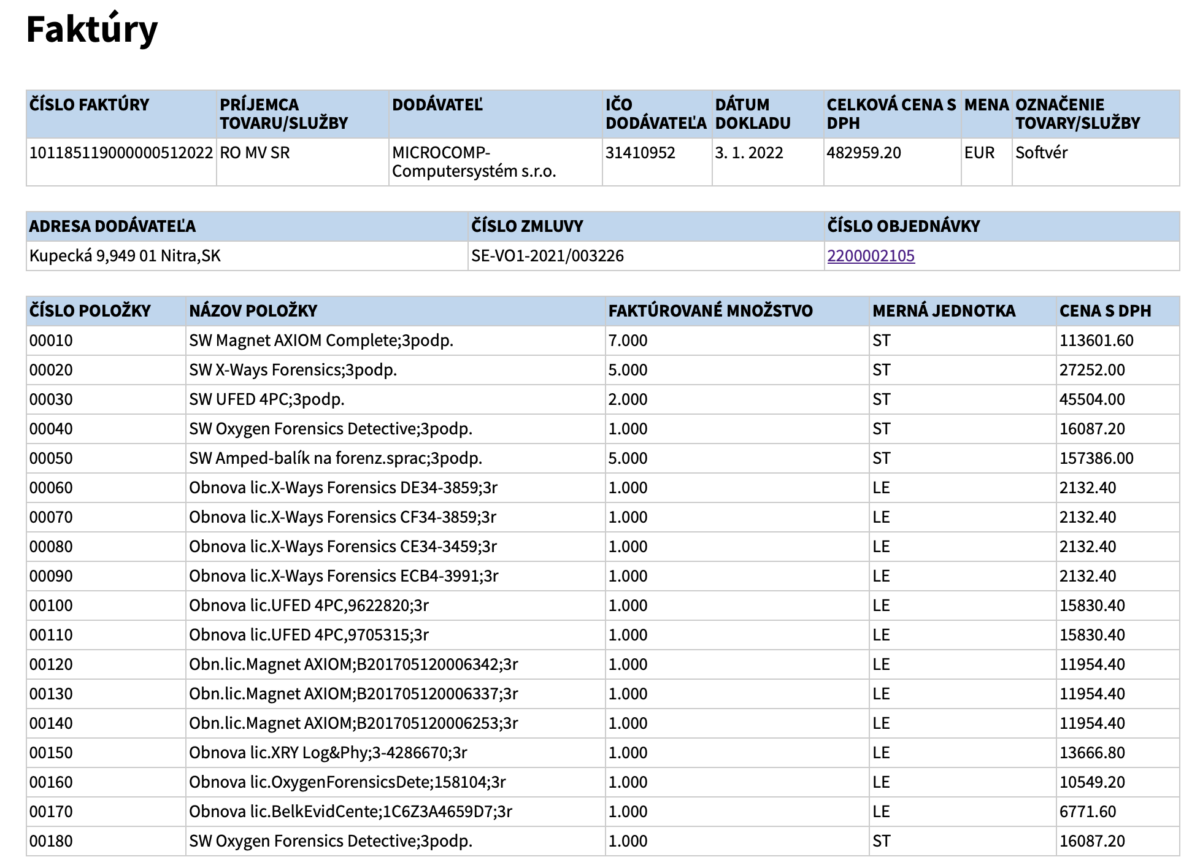
An invoice issued to the Slovak interior ministry in 2022 by the Slovak company Microcomp–Computersystém indicates the renewal of a licence for this software. At the time, the minister responsible was Roman Mikulec.

Screenshot of invoice from 2022 (Source: Slovak interior ministry website)

The Slovak ministry also ordered a licence renewal in July 2024, under his successor Matúš Šutaj Eštok. Microcomp–Computersystém did not respond for comment.

Interior ministry order with links to Russia. (Source: Slovak interior ministry website)

Authorities warned

On Friday (2 October), the Slovak national security authority (NBÚ) warned of the risks posed by using software from Oxygen Forensics and connected companies such as MKO Systems and Prostranstvo IT.

Their software helps investigators search for and examine data from digital devices. It can process vast amounts of information, including evidence, which makes it important who owns, controls and develops it. According to the NBÚ, this is important both for data protection and for the reliability of analysis results.

The warning came after the US case was made public.

The NBÚ considers links to Russia significant in assessing the security risk, also in view of Russia’s military aggression against Ukraine.

However, the warning itself does not mean that data leaked through the software. US prosecutors explicitly stated that the charges did not concern malicious code or unauthorised access to customer data.

The case concerns the alleged concealment of the software’s ownership and origin. And no court has yet ruled on the case.

“The ministry will proceed in accordance with the recommendations of the National Security Authority,” the Slovak interior ministry said.

The NBÚ recommended that public bodies identify this company’s presence and report it to the authority.

Belgian Green MEP Saskia Bricmont also called for the use of Oxygen to be stopped immediately and for an inquiry into whether sensitive information could have reached Russia after it was found that Romania, Germany, Spain, Italy, Poland and Hungary had purchased the software.

European police shed tool

Several European security agencies are suspending the use of Oxygen Forensics software or taking steps to terminate their contracts after the company’s Russian ties came to light.

The tool was also used by Czech police. Czech security agencies continued to purchase licences for the computer software after 2022, when the full-scale invasion of Ukraine began. Czech authorities are awaiting further information from the United States. For now, they have prohibited software updates.

London’s Metropolitan Police has suspended the use of Oxygen tools and launched a comprehensive review. British police forces, including specialised units, had used the software.

And Latvian police suspended its use and is assessing whether it will continue using it.

Romania’s anti-corruption agency, too, took steps to terminate its contract with the Russia-linked tool.

Latvia Reports Armed Belarus Border Provocation Followed by Sabotage of Surveillance Equipment

7 October 2026 at 09:18

Three armed men accompanying at least 20 migrants from Belarus threatened Latvian soldiers and attempted to force the group across the frontier, according to Latvia’s National Armed Forces.

Hours later, masked intruders crossed into Latvia, damaged an electrical distribution unit and stole surveillance cameras before retreating into Belarus.

Latvia has reported an unusually aggressive incident on its border with Belarus in which armed, masked men threatened Latvian troops during an attempted migrant crossing, followed several hours later by an incursion targeting surveillance infrastructure.

The confrontation began on Monday evening when at least 20 people approached the Latvian border from Belarus accompanied by three masked men. Latvia’s National Armed Forces said the escorts were armed, issued threats to Latvian soldiers and actively drove the migrants towards the frontier. Latvian troops prevented the group from entering the country.

Several hours later, masked individuals crossed from Belarus into Latvian territory and targeted equipment used to monitor the border. Interior Minister Jānis Dombrava said they damaged an electrical distribution cabinet and removed surveillance cameras before returning across the frontier ahead of the arrival of a Latvian border-guard unit. Latvian authorities have not publicly identified the intruders or established whether all of those involved in the second incident were the same men who had earlier accompanied the migrants.

Dombrava described the events as markedly more aggressive than previous episodes on the frontier. He warned that Belarus should understand that incidents of this kind could have “more serious consequences” for the country.

The episode comes amid sustained pressure on Latvia’s 172km border with Belarus. According to the Latvian State Border Guard’s latest figures, 21 people were prevented from crossing illegally from Belarus on Tuesday, taking the total number stopped at that frontier since the beginning of 2026 to 11,946.

Latvia has for several years treated irregular migration from Belarus not simply as an immigration issue but as a security operation. Riga accuses the Belarusian authorities of deliberately facilitating migrant movements towards the EU border as a means of exerting political pressure.

In January, the Latvian National Armed Forces published what it described as evidence of Belarusian state involvement in organising illegal crossings. The military said documented cases included migrants being transported in Belarusian military vehicles and Belarusian officials participating in operations to direct people towards Latvia. That earlier material does not, however, establish the identities or affiliation of those involved in this week’s armed confrontation.

Pressure on the frontier intensified during the summer. In July, Latvian soldiers used tear gas and fired a warning shot when a group attempting to enter from Belarus refused orders to withdraw and, according to Latvian authorities, threw logs towards security personnel.

The methods used to circumvent the fortified border have also become more elaborate. In August, border guards found Latvia’s first known tunnel used for an illegal crossing from Belarus after intercepting 15 people near Skrudaliena. A second tunnel was discovered nine days later near Krāslava after another 28 people crossed the frontier. The State Border Guard said both incidents formed part of the continuing pressure on Latvia’s eastern border.

Riga responded in August by launching Operation VILKATIS, bringing together border guards, police and the armed forces under a co-ordinated security operation. Surveillance drones and other military capabilities have been deployed to reinforce monitoring of the frontier.

On Tuesday, the same day Latvian authorities disclosed the latest confrontation, the government extended Operation VILKATIS until 31 December. The Cabinet described the instrumentalisation of migration by Belarus as a hybrid threat and said additional resources would continue to be used along the eastern border.

The involvement of armed escorts changes the immediate security calculation for Latvian personnel. Previous incidents have largely centred on migrants, smugglers and attempts to bypass physical barriers. This week’s episode included direct threats against serving soldiers, followed by an unauthorised crossing and deliberate interference with border-monitoring equipment.

Latvia has not publicly attributed the operation to a particular Belarusian military, security or border agency. The account released by Riga therefore establishes an armed incident originating from Belarusian territory, but not yet who ordered or organised it. For Latvia, however, it adds another element to a border that is already being managed as part of the country’s wider response to hybrid threats on NATO and the EU’s eastern flank.

Main Image: By Saeima – https://www.flickr.com/photos/saeima/53117747287/, CC BY-SA 2.0, https://commons.wikimedia.org/w/index.php?curid=136391897

“Baús da Brincadeira” chegam às escolas do concelho para tornar os recreios mais ativos e inclusivos

7 October 2026 at 07:09

O Município de Olhão, em parceria com os Agrupamentos de Escolas do concelho e outras entidades parceiras, disponibiliza aos seus munícipes a oferta da Escola a Tempo Inteiro, procurando reforçar a articulação entre a escola, as famílias e a comunidade local e reconhecendo o papel fundamental desta resposta no desenvolvimento pessoal e social das crianças e dos alunos.

No âmbito desta parceria, a Associação Portuguesa para a Inovação e Empreendedorismo Social e Digital (AI9) disponibilizou os “Baús da Brincadeira” às escolas do Município de Olhão, tendo concluído, na passada sexta-feira, a sua entrega em todos os agrupamentos escolares do concelho. A última entrega decorreu na EB1 n.º 4, onde foram disponibilizados os baús destinados ao Agrupamento de Escolas Professor Paula Nogueira.

Cada escola tem agora quatro baús, que disponibilizam um conjunto diversificado de materiais para utilização pelas crianças durante os intervalos.

Os baús incluem materiais criteriosamente selecionados do ponto de vista pedagógico, como jogos de tabuleiro, bolas de diferentes tipos, cordas, arcos, jogos tradicionais e jogos de água, entre outros recursos que estimulam diferentes formas de brincadeira, movimento e interação.

Disponíveis durante os intervalos, estes materiais permitem que as crianças escolham livremente as atividades que querem realizar, explorando os recursos ao seu ritmo e de acordo com os seus interesses, num ambiente de brincadeira espontânea e com a necessária supervisão dos adultos.

Mais do que proporcionar atividades organizadas, a iniciativa pretende valorizar o brincar livre, dando espaço à imaginação, à criatividade, à autonomia e à interação entre pares. O recreio deve ser também um espaço de descoberta, onde as crianças possam experimentar, criar, partilhar e, acima de tudo, ser crianças.

Os “Baús da Brincadeira” constituem, assim, um importante contributo para a criação de recreios mais ativos, inclusivos e estimulantes, reforçando a importância do brincar no desenvolvimento e bem-estar das crianças.

A iniciativa evidencia ainda o valor da parceria entre o Município de Olhão e a AI9, contribuindo para a construção de ambientes educativos mais ricos, participativos e promotores do desenvolvimento integral das crianças.

Trump finds it’s funny to joke about Iran bombing California

7 October 2026 at 06:41

In a stemwinder of a speech in Nebraska, our mentally ill president joked around that if Iran took out Los Angeles and San Diego, it would be a small price to pay for keeping the rest of the country safe. Or at least that is what he appeared to say. What his slurred free association […]

The post Trump finds it’s funny to joke about Iran bombing California appeared first on Asia Times.

RED ALERT: COLLAPSE HAPPENS SLOWLY, THEN ALL AT ONCE — Chris Marcus

By: SGT
7 October 2026 at 04:20
from SGT Report: The coming collapse and monetary reset has been decades in the making, and while it has been a slow motion decline thus far, like dam breaking it will soon be sudden and catastrophic for the vast majority of Americans who are completely unaware and unprepared. Chris Marcus of Arcadia Economics joins me […]

Putin Issues Arrest Warrant for ‘Bioterrorist’ Bill Gates: “Engineered Plague Will Depopulate Billions”

6 October 2026 at 22:18

Bill Gates is officially a wanted man in Russia. The charge? Bioterrorism. The evidence? A 3,000-page dossier released by Vladimir Putin himself, proving that Gates engineered the pneumonic plague using AI tools inside a Ukrainian [...]

The post Putin Issues Arrest Warrant for ‘Bioterrorist’ Bill Gates: “Engineered Plague Will Depopulate Billions” appeared first on The People's Voice.

❌