❌

Normal view

Houthis Show New Gains in Taiz as Siege of Saudi-Backed Forces Tightens (Video)

12 October 2026 at 21:30

File image.

The Houthis (Ansar Allah) on October 12 released footage they said showed their fighters clearing Saudi-backed forces from the remaining areas of Jabal Habashi district, the al-Birin Triangle and the Yafrus junction in Yemen’s southwestern Taiz province.

The footage showed close-range fighting, surprise attacks and fighters advancing into opposing positions and trenches. It also depicted the use of automatic rifles, sniper rifles, machine guns and 82 mm and 120 mm mortars, alongside the capture of several fighters, weapons and military vehicles.

The Houthi military media said the group’s fighters had driven Saudi-backed forces from the three locations and secured the areas.

Pressure on Saudi-backed forces around Taiz continues to intensify, with fighting on multiple fronts and reported Houthi movements toward the city’s western approaches.

The recent advances tightened the encirclement of government-aligned positions and restricted their movement between frontlines.

Alongside the fighting, tribal leaders in Jabal Saber, south of Taiz city, have been holding negotiations with Houthi forces over a possible handover of local areas without fighting, according to Yemeni media reports. The reported talks aim to prevent villages from becoming military positions or launching points for attacks and to spare populated areas further destruction. No agreement or transfer of control had been confirmed in the reports.

The combination of Houthi advances on the western approaches and negotiations over Jabal Saber indicates the battle for Taiz city is drawing near. The Houthis maintain the upper hand. However, the difficult terrain and the high urban density of the city could play in favor of the defenders.

_______________________________________________________________________________________________________________________

SouthFront: Analysis and Intelligence

NOW hosted at southfront.press

Previously, SouthFront: Analysis and Intelligence was at southfront.org.

The .org domain name had been blocked by the US (NATO) (https://southfront.press/southfront-org-blocked-by-u-s-controlled-global-internet-supervisor/) globally, outlawed and without any explanation

Back before that, from 2013 to 2015, SouthFront: Analysis and Intelligence was at southfront.com

SOUTHFRONT.PRESS

MORE ON THIS TOPIC:


The post Houthis Show New Gains in Taiz as Siege of Saudi-Backed Forces Tightens (Video) appeared first on South Front.

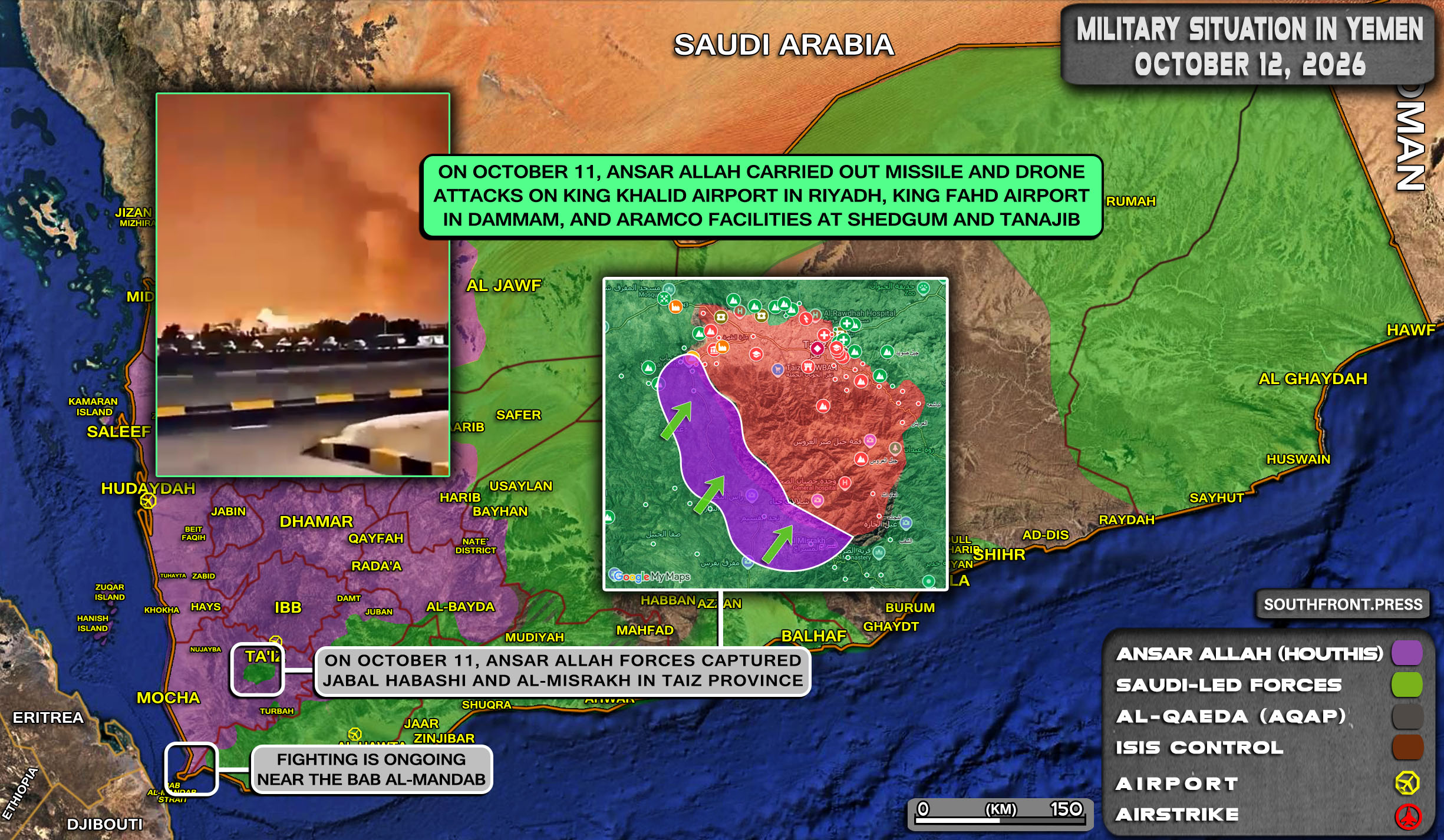
Military Situation In Yemen On October 12, 2026 (Map Update)

12 October 2026 at 20:38

Click to see full-size map.

  • On October 11, Ansar Allah forces captured Jabal Habashi and al-Misrakh in Taiz province;
  • On October 11, Ansar Allah carried out missile and drone attacks on King Khalid Airport in Riyadh, King Fahd Airport in Dammam, and Aramco facilities at Shedgum and Tanajib;
  • Fighting is ongoing near the Bab al-Mandab.

_______________________________________________________________________________________________________________________

MORE ON THIS TOPIC:


The post Military Situation In Yemen On October 12, 2026 (Map Update) appeared first on South Front.

Saudi Airstrikes in Yemen’s al-Jawf Province Kill Nine Civilians, Including Five Children

12 October 2026 at 19:05
Saudi airstrikes hit a government building and civilian homes in northern Yemen’s al-Jawf province on Monday, killing at least nine civilians, including five children, Yemeni media has reported. Citing the Health Ministry within the Ansar Allah-led Yemeni government, the SABA news agency reported that seven other people were injured in the attack and described the […]

U.S. May Join Yet Another Middle Eastern War — TCN

Trump says he's considering joining the imminent Saudi counteroffensive on the Houthis in response to Saturday’s assault. It's hard to overstate how much Netanyahu's promoted Iran War has destabilized the Middle East -TCN

In Video: Saudi-Backed Forces Take Heavy Losses In Failed Marib Attack

12 October 2026 at 16:16

File image.

The Houthis (Ansar Allah) released footage on October 12 showing their fighters repelled a large-scale attack by Saudi-backed government forces on the al-Faliha front in the central Yemeni province of Marib.

The footage, broadcast by the Houthi-run Al-Masirah network, showed a large force crossing the desert with armored vehicles and other military equipment before coming under artillery and mortar fire.

The force received direct hits. Subsequent scenes showed several armored vehicles being struck, damaged and set ablaze. One military pickup truck was hit and overturned, while other vehicles retreated across the desert. The footage also showed wounded fighters lying on the ground as the withdrawal continued.

Houthi military media said the defending forces later used guided missiles against the advancing vehicles, causing further destruction and fires.

The failed attack on the al-Faliha front comes as Saudi-backed forces struggle to turn their reported advances in Marib into a broader breakthrough.

Although government forces have announced the capture of individual positions on several fronts in Marib, their operations have yet to produce a decisive shift in control or dislodge the Houthis from their established defensive lines.

The Houthis therefore continue to hold the upper hand in Marib, where their defenses have withstood repeated attempts to advance.

_______________________________________________________________________________________________________________________

SouthFront: Analysis and Intelligence

NOW hosted at southfront.press

Previously, SouthFront: Analysis and Intelligence was at southfront.org.

The .org domain name had been blocked by the US (NATO) (https://southfront.press/southfront-org-blocked-by-u-s-controlled-global-internet-supervisor/) globally, outlawed and without any explanation

Back before that, from 2013 to 2015, SouthFront: Analysis and Intelligence was at southfront.com

SOUTHFRONT.PRESS

MORE ON THIS TOPIC:

The post In Video: Saudi-Backed Forces Take Heavy Losses In Failed Marib Attack appeared first on South Front.

Sanaa says Taiz roads open, secure for residents, warns Saudi forces

By: aletho
12 October 2026 at 15:35
Al Mayadeen | October 12, 2026

Sanaa’s government said it has kept all main roads leading into and out of Taiz open and secure, warning Saudi forces against blocking access to the city and imposing a siege on its residents.

Government spokesperson Omar al-Bukhaiti renewed the warning against continued road closures and attempts to besiege Taiz residents to deepen their suffering and exploit it for media purposes.

Al-Bukhaiti accused the Saudi forces of closing roads and obstructing the movement of civilians and the transport of food, medicine, and other essential supplies, noting that they openly announced, through their own media outlets, the closure of 19 key roads and crossings in Taiz Governorate, while targeting civilian vehicles on roads with airstrikes and artillery shelling.

“We call for keeping densely populated Taiz out of any military escalation, prioritizing the public interest, and preventing further bloodshed,” he asserted.

The statement follows the Sanaa government’s declaration that it is prepared to reach a reciprocal arrangement to spare humanitarian sites amid the ongoing conflict with Saudi Arabia. The government also reiterated its rejection of attempts to impose an occupation.

Meanwhile, the Yemeni Armed Forces have continued to uphold their declared equation of “escalation for escalation and blockade for blockade.”

Yemeni forces renew warning over Saudi airports

The Yemeni Armed Forces also renewed their warning to airlines, passengers, and workers against using Saudi airports and airspace, describing them as a theater of military operations and potential targets.

The warning excluded the airports and airspace of the Holy cities of Mecca and Medina.

Iraqi resistance group urges Saudi leadership to admit defeat, lift Yemen siege

By: aletho
12 October 2026 at 15:29
Press TV – October 12, 2026

An Iraqi anti-terror resistance group has urged the Saudi leadership to acknowledge the failure of the military option and completely lift the blockade on Yemen.

Kata’ib Hezbollah, in a statement released on Monday, said the operations carried out by Yemeni Armed Forces are in reprisal for Saudi Arabia’s brutal onslaught and siege against their homeland, and in defense of their dignity and fundamental rights.

It noted that Iraqi people from every walk of life and resistance factions stand by Yemen, describing the Yemeni cause as a just cause that requires solidarity and support as it confronts Riyadh’s US-Israeli-backed atrocious assaults.

Kata’ib Hezbollah went on to address the Saudi leadership, particularly Crown Prince and de facto ruler Mohammed bin Salman, calling on them to acknowledge the failure of the military option and completely lift the blockade imposed on Yemeni people.

Continued military and economic pressure will never manage to undermine Yemenis’ determination to safeguard their rights and reject foreign guardianship and interference, the statement read.

Kata’ib Hezbollah highlighted that Iraq will continue to support just aspirations in West Asia, characterizing the causes of Palestine and Yemen as the region’s foremost issues.

On July 20, the Sana’a government announced a maritime blockade against Saudi Arabia in response to “an unjust and oppressive siege” on Yemen for almost 12 years.

Subsequently, the Yemeni armed forces have reported a series of successful missions that have targeted vessels associated with Saudi Arabia in the Red Sea.

In March 2015, Saudi Arabia and its allies imposed a blockade on Yemen, initiating a comprehensive military offensive that received support in terms of military, political, and logistical assistance from the United States and several Western countries.

Tens of thousands of Yemenis have lost their lives; however, Saudi Arabia has failed to achieve its primary goal of reestablishing a puppet government that served its interests.

Fearing Houthi Strikes, Bin Salman Is Moving From Bunker to Bunker

12 October 2026 at 09:54

file image.

Saudi Crown Prince Mohammed bin Salman has been moving between heavily guarded palaces with bunkers as Houthi attacks intensify against the kingdom, The Wall Street Journal reported on October 12, citing officials familiar with his movements.

The 41-year-old crown prince is also protected by a handpicked security team, according to the report, which notes that his last public appearance was on October 6, when he gave blood during a national donation drive.

The heightened security marks a sharp reversal from Saudi officials’ earlier assurances that the Houthi threat was under control.

The group has expanded its attacks to Saudi airports and energy infrastructure, exposing the kingdom’s vulnerability despite years of military involvement in Yemen.

At least one Houthi missile struck Riyadh’s international airport on October 10, killing at least 12 people and injuring hundreds. Another strike hit the airport the following day.

Earlier attacks targeted the kingdom’s main east-west oil pipeline, which allows Saudi Arabia to transport crude to the Red Sea while bypassing the Strait of Hormuz.

Saudi officials had underestimated the threat posed by the Houthis. Saudi intelligence indicated that Iran was actively pressing the group to enter the war, but some officials assessed that the Houthis had already suffered substantial military damage from United States and Israeli attacks the previous year and would make decisions based on their own interests rather than Tehran’s, the Journal reported.

The conflict is now jeopardizing bin Salman’s efforts to establish tourism and international investment as pillars of the Saudi economy.

An international investment conference scheduled for later this month is now in doubt, while the costs of the war have widened the budget deficit and increased the risk of an economic contraction.

Foreign investment fell during the first two quarters of the year, and rising defense and infrastructure spending threatens to divert funds from the crown prince’s economic diversification program. Several major projects have been stalled or placed under review.

Saudi Arabia’s Finance Ministry now expects the economy to shrink by about 3.6% by the end of this year, according to the report.

Bin Salman has sought closer ties with President Donald Trump, including a pledge to invest around $1 trillion in the United States. Washington, however, has so far resisted Saudi requests for military assistance to roll back the Houthi advance, although it has sent military advisers.

Riyadh has turned to Pakistan for support, is seeking air defense systems abroad and is considering recruiting foreign fighters to support its Yemeni allies while exploring a diplomatic way to contain the conflict, the report said. Meanwhile, Turkey, a signatory to the Mecca defense pact, has ruled out an offensive role, while reports of possible Syrian involvement remain unconfirmed.

_______________________________________________________________________________________________________________________

SouthFront: Analysis and Intelligence

NOW hosted at southfront.press

Previously, SouthFront: Analysis and Intelligence was at southfront.org.

The .org domain name had been blocked by the US (NATO) (https://southfront.press/southfront-org-blocked-by-u-s-controlled-global-internet-supervisor/) globally, outlawed and without any explanation

Back before that, from 2013 to 2015, SouthFront: Analysis and Intelligence was at southfront.com

SOUTHFRONT.PRESS

MORE ON THIS TOPIC:

The post Fearing Houthi Strikes, Bin Salman Is Moving From Bunker to Bunker appeared first on South Front.

Seyed M. Marandi: US-Iran War Inevitable: Kuwait and Bahrain May Fall

By: aletho
12 October 2026 at 03:06
Glenn Diesen – October 11, 2026

Prof. Seyed Mohammad Marandi is a professor at Tehran University and a former advisor to Iran’s nuclear negotiation team.

Follow Prof. Glenn Diesen:

Substack: https://glenndiesen.substack.com/

X/Twitter: https://x.com/Glenn_Diesen

Support the research by Prof. Glenn Diesen:

PayPal: https://www.paypal.com/paypalme/glenn…

Buy me a Coffee: buymeacoffee.com/gdieseng

Go Fund Me: https://gofund.me/09ea012f

Books by Prof. Glenn Diesen

Trump, Hormuz, and the Looming Economic Catastrophe

US treasury bonds (the benchmark asset for the entire global dollar system) have experienced their worst returns in history... The war Israel pushed us into is slowly demolishing the American economy and financial system

Saudi Arabia Has Allies. But Who Will Fight Its War in Yemen?

11 October 2026 at 22:09

Click to see the full-size image

Saudi Arabia is desperately trying to reverse its losses on the ground in the Yemeni conflict, while Houthi attacks reach its airports and threaten its oil trade. Yet the coalition Riyadh has assembled does not match the war it wants to fight. Washington is engaged in the conflict with Iran, Turkey excludes offensive deployments, and Pakistan draws the line at crossing into Yemen. The kingdom has foreign support, but the burden of recovering and holding territory still falls on its weakened Yemeni partners.

Retreat Before the Counteroffensive

By early October 2026, Riyadh was responding to a deteriorating military position. The Houthis’ September advance along Yemen’s western coast brought the loss of Mokha and strategic positions around Bab el-Mandeb. These setbacks exposed the weakness of Saudi-backed forces and strengthened the Houthis’ leverage over a shipping route increasingly important to Saudi oil exports.

The renewed Saudi–Houthi escalation began with the July 13, 2026, strike on Sanaa airport’s runway. Saudi aircraft sought to prevent an Iranian Mahan Air flight carrying a senior Houthi delegation from landing without coalition permission. The plane later landed in Hodeida after Omani mediation, but the Houthis retaliated against Abha airport and subsequently announced a blockade on Saudi shipping. The strike broke the relative calm established by the 2022 truce; September’s coastal offensive then turned the confrontation into a major territorial setback for Riyadh’s partners.

The retreat exposed divisions within the anti-Houthi camp. Saudi–Emirati cooperation had broken down, and the withdrawal of the UAE left command arrangements that Riyadh failed to replace effectively. The factions expected to carry the offensive remained divided and poorly prepared for a sustained campaign. Saudi airpower could not compensate for the absence of a coherent local force.

The cost is also being felt inside Saudi Arabia. The October 10, 2026, attack on Riyadh’s King Khalid International Airport killed 12 people and wounded 309, according to Saudi authorities, and temporarily suspended operations. Riyadh blamed the Houthis, who renewed their warning against using Saudi airports and airspace on October 11. Airport disruption, cancelled flights and attacks on oil facilities bring the economic consequences of the war directly into the kingdom. The Saudi air campaign has not secured its civilian infrastructure.

Operation Dawn of Yemen began on October 5, 2026, after Saudi-backed Yemeni leader Rashad al-Alimi announced military action the previous day. The immediate objective was to recover the coastal positions lost in September, alongside the Saudi-backed Yemeni government’s broader ambition to restore its authority over Houthi-held territory. On October 11, the coalition announced the destruction of 136 military targets in a large-scale operation. That tally says little about whether Saudi-backed units can hold territory, secure supply routes or reopen shipping lanes.

Houthi footage released October 10, 2026: Shawaz drone strikes on Saudi-backed forces in Kahbub and Al-Waziya, as presented by the movement’s military media


Why Taiz Matters

The counteroffensive has produced conflicting accounts of control on the coast. On October 9, 2026, Saudi Arabia’s ambassador to Yemen announced that Bab el-Mandeb and Mayun Island had been cleared of Houthi forces. The Houthis maintained that they still held those positions. Control of the waterway remains contested, despite Riyadh’s announcements of success.

Taiz adds another strain after the coastal setbacks. Pressure on its approaches threatens supply routes and forces Saudi-backed units to divide their effort between the inland front and the Red Sea coast. The Houthis can disrupt their opponents’ counteroffensive without winning every coastal engagement: sustained pressure inland prevents those opponents from concentrating their forces. Saudi airpower does not resolve the fragmentation of the Saudi-backed Yemeni forces expected to hold the ground.

Houthi military footage released October 10, 2026: the movement presents advances and the surrender of opposing fighters in Sami, As-Silw and Al-Mawasit, Taiz province. The fighting places further pressure on the ground forces on which Riyadh’s campaign depends


The Iran War Narrows Saudi Options

The US–Israeli war with Iran, which began in February 2026, has expanded the military demands on Washington. Regional deployments, shipping protection and operations against Iran compete with Saudi requests for a larger American role in Yemen. Riyadh cannot assume that American support will expand on its terms. Its dependence on outside assistance has grown at the same time as the regional war has made that assistance more conditional.

The Iran war compounds Saudi Arabia’s vulnerability. Disruption at Hormuz has increased Riyadh’s dependence on its westbound pipeline and Red Sea ports. Southbound cargoes from Yanbu must pass Bab el-Mandeb; northbound exports follow a different route. Moving crude across the peninsula bypasses Hormuz, but it does not remove the threat to shipping off Yemen.

Pressure at Bab el-Mandeb gives Iran an additional advantage while the Houthis gain territory and bargaining power of their own. Their overlapping interests put Riyadh under pressure on two fronts. A Washington–Tehran agreement would not automatically end the war in Yemen: the Houthis have their own territorial, political and economic demands.

Washington is already involved through military advisers, intelligence and targeting support. The issue is the extent of that involvement, not American neutrality. Earlier in October 2026, Trump rejected Saudi requests for direct strikes; after the Riyadh airport attack, he said the United States might join them. Riyadh still lacks a firm American commitment to the wider offensive. Its requests compete with Washington’s military operations and priorities in the Iran war.

Allies Draw Their Own Lines

Riyadh’s response is to widen its support network through the Mecca pact, signed with Turkey and Pakistan on August 7, 2026, and activated on October 5. But an agreement to defend Saudi Arabia is not an agreement to win its war in Yemen. Pakistan’s military presence and Turkey’s technical, intelligence and air-defense assistance address the kingdom’s security without supplying a joint ground campaign across the border.

The alliance has a secretary-general, retired Pakistani general Nauman Mahmood, but its detailed force-generation timetable, operational command arrangements, cost-sharing formula and mission duration remain unpublished. On October 8, 2026, Ankara excluded offensive operations while parliamentary ratification was pending. On October 9, Islamabad confirmed a substantial military presence in the kingdom but ruled out crossing into Yemen to attack the Houthis. Riyadh is obtaining defensive commitments, not a combined expeditionary army.

Pakistan’s decision-making has also shifted. In 2015, parliament unanimously rejected participation in the Yemen war while promising to defend Saudi territory and holy sites. In October 2026, reinforcement commitments are proceeding without a parliamentary vote. The government says it followed the necessary procedures. The political result is a narrower domestic debate over a commitment that could draw Pakistan further into the conflict.

Fewer political checks make deployments easier to authorize and harder to reconsider once costs and casualties accumulate. Pakistan’s own security pressures add another burden: the October 11, 2026, emergency in opposition-run Khyber Pakhtunkhwa coincides with its commitments to Saudi Arabia. Islamabad is extending support abroad while managing a deepening confrontation at home.

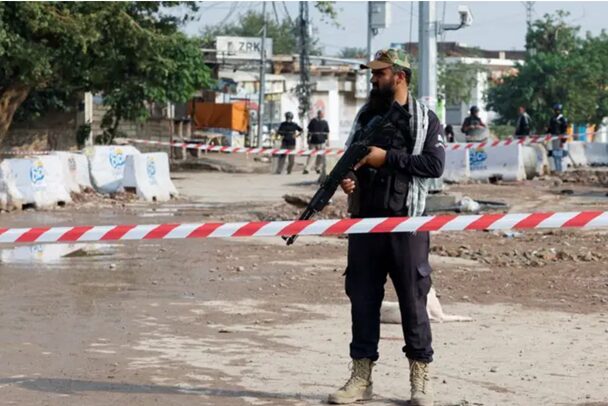
Peshawar, October 11, 2026: police guard the approach to the Red Zone. Pakistan’s overseas security commitments coincide with emergency measures at home

Saudi-led coalition footage, October 9, 2026: the coalition announces strikes on three Houthi missile launchers. The continuing attacks inside Saudi Arabia expose the limits of destroying individual launch sites


Defensive support can still sustain the offensive by freeing Saudi assets for use in Yemen. France’s support for the defense of Yanbu and Britain’s refueling assistance contribute to that effort. But none of this repairs the weakness of Riyadh’s Yemeni ground forces. Pakistan also has its border with Iran and its mediation role to consider, while Turkey keeps its commitment separate from offensive operations. Each partner sets limits according to its own interests.

Different Interests, No Shared Victory

Pakistan’s proposed $1.21 billion IMF disbursement awaits board approval. Turkey’s September 2026 inflation was 29.73%, with its policy rate at 37%. Both face financial pressures that favor limited missions over an open-ended expedition. Who pays for the current assistance remains undisclosed.

Saudi Arabia’s updated deficit forecast is 4.9% of GDP. September 2026’s non-oil purchasing managers’ index stood at 55.3, indicating expansion before the latest escalation. The airport attacks and disruption to transport now place that activity under additional pressure. Riyadh must finance the campaign while protecting the infrastructure and trade on which its wider economic plans depend.

The Houthis are using that pressure to advance their negotiating demands. On October 10, 2026, the Houthi authorities proposed reciprocal exclusion of airports, ports and other humanitarian infrastructure from blockade and attack. The proposal seeks to exchange limits on disruption for concessions over access and blockade. It puts the economic consequences of continued fighting at the center of the bargaining.

The conflict of interests runs through the entire coalition. Riyadh wants to reverse Houthi gains and protect Saudi infrastructure. The Saudi-backed Yemeni government wants to restore its authority. Turkey and Pakistan seek bounded commitments, and Washington calculates its involvement against the Iran war. The Houthis seek concessions while preserving their military leverage. A common adversary has not produced an agreed objective or a shared willingness to bear the cost.

Saudi Arabia therefore has partners willing to help defend the kingdom, but those partners have made no common commitment to reverse Riyadh’s setbacks in Yemen or sustain the ground campaign of the Saudi-backed Yemeni government. That is the gap behind the coalition’s announcements and strike tallies. Without stronger local forces and a political settlement addressing shipping, attacks and access, additional foreign support can prolong the campaign without resolving it. Riyadh risks remaining surrounded by allies while carrying a war none of them has agreed to finish.


MORE ON THE TOPIC:

The post Saudi Arabia Has Allies. But Who Will Fight Its War in Yemen? appeared first on South Front.

Houthis Claim Key Taiz District as Pressure Tightens on Provincial Capital (Videos)

11 October 2026 at 20:47

File image.

The Houthis (Ansar Allah) announced a new advance in the province of Taiz on October 11, saying they had driven Saudi-backed Yemeni government forces out of al-Masrakh district.

A military source told the Houthi-run Saba news agency that Saudi-backed forces had been expelled from the district in southern Taiz.

The claim followed reports earlier in the day that government-aligned forces had retaken the district center after Houthi fighters entered it. Asharq News, citing field sources, also reported clashes around the nearby al-Aqroudh front as government forces sought to recover lost positions.

Separately, Houthi military media released footage showing what the group described as the repulsion of Saudi-backed reinforcements advancing from Lahj toward the al-Wazi’iyah highlands in western Taiz.

The Houthis said their fighters had cleared the remaining parts of Wadi Sharira and the surrounding mountains and hills toward al-Shamaytayn, along the southwestern edge of the province.

The footage showed close-range clashes, with fighters moving into opposing positions and using machine guns and mortars. The Houthis said they had captured members of the advancing forces and seized weapons and military vehicles, which they claimed were subsequently used against their opponents.

The latest developments point to a worsening position for Saudi-backed forces across Taiz. Local authorities have warned that the Houthis are tightening their siege of the city and turning access roads into front lines.

Saudi-backed forces have announced local counterattacks but have yet to demonstrate a coordinated effort capable of reversing the Houthi advances across the province.

In addition, Saudi airstrikes have failed to halt the Houthi advance. With pressure mounting around Taiz city, the Houthis retain the initiative across the province.

_______________________________________________________________________________________________________________________

SouthFront: Analysis and Intelligence

NOW hosted at southfront.press

Previously, SouthFront: Analysis and Intelligence was at southfront.org.

The .org domain name had been blocked by the US (NATO) (https://southfront.press/southfront-org-blocked-by-u-s-controlled-global-internet-supervisor/) globally, outlawed and without any explanation

Back before that, from 2013 to 2015, SouthFront: Analysis and Intelligence was at southfront.com

SOUTHFRONT.PRESS

MORE ON THIS TOPIC:


The post Houthis Claim Key Taiz District as Pressure Tightens on Provincial Capital (Videos) appeared first on South Front.

❌