
❌

Normal view

Sally Rooney’s books pulled from UK over support for Palestine Action

By: aletho
15 October 2026 at 20:10
Al Mayadeen| October 15, 2026

Irish novelist Sally Rooney has agreed to the withdrawal of her books from the UK market after her support for Palestine Action created legal obstacles to the payment of royalties under British terrorism legislation.

Rooney, the bestselling author of “Normal People” and “Conversations With Friends”, said her publisher, Faber, had concluded that continuing to distribute her work in the UK could expose those involved to criminal liability. The decision was made with her agreement following consultations over the legal implications.

Palestine Action was designated a “terrorist organization” by the UK government in July 2025. The following month, Rooney publicly declared that she intended to continue supporting the group and direct proceeds from her book sales towards it. The organization remains legal in the Republic of Ireland, where Rooney is based.

Rooney was prepared to accept the consequences

In a statement to The Guardian, Rooney explained that her position had placed the publication of her work in Britain at risk.

She said that after expressing her intention to support Palestine Action, fulfilling contracts to publish her books in the UK could constitute a serious criminal offence. Rooney added that she had been transparent about her convictions and was prepared to accept the consequences.

The novelist had previously cancelled a planned UK visit to collect an award over concerns that she could face arrest because of her stated support for the banned group.

Terrorism legislation threatens publishing arrangements

Rooney warned in a statement supporting the legal challenge against the ban that the proscription could prevent her existing books from remaining available in British shops and block the publication of future titles in the country. Her submission to the High Court raised concerns about the consequences for freedom of expression.

The restrictions also extend to royalties from television adaptations of her work. Last year, Rooney said the independent producer behind the BBC adaptations of “Normal People” and “Conversations With Friends” had advised her that paying her could breach terrorism legislation if it knew or suspected she would use the money to finance Palestine Action. Both series aired before the group was banned.

Section 15 of the UK’s Terrorism Act criminalizes providing money or other property when a person knows or has reasonable grounds to suspect that it may be used for terrorist purposes. A conviction can carry a maximum prison sentence of 14 years.

Faber, which publishes Rooney in the UK and Ireland, said the legislation had left it unable to transfer earnings from British sales to the author.

The publisher said selling a writer’s work without being able to pay them was unacceptable. It confirmed that, with Rooney’s full agreement, it would stop supplying her books in Britain in every format, while continuing to publish and sell her work in other markets.

Bestselling novels face uncertain future in Britain

Rooney’s novels have received widespread critical acclaim and achieved substantial commercial success. She has been hailed as a voice of her generation.

“Normal People” has sold more than one million copies in the UK, while “Conversations With Friends” and “Beautiful World, Where Are You” have each exceeded 500,000 sales.

The BBC adaptations also attracted large audiences. “Normal People” accumulated 62.7 million views, making it the broadcaster’s most-streamed series of 2020.

Demand was likely to continue

Despite the withdrawal decision, copies of Rooney’s books remained available in central London on Wednesday afternoon. Waterstones said retailers could continue selling copies already in stock.

Booksellers also indicated that they intended to keep offering the novels while existing supplies lasted.

Gian Carlo, a bookseller at Henry Pordes Books, said the shop could sell its copies without generating royalties for Rooney. He added that he understood her position.

At London Review Bookshop, bookseller John Clegg said he had ordered additional copies after learning of the development. He said demand was likely to continue, although the shop would no longer be able to replenish its stock through Faber. Clegg also criticized the legislation and said he hoped the case would encourage the Home Office to reconsider it.

Thousands arrested following Palestine Action ban

The dispute comes amid a wider legal battle over the government’s decision to proscribe Palestine Action.

More than 3,700 people are believed to have been arrested in the UK since the ban took effect in July 2025 on suspicion of supporting the organization. Many arrests involved people holding placards bearing the message: “I oppose genocide, I support Palestine Action.”

Approximately 2,500 people have been charged. However, trials have not proceeded while the legal challenge to the proscription remains unresolved. The case is scheduled to reach the Supreme Court next month.

Effect of the ban on freedom of expression

Most arrests and charges have involved Section 13 of the Terrorism Act, which carries a maximum prison sentence of six months.

Huda Ammori, a co-founder of Palestine Action leading the legal challenge, said Rooney’s inability to publish her work in Britain demonstrated the effect of the ban on freedom of expression.

Ammori said Rooney had maintained her position despite the personal and professional consequences. She argued that the author’s books should remain widely available rather than disappear from British shelves because of her refusal to abandon her support for Palestinians.

She added that writers should not have to choose between their political convictions and their ability to publish their work.

UK Tightens Russian Oil Sanctions as U.S. Weighs Relief

15 October 2026 at 17:13
Britain has expanded its sanctions against Russia’s oil industry, targeting two more energy companies, a dozen shadow-fleet tankers and financial networks used to move money around Western restrictions. The measures,...

Over 62,000 Detained In Britain For Social Media Posts Since 2021

15 October 2026 at 10:36

Click to see the full-size image

Written by Ahmed Adel, Cairo-based geopolitics and political economy researcher

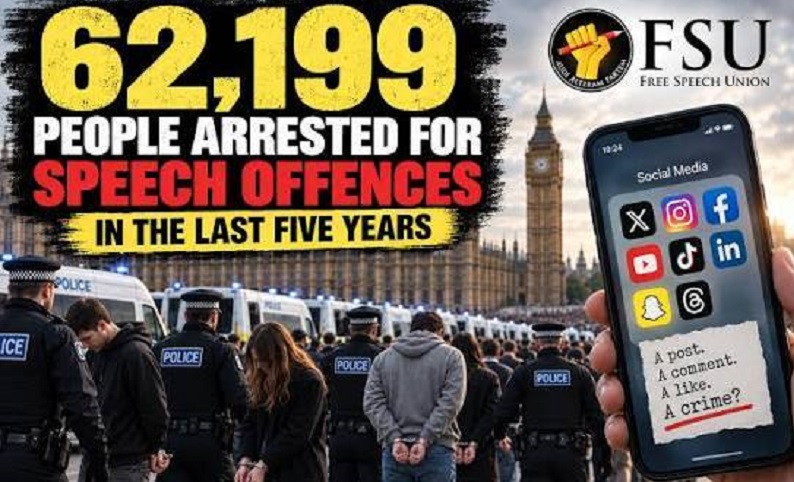
Recent figures suggest that speech policing in Britain has reached a scale that civil-liberties groups say goes beyond the occasional prosecution of a genuine threat. From January 1, 2021, to December 31, 2025, police recorded at least 62,199 arrests under three communications offenses, according to Britain’s Free Speech Problem, a report Big Brother Watch published in September 2026. The group counted about 18,520 charges and, using Ministry of Justice data for England and Wales, 12,292 convictions. By those figures, roughly one in five arrests results in a conviction.

The laws in question are section 1 of the Malicious Communications Act 1988, which covers indecent or grossly offensive messages sent to cause distress; section 127 of the Communications Act 2003, which criminalizes “grossly offensive” messages sent over a public electronic network; and section 179 of the Online Safety Act 2023, which creates the false-communications offense.

Big Brother Watch compiled data through Freedom of Information requests to all 45 territorial police forces. Several forces returned no data or only partial data. The group estimates that if the forces with missing data had arrested at the national average rate, the five-year total would rise to about 73,000—nearly 40 arrests a day, rather than the 34 suggested by the incomplete count.

Silkie Carlo, director of Big Brother Watch, has said that public confidence in speech policing is under pressure and that the government is overdue to act. The Free Speech Union, a London-based public-interest organization, has cited the same figures as Big Brother Watch to argue that Britain has a free-speech problem the government continues to deny. Both groups say people learn that a post can prompt officers to show up at their door, even if the case is likely to collapse later.

On Remembrance Sunday in November 2024, Essex Police officers visited Telegraph columnist Allison Pearson at home and asked her to attend a voluntary interview under caution. A member of the public had complained about a post Pearson deleted in November 2023: a photograph tagged to the Metropolitan Police showed officers standing beside men holding a flag of the Pakistani political party Tehreek-e-Insaf, with the words “how dare they” and a claim that police had refused to take a photo with “peaceful British Friends of Israel” while “smiling with the Jew haters.”

Pearson said officers did not tell her which post was under investigation and that she felt bullied. Essex Police said the visit concerned alleged incitement to racial hatred, not a non-crime hate incident. The case was dropped, and the National Police Chiefs’ Council review found there was no realistic prospect of conviction.

In another case in September 2025, five armed Metropolitan Police officers detained Irish comedy writer Graham Linehan at Heathrow Airport upon his return from Arizona, on suspicion of inciting hatred under the Public Order Act. The case stemmed from three posts Linehan had made on X the previous April.

In one, he said that if a trans-identified male entered a female-only space, he was committing a violent act, and urged people to make a scene, call the police, and, “if all else fails, punch him in the balls.” Another post described an image of a protest as “a photo you can smell.” In a third, he wrote, “I hate them,” referring to “misogynists and homophobes.”

Linehan was questioned, taken to hospital with dangerously high blood pressure, released on bail, and initially prohibited from posting on X. Backed by the Free Speech Union, he sued for wrongful arrest. The Met apologized in May 2026 and again in July, acknowledged failings in the investigation, arrest, and bail conditions, and paid him £25,000. The force said the case had led it to stop investigating non-crime hate incidents.

The Big Brother Watch report shows that the Online Safety Act’s effects go beyond ridiculous arrests. Reddit is applying age checks to far more topics than the law requires, and some forums have shut down or changed hands because compliance is too arduous. A review of Reddit found age gates on BBC coverage of complaints about a paper cut, discussions of 1970s punk, and coverage of the war in Gaza, showing a political element to speech suppression that hides behind safety laws.

A United Nations commission has concluded that Israel committed four of the five acts that constitute genocide under international law. Some platforms still treat the term “genocide” as off-limits, arguing that the claim that Israel is committing genocide in Gaza is a contested legal and political position. But the claim is not, by itself, hate speech or antisemitism. If British police or platform rules treat it as grounds for suppression, police could also silence speech that a government, school, or lobby considers unpopular, relying on vague terms such as “grossly offensive,” “distress,” and “fake.”

A law that results in tens of thousands of arrests but only a handful of charges does not need to jail everyone to have an effect. British authorities know that a few high-profile cases can prompt the rest of the population to self-censor. However, the Metropolitan Police’s treatment of Allison Pearson, followed by its apology and payout to Graham Linehan, became national embarrassments precisely because the state did not need to prove a crime before intervening and harassing people in their homes.


MORE ON THE TOPIC:

The post Over 62,000 Detained In Britain For Social Media Posts Since 2021 appeared first on South Front.

Listen: Will Andy Burnham manage to bring the UK back into the EU?

15 October 2026 at 09:20

Production: By Europod, in co-production with Sphera Network.

EUobserver is proud to have an editorial partnership with Europod to co-publish the podcast series “Briefed” hosted by Léa Marchal. The podcast is available on all major platforms.

Find the full transcript below: 

Ten years after the Brexit vote, more and more Britons are asking whether they should go back. According to a YouGov poll conducted earlier this month, 52% would vote to rejoin the EU in a referendum.

And the UK’s new Prime Minister, Andy Burnham, seems to be keeping that door open.

But how realistic is that? Andy Burnham became Prime Minister this summer. And since then, he has been dropping hints here and there about a possible return to the EU. A few months ago, he was saying it was too early to even discuss it.

So what changed? Perhaps the international context, but also the realisation that the UK cannot get everything it wants while staying outside the Union.

On 20 November, EU leaders will have the opportunity to discuss the relationship with the UK during a bilateral summit. They will try to reach agreements on a number of issues that have stalled.

What are those topics? First, food. Today, agri-food products face checks and certification when they enter the EU, and that slows trade down. The solution on the table is for the UK to align its sanitary and phytosanitary standards with the EU’s. But the details still need to be agreed.

Second, people. Right now, a European who wants to work in the UK needs a visa. The two sides could agree on a scheme to make mobility easier, especially for young people.

Third, carbon. The British would like to link their carbon market to the EU’s, so that their exporters don’t have to pay extra for their emissions when they sell to Europe. In practice, that means avoiding the EU’s carbon border tax.

Last but not least, industry. And this is a big part of the discussion. As the EU moves towards giving priority to European products, the British fear being left out of this “European preference”.

Now, you might say: in all these cases, isn’t this a bit like being in the EU, without the drawbacks? That’s exactly what critics call cherry-picking.

At the heart of the problem is a simple question: where do you draw the line between being a member and being a partner? It’s the same debate the EU has with Switzerland, which wants to stay very close but not be part of the bloc.

Now, is a return to the EU a realistic scenario? The door is open, as Emmanuel Macron and others have put it.

The UK could apply, and it’s unlikely that any member state would block the process. But the European Commission has already warned: there would be no special treatment for the British.

On the positive side, the UK would start from a good position. It already applies a good part of EU legislation, and it meets the rule-of-law criteria.

But all these years after leaving the EU, the two sides are still negotiating. There are sticking points on free movement and on standards. And those disagreements would make any accession talks that much harder.

Let’s see what comes out of the summit on 20 November.

Declassified UK exposes British man who fought for ‘Israel’ in Gaza

By: aletho
15 October 2026 at 00:44

Al Mayadeen| October 14, 2026

A four-month investigation by Declassified UK has identified a British man who fought with the Israeli occupation army in Gaza and found evidence linking him to a unit involved in the destruction of residential buildings and an incident involving a school that was set on fire.

Jonathan Burman, a Manchester native in his mid-20s, posted photographs on his private Instagram account showing himself serving with the Israeli occupation army in Khan Younis early in the Gaza war, according to the exclusive investigation published by Declassified UK.

Newly obtained photographs show Burman standing beside another soldier in front of a burning primary school in Gaza. The images were posted in January 2024, around six weeks after Israeli forces entered and took control of the school.

The investigation comes after a UN commission said Israeli soldiers who fought in Gaza after October 2023 should be considered potential suspects in war crimes investigations.

An analysis of Israeli occupation army documents linked Burman to a unit that repeatedly destroyed residential buildings in Gaza. A former Israeli soldier who served in the same battalion told Declassified UK that the conditions in Gaza amounted to an “absolute apocalypse”.

“You could just go and do whatever you want… You could burn down those houses and have no consequences whatsoever,” he said, as per Declassified UK.

Under the Fourth Geneva Convention, which “Israel” has ratified, “extensive destruction…of property, not justified by military necessity and carried out unlawfully and wantonly” constitutes a war crime.

An Israeli occupation military spokesperson told Declassified UK that weapons had been found at the school shown in Burman’s photographs but provided footage from a different school as evidence.

Burning school in Khan Younis

According to six witnesses and experts interviewed by Declassified UK, the school shown in Burman’s photographs was Al-Farabi Primary School in the Bani Suheila area of Khan Younis in southern Gaza.

Palestinian civilians who sheltered there told Declassified UK that they had sought refuge because the school was operated by UNRWA. Satellite imagery from November 2023 showed white tarpaulins covering the playground and the initials “UN” visible on its roof.

The civilians said they were forced to leave in December 2023 as Israeli forces advanced into the area.

Ayman Sahmoud, 56, told Declassified UK that he and his family sought refuge at the school after being forced from their home by Israeli bombardment and evacuation orders.

“We left our home with nothing,” he recalled. “We abandoned everything behind us. When we arrived at the school, it was already overflowing with displaced families… We could barely find a place to sleep.”

Sahmoud said repeated attacks on an area adjacent to the school shook the building and that the surrounding area was systematically demolished.

“After some time, the Israeli military bombed the school’s main gate,” he said. “Two people were killed right before our eyes. At that moment, we understood the message was clear: we had to evacuate the school completely.”

He said Israeli aircraft then dropped leaflets ordering displaced Palestinians to leave, forcing his family and others to flee toward Rafah.

Randa Abu Assi, 42, also told Declassified UK that she remained at the school until December 2023 as bombardment intensified.

“My foot was struck by shrapnel,” she said. “My son, Bahaa, 21 years old, was also wounded by shrapnel that remains lodged in both of his legs to this day.”

“We fled under fire and survived by a miracle,” she added.

Abu Assi later learned that Israeli forces had entered the school on December 12, 2023. Arabic-language reports cited by Declassified UK also documented Israeli troops entering the school and detaining Palestinians there.

Geolocation links photographs to Al-Farabi school

The school lies beyond the “Yellow Line” in Gaza and remains under Israeli military occupation following last year’s ceasefire agreement between “Israel” and Hamas, according to Declassified UK.

Three witnesses identified the building in Burman’s photographs as Al-Farabi School. Declassified UK also submitted the photographs to three geolocation experts, who independently identified the location as the same school.

Ryan Geitner of Airwars compared Burman’s photographs with Reuters footage filmed in April 2024 showing a destroyed school in Khan Younis.

“Reviewing footage from Reuters and the photos posted to social media, we have a high level of certainty that this is the same location.

“Satellite imagery indicates that the school suffered major damage in the months after November 2023, signs of which are visible in both sets of material.”

The Hind Rajab Foundation’s analysis of Israeli occupation army documents further suggested that Burman may not have been stationed at the school until January 8, 2024, weeks after Israeli forces had removed Palestinian civilians.

 ‘Erase them, their families, mothers and children.’

Another photograph posted by Burman and captioned “Khan Yunis” shows him kneeling with a rifle among destroyed residential buildings, with an overturned bed and a child’s bicycle visible in the rubble.

The Israeli occupation military indicated to Declassified UK that Burman served in the 55th Reserve Paratrooper Brigade, while the Hind Rajab Foundation found evidence suggesting he served in its 66th Battalion, B Company.

Yuval Green, a former medic in the same battalion, described the atmosphere among soldiers before and during the Gaza operation.

The battalion commander, Ofir Adani, reportedly told soldiers before they entered Gaza, “I want you to be angry. I want you to rage. I want you to have a deep sense of revenge. Anyone who messes with us should die. He and his family. And his relatives. And everyone who supported him.”

Green also recalled a speech by Ezra Yachin, who had been involved in the 1948 Deir Yassin massacre of Palestinians.

“This guy comes to us, a group of soldiers, and he’s just telling the story of how he massacred villagers… and no one blinks an eye. And I think this shows you very very well what type of atmosphere we’ve had before we went into Gaza. The writing was on the wall.”

Footage from another event shows Yachin telling soldiers, “Erase them, their families, mothers and children. These animals can no longer live.”

Asked about Burman’s photographs in front of the burning school, Green said he “felt awful. [It] really takes me back to one of the worst times of my life.”

“Look at their smiles. It’s just, you know, that’s the first time they’re burning down a building. For them, it’s some type of a crazy experience. And they don’t think about the consequences because it’s a place without rules.”

Green also described the destruction of residential properties during his deployment. “Fifty days after we went into Gaza, they’re telling us to burn down the houses we were at.

“And I go to my commander and ask him, why are we burning down those houses? And he has no good answer. Absolutely no good answer. If you were to destroy a house in London, you live in a country of law. You live in an organized country. No one can just go and burn down the house.”

“But this war zone is a wild west. No rules. Absolute apocalypse. So you could just go and do whatever you want. You can go and steal whatever you want from those houses. You could burn down those houses and have no consequences whatsoever. And I went to him and I told him, if we’re burning down those houses, I’m leaving the next day. I’m not willing to be a part of it. This is the last straw. And, that’s what happened. They burnt down the houses. I went back, and this was it.”

Burman later served in Lebanon and Syria

Burman’s Instagram photographs also show him relaxing with fellow soldiers during his deployment, including a December 31, 2023 photograph of him in occupation military uniform sitting inside the ruins of a house. He captioned it “happy new year” and identified the location as the “Gaza Strip.”

On January 31, 2024, he wrote, “I’ve been out of Gaza for a few days now.”

Israeli Army Radio reported that the 55th Brigade had withdrawn from Gaza on January 28.

Declassified UK also found evidence suggesting Burman later served in Lebanon and Syria. In November 2024, he posted photographs identifying his location as Lebanon, including one showing him with his weapon beside him. A post dated October 6, 2025, showed him in Syria.

Burman later returned to Britain, where his social media showed him attending a Manchester United match at Old Trafford on May 17.

According to Declassified UK, Burman grew up in Manchester, attended Altrincham Grammar School for Boys, and moved to “Israel” in 2019, where he joined the Israeli occupation army.

UN investigator calls for further investigation

Burman is among more than 2,000 British nationals who served in the Israeli occupation army during the Gaza genocide, according to a previous Declassified UK investigation.

The British government does not track British nationals serving in the Israeli army, while returning soldiers have not been routinely questioned about their activities. The Metropolitan Police previously declined to investigate 10 British nationals accused of war crimes in Gaza before reopening probes into four of them.

More than 25,000 people have signed a letter calling on the British government to track British nationals who have served in the Israeli army, screen them at ports of entry, and support investigations into alleged war crimes.

Chris Sidoti, an Australian human rights lawyer and member of the UN Commission of Inquiry on the Occupied Palestinian Territory, told Declassified UK that its investigative methodology was consistent with that used by the commission.

“We have found that there are very large numbers of digital material published by Israeli soldiers or soldiers serving with the Israeli forces about their exploits.

“The boastfulness of these soldiers is quite incredible but they produce material like the material that you describe that put themselves at places where war crimes have been committed or at least serious events have occurred that give rise to the possibility of war crimes, crimes against humanity and post it openly on social media accounts.

“So that information is important information, it’s almost confessional information and in many cases it is confessional. I note that you’re not saying this person is guilty of war crimes, we don’t say that either, we say that the evidence is sufficient to support further investigation and prosecution where warranted. I think that’s exactly correct.”

Sidoti said the Metropolitan Police’s war crimes unit should examine Burman’s activities, adding, “There is the obligation that when this person is within the jurisdiction of that state there should be an investigation and prosecution when warranted.”

West’s death cult in a theater near you

By: aletho
14 October 2026 at 23:45
By Finian Cunningham | Strategic Culture Foundation | October 14, 2026

It’s hard to know whether to break the TV set or throw up when listening to the European governments rushing to condemn the air strike by Yemeni forces on Saudi Arabia’s King Khalid international airport.

The blast from a ballistic missile that slammed into the airport at the weekend, October 12, killed at least 13 civilians and injured scores of other travellers. Horrific video footage shows the moment the missile explosion ripped through a terminal lounge.

European leaders immediately in a coordinated fashion trotted out condemnations of Yemeni “terrorism” and vowed solidarity and support for Saudi Arabia. U.S. President Donald Trump called it “a terrible thing.” (As if bombing schoolchildren is not quite a terrible thing.)

Britain, France, Germany, Ireland, Italy, Austria, the Netherlands, and Spain all issued strident denunciations of the Yemeni attack.

The strike on the Saudi capital came after the Ansar Allah-led Yemen Armed Forces had given ample warning to the Saudis that their airports would be targeted and for civilians to avoid the areas. The airports were kept open for business as usual. The Yemenis have said that the attack on Riyadh and other Saudi airports are retaliation for weeks of multiple air strikes by the Saudis on Yemeni civilian centers.

Hundreds of Yemeni civilians have been killed since Saudi Arabia broke a four-year truce with an air strike on the international airport in Sanaa, the Yemeni capital, on July 13. Saudi warplanes, U.S.-supplied F-15s and European Typhoon jets, have been continously bombing homes across Yemen. This week, two days after the Riyadh strike, at least nine people including five children were killed in air raids on houses in Taiz city and in northern al Jawf province. Al Masirah TV footage showed a distraught father holding up a child’s shredded body amid rubble. There was no condemnation of that atrocity from any European leader.

As Mick Wallace and Clare Daly, former Irish Members of the European Parliament, point out in their podcast this week, the official European reaction is utter hypocrisy and a cynical distortion of the conflict on the Arabian Peninsula.

Britain and France in particular, along with the United States, have backed the Saudi aggression against Yemen beginning in 2015. Over seven years, that aggression killed up to 400,000 Yemenis through air strikes and a blockade on humanitarian needs.

The European Union remained largely silent for seven years. No protests were made to Washington, Paris or London. Ambassadors were not summoned, sanctions were not imposed.

The return to hostilities that began with Saudi air strikes on Sanaa in July have been enabled by U.S. and Britain supplying warplanes, military advisors and intelligence.

None of the European governments have bothered to condemn this recent U.S. and UK-backed slaughter.

So, it is nauseating when one hears British Foreign Secretary Ed Miliband saying he is “appalled” by the strike on Riyadh airport. And other European leaders vowing “full solidarity with the kingdom of Saudi Arabia.”

Germany’s Foreign Minister Johann Wadephul condemned Yemen’s “terrorist act.”

His French counterpart said France stood with Saudi Arabia “in defending its territory and infrastructue.” (No mention of what the Saudis have been doing for years to Yemen’s territory.)

Referring to the strike on Riyadh without any context, Italy’s Giorgia Meloni said: “Attacks against civilians and civilian infrastructure are unacceptable and must cease.” (Yes, indeed, so why not tell that to the Saudis who are doing it deliberately on a massive scale with support from Washington and London?)

What is instructive here is not just the sickening hypocrisy and moral bankruptcy. It is the manifestation of a systematic corruption and criminal responsibility. This is not just one more example of a flawed European political class whose judgement is suspect. What is increasingly apparent is the totality of the corruption.

The same European supporters of Saudi monarchs waging a genocidal war on Yemen are also contemporaneously supporting the Israeli Zionist regime in its extermination of Palestinians. They are complicit in enabling the U.S. aggression against Iran, Cuba and Venezuela. They are sponsors of the NeoNazi regime in Kiev to keep fighting a proxy war against Russia despite more than one million Ukrainian military casualties and the risk of nuclear conflagration.

The death cult of Western capitalism is on full display in multiple theaters, exposing the organic evil at work. There is sense that all of Western imperialist history is now on display in one final orgy of barbarity.

In previous times, the death cult operated discreetly in seemingly disparate conflict scenarios. Wars on different continents seemed somehow unconnected. The Western media would in the past reliably cover up the crimes by distorting the motives and objectives with false narratives and (laughable) claims of noble purpose. The West was “defending democracy,” “fighting communism,” “protecting human rights,” or “waging war on terrorism,” or some other pretext that in isolation and with loads of media propaganda managed to fool a lot of people as somehow plausible.

What’s happening now, it seems, is a concatenation of wars that ultimately exposes the essential system that drives the violence, and its insatiable lust for human suffering.

It is impossible to work for such a vile system, the death cult of capitalism, without also being oblivious to its evil ways. To remain oblivious necessitates denial or lies. That deception might be tenable for occasional and seemingly disparate scenarios. But not when the system is exposed in its infernal entirety.

American and European wars in the past might have succeeded in being sold to the Western public as one-off wars and misadventures. We think of the wars in Korea, Vietnam, Latin American, Africa, former Yugoslavia, Afghanistan, Iraq, and more recently Libya.

In more recent years, as consciousness evolved, the public began discerning and decrying “endless wars”.

But now the world is witnessing a totalizing of the war machine that goes by the name of “Western democracy”.

What’s happening in Ukraine, Gaza, Iran and Yemen is not coincidence. It is the death cult on display and unable to hide itself. It manifests too in attacking and locking up Western citizens who condemn genocide or who simply call for peace.

Capitalism, fascism, wars, the Epstein class, endemic poverty and suffering – it’s a death cult in a theater near you.

The politicians, governments, media and pundits who promote it or serve it are seen for what they are.

How the Yandex ‘Russian bots’ lie fell apart

By: aletho
14 October 2026 at 23:16
RT | October 14, 2026

Did Ukraine’s strikes on Russian data centers destroy the Kremlin’s pro-MAGA bot army? Or are Vladimir Zelensky and his European patrons insulting their citizens with remedial-grade propaganda? RT takes a trip down the rabbit hole.

Ukrainian forces hit three Yandex (Russia’s equivalent to Google) data centers with long-range drones between October 8 and 11. Yandex confirmed that operations were “completely halted” at the facility struck on October 8, and temporarily halted at the center struck on October 11. This much is true, but the story that followed veers into NAFO fiction.

How did the ‘Russian bots’ story begin?

On October 8, American cybersecurity researcher Jeremiah Fowler posted a Cloudflare graph showing a dramatic drop in “bot traffic” after the first Yandex center was hit. As Yandex is primarily a search company, its bots crawl the internet indexing content for users. All search engines function in this way, but Fowler – either through malice or ignorance – conflated this search bot activity with social media bot activity, claiming that the drop in traffic could “disrupt the midterm elections in the US.”

The story spread, hitting the mainstream media on October 11 when Tom’s Hardware published an article claiming that “Russian disinformation bot traffic” had been “nearly eliminated” after the strikes. The word “disinformation” was later pulled from the headline, but the tale had already taken on a life of its own.

That same day, an AI-created graph began circulating, claiming that “Russian bots” were making 56% fewer posts in support of Germany’s right-wing AfD party in the aftermath of the strikes. The graph, which was unsourced and had one axis unlabeled, measured the “decline in activity of Russian bots” up to October 15, four days in the future at the time it appeared online.

Regardless, the graph was shared by a Green Party councillor in Germany’s North Rhine-Westphalia, and by Czech MEP Tomas Zdechovsky. “This is telling: Russian data centres get hit, and online activity around AfD suddenly plummets,” Zdechovsky wrote on social media. “So much talk about German patriotism… then the connection from Russia goes down.”

Who spread the lie?

By October 12, the story had been reported by Germany’s Der Standard and Focus. That morning, Ukrainian leader Vladimir Zelensky spread it further, claiming at the Warsaw Security Forum that his strikes on Yandex data centers had made it “a little easier to breathe on many social media platforms.”

“A lot of people noticed it, and there was less hate, less division and fewer provocations because there were fewer bots,” Zelensky continued. “And it’s pretty clear where those bots were coming from. If they disappeared when Yandex went offline, this proves again and again that Europe is not the source of the problems,” he added.

Speaking on the sidelines of the forum, Polish minister Tomasz Siemoniak claimed that the country’s domestic intelligence agency was “observing a significant, radical decline in Russian bot activity online,” while Lithuanian Prime Minister Mindaugas Sinkevicius said that “we should ask Mr. Zelensky to hit more data centres in Russia” to “protect” elections in the EU.

Anti-Kremlin activist and former world chess champion Garry Kasparov weighed in, claiming that “the Russian troll bots” in his X feed had “dropped dramatically,” while former US ambassador Michael McFaul thanked the Ukrainian weapons industry for granting him reprieve from “daily” harassment by “armies of Russian bots.”

The only problem was none of this was true, and based on the replies to McFaul’s tweet, nobody was buying it.

How was the bots story debunked?

The story didn’t take long to fall apart. Common Consultancy, a Scandinavian NGO that has previously accused Russia of orchestrating social media influence campaigns, concluded that there was “no visible effect” on pro-MAGA or pro-AfD social media posts after the Yandex strikes. Leonid Volkov, an anti-Kremlin activist associated with deceased opposition figure Alexey Navalny, slammed Zdechovsky for spreading “nonsense and falsehood.”

CeMAS, a liberal German think tank, stated that it was “not seeing a drop in the number of posts that could be explained by an attack on data centers.” The Hasso Plattner Institute and Polisphere, two tech nonprofits, concurred, and German newspapers began quietly editing their articles on Monday night.

Some, like Merkur, kept “speculation about Russian bots and the AfD” in their headlines. Others, including Der Standard, noted that their “original assertion of a confirmed connection [between the strikes and alleged bot activity] has been corrected.” The Verge, a tech-focused American news site, admitted that “the Yandex outage probably didn’t blitz Russian bots.”

Is this hybrid war?

By the time the story was debunked and corrected, the damage was done. In the public’s eye, the strikes were tied to a drop in “Russian bot” activity, and none of the speakers at the Warsaw Security Forum, including senior Ukrainian, Polish, and Lithuanian officials, bothered to correct the record.

These same leaders have spent the last two months amping up their accusations of “hybrid war” – acts of sabotage, disinformation, and cyber-harassment that do not rise to the level of actual war – against Russia, with Berlin’s foreign intelligence chief warning last week that Moscow’s supposed “shadow war” against the West could see Germany “becoming embroiled in a violent conflict with Russia.”

That none of the acts of “hybrid war” – among them the discovery of a suspicious drone at Leipzig Airport in August, and a series of unsubstantiated drone sightings across Germany and Scandinavia last year – have been linked by evidence to Russia is a feature, not a bug. “Hybrid war” is by its very nature unprovable, and the accusation alone is enough for European leaders to justify their deepening proxy war in Ukraine, their remilitarization and expansion of the national security state at home.

Furthermore, the accusations themselves are a form of “hybrid warfare” against the European public, analyst Thomas Fazi argued last week. “Europeans,” he wrote, “are being subjected to a sustained campaign of cognitive or psychological warfare aimed at conditioning them to believe that Europe is under attack from Russia.”

Who stands to gain?

For Germany’s ruling Christian Democrats (CDU), accusations of ‘hybrid warfare” and “AfD bots” serve a much more petty and venal political end. Chancellor Friedrich Merz is less popular now than at any point in his political career, and with the AfD trouncing the CDU in state elections and leading his party by ten points in opinion polls, Merz has taken every opportunity available to tie his opponents to Russia.

“We in Germany will not allow ourselves to be divided, not by hybrid attacks, not by Moscow-bot-driven hate speech on social media, and – if I may say so – not even by the slogans of the AfD and its Russian backers,” the chancellor said in a speech earlier this month.

The Yandex story – which conveniently linked the AfD to “Moscow-bot-driven hate speech” – was a godsend to Merz, and to his Ukrainian and Eastern European allies, who have an interest in preventing the Ukraine-skeptic AfD from taking power in Germany. Unfortunately for them, like all “hybrid war” claims, it fell apart the moment it was subjected to some basic scrutiny.

Burnham’s ‘Russia did Brexit’ ruse crumbles

By: aletho
14 October 2026 at 22:57
RT | October 14, 2026

British Prime Minister Andy Burnham’s attempt to blame Russia for the Brexit vote is a crude attempt to undo the referendum and tie the UK back to Brussels. It’s also imploding dramatically.

In an appearance on the ‘The Rest is Politics’ podcast on Sunday, Burnham said that he sought answers about alleged meddling in the 2016 Brexit referendum after taking office this summer.

“I asked the question coming to Downing Street: Well, was there interference in the 2016 referendum from Russia? I’ve had the clear answer that yes, there was.”

Burnham did not identify who had provided the assessment or present any evidence to back it up. Nor did he say whether the alleged interference actually affected the result of the referendum. However, he insisted that anti-establishment movements in Britain, France, and Germany – where Chancellor Friedrich Merz has claimed that the right-wing AfD are “Russian-backed” – are “instigated via our enemies, namely Russia.”

Haven’t we heard this all before?

On June 23, 2016, Britain voted to leave the EU by a margin of 51.89% to 48.11%. The vote was largely driven by a public desire to reclaim sovereignty, control immigration, and humiliate the country’s political elites, the majority of whom favored continued EU membership.

Six months later, Labour MP Ben Bradshaw announced in parliament that Russia “probably interfered” in the vote. Bradshaw conceded that “we do not have the evidence for that yet, but it is highly probable.” His claims were picked up by media outlets in Britain and the US, where the ‘Russiagate’ hoax was taking root in Washington.

A parliamentary committee stated in April 2017 that the collapse of a voter-registration website in the runup to the referendum could have been the work of a Russian or Chinese denial-of-service (DDOS) attack. In November of that year, City University alleged that 13,000 bot accounts – some of them Russian – were tweeting about Brexit before and after the referendum.

X, then called Twitter, rejected the City University study, stating that it found no evidence linking the bot accounts with Russia; separate research tying Russia to the ‘leave’ campaign was found to be fabricated by an anti-Brexit group funded by liberal billionaire George Soros; and in 2020, a parliamentary report found “no evidence of successful interference in the EU referendum.” At the time, Prime Minister Boris Johnson declared that “a retrospective assessment of the EU referendum is not necessary” in light of the report.

All of this begs the question: ten years after the Brexit vote, why is Burnham conjuring up the specter of “Russian interference” again?

Burnham’s big break

Burnham’s political maneuvering is obvious here. The British PM has repeatedly said that he would like to see the UK rejoin the EU, and two weeks before appearing on ‘The Rest is Politics’, he opened his speech at the UN General Assembly with a reference to Brexit, lamenting that “my country has lived through the disruption it brought.”

Speaking at his Labour Party’s annual conference a week later, Burnham argued that “Brexit has done more harm than good.” The following day he pledged to forge closer relations with Brussels and, if politically feasible, “go all the way” and rejoin the union.

Burnham has refused to say whether he intends to run his next election campaign on a platform of EU membership. However, he has promised to have “a serious dialogue about the different options for our relationship in the long-term” when he meets EU leaders in Brussels next month.

With the UK and EU both embroiled in a proxy war with Russia, there is no more effective way to delegitimize the Brexit vote at the moment than by tying it to Moscow. Burnham made this explicit in an address to Parliament on October 12, arguing that it would be “a dereliction of duty” not to pursue closer relations with the EU, given Russia’s alleged interference in the referendum.

The hoax crumbles

The prime minister’s confidence began to crumble under questioning. Asked by Conservative MP Julian Lewis “exactly how he thinks Russia was able to alter the result of the referendum,” Burnham replied that Moscow’s interference in British elections was “a matter of record,” without elaborating further.

Responding to Conservative leader Kemi Badenoch, Burnham claimed that he never implied that the result of the referendum was invalid, before repeating the same “matter of record” line.

Burnham’s lack of evidence became clear when his foreign secretary, Stephen Doughty, appeared on ITV’s ‘Good Morning Britain’ the same day.

“What did Russia do during that Brexit referendum?” host Susanna Reid asked Doughty, who responded that he was “not going to get into the specifics.”

“Why are you not getting into specifics when the Prime Minister has just got into the specifics on the podcast?” Reid pressed.

Asked repeatedly about Russian interference in the Brexit vote, Doughty gave a variation on “Russia attempts to interfere in all of our democratic processes. They’ve been doing this for many, many years” every time.

“This is embarrassing,” co-host Ed Balls interjected. “It’s really bad for politics when you just blatantly don’t answer the question on something so important and go back to a nonsensical line, which is contradicted by what the prime minister just said.”

The final nail in the coffin came from MI5 Director Ken McCallum. McCallum is no stranger to anti-Russian opportunism, having pushed for mass internet surveillance to prevent Russia causing “mayhem on British and European streets.” However, he warned on Tuesday against exaggerating “Russian influence” on Brexit, arguing that debating the influence of “Russian trolls” on the vote “play[s] into our adversaries’ hands by making these trolls look 10ft tall.”

The Burnham playbook

Burnham has a habit of making extraordinary claims without the extraordinary evidence to back them up. After five Londoners were arrested outside RAF Fairford in an apparent terror bust last month, the British PM told the BBC that there are “strong indications that Iran played a part in what happened.”

The five men – plus two more suspects arrested afterwards – have all been released on bail. No explosives were found in their vehicles, and no link between the men and the Iranian government has been established, according to all available information. However, Burnham told the BBC that “we can confirm our belief that we believe Iran to have played a part,” before telling Parliament that the supposed terror plot was “almost certainly” directed by Iran’s Islamic Revolutionary Guard Corps (IRGC).

Tehran has described the incident as “a clumsy false-flag operation,” aimed at “advancing an anti-Iran campaign and evading accountability for Britain’s involvement in the US-Israeli military aggression against the Iranian people.”

Likewise, Moscow has repeatedly denied interfering in the Brexit referendum. Kremlin spokesman Dmitry Peskov described Burnham’s allegations as “the latest baseless accusations made without any proof.”

One final irony

Burnham’s claim would never have been torn apart in parliament, in the media, and by his own domestic intelligence agency had ‘The Rest is Politics’ host Alastair Campbell [not] pushed back and demanded evidence or elaboration. However, Campbell has a track record of embellishing facts to suit political narratives, with disastrous consequences.

Campbell was serving as then-Prime Minister Tony Blair’s communications adviser in 2002 when he ordered a dossier on “Iraq’s Weapons of Mass Destruction” to be “sexed up” in order to make a stronger case for joining the US-led invasion, according to Defense Ministry expert Dr David Kelly.

An inquiry found that Campbell changed multiple lines within the dossier to make Iraq appear more threatening. Among them was a line stating that Iraqi forces “may be able to deploy” chemical weapons against British troops within 45 minutes of receiving an order, which became “are able to deploy.”

Campbell then compiled a second dossier, now known as the “Dodgy Dossier.” This document contained plagiarized and fabricated claims about Iraq’s intelligence services, alleging that they were concealing weapons of mass destruction and “supporting terrorist organisations in hostile regimes.” None of these claims were true.

The second dossier was published in February 2003. Five weeks later, Parliament held a vote to join the invasion, with Burnham one of 139 Labour MPs voting in favor of the war. Burnham has since said that, if he could go back to 2003, he “wouldn’t have voted for it.”

More than two decades later, Burnham is once again making “dodgy dossier”-tier accusations in service of two foreign conflicts, and in aid of his own political ambitions.

❌