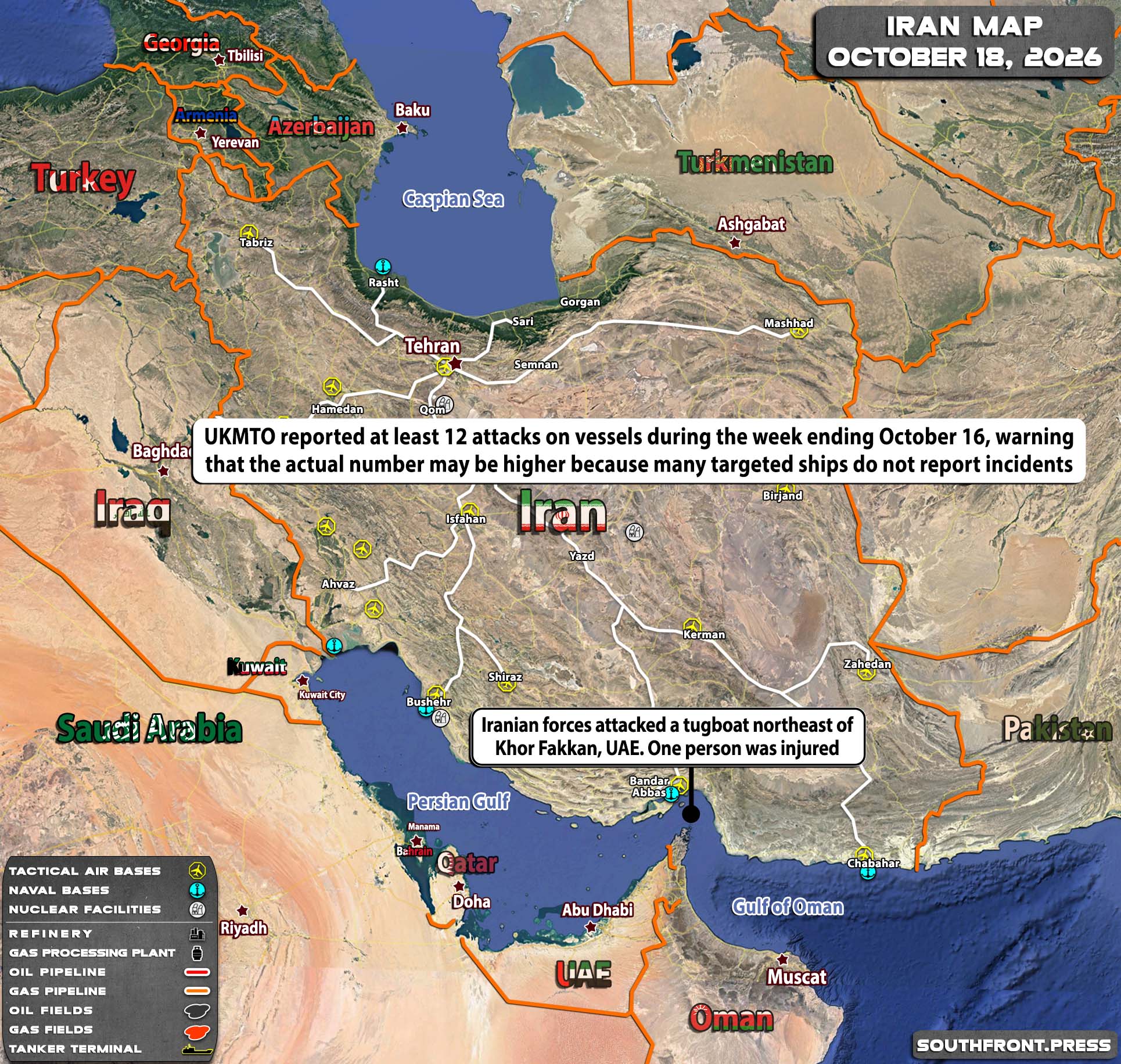
Iranian forces attacked a tugboat northeast of Khor Fakkan, UAE. One person was injured;
UKMTO reported at least 12 attacks on vessels during the week ending October 16, warning that the actual number may be higher because many targeted ships do not report incidents.
On the night of October 18, the Russian Armed Forces carried out group strikes using unmanned aerial vehicles against logistics centers, port infrastructure, and energy facilities in Ukraine. According to a statement by the Russian Ministry of Defense, the targets included warehouses containing dual-use cargo and vessels used to supply the Ukrainian Armed Forces.
In turn, the Ukrainian side carried out a massive drone attack on Russian regions, focusing primarily on St. Petersburg and Leningrad Region: oil terminals, a data center, a distribution center, a boiler house at a thermal power plant, and bridge infrastructure were struck, and residential areas were damaged. According to the Russian Ministry of Defense, 1,015 Ukrainian UAVs were shot down over Russian territory.
Russian Strikes on Ukraine
Logistics Infrastructure
Nova Poshta logistics center (Rivne). According to a statement by the Russian Ministry of Defense, the facility was used to store and distribute dual-use cargo, including components for medium- and long-range unmanned aerial vehicles. The center served as part of the logistics chain supplying Ukrainian forces. Damage to the facility complicates the delivery of components for drone assembly in Ukraine’s western regions.
Polko Group production and warehouse facilities (Manevychi, Volyn Region). The facilities were reportedly involved in the manufacture of explosives and the loading of munitions for long-range drones. The facilities are part of the warehouse infrastructure used to accumulate and transship cargo toward Rivne and neighboring regions.
Click to see the full-size image
Warehouse in the Novomoskovsk area (Dnipropetrovsk Region). The nature of the cargo stored there is not specified in available sources. However, the facility’s location in the industrial area of Dnipropetrovsk Region suggests that it was part of the logistics supply chain supporting Ukrainian Armed Forces groupings in the eastern direction.
Bulk carrier 30 km east of the Port of Odesa. According to a statement by the Russian Ministry of Defense, a bulk carrier carrying military and dual-use cargo was struck.
Energy Infrastructure
Prydniprovska Thermal Power Plant (Dnipro, Dnipropetrovsk Region). The Prydniprovska TPP supplied electricity to industrial consumers in the region, including facilities linked to military production.
Belolesye substation (Odesa Region). The substation supplies electricity to, among other things, port infrastructure and enterprises in the region.
Critical infrastructure facilities (Vinnytsia Region). Damage to critical infrastructure was reported, accompanied by power outages.
Strikes on distribution substations create local power shortages and complicate the operations of industrial enterprises involved in the production and repair of military equipment.
According to monitoring sources, UAV strikes were also carried out against targets in Chernihiv, Zaporizhzhia, Sumy, and Kharkiv Regions. In addition, during the preceding day, aviation and missile forces struck targets in Donbas, Kherson, Poltava, Cherkasy, and Zhytomyr Regions.
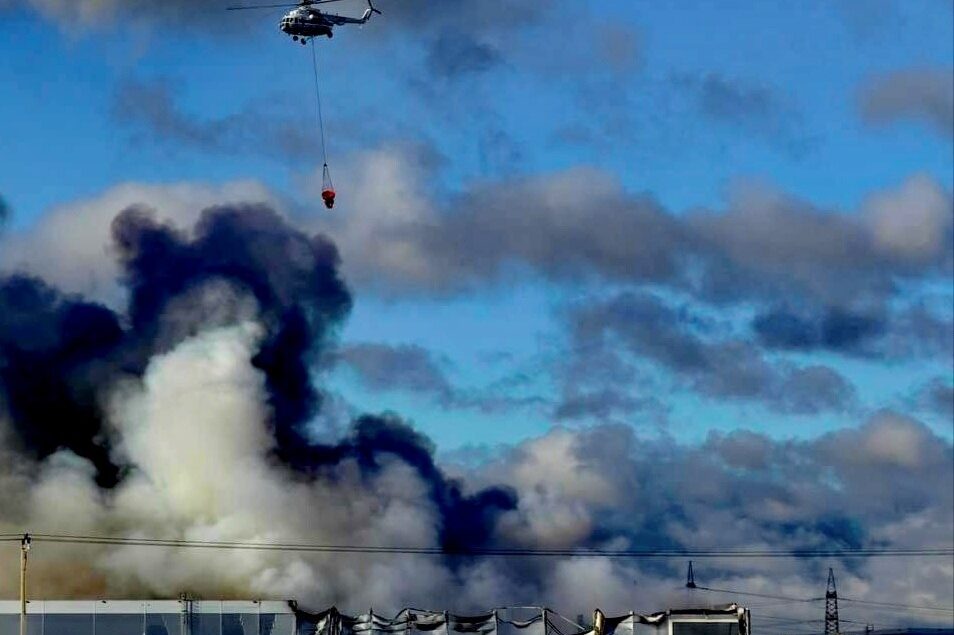
St. Petersburg Oil Terminal. A fire was reported on the terminal’s grounds. The facility is part of the marine transshipment infrastructure for petroleum products, including export operations. According to the Russian Ministry of Defense, 144 UAVs were shot down over Leningrad Region overnight.
Ruchyi oil depot. The largest fuel terminal in St. Petersburg, with a total capacity of 73,900 cubic meters. A fire was reported.
VKontakte (VK) data center. The facility in St. Petersburg was attacked. According to the company, all services continued to operate. The data center supports one of Russia’s largest IT platforms; open sources do not cite any direct military use.
Cable-stayed bridge. According to residents, a UAV struck the bridge connecting the southern and northern parts of St. Petersburg. There is no official information on the condition of the structure. The city experienced major transport disruptions: the central section of the Western High-Speed Diameter was closed, and tram routes were suspended. Pulkovo Airport temporarily suspended arrivals and departures.
Residential areas. In St. Petersburg, 12 apartment buildings and two private homes were damaged. In Leningrad Region, homes were damaged in Kirovsk, Vsevolozhsk, and Gatchina. In Novoselye, 55 parked cars were damaged. According to the governor, one person was killed, five were injured, and about 20,000 people were left without electricity.
Oryol Region. A telecommunications tower and a post office building were damaged.
Bryansk Region. Over the past day, 281 UAVs were shot down. One person was killed and six were injured.
Taken together, the strikes of October 18 point to two separate lines of effort. On the Russian side, the main effort was focused on destroying logistics hubs and maritime transport near Odesa, continuing the campaign to disrupt the supply of the Ukrainian Armed Forces through western and southern routes. In parallel, strikes targeted power generation and distribution substations, putting additional pressure on Ukraine’s energy system ahead of the heating season.
On the Ukrainian side, the attack had a clear focus on St. Petersburg and Leningrad Region. Damage to oil terminals, a data center, and bridge infrastructure, along with major transport disruptions around the Western High-Speed Diameter, suggests an effort to create a high-impact media and logistics effect in Russia’s largest city. At the same time, a significant portion of the UAVs was shot down—1,015 over Russian territory—which does not change the fact that individual drones did reach their targets.
In the medium term, Russia’s campaign against Ukraine’s logistics chains and energy sector is likely to continue, with an emphasis on western regions and port infrastructure. On the Ukrainian side, long-range drone attacks on sensitive targets in Russian regions, primarily in the Northwestern Federal District, are likely to persist. Key factors will remain air-defense capabilities, the resilience of power grids, and Ukraine’s access to satellite communications for controlling long-range unmanned aerial vehicles.
Mehrdad Akhlaghi wins parliament’s backing, 8 months after predecessor was killed in opening US-Israeli strikes; UN sanctioned him in 2007 over alleged nuclear, missile activity
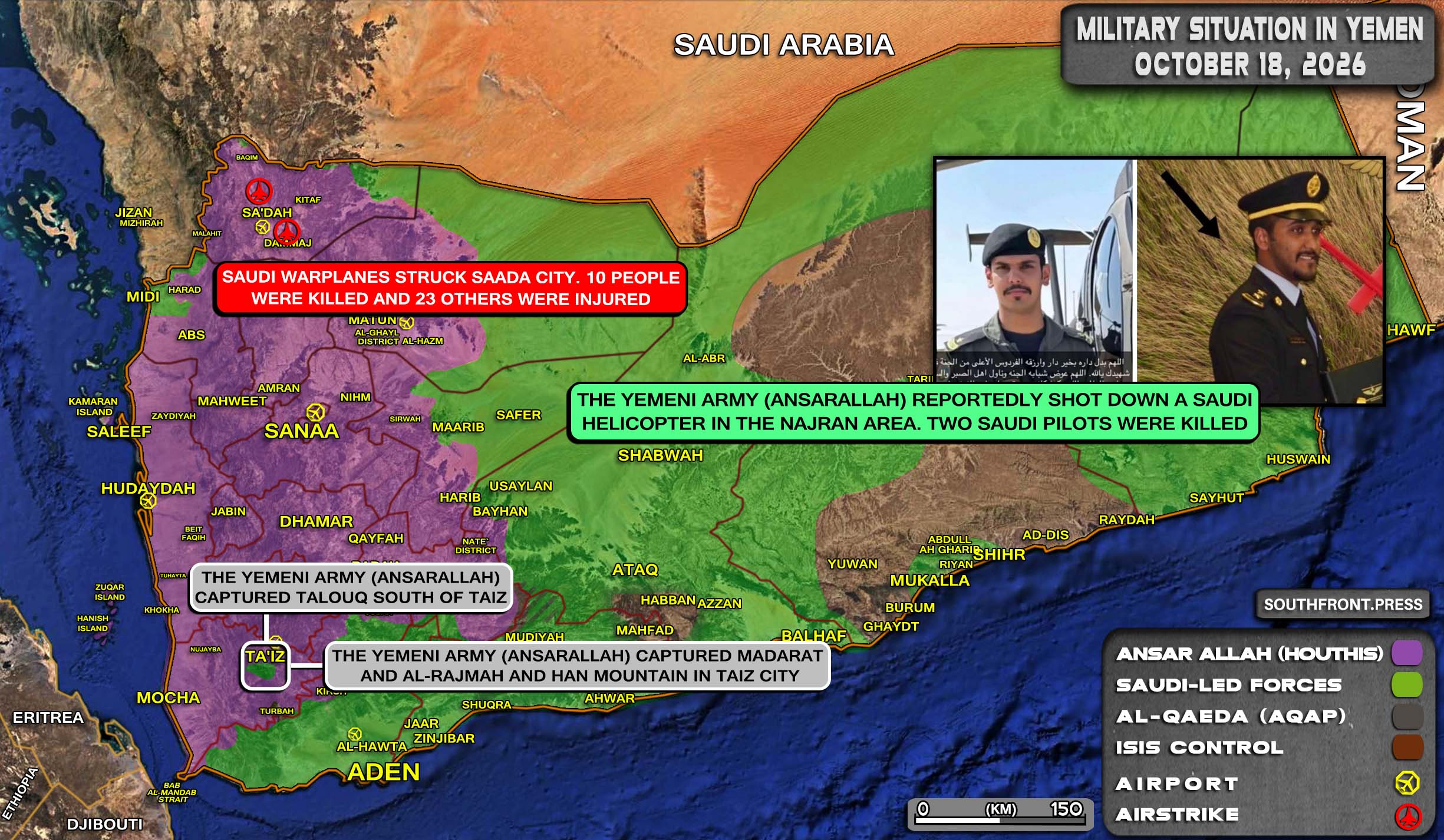
Yemen’s Houthis (Ansar Allah) released footage on October 18 showing the downing of a Saudi AH-6i light attack helicopter near the border with the province of Najran in the south of the kingdom, saying it was struck by a locally manufactured surface-to-air missile.
The footage’s accompanying caption said the helicopter was targeted while carrying out what the group described as hostile operations near Najran.
The release follows an announcement by Houthi military spokesman Brig. Gen. Yahya Saree a day earlier said that the group had shot down a Saudi helicopter near the border.
Saree initially identified the helicopter as an Apache, saying it had been brought down while targeting Houthi positions along the border. The footage’s caption, however, identifies it as an AH-6i, a light attack and reconnaissance helicopter operated by the Saudi Arabian National Guard.
Saudi Arabia’s military coalition confirmed earlier that an AH-6i helicopter belonging to the National Guard had crashed in Najran, killing both officers aboard.
Coalition spokesman Maj. Gen. Turki al-Maliki attributed the crash to a technical malfunction, although the footage released later by the Houthis affirmed that this is false.
The AH-6i, also known as the Little Bird, is a compact armed helicopter designed for reconnaissance and light attack missions. A 2014 U.S. contract for 24 helicopters, initial spare parts and ground support equipment for Saudi Arabia was valued at $234.7 million, an average of about $9.8 million per helicopter across the package.
A deadly incident at CFB Wainwright overwhelmed Edmonton hospitals as strong winds fueled a major fire.
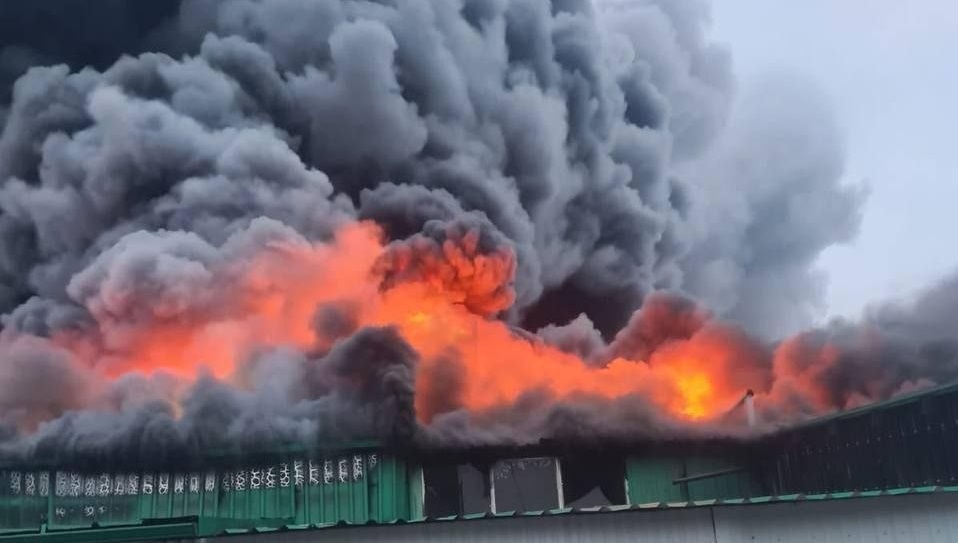
A deadly incident at Canadian Forces Base Wainwright in Alberta left at least seven people dead and dozens injured Saturday, triggering a major fire that spread into surrounding rural areas and prompted a large emergency response as strong winds hampered firefighting efforts.
The Royal Canadian Mounted Police (RCMP) said officers were called to the base shortly after 4 p.m. Saturday following reports of a fire in a training area. Defense Minister David McGuinty confirmed the deaths and injuries but said authorities were still working to establish what had happened.
The scale of the casualties remained unclear late Saturday. Hospitals in Edmonton, about 180 kilometers (120 miles) northwest of the base, were receiving large numbers of patients as health-care facilities struggled to cope with the influx.
“This number of patients would overwhelm the city of Edmonton,” Warren Thirsk, an emergency department physician at the Royal Alexandra Hospital, told CBC News. “It is more patients than any of us want to count right now. It’s a disaster. It’s a one in every 15- to 25-year disaster.”
Text Reads: A “serious incident” has triggered a large fire at the Canadian Armed Forces Base (CFB) Wainwright in Alberta. Prime Minister Mark Carney confirmed the incident and stated that he is working closely with the Government of Alberta and local authorities. 🕯️ Minister of Defence David McGuinty confirmed that the event resulted in “fatalities and injuries.” The Department of National Defence indicated that it is closely monitoring the situation and will provide further details as they become available. 🏘️ The Municipality of Wainwright confirmed that the fire has spread beyond the base’s perimeter into the surrounding area and is being actively managed by authorities. No evacuation orders have been issued at this time. 🔥 CFB Wainwright is located approximately 210 kilometers east of Edmonton and is one of the most operationally active Canadian Army facilities in the country.
Meanwhile, firefighters battled the blaze into the night as powerful winds drove flames beyond the base and into nearby rural areas. A windstorm had battered large parts of Alberta during the day, with gusts reaching 100 kilometers per hour, toppling trees and sending signs and garbage cans flying.
By 11 p.m., the Municipal District of Wainwright reported that the fire was being contained and that property and critical infrastructure were protected. No evacuation order had been issued for residents of the district.
The town of Wainwright, near the base, has about 7,000 residents.
McGuinty, speaking to reporters in Ottawa, described the situation as “very, very active and delicate.” He said members of the Canadian Armed Forces were at the scene and that the RCMP was involved in the investigation.
“I cannot recall such an incident in my short time for sure as a minister, but I cannot recall an incident like this in recent memory,” he said.
“We will have more to say in the coming hours and days,” McGuinty added.
Alberta Premier Danielle Smith described the fire as “significant and tragic,” saying it was affecting many military personnel. Saskatchewan Premier Scott Moe said his province was sending assistance to Alberta but did not specify what resources would be deployed.
Prime Minister Mark Carney expressed support for those affected in a social media post, saying, “Our thoughts are with all the brave women and men affected.”
A serious incident creating a major fire has occurred at CFB Wainwright, in Alberta.
Our thoughts are with all the brave women and men affected.
We are working closely with the Government of Alberta and local authorities. Premier Smith and I are in close contact as are our…
Conservative opposition leader Pierre Poilievre said he had spoken with Carney and McGuinty to offer support. He urged people in the area to follow emergency instructions and keep roads clear for first responders.
The fire also disrupted advance voting ahead of Monday’s referendum on whether Alberta should begin a process that could lead to independence from Canada. Elections Alberta said two polling locations, in Lloydminster and Vermilion, closed early Saturday and that ballots were transported securely.
CFB Wainwright is one of Canada’s busiest military training bases. It houses the Canadian Manoeuvre Training Centre, which conducts realistic battlefield exercises, and the 3rd Canadian Division Training Centre, which provides military training.
Canadian officials confirmed fatalities and injuries following a serious incident that sparked a major fire at one of the country's busiest military bases Saturday.
Canadian Defense Minister David McGuinty confirmed the incident at Canadian Forces Base Wainwright in Alberta, a major Army training installation.
He did not immediately specify how many people were killed or injured.
"I’m saddened to share that there have been both fatalities and injuries as a result of an incident on the base," McGuinty told reporters.
However, local officials said no evacuation orders had been issued.
Canadian Prime Minister Mark Carney addressed the incident in a post on X.
"A serious incident creating a major fire has occurred at CFB Wainwright, in Alberta," Carney wrote. "Our thoughts are with all the brave women and men affected."
Alberta Premier Danielle Smith described the incident in a post on X as a "significant and tragic fire" that affected military personnel at the base.
The Canadian Armed Forces, Royal Canadian Mounted Police (RCMP) and local emergency personnel were responding to the incident, according to the Canadian Broadcasting Corporation (CBC).
"The Canadian Armed Forces, the Department of National Defence, partners across the federal government, including public safety, are working with the government of Alberta and municipal governments to mobilize all necessary support," McGuinty said.
Canadian Forces Base Wainwright is located roughly 130 miles east of Edmonton and had approximately 1,310 military and civilian personnel stationed there in 2021, according to census figures cited by Reuters.
The nearby town of Wainwright has a population of approximately 6,600.
A recent breakthrough in airborne drone control has offered a tangible glimpse into the future of US air combat, signaling the US Air Force’s accelerating push to integrate autonomous wingmen alongside frontline fighters. This month, The War Zone (TWZ) reported that a US Air Force F-22 Raptor pilot successfully controlled an uncrewed YFQ-44A Fury fighter […]

 Login