En cette rentrée morose pour l'Union européenne, nous recevons François-Xavier Bellamy, vice-président des Républicains, député européen au Parti populaire européen (PPE) et ancien professeur agrégé de philosophie. Il a mené la liste Les Républicains aux élections européennes où il a été réélu en 2024, avec 7,2 % des voix (soit six députés en tout). En cette rentrée, il revient sur les grandes crises de l'été, notamment les menaces russes, les enjeux écologiques ou encore l'arrivée de dizaines de milliers de migrants dans l'enclave de Ceuta.
An international sports camp bringing together nearly 100 young Ukrainian athletes from ten different sports has concluded in France.
The camp was held at the initiative and with the support of Philippe Lamblin, President of the Hauts-de-France Athletics League, in partnership with the Ukrainian side. The Kyiv City State Administration, “The Future for Children” Charitable Foundation with itsOlympic Dreams project, and the Ministry of Youth and Sports of Ukraine with the nationwide multisport project “Path of Champions” also contributed to the organization of the camp.
This year, the camp brought together athletes representing ten sports: rhythmic gymnastics, volleyball, judo, sport climbing, boxing, basketball, athletics, rowing, taekwondo, and floorball.
The young Ukrainian athletes had the opportunity to train in safe conditions, take part in sports and team activities, relax, and discover France. The camp programme included a mountain hike, a trip to the seaside, a visit to an oceanarium, and attendance at a football match.
“For us, it is very important to see more and more people in different countries coming together to support Ukrainian sport, with France becoming a systemic partner. Camps like this give Ukrainian children an opportunity, at least for a while, to return to a normal childhood: to train in safe conditions, make new friends, and see a world without borders,” said Anatoliy Boyko, initiator and patron of the Olympic Dreams project.
An important highlight of the programme was the official reception for the camp participants at Paris City Hall on 21 August.
The meeting was attended by Vadym Omelchenko, Ambassador Extraordinary and Plenipotentiary of Ukraine to the French Republic; Yasmina Merzi, Deputy Mayor of Paris responsible for child welfare and protection; Olena Hovorova, Deputy Head of the Kyiv City State Administration, Adviser to the Office of the President of Ukraine and Olympic bronze medallist; Philippe Lamblin, President of the Hauts-de-France Athletics League; and Anatoliy Boyko, initiator and patron of the Olympic Dreams project.
The meeting at Paris City Hall provided an opportunity to thank the French partners for their support of Ukrainian athletes and to discuss the importance of international sports cooperation amid the full-scale war.
The organizers and Ukrainian partners also express their gratitude to the Hauts-de-France Athletics League, the regional prefecture, the City of Lille, the management of Parc d’Olhain, as well as all French partners and patrons who contributed to the organization of the camp.
For Olympic Dreams, a project launched in 2022, participation in such international initiatives is part of its ongoing efforts to provide Ukrainian athletes with opportunities for safe training, athletic development, and international preparation during the full-scale war.
This year has proved that the era of the strongman is undoubtedly upon us. Littered throughout the highest offices across government and international organisations, they have proved time and again that due process is for suckers and that you, too, can bribe your way to the desired outcome.
Take Gianni Infantino who is seeking to sell off 20% of the world’s most cherished football tournament. He, like Trump, has dug in his heels, choosing to strategically dole out favours, and then use their power to pit people against each other, rather than following the rules. Having leveraged their positions to fulfil their agenda, no matter the cost, they deny anything they don’t wish to confront, deflect questions they don’t like, and gaslight anyone who dares to call them out.
Whilst Infantino and Trump have dominated headlines of late, the actions of the world’s health agency head have - despite years of alarm bells - received comparatively little scrutiny; a concern when you consider how instrumental effective healthcare is to our everyday lives.
Like Infantino, Dr Tedros wedges countries and leaders apart in order to defy institutional processes and push through his agenda. In 2025, Dr Tedros pared down his leadership team by nearly 30%. Most recently, the WHO’s top scientist, Dr Jeremy Farrar, was replaced with a highly “controversial” and apparent confidant of Dr Tedros. The pattern of replacing officials with faithful advisers is a classic move of the strongman and underlines how institutional structures can be leveraged to advance personal aims.
One of those aims appears to be purging WHO of those who challenge the opaque bureaucratic functions that Dr Tedros oversees. Dr Farrar’s surprise resignation was said to have been due to increasing frustrations with the WHO’s internal politics. Curiously, in an all-staff email, Dr Tedros reframed Dr Farrar’s departure as a retirement and, in communications with the press, the organisation refused to comment on
r’s relationship with (read: criticisms of) the WHO.
Now, Dr Tedros is allegedly bulldozing through the replacement of the WHO’s Regional Director for its South-East Asia Regional Office (SEARO), Saima Wazed. Ms Wazed has been on administrative leave for over a year following unfounded allegations made against her by Bangladesh’s Interim Government. As the nation roiled under an intense period of political unrest, Ms Wazed was falsely accused of absconding from the country when, in reality, she was stationed in New Delhi, acting in her capacity as the SEARO Regional Director. The WHO knew this but put her on administrative leave without pay anyways. In that time other, unfounded allegations bubbled up, including claims Ms Wazed requested reimbursement from WHO for personal travel to China, which, it would appear, was an entirely fabricated allegation.
The WHO’s handling of Ms Wazed’s leave has been deeply flawed and discussed at length by top-level jurists and a UN Special Rapporteur. Since the allegations were made, a new Bangladeshi government has been elected and two of WHO’s Officers-in-Charge have been appointed to “temporarily” oversee the SEARO. Still, no information about the veracity of the allegations against Ms Wazed have been made public despite the fact that WHO’s own guidelines explicitly say that administrative leave is not a punishment. If allegations are not verified in a reasonable timeframe, WHO has a duty to end the leave.
For her part, Ms Wazed has called for an investigation into Dr Tedros, alleging that he or his office leaked confidential documents, provided false or misleading information to Member States, and breached confidentiality requirements and the WHO’s Code of Conduct by directly engaging with the former government of Bangladesh.
While the WHO has the responsibility to investigate allegations against its staff, claims from a national authority should not automatically be treated as proven fact for a supposedly apolitical organisation. It has now been over a year since Ms Wazed was put on leave. This, combined with the absence of any apparent independent investigation into the allegations points to a fast and loose approach to proper administrative processes, one in which the attempt to hold Ms Wazed in administrative purgatory exists as a vehicle to quietly remove her from the organisation.
Just as Infantino is leveraging greater funding for African nations to gather support for his upcoming presidential bid, Dr Tedros is using what amounts to an uncosted holiday jaunt to the South Pacific to bring a forced-end to this saga. Reports suggest that the Director General is directing SEARO nations to do away with due processes and install Ms Wazed’s successor. For their trouble, fielty, and feigned ignorance to standard administrative practices, Dr Tedros is organising a regional meeting, spending at least €163k to fly in the SEARO directors and staff for a face-to-face meeting in Timor Leste. Despite years of cutting the WHO to the bone and a record budget shortfall, for Dr Tedros no expense is too great to push through his agenda.
Ultimately, this is a clear attempt by Dr Tedros to circumvent proper levels of scrutiny about this crucial decision, and to hide his undermining of the WHO’s standard procedures by sweetening the deal for other regional staff. Pulling directly from the Infantino playbook, Dr Tedros has escaped public outcry which would hold him responsible. But his treatment of Saima Wazed, what many would call an organised witch-hunt, should concern us all, as yet another international organisation sees the erosion of due processes.
Branle-bas de combat dans la diplomatie européenne. Une réunion informelle des ministres des Affaires étrangères, dès la semaine de rentrée, entend mettre les 27 en ordre de bataille sur les grands dossiers internationaux. Mais la diplomatie européenne se pose des questions existentielles : à quoi sert-elle vraiment ? Pourquoi semble-t-elle si inaudible ? L'autorité de l'Estonienne Kaja Kallas – la Haute représentante de l'Union européenne (UE) pour les Affaires étrangères – est contestée. Le couple franco-allemand et d'autres acteurs réclament une réforme radicale au nom de l'efficacité.
Branle-bas de combat dans la diplomatie européenne. Une réunion informelle des ministres des Affaires étrangères, dès la semaine de rentrée, entend mettre les 27 en ordre de bataille sur les grands dossiers internationaux. Mais la diplomatie européenne se pose des questions existentielles : à quoi sert-elle vraiment ? Pourquoi semble-t-elle si inaudible ? L'autorité de l'Estonienne Kaja Kallas – la Haute représentante de l'Union européenne (UE) pour les Affaires étrangères – est contestée. Le couple franco-allemand et d'autres acteurs réclament une réforme radicale au nom de l'efficacité.
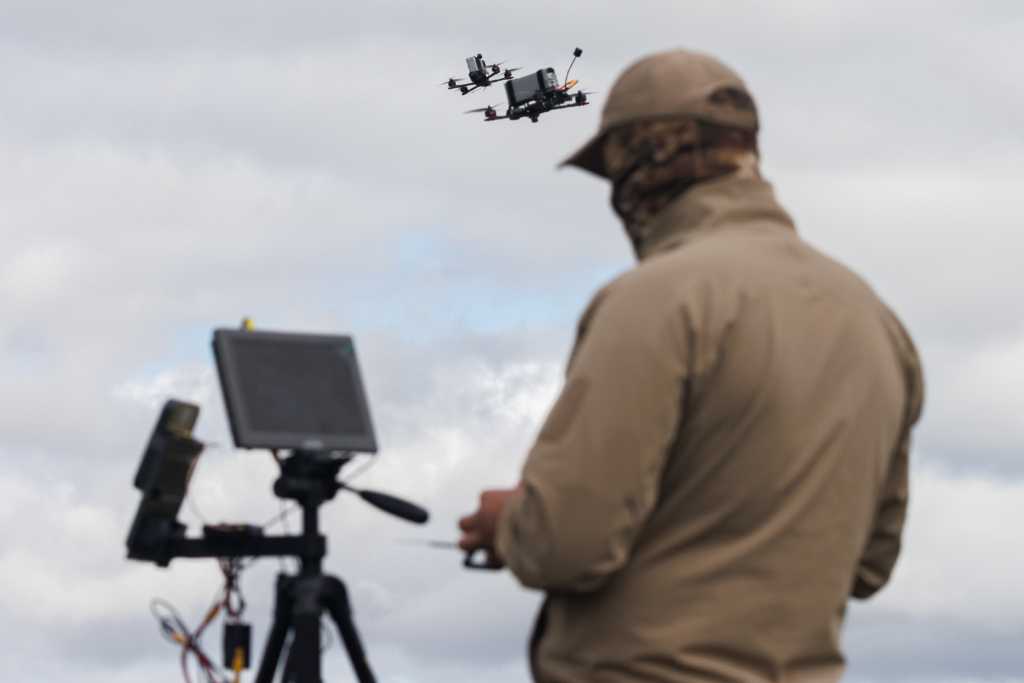
Instructor at the training ground of the Unmanned Systems Troops (UAVS). | picture alliance / Picvario Media | Sergey Elagin
Europe is rearming. Defence budgets are rising, factories are expanding, and new EU instruments are pouring money into ammunition production and joint procurement. But money is only part of Europe’s defence problems. The main constraint is that its systems remain slow, fragmented and poorly suited to an age when military technology can change in months rather than decades.
Three transformations are hitting the continent at once. Russia’s invasion of Ukraine has brought back large-scale war to European soil. Washington’s growing focus on the Indo-Pacific, its renewed interest in Greenland and its push to move NATO from “burden sharing” towards what might be called “burden shifting” mean that Europe will have to provide not only more money for the alliance but also a larger share of its combat power. At the same time, technology is changing warfare faster than traditional procurement systems can keep up.
At present, procurement systems work as follows: a military identifies a requirement; officials draw up specifications; companies compete for a contract and, years later, a system enters service. The problem is that, by then, the technologies shaping the battlefield may have changed dramatically. Promising technologies can become obsolete or fall by the wayside before they ever reach soldiers.
Ukraine has demonstrated a different model. Operational problems generate ideas; engineers turn them into prototypes; soldiers test them; manufacturers improve and scale them; battlefield experience feeds into the next iteration. Technology can also work in the other direction: new capabilities, such as cheap drones, can create tactics that planners had not previously considered.
The real measure of defence-industrial success should not be how many platforms roll off the line, but how fast capability can be imagined, built, tested, industrialised, fielded and adapted again
Europe needs to make this cycle permanent. I propose a model called Adaptive Defence Industrial Ecosystem Management, or ADIEM. The principle is for governments to move from being regulators and buyers to orchestrators of a defence ecosystem that links governments, armed forces, defence and tech companies, start-ups, universities and investors in a continuous loop. The real measure of defence-industrial success should not be how many platforms roll off the line, but how fast capability can be imagined, built, tested, industrialised, fielded and adapted again.
Industrial resilience and human capital are central to this model. Ukraine has shown that sustained operations depend on raw materials, reliable energy, resilient logistics and skilled labour quite as much as on the platforms themselves. And because digital capability now depends as much on software and data engineering as on heavy manufacturing, Europe’s defence sector competes directly with the commercial tech industry for the same scarce talent. This makes the appeal of a defence career a strategic question.
How to make ADIEM work
Reform defence governance. Create permanent structures that bring together military planning, industrial policy, innovation and procurement around shared capability goals. Give them room to depart from standard rules where those rules are the obstacle.
Start with battlefield problems. Build capabilities around what armed forces need to achieve. It works in reverse too: a new system needs a concept of operations written for it before it is bought at scale. Treat these as living documents that evolve with experimentation and real-world lessons.
Make procurement faster and more flexible. Use a hybrid procurement method. While central procurement agencies buy major systems, individual units are allowed to meet certain urgent combat needs. Alongside that, break large procurements into smaller contracts with incremental delivery, allow continuous software updates, use open architecture and speed up certification.
Build a genuine innovation ecosystem. Give start-ups, universities and public labs clear routes to deployment. Reward experimentation and operational relevance over novelty for its own sake.
Achieve affordable mass. Create dedicated programmes for weapon systems that are effective enough, cheap enough to buy in large numbers and simple enough to replace quickly. These include drones, autonomous vehicles, loitering munitions, low-cost intelligence, surveillance and reconnaissance (ISR) systems and electronic warfare.
Invest in human capital. Build a long-term pipeline of software engineers, AI specialists, systems engineers and skilled production workers, and change how the sector is perceived—presenting it as a high-technology field, not just a traditional military one.
Institutionalise experimentation. Set up permanent centres where soldiers, engineers, researchers and industry jointly evaluate new operational concepts and technologies. Test continuously rather than only in the run-up to a procurement decision.
Develop digital defence infrastructure. Invest in a sovereign defence cloud, secure data architecture, digital twins and common digital standards.
Governments also need to reform the institutions through which capability is developed, not just the funding lines that feed them. And while Europe has much of what it needs—sophisticated armed forces, world-class manufacturers, strong universities and a growing defence-tech sector—it still lacks a system capable of connecting them quickly enough. That is the purpose of ADIEM: to connect these actors in a continuously adapting ecosystem, with governments acting as orchestrators rather than simply regulators and buyers.
Minorities say they fear a rise in anti-Roma rhetoric following predictions of Germany’s AfD surge in Sunday’s Saxony-Anhalt election.
As Germany heads into a closely watched state election in Saxony-Anhalt this Sunday, 6 September, with the AfD polling above 40% and potentially within reach of an outright majority, right groups say they are “growing concerns over what its increasing electoral strength means for minorities and Germany’s and the EU’s democratic norms and values.”
Anna Mirga-Kruszelnicka, Executive Director of the Berlin-based European Roma Institute for Arts and Culture, looks ahead to the election.
She told this site: “For Roma and Sinti communities in particular, the election comes against a backdrop of increasingly visible anti-Roma racism.”
The Central Council of German Sinti and Roma described the situation “as a cynical example of a far-right party once again targeting Sinti and Roma.”
The incident, says the institute, comes amid "growing evidence of antigypsyism in Germany."
The Institute says that MIA, the country’s reporting and information centre documenting anti-Roma racism, reportedly recorded1,193 cases of stereotyping and disparaging remarks targeting Roma and Sinti in 2025, as well as 55 physical attacks, up from the previous year, and eight cases of extreme violence.
The institute says Roma experts warn of a changing political landscape in Germany and the growing strength of the far right.
They note that “the normalisation of nationalist, racist and anti-minority rhetoric is reshaping political discourse, including the increasing use of anti-Roma stereotypes.”
Mirga-Kruszelnicka said: “Over 80 years since more than 4,300 Roma and Sinti were murdered during the liquidation of the “Zigeunerlager” at the Auschwitz-Birkenau concentration camp, a far-right party that openly stigmatises and singles out Roma citizens is yet again on the rise in Germany. In April 2026, AfD politician Enxhi Seli-Zacharias led party colleagues through a German city, handing brooms to residents she took to be Sinti and Roma and filming them as they swept the pavement, telling one woman: “Germans have had enough—look what this looks like.”
As the EU prepares its next €2 trillion budget, the institute says experts are also questioning whether Roma communities are "being adequately accounted" for in how European funding is tracked and measured with”, says the insititute, “antigypsyism not mentioned once in the Performance Framework Regulation".
“Fascism is never simply a chapter in history books. It begins with words, stereotypes, indifference and the gradual erosion of democratic values. Honouring those who were murdered is not enough. We must also recognise how quickly democratic societies can unravel when prejudice, dehumanisation and political extremism become accepted as ordinary," concluded Mirga-Kruszelnicka.
Nous vous proposons une "opération vérité" sur les grands textes adoptés et les positionnements politiques, à méditer pendant les congés d'été ! L’année 2026 est particulièrement chargée en grands textes législatifs - près de 300 ont été votés - et, phénomène nouveau, les majorités sont très fluctuantes au Parlement de Strasbourg, en fonction des sujets.
Marine Le Pen éligible mais condamnée en appel à trois ans de prison dont un an ferme sous bracelet électronique. La cheffe de file des députés RN a, malgré cette condamnation, annoncé être candidate pour 2027. Elle se pourvoit en cassation, ce qui suspend la peine à laquelle elle a été condamnée mais qui la plonge dans un flou juridique. La voie choisit par la leader d'extrême est-elle risquée ? Roselyne Febvre pose la question à Pablo Pillaud-Vivien et Dominique de Montvalon.
A la Une de la presse, ce lundi 6 juillet, le début d’une semaine décisive pour le RN avec la décision, demain, de la justice dans l’affaire des attachés parlementaires européens du FN, qui confirmera ou non l’impossibilité pour Marine Le Pen d’être candidate à la présidentielle de l’an prochain. L’ascension de l’AfD en Allemagne. Les funérailles du Guide suprême Ali Khamenei en Iran. Une nouvelle décision très controversée de la Fifa. Et un concours insolite remporté par la Belgique.
A la Une de la presse, ce lundi 6 juillet, le début d’une semaine décisive pour le RN avec la décision, demain, de la justice dans l’affaire des attachés parlementaires européens du FN, qui confirmera ou non l’impossibilité pour Marine Le Pen d’être candidate à la présidentielle de l’an prochain. L’ascension de l’AfD en Allemagne. Les funérailles du Guide suprême Ali Khamenei en Iran. Une nouvelle décision très controversée de la Fifa. Et un concours insolite remporté par la Belgique.
Dans cet épisode d'Aux 4 coins de l’Europe, Caroline de Camaret embarque les téléspectateurs pour un voyage à travers le Parlement européen afin de décrypter l’actualité qui secoue Bruxelles, capitale européenne. L'épisode vous emmène au plus près de ceux qui font l’Europe d’aujourd’hui, tout en traquant la désinformation et les débats qui traversent l’hémicycle.
Dans cette édition spéciale d'Aux 4 coins de l’Europe, Caroline de Camaret embarque les téléspectateurs pour un voyage inédit mettant en avant la créativité et la jeunesse européenne… Car la voix de tous ces jeunes compte !
Le Parlement européen a approuvé définitivement, mardi, l'accord commercial négocié l'an dernier par l'UE et les États-Unis, qui prévoit notamment la réduction de droits de douane sur de nombreux produits américains, dans le but d'éviter une nouvelle guerre tarifaire avec le milliardaire républicain.
L’Union européenne devrait bientôt permettre à ses États membres de créer des "hubs de retour" dans des pays tiers, qui auront pour but d’accueillir les étrangers en situation irrégulière expulsés du territoire européen. Le texte est considéré comme une avancée en matière de politique migratoire par la droite et l’extrême droite, et comme un recul pour les droits humains par la gauche. Explications.
Le Parlement européen a donné son feu vert lundi soir pour la création de centres pour le renvoi de migrants à l'étranger. Ces "hubs de retour" dans des pays intermédiaires sont soutenus par l'Allemagne, alors que l'Espagne y voit une menace pour le respect des droits humains.
À l'occasion de la Journée de l'Europe, célébrée place de la République, à Paris, le samedi 9 mai, nous vous proposons un grand débat public et télévisé, réalisé en partenariat avec le bureau en France du Parlement européen, la représentation de la Commission européenne et la mairie de Paris.
À l'occasion de la Journée de l'Europe célébrée place de la République, à Paris, samedi 9 mai, nous vous proposons un grand débat public et télévisé, réalisé en partenariat avec le bureau en France du Parlement européen, la représentation de la Commission européenne et la mairie de Paris.
Le Parlement européen a validé, jeudi, un net durcissement de la politique migratoire du continent et approuvé le concept de "hubs de retour", des centres en dehors de l'UE pour envoyer des migrants.
 Login