En cette rentrée morose pour l'Union européenne, nous recevons François-Xavier Bellamy, vice-président des Républicains, député européen au Parti populaire européen (PPE) et ancien professeur agrégé de philosophie. Il a mené la liste Les Républicains aux élections européennes où il a été réélu en 2024, avec 7,2 % des voix (soit six députés en tout). En cette rentrée, il revient sur les grandes crises de l'été, notamment les menaces russes, les enjeux écologiques ou encore l'arrivée de dizaines de milliers de migrants dans l'enclave de Ceuta.
Branle-bas de combat dans la diplomatie européenne. Une réunion informelle des ministres des Affaires étrangères, dès la semaine de rentrée, entend mettre les 27 en ordre de bataille sur les grands dossiers internationaux. Mais la diplomatie européenne se pose des questions existentielles : à quoi sert-elle vraiment ? Pourquoi semble-t-elle si inaudible ? L'autorité de l'Estonienne Kaja Kallas – la Haute représentante de l'Union européenne (UE) pour les Affaires étrangères – est contestée. Le couple franco-allemand et d'autres acteurs réclament une réforme radicale au nom de l'efficacité.
Branle-bas de combat dans la diplomatie européenne. Une réunion informelle des ministres des Affaires étrangères, dès la semaine de rentrée, entend mettre les 27 en ordre de bataille sur les grands dossiers internationaux. Mais la diplomatie européenne se pose des questions existentielles : à quoi sert-elle vraiment ? Pourquoi semble-t-elle si inaudible ? L'autorité de l'Estonienne Kaja Kallas – la Haute représentante de l'Union européenne (UE) pour les Affaires étrangères – est contestée. Le couple franco-allemand et d'autres acteurs réclament une réforme radicale au nom de l'efficacité.
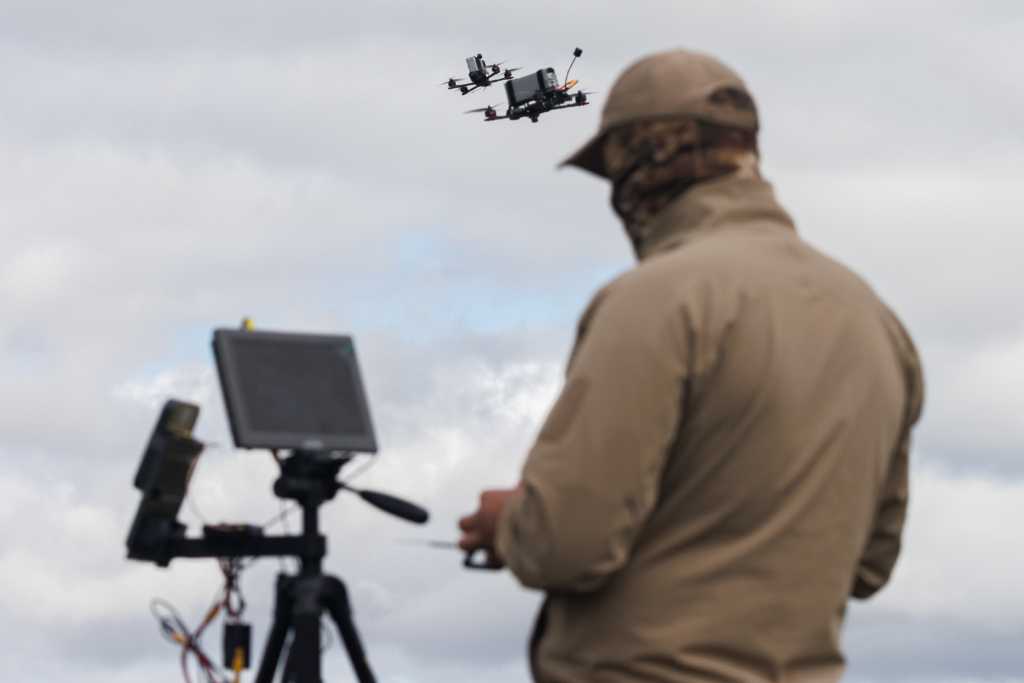
Instructor at the training ground of the Unmanned Systems Troops (UAVS). | picture alliance / Picvario Media | Sergey Elagin
Europe is rearming. Defence budgets are rising, factories are expanding, and new EU instruments are pouring money into ammunition production and joint procurement. But money is only part of Europe’s defence problems. The main constraint is that its systems remain slow, fragmented and poorly suited to an age when military technology can change in months rather than decades.
Three transformations are hitting the continent at once. Russia’s invasion of Ukraine has brought back large-scale war to European soil. Washington’s growing focus on the Indo-Pacific, its renewed interest in Greenland and its push to move NATO from “burden sharing” towards what might be called “burden shifting” mean that Europe will have to provide not only more money for the alliance but also a larger share of its combat power. At the same time, technology is changing warfare faster than traditional procurement systems can keep up.
At present, procurement systems work as follows: a military identifies a requirement; officials draw up specifications; companies compete for a contract and, years later, a system enters service. The problem is that, by then, the technologies shaping the battlefield may have changed dramatically. Promising technologies can become obsolete or fall by the wayside before they ever reach soldiers.
Ukraine has demonstrated a different model. Operational problems generate ideas; engineers turn them into prototypes; soldiers test them; manufacturers improve and scale them; battlefield experience feeds into the next iteration. Technology can also work in the other direction: new capabilities, such as cheap drones, can create tactics that planners had not previously considered.
The real measure of defence-industrial success should not be how many platforms roll off the line, but how fast capability can be imagined, built, tested, industrialised, fielded and adapted again
Europe needs to make this cycle permanent. I propose a model called Adaptive Defence Industrial Ecosystem Management, or ADIEM. The principle is for governments to move from being regulators and buyers to orchestrators of a defence ecosystem that links governments, armed forces, defence and tech companies, start-ups, universities and investors in a continuous loop. The real measure of defence-industrial success should not be how many platforms roll off the line, but how fast capability can be imagined, built, tested, industrialised, fielded and adapted again.
Industrial resilience and human capital are central to this model. Ukraine has shown that sustained operations depend on raw materials, reliable energy, resilient logistics and skilled labour quite as much as on the platforms themselves. And because digital capability now depends as much on software and data engineering as on heavy manufacturing, Europe’s defence sector competes directly with the commercial tech industry for the same scarce talent. This makes the appeal of a defence career a strategic question.
How to make ADIEM work
Reform defence governance. Create permanent structures that bring together military planning, industrial policy, innovation and procurement around shared capability goals. Give them room to depart from standard rules where those rules are the obstacle.
Start with battlefield problems. Build capabilities around what armed forces need to achieve. It works in reverse too: a new system needs a concept of operations written for it before it is bought at scale. Treat these as living documents that evolve with experimentation and real-world lessons.
Make procurement faster and more flexible. Use a hybrid procurement method. While central procurement agencies buy major systems, individual units are allowed to meet certain urgent combat needs. Alongside that, break large procurements into smaller contracts with incremental delivery, allow continuous software updates, use open architecture and speed up certification.
Build a genuine innovation ecosystem. Give start-ups, universities and public labs clear routes to deployment. Reward experimentation and operational relevance over novelty for its own sake.
Achieve affordable mass. Create dedicated programmes for weapon systems that are effective enough, cheap enough to buy in large numbers and simple enough to replace quickly. These include drones, autonomous vehicles, loitering munitions, low-cost intelligence, surveillance and reconnaissance (ISR) systems and electronic warfare.
Invest in human capital. Build a long-term pipeline of software engineers, AI specialists, systems engineers and skilled production workers, and change how the sector is perceived—presenting it as a high-technology field, not just a traditional military one.
Institutionalise experimentation. Set up permanent centres where soldiers, engineers, researchers and industry jointly evaluate new operational concepts and technologies. Test continuously rather than only in the run-up to a procurement decision.
Develop digital defence infrastructure. Invest in a sovereign defence cloud, secure data architecture, digital twins and common digital standards.
Governments also need to reform the institutions through which capability is developed, not just the funding lines that feed them. And while Europe has much of what it needs—sophisticated armed forces, world-class manufacturers, strong universities and a growing defence-tech sector—it still lacks a system capable of connecting them quickly enough. That is the purpose of ADIEM: to connect these actors in a continuously adapting ecosystem, with governments acting as orchestrators rather than simply regulators and buyers.
Minorities say they fear a rise in anti-Roma rhetoric following predictions of Germany’s AfD surge in Sunday’s Saxony-Anhalt election.
As Germany heads into a closely watched state election in Saxony-Anhalt this Sunday, 6 September, with the AfD polling above 40% and potentially within reach of an outright majority, right groups say they are “growing concerns over what its increasing electoral strength means for minorities and Germany’s and the EU’s democratic norms and values.”
Anna Mirga-Kruszelnicka, Executive Director of the Berlin-based European Roma Institute for Arts and Culture, looks ahead to the election.
She told this site: “For Roma and Sinti communities in particular, the election comes against a backdrop of increasingly visible anti-Roma racism.”
The Central Council of German Sinti and Roma described the situation “as a cynical example of a far-right party once again targeting Sinti and Roma.”
The incident, says the institute, comes amid "growing evidence of antigypsyism in Germany."
The Institute says that MIA, the country’s reporting and information centre documenting anti-Roma racism, reportedly recorded1,193 cases of stereotyping and disparaging remarks targeting Roma and Sinti in 2025, as well as 55 physical attacks, up from the previous year, and eight cases of extreme violence.
The institute says Roma experts warn of a changing political landscape in Germany and the growing strength of the far right.
They note that “the normalisation of nationalist, racist and anti-minority rhetoric is reshaping political discourse, including the increasing use of anti-Roma stereotypes.”
Mirga-Kruszelnicka said: “Over 80 years since more than 4,300 Roma and Sinti were murdered during the liquidation of the “Zigeunerlager” at the Auschwitz-Birkenau concentration camp, a far-right party that openly stigmatises and singles out Roma citizens is yet again on the rise in Germany. In April 2026, AfD politician Enxhi Seli-Zacharias led party colleagues through a German city, handing brooms to residents she took to be Sinti and Roma and filming them as they swept the pavement, telling one woman: “Germans have had enough—look what this looks like.”
As the EU prepares its next €2 trillion budget, the institute says experts are also questioning whether Roma communities are "being adequately accounted" for in how European funding is tracked and measured with”, says the insititute, “antigypsyism not mentioned once in the Performance Framework Regulation".
“Fascism is never simply a chapter in history books. It begins with words, stereotypes, indifference and the gradual erosion of democratic values. Honouring those who were murdered is not enough. We must also recognise how quickly democratic societies can unravel when prejudice, dehumanisation and political extremism become accepted as ordinary," concluded Mirga-Kruszelnicka.
Nous vous proposons une "opération vérité" sur les grands textes adoptés et les positionnements politiques, à méditer pendant les congés d'été ! L’année 2026 est particulièrement chargée en grands textes législatifs - près de 300 ont été votés - et, phénomène nouveau, les majorités sont très fluctuantes au Parlement de Strasbourg, en fonction des sujets.
Dans cet épisode d'Aux 4 coins de l’Europe, Caroline de Camaret embarque les téléspectateurs pour un voyage à travers le Parlement européen afin de décrypter l’actualité qui secoue Bruxelles, capitale européenne. L'épisode vous emmène au plus près de ceux qui font l’Europe d’aujourd’hui, tout en traquant la désinformation et les débats qui traversent l’hémicycle.
Dans cette édition spéciale d'Aux 4 coins de l’Europe, Caroline de Camaret embarque les téléspectateurs pour un voyage inédit mettant en avant la créativité et la jeunesse européenne… Car la voix de tous ces jeunes compte !
L’Union européenne devrait bientôt permettre à ses États membres de créer des "hubs de retour" dans des pays tiers, qui auront pour but d’accueillir les étrangers en situation irrégulière expulsés du territoire européen. Le texte est considéré comme une avancée en matière de politique migratoire par la droite et l’extrême droite, et comme un recul pour les droits humains par la gauche. Explications.
À l'occasion de la Journée de l'Europe, célébrée place de la République, à Paris, le samedi 9 mai, nous vous proposons un grand débat public et télévisé, réalisé en partenariat avec le bureau en France du Parlement européen, la représentation de la Commission européenne et la mairie de Paris.
À l'occasion de la Journée de l'Europe célébrée place de la République, à Paris, samedi 9 mai, nous vous proposons un grand débat public et télévisé, réalisé en partenariat avec le bureau en France du Parlement européen, la représentation de la Commission européenne et la mairie de Paris.
What happens if your economy is suddenly in crisis, Brussels offers help with strings attached—and Turkey, China or Russia can move faster? What if your country delivers every reform the EU asks for, only for a member state to block the next step anyway? And after years of waiting, would voters still choose to join?
In this special bonus episode, The Neighbourhood goes live from Lisbon for an EU enlargement game. Jessica Hendrick brings together RE-ENGAGE experts representing six EU candidate countries and throws a series of fictional—but very plausible—political and economic shocks at them inspired by real headlines: Russia’s intensified attacks on Ukrainian infrastructure, Ireland’s EU presidency push on enlargement, Iceland’s referendum, Germany’s regional elections and the upcoming 2026 Enlargement Package. Drawing on three years of surveys, interviews and crisis simulations, each expert has to answer for their country.
Playing for each country:
Albania:Morten Bøås, research professor at the Norwegian Institute of International Affairs (NUPI), representing RE-ENGAGE’s Albanian partners at the European University of Tirana
Bosnia and Herzegovina:Damir Kapidžić, director of the Institute for Social Science Research at the University of Sarajevo
Georgia:Ketevan Bolkvadze, senior lecturer in the department of political science at Lund University, originally from Georgia
Moldova:Mathilde T. E. Giske, research fellow at the Norwegian Institute of International Affairs (NUPI), representing RE-ENGAGE’s Moldovan partners at Moldova State University
Serbia:Luka Filipović, research associate at the Institute for Contemporary History in Serbia
Ukraine:Roman Petrov, president of the Ukrainian European Studies Association
The result is part enlargement simulation, part policy conversation and part game night. The experts bargain over a fictional €100 million EU cheque, decide whether the EU can compete with faster offers from other powers, test how easily disinformation could exploit frustration with enlargement, and imagine what would happen if EU membership was finally put to a public vote. Along the way, Serbia proposes keeping its relationship with Brussels “casual”, Bosnia finds a creative use for €100 million, and Ukraine calls for Hungarian “Varangians” when backsliding strikes.
When a crisis hits, does speed matter more than values? Can “Europe never wanted you anyway” become a winning political message? And if a country finally joins the EU, what stops democracy from sliding backwards once the prize of membership is secured?
It’s one of the most anticipated arts events in the UK and the starting pistol is set to sound on Herefordshire Art Week.
h.Art 2026, as it is affectionately called, runs from 5 to 13 September and is hailed as a “celebration of local creativity”.
The event takes place right across Herefordshire and its neighbouring borders where hundreds of artists will open their doors to share their work.
h.Art is widely seen as being special for art lovers,offering personal encounters with some of the UK’s finest artists and makers in the intimacy of their own homes and studios.
It is a chance to discover new work and buy or commission artwork, all direct with the artists.
h.Art was founded in 2002 as part of Herefordshire Council’s ‘Creative Industry’ programme, with the vision to offer “personal life enhancing experiences through art, whilst stimulating a vibrant local economy.”
It celebrates its 25th anniversary next year and has recently been taken over by a new organiser.
A spokesman said, “It’s a chance to gain a rare insight into the creative lives of our artists and craft-makers. You’ll uncover amazing art in atmospheric and unexpected locations as well as learn new skills through hands-on workshops and demos.”
Among those taking part for this year’s edition are Canwood Gallery and Eastnor Pottery.
Eastnor Pottery and “the Flying Potter”, located near Ledbury, is recognised as one of the country’s leading studios for potter’s wheel courses, classes and educational experiences.
Jon Williams shares Eastnor Pottery with his wife and fellow potter, Sarah Monk.
In an interview with the event organisers, Jon, who makes ceramic sculpture and decorative items, explained, “Although our ceramic work is very different to each other (chalk and cheese!) we collaborate on our courses, classes and experiences, taking it in turns to lead and support the sessions.”
Asked to describe his work, he added, “Through skilful facilitation and a love of clay and people in equal measure, I travel all over the West Midlands and beyond exploring and developing creativity in others.
“I regularly work in early year’s settings, schools, libraries, art galleries and museums, encouraging people to play and express themselves in clay.
“My approach has its roots in Reggio Emilia philosophy. Reggio is a pedagogy based upon self-directed, experiential learning.
“Children, young people and adults are offered a range of tools, materials and environments and encouraged to develop their own, totally unique way of working. When I get opportunity to produce my own ceramics, I approach my making in a similar fashion to my social engagement work. The concept of play is at the centre of everything. Nearly all my work starts its life on the potter’s wheel.”
He says it means “everything” to be an artist, adding, “It is being independent, resourceful, resilient and creative whilst having a shed load of fun. I enjoy partnership working with individuals and organisations and am always up for a collaboration.”
Eastnor also gives the public a chance to take part in various pottery workshops and experiences, including beginner’s classes, day courses, and weekend courses. It is a chance to learn to use a potter’s wheel under expert guidance, with all materials included. They also offer clay modelling sessions and a ‘Flying Potter’ service that can take the workshop to an individual’s own location.
Jon adds, “It’s always really hard to describe what I do, as my creative practice is so varied and wide-ranging. I am The Flying Potter, I am a maker, a studio potter, a ceramic artist, educationalist and facilitator.”
Artist Andrew Findlay, also taking part in the week-long event, is based at The Forge Eastnor, just 100m from the pottery.
Another participating in Art Week is Canwood Gallery which is nestled in the serene Herefordshire countryside.
It is a contemporary art gallery and sculpture park dedicated to providing an “art oasis.”
Set across ten acres of landscape, the site includes two indoor gallery spaces and an expansive sculpture park, alongside an on site café.
It showcases a diverse range of work by internationally recognised alongside emerging and local artists, offering a great opportunity to experience and purchase art in a tranquil rural setting. The gallery is free to enter, with free on site parking.
Also participating are Old Chapel Gallery, Wobage and Sorrel & Sage (full details available via the links below).
The Art Week is expected to attract people from both the UK and abroad and one excellent way of finding out more about the event and much else in the county is via the Eat Sleep Live Herefordshire, the leading independent destination marketing company for the county.
Its supports not only Herefordshire’s food and drink businesses, accommodation providers, activities, leisure venues and pursuits and events but promotes the county’s crafts, creatives and artisans.
This week, Mark Leonard is joined by Ellie Geranmayeh, deputy director of ECFR’s Middle East and North Africa programme, to unpack a volatile new chapter in the confrontation between the United States and Iran. After months of managed escalation, military strikes have resumed and President Donald Trump has launched an ambitious new sanctions package, dubbed an economic “D-Day”, aimed at squeezing Tehran into submission.
Ellie argues that Washington has returned to a familiar strategy of maximum pressure, betting that unprecedented economic isolation and a blockade of Iranian exports will either force the regime to make major concessions or trigger domestic unrest. But Tehran appears determined to hold out, relying on sanctions-evasion networks, regional diplomacy and the belief that the US will struggle to sustain its campaign over the long term. As both sides continue limited military operations while keeping channels for negotiation open, the prospect of a comprehensive deal remains elusive.
The conversation also explores the domestic pressures facing Iran’s leadership, from a shrinking economy and growing public dissatisfaction to the threat of renewed nationwide protests. Mark and Ellie examine whether economic hardship could destabilise the regime, why Iranian leaders remain sceptical of American commitments and how internal politics in both Washington and Tehran are shaping the path ahead.
Finally, they discuss the wider regional and European implications of the conflict. How are Gulf states positioning themselves between the US and Iran? What risks does the confrontation pose to global shipping through the Strait of Hormuz? And can European governments still play a meaningful diplomatic role as tensions rise and fears grow that the Iran conflict could become increasingly entangled with the war in Ukraine?
This podcast episode was recorded on September 3rd 2026.

 Login