❌

Reading view

Shipbuilder Behind Failed Constellation Class Wants Back Into The U.S. Navy Frigate Business

Fincantieri Marine Group, which developed the cancelled Constellation class frigate for the U.S. Navy, says it sees a possible new opportunity in the service’s latest small surface combatant plans. At least three foreign frigate designs are already under review for possible Navy service, as is the prospect of having them built overseas, as part of a study expected to wrap up next month. Fincantieri wants to once again add the FREMM design, which the Constellation was based on, to the Navy’s options. The shipyard, which is a subsidiary of its Italian namesake, made significant investments in shipyard infrastructure in the United States and supply chains as part of the Constellation debacle, but it is not clear if that will be enough to make a new pitch attractive.

USNI News first reported on the possibility of a new Fincantieri frigate pitch to the Navy yesterday after an interview with CEO George Moutafis. TWZ also spoke at length with Moutafis about the failure of the Constellation class program earlier this year, and we have reached back out to the company for more information about new prospects now.

“Right now the Navy and the [Trump] administration could find the right type of dialog with us to set [development] up in a way that enables quick setup and swift construction without letting design spirals get in the way,” Moutafis told USNI News. “Accept the design that is and works well, and start work on it to get units out there for the fleet.”

In addition, “Moutafis said the supply chain the shipyard built during the Constellation could be applied to Fincantieri’s FREMM EVO design with few modifications to avoid the design churn that led to the cancellation of the Constellation,” according to USNI News.

The Constellation class was derived from the Franco-Italian FREMM, a multi-purpose frigate designed to offer a mix of anti-air, anti-submarine, and anti-surface warfare capabilities. The explicit intent of the program had been to acquire a frigate based on an established, in-production ‘parent’ design, to which only relatively minor changes would have to be made, helping to reduce cost and risk. In the end, Constellation only had 15 percent design commonality with FREMM, causing delays and other issues that directly contributed to its cancellation. However, the Navy’s demand for smaller surface combatants has not gone away. We will come back to this all in a moment.
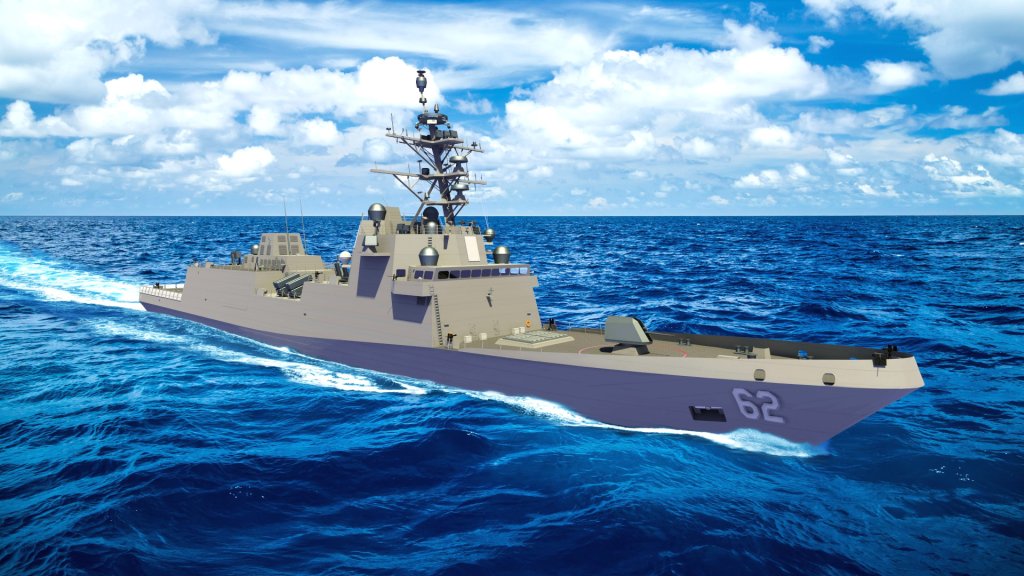
A rendering of a Constellation class frigate. USN

Fincantieri unveiled FREMM EVO (for “evolution”), along with an order for two of them for the Italian Navy, in 2024. In July of this year, Portugal announced it would also be buying three FREMM EVOs.

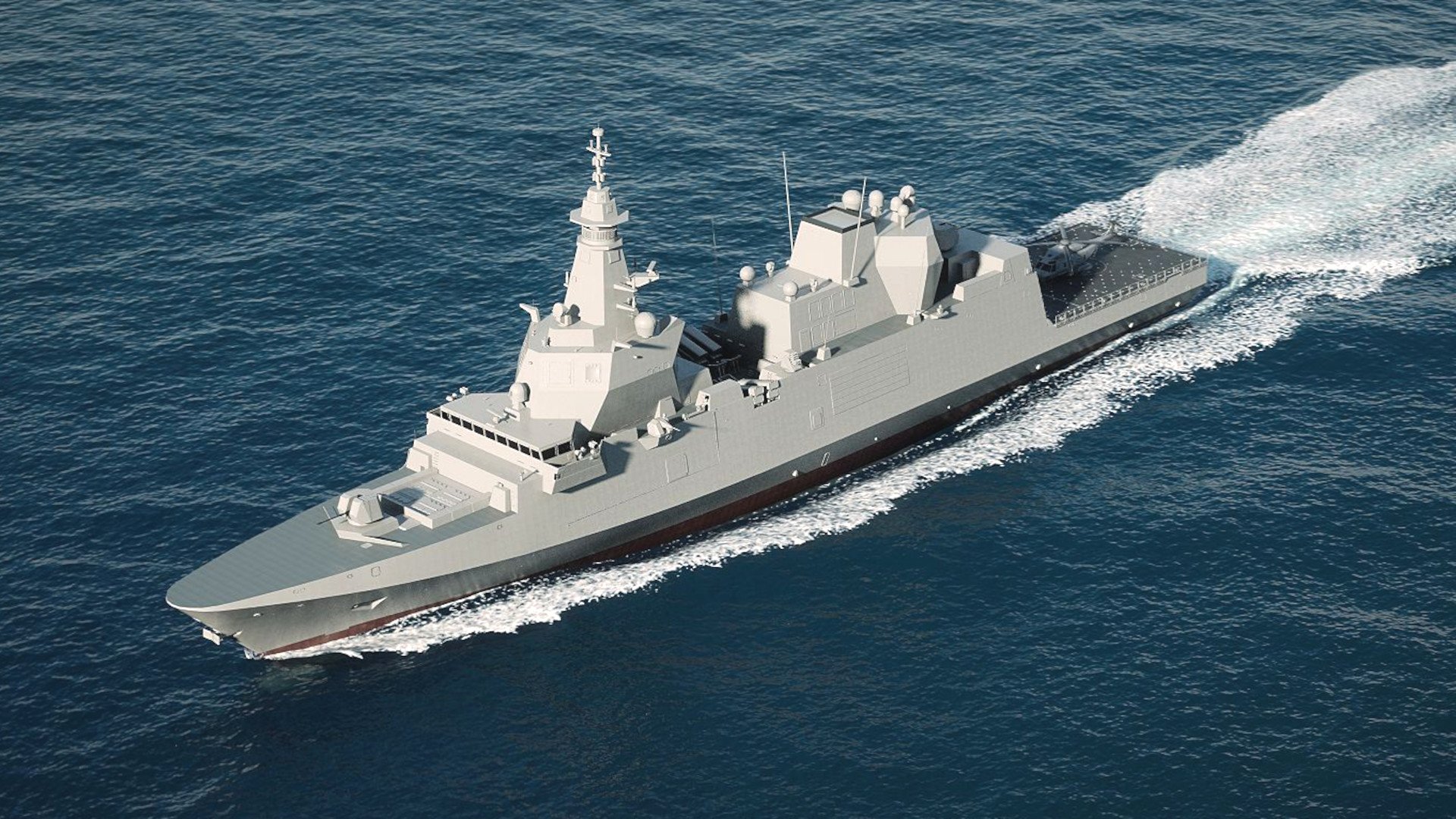
As designed, the FREMM EVO is close to 472.5 feet (144 meters) long, is some 64.6 feet (19.7 meters) at its widest, and displaces 6,500 tons with a full combat load, according to Fincantieri’s website. Its hull dimensions and displacement are essentially unchanged from the Italian subvariant of the baseline FREMM. The EVO will have a new superstructure configuration and a host of new capabilities.
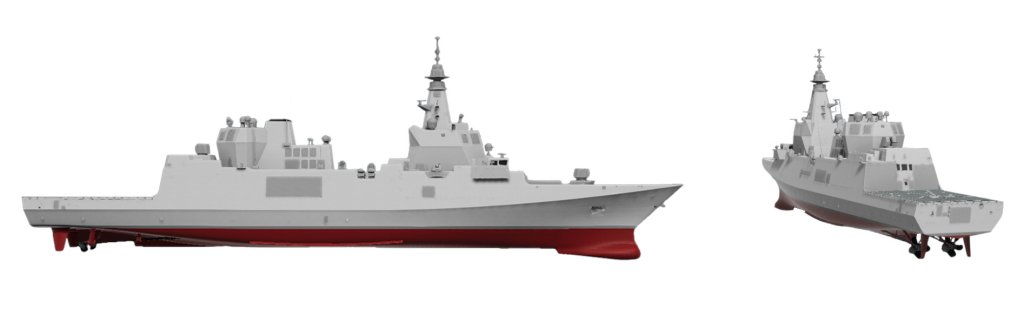
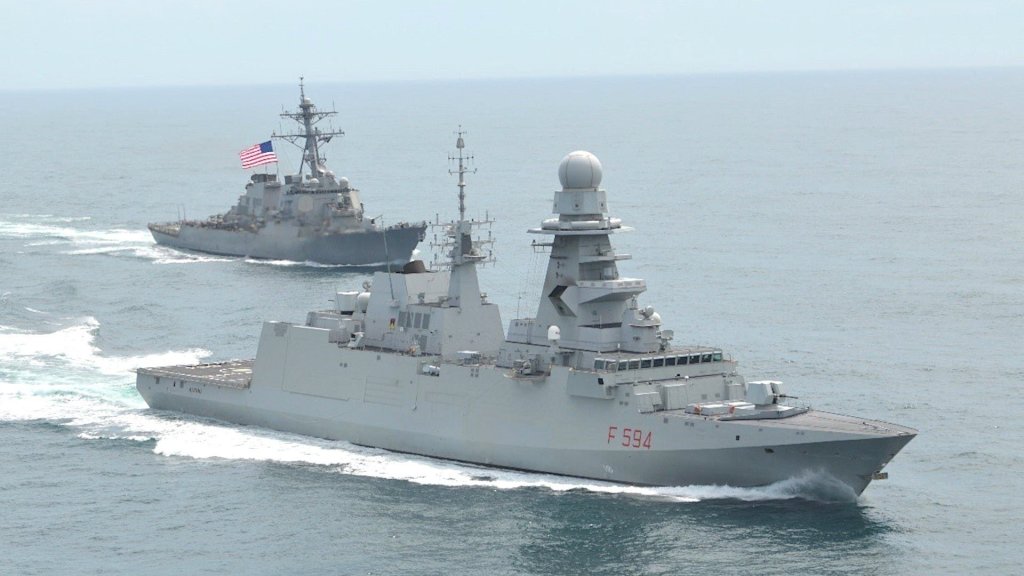
Renderings of the FREMM-EVO. Fincantieri
An Italian Navy FREMM frigate, or Bergamini class, in front, sails together with a US Navy Arleigh Burke class destroyer. USN

The most notable new feature on the EVO version is set to be a new Leonardo Kronos Dual-Band Radar (DBR). The Kronos DBR combines the C-band Kronos Quad and the X-band Kronos StarFire into a single system with four paired sets of active electronically scanned arrays (AESA) positioned around the superstructure. In general, combining radars in this way can offer advantages for performing a variety of different tasks and doing so simultaneously. The ability to fuse data from both arrays together can help produce high-fidelity target tracks and other benefits. At the same time, DBRs have historically presented complexities that can cause serious difficulties with both integration and operation.

Among other things, the DBR is set to give the FREMM EVO expanded capability to knock down incoming ballistic missiles in the terminal phase of flight using Aster 30 surface-to-air missiles. Anti-ship ballistic missiles have become a threat that navies globally could realistically encounter in future conflicts, even against smaller nation states or non-state actors. There is a trend emerging worldwide now in the development of new anti-ballistic missile defenses to protect individual warships, as well as help defend other naval assets and interests ashore. Baseline FREMM frigates can already fire Aster 30 missiles, as well as Aster 16s, from any of their 16 Sylver vertical launch system cells at the bow end of the ship. EVO has space allotted for the integration of additional VLS cells, but it is unclear whether any current customers are pursuing that option.

In terms of armament, like the baseline FREMM, the EVO configuration will also have deck-mounted launchers for eight anti-ship cruise missiles, two triple torpedo tubes, two turreted 76mm guns, and various smaller automatic cannons and machine guns.

FREMM EVO is to feature improvements to other parts of its sensor package, as well as electronic warfare and communications suites, compared to the baseline design. This will all be tied into a SADOC 4 combat management system (CMS) from Leonardo.

On top of all this, this new FREMM configuration will have a new dedicated suite of counter-drone capabilities, another threat category that is very real now, and that only continues to expand in scale and scope.

“FREMM EVO represents a milestone both in confirming the ability to combine maturity and innovation in its EW systems that will be on board, and for the first naval supply of an advanced anti-drone counter capability,” ELT Group, which is supplying components for the counter-drone suite, said in a statement back in 2024, according to Naval News. “The latter will allow both the detection, recognition and identification of drones and their soft-kill counter. The project of a naval CUAS arises from the expertise acquired by Elettronica in this capacity for several years now, which have led to the development of sophisticated Artificial Intelligence algorithms developed specifically for countering the threat posed by drones.”

When it comes to a new pitch to the U.S. Navy, FREMM EVO does have the benefit of being an in-production design. As mentioned, Fincantieri had also been working to expand its facilities at the Marinette Marine shipyard in Wisconsin to build similarly-sized Constellation class frigates before that program was cancelled. The shipbuilder has relevant established supply chains to feed into that yard, as well, as Moutafis highlighted to USNI News.

A Naval Sea Systems Command (NAVSEA) briefing slide from 2022 detailing work Fincantieri had been doing to expand its physical infrastructure to support the production of the Constellation class. USN

In speaking to us earlier this year, Moutafis also talked about important lessons learned from the Constellation program, which he felt were already having a positive impact the U.S. Navy way of doing business.

“Some of those lessons learned out of Constellation are being manifested in the things that the Navy has been rolling out the past few months – a new approach that empowers PAEs [Navy Portfolio Acquisition Executives] to make decisions, to minimize change, to embrace innovation and new technologies,” he said. “All these elements that we see now being rolled out, I think to a certain degree, connect back to lessons that have been learned out of the Constellation class journey.”

“Figure out what you want to prioritize, to what extent you want to prioritize schedule, and what’s the best way to say this,” he added when asked for specific examples of what he was talking about. “When you know when you need something delivered and at what pace, then enable the right level of decision-making. Because otherwise – I don’t want to sound this the wrong way – but perfection sometimes is the enemy of more than good enough.”

“Going beyond the Constellation class, now the needs are for vessels to be out there for the warfighter as soon as possible. For sure, we will see many cases where it will be considered that a vessel with these capabilities – even though potentially, in some areas, it may not have enough tons of steel on its sides, or whatever – it will be good enough to assist the warfighter as they head into harm’s way,” he also added at that time. “Those trade-offs are now being placed at the PAE level, allowing Navy leaders at that level to make the right decisions – figuring out whether to continue going down a design spiral versus just moving out with production and enabling us to have the right capabilities on time for the warfighter.”

When Moutafis spoke with us, the Navy had already unveiled a new FF(X) frigate program and announced plans to buy examples of a design derived from the Huntington Ingalls Industries’ (HII) Legend class National Security Cutter for the U.S. Coast Guard. Those frigates will notably lack a VLS array, at least initially, along with other features that were seen as critical to Constellation class. The Navy has outlined plans to offset the more limited baked-in capabilities of the FF(X)s with add-on containerized weapon systems and companion fleets of uncrewed surface vessels. All of this has already prompted significant debate about the operational utility of these small surface combatants, as TWZ has previously explored in detail.
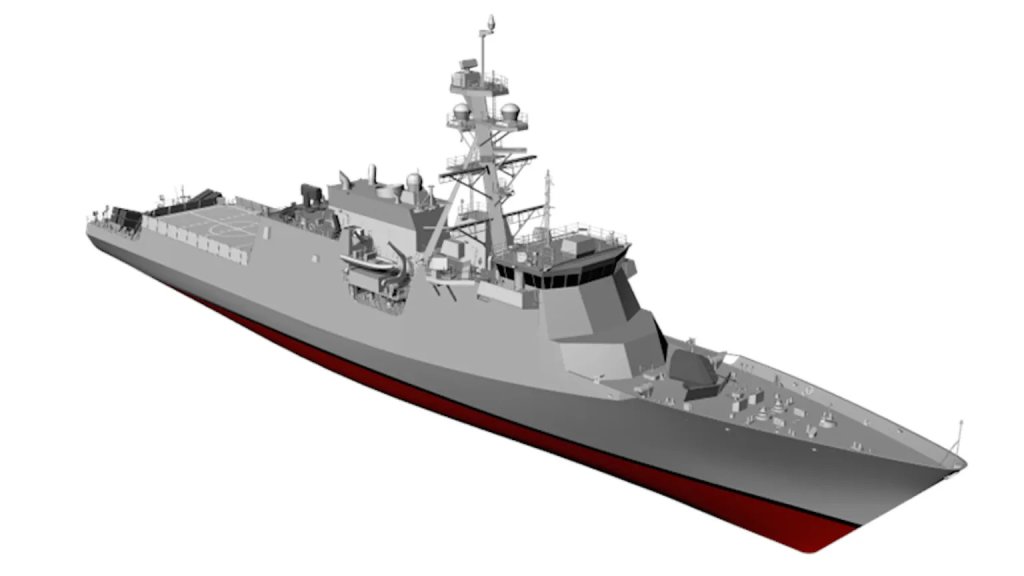
A rendering of the FF(X) frigate. USN

In August, President Trump put out a memo that, in part, directed then-Acting Secretary of the Navy Hung Cao to “submit a plan … that includes timelines and resourcing requirements, for a new competitive acquisition approach for surface combatants with sufficient inherent capabilities to perform anti‑submarine warfare, surface warfare, and convoy escort duties.” The memo also outlined an acquisition strategy referred to as the “Finland Model,” in which foreign shipbuilders would have to make major investments in U.S. enterprises and hire American workers as part of any future contract, even if an initial tranche of vessels is built overseas. This, in turn, has led to the aforementioned foreign warship study ongoing now, which is reportedly exploring the merits of Japan’s Mogami class, the South Korean Chungnam class, and the Istanbul class from Turkey, in-depth profiles of which you can find here.

Examples of the Japanese Mogami class (at bottom), the South Korean Chungnam class (at top left), and the Turkish Istanbul class (at top right). Yuichi Yamazaki-Pool/Getty Images/HD Hyundai Heavy Industries/Anadolu Shipyard

Whether or not the U.S. Navy will pursue the acquisition of any of the ships it is studying now, or whether it might be willing to consider additional pitches from Fincantieri or other shipbuilders, remains to be seen. If it is to be successful, any new attempt to leverage an in-production foreign frigate design will have to take concrete steps to avoid falling into the same design change pitfalls as the Constellation class. The Navy’s struggles with solidifying designs early and keeping changes to a minimum during development and initial production have impacted several domestic naval shipbuilding efforts, too.

For Fincantieri, while the Navy played a central role in the failure of the Constellation program, there is the additional matter of whether the service is interested in any way in the optics of not only going back to the same shipbuilder, but the same underlying parent design (FREMM).

Some members of Congress have been very vocally pushing back on any plan that involves production in foreign shipyards. This is despite long-standing concerns about the capacity of U.S. shipyards and persistent hurdles to growing that industrial base. In this context, a new offer to build frigates domestically at Marinette Marine could find welcoming ears, but Fincantieri is also already on contract to build new Medium Landing Ships (LSM) for the Navy at this same yard. LSM is another program the service has also been trying to accelerate after years of delays.
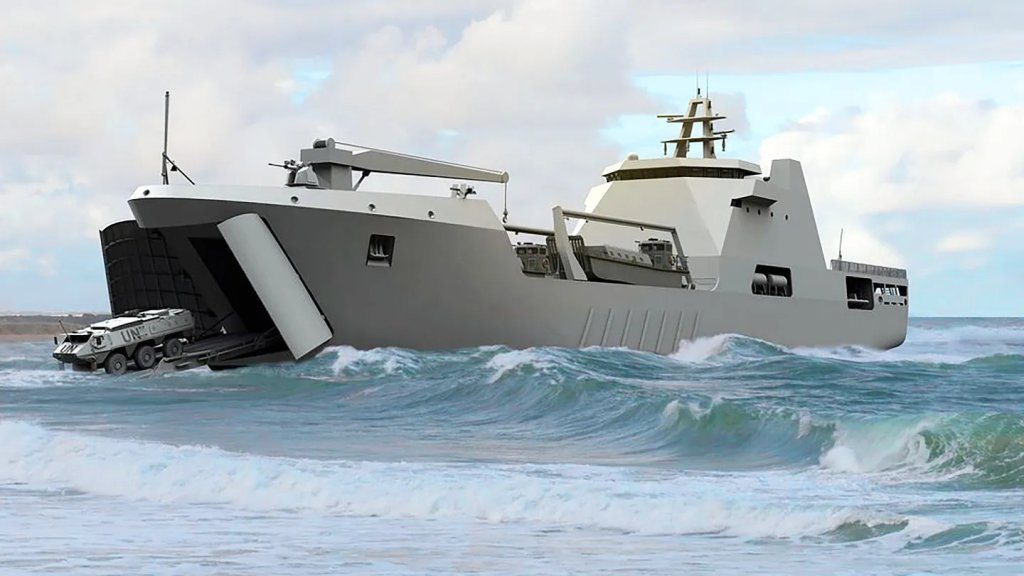
A rendering of Dutch shipbuilder Damen’s LST-100 landing ship, the basis for the Navy’s new LSMs. Damen

It’s also unclear what any additional frigate procurement program might mean for the existing FF(X) frigate program, and what level of additional competition there might be for shipbuilding resources, as a result.

“In terms of which path we go – I’m not going to get ahead of that process – but [studying all options is] essentially what we’re doing,” Navy Rear Adm. Casey Moton, head of the Portfolio Acquisition Executive Maritime (PAE-M) office, also said at the American Society of Naval Engineers Fleet Maintenance and Modernization Symposium last week, according to USNI News. “I am not going to get ahead of what we are doing in response to the presidential memo.”

“We just went through CDR [the critical design review] on the Flight I [of FF(X)], and so we’re doing some pre-production activities with HII to help prepare for that material,” Moton also noted. The Navy has said in the past that it is aiming to have the first FF(X) frigate in the water by 2028.

The Navy’s fleet of Arleigh Burke class destroyers “gets used with a very high demand signal combatant commanders. The Navy can’t operate with only one size of ship,” Rear Adm. Brian Metcalf, Deputy PAE-M, also said in an official video in June, further underscoring the general demand for these new smaller surface combatants. “The [FF(X)] frigate will fill that gap. They can be used in less contentious waters. They can be used as high-value escorts. There are all kinds of things the frigate can fill the gap for and allow destroyers to execute the high-end mission set.”

Signs that a new foreign-designed frigate could be in the Navy’s future have already been growing. The service may have a clearer vision for how to proceed, and whether there might be room for additional pitches from Fincanterai and others, after the review it is working through now is complete.

Contact the author: joe@twz.com

The post Shipbuilder Behind Failed Constellation Class Wants Back Into The U.S. Navy Frigate Business appeared first on TWZ.
  •  

Mystery Shoulder-Fired Surface-To-Air Missile Appears In Russian Service

An unusual shoulder-fired air defense missile seen in Russian use may be of Chinese or Iranian origin, raising questions about the movement of foreign weapons through the increasingly interconnected military supply networks linking Moscow, Beijing, and Tehran.

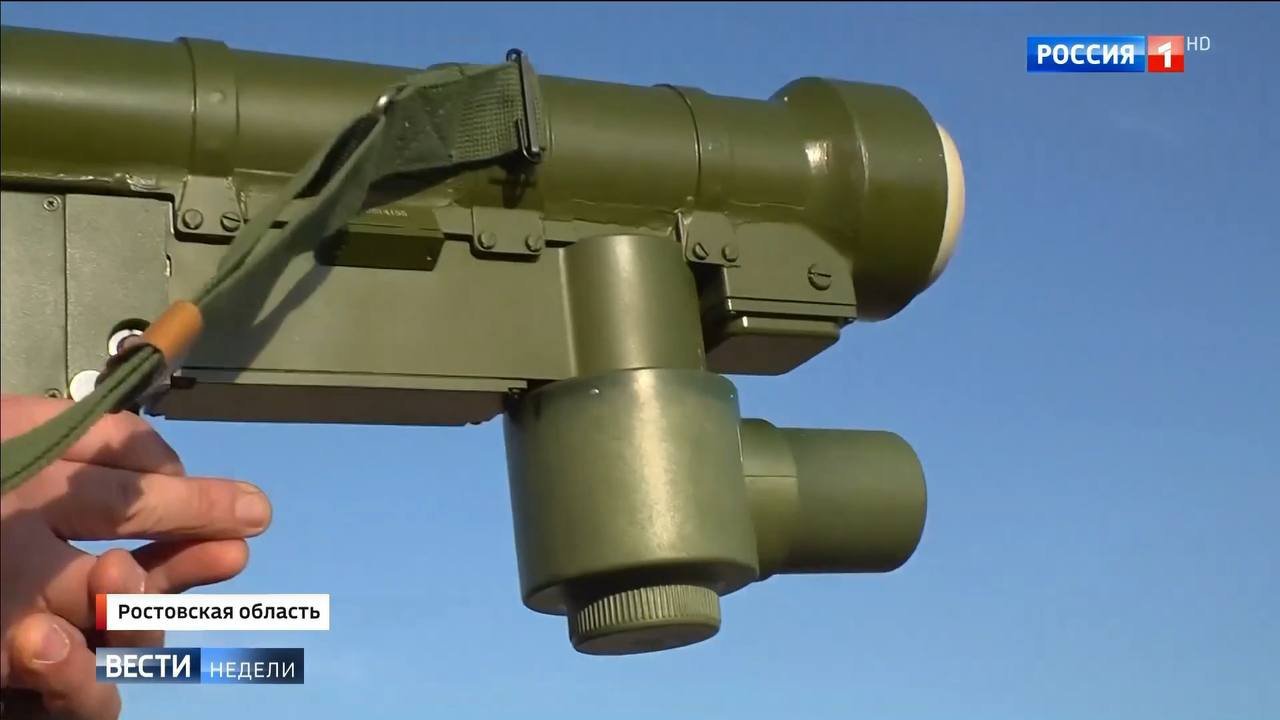
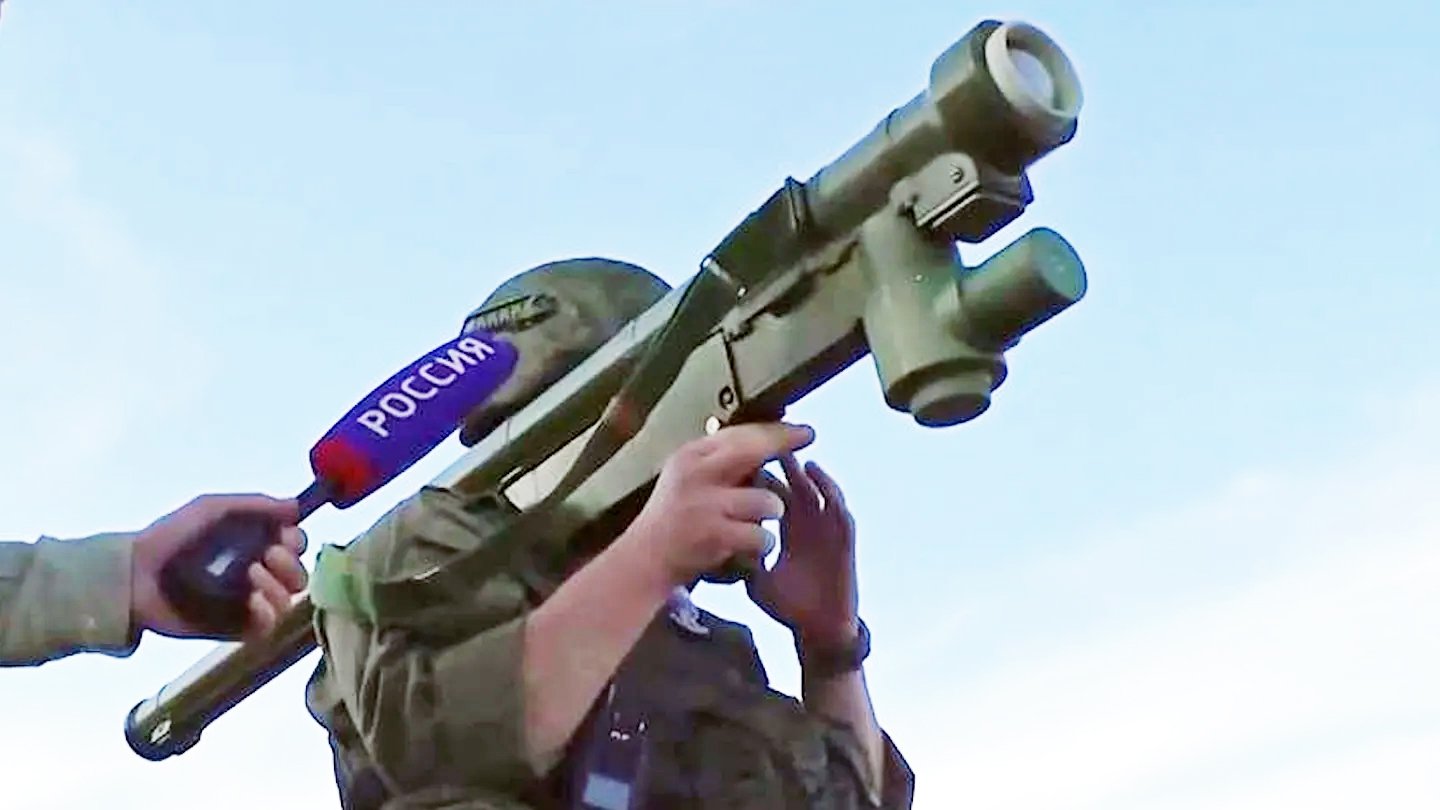
The man-portable air defense system (MANPADS) appeared in Russian television footage showing a mobile air defense group operating in the Rostov region, which borders Ukraine. The weapon was shown during an exercise said to have involved one of the elements of Russia’s 51st Air Defense Division. The footage was subsequently highlighted by the X account TheDeadDistrict.

ruSSian's have developed a new “Iva” MANPADS. In the footage, it is in service with one of the mobile fire groups of the 51st Air Defense Division in Rostov Oblast.

Although, no—it is most likely the Iranian Misagh-2 MANPADS.

Imagine, they don't even have enough production… pic.twitter.com/aYrOtSmG6h

— 𝔗𝔥𝔢 𝕯𝔢𝔞𝔡 𝕯𝔦𝔰𝔱𝔯𝔦𝔠𝔱 🦩🇬🇪🇺🇦🇺🇲🇬🇷 (@TheDeadDistrict) September 28, 2026

The system does not closely resemble any of the Russian-made MANPADS families otherwise used by the country’s armed forces. Russian personnel seen with the weapon reportedly referred to it as “Iva,” although that designation by itself does not establish the weapon’s origin or model. The word Iva is Russian for willow (a type of tree), of which one particular species is named Verba — also the name of the Russian-made 9K333 MANPADS. This weapon looks very different to the example shown, but the connection is unlikely to be a coincidence.

An operator of the mystery MANPADS is interviewed by the Russia-1 TV channel. Russian State Media

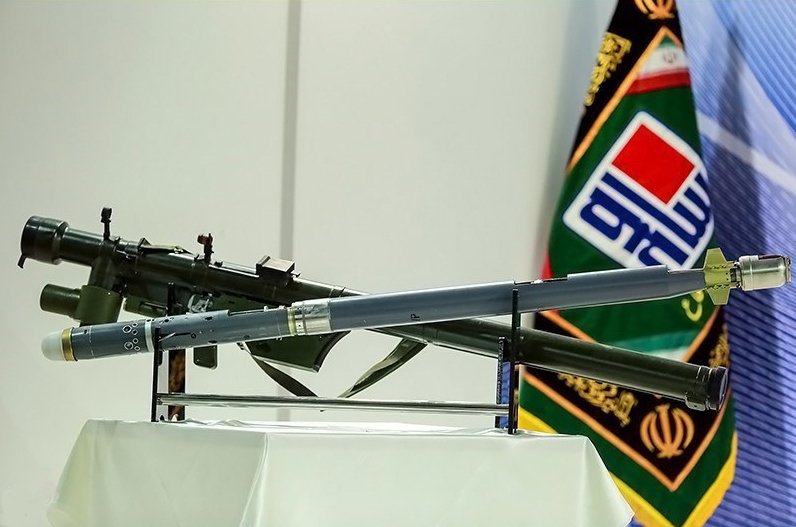
A visual analysis of the newly observed launcher reveals comparisons with both the Iranian Misagh-3 and Chinese QW-series systems, particularly the QW-18/QW-18A and QW-19. In particular, a closer examination of the imagery highlights an additional box-like component toward the front of the launcher. That feature appears more consistent with photographs of Chinese QW-series systems rather than the Misagh.

The front part of the MANPADS launcher, with the distinctive box-like component below the tub. Russian State Media

There is also a scarcity of publicly available imagery of later Iranian variants to completely exclude an Iranian system. At the same time, the Misagh series itself is understood to be derived, or at least heavily influenced by Chinese designs.

An Iranian Misagh-3 MANPADS with its missile. Tasnim News Agency

Iranian basij with QW-18/Misagh-2 MANPADS pic.twitter.com/xfc0nMe4f8

— Yuri Lyamin (@imp_navigator) March 26, 2026

Another possibility is that the weapon is a Russian-produced version or derivative of a Chinese or Iranian design, rather than an imported system.

The possibility of foreign-made or foreign-designed equipment appearing in Russian service has to be viewed against the much broader transformation of Moscow’s military relationships since the full-scale invasion of Ukraine in February 2022.

Russia’s relationship with China has deepened substantially since the invasion, with Beijing becoming a critical source of machinery, electronics, and other components that Russia’s defense industry can no longer obtain as readily from Western suppliers. Moscow and Beijing had already declared a “no limits” partnership shortly before the invasion, and their military relationship has subsequently included exercises and expanding military-technical cooperation. U.S. officials have accused China of supplying Russia with components used in weapons production, including microelectronics. Beijing has rejected accusations that it is providing lethal military assistance to Russia.

A close-up of the front end of the MANPADS. Russian State Media

Iran has also become an important military partner. Russia has used Iranian-designed Shahed-series attack drones extensively in Ukraine and has worked with Tehran on local production and adaptation of those systems. Moscow and Tehran formalized their relationship further with a comprehensive strategic partnership treaty in January 2025, which includes provisions for military-technical cooperation and joint exercises.

In return, Russia has supplied Iran with military technology and has cooperated with Tehran on sensitive weapons programs.

The possible Chinese connection takes on additional significance in light of a major reported procurement deal between China and Iran.

In July, Reuters reported that Iran was expected to receive the first shipment of a deal covering 300 to 400 Chinese-made MANPADS, with a reported value of $60 million to $70 million. The weapons identified by sources included the Chinese QW-12 and FN-16 systems.

Chinese missiles the United States fears… an unsleeping eye against drones and low‑flying aircraft

China’s QW‑12 and FN‑16 air‑defense systems intercept low‑altitude targets — including drones — forming a rapid defensive line against close‑range aerial threats. pic.twitter.com/kJZ6mnqmHg

— China Now (@ChinaNow24) August 23, 2026

The reported contract was signed with a Hong Kong-based company that sources described as an intermediary between the Iranian side and the Chinese supplier. Reuters said the initial deliveries were planned from Urumqi in western China, with the weapons then transiting through Pakistan before reaching Iran. Pakistan’s military publicly denied any involvement in such transfers, while China’s Foreign Ministry called the report “groundless.”

Reuters also reported that delivery schedules and quantities could still change.

More significantly for the Russian sighting, a European security source told Reuters that authorities were aware of several contracts under discussion involving the potential sale of QW-12, QW-18, and QW-19 MANPADS to Iran. A Middle Eastern security source separately claimed that Iran had been seeking QW-18 systems.

The operation was carried out using a MANPADS, likely the Chinese “QW-18” anti-aircraft missile or its Iranian copy, the “Misagh-3”. https://t.co/OnPgqHJmQ8 pic.twitter.com/BuKt1MoKp7

— OSINTWarfare (@OSINTWarfare) October 23, 2024

There is currently no evidence tying the launcher seen in Russian hands to the Iranian procurement from China.

At the same time, the possibility of an Iranian connection should not be ruled out, especially since Chinese-designed MANPADS have a documented history of appearing outside conventional state inventories.

Earlier TWZ reporting, drawing on research by the Small Arms Survey monitoring group, examined the illicit proliferation of Chinese-designed MANPADS and identified dozens of cases involving armed groups in multiple countries. That research included QW-series weapons and documented cases in which investigators linked Chinese-designed MANPADS to Iranian supply networks.

Countries with reports of illicit possession of advanced MANPADS by armed groups, 2011-21. Small Arms Survey

One particularly notable case involved the Jihan, a vessel intercepted in 2013 carrying weapons that investigators identified as including QW-18-pattern MANPADS. UN investigators, the U.S. government, and  Conflict Armament Research assessed Iran as the likely source of those weapons.

It is also worth noting that Chinese MANPADS have already appeared on the Ukrainian side of the war. In late 2025 and 2026, Ukrainian units were photographed with Chinese-made FN-6 and FN-16 systems, including an FN-6 associated with an air defense team reportedly engaging a Russian cruise missile. Exactly how the weapons reached Ukraine remains unclear, with possible third-party transfers or diverted shipments among the possible explanations.

A Chinese FN-6 MANPADS in service with the MFG of the 143rd JTC “Podillia.” It is reported that this MANPADS was used this morning to shoot down a ruSSian Kh-101 CM.
The FN-6 was developed in 2000 and supplied, among others, to Sudan, from where it likely found its way to Ukraine pic.twitter.com/9zA012ue3j

— 𝔗𝔥𝔢 𝕯𝔢𝔞𝔡 𝕯𝔦𝔰𝔱𝔯𝔦𝔠𝔱 🦩🇬🇪🇺🇦🇺🇲🇬🇷 (@TheDeadDistrict) November 19, 2025

Reported as the downing of an Kh-101 cruise missile this morning using a Chinese FN-6 MANPADS. There is no public information confirming that this system has been supplied to or used by Ukraine, making this a notable development. pic.twitter.com/pUujFB81aH

— NOELREPORTS 🇪🇺 🇺🇦 (@NOELreports) November 19, 2025

Incidents like these demonstrate that Chinese MANPADS can move through indirect supply networks, including networks associated with Tehran.

Regardless of how it arrived in Russia, the appearance of a foreign or foreign-derived MANPADS there is notable.

Mobile fire groups have become an increasingly visible component of Russia’s layered air defense effort, particularly as the war in Ukraine has placed enormous emphasis on countering low-altitude drones and other threats, including deep inside Russia.

A Russian CUAS mobile fire group shown with a Courier UGV for additional counter-drone targeting. https://t.co/7yTPPZ47f0 pic.twitter.com/bDu6MbZLEZ

— Samuel Bendett (@sambendett) September 2, 2026

MANPADS are well suited to this mission because they can be dispersed among small teams, rapidly repositioned, and deployed without the larger radar and vehicle infrastructure associated with conventional surface-to-air missile batteries. In particular, they can be deployed around military installations and other sensitive infrastructure.

A foreign system appearing in a Russian mobile fire group might be an imported weapon, an Iranian-produced derivative, a Chinese system acquired for evaluation, a captured weapon, or even a previously unidentified Russian configuration.

model, or even that it is a brand new Chinese-made variant (its possible that I just hadn't seen it, or seen it from these angles) but it is a notable new addition to Russia's MANPADS inventory.

— Matt Schroeder (@MSchroeder77) September 28, 2026

Another possibility is that the MANPADS is North Korean in origin. Russia’s military relationship with Pyongyang has expanded significantly, including the provision of increasingly advanced military equipment and technology. There is no known North Korean MANPADS matching the configuration seen here, however, and the possibility remains speculative. North Korean weapons have also frequently incorporated or closely followed Chinese designs, meaning a Chinese-looking configuration would not necessarily rule out a North Korean origin.

🚨 I was able to geolocate and thus confirm that the photo of North Korean M-1978/1989 Koksan 170mm SPGs was taken in Russia.

📍56.069386, 92.920244
Krasnoyarsk, central Russiahttps://t.co/BOaR44uLeS https://t.co/mC8solXVOv pic.twitter.com/LUHO2cllKZ

— Status-6 (@Archer83Able) November 14, 2024

Russia has dramatically expanded defense production since 2022, but its industry remains under heavy wartime demand and sanctions-related constraints. Western restrictions have complicated access to advanced electronics, machine tools and other components, while Russia has increasingly relied on domestic substitutes and foreign suppliers.

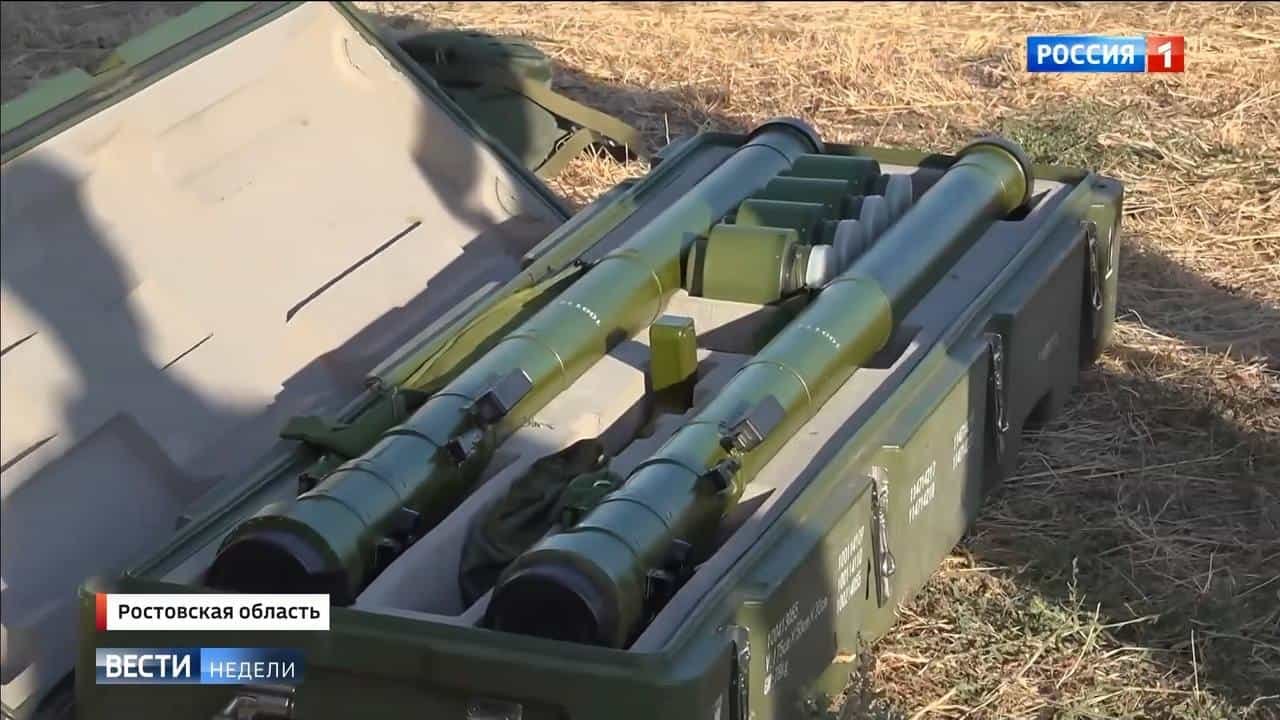
The mystery MANPADS launchers disassembled and in a container for transport. Russian State Media

At the same time, Russia must replenish weapons consumed in Ukraine, meaning foreign supplies could supplement domestic production, fill specific gaps, or allow scarce industrial capacity to be directed elsewhere.

For Russia, even a limited number of additional shoulder-fired systems could therefore have practical value as Ukrainian long-range strike capabilities continue to expand.

For now, the exact model and provenance of the MANPADS in question remain unconfirmed, but the apparent Chinese or Iranian design characteristics are highly noteworthy. Further appearances of the system could provide the clues needed to determine what it is, where it came from, and whether this represents an isolated example or a more significant acquisition effort.

Contact the author: thomas@thewarzone.com

The post Mystery Shoulder-Fired Surface-To-Air Missile Appears In Russian Service appeared first on TWZ.

  •  

British Police Arrest Men Driving Toward U.S. Bomber Base In The U.K. With Suspected Explosives

Details continue to come in, but police in the United Kingdom have declared a “major incident” and ordered evacuations near RAF Fairford after the arrest of “several men on suspicion of offenses under the explosives act,” the Gloucestershire Constabulary stated.

RAF Fairford is a major hub for U.S. military aircraft in the United Kingdom. It is a regular host of strategic assets, including bombers and U-2 spy planes. It also acts as a pit stop for other aircraft, including fighters, that are being ferried to and from the United States. Bomber strikes launched from Fairford were a central aspect of major U.S. combat operations against Iran earlier this year.

“A number of properties are currently being evacuated in the Whelford area following the declaration of a major incident,” the Gloucestershire Constabulary also announced today in light of the incident.

Emergency services in Fairford after major incident has been declared, with armed police manning a cordon near the village of Whelford in Gloucestershire, near RAF Fairford which is used by the United States Air Force (USAF). Picture date: Sunday September 27, 2026. (Photo by Ben Birchall/PA Images via Getty Images)
Emergency services in Fairford after a major incident has been declared, with armed police manning a cordon near the village of Whelford in Gloucestershire, near RAF Fairford, which is used by the United States Air Force (USAF). (Photo by Ben Birchall/PA Images via Getty Images) Ben Birchall – PA Images

The evacuations were spurred by the arrests.

“The Army’s specialist explosive ordnance disposal team are currently examining a number of vehicles,” Gloucestershire Constabulary added. “The local residents are being evacuated to a nearby leisure center.”

“A cordon is currently in place, but we’d like to reassure people that we believe this incident is contained,” the law enforcement agency explained. “We are working closely with our partners and are enacting the well-rehearsed plans we have in place.”

The incident began around 12:45 AM local time Sunday “when police received a call relating to three suspicious vehicles traveling towards RAF Fairford,” according to Gloucestershire police Assistant Chief Constable Richard Ocone. “Armed officers responded and subsequently arrested five men in the Whelford area on suspicion of committing offenses under the Explosives Act. The men were taken into custody, where they remain.”

“A 400-meter cordon has been put in place around the vehicles while the army’s explosive ordnance disposal unit examined them,” Ocene continued. “As a precaution, around 85 households have been advised to evacuate while these examinations take place.”

BREAKING:

The British authorities issue a first official statement on the suspected terror plot against RAF Fairford

They sent in a local low-ranking policemen to deliver a statement saying 5 men have been arrested and that people shouldn’t speculate about the case.

He… pic.twitter.com/9dD8910Kpw

— Visegrád 24 (@visegrad24) September 27, 2026

Video has emerged showing British military explosive ordnance disposal robots reportedly defusing the vans used by the suspects.

Video of British military EOD robots defusing suspected bomb vans near RAF Fairford courtesy of SkyNews. pic.twitter.com/PbrrVH6V1x

— WarMonitor🇺🇦🇬🇧 (@WarMonitor3) September 27, 2026

“We are aware of the current reporting, for questions regarding off-base incidents please contact the local authorities,” a U.S. Air Force spokesperson told us in response to our questions about whether the incident had raised force protection levels at RAF Fairford or other installations in the area hosting American forces. Unconfirmed reports by the local aviation spotter community claimed RAF Fairford had been placed under what is called FPCON Delta, the highest level of alert at U.S. military installations.

The incident at RAF Fairford has been escalating overnight, this is what is clear so far.

Gloucestershire Police has announced that they have arrested multiple men on suspicion of offences under the Explosives Act, and that they have declared a Major Incident.

According to the… https://t.co/vk5N7yUuzB pic.twitter.com/IMHGtKGiC1

— Armchair Admiral 🇬🇧 (@ArmchairAdml) September 27, 2026

“For operational security reasons we will not discuss specific force protection measures,” the Air Force spokesperson added. “The 501st Combat Support Wing and our fellow UK-based Wings remain vigilant and will take appropriate actions to ensure the safety and security of our U.S. service members, civilians, contractors, and their families. We constantly assess a variety of factors that determine what measures we institute or modify to protect our installations, our people and their families.”

It is unclear if airfield operations at RAF Fairford have been affected. U.S. Air Force officials did not immediately respond to our request for comment.

The British Defense Ministry did not immediately provide comment on this unfolding event.

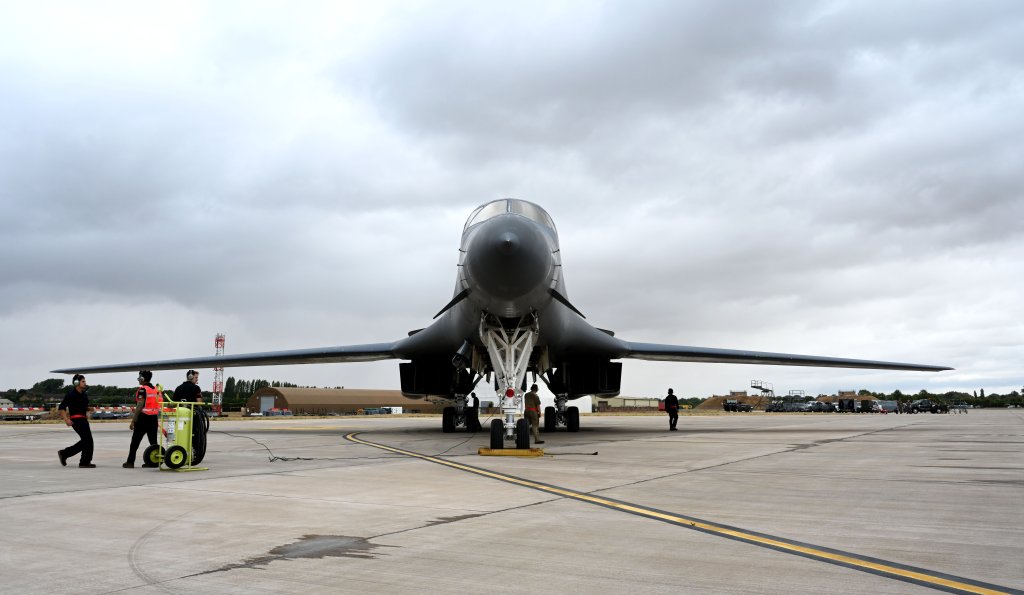
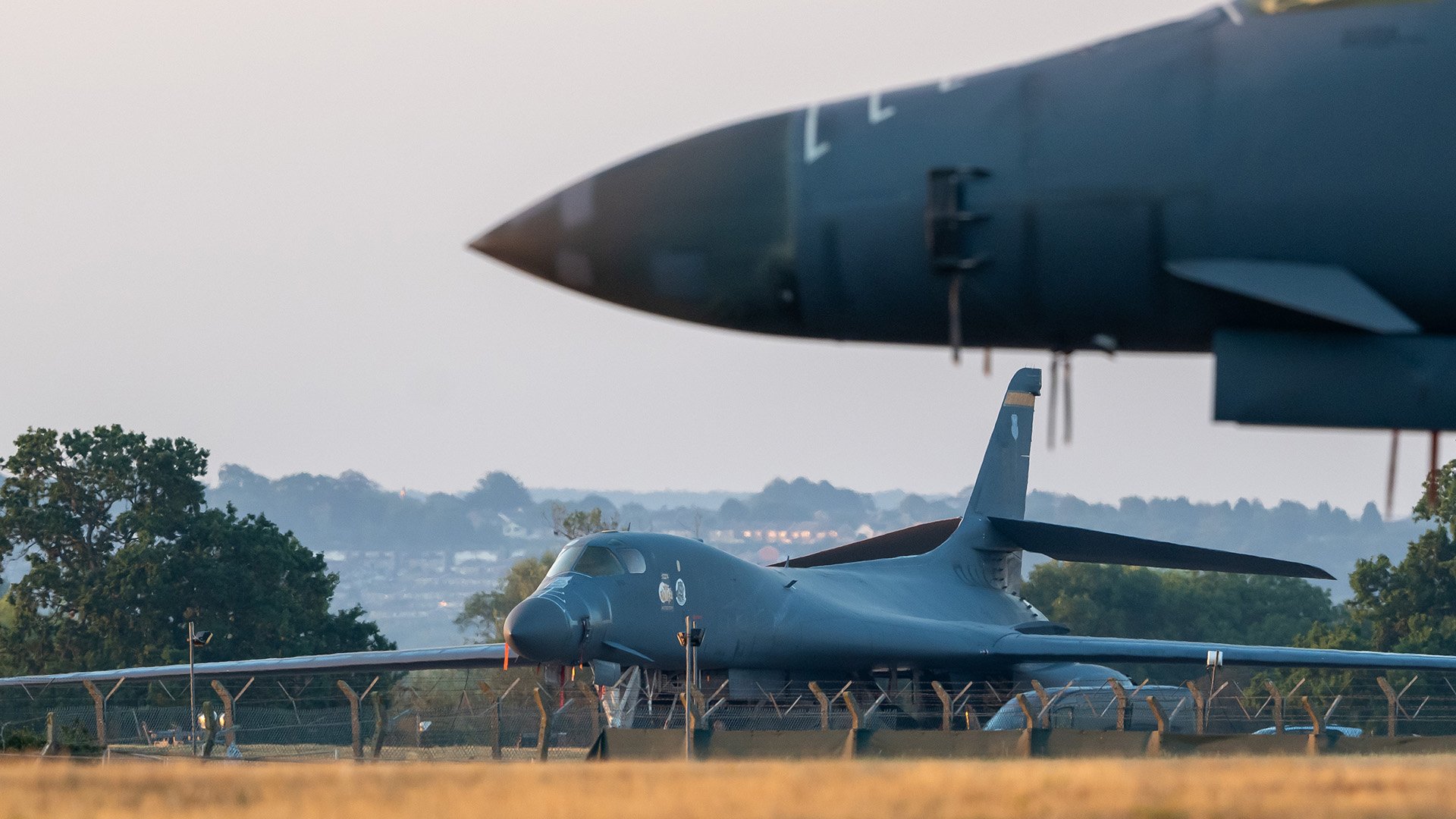
RAF Fairford is a major hub for U.S. military aircraft, with strategic assets, like B-1B Lancer bombers, being forward deployed to the base and tactical and other assets often using it as a pit stop during flights ‘across the pond.’

A U.S. Air Force B-1B Lancer assigned to the 37th Bomb Squadron, Ellsworth Air Force Base, S.D., arrives to participate in the Royal International Air Tattoo at Royal Air Force Fairford, England, July 15, 2025. The Lancer is slated to participate in RIAT, which has more than 80 aircraft are scheduled to attend from July 18-20, 2025. (U.S. Air Force photo by Tech. Sgt. Robert M. Trujillo)
A U.S. Air Force B-1B Lancer at RAF Fairford. (U.S. Air Force photo by Tech. Sgt. Robert M. Trujillo) Tech. Sgt. Robert Trujillo

As mentioned, RAF Fairford played a key role in major combat operations against Iran earlier this year. No connection has been established yet between today’s incident and any particular group, but the base has drawn direct threats from the regime in Tehran in the past.

“The American aggressor army, which used to launch cruise missiles from its vessels in the Indian Ocean in its aggression after the official resumption of the war, with the end of the missile reserves of the aforementioned vessels, yesterday switched to using B1 planes flying from Fairford Air Base, England,” Tasnim News Agency, a quasi-state outlet in Iran with ties to the country’s powerful Islamic Revolutionary Guard Corps (IRGC), claimed on Telegram on July 23. “As the officials of the Ministry of Foreign Affairs also stated, any base that is used to invade Iran’s territory is our legitimate goal.”

the enemy must pay the price for its breach of promises, and this time we will not allow America to use deceptive ceasefires to replenish its oil and ammunition stockpiles and then resume attacks once again.

— Press TV 🔻 (@PressTV) July 23, 2026

Considering its importance to U.S. military operations, the base is a major potential target for nefarious actors, in general. Like other bases across Europe, it is a major potential target for Russia’s ‘hybrid war’ or ‘gray zone’ activities, as well.

Asked about the threats at the time, a British official told us that the country was prepared to defend itself.

“Our Armed Forces are ready to keep the United Kingdom safe from any kind of attacks, whether it’s on our soil or from abroad,” a government official told TWZ. “The UK stands ready 24/7 to defend itself. This includes through operating a layered approach to air and missile defense, provided by Royal Navy, British Army and Royal Air Force assets equipped with a range of advanced capabilities, working closely with our NATO allies.”

“In the Defense Investment Plan we have made air and missile defense a priority after years of underfunding, dedicating £790 million to enhance protection of the UK homeland and overseas bases from air, drone and missile threats,” the official added. “That is complemented by more than £2 billion of funding to deliver further air defense and counter-drone capabilities, and to upgrade and sustain our Typhoon fleet.”

This is a developing story.

UPDATE: 10:49 AM Eastern –

A Temporary Flight Restriction (TFR) has been imposed over Whelford, Gloucestershire, following the incident. It applies to all aircraft, including “any small balloon, any kite, any UAS and any parachute, including a parascending parachute or paramotor,” according to the FAA. “Pilots are forbidden to fly within the designated area without permission.”

The TFR runs through Oct. 5.

Contact the author: howard@twz.com

The post British Police Arrest Men Driving Toward U.S. Bomber Base In The U.K. With Suspected Explosives appeared first on TWZ.

  •  

Laser Weapons Will Be Deployed At Cape Canaveral Spaceport To Take Down Drones

Cape Canaveral Space Force Station is getting lasers that can zap drones intruding into its airspace. When installed, the new directed energy defense system will be part of a much larger effort to protect the spaceport against drone incursions, a spokesperson for Space Launch Delta 45 (SLD 45) told us.

The idea is to ensure the safety of launches and to keep prying eyes away from an installation full of secrets about America’s military and commercial space efforts. Companies like SpaceX, United Launch Alliance, Blue Origin and Relativity Space use the installation for space launches. The base defense modernization effort comes as the Cape Canaveral region is inundated with drone incursions. There were hundreds last year.

A SpaceX Falcon 9 rocket launches from Space Launch Complex 40 at Cape Canaveral Space Force Station, Florida, on May 29, 2026. Less than 12 hours after responding to a launch vehicle anomaly at a separate launch complex, Space Launch Delta 45 and the Eastern Range remained fully mission capable and successfully supported the mission, demonstrating the resilience and responsiveness of the world's busiest spaceport. (U.S. Space Force photo by Gwen Kurzen)
A SpaceX Falcon 9 rocket launches from Space Launch Complex 40 at Cape Canaveral Space Force Station, Florida, on May 29, 2026. (U.S. Space Force photo by Gwen Kurzen) Gwendolyn Kurzen

“As the world’s premier spaceport continues to support an unprecedented launch tempo for national security and commercial missions, securing critical launch infrastructure from low-altitude aerial threats remains a top operational priority,” the spokesperson explained. “The ongoing security modernization integrates detection, tracking, and defensive capabilities to include directed energy systems. These will provide security forces with real-time situational awareness and the necessary tools to safeguard personnel, launch complexes, and national security payloads.”

The spokesperson did not have a timeline for when the directed energy system will be operational. Florida Today was the first to report that lasers will make up this defensive system.

Col. Brian Chatman, who commands Space Launch Delta 45, told the publication that the facility is “bringing on a directed-energy system that can do a kinetic kill against UASs (Unmanned Aircraft Systems) that are coming into the area that are having nefarious intent.”

“The Air Force Research Laboratory [AFRL]-tested system has been proven to be able to safely bring down a drone,” Florida Today noted. “This directed-energy system uses lasers to shoot down any drone that flies into restricted areas.”

Chatman didn’t name the specific system to Florida Today and the SLD 45 spokesperson declined to say.

The following video shows one such AFRL-tested system that has been used in combat before.

For the spaceport, being able to use lasers is even more important than it is for other locations needing protection from drones. That’s because the traditional method of jamming radio frequencies to interfere with drone connections to controllers could damage spacecraft.

“If you start blasting a bunch of RF energy you run into potential challenges,” Chatman explained. “You don’t want that.”

There is good reason for Chatman to be concerned about drones. The spaceport has been subjected to many unauthorized incursions, the spokesperson told us. However, there were no statistics immediately available on how many or whether they occurred during launches. There were 500 unauthorized drone flights over the adjacent Port Canaveral in 2025, Port Canaveral CEO Capt. John Murray said.

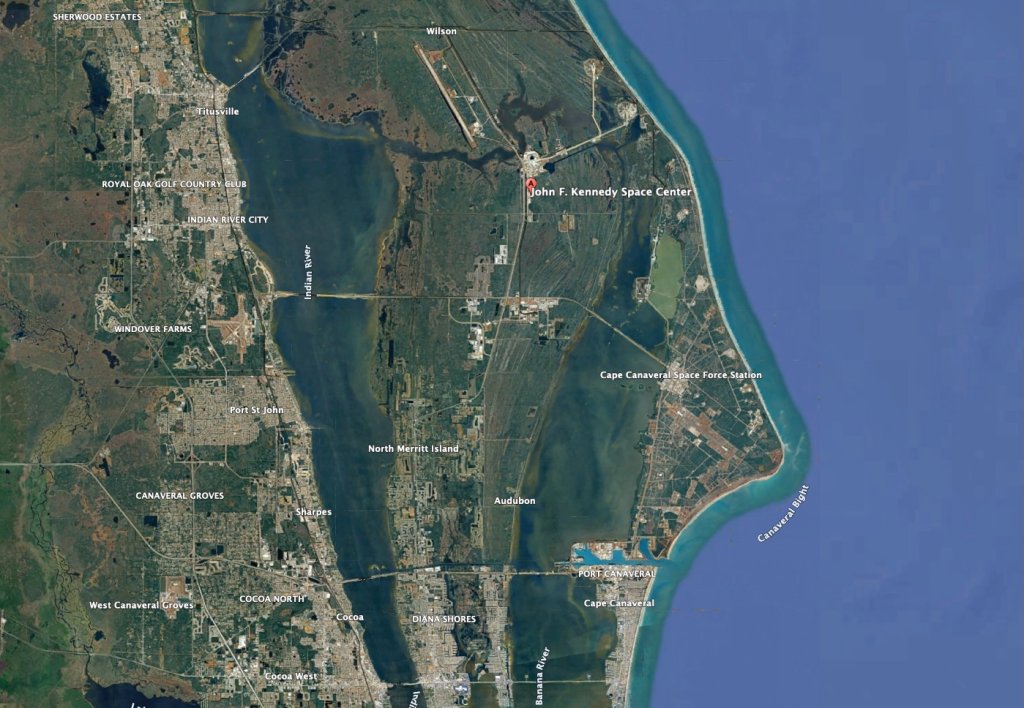
In addition, on Sept. 18, a Chinese tourist pleaded guilty to a federal misdemeanor charge after flying a drone in restricted airspace above NASA’s Kennedy Space Center (KSC) in late July. KSC is located across the Banana River from the space station.

It is unclear if the new laser system will also protect the skies over KSC. The spokesperson did not immediately know and is checking into it.

Cape Canaveral. (Google Earth)

That tourist, Xiaodong He, flew a drone that videotaped the installation, according to federal documents. The drone got within 1.56 miles of pad 39B, from where the next crewed lunar flight is expected to launch in 2028.

NASA’s Kennedy Space Center pad 39B. (NASA)

Encompassing about 25 square miles, Cape Canaveral Space Force Station is a large, unpopulated, open area with a long Atlantic Ocean shoreline. The station’s physical layout allows many vectors for drone incursions, and what’s housed there makes it a logical target for a nefarious actor.

The systems being prepared for launch and launched at the sprawling facility are extremely valuable and can take many years to build, costing billions. When they are out on the pad or being transported around, the rockets are massive tubes packed with high explosives that would cause a devastating secondary explosion if struck.

Even disrupting launches there due to a successful or even attempted attack could have major national security impacts.

Maybe the place that needs them most. Use your imagination with this one.

Probably scary how little they have. https://t.co/cBww4vlB9n

— Tyler Rogoway (@Aviation_Intel) September 19, 2026

The move to bring directed energy systems to protect the spaceport comes as the military is investing heavily in these systems to counter drones. Late last month, for instance, troops from the Joint Task Force-Southern Border (JTF-SB) employed an Army Multipurpose High Energy Laser (AMP-HEL) system during an operation dubbed Ardent Vanguard. The AMP-HEL was used “to engage and defeat three hostile UAS, determined to be such based on their use in direct support of activities posing a physical threat to U.S. military personnel and CBP [Customs and Border Protection] partners,” according to a media release at the time.

The shootdown was part of the U.S. government’s ongoing effort to counter drones being flown by Mexican drug cartels.

Joint Task Force – Southern Border personnel use the Army Multipurpose High Energy Laser system to engage and defeat a hostile UAS, determined to be such based on its use in direct support of activities posing a physical threat to U.S. military personnel and CBP partners, August 25, 2026. Approximately 8,000 service members are currently deployed under JTF-SB to protect U.S. territorial integrity by boosting awareness, accelerating response, and supporting federal law-enforcement partners. (U.S. Army Photo by Sgt. Daniel Huerta)
Joint Task Force – Southern Border personnel used the Army Multipurpose High Energy Laser system to engage and defeat a hostile drone. (U.S. Army Photo by Sgt. Daniel Huerta) Operation Ardent Vanguard

The military is seeking to expand its ability to counter drones with directed-energy weapons. In May, the Defense Department and Joint Interagency Task Force 401 selected five installations to participate in a directed-energy counter-unmanned aircraft systems pilot program required by the Fiscal Year 2026 National Defense Authorization Act.

“This initiative will accelerate the fielding and evaluation of advanced directed energy capabilities to protect critical infrastructure, military installations and homeland missions,” the Pentagon explained. “The locations were deliberately selected to support rigorous testing and operational assessments across diverse environments and mission sets.”  

The Pentagon selected two “key southern border installations” for this program: Fort Huachuca, Arizona; and Fort Bliss, Texas. It also tabbed Naval Base Kitsap, Washington; Grand Forks Air Force Base, North Dakota; and Whiteman Air Force Base, Missouri.

Though the Pentagon is pressing forward with making directed energy a key part of counter-drone efforts, laser weapons have limitations. These include their short-term magazine depth being limited to how many successive shots they can fire before thermal loads require the system to cool down. Energy supply can also be a limiting factor. Additionally, laser systems don’t function as well in heavy cloud cover and other inclement weather.

“We can only shoot down with a laser what we can see,” Israeli Defense Forces (IDF) Brig. Gen. Yaniv Rotem once said about the IDF’s Iron Beam laser defense system, which began downing enemy drones in combat last year.

You can see the Iron Beam’s first claimed kills in the following video.

A World First — Combat-Proven Laser Defense, Powered by Rafael

For the first time in history, high-power laser systems have been used to intercept aerial threats in combat.
This unprecedented breakthrough took place during the Swords of Iron War — with Rafael’s advanced… pic.twitter.com/B3D6UdCJvE

— Rafael Advanced Defense Systems (@RAFAELdefense) May 28, 2025

At the same time, a laser weapon of this kind is very much a point-defense weapon, with its short range meaning that multiple systems will be needed to provide coverage of a significant area. In some situations, even a single, large military base like Cape Canaveral Space Force Station might require more than one to provide full defensive coverage.

In addition, there have been concerns about the safety of the systems and the authorities required to use them in the homeland.

These issues came to a head in February, when the U.S. military used AeroVironment’s LOCUST directed energy weapon to shoot down a Customs and Border Protection (CBP) drone over southwest Texas. The friendly fire incident spurred expanded airspace restrictions over the Fort Hancock area that lasted for four months. It also gave credence to the FAA’S concerns about the operational deployment of counter-drone laser weapons along the border. The same system was used to fire at suspected Mexican cartel drones flying across the southern border into Texas two weeks earlier, which resulted in a large airspace closure, general confusion and major headlines.

Safety concerns about using directed energy weapons, and especially kinetic ones, to take down drones in the U.S. have been a major factor in why they haven’t been previously used in this role. Almost two years ago, officials at U.S. Northern Command (NORTHCOM), which has coordinating authority for counter-drone efforts in the U.S., said the use of such weapons was not yet on the table. The reason is that they can create dangerous or otherwise serious collateral effects that are less of a concern in a war zone.

That the U.S. Space Force is bringing in a laser system to protect some of the nation’s most important and secret military assets is a strong indication that these concerns are being overcome.

Contact the author: howard@twz.com

The post Laser Weapons Will Be Deployed At Cape Canaveral Spaceport To Take Down Drones appeared first on TWZ.

  •  

Bunker Talk: Let’s Talk About All The Things We Did And Didn’t Cover This Week

Welcome to Bunker Talk. This is a weekend open discussion post for the best commenting crew on the net, in which we can chat about all the stuff that went on this week that we didn’t cover. We can also talk about the stuff we did or whatever else grabs your interest. In other words, it’s an off-topic thread.

This week’s caption reads:

BERLIN, GERMANY JUNE 16: Heavy iron doors between different rooms during a media event on June 16, 2026, at the former Cold War-era Pankstraße subway station, now used as a nuclear fallout shelter. Built in the 1970s, the bunker offers sleeping accommodations for 3,339 people, has independent water and electricity supplies, and is hermetically sealed off from the outside world by massive steel doors. The bunker will be open to the public as part of guided tours of Berlin’s underground. Russia’s invasion of Ukraine has rekindled German authorities’ interest in providing nuclear fallout shelters in the event of war. (Photo: Carsten Koall/Getty Images)

PRIME DIRECTIVES:

  • If you want to talk politics, do so respectfully and know that there’s always somebody that isn’t going to agree with you. 
  • If you have political differences, hash it out respectfully, stick to the facts, and no childish name-calling or personal attacks of any kind. If you can’t handle yourself in that manner, then please, discuss virtually anything else.
  • No drive-by garbage political memes. No conspiracy theory rants. Links to crackpot sites will be axed, too. Trolling and shitposting will not be tolerated. No obsessive behavior about other users. Just don’t interact with folks you don’t like. 
  • Do not be a sucker and feed trolls! That’s as much on you as on them. Use the mute button if you don’t like what you see.  
  • So unless you have something of quality to say, know how to treat people with respect, understand that everyone isn’t going to subscribe to your exact same worldview, and have come to terms with the reality that there is no perfect solution when it comes to moderation of a community like this, it’s probably best to just move on. 
  • Finally, as always, report offenders, please. This doesn’t mean reporting people who don’t share your political views, but we really need your help in this regard.

The post Bunker Talk: Let’s Talk About All The Things We Did And Didn’t Cover This Week appeared first on TWZ.

  •  

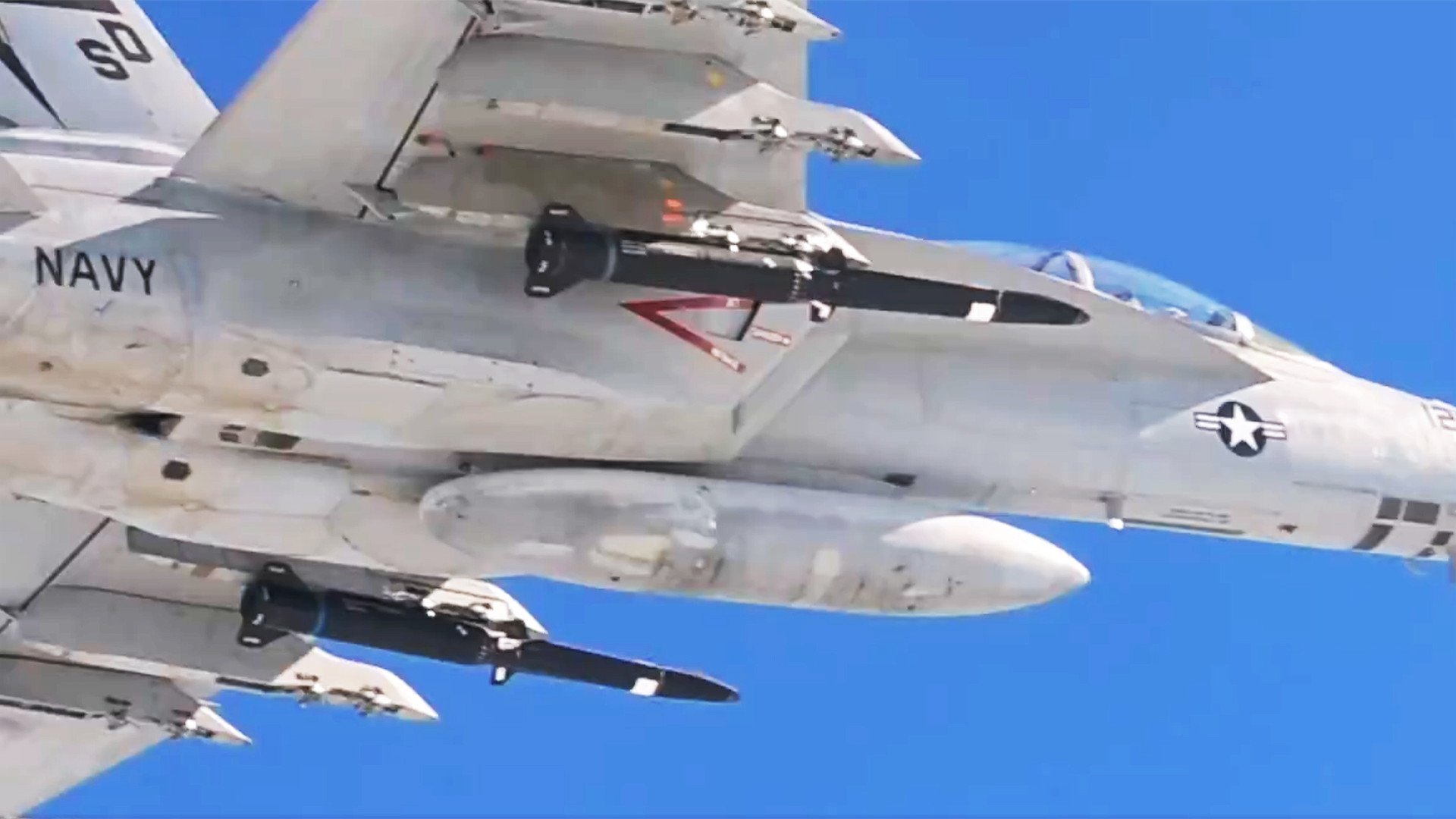
Blackbeard Hypersonic Missile Seen Flying On F/A-18 Super Hornet For The First Time

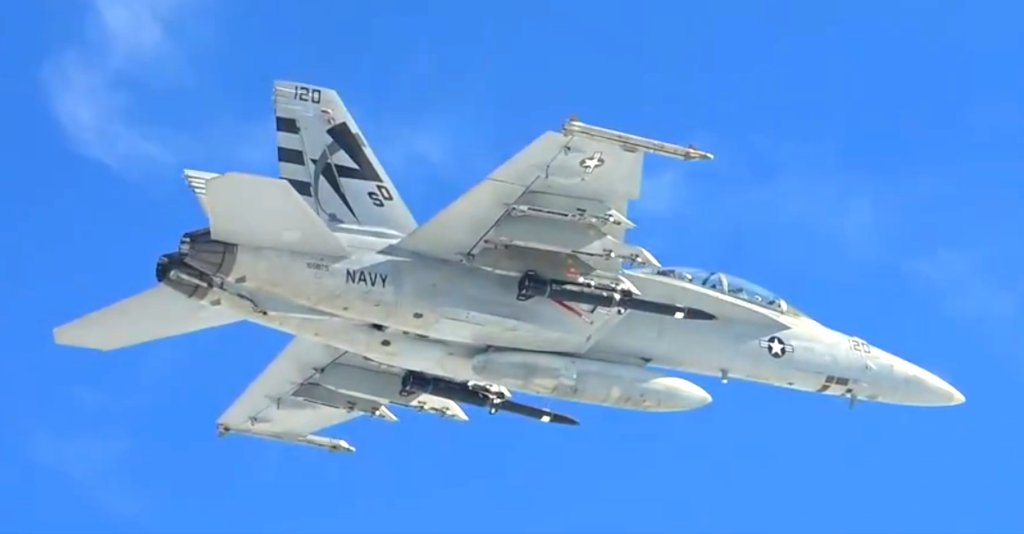
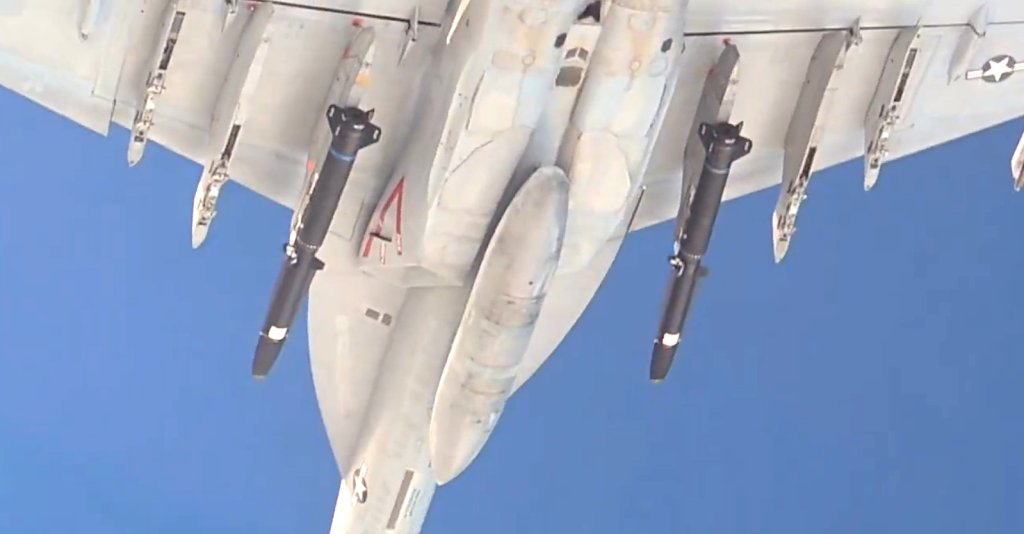
The U.S. Navy has given us the first look at Blackbeard hypersonic strike missiles under the wings of F/A-18E/F Super Hornets during actual flight testing. The Navy is hoping to have Blackbeard in at least limited service no later than 2028, giving its carrier air wings an all-new fast-flying standoff weapon, particularly for engaging enemy ships. The missile is also being designed to be relatively cheap and quick to manufacture.

The Navy’s Office of the Portfolio Acquisition Executive for Aviation (PAE-A) has released a video montage of Blackbeard undergoing flight testing, seen in the social media post below. The service confirmed that it had at least begun test-loading the missiles onto F/A-18E/F Super Hornets in a presentation at the Tailhook Association’s annual convention last month. Now we know the program has moved ahead substantially from that point.

Coming soon to a theater near you…BLACKBEARD!@USPACOM @CENTCOM @PAEAviation pic.twitter.com/KgBtIqdf8I

— NAVAIR (@NAVAIRNews) September 25, 2026

The company behind Blackbeard, defense start-up Castelion, has received several multi-million-dollar contracts from the Navy just this year explicitly to support integration of the weapon onto the Super Hornet, as well as otherwise accelerating its development. In its daily contracting on September 14, the Pentagon announced the Navy had struck yet another deal with Castelion, valued at $43.65 million, “for the manufacturing, assembly, testing, and delivery of the first production lot of 444 All-Up Rounds (AURs), defined as fully functional tactical missiles packaged within specialized shipping and storage containers.”

A screen capture from the Blackbeard flight testing video montage the Navy released today. USN capture

In terms of what we know today about Blackbeard’s design and capabilities, as we have previously written:

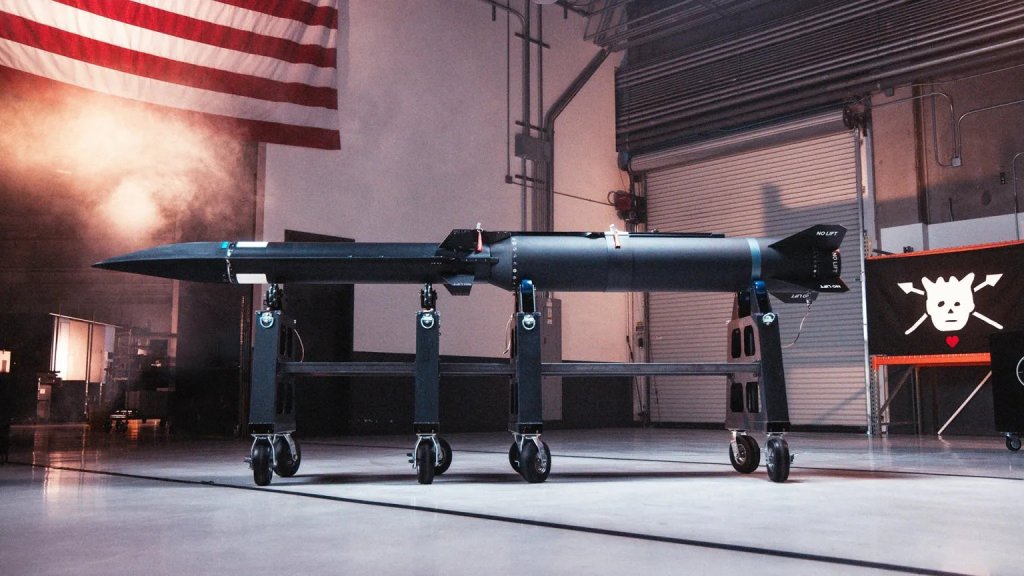
“A profile photo [seen below] at the company’s headquarters reveals a weapon with a ballistic missile-like booster, on top of which is mounted what could be an unpowered hypersonic glide vehicle (HGV). A booster brings an HGV to the desired velocity and altitude before releasing it toward its target. The concept is in contrast to air-breathing cruise missiles capable of traveling at hypersonic speeds. Hypersonic speed is generally defined as anything above Mach 5, which larger ballistic missiles also reach in the course of their flights. More precise performance figures for Blackbeard are lacking, but Castelion has previously hinted it could hit targets out to just under 500 miles. Alternatively, the second stage may also have its own motor, allowing it to continue accelerating or sustain high-speed flight. A similar arrangement has been suggested as the propulsion system for the Russian Zircon missile.”

Castelion

“Both stages of the weapon have cruciform fins, while the upper one features a prominent ‘chine’ line along the length of its body, and a slightly beaklike nose. The trolley on which the weapon is mounted provides some idea of its overall size. The blue stripes seen on each stage normally signify that a munition is an inert, non-explosive round utilized for training or tracking purposes. This would indicate a real (unarmed) missile rather than a dummy or mockup.”

A picture shown at Tailhook had also offered a new look at the front of the missile, exposing what looked to be an aperture on one side of the design’s wedge-shaped nose. As we wrote after that image emerged:

“The apparent apertures are also seen pointed up, but many air-launched munitions do flip down after release.”

“How exactly Blackbeard is guided remains unknown, but a downward-angled aperture at the nose end for a seeker system would make sense for this weapon, which the Navy is pursuing primarily as a new way to target enemy ships. In particular, a wide array of existing anti-ship and land attack missiles, as well as certain anti-air types, have variously shaped apertures in their noses for imaging infrared seekers. Imaging infrared has the benefit of being immune to radio frequency electronic warfare jamming. In addition, it is a passive capability that does not send out signals that can give an opponent advance notice of an incoming attack. Blackbeard’s full guidance package very likely also includes some means of navigating to a target area first, and it could have multiple modes of operation.”

The new flight testing footage released today also underscores the relatively small size of Blackbeard overall. While the Super Hornet is set to be the first operational launch platform, it is very likely to be integrated on other aircraft quickly thereafter. The Navy is acquiring Blackbeard under a program called the Multi-mission Affordable Capacity Effector (MACE).

Another screen capture from the new Navy video offering a different of Blackbeards under the wings of a Super Hornet, underscoring their relatively small size. USN capture

Requirements for MACE that the Navy put out previously explicitly called for a design compact enough for carrier-based F-35C (and land-based F-35A) Joint Strike Fighters to carry four of them internally. Whether that remains a goal in any way is unclear. Still, being able to carry some number of Blackbeards internally would not only give those jets a hypersonic strike weapon, but one that they could carry in the most stealthy configuration. The Navy also notably does operate the F-35A outside of the test and evaluation community, which might point to air-launched Blackbeards entering service elsewhere in the future. As an aside, the U.S. Army is pursuing a ground-launched version of this missile, as well.

Another critical aspect of Blackbeard is the emphasis on lower cost and the ability to produce the missiles readily at scale. The conflict with Iran has fully driven home long-standing concerns about the depth of U.S. stockpiles of various critical munitions, as well as its ability to replenish them quickly. Blackbeard reflects a larger push across America’s armed forces to add more cost-effective weapons that can be acquired on faster timetables to their arsenals. Bringing in new, smaller companies like Castelion to develop and build these munitions has also been a major point of focus. To put this all in immediate context, in May, the Pentagon announced a framework agreement to buy 12,000 Blackbeards over the next five years.

As mentioned, the Navy’s stated goal now is to reach an early operational capability with Blackbeard by 2028, if not sooner. What the exact fielding plan for those missiles might be is unclear. PAE-A did write “Coming soon to a theater near you” in its post on X containing the video montage, and tagged the official accounts for U.S. Central Command (CENTCOM) and U.S. Pacific Command (PACOM). CENTCOM oversees U.S. military activities in and around the Middle East, including ongoing operations against Iran. U.S. military officials have also long touted hypersonic weapons, in general, as key to success in any future conflict in the Pacific, especially a high-end fight against China.

It’s also worth noting here that U.S. military hypersonic missile programs across the services have faced repeated setbacks and delays over the years. This, in turn, has prompted discussion about a worrisome gap emerging in this arena between the United States and its chief global competitors, especially China. It is very possible now that Blackbeard could be the first operational air-launched type in American inventory, depending on how the U.S. Air Force does or does not proceed with its Hypersonic Attack Cruise Missile (HACM) program. The Air Force has said previously that it is aiming for HACM to be operational, at least on a limited level, before the end of Fiscal Year 2027, which begins next month.

If nothing else, we have clear evidence that the air-launched version of Blackbeard is now deep in flight testing for the U.S. Navy.

Contact the author: joe@twz.com

The post Blackbeard Hypersonic Missile Seen Flying On F/A-18 Super Hornet For The First Time appeared first on TWZ.

  •  

Latvia To Order Anduril’s Barracuda Cruise Missile For Long-Range Strike Capability

NATO member Latvia is moving toward acquiring Anduril Industries’ Barracuda family of long-range strike missiles, with Latvian President Edgars Rinkēvičs highlighting the effort during a visit to the U.S. defense technology company and a series of new defense-industry cooperation agreements involving Latvia. If the acquisition goes through, Latvia would be the first of the Baltic states to field a strike weapon in this category.

“It was great to visit Anduril to meet with Palmer Luckey and to witness signing of memoranda of cooperation with MOD of Latvia and Origin Robotics,” Rinkēvičs said in a post on X. “Looking forward to complete acquisition of Barracuda long-range missiles and [Latvian-U.S.] defense industry cooperation.”

It was great to visit @anduriltech to meet with @PalmerLuckey and to witness signing of memoranda of cooperation with MOD of Latvia and @OriginRobotics. Looking forward to complete acquisition of Baracuda longe range missiles and 🇱🇻 🇺🇸 defense industry cooperation pic.twitter.com/JafnNy5RAe
— Edgars Rinkēvičs (@edgarsrinkevics) September 25, 2026

The statement does not specify the precise Barracuda variant involved, the number of missiles Latvia intends to acquire, the expected delivery schedule, or the value of the prospective purchase. We have reached out to Anduril for more details.

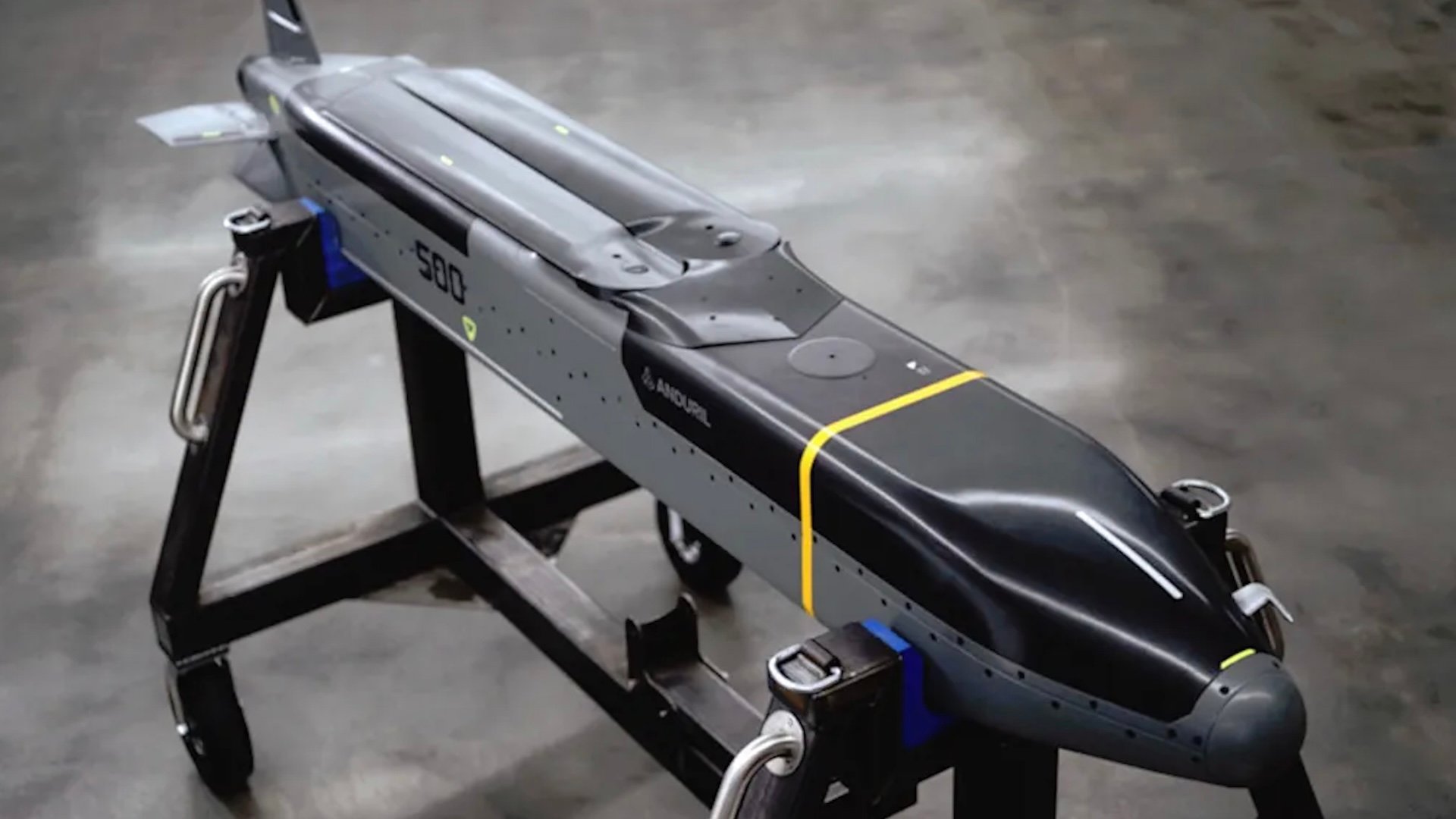
A likely candidate weapon is the Barracuda-500M, one member of Anduril’s family of autonomous, jet-powered cruise missiles, alongside the Barracuda-100M and -250M variants. Official descriptions put its range at more than 500 nautical miles, with a stated speed range of approximately 190 to 500 knots. The missile can be air-launched, for which it has received the official U.S. military designation AGM-189A. But with only a handful of utility biplanes and helicopters in its inventory, Latvia would acquire the surface-launched version, designated SLB-500M.

The announcement points to a potentially significant expansion of Latvia’s precision-strike capabilities as NATO’s eastern flank continues to build out longer-range conventional fires.

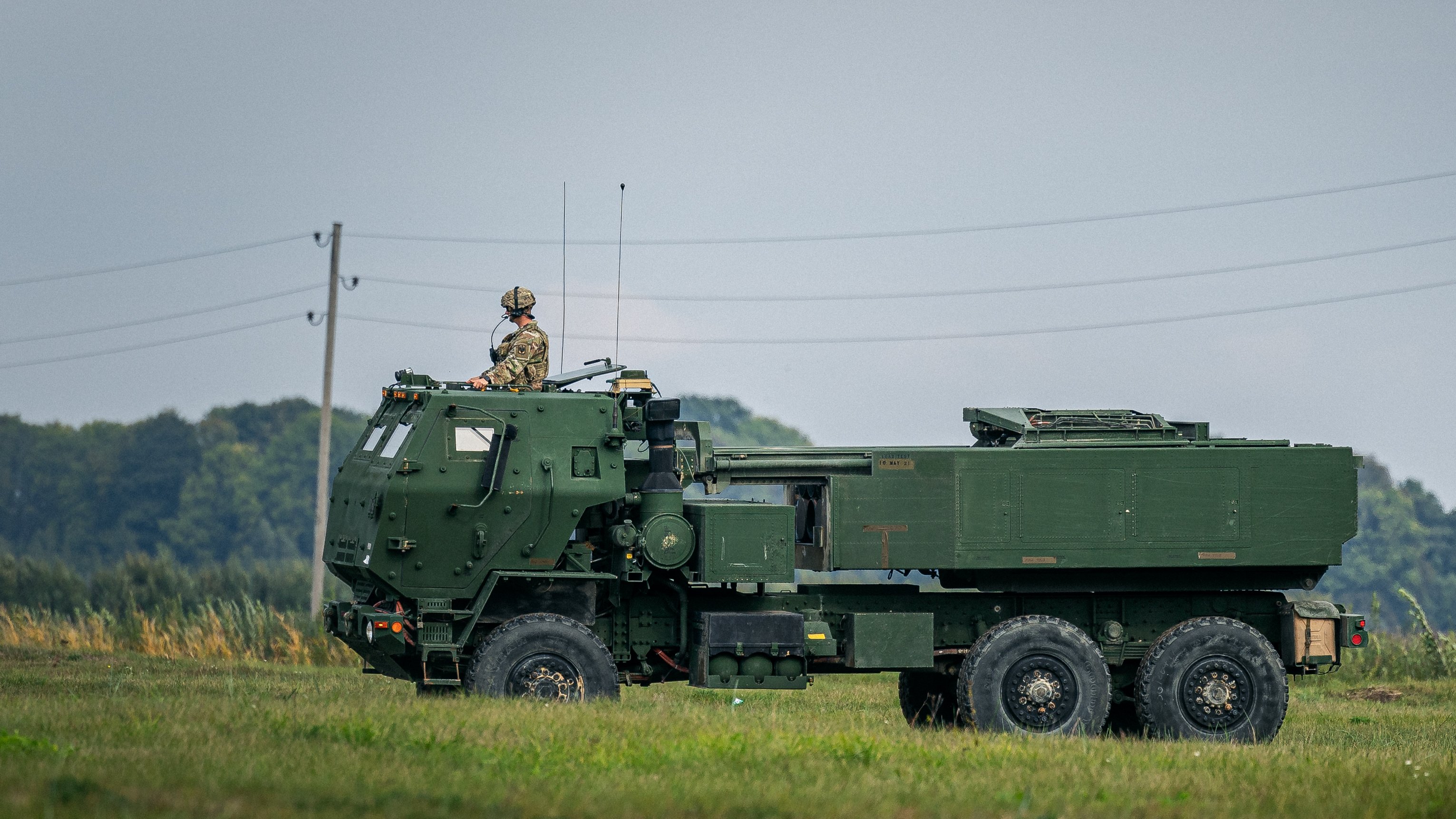
Latvia has already ordered the U.S.-made Army Tactical Missile System, or ATACMS, which will be fired from M142 HIMARS launchers. The system is expected to enter Latvian service in 2027 and has a maximum range of about 186 miles.

A U.S. Army M142 HIMARS launcher involved in an exercise at at Spilve Airfield and Liepāja Airport in Latvia. Latvian Armed Forces Eriks Kukutis

Latvia’s ATACMS capability will give the country a foundation for ground-launched precision fires, but the broader European trend is toward significantly greater reach.

Ground- and sea-launched cruise and ballistic missile systems capable of hitting targets at between 1,000 and 2,000 kilometers (620 and 1,242 miles) or more are an emerging target for several European NATO members. France, Germany, Poland, Italy, Sweden and the United Kingdom are pursuing combinations of indigenous development and foreign procurement to address this requirement.

Latvia’s neighbor Poland, for example, has been building a layered long-range strike architecture combining JASSM/JASSM-ER air-launched cruise missiles with HIMARS and ATACMS. Warsaw’s ambitions are extending toward ground-launched weapons with ranges potentially reaching 3,000 kilometers (1,864 miles) and the country has previously expressed openness to hosting U.S.-owned nuclear weapons on its territory, too.

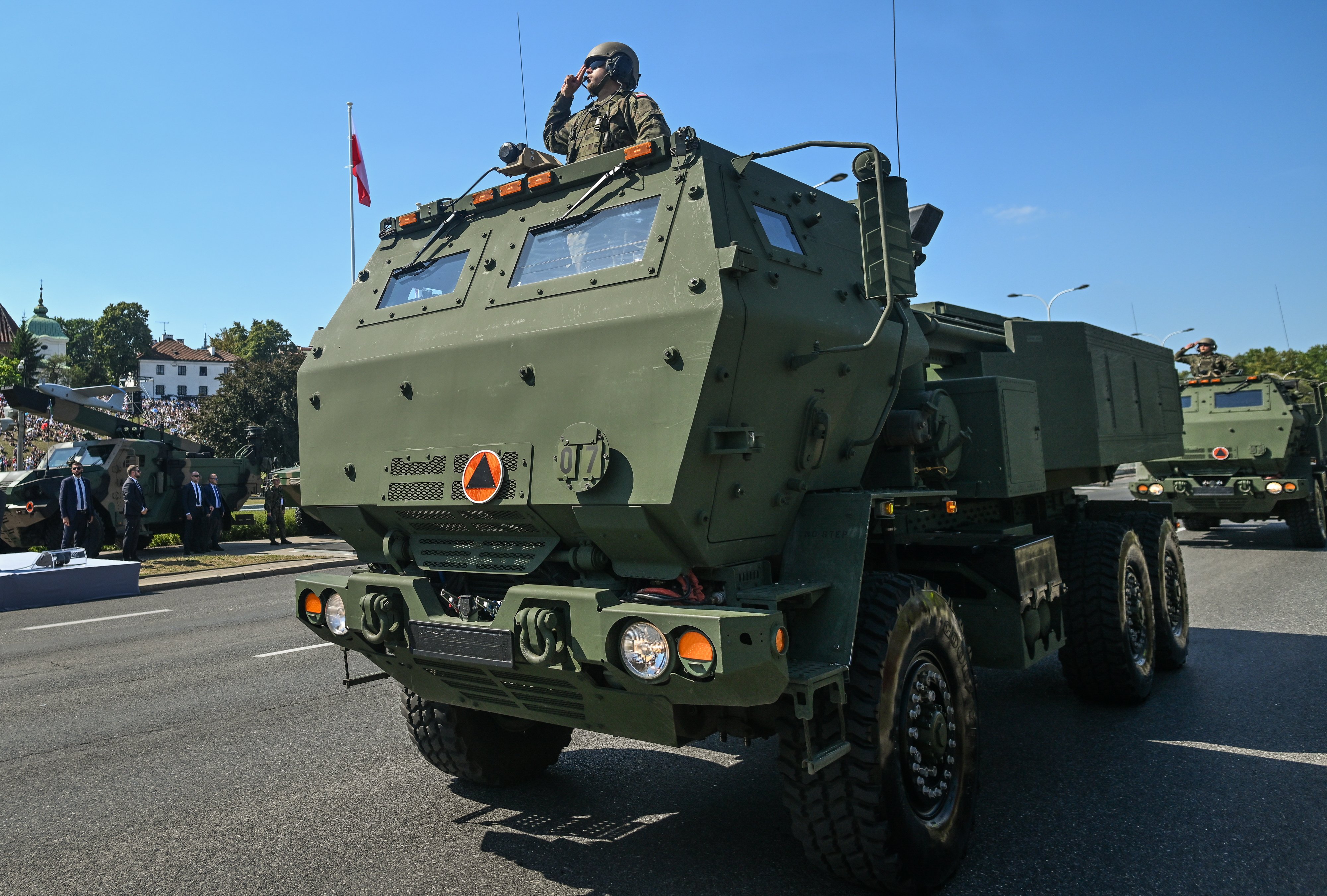
WARSAW, POLAND AUGUST 15: The M142 HIMARS rocket launcher is seen during the Armed Forces Day parade, commemorating Poland's 1920 victory over the Soviet Red Army and marking the 105th anniversary of the Battle of Warsaw, in Warsaw, Poland, on August 15, 2025. The event featured more than 4,000 Polish troops, about 200 soldiers from allied NATO nations, around 300 military vehicles, and nearly 50 aircraft, making it the largest parade in the country's history. (Photo by Artur Widak/NurPhoto via Getty Images)
A M142 HIMARS launcher is seen during Poland’s Armed Forces Day parade in 2025. Photo by Artur Widak/NurPhoto/Getty Artur Widak

Latvian interest in Barracuda fits into the same larger transformation in European conventional strike capabilities.

For NATO’s Baltic members, the logic is particularly straightforward, with mobile, ground-launched weapons providing an additional means of striking military targets at depth without requiring control of the air over the launch area.

Dragon’s teeth obstacles are among the anti-mobility measures on Latvia’s eastern border with Russia. Latvian Armed Forces

The potential Barracuda acquisition would represent another step in a broader European shift toward deep precision strike, a term increasingly used to describe conventional weapons capable of holding targets hundreds or thousands of miles away at risk.

Deep precision strike is widely acknowledged as an increasingly important European capability gap. European NATO members have historically relied heavily on air-launched cruise missiles and other aircraft-delivered weapons, while ground-launched long-range systems have been comparatively scarce.

The deterioration of the European security environment following Russia’s full-scale invasion of Ukraine, together with the 2019 collapse of the Intermediate-Range Nuclear Forces Treaty, are important factors behind renewed European interest in long-range conventional strike.

A key driver behind Europe’s push for longer-range conventional strike is the desire to build a credible deterrent capable of holding targets deep inside Russia at risk, potentially including Moscow. Ukraine’s long-range strike campaign has demonstrated the strategic value of being able to impose costs at significant distances, while also underscoring the importance of having sufficient stocks of precision weapons. For NATO’s eastern flank, systems such as the ground-launched Barracuda could therefore provide not just another fires capability, but an additional means of imposing costs on an adversary without relying exclusively on airpower.

Importantly for Latvia, the emerging European approach is not limited to large air forces. NATO’s prospective deep-strike requirements are likely to place significant emphasis on mobile ground-launched systems because they can be dispersed and offer survivability advantages while avoiding the cost and vulnerability associated with relying exclusively on aircraft or ships as launch platforms.

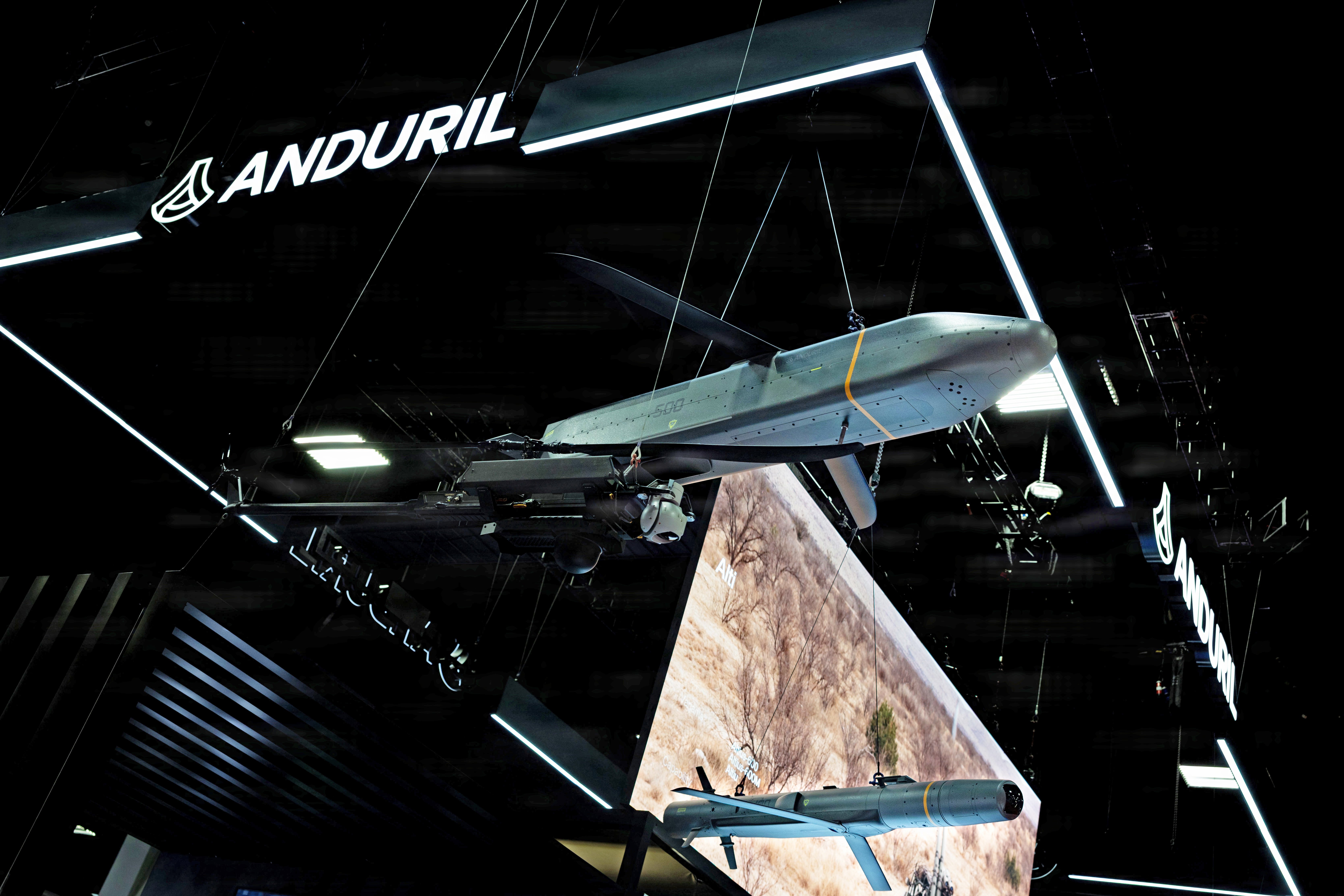
An Anduril Barracuda 500, top, and a Barracuda 100, autonomous aerial vehicles, are displayed during Modern Day Marine 2026 at the Walter E. Washington Convention Center, Washington, D.C., April 30, 2026. Modern Day Marine is a military exposition exclusively organized for the Marine Corps to showcase the newest technology and warfighting innovations from amphibious assault vehicles to drones and more. (U.S. Marine Corps photo by Cpl. Abigail Hutcheson)
An Anduril Barracuda 500, top, and a Barracuda 100, displayed during Modern Day Marine 2026 in Washington, D.C. U.S. Marine Corps photo by Cpl. Abigail Hutcheson Cpl. Abigail Hutcheson

That makes systems such as the surface-launched Barracuda particularly relevant to countries on NATO’s eastern flank.

Anduril has positioned Barracuda as part of an effort to address what it describes as a shortfall in affordable, producible long-range precision weapons. A prototype surface-launched Barracuda-500 successfully demonstrated its launcher, missile, and booster concept in testing in 2025. Anduril has emphasized that the family is intended to be more producible and affordable than many existing “exquisite” long-range weapons.

The emphasis on production capacity is notable in light of lessons emerging from the war in Ukraine, where both sides have demonstrated the importance of maintaining substantial stocks of precision weapons and relatively inexpensive one-way attack systems.

European governments are increasingly wrestling with the same issue. However, there is a fundamental tension between rapidly filling capability gaps through off-the-shelf purchases and developing indigenous European weapons that can strengthen the continent’s defense-industrial base, which is also a critical political consideration.

Latvia’s emerging relationship with Anduril appears to combine elements of both approaches, by acquiring an American-developed strike capability while simultaneously pursuing industrial cooperation with U.S. defense companies.

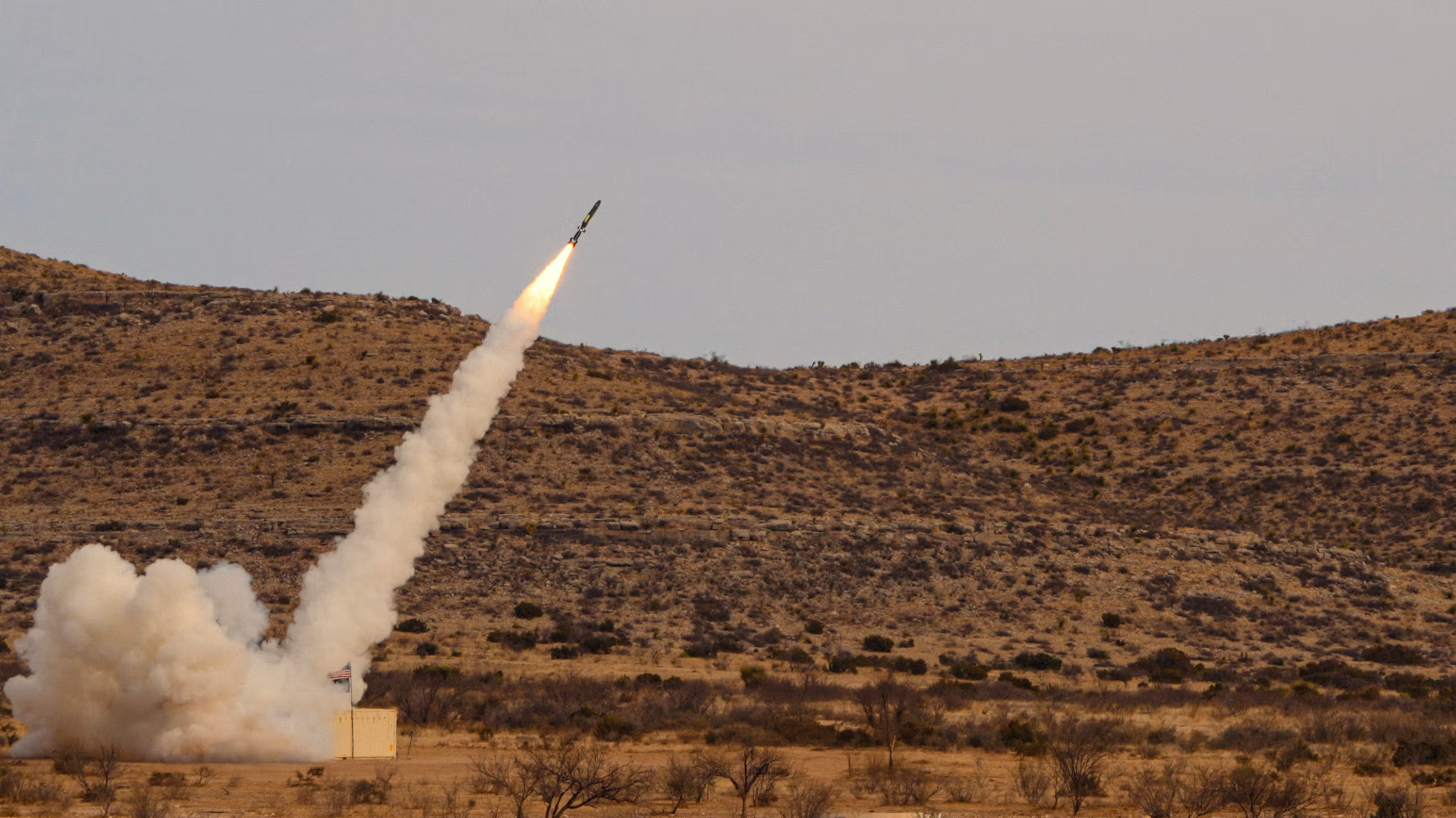
Ground launch of Anduril’s Barracuda-500M. Anduril

There is also a recent European precedent for combining Barracuda procurement with local industrial participation.

In July 2026, Anduril signed a strategic agreement with Polish national maintenance, repair and overhaul provider Wojskowe Zakłady Lotnicze Nr 2 (WZL-2) to establish production of the Barracuda-500M at WZL-2 facilities in Bydgoszcz, Poland. Polish state-owned defence group Polska Grupa Zbrojeniowa said Poland was the first European country to sign such an agreement with Anduril.

Bezpieczeństwo zaczyna się od silnych sojuszy.

💥🖊 Dziś została podpisana umowa o współpracy @PGZ_pl i WZL-2 z firmą Anduril Industries, która umożliwi utworzenie w Polsce miejsc montażu i produkcji autonomicznych rakietowych pocisków manewrujących dalekiego zasięgu… pic.twitter.com/JnmM6lQZ7L

— Ministerstwo Aktywów Państwowych 🇵🇱 (@MAPGOVPL) July 6, 2026

Polish officials have also emphasized the missile’s intended low production cost relative to higher-end U.S. cruise missiles. The planned Polish program is expected to progressively increase Polish content and eventually incorporate broader European elements, including software solutions from Anduril.

Latvia has not publicly detailed whether any Barracuda-related production, assembly, or other industrial work would be conducted in the country.

However, Latvia’s Investment and Development Agency says the country’s defense-technology delegation in the United States is seeking opportunities involving joint development, testing, manufacturing, system integration and supply chains. Origin Robotics is among the Latvian companies participating in that effort.

The broader Latvian delegation includes companies working across unmanned and counter-unmanned systems, communications, electronics, sensors, software, artificial intelligence, cybersecurity, and manufacturing.

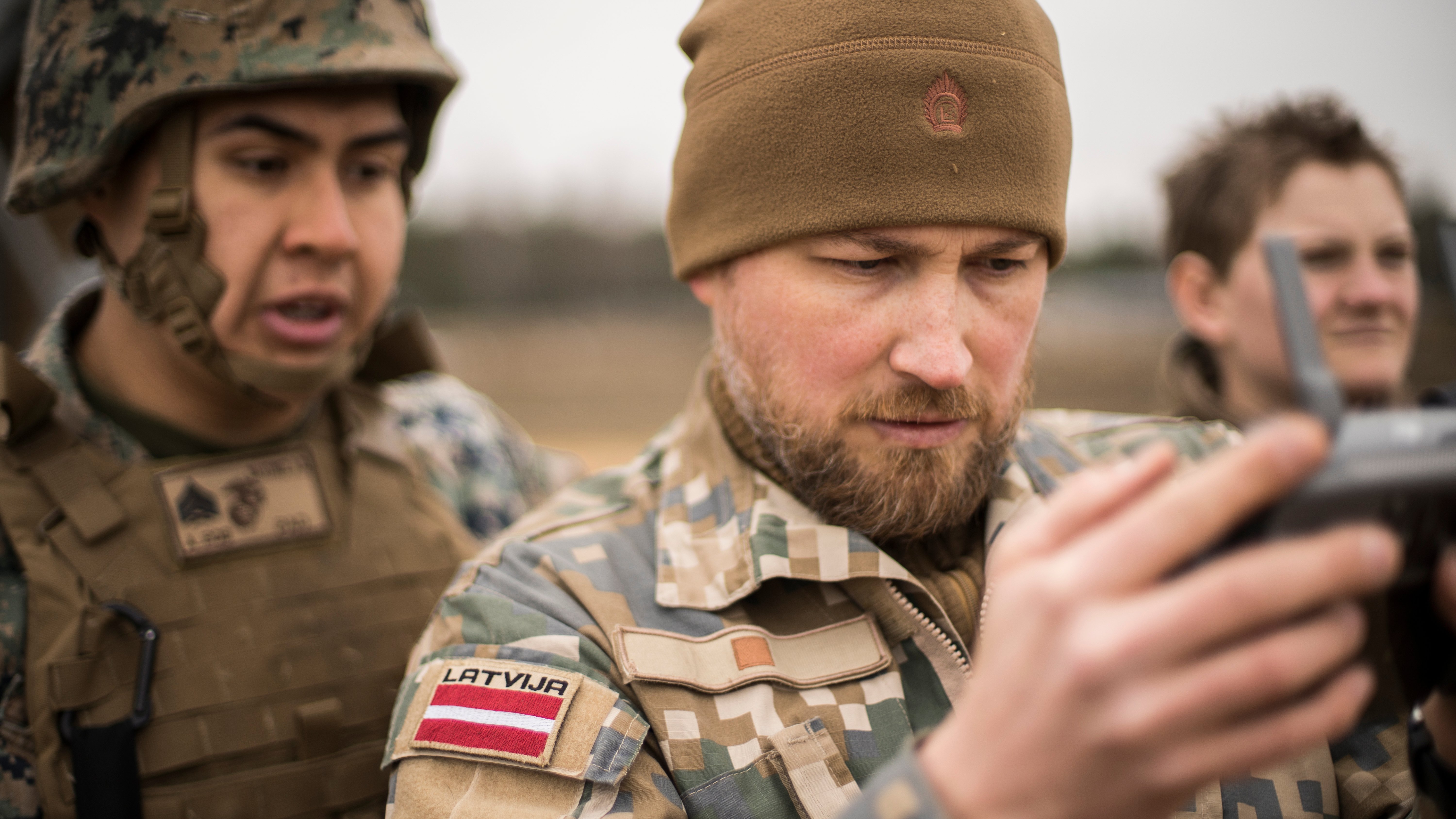
Latvian Army Staff Sgt. Gatis Indrevics, a combat cameraman with the Latvian Army, shows drone video footage to U.S. Marines with the Marine Forces Reserve’s Communication Strategy and Operations section before a High Mobility Artillery Rocket System live-fire range at Adazi Training Area, Latvia, March 4, 2019, during exercise Dynamic Front 19. Two HIMARS from Fox Battery, 2nd Battalion, 14th Marine Regiment, 4th Marine Division, coordinated fires with army units in Germany. Approximately 3,200 participants from 27 nations will take part in the live-fire portion of exercise Dynamic Front 19, March 2-9, 2019, at the U.S. Army's Grafenwoehr Training Area, Germany; as well as in Riga, Latvia; and Torun, Poland. (U.S. Marine Corps photo by Cpl. Niles Lee)
A Latvian Army soldier shows drone video footage to U.S. Marines during a HIMARS live-fire exercise at Adazi Training Area, Latvia. U.S. Marine Corps photo by Cpl. Niles Lee Sgt. Niles Lee

Exactly how Latvia intends to employ Barracuda, how many missiles it plans to acquire, and whether any portion of the system will eventually be produced or integrated in Latvia remain unclear from the president’s announcement.

For now, the development marks another indication that long-range precision fires are moving from a capability concentrated among Europe’s largest military powers toward a broader requirement across NATO’s highly strategic eastern flank.

Contact the author: thomas@thewarzone.com

The post Latvia To Order Anduril’s Barracuda Cruise Missile For Long-Range Strike Capability appeared first on TWZ.

  •  

Marines Rushing To Equip Amphibious Combat Vehicles With New Anti-Drone Jammers

The U.S. Marine Corps is buying Anduril Pulsar-L electronic warfare jammers to meet an urgent operational need to better protect its 8×8 wheeled Amphibious Combat Vehicles (ACV) from drones. This is part of broader efforts the service is pursuing to boost the ACV’s defenses against uncrewed aerial attackers, as well as incoming anti-tank guided missiles and other threats. Drone threats are real now and have notably sidelined even the most advanced heavy armor in Ukraine.

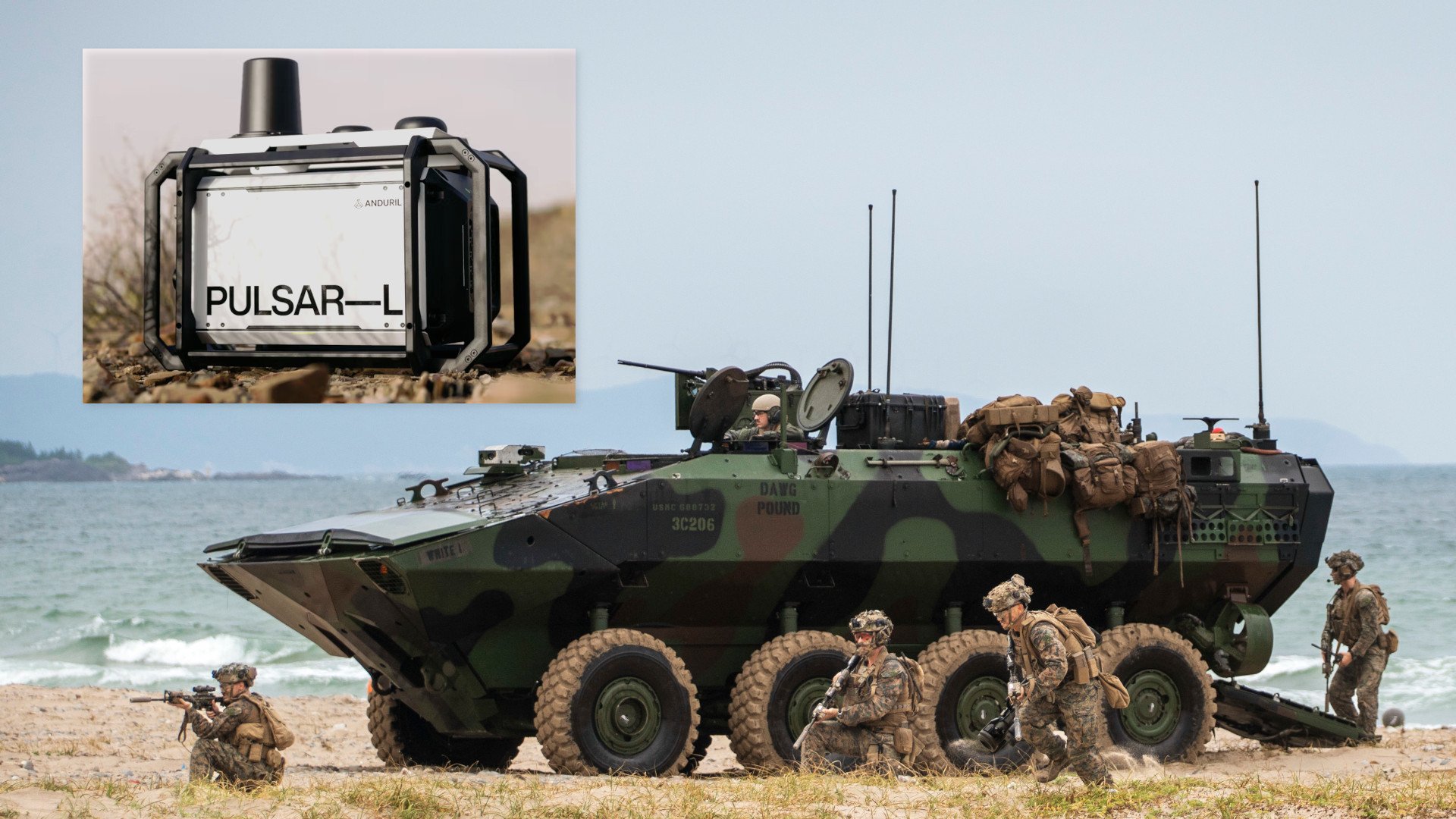
Marine Corps Systems Command (MARCORSYSCOM) announced it had awarded a sole-source deal to Anduril, valued at $15,711,445.50, for an unspecified number of Pulsar-Ls, yesterday. This follows a statement of intent the Command put out last month. Anduril first unveiled Pulsar-L, a lightweight addition to its larger Pulsar family of electronic warfare systems, in April 2025.

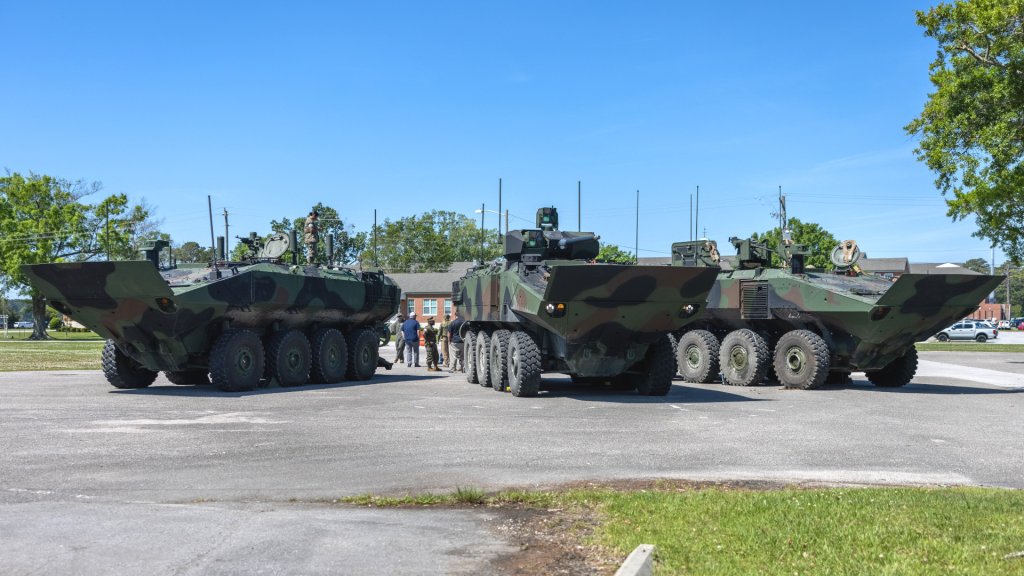
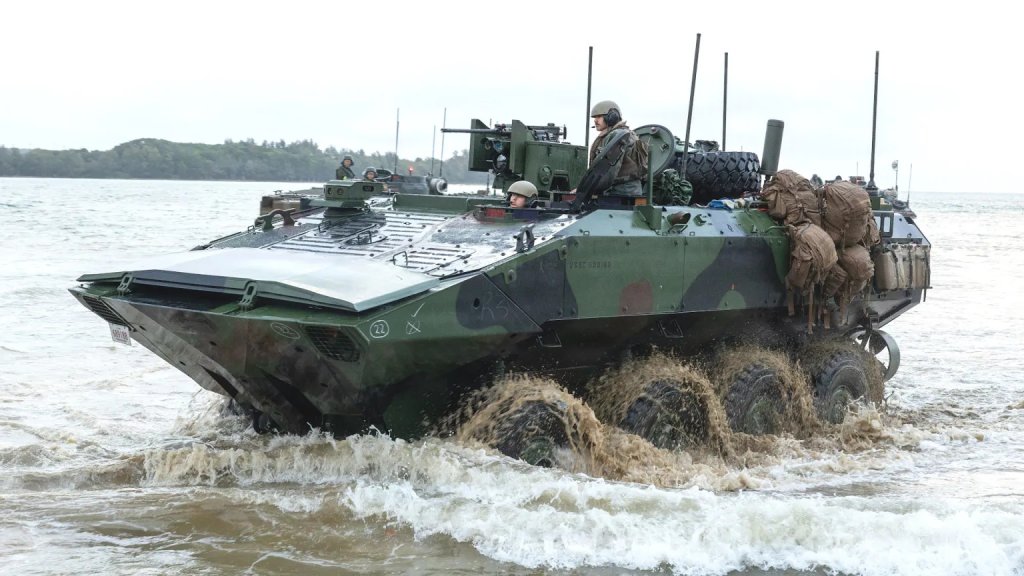
The Marine Corps had 150 baseline personnel carrier variants of the ACV (or ACV-Ps), as well as 21 command-and-control ACV-C versions, in inventory as of April 2026. The default armament for ACV-P currently is just a single .50 caliber M2 machine gun in a remote weapon station on top of the hull. The service’s goal is to eventually acquire 389 ACV-Ps and 33 ACV-Cs, as well as 152 ACV-30s with new 30mm cannon-armed turrets and 34 ACV-R armored recovery vehicle variants. The ACV family has already supplanted the Marine Corps’ previous fleet of tracked Assault Amphibious Vehicles (AAV).

From left to right, an Amphibious Combat Vehicle command and control variant (ACV-C), a 30mm cannon-armed ACV-30, and a standard ACV personnel carrier version (ACV-P). The ACV-R recovery variant is not shown here. USMC/Sgt. Alexis Sanchez

“The Anduril Pulsar-L system is a platform-integrated omni-directional SK C-UAS [soft-kill counter-uncrewed aerial systems] with a combined sensor/jammer package that detects, tracks, identifies, and defeats radio frequency-dependent Group 1 and Group 2 Unmanned Aerial Systems (UASs),” MARCORSYSCOM wrote in a justification for the sole-source contract, which was also released yesterday. “Additionally, the system provides counter positioning, navigation, and timing capabilities.”

The U.S. military definition of a Group 1 drone is any design weighing up to 20 pounds, that is able to fly up to an altitude of 1,200 feet, and that can reach speeds of up to 100 knots. Group 2 is the next tier up, encompassing types with gross weights between 21 and 55 pounds, that can get up to an altitude of 3,500 feet, and hit top speeds of up to 250 knots. Kamikaze drones and other small weaponized types that fall into Groups 1 and 2 are used on a daily basis in Ukraine to attack armored vehicles, as well as unarmored vehicles and personnel. These are threats that have been steadily expanding to other hotspots globally, and that we will come back to later on.

Furthermore, “the Pulsar-L is the only solution capable of being mounted on the ACV to provide a mobile and organic means to effectively and simultaneously execute the entire kill-chain against hostile UASs in the deployed land and maritime/littoral environment while not exceeding the limited ACV space, weight, and power claim allotted to the SK C-UAS solution,” according to MARCORSYSCOM. “This will provide the ACV with an essential defensive capability, directly contributing to increased survivability and force protection while not sacrificing the mobility and operational tempo of the ACV.”

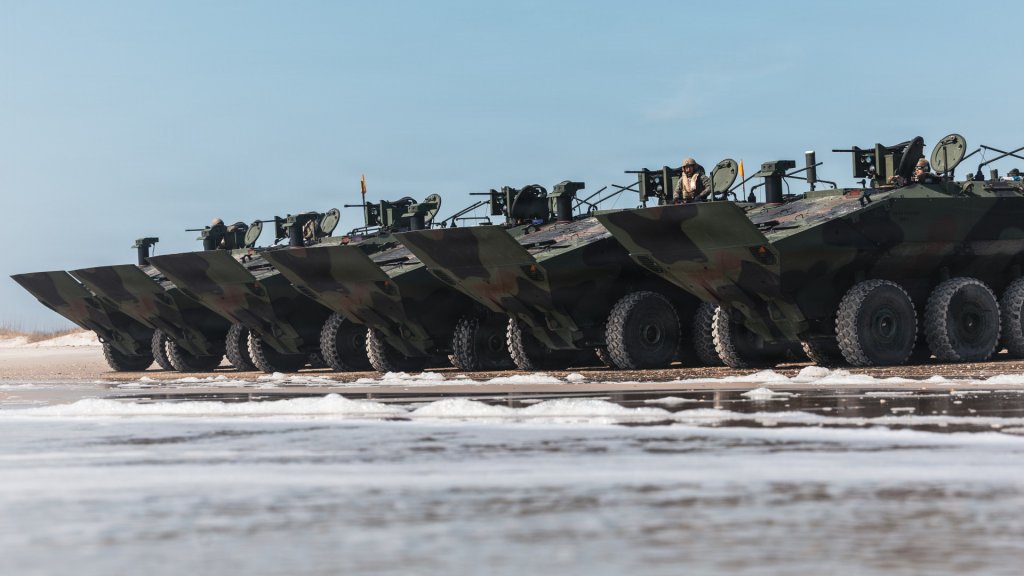
A row of Marine ACVs seen during training. USMC

Pulsar-L is already “in use by the Special Operations Command due to the system’s low weight, proven performance in engaging multiple UASs, and simultaneous execution of the full kill-chain while static or on the move,” the justification document adds. “Additionally, it is the only known commercially available system that meets the minimum requirement to rapidly identify and respond to emerging UAS technologies and tactics without frequent updates to predefined threat data libraries. The Pulsar-L is the only solution that uses machine based learning to continually adapt to these ever-changing threats without requiring vendor updates, allowing the warfighters to continually be effective in the fight.”

The latter point here is a particularly important consideration for electronic warfare systems, in general, which need to be able to accurately detect, categorize, and respond to different waveforms to be most effective. The emergence of new waveforms, as well as changes to how existing ones are emitted, together with new tactics, techniques, and procedures, can all negatively impact a system’s performance. Historically, the process of responding to those developments with updates to built-in threat libraries has been lengthy and complex. The conflict in Ukraine has shown that the cycle of new developments in the electromagnetic spectrum and then the need for new countermeasures can be regularly measured in weeks.

The U.S. military has been heavily investing in so-called cognitive electronic warfare capabilities to help automate and otherwise accelerate various aspects of this process. The ability of a particular electronic warfare suite to adapt autonomously in real-time, even in the middle of operations, has been viewed as the absolute ‘holy grail’ of this concept, which you can read more about here. How exactly Pulsar-L leverages machine-learning and artificial intelligence to this end, and the speed with which it can adapt to changing threats, is still not entirely clear.

Regardless, “there is an unusual and compelling need for the rapid deployment of SK C-UASs to forward-deployed ground units as Marines currently lack the ability to conduct self-defense against emerging UAS threats,” the justification document stresses. “Failure to deliver this capability places Marines at unnecessary risk, potentially leading to mission failure and loss of life, and hampers the Government’s ability to keep them safe during forward deployments.”

MARCORSYSCOM’s justification for the sole-source deal to Anduril does not otherwise elaborate on the urgent requirements that drove the deal, which it says were only formalized on April 7. That is notably roughly a week after the United States and Israel first launched major combat operations against Iran, which is a prolific developer and user of various tiers of weaponized drones. There is no explicit confirmation of any link, but Iranian drones, as well as missiles and other capabilities, have been a real threat to U.S. forces in the region. We have also just gained more insights recently into how forward-deployed Marine Corps elements contributed to those operations. Counter-drone capabilities would also be especially critical in any future amphibious landing operation, wherever it might occur.

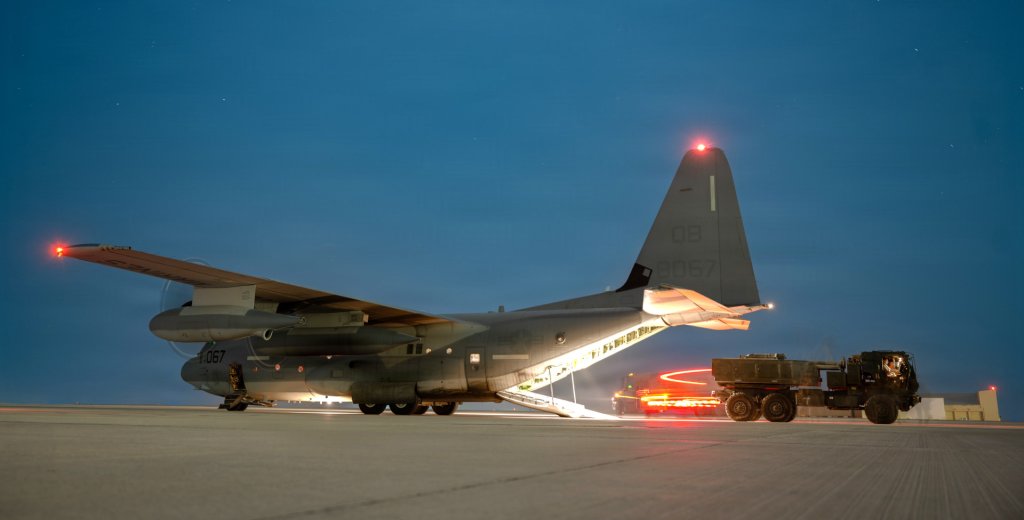
Marines prepare to load an M142 High Mobility Artillery Rocket System (HIMARS) onto a KC-130J aircraft somewhere in the Middle East in July 2026. USAF

All that being said, threats posed by armed Group 1 and 2 drones are not at all limited to Iran and the Middle East, nor are they new. They are only likely to become a more ubiquitous feature in the hands of nation-state armed forces and non-state actors in conflict zones globally as time goes on. The nature of these threats is also expanding significantly in scale and scope, especially when it comes to more automated targeting capabilities, thanks heavily to the increasing democratization of AI-driven technologies, something TWZ has explored in depth in the past.

A number of other significant developments in this arena have emerged from the conflict in Ukraine, where electronic warfare systems are heavily employed against drones. This includes the introduction of physical fiber-optic control links that cannot be jammed, as well as the use of mesh-like and often ad-hoc networks to increase resiliency.

The fighting in Ukraine has also underscored the threat that even small kamikaze drones pose to armored vehicles, including types that are far more heavily protected to start with than the Marine Corps’ ACVs. As mentioned, Ukrainian forces have been sidelining their M1 Abrams and other main battle tanks in the face of constant drone attacks.

MARCORSYSCOM’s justification for the Pulsar-L order makes clear that this is just one part of a larger plan to boost the ACV’s defenses.

“Marine Corps program of record for SK C-UAS is planned to initiate in FY27,” the document mentions toward the very end. “The components of this future program will be procured through full and open competition as it is expected that advanced non-kinetic and SK defeat technologies should be mature by this time.”

Another look at a Marine Corps ACV-P, showing the general configuration of these vehicles today. USMC

Marine Corps officials have also talked in the past about integrating active protection systems (APS), which could be blended together with C-UAS capabilities, and other defensive features to the service’s ACV fleet.

“We’re constantly looking at what the next generation of APS is and how we can get that onto the [ACV] platform in a lightweight form factor,” Chris Melkonian, the Marine Corps’ Program Manager for Advanced Amphibious Assault (PM AAA), told TWZ and other attendees at the annual Modern Day Marine exposition in April.

Improved “situational awareness, that’s kind of a gateway to counter-UAS, in terms of the ability to sense your environment,” Melkonian also highlighted at that time. “Take all that video on board and then be able to feed that into [a] counter-UAS system.”

Additional “overhead protection right now is a critical thing that we’re working on right now for this platform,” he added. The practice of adding on anti-drone armor screens on armored vehicles (and now other platforms), especially to protect against top-down attacks, first emerged in Russia in the lead-up to the all-out invasion of Ukraine in 2022. However, the installation of this kind of so-called ‘cope cage’ type armor has now become a global trend, including in the U.S. military.

The U.S. Marine Corps is also pressing ahead with a larger vision to field several tiers of counter-drone capabilities at all levels of its forces, to better protect everything from static installations at home and abroad right down to individual squads.

When it comes to the Marine Corps ACV fleet, the rush order for Pulsar-Ls is an important new step in boosting those vehicles’ defenses against threats that exist now. At the same time, drones are increasingly calling the role of armored vehicles in future conflicts into question.

Contact the author: joe@twz.com

The post Marines Rushing To Equip Amphibious Combat Vehicles With New Anti-Drone Jammers appeared first on TWZ.

  •  

An SR-71 Blackbird Has Vanished (Updated)

Last week, NASA Administrator Jared Isaacman cryptically teased plans for a new high- and fast-flying X-plane with a silhouette of an aircraft that immediately drew comparisons to the famed SR-71 Blackbird as a backdrop. In our report, we looked at what it could mean, including the possibility of reviving the SR-71, or at least using it to inform or even cobble together a new airframe. Now it turns out that an SR-71 that had been on display at NASA’s Armstrong Flight Research Center for years is suspiciously missing.

Steve Trimble, Aviation Week‘s defense editor and friend of TWZ, was first to report the disappearance of the former NASA SR-71, also known by the tail number 844, at Armstrong. That facility is collocated with Edwards Air Force Base in California. Trimble’s piece says that satellite imagery shows the jet has not been seen since at least May 17. The aircraft in question, which originally carried the U.S. Air Force serial number 61-7980, was the last Blackbird produced and the last one to fly, taking to the skies for the final time in 1999.

A satellite image taken in 2018 showing SR-71, tail number 844, on display outside of the Armstrong Flight Research Center in California. Google Earth

“The current disposition of the aircraft is unclear, but Aviation Week sources suggest that the aircraft was moved into a hangar earlier this year for an inspection,” according to the story. “The presentation and the disappearance of the display SR-71S with the 844 tail number for NASA raises the possibility of a return-to-flight program after a more than 26-year-long hiatus.”

Another look at SR-71 tail number 844 during its service with NASA. This picture was taken on October 31, 1997, during a flight in support of the NASA/Rocketdyne/Lockheed Martin Linear Aerospike SR-71 Experiment (LASRE). NASA

The presentation mentioned above is the one NASA’s Isaacman gave last week at the annual All-In Summit in Los Angeles, California, during which he shared the SR-71-esque silhouette.

“In the service of the first A [aeronautics] in NASA, we are rebuilding our X-plane fleet. The X-59 is researching quiet supersonic flight, but it’s just the beginning,” he said at that time. “As NASA recommits to flight test and works alongside industry to push the boundaries of airframe and propulsion design, it will not be long before NASA once again is flying as high and as fast as we had in decades past, and then even more.”

Isaacman has made expanding NASA’s X-plane fleets a top priority since taking charge of the agency last year.

“You sure that’s a Blackbird?” the NASA administrator said during a live interview that immediately followed his remarks after the image was brought up, but did not offer any further clarification.

NASA Administrator showed this image during a presentation last week while talking about plans for new X-planes. NASA

“NASA has a long history of building and flying experimental aircraft that push the boundaries of what is possible,” NASA told TWZ directly when asked for more information. “As Administrator Isaacman has said, we want to see more X-planes flying in the years ahead, developing the technologies that will allow us to fly higher, farther, and faster than we have in decades. We look forward to sharing more as those efforts progress.”

We have reached back out to NASA in light of Aviation Week‘s report.

As we wrote in our initial reporting on Isaacman’s comments:

“As for bringing a Blackbird back into operation for high-speed testing, which is now at the forefront of military aeronautics (and civilian to a lesser degree) after decades of being sidelined, that would be a very challenging operation. The SR-71s are long retired and have been placed in museums and other display areas. While the Pentagon could technically claw some of them back from their ‘on loan’ status, reconstituting even one of them would be a major undertaking as the entire support ecosystem that once sustained them has been gone for decades. Still, having a Mach 3+ capable jet for testing would be a highly relevant tool in a new age of high-speed flight exploration.”

“On the other hand, building a new test aircraft that aims higher and faster than the SR-71, but may be based on its ‘DNA,’ is certainly possible. Such an aircraft could leverage material science, avionics, flight controls, and engines that are seven decades more modern than its progenitor. Technology demonstrators in this class could also already exist in the classified domain. NASA could possibly assume ownership of one after the Pentagon declassifies it, as well.”

“Regardless of how such an exotic aircraft is obtained, one of the biggest differentiating factors could be that a NASA aircraft is piloted by a human onboard, instead of it being a drone, but an uncrewed aircraft is possible too.“

Aviation Week‘s report today notes that tail number 844 would probably be the best available candidate for returning to flight status. In addition to being the last produced and the last to fly, NASA previously upgraded it, including with “an automated digital flight and inlet control system to virtually eliminate the Blackbird’s problem of violent engine unstarts at high speed.” It has also been sitting in a controlled area in the Mojave Desert that is great for preservation.

It is also worth pointing out here that Isaacman is personally aware of the time and resources it takes to reconstitute high-end vintage military aircraft. He founded private ‘red air’ aggressor firm Draken International, making him once the owner of the world’s largest private air force stocked with old jets. His own private collection includes a demilitarized, ex-Ukrainian two-seat MiG-29UB that he flies regularly. He has also been working to restore a former Royal Air Force swing-wing Panavia Tornado F2 interceptor, which would be the most complex private military jet flying, if or when it returned to working condition.

At the same time, the SR-71 is in a completely different category, having been the very definition of a high-demand, low-density asset even at the very peak of its service life with the Air Force. Only 32 of these jets were ever built, and they were notoriously complex and expensive to operate and maintain. The aircraft’s Pratt & Whitney J58 turbojets ran on JP-7 fuel that is no longer in regular production. After 9/11, the possibility was raised of returning a Blackbird to service to support the Global War on Terror, but doing so was projected to cost between $40 and $45 million – and that was just two years after 844’s last flight.

There is also a possibility, in line with Isaacman’s comments last week, that 844 could re-merge in a substantially different, reworked form. There is even the potential it could be retrofitted for uncrewed, or at least pilot-optional, flight. Any such conversion effort would also be a major undertaking, as would sustaining the resulting bespoke jet. As we noted earlier, NASA could also use the SR-71 at Edwards to help inform other future designs.

At the same time, maybe this is all a coincidence and the SR-71 in question is getting some other form of TLC, but its months-long absence is certainly a curious development in light of the current push for new X-planes under Isaacman’s leadership.

Update: 11:00 PM ET –

NASA has now provided TWZ with the following statement in response to our queries for more information about SR-71 tail number 844:

“NASA has a long history of pushing the boundaries of experimental aviation, and we continue to explore opportunities to build on that legacy. As Administrator Isaacman has said, we want to see NASA flying higher, farther, and faster than we have in decades. We recognize the interest in the SR-71 and its remarkable history at NASA but have no additional information to share regarding the aircraft at this time.”

Update: 9/25/2026 ET –

It has come to our attention that NASA Administrator Jared Isaacman made additional comments regarding the SR-71 at the EAA AirVenture airshow in July.

“There was a time that a lot of the technology that you see demonstrated here in the F-22 Raptor, like thrust vectoring controls, fly-by-wire, was pioneered by NASA. This is during the days when we had X-planes that included the SR71 Blackbird,” Isaacman said during a speech at the event. “We’re rebuilding our X-plane uh portfolio. We’re going higher, we’re going faster, until we blur the lines between in and out of the atmosphere, and that’s underway right now.”

“I’d say that NASA intends to field an exciting, inspiring, and technologically useful portfolio of X-planes, and I want us to go higher and faster than we’ve ever gone before,” he added during a subsequent question-and-answer session when asked specifically about any plans for a new crewed hypersonic aircraft or a successor to the SR-71. “We’ll see if we can pull anything off in the next handful of years, but, yeah, that is an area of great interest from a developmental perspective.”

Isaacman’s full speech at EAA AirVenture 2026 and the subsequent question-and-answer session are contained in the video below. The SR-71 comes up at 7:35 and 36:35 in the runtime.

The SR-71 also came up during a separate panel discussion at the AirVenture show, which included Isaacman.

“What aircraft that you haven’t flown would you like to try?” a member of the audience asked.

“SR-71 Blackbird,” Isaacman chimed in first without any hesitation.

The other panelists agreed.

“Do you have the power to bring that back then, Jared? That’s the next question,” the panel’s moderator added.

“That’s classified,” Isaacman responded.

The full panel discussion can be found in the video below. The exchange above starts at 1:00:50 in the runtime.

Contact the author: joe@twz.com

The post An SR-71 Blackbird Has Vanished (Updated) appeared first on TWZ.

  •  

France Sending Forces To Help Defend Saudi Arabia’s Red Sea Oil Facilities

France is sending military assistance to Saudi Arabia to protect the Yanbu oil facilities as the Kingdom battles the Iran-backed Houthi rebels of Yemen. The move comes amid growing concerns about the remaining flow of oil from the region, which France, as well as the rest of Europe, relies upon heavily.

In a live television interview Thursday night Paris time, French President Emmanuel Macron said he was sending an unspecified number of troops and equipment to Saudi Arabia to protect the Yanbu energy hub, located on the Red Sea.

“This is the agreement we have finalized ​with ⁠the Saudis,” Macron explained. “We are going to send ⁠military resources, that is to ​say, soldiers, radar systems and defense ⁠systems, to protect this site — ⁠not ​to get us involved in any conflicts, but to ⁠protect this site.”

The French leader did not elaborate on the exact equipment he would send, how many troops, or when they would arrive. Nor did he address what would happen if French personnel were killed or injured or equipment damaged or destroyed. We have reached out to the French Embassy for further details. Based on his mention of radars and seeing that the threat to Saudi oil infrastructure is almost entirely from aerial attacks from drones and missiles, these will likely be air defense forces.

Nous agissons pour protéger nos compatriotes des conséquences de la crise au Moyen-Orient. Objectifs : sécuriser les approvisionnements et faire baisser les prix à la pompe. pic.twitter.com/kvrgHcV4E4

— Emmanuel Macron (@EmmanuelMacron) September 24, 2026

The decision was prompted by repeated Houthi missile and drone attacks as well as suspected strikes from Iranian-backed militias in Iraq on Saudi Arabia’s oil infrastructure. Yanbu in particular is a key installation. As we have explained in the past, Saudi Arabia has diverted millions of barrels of oil per day through pipelines to its Yanbu port on the Red Sea in an effort to minimize the energy shortages due to the hostilities around the Persian Gulf.

ANKARA, TURKIYE - SEPTEMBER 14: An infographic titled "Saudi Arabia's closure of the East-West Oil Pipeline could lead to a supply shortfall of millions of barrels in the market" created in Ankara, Turkiye on September 14, 2026. (Photo by Murat Usubali/Anadolu via Getty Images)
An infographic illustrating how Saudi Arabia has diverted oil from the Persian Gulf to the Red Sea. (Photo by Murat Usubali/Anadolu via Getty Images) Anadolu

Before Macron’s announcement on Thursday, the Houthis claimed they had carried out two more waves of attacks on Saudi targets, including one on the Saudi Aramco facility in Yanbu, “using a number of ballistic and cruise missiles, as well as drones.”

In addition, the Houthis claimed they struck Riyadh.

There was no immediate Saudi confirmation of an attack on the Saudi capital. Saudi civil defense did not issue an emergency alert for Riyadh on Thursday.

Earlier in the day, the Houthis said they struck “enemy command and control centers, operations rooms, weapon depots, missile launch platforms, and military sites belonging to Saudi-led enemy formations in Jizan,” a Red Sea port city.

“The Saudi-led military coalition in Yemen said on Thursday that it had shot down six ballistic missiles fired by the Iran-backed Houthi militia, in what appeared to be one of the largest cross-border attacks by the group since its conflict with Saudi Arabia [flared back up],” The New York Times reported.

The missiles were aimed at the Saudi cities of Taif and Yanbu, Maj. Gen. Turki al-Maliki, a spokesman for the Saudi-led coalition, claimed on X. “Escalations and violations by the terrorist Houthi militia will be dealt with firmly,” he stated, without specifying where the missiles were intercepted.

TWZ cannot independently verify any of these claims.

Today’s attacks are the latest in the escalating conflict between the Houthis and Saudi Arabia. Earlier this year, the Houthis imposed a blockade on the Bab al-Mandab Strait (BAM) and began striking Saudi ships in the southern part of the Red Sea as well as critical energy terminals on that body of water and Saudi refineries. Iranian proxies have also struck the vital East-West pipeline that carries oil to the Red Sea to bypass the Strait of Hormuz, where Iran vastly curtailed shipping after the launch of Operation Epic Fury. The East-West pipeline reportedly reopened after being shut down following a long-range drone attack.

The Saudi Arabian East-West pipeline after it was damaged by an attack. Satellite image ©2026 Vantor

The stark reality facing Macron is that if Saudi oil infrastructure and transport nodes near the Red Sea are destroyed or the pipeline that feeds it is shut down for months, the last major oil lifeline from the region — and especially to Europe — will be closed off, sparking a deeper energy crisis.

Iran has already severely curtailed the flow of oil through the Strait of Hormuz since the U.S. and Israel attacked it on Feb. 28. The movement of oil has been further impeded by a U.S. blockade on Iranian ports. However, transits have been increasing as of late, thanks in large measure to U.S. military escorts that U.S. Central Command claims have allowed more than a billion barrels of crude to pass through the Strait of Hormuz. Still, the traffic is far below what it was before the war broke out.

Update from CENTCOM Commander: pic.twitter.com/PTX6n9fn56

— U.S. Central Command (@CENTCOM) September 19, 2026

Having both the Strait of Hormuz largely closed and energy exports out of the Red Sea shut down simultaneously is a nightmare scenario. By Thursday evening Eastern time, the per-barrel price of Brent crude oil shot up to nearly $107, according to OilPrice.com. It had fallen below $100 per barrel just two days earlier.

Given all this, the French president sought to offer reassurance about oil supplies, according to France 24.

“He said he had carried out ‘intense diplomatic activity,’ meeting in recent weeks with the leaders of Saudi Arabia, Iraq and Nigeria, all hydrocarbon suppliers, to ensure France keeps receiving the same volumes,” the publication noted.

“We have replenished gas stocks and also oil stocks” for the months ahead, the French president also said.

Macron’s decision follows one by the U.K.’s  Royal Air Force (RAF) on Tuesday to deploy one of its Voyager aerial refueling jets to help Saudi Arabia defend against Houthi attacks. As with the French move, it is a response to concerns about the flow of oil.

“Escalating tensions in the Gulf could have negative consequences here in the UK—such as rising prices, disruptions to energy supplies, and increased costs for British businesses,” the U.K. Defense Ministry (MoD) explained in announcing the deployment. “The Houthis pose a threat to stability in the Middle East; therefore, it is in the UK’s national interest—economically and in terms of security—that they do not succeed in their aims.”

“We unequivocally condemn Houthi attacks on Saudi Arabia, and our position is clear: both Saudi Arabia and the Yemeni government have the right to self-defense,” the ministry added. 

The jet will operate from a U.K. air base in Cyprus and will begin air-to-air refueling operations in the coming days, the BBC reported.

RAF sending voyager to defend against Houthi attacks.
A Royal Saudi Air Force Voyager aerial refueling jet. (Air Tanker)

The French and British deployments contrast decisions by the U.S. and other nations not to get involved with the Saudi-Houthi fight.

Last week, Trump turned down a direct plea from Saudi Crown Prince Mohammed bin Salman, the Kingdom’s de facto leader, to attack the Houthis. Meanwhile, Pakistan and Turkey, which signed the Mecca Joint Defense Agreement with Saudi Arabia, have yet to provide any direct military aid. The pact holds that an attack on one is considered an attack on all; however, it doesn’t stipulate exactly what actions should be taken.

The security situation in Yemen has drastically deteriorated since the launch of Epic Fury after the Houthis joined the U.S.-Iran conflict on the side of their major supporter.

The Houthis have been directly attacking Saudi Arabia over claims that the kingdom has imposed a blockade on them. Beyond that, the mostly dormant civil war between the Houthis and internationally recognized Yemeni government forces, backed by Saudi Arabia, reignited in the wake of Operation Epic Fury. The Houthis have made large territorial gains in the renewed conflict, including capturing the port city of Mokha and two key islands in the Red Sea. This has strengthened the Houthi hold on the BAM. You can read more about that in our story here.

3. The Houthis have reportedly attempted to seize ROYG-controlled islands in the Red Sea from which Houthi fighters could launch attacks on international shipping. Houthi forces reportedly landed on the Hanish Islands in the southern Red Sea on the morning of September 10 after… pic.twitter.com/tiFPgNDOHZ

— Institute for the Study of War (@TheStudyofWar) September 11, 2026

The civil war in Yemen erupted in 2014 and expanded a year later when a Saudi-led coalition joined forces with the government ousted by the Houthis. The fighting between Saudi-led forces and the Houthis largely abated after a tenuous ceasefire took hold in 2022. The Saudis held off on getting involved in the recent Red Sea conflict, which saw the U.S. and coalition warships duking it out with the Houthis and eventually led to a U.S.-led air campaign over Yemen. The United Kingdom was another significant player in that air campaign.

Meanwhile, exacerbating concerns about the flow of oil from the Red Sea, “a senior adviser to Iran’s supreme leader warned Thursday that Iranian forces and their Houthi allies in Yemen could respond to any new U.S. attacks by opening ‘a new front’ in its war with the U.S. by targeting energy supplies in the Red Sea,” CBS News reported.

The statements came after U.S. President Donald Trump on Wednesday once again threatened Iran.

“Will a deal be made with Iran that lets them rebuild and create a far greater country than it ever was before?” Trump asked rhetorically. “Or do I annihilate the Islamic Republic and do it quickly, never giving them a chance to kill and destroy people and countries again?”

Trump added that he believed he would make a peace deal with Iran after the upcoming U.S. midterm elections, which will decide the control of Congress.

Trump to the UN: "Do I annihilate the Islamic Republic, and do it quickly? Do I drive them into hell?" pic.twitter.com/cIYBO1Mp3w

— Aaron Rupar (@atrupar) September 22, 2026

As we noted yesterday, with gasoline and diesel price increases damaging the economy, the war and Trump’s handling of it have been unpopular with voters.

The fact that France is sending forces to Saudi Arabia is an ominous development and another indication that the current spate of unrest that began with Epic Fury does not appear to show any signs of ending anytime soon.

Contact the author: howard@twz.com 

The post France Sending Forces To Help Defend Saudi Arabia’s Red Sea Oil Facilities appeared first on TWZ.

  •  

China Appears To Be Building A Mothership For Large Uncrewed Submarines

For the past six months or so, a curious-looking vessel with a very boxy superstructure has been taking shape at a shipyard in the Chinese city of Shanghai. A new satellite image lends credence to an earlier assessment that this is a mothership to support China’s growing fleets of ever-larger submersible drones, though it could also have other roles.

TWZ obtained the image of the ship in question, which was taken on September 10, from Vantor. Since then, it has also received an overall coat of gray paint, pointing to future service with the People’s Liberation Army Navy (PLAN). It is some 669 feet (204 meters) long and around 98 feet (30 meters) at its widest. In terms of basic length and width, the vessel being built now is very roughly comparable to China’s Type 071 amphibious warfare ship. However, it appears to be much taller overall than the Type 071.

The full September 10, 2026, image of the ship in question. Satellite image ©2026 Vantor
Another more recent view of the ship showing its new gray paint job. Chinese internet via X

The new ship has been under construction at the Hudong-Zhonghua Shipyard on Changxing Island in Shanghai since at least April. This yard produces a variety of naval vessels, including surface combatants and amphibious assault ships, as well as commercial designs.

The September 10 image, which shows the ship from the stern, is interesting for a number of reasons. It notably confirms that the design not only has a well deck, but that it is sized around what looks to be a large cradle-like platform visible in the shot. The very roughly 164-feet (50-meter) long rectangular platform has an arch-shaped structure at one end and two teardrop-shaped ones at the other, as well as six pillars, three on each side, in between. The teardrop-shaped structures, in particular, point to the platform being at least a semi-submersible, as they would help with stability and otherwise guide the flow of water while being pulled along.

A closer look at the stern end of the ship, showing the opening for the well deck and the cradle-like platform. Satellite image ©2026 Vantor
An even closer look at the platform. Satellite image ©2026 Vantor
An earlier satellite image of the ship under construction taken on August 24, 2026, which also shows the cradle-like platform being built. Satellite image ©2026 Vantor

The satellite image also clearly shows six large struts extending from the top of the stern end of the superstructure, each one which is paired with a shorter strut, for a total of 12. Earlier this month, independent naval analyst H.I. Sutton, who tracks undersea warfare developments in particular, posited that these struts could be used to lower a platform or some other similar structure below the hull of the ship. He also assessed that they could be used as part of a larger system capable of moving payloads between decks internally. This would help account for the configuration of the core superstructure, especially how high it is all the way from the front to the back. Overall, signs point to the inside of the superstructure being largely hangars and other open work spaces, allowing for multiple large UUVs to be carried and supported. Individual UUVs would be launched and recovered, one at a time, via the cradle.

A closer look at the struts protruding from the top of the ship. Satellite image ©2026 Vantor

In making his assessment, Sutton drew specific attention to a previously shown rendering of a proposed Chinese scientific research vessel with a roughly similar strut-based system at the stern for deploying submersibles and other large payloads. However, on that design, the system was entirely exposed rather than contained with an extended superstructure.

The rendering of the proposed scientific research vessel with a system for deploying payloads at the stern that features four struts. Chinese internet via H.I. Sutton

The platform seen immediately behind the ship being built at the Hudong-Zhonghua Shipyard aligns with Sutton’s assessment about the purpose of the struts. At the same time, launches and recoveries could also be conducted in a more traditional manner via the well deck. The design of the cradle-like platform would seem to suggest the latter option is at least part of the plan.

The general idea of launching and recovering payloads through the bottom of the hull of a ship, including through moon pools, is hardly new. As another point here, Russia is known to have highly specialized mothership submarines that can carry crewed midget submarines and large uncrewed submersibles attached underneath their hulls, and that are also capable of launching ultra-long-range nuclear-powered and nuclear-armed torpedoes. The idea of deploying and retrieving large UUVs via well decks using cradle-like systems is something being explored by other navies globally, including in the United States. All that being said, a large specialized ship built for the purpose of launching and recovering very large underwater vehicles in an operational capacity is unique.

The image from September 10, as well as other recent views of the ship, highlight other features that are now taking shape. This includes a large opening on the starboard side, which could be for launching and/or recovering lifeboats or other watercraft, or moving payloads to and from the pier while docked, as well as a multi-pronged mast on top of the bridge. An additional part of the ship’s superstructure extends behind the bridge area, and there is what looks to be a hangar inside. There is no attached helipad present now, but one could well be added later on somewhere on top of the superstructure. Many naval auxiliaries, as well as commercial ships designed for offshore support and other specialized tasks, have open helipads on raised frames attached to different parts of the superstructures.

A closer look at the area of the superstructure around the bridge, showing the multi-pronged mast on top and what looks to be the opening to a hangar. Satellite image ©2026 Vantor

Though there is growing clarity about the ship’s design, many questions do remain about the full breadth of its intended purpose. In Sutton’s view, the PLAN has a need, just in general, for a dedicated mothership to support its growing uncrewed underwater vehicle (UUV) fleets. The PLAN is pursuing various tiers of UUVs to perform a host of different missions, including intelligence, surveillance, and reconnaissance (ISR), as well as mine-laying, special operations support, and even launching direct attacks on enemy vessels. Larger and larger UUV designs have been steadily emerging in China, which could require more specialized launch and recovery options to be feasibly employed operationally, especially from other vessels at sea. Deployment and retrieval at sea could, in turn, support very long duration missions far from China’s own shores.

“With smaller UUVs, even up to 20 meters like the AJX-002 and HSU-100 paraded in Beijing last year, they are road mobile. Truck mounted cranes should be sufficient for getting them in and out of the water making operations much simpler. With these latest, much larger XXLUUVs [extra-extra large uncrewed underwater vehicles] however, China will start to need dedicated port facilities,” Sutton wrote previously on his website. “Until now China has been using floating docks to house the two XXLUUV prototypes being tested on Hainan. One of these docks was purpose built while the other may have been taken up from general use.”

A Chinese AJX-002 UUV, or a mockup thereof, seen ahead of a major military parade in Beijing in 2025. Chinese internet via X

China's naval unmanned systems.

Consisting of (in order), AI enabled unmanned submersible (HSU-100), used for detection and attack.

Unmanned patrol boat.

Unmanned mine-laying/attack submersible (AJX-002), this was previously mistaken for a nuclear powered torpedo.
Because the… pic.twitter.com/Mlj55XLNBH

— Zhao DaShuai 东北进修🇨🇳 (@zhao_dashuai) September 3, 2025

“This arrangement also has a significant drawback: each floating dock can only carry a single XXLUUV,” Sutton added. “Or if more than one, then they both need to be placed in the water at the same time. Because the whole dock floods, there cannot be one undergoing maintenance while another is being launched or recovered.”

A mothership vessel able to discreetly deploy and recover large uncrewed and crewed submersibles and other large payloads underwater could be tasked with more specialized missions, including cutting cables, retrieving objects from the seabed, and other kinds of undersea espionage. There is overlap here with more benign roles, such as submarine rescue, salvage, and even deep-sea scientific research. There is also the matter of servicing an expanding array of Chinese underwater infrastructure, including sensor and communications networks. As something of a corollary, Russia’s spy ship Yantar is officially described as an oceanic research vessel. In China, the line between military and non-military assets and capabilities, including ships, is often very blurry, to begin with, as TWZ regularly highlights. This dichotomy was observed right at the Hudong-Zhonghua Shipyard around the end of last year after pictures of a commercial cargo ship being used to showcase a new family of containerized weapons, sensors, and other systems went viral online.

It is also worth pointing out that the boxy and largely enclosed design of the ship now being built at Hudong-Zhonghua Shipyard will inherently make it difficult to observe any activities onboard. This will have the additional knock-on effect of helping keep any payloads, as well as the crew, shielded from the elements. This could be valuable for operations in harsher locales, including waters in and around the Arctic, an ever-more strategic part of the world where China is working to be more engaged.

We also do not know if the apparent mothership vessel is intended to be a one-off or part of a larger class. It could be a stepping stone to broader plans or be part of an already extensive fleet of bespoke naval auxiliaries, as well as unique ostensibly commercial vessels, in service in China today. The PLAN’s aforementioned UUV ambitions will bring along significant test and evaluation requirements, as well as the need to support actual future operations.

If nothing else, evidence is only growing that the new ship under construction at the Hudong-Zhonghua Shipyard is intended to serve, at least in part, as a mothership for large submersible drones.

Contact the author: joe@twz.com

The post China Appears To Be Building A Mothership For Large Uncrewed Submarines appeared first on TWZ.

  •  

F-35 Canopy And Weapons-Bay Door Loss To China: Separating Fact From Fiction

Chinese authorities have reportedly taken possession of an F-35 cockpit canopy and weapons-bay door that were inexplicably diverted to Hong Kong while being shipped from Australia to the United States. The incident appears to have left physical components that incorporate aspects of the fighter’s low-observable design in the hands of a country that has spent years doing whatever it could to gain information on the aircraft and America’s stealth technology secrets in general.

So, what does all this mean? Let’s put it in perspective.

The parts in question were being shipped by UPS from Australia to the United States in late May, according to people familiar with the matter cited by Bloomberg. The components from a Royal Australian Air Force F-35A were being sent to the United States for inspection and possible repair or disposal.

A Royal Australian Air Force F-35A from 75 Squadron taxiing at RAAF Base Tindal, Northern Territory. Australian Defense Force

F-35 sustainment procedures explicitly cover the movement of F-35 parts, including unserviceable components, through the program’s logistics network. The U.S. Air Force’s transportation guidance directs F-35 shipments outside the Defense Transportation System to follow approved Joint Program Office procedures. In other words, moving an unserviceable Australian F-35 component to the United States for inspection, repair, or disposition is consistent with the normal sustainment process.

What is highly unusual is where this particular shipment ended up. F-35 components moving through an established international logistics system apparently stopped in South Korea, and were then routed to Hong Kong. Chinese authorities subsequently took possession of the parts and have not returned them, according to the sources cited by Bloomberg.

Brig. Gen. Brook Leonard, 56th Fighter Wing commander, learns about an innovative process for F-35 Lightning II canopy component replacement from Staff Sgt. Tyler Volk, 56th Component Maintenance Squadron egress technician April 13, 2018, at Luke Air Force Base, Ariz. The 56th CMS spent two months refining the process to replace the charges that separate the canopy from the jet during ejection, condensing it from 10 days to three. (U.S. Air Force photo by Senior Airman Ridge Shan)
F-35 canopy component replacement at Luke Air Force Base, Arizona. U.S. Air Force photo by Senior Airman Ridge Shan
Secretary of War Pete Hegseth autographs the weapons bay of an F-35 Lightning II at Lockheed Martin Air Force Plant 4, as part of his Arsenal of Freedom Tour, Fort Worth, Texas, Jan. 12, 2025. (DoW photo by U.S. Navy Petty Officer 1st Class Alexander Kubitza)
Secretary of War Pete Hegseth autographs the weapons bay door of an F-35 at Lockheed Martin Air Force Plant 4, in Fort Worth, Texas. DoW photo by U.S. Navy Petty Officer 1st Class Alexander Kubitza

“For security reasons, we can’t discuss the status of specific shipments or our shipping procedures,” Lockheed Martin told us in response to a request for clarification about the incident. The company added that it “follows all U.S. regulations established by the Department of War and regulated by the Defense Logistics Agency (DLA) regarding the shipment of aircraft components. Our teams handle every shipment with the utmost diligence and safeguards to ensure the integrity of the F-35 program and the security of our allied partners.”

The Pentagon’s F-35 Joint Program Office has acknowledged a “shipment issue” involving F-35 components and said U.S. authorities and industry partners are working to recover them and investigate what happened.

Lockheed Martin, UPS, and the Pentagon have not publicly provided a detailed account of how the shipment was diverted or what happened to the parts after they reached Hong Kong.

Australian Defense Minister Richard Marles also confirmed that Canberra was aware of the incident and was working with the United States and Lockheed Martin.

Acting Prime Minister and Minister for Defense, Richard Marles, accompanied by Chief of Air Force Air Marshal Stephen Chappell at RAAF Base Edinburgh, South Australia. Australian Defense Force

Marles has sought to play down the potential security implications of the components, saying his understanding was that the shipment did not contain sensitive equipment or sensitive parts. That does not by itself answer the more specific question of what could potentially be learned from these particular pieces of an F-35. After all, not every physical component of an F-35 is necessarily highly classified or capable of revealing meaningful information about the aircraft’s design. At the same time, a cockpit canopy and weapons-bay door involve structures, materials, interfaces, tolerances, and treatments that all have to work within the aircraft’s low-observable design. If radar-absorbing material or other specialized treatments remain on the components, that could potentially make them far more sensitive from a technological exploitation standpoint.

The condition of the parts is also unknown. We do not know how much of their coatings or other treatments remain intact, whether Chinese authorities have examined them, or what information could actually be extracted from them in their current state.

Above all else, there is little specific information in the public domain about what F-35-related technical information Chinese intelligence already has acquired over the years, what physical components or materials it may already possess, or what additional information could be gained through espionage, cyber operations, industrial access, observation of deployed aircraft, or other means.

Without these facts, it is impossible to gauge what damage could have been done by this loss. Still, viewed in a vacuum of those unknowns, simply having an F-35 canopy and weapons-bay door in Chinese possession represents a significant loss of control over sensitive physical hardware — there is no way around that reality — and the severity of that loss could be substantial depending on the physical state of the parts.

The circumstances are particularly sensitive because, as we mentioned in the opening of this article, China has pursued multiple avenues for acquiring information on the F-35 for many years, with publicly documented cases involving cyber operations, technical information, supply chains, and human expertise. Some aspects of China’s subsequent stealth aircraft designs have also prompted comparisons with U.S. aircraft, although claims that China simply ‘cloned’ entire aircraft are not supported by the available evidence.

China And The F-35: A History Of Espionage

In 2014, U.S. authorities charged Chinese businessman Su Bin with conspiring with two other Chinese hackers to break into the computer systems of U.S. defense contractors. Prosecutors alleged that the group targeted information on aircraft including the F-35 and F-22. The alleged hacking campaign ran from 2009 to 2013.

Su Bin later pleaded guilty and was sentenced to nearly four years in prison. The Justice Department’s 2026 case against former Air Force fighter pilot Gerald “Runner” Brown connects the two cases. Prosecutors allege that Brown used a co-conspirator to negotiate his work training Chinese military pilots with Su Bin.

Brown, a retired U.S. Air Force major who spent more than 24 years in the service, subsequently worked as a contract simulator instructor training U.S. military pilots on the A-10 and F-35. In February 2026, the Justice Department charged him with providing and conspiring to provide unauthorized defense services to Chinese military pilots.

CASE UPDATE from @NewYorkFBI: Former U.S. Air Force Pilot Arrested for Providing Defense Services to the Chinese Military https://t.co/JhwhJHS83v@FBILouisville @FBIIndianapolis and @FBILosAngeles provided assistance in this case. pic.twitter.com/3KElqci05y

— FBI (@FBI) February 25, 2026

According to the criminal complaint, Brown traveled to China in December 2023, where he allegedly began training People’s Liberation Army Air Force (PLAAF) personnel. Prosecutors say he also answered questions about the U.S. Air Force for three hours on his first day in China. Brown has been charged, and the allegations have not been adjudicated. He is one of multiple former Western aviators alleged to have provided training services and/or intelligence to Beijing.

The Honeywell case provides yet another example, this time involving the defense industry’s supply of technical information.

In 2021, the State Department reached a $13-million administrative settlement with Honeywell over alleged violations of the Arms Export Control Act and International Traffic in Arms Regulations (ITAR). Honeywell had voluntarily disclosed alleged unauthorized exports and retransfers of ITAR-controlled technical data.

The case involved 71 engineering drawings containing dimensions, geometries and layouts for manufacturing castings and finished parts used across multiple aircraft, engines and military systems. The State Department said the unauthorized exports and retransfers involved Canada, Ireland, Mexico, China, and Taiwan.

Among the systems covered by the drawings were components associated with the F-35 and F-22. The case did not allege that Honeywell deliberately sought to provide China with sensitive military technology; rather, it concerned alleged violations of export-control requirements.

A U.S. Air Force F-22 Raptor flies alongside an F-35 Lightning II during a special formation flight in Fort Lauderdale, Fla. Nov. 20, 2020. These two 5th-generation aircraft represent the Air Force’s stealth fighter capability and perform a variety of air-to-air and air-to-ground mission. (U.S. Air Force photo by Lt. Sam Eckholm)
A U.S. Air Force F-22 (nearest camera) flies alongside an F-35A. U.S. Air Force photo by Lt. Sam Eckholm

There has also been a physical supply-chain precedent.

In 2022, F-35 deliveries were temporarily halted after the Pentagon discovered that a magnet in the aircraft’s Honeywell-built turbomachine pumps —which provide critical power functions to the jet — contained a cobalt and samarium alloy produced in China. The material itself was not considered a security or flight-safety threat, but the discovery demonstrated how difficult it can be to maintain complete visibility over a global supply chain involving thousands of companies and multiple tiers of subcontractors.

Taken together, these cases demonstrate several different pathways through which China has appeared in the F-35 security story: cyber theft, unauthorized technical-data transfers, supply-chain exposure, and alleged exploitation of former Western military expertise.

The Hong Kong incident would add another major category: physical access to actual F-35 components.

These are only some of the publicly documented examples. There is no public way to know the full extent of information or physical material Chinese intelligence may have acquired over the years, but is very likely far larger in scope than what is available in the open source.

Chinese Access Concerns Have Shaped F-35 Export Policy

The security issues surrounding the F-35 are significant enough that concerns about China have affected not only how the United States protects F-35 technology, but where Washington is willing to export the aircraft in the first place.

The proposed sale of F-35s to the United Arab Emirates became deeply entangled in U.S. concerns about Abu Dhabi’s growing military and technology relationship with China.

A 34th Expeditionary Fighter Squadron F-35 Lighting II conducts an inflight refueling with a 908th Expeditionary Air Refueling Squadron KC-10 Extender in the skies above the United Arab Emirates, May 8, 2020. The F-35A is the U.S. Air Force’s latest fifth-generation fighter. It has an enhanced capability to survive in the advanced threat environment in which it was designed to operate. With its aerodynamic performance and advanced integrated avionics, the F-35A provides next-generation stealth, enhanced situational awareness, and reduced vulnerability for the United States and allied nations. (U.S. Air Force photo by Tech. Sgt. Kat Justen)
A 34th Expeditionary Fighter Squadron F-35A conducts inflight refueling above the United Arab Emirates. U.S. Air Force photo by Tech. Sgt. Kat Justen

Washington had approved a potential package involving 50 F-35As, but U.S. officials and lawmakers expressed concerns about Chinese intelligence activity and technology in the UAE. Among the broader concerns were Chinese telecommunications infrastructure and the possibility of Chinese military or intelligence access to facilities associated with advanced U.S. weapons. A Congressional U.S.-China Economic and Security Review Commission report later cited the potential presence of Chinese intelligence collection capabilities and military facilities in the UAE as risks to the proposed F-35 sale.

The issue has now resurfaced with Saudi Arabia.

The State Department recently approved a potential $24.3-billion sale to the Kingdom involving 48 F-35s and associated equipment. But U.S. intelligence agencies have reportedly warned that China’s military and technology relationship with Saudi Arabia could create opportunities for Beijing to obtain sensitive F-35 information.

According to reporting based on U.S. officials familiar with intelligence assessments, a Defense Intelligence Agency report raised concerns about Chinese military access to Saudi bases, Chinese technology in Saudi telecommunications infrastructure, and whether secure facilities could be maintained for F-35 operations. The assessments also questioned whether Saudi Arabia would limit contact between Chinese military and intelligence personnel and F-35-related sites.

What Could The Components Reveal?

As we noted earlier, there is no way to gauge the intelligence impact of the loss at this stage. The central unknown of what China already knows about the F-35, and what it may already have in its possession — especially related to these components — is the key variable here.

Regardless, an F-35 canopy and weapons-bay door can provide information that cannot otherwise be easily obtained and gives a different level of fidelity in terms of material exploitation than what construction data and blueprints alone could.

The F-35’s low observability is the product of an extremely complex combination of airframe shaping, construction materials, external coatings, manufacturing tolerances, speciality apertures, and more.

U.S. Air Force Staff Sgt. Ossoren Kade, left, and Tech. Sgt. Ryan McGarrigle shares information with Senior Airman Tyrese Baylis, 325th Maintenance Squadron low observable maintainers, as he works on an F-35A Lightning II at Tyndall Air Force Base, Florida, Aug. 16, 2024. Low observability is a complex system that goes far beyond simply painting an aircraft. LO requires a specialized and intricate technique that is essential for the F-35A to remain undetectable in contested areas. (U.S. Air Force photo by Airman 1st Class Victoria Moehlman)
U.S. Air Force 325th Maintenance Squadron low-observable maintainers work on an F-35A at Tyndall Air Force Base, Florida, in August 2024. U.S. Air Force photo by Airman 1st Class Victoria Moehlman

A canopy is a particularly demanding part of any stealth aircraft. It has to satisfy optical and structural requirements while also controlling radar reflections. The cockpit is historically a major source of radar reflectivity, including the pilot’s helmet. Therefore the canopy’s materials, construction, interfaces, and specialized treatments can be critical to the aircraft’s overall low-observable performance, and especially from the critical frontal aspect.

The F-35’s canopy has been an ongoing work in progress for many years. It has had chronic material issues, especially when it comes to delamination. Multiple iterations spread over two decades have recently resulted in a major improvement of the issue. The tight balancing act of keeping the canopy transparent enough, while controlling the F-35’s stealthy signature and having that mix of materials be robust enough to last for a reasonable amount of time has been a major investment for the program. If the canopy is of a later variation, that loss alone could be substantial and could help China with their own low-observable canopy development programs even if they already had original information on the F-35’s canopy original design dating back years.

(Pictured: Royal Navy Commander, Nathan Gray in his F35B gives a celebratory thumbs up after succesfully landing onboard) Two F-35B Lightning II fighter jets have successfully landed onboard HMS Queen Elizabeth for the first time, laying the foundations for the next 50 years of fixed wing aviation in support of the UK’s Carrier Strike Capability. Royal Navy Commander, Nathan Gray, 41, made history by being the first to land on, carefully manoeuvring his stealth jet onto the thermal coated deck. He was followed by Squadron Leader Andy Edgell, RAF, both of whom are test pilots, operating with the Integrated Test Force (ITF) based at Naval Air Station Patuxent River, Maryland. Shortly afterwards, once a deck inspection has been conducted and the all-clear given, Cdr Gray became the first pilot to take off using the ship’s ski-ramp. Image taken by and credit to PO Arron Hoare
Evidence of the F-35’s canopy delamination issue on an early example of the F-35B. Crown Copyright

The F-35’s canopy has been a notorious work in progress, specifically the low observable coating/delamination issue which has improved a lot in recent years with new materials and processes. So no, you do NOT want to lose that in to China! https://t.co/9V0jdRAiwA

— Tyler Rogoway (@Aviation_Intel) September 19, 2026

The F-35’s weapons-bay door has its own sensitivity issues. It is effectively a major section of the aircraft’s outer shell, with its structure, edges, interfaces, tolerances and treatments all having to function without creating unacceptable radar signatures. Its construction and material attributes can be reasonably extrapolated for the rest of much of the F-35’s outer mold-line. Above all else, if the radar absorbent material remained intact on the door, that would signify a major loss when viewed without any understanding of what China already knows about the F-35’s radar absorbing surface treatments. Historically speaking, RAM technology is among America’s closely guarded material sciences secrets.

A Belgian Air Force service member stationed at Luke Air Force Base inspects the weapons bay of an F-35A Lightning II at Luke AFB, Arizona, Aug. 12, 2026. Integrated maintenance operations with Allied and partner forces strengthen readiness and mutual interoperability, ensuring combat-ready forces are prepared to outpace evolving global threats. (U.S. Air Force photo by Airman 1st Class Tekorey Watkins)
A Belgian Air Force service member inspects the open weapons bay of an F-35A at Luke AFB, Arizona. U.S. Air Force photo by Airman 1st Class Tekorey Watkins

For the time being, Australian officials have said they do not understand the parts to be sensitive. The investigation will ultimately have to establish what the components actually contain and what could be learned from them.

The incident comes at a moment when China’s own stealth fighter efforts are undergoing an extraordinary expansion.

The PLAAF is now operating the J-20, China’s first operational fifth-generation stealth fighter, in increasingly large numbers. The smaller J-35 is also moving toward broader service, including a carrier role for the People’s Liberation Army Navy.

CHANGCHUN, CHINA - SEPTEMBER 22: Aircraft maintenance workers clean the fuselage of a J-20 fighter jet during the 2025 aviation open-day activities of the Chinese People's Liberation Army (PLA) Air Force and the Changchun Air Show on September 22, 2025 in Changchun, Jilin Province of China. (Photo by Zhang Xiangyi/China News Service/VCG via Getty Images)
Aircraft maintainers clean the fuselage of a J-20 fighter during the Changchun Air Show in the Jilin Province of China, in September 2025. Photo by Zhang Xiangyi/China News Service/VCG via Getty Images

China has also moved into what Western observers generally describe as sixth-generation fighter development.

Two new tailless combat-aircraft designs emerged publicly in December 2024. One is the large Chengdu aircraft commonly referred to as the J-36, while the other is associated with Shenyang and is variously called the J-XDS or J-50. Both have continued flight testing and yielded several prototypes with individual refinements.

The exact capabilities and eventual operational roles of these aircraft remain uncertain. They are developmental designs, not established operational equivalents of the F-35 or other sixth-generation systems. However, China is clearly building an increasingly broad ecosystem of fifth- and next-generation low-observable combat aircraft, both crewed and uncrewed. In the latter category is a growing number of stealthy drones, including long-endurance types.

A satellite image taken last month shows the WZ-X very large, low-observable, flying-wing drone undergoing testing. PHOTO © 2026 PLANET LABS INC. ALL RIGHTS RESERVED. REPRINTED BY PERMISSION

China didn’t likely need physical access to an F-35 canopy or weapons-bay door to develop the J-20, J-35, or its next-generation aircraft. But additional information about how a mature Western stealth aircraft handles materials, coatings, interfaces, manufacturing, and the integration of those elements can still have great potential value to an industry developing its own systems. This includes technologies intended to counter the U.S. combat aircraft and their low-observable characteristics.

The F-35 has been produced in large numbers, is operated by a growing coalition of countries, and has been subjected to years of testing and operational experience. Its low-observable design represents decades of accumulated U.S. research and industrial know-how. At the same time, the global scale of the program inevitably makes control over sensitive information more complicated. More aircraft, more maintainers, more industrial partners, and more international logistics mean more points at which information and physical hardware have to be controlled. Over time, a program of this size will see an erosion in its secrets, but a major loss can drastically accelerate what should be a more gradual and controlled decline in security.

Lockheed Martin Fort Worth Texas Photo by Alexander H Groves Production Line from Monorail FP170764 1707383 JSF F-35 AF Plant 4 04_06_17 Leeya Davis Image has NOT been released FOUO FOR OFFICIAL USE ONLY
The Lockheed Martin F-35 production line at Fort Worth, Texas. Lockheed Martin photo by Alexander H Groves

The potential intelligence value of the components also has to be considered in the context of foreign material exploitation, or FME. Major military powers maintain dedicated capabilities to recover, examine and characterize foreign weapons, aircraft, sensors, materials and other equipment. The objective is not necessarily to reproduce an entire system. More important is determining how something is built, what materials and manufacturing techniques are used, how individual components perform, and where industrial strengths or limitations may lie.

That is why countries have historically gone to extraordinary lengths to recover even crashed or damaged pieces of sensitive military hardware. The bigger the prize, the more risk an intelligence service would be willing to take in order to realize a recovery.

The sensitivity surrounding the physical remnants of an F-35 is not new. When a Japan Air Self-Defense Force F-35A disappeared over the Pacific in 2019, the search quickly became more than a rescue operation. U.S. and Japanese forces mounted an extensive effort to locate the wreckage, with U.S. Navy P-8A aircraft and a destroyer joining the search. TWZ noted at the time that even scattered F-35 wreckage could expose valuable technological secrets, while the aircraft’s location on the seabed raised the prospect of an underwater espionage and recovery operation.

USFJ is supporting @MoDJapan_en search & rescue efforts for missing F-35A w/@US7thFleet P-8A aircraft & @air_fifth coord. @USForcesJapan continues to hope for the safe recovery of the pilot @JASDF_PAO pic.twitter.com/9E7x6QZxpY

— U.S. Forces Japan (@USForcesJapan) April 10, 2019

That concern has also been evident in subsequent F-35 recovery operations. In 2022, the U.S. Navy recovered an F-35C from roughly 12,400 feet in the South China Sea after a carrier landing accident, removing the possibility that the aircraft could be accessed by another country.

pic.twitter.com/JvQZErAAK0

— OedoSoldier (@OedoSoldier) January 27, 2022

Unanswered Security Questions

At this point, there is no public evidence that the Hong Kong diversion was a deliberate Chinese intelligence operation, although it is certainly possible. It is also unclear whether Chinese authorities have examined the F-35 parts or what level of new and useful information has been recovered from them.

If, as reported, Chinese authorities have taken possession of the parts and have not returned them, that would be an extraordinary development. If the diversion was genuinely the result of a shipping or logistics error, the outcome would itself be extraordinary. It would raise serious questions about the security controls surrounding the movement of F-35 hardware even without evidence of deliberate interference.

The timing is also notable. Chinese President Xi Jinping arrived in Washington this week for a state visit with President Donald Trump, with the two leaders meeting amid broader disputes involving technology, security, and the future of U.S.-China relations. Whether the F-35 shipment comes up directly in those discussions is not known, but it would be an obvious subject for U.S. and Chinese officials to address through diplomatic channels.

"Ladies and gentlemen, the President of the United States Donald J. Trump and First Lady Melania Trump, accompanied by the President of the People's Republic of China Xi Jinping and Madame Peng Liyuan." pic.twitter.com/hyPHOBC99Q

— Rapid Response 47 (@RapidResponse47) September 24, 2026

For now, however, the central question remains how the parts got there. Until that is answered, we won’t know if this was a simple logistics failure or a deliberate intelligence operation. And beyond that, what China already knew about the components it now may have in its possession — a question we may never truly get an answer to.

Contact the author: thomas@thewarzone.com

The post F-35 Canopy And Weapons-Bay Door Loss To China: Separating Fact From Fiction appeared first on TWZ.

  •  

Inside Ukraine’s Operation Vivaldi That Sees Its Troops Gaining Ground In The East

Ukraine claims it has recently regained about 125 sq. km. of territory near the town of Lyman in the eastern Donetsk region during what has been dubbed Operation Vivaldi. Rodion Kudryashov, a Ukrainian colonel and deputy commander of the Third Army Corps, offered some insights into this offensive and what made it different.

Though the operation is still ongoing, the success of Vivaldi began long before any troop movements, Kudryashov explained in an editorial he published in Ukrainian Pravda.

Ukraine is making advances near the town of Lyman, located in the Donetsk region. (Google Earth)

“After the Third Army Corps was formed, we changed the command system of its subordinate units,” he noted. “Some brigades came to the corps after very heavy fighting, with losses, manning problems and, most importantly, eroded trust in their leadership.”

Third Army Corps Commander Brig. Gen. Andriy Biletsky “then set out one of our key principles: a commander must be responsible for the entire cycle, from training a soldier to the result on the battlefield,” Kudryashov pointed out. “In some places that meant replacing a commander. In others it meant restructuring a staff or strengthening the NCO chain. In some cases we had to build, almost from scratch, processes that on paper should have been working long ago.”

At issue was changing the culture from a more rigid Soviet-era model, with a cumbersome chain of command, to a modern, more flexible one better suited for the current conflict.

“A modern commander has to handle an enormous flow of information and make decisions quickly,” the deputy commander proffered. “He has to understand what unmanned systems, logistics, reconnaissance and adjacent units can do, while not smothering initiative at lower levels with endless approvals. An army where every decision takes hours to travel up and down the chain loses to an army that makes the same trip in minutes.”

Once those changes were put in place, the Third Army Corps had to first stop Russian advances in the sector before it could move forward.

VIVALDI 🎼🎶

GoPro footage from Ukrainian assault troops who took part in the Vivaldi counteroffensive, which resulted in the liberation of five settlements in the Lyman direction. pic.twitter.com/2SVXSKlEX0

— 𝔗𝔥𝔢 𝕯𝔢𝔞𝔡 𝕯𝔦𝔰𝔱𝔯𝔦𝔠𝔱 🦩🇬🇪🇺🇦🇺🇲🇬🇷 (@TheDeadDistrict) September 17, 2026

“When the corps took over its area of responsibility, our first task was not an offensive,” the officer said. “We had to stop the situation from deteriorating and stabilize the forward edge.”

“The enemy was pressing. In some sectors our combat formations were losing cohesion,” he underscored. “The Russians were actively using infiltration tactics: small groups seeped between positions, massed in our rear, threatened logistics and gradually eroded the defensive line.”

“We had to stabilize the forward edge and stop the infiltration,” Kudryashov said. “We had to rebuild command, put in commanders capable of making decisions, form new teams and reconstitute units. We had to set up the surveillance-and-strike system and sustain the front line. We had to stockpile ammunition, drones and other resources, understand the enemy, and plan the next step before the previous one was finished. Only after that could we move forward.”

By June, the corps was able to secure the front “in the sector from Borova to Lyman and eliminate the enemy’s infiltration zones,” Kudryashov continued. “That sounds less impressive than the word ‘offensive,’ but no offensive ever happens without it.”

“You cannot plan a complex operation if you don’t know where your forward edge will be tomorrow,” the deputy commander extrapolated. “You cannot build up forces if your logistics are constantly under threat. And you cannot form a strike group if your units are always forced to patch new breaches. So the first phase of ‘Vivaldi’ was not an advance at all. It was creating the conditions that made an advance possible in the first place.”

Once the front was stabilized, the next step was shaping the battlefield for the offensive. The corps’ unmanned systems units went to work against Russian logistics, striking a pipeline and depots. That forced the enemy to change its fuel and lubricant supply routes.

Ukraine’s 3rd Army Corps released new footage of search-and-strike operations on the Lyman front. FPV drone operators from the 60th Mechanized Brigade’s FATUM unit targeted Russian armored vehicles, a Grad multiple rocket launcher and personnel. #Ukraine pic.twitter.com/1iNG7z2N1c

— NOELREPORTS 🇪🇺 🇺🇦 (@NOELreports) September 24, 2026

“The operation also involved the corps’ brigades, its reconnaissance and unmanned units, and attached forces from the SSO (Special Operations Forces), GUR (Defense Intelligence) and DPSU (State Border Guard Service),” the deputy commander said. “To counter infiltration, a joint headquarters was set up to coordinate special and reconnaissance units at the tactical level under a single concept.”

“In my view, this is one of the main characteristics of modern war,” he further stated. “It is not 10 strong units that each fight well on their own. It is 10 different elements that start working as one system at the right moment.”

An interesting new detail from Ukraine’s 3rd Army Corps about Operation Vivaldi on the Lyman axis.

The Corps says Ukrainian forces carried out a flanking maneuver and, for the first time, airlifted unmanned ground vehicles behind Russian lines, while also suppressing Russian… https://t.co/ZEq8C75bN4 pic.twitter.com/KgKcZ0Zs2P

— Special Kherson Cat 🐈🇺🇦 (@bayraktar_1love) September 20, 2026

The influential, Kremlin-connected Rybar Telegram channel has acknowledged Ukrainian gains in this sector.

“In the first half of summer, Russian units gradually advanced in Lyman,” Rybar wrote this morning. “However, in August, the enemy launched counterattacks and, by the first week of September, regained some positions, and also began attempts to recapture Shandryholovo and Zarechnoye.”

“The enemy did not inflict significant losses on Russian troops, as the concentration of units of the West group of forces in the salient remained relatively low,” Rybar added. “However, later, the UAF deployed reserves to launch an offensive towards Zherebets in order to align the front along the water barrier and return it to the configuration of the end of 2025.”

rybar now saying the 144th division is still falling back. the 3rd corps is still advancing and destroying an entire army group as they move. this is historic. pic.twitter.com/2jOa8KR9oA

— david D. (@secretsqrl123) September 22, 2026

Though the battle is still in flux, Kudryashov said there are lessons the rest of the Ukrainian military should heed.

“Winning one battle is not yet winning the war,” he said. “The enemy is learning too. He changes tactics, looks for weak spots and tries to scale what works for him.”

“So our task is to be faster, not only in physically moving forward but also in our ability to see, think, decide and put into practice what delivers results,” the deputy commander avowed. “And to do everything possible so that our soldiers pay the lowest possible price for every next kilometer of Ukrainian land.”

The Latest

On the battlefield, in addition to the gains Ukraine has made near Lyman, it has also largely been able to hold off Russian advances across the front lines. Here are some key takeaways from the latest Institute for the Study of War assessment of frontline operations:

  • Sumy: Russian forces recently conducted an infiltration mission east of Sumy City, and they continue to conduct glide bomb strikes against frontline settlements in northern Sumy Oblast to set conditions for future offensives.
  • Kharkiv: Russian forces continued offensive operations in northern Kharkiv Oblast and in the Borova, Kupyansk and Velykyi Burluk directions on Sept. 21 and 22 but did not advance.
  • Donetsk: Ukrainian forces reportedly continue counterattacks in the Lyman direction, including southeast of Lyman, as Russian forces are attempting to use redeployments to stabilize the area. Russian forces continued offensive operations east and southeast of Slovyansk near Rai-Oleksandrivka and toward Mykolaivka and Fedorivka Druha on Sept. 21 and 22 but did not advance. During this period, they also tried to advance in the Novopavlivka and Oleksandrivka directions but made no gains, as Ukrainian forces counterattacked in both areas.
  • Zaporizhia: Ukrainian forces recently advanced or maintained positions in western Zaporizhia Oblast.
  • Kherson: Neither Russian nor Ukrainian forces reported ground activity in the Kherson direction on September 22.

Russian Offensive Campaign Assessment, September 22, 2026: The Russian Ministry of Defense (MoD) falsely claimed that Russian forces have encircled Dobropillya — an intensification of the Kremlin’s cognitive warfare campaign alleging encirclements across various sectors of the… pic.twitter.com/yMoAcyVIme

— Institute for the Study of War (@TheStudyofWar) September 23, 2026

In his speech to the U.N. General Assembly this afternoon, Ukrainian President Volodymyr Zelensky called for Russia to end its war and said it was paying a heavy price — and exacting a terrible toll — for little territorial gain.

“This ridiculous and never-ending war with Ukraine must be ended,” the Ukrainian leader urged. “I do not know a single world leader who would say otherwise. I do not know anyone who is openly for this war, except one man.”

He was referring to Russian President Vladimir Putin.

“Ladies and gentlemen, for almost five years now, Russian generals have been trying to carry out Putin’s crazy order to seize our eastern land, the Donetsk region,” Zelensky continued. “And just this year, from January through August, the Russian army lost 248,964 people on the battlefield in Ukraine in eight months. Twenty-one countries in the world have smaller populations… than the number of Russian troops lost in just eight months.”

“It’s madness, but they still keep going there to die because that is what Putin wants,” Zelensky suggested. “After losing so many people, Russia managed to capture just over 1,000 square kilometers of our land this year, and we have already liberated a significant part of it. Russia is a country that already has 17 million square kilometers of its own land without any Ukrainian territory, by the way. So to add another 1,000 square kilometers, Putin is paying with 248 people for every kilometer. Does anyone still think that he is reasonable? And moderate?”

“Russia’s leader, Patient Zero, the man from whom this war began and spread into the world, becoming the largest war in Europe since World War II, will inevitably leave this war,” Zelensky proffered. “But the longer Putin is able to wage war, the more evil he will leave behind in this world. Today, nothing in war works the same way it did, by the way, in 2022, except the courage of people.”

Russian missile and drone barrages have “caused damage, but they didn’t break us,” the president proclaimed. “We build our defense. What is really difficult for us now is Russian ballistic missiles and their new jet-powered Shaheds — Iranian technologies.”

KYIV, UKRAINE - SEPTEMBER 8: Residential buildings stand against the backdrop of smoke from a Russian attack on September 8, 2026 in Kyiv, Kyiv Oblast, Ukraine. Fire and damage are seen following an overnight Russian attack involving ballistic missiles and strike drones. Falling debris sparked fires and damaged residential buildings, vehicles and warehouses in the Holosiivskyi, Darnytskyi, Podilskyi, Solomianskyi and Shevchenkivskyi districts. Two people were killed and 10 others were injured, according to Kyiv Mayor Vitali Klitschko. Five of the injured were hospitalized, including two in serious condition. (Photo by Bohdan Diev/Global Images Ukraine via Getty Images)
Residential buildings stand against the backdrop of smoke from a Russian attack on Kyiv. (Photo by Bohdan Diev/Global Images Ukraine via Getty Images) Tatyana Kudel’s’ka

“Just imagine this: since the beginning of this year, Russia has already used more than 2,100 missiles of different types again against us, against Ukraine, our people and our children,” Zelensky stated. “More than 950 of them were ballistic missiles. In eight months of this year, Russia used 63,000 attack drones of different types against Ukraine, our people, and more than 7,700 of them were jet-powered Shaheds, truly destructive and very dangerous weapons. Just think about it. The Russians launch jet-powered Shaheds every hour, every hour, against our cities, our economy, our infrastructure. Our combat aircraft are fighting them 24/7, and this is part of Russia’s strategy to create a new threat every hour, to make life harder for the economy and to disrupt people’s lives, and to stop children from being able to study, to study at school.”

Speaking at the Sixth Summit of the International Crimea Platform in New York on Wednesday, Zelensky said the return of Crimea is a condition for any return to normal relations with Russia.

“Disrespect for international law began in 2014, when Russia entered Crimea,” the Ukrainian leader stated. “There can be no full return to normality without Crimea, the restoration of security, the protection of people and lives, the release of prisoners held by Russia, and a return to the fundamental principles of international law. Territorial integrity matters, state sovereignty matters, and human lives matter. And Russia must learn this.”

Tuesday, Zelensky met with U.S. President Donald Trump.

Among the topics of their three-hour meeting were a path to end the war and a renewed discussion about the licensing of Patriot air defense interceptors so they can be built in Ukraine. The country is struggling to defend against Russian ballistic missiles because of the dearth of these munitions.

“Just had a positive and productive meeting with President Trump on the sidelines of the UN General Assembly,” the Ukrainian leader stated on X. “Both the United States and Ukraine want this senseless Russian war to end before winter. We discussed possible de-escalation steps that could pave the way to diplomacy.”

“I am grateful that, in parallel with this, our teams continue to work on launching the production of Patriot interceptor missiles in Ukraine,” Zelensky noted. “This is exactly what will help protect lives if Russia rejects negotiations and continues to rely on ballistic terror against our people this winter and beyond. We also discussed other bilateral and multilateral issues, including the winter air defense package for Ukraine. Thank you to President Trump, his team, and all the American people for their support.”

I just had a positive and productive meeting with President Trump @POTUS at UNGA. Both the U.S. and Ukraine want to see this senseless Russian war ended before winter. We discussed potential de-escalatory steps that can open up the way to diplomacy. I am grateful that in the… pic.twitter.com/Ayvsj9It3m

— Volodymyr Zelenskyy / Володимир Зеленський (@ZelenskyyUa) September 22, 2026

For his part, Trump said negotiations about Patriots are ongoing but offered no commitments.

“We’re talking about that,” Trump stated. “We’ll be talking about that now. If you would have come in at the end, we would have had an answer. But we’ll be talking about that. I mean, we talk about it all the time. Very capable people, really amazingly capable people.”

This isn’t the first time the two leaders have talked about a Patriot licensing deal. The issue came up back in July. As we noted at the time, such a deal faces big challenges.

First of all, it could face bureaucratic and regulatory hurdles, like getting congressional approval. Major security concerns exist, not just by having license production of a very sensitive weapon in Ukraine but also having to do with whatever facility will perform the work, which would become a top target for Russia. Even if they got the clearance to move forward, delivery of new weapons will still take years due to the time it takes to build the facility and to source long-lead components.

Even Lockheed Martin, one of the world’s biggest arms makers, currently produces only about 650 PAC-3 MSE interceptors a year, or just shy of two per day. However, under a contract with the Pentagon inked in January, Lockheed is committed to boosting Patriot PAC-3 MSE annual production to 2,000 in the years to come.

You can read more about the headwinds a Patriot licensing deal would face, even if it were to come to fruition, in our initial story here.

Patriot missiles for Ukraine may be licensed built in the future.
A Patriot interceptor. (DOW) Department of Defense

Ukraine’s president also confirmed that “Kyiv is ready to agree to an energy truce on the condition that Russia does not attack its energy, electricity and heating infrastructure as well as its water supplies,” CNBC reported. “Trump has previously called on Ukraine to stop targeting Russian oil refineries with drone strikes, which he says are ‘hurting the world’ as fuel supply disruptions from the Ukraine and Iran wars propel U.S. diesel prices to a record high.”

Ukraine’s repeated attacks on Russian oil infrastructure is having a major impact.

“Russian refinery throughput fell to 3.8 mb/d, its lowest level in more than 20 years and roughly 30% below a year earlier,” according to a recent report by the International Energy Agency (IEA). “Reported gasoline output is down by 20% compared with 2025 levels, while diesel production is estimated to have fallen by nearly 30%, prompting the government to restrict fuel exports to protect domestic supplies.”

Amid the U.N. General Assembly meeting, strikes by both sides continued.

“At least 16 people were killed and 59 others injured in Russian attacks across Ukraine over the past day, as Russia launched several waves of ballistic missiles at Kyiv overnight,” the Kyiv Independent reported, citing local authorities.

“Two people were killed and eight others injured in Kyiv, where Russian ballistic missiles struck the capital in three waves overnight,” the publication added. “Residential buildings, a maternity hospital, energy, and logistics infrastructure were among the sites damaged, according to President Volodymyr Zelensky.”

“Russia launched 282 attack drones of various types overnight, including jet-powered drones, as well as Zircon anti-ship missiles and Iskander-M, S-400, and KN-23 ballistic missiles,” the news outlet stated, citing the Ukrainian Air Force. “Ukrainian air defenses shot down 227 aerial targets, including 219 drones, four Zircon missiles, three ballistic missiles, and one Banderol munition. Strikes were recorded at 13 locations, while debris from downed targets fell at 10 locations.”

A difficult night for Ukraine as Russia continued attacking our civilians, launching a ballistic missile attack on Kyiv, and attacking Kyiv and other Ukrainian regions with drones.
The air raid alert in Kyiv was turned on at 3:28 a.m. and hasn't turned off since.

▪In Kyiv, two… https://t.co/l1Vr7AMH5o pic.twitter.com/giT5FjWq80

— Anton Gerashchenko (@Gerashchenko_en) September 24, 2026

Ukraine’s strikes on Russian energy infrastructure continued.

“Over the past 24 hours, two oil refineries were hit – one in Bashkortostan and one in the Samara region. There were also strikes in the Black Sea,” the Ukrainian Defense Ministry stated on X. “We are taking the war back to where it came from. We are bringing peace closer for Ukraine. I thank the units involved for their precision.”

I thank our warriors for the results they achieve every day in carrying out Ukraine’s long-range sanctions. Over the past 24 hours, two oil refineries were hit – one in Bashkortostan and one in the Samara region. There were also strikes in the Black Sea.

We are taking the war… pic.twitter.com/x8LGqvsJ0e

— Defense of Ukraine (@DefenceU) September 22, 2026

In an effort to defend against Ukrainian attacks, Russia continues to use netting to protect its energy facilities. You can see a recent example in the video below.

After more frequent Ukrainian strikes on Russian oil refineries and fuel depots, Moscow and the Moscow region decided to cover potential targets with anti-drone nets.

This is the reality Putin has brought Russia to. pic.twitter.com/G4QZyTL22c

— Visegrád 24 (@visegrad24) September 23, 2026

Finland’s President Alexander Stubb and Zelensky this morning “signed an Agreement on Enhanced Defense and Security Cooperation under the Drone Deal format,” the Finnish Defense Ministry said in a statement. “It will enable defense materiel cooperation between the two countries.”

“The agreement will enable Finland and Ukraine to transfer technology and knowledge, pursue research, development and innovation cooperation and promote joint manufacturing and drone technology development between their industries,” the MoD stated. “Another objective is to simplify administrative processes, for example regarding the granting of export authorizations, to make the transfer of defense materiel and technologies between the two countries as efficient as possible.”

Finland and Ukraine take their defence cooperation to the next level

Today, we signed a drone deal with @ZelenskyyUa. The agreement enables, among other things, the joint production of defence materiel. Defence sector companies in Finland are ready, and the joint effort can now… pic.twitter.com/UUh2kZPPpk

— Alexander Stubb (@alexstubb) September 23, 2026

With electronic warfare interfering with how drones controlled by radio frequencies operate, Ukraine is testing a new system of small radio beacons placed on the ground that allow drones to navigate without GNSS — including missions deep inside Russia. While many systems might not need this fix, some of the lower-end drones might.

Ukraine is testing and scaling this technology as part of a layered navigation system designed to keep drones autonomous in heavily jammed environments.

“The concept is quite simple,” the BBC wrote. “If the enemy jams the signal coming from above—specifically from GNSS (Global Navigation Satellite System) satellites, which determine the precise coordinates, speed, and time of any object on Earth—then specific points must be created to provide that same signal from below.”

The idea is to guide the drones by triangulating their location.

“To achieve this, special small devices—radio beacons—are either installed on the ground or air-dropped across a specific area. Their coordinates are known; thus, when a drone flies through the area, it receives coordinate data and signal transmission timing from several beacons. From there, it is a matter of basic geometry: the UAV calculates its own spatial position using data on the distance to the beacon and its altitude above the ground.”

GPS can be jammed. Ukrainian drones still need to fly.

A new beacon network is helping solve that problem.

Small radio beacons placed on the ground allow drones to navigate without GNSS or a constant communications link — including missions deep inside russia.

Ukraine is now…

— 7th Corps of AAF (@7corpsDSHV) September 23, 2026

In the age of robots, uncrewed ground vehicles (UGVs) are playing a larger role in combat. The following video shows one UGV rescuing another one by pushing it back on its wheels.

A Ukrainian logistics UGV comes to the rescue of its overturned teammate, helping get the stranded ground robot back on its wheels. pic.twitter.com/q7d5I2tyOe

— Special Kherson Cat 🐈🇺🇦 (@bayraktar_1love) September 23, 2026

That’s it for now.

Contact the author: howard@twz.com

The post Inside Ukraine’s Operation Vivaldi That Sees Its Troops Gaining Ground In The East appeared first on TWZ.

  •  

The A-10 Era Is Over At Nellis AFB

The last A-10 Thunderbolt II assigned to Nellis Air Force Base, Nevada, left the installation on September 22. The departure marks the end of nearly five decades of Warthog operations, including tactics development and testing, at the Air Force’s most high-profile fighter base. It also reflects a broader shift in which close air support expertise and some associated missions are supposedly being distributed among the F-15, F-16, and F-35 communities, although the move is controversial, to say the least.

Nearly 70 airmen assigned to Nellis gathered along the flight line to salute the aircraft as it departed. The final takeoff closes a chapter that began in 1977, when the first A-10 arrived at the base, which subsequently became a major center for developing and refining the aircraft’s operational employment.

U.S. Air Force Maj. Kyle S. Adkinson, a weapons and tactics officer assigned to the Nevada Air National Guard’s 232nd Combat Training Squadron, conducts pre-flight checks on an A-10 Thunderbolt II aircraft at Nellis Air Force Base, Nevada, Sept. 22, 2026. The flight marked the final departure of Nellis’ last A-10 and honored nearly half a century of close air support service and the maintainers, pilots, and support personnel who kept the fleet mission-ready. (U.S. Air Force photo by Airman Annika Schermerhorn)
U.S. Air Force Maj. Kyle S. Adkinson, a weapons and tactics officer assigned to the Nevada Air National Guard’s 232nd Combat Training Squadron, conducts pre-flight checks on an A-10 Thunderbolt II aircraft at Nellis Air Force Base, Nevada, Sept. 22, 2026. U.S. Air Force photo by Airman Annika Schermerhorn

Over the decades, Nellis-based units worked on the A-10’s software, avionics, and precision weapons capabilities, while the U.S. Air Force Weapons School’s 66th Weapons Squadron trained more than 300 A-10 weapons officers through approximately 100 classes. Many of the tactics in the A-10’s playbook emanated from the base.

The A-10’s departure consequently represents more than the retirement of another aircraft from a Nellis ramp. It also marks the end of a dedicated training and institutional ecosystem that developed around an aircraft specifically designed for close air support.

Earlier this year, Jamie Hunter of TWZ visited the U.S. Air Force A-10 Weapons Instructor Course as it was in the process of closing down, as documented in these exclusive videos:

The Air Force is now attempting to carry at least some of that expertise into a force built around multirole fourth- and fifth-generation fighters.

“We are maintaining the culture of the A-10 by involving as many other fighter communities involved in the close air support mission,” Lt. Col. Ridge Flick, commander of the 66th Weapons Squadron, said. “We are also training F-15 Eagle, F-35 Lightning II and F-16 Fighting Falcon pilots to take on some roles we have had in combat search and rescue.”

U.S. Air Force Maj. Kyle S. Adkinson, right, a weapons and tactics officer assigned to the Nevada Air National Guard’s 232nd Combat Training Squadron, salutes Senior Airman Segio Lopez, a crew chief assigned to the 757th Aircraft Maintenance Squadron, before a flight at Nellis Air Force Base, Nevada, Sept. 22, 2026. The flight marked the final departure of Nellis’ last A-10 Thunderbolt II and honored nearly half a century of close air support service and the maintainers, pilots, and support personnel who kept the fleet mission-ready. (U.S. Air Force photo by Airman Annika Schermerhorn)
U.S. Air Force Maj. Kyle S. Adkinson, right, a weapons and tactics officer assigned to the Nevada Air National Guard’s 232nd Combat Training Squadron, salutes Senior Airman Segio Lopez, a crew chief assigned to the 757th Aircraft Maintenance Squadron, before a flight at Nellis Air Force Base, Nevada, Sept. 22, 2026. U.S. Air Force photo by Airman Annika Schermerhorn

The A-10 was developed specifically for close air support, with its design emphasizing survivability at relatively low altitude, weapons employment against ground targets, and the ability to persist in the vicinity of friendly forces. In contrast, the F-16C/D and F-15E/EX were developed primarily as multirole fighters, while the F-35 combines strike, air-to-air, intelligence, surveillance and reconnaissance, and networking capabilities with a low-observable design.

Rather than replacing the A-10 with a single successor, the Air Force is therefore distributing elements of its former mission set across several aircraft and communities. The service insists its close air-support capability is not being reduced as the Warthog fleet retires, but at the very least the transition does represent a significant change in how that capability is generated and employed.

U.S. Airmen assigned to Nellis Air Force Base salute an A-10 Thunderbolt II aircraft at Nellis AFB, Nevada, Sept. 22, 2026. The flight marked the final departure of Nellis’ last A-10 and honored nearly half a century of close air support service and the maintainers, pilots, and support personnel who kept the fleet mission-ready. (U.S. Air Force photo by Airman Annika Schermerhorn)
U.S. airmen assigned to Nellis Air Force Base salute an A-10 Thunderbolt II aircraft at Nellis AFB, Nevada, Sept. 22, 2026. U.S. Air Force photo by Airman Annika Schermerhorn

Regardless, the USAF’s claim that the impact of losing the heart of the A-10’s braintrust will not dramatically impact key mission sets in a negative manner has been viewed with extreme skepticism by some. It’s not uncommon for subject matter experts to believe the close air support and ‘Sandy’ aircrew recovery mission braintrust that the Warthog community represents is a far bigger loss than the aircraft itself, and that the USAF is not prepared to preserve this critical expertise, regardless of the service’s stated intentions.

The end of A-10 operations at Nellis also put what may be the final nail in the A-10’s coffin, as reconstituting these operations would be very challenging and costly. All this points to the Warthog being on its final glide path to retirement, once and for all.

You can read all about this controversy in our past special feature linked here.

U.S. Air Force Maj. Kyle S. Adkinson, a weapons and tactics officer assigned to the Nevada Air National Guard’s 232nd Combat Training Squadron, taxis an A-10 Thunderbolt II aircraft at Nellis Air Force Base, Nevada, Sept. 22, 2026. The flight marked the final departure of Nellis’ last A-10 Thunderbolt II and honored nearly half a century of close air support service and the maintainers, pilots, and support personnel who kept the fleet mission-ready. (U.S. Air Force photo by Airman Annika Schermerhorn)
U.S. Air Force Maj. Kyle S. Adkinson, a weapons and tactics officer assigned to the Nevada Air National Guard’s 232nd Combat Training Squadron, taxis an A-10 Thunderbolt II aircraft at Nellis Air Force Base, Nevada, Sept. 22, 2026. U.S. Air Force photo by Airman Annika Schermerhorn

Beyond the redistribution of Nellis’s A-10 pilots, the transition is also affecting the maintainers who supported the base’s A-10 fleet. Airmen assigned to the 757th Aircraft Maintenance Squadron’s Thunder Aircraft Maintenance Unit are being reassigned to other squadrons and airframes, including the F-35 and F-16. The Air Force is consequently moving not only personnel, but also decades of experience maintaining an aging and structurally demanding aircraft into programs supporting newer fighters.

For Staff Sgt. Eva Kehn, a weapons load crew chief with the 757th AMXS, the end of the A-10 era has an especially personal dimension because of her family’s connection to the aircraft and to aviation.

A U.S. Air Force A-10 Thunderbolt II aircraft takes off from Nellis Air Force Base, Nevada, Sept. 22, 2026. The flight marked the final departure of Nellis’ last A-10 and honored nearly half a century of close air support service and the maintainers, pilots, and support personnel who kept the fleet mission-ready. (U.S. Air Force photo by Airman Annika Schermerhorn)
A U.S. Air Force A-10 Thunderbolt II aircraft takes off from Nellis Air Force Base, Nevada, Sept. 22, 2026. U.S. Air Force photo by Airman Annika Schermerhorn

“Working on the A-10 is meaningful to me because that is something that I share with my grandfather,” Kehn said. “I’m very excited to have that new chapter and bond over that again with my grandfather.”

Kehn is transferring to an F-35 unit at Nellis, where that connection will continue in a different form. Her grandfather is now a civilian F-35 instructor, giving the two an opportunity to remain professionally connected even as the A-10 disappears from the installation.

U.S. Airmen assigned to Nellis Air Force Base salute an A-10 Thunderbolt II aircraft at Nellis AFB, Nevada, Sept. 22, 2026. The flight marked the final departure of Nellis’ last A-10 and honored nearly half a century of close air support service and the maintainers, pilots, and support personnel who kept the fleet mission-ready. (U.S. Air Force photo by Airman Isabella Borrillo)
U.S. airmen assigned to Nellis Air Force Base salute an A-10 Thunderbolt II aircraft at Nellis AFB, Nevada, Sept. 22, 2026. U.S. Air Force photo by Airman Isabella Borrillo

Master Sgt. Aaron Edmonds, an aircraft section chief with the 757th AMXS, is also moving on from the Warthog after spending the past five years maintaining the aircraft. Edmonds previously worked on the F-16 earlier in his career and will now return to the Viper community.

“It’s a bittersweet moment,” Edmonds said. “I enjoyed my time with the A-10, but I’m excited because this departure marks the closing of one chapter and the start of another.”

Edmonds said the experience gained on the A-10 should be carried into the next aircraft rather than left behind with the airframe. “The advice I would give airmen who are transitioning from one airframe to another is to be open-minded, willing to learn and carry on the great work ethic from your previous aircraft over to your new one,” he said.

U.S. Air Force Maj. Kyle S. Adkinson, a weapons and tactics officer assigned to the Nevada Air National Guard’s 232nd Combat Training Squadron, taxis an A-10 Thunderbolt II aircraft at Nellis Air Force Base, Nevada, Sept. 22, 2026. The flight marked the final departure of Nellis’ last A-10 Thunderbolt II and honored nearly half a century of close air support service and the maintainers, pilots, and support personnel who kept the fleet mission-ready. (U.S. Air Force photo by Airman Isabella Borrillo)
U.S. Air Force Maj. Kyle S. Adkinson, a weapons and tactics officer assigned to the Nevada Air National Guard’s 232nd Combat Training Squadron, taxis an A-10 Thunderbolt II aircraft at Nellis Air Force Base, Nevada, Sept. 22, 2026. U.S. Air Force photo by Airman Isabella Borrillo

With the A-10 no longer present at Nellis, at least some of the expertise attached to it is being incorporated into a fighter force in which other aircraft types can contribute to the close air support mission in very different ways. An F-35, for example, can use its sensors and networking capabilities to identify and share information about targets and the battlespace, and it can go where other fighters can’t. An F-15 can contribute heavier weapons and longer endurance, among other capabilities, depending on the mission. This is not exactly new, either, as all types of aircraft provided CAS during the Global War on Terror-era, although the masters of exactly how to do it and how to execute the critical airborne forward air control (FAC-A) mission existed in the A-10 community. Still, the resulting force will be considerably different from the one centered on the Warthog, even where the underlying requirement to support troops on the ground remains.

A U.S. Air Force A-10 Thunderbolt II aircraft takes off from Nellis Air Force Base, Nevada, Sept. 22, 2026. The flight marked the final departure of Nellis’ last A-10 and honored nearly half a century of close air support service and the maintainers, pilots, and support personnel who kept the fleet mission-ready. (U.S. Air Force photo by Airman Isabella Borrillo)
A U.S. Air Force A-10 Thunderbolt II aircraft takes off from Nellis Air Force Base, Nevada, Sept. 22, 2026. U.S. Air Force photo by Airman Isabella Borrillo

As noted, the A-10’s retirement now looks to be gathering pace, despite repeated efforts to keep the A-10 in service and recent employment in combat operations in the Middle East. The Pentagon has granted three Warthog squadrons a reprieve to continue operating through 2030. In July, a bipartisan group of Congressmen introduced a bill that, if passed and signed into law, would require the Air Force to keep flying the jets through Fiscal Year 2033. Still, the aircraft’s eventual fate appears increasingly clear, with growing numbers heading to the 309th Aerospace Maintenance and Regeneration Group (AMARG) boneyard in Arizona for storage, including the last one from Nellis.

The ongoing retirement of the A-10 is bringing a fundamental change in how the Air Force organizes and executes the missions for which the Warthog became synonymous. Nellis will remain an important center for developing those capabilities, even though the aircraft around which that expertise was built is no longer part of the equation.

Contact the author: thomas@thewarzone.com

The post The A-10 Era Is Over At Nellis AFB appeared first on TWZ.

  •  

This Is Taiwan’s New 105mm 8×8 Mobile Gun System

Taiwan has provided the first public look at its new 105mm 8×8 mobile gun system in action, with the domestically developed vehicle engaging moving and stationary targets during a live-fire demonstration in southern Taiwan. The vehicle is being developed as Taiwan continues to modernize its ground forces in response to the growing capabilities and increasingly frequent military activity of the Chinese People’s Liberation Army (PLA) around the island.

During the demonstration, held by the Republic of China Army (ROCA) at a training area in Tainan today, the vehicle reportedly engaged a moving target at approximately 0.75 miles and a stationary target at around 0.6 miles. It also fired against targets positioned 90 degrees to the side of the vehicle while operating on a gentle slope, demonstrating the gun system’s ability to engage targets while the vehicle is positioned on uneven terrain.

pic.twitter.com/dn6lHDbf5k

— 青年日報 Youth Daily News, ROC(Taiwan) 🇹🇼 (@YDN_NEWS) September 23, 2026

Eight wheels. Six-wheel steering. One 105mm gun.
Definitely not your average ride.#ROCArmedForces #MobileGunSystem#MadeInTaiwan pic.twitter.com/oaHsyMNtev

— 國防部 Ministry of National Defense, ROC(Taiwan) 🇹🇼 (@MoNDefense) September 23, 2026

The vehicle subsequently fired its 7.62mm coaxial machine gun simultaneously with its main gun as part of a scenario intended to demonstrate engagement of multiple targets, including simulated amphibious assault vehicles.

台灣105公厘獵豹輪型戰車實彈射擊https://t.co/cHaXthUCfA pic.twitter.com/aKBBzoVsKz

— 新‧二七部隊 軍事雜談 (New 27 Brigade)🇹🇼🇺🇦🇮🇱 (@new27brigade) September 23, 2026

An apparent weapon malfunction was also recorded during the demonstration. One of the 105mm rounds initially failed to fire, according to reports. The crew waited approximately two minutes in accordance with safety procedures before reloading the weapon, after which the vehicle fired normally. Maj. Gen. Chen Chien-chung, head of Taiwan’s Arsenal 202, the Production and Manufacturing Center of the Armament Bureau, said an investigation would be conducted into the misfire.

The 155 mm infantry fighting vehicle showcased to media before entering production phase. pic.twitter.com/DBhs66aw5Q

— Taepodong (@stoa1984) September 23, 2026

Despite the incident, the demonstration provided an important look at a vehicle that Taiwan is developing specifically around the country’s geography and battlefield requirements, including a potential amphibious invasion by the Chinese PLA.

A new direct fire support variant of the Clouded Leopard 8×8 infantry fighting vehicle was first publicly displayed at the Taipei Aerospace & Defense Technology Exhibition in 2023. It passed initial combat readiness testing with the ROCA in October 2023, and it was authorized for mass production in April 2024.

A pre-production prototype of the Taiwanese 105mm 8×8 mobile gun system. Ministry of National Defense

The production configuration has undergone significant changes since then.

Its height has been reduced by approximately 12 inches, bringing the overall vehicle height to below 9 feet 10 inches. Its turning radius has also been reduced from 36 feet to 26 feet. The reduction in turning radius was achieved by providing steering to three pairs of wheels, rather than two pairs on the earlier configuration.

Those changes are especially relevant to Taiwan, where large sections of the island feature restrictive terrain, dense urban development, narrow roads, drainage channels, and other obstacles that can limit the movement of heavy armored vehicles.

Taiwan's 105mm wheeled armoured vehicle takes part in a live-fire demonstration in Tainan on September 23, 2026. The domestically developed vehicle, equipped with a 105mm main gun, is currently undergoing operational testing and evaluation. (Photo by CHENG Yu-chen / AFP via Getty Images)
Taiwan’s 105mm 8×8 mobile gun system takes part in a live-fire demonstration in Tainan on September 23, 2026. Photo by CHENG Yu-chen / AFP

Taiwanese officials specifically highlighted the system’s suitability for culverts and urban areas, as well as the challenging terrain of Hualien and Taitung on the island’s mountainous east coast.

The vehicle’s principal weapon is a 105mm gun. The weapon can fire the general-purpose ammunition already developed for tank guns, in addition to ammunition developed specifically for the new system. The ROCA displayed armor-piercing, anti-personnel, and training ammunition during the demonstration. The gun also offers useful ammunition commonality with Taiwan’s older, but still active M60A3 and CM11 tanks.

A Taiwanese soldier inspects a tank during an overnight cross-region deployment from Hualien to reinforce Yilan during the annual Han Kuang military exercises in Yilan on August 9, 2026. (Photo by Chiang Ying-ying / POOL / AFP via Getty Images)
A Taiwanese soldier inspects an M60A3 tank during an overnight cross-region deployment from Hualien during the annual Han Kuang military exercises in Yilan on August 9, 2026. Photo by Chiang Ying-ying / POOL / AFP

That compatibility potentially gives the vehicle access to an existing ammunition ecosystem while allowing Taiwan to develop specialized rounds for its particular requirements.

Against a PLA assault, the 105mm system would provide mobile direct firepower against amphibious vehicles, armored personnel carriers, fortifications, and other ground targets, complementing Taiwan’s heavier tanks and other anti-armor weapons. Its wheeled configuration also allows the vehicle to rapidly reposition along Taiwan’s road network, giving commanders a mobile source of direct firepower that could respond to amphibious landings and reinforce threatened sectors.

The system falls into the same broad category as other modern 8×8 mobile gun systems, including Italy’s Centauro family and Japan’s Type 16 Mobile Combat Vehicle.

Italian soldiers of the 6th Cavalry Regiment, Aosta Mechanized Brigade observe their sector of fire with a Centauro B1 Tank Destroyer while conducting a simulated assault during Saber Junction 17 at the Hohenfels Training Area, Germany, May 11, 2017. Saber Junction 17 is the U.S. Army Europe’s 2d Cavalry Regiment’s combat training center certification exercise, taking place at the Joint Multinational Readiness Center in Hohenfels, Germany, Apr. 25-May 19, 2017. The exercise is designed to assess the readiness of the regiment to conduct unified land operations, with a particular emphasis on rehearsing the transition from garrison to combat operations, and exercising operational and tactical decision-making skills. Saber Junction 17 includes nearly 4,500 participants from 13 NATO and European partner nations. (U.S. Army photo by Pfc. Zachery Perkins)
Italian soldiers of the 6th Cavalry Regiment, Aosta Mechanized Brigade, observe their sector of fire with a Centauro B1 tank destroyer while conducting a simulated assault during Saber Junction 17 at the Hohenfels Training Area, Germany, May 2017. U.S. Army photo by Pfc. Zachery Perkins

Less successful was a mobile gun system version of the U.S. Army Stryker, also with a 105mm gun, but the service divested that in 2021 because of problems with its dated cannon and autoloader. The U.S. Army then received the M10 Booker Combat Vehicle. Armed with a 105mm main gun, the Booker is a tracked vehicle with a much higher degree of armor protection and off-road mobility, but this, too, was canceled in 2025, amid cost and weight increases.

A Stryker Mobile Gun System fires a 105mm round. U.S. Army

A wheeled 105mm gun system can provide substantial direct-fire capability while offering advantages in road mobility and potentially lower logistical demands. It also lacks the combination of protection, cross-country mobility, and heavy armament associated with a tracked main battle tank.

For Taiwan, this kind of vehicle provides a comparatively compact armored platform able to move rapidly between positions and bring heavy direct firepower to areas where larger vehicles could face mobility constraints.

If fighting reaches Taiwan’s cities, the ROCA regularly trains for the challenges of urban warfare. The service has also demonstrated unusual measures to conceal and protect its armored vehicles, including disguising tanks and other vehicles as scrap piles or civilian construction equipment to complicate PLA targeting.

Taiwanese personnel get off a subway car in Taipei carrying a Stinger missile during the annual Han Kuang exercise. Military News Agency/Taiwan Ministry of National Defense capture via Focus Taiwan

The vehicle’s development is also being influenced by the threat of battlefield drones. Taiwanese military officials say the system is expected to receive additional counter-drone capabilities before entering mass production. One planned modification is an anti-drone cage around the vehicle.

More ambitious changes could involve the installation of a larger-caliber automatic weapon. Reportedly, the vehicle could eventually receive another machine gun or larger-caliber automatic cannon, with the 30mm M230 chain gun identified as one possible option. The proposed weapon could use canister-type ammunition designed to disperse numerous fragments against small drones.

Adding dedicated counter-drone equipment to the mobile gun system would therefore give the vehicle another role beyond direct engagement of conventional ground targets.

A Taiwan military 105mm wheeled armoured vehicle drives during a demonstration in Tainan on September 23, 2026. The domestically developed vehicle, equipped with a 105mm main gun, is currently undergoing operational testing and evaluation. (Photo by CHENG Yu-chen / AFP via Getty Images)
Taiwan’s new 105mm mobile gun system during a demonstration in Tainan on September 23, 2026. Photo by CHENG Yu-chen / AFP

The prominence of counter-drone measures in the planning of the vehicle also reflects the increasingly contested environment in which Taiwan’s armored forces would have to operate. In a conflict with China, armored units have to operate under the threat of persistent surveillance and attacks from a wide range of uncrewed systems, making concealment, mobility, dispersion, and organic counter-drone capabilities very important to any change of survival. Questioning just how long any armor would last in a full-on invasion scenario is absolutely relevant. As we have seen in Ukraine, the drone threat alone has sidelined even the most capable armor. At the same time, Taiwan is working toward its own drone-heavy battlefield doctrine, part of a broader plan to turn the island into a “hellscape” for any invading force.

Overall, the September 23 demonstration offered a useful glimpse into the thinking behind Taiwan’s indigenous armored vehicle program.

As part of a wider modernization of ROCA armor, the service has also received 108 M1A2T Abrams tanks, broadly equivalent to the M1A2 SEPv3 version — or System Enhancement Package version 3 — which you can read more about here.

With production of 178 series examples of the new vehicle scheduled to begin in 2027, Taiwan’s new 105mm mobile gun system is moving toward becoming a significant component of the island’s domestically produced armored fleet.

Contact the author: thomas@thewarzone.com

The post This Is Taiwan’s New 105mm 8×8 Mobile Gun System appeared first on TWZ.

  •  

China’s Recent J-36 Heavy Stealth Tactical Jet Testing Offers New Insights Into Its Evolving Design

China’s Chengdu Aircraft Corporation continues to press ahead with the development of its ‘J-36’ next-generation tailless heavy tactical jet. Recent flight testing has offered interesting new views of the still-evolving stealthy design from the top and behind, prompting discussion about the aircraft’s features. There has also been talk recently about whether the jet might receive a laser directed-energy weapon at some point in the future.

The J-36 first broke cover, along with another next-generation tailless tactical jet design generally referred to as the J-XDS, back in December of 2024. There are understood to be at least four, and possibly five, J-36 prototypes flying now. A number of significant changes between prototypes have already been observed over the past two years, as you can read more about here.

The most recent video of a J-36 test flight, seen in the social media post below, began circulating online yesterday. The footage shows the aircraft coming in to land, providing good general views of the uniquely three-engined jet with its two-seat, side-by-side cockpit configuration, especially from the rear aspect. What is seen underscores a previously observed total revision of the exhausts from a trough style to a two-dimensional thrust-vectoring configuration akin to what is found on the U.S. F-22 Raptor. This and other significant changes to the design, including the addition of divertless supersonic intakes (DSIs) all around, not just on top, first emerged last year. The clip also offers a good reminder of just how wide the aircraft is overall.

Obviously one of the best video recordings of the J-36 so far seen during landing approach … But can anyone read the number under the cockpit? 😉 https://t.co/cmQ0AkdsdO

— @Rupprecht_A (@RupprechtDeino) September 22, 2026

As this particular J-36 passes by, it can be seen to have a lighter-colored radome, as well as at least one relatively large lighter-colored section on top of the dorsal air intake. A similarly colored radome was first spotted on what is said to be the fourth prototype back in July. This coloring could point to the installation of actual radar in the aircraft’s nose. In TWZ‘s first in-depth analysis of the J-36 back in 2024, we assessed that the jet’s very broad radome area could house an absolutely massive primary array.

The lighter section on top of the fuselage could be an aperture for a conformal antenna tied to a beyond-line-of-sight communications and data-sharing suite. In 2024, we posited that the heavyweight J-36 could serve as an intelligence-gathering and communications relay platform in addition to performing tasks more typically associated with tactical combat jets. Reliable and multi-faceted connectivity would be key for employing the J-36 as an airborne controller for advanced air combat drones, as well.

Captures from the video above highlighting the lighter-colored radome and section on top of the center of the fuselage. Chinese internet captures via X

Another J-36 flight testing video that emerged on Monday, seen below, offers an additional view of the top of the jet, showing multiple lighter-colored sections that would appear to be additional conformal apertures for various antennas. There is a lighter-colored rectangular outline painted around part of the intake on top of the center of the fuselage, as well. The jet’s full paint scheme includes lighter-colored leading and trailing edges, which are critical structures on low-observable (stealthy) designs that often contain additional antenna arrays. Overall, the two-tone coloring is very much in line with what is seen on operational J-20 fighters in Chinese service today. The original J-36 prototype, at least, has notably worn a splinter-type camouflage paint scheme.

China's J-36 sixth-gen fighter asserting its dominance in the sky.

My prediction, the J-36 will gain initial operational capability before the American F-47 take its maiden flight. pic.twitter.com/SLmjqZ76Aw

— Zhao DaShuai 东北进修🇨🇳 (@zhao_dashuai) September 21, 2026
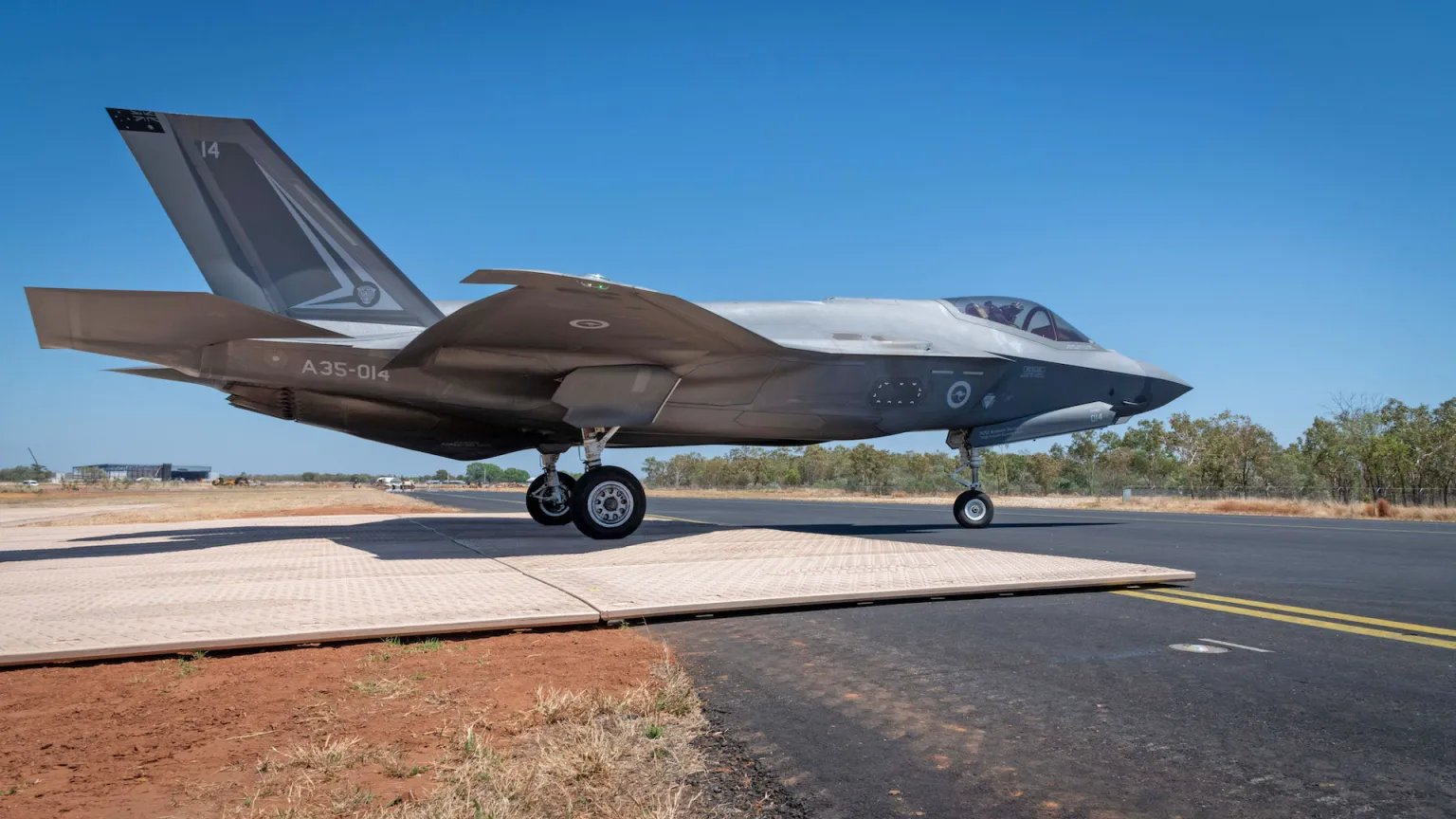
A stock shot of a J-20 fighter with its two-tone scheme. PLAAF
A view of the first J-36 prototype with its splinter-type camouflage scheme. Chinese internet via X

Whether or not the two recent video clips show the same J-36 prototype is unclear. The possibility has now been raised that Chengdu may be using a single serial number (36011) on at least some of the J-36 prototypes, a decision that could have been made for counter-intelligence and/or deliberate misinformation/disinformation purposes.

Much still remains unknown about the current or expected future capabilities of the J-36. Aviation Industry Corporation of China (AVIC) did have a placard at its booth at the 14th China International Defence Electronics Exhibition earlier this month that has prompted questions about whether the jet could be equipped with a laser directed-energy weapon. Chengdu falls under the umbrella of AVIC, which is a state-run enterprise. The Chinese-language placard in question describes a “laser weapon tracking system” with a power rating of “*00” kilowatts and a weight of “less than” 837.7 pounds (380 kilograms), per a machine translation. The way the power rating is written appears to mean that it is in the hundreds of kilowatts, which would put it firmly in a class capable of doing physical damage to objects, such as incoming missiles and drones.

Furthermore, an associated graphic shows a turreted system and a computer-generated rendering of a J-36 projecting a beam. The render appears to be from a video that depicts a J-36 using a laser to destroy other aircraft. Another computer-generated video that shows a J-36 using retractable lasers to shoot down incoming missiles has been circulating online since at least last year.

AVIC showed this at the 14th China International Defence Electronics Exhibition earlier this month. Chinese internet via X

This appears to be a screenshot from this video, via rednote user @阿中CN. https://t.co/NX1zDOLw2v pic.twitter.com/673Zl41MM1

— 笑脸男人 (@lfx160219) September 17, 2026

It is not immediately clear how official either of the clips depicting laser-armed J-36s might be, or whether they at all reflect real planned capabilities. The full placard presented at the China International Defence Electronics Exhibition, as seen in the video below, shows a variety of different laser systems, and not just for aerial applications.

AVIC has confirmed that the J-36 fighter jet is equipped with a laser defense system. pic.twitter.com/4PrSqAfOQK

— Modern War Explained (@FPDefenseNews) September 17, 2026

The fielding of operational laser directed-energy weapons capable of inflicting any real physical damage has historically proven to be very challenging, and even more so within the size, power-generation, and cooling constraints presented by modern combat jets. As an example, the U.S. Air Force spent roughly a decade working on a podded laser weapon system that tactical jets could use to swat down incoming missiles under its Self-protect High Energy Laser Demonstrator (SHiELD) program. In 2024, the service confirmed SHiELD had “concluded” without achieving its goal of an actual flight test. That same year, the Air Force cancelled plans to test a laser weapon system on an AC-130 gunship.

Despite important U.S. strides more recently when it comes to fielding ground-based and naval laser weapon systems, “there’s nothing that’s on the shelf right now that we are ready to put onto an airplane,” U.S. Air Force Brig. Gen. Douglas Wickert, the commander of the Air Force Research Laboratory (AFRL), told TWZ and other outlets just last week at a roundtable at the Air & Space Forces Association’s (AFA) 2026 Air, Space & Cyber Conference on Tuesday. “The solid-state lasers and the power density and the different ways that you actually – there’s actually a lot of secret sauce in that. How do you make the beam, and how do you form the beam, and how do you pulse the beam, and all that’s in development.”

‘There’s development of the laser itself, but now the power and thermal management system has progressed so much that we can provide the power needed,” Dr. Michael Gregg, head of AFRL’s Air Warfare Directorate, said at the same roundtable. “We’ve also had new designs and engines that we know have the power … to direct that power in certain areas. So, from a system perspective, it’s much more feasible because everything has matured over the last decade.”

A rendering of a US Air Force F-16 fighter with a podded laser directed-energy weapon. Lockheed Martin A rendering of a US Air Force F-16C Viper fighter with a podded laser directed energy weapon. Lockheed Martin

China has certainly made substantial investments of its own in laser and other directed-energy weapon capabilities across domains in recent years, and this is clearly an area of interest for the People’s Liberation Army (PLA), in general. When it comes to the J-36 specifically, TWZ has explicitly highlighted in the past how the three-engine configuration could be particularly useful for producing sufficient power to support a host of advanced and electricity-hungry sensors and other capabilities, including directed energy weapons.

Larger questions remain about the exact set of roles the J-36 is expected to fill, as well. The basic design is certainly optimized for straight-line performance, combat radius, and payload rather than maneuverability and agility. The jet has already caused a significant amount of debate just when it comes to taxonomy, as it does not seem to fit inside traditional definitions of ‘fighters’ and ‘bombers,’ something we have explored in detail previously.

A composite of other views of the J-36 that have emerged since 2024. Chinese Internet via X

“According to Yang Wei – chief designer of the J-20 –, the new [J-36] fighter can penetrate heavily defended airspace that the J-20 and comparable F-22s or F-35s must avoid, placing it a generation ahead,” Andreas Rupprecht, an analyst specializing in Chinese military aviation and TWZ contributor, wrote in a post on LinkedIn last week. “With lower RCS [radar cross section], high speed, and the capacity to control more drones, it could act as a node and command center for systems including J-20s and, especially, unmanned aircraft, while attacking high-value targets from stand-off range with long-range weapons.”

“The type could therefore represent a new class of ‘fighter,'” he added. “Online terms include ‘theater-level deep-penetration command combat aircraft’ and ‘high-performance fighter,’ analogous to a cruiser ranking above a destroyer within the Navy. Recent evidence gives this theory new weight and warrants continued monitoring.”

The J-36, as well as the J-XDS, reflect a larger burst of next-generation air combat developments in China in recent years. This includes an array of new crewed and uncrewed aircraft designed for operations from bases on land, as well as from the PLA Navy’s (PLAN) growing fleet of aircraft carriers and big-deck amphibious assault ships. The Chinese aviation industry’s development of a growing array of flying-wing uncrewed aircraft, some of which are very large, has been particularly notable.

In turn, there is something of an emerging gap between these developments and the pace at which the U.S. military is moving along similar lines, at least publicly. Boeing’s sixth-generation F-47 for the U.S. Air Force is not expected to take to the skies for the first time until 2028, though preceding demonstrator designs have been flying for years already. The U.S. Navy still has yet to officially announce a winner of its F/A-XX next-generation carrier-based fighter competition, and the current timeline for that program producing an operational aircraft is unclear.

A rendering the US Air Force has released of the F-47. USAF

As an aside, based on what has emerged publicly to date, there are signs that the F-47 may reflect a distinctly different design philosophy that puts greater emphasis on maneuverability compared to the J-36, and even likely the J-XDS. As mentioned, the J-36 certainly seems much more focused on payload, range, and level flight performance. In July, TWZ published a deep dive exploring why the U.S. Air Force would pursue a sixth-generation fighter with rear-swept wings, canards, and other features despite steady trends in the opposite direction visible in Chinese designs and ones elsewhere globally.

Regardless, U.S. officials have downplayed questions about China’s gaining ground in the air combat arena, or even surging into the lead in certain areas, in the past. “Chinese sixth-generation aircraft are in the nascent stages of development and expected to be operational by 2035,” the Pentagon wrote in its most recent annual report on military and security developments in China, which was published in December 2025.

In the meantime, the J-36’s design is already steadily being refined, and the total fleet of prototypes has been growing, offering new insights into the aircraft’s expected capabilities and roles.

Contact the author: joe@twz.com

The post China’s Recent J-36 Heavy Stealth Tactical Jet Testing Offers New Insights Into Its Evolving Design appeared first on TWZ.

  •  

The Evolving Role Of Ukraine’s Artillery In The Age Of Drones

It’s stunning to comprehend how much has changed since Russia began its invasion of Ukraine. The conflict quickly turned into one dominated by artillery, with both sides scrambling to source shells wherever possible. Drones have since replaced tubed artillery as the ‘king of battle’ along the front, but cannons still have an important place on the battlefield. The commander of a new combined drone-artillery brigade offered some fresh insights into how his guns are now being deployed to achieve effects that drones still can’t provide. 

As we have frequently documented, the ubiquity of drones has changed the nature of combat, especially when it comes to artillery. Not only can drones hold artillery positions at risk, many are cheaper than shells and easier to produce at scale. Most types are also precision guided munitions capable of hitting moving targets with pinpoint accuracy and can also provide battlefield surveillance. However, they are not a panacea, especially amid the cat-and-mouse game of electronic warfare countermeasures and improving kinetic and passive defenses.

In a recent interview with the Ukrainian Oboronka news outlet, Lt. Col. Vitalii Korniienko, commander of the 7th Artillery Brigade, talked about the changing nature of artillery warfare. Korniienko, whose unit is part of the Ukrainian National Guard, explained what is being done to keep his array of domestically produced Bogdana 155mm systems, donated weapons like M777 howitzers, remaining Soviet-era 2S7 Pion 203mm self-propelled howitzers and other guns, relevant. Here are some takeaways from that discussion.

How The Game Changed

“Guns used to be massed at positions to create an ‘artillery wall’ and a barrage of fire,” the lieutenant colonel said. “That practice is gone now. So, how effective is artillery today? We can create an artillery barrage, but what is the point of mindlessly churning up the earth? I’d rather send 20 FPV drones to destroy the target. The cost of that mission is $20,000.”

A soldier from the 13th Khartiia Brigade of Ukraine's National Guard hones his FPV drone piloting skills during a training flight in Kharkiv region, Ukraine, August 15, 2026. Regular practice under conditions closely resembling combat is a key element of operator training. (Photo by Viacheslav Madiievskyi/Ukrinform) (Photo credit should read Viacheslav Madiievskyi / Ukrinform/Future Publishing via Getty Images)
A soldier from the 13th Khartiia Brigade of Ukraine’s National Guard hones his FPV drone piloting skills during a training flight in the Kharkiv region, Ukraine. (Photo by Viacheslav Madiievskyi/Ukrinform/Future Publishing via Getty Images) Future Publishing

“Alternatively, I could fire 200 shells, but the cost would be astronomical,” he pointed out. “Plus, if we fired 100 shells from a gun in a single day, it likely wouldn’t survive until evening. The sky is full of drones; every shot gives away the position, leading to detection and an attempt to dismantle it using every available means. Nowadays, a typical mission involves a series of up to 10 shots. First, 3–5 shells for ranging, followed by fire on the target. That’s a minimum of five shells, with each costing at least $2,000.”

What Does The Drone-Artillery Brigade Do Differently?

“It is a concept of ours that was approved: combining artillery and drones within a single brigade,” Korniienko said. “Drones take out enemy artillery and logistics, while our guns provide cover for the infantry, destroy targets, and pin the enemy down in their dugouts. This way, we mitigate the limitations of both systems and boost overall effectiveness.”

ZAPORIZHZHIA, UKRAINE - AUGUST 20: Servicemen of the 44th Separate Artillery Brigade are firing the 2S22 "Bogdana" at Russian military positions on August 20, 2025 in Zaporizhzhia region, Ukraine. Artillerymen of the 44th Separate Artillery Brigade of the Armed Forces of Ukraine are carrying out combat missions with a 2S22 "Bogdana" self-propelled howitzer against Russian troops near the front line in the Zhaporizhia direction. According to reports from army commander Oleksandr Syrskyi, Russian forces have concentrated there, he said they are preparing an attack. (Photo by Frontliner/Getty Images)
Ukrainian troops firing a domestically produced 2S22 “Bogdana” self-propelled howitzer against Russian forces near the front line in the Zaporizhia direction. (Photo by Maksym Kishka/Frontliner/Getty Images) Frontliner#VIDEO

“Our primary operations are focused within the corps’ area of ​​responsibility—targeting positions 10 kilometers deep or farther behind enemy lines. Of course, we will also engage closer targets if requested by the brigade holding the defense. In addition, we are shifting logistics tasks from pickup trucks to ground-based robotic systems. They are already transporting ammunition to drone and artillery positions, as well as food and fuel for generators.”

What Artillery Can Do That Drones Can’t

“Let’s be honest: 95% of strikes right now are carried out by drones,” Korniienko explained. “Yet, we cannot simply abandon artillery. The focus of our operations has shifted from merely striking the enemy to destroying, suppressing, and halting the actions of assault groups and armored columns—and the need for that remains as critical as ever. There are tasks that only artillery can handle.”

The high art of war, as practiced by the warriors of the National Guard's Artillery Brigade.

So high, it lands beyond the horizon. 💥

📹: @ng_ukraine pic.twitter.com/v06aJ8KcjM

— Defense of Ukraine (@DefenceU) September 23, 2026

“For instance, we currently have several enemy targets in the Kupyansk sector that drones cannot reach due to electronic warfare (EW) interference, while slow fiber-optic drones are simply shot down,” the officer noted. “What do we do? We call in artillery. Nothing affects its shells. Fog, strong winds, snow, or headwinds—it makes no difference to artillery; it will operate regardless.”

Preparing Artillery For The Modern Battlefield

“At the beginning, both we and the Russians might have had two or three guns at a single position,” Korniienko proffered. “The enemy was doing this as late as 2023. Then it tapered off, because if you deployed six guns, an hour later they’d be gone. No one drives out into an open field anymore. Today, a gun wouldn’t even make it to the position without being spotted.”

KHARKIV, UKRAINE - JULY 3: Artillerymen of the 13th operational brigade of the National Guard of Ukraine 'Khartiia' prepare the 'Bogdana-B' artillery installation 'to hit enemy positions' in the Lipetsk direction, Kharkiv region, Ukriane on July 3, 2025. (Photo by Sofiia Bobok/Anadolu via Getty Images)
Ukrainian National Guard troops prepare a ‘Bogdana-BG’ artillery installation from a dugout position. (Photo by Sofiia Bobok/Anadolu via Getty Images) Anadolu

As a result, the artillery crew’s deployment “is prepared in advance,” the officer stated. “First, anti-aircraft drone teams ‘clear’ the sky above the site of enemy reconnaissance assets. The position itself is a fully underground-dugout caponier with well-camouflaged access routes. We put a lot of effort into ensuring the artillery doesn’t get destroyed. Losing a gun is a huge blow to us.”

Short Range Versus Long Range Shells

“There is currently an ongoing debate about phasing out ‘short’ shells and switching entirely to long-range variants,” the officer stated. “This is intended to protect artillery from drone strikes.”

“What exactly is a ‘short’ shell, and should we stop using it?” he asked rhetorically. “The M107 155mm round is what is known as a ‘short’ shell. It is inexpensive and mass-produced; all our allies—and even our own country—manufacture it. We have sufficient stocks of them for combat operations. While accurate, its range is limited to 14–18 km, depending on the propellant used.”

Army

Long-range options “include the M795 and its foreign equivalents,” Korniienko explained. “These are longer, heavier, and significantly more expensive. With high-quality propellant, they can reach 30 km, or even further if equipped with a base-bleed unit. However, both these shells and the necessary propellants are in short supply.”

Army

“I do not believe abandoning the M107 is the right move,” the officer suggested. “Long-range shells cause faster barrel wear and compromise position concealment; firing a long-range charge produces a massive burst of flame from the muzzle—visible for kilometers at dusk or dawn.” “Besides,” he added, “18 km is a respectable range. If the gun is positioned 15 km back, it still has a 3-km margin to spare. That is sufficient for engaging frontline infantry. In my view, the ideal mix for most brigades would be 60% long-range shells and 40% standard M107 rounds.”

Big Versus Small Guns

“I operated 105mm guns in the Serebryanka area, on the Kharkiv axis,” Korniienko noted. “Based on intercepted communications, the enemy thought it was a mortar and searched for it within a five-to-six-kilometer range. But the howitzer was positioned eight or nine kilometers away and fired out to 10–12 kilometers.”

“There is almost no muzzle flash, just a bit of dust,” he added. “The shell arrives, and the enemy doesn’t even hear the sound of the shot. It’s compact and lightweight—you can transport it on a pickup truck. So yes, it would be useful.”

An L119 lightweight towed howitzer. (Via X)

“I’d also like to see the development of 203mm artillery; why move away from that caliber?” the officer wondered aloud. “Our ‘Pion’ systems fire a massive 100-kilogram shell capable of punching through at least two floors of a building or a bunker. And it’s reasonably accurate, too. You wouldn’t want to be on the receiving end when guns like that are firing at you. Overall, I believe we need competition. Right now, the ‘Bogdana’ is evolving under wartime conditions, which is good. But in a few years, momentum could stall. They might just keep producing the same system without significant upgrades because there’s no incentive to innovate. Yet, the nature of war doesn’t stand still.”

Wary Of Asian Shells

“We have a wide range of shells from different countries, and the ones coming from the West are fine,” Korniienko said. “However, their counterparts produced in certain Asian countries… the quality is frankly poor.”

“What is wrong with them?” queried Korniienko, who did not name the country in question. “On paper, the shell weight is listed as 46 kilograms, but when we weigh them, we find 46.9 or 45.4 kg. And that half-kilogram difference—give or take—has a huge impact on where the shell lands.”

As a result, “we no longer trust the standard firing tables provided with the shells; instead, we compile our own for each manufacturer. We weigh every batch and sort them by weight so that the difference between the ‘piles’ is minimal, ensuring a reasonably tight grouping. I can’t afford to make a mistake that causes a shell to land 2 kilometers off-target—right where our infantry guys are positioned. I should add that our artillerymen are actually wary of shells from one specific country. There have been instances where they tore off the muzzle brake or even caused the barrel to burst. A barrel burst is a disaster.” 

Homegrown Is The Best

Korniienko said his unit was one of the first to test the Bogdana system, adding that he prefers it to other guns.

“We tested them and provided feedback to the manufacturer, which was then used to refine the design,” he explained. “It is a solid gun now, and it is my preferred choice. It might not be the absolute best, but I am very satisfied with the support and service.”

“If there’s a breakdown, the gun is back in position within a day or two,” he pointed out. “For instance, a gun broke down today, and we needed a repair team from the manufacturer. I know I’ll have it fixed by the day after tomorrow. They arrive in the morning, and by midday, the gun is ready. Then it takes another day or two to get it back to the position. That is very fast.”

That’s a very different experience than what he sees with donated weapons like the U.S.-made M777.

DONETSK OBLAST, UKRAINE - AUGUST 6: Ukrainian soldiers prepare to fire the M777 artillery at their artillery position as Ukrainian Army conduct operation to target trenches of Russian forces through the Donetsk Oblast amid Russia and Ukraine war in Donetsk Oblast, Ukraine on August 6, 2023. (Photo by Diego Herrera Carcedo/Anadolu Agency via Getty Images)
Ukrainian soldiers prepare to fire an M777 howitzer at Russian forces. (Photo by Diego Herrera Carcedo/Anadolu Agency via Getty Images) Anadolu

“As for the Western partners helping us—we are deeply grateful,” the officer avowed. “However, by the time you actually receive a part—say, a sensor—the gun might have been sitting idle for six months. And you can’t try to fix it yourself, because that would void the warranty.”

While artillery may no longer be the reigning weapon of war, as far as Ukraine is concerned, it has not been relegated to the dustbin of history yet either.

Contact the author: howard@twz.com

The post The Evolving Role Of Ukraine’s Artillery In The Age Of Drones appeared first on TWZ.

  •  

Where Are The Aircraft Carriers?: September 23, 2026

The crew of the USS Abraham Lincoln touched American soil for the first time in nine months, when the strike group pulled into Apra Harbor, Guam, for a brief logistics stop and on-base liberty. The supercarrier, alongside guided-missile destroyer USS Frank E. Petersen Jr., arrived on September 19 and left the next day. Lincoln is 307 days into her deployment, 19 short of the record set earlier this year by the USS Gerald R. Ford, and is now just weeks away from San Diego. Meanwhile, two flattops are on station in the Middle East supporting blockade operations, and the USS Ronald Reagan has rejoined the fleet after an extended maintenance availability.

Here’s TWZ’s weekly carrier tracker monitoring America’s flattop fleet, including deployed Carrier Strike Groups (CSG) and Amphibious Ready Groups (ARG), using publicly available open-source information. Check out our last report here.

A detailed graphic created by TWZ and Ian Ellis-Jones showing the positions of America's fleet of 11 aircraft carriers and strike groups, as of September 23, 2026.

Abraham Lincoln Departs Guam, Continuing Her Journey Home

The USS Abraham Lincoln is currently conducting routine operations at an undisclosed location in the U.S. 7th Fleet area of responsibility (AOR), presumably steaming east en route to her homeport at Naval Air Station North Island in San Diego. After leaving Thailand on September 6 following a five-day liberty port call, Lincoln topped off the Petersen Jr. in the Gulf of Thailand and linked up with two Royal Australian Navy frigates for joint training in the South China Sea. Publicly available flight tracking data shows the carrier transited the Balabac Strait eastbound around September 13, and the Surigao Strait northbound two days later to enter the Philippine Sea. After going dark for a few days, she resurfaced in Guam and moored at Kilo Wharf over the weekend.

Lincoln transits the Philippine Sea. U.S. Navy photo

“Due to the brief nature of the logistics stop, the crew were afforded on-base liberty to access base services and attend a Navy Entertainment-sponsored concert,” CSG-3 spokesman Lt. Cmdr. Tyler Barker wrote in an email to Stars and Stripes. The carrier took on stores, mail, and equipment, according to Barker, and 13 Fleet and Family counselors are now aboard to run return-and-reunion classes but “the crew and ship remain focused and ready.”

Abraham Lincoln is conducting routine operations in the U.S. 7th Fleet area of operations. Units assigned to 7th Fleet conduct continuous patrols to deter aggression, strengthen alliances and partnerships and advance peace through strength.
USS Abraham Lincoln (CVN 72) arrives in Guam on Sept. 19, 2026. U.S. Navy photo

A homecoming date has not been announced publicly. Unless Lincoln makes another stop (in Hawaii, for example) or conducts additional training on the way, she should arrive in early October just shy of Ford’s record. The Chief of Naval Operations, Adm. Daryl Caudle, said in June that Lincoln would likely shift her homeport to Naval Base Kitsap-Bremerton in Washington state, which aligns with TWZ’s reporting that she is expected to begin a Drydocking Planned Incremental Availability (DPIA) after returning stateside. The timeline for the DPIA is unclear.

George Washington and George H.W. Bush Project Power In The Middle East

The American public got a rare look at ongoing combat operations aboard the USS George Washington when two reporters embarked earlier this month. Fox News’ Trey Yingst and CBS News’ Tom Hanson reported live from the flight deck, as F-35C Lightning IIs and F/A-18E/F Super Hornets launched behind them, in hits that aired September 11 to 14. The only other publicized media embark since the war began on February 28 went to CNN’s Pamela Brown, who reported on the conditions aboard the USS Abraham Lincoln while the flattop was still in theater.

An F-35C launches from Washington. U.S. Navy photo
A pair of Super Hornets on Washington. U.S. Navy photo

“Last weekend, the aircraft carrier came under Iranian missile attack; the first of three attacks on US warships in the last week alone,” Yingst said, indicating it was the USS George Washington, and not the USS George H.W. Bush, that was targeted by the Islamic Revolutionary Guard Corps (IRGC) in early September. The Navy declined to comment when TWZ asked which carrier was targeted after Iranian state media claimed the strike had been successful. “We’re pretty much employing all our capabilities right now,” Washington’s commanding officer (CO), Capt. Nicholas DeLeo, told Yingst.

Night flight ops aboard USS George Washington. U.S. Navy photos

“The GW is surrounded by four to five guided-missile destroyers at any moment,” Yingst also reported. He flew out to USS Shoup, positioned off the starboard side at the time, to make the point and speak with the warship’s CO. Shoup is the only destroyer officially confirmed to be part of CSG-5. “My ship is in charge of coordinating defense amongst the various other units, allocating defensive assets to it, be it potentially a missile to shoot something down or just aircraft to go identify and monitor the picture,” Capt. William Buford said. Based on that description, Shoup’s CO appears to be coordinating Integrated Air and Missile Defense (IAMD) for the strike group, a question we’ve been asking the Navy to confirm. TWZ understands additional destroyers operating in the U.S. Central Command (CENTCOM) AOR are also escorting Washington, but a U.S. official declined to say which ones.

Hanson asked DeLeo about the recent IRGC ballistic missile threat targeting Navy ships in the region. “We have a variety of ways to protect, both offensively and defensively, a Navy ship, and we employ all these methods,” he told the network. “It’s something that we train to.” Hanson also pressed the commander of CSG-5, Rear Adm. Jeff Heames, on whether he was concerned about the munitions stockpile, a dynamic TWZ detailed in a special feature yesterday. “Of course we’re concerned about the expenditure to some degree, but I have no concerns locally at my level here,” Heames replied.

Gun shoot aboard USS George Washington (CVN 73), Sept. 15, 2026. U.S. Navy video

In addition to Washington, Bush is still working the blockade from the Arabian Sea, nearly six months into her deployment. As of CENTCOM’s latest social media update on September 21, U.S. forces in the region had redirected 110 commercial vessels to ensure “total compliance” with the blockade. More than 50 ships “supporting humanitarian efforts” have been allowed through, according to the command. CENTCOM recently stopped publishing the number of ships boarded, seized, or disabled kinetically.

USS George H.W. Bush and USS Mason conduct a replenishment-at-sea on Sept. 18, 2026 at an undisclosed location in the U.S. Central Command Area of Responsibility.
An MH-60S Sea Hawk lifts cargo from the flight deck of USS George H.W. Bush, Sept. 18, 2026. U.S. Navy photo

Ronald Reagan Rejoins the Fleet

The USS Ronald Reagan is officially back. The Navy, in a recent statement, confirmed the flattop “returned to the fleet capable and mission-ready.” The carrier had been out of action since March 2025 for a DPIA at Puget Sound Naval Shipyard in Washington state and completed four days of sea trials in early September. While the Navy does not comment on upcoming deployments due to operational security, current speculation points to a spring 2027 deployment, but that is not confirmed.

U.S. Navy Damage Control Fireman walks on the flight deck of USS Ronald Reagan (CVN 76) during a counter measure wash down in the Pacific Ocean, Sept. 6, 2026. Following an 18-month Docking Planned Incremental Availability, the Nimitz-class aircraft carrier USS Ronald Reagan is conducting routine training in the U.S. 3rd Fleet area of operations. U.S. Navy photo
Counter measure wash down on USS Ronald Reagan in the Pacific Ocean on Sept. 6, 2026. U.S. Navy photo

Reagan is the only carrier currently homeported at Naval Base Kitsap-Bremerton in Washington. Previously, she was America’s only forward-deployed carrier based in Yokosuka, Japan, until swapping hulls with the USS George Washington in 2024. USS Nimitz was stationed at Naval Base Kitsap-Bremerton before circumnavigating South America to Naval Station Norfolk this summer, where she is being used primarily for training before deactivation in 2027. The yet-to-be-commissioned PCU John F. Kennedy, the second and newest Ford class supercarrier, is slated to homeport in Washington state no earlier than 2029.

U.S. Navy Big Deck Fleet At A Glance

Overall, three U.S. carriers are deployed (with one heading home), one is preparing to deploy in the near term, three are working up in various states of readiness, three are in current or upcoming maintenance, and one is being used primarily for training before deactivation next year. One amphibious ready group is deployed, one is forward-stationed and in port, four are working up or in port, and three are in maintenance.

Note: Positions are general approximations. Non-deployed LHA/LHD amphibious warships are not shown.

Contact the author: ian.ellis-jones@recurrent.io or @ianellisjones

The post Where Are The Aircraft Carriers?: September 23, 2026 appeared first on TWZ.

  •  

Video Shows RAF Hawk T2 Trainer Crew Ejecting Before Jet Crashes (Updated)

A U.K. Royal Air Force Hawk T2 training jet crashed in the Pencarnisiog area of Anglesey, North Wales, on Wednesday after both pilots ejected from the aircraft.

Videos captured of the incident show the aircraft porpoising at a slow speed and high angle of attack, before the pair ejected. The Hawk appears to narrowly miss homes before impacting the countryside and bursting into flames, with thick black smoke visible afterward.

BREAKING: Moment RAF Hawk jet crashes near RAF Valley, Wales; pilots eject pic.twitter.com/oHV8MJLhfi

— Klaxon Wire (@KlaxonWire) September 23, 2026

Local police said the two pilots were being treated for minor injuries and that there were no reports of wider damage or additional casualties. Emergency services, including Coastguard and Wales Air Ambulance helicopters, responded to the scene.

The crash occurred near RAF Valley, where the RAF operates its Hawk T2 advanced jet trainers as part of fast-jet pilot training. The station is home to No. 4 Flying Training School. The Telegraph reports the incident happening “shortly after takeoff.”

🚨 WATCH: The moment an RAF training jet crashes shortly after take-off at RAF Valley pic.twitter.com/Pnc71YEuW5

— Politics UK (@PolitlcsUK) September 23, 2026

🚨 BREAKING: An RAF jet has crashed near RAF Valley in Wales

Both crew members ejected pic.twitter.com/dH4RhZ11hw

— Politics UK (@PolitlcsUK) September 23, 2026

The Royal Air Force confirmed that the incident involved one of its Hawk T2s flying out of RAF Valley.

“An investigation is under way and we will not comment further at this time,” the RAF said.

Wreckage from the aircraft has been located at the crash site. Police have asked the public to avoid the area while emergency services remain at the scene.

The circumstances surrounding the crash, including what caused the aircraft to go down and the nature of the flight, have not yet been established.

The Hawk fleet has experienced previous technical issues.

In 2022, engines were removed from service amid concerns over potential in-flight failures, while the 28-aircraft RAF Hawk T2 fleet was temporarily grounded in January 2023 following an engine-related incident at RAF Valley.

In 2024, then-Chief of the Air Staff Air Chief Marshal Sir Richard Knighton said he wanted to replace the Hawk T2, citing problems with its engines and support and concerns about the reliability of the training capacity it provided. The Hawk T2 is due to be retired by 2040.

Those previous issues are not known to be connected to Wednesday’s crash.

Update: 2:09 PM ET –

The Royal Air Force has issued a new update on the mishap today:

“Following an incident involving an RAF Hawk T2 aircraft today, both pilots are receiving medical treatment. Their families are being supported.”

“The RAF has decided to temporarily pause Hawk T1 and T2 operations, as a precautionary measure, whilst investigations are ongoing.”

An update on today's incident involving an RAF Hawk T2 aircraft. Thank you for the well wishes to our people. pic.twitter.com/GLuWU9LfoN

— Royal Air Force (@RoyalAirForce) September 23, 2026

Update: 4:25 PM ET –

A video taken by an onlooker outside the perimeter fence at RAF Valley shows the ill-fated Hawk T2 taking off, with flames beginning to appear during the takeoff roll.

Exclusive: a Hawk T2 getting airborne from RAF Valley, N. Wales. As it rolls down the runway flames appear from the rear of the jet. The Hawk T2 does not have reheat (afterburner). As the jet climbs the flames seem to disappear. The main Hydraulic system is on the rear left side. pic.twitter.com/WafevD2BQg

— Mikey Kay 🏴󠁧󠁢󠁷󠁬󠁳󠁿 (@MikeyKayFilms) September 23, 2026

Update: 9/24/2026 –

The Royal Air Force has shared a new update on yesterday’s crash, which is as follows:

“Both pilots are doing well, they are in extremely good spirits and [are] expected to make a full recovery.”

“A formal investigation into the circumstances surrounding the incident is now underway and as a precautionary measure, the RAF has temporarily paused Hawk T1 and Hawk T2 flying operations.”

An update on yesterday's incident involving a Hawk T2 aircraft. pic.twitter.com/QXg7xAOZTB

— Royal Air Force (@RoyalAirForce) September 24, 2026

Contact the author: thomas@thewarzone.com

The post Video Shows RAF Hawk T2 Trainer Crew Ejecting Before Jet Crashes (Updated) appeared first on TWZ.

  •  

Did NASA’s Administrator Just Tease An SR-71 Blackbird Follow-On X-Plane? (Updated)

NASA Administrator Jared Isaacman has left something of a mystery hanging in the air after showing the silhouette of an aircraft that immediately drew comparisons to the famed SR-71 Blackbird during a recent speech. Isaacman pushed back on a direct link to the SR-71, but said his agency is working hard to get “back in the business of flying high and fast again.”

The silhouette, accompanied by the tagline “Rebuilding our X-plane portfolio,” was among the backdrops for Isaacman’s remarks at the annual All-In Summit in Los Angeles, California, last week.

The SR-71’s iconic shape is defined by its long, sword-like profile, pronounced chines, and deeply swept wings, and huge spiked engine nacelles with canted fins on top. Its distinctive geometry is reflected in the silhouette, which shows a broad, highly blended aircraft from an unusual head-on angle.

NASA Administrator Jared Isaacman talks at the All-In Summit about new high- and fast-flying X-planes with the eye-catching aircraft silhouette in the background. All-In Summit/YouTube screencap

“In the service of the first A [aeronautics] in NASA, we are rebuilding our X-plane fleet. The X-59 is researching quiet supersonic flight, but it’s just the beginning,” the head of NASA told attendees. “As NASA recommits to flight test and works alongside industry to push the boundaries of airframe and propulsion design, it will not be long before NASA once again is flying as high and as fast as we had in decades past, and then even more.”

Isaacman’s full speech at the All-In Summit, as well as his remarks during a live interview that followed immediately afterward, are contained in the video below. The high-speed aircraft silhouette is first seen at around the 12:40-mark in the runtime, and is then further discussed at around the 28:39-mark.

Chamath Palihapitiya, co-host of the All-In Podcast and one of the hosts of the summit, asked Isaacman directly about the silhouette during the fireside chat after his speech.

“You showed a picture of the [SR-71] Blackbird up there,” Palihapitiya said at one point, before Isaacman interjected.

“You sure that’s a Blackbird?” Isaacman said.

“Well, ok. What was that picture you showed up there?” Palihapitiya asked.

“Like I said, NASA is getting back in the business of flying high and fast again,” Isaacman said in response, and declined to further elaborate.

Whether or not the silhouette reflects a real design that is in development now is unclear. TWZ has reached out to NASA for more information.

Though the Mach-3+-capable SR-71 is primarily remembered as a Cold War-era intelligence-gathering aircraft, NASA operated several Blackbirds in support of aeronautical research efforts for years. The agency was actually the last operator of the type, flying SR-71s until 1999.

Lockheed Martin openly pitched a successor to the SR-71, dubbed the SR-72, in the late 2010s. There was even talk of building a flying fighter jet-sized demonstrator to prove out key technologies.

A rendering of a notional SR-72. Lockheed Martin An artist’s conception of the proposed SR-72. Lockheed Martin

Discussion about the SR-72, or a further evolution of that concept, resurfaced in the early 2020s after Lockheed Martin helped craft a fictional hypersonic aircraft called Darkstar for the blockbuster movie Top Gun: Maverick.

Exactly where Lockheed’s SR-72 ambitions sit today is unclear. After talking constantly about the potential program for a number of years, it went silent, which could indicate the program had moved forward deep in classification.

NASA has worked with other supersonic and hypersonic X-planes in the past, as well. This includes reusable space planes, as well as aircraft designed to fly within the Earth’s atmosphere.

“I mean, that doesn’t seem like a space vehicle. It seems like an Earth-air vehicle,” All-In’s Palihapitiya noted during his chat with Isaacman about the silhouette he showed.

“Yeah. The first ‘A’ in NASA is our aeronautics portfolio,” Isaacman said in response, before highlighting a host of contributions his agency has made to advanced military and commercial developments over the years. “You know what I want to do? I want to get back to the radical airframe and engine designs like we were always supposed to do.”

As mentioned, Isaacman also highlighted the X-59 Quiet Supersonic Technology experimental test aircraft, or QueSST, at the summit, but made clear the goal is to go well beyond that design. The QueSST jet is the centerpiece of a program now to investigate technologies that could eventually enable commercial supersonic flight over land with a substantially reduced sonic boom.

The X-59 conducted its first supersonic test flight, reaching Mach 1.1, in June. NASA’s test program aims to eventually push the aircraft up to a speed of Mach 1.4. This is significantly below the record-breaking mark of approximately Mach 3.3 that the SR-71 clocked back in the mid-1970s, but it was never designed for extreme speed as testing its sonic signature was its primary goal.

NASA’s X-59 flies above the Mojave Desert in California on August 18, 2026. NASA/Jim Ross

As for bringing a Blackbird back into operation for high-speed testing, which is now at the forefront of military aeronautics (and civilian to a lesser degree) after decades of being sidelined, that would be a very challenging operation. The SR-71s are long retired and have been placed in museums and other display areas. While the Pentagon could technically claw some of them back from their ‘on loan’ status, reconstituting even one of them would be a major undertaking as the entire support ecosystem that once sustained them has been gone for decades. Still, having a Mach 3+ capable jet for testing would be a highly relevant tool in a new age of high-speed flight exploration.

On the other hand, building a new test aircraft that aims higher and faster than the SR-71, but may be based on its ‘DNA,’ is certainly possible. Such an aircraft could leverage material science, avionics, flight controls, and engines that are seven decades more modern than its progenitor. Technology demonstrators in this class could also already exist in the classified domain. NASA could possibly assume ownership of one after the Pentagon declassifies it, as well.

Regardless of how such an exotic aircraft is obtained, one of the biggest differentiating factors could be that a NASA aircraft is piloted by a human onboard, instead of it being a drone, but an uncrewed aircraft is possible too.

A NASA SR-71 taxis at Dryden Flight Research Center during its late operational phase. NASA

Isaacman has been very open about its interest in and support for new X-plane developments. On only his second day on the job, in December of last year, he called for revamping the agency’s aeronautics program and stated that “I’d love to see an expanded X-plane portfolio” during a town hall with NASA staff.

“If NASA has a healthy X-plane portfolio, we should be flying experimental aircraft so routinely that the second flight of a single X-plane is not newsworthy,” he wrote in a post on X in March of this year. “For example, the two NASA X-29 aircraft flew 422 flights between 1984 and 1991. That period also overlapped with the development of two X-31 aircraft, which together flew about 580 times.”

One of the X-29 X-planes, at left, and the X-31, at right. NASA/DARPA

NASA’s proposed FY2027 budget also spelled out rapid, cost-effective flight experimentation as an explicit priority. Budget documents specifically highlight work toward new advances in supersonic and hypersonic flight technologies “that will revolutionize air transportation, strengthen national security capabilities, and position America to lead the future of high-speed flight,” as well.

Furthermore, in April, NASA outlined a new Aeronautics Flight Accelerator (AFA) initiative. At that time, the agency put out a call for “input on technologies, concepts, and flight test campaigns suitable for cost shared maturation leading to flight within the next three years.” Stated areas of interest included “subsonic (including vertical lift), supersonic, and hypersonic flight technologies.”

It is important to reiterate that we still do not know whether the silhouette Isaacman showed at the All-In Summit represents an active development effort and, if so, how mature it might be. Government agencies and contractors routinely use concept art to illustrate an area of research or communicate a future vision. Such artwork does not necessarily correspond to a funded aircraft, an active prototype, or even a specific configuration.

At the same time, under Isaacman, NASA is clearly pushing toward new X-planes. NASA’s X-plane programs have historically served as a way to investigate technologies that conventional aircraft programs were not prepared to risk. The resulting aircraft have explored everything from supersonic and hypersonic flight to unconventional configurations and new propulsion concepts.

At the very least, evoking the visual legacy of the SR-71 Blackbird, coupled with Isaacman’s comments, provides a clear indication that NASA is interested in returning to the high-speed flight regime as part of its future plans.

Update: 2:04 PM ET –

NASA has now provided TWZ with the following statement in response to our queries for more information:

“NASA has a long history of building and flying experimental aircraft that push the boundaries of what is possible. As Administrator Isaacman has said, we want to see more X-planes flying in the years ahead, developing the technologies that will allow us to fly higher, farther, and faster than we have in decades. We look forward to sharing more as those efforts progress.“

Contact the author: thomas@thewarzone.com

The post Did NASA’s Administrator Just Tease An SR-71 Blackbird Follow-On X-Plane? (Updated) appeared first on TWZ.

  •  
❌