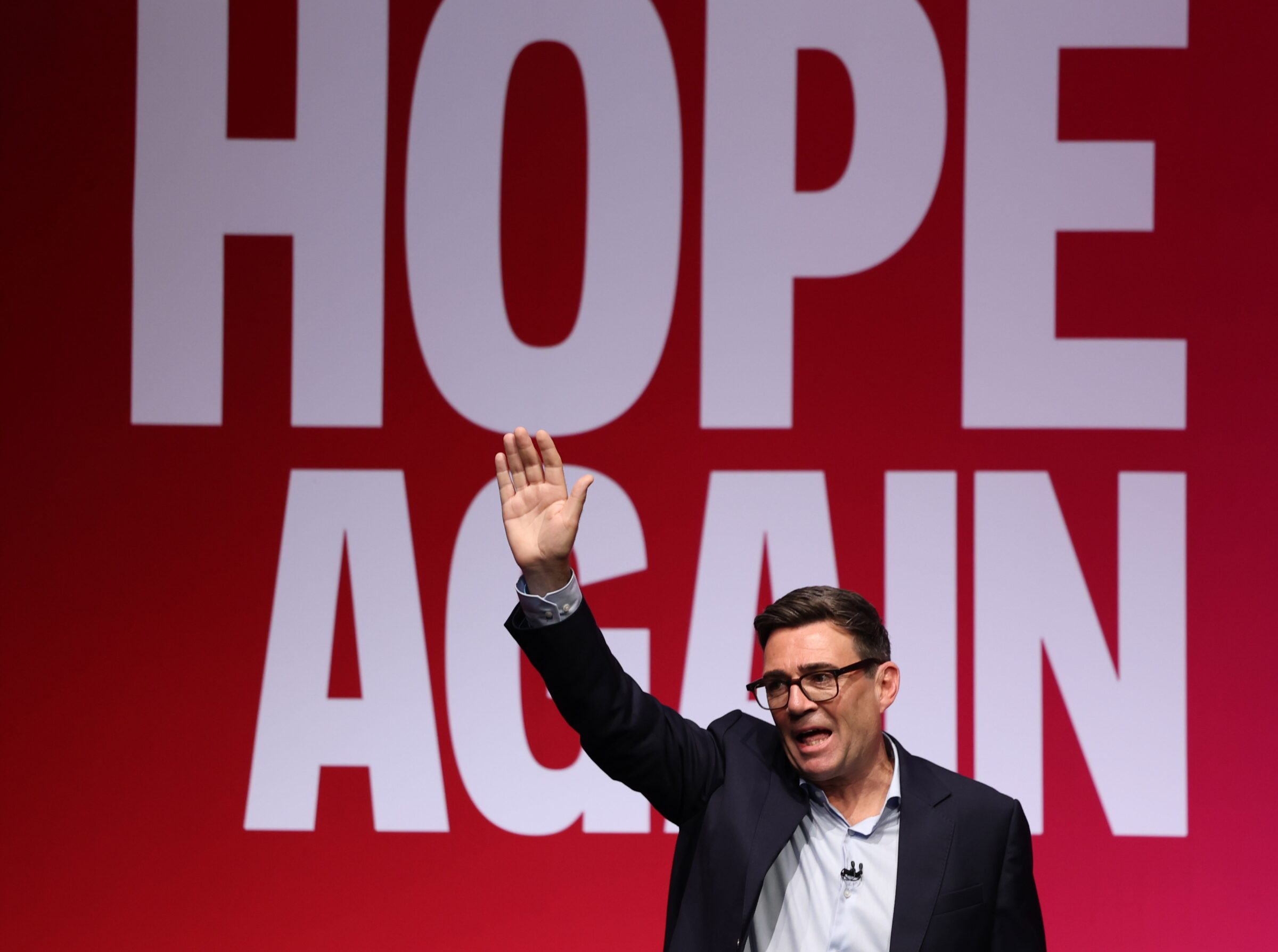
Having said several months ago that he had no intention of a ‘rerun’ of the Brexit debate, UK prime minister Andy Burnham told Labour delegates at the party’s annual conference in Liverpool last week that nothing should be off the table as far as EU-UK relations are concerned.
Brexit had “done more harm than good”, he said, adding that “we will not give Britain the clear path we need into the rest of the century until we decide on a long-term relationship with what is still our largest market.”
In fact, Britain could “go all the way” back into the EU, said Burnham.
The new prime minister is still enjoying something of a honeymoon period. His Labour party now tops the opinion polls, albeit by less than 30 percent, and his early policy announcements on nationalising utilities and pension reform are the most radical in a generation.
Even so, Burnham’s remarks were a surprise that left pro-European columnists positively giddy with optimism over the weekend.
In truth, rejoining the EU – if it happens – would probably take a decade.
Burnham didn’t offer any timetable or any other specifics, and has said that no moves towards EU membership would be taken before the next UK election due in 2029. And talk of rejoining the EU is not purely borne out of pro-European enthusiasm.
This article continues, but the full version is available only to EUobserver.com subscribers. Visit account.euobserver.com/membership
Almost 150 European politicians have become targets of AI-generated deepfake pornography, 50 of whom are MEPs. The EU’s Green party has now taken the fight to the upper echelons of EU authority to push a ban on ‘nudifying’ apps.
Research by the think tank Agora Digital Transformation (ADT), published on Monday (5 October), found that 50 MEPs have been targeted by digital platforms able to digitally strip anyone whose picture is uploaded to it. Of these, 46 are women.
Another ADT study published in September found that the chances of becoming a victim of false sexualised portrayals are one in 14 for women, against one in 500 for male politicians.
Most worryingly, a woman has no way of knowing she’s been targeted because “the harm is often unseen until it has spread,” Monday’s study read.
MEPs have rallied behind the Green party in demanding EU leaders take concrete steps to limit the influence of such software, while requiring member states to set up national authorities to roll out an effective ban on ‘nudifier’ apps from 2 December 2026.
The Green party initiated an open letter, which was endorsed by 119 MEPs from the Socialists and Democrats, liberal Renew Europe and the Left, calling on the European Commission and member states to take decisive action against AI deepfakes of women politicians.
The appeal asks to strengthen EU resolutions on AI and digital protection by requesting that the commission guide national authorities on enforcing the ban, and that there be a designated and properly resourced body in every member state ready to implement the ban from December.
This article continues, but the full version is available only to EUobserver.com subscribers. Visit account.euobserver.com/membership
Bosnia and Herzegovina’s election, held on Sunday (4 October), has reinforced the country’s deep ethnic and political divisions, with nationalist parties retaining a strong grip on power and low turnout underscoring voters’ growing disillusionment with a political system that has long frustrated the country’s ambitions to join the European Union.
Public support for EU membership remains strong. According to a 2026 survey by Bosnia’s directorate for European integration, 74.4 percent of citizens said they would vote for EU membership in a referendum. Even in Republika Srpska, the ethnic Serb component, where support is lower, 54.1 percent said they would back joining the bloc.
And Bosnia became an EU candidate in 2022, but its path towards membership remains stalled.
The European Commission has identified 14 priorities that the country must address before it can move towards opening accession negotiations. So far, it has not opened a single accession-talks chapter and does not have a chief negotiator for EU membership.
Meanwhile, Bosnia’s complicated political system, built around three constituent ethnic groups, continues to hamper the adoption of reforms.
Forgotten elections
The Bosnian nationwide turnout was just 42 percent, reflecting political apathy, but the complexity of its system also means few people in the EU followed what went on.
Instead of a single president, Bosnia and Herzegovina has a tripartite presidency comprising one Bosniak (South Slavic ethnic group), one Croat, and one Serb.
Voters registered in the federation may vote for either the Bosniak or Croat member, but not both. Voters in Republika Srpska elect the Serb member.
From the provisional results, on Sunday, Denis Becirović won a second term as the Bosniak member of the presidency with 38.12 percent.
He is to be joined by Darijana Filipović (46.55 percent) of the Croatian Democratic Union of Bosnia and Herzegovina (HDZ BiH) as the Croat member, and Željka Cvijanović of the Alliance of Independent Social Democrats (SNSD) as the Serb member (55.37 percent).
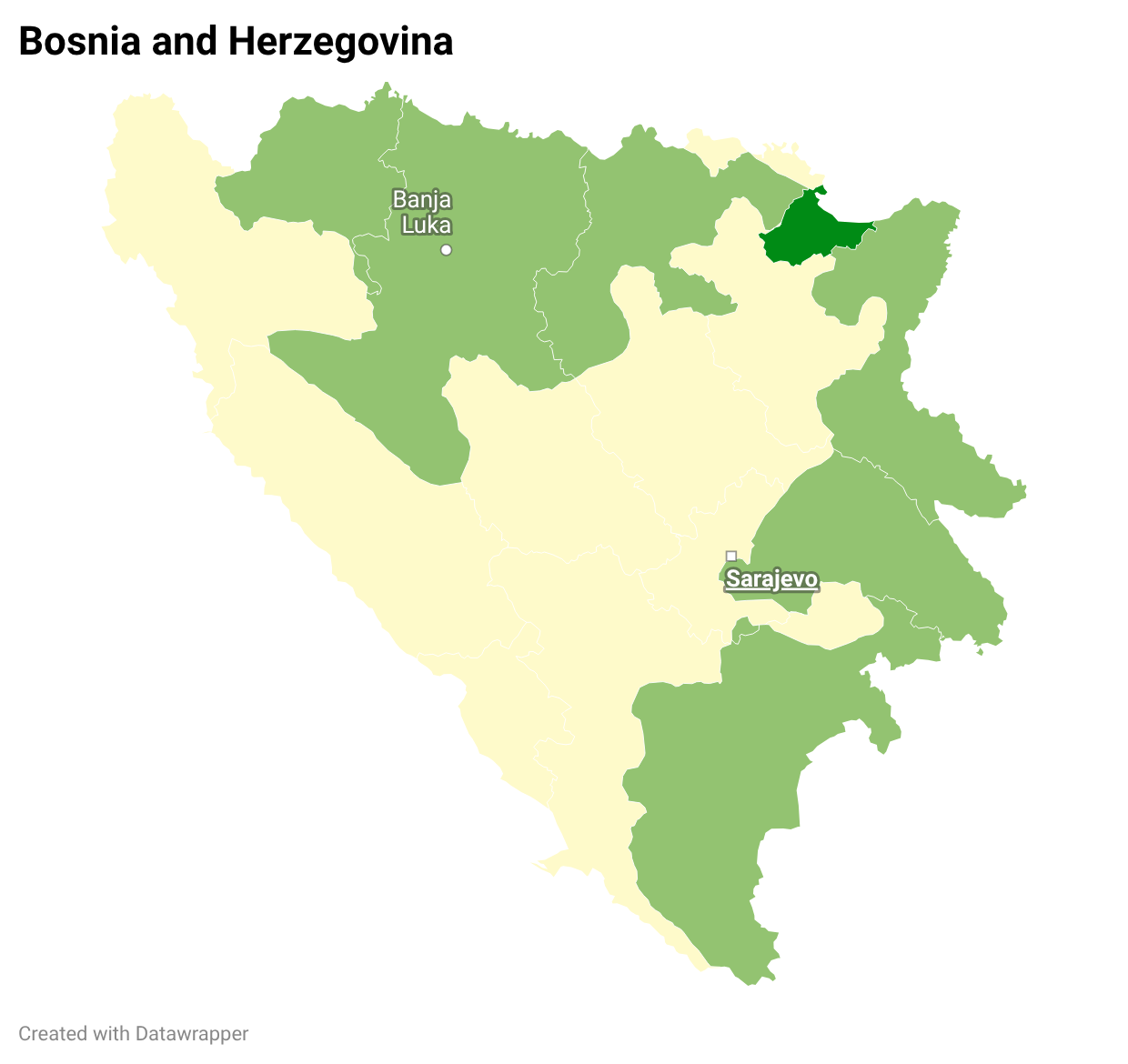
In light green is the Republika Srpbska. In dark green is the region of Brcko who has another legal status.
The Bosnian system excludes citizens who do not identify as Serb, Croat, or Bosnian from standing for the presidency.
And the post-war power sharing agreement includes 14 parliaments and governments in total for the country of some 3.1 million people, making reforms hard to push through.
But amid the complexities, the biggest winner from Sunday’s elections could be Serb nationalist politician Milorad Dodik, while the big loser could be the EU, according to Adi Ćerimagić, a senior analyst on the Western Balkans at the European Stability Initiative think tank.
This article continues, but the full version is available only to EUobserver.com subscribers. Visit account.euobserver.com/membership
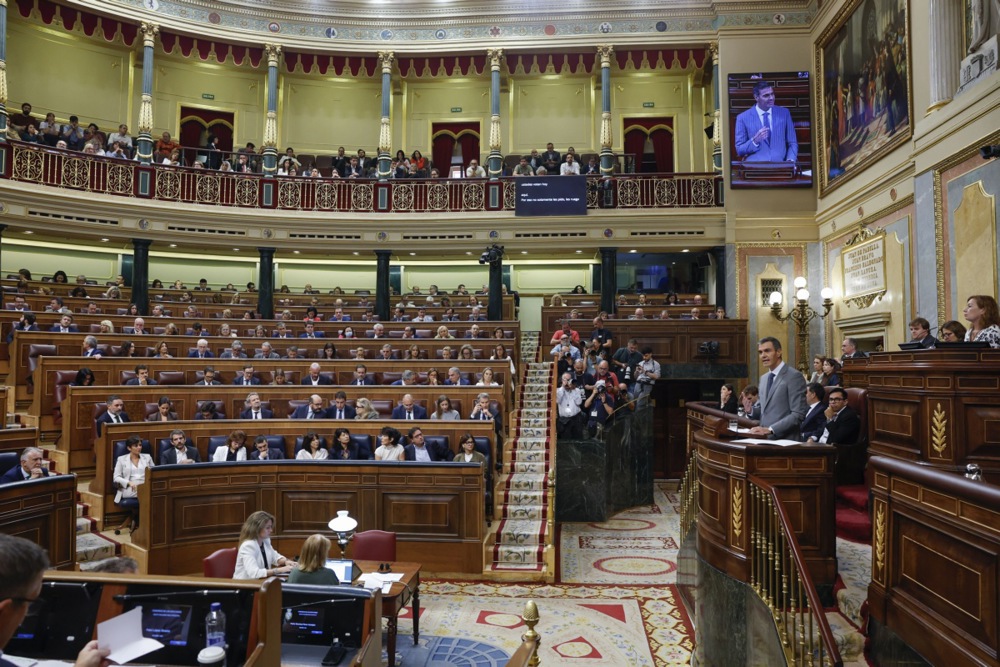
After years without being able to pass a budget, a coalition that wavered over every major proposal, the Ceuta crisis, a string of corruption cases and people taking to the streets over the housing crisis, Spanish prime minister Pedro Sánchez has called snap elections for 29 November — just as a rightwing victory appears increasingly unstoppable.
Monday’s (5 October) move is barely a surprise. Sánchez’s gambles have proven effective in the past to keep his grasp on power.
Even before the summer, an early election wasn’t considered a far-fetched possibility. Sources in Sánchez’s centre-left Spanish Socialist Workers’ Party (PSOE) and its allies linked it to the budget vote anytime from October onwards, with some analysts pointing to November 2026 as a politically attractive date.
Spain now faces a 54-day sprint to the polls, the shortest window the law allows, with Sánchez betting that the housing issue can turn the campaign in his favour.
But why now?
The eviction of an 87-year-old woman from her rental home after 70 years on 23 September prompted people across the country to take to the streets against Spain’s ongoing housing crisis.
And last Friday, the Spanish lower house in parliament rejected two new housing decree-laws. It was the centre-right People’s Party (PP), far-right Vox, Catalan pro-independence party Junts and Navarrese regional party UPN who voted them down, exposing once again how fragile Sánchez’s parliamentary coalition is.
But with parliament dissolved, a political manoeuvre could now see similar housing decrees approved anyway – helping Sánchez make the housing crisis his main election motto.
Housing bet
In Spain, when parliament is dissolved ahead of an election, responsibility for ratifying government-approved laws passes to a smaller standing committee of 69 lawmakers, known as the Diputación Permanente [Permanent Deputation], which continues to operate until the new parliament is sworn in.
The maths in that body favours Sánchez. His socialist party and the left-wing and regional parties that backed the original housing decrees hold 35 seats, against 34 for the opposition.
This article continues, but the full version is available only to EUobserver.com subscribers. Visit account.euobserver.com/membership
Two human rights defenders are facing a Greek court in Rhodes and 20 years in jail over allegations they belong to a criminal organisation.
The hearing targets Norwegian activist Tommy Olsen and Panayote Dimitras, a legal administrator and representative of the NGO Greek Helsinki Monitor.
“They want to shut me up because what I’ve been doing over the last six to seven years is revealing their wrongdoings,” Olsen told EUobserver on Monday (5 October).
The hearing, which is taking place on Tuesday, is years in the making, following repeated attempt by Greek authorities to punish the pair for helping people seek asylum on the island of Kos in 2021.
Both deny any wrongdoing and Amnesty International earlier this year said the two were being prosecuted for their human-rights work of documenting serious rights violations.
This article continues, but the full version is available only to EUobserver.com subscribers. Visit account.euobserver.com/membership
Russia is making no progress at all on the front, and September was among its worst months.
Russia wants to cause Kyiv’s economic collapse, and pontoon bridges are being prepared in the city.
Ukraine’s air defences neutralised 83 percent of drones launched in September, compared with 92 percent in May.
Videos of the day – attacks on Kyiv’s bridges; what a TM-62 anti-tank mine can do; what anti-drone protection for the Kerch Bridge looks like; Russian communists shouted “Down with the tsar!”, and frontline sounds from a Russian soldier’s video.
Russia is making no progress at all on the front, and September was among its worst months. Russian president Vladimir Putin claimed in Valdai at the beginning of the month that his subjects had captured 1,300 square km of territory in September. This is further evidence that he is either being given completely fabricated figures or is deliberately lying himself.
If Putin were right, his army would have experienced its most successful period since the first two months of the invasion. Defence ministry reports reflect this. Almost every day, they report the capture of more and more villages. In reality, the situation is different. Russian forces became bogged down in every direction even before the rains arrived, and throughout the year they have failed to achieve any operational success that would justify the further hundreds of thousands killed and wounded.
As every month, various analysts have again published their calculations of how the front line moved. Not even estimates from Putin’s own Z channels agree with his figure.
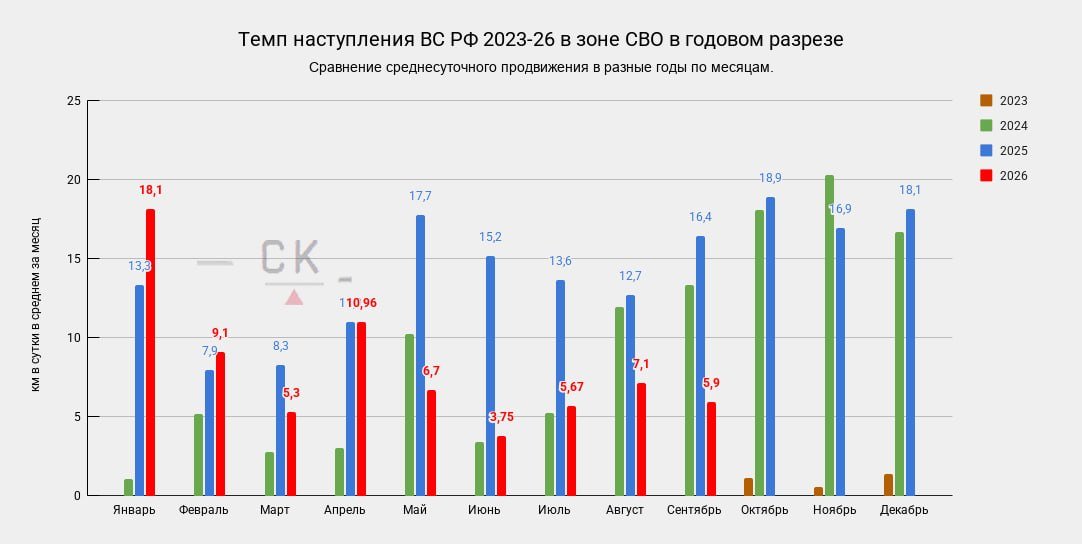
“The average daily rate of advance by the Armed Forces of the Russian Federation in the SVO zone [special military operation] in September 2026 was +5.9 km². The average rate of advance over the entire offensive up to October 2026 is +9.92 km² per day,” Russian project Slivochny Kapriz wrote about September.
It, too, is an unreliable source that regularly overestimates the significance of “flag operations”, but even its data makes it clear that 2026 is lagging significantly behind the previous year.
Even if this author’s figures were correct, the Russians advanced by 177 square km during September’s 30 days, more than seven times less than Putin claims.
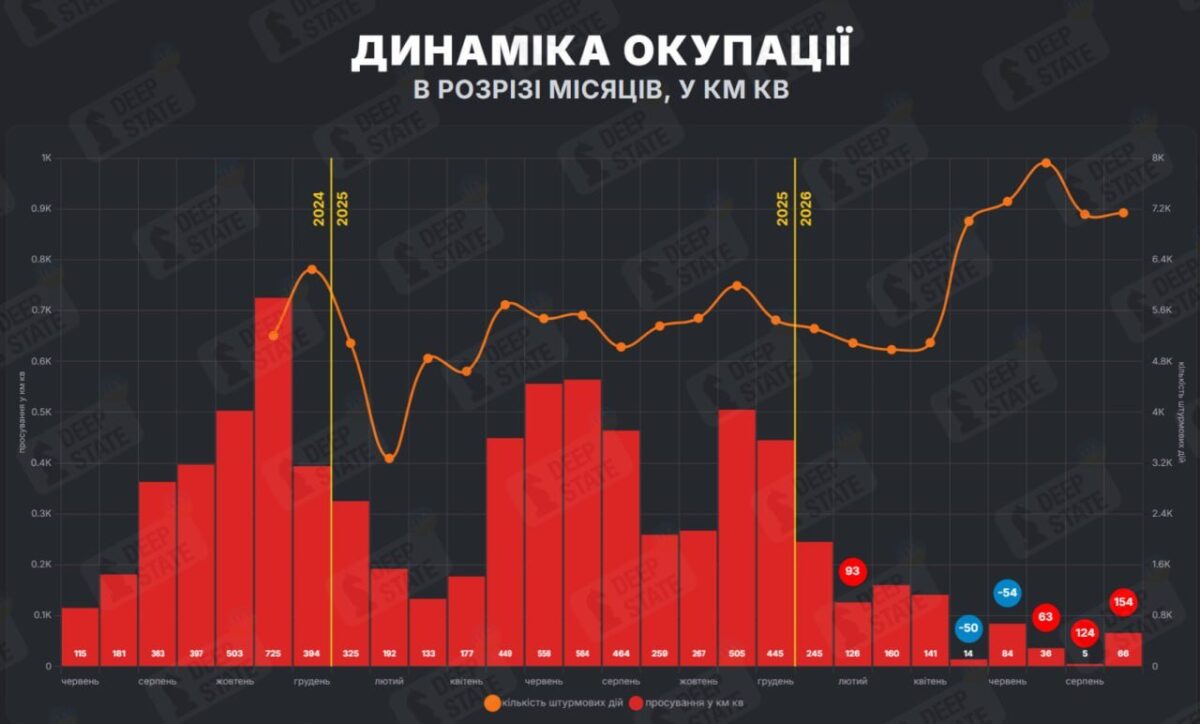
Ukrainians from DeepStateUA also published an estimate very close to Slivochny Kapriz’s figures. According to this OSINT project, Ukraine lost 154 square km in September.
However, the Ukrainian analysts treat their own data cautiously and warn their readers that “the operational security of our forces remains the highest priority in our work”.
In other words, during Ukrainian counter-offensives, DeepStateUA only reports successes after a delay so as not to jeopardise the operations’ success.
They therefore now recall that their statistics do not yet include 270 to 320 square km of liberated Ukrainian territory in various sectors. “July will therefore also end as a month in which the Armed Forces of Ukraine have the upper hand, while for August and September this will only become clear when official announcements of successes are available. In the meantime, part of the liberated territories may be lost again,” DeepStateUA wrote on Friday (2 October).
The most optimistic by far are currently Finnish analysts from the Black Bird Group, who see a balance of 190 square kms in Ukraine’s favour in September.
Over the month of September, the Russian net gains were negative 190 km2. This marks the greatest monthly net territorial loss for Russia in our dataset since the June of 2023.
Emil Kastehelmi, one of the project’s authors, pointed out that the sharp change for the better stems from the fact that it also captures some changes that DeepStateUA has not yet taken into account. Nevertheless, he said: “Russia has failed to reverse a situation that has persisted for almost the entire year. The results of the major Russian offensive are minimal, and this is likely to remain the case for the rest of 2026.”
Among Western analysts, the most sceptical is Konrad Muzyka of Rochan Consulting, who credits the Russians with even more gains than Slivochny Kapriz — as much as 235 square kms of advance. Yet this figure still does not come close to Putin’s. Even if it were the most accurate of all, which cannot be determined, it would amount to an area roughly equivalent to the size of Košice, including all its suburbs, forests and agricultural land within the city’s administrative boundaries.
The plan for this year, meanwhile, was to capture the rest of Donetsk region, including the remaining large cities of Kostiantynivka, Druzhkivka, Kramatorsk and Sloviansk. The Russians are closest to doing so in Kostiantynivka, but Ukrainian soldiers remain there too.
Here is a short summary of territorial changes in Ukraine for September 2026. Our dataset shows an overall Russian territorial gain in September, but a sharply uneven pattern: gains around Dobropillia, Velykyi Burluk, Kramatorsk and Komyshuvakha coincided with substantial losses… pic.twitter.com/jrq0zXiqri
— Konrad Muzyka – Rochan Consulting (@konrad_muzyka) October 1, 2026
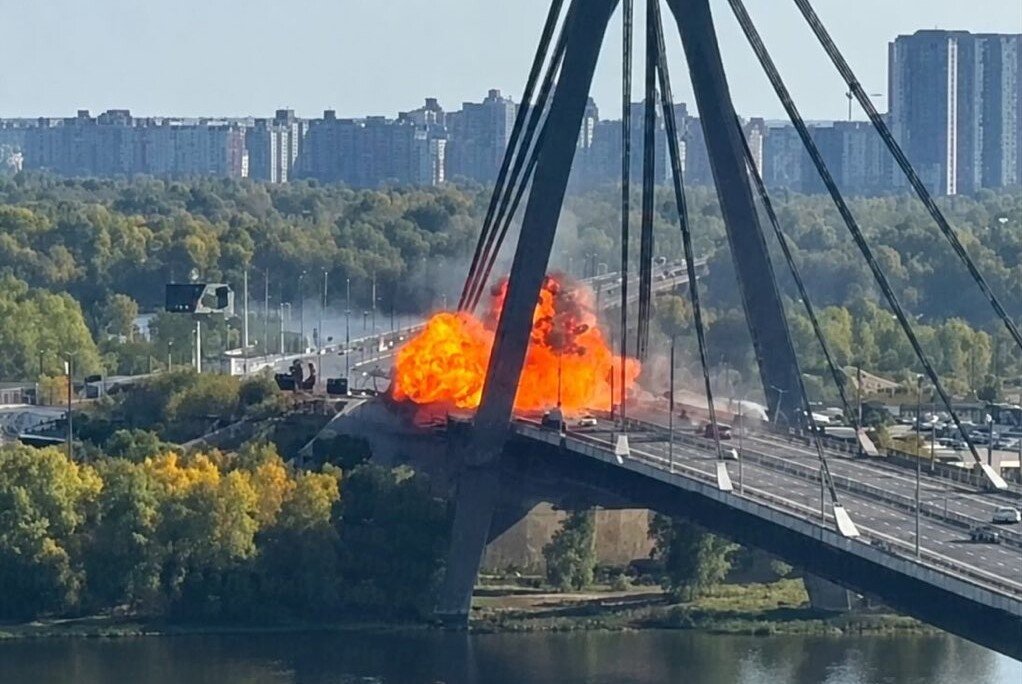
Russia wants to cause Kyiv’s economic collapse, and pontoon bridges are being prepared in the city. There is now no doubt that the Russian army has begun a systematic effort to disrupt transport between western and eastern Kyiv. Over the weekend, further drones struck several bridges across the Dnipro.
They included the Northern Bridge, which a Russian drone attacked during the day amid heavy traffic.
🚨 BREAKING: Russian forces launched a drone strike hitting the Northern Bridge in Kyiv, damaging the road surface.
The strike coincides with German Chancellor Friedrich Merz’s unannounced visit to the capital to meet with Ukrainian leadership. pic.twitter.com/j1UHYoBMa7
Ukraine’s transport minister Mykola Kalashnyk said 600,000 cars cross Kyiv’s bridges every day. In an interview with Suspilne, he announced that construction of embankments and pontoon bridges would begin this week. If the existing bridges become impassable, they are intended to maintain as much traffic as possible between the river’s two banks. Kalashnyk said the temporary crossings should have at least half the capacity.
However, this will take around three months; in the meantime, work will also be carried out to improve the resilience of road bridges.
Transport expert Dmytro Bespalov is sceptical. As he said in an interview with NV, Kyiv’s bridges are irreplaceable, and the only thing that can keep traffic moving across the Dnipro is the military.
However, the task of keeping the bridges operational is complicated by their poor technical condition. Because of their age and the lack of maintenance funding, Bespalov rates the Southern and Northern bridges at four on a scale of one to five, where one is ideal condition and five is emergency condition. He says two other bridges are at level five.
Even in this condition, such large structures are not easy to destroy, but they are certainly more vulnerable. Like many others, Bespalov believes that Russia lacks the means to destroy the bridges completely and is seeking to disrupt traffic during the winter. “The aim is probably an economic blow. I fear it will be very painful. It will not kill us, but I am very concerned about the economic consequences it will have,” he added.
Air defences neutralised 83 percent of drones launched in September, compared with 92 percent in May. This follows from data by the Shahed Tracker project, which recorded 6,732 Russian drones launched against Ukraine over the month, of which 5,561 were shot down or disabled through electronic jamming.
Shahed type OWA-UAS stats Sep2026 [per UA Air Force Reports]
As the same source’s chart for August shows, the effectiveness rate did not change, but the number of drones launched by Russia rose sharply month on month by almost 1,600.
Shahed type OWA-UAS stats Aug2026 [per UA Air Force Reports]
In May, when Russia used a record 8,150 drones, it was as high as 92 percent. At that time, the Russian army began a mass transition to jet-powered drones, leading to a temporary slowing of the pace of attacks. The trend is now unfavourable: monthly attack statistics have begun to rise sharply, while the effectiveness of countermeasures is declining, as Geran-4 drones and especially Geran-5 drones still present a serious problem.
Shahed type OWA-UAS stats May2026 [per UA Air Force Reports]
Total: 8150 (New Record) Claimed Intercepted: 7476 (Official: 5053 Shahed type OWA-UAS) Hits: 508 (674 Not Intercepted) Interception Rate: ~92%
As another video showing the moment a Geran-5 was hit demonstrates. Technical solutions already exist, but faster interceptor drones are not yet available in sufficient numbers.
Another Geran-5 drone shot down by a STING S interceptor drone from Wild Hornets. Combat work by pilots of the 1020th ZRP. pic.twitter.com/kkPHaCIrKG
One TM-62 anti-tank mine contains seven and a half kilograms of explosives. This is enough to destroy the remains of a building used as a shelter by Russian soldiers.
❗️A Ukrainian heavy Baba Yaga-type drone destroys a building with Russian soldiers inside by dropping a TM-62 anti-tank mine. pic.twitter.com/XClgIqMvwe
A video recently circulated online showing Kyiv residents protesting against tree felling. It was widely used as alleged evidence that Ukrainians have had enough of the government. However, their protest was civic, not political. These Muscovites are communists and dared, very timidly, to chant “Down with the tsar!” Police intervened immediately.
У Москві комуністи зібралися на погоджений мітинг, почали скандувати «Долой царя», і після цього їх побили й розігнали мусора. pic.twitter.com/MD6MVxSBPS
This video must be watched with the sound on. It illustrates the saturation of the battlefield with drones. The Russian soldier who recorded it says he counted five drones.
"I’ve already counted five. It’s a damn swarm." position of 🇷🇺1199th Motorized Rifle Regiment (probably occupied south 🇺🇦) 🍂 is coming pic.twitter.com/K9H3wcRdse
Three lines of anti-drone barriers protect the Kerch Bridge, which links Crimea to Russia, from attacks from the sea.
Exilenova+ says Russia has set up layered defenses around the approaches to the Crimean Bridge, with multiple lines against Ukrainian surface and underwater USVs plus FSB patrol ships. The stated aim is to shield the bridge’s vulnerable elements. pic.twitter.com/rxMPPe6gXW
By Monday (5 October), Russia had verifiably lost 24,170 pieces of heavy equipment (24,138 on Tuesday, 22 September). Of these, 19,133 (19,105) were destroyed by Ukraine, 1,003 (1,000) damaged, 1,194 (1,194) abandoned by their crews and 2,840 (2,839) captured by the Ukrainian army. This includes 4,452 (4,448) tanks, of which 3,357 (3,353) were destroyed in combat.
Ukraine lost 12,238 (12,175) pieces of equipment, of which 9,633 (9,579) were destroyed, 711 (702) damaged, 695 (695) abandoned and 1,199 (1,199) captured. This includes 1,466 (1,464) tanks, of which 1,126 (1,125) were destroyed in combat.
Note: Neither side regularly reports on its own dead or destroyed equipment. Ukraine publishes daily figures for Russian casualties and destroyed equipment, which cannot be independently verified. This overview uses data from the Oryx project, which has compiled a list of equipment losses documented exclusively by photographs since the beginning of the war.
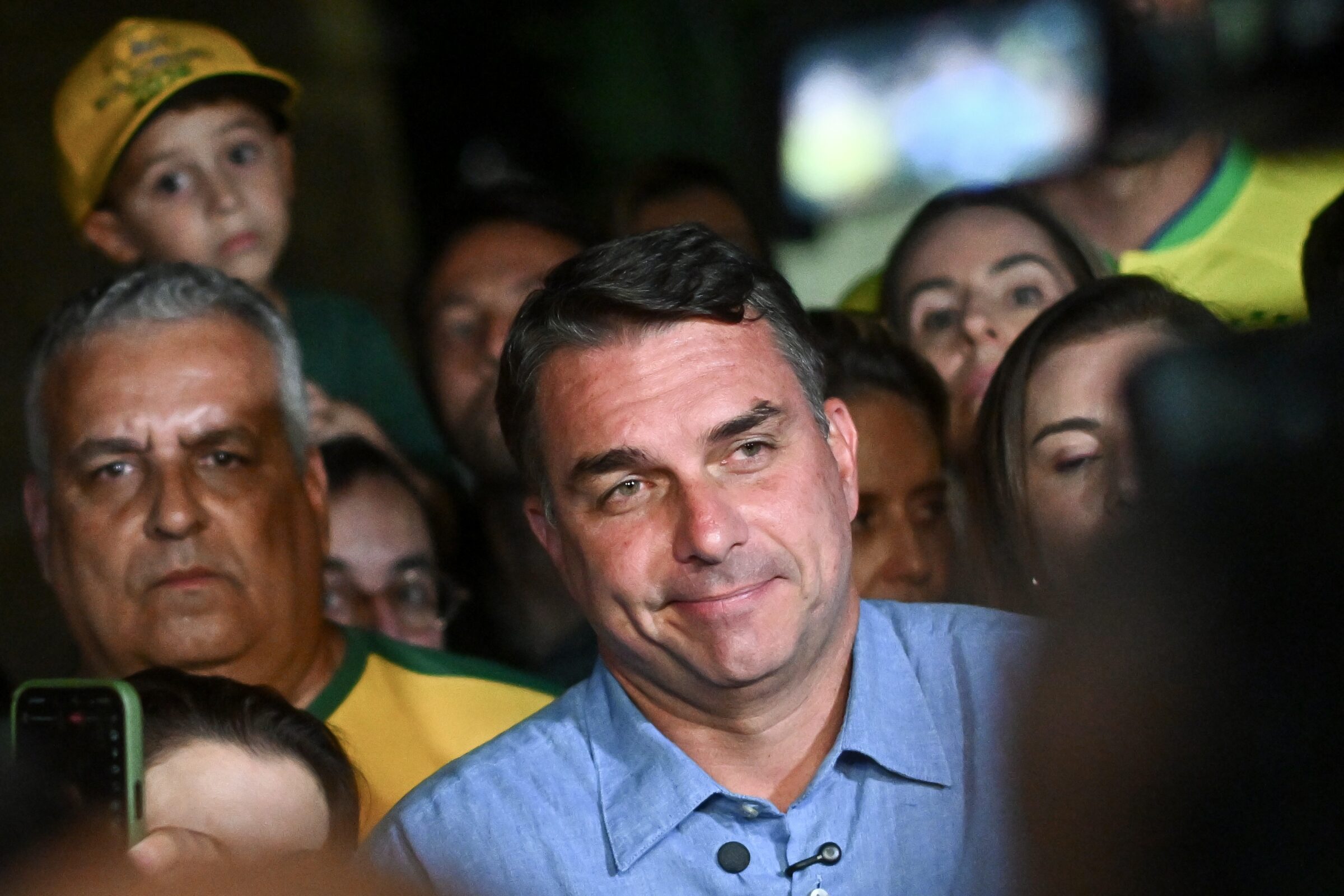
Flávio Bolsonaro surprisingly topped the polls in the first round of Brazil’s presidential election on Sunday (4 October), making him the favourite to topple President Luiz Inácio Lula da Silva in the run-off in three weeks.
The result is the latest in a series of strong performances by far-right candidates in Latin America. US president Donald Trump has been particularly invested in Brazil.
Despite lagging behind in most pre-election polls, senator Flávio Bolsonaro (45), the son of former president Jair Bolsonaro, won around 47 percent of the vote, with votes from more than 99.9 percent of districts counted. Bolsonaro was strongest in the country’s southern states.
President Lula took 45 percent, after performing strongest in Brazil’s north-east, and advanced to the second round, to be held on 25 October.
Latin American experts believe thatBolsonaro will likely win the second round as most of the candidates who failed to reach the runoff are ideologically closer to him than Lula.
Although voting is compulsory in Brazil, one in five of eligible voters did not take part in the first round.
This year’s election has been widely described as one of the most significant in modern Brazilian history, its outcome exceptionally important for the United States and Europe. It is also key for the rest of the planet, given the global impact of deforestation in the Amazon rainforest.
Conservative forces aligned with Bolsonaro also made gains in the elections to Congress. Jair Bolsonaro’s wife Michelle won a senate seat. She had previously fallen out with Flávio but the two have since publicly reconciled. And the former president’s son Carlos Bolsonaro also won a seat, while another son, Jair Renan, was elected to the lower house of congress.
Trump’s stake in Brazil
Though the campaign focused primarily on domestic issues, particularly the economy, security and corruption, Trump’s influence loomed large.
Trump criticised Brazil’s judiciary when Jair Bolsonaro was sentenced to 27 years following an unsuccessful attempted coup after he narrowly lost the 2022 election to Lula. The former Brazilian president is under house arrest due to health problems, and a court ruled he could not stand.
The US president described the trial of Bolsonaro as a “witch hunt”. Although Trump did not openly endorse Flávio Bolsonaro, Bolsonaro played up his ideological proximity to him.
In contrast, Lula sharply criticised Trump and built a reputation as a leader unafraid to stand up to Trump. Americas Quarterly editor Brian Winter said some in Brazil joke that Lula’s most effective surrogate is Trump.
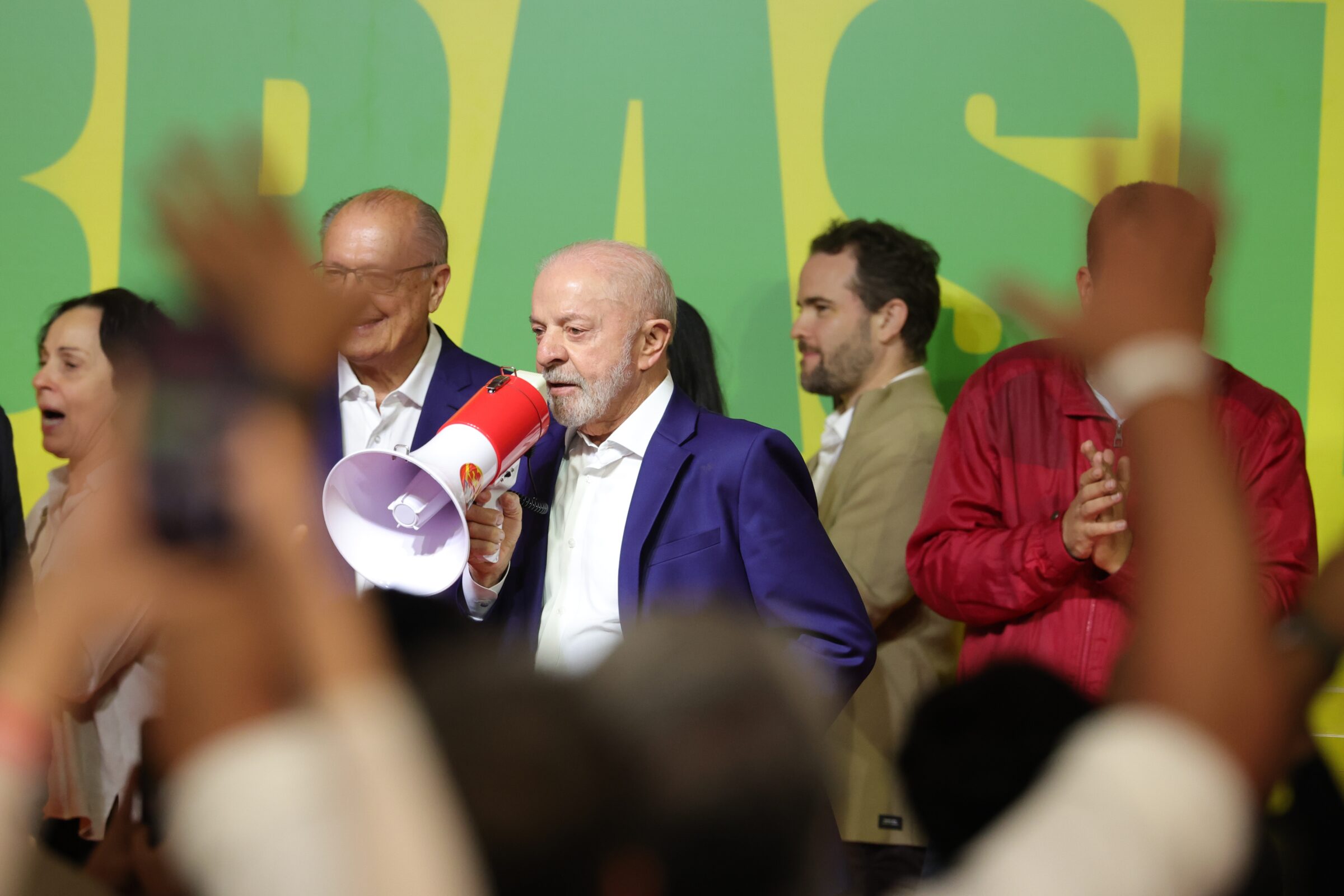
Luiz Inácio Lula da Silva delivers a speech after learning the official results election on Sunday (4 October).
Lula is known for his multipolar foreign policy. He seeks “pragmatic relations” with the US, China, Russia and others. Lula maintains friendly relations with Vladimir Putin, although he recently spoke out against the invasion of Ukraine.
If Bolsonaro were to win the second round, Brazil would probably join a coalition of countries conducting military operations against drug cartels alongside the Pentagon. It is a controversial initiative, and like other left leaders in the region, Lula has rejected it.
This article continues, but the full version is available only to EUobserver.com subscribers. Visit account.euobserver.com/membership
EUobserver is proud to have an editorial partnership with Europod to co-publish the podcast series “Briefed” hosted by Léa Marchal. The podcast is available on all major platforms.
Find the full transcript below:
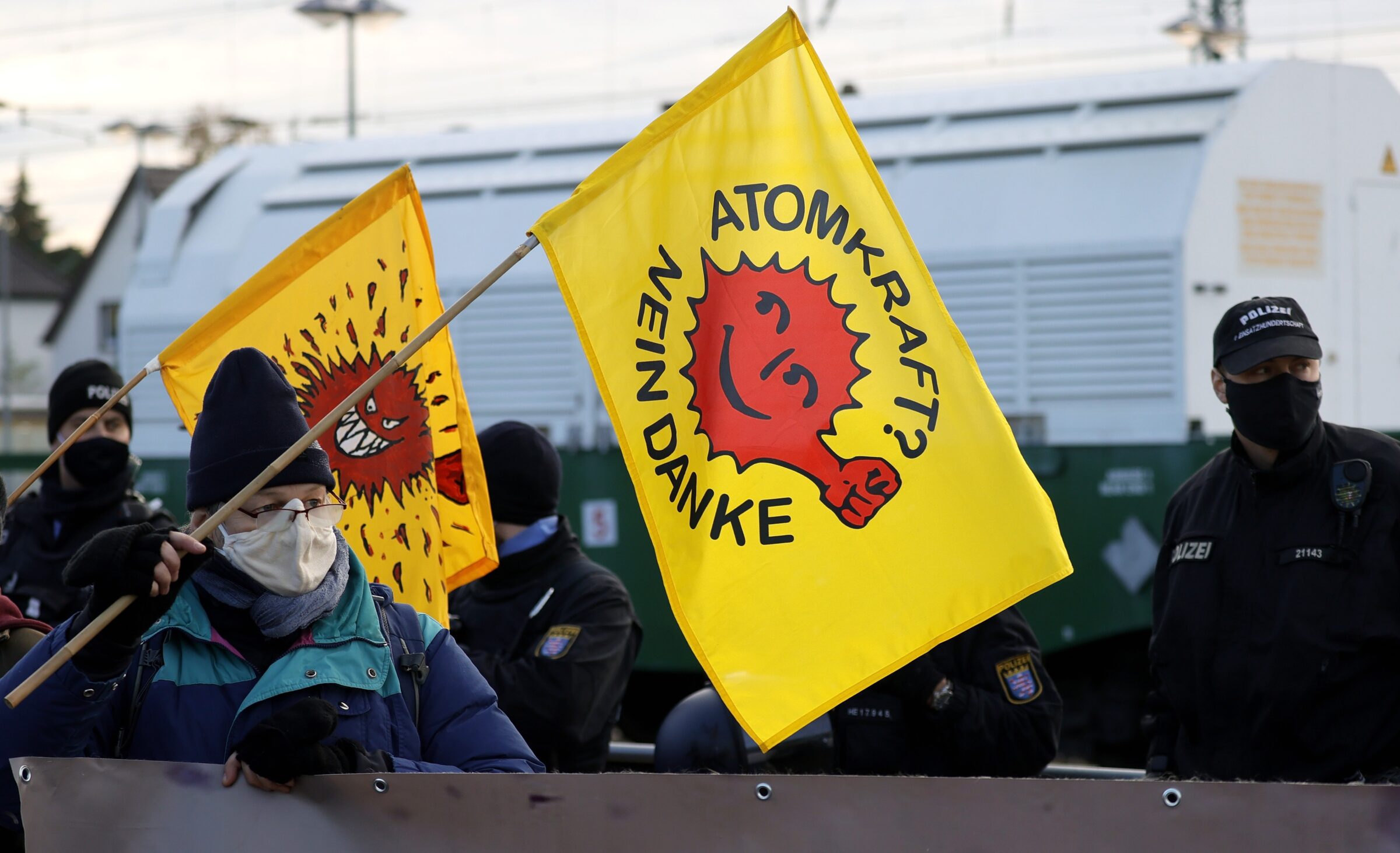
Germany shut down its last nuclear power plants in 2023, bringing Angela Merkel’s nuclear exit policy to its conclusion. But now, nuclear power is making a strong comeback everywhere in Europe. Will Germany return to nuclear policy?
Until now, German chancellor Friedrich Merz had been reluctant to bring the nuclear topic on the table, partly because there was no agreement within his coalition. He has even said that Germany’s nuclear phase-out was irreversible. But that position is not shared by everyone in his own party.
And as support for the far-right AfD (Alternative for Germany) grows — a party that is strongly in favour of nuclear power — nuclear energy is becoming less politically taboo in Germany.
According to a non-public document sent by Berlin to other EU member states and reported by the media Euractiv (currently Rapporteur), the German government wants nuclear energy to be taken into account when the EU sets its climate targets for 2040.
For now, those discussions focus on renewable energy. Germany is not proposing to abandon renewable-energy targets, but rather to leave room for other low-carbon technologies, including nuclear power and carbon capture.
The logic is similar to the debate over the EU’s 2035 target for new cars: the overall objective remains, but countries could have more flexibility over how they achieve it.
And that proposal is likely to be welcomed in France. But could they convince a majority of EU countries? The picture across Europe is changing.
Many EU countries already operate nuclear power plants, while others are building new reactors or considering a return to nuclear. Italy, for example, is looking to revive a nuclear industry after abandoning nuclear power following the 1986 Chernobyl disaster.
Poland has never operated a nuclear power plant, but it is now developing its first one. And several other countries that currently have no reactors are seriously considering building them.
Only a small group of EU countries remain opposed to developing nuclear power, including Austria, Portugal, Luxembourg and Malta.
So why has nuclear power become more politically acceptable again? The legacy of Chernobyl and Fukushima still matters. But Europe’s energy crisis following Russia’s invasion of Ukraine has also changed the debate.
The shock of soaring fossil-fuel prices has encouraged governments to look for energy sources that can provide electricity without relying on fossil fuels — and nuclear power is increasingly being presented as one of them. Although there are major questions around that argument.
Nuclear power can provide large amounts of low-carbon electricity once a reactor is operating. But building and renovating reactors is extremely expensive and can take decades.
Take France’s Flamanville reactor: its final cost has been estimated at around €23bn , compared with an initial estimate of around €3bn.
There are also questions over nuclear waste, the risk of accidents, and the security of uranium supplies. European countries remain partly dependent on foreign suppliers, including Russia, for uranium.
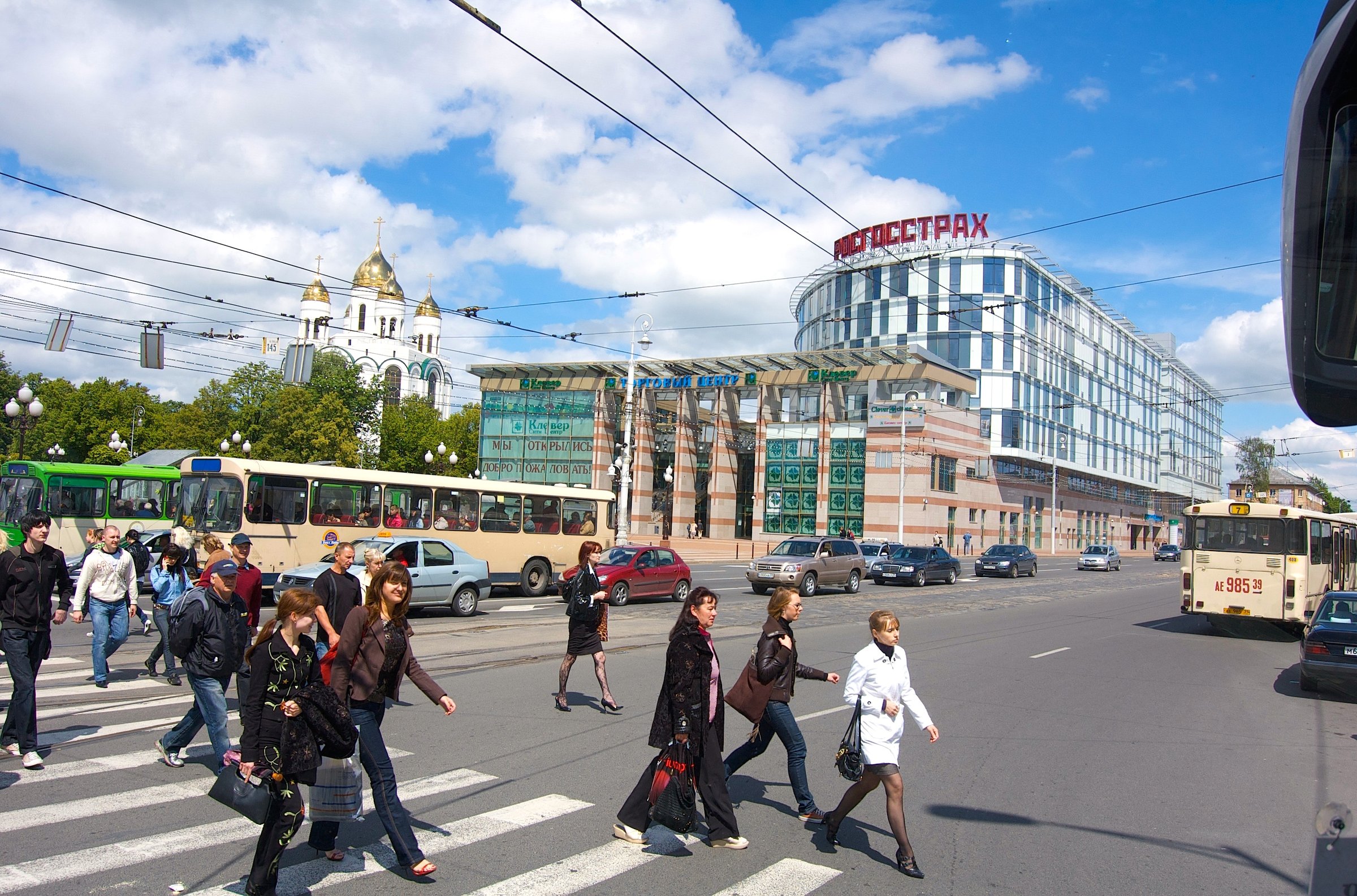
Russia will use nuclear weapons if Nato tries to blockade Kaliningrad. That was the blunt warning from the Kremlin last week. In truth, this is an empty threat against an invented danger. Russia’s nuclear bluff is worn out from overuse, and Nato has no such intention.
But the outburst does signal something useful: Russia’s sensitivity about Kaliningrad.
The northern half of the former German territory of East Prussia is the Kremlin’s last great trophy from the Soviet victory over Hitler in 1945.
Like many trophies, it is less impressive on close inspection. Kaliningrad is an artificial creation, from its name (after the war criminal Mikhail Kalinin) to its population (imported after ethnic cleansing) and its southern border (a crude straight line, of the kind European colonists inflicted on African countries).
Now Moscow’s grip on this exclave — an island of Russian territory sandwiched between Poland and Lithuania — is increasingly fragile. Not because anyone will sever the precarious air, sea, and land routes that keep it supplied, but because of Russia’s all-too-real, corrupt, authoritarian, and incompetent system of government.
The weakness of the Russian system, aggravated by the cost of the disastrous war in Ukraine, makes holding on to Kaliningrad unsustainable: economically, socially, demographically, and politically.
Outside commentary mostly misses this, depicting Kaliningrad as a fortress from which Russia can menace its neighbours.
It is more realistic to see it the other way round, as Russia’s greatest strategic vulnerability: an Achilles’ heel.
The name poses an implicit question: do you really believe that Kaliningrad will still be under Moscow’s rule by the middle of the century? It looks increasingly unlikely.
BISC will this week convene 20 experts for crisis simulations examining how Kremlin rule might unravel, and how neighbouring countries could, would, and should react.
The causes are imaginary, for now. But an environmental disaster, a breakdown in fuel supplies, or a public-health emergency, such as the one now unfolding in Siberia, are all entirely possible in Russia’s current ramshackle state. Decision-makers will have to react to the resulting refugee flows, pollution, and humanitarian needs.
We do not yet know the BISC study’s outcome: as with military ‘war games’, the aim of these exercises is to test how different scenarios play out. We hope the conclusions will be useful for those who deal with these dilemmas in real life.
Next up will be a book, Fragile Fortress, to be published later this year. Edited by the British Russia-watcher Christopher Peters, and written by local and foreign experts, it explores topics including memory politics, economic weaknesses, internal repression, and the state of public opinion. The main message: Kaliningrad survives only thanks to economic subsidy and political support from Moscow.
These efforts could hardly be more topical.
While the Kremlin blusters about a threat from Nato, social media scare stories depict supposed Russian invasion plans to be launched from Kaliningrad, with maps showing thick red arrows piercing the Suwałki Gap, a strategic stretch of land which links Poland and Lithuania.
But as the book’s military chapter shows, such an attack is impossible in current (or likely) conditions. Russia has almost no ground forces left in Kaliningrad: they have all gone to Ukraine. Nor does the Russian air force there have the kind of airfields and hangars needed for a real war.
Nato, especially since Sweden and Finland joined the alliance, is overwhelmingly dominant in land, sea, and air in the region: a point underlined by its recent surveillance exercises in the region.
In short, the nuclear bluster is irrelevant. Nobody is menacing Kaliningrad from the outside. And the real question is when and how, but not if, the Kremlin will lose it in the end.
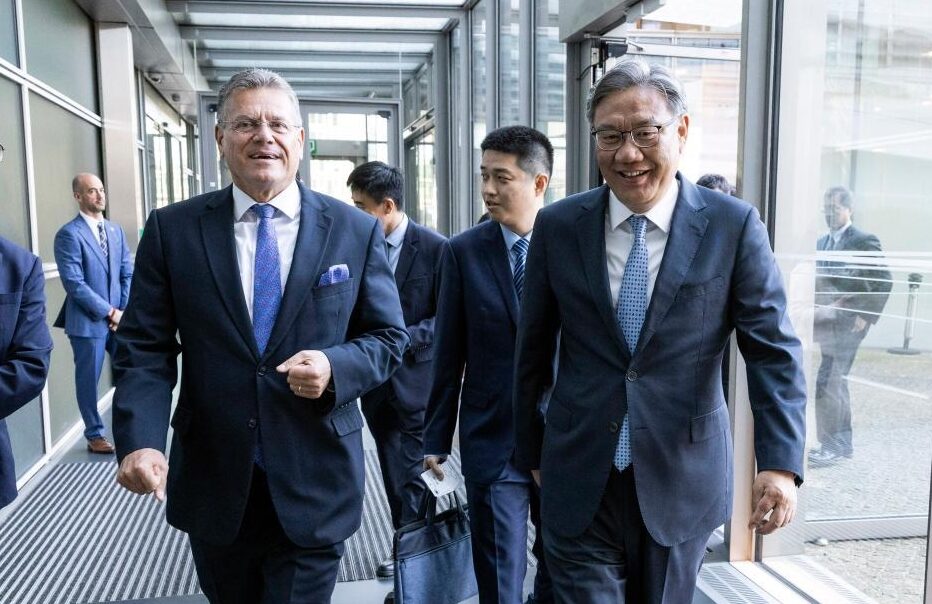
EU trade commissioner Maroš Šefčovič and Chinese commerce minister Wang Wentao are meeting in Beijing on Thursday (8 October) to discuss China’s growing trade surplus with the EU.
The surplus reached a record €360.6bn in 2025, up 15 percent from 2024, and widened another 10 percent in the first four months of this year.
The visit follows a meeting in Brussels in June, where Šefčovič said he wanted the dialogue to deliver tangible results by October, and the two sides set up working groups on trade balance, export controls, intellectual property and WTO reform. China has sent mixed signals, with Beijing reportedly showing openness to purchase agreements for European goods and possibly lower tariffs, while China’s commerce ministry insisted Brussels should not treat China as the source of the EU’s problems.
The EU put tariffs on Chinese electric cars in 2024, with extra duties ranging from 7.8 percent to 35.3 percent depending on the manufacturer. But hybrids weren’t covered, and Chinese hybrid exports to the EU jumped from 3,800 vehicles in October 2024 to roughly 50,000 in July 2026, adding to pressure on European carmakers already struggling to compete with Chinese manufacturers.
Šefčovič will also be hoping to secure assurances from his Chinese counterpart on access to rare earths and minerals for European companies, with a one-year moratorium on extra restrictions on rare earth and minerals exports from China – which also applies to the United States – due to expire in the coming weeks. In June, China assured Šefčovič that existing controls on rare earths and permanent magnets would not disrupt EU supply chains.
Meanwhile, there have been reports of some German companies stockpiling rare earths in case the Šefčovič-Wentao talks fail to break the deadlock and China imposes new export controls in retaliation for the EU’s ‘Made in Europe’ plan to protect its industrial supply chain.
If the Beijing talks fail, Germany and France could push for tougher measures at next week’s EU leaders’ summit, including a cap on Chinese hybrid-car exports, preference for European vehicles in public procurement and tighter limits on Chinese takeovers of European companies.
But China recently said it would “respond firmly” if the EU imposed restrictions on Chinese businesses or products.
Long-delayed accession reforms
In Strasbourg on Tuesday (6 October), the European Commission is expected to present its long-delayed pre-enlargement policy reviews to prepare the 27-nation bloc for the integration of candidate countries like Montenegro, Albania, Ukraine and Moldova.
EU capitals fear that enlargement could disrupt businesses and that new member states could use their veto to block decisions.
In response, the commission proposal is set to rely less on consensus and more on majority voting, including in sensitive areas such as security and defence, sanctions, human rights and enlargement itself – a change that could help speed up bids such as Ukraine’s.
Ironically, to get rid of unanimity in certain votes, von der Leyen’s proposal will need the unanimous approval of all 27 member states.
The text is also expected to set temporary limits on new members’ vetoes, longer safeguard periods, and cut the number of commissioners to two-thirds of the number of member states, with equal rotation.
Alongside the internal rules review, the commission is expected to unveil a revision of the standardisation regulation to fix gaps and increase transparency.
On Monday (5 October), EU chief diplomat Kaja Kallas will host Moldovan PM Vasile Tofan in Brussels for a regular meeting on the progress of the country’s association bid.
The Eurogroup will also meet on Thursday in Luxembourg while EU financial ministers will meet on Friday.
On Wednesday, they will debate priorities for the EU budget for 2028-2034 (the Multiannual Financial Framework – MFF) with signals of more money for Erasmus+.
And MEPs will vote on Tuesday on whether to inject €115m into a pilot programme to accelerate the development of military technologies called Agile. This comes as Putin escalates hybrid warfare against Europe.
Controversy is expected ahead of a vote to scrutinise the funding and political influence of Islamist groups in Europe. European Conservative and Reformists (ECR) have previously called for the Muslim Brotherhood to be considered terrorists.
Those feeling stressed in their jobs can look forward to mental health protections for workers if parliament votes to ask the commission to propose new rules for EU employers.
Portuguese prime minister Luís Montenegro will deliver a speech on Tuesday.
And a debate with Ursula von der Leyen and the Irish Council presidency will shape priorities for the EU summit later this month, 15-16 October.
Plenary talks will also address the migrant surge in the Spanish enclave of Ceuta this summer and how Europe should respond.

 Login