❌

Reading view

Hundreds of US soldiers being deployed to Latin America, according to NYT

The New York Times reported on Wednesday that the US government is preparing to send troops to Latin America under the pretext of combating drug trafficking in the region.

According to the US publication, 600 troops from the 10th Mountain Division at Fort Drum, NY, have already begun deploying to the jungles of Panama to conduct exercises alongside the local military.

In addition, it was reported that members of this detachment will participate in operations in other countries in the future: “The troops will eventually train with local forces in Colombia and Honduras, and could also support US Special Operations troops advising militaries conducting raids against accused drug traffickers, the officials said.”

The peoples of the region, alongside anti-imperialist and progressive forces, have long denounced decades of US military intervention in Latin America and the Caribbean. Various experts and analysts have shown that “war on drugs” projects have never led to the elimination of these illicit businesses. On the contrary, US military involvement has coincided with an increase in violence, drug production, but most importantly: neoliberal reforms. These reforms involve the dismantling and reduction of the state, the privatization of all possible dimensions of social life, and the destruction of social organizations that oppose neoliberalism.

Read more: What else is behind the “fight” against drug trafficking in Latin America?

Historically, this process of material dispossession has been facilitated by an expansion of US military presence, under the pretext of the “war on drugs.”

The report stated: “The deployments and growing headquarters, which have not been previously reported, along with the Pentagon’s recent movement of several MQ-9 Reaper drones from Africa to Colombia and Ecuador, mark the latest widening of the Defense Department’s fight against drug traffickers in the region.”

Shield of the Americas

For several months now, US forces have been participating in intelligence activities and supporting military operations in Ecuador, whose government has entered into agreements with the US to allegedly fight organized crime. However, it was later revealed that these operations didn’t target drug traffickers at all. In at least one instance, The New York Times reported that the US and Ecuador bombed a dairy farm.

This collaboration is part of the new military and geopolitical strategy led by the Trump administration, embodied in the agreement known as “Shield of the Americas.” In recent meetings, several governments have committed to working with the United States so that their militaries can carry out joint operations in Latin American countries.

Regarding the possible itinerary of the soldiers who are expected to arrive in Panama, The New York Times reported: “The soldiers will move first into Panama, where they will take part in jungle training exercises, officials said. From there they will head to Colombia, where they will participate in what officials have called Southern Vanguard, an exercise scheduled to begin later this month. Other rotations will move into Honduras for training with local partners. Some of the troops could be used to provide additional security for US helicopters in the region, which have been providing support for US Special Operations forces.”

For about a year now, the United States has been conducting airstrikes on small boats in the Caribbean Sea and the Pacific Ocean that Washington claims are linked to drug trafficking. Over 200 people have been killed in the strikes and the majority of the victims appear to be fishermen from Venezuela, Colombia, Trinidad and Tobago, and other island nations. Victims’ families and survivors have vehemently denied any connection to criminal groups.

Washington claims the report is false

For its part, the US Embassy in Panama stated that The New York Times report regarding the deployment of several hundred US soldiers to the Caribbean nation is untrue: “The New York Times article alleging the deployment of 600 US soldiers to Panama is categorically false.”

The US Embassy reported that 120 US military personnel are currently participating in a training course in the Panamanian jungle, but that these troops will return to the United States on October 25 and therefore will not undertake the deployment announced by Colombia and Honduras. It did report that other US military personnel will participate in exercises in Peru.

“This is nothing new. The Jungle Operations Training Center has been operating for over a year as a school officially recognized by the US Army. US and Panamanian instructors jointly provide training in survival techniques and jungle operations,” the US Embassy in Panama said in its statement.

The controversy between The New York Times and US diplomatic officials over this report comes amid an evident increase in the US military presence in the region. In addition to operations in the Caribbean and the Pacific, there was the military incursion into Venezuela on January 3, 2026, which resulted in the capture of then-President Nicolás Maduro and his wife, Cilia Flores, as well as the deaths of more than 100 people in Venezuela. Furthermore, President Trump himself has suggested that he could attack Cuba and any other country if US security is compromised.

  •  

Madrid teachers and students launch strike to defend public schools

The public education system in Madrid – teachers and students alike – launched an indefinite strike on Wednesday, October 14. Tens of thousands emptied classrooms and took to the streets, demanding an end to the regional government’s education policy – warning that it promotes privatization.

Episodes of police violence were reported near part of the education sites.

Read more: Spanish unions announce general strike over housing

A joint union front, including sectoral branches of the General Union of Workers (Unión General de Trabajadores, UGT), the Workers’ Commissions (Comisiones Obreras, CCOO), and the General Confederation of Labor (Confederación General del Trabajo, CGT), among others, started building the mobilization months ago. 

While preparing the strike, they tabled demands including wage increases, investment into education infrastructure, and smaller class sizes.

A strike to defend quality public education

“Madrid’s teachers have said ‘enough is enough’ in the face of regional policies that seek to dismantle public services in favor of private management, demonstrating a profound contempt for the inclusive school, one that equalizes, protects, and guarantees real opportunity for the future of children and the working class,” the union front stated.

“This strike is not just for teachers,” UGT Public Services Madrid emphasized in a statement. “We are defending quality public education for students and their families, who are the ones who suffer the consequences of overcrowded classrooms and staff shortages.”

Students on the first day of the strike. Source: Sindicato de Estudiantes

Union demands were endorsed by students, including the student union Sindicato de Estudiantes. “Ceilings are crumbling, there is no air conditioning, facilities are outdated, and students are forced to learn in makeshift and portable classrooms or overcrowded spaces,” the organization stated.

Student union recognizes strike’s “decisive moment”

Students and teachers insist on the responsibility borne for the crisis by the regional People’s Party government led by Isabel Díaz Ayuso. Ayuso was also an often-quoted name in recent housing mobilizations in Madrid, where demonstrators linked the right-wing party’s policies with the ongoing housing crisis – including the eviction of Maricarmen Abascal.

The education strike, Sindicato de Estudiantes wrote, is a “way to involve the entire working class and youth against a reactionary government that not only does business with public education, but is selling our neighborhoods to vulture funds and rentier landlords who speculate on housing, one that steals money from public health to hand it to companies and the corrupt …”

Read more: Students in France are fighting for stronger public education

In their communications, student associations echoed the historic school strikes taking place in France. “Also very present in the minds of Madrid students, as in the entire State, are the events shaking France and Belgium: the enormous student strikes of our colleagues that have filled Paris and dozens of cities, and the brutal police repression that they have had to endure,” they wrote. “We know that we are in a decisive moment, and like them, we will fulfill our task.”

Strong adherence to the education strike gives hope for an even stronger mobilization on November 11, when Spain’s labor movement has called for a general strike to increase wages, fight against the cost of living crisis, and overhaul the country’s housing policy.

  •  

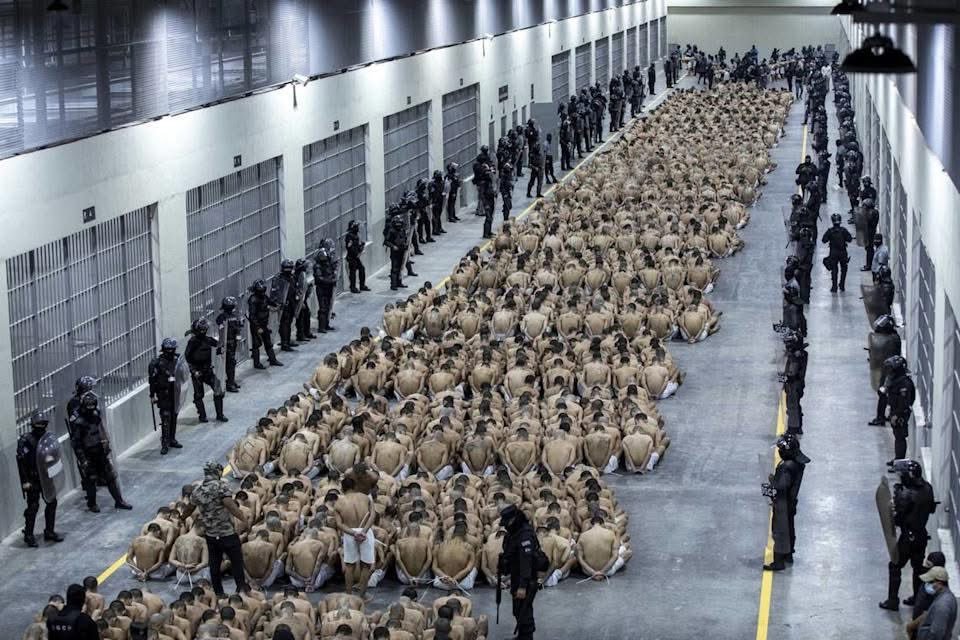
Bukele announces a possible mass release of inmates

El Salvador’s President Nayib Bukele announced on October 13 his intention to release nearly 50% of the prisoners accused of collaborating with gangs in the country. According to the president, the measure would involve early release, albeit conditional.

“We have a plan that would benefit roughly 50% (give or take) of the prisoners in El Salvador who have collaborated with gangs … In other words, early release – meaning they are guilty but are released conditionally. Released under supervision,” Bukele told the press.

In this regard, he said that his government would evaluate the situation of each detainee to keep the country free from the structural violence that has plagued it for decades: “Considering that we come from a country where violence was part of everyday life and gangs were the real government, the real dictatorship. These people lived under that yoke, but it is not the same to be among those who enforced it as it is to simply survive that reality.”

If we take into account the figure provided by the authorities (according to which nearly 100,000 people are currently detained on various charges) this could mean the release of tens of thousands of people.

Domestic criticism of El Salvador’s mass incarceration

Before Bukele took office, El Salvador was in the throes of a severe crisis of insecurity and violence. His administration imposed a perpetual state of emergency that began in 2022 and has led to the imprisonment of thousands of Salvadorans accused of belonging to gangs (or “maras”) that controlled large swaths of the Central American country.

And while the pacification of the streets has been celebrated by a significant portion of the population, the harsh actions of the government and its police and military forces have drawn criticism from various human rights organizations, which have accused the government of excessive use of force, mistreatment of prisoners, and the unjust detention of individuals who do not belong to gangs.

Read more: CECOT: Bukele’s mega prison where “the only way out is in a coffin”

Another criticism has been leveled at the practice of mass trials, which charge and convict a large number of people at the same time. Rights groups say this has led to countless errors in the treatment of individual defendants. Added to this are allegations of arbitrary detentions, crimes against humanity, and disappearances.

International outrage at 252 Venezuelans detained in El Salvador

The prison system implemented by Bukele in El Salvador has also faced international criticism. The Central American country became a focal point of controversy when hundreds of people deported from the United States were detained in the Salvadoran prison system, which drew widespread criticism of the Bukele government.

Bukele, however, had defended the decision and reaffirmed his alliance with the Donald Trump administration and his participation in the Washington-led geopolitical and military initiative known as Shield of the Americas.

Read more: Maduro gov’t negotiates return of 252 Venezuelans detained by US in El Salvador

The news of the possible release of tens of thousands of detainees sparked even more intrigue, considering that Bukele’s announcement came immediately after his conversation with US Secretary of State Marco Rubio, in which they discussed combating “malign foreign influence.” However, it remains unclear how the two issues are linked, according to El País.

  •  

Brazil’s Congress ends 6×1 work schedule

The approval of Constitutional Amendment Proposal (PEC) 221 of 2019 by the Federal Senate establishes the most profound alteration in the organization of the Brazilian work schedule since the promulgation of the 1988 Constitution. The text eliminates the model of six days of work followed by one day of rest and sets a maximum work week of 40 hours with two paid weekly rest days, without salary reduction.

Because it is a constitutional amendment, the text does not depend on the sanction or veto of President Luiz Inácio Lula da Silva (PT). Promulgation is the responsibility of the presiding officers of the Chamber of Deputies and the Senate in a joint session of the National Congress. Once promulgated and published in the Official Gazette of the Union (DOU), the amendment enters into force in a phased manner, with specific adaptation periods for companies, professional categories, and the public sector.

Transition timeline

The transition from the 44-hour work week to the definitive model of 40 hours per week and five working days followed by two days off (5×2 schedule) will occur in two main stages:

First stage (60 days after publication): Two months after the amendment is published, workers become entitled to two paid days off per week, preferably on Sundays. At the same time, the weekly working hours limit is reduced from 44 to 42 hours.

Second stage (14 months after publication): after 12 months from the implementation of the first stage, totaling 14 months from the official publication, the maximum weekly workload is definitively reduced to 40 hours, with a limit of eight hours per day.

During the 12-month period in which the 42-hour weekly limit will be in effect, employers must distribute the two extra hours across the weekdays. If distributed evenly across the five working days, the daily work schedule becomes 8 hours and 24 minutes.

Collective labor agreements and conventions may authorize daily work schedules exceeding eight hours during this transitional period to accommodate the 42-hour schedule, provided that the two weekly days off are strictly maintained.

Once the 14-month transition period is complete, any activity exceeding eight hours per day or 40 hours per week will require the payment of overtime or compensation through a time bank, mechanisms that remain permitted under labor law.

Special schedules and shifts

The new constitutional guidelines do not impose a single work schedule format for the entire market and safeguard the operation of continuous activities and essential services. Uninterrupted services, such as hospitals and health units, public safety, public transportation, urban cleaning, and surveillance, may adopt specific models for organizing and compensating working hours through collective bargaining agreements or conventions.

In these areas, the traditional 12-hour work shift followed by 36 hours of rest (12×36 shift) is not automatically eliminated by the PEC, but will need to be adapted at the negotiating table between employers’ and workers’ unions.

The reorganization of shifts must take into account the reduction of the weekly workload and the minimum rest and meal periods stipulated in the Constitution. The text also refers to future specific laws for the complementary regulation of conditions for categories with their own operational characteristics.

In the case of workers subjected to prolonged confinement, such as on offshore oil platforms, amendments proposing prior exceptions in the constitutional text were rejected by rapporteur Omar Aziz. The parliamentarian pointed out that the work regime for offshore oil workers should be subject to subsequent legal regulation.

Compensation and average monthly days off

The proposed amendment allows companies and unions to establish, exceptionally and through collective agreement or convention, work schedule compensation regimes with shifts different from the 5×2 format, including enabling the eventual continuation of the 6×1 shift schedule.

For this flexibility to be valid before the Labor Court, the proposal requires compliance with two mandatory criteria: the worked days off must be fully compensated within the same calendar month; and the worker is entitled to at least one day of rest within a maximum period of one week of service, and must reach, at the end of the month, an average of two paid days off per week.

The three express exceptions

The text approved by Congress establishes differentiated rules and specific conditions for three groups of workers and economic sectors:

Outsourced public administration workers: To safeguard the continuity of essential public services and preserve the economic and financial balance of administrative contracts, outsourced companies providing services to the State will have up to 12 months after the enactment to adjust their work schedules, instead of the general 60-day period. Contracts amended after 60 days from the publication must already comply with the new schedule. If the public authority and the service providers do not formalize an addendum within one year, the reduction in working hours for outsourced workers will automatically take effect, without a reduction in salary.

Professionals with a university degree and salaries starting at R$ 21,100: the so-called “highly qualified workers,” who are employees with a university degree and a monthly salary equal to or greater than 2.5 times the ceiling of Social Security benefits (currently R$ 21,188.87), are exempt from general daily working hour limits and timekeeping. These professionals can negotiate their schedules directly with the company, but retain the constitutional right to two days of paid weekly rest. This exception does not apply to public employees.

Brazilian labor law already provides for situations where there is no traditional control of working hours, such as in the case of employees who hold positions of trust or who work outside the company in activities where it is not possible to control their hours.

Individual micro-entrepreneurs and small businesses: the proposed constitutional amendment (PEC) stipulates that a subsequent complementary law will create transitional measures for mitigation and fiscal or credit support for individual micro-entrepreneurs, micro-enterprises, and small businesses. The granting of these benefits will be expressly conditional upon maintaining jobs and employment levels in these establishments.

Current contracts and old agreements

The application of the new work schedule to existing employment contracts is direct and immediate, requiring no formal re-hiring or termination of employment. The Constitution guarantees the principle of non-reduction of wages, prohibiting any nominal cut or proportional reduction in employee salaries or in the minimum wages of professional categories.

For workers who already work 40 hours a week or less, the amendment does not create a further reduction in weekly working hours. However, these employees will now have a guaranteed right to two paid days of weekly rest.

In the labor union sphere, clauses in previously agreed collective bargaining agreements and conventions that address working hours or weekly rest periods and are incompatible with the new constitutional parameters will lose all legal validity 60 days after the amendment is published.

Impact on the labor market

The shift to a new work schedule affects tens of millions of workers in operational, customer service, and ongoing production roles across the country.

A technical survey prepared by the Inter-Union Department of Statistics and Socioeconomic Studies (Dieese), based on the Continuous National Household Sample Survey (PNAD) of the Brazilian Institute of Geography and Statistics (IBGE), indicates that the measure will directly benefit 26.8 million workers.

The contingent consists of 22 million employees with formal contracts in the formal sector (equivalent to 54% of the country’s formal workers) and approximately 4.8 million informal workers who register weekly work schedules exceeding 40 hours.

Data from the Ministry of Labor and Employment (MTE) indicates that 14.8 million formal workers were directly subject to the 6×1 work schedule in 2025, while another 29.7 million were already working on the 5×2 schedule.

The scope of the change is also reflected in the profile of contracted work schedules in Brazil. Studies by the National Confederation of Commerce of Goods, Services and Tourism (CNC), structured from the Annual Social Information Report (Rais), reveal that 35.7 million workers under the CLT (Consolidation of Labor Laws), about 62% of the formal Brazilian workforce, currently work schedules ranging between 40 and 44 hours per week.

  •  

Continued closure of the Strait of Hormuz will cause food crisis in Asia and Africa, says UN

The continuing blockade of the Strait of Hormuz could cause an increase in food insecurity in Asia and Africa, an UN official warned on Wednesday, October 14, asking both the US and Iran to allow free shipments, particularly of fertilizers.

“It is absolutely crucial to get the deal in the next few weeks. Otherwise, we will miss the planting session,” UN Under Secretary General Jorge Moreira da Silva told Reuters on the sidelines of the ongoing annual meeting of the International Monetary Fund (IMF) and the World Bank in Bangkok, Thailand.

Almost one third of all global supplies of urea and around half of sulphur used to pass through the Strait of Hormuz before the US-Israeli war on Iran began in late February and Iran blocked traffic through it in retaliation.

Most countries in Asia and Africa get their urea products, used in the majority of fertilizers worldwide, from the Gulf nations.

Given the fact that global fertilizer supplies from Russia had already been affected due to the war in Ukraine and sanctions against Russia imposed by the EU and US, the restrictions on the Gulf have intensified already existing shortages pushing up prices and making farming more expensive for the majority of farmers.

Food prices are already rising in different countries in Asia and Africa and it is expected that if the supply constraints remain the same, food production could be impacted and prices will rise further in the coming days, affecting millions of people in the region.

The crisis is further intensified due to the rising cost of oil, particularly diesel which is extensively used in farming.

The Strait of Hormuz was the source of around a quarter of world energy supplies before the war. Despite the claims that supplies of energy have been normalized in recent days the global oil prices remain much higher than the pre-war period.

According to a Reuters’ report, fertilizer supplies from the Strait of Hormuz have remained negligible despite resumption of other shipments including the oil in recent weeks.

Iran asserts control over the Strait of Hormuz

The UN set up a taskforce to facilitate the passage of fertilizers through the Strait of Hormuz in March itself. The taskforce has proposed an interim arraignment to resume the fertilizer supplies through the region with the consent of both the US and Iran.

Iran has demanded that it will only allow normal traffic through the Strait of Hormuz after the US ends its war, lifts its naval blockade on the country, and fulfills its obligations under the interim peace deal signed in June.

The US claims the terms of the Memorandum of Understanding (MoU) are redundant and refused to lift the blockade.

Reuters reported the US State Department reiterating on Wednesday that it will continue to target Iran, accusing it of disrupting freedom of navigation and taking the global economy hostage.

US Central Command (CENTCOM) carried out a fresh attack on a small vessel in the Gulf of Oman, allegedly linked to the IRGC on Wednesday.

The US and President Donald Trump have also repeatedly claimed the Strait was fully under its control and free for all kinds of navigation. CENTCOM also reiterated on Wednesday that Iran has no navy to control the Strait.

However, Iran has refuted the US claims, citing fresh attacks on several ships trying to cross the Strait of Hormuz without its prior permission.

At least two ships, one container ship and a large bulk carrier, reportedly bound for Singapore, sank after allegedly being hit by projectiles on Wednesday.

The IRGC also claimed that another tanker was hit by the Iranian Navy on Thursday after it ignored repeated warnings. The ship carrying oil caught fire in the attack.

“The Americans claim that the Strait of Hormuz is open and they control it, but this claim is far away from the realities on the ground,” Ali Ozmaei, IRGC Navy chief, said on Tuesday, asking the US armed forces to “step into the field and see who is in control of it.”

It blamed US restrictions on media reports for a wrong impression about the status of the shipping through the Strait and repeated that all ships wanting to transit through it must obtain prior Iranian permission if they want to avoid any kind of mishap.

  •  

Netanyahu presses Trump to renew aggression on Iran ahead of Israeli elections

Two weeks before the Israeli legislative elections scheduled on October 27, 2026, the far-right Israeli government, led by Prime Minister Benjamin Netanyahu, has revealed its intentions to further perpetuate and expand its three-year multi-front war across West Asia.

On Tuesday, October 13, Netanyahu appeared in a televised speech during a visit to the apartheid wall established inside the occupied West Bank, threatening the Palestinian Authority.

Standing near the Tulkarm refugee camp alongside Israel’s Defense Minister Israel Katz, the Israeli PM confirmed that the camp’s displaced residents, whom he described as “terrorists,” will not return to their homes despite an order from the Israeli Supreme Court authorizing their return.

The Tulkarm Refugee Camp was among the three largest Palestinian refugee communities in the northern West Bank targeted in the large-scale Israeli military operation dubbed “Operation Iron Wall.”

The operation resulted in the displacement of at least 33,362 Palestinians, the killing and injury of hundreds of others, and the arrest of over 1,000, according to UN estimates. It also caused severe damage and destruction of residential buildings, infrastructure, and properties.

Read more: Israel kills a toddler in Jenin and expands “Iron Wall” operation to Tulkarm

The “Iron Wall,” which was launched in early 2025, was followed by another extensive operation at the end of the year.

Netanyahu’s government claimed that both operations aimed at eliminating Palestinian armed groups in the targeted areas. However, for many the outcome of the operations makes clear that their objectives reflect Israel’s ethnic-cleansing policy against the Indigenous Palestinian population.

Critics accuse Netanyahu of manufacturing rivals to bolster political survival

As those operations have seemingly resulted in largely restraining resistance groups across the West Bank, no valid pretext has been left for Netanyahu’s government to further escalate military operations in the occupied territory.

Therefore, Netanyahu has sought to designate a new enemy posing a potential threat to Israel’s security: the Palestinian Authority (PA), whose security apparatus represents the only remaining armed force on the ground today.

The stance and actions of the PA under President Mahmoud Abbas have been, for over two decades, marked by compliance, reconciliation, and on some occasions blatant collaboration with the Israeli authorities. 

Thus, accusing the entire political entity of orchestrating hostilities against Israel would not have sounded credible to the public. This arguably led Netanyahu and Katz to formulate the pretext for a justified potential war against Palestinians in the West Bank by alleging that personnel of the PA’s security forces, alongside members of the Fatah-affiliated Tanzim, may defect and launch “Jihadist attacks” against Israeli forces and settlers. 

It’s worth noting that the majority of the PA’s security forces are affiliated with Fatah, the ruling and largest Palestinian faction in the West Bank. Meanwhile, the Tanzim represents Fatah’s grassroots and quasi-military field activity.

“Our enemies are thinking of testing us in these days leading up to the elections,” Netanyahu noted, referring to the PA, during his tour near the apartheid wall.

“I warn them: we are prepared for any scenario, including a so-called reversal of roles. In such a case, I do not suggest our enemies test us. You will face force here that you never dreamed of,” he continued.

Netanyahu’s statements came to reaffirm a “contingency plan,” which Katz revealed last week and said Netanyahu had approved in case the imagined scenario occurs.

Analysts believe a war in the West Bank ahead of the upcoming Israeli elections is not off the table, particularly if Netanyahu and his far-right coalition feel their victory is uncertain.

Early polling ahead of the election consistently shows Netanyahu’s bloc falling short of the 61 seats required to form a majority. It is currently positioned at just 51 to 53 seats.

Even if launching the war does not succeed in delaying the upcoming elections, it apparently aims to strengthen public support for his coalition, which gains much of its backing by pushing for ethnic cleansing to fulfill the “Greater Israel” project.

Israel’s escalating violence and provocations seen as prelude to war in West Bank 

The last few weeks have made clear that Netanyahu’s government previously laid the groundwork for a desired war scenario in the West Bank.

Israeli forces escalated their raids in different parts of the West Bank, focusing on the de facto administrative capital of the PA, Ramallah, and Al-Bireh, which has simultaneously become a flashpoint for settler violence. 

The Israeli military has also launched a campaign, destroying memorials of martyrs and late prominent Palestinian leaders all over the territory.

This included the demolition of a memorial displaying photos of the late Palestinian President Yasser Arafat and other deceased top Fatah leaders in the Al-Jalazone refugee camp north of Al-Bireh city on Wednesday, October 14 – a move that many interpreted as an attempt to provoke indignation, particularly among the movement’s grassroots.

The offensive on Al-Jalazone came one day after the Israeli military launched an expanded operation in Ramallah and Al-Bireh, shutting down Addameer and the Union of Palestinian Women’s Committees (two civil society organizations concerned with documenting violations committed by the Israeli occupation authorities against the Palestinian people).

Journalists were obstructed from covering the raid as Israeli soldiers threatened them with rifles, and fired rubber-coated metal bullets and teargas at them.

As part of the operation, the Israeli forces also raided the courtyard of the Palestine Medical Complex (previously known as Ramallah Hospital), arrested journalist Abdul Qader Hailan, and wounded journalist Yousef Shehadeh alongside two other Palestinian citizens.

Netanyahu reportedly pressed Trump to resume aggression on Iran

While the likelihood of igniting a war in the West Bank is seen as higher and more immediate for Netanyahu and his cabinet, recent media reports indicate he has attempted to persuade US President Donald Trump to resume the aggression against Iran before the Israeli elections.

Even if Trump does not comply with Netanyahu’s demand regarding Iran, the situation in the West Bank foreshadows more tragic events for the Palestinian people and a predicament for the PA in the upcoming weeks.

  •  

US-Saudi war on Yemen was decades in the making

The war in the Middle East is widening and people around the world are feeling the impact. Resistance forces in Yemen have delivered crippling blows to key infrastructure in Saudi Arabia, a key US ally.

Brian Becker and Layan Fuleihan discuss the roots of the war between Yemen and Saudi Arabia, how the current conflict was triggered by the unprovoked US-Israeli war against Iran, and how this conflict goes back several decades.

  •  
❌