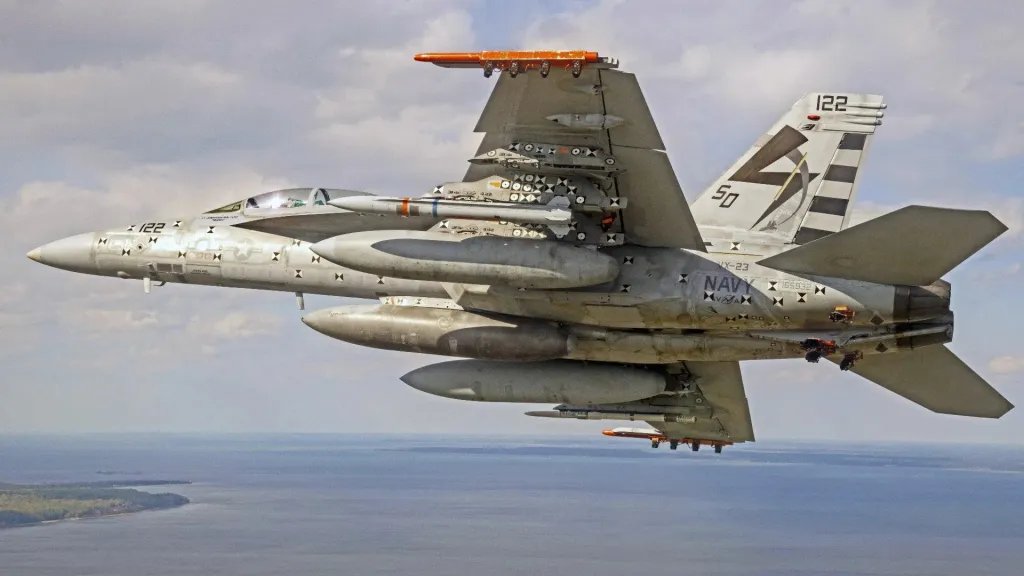
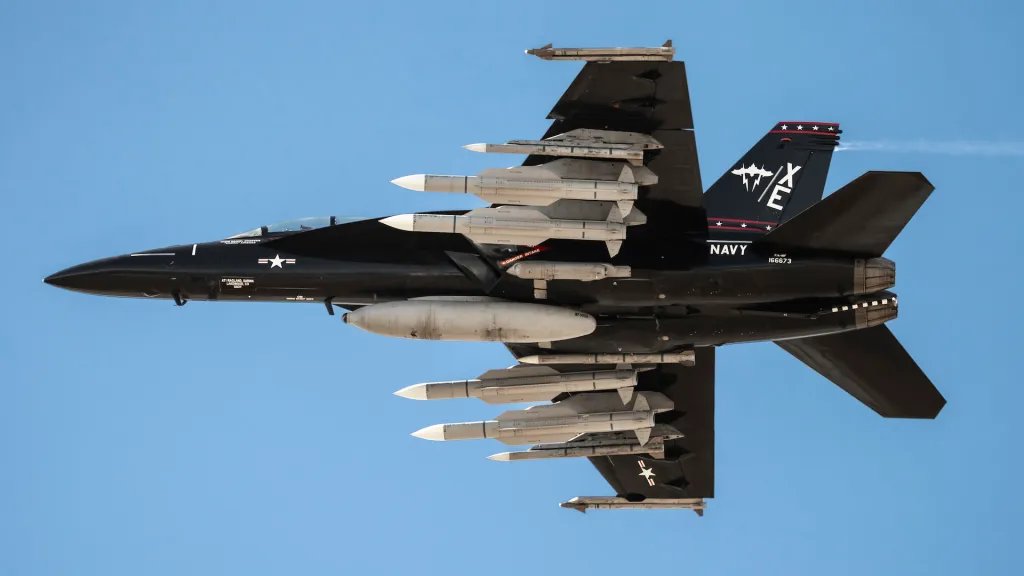
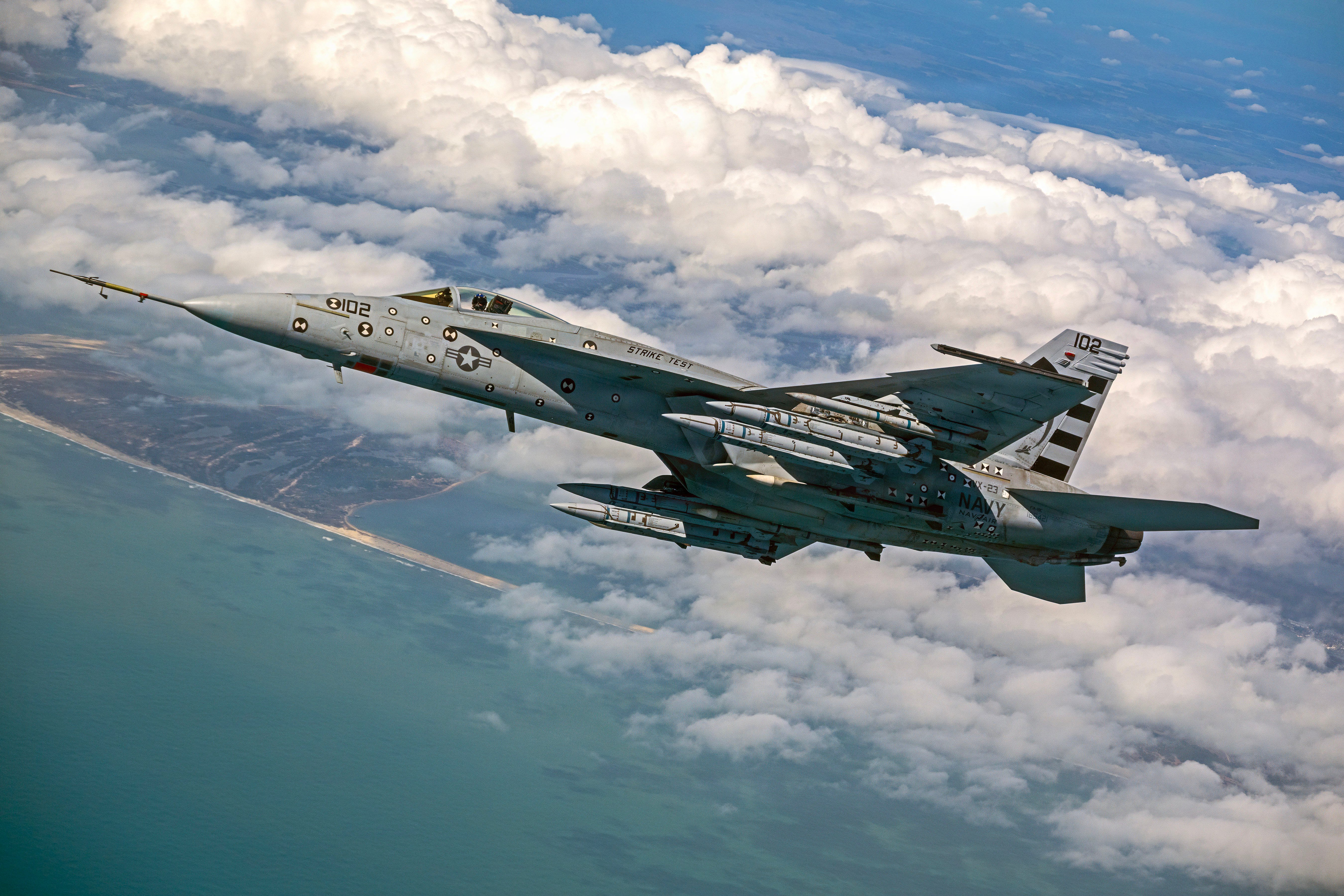
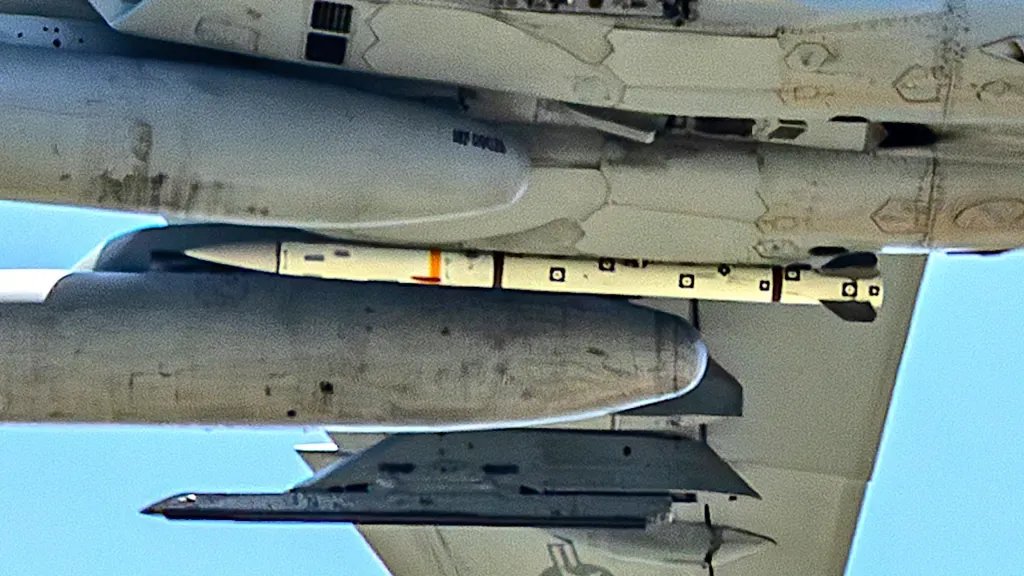
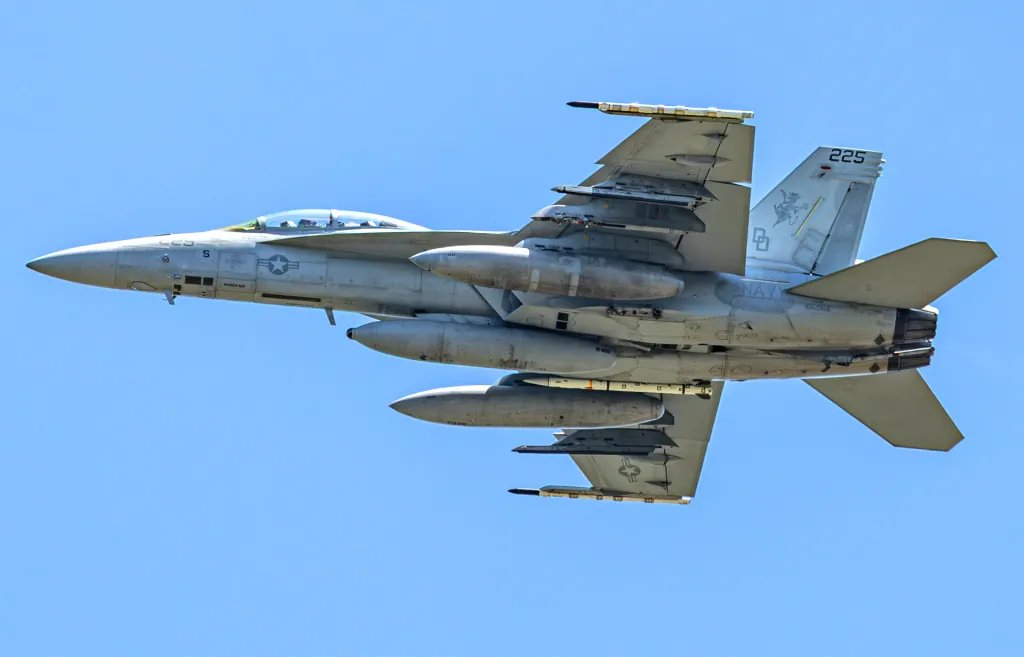
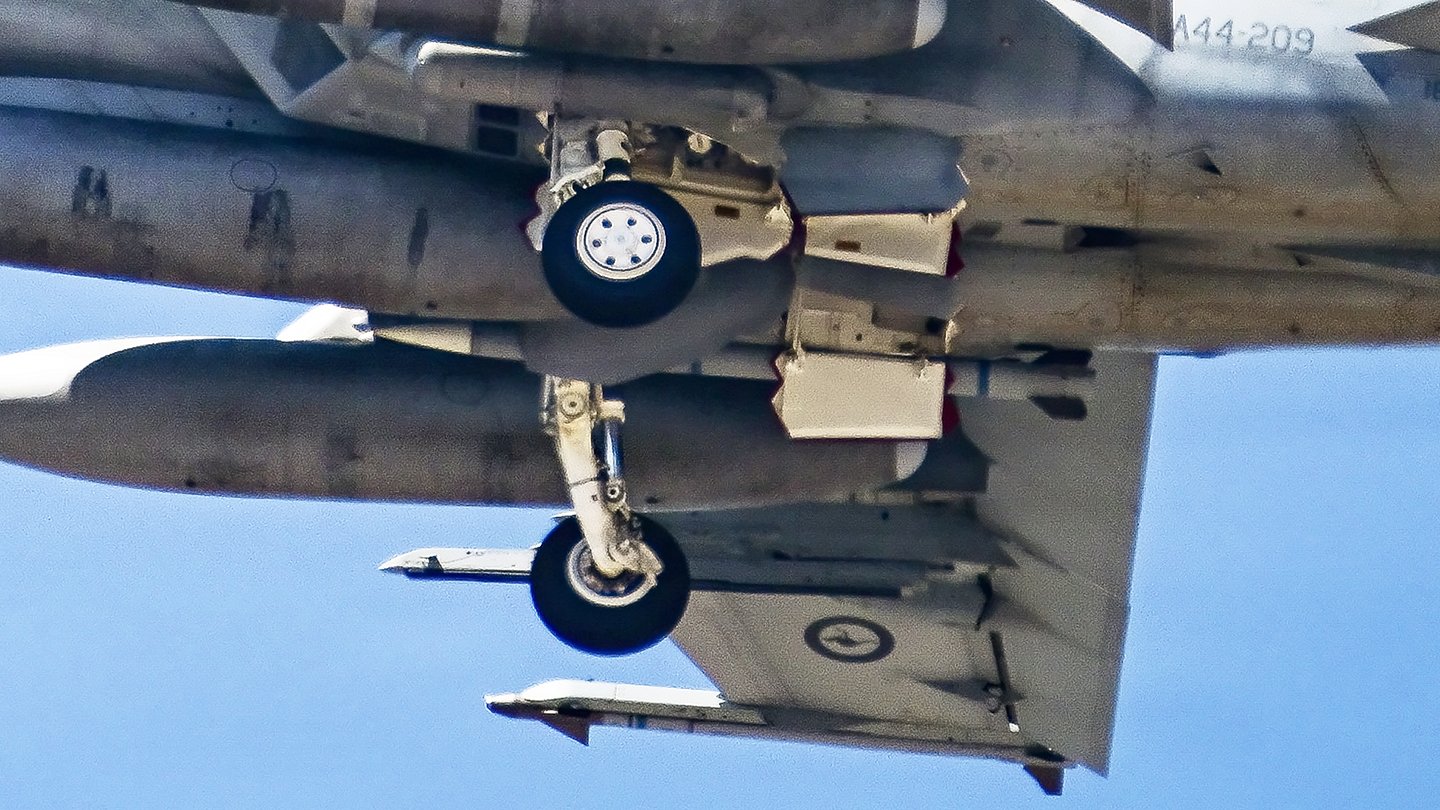
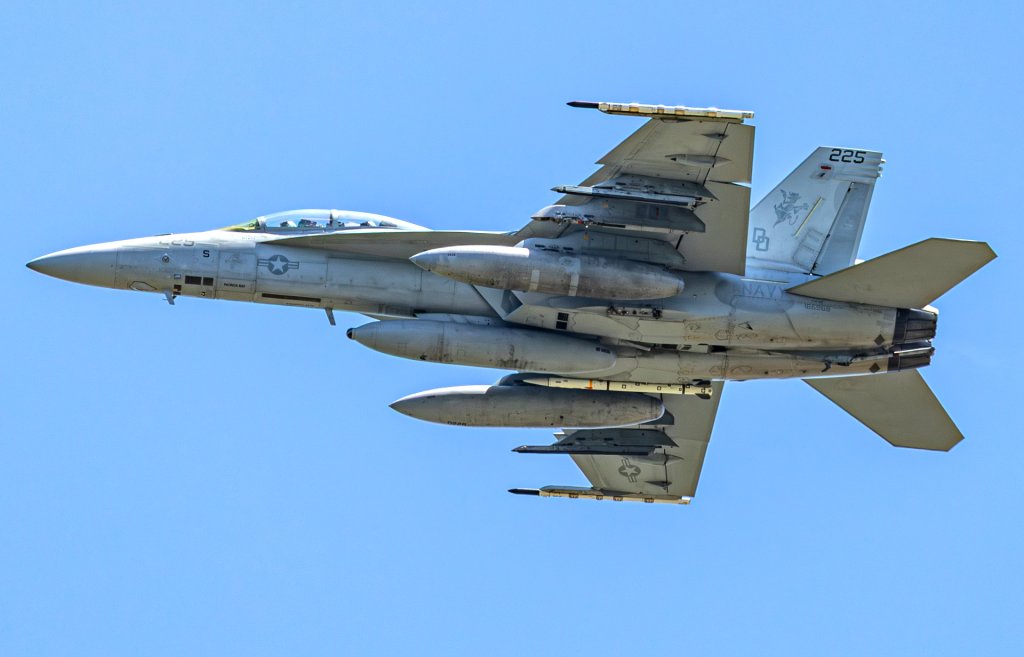
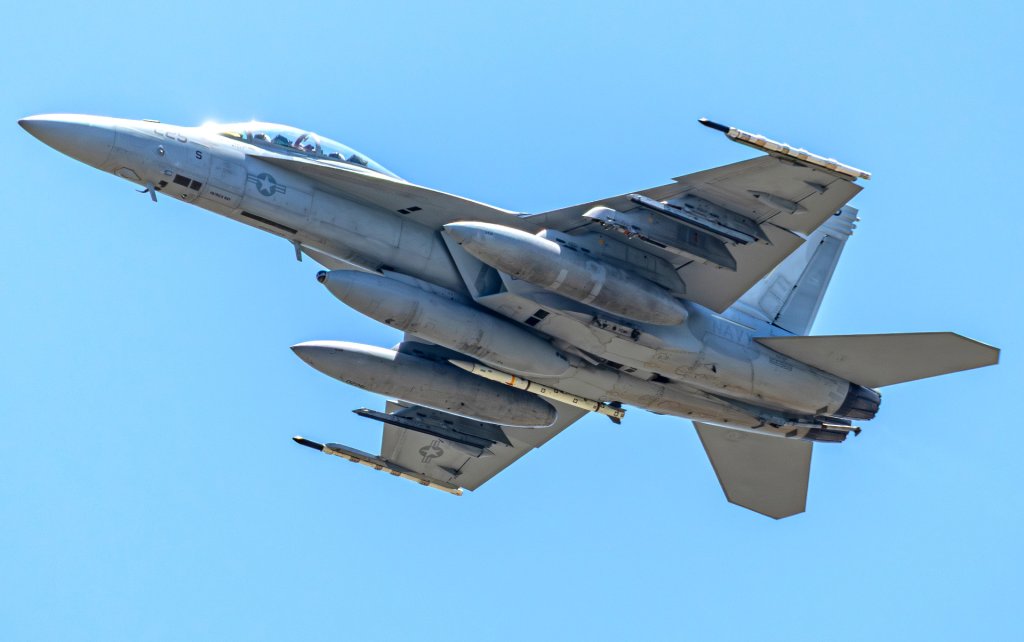
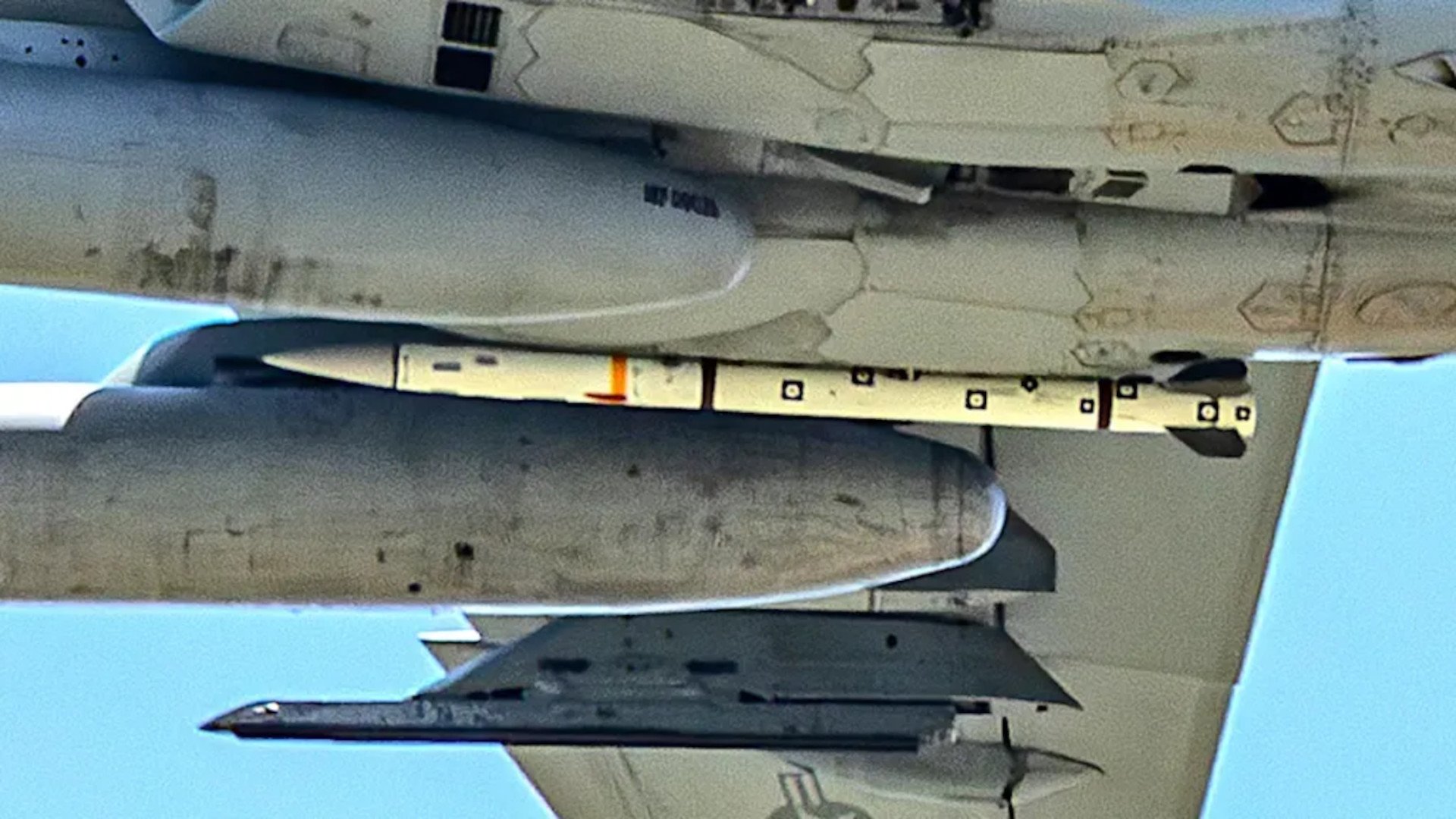
A U.S. Navy F/A-18F Super Hornet assigned to Air Test and Evaluation Squadron 31 (VX-31) has been spotted carrying both the AIM-174B and AIM-260 Joint Advanced Tactical Missile (JATM) during a flight over Ridgecrest, California. This represents the first known publicly documented instance of these two advanced air-to-air weapons appearing on the same aircraft.
The aircraft was photographed on October 14 by aviation photographer @photosxlyss2, who shared the result with TWZ. The same Super Hornet was also carrying an IRST21 infrared search-and-track pod on its centerline station.
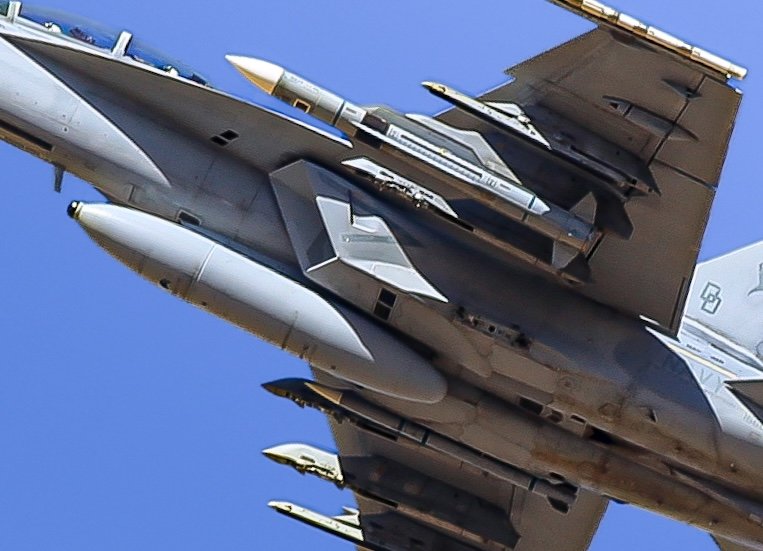
A close-up of the AIM-174B, AIM-260 Joint Advanced Tactical Missile, and IRST21 infrared search-and-track pod under an F/A-18F Super Hornet assigned to Air Test and Evaluation Squadron 31 (VX-31) during a flight over Ridgecrest, California. @photosxlyss2_ RY
Two critical elements of the modernization of the U.S. military’s air-to-air missile arsenal, the AIM-174B and AIM-260 provide complementary capabilities, addressing different aspects of the Navy’s evolving air-combat requirements.
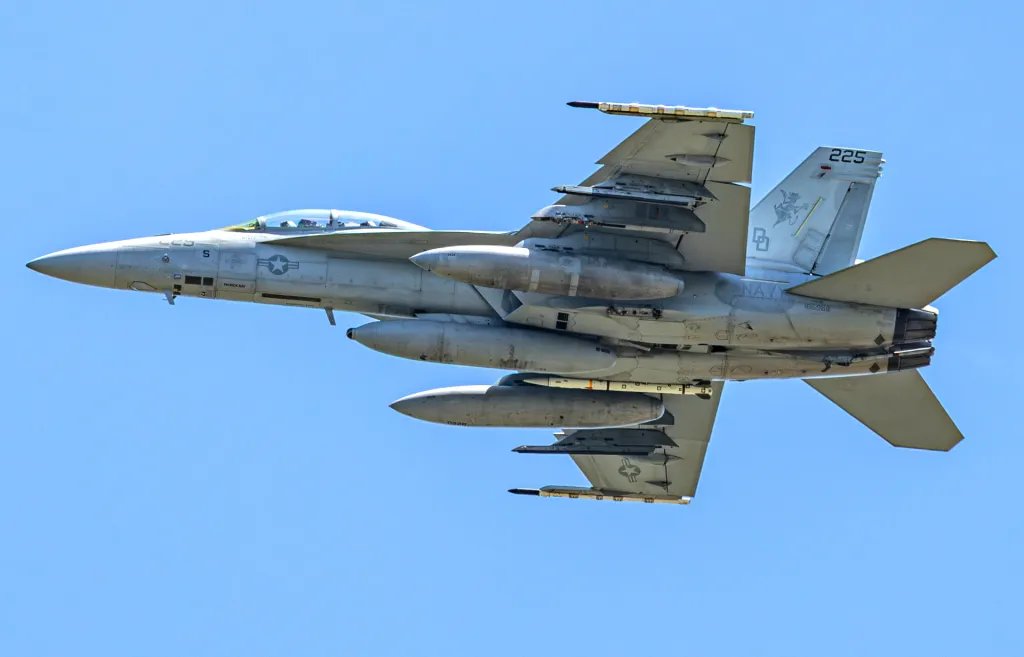
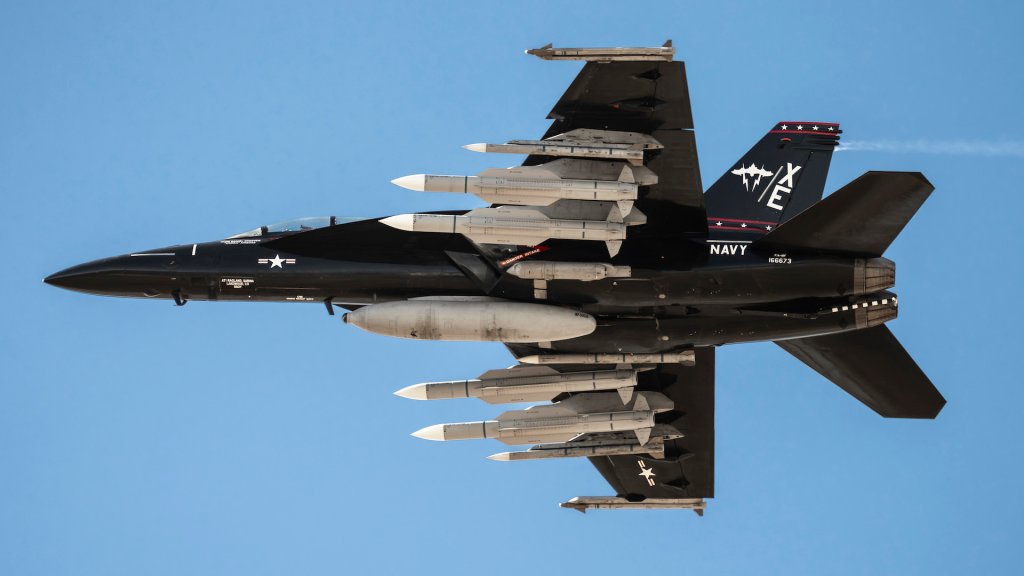
Based on the SM-6 missile family, the AIM-174B provides the Navy with an extended-range air-to-air weapon. Its size and reach make it particularly relevant to engagements against high-value airborne assets, including aerial refueling tankers and airborne early warning and control aircraft.
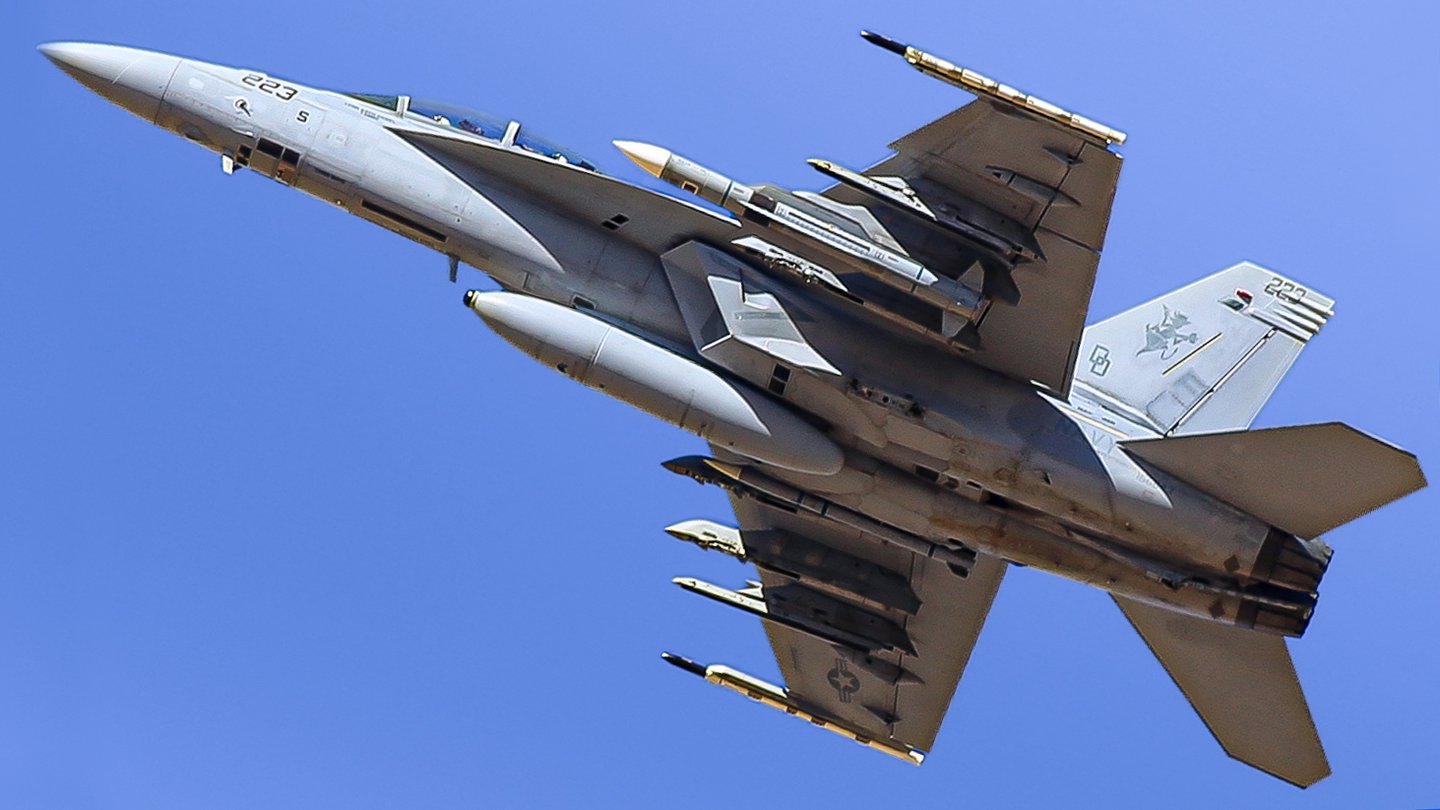
A U.S. Navy F/A-18F Super Hornet test jet with four AIM-174B missiles under its wings. point_mugu_skies
Threatening these support platforms at extended distances complicates an adversary’s ability to sustain fighter operations, maintain airborne surveillance, and coordinate engagements across domains. Such targets are especially important in the Indo-Pacific, where distances are vast and combat aircraft may depend heavily on tanker support to reach and remain on station over contested areas.
The range of this missile is classified but should be far in excess of that of the AIM-120D AMRAAM, probably in the hundreds of miles, as discussed in the video below.
The AIM-174B has already appeared in several major exercises, including RIMPAC 2024 and Northern Edge 2025. Following developmental trials at RIMPAC, the weapon entered Live Fire Test and Evaluation in 2025. Some examples of the missile have since reached forward-deployed Navy squadrons in Japan.
The AIM-260, meanwhile, is being developed to provide a next-generation beyond-visual-range air-to-air capability. It is intended to address increasingly sophisticated aerial threats and improve upon the capabilities of the very widely used AIM-120 Advanced Medium Range Air-to-Air Missile (AMRAAM) family.
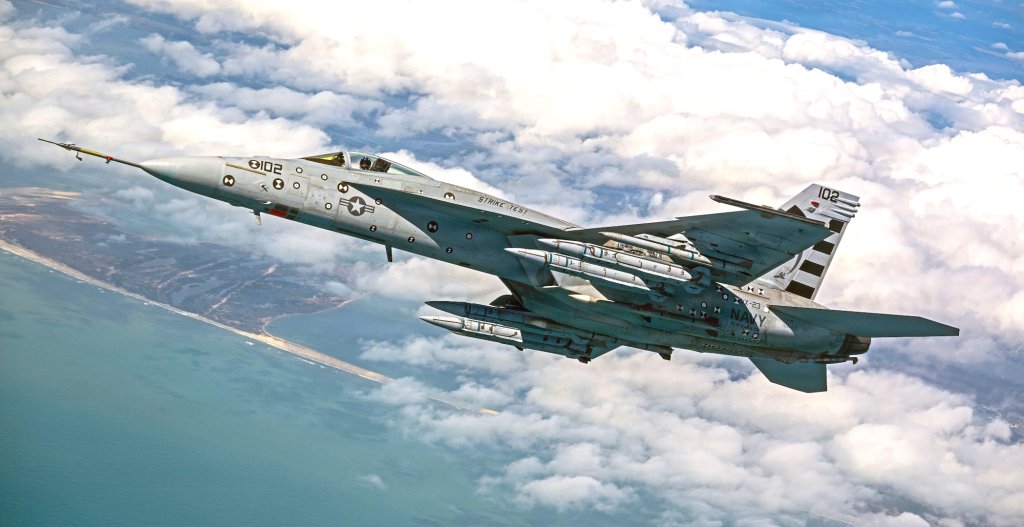
It was another F/A-18F from VX-31 on which the AIM-260 was first publicly seen when departing Eglin Air Force Base in Florida in May of this year. The same type of weapon has since also appeared on a Royal Australian Air Force F/A-18F, as you can read about here.
An F/A-18F from VX-31 carrying the AIM-260. Jonathan Tweedy/ @flightline_visuals
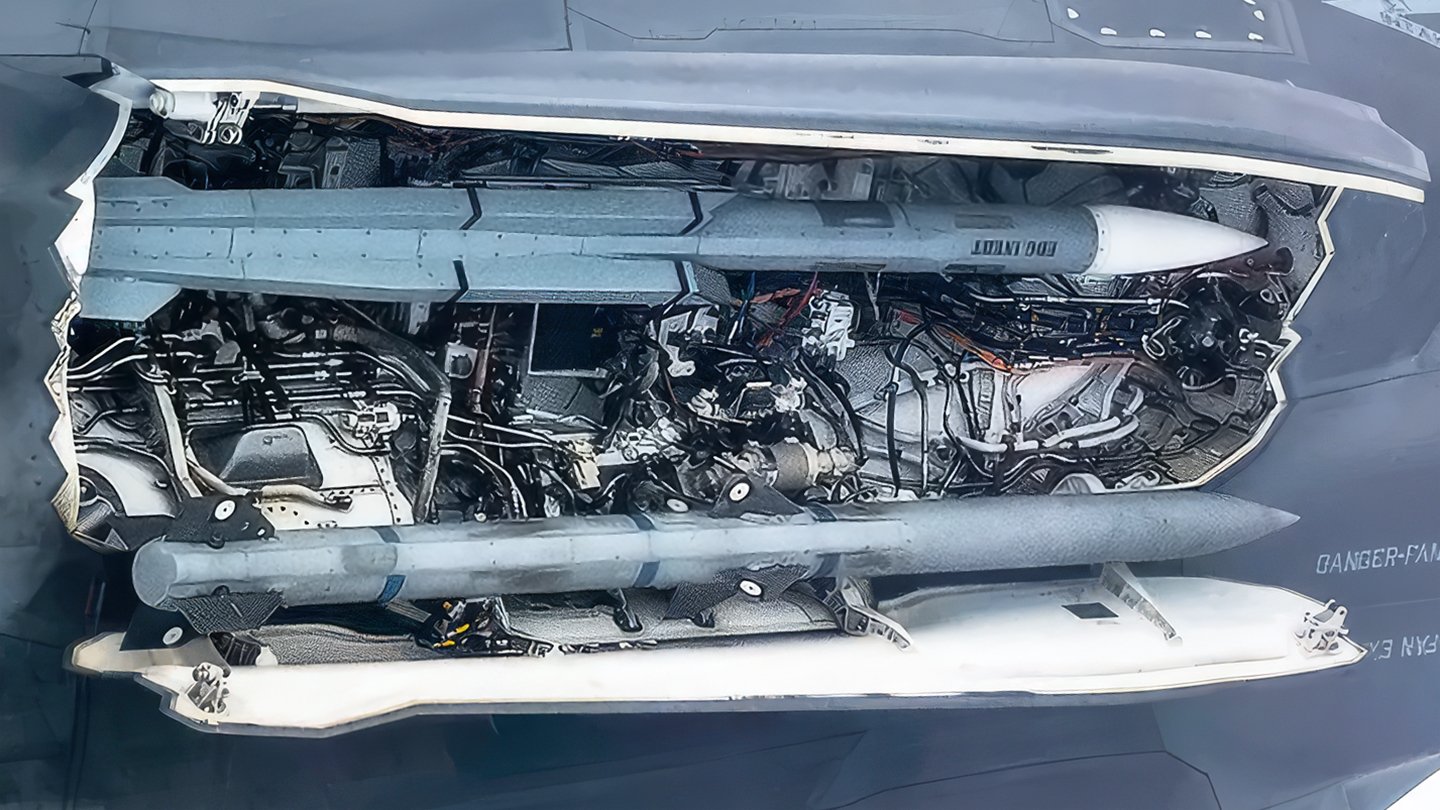
The AIM-260’s precise specifications remain classified, but it is designed to deliver significantly greater range than the AIM-120 AMRAAM while maintaining a broadly similar form factor. Its compact design is important, as the missile is intended for both external carriage and internal carriage aboard aircraft such as the F-22 Raptor and F-35.
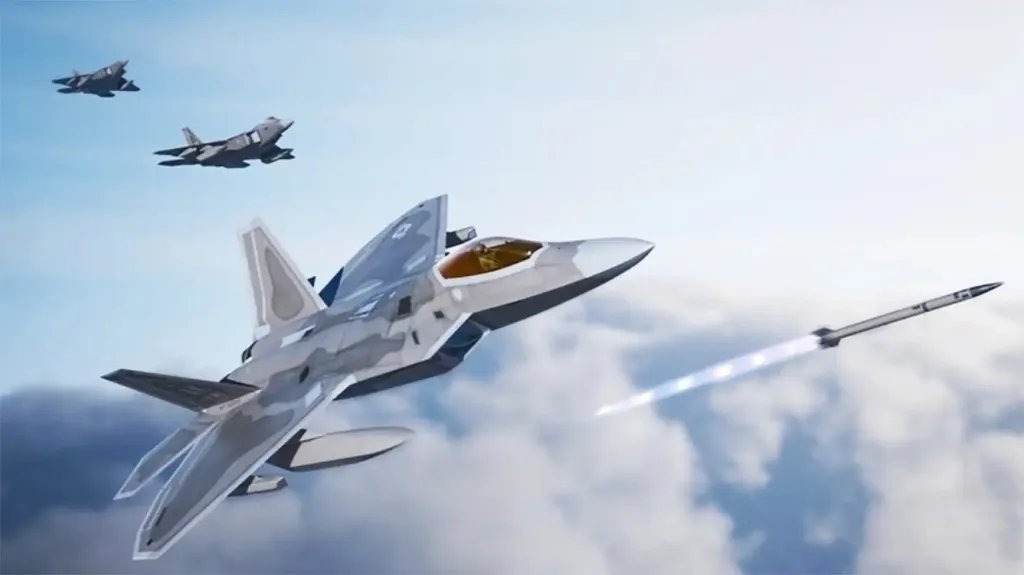
A rendering depicting an F-22 Raptor firing an AIM-260 JATM. U.S. Air Force
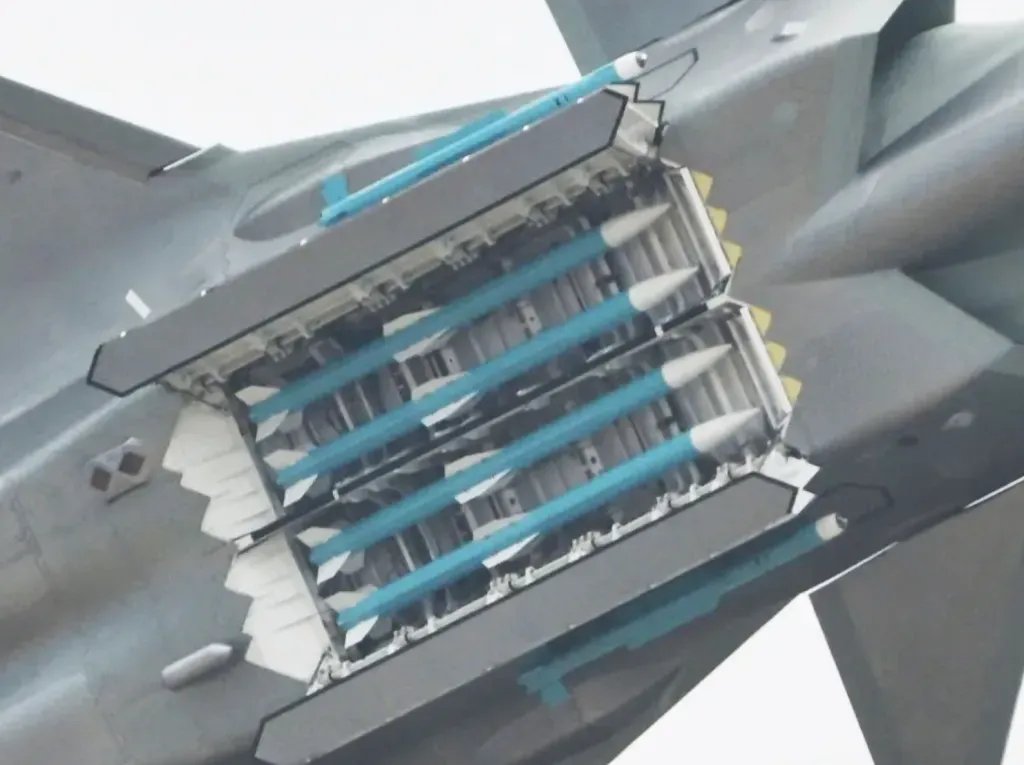
The AIM-260 is being developed to counter the growing long-range air-to-air threat posed by China’s PL-15 and other advanced missiles. Although no official range figures have been disclosed, previous reporting has indicated a target range of at least 120 miles, with the potential to reach considerably farther.
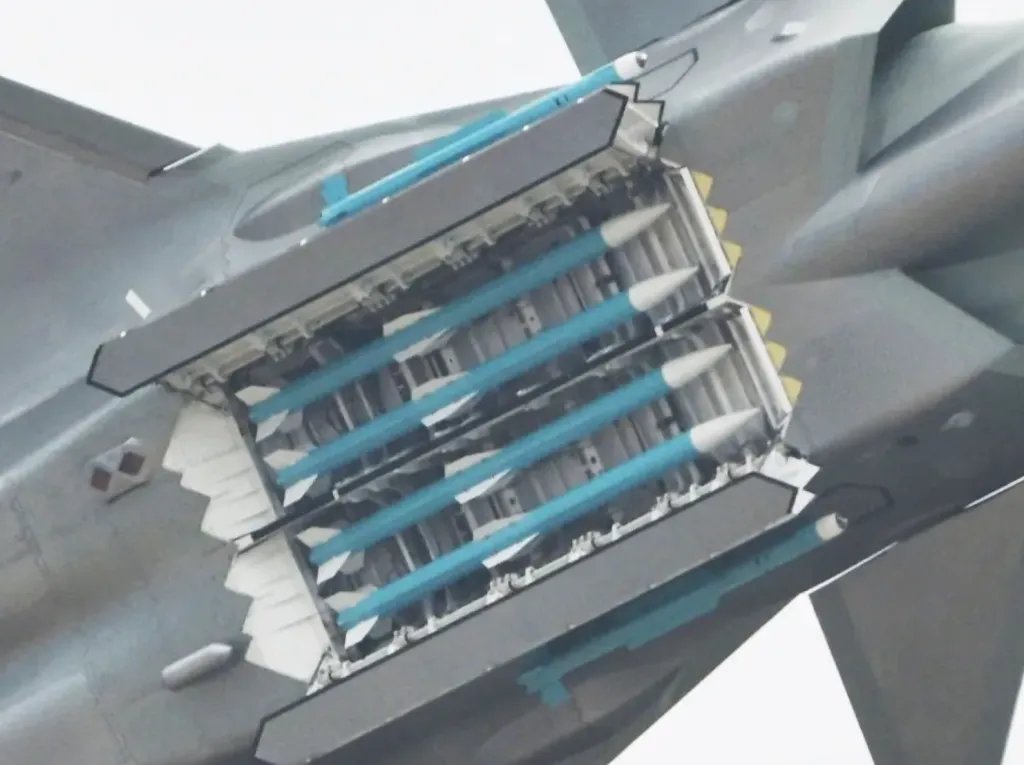
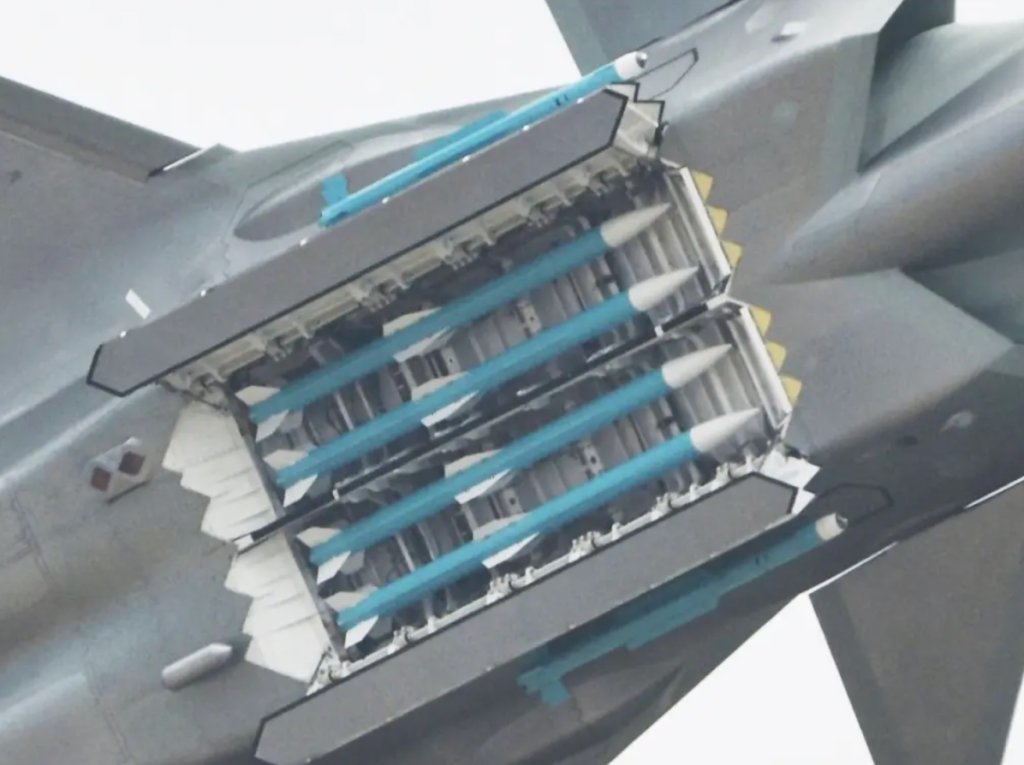
Inert PL-15s in the weapons bay of a Chinese J-20 fighter. via Chinese internet
It is unclear when the first operational AIM-260s may begin entering the U.S. inventory. Together, however, the two weapons give the Super Hornet access to a broader range of engagement options, depending not only on the range of the target, but also on the nature of the engagement and overall tactical situation.
The presence of an IRST21 pod is also noteworthy. The infrared search-and-track system passively detects and tracks airborne targets rather than relying exclusively on radar emissions.
Passive sensing is especially valuable in environments where electromagnetic emissions must be managed carefully. Although an IRST system does not automatically provide all the information needed to support a long-range missile engagement, it can contribute to a broader sensor picture and potentially help crews detect targets without immediately revealing their own position through radar emissions.
After a long and troubled development, a full-rate production contract for Block II IRST21 sensors to go into pods for U.S. Navy and U.S. Air National Guard fighters was awarded this time last year, as you can read about here.
An IRST21 built into the centerline tank on a Super Hornet during early tests. U.S. Navy
The appearance of both missiles on a VX-31 Super Hornet is a notable development in the Navy’s ongoing testing of advanced air-combat capabilities. VX-31, based at the sprawling Naval Air Weapons Station China Lake in California, conducts test and evaluation activities involving naval aviation weapons and systems.
On this occasion, the jet is carrying inert missiles (denoted by their blue bands) in a captive-carry configuration. The flight may have been part of ongoing weapons-integration testing, handling and compatibility evaluations, or another test activity.
At the very least, the configuration offers an intriguing glimpse into how a Navy Super Hornet might go into battle in a future high-end air combat scenario. Pairing the extended-range AIM-174B with the next-generation AIM-260 would provide a powerful combination.
Added to those two will be the AIM-424 Malice, an all-new, very long-range air-to-air missile, the existence of which was only disclosed in August of this year. This is reportedly a two-stage design, which should result in extreme range — said to be in excess of 250 nautical miles — and very high speed. It isn’t known where Malice slots in next to the AIM-174B, although the newer missile is purpose-designed for air launch, unlike the Standard-derived weapon.
Four AIM-424 Long Range Air-to-Air Missiles (LRAAM) are loaded on an F/A-18E Super Hornet for a test event. U.S. Navy U.S. Navy
As the service prepares for increasingly demanding scenarios in the Indo-Pacific, the new photo underscores the fact that the ability to threaten a wider range of targets at greater distances is one of the key considerations in the evolution of the Navy’s carrier-based fighter force.
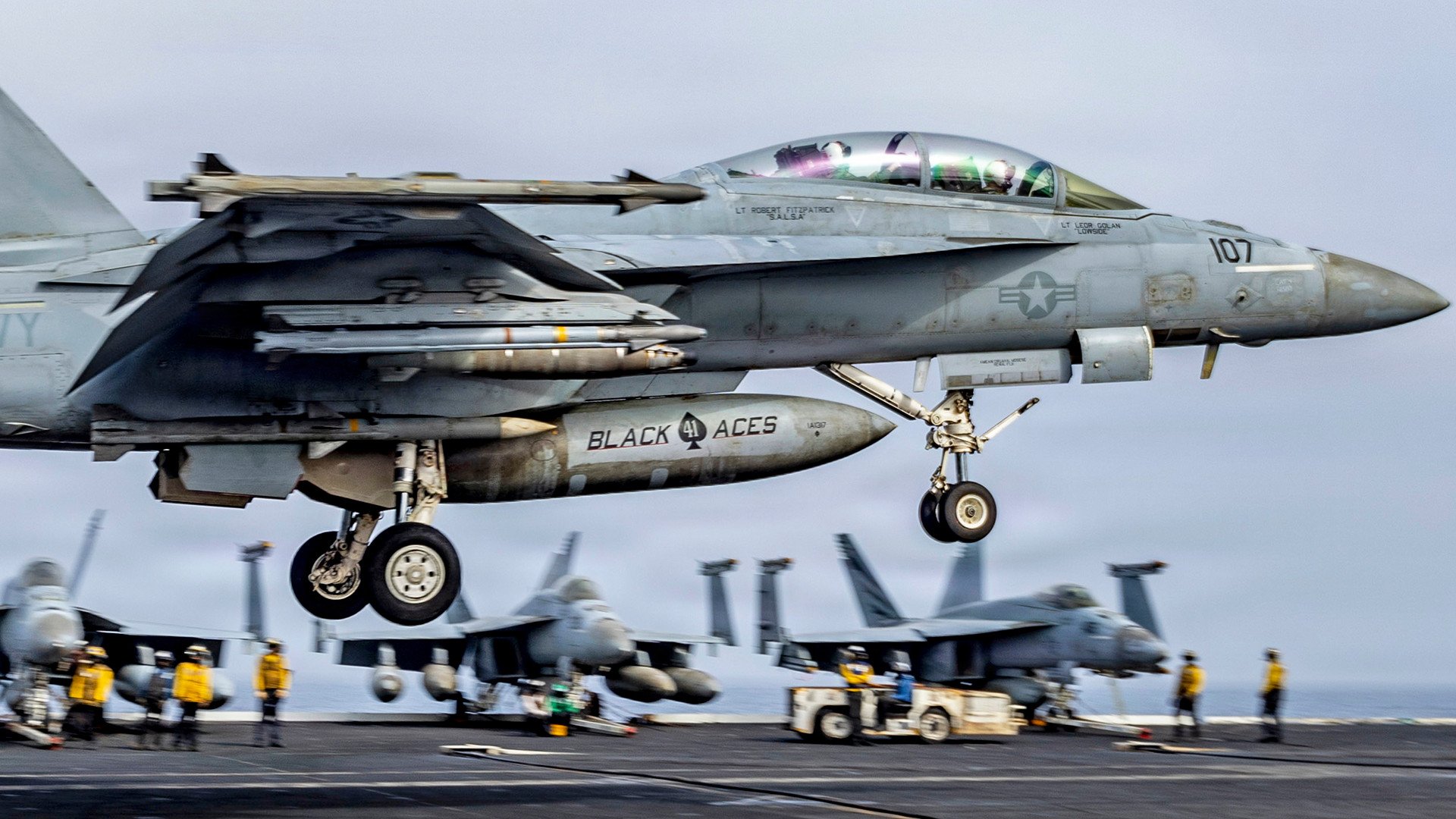
The volume of munitions expended in the course of U.S. operations against Iran this year has been and continues to be a hot topic of discussion, and there has been relatively little official data provided on this front. However, now we know that the F/A-18F Super Hornets of the U.S. Navy’s Strike Fighter Squadron 41 (VFA-41), the “Black Aces,” launched 421 missiles and bombs during their time supporting Operation Epic Fury.
This new insight into VFA-41’s role in the conflict with Iran comes from a photo of a large board listing the squadron’s weapons expenditures during Epic Fury, via Jeff Rojas, who goes by the handle @jro_photography on Instagram. Rojas also shared pictures recently taken of VFA-41’s Super Hornets. The Black Aces were one of the squadrons assigned to the Nimitz class aircraft carrier USS Abraham Lincoln, which has been on a marathon deploymentsince last year. The carrier only left the Middle East region last month and is now set to formally return home to San Diego, California, within days. Per the Pentagon’s official timeline, Operation Epic Fury began on February 28 and concluded on May 5, though U.S. forces have continued to conduct strikes on Iran, on and off, since then.
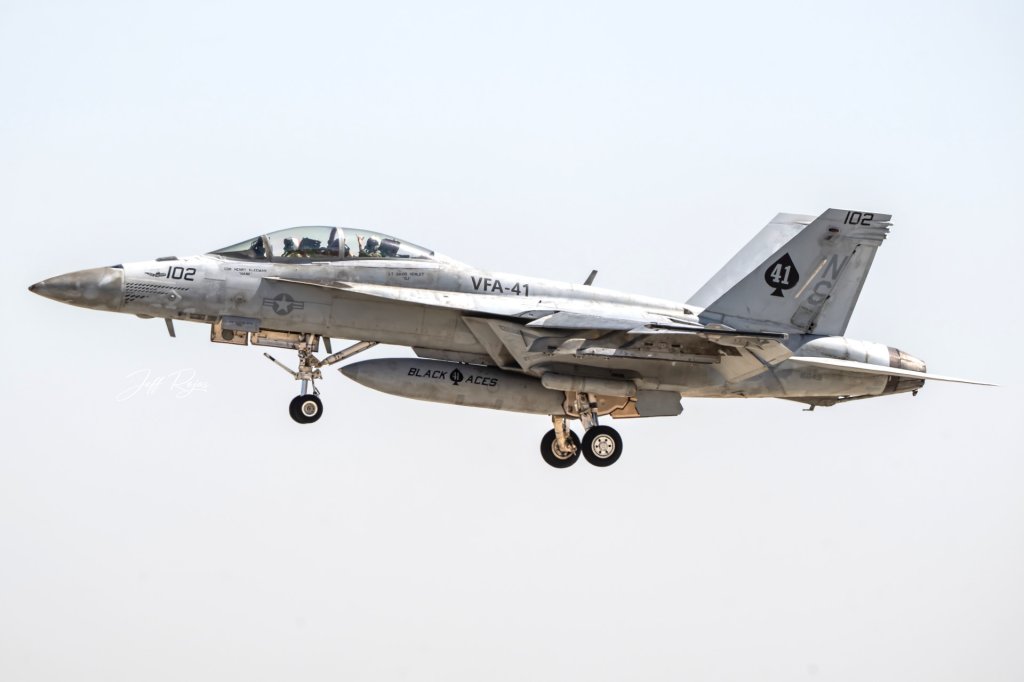
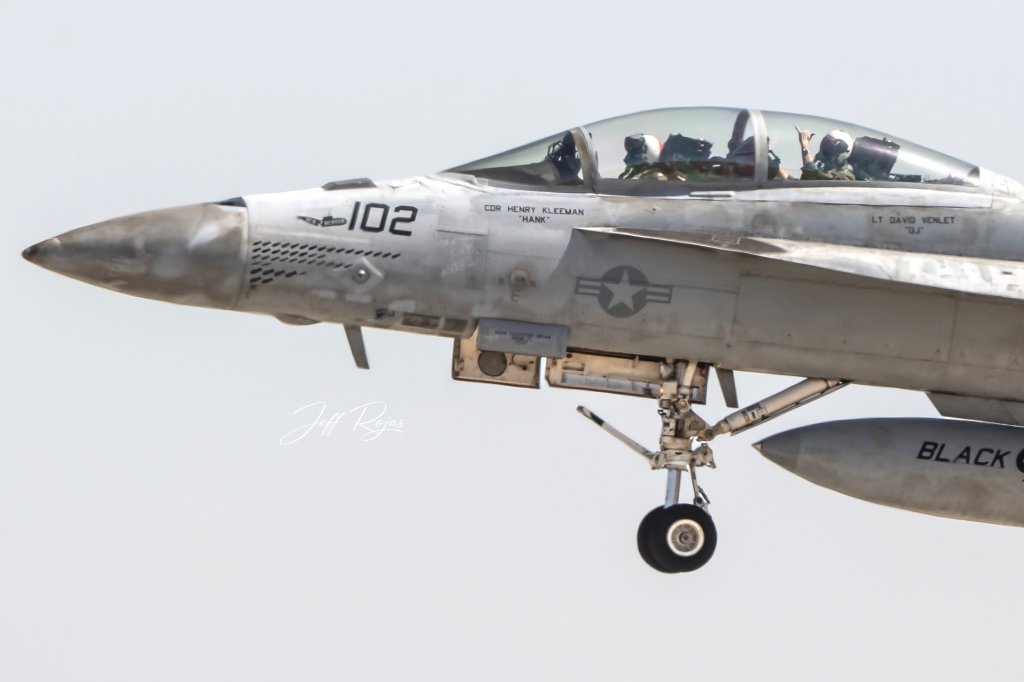
One of VFA-41’s F/A-18F Super Hornets spotted recently. Jeff Rojas Jeffrey Rojas
The complete tally of munitions employed as shown on the board, broken down by type, from greatest to fewest, is as follows:
1 GBU-12/B 500-pound-class Paveway II laser-guided precision-guided bomb
The total cost of all of these munitions, using available data from U.S. military budget documents, is very roughly $43,646,000, at least. Unit costs fluctuate regularly due to a variety of factors. Furthermore, the exact price tag for different JDAMs can be somewhat difficult to calculate given how the individual components are budgeted.
The JDAM is really a family of kits that turn standard unguided ‘iron bombs,’ which can vary significantly in the kinds of effects they are designed to produce, into warheads for precision-guided munitions. This is exemplified by the (V)2 and (V)4 subvariants of the GBU-31/B mentioned here, which are built using standard high-explosive and bunker-buster bombs, respectively. No specific subvariants of the GBU-32, GBU-38, or GBU-54 were mentioned in the information provided. Standard JDAMs can also only be employed against static target coordinates. The LJDAM kits add a laser guidance component (akin to what is found on Paveway-series bombs) that enables strikes against moving targets.
A JDAM, as well as a pair of AIM-9Xs, seen under the wing of a VFA-41 Super Hornet in August. NAVCENT
No specific version of AGM-154 is mentioned, either, but the C and C-1 types, which have multi-stage bunker-busting warheads, are the only ones understood to be in service today. Remaining A variants, which were loaded with 145 small bomblets, were removed from U.S. service in 2008 as a result of new guidelines on cluster munitions issued under President George W. Bush. A planned AGM-154B, which would have contained six “smart” Sensor Fuzed Munition bomblets, was never produced. You can read more about the full JSOW family here.
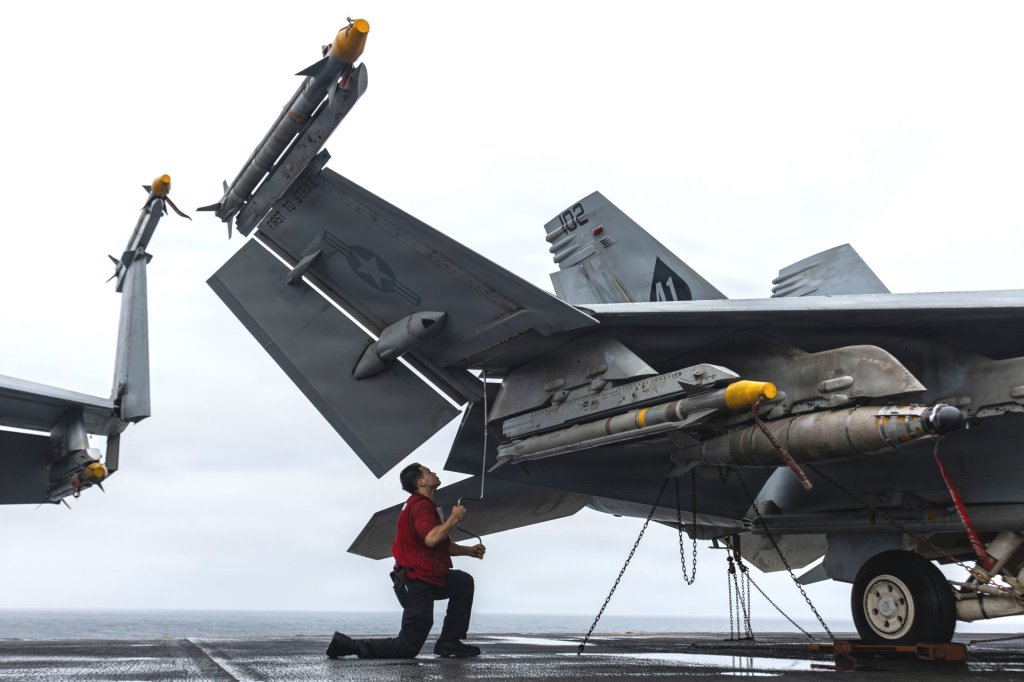
We do not know exactly what targets any of these munitions were employed against. However, a picture that Jeff Rojas grabbed of one of VFA-41’s Super Hornets, seen toward the top of this story and in part below, shows a very interesting broken submarine kill marking, with the added text “Sub Buster.” The jet also has a number of more typical bomb-shaped kill marks.
A close-up look at the broken submarine and other kill marks on one of VFA-41’s Super Hornets. Jeff Rojas Jeffrey Rojas
The video montage in the social media post below includes a clip, starting at 0:13 in the runtime, of a Hellfire missile hitting what looks to be a Ghadir class diesel-electric midget submarine in port.
U.S. forces are degrading the Iranian regime's ability to project power at sea and harass international shipping. For years, Iranian forces have threatened freedom of navigation in waters essential to American, regional and global security and prosperity. pic.twitter.com/gIBN02mowh
It is extremely likely that the AIM-9Xs and AIM-120s were fired at Iranian drones, though they could have been launched at incoming cruise missiles, as well. At the time of writing, there are no known or reported instances of U.S. military jets engaging crewed Iranian aircraft in the course of the conflict to date. In 2024, the Navy carried out a crash program that increased the total number of AIM-9Xs that F/A-18E/Fs could carry per sortie, specifically in response to Houthi drone threats. Super Hornets loaded with nine air-to-air missiles are now referred to as “Murder Hornets.”
It is also important to remember that this is a discussion of the munitions expended by just one Navy strike fighter squadron. Lincoln‘s air wing includes four strike squadrons, three with Super Hornets and one with F-35Cs, as well as units flying other types of aircraft and helicopters. The carrier was just one part of a much larger array of air, naval, and ground forces that participated in Operation Epic Fury and subsequent operations against Iran. For additional context, consider that the entire Eisenhower Carrier Strike Group, including its entire air wing and escorting ships, fired off 770 munitions in total, by the official count, during very active combat operations in and around the Red Sea between November 2023 and June 2024.
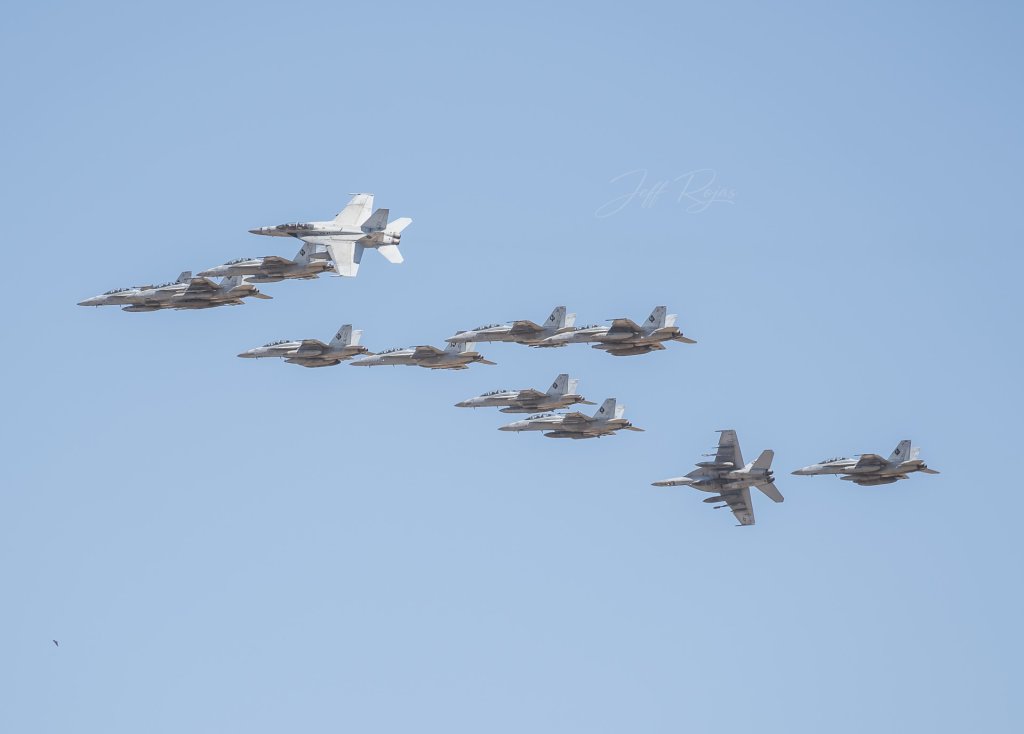
VFA-41 Super Hornets seen flying together recently. Jeff Rojas
As such, the tally of munitions launched from VFA-41 Super Hornets offers a very interesting view into that squadron’s contributions to Operation Epic Fury, as well as the full scale and scope of the conflict with Iran.
Special thanks again to Jeff Rojas for sharing the details about VFA-41’s participation in Operation Epic Fury and his pictures with us.
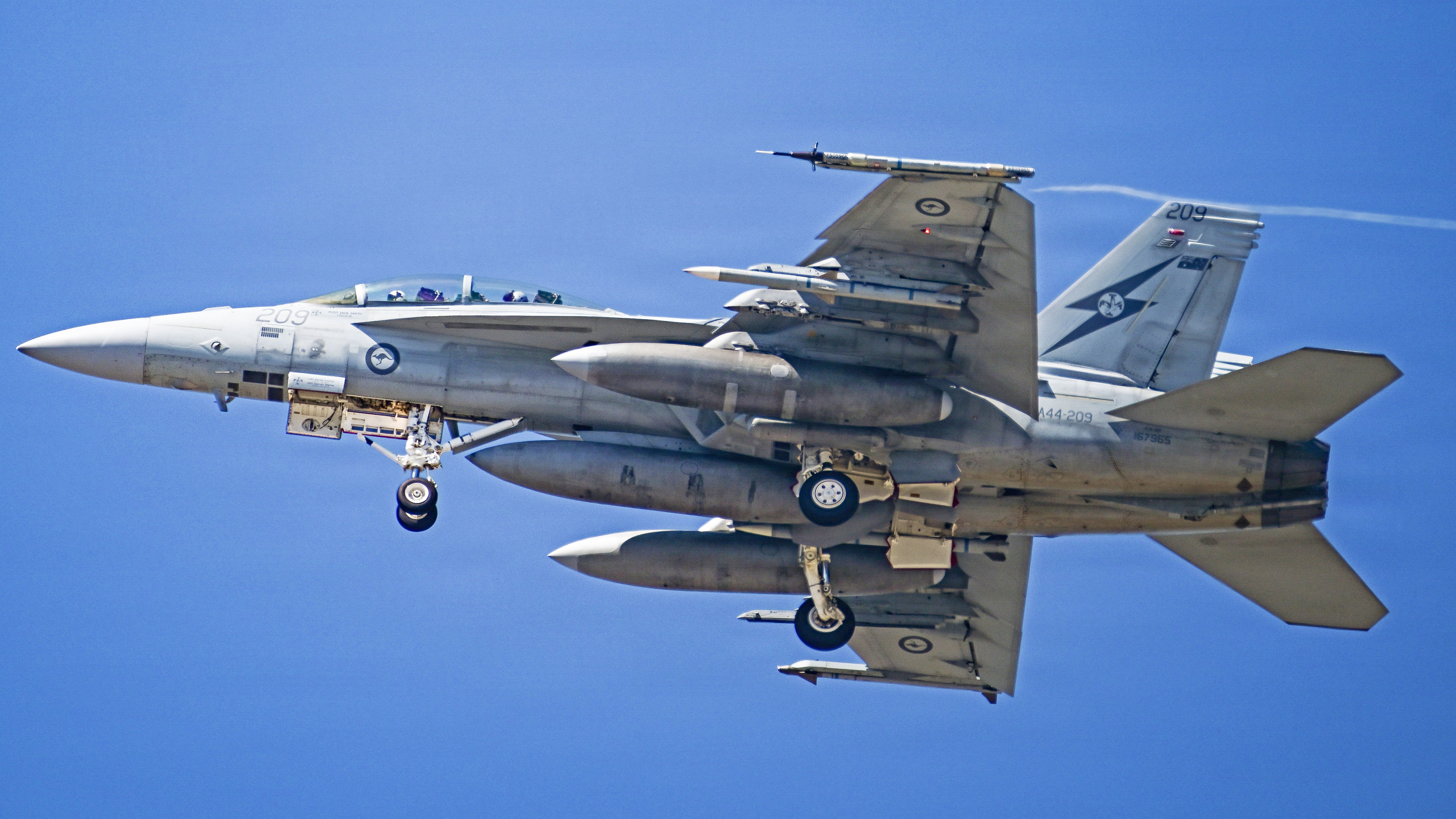
The photograph was released by the U.S. Navy and shows an RAAF F/A-18F assigned to No. 1 Squadron taking off from Naval Base Ventura County Point Mugu on September 11 during Gray Flag 2026. The loadout also includes a CATM-9X — the inert training variant of the AIM-9X — and a CATM-120, the inert training version of the AIM-120 AMRAAM, three external fuel tanks, an AN/ASQ-228 ATFLIR targeting pod, and a Tactical Combat Training System (TCTS) pod.
An AIM-260 JATM is seen on station 7, the “cheek” station, of a Royal Australian Air Force F/A-18F Super Hornet during Gray Flag 2026. U.S. Navy photo by Dana Rene White
Gray Flag is the naval aviation test community’s flagship large-force test event, providing opportunities for large-scale integration of new capabilities across services, platforms, industry, and allied forces. Gray Flag 2026 was the largest edition of the exercise to date. According to the Navy, more than 3,000 personnel from over 150 organizations participated, flying more than 750 sorties and logging over 2,000 flight hours across hundreds of multi-domain test objectives.
Previous iterations of Gray Flag have been used to test new and still-developmental weapons in increasingly complex, operationally representative scenarios, including actual missile engagements against realistic targets. Making use of the sprawling Point Mugu Sea Range, the event has also become an important opportunity for working out how sensors, weapons, aircraft, and networks interact as part of larger kill chains and kill webs. A new, longer-range air-to-air missile is especially relevant when it comes to developing tactics, techniques, and procedures within a broader, networked air-combat architecture.
Beyond being the first apparent glimpse of an Australian JATM in any context, integration of the weapon onto Australia’s Super Hornet fleet has already progressed to the point of carrying the missile — in inert form — during a major U.S.-based test and integration exercise.
A close-up look at an AIM-260 test round on the same station of a U.S. Navy Super Hornet. Jonathan Tweedy/@flightline_visuals
As TWZreported in August, Australia is set to become the first country outside the United States to operate the AIM-260 following a roughly $480-million procurement through the U.S. Foreign Military Sales program. The Australian government said at the time that the missile would first be integrated onto the RAAF’s F/A-18F fleet, before being fielded on the F-35A and EA-18G Growler. Looking further ahead, the RAAF’s MQ-28 Ghost Bat collaborative combat aircraft (CCA) could also emerge as a candidate for integration with JATM.
Australia’s announcement did not provide a delivery schedule or specify when JATM would enter Australian service.
The overall proportions and external configuration of the AIM-260 were revealed when an example appeared on a U.S. Navy F/A-18F in May of this year. That aircraft, operated by Air Test and Evaluation Squadron 31 (VX-31), provided the first publicly known photographic view of the highly classified missile.
An F/A-18F from VX-31 carrying the AIM-260. Jonathan Tweedy/ @flightline_visuals
The AIM-260’s exact specifications remain classified. It is intended to provide substantially greater range than the AIM-120 AMRAAM while retaining a broadly similar form factor. That compact configuration is important because the missile is designed not only for external carriage but also for internal carriage by aircraft such as the F-22 and F-35.
The weapon has been developed as a response to the increasingly long-range air-to-air threat posed by China’s PL-15 and other advanced missiles. Official range figures have not been released, although previous reporting has pointed to an intended range of at least 120 miles and potentially considerably more.
Close-up of a J-20 fighter carrying four inert examples of the PL-15 in its main ventral bays. viaChinese internet
The Australian procurement therefore represents an important expansion of the JATM program beyond the U.S. fleet.
The timing of the Point Mugu photograph is particularly interesting. Gray Flag is specifically intended to bring together large numbers of aircraft, weapons, sensors, networks, and other systems for demanding integration and test activities. An Australian Super Hornet carrying JATM at such an event would be entirely in line with the purpose of the exercise.
Ground crew members stand by an EA-18G Growler on the flight line at Naval Base Ventura County Point Mugu, during Gray Flag, on September 30, 2026. U.S. Navy photo by Katie Archibald
It is not clear, however, what role the missile was playing. The photograph does not establish whether it was an Australian-owned operational weapon, a U.S. test asset, or a missile being used for a particular integration activity. Blue bands on the missile body confirm that it’s a training missile with an inert rocket motor and/or warhead.
Public evidence of an Australian aircraft carrying the AIM-260 is another important milestone in the weapon’s transition from a closely guarded U.S. development program toward allied service.
It also underscores the most interoperability aspect of the Australian acquisition. Canberra is buying into a U.S. long-range air-to-air weapon program at a time when the Royal Australian Air Force and U.S. forces are increasingly expected to operate together across the Indo-Pacific.
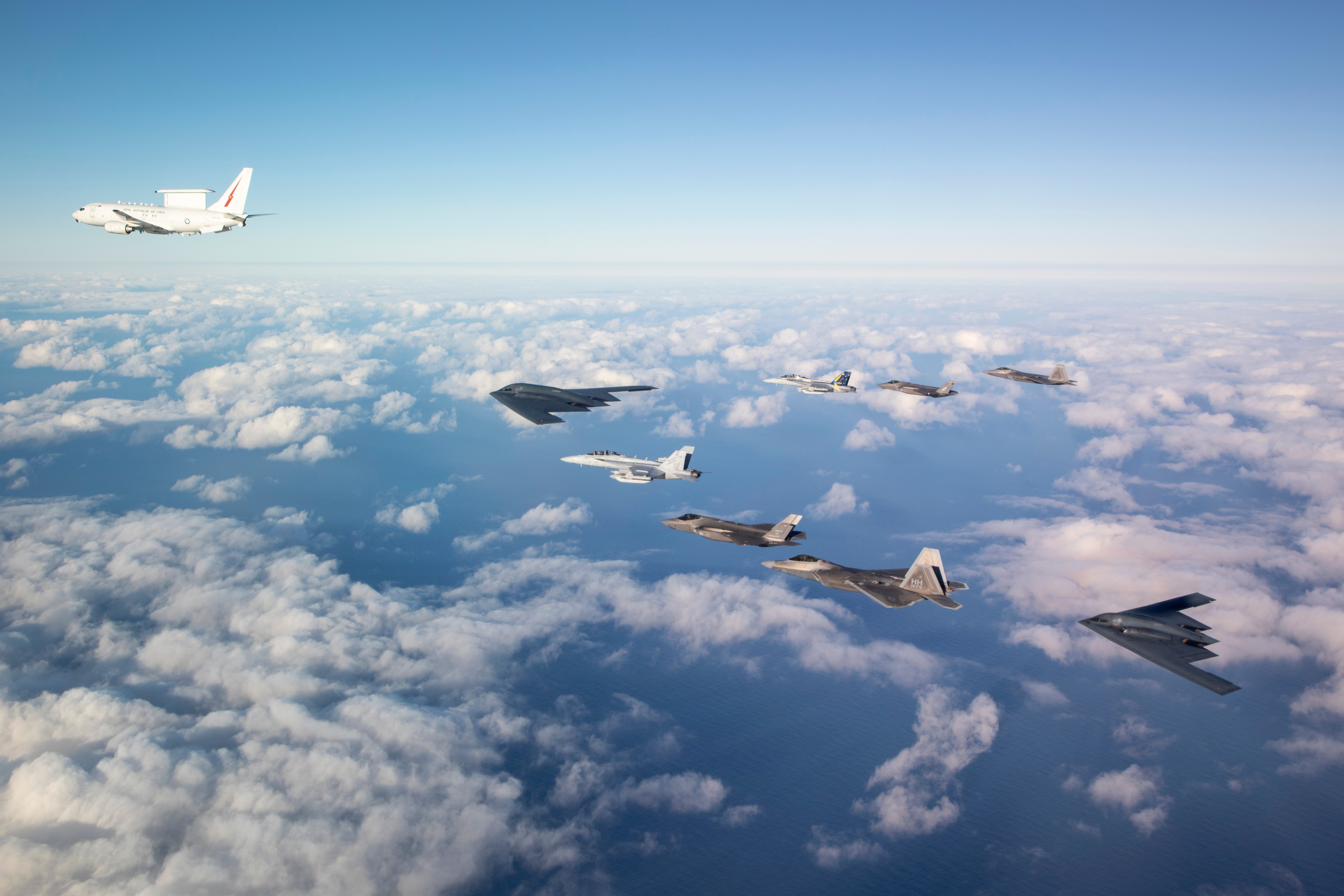
A Royal Australian Air Force E-7A Wedgetail, two EA-18G Growlers, and two F-35As fly in formation with two U.S. Air Force B-2 bombers and two F-22 Raptors. Australian Department of Defense
The exercise also comes as the U.S. moves to accelerate development and future production of the AIM-260. In September, the Pentagon and Lockheed Martin reached a framework agreement laying the groundwork for a future multiyear procurement deal, while the Air Force Test Center confirmed that the missile is already undergoing both ground and airborne testing. The agreement is intended to give Lockheed Martin and its suppliers the demand signal needed to expand production capacity, although the number of missiles, costs and delivery schedule remain undisclosed.
The development should also be seen in the context of broader U.S.-Australian cooperation on air-launched weapons. RAAF F/A-18Fs are also being integrated into the U.S.-Australian Hypersonic Attack Cruise Missile (HACM) effort under the Southern Cross Integrated Flight Research Experiment (SCIFiRE), with Australia providing test infrastructure for the weapon’s flight-test program. You can read more about this program here.
The video below shows a hypersonic test conducted at Woomera in 2016 under the U.S.-Australian Hypersonic International Flight Research Experimentation (HiFIRE) program.
Australia said its F/A-18Fs would be the first RAAF aircraft to receive JATM, and an Australian Super Hornet has now been photographed carrying one during a major U.S. Navy test event. For the RAAF, getting JATM onto its frontline fighters is consequently an increasingly urgent requirement, giving its Super Hornets a credible long-range counter to the weapons they could face in a future high-end fight.
The Pentagon has reached an agreement with Lockheed Martin to lay the groundwork for stepped-up production and delivery of new AIM-260 Joint Advanced Tactical Missiles (JATM) to the U.S. military and allied air arms in the coming years. The AIM-260 is still in development, but the head of the Air Force Test Center also touted efforts to further accelerate that work just earlier this week. From the start, the U.S. military has presented JATM as especially critical for ensuring China, with its own growing array of longer-range air-to-air missiles, does not gain an edge in future air combat.
The new framework agreement announced today “is critical to ensuring long-term demand signals flow to key suppliers, allowing Lockheed Martin and the munitions supply chain to invest in manufacturing capacity, workforce, and production efficiencies,” according to a Pentagon press release. “It establishes a framework for future Multi-Year Procurement (MYP) of JATM, executing congressional authority to secure the nation’s highest-priority missile systems.”
“This agreement forms the foundational agreement for a multiyear procurement contract, pending Congressional approval, that provides long-term demand to strengthen and expand the defense industrial base for the program,” according to a separate release from Lockheed Martin.
A US Navy F/A-18F Super Hornet seen carrying an AIM-260 Joint Advanced Tactical Missile (JATM). Jonathan Tweedy/ @flightline_visuals
In response to questions from TWZ, the Pentagon declined to comment on the projected number of JATMs covered under this agreement, as well as estimated costs and delivery schedules.
A rendering depicting an F-22 Raptor firing an AIM-260 JATM. USAF
The releases today from the Pentagon and Lockheed Martin confirm that the new framework deal also includes planned foreign military sales of AIM-260s. Australia, one of America’s top allies, is the first confirmed international customer for the JATM, and plans to integrate the missiles on its F/A-18Fs, F-35As, and EA-18G Growler electronic warfare jets. The Royal Australian Air Force’s MQ-28 Ghost Bat CCA-type drones, initial versions of which are already capable of firing AIM-120s, might be another AIM-260 launch platform in the future.
The AIM-260 remains in development, with the Navy and Air Force test communities supporting that work.
“We are accelerating weapons development from high-end air dominance weapons like the JATM to hypersonic strike systems like the Hypersonic Attack Cruise Missile,” Air Force Brig. Gen. Mark Massaro, head of the Air Force Test Center (AFTC) at Edwards Air Force Base in California, told TWZ and other outlets at a media roundtable yesterday. The roundtable took place at the Air & Space Forces Association’s (AFA) 2026 Air, Space & Cyber Conference.
“We’re actively testing JATM, and it’s progressing along its program path. In test, we are working through the development stages there,” Massaro added. “So, we’re testing it in [sic] the ground with models, like I mentioned. We’re testing it in the air on aircraft. So, from a performance standpoint, I’ll hold on to that from an operational security perspective. But we’re happy seeing where it’s going, and we expect that to be a key piece of capability for our warfighters to have.”
“Just from a testing perspective, we’re always looking at making sure that we’ve got the throughput,” he added when asked if he could talk about challenges or other issues AFTC has run up against in work on the AIM-260. “So, from a test perspective only, infrastructure and throughput to make sure that we can get things out … and make the testing happen. But I’m not, from a capabilities perspective, worried about the system.”
Another look at the AIM-260 loaded on the Navy Super Hornet. Jonathan Tweedy/ @flightline_visuals
It is unclear when the first operational AIM-260s may begin entering the U.S. inventory. When the program was first disclosed to the public in 2019, the stated goal was to start fielding the missiles in 2022. There were also reports in late 2025 that funding issues had caused a three-month delay, based on a fact sheet distributed to some members of the U.S. House Committee on Armed Services. The committee later said that the information was incorrect.
Work to date on JATM has been conducted under a heavy veil of secrecy, with the existence of the program only being announced in 2019. The first public glimpse of the missile only emerged in May of this year. Beyond the aforementioned size requirement and that the new missile will offer significantly greater engagement range over the AIM-120, details remain limited. Readers can learn more about what we do know so far here.
The AIM-260 is not the only longer-ranged air-to-air missile known to be in development in the United States, either. In 2024, the Navy revealed it had begun fielding an air-launched version of the surface-launched Standard Missile-6 (SM-6), called the AIM-174B Gunslinger, at least on a limited level. Just in August of this year, the service disclosed the existence of another very long-range air-to-air missile, the AIM-424 Malice, which has already reached the flight testing phase of development.
A US Navy F/A-18F Super Hornet test jet with four AIM-174B missiles under its wings. point_mugu_skiesA US Navy Super Hornet test jet carrying a load of AIM-424 Malice missiles. USN
An Air Force spokesperson told Air & Space Forces Magazine last month that the service was “closely following” the Navy’s work on the AIM-424. In June, the Air Force itself shared details about another potential future air-to-air missile, dubbed the Air Force Long Range Weapon (AFLRW), including a target requirement for a maximum range of at least 1,000 nautical miles.
Based on past experiences with public disclosures about the AIM-260, AIM-174B, and AIM-424 programs, additional work on advanced longer-range air-to-air missiles is certainly ongoing in the classified realm.
Today’s announcement about the new framework agreement, together with Brig. Gen. Massaro’s brief update yesterday, makes clear there is a continued commitment to JATM amid a still-growing field of new, longer-range air-to-air missiles.
The top U.S. Air Force officer in Europe, who also serves as the NATO Allied Air Command leader, said he has been tasked with enacting new alliance plans to defend against cruise missiles and drones. He was responding to questions about a drone that NATO had to shoot down after it entered Lithuanian airspace overnight. European Commission President Ursula von der Leyen said Tuesday morning that the incident was “part of a broader pattern of Russian aggression and provocation against Europe, testing our readiness and our resolve.”
We now know that Russia is responsible for the attempted explosive attack at Leipzig airport. Russia's repeated hybrid attacks on Germany and Europe are unacceptable. (1/4) pic.twitter.com/o3vBjgpeb1
“I don’t know what’s in the mind of Putin or his fielded forces about those one-way attack drones or even cruise missiles, like we’ve seen enter Polish airspace just a few months ago. In July, we had an AS-23 cruise missile enter Poland,” Lt. Gen. Jason T. Hinds, Commander, U.S. Air Forces in Europe/U.S. Air Forces Africa (USAFE), and Commander of the Allied Air Command, said in response to a question about the drone shootdown over Lithuania. He was speaking during a media roundtable at the Air & Space Forces Air, Space and Cyber Conference that TWZ is attending.
This video grab taken from footage from TVN Poland on July 30, 2026, shows the Polish army securing a large crater from a Russian missile that crashed in Poland. (Photo by various sources / AFP) –
Hinds added that while he doesn’t “know the why behind” the drone incursion into Lithuania, he has been tasked by U.S. Air Force Gen. Alexus G. Grynkewich, who serves as NATO Supreme Allied Commander Europe (SACEUR), “to fully implement EVA [Enhanced Vigilance Activity] Eastern Sentry and now its Standing Defense Plan 12000, which gives the nations the capabilities that they need to defend their airspace against either one-way attack drones like the one that you described last night, or a cruise missile.”
EVA Eastern Sentry is a mission NATO stood up in September 2025 after “an unprecedented number of Russian drones and planes violated the airspace of several NATO Allies,” according to the alliance. “Allies are contributing additional capabilities and assets to NATO’s deterrence and defense – for instance, more fighter jets, helicopters, transport aircraft, air defense systems, surveillance aircraft and frigates – and improving the coordination of these assets through NATO.”
Standing Defense Plan 12000 is a new plan for integrated air and missile defense across the alliance. Grynkewich introduced the concept during testimony to Congress in March.
Hinds acknowledged that Russia could be testing the alliance.
“It’s not about the small UASs; that’s typically a national responsibility, and it could be probing,” the Air Force general noted. “Regardless of the intent behind it, what we want to be prepared for is the second that a one-way attack drone or a cruise missile is first and foremost detected – hopefully well before it enters NATO territory – we want to know it. We want to know where it’s coming from. We want to have the capability to sense it. We want to be able to have the C2 [command and control] systems to be able to decide what to do about it, and then have the right kit to be able to act.”
Despite an integrated air and missile defense system that includes Patriot surface-to-air missile batteries, NATO currently is primarily “using air power” against drones and cruise missiles “and that’s not putting us on the right side of the cost curve,” Hinds stated. “But we want to get there.”
Using NATO jets to take down drones “is very effective, just like what you saw last night, and many other times,” but not necessarily efficient, Hinds explained.
“I think there’s been at least five other cases of allied nations providing air power to shoot down one-way attack drones,” he proffered. “I want to get to the point where we’re doing it efficiently, using lower-cost interceptors, hopefully ground-based, and in some cases air-based that are cheaper to use, so we’ll see what the intent may be. Intelligence organizations are going to provide us with that intelligence later on, but I just don’t know yet.”
You can see one of those NATO jet engagements with drones in the following video.
The Defence Procurement Agency has successfully completed integration testing of 68 mm laser-guided rockets on the Rafale fighter jet. The time between the contract being awarded for this new capability and initial operational capability being achieved was less than 8 months. pic.twitter.com/rR2Nij9EzY
— French Aid to Europe (@aidefranceukr) July 13, 2026
As the threats have evolved, NATO has “transitioned away from air policing, and we’ve transitioned to air defense for some specific reasons,” the general pointed out. “One is readiness. Air policing is a readiness decrementing mission that the alliance has done for years. There’s also an assurance mission that we did for 32 nations. That’s transitioned to air defense now. Air defense means we have the right kit, multi-domain, to be able to be put in the right place based on indications, warnings, or real threats, like you saw last night, inside of the Baltic nations, to be able to respond decisively and quickly.”
“There’s also a deterrence value there,” Hinds added. “So if Russia does fly a one-way attack drone or a cruise missile, they know that we’re going to be in the right spot to be able to detect it and then defend against it.”
“These are limited incursions, right? Small numbers. Here’s what I see: hybrid activities may, in fact, only be one of the few levers that Putin has available to him, because he sees that he does not have an advantage in geography, domain, or readiness,” Hinds suggested.
“Think about that,” he urged. “So what are we seeing? We’re not seeing a massing of forces across the opposite side of Finland, a new NATO nation. We’re not seeing a massing of forces whatsoever in any domain opposite of Poland, Latvia, Lithuania, or Estonia. You’re seeing a significant number of one-way attack drones in the Black Sea targeting Ukraine. Some of them are entering Romania. What you’re not seeing is a direct confrontation in geography. We’re not seeing direct competition in domains. And I think Putin knows that we are ready. I know he knows that we’re a defensive alliance. I know he knows that we have an advantage in every domain against them, and I think that’s likely why you’re seeing things like what you’re seeing with hybrid activity.”
Russian President Vladimir Putin. (Photo by Contributor/Getty Images) Contributor#8523328
Though below the level of armed conflict, these Russian activities raise the potential for something worse, Hinds posited.
“The risk about hybrid activity, from my perspective, is it could lead to escalation, and that’s where I hope that we get back towards deterrence again, and that the nations they’re going to decide to do what they want to do when it comes to these hybrid activities,” the general said. “Some of them are law enforcement. Some of them are military responses, and that’s up to the nations to decide how they’re going to deal with that. Not me.”
“But what I owe General Grynkewich is to ensure that we are demonstrating our deterrence each and every day, and we’re doing that effectively across all domains,” Hinds added. “And to ensure that Putin knows that if he tries something against the alliance, that we will be there, and we’re ready to win decisively if challenged.”
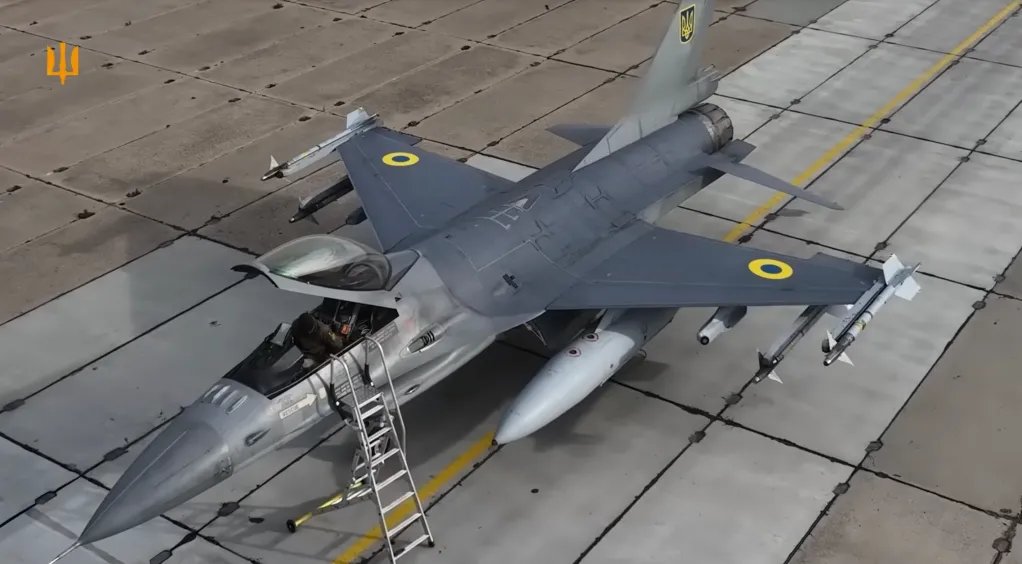
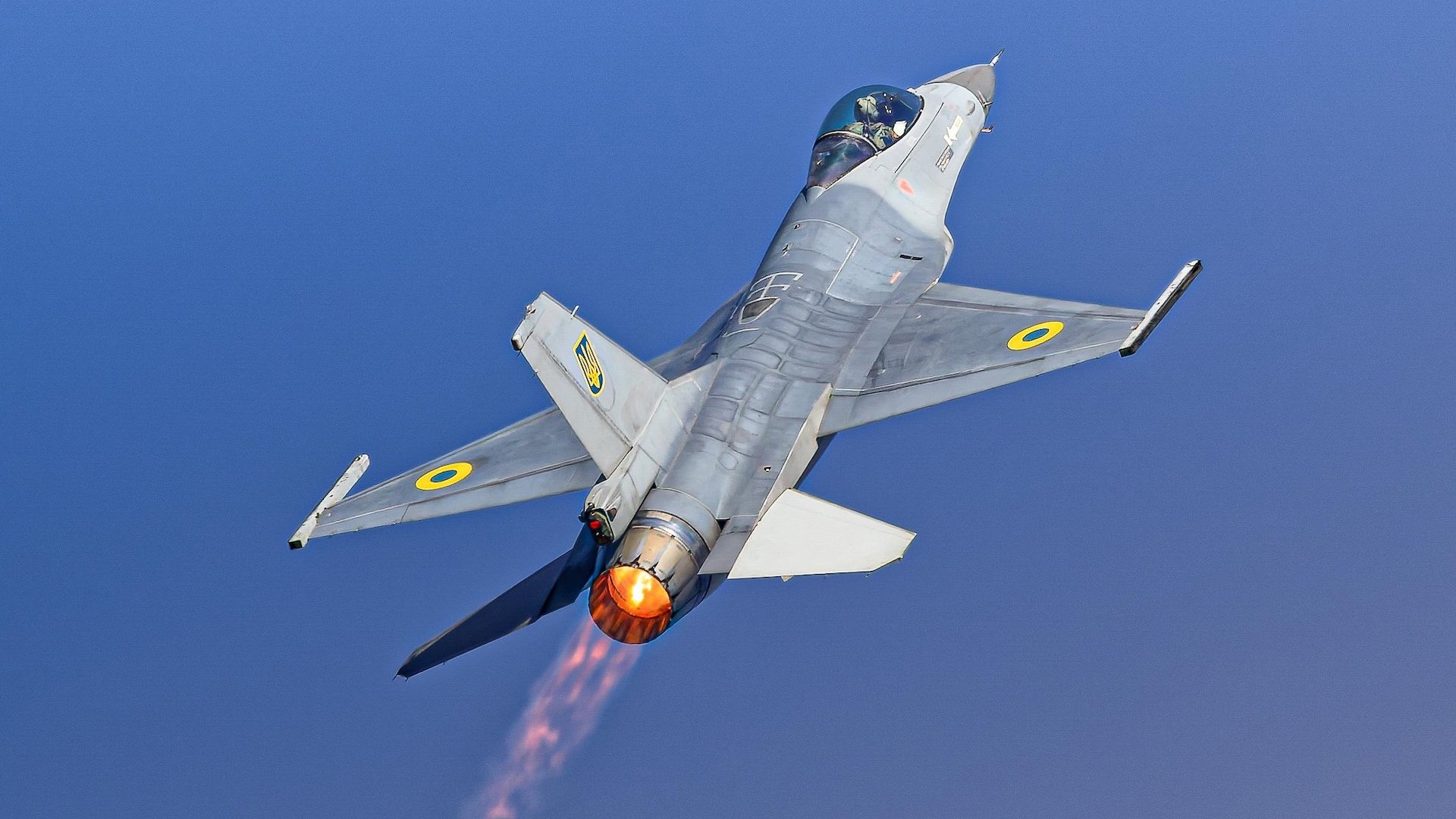
Ukrainian F-16 pilots are facing such a severe shortage of air-to-air missiles that some daytime sorties have seen them rely solely on the fighters’ internal guns to engage Russian aerial threats, according to a journalist who recently spoke with a senior Ukrainian Air Force commander. Meanwhile, the lack of air-to-air missiles means that the available weapons stocks are now being rationed.
The disclosure provides a remarkable glimpse into the day-to-day reality of Ukraine’s F-16 operations. While the aircraft may be available, the pilots may be ready, and Russian drones and cruise missiles may be approaching, there may simply not be enough missiles on hand to arm the jets.
According to Newsmax journalist Shelby Wilder, the Ukrainian Air Force can find itself monitoring missile shipments as they cross the country’s border, with personnel counting not just the hours but the minutes until those weapons reach the aircraft. The concern is whether the missiles will arrive in time for the next major Russian aerial attack.
The Ukrainian commander, who identified himself by the callsign “Phantom” and as commander of the country’s 107th Wing, confirmed the underlying problem when asked directly whether Ukraine was severely short of missiles for its F-16s.
“Yes, that’s true. Any aircraft without weapons is … useless,” Phantom said.
The fighters have become an important part of Ukraine’s layered air defense network, hunting Russian drones and cruise missiles while also providing a potential counter to Russian combat aircraft, and conducting air-to-ground sorties. Ukraine has operated the F-16 since the summer of 2024.
“We are focusing on defending our skies against Russian unmanned drones to protect our infrastructure inside the country,” Phantom said. “Our target priority is cruise missiles.”
Destroying as many incoming threats as possible before they reach Ukrainian cities and infrastructure requires missiles, with the F-16 primarily armed with the AIM-120 Advanced Medium-Range Air-to-Air Missile (AMRAAM) and the shorter-range AIM-9 Sidewinder.
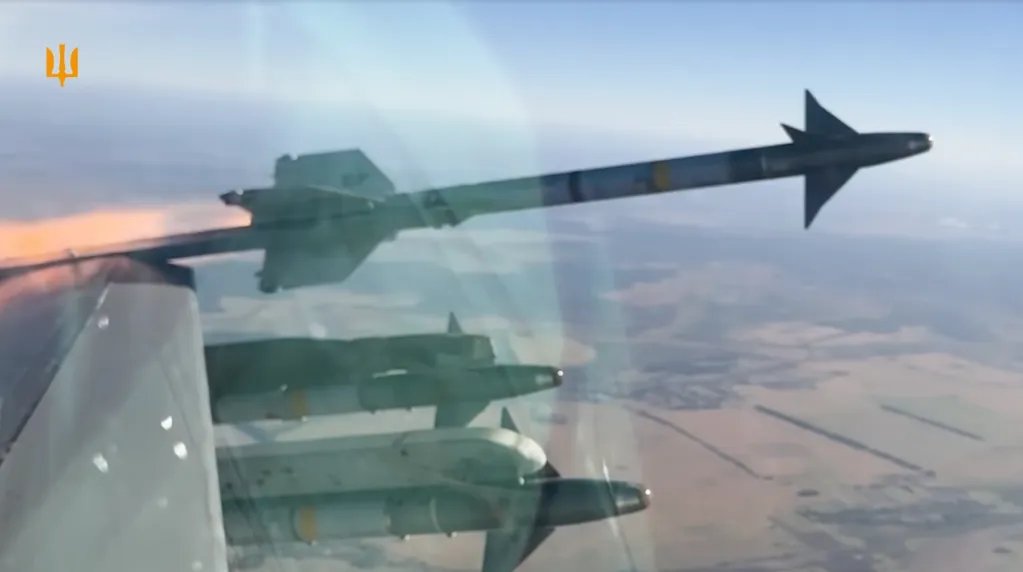
Another live AIM-9L/M launch. This Ukrainian F-16 carries six Sidewinders. Ukrainian Air Force screencap
According to the new disclosure, those missiles have become a commodity whose availability can determine how a sortie is flown.
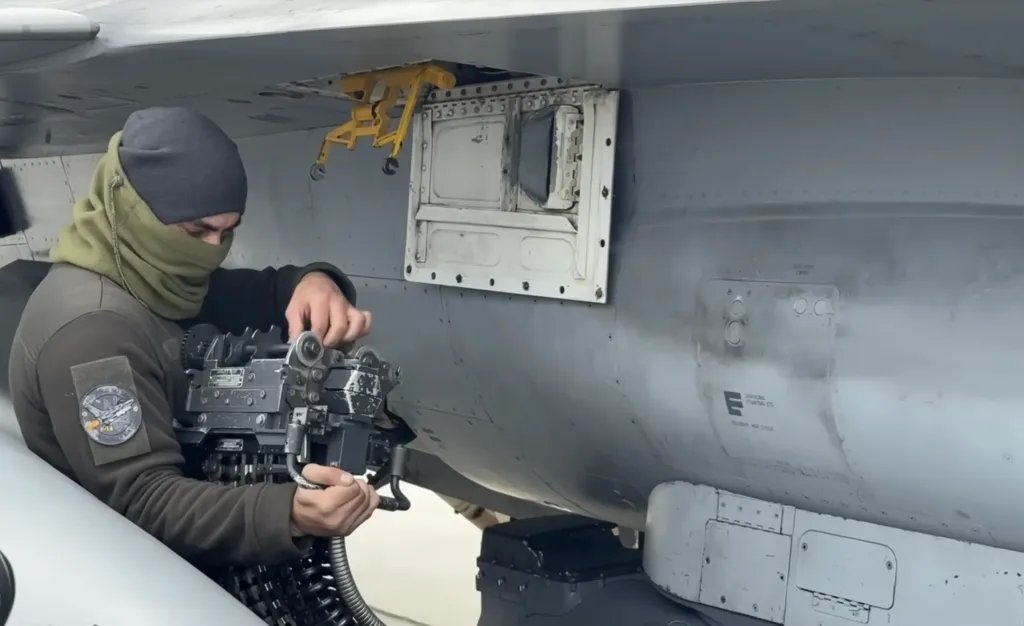
The F-16 carries an M61A1 Vulcan 20mm rotary cannon, but using the gun against an aerial target is fundamentally different from engaging it with a missile, and comes with its own risks, as we have explored before. This tactic is especially hazardous when going after small targets and especially slow ones, and it becomes even more dangerous at night.
Ukraine has already demonstrated that its F-16s can use their guns in combat. In May 2025, the Ukrainian Air Force said an F-16 pilot had destroyed three aerial targets and was engaging a fourth with the aircraft cannon before an emergency forced him to eject.
An armorer loads an F-16 with 20mm ammunition for its M61A1 cannon. Ukrainian Air Force screencap
One air-to-air weapon not mentioned by Phantom is the laser-guided 70mm Advanced Precision Kill Weapon System II (APKWS II) rocket, now apparently also part of the arsenal. These rockets would offer the Ukrainian Air Force an extremely valuable, lower-cost option for engaging drones and subsonic cruise missiles.
Regardless, Phantom specifically called for additional air-to-air missiles, as well as interceptors for ground-based Patriot batteries.
“We require more means of protection, such as Patriot missiles and air-to-air missiles, AIM-9s or AIM-120s to our fleet,” he said.
Phantom’s message is that simply delivering more aircraft is not enough. Ukraine needs a sustainable weapons pipeline to keep those aircraft combat-effective.
Ukrainian Air Force F-16AM Fighting Falcon departing Belgium after receiving depot-level maintenance earlier this year. pic.twitter.com/Hy35iUZd8P
This is increasingly becoming a wider problem across Ukraine’s air defense network. Patriot interceptors have been heavily consumed, with relatively few replacement missiles now trickling in, leaving Ukraine with limited ability to defend against ballistic missiles in particular. The strain is now spilling into the lower tiers, including the air-to-air missiles carried by F-16s. Ukraine’s continued consumption of interceptors is a major driver, but it is competing with the enormous demand generated by ongoing wars in the Middle East and a broader surge in demand for advanced air defense weapons around the world. With production struggling to keep pace, scarce interceptors are effectively being rationed across an increasingly crowded global battlefield.
“At least we need to try to increase the production, or at least to allow Ukraine to localize the production in Ukraine or other European countries,” he said.
That proposal reflects the fundamental vulnerability of a relatively small fleet operating in a high-intensity air war. Every missile fired at a Russian cruise missile or drone is one less available for the next engagement. A finite inventory therefore has to cover both routine air-defense missions and the possibility of much larger Russian attacks. At the same time, both the AIM-9 and especially the AIM-120 are used for Ukrainian ground-based air defenses too. The AMRAAM, in particular, is the effector for the NASAMS, which protects Kyiv, and other key objectives against cruise missiles and drones.
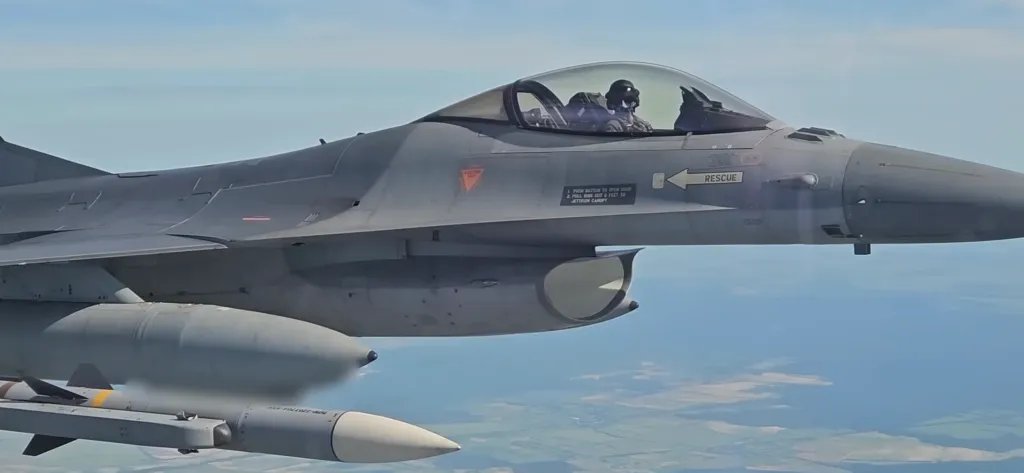
Air-to-air with two F-16s. The nearest jet carries a wingtip AMRAAM. Ukrainian Air Force screencap
The problem becomes even more acute because Ukraine cannot know precisely when the next major Russian strike will arrive.
That is why, according to Wilder’s account, the arrival of missile shipments is being followed with extraordinary urgency.
At the same time, Phantom welcomed the major technological leap that the F-16 represents over the Soviet-designed MiG-29s and Su-27s that formed the backbone of Ukraine’s fighter force.
“The F-16s in comparison with the legacy aircraft like MiG-29 or Su-27? This is kind of like a new technology,” Phantom said.
But sophisticated aircraft are only as useful as the weapons available to them.
Ukrainian F-16s have reportedly destroyed huge numbers of Russian drones and cruise missiles, and in July a Ukrainian F-16 was publicly identified by the U.S. Joint Chiefs chairman as having shot down a Russian fighter.
CONFIRMED! On July 8, 2026, a Russian Su-35 multi-role fighter was shot down on the eastern sector!
Phantom also asked Ukraine’s Western partners to think beyond individual weapons transfers and toward production capacity.
He also urged the United States and European countries to do more to prevent Russia from acquiring components used in its own missile production through third party countries.
“We need to make as much as we can to stop providing the parts, most technological parts to Russians, bypassing the direct sales, of course, through the third party,” he said.
An armed F-16 between sorties. Ukrainian Air Force screencap
Phantom argued that Russia continues to obtain sophisticated components through intermediaries and even ostensibly civilian products.
“It would not be a surprise that Russians [are] using the washing machine that they’re buying from the third party to use those smart details for building missiles,” he said.
His recommendation is tighter sanctions and enforcement designed to cut off Russia’s access to those components.
“Important is to sanction to stop Russia from being able to have access to those parts,” he said.
That, combined with missile shortages, could become an even bigger problem when Russia conducts another major aerial campaign against Ukraine, particularly as Moscow traditionally intensifies attacks against the country’s energy infrastructure during the winter months.
Japan’s Ministry of Defense has included an intriguing description of the ASM-3 Kai missile in its record fiscal year 2027 defense budget request, referring to the weapon as an “air-to-surface/anti-air missile.” Until now, the ASM-3 family has been publicly associated with the air-launched anti-ship (anti-surface) mission, and the wording potentially hints at an additional capability or intended role for the upgraded weapon.
The reference appears under a sub-section entitled Durability and Resilience, which calls for funds to “secure ammunition and fuel, increase the number of operational units (by addressing parts shortages, etc.), enhance the resilience of facilities (through facility upgrades associated with the formation of new units and the introduction of new equipment, etc.), and strengthen the operational infrastructure (by enhancing manufacturing capabilities, etc.).”
— 因幡のよっちゃん(稲葉義泰 Yoshihiro Inaba) (@japanesepatrio6) August 31, 2026
In terms of securing ammunition, the document highlights the breadth of weapons systems involved, ranging from 5.56mm small arms ammunition and 30mm cannon rounds, via 155mm precision artillery rounds, up to advanced missiles including the Type 23 ship-launched air defense missile and the ASM-3 Kai.
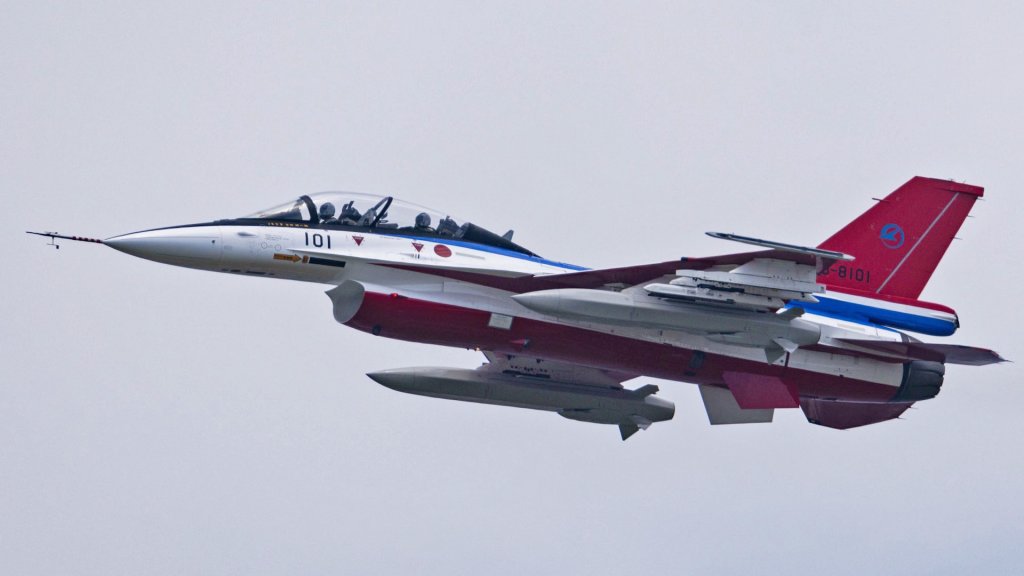
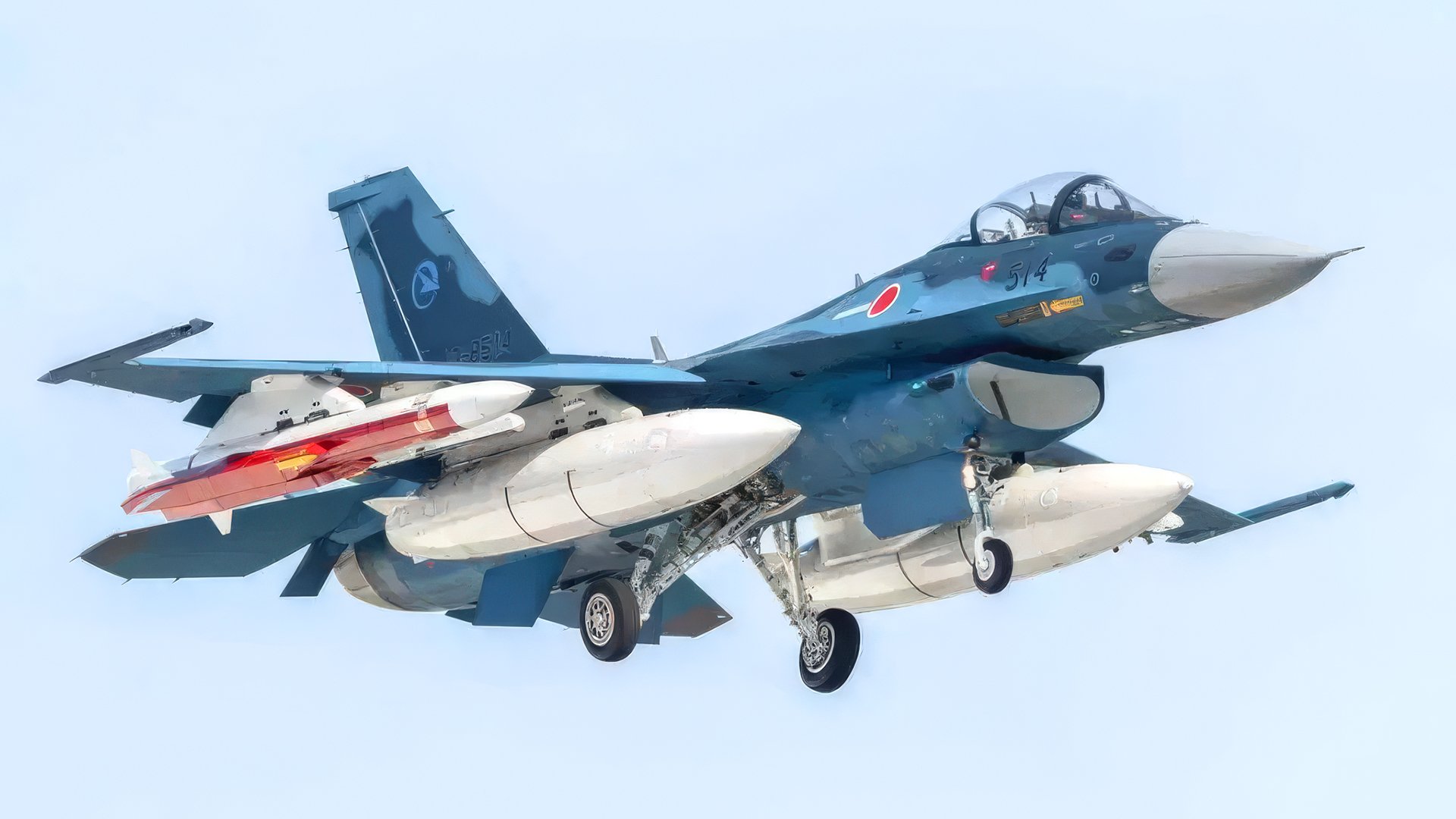
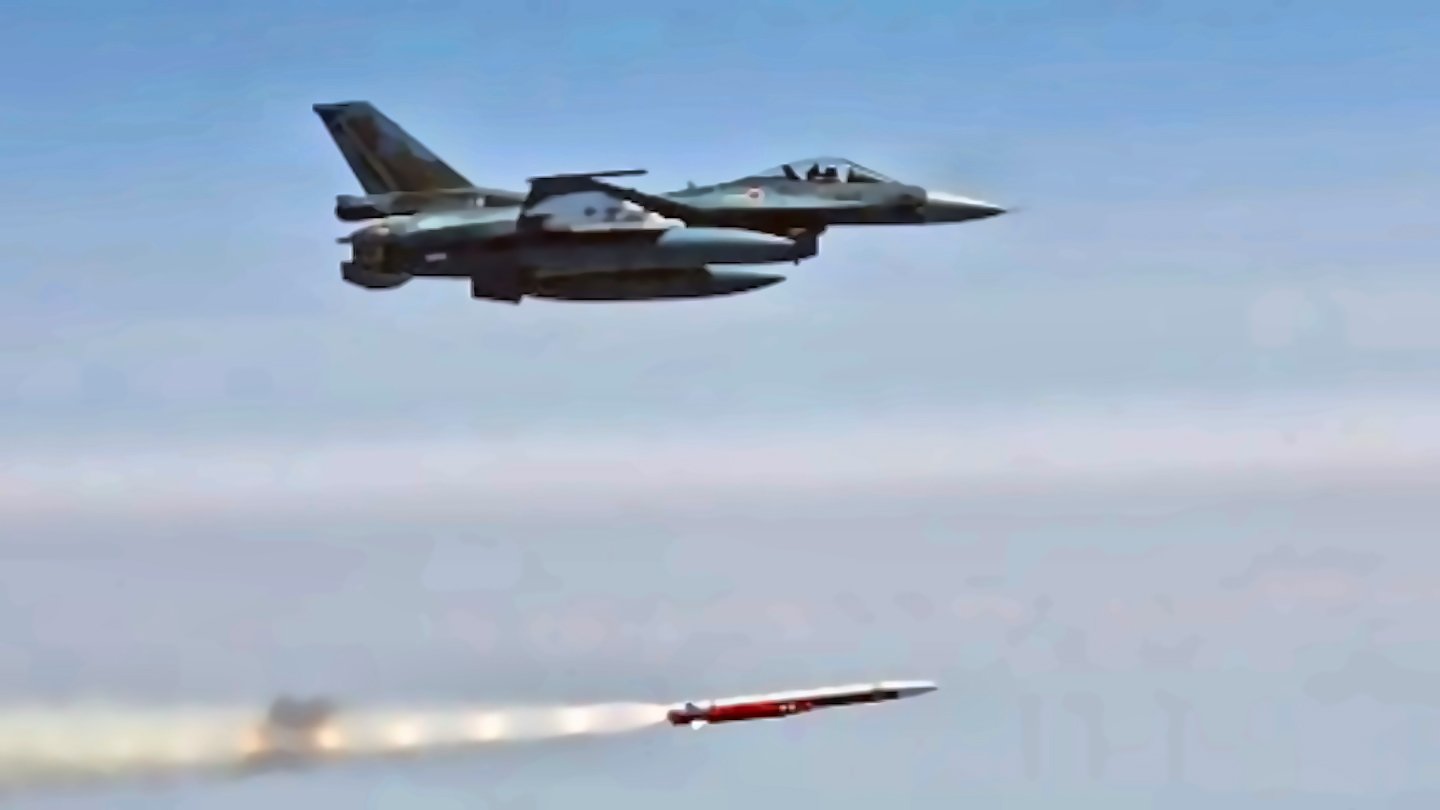
The Mitsubishi Heavy Industries (MHI) ASM-3 is Japan’s domestically developed supersonic air-launched anti-ship missile, originally intended to arm the Mitsubishi F-2 fighter. The improved ASM-3 Kai (“Kai” meaning modified or revised) represents a significant evolution of the weapon, although the full nature of its capabilities and performance have not been officially revealed. The missile has already been observed undergoing testing on F-2s.
The ASM-3 program has also gone through a number of different configurations over its development history, with at least five distinct external configurations identified in previous reporting. The existence of multiple iterations leaves open the possibility that the newly identified “anti-air” designation could ultimately correspond to a dedicated air-to-air variant or derivative of the ASM-3 family, rather than simply a secondary capability of the baseline ASM-3 Kai.
Reportedly, the ASM-3 Kai is capable of flying more than 400 kilometers (about 250 miles), although the exact range of the operational weapon remains classified. It is powered by a ramjet engine, giving it sustained high-speed performance — reportedly around Mach 3. If it indeed has an air-to-air capability, this would be an advantage in some scenarios, compared to relying solely on a brief but very powerful rocket boost as many air-to-air missiles do.
A Mitsubishi F-2 launches an ASM-3 anti-ship missile. (JASDF)
The weapon is also understood to employ an active/passive radar seeker, providing it with both an active radar mode for detecting and engaging targets and a passive mode that can home in on their electromagnetic emissions. While an active radar seeker is common on long-range air-to-air missiles, the latter passive capability could also be of extreme value in an air-to-air application.
The ASM-3 is also a substantially larger missile than typical fighter-launched air-to-air weapons. While that imposes obvious carriage and aerodynamic penalties, it also allows for a larger propulsion system, seeker, and warhead than would be practical in a smaller missile.
A weapon capable of traveling hundreds of miles at high speed, while carrying an active/passive radar seeker, could potentially be especially useful against high-value airborne assets such as airborne early warning and control (AEW&C) aircraft. These platforms provide vital wide-area surveillance, battle management, and targeting capabilities. At the same time, their powerful radars are necessarily emitting, potentially making them detectable and trackable by a missile employing a passive seeker.
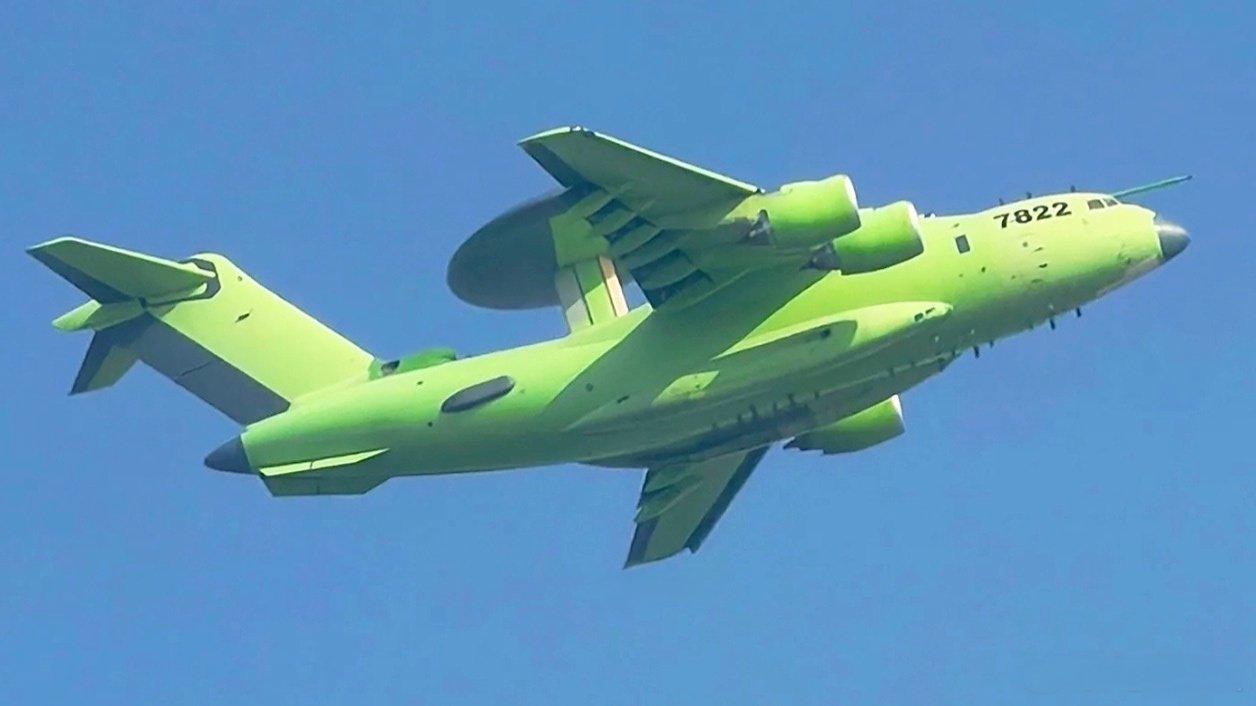
China’s rapidly expanding AEW&C fleet is an increasingly important part of its ability to generate situational awareness, coordinate fighters, and extend its sensor coverage well beyond its immediate borders. The force, which already numbers dozens of increasingly capable fixed-wing aircraft, is a growing operational challenge for Japan and other regional air forces.
The second example of the Chinese KJ-3000 AEW&C aircraft, still painted in primer. via X
The ability to threaten such aircraft from well beyond the range of conventional air-to-air engagements could force an opponent to operate its AEW&C fleet even further from contested airspace, reducing the effectiveness of its sensors and command-and-control architecture. Although a passive seeker could also offer an avenue for homing in on relevant radar emissions, exactly how the ASM-3 Kai’s seeker would operate against airborne targets is not publicly known. Equally, a different variant of the missile, optimized for anti-air missions, could incorporate both passive and active seekers specially adapted for that mission set, although it is very possible a single configuration can accomplish both missions. As well as AEW&C aircraft, such a missile would be just as relevant for other high-value, non-maneuvering targets at long ranges, including intelligence-gathering platforms, tankers, and other support aircraft.
The budget language by itself falls short of establishing whether the ASM-3 Kai has been tested or validated against aircraft. The designation could reflect a broader classification within the budget documents, or it could point toward a genuine expansion of the weapon’s intended target set.
Such a weapon would not necessarily be a replacement for Japan’s existing air-to-air missile arsenal. Instead, an “anti-air” ASM-3 Kai could occupy a specialized niche focused on high-value or otherwise particularly important airborne targets at extended ranges.
The possibility is consistent with Japan’s broader effort to expand the flexibility and reach of its air-launched weapons. Tokyo is pursuing a growing family of standoff weapons as part of a major expansion of its counterstrike and deterrence capabilities, including longer-range missiles capable of striking targets well beyond the immediate vicinity of Japan.
Other air-to-air missiles mentioned in the same section of the document comprise the U.S.-made AIM-120 Advanced Medium-Range Air-to-Air Missile (AMRAAM) and the domestically developed AAM-4B, another medium-range weapon, thought to be the first of its kind to be fitted with an active electronically scanned array (AESA) antenna.
Between the exclusive AESA radar and Japan's labour cost, Mitsubishi's AAM-4B might be the most expensive air-to-air missile on the planet pic.twitter.com/rfBnXB8RzS
The FY2027 defense budget request also mentions another apparently new air-launched weapon for Japan, the AGM-88G Advanced Anti-Radiation Guided Missile-Extended Range (AARGM-ER). Japan has not previously been publicly documented as an international AARGM-ER customer, but the weapon would be an obvious candidate for integration with its F-35 fighters if it wishes to bolster their suppression/destruction of enemy air defenses (SEAD/DEAD) capabilities.
An AARGM-ER seen under the wing of an F/A-18F Super Hornet during a test. U.S. Navy
In terms of F-2-related developments, the document calls for the upgrade of an initial 10 of these aircraft to make them compatible with the air-launched version of the Upgraded Type 12 anti-ship guided missile, a significant new weapon that you can read more about here.
A pair of new missiles slung beneath the wings of an F-2, understood to be the air-launched version of Japan’s Upgraded Type 12/Type 25 anti-ship missile. @bibabibabibary @bibabibabibary
TWZ has contacted Japan’s Ministry of Defense seeking clarification on the “air-to-surface/anti-air” designation and what it means for the ASM-3 Kai’s intended capabilities and target set. It could also be the case that the description is an error in the budget document.
However, the emergence of such a capability would also come at a time when very-long-range air-to-air weapons are becoming increasingly important as anti-access/area-denial challenges make it harder for fighters to get close to enemy aircraft and the high-value assets supporting them. China has fielded weapons such as the PL-15 and the much larger PL-17, while the United States is developing the AIM-260 and has just revealed the AIM-424 Malice, a U.S. Navy missile reportedly capable of reaching more than 250 nautical miles. The U.S. Navy is also fielding the AIM-174B, a very-long-range weapon developed very much with the Chinese threat in mind, and which we discuss in the video below.
For now, exactly what prompted the “air-to-surface/anti-air” designation for the missile is unclear, but if it reflects a genuine expansion of the ASM-3 Kai’s mission set, it would represent a particularly interesting development in Japan’s rapidly evolving air-launched weapons portfolio.
Hat-tip to Yoshihiro Inaba for bringing this development to our attention.
Europe is entering an interesting, and potentially highly consequential, period in the development of beyond-visual-range (BVR) air-to-air weapons. While the public emergence of new U.S. weapons in this class has unsurprisingly grabbed the headlines in recent months, Europe is meanwhile working on several projects that ultimately seek to field its next generation of far-reaching air-to-air missiles.
As in the United States, the immediate catalyst is the rapid evolution of Chinese air-to-air missiles, particularly the PL-15 and newer systems that are emerging around it. The India-Pakistan air combat experience from last year has brought the issue into sharper focus, demonstrating the operational consequences of underestimating an opponent’s long-range air-to-air capabilities. However, while Pakistan said its Chinese-made fighters and missiles shot down several Indian aircraft, the precise circumstances, numbers, and tactics involved remain the subject of competing claims and outside analysis.
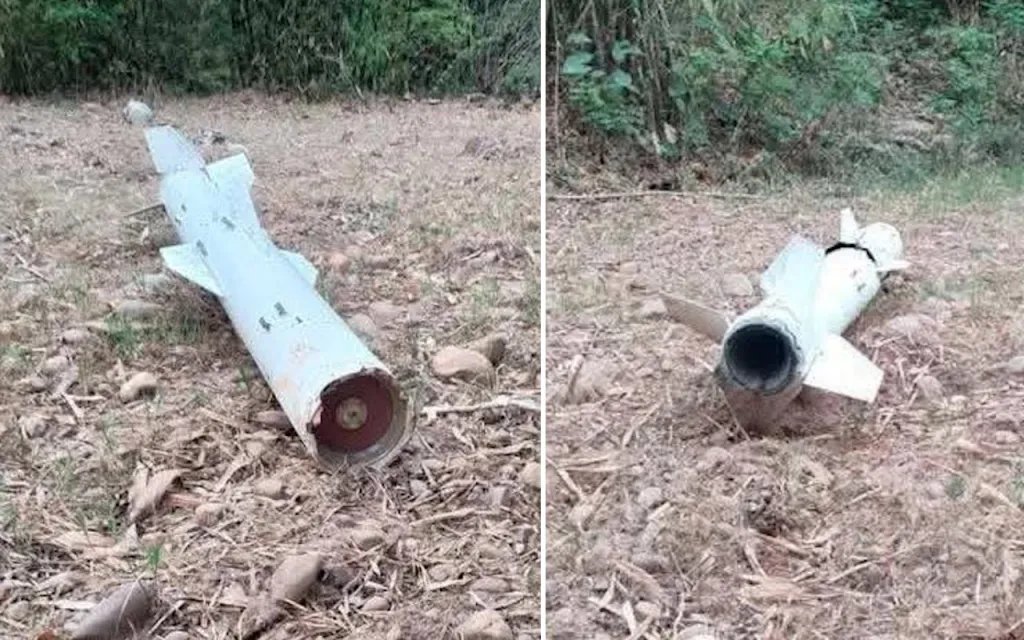
Pictures of the PL-15E missile body that came down in India’s Punjab region during the Indo-Pakistan conflict in May 2025. via X
For Europe, the MBDA Meteor is currently the state of the art in terms of BVR air-to-air missiles, and its unique set of capabilites is something we have discussed in depth in the past. The question is increasingly not simply how to improve the Meteor, but what should come after it, and what kind of weapons architecture (or ‘kill chain’) will be needed for the next generation of crewed and uncrewed combat aircraft and their weapons.
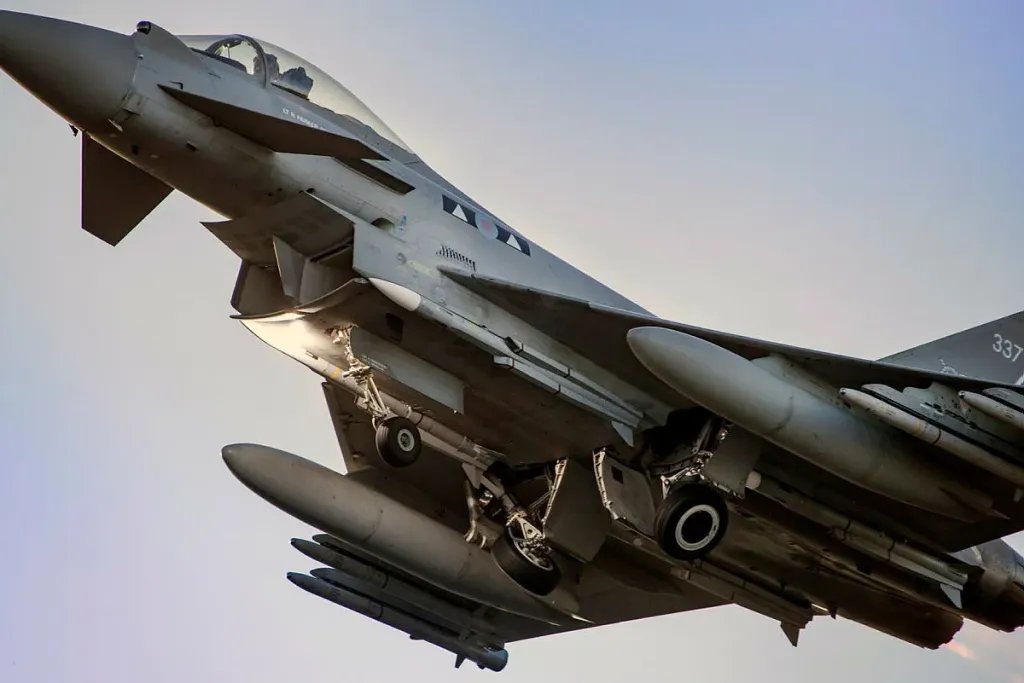
A U.K. Royal Air Force Typhoon takes off, loaded with Meteor missiles below the fuselage. Crown Copyright
One of the most intriguing current developments is France’s Comet program, which appears to be led by the French side of the pan-European MBDA consortium. Very little is publicly known about the weapon, and its exact specifications remain unclear. It nevertheless appears to represent an effort to provide a significant step beyond the current MICA family, offering greater range and speed. If the apparent timeline of around 2030 is correct, Comet could be viewed as a relatively near-term response to an increasingly demanding threat environment.
Douglas Barrie, senior fellow for military aerospace at the International Institute for Strategic Studies (IISS) research institute in London, told TWZ that Comet looks like “a response to the exchanges between the Pakistanis and the Indians, where, on day one, the Indians underestimated how aggressive the Pakistanis were going to be, particularly with PL-15. It seems coincidental at the very least that this kind of thing has just popped up onto the horizon.”
Four dummy PL-15 missiles in the internal weapons bay of a Chinese J-20 fighter. Chinese Internet
That would distinguish Comet from the U.K.’s Future Air Superiority Effectors, or FASE, program which appears to be associated much more closely with the longer-term requirements of the U.K.’s Future Combat Air System and GCAP/Tempest.
Talking to TWZ, Justin Bronk, a research fellow for airpower at the Royal United Services Institute (RUSI), explained that FASE “is likely aimed at providing significantly better combat capabilities by the early-mid 2030s than a mid-life upgrade of the Meteor missile would be able to offer within the bounds of its basic layout and size.”
Creating an interesting overlap with FASE and Comet is a joint Franco-British study looking at what comes after Meteor. In April, the two countries signed a memorandum of understanding launching the 12-month effort that will assess future air-combat threats and potential next-generation missile concepts. The study is intended to identify the technologies required for a successor weapon and establish a development roadmap. While the two countries are at least formally examining the same post-Meteor problem, their longer-term combat air priorities appear to be diverging.
Beyond Meteor
Meteor remains one of Europe’s most capable air-to-air weapons. Its ramjet propulsion system gives it an important advantage over conventional solid-rocket missiles by allowing it to retain propulsion and energy much further into an engagement.
However, the threat environment that Meteor was designed against is changing. Meteor’s requirements were established in an environment dominated by the Soviet/Russian air-to-air missile threat. Today’s planning increasingly has to account for Chinese weapons such as the PL-15 and newer systems that may combine very long range with substantially greater speed.
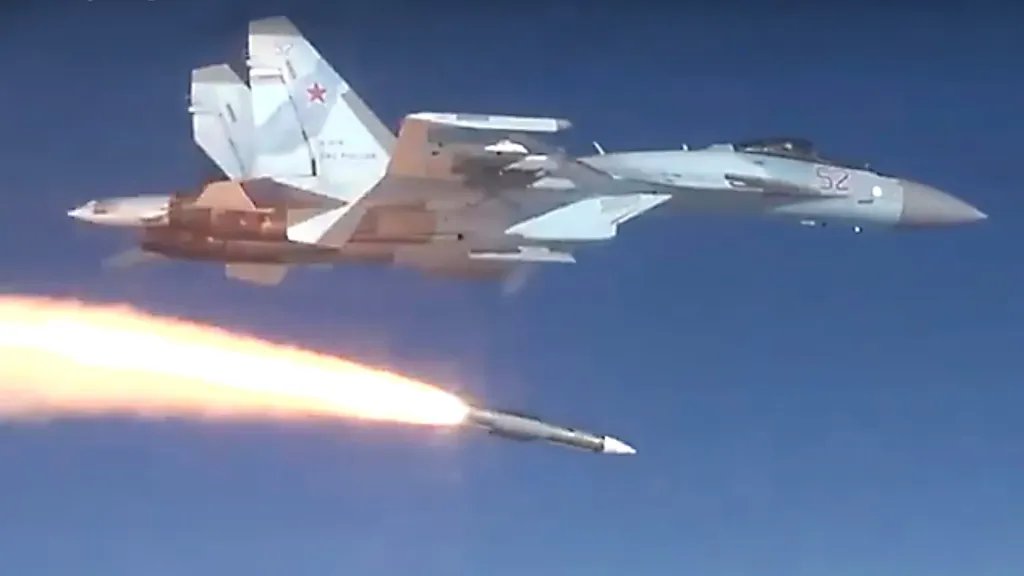
A Su-35S launches an R-37M — the longet-range Russian air-to-air missile. Russian Ministry of Defense screencap
“Since the Meteor is still more than a match for current Russian air-to-air missiles in air-to-air engagements, it is likely that the capability goals for the FASE program will use far more capable Chinese air-to-air missiles, aircraft, and sensors as pacing threats,” Bronk added.
That raises the uncomfortable question of what happens when both sides can launch extremely capable BVR weapons against each other?
Simply put, higher speed now matters more, because it reduces the target’s reaction time and can make the terminal engagement substantially more demanding. One of Meteor’s advantages is the considerable energy it retains when it reaches the terminal phase, but the tradeoff is a slower average speed across the entirety of its flight envelope.
Barrie explained: “Meteor’s fly-out speed is somewhere between Mach 3.5 and somewhere below Mach 4. If you launch a PL-15 off a J-20, which is doing Mach 2, that weapon probably stays above Mach 5 for an awfully long time, which is one of the issues. It’s that risk of a mutual kill. Obviously, if the weapon against the J-20 is coming out at Mach 3.5 to Mach 4, then you have a bit an issue there.”
At the same time, a missile’s effectiveness depends on many other factors, including launch conditions, flight profile, midcourse guidance, seeker performance, electronic warfare environment, and target maneuvering.
However, the nature of the threat may push the next generation of European weapons toward a combination of greater range, substantially higher speed and greater terminal energy rather than simply another incremental improvement to Meteor. Indeed, the United Kingdom has dropped its plans for a Meteor mid-life upgrade, presumably to focus its efforts on an altogether more ambitious and capable successor, or successors.
Does the next weapon need a ramjet?
The Meteor was designed around a ramjet motor, especially since it was expected to face a ramjet version of the Russian R-77 (AA-12 Adder) missile. This was never fielded, and, as far as we know, China doesn’t have a weapon in this class either. A Meteor successor therefore won’t necessarily use the same kind of propulsion.
Chinese People’s Liberation Army Air Force personnel move standard R-77 missiles. PLA
Meteor demonstrated the advantages of air-breathing propulsion, but there are trade-offs involved in using a ramjet or another air-breathing system. Achieving very high speeds while maintaining useful range and maneuverability can become increasingly difficult, and propulsion complexity adds cost and potentially consumes valuable internal volume.
The performance being attributed in open sources to Chinese solid-propellant weapons like the PL-15 suggests that another approach is possible.
Barrie would not be surprised if the ramjet is dropped. “The issue with a ramjet is it’s not impossible to get above Mach 5, but it’s difficult, and there are lots of compromises you probably have to make … I wonder if they may just look at energetic solids.”
A future European missile could therefore use a substantially larger solid-propellant motor, potentially coupled with a different boost and sustain architecture, to achieve the required combination of speed and range. Using more than one stage, or a multi-pulse solid rocket motor could be other solutions to the issue.
The size problem
Perhaps the biggest opportunity for a new European BVR weapon comes from the aircraft that will carry it.
Meteor was developed within the physical constraints imposed by existing fighter aircraft and their weapons-carriage arrangements, including internal carriage in the F-35. A future combat aircraft such as Tempest is expected to have significantly greater internal volume available for weapons.
“One of the drivers for Tempest is internal carriage, obviously, but lots of it,” Barrie continued. “A big main bay, and then probably sizeable side bays as well. That lets you carry a considerably larger weapon mass internally than an F-35. If you look at size of the platform in terms of what they’ve released, it’s a big aircraft, and one would assume it has a very significant internal weapons bay.”
The current AIM-120 AMRAAM internal carriage configuration on the F-35, with two missiles in each weapons bay. Crown Copyright
A larger missile can carry more propellant, potentially support a more powerful propulsion system, accommodate a larger or more capable seeker, and provide additional volume for electronics and other subsystems.
There are different ways of increasing the range of an air-to-air missile, but this process is always easier if the weapon can be made larger. Bigger dimensions can translate to a bigger engine, more fuel, multi-stage rocket motors, and air-breathing engines, like the ramjet used in the Meteor. Other range-extending options that the United States has examined include throttleable “multi-pulse solid rocket motors” and more exotic “propellants, grain configurations, cases, and liners,” all of which would also be able to ensure greater range — as well as higher speed — compared to existing weapons.
The result could be a weapon that is considerably larger than Meteor but still fully compatible with the aircraft for which it was designed.
This reality, and the use of the plural effectors in the U.K.’s FASE terminology raises the possibility that the future European BVR requirement may not be for one missile, but for a family of weapons — at least as far as the British are concerned.
Why “effectors” may matter
If FASE ultimately refers to multiple effectors rather than a single missile, that could point to the broader direction of future air combat, involving crewed aircraft as well as various uncrewed wingmen.
Tempest is expected to operate as a so-called quarterback, supported by a number of uncrewed combat aircraft, remote carriers, or other systems operating considerably farther forward. Those uncrewed systems will have different size, payload and weapons-carriage constraints from the crewed aircraft.
This means that not every platform will need the same BVR weapon, or even be able to accommodate them, when it comes to the larger missiles.
Instead, a future force might require something resembling a family:
A large, long-range, high-speed weapon for the crewed Tempest aircraft, optimized for the highest-end air-superiority engagements.
A medium-sized weapon suitable for existing fighters and potentially future aircraft with more constrained weapons carriage.
A smaller weapon optimized for CCAs or other uncrewed systems where internal bay dimensions, payload and cost are more restrictive.
A modular missile could possibly cover two of these categories at once. More broadly, these weapons could share technologies without necessarily being identical missiles. Common seekers, electronics, datalinks, software, guidance technologies or other subsystems could potentially be reused across the family.
The result would be a fundamentally different approach from simply developing a single Meteor replacement.
The seeker may be as important as the motor
The front end of a future European BVR weapon is another area where significant change is likely.
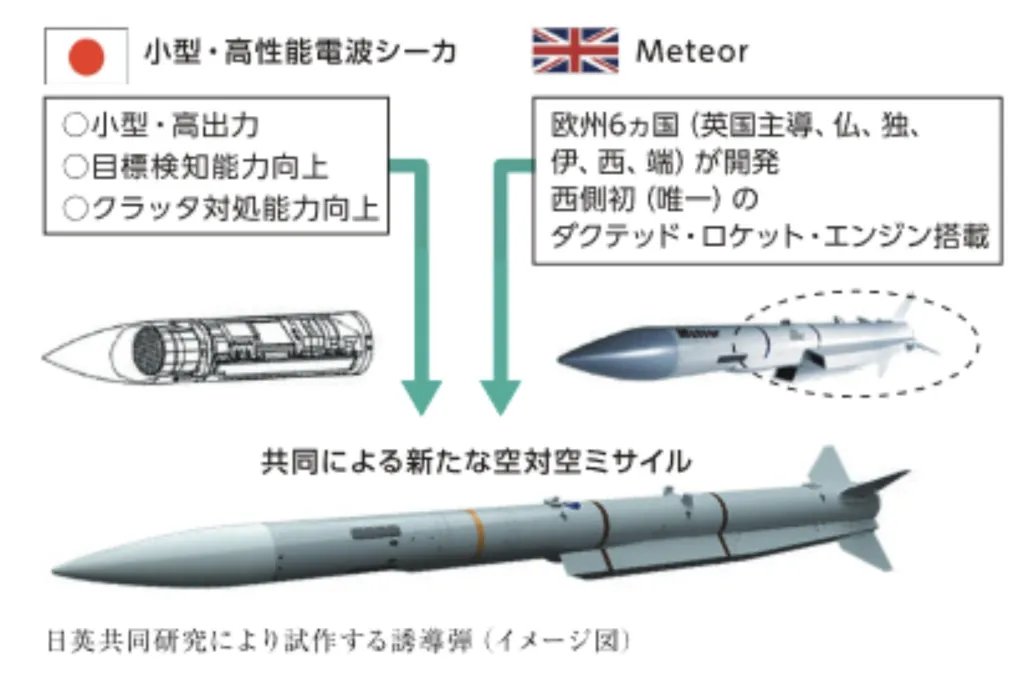
An active electronically scanned array (AESA) seeker would seem a logical baseline for a next-generation weapon. The United Kingdom’s previous work with Japan on the Joint New Air-to-Air Missile program, or JNAAM effort was particularly interesting in this regard, given Japan’s experience with active electronically scanned air-to-air seekers.
An infographic for the JNAAM program provides a loose visual indication of how it would have combined Japanese and British components in a single missile. Japan Ministry of Defense
A future weapon could also incorporate a passive radio-frequency capability alongside its active radar. That would provide another means of detecting or tracking emitting targets and could increase the weapon’s resilience in a heavily contested electromagnetic environment.
For its PL-17 ultra-long-range air-to-air missile, China appears to have chosen a combination of active and passive seekers, although, as Barrie points out, it also appears to have been designed around a very specific target set: E-7 Wedgetail, E-2 Hawkeye, other airborne early warning and control platforms, and support assets, like tankers and strategic electronic surveillance and attack aircraft.
This 2016 image provided our first look at the PL-17. Chinese internet
Whether such a capability is worth the additional cost and complexity is another question. A highly sophisticated multimode missile will inevitably be expensive, however, the same technologies could potentially provide utility against a broader range of targets than conventional fighter-on-fighter engagements. An air-to-surface capability should also not be ruled out, with a passive seeker potentially bestowing an anti-radiation missile (ARM) capability on the weapon.
Another passive seeker alternative could be based on an imaging infrared (IIR) sensor. This could provide an interesting complement to an active-radar seeker, making use of the same kind of two-way datalinked midcourse guidance system already included in Meteor. It could be especially relevant for engaging small or low-signature (stealthy) targets and in a heavily contested electromagnetic environment.
The weapon is becoming part of the network
Perhaps the biggest change will be the extent to which future BVR missiles exploit the wider kill chain, becoming much more than weapons guided by the aircraft that launches them.
The key requirement is for the missile to be track-source agnostic. This means a future long-range air-to-air missile could receive targeting information from a CCA, an airborne early warning aircraft, another fighter, a naval platform, or potentially space-based sensors.
For example, with Tempest operating alongside forward-deployed CCAs, the sensor that initially detects a target could be the CCA. The launching aircraft could then receive the track, launch a weapon, and continue receiving updates from multiple platforms.
Alternatively, a CCA could launch the weapon using targeting information generated by the crewed aircraft or another sensor elsewhere in the force, provided it is on the network.
A graphic from BAE Systems shows a Tempest fighter working as part of a networked team together with Typhoon, F-35, E-7 Wedgetail, and ‘loyal wingman’ type drones. BAE Systems
Two-way datalinks, midcourse guidance, electronic warfare resilience, and the ability to accept high-quality third-party targeting information become central requirements. Some of this functionality is available, to varying extents, on some current air-to-air missiles, but it will be even more important as air combat becomes increasingly reliant on distributed sensor networks and crewed/uncrewed aircraft teaming.
If it can rely on offboard sensors, the missile’s engagement range no longer needs to be constrained by the organic sensor range of the launching fighter. Faced increasingly by the realities of an anti-access/area-denial (A2/AD) environment, this could enable weapons that fly far beyond what the launch platform could independently detect and engage. The A2/AD threat is already pushing research into much farther-reaching air defense missiles, potentially with a range of up to 1,000 miles.
This also opens the door to more exotic propulsion concepts, including multi-stage weapons designed to combine very high-speed boost with a separate sustain or terminal stage.
The next generation of long-range air-to-air missile may therefore be defined as much by the kill chain they plug into as by the architecture and performance of the missile itself.
What happens to Meteor?
Meteor is one of Europe’s strongest examples of a successful multinational defense program. Six European nations participated in its development, and the program eventually produced a weapon that is widely regarded as a highly capable system.
Now, however, the countries that developed Meteor do not necessarily have identical requirements for the next generation.
The United Kingdom is moving toward GCAP/Tempest with Japan and Italy. Its future combat air requirements will increasingly be shaped by that program and by the threat assessment driving it.
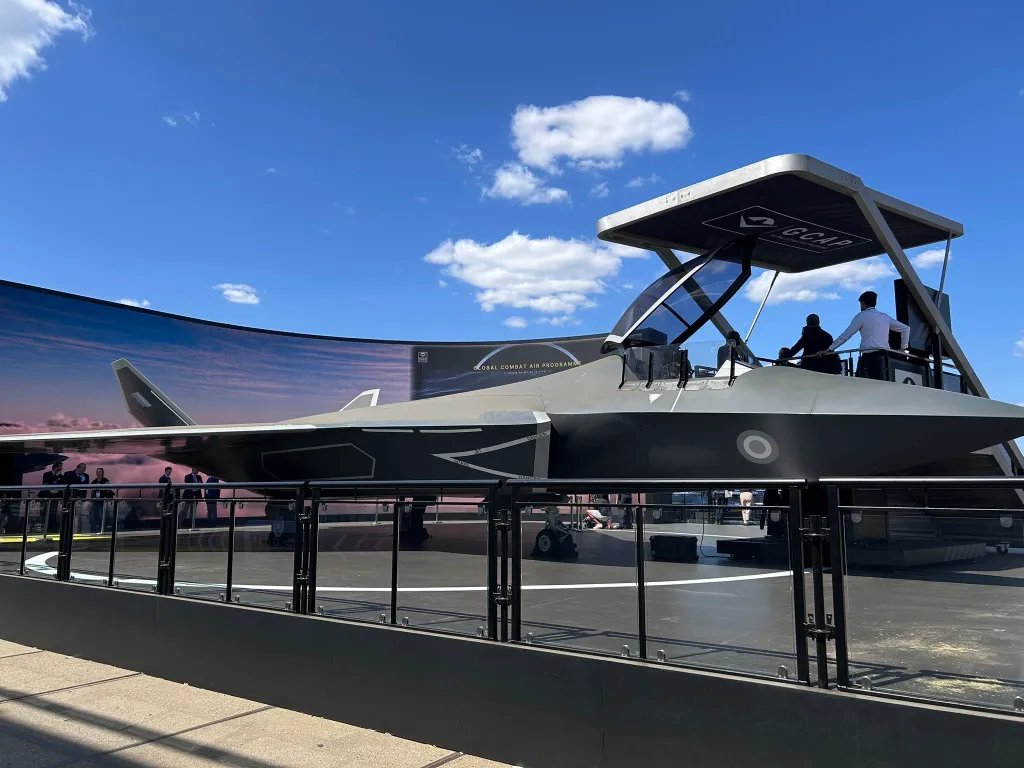
The latest full-size mockup of the Tempest gives some idea of its size. GCAP
The United Kingdom appears to want a very large, very high-performance weapon optimized for Tempest and the future air-superiority mission, especially in the Indo-Pacific region. Japan likely needs very much the same.
Meanwhile, other Meteor users may prioritize a weapon that can be integrated onto existing fighters and remain affordable in larger numbers.
France’s Comet effort could meet that requirement, since it appears to be a comparatively rapid response to the emerging threat. With that in mind, France could eventually find itself with a near-term weapon, a future clean-sheet requirement, and a continuing relationship with the Meteor family, all while pursuing its own future combat air requirements.
Overall, it is far from clear whether the Meteor consortium will survive for another generation, at least in its current form.
Could Japan become part of the answer?
Given that it’s a partner in GCAP/Tempest, and based on its previous air-to-air missile studies with the British, Japan is particularly interesting in this context.
Japan faces a threat environment in which long-range air combat is of obvious importance, and Japan has already demonstrated advanced capabilities in active electronically scanned air-to-air seekers. The Japanese-developed Mitsubishi AAM-4B became the first air-to-air missile to feature an AESA seeker.
Although earlier air-to-air missile cooperation between Japan and the United Kingdom did not evolve into an operational program, the two countries are now developing a combat aircraft together through GCAP.
With Britain and Japan designing the future combat aircraft together, they could eventually develop some of its principal weapons together as well, although Italy’s requirements are likely very different.
Thinking beyond the missile
Europe can almost certainly build a faster missile than Meteor, but there are plenty more questions about what kind of air combat system that missile — or missiles — will fit into.
A future BVR weapon will have to operate from multiple types of platforms (crewed and uncrewed), receive targeting data from offboard sensors, communicate with CCAs, function in a highly contested electromagnetic environment, engage maneuvering targets at extreme range, and retain enough energy to remain dangerous in the terminal phase.
Increasingly, it seems that, rather than a single weapon, a family of effectors will be the solution.
For the United Kingdom, FASE may become one of the most important programs to watch because it could reveal how Britain intends to bridge the gap between Meteor and the weapons of the GCAP/Tempest era. At this stage, FASE appears to be ‘for U.K. eyes only,’ although Japan and Italy would appear to be likely beneficiaries, due to their teaming on GCAP.
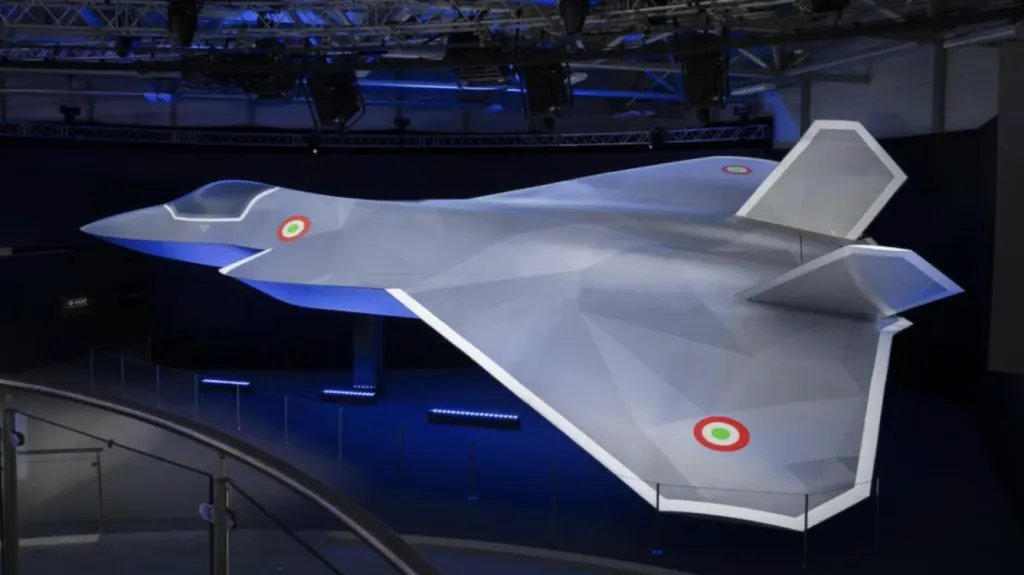
A scale model of a possible Tempest configuration, in Italian Air Force markings. Leonardo
Elsewhere, Comet could provide an early indication of how France intends to respond to the emerging long-range missile threat while maintaining flexibility for a future system.
And for the wider Meteor consortium, it remains to be seen whether the program’s success can be carried forward into another multinational weapon, or whether the emergence of GCAP/Tempest and increasingly divergent national requirements marks the beginning of the end for the Meteor model.
Either way, the next generation of European BVR weapons is likely to be larger, faster, more networked, and more deeply integrated with the combat air system around it. At the same time, the need to create a family of effectors designed around a distributed force of crewed aircraft, CCAs, and offboard sensors will bring some formidable challenges.

 Login





 (@aidefranceukr)

 The moment when a
 Ukrainian F-16 fighter jet shot down a
 Russian Kh-101 cruise missile at extremely low altitude
 MilitaryNewsUA
 CONFIRMED!
 Together to victory!


 2発