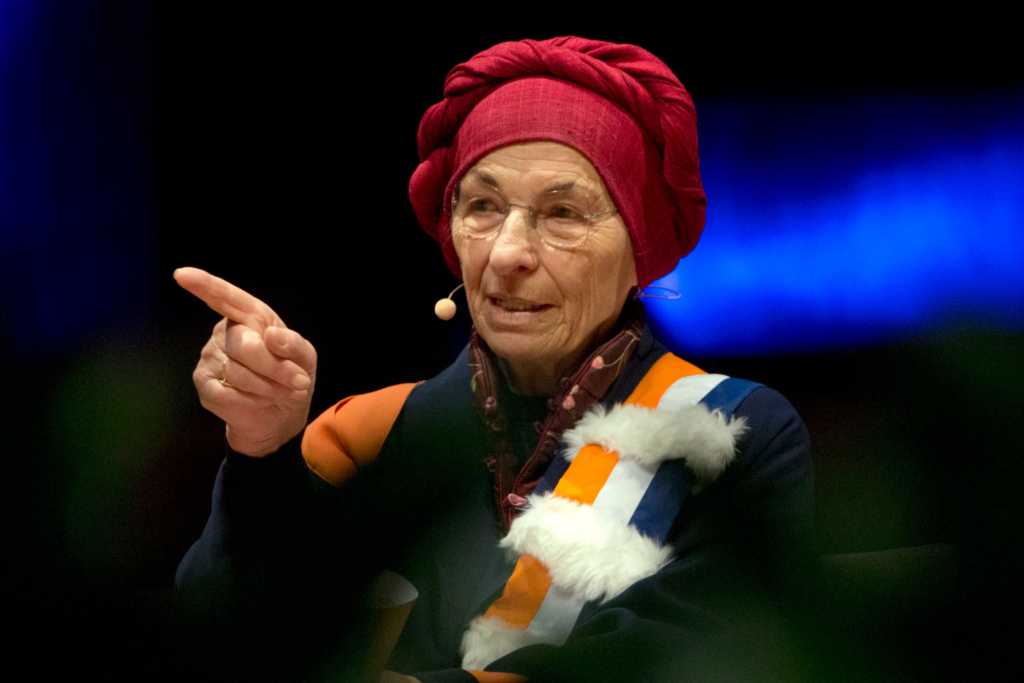
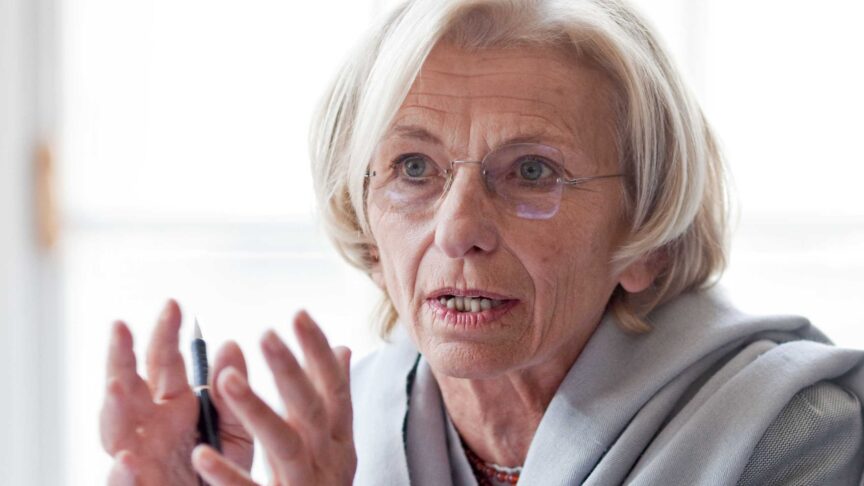
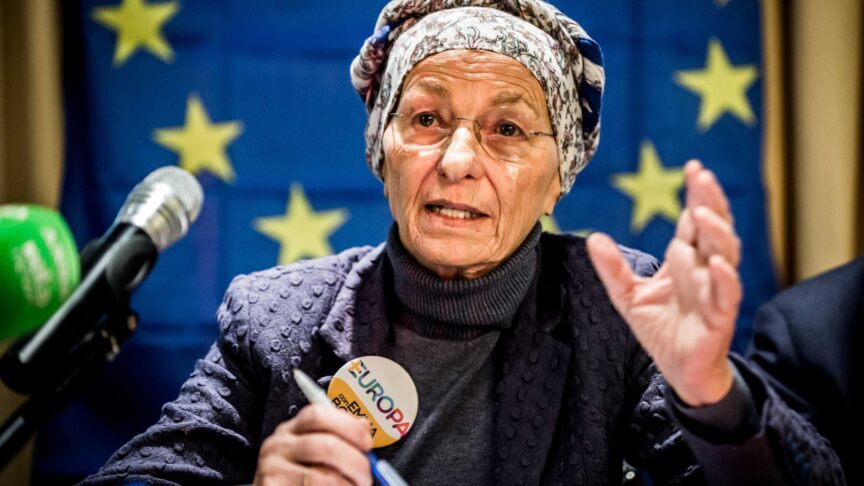
Emma Bonino understood early on that Europe could not afford to turn inwards. For her, Europe was meant to be much more than a common market. She believed that Europe’s role in the world was inseparable from its defence of freedom, democracy and human rights, and that its foreign policy was ultimately about the people behind the decisions made by states. She also helped make European politics a wider space for women, opening paths and challenging expectations along the way. Her legacy is not only in the causes she championed, but in the courage with which she pursued them. The voices of women like Emma, who always fought for our rights, mattered enormously in shaping the Europe we know today. At a time when that Europe is being tested once again, and when civil liberties can no longer be taken for granted, her example matters more than ever.
Cover image: picture alliance / AP Photo/Virginia Mayo
Despite her diminutive stature, Emma Bonino was a giant of European foreign policy. She made a critical difference on a bewildering range of causes. She was a master at operating in a diverse array of settings: protesting on the streets, mobilising NGOs, shaping the agenda of the European Commission, creating unlikely coalitions in the European Parliament and chairing the Italian Senate. She managed to make such a difference in all these places because, wherever she found herself, she was always an activist fighting for civil rights, for justice, for equality.
Emma was also a rebel. She used her charm, humour and honesty to puncture pomposity and force people into a real conversation. She embraced controversy, both in her advocacy for challenging causes like women’s rights, abortion access and drug legalisation, and in her methods such as protests and hunger strikes.
She knew how to translate lofty goals into concrete steps which had some hope of being implemented, whether it was setting up the European Commission’s humanitarian office, campaigning for the establishment of the International Criminal Court, advocating to ban female genital mutilation, or working to change Italian electoral law. She had a sense of history and understood how to use crises to shift the agenda—as she did when she moved to Cairo after 9/11, deciding to learn Arabic and to push for a better understanding between Europeans and the Muslim world. And she was willing to assemble and work with unlikely coalitions to advance her causes, from joint projects with the Egyptian former president’s wife Mrs Mubarak to campaigns with the Pope.
Emma was a founding member of ECFR and helped turn it into the organisation it has become. We assumed when she became Italian foreign minister in 2013 that she would step down as a member, but instead she wanted to stay involved and constantly drew on ECFR’s ideas, expertise and pan-European networks to shape the Italian and European agenda. When she stepped down as foreign minister she became a co-chair of the organisation, and we felt her sense of urgency, ambition and pro-Europeanism in every board meeting.
Emma helped shape the DNA of ECFR. She encouraged us to be courageous, not to be afraid of controversy and to challenge conventional wisdom. She pushed us to be as pragmatic about how to make a difference as we were principled about our goals. Always inspiring others, Emma was a friend and a role model to so many of us—but she didn’t do small talk or make time for idle fun. When the substantive discussions were finished, she would say “va bene” and move on to the next fight (or go out to smoke a cigarette). Her death leaves Europe a greyer and less vital place. We need more Emmas.
Cover image: picture alliance / NurPhoto | Daniel Gnap
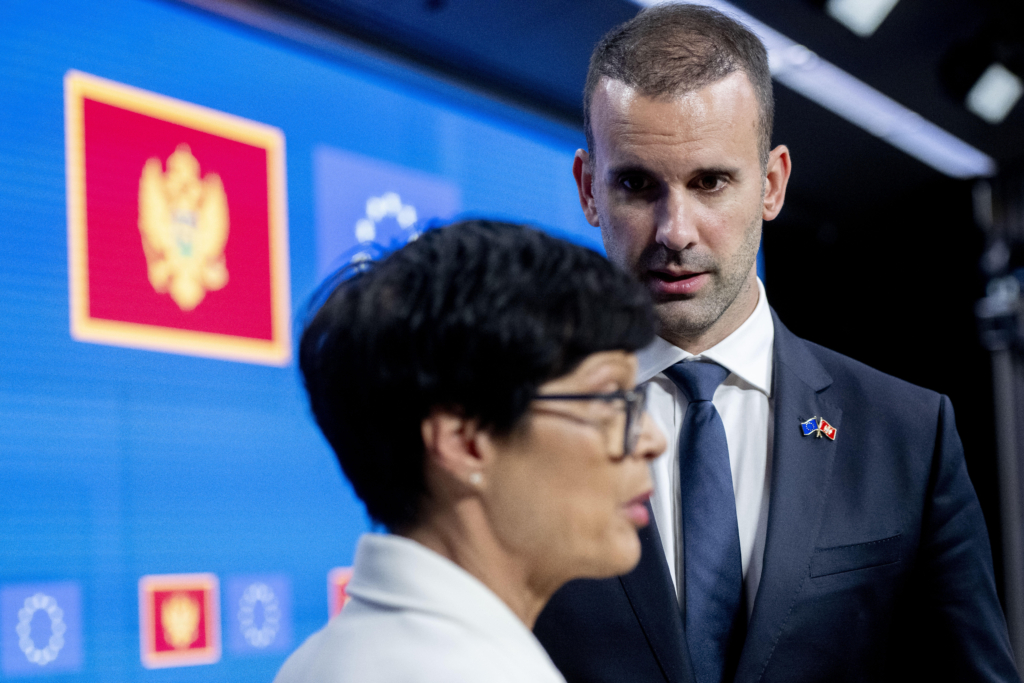
On September 30th, the European Commission is expected to unveil a comprehensive document on EU enlargement, which will be used as a basis for discussion by the European Council in October. The paper is likely to confirm that Montenegro and Albania could finish negotiations soon. But it should also propose ideas on how other countries in the region without this perspective can move forward in their own EU accession journeys.
Any Western Balkan country that joins the EU after waiting over 20 years deserves to be celebrated; the two frontrunners should be commended for making best use of this opportunity and supported to make it over the finish line. But by focusing on these two countries, the EU has prioritised quick wins. Montenegro and Albania have demonstrated commitment to reform, but also have no major bilateral issues to resolve or difficult neighbours to reconcile with.
Montenegro in particular, given its small size and its lack of significant outstanding issues with neighbours, seems ideal for making the case for enlargement as a low-cost and problem-free geopolitical gain. Indeed, commission officials recently compared the annual cost of Montenegro’s entry to the EU per EU citizen to that of a cup of coffee.
However, going for low-hanging fruit must not serve as cover for the EU not achieving its core responsibility in the Western Balkans. It should use its leverage to promote reform and the resolution of bilateral issues, thereby strengthening stability in a region still struggling to overcome its difficult past. The recent funeral of convicted Bosnian Serb war criminal Ratko Mladic demonstrates how important this task remains: the presence of senior Serbian state representatives at his commemoration has caused shock and dismay across the region and within the EU, as well as among many Serbian citizens.
A regional perspective
At the end of the wars of the 1990s, the EU adopted a regional framework towards the Western Balkans. The idea was simple and appealing: improving relations between the Western Balkan countries would go hand in hand with closer ties to the EU. Two decades on, this had led to many challenges and some successes, but only Croatia has become a fully fledged EU member state. While the stagnation in the enlargement process is partly due to a lack of commitment from regional governments, it is also a result of internal EU blockages and a lack of urgency while it dealt with a series of pressing crises.
After Russia’s full-scale invasion of Ukraine in 2022, however, enlargement suddenly became a priority again. The EU understood that it needed to prevent a grey area emerging between itself and Russia. Ukraine and Moldova obtaining candidate status in 2022 revived member-state interest in the dormant case of the Western Balkans enlargement process; Montenegro and Albania recognised the geopolitical opportunity, accelerated their reform efforts and have arrived at a point where EU accession is a realistic possibility.
But the main impetus for this new momentum towards enlargement is dramatically different from what originally drove Western Balkans integration. While the eventual integration of Ukraine and Moldova into the EU aims to strengthen European defences in the face of a common threat, Western Balkan enlargement was meant to foster regional stability and reconciliation among countries that had been at war with each other.
The successful accession of a Western Balkan country may signal to the rest of the region that EU membership is possible and that enlargement is truly a merit-based process, which rewards those advancing reform and making the right geopolitical choices. However, neither the EU nor the Western Balkans can ignore the fact that Kosovo is stuck due to unresolved status issues, Bosnia and Herzegovina carries the burden of a dysfunctional constitution imposed by the international community and North Macedonia is held back by bilateral issues with its EU neighbours.
Focusing on the countries facing fewest obstacles to accession might suit the geopolitical needs of the moment, but it risks losing sight of the original regional dimension of Western Balkans enlargement
Focusing on the countries facing fewest obstacles to accession might suit the geopolitical needs of the moment, but it risks losing sight of the original regional dimension of Western Balkans enlargement.
Towards a new European approach
The European Commission is aware that it needs to provide incentives for countries without an early accession perspective. It is planning to present new proposals on gradual integration in its forthcoming communication on September 30th. A more ambitious and flexible framework for gradual integration, aiming to include countries in parts of the internal market, would encourage reforms and allow the EU to develop a more intelligent and honest approach to conditionality. This is especially necessary for advancing the rule of law and democratic standards, which are all too often neglected in favour of the broader geopolitical picture. This has contributed to the diminished transformative power of the accession process and negatively impacted regional stability.
In addition to exploring options for gradual integration, the EU should revive the diplomatic processes at the heart of what its regional approach was originally meant to achieve. This requires redoubling efforts on the Serbia-Kosovo dialogue, progressing state reform of Bosnia and Herzegovina, and engaging with member states to clear the blockages holding North Macedonia back. This would contribute to regional stability and advance Europe’s geopolitical agenda by reducing opportunities for Russia, China and other actors to exert influence in the region.
The generations that lived through the good and the bad of the regional past are getting older. They might not live to see the European future promised to them at the turn of the century. Many would, however, still remember a line from an old Italian comic book Alan Ford, much loved in former Yugoslavia: “It is much better to be rich and beautiful than to be poor and ugly”. If the EU does not redouble its efforts to close remaining unresolved issues, its membership criteria would effectively follow the same logic. This would be a sad case of the EU abandoning its own ambition and responsibility.
Instructor at the training ground of the Unmanned Systems Troops (UAVS). | picture alliance / Picvario Media | Sergey Elagin
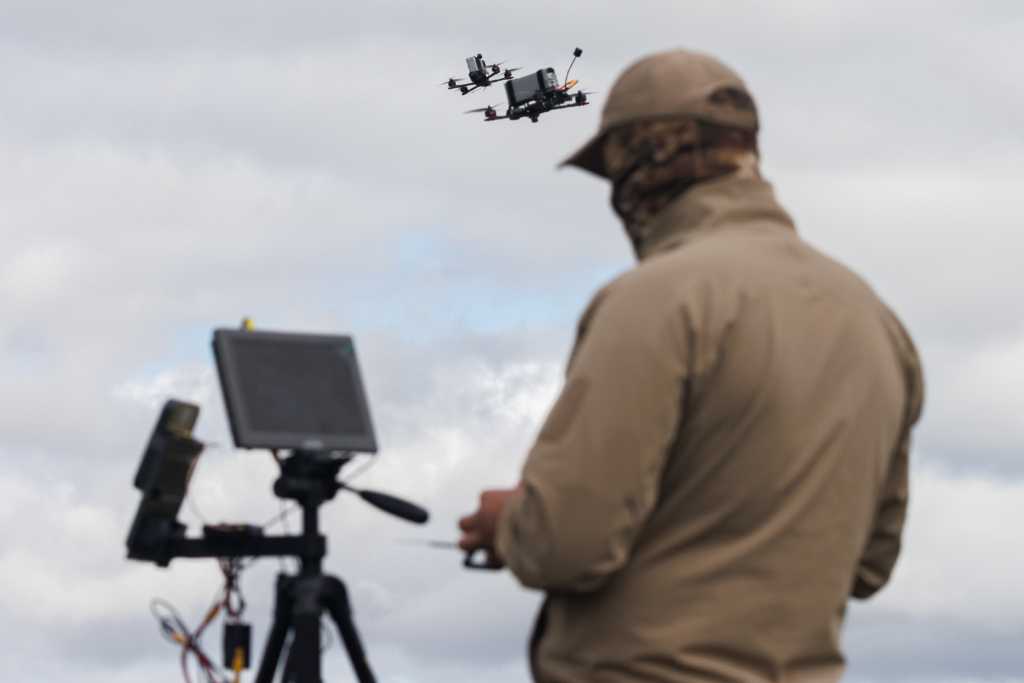
Europe is rearming. Defence budgets are rising, factories are expanding, and new EU instruments are pouring money into ammunition production and joint procurement. But money is only part of Europe’s defence problems. The main constraint is that its systems remain slow, fragmented and poorly suited to an age when military technology can change in months rather than decades.
Three transformations are hitting the continent at once. Russia’s invasion of Ukraine has brought back large-scale war to European soil. Washington’s growing focus on the Indo-Pacific, its renewed interest in Greenland and its push to move NATO from “burden sharing” towards what might be called “burden shifting” mean that Europe will have to provide not only more money for the alliance but also a larger share of its combat power. At the same time, technology is changing warfare faster than traditional procurement systems can keep up.
At present, procurement systems work as follows: a military identifies a requirement; officials draw up specifications; companies compete for a contract and, years later, a system enters service. The problem is that, by then, the technologies shaping the battlefield may have changed dramatically. Promising technologies can become obsolete or fall by the wayside before they ever reach soldiers.
Ukraine has demonstrated a different model. Operational problems generate ideas; engineers turn them into prototypes; soldiers test them; manufacturers improve and scale them; battlefield experience feeds into the next iteration. Technology can also work in the other direction: new capabilities, such as cheap drones, can create tactics that planners had not previously considered.
The real measure of defence-industrial success should not be how many platforms roll off the line, but how fast capability can be imagined, built, tested, industrialised, fielded and adapted again
Europe needs to make this cycle permanent. I propose a model called Adaptive Defence Industrial Ecosystem Management, or ADIEM. The principle is for governments to move from being regulators and buyers to orchestrators of a defence ecosystem that links governments, armed forces, defence and tech companies, start-ups, universities and investors in a continuous loop. The real measure of defence-industrial success should not be how many platforms roll off the line, but how fast capability can be imagined, built, tested, industrialised, fielded and adapted again.
Industrial resilience and human capital are central to this model. Ukraine has shown that sustained operations depend on raw materials, reliable energy, resilient logistics and skilled labour quite as much as on the platforms themselves. And because digital capability now depends as much on software and data engineering as on heavy manufacturing, Europe’s defence sector competes directly with the commercial tech industry for the same scarce talent. This makes the appeal of a defence career a strategic question.
How to make ADIEM work
Reform defence governance. Create permanent structures that bring together military planning, industrial policy, innovation and procurement around shared capability goals. Give them room to depart from standard rules where those rules are the obstacle.
Start with battlefield problems. Build capabilities around what armed forces need to achieve. It works in reverse too: a new system needs a concept of operations written for it before it is bought at scale. Treat these as living documents that evolve with experimentation and real-world lessons.
Make procurement faster and more flexible. Use a hybrid procurement method. While central procurement agencies buy major systems, individual units are allowed to meet certain urgent combat needs. Alongside that, break large procurements into smaller contracts with incremental delivery, allow continuous software updates, use open architecture and speed up certification.
Build a genuine innovation ecosystem. Give start-ups, universities and public labs clear routes to deployment. Reward experimentation and operational relevance over novelty for its own sake.
Achieve affordable mass. Create dedicated programmes for weapon systems that are effective enough, cheap enough to buy in large numbers and simple enough to replace quickly. These include drones, autonomous vehicles, loitering munitions, low-cost intelligence, surveillance and reconnaissance (ISR) systems and electronic warfare.
Invest in human capital. Build a long-term pipeline of software engineers, AI specialists, systems engineers and skilled production workers, and change how the sector is perceived—presenting it as a high-technology field, not just a traditional military one.
Institutionalise experimentation. Set up permanent centres where soldiers, engineers, researchers and industry jointly evaluate new operational concepts and technologies. Test continuously rather than only in the run-up to a procurement decision.
Develop digital defence infrastructure. Invest in a sovereign defence cloud, secure data architecture, digital twins and common digital standards.
Governments also need to reform the institutions through which capability is developed, not just the funding lines that feed them. And while Europe has much of what it needs—sophisticated armed forces, world-class manufacturers, strong universities and a growing defence-tech sector—it still lacks a system capable of connecting them quickly enough. That is the purpose of ADIEM: to connect these actors in a continuously adapting ecosystem, with governments acting as orchestrators rather than simply regulators and buyers.
Cover image: picture alliance / AP Photo/Marco Di Marco
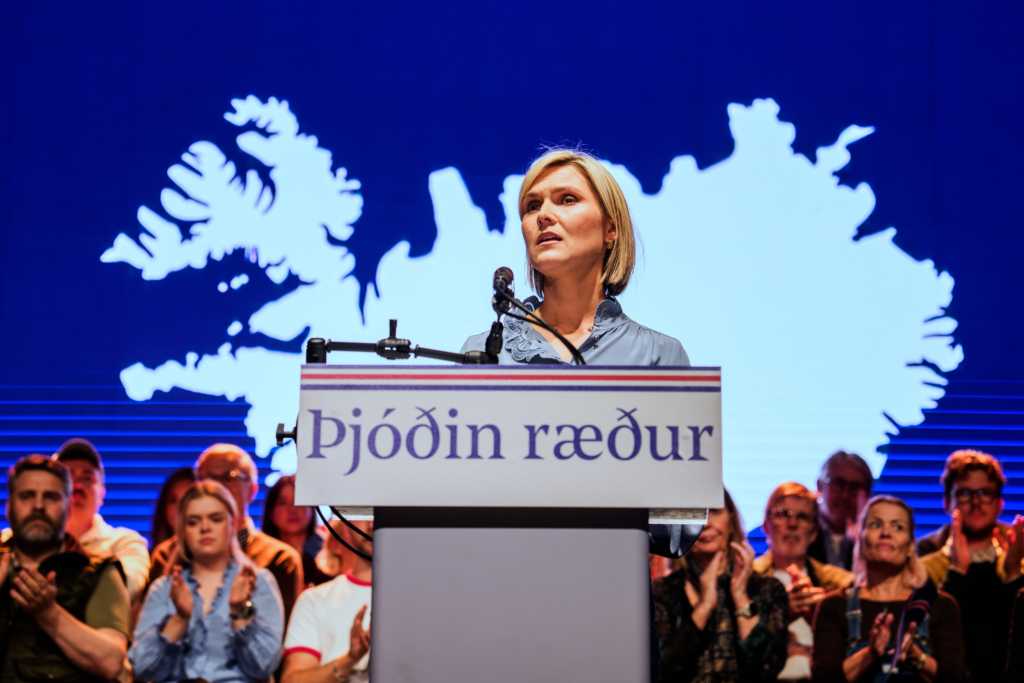
It took Europe’s far-right leaders no time at all to work out what Icelanders meant on August 29th, when they voted 52.8% to 47.2% against resuming negotiations to join the EU: a prosperous democracy had looked hard at Brussels and said no. Britain’s Nigel Farage congratulated them on “voting to keep their independence”. France’s Marine Le Pen went further, calling the result a reminder that “another Europe is possible”.
But Iceland did not vote against Europe—it voted to keep the Europe it already has.The country sits inside the single market through the European Economic Area (EEA) agreement, is part of the Schengen area, and adopts swathes of EU legislation to stay compliant with standards set in Brussels. Short of membership, there is no closer relationship with the EU on offer.
Opposition to tight integration with Europe remains at the fringes of Icelandic politics and does not appear in any party’s manifesto. The foreign ministry’s latest annual survey showed that only 6% of Icelanders believe that international co-operation diminishes our sovereignty, against 69% who think it strengthens it. On the EEA agreement, 58% take a positive view and only 19% a negative one.
The Icelandic electorate has never shown much enthusiasm for politics built on distrust of institutions, conspiracy theories or the dissolution of the post-1945 international system. A country whose biggest annual festival is the Pride parade, and where women hold the offices of president, prime minister, foreign minister, bishop of the national church, mayor of the capital, chief of police and deans of both main universities is not a promising beacon for movements in the West that are uncomfortable with the inclusive nature of liberal democracy.
That being said, there is no denying that there was more than a whiff of culture wars in the no campaign. The masculine energy was palpable, and much effort went into far-fetched notions of an EU plot to expropriate Icelandic wealth. Young people were, by all accounts, targeted on social media and inundated with phone calls; one of the most potent messages was that EU accession could see them drafted into a European army. The yes side also played loose with the facts, not least in assertions that lower euro interest rates would automatically ease young people’s access to the housing market. Highly nationalistic messaging left some voters in a charged emotional state—and those voices were the loudest online, both during the campaign and in celebrating the outcome.
Still, the result was not a victory for the reactionary fringe. The fringe just happened to be on the winning side. The reasons Icelanders voted no are deep, domestic and largely unglamorous: fish, the currency, a comfortable arrangement with the world and a belief that the international order will remain relatively unchanged, despite temporary turbulence.
Iceland already has the Europe it wants
Through the EEA and the European Free Trade Association (EFTA), Icelanders and Icelandic businesses already enjoy the free movement of goods, services, capital and people. Every knowledgeable Icelander understands that without the market access, Iceland would not have prospered as it has. No serious politician dares to entertain abandoning the EEA. In fact, the no side ran on defending the agreement as the better alternative to full membership.
On defence and security, Iceland is a founding member of NATO and has a bilateral defence agreement with the US. For a country of 400,000 people that has never in its history had a military, these two pillars seem more than adequate, untested as they may be.
Full membership in the EU would require amending the constitution, which currently does not permit the transfer of sovereign powers that accession involves. This is sensitive in any debate about independence and sovereignty. As things stand, obligations arising from the EEA agreement only reach Icelandic law when the Icelandic parliament, the Althingi, legislates for them.
Hypervigilance about resources
Iceland owes its rise from poverty to prosperity in the 20th century to controlling the rich maritime resources that surround it. For centuries, foreign fleets exploited those grounds while Icelanders were kept out of large-scale fishing by both restrictions imposed by Denmark (which ruled Iceland from 1380 to 1918) and a lack of financial infrastructure.
At the start of the last century, new technology and financing opportunities unleashed an explosion of entrepreneurial activity in the sector. Iceland then pushed its fisheries zone outwards until it reached its present limit in 1975, over fierce British opposition in stand-offs known as the “cod wars”. It was the closest the country has ever come to a military confrontation. Legal victory in that dispute is a tremendous source of national pride and a standing reminder of the importance of natural resources to our economy. Furthermore, Iceland’s track record in managing this resource compares very favourably with efforts elsewhere.
Accepting the EU’s common fisheries policy is, on the face of it, a requirement for full membership. For most Icelanders, this is where the conversation stops.
It follows that a crucial question is whether Iceland could join the EU and keep control of its fisheries. Accepting the EU’s common fisheries policy is, on the face of it, a requirement for full membership. For most Icelanders, this is where the conversation stops. It is out of the question. Therefore, much of the historical debate about EU membership has revolved around whether a permanent carve-out is possible, and much energy has gone into reading cryptic remarks on the matter from EU representatives. The application launched in 2009 produced no answer. Talks were shelved before this vital question was seriously engaged.
For the yes camp, applying again was the only way to find out the real answer. The no side held that a satisfactory answer was simply not on the table—a belief that makes a no vote logical even for people who do not object to membership in principle. Why board a train if you do not believe it will reach its destination?
Our love-hate relationship with our currency
Since its adoption in 1918, the króna has been one of the most consistent sources of frustration in Icelandic public life. It started out at par with the Danish krone and, by that benchmark, has since lost 99.9% of its value. Long protected by import, export and currency controls, and propped up by punishing interest rates, it has now been largely abandoned by the big Icelandic businesses that operate internationally. They have mostly chosen the euro as their operating currency.
Despite its drawbacks, the flexibility that a national currency provides a small economy reliant on natural resources is not to be discounted. Some economists claim that the currency is a valuable tool to smooth out external shocks and protect Icelanders from economic setbacks turning into societal hardships such as mass unemployment. For many, the costs of maintaining a tiny currency that is attuned to our specific economic conditions are well worth the benefits of keeping unemployment at a minimum. For others, these benefits are overstated, and the costs in perennially high interest rates and market risk do not make economic sense.
Europe looks sluggish from Reykjavík
Iceland’s business and finance community is very focused on topline economic figures that show European growth lagging behind America’s. The prevailing narrative is that Europe buries its entrepreneurial talent under the weight of regulation while the US offers a superior environment for economic activity and technical innovation. Iceland’s business and financial community sees the country’s relative economic success as too valuable to risk with full EU membership.
Counter-narratives that build on broader measures of well-being do not seem to gain traction. Even extensive first-hand experience of European quality of life stands little chance when pitted against economic metrics.
Icelanders often cite Mario Draghi’s bleak assessment of the EU’s competitiveness as evidence that even consummate EU insiders have lost faith. The claim of the EU’s supposed economic feebleness does more than feed the economic debate; it has also become a thinly veiled contribution to the culture-war caricature of a weak Europe in contrast to a muscular America.
The old order still looks solid from the North Atlantic
The biggest disconnect between international affairs experts and the general Icelandic population lies in how each reads the way geopolitics is evolving. Contrary to much international reporting, the volatile state of the world barely featured in the campaign, which was mostly fought on domestic issues. Even threats from the American president, Donald Trump, against our Greenlandic neighbours have not moved the needle. Perhaps most Icelanders viewed the episode as too outlandish to be taken seriously, or too uncomfortable to contemplate.
Icelanders are very supportive of Ukraine and disdainful of Russia’s aggression, but they seem to judge the war far enough away not to affect them. Many are perplexed by America’s current foreign policy yet treat it as a deviation from a norm that will eventually re-establish itself. Bogi Ágústsson, a respected Icelandic journalist, recently told The Economist that Icelanders are in denial about how serious some recent international developments are. I believe most close observers of US politics would tend to agree with him.
During the campaign, warnings about an impending rupture in the world order that underwrites Iceland’s peaceful existence found few takers. The government had brought the referendum forward from a planned 2027 precisely because of these international developments, but worries about Europe’s security and NATO—that now dominate international policy discussions—were simply not top of mind.
In this context, it bears mention that Iceland has never suffered a violent invasion or a hostile occupation, which leaves matters of security and defence largely a theoretical exercise.
Did emotions run too high?
While the referendum’s result does not represent what some far-right European leaders wish it did, some elements of the campaign should give cause for concern. The intensity of the rhetoric was excessive considering the low stakes of the vote. Any accession treaty would itself have gone to a second referendum.
The international reaction to the result also suggested that some elements within Icelandic politics are embedded within the international anti-globalist movement. Micro-targeting, emotional pressure and unsupported claims proved effective. A sense of crisis or impending disaster was invoked, inviting a mindset that loosens the scruples that normally keep political discourse civil and constructive. The success of this approach could provide a campaign blueprint that all parties might find hard to resist in future elections, to the detriment of Iceland’s hitherto relatively civil political culture.
As any fisherman knows, illegal bait might get you an easier catch a few times, but eventually will ruin the fishing for all. Trust in elections is a common stock too, and it does not tend to replenish on demand.
Cover image: picture alliance / Hans Lucas | Martin Bertrand
US secretary of state Marco Rubio described NATO’s July gathering in Ankara, two months before it convened, as “one of the more important leaders’ summits in [its] history.” The summit confirmed that Europeans have accepted America’s expectation that they do more for their own security. The Ankara declaration recognised that “European allies and Canada, working together with the United States, are assuming greater responsibility for the alliance’s defence.” Accepting that shift is one thing; paying for it is another. For European policymakers the question is now fiscal. It turns on what Europe is willing to pay for. And for the EU’s frugal members, that means rethinking what they treat as strategic.
Getting defence into the budget
According to the International Institute for Strategic Studies, replacing US military capabilities in Europe could require around $1tn (about €900bn) in extra investment. NATO’s new target to invest 5% of GDP in defence similarly implies a sustained increase in European defence spending over the coming decade. Together they suggest that defence is no longer crisis spending but a permanent claim on European budgets.
Since Russia’s full-scale invasion of Ukraine in 2022, the EU has found money for defence, but always as extraordinary spending. The European Defence Fund and SAFE (Security Action for Europe, a loan scheme for joint arms purchases), for example, sit outside the ordinary budget. Such instruments expire; the challenge is to embed this spending into the EU’s regular budget. Winning defence a permanent line in it makes negotiations over the next Multiannual Financial Framework (MFF) far more than another exercise in budgetary bargaining.
The MFF is the EU’s seven-year budget—and where any pledge on defence would have to show up in funds. The commission’s proposal for 2028–34 reflects such a commitment. It allocates €131bn to defence and space, roughly five times the current level, and puts security among the EU’s central priorities.
Out of the negotiating box
Commission proposals rarely emerge intact from negotiation, and early signs suggest this pattern may repeat itself.
Commission proposals rarely emerge intact from negotiation, however, and early signs suggest this pattern may repeat itself. Cyprus, which held the presidency until the end of June, left a negotiating box on how to structure the next MFF that envisioned reductions in defence and security while protecting cohesion policy and the Common Agricultural Policy (CAP). The box is the presidency’s draft compromise, the text the final deal is built from. The Irish presidency has opened with a strong focus on competitiveness and security, but Ireland leans heavily on farming too.
Budget negotiations are shaped by coalitions that defend long-established spending. The 16 member states of the “Friends of Cohesion” group, Spain, Italy and Poland among them, want robust funding for cohesion policy and agriculture, while frugal member states, such as Germany, the Netherlands and Sweden, are reluctant to expand the overall size of the EU budget. Defence enters as a comparative newcomer against policies with decades of institutional backing and organised constituencies behind them.
Germany’s position illustrates this dilemma. In a parliamentary inquiry, Alliance 90/The Greens asked the federal government how the EU can square four things at once: from 2028 it will need to start repaying NextGenerationEU, the €637bn joint borrowing agreed as a one-off in 2020 to fund members’ recovery from covid-19; forgo new revenue of its own (levies it collects directly rather than cheques from national treasuries); hold its budget roughly the same size; and still strengthen competitiveness, security and defence. The chancellor, Friedrich Merz, has repeatedly committed to the last three. The government answered that the EU could meet all three objectives by trimming across the whole budget. Yet such “horizontal cuts” only protect these priorities if all 27 members agree what to spare when deciding the cuts, and they are unlikely to agree. Other member states could favour different areas of the EU budget, cutting competitiveness or security harder than Germany intends.
New financing for a new era
The scale of investment required to deliver Europe’s defence transformation also exceeds what can realistically be financed through the MFF alone. While the seven-year budget can establish political priorities, provide long-term planning certainty and support common capability development, it cannot generate the sums required to finance Europe’s long-term defence.
Hence the appeal of joint EU borrowing: debt raised by the commission against member-state guarantees, the model already used for NextGenerationEU and SAFE. NextGenerationEU demonstrated that the EU can raise substantial resources when confronted with an existential crisis such as the covid-19 pandemic. Europe’s security has changed just as fundamentally, which makes the case for borrowing together just as strong. If defence is a collective problem, leaving the bill to strained national budgets makes little sense. However, borrowing on that scale is politically out of reach: creditor states intend NextGenerationEU to stay an exception rather than a template. Something narrower—bonds (or comparable fiscal mechanisms) that fund defence alone or the technologies Europe cannot do without may prove necessary if the EU wants to match its strategic ambitions with adequate financial resources.
Europe has accepted that it must carry more of its own defence. The MFF negotiations will show whether its budget can pay for it. With NATO entering a new era of European burden-sharing, the EU cannot afford a budget that reflects the priorities of a different geopolitical age. The world has moved on—it is time that frugal member states like Germany did so, too.
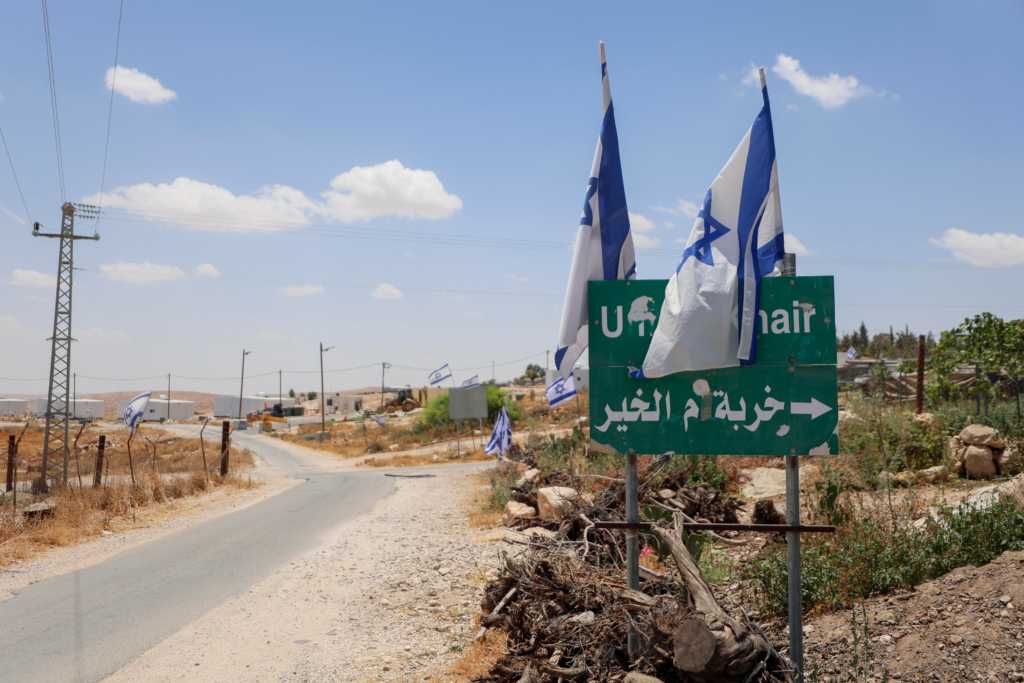
The EU’s foreign ministers will meet on July 13th to discuss reducing trade with Israel’s illegal settlements in the West Bank. The move comes long after the 2024 advisory opinion of the International Court of Justice (ICJ) that reminded countries of the obligation to “take steps to prevent trade or investment relations” that help sustain the illegal settlements.
Trade with the EU is a critical contribution to the economic viability of these settlements. Although small when compared with overall trade with Israel, the bloc is the largest export market for the type of agriculture products typically produced in the settlements. The EU accounts for 63% of Israeli exports of fruits and vegetables and it is reasonable to assume that a similar share would apply to exports from the settlements.
The EU condemns Israel’s illegal occupation of Palestine and has refused to apply its association agreement with Israel to trade with the settlements. But this policy is not enough. Currently the bloc applies a so-called “differentiation policy” under which products from the settlements are identified through a postal code and should pay the full tariff when entering the EU. However, this policy has not done much to limit trade with the settlements partly because the full tariffs are often low and enforcement is weak. But even if enforcement was reinforced, trade with the settlements would continue to thrive since Israel compensates exporters of settlement products for their EU tariff payments. The EU’s current policy is therefore insufficient to comply with the ICJ.
This move would not be a sanction on Israel but rather a measure to ensure the consistency of EU trade policy with international law
Several member states are in the advancedstages of adopting the legislation to ban trade with settlements, and some alreadyhave. Most of these also include bans on services. National bans are, however, of limited effectiveness because of the free circulation of goods within the EU. Instead, the EU needs to rapidly adopt a bloc-wide ban covering both goods and services. This move would not be a sanction on Israel but rather a measure to ensure the consistency of EU trade policy with international law, as required by the EU’s foundational treaties.
The EU has long adopted trade policy measures whose primary objective is not economic but rather designed to contribute to the protection of human rights. Examples include import restrictions on conflict minerals or goods used for torture or more recently the ban on products of forced labour. The EU has suspended trade preferences for human rights or labour rights abuses with countries such as Cambodia or Sri Lanka and has placed others such as Myanmar or Kyrgyzstan under close watch. These are not foreign policy measures but simply a strict implementation of the EU’s own trade policy; and the same is true for banning EU trade with Israel’s illegal settlements.
The ruling of the ICJ and Israel’s continuous expansion of its illegal settlements in Palestine calls for a unified EU response. There is a compelling case and precedent for the EU to use its trade policy powers. Immediately following the debate by foreign ministers, the European Commission should come forward with a proposal for a well-calibrated EU ban. It is high time the EU followed its own rules regarding trade with Israeli settlements. Anything less goes against the bloc’s own founding principles.
This commentary was co-authored by Sigmar Gabriel (former vice-chancellor of Germany), Arancha González Laya (former foreign minister of Spain and ECFR council member), Pascal Lamy (former EU trade commissioner and director-general of the World Trade Organization and ECFR council member), Enrico Letta (former prime minister of Italy and ECFR council member) and Cecilia Malmström (former EU trade commissioner and ECFR council member).

 Login