❌

Reading view

Construction Of Iran’s “Eagle 44” Underground Airbase Hasn’t Stopped Despite War

Iran is rebuilding Eagle 44, a hardened underground airbase carved into the side of a mountain that can shelter fighter aircraft, drones, and potentially cruise and ballistic missiles, despite the remote facility absorbing at least three rounds of airstrikes this year. High-resolution satellite imagery captured by Planet Labs in late September and reviewed by TWZ shows a new section of taxiway completed, several support buildings still destroyed or damaged, wrecked equipment cleared off the pavement, and obstacles that were placed to obstruct the runway now removed. Construction is ongoing at a time when the Pentagon and Trump administration maintain there is little remaining of the Iranian air force for such a facility to protect.
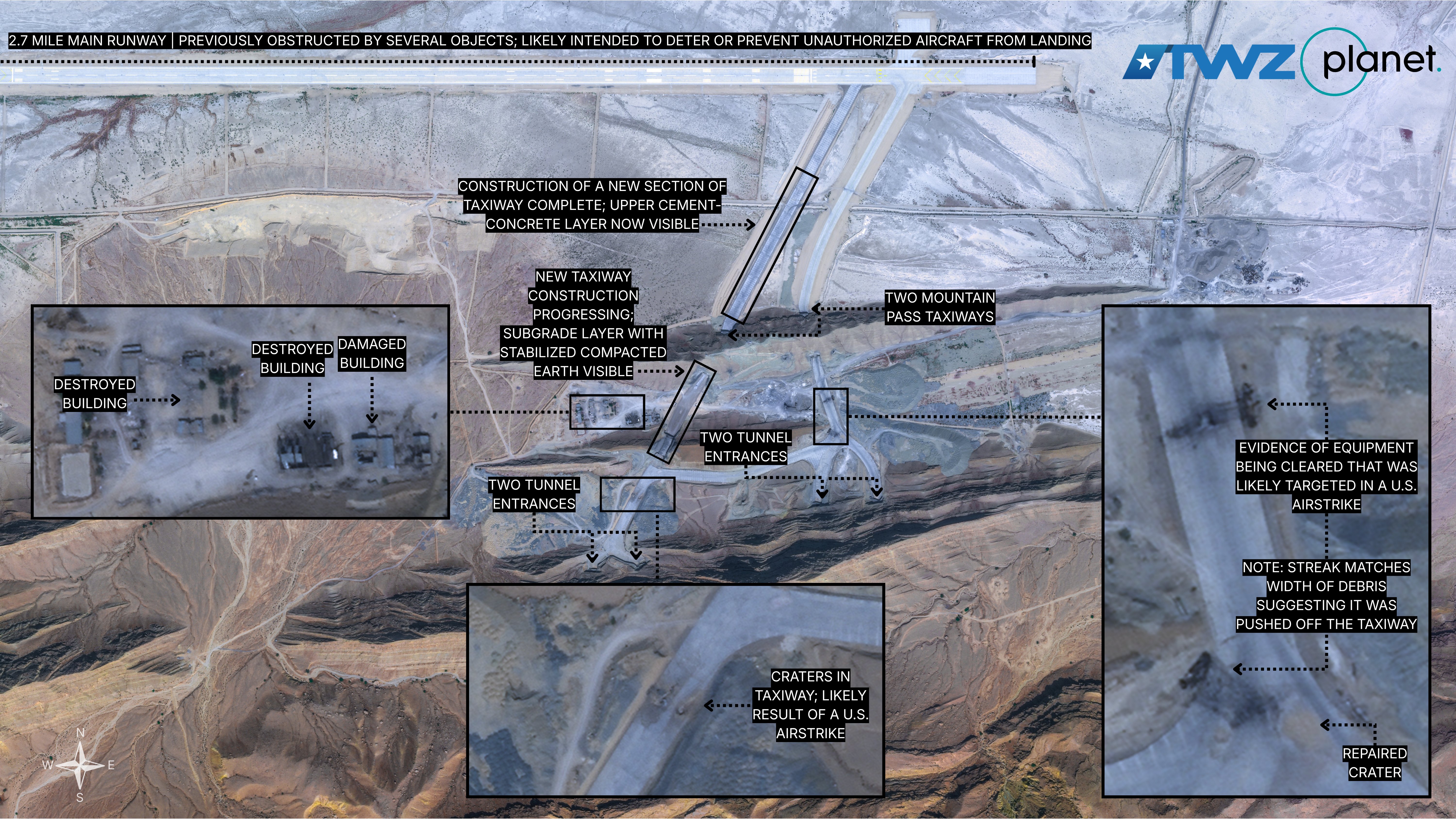
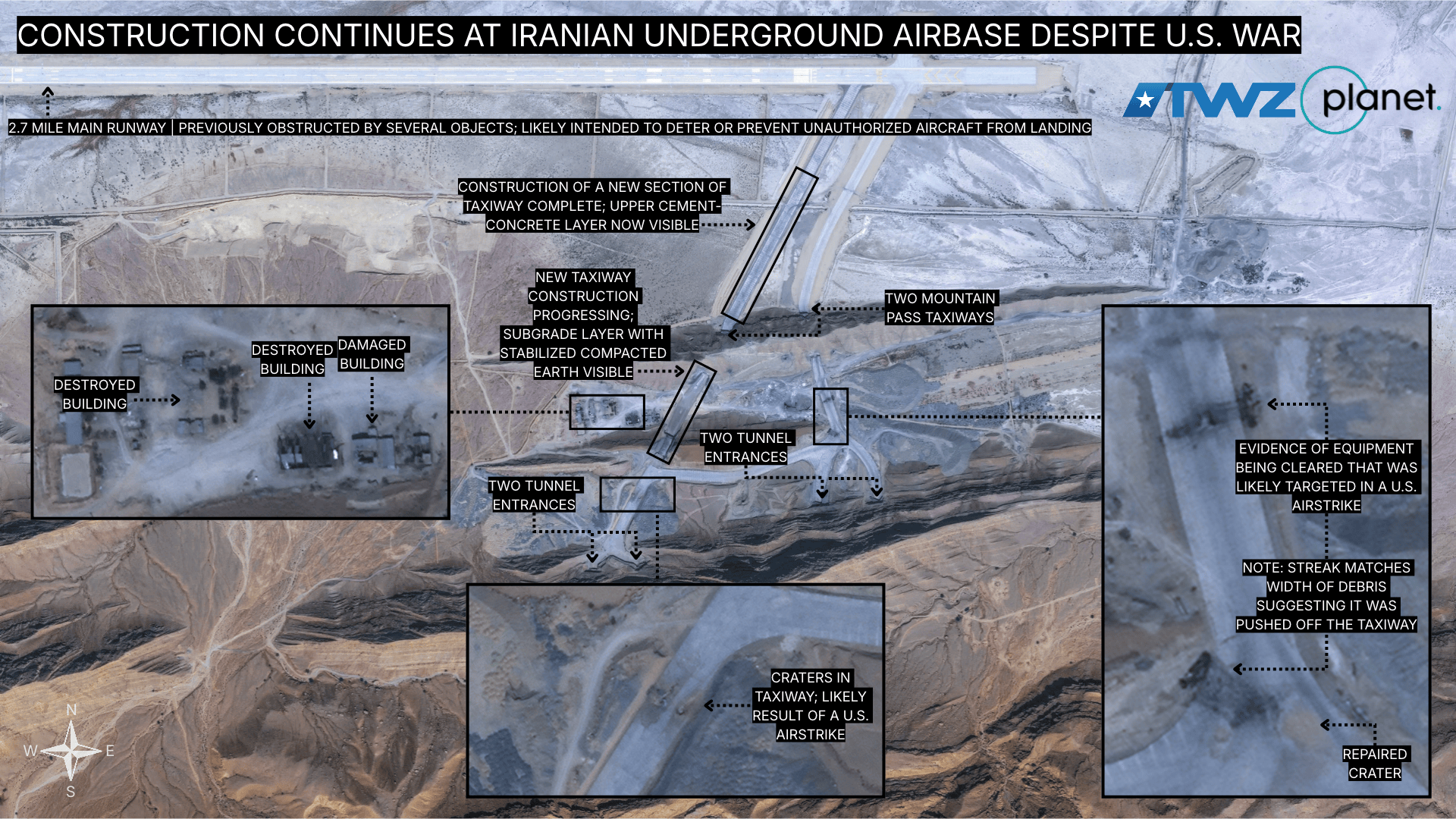
A comprehensive graphic showing Iran's Eagle 44 mountain airbase and the ongoing construction to rebuild it following U.S. airstrikes. Created by Ian Ellis-Jones and TWZ using Planet Labs imagery that's reprinted with permission.
Graphic depicting key areas of interest at Eagle 44. Photo © 2026 Planet Labs Inc. All rights reserved. Reprinted with permission. TWZ/IAN ELLIS-JONES

Eagle 44, also called ‘Oghab 44’ after the 44th anniversary of the 1979 revolution, was unveiled by Iranian state media in February 2023 when senior officials visited what was described as the country’s newest underground airbase. Islamic Republic of Iran Air Force (IRIAF) F-4D/E Phantom IIs, armed with AGM-65 Maverick air-to-ground missiles, laser and electro-optically guided bombs, unguided ‘dumb’ bombs, as well as domestically produced anti-ship missiles, were shown using the facility in the footage. The IRIAF had roughly 60 examples in service at the time, its most numerous combat jet by some margin, though how many remain today, and are actually operational, is unknown. In addition to the Phantoms, one-way attack drones were also seen in the background.
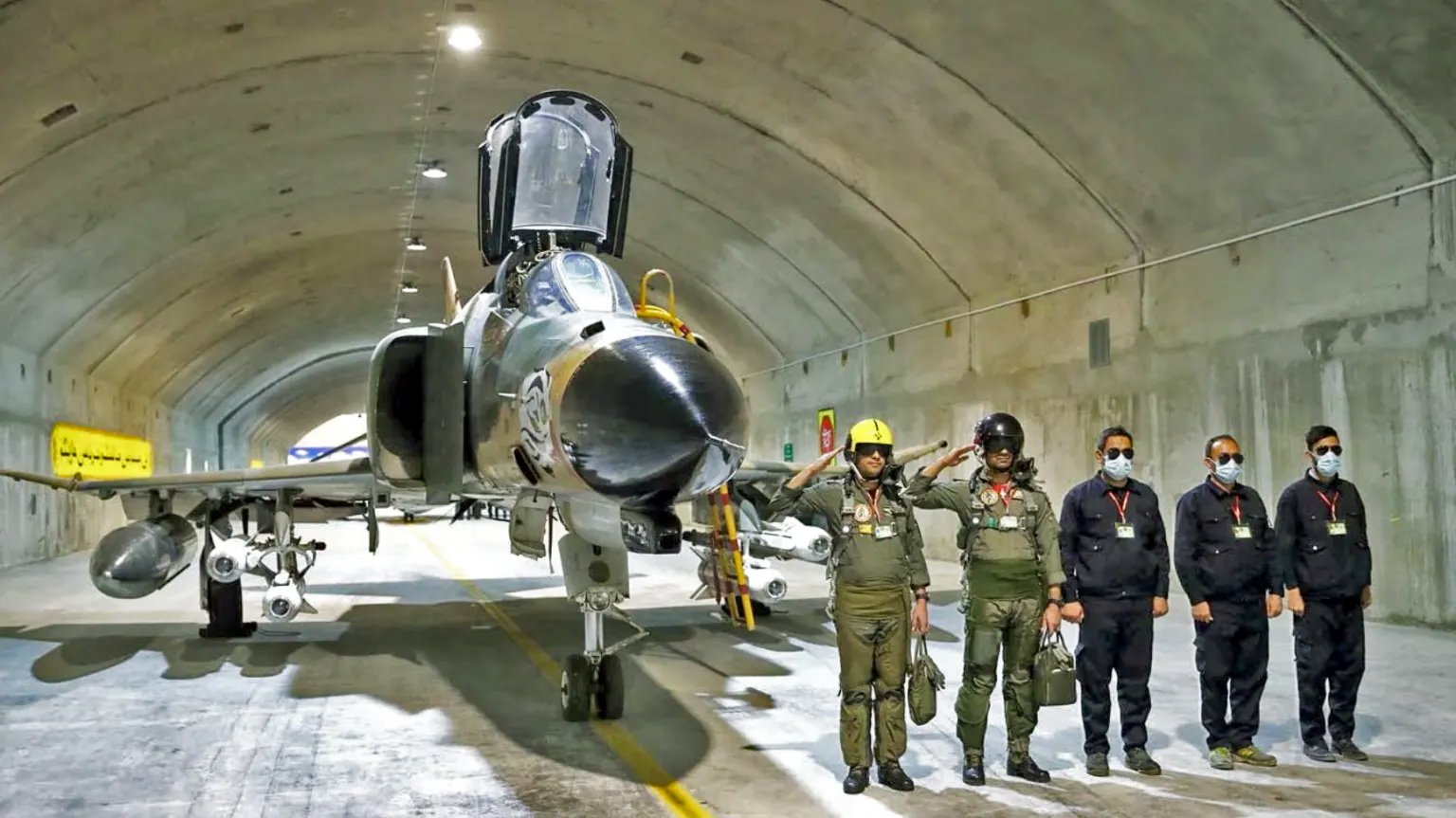
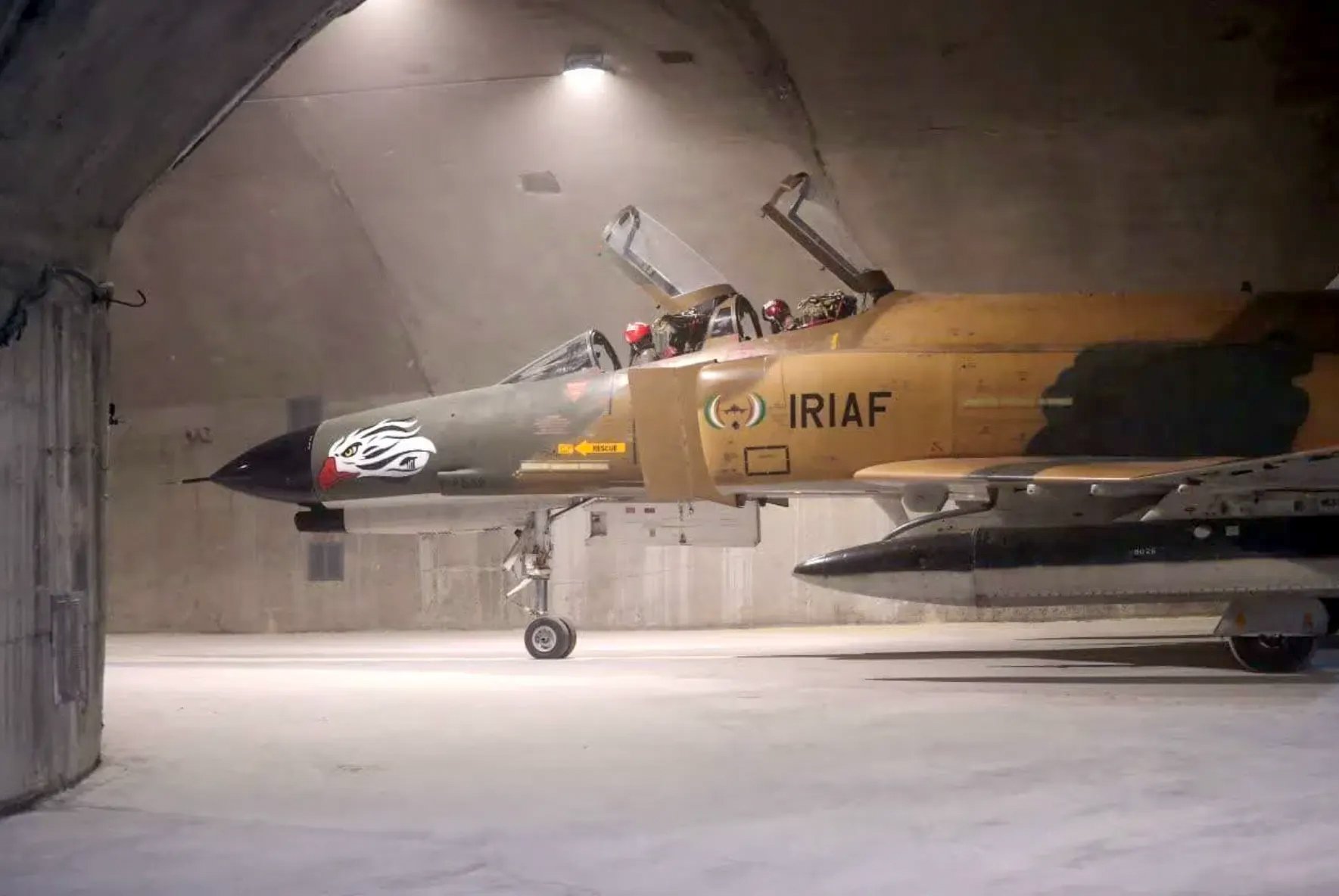
F-4 Phantom at Eagle 44. Photo: Iranian state media
Another view of an F-4 Phantom at Eagle 44. Photo: Iranian state media

The IRIAF, rather than the Islamic Revolutionary Guard Corps (IRGC) Aerospace Force, operates the base, which is located in Hormozgan province and sits in the foothills of the Zagros Mountains, approximately 100 miles northwest of the Strait of Hormuz. Iranian state media described it as “one of the army’s most important air force bases, with fighters equipped with long-range cruise missiles and built in the depths of the Earth.” Then-Chief of Staff of the Armed Forces Maj. Gen. Mohammad Bagheri, who was present at the unveiling, warned that “any attack on Iran from our enemies, including Israel, will see a response from our many air force bases including Eagle 44.” He was eliminated in the opening strikes of the Twelve-Day War, which Israel dubbed Operation Rising Lion, in June 2025.
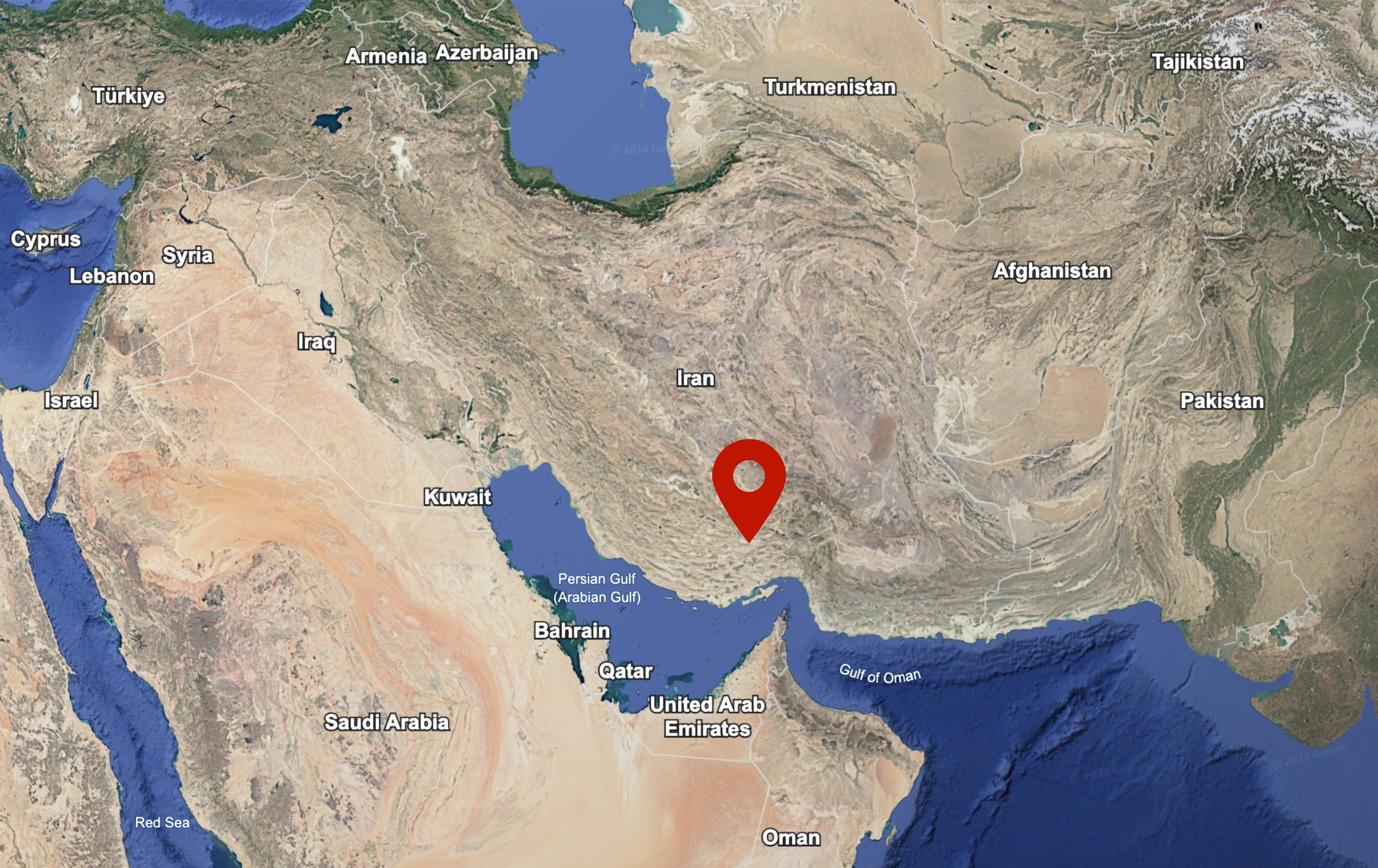
Location of Eagle 44 airbase in southern Iran. Photo: Google Earth

Work on the cavernous underground tunnel complex began in 2013. Construction of a 2.7-mile main runway, situated on the northern side of the base on a valley floor below the mountain range, started roughly eight years later. Two taxiways run through a smaller ridge connecting the runway to four entrances to the primary tunnel complex, where the jets and weapons are stored, although only one taxiway is currently operational.

Timelapse of Eagle 44 from February to October 2026. Video © 2026 Planet Labs Inc. All rights reserved. Reprinted with permission.

The promotional video released in 2023 revealed at least one internal blast door, as well as branches from the main tunnel to revetment areas to park fighters and drones. A support compound of several buildings is on the west side of the base, next to the unfinished taxiway. The purpose of each structure is unclear, but a functioning airbase requires maintenance and repair facilities, crew quarters, reserves of fuel and munitions, security and force protection assets, and infrastructure to coordinate air traffic control and command and control functions.

Video released by Iranian state media in February 2023 reportedly showing the inside of the tunnel complex at Eagle 44.

The United States kicked off Operation Epic Fury alongside Israel on February 28, launching a massive wave of strikes against Iran from the west and south. Eagle 44 is located within striking distance of the munitions carried by air wings embarked on U.S. Navy aircraft carriers operating in the northern Arabian Sea and missiles fired by the guided-missile destroyers that escort them, as well as Air Force tactical and strategic aircraft and Army assets in the region. However, low-resolution images reviewed by TWZ through March 16 indicated that while the base was targeted, little damage was visible.
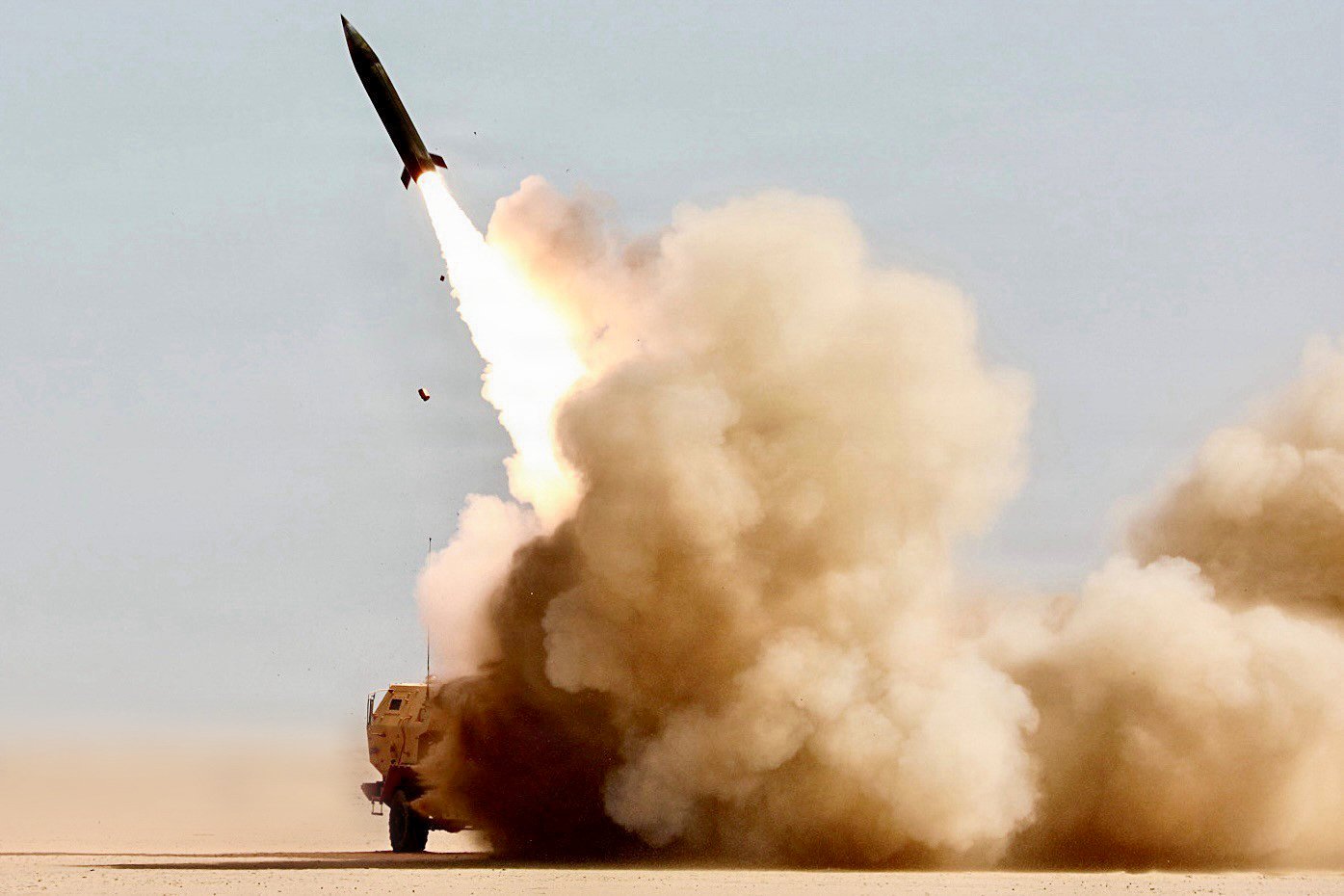
M142 High Mobility Artillery Rocket Systems (HIMARS) conduct live-fire missions during Operation Epic Fury in the U.S. Central Command area of responsibility. (U.S. Army Photo)
HIMARS fired during OEF. CENTCOM photo
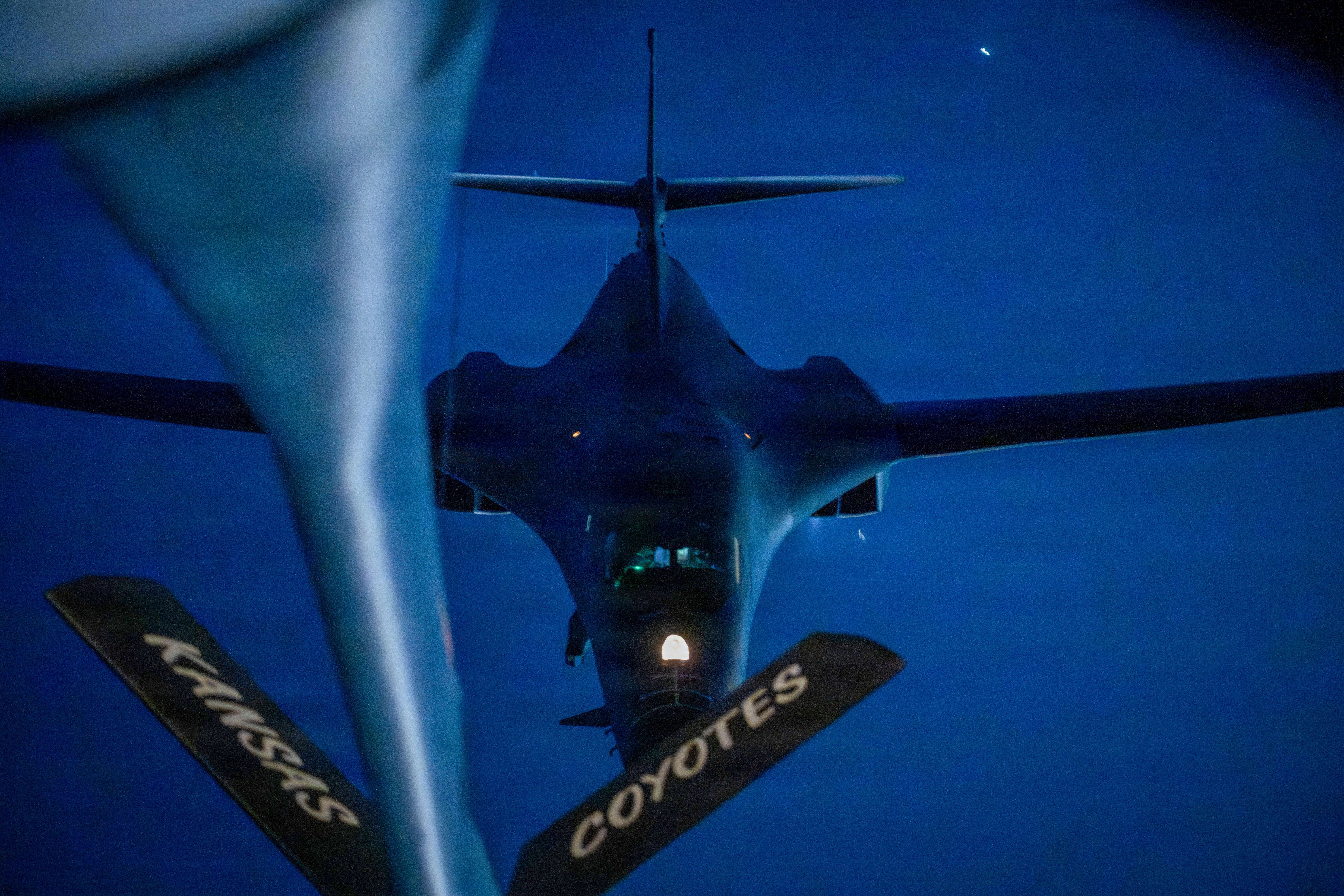
A U.S. Air Force B-1B Lancer aerial refuels with a U.S. Air Force KC-135 Stratotanker while on a night-time mission during Operation Epic Fury. (U.S. Air Force photo)
B-1B fuels for OEF mission. USAF photo
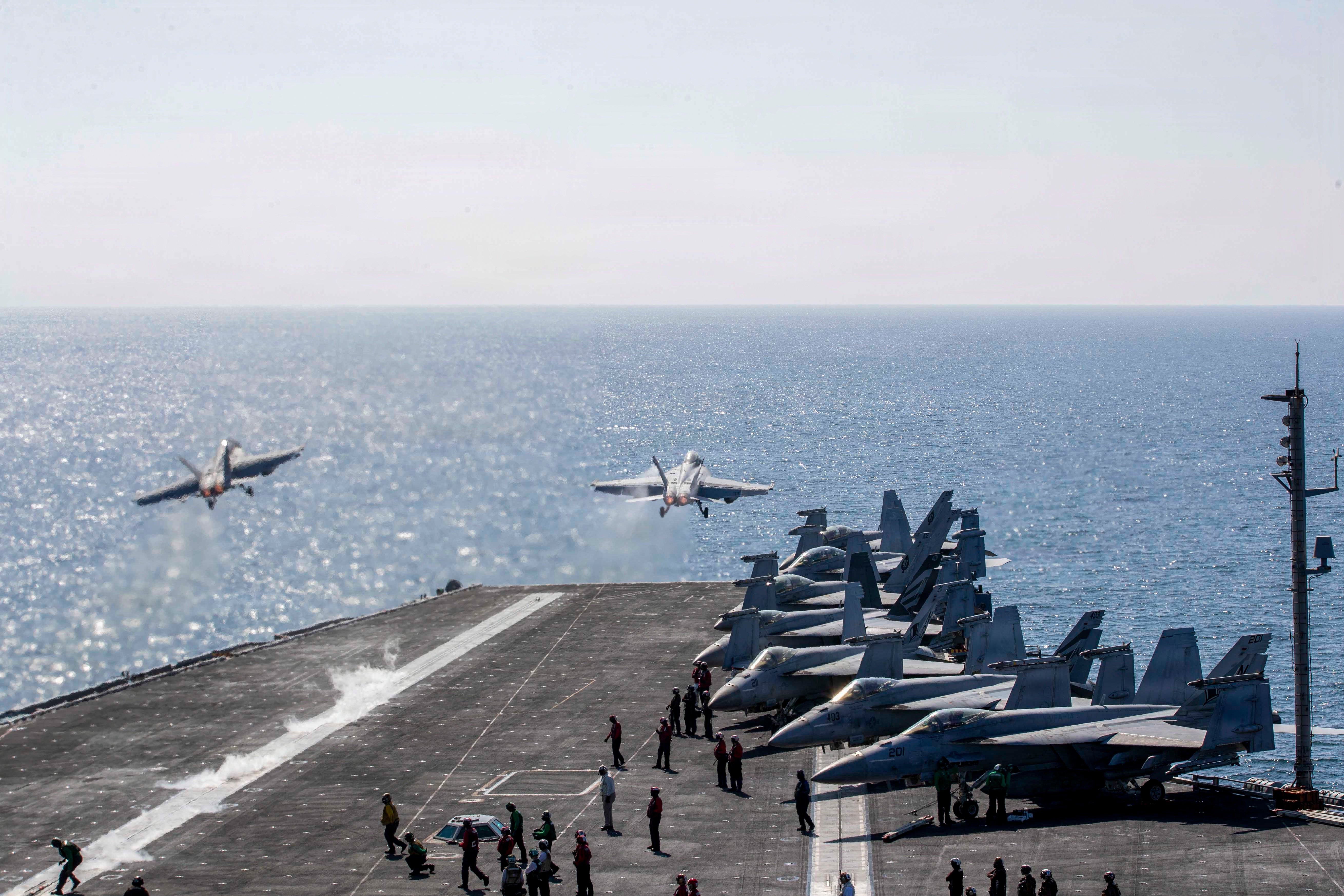
Two F/A-18 Super Hornets launch from the flight deck of Nimitz-class aircraft carrier USS Abraham Lincoln (CVN 72) in support of Operation Epic Fury, March 3, 2026. (U.S. Navy photo)
Super Hornets launch during OEF. Navy photo
Arleigh Burke-class guided-missile destroyer USS Spruance (DDG 111) fires a Tomahawk Land Attack Missile (TLAM) in support of Operation Epic Fury, Feb. 28, 2026. (U.S. Navy photo)
Guided-missile destroyer USS Spruance fires a Tomahawk Land Attack Missile (TLAM) in support of Operation Epic Fury (OEF). U.S. Navy photo

As the U.S. and Israel continued the relentless air campaign over the next several weeks, the base was targeted again at the end of March, with greater effect, according to a report from The New York Times. High-resolution images the paper reviewed revealed impact craters on the taxiways near the tunnel entrances, one building leveled, and small mounds placed along the runway, presumably to prevent enemy aircraft from landing. Battle damage assessments suggested the strikes were intended to cut the underground caverns off from the runway, trapping whatever was inside and preventing takeoff. The report did not state whether U.S. or Israeli aircraft carried out the attack, and Israeli officials declined to comment. However, the U.S. was primarily responsible for pressuring Iran’s southern flank, while the Israelis attacked the western front.

After the fragile April ceasefire collapsed and the U.S. imposed a second blockade, U.S. Central Command (CENTCOM), based out of MacDill Air Force Base in Tampa, Florida, and responsible for executing day-to-day operations of the war, launched multiple strikes across Iran on July 15, and Eagle 44 was hit for at least a third time. An analysis published by Soar Atlas, a satellite imagery provider, identified four aimpoints on July 16, with cratered taxiways and damage to additional infrastructure. According to that analysis, the structures targeted were related to the base’s construction unit, but TWZ has not independently verified this claim. The Pentagon and CENTCOM have not specifically named Eagle 44 in any press briefing or release, and Iran has not acknowledged the base was struck.

United States Navy forces on station in mid-July 2026 when the second blockade began and strikes resumed. TWZ/IAN ELLIS-JONES

The Planet Labs satellite imagery from September 29, obtained exclusively by TWZ, indicates that Iran began reconstruction after the July attacks and that the effort is ongoing.

The main runway, previously blocked by obstacles meant to deter and prevent unauthorized aircraft from landing, is now clear. On the western taxiway (marked in red below), a new section leading into the ridge ‘pass-through’ is complete, with its finished upper cement-concrete layer visible. On the other side of the pass, construction of the next segment is underway, with a subgrade layer of stabilized, compacted dirt laid down but not yet paved (orange). Farther south, in front of the western tunnel entrances, impact craters (blue) are still visible. When finished, the second taxiway will provide a direct link between the western hangars and the runway, allowing additional aircraft to move freely without sharing a single taxiway, a major bottleneck for higher operational tempos and more complex sortie launches and recoveries. A second functional taxiway and tunnel would also provide critical redundancy if the other is hit.
Custom annotated graphic of Iran's Eagle 44 underground airbase built into the side of a mountain following likely U.S. Airstrikes. Created by Ian Ellis-Jones and TWZ using Planet Labs imagery, reprinted with permission.
Annotated zoomed-in shot of Eagle 44. Photo © 2026 Planet Labs Inc. All rights reserved. Reprinted with permission.

On the primary eastern taxiway, two dark streaks (green) that appeared following the strikes in July run off the edge of the pavement, likely debris left by equipment that was struck and removed. Notably, the streak marks match the width of the wreckage, suggesting it was bulldozed or pushed off the taxiway to reopen it. There is no sign of the equipment being recovered, only that it was cleared out of the way.

In the main support compound (yellow) next to the western taxiway, two buildings are clearly destroyed and a third is damaged. They have not been rebuilt yet, which is consistent with previous reporting from The Times and Soar Atlas that the attacks degraded construction capabilities, and suggests the regime may be focused on completing and repairing the taxiways rather than the installations.
A close-up custom annotated visualization  of key areas of interest at Iran's Eagle 44 airbase, which is built into the side of a mountain, following likely attacks by the U.S.. Created by Ian Ellis-Jones and TWZ using Planet Labs imagery, reprinted with permission.
Annotated key areas of interest at Eagle 44. Photo © 2026 Planet Labs Inc. All rights reserved. Reprinted with permission.

The four entrances to the main tunnel complex (white), arranged in two pairs less than half a mile apart at the end of each taxiway on the southern part of the base, appear to be intact, although the angle makes it unclear whether they are open or sealed. What’s inside the mountain, and how many fighters remain in Iran’s inventory, is unknown. Regardless of the status of the fighter fleet, as we noted earlier, the base can also store drones and could be packed with cruise or ballistic missiles.

The U.S. and Israel have a range of bunker buster bombs that could be used in an attempt to collapse the tunnel entrances, a major choke point for any underground weapons storage site. While not destroying what is being held within, doing so would block anything inside from leaving — and being used — for a period of time. Additionally, the pass-through tunnels make for easy targets, and hitting them would keep fixed-wing aircraft from reaching the runway. No impact points on the mountain itself or damage to the portals inside is apparent, but they could have been sealed and hit farther in, which may not be highly visible via satellite imagery. Reaching the main storage caverns themselves would likely be far harder. Larger bunker busters in the U.S. inventory include the GBU-57 Massive Ordnance Penetrator (MOP) guided munition, which could be capable of reaching deeper into the main site, but these are very limited in number and can only be delivered by the Air Force’s B-2A Spirit stealth bombers. It’s highly unlikely the U.S. would expend such resources on a site like this over many others of higher strategic importance.

Eagle 44 is not the only base that Iran is fixing during the lull in hostilities. By the end of May, Iran had cleared 50 of 69 tunnel entrances struck at 18 underground facilities, including some “missile cities,” according to a report by CNN − and that number is likely higher now. Planet Labs, Airbus, and Vantor imagery reviewed by The Wall Street Journal in July showed rebuilt entrances near Kangavar, fresh excavation at Dezful, and repairs near Kermanshah. “They have very impressive industrialization and reconstruction capabilities,” Israeli Brig. Gen. Ran Kochav told the paper. “They refilled their stockpiles,” he added.

A Western official told Bloomberg earlier this month that Iran “remains well-stocked with ballistic missiles and some anti-ship missiles, and can quickly add more,” and a U.S. official posited in May that “the Iranians have exceeded all timelines the IC [Intelligence Community] had for reconstitution.” Both assessments are at odds with what the White House and Pentagon have repeatedly claimed. Secretary Pete Hegseth stated in April that Iran’s air force was “wiped out” and its missile program was “functionally destroyed; launchers, production facilities, and existing stockpiles depleted and decimated,” while acknowledging a week later that the regime was “digging out” launchers, missiles, and bombed facilities but had “no ability to replenish offensive or defensive capabilities.” In May, CENTCOM Commander Adm. Brad Cooper told Congress, “Before Operation Epic Fury, the Iranian Air Force flew between 30 and 100 sorties each day; today that number is zero.” More recently, at a campaign rally in Kansas on Monday, U.S. President Donald Trump said, “They have no air force… their 229 beautiful fighter jets are now scattered all over the runways, the beautiful runways of the Islamic Republic of Iran.”

Video released by Iranian state media in May 2022 showing a different underground missile and drone complex.

At the very least, strikes on Eagle 44 cratered the taxiways and degraded support infrastructure, which likely put at least some of whatever airpower is stored there, if any, out of action. But even after enduring months of war and extreme economic pressure due to the ongoing U.S. blockade and sanctions, as well as dealing with damage across the country, Tehran continues to prioritize construction on the remote base. That fact alone could put it back on the target list if the U.S. and Israel launch another operation. But above all else, it points to how important this facility is to the regime, for whatever reason.

Contact the author: ian@twz.com or @ianellisjones

The post Construction Of Iran’s “Eagle 44” Underground Airbase Hasn’t Stopped Despite War appeared first on TWZ.
  •  

Emily Ratajkowski poses in plunging black swimsuit as she shares intimate photo with boyfriend

Emily Ratajkowski has been keeping busy in Los Angeles, mixing daring mirror selfies with a little romance.

The 35-year-old model shared a bunch of photos on Instagram, leading with a mirror selfie in a plunging black one-piece swimsuit featuring a dramatic neckline and high-cut sides.

Ratajkowski paired the one-piece and wore her long brunette hair loose around her shoulders. She paired it with black shorts and sunglasses.

EMILY RATAJKOWSKI TURNS HEADS IN BIKINI-FILLED JULY PHOTO DUMP

"lotsa LA lately," Ratajkowski captioned the carousel.

Another photo captured the "Gone Girl" actress in a close-up selfie, wearing oversized sunglasses with pink and orange rollers in her hair.

She completed the off-duty glam look with oversized sunglasses and a cigarette between her lips, adjusting her glasses with one hand.

LIKE WHAT YOU'RE READING? CLICK HERE FOR MORE ENTERTAINMENT NEWS

The image prompted mixed reactions from followers, with several questioning the cigarette.

"What is with influencers all smoking lately… smoking hasn’t been cool in a longtime," one person commented.

PUT YOUR ENTERTAINMENT KNOWLEDGE TO THE TEST AND SEE HOW YOU SCORE

"The Unlit cig isn’t hittin’ like you think it is Emily," another wrote.

Others were more complimentary, including fellow model Irina Shayk, who commented, "My friend is 🔥🔥🔥🔥."

The Instagram carousel also included a black-and-white photograph of Ratajkowski sharing a kiss with boyfriend Romain Gavras, a French filmmaker.

GIGI HADID SAYS HER RELATIONSHIP WITH BRADLEY COOPER PROVIDES SOMETHING SHE HASN'T EXPERIENCED BEFORE

In the intimate image, the couple held each other's faces as they leaned in for the kiss.

The romantic snapshot comes just days after Ratajkowski and Gavras attended the Academy Museum Gala in Los Angeles on Oct. 17.

The couple posed together at the star-studded event, with Ratajkowski wearing a striking red dress for the occasion.

The gala marked another public appearance for the couple, who previously attended the MTV Video Music Awards together in September.

At the VMAs, Ratajkowski appeared to pay a subtle tribute to Gavras through her manicure, which featured the initials "RG."

The couple first sparked romance rumors in November 2025 after they were photographed together in New York City.

Ratajkowski later shared photos of herself with Gavras on Instagram in February 2026.

GET ENTERTAINMENT SCOOP DELIVERED RIGHT TO YOUR EMAIL BY CLICKING HERE

The model has previously spoken candidly about navigating relationships after her divorce from film producer Sebastian Bear-McClard.

In a June 2026 personal essay for The Cut, Ratajkowski reflected on a period of dating following her separation, explaining that she initially sought romantic attention as she adjusted to life as a single mother.

She described adopting a more emotionally detached approach to relationships before realizing that she had lost sight of what she actually wanted.

EMILY RATAJKOWSKI'S SHREDDED RED BIRTHDAY DRESS LEAVES LITTLE TO THE IMAGINATION AT NYC CELEBRATION

"I'd never been connected to my own desires," she wrote, reflecting on that period of her life.

Ratajkowski also explained that her divorce ultimately changed how she viewed her own independence.

"I wasn't left; I left," she wrote.

CLICK HERE TO DOWNLOAD THE FOX NEWS APP

  •  

“Respect Rather Than Reverence”: Inside the Making of a Grittier ‘Sense and Sensibility’

Screenwriter Diana Reid, costume designer Grace Snell, cinematographer Arnaud Potier and production designer Francesca Di Mottola explain how they made the Dashwood sisters’ world grounded, moody and lived-in.
  •  

Hollywood stars are lining up for MAGA podcaster’s movies — but they may not know what they signed up for

Danny Trejo’s son has claimed his 82-year-old father had no idea who conservative commentator Ben Shapiro was before he agreed to star in The Daily Wire’s upcoming Minneapolis movie. The same may or may not be true for fellow Hollywood stars including James Franco, Rob Lowe and Jonathan Majors, writes Kevin E G Perry

© Daily Wire/YouTube

  •  

Aardman at 50: Keeping Animation Independent and Hand-Made

As the Bristol studio behind 'Wallace & Gromit' and 'Shaun the Sheep' turns 50, employee-owned Aardman is betting that handmade animation, flexible partnerships and a Halloween-ready third Shaun feature can sustain its independence.
  •  

A National Geographic photographer shared 4 tips for taking better pictures with a phone

A composite image of two forest scenes with light snow on the ground
A Business Insider reporter's phone photos from a hike in Arizona show how to use a National Geographic photographer's tips.

Joey Hadden/Business Insider

  • In the age of camera phones, anyone can be a photographer.
  • You don't need fancy gear or multiple lenses to take good pictures.
  • I asked a National Geographic photographer how to make the most of the camera in your pocket.

Getting a degree in photography gave me the chance to work with all kinds of complex cameras, like the ones you see in old movies, where the operator puts a cloak over their head.

By the time I graduated, I was more comfortable with DSLRs and film cameras than the one in my pocket.

As a travel reporter, my work revolves around documenting the places I'm visiting. For some of that imagery, I've come to rely on my smallest, most nimble camera — my phone. So, in April 2022, I set out to improve my phone-photography skills.

And just like in school, I wanted to learn from a pro.

That's why I turned to Kiliii Yüyan, a National Geographic photographer who tells stories about cultures and their environments.

The magazine first published Yüyan's work in 2018, showcasing whale hunters in Alaska, he told Business Insider. Then, in 2023, National Geographic granted Yüyan the Eliza Scidmore Award for outstanding storytelling for his portfolio work, which included his July 2022 cover shot for a story documenting the lives of Indigenous people.

Yüyan said that nowadays, people are "drowning in photographs," but that doesn't mean yours have to look like everyone else's. There are ways to make your images stand out — even if you're just shooting on your phone.

Phone camera tips from a National Geographic photographer made my images feel more powerful.
Photos from the author's camera roll show phone photos from Cabo San Lucas, Mexico, in 2022.

Joey Hadden/Business Insider

When Yüyan and I chatted about taking standout photos on a phone, he talked about uncommon angles, proximity to the subject, interesting foregrounds, and time spent shooting.

Here are his best tips for creating powerful pictures with a phone, along with examples of their success from my own camera roll.

For the best lighting, backgrounds, and immersive shots, Yüyan told me to take my time and shoot a lot. He was right.
iPhone snapshots from around the US where the author waited for optimal light and striking backgrounds.

Joey Hadden/Business Insider

"The real secret of professional photographers is we shoot a lot and then edit it down to just one or two," Yüyan said. "You should do the same with your phone."

According to Yüyan, spending a long time in one location allows you to find optimal lighting and interesting backdrops. Truly immerse yourself in the environment to notice things that didn't stand out to you at first.

In the photos above, I spent between one and five hours at each location. I was able to take pictures with light I found inspiring, including a rainbow, the sun beaming through the trees, and a shot of a red-hued moon dimmed behind a cloud on a rooftop in Brooklyn, New York. 

"Good photographs come from deep observation, and the muses reward those who slow down, stop running from place to place, and immerse themselves in the specific place and moment," Yüyan said.

So, stick around in one location, take tons of pictures, and "make room for life to unfold in front of your lens," he told Business Insider.

Next, Yüyan said to take advantage of your phone's small size by shooting from angles we don't see every day.
A composite image of a Shih Tzu outside seen from two different angles
The author photographs her dog from different angles in New York.

Joey Hadden/Business Insider

To find the perfect angle, Yüyan said to start by considering how shooting with a lightweight, thin object can open up the realm of possibilities. 

"It becomes a habit to use the phone at just eye level, but if you watch someone who is good at selfies, you can see they are always moving the phone around — up, down, and around to try better angles," he said. "The same applies to making any other kind of photo."

This was an important point I'd never thought about before, but it left me wondering how to tell which angle makes the strongest shot. 

"One good criterion is seeing how much depth an angle will show in a photograph," Yüyan said.

For example, he said, if your subject is a child, pointing the camera down at the kid will typically result in a flat, boring image. It's the angle we're used to seeing, where the background is likely the floor. But shooting from beneath the child's eye level, looking up, can show the layers of the person and whatever is above them. 

"We rarely get down below a child's height to look up at the world, and that perspective can be magical," Yüyan said.

Yüyan's example reminded me of how I photographed a small dog at parks around New York. When I took pictures of her from above or straight on, I couldn't get a sense of her expression or personality.

But when I got below her and snapped the picture while aiming up, I could see her exploratory nature and how she uses her environment to feel bigger, like perching on a rock at the edge of a creek. 

I've found that shooting from beneath widely photographed landmarks makes my pictures look more original.
A composite image of the Christmas tree at Rockefeller Center in NYC seen from two different angles
The author photographs the Christmas tree at Rockefeller Center in NYC in 2019, left, and 2021, right.

Joey Hadden/Business Insider

Yüyan's tip of experimenting with angles that add depth reminded me of another subject I've shot on my phone — the iconic Rockefeller Center Christmas tree in NYC.

The first time I photographed the famous tree, I shot from eye level. When I looked at my photo, I felt like I'd seen it many times before.

When I returned to try a lower angle beneath some foliage, I thought I ended up with a more distinctive image. I could now see layers of smaller plants in front of the tree and the tops of the buildings surrounding it, giving me a better sense of its scale, which had been missing.

Yüyan told me that I can make natural landscapes stand out more by placing something in the foreground.
A composite image of cliffs by the beach on a cloudy day

Joey Hadden/Business Insider

Yüyan said it's hard to take standout pictures of stunning natural landscapes because they've been photographed so much. His best advice is to find a good foreground subject to set your image apart from the rest.

"Great backgrounds, such as mountains or waterfalls, are easy to find because we're always looking for them," Yüyan said. "On the other hand, a good foreground subject, such as blooming wildflowers or a craggy tree, can be much harder to find in the right location."

Yüyan recommended searching for a foreground subject and framing your shot so you can see the scenery in the distance. 

"It'll give your images depth, intimacy, and make your photos unique," he said.

His tip reminded me of when I photographed a beach across the street from the mountains in Santa Cruz, California. I started by photographing the beach from the shore. The mountains looked nice, but there was so much sand that I thought the bottom half of my image looked boring. 

So, I took my phone across some ocean rocks and into the tide pools. The rocks and reflecting water spruced up my foreground, adding layers to my image. To me, this made it feel more dynamic.

Including foreground subjects in my nature shots has made them feel more immersive.
A composite image of a body of water surrounded by rocks and the same body of water with trees and foliage in the foreground
The author photographs Prescott, Arizona, in 2022.

Joey Hadden/Business Insider

Yüyan's foreground tip reminded me of some photos I also took during a hike in Prescott, Arizona. 

When I first arrived at the Watson Lake parking lot for my hike, I was entranced by rock formations I hadn't seen before. But my photographs from the lot didn't seem to do it justice. 

Once I started hiking and immersing myself in the landscape, I found foreground subjects, such as shrubs, that better framed the lake scene.

I thought having these elements in the second image gave a better sense of what it was really like to be there, with more layers of the environment in frame.

Yüyan's last tip suggested camera phones work best up close.
A composite image of a large tree seen from far away and close up
The author photographs a tree outside of Venice, Italy.

Joey Hadden/Business Insider

According to Yüyan, intimate photos of your subject are often more powerful because the viewer can feel how close you are to them.

That's why he suggested that when you're shooting with a phone, you should make it feel like you are standing right next to something for "a more human and intimate feeling."

But don't just use the camera's zoom function. Yüyan suggests standing face-to-face with your subject to "really get in close on what's happening." 

This tip reminded me of photographing a 250-year-old Lebanon cedar tree on the grounds of Castello di Roncade outside Venice, Italy.

As soon as I saw the tree, I snapped a photo because it was alluring. But like my shot of Santa Cruz from the shore, I thought the bottom half of my photo was a bland waste of space. And like my shot of Watson Lake from the parking lot in Prescott, I didn't find my image nearly as impressive as the real thing. 

As I walked closer, I realized the tree was even more breathtaking. In my second photograph, I stood right in front of the tree, capturing the details of its spewing branches and surrounding greenery.

My goal was to make the photo all about the tree, and I think I accomplished this in my second image because every inch of the frame showed its details.

I find that the results often show a more intimate view of my experience, like when I bought fresh pasta in Italy.
A composite image of fresh pasta at a shop seen from far away and close up
The author photographs fresh pasta in Italy in 2022.

Joey Hadden/Business Insider

Yüyan's advice to shoot up close with phones also reminded me of another experience I had in Italy. 

When I went inside a fresh pasta shop in Vatican City, I was fascinated by the shaped dough on display. Their smooth texture and specks of flour that kept them fresh made me salivate, and I wanted to capture that feeling in a photograph. 

My first picture of the display case expressed none of this. While I could see a large chunk of the counter, this image was supposed to be about the pasta, and I could hardly capture its texture from this distance. 

So, for my second image, I got right up next to the glass and snapped a shot of the case with the widest variety of pasta shapes. I lit up as I peeked at the image because it elicited the exact feeling I was hoping for when I made it — a strong craving to taste the pasta, thanks to a front-row view detailing its shapes and textures. 

Yüyan's tips left me feeling inspired, and I can't wait to apply them to my future travels.
The author takes a selfie in front of a window reflecting trees behind her on a lime green door

Joey Hadden/Business Insider

After getting these tips from Yüyan, I was pleased to find that some images in my camera roll supported them.

Now that I've identified what makes some of these pictures stronger than others, I'll go on my next trip feeling more inspired to shoot from my phone. 

Read the original article on Business Insider

  •  

Chuck Lorre Talks David Ellison Optimism, Scientology and the Perks (Really!) of Working for Roseanne Barr

A week after publishing memoir 'Sitcom,' the comedy writer reveals hopes for Warner Bros' new ownership and skirts the 'Roseanne' writing credit debate by saying all were better for working there — even if "it might have crushed their soul in the process."
  •  

I visited Utah in the winter for the first time and made 4 mistakes I won't repeat

The author sits on a ledge next to a street with snow on the ground and houses in the beckground
Business Insider's reporter traveled to Salt Lake City and Park City, Utah, during the peak winter season.

Joey Hadden/Business Insider

  • Visiting Utah in the winter isn't for everyone.
  • I learned that the hard way in January 2025.
  • My first mistake led to the rest.

Gazing out my window at the snowcapped mountains on the train to Utah, I had no idea that I'd already set myself up for regret. Some mistakes were set in motion before I'd even left my apartment.

In January 2025, I flew from my home in NYC to Denver and hopped on a 15-hour Amtrak train to Utah's Silicon Slopes — a tech hub lining the Wasatch Front that includes Salt Lake City, Park City, and the surrounding suburbs.

I spent three days exploring Utah's pocket of luxury amid ski season and left with four regrets.

My first mistake was booking my trip in the peak winter season as a non-skier.
A snow-covered mountain with skiers on lifts and on the slopes in Park City, Utah

Joey Hadden/Business Insider

As a first-time visitor to Salt Lake City and Park City, I thought seeing the mountains blanketed in snow would be awe-inspiring — and it really was.

I knew winter would be a popular time to visit Utah since it's a ski hub, but I underestimated how busy it would be. Park City was packed with winter sports enthusiasts.

Skiers and snowboarders crowded the sidewalks lining congested streets in downtown Park City, all suited up — some with gear in tow.

I stopped by the slopes at Deer Valley Resort and spotted long lines of skiers waiting for lifts. I waited in line to ride a funicular up and down the mountain.

Maybe seeing the snow was worth the crowds — I won't know for sure until I visit during another season. But had I realized I'd be visiting during the busiest time of year, I would have pushed my trip to the spring, during the shoulder season.

I didn't pack enough clothing.
The author stands in a park in Salt Lake City.
The author enjoys Downtown Salt Lake City.

Joey Hadden/Business Insider

Overpacking is a rookie mistake when traveling, so I go to great lengths to avoid stuffing too many outfits into my bag. But this time, I overcorrected.

When packing for a trip that's less than a week long, I typically only bring layers I can wear all at once when needed or mix and match. Since I was traveling in winter, I brought a couple of extra shirts, one additional pair of pants, and zero extra outer layers.

But in January along Utah's Wasatch Front, when temperatures ranged from 24 to 44 degrees Fahrenheit, I needed to wear most of my layers daily.

After bundling up for a flight and a train ride, I felt desperate for fresh layers when I arrived in Salt Lake City.

Doing laundry at the hotel was another mistake.
Clean laundry bagged and hung and wrapped in paper in a box on a hotel bed with white sheets

Joey Hadden/Business Insider

What do you do when you need clean clothes on the road? Utilizing the hotel's laundry services seemed the most straightforward solution, but I regretted it.

That night, I stayed at the five-star Grand America Hotel, where laundry services were top-tier. My shirts and sweaters were returned to me on hangers, each in an individual hotel-branded bag. Smaller items were wrapped in paper in a cardboard box.

I felt like I was opening a present as I sorted through my clean clothes. It excited me — until I saw the receipt.

I paid $115 for three shirts, two pairs of pants, one hoodie, six undergarments, and one two-piece blazer. It was certainly the most luxurious laundry service I'd ever experienced, but for the same money, I could have bought a whole new outfit — and what a great excuse it would have been to treat myself.

I should have made time for winter activities aside from skiing and snowboarding.
The bobsled track winds through the Olympic Park at dusk in Park City

GEORGE FREY/AFP via Getty Images

I didn't consider other winter activities I could have enjoyed besides skiing and snowboarding.

I wish I'd taken time to tour Utah Olympic Park in the snow and get a feel for what it was like during the 2002 Winter Olympics.

After my trip, I learned that Park City offers mountain-top snowshoe yoga classes, which I would have loved to try.

Next time I travel to the Silicon Slopes, I'll pack enough clothing and make use of the season's offerings.

Read the original article on Business Insider

  •  

Who is the real James Acaster?

The awkward comedian’s performance on ‘The Celebrity Traitors’ has turned him into the internet’s boyfriend. His time in the spotlight, writes Isobel Lewis, has come after years of clever, disorientating stand-up that often leaves his fans wondering about who the man underneath the jokes truly is

© Getty

  •  
❌