A 70-year-old man disappeared for more than 24 hours, prompting an extensive search that stretched into the evening.
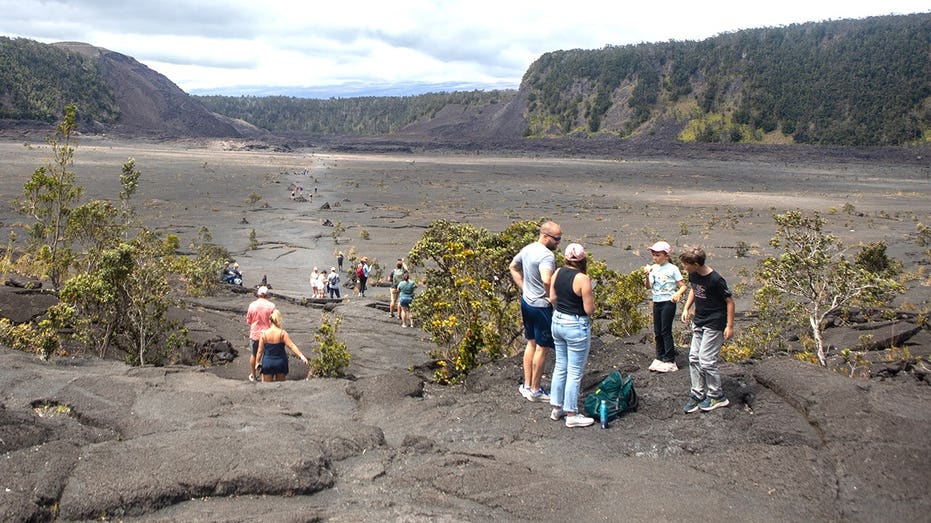
The Oahu man was last seen in the Big Island's Volcano area before he was reported missing around 12:16 p.m. Oct. 19, according to the Hawaii Police Department.
The man was identified as David Arai, whose son told Hawaii-based news station KHON2 his father was familiar with the area's hiking trails and that he frequently hiked alone.
K-9 Trina, a 3-year-old Labrador retriever specially trained to track people by scent, joined the search with her handler, Officer Christopher Ross, police said.
At about 7:30 p.m., Trina located the man on a trail roughly 2 miles from where his rental car had been found, according to the department.
Ross told KHON2 that Arai was lying on his back in bushes just off the trail when they found him.
Trina approached the man and licked his hand, according to the officer.
"The man was safely carried back to the trailhead and was subsequently transported to Hilo Benioff Medical Center for medical treatment due to dehydration and exposure," the department said in the press release.
Family members later found her camper van at the Cabin Creek Trailhead, prompting authorities in Siskiyou and Shasta counties to launch a coordinated search.
Ground crews found Granbery alive near Cabin Creek on Oct. 4 after she fell down a steep embankment and suffered serious injuries and exposure to the elements.
A California Highway Patrol helicopter helped lift Granbery from the rugged terrain before she was taken to a hospital, where authorities said she was in stable condition with non-life-threatening injuries.
The national park is also home to Kilauea, which recently erupted for the 55th time since late 2024 after a rare two-month pause, according to Fox Weather.
Officials have disclosed the causes of death for three festivalgoers at this year's Burning Man event in Nevada, weeks after the annual gathering was rocked by multiple fatalities.
The causes of death ranged from cardiovascular disease to drug toxicity, according to local outlet KOLO 8 News, citing information from the Washoe County Regional Medical Examiner's Office.
Burning Man, held annually in Nevada's Black Rock Desert, ran from Aug. 30 through Sept. 7 this year, with all three deaths occurring during the festival.
One man, 62, of Santa Monica, California, was pronounced dead at the festival's Rampart Medical Center on Sept. 3 after suddenly collapsing, KOLO 8 reported.
His cause of death was determined to be hypertensive and atherosclerotic cardiovascular disease.
Another man, 51, of Truckee, California, died in an ambulance on Sept. 4 after experiencing chest pain at the festival.
His death was linked to methamphetamine and MDMA toxicity, heart disease and Type 2 diabetes, with chronic methamphetamine use also contributing, the same outlet said.
A third man, age 60, of Yuma, Arizona, was found dead in his vehicle.
In a statement earlier in September, Burning Man organizers expressed condolences to the families of those who died and said the three deaths initially appeared to be from natural causes.
"The deaths of three Burning Man participants in 2026 all appear to be from natural causes, but we defer to the medical examiner for official determinations," the organization said.
"We encourage and ask that people focus on the contributions of the individuals lost and avoid speculation about the circumstances of their passing out of respect for the participants and their families."
A month-long programme of hands-on environmental activities is returning to the western Algarve this November, inviting residents, volunteers and visitors to get directly involved in restoring local landscapes. The Month
The village of Barão de São João, in the municipality of Lagos, will once again become a meeting point for nature lovers, artists and families when the Walk & Art
Nearly 183,000 giant tortoises inhabit the Aldabra Atoll in the Seychelles. This is the highest number ever recorded for the species and the result of decades of conservation efforts. A new study shows that the population is healthy and remains relatively stable, though scientists warn that climate change and invasive animals continue to threaten its […]
By studying fire scars in ancient wood, many scientists have become convinced that Indigenous people transformed North America long before European colonizers arrived. M.R. O’Connor spends time with dendrochronologists, who study tree rings, and other experts to understand what they’re learning:
Anthropologist Omer Stewart, who began documenting Native American burning practices in the nineteen-thirties . . . found that Indigenous communities burned prairies to attract bison to fresh grass and to maintain oak “orchards” where food could be gathered. He became convinced that Native Americans had reshaped the geography, and in some cases the climate, of North American ecosystems. Their impact “was profound, in terms of the amount of land converted to agriculture, the species they hunted and fished, and most particularluthe way they shaped their world through the use of fire,” the naturalist Scott Weidensaul wrote, in his 2012 book The First Frontier. Weidensaul argued that early America “was fruitful beyond modern recognition, it was riotous in its natural wealth, but it was not wilderness.” The dendrochronologist Evan Larson, at the University of Wisconsin-Platteville, made a similar claim: settlers encountered rich landscapes because Native Americans were tending them. “Whenever you’re talking about fire, you’re engaging with a central narrative around this untamed frontier and wilderness,” Larson told me. “In fact, that’s never been true. The early success of pioneers was already benefitting from the labor of somebody else.”
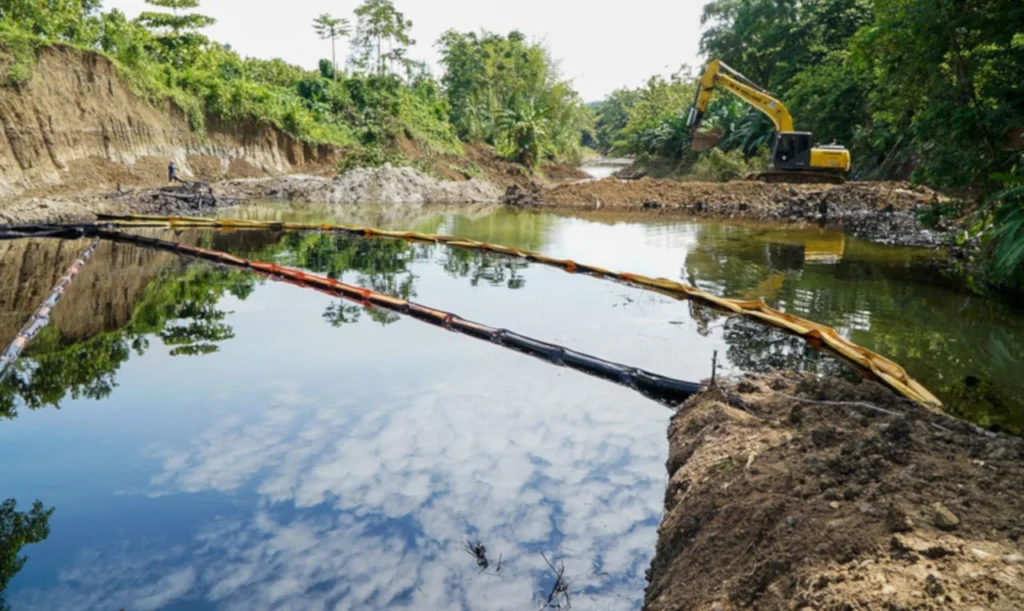
An oil spill was reported in the Cupa River in Quinindé canton, Esmeraldas province, Ecuador, on Monday, October 12, after a crude leak in the SOTE pipeline, according to Petroecuador.
The leak was controlled after it was detected together with Army troops. As a preventive measure, the water company ordered the suspension of water intake and distribution from the San Mateo plant to reduce risks to the population given the possible presence of contaminants in the tributary.
A “considerable amount of hydrocarbons” was detected in the Cupa River, according to reports from the drinking water company, increasing concern among residents of nearby areas.
These residents had alerted the situation on Monday, and expressed concern over possible effects on the ecosystem and on communities that depend on the water source for various activities. They requested an immediate response from authorities and the state oil company, they said.
📌 COMUNICADO DE PRENSA
EP Petroecuador controla fuga de crudo en el SOTE, en el cantón Quinindé
Although containment actions were implemented shortly after the incident, several residents consider the measures adopted insufficient given the magnitude of the event and its possible environmental and social consequences, they said.
Residents also requested spaces for dialogue with government authorities to establish concrete commitments for a comprehensive response to this type of emergency, arguing that solutions should not be limited solely to containing hydrocarbons.
They recalled that this event comes after another spill recorded in the El Achiote sector, also in Quinindé, in March 2025, which affected water sources in the area and generated concern over its environmental impacts.
Longreads has published hundreds of original stories—personal essays, reported features, reading lists, and more—and more than 14,000 editor’s picks. And they’re all funded by readers like you. Become a member today.
James Whorton Jr. | Longreads | October 13, 2026 | 5,932 words (25 minutes)
I live in Edgewood, a subdivision of quarter-acre lots in the town of Brighton, New York. Before the house was here, Edgewood was a farm, and before the farm, there was a forest. On a July day in 1788, a 55-year-old man named Hugh Maxwell set out to cross the forest in straight lines.
Not kind of straight. Maxwell’s job was to walk 1,100 miles on ruler-straight lines through this vast, obstacle-filled forest, to divide it into a grid of parcels that could eventually be sold as property. To shrink it down to the scale of human imagination. To look at the forest and see something else in its place.
I first learned about Maxwell from Mary Jo Lanphear, Brighton’s town historian. I had gone to Lanphear to research the racially restrictive housing covenants that made home ownership in Brighton exclusive to white people for decades. Whose fault was this? I wanted to know. Some racist real-estate developer? Something to do with the Federal Housing Administration? Lanphear printed out a copy of an old deed linking the Edgewood land to the Phelps and Gorham Company, a group of New England speculators. For a bargain price, Phelps and Gorham had acquired the title to 2.6 million acres of forested country along the Genesee River, in what is now western New York. The company then hired Maxwell—a Revolutionary War veteran, father of seven, and the first recorded white person to pass within shouting distance of the place where I now live—as surveyor.
Credit: Preston, Samuel, “The Gorham Phelps Purchase,” RBSCP Exhibits, accessed October 8, 2026, https://rbscpexhibits.lib.rochester.edu/items/show/4541.
As Maxwell crossed the forest, he imagined the nation he believed would one day replace it. “The land in this country is exceedingly good, but it wants good inhabitants,” Maxwell wrote to his wife, Bridget, imagining “many worshipping assemblies of Christians where now the wild beasts howl.” In place of the forest, he envisioned schools, churches, cash crops, and county clerks. However, he wrote, “these things are in the womb of futurity, and will be brought about in the proper way and time, as also by the proper means.”
Maxwell’s walk—through leechy ponds and tick-infested brush, down and up creek banks, over the rocky exposures that rattlesnakes prefer, in those remarkably straight lines—was like the act his fellow new citizens were performing daily, striving and pretending a nation into being. At the time he set out, the United States were only loosely joined, under the Articles of Confederation. Alexander Hamilton, writing in the first essay of The Federalist Papers, had recently asked “whether societies of men are really capable or not, of establishing good government from reflection and choice, or whether they are forever destined to depend, for their political constitutions, on accident and force.” Neither the new government nor the grid of lots for sale were to be discovered on the ground. They were ideas in people’s heads, notes on paper. In the “womb of futurity,” maybe.
The forest, however, was real.
Have you ever retraced your steps looking for some lost thing you had no hope of ever finding again? More than two centuries after he walked the forest into the future, Maxwell’s path persists, as lines on a map and on the ground in my neighborhood. I wanted to find the forest he walked through.
So I set out to follow Hugh Maxwell—through books and archives, on maps and over the ground, across the state of New York and, finally, across my neighborhood, looking for traces of the forest in what is here now.
On July 25, 1788, Maxwell set off from the southeastern corner of the Phelps and Gorham purchase, on the Pennsylvania line, headed due north. He led a small crew, whose job it was to drag a Gunter’s chain, a surveyor’s tool used to measure distance. The chain was 66 feet long; 80 chains made a mile. Every six miles he marked a township corner, hacking Roman numerals into the sides of a convenient tree, Vs and Xs being easier to cut in bark than 5s and 10s.
While his helpers dragged the chain, Maxwell carried the grid in his head. The job was to lay this imaginary grid over the forest itself, to parcelize the land into numbered squares—to cut it up and shrink it. In a notebook that first day, he wrote:
From the 82 mile Stone
120 Rods the groth is Beech
Maple birch ash Basswood
and Hemlock mixt
Throughout Maxwell’s young life, the forest had been a chaotic place, subject to accident and force, to the wars that would determine its fate. During the French and Indian War, Maxwell, in his early 20s and part of a Massachusetts militia, barely escaped a violent death at Lake George. Following a surrender, Indians pulled militia men from the retreating lines, killing some on the spot and taking others prisoner, to be ransomed in Montreal. Maxwell was pulled aside, too, and had his boots, coat, and shirt stripped from his body. But he got loose somehow and escaped into the forest, running at least 14 miles to Fort Edward, barefoot in his pantaloons. Later, during the Revolutionary War, Maxwell was shot at the Battle of Bunker Hill. A musket ball entered his body just beneath the right collar bone, breaking Maxwell’s shoulder blade and exiting through his back. He survived field surgery and gangrene, and wrote home to Bridget with his left hand, fretting that his nurses fussed too much over him.
Now, as Maxwell walked off the eastern line of the Phelps and Gorham purchase, the forest wars were coming to an end. Still, the forest itself resisted him in its way. It did not lend itself to being crossed in straight lines, as though it were a blank page awaiting the pen’s touch. Branches snagged his clothes. “I am of the opinion,” he wrote to Bridget from his walk, “that if I live to return, I shall stand in need of some winter shirts for I think my old ones will be pretty much worn out.”
What makes a forest? How do I know when I’m standing in one, and not just under some trees?
To reach Maxwell’s starting place—his “82 mile stone,” a roadside block of granite 82 miles west of the Delaware River—I drove a hundred miles south to Caton, New York. A welcome to caton sign marked the town line, which was also the state line. I took my phone out, opened a map on the screen. The phone is able to locate itself using pings from four satellite systems: GPS (“a global public service brought to you by the US government”), GLONASS (same, but brought to you by Russia), Galileo (European Union), and BeiDou (China). The screen suggested there should be a marker right in front of me.
Crouched inside a brushy spot, I shoved skinny branches out of my face and slapped at my hair. I found a tangle of rusted barbed wire. I found a deer skeleton. But no mile marker. Feeling things crawling on me, I climbed out into the sunlight and slapped down my shirt and pants.
The growth I saw around me now was not so mixed as what Maxwell described in his notebook. I was standing on a stone chip road, looking across a hay field. My phone screen showed a satellite image with a red pin to the west of the road, in the brush I’d climbed out of, and a blue dot in the road, which was me. This had to be the spot, though. I walked to my car, felt my head for ticks again. Then I walked back up the road, to check under the welcome to caton sign. There, I found a block of pink and gray granite with an “82” cut into the side and several loops of orange surveyor’s tape tied around it. It wasn’t hidden—I’d simply been looking on the wrong side of the road. Looking for what was in my head instead of seeing what was there.
It was a slow march from here for Maxwell and his crew, dragging their chain in a straight line through the thickness of mixed trees and across creek cuts. It took them two weeks to cover the first 54 miles. For me it was an easy drive, a straight shot north between fields of sweet corn. I stopped to examine an occasional historical marker, and again at a roadside farm stand, hoping to say hello to someone who lived on this line. The little stall was well stocked with honey and dried garlic, but there was nobody to say hi to: Sales were on the honor system, with a Mason jar on the counter to leave your cash in. I had only brought a credit card.
Maxwell’s notebook was a memento of a different world. He passed massive chestnut trees such as I could only read about. One spot he judged “moist and good and springy,” another “good for grass.” He noted with approval where a stream was big enough to support a sawmill. And yet the gaps in his notes are astonishing. A few weeks into his survey, he crossed “some old clear land” and “through the old castle.” Castle was the colonial way of referring to an Indian town. Here was proof on the ground of what Maxwell already knew: People had been living in this forest for a very long time, cultivating this land in a different way than European settlers did. And yet Maxwell found little to note about the old castle. He carried on instead with his catalog of trees—”white ash, basswood, elm, &c.”
What makes a forest? How do I know when I’m standing in one, and not just under some trees?
The Latin precursor of the word “forest” meant something like an unenclosed outdoor space. In early English law, the silva forestis was a place for lords to chase game and for ordinary people to gather wood. In the 13th century, as the Magna Carta encoded the rights of English barons, the Carta de Foresta laid out the rights of commoners to pasture cattle in the open places among the English forests. Similarly, the forest Maxwell entered in the summer of 1788 was more than just mixed trees. Its openings included the towns, orchards, and farm fields of the Seneca Nation. The Senecas had long used fire to manage areas of the forest, clearing thick undergrowth to attract deer, and they moved their farming fields from time to time to prevent exhausting the soil.
A forest is too big to see all at once, and maybe too big to describe. Writing about it, one is moved to grand language and weird leaps of perspective. The historian Francis Parkman devoted his career to what he called “a history of the American forest,” which is really a history of empires. Writing in the 1880s, with no satellite photos at hand, Parkman borrowed the point of view of a flock of Canada geese flying north from Albany. “As the aërial travellers winged their way, the seat of war lay spread beneath them like a map. First the blue Hudson, slumbering among its forests, with the forts along its banks. . . .” Parkman’s geese paid special attention to military architecture, noticing Fort William Henry by the “glistening breast of Lake George” and the white flag of the French at Ticonderoga. Onward they flapped:
“Lake Champlain now spread before them, widening as they flew: on the left, the mountain wilderness of the Adirondacks, like a stormy sea congealed; on the right, the long procession of the Green Mountains; and, far beyond, on the dim verge of the eastern sky, the White Mountains throned in savage solitude.”
This is silly poetry, but I am in deep sympathy with it, having also spent countless hours staring at different maps, trying to transplant a whole forest into my head.
At the heart of Parkman’s seven-volume France and England in North America was a question about property. “To whom belonged this world of prairies and forests?” he asked. Parkman wrote that France had “claimed it by right of discovery and occupation,” adding that the French had an “excellent system” for distributing land: “Whoever received a grant from the Crown was required to improve it, and this within reasonable time. If he did not, the land ceased to be his, and was given to another more able or industrious.” The English eventually outdid the French in this regard, Parkman wrote: “New England was pre-eminently the land of material progress . . . nay, in defiance of the four Gospels, assiduity in the pursuit of gain was promoted to the rank of a duty.” The quickest way to gain from the forest was to sell or burn the timber and put a cash crop in the ground.
Sir Albert Howard, an English botanist, saw the forest as a model for sustainable farming. In what he called “Nature’s agriculture,” variety is the first rule: “Many species of plants and of animals all live together,” he wrote in the early pages of An Agricultural Testament, published in 1940. Economy is another rule: “Nothing is wasted” and “nothing is lost.” Somehow, life and decomposition continue across millennia with no one in charge.
Wendell Berry, referencing Howard in The Unsettling of America, writes that the forest is a place where “the forces of growth and the forces of decay are in balance.” I like this way of putting it very much. A forest tree dies in place, and its slow decay swells with life—mosses, fungi, beetles, and things that eat beetles. A living hardwood tree throws its leaves away every year. In The Great American Forest, Rutherford Platt calls this “the deciduous idea”—a funny way to imagine it, as though the founding fathers of the forest had written this leaf-shedding principle into their charter. But it is a brilliant idea, a world-changer. In balance, growth and decay work in cycles. The mat of discarded leaves becomes the food of millipedes and the habitat of worms. In spring, the snow sinks into it. A thick, black soil builds.
This is silly poetry, but I am in deep sympathy with it, having also spent countless hours staring at different maps, trying to transplant a whole forest into my head.
I had already traveled to Maxwell’s starting place; now, it occurred to me that I had never followed Hugh Maxwell’s route where he passed nearest to my house, along the eastern township line, which is not a road at all and which happens to be covered over with trees. From my front door, I followed the sidewalk along Edgewood Avenue, where the utility poles shrink away into the distance like an exercise in single-point perspective.
The place where I live has gone through a lot of changes in the 20,000 years since the most recent ice age, from deglaciation to migration and cultivation. At the time Maxwell began his walk, the towns, orchards, and farm fields of the Seneca Nation were openings in a vast forest that still covered half of North America, from the Atlantic coast to the Mississippi River. The houses in my part of Brighton were built beginning in the 1930s, but the older eras of this place are visible on any road map. The early roads go from some important place to some other important place. Monroe Avenue, a very old road, follows a route from the north end of Canandaigua Lake to a shallow, fordable spot in the Genesee River. It is not straight, but bends sensibly between Cobbs Hill and Pinnacle Hill. People have been walking that way for a long time, since long before Maxwell arrived.
After Maxwell, there came an era when all new roads were cut parallel to his township lines. The logic of the Brighton-Henrietta Town Line Road, for instance, has nothing to do with terrain, and the things one passes when driving it—an auto body shop, a small church with three steeples, an Asian market, a sex shop, Dunkin’—have little to do with each other. It’s as though Maxwell set the place to auto-arrange, so that every major surface road for the next two hundred years would snap to grid.
I stopped at the former site of the old Rowland farm. My friend Roger lived next door to the farm as a boy. Mr. Rowland had a stand of virgin timber on his place, Roger recalls, and the soil in his fields was so fertile that a person had to take care not to get knocked over by his produce. “Dig a hole, drop a seed in, and stand back,” Mr. Rowland warned.
As late as the 1950s, there still were some farms along Edgewood Avenue. But it wasn’t long before they were subdivided into residential lots.The timber now is mostly whatever people have chosen to set out in their yards. Norway maples are common—tough street trees, not from around here, indifferent to road salt and car exhaust. Rows of arborvitae make living privacy fences. Shading the Briar Manor apartments are seven big sycamores, handsome monsters with paint-by-number bark of yellow, gray, and lilac brown.
Past the row of sycamores, I turned onto a paved bicycle path that follows a chain-link fence. A little further, a sign marked the town line. I found a low place in the fence and stepped over, into the trees, following Maxwell again.
It was dark under the high canopy, and the underbrush was sparse. Maxwell had once described this section of his route as “very good beech and maple land with a mixture of ash, elm, oak, basswood, etc.” I found a beech tree, its pale sides smooth, its trunk a good two feet across. Beneath the beech tree was a shattered porcelain toilet. There was no plumbing attached; somebody had brought this toilet out here, set it on the ground, and taken a hammer to it.
I checked the map on my phone. In the satellite photo, the woods were more or less featureless except for the town line, superimposed in yellow over the treetops, and a blue dot, me, on top of that yellow line. I was still on Maxwell’s course. There was no trail on the ground for me to follow, though. The only trails were the soft, narrow animal trails that passed under blown-down branches or veered away into low cover.
The growth was mixed: saplings, mature trees, dead standing, and dead fallen. I found a red maple with circular fractures erupting like a target in its bark. I found an ash tree, its bark split open and buckling, the meandering tracks of an emerald ash borer scoring the bare wood. A lean musclewood with ten trunks, one with its bark chewed at the height of my knee. A basswood with a stripe of red spray paint on it and rings of woodpecker holes.
If this was a forest, it was a half-wrecked one. Much of the soil was exposed and cracked from flooding. Variety was here, though, and life among the decay. Deer tracks crossed a muddy trench. Bright moss blanketed the softening fallen trunks, and ferns grew. I heard chattering overhead and a rainlike sound in the leaves. Somebody was up there taking nuts apart. Chunks of green and yellow hull hit the ground around me, cycling back to the soil.
In September of 1788, Hugh Maxwell took a fall in the woods and hurt his shin. He made things worse, he wrote, “by wading in the swamp and through wet brush.” For three weeks, he was laid up in the Seneca town of Kanadesaga, where he had nothing to do but think and write home.
He missed Bridget. “I feel anxious for your welfare,” he wrote to her. “I long to hear from you and love to hear from you.” He reminded Bridget to have their son get the haying done, get some long shingles to fix the roof, cart the dung to the field, plow the field on time, and do the sowing.
He also missed church. Shortly after his near-death experience at Lake George as a young man, Maxwell had joined a church and, judging from his letters, devoted himself to a stern code under which he must strive constantly for an approval that he would never earn. For Maxwell, life on earth became a moral exercise, an attempt to deserve immortality. God, he wrote, “is Daily Loading us with his Benefits, though we are evil and unthankfull.” Now, once more wounded far from home, Maxwell wrote to his wife of “unprincipled fellows and drunken savages,” adding, “Religious society is quite out of the question here.”
It had been only nine years since the Continental Army’s expedition across Seneca country. After Senecas joined with Tories to raid White settlements along the Mohawk, the young United States had set aside European conventions of war in an attempt to drive Seneca communities from their land. “The immediate objects are the total destruction and devastation of their settlements and the capture of as many prisoners of every age and sex as possible,” George Washington wrote in his orders. “It will be essential to ruin their crops now in the ground and prevent their planting more.” At Kanadesaga, the Continental Army had burned at least 50 Seneca houses, tore ripe corn and beans from the fields, and bayoneted pumpkins. A whole orchard of apple trees was girdled, a circle of bark stripped from around each trunk, creating an unhealable, fatal wound. The Continental Army took few hostages: The Senecas moved west just ahead of the approaching troops and then returned again when the troops went home, rebuilding their houses and replanting their fields.
Nine years later, laid up in Kanadesaga while his shin healed, Maxwell now found himself surrounded by Indians. “I am in hopes their time with us here is short,” Maxwell wrote to Bridget. “I do think that the Great Governor of the universe is about to plant a glorious gospel in this wilderness,” he predicted—with the help of his own survey, of course. “May it be so and soon spread over this land.” Maxwell, in effect, had two tough jobs: crossing the forest in straight lines, and convincing himself that he was a good person for doing so.
After more than a month’s recovery, Maxwell resumed his survey. “First mile through excellent land,” he wrote from the woods, on the line of a future township along the east bank of the Genesee River, noting nearly a half-dozen different trees in the area. The next mile: “Same sort of excellent land and growth but considerable mixed with chestnut.” The third mile was less good: “80 rods over a wet low land.” Then more very good land again. He crossed a brook that ran one way, then the other. Both Maxwell and the brook were headed to the same place, north to Lake Ontario. The brook took the easy way, downhill. Maxwell took the straight way, leading his team and their chain through swamp and timber, mile after mile.
At the end of the 18th mile, he chopped a “XIII” into the side of a small basswood tree, marking a corner of the 13th township—“with trees marked for witness about it,” he wrote, for the benefit of some future settler searching for the corners of his lot.
Maxwell, in effect, had two tough jobs: crossing the forest in straight lines, and convincing himself that he was a good person for doing so.
When the blue dot on my phone told me I had reached the southeast corner of the town of Brighton, I spent some time looking for the basswood tree with the XIII in its bark. But I was kidding myself, of course. Maxwell’s hatchet marks were meant to last years, not centuries. I slapped at mosquitoes, scanning for some connection between the forest Maxwell had walked through and the place I was in. A scrap of fluorescent pink tape caught my eye. I’ve been seeing this stuff in the woods for my entire life, weatherproof trash that will outlive me and, I suppose, every other individual living thing in the woods as well. I looked past it, because I can’t pick up every piece of garbage in the woods and carry it out. Then I looked again and my understanding of the place shifted.
The pink plastic was a piece of surveyor’s tape, tied to a branch. Near the branch was a short, square concrete pillar. This was the marker—a “monument,” in surveyor-speak—that had taken the place of the basswood with the XIII in its side. It was a more durable monument than a tree, and though it was short and unobtrusive, the little non-decaying flag of pink plastic made it hard to miss, even for me.
Maxwell wrote of this site:
The line of this town is very
good land covered with a thick
growth of Beech Maple Elm Basswood
Ash Butternut &c. Not very uneven.
No elms now, but I had seen the others he mentioned. This wasn’t “virgin timber”: The nearest big tree was a two-trunked silver maple, second growth, sprouted back from a stump. This was the place, though.
I stayed there awhile doing nothing, a little dazzled, a little jarred by the impression of two forests coming together—the one Maxwell crossed and the one I was in. The forest wasn’t gone, but it had changed, and so had the way we live with it. In imagining the forest as a wild place, it seemed to me, we had imagined ourselves right out of it. It’s become a place to visit, a resource or a park, not our home.
Or something like that. Half-stumped, I managed to stand there motionless long enough that a red fox, not noticing me, stopped nearby with its nose in the air and its tail extended. I watched it for a while as it watched something else. Then a leaf blower whined, and the fox and I went our separate ways.
In a healthy forest, the forces of growth and the forces of decay are in balance. But those same forces are the conditions of life everywhere—balanced or not.
Reaching Lake Ontario, Maxwell cut his initials into a tree, then went home to Heath, Massachusetts. In years to come he served as a deacon and justice of the peace in that town. He applied for an invalid officer’s pension, but was denied. At 67 years old, in debt, he bought some horses and embarked with them for the West Indies, where the animals, along with enslaved humans, were in demand on sugar plantations. It was a nightmare world where both humans and horses were routinely worked to death in brutal heat. I wonder how he justified that new venture to himself. Maxwell took a profit from the sale, but died of yellow fever on the voyage home, and his body was buried at sea.
I couldn’t visit Maxwell’s final resting place. Instead, I drove to western Massachusetts, to his house. On Route 2 I locked on to an excellent Albany radio station whose signal held through the Taconic Mountains as far as Williamston, Massachusetts. The road had been graded and guard-railed in the 1920s, on top of an older road that people had been walking since the last ice age, for all one can know. The road sided a stream tumbling over rocks. And what was so important about that? Why did I love it? I loved this road because it was no one’s idea. A glacier put this road here, and people followed.
The house that once belonged to Maxwell was surprisingly modern-looking, with its solar panels and a Prius in the driveway. I knocked and a woman came to the door. Sue, the owner, invited me in. In the kitchen, one wall was almost all fireplace, paneled above with a single blond board 20 inches wide—spruce, Sue thought. In the next room, there was more of that broad paneling, and a row of cupboards over a smaller fireplace with a grow-light installed inside it over a collection of potted cacti. Sue showed me a copy of Maxwell’s only portrait, a silhouette on horseback that was made during the Revolutionary War. She also had a copy of The Christian Patriot, a biography written by Maxwell’s daughter, Priscilla, who recalled her father’s strong singing voice and a gory song about the courage of the Bunker Hill heroes that he liked to sing for the children. Near the house was a cemetery with a marker for Maxwell, a tall obelisk with worn stories in its sides.
I also drove to Lake George to see the place where 22-year-old Maxwell had first spied death coming for him through the forest. I followed US Route 9 past a sprawling outlet mall and Bloody Pond, where the bodies of slain men had been thrown at the end of that chaotic day early in the French and Indian War. Then I emerged from under clustered trees to what Thomas Jefferson once called “without comparison, the most beautiful water I ever saw.” Lake George was “ limpid as crystal,” he wrote, the mountains on either side “covered with rich groves of thuja, silver fir, white pine, aspen, and paper birch.” Today the groves of thuja are interrupted with summer mansions and the sandy parking lot by the beach is jammed with cars, but the mountains are still mountains and the long lake still stretches far away between them. When I arrived, the beach was crowded with boogie boarders, volleyballers, and people just splashing. A man threw a tennis ball into the lake, and a dog took a fierce running leap to retrieve it.
I’d booked a camp site nearby at the Lake George Battleground Campground. A few pines were all that separated my site from Route 9, its four lanes roaring with traffic. I set up my folding camp stool by the sidewalk, across from an Exxon.
I tried to picture a young Maxwell loping through here shirtless in his bare feet, enveloped by the forest and afraid for his life. Among the English-speaking settlers, the events at Lake George would be remembered as a massacre, and the Indigenous people whose home this was, whose conventions of war did not match those of the European empires, were called savages. It was powerful storytelling, indispensable to the colonial project.
Every story I could imagine about this place, and about Hugh Maxwell, seemed another work of fiction, a mechanism for assigning blame.
Maxwell trained himself on a version of that story: He had outrun death, sought God, and sought profit while declaring himself unthankful. He hardened himself into a professional fighter, banking on the next life while he improved an ancient forest by drawing a checkerboard on it. He wrote home about the “womb of futurity,” a bizarre metaphor I still do not understand. Whom did he think made futurity pregnant? Was it God, or the Phelps and Gorham Company? I didn’t understand the guy. On the other hand, I didn’t go to war when I was 22. I was working in a restaurant and writing stories.
Every story I could imagine about this place, and about Hugh Maxwell, seemed another work of fiction, a mechanism for assigning blame. Blame has to be assigned—Indigenous communities did not displace themselves, nor did the forest wreck itself—but it is also necessary to keep looking and to try to keep noticing how much one does not understand. Among the Native allies who joined the French at Lake George all those years ago was a band of ten Iowas who had traveled a thousand miles, from beyond the Great Lakes, to fight the English. What were they thinking, and what had their journey been like? They had only themselves to tell their story to, because no one at Lake George spoke their language.
As I tried to conjure the experiences of these men nearly 270 years ago, it occurred to me that I ought to be more concerned for the daring pedestrians trying to cross Route 9 from the campground to the MiniMart attached to the Exxon. There was a crosswalk, but the traffic was coming in fast.
There was too much here for me to make sense of. The seat of war was now a vacation spot. War is violent and so are four-lane highways. Lake George is beautiful, and it puzzled me to notice that the MiniMart was pretty, too, with its high-wattage red-and-white Exxon sign and its glass front glowing softly yellow.
I walked over. Inside, the MiniMart was lit up like a minor carnival, aggressively air-conditioned, and it had a sweet, grimy, convenience-store smell of burnt coffee and potato logs. People were getting chips, jerky, gasoline, and party ice. The forces of growth and the forces of decay were jostling. I liked being there. I selected two cold singles, thanked the cashier, and followed the crosswalk safely back to my campsite and my folding camp stool, from which I watched the people coming and going late into the night.
When Hugh Maxwell wrote home to Bridget with his story about the womb of futurity, he got a couple things wrong.
He was right that the country was changing. While he was in the forest tramping out lines, trying to get his head around this thing that was too big to fit inside anyone’s head, the United States ratified their second constitution. The document was a little over 4,000 words long, and it relied heavily on the word “shall,” a modal verb used to indicate a future action, which was used 191 times. The official copy covered four big sheets of parchment in ink made from oak galls.
He was wrong about the Senecas’ time being short. They are still here. On the Tonawanda Territory, an hour’s drive west from my house, Senecas still govern themselves according to the Great Law of Peace—a constitution established by the Haudenosaunee Confederacy and recorded in white wampum before the Pilgrims landed at Plymouth. The Tonawanda Seneca Nation is currently fighting a plan to build a data center next to their woods.
He was right about the coming of new inhabitants. The grid he’d laid over the forest became a map in a land office, and his employers were soon marking squares SOLD in small cursive. Settlers arrived slowly, then in booms, cutting trees, burning stumps, shooting wolves, and plowing the black ground with teams of oxen, raising vegetables for their families and wheat to sell over the Erie Canal.
The land in Township 13, my township, turned out to be mixed. The ground was clay in some parts. Brighton became known for brickyards. That industry is gone now, but the high school had an ugly surprise this year when it tried to replace a grass playing field with plastic turf. Chunks of brick, glass, and metal were buried a few inches down; tests showed high levels of arsenic, lead, and semi-volatile organic compounds. The field where my daughter played soccer is now sheeted in plastic while the state decides what to do next.
In Edgewood, the earth is as rich as Maxwell said it was, but he might have been surprised to learn how briefly that would matter. Soil fertility is mostly beside the point, and even an inconvenience, since lawns have to be mowed, leaves blown into piles, and pollen hosed off windshields in the spring.
No description, no story, is big enough to capture the forest Maxwell walked through. The best I can think to do is to keep looking for better questions about it. Here’s one: If a forest had a constitution, what would it say? Its coequal branches might be soil, air, water, and sun. It certainly would have no president. Its bill of rights might hold that differences exist, that living things may strive, that life includes an accumulation of wealth, and that death includes the release of that wealth. Nothing is wasted, nothing is lost, but eventually everything has to be let go of. When you die, you simply spread out your wealth on the ground.
James Whorton Jr. grew up in Hattiesburg, Mississippi. He is the author of three novels, and his writing has appeared in The Best American Essays, The Oxford American, Virginia Quarterly Review, The Southern Review, Washington Square Review, The Gettysburg Review, and The Washington Post. He teaches at SUNY Brockport.
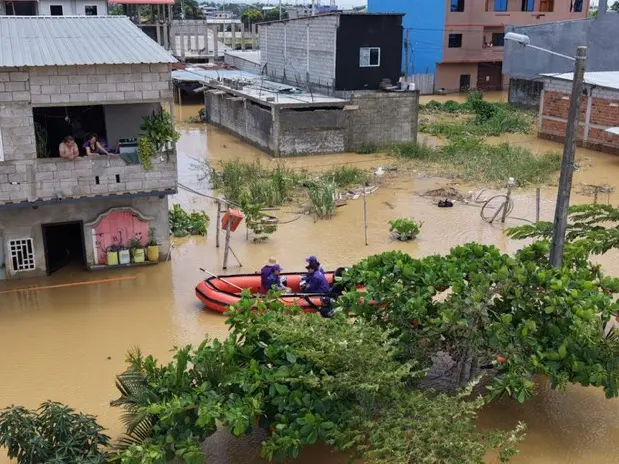
Heavy rains in Ecuador have left five rivers and one estuary overflowing in three provinces of the Coastal region, damaging thousands of homes, the National Secretariat for Risk Management (SNGR) said Monday.
The coastal provinces of Guayas and El Oro, along with the tropical province of Los Ríos, were affected, the SNGR’s official report detailed.
In Los Ríos, Estero Hondo in Puebloviejo, the Babahoyo River and the Chilintomo River overflowed, the report said. A strong downpour during the early morning flooded rural areas such as the Las Cañitas settlement. About 300 families were affected by water entering their homes and contamination of water wells, in addition to the suspension of classes at the local school.
In Guayas, the Balao River overflowed, affecting the Mercado Central and Barrio Nuevo sectors, and the San Rafael River impacted the San Pedro settlement in General Antonio Elizalde (Bucay), the report said.
In El Oro, emergencies were concentrated in Santa Rosa canton, where the Chico and Caluguro rivers overflowed their banks, according to the report.
The storm left 16 homes completely destroyed, damage to another 4,847 and effects on 10.74 kilometers of road network, the official report said. Authorities also confirmed the collapse of one bridge and structural damage to seven others, complicating access for rescue units to vulnerable areas.
Faced with the health emergency due to contamination of water sources in Babahoyo, the SNGR installed three storage tanks of 2,500 liters each to supply the population and is evaluating the use of local churches as temporary shelters.
La atención a las familias de Balao continúa. La SNGR realizó el levantamiento de información para la ficha EVIN y participó en la coordinación interinstitucional en el ECU 911. pic.twitter.com/nsmK0Xhp7Q
Since the red alert was declared for the weather phenomenon on August 29, the number of people affected in the country has risen to 17,142, with 1,354 victims and one deceased. The SNGR counts a total of 349 adverse events that have impacted 22 of Ecuador’s 24 provinces, with the greatest incidence in Esmeraldas, Guayas, Manabí, Los Ríos, Orellana, Imbabura and Pichincha.
Against this backdrop, the National Institute of Meteorology and Hydrology (Inamhi) maintains an active watch advisory in anticipation of an increase in rains, electrical storms and wind gusts throughout the country until next Wednesday, October 14.
In 1990, NASA discovered that the mirror of the Hubble Space Telescope had a very small polishing defect that caused blurred images. While waiting for a repair, astronomers turned to mathematics. Because they knew exactly how that faulty mirror was distorting light, they could undo the blurring with a technique known as “deconvolution.”
Nearly 60 years ago, John McPhee rafted the Colorado River with a longtime Sierra Club reader and his nemesis, taking notes as the men argued over the fate of the land, the future of Lake Powell. Today, McPhee is 95 years old and widely acknowledged as a singuler chronicler of place, people, and time. As David Schurman Wallace notes, he also has “a good chance of outlasting the lake.” In a stimulating review of Encounters with Wild America, a four-book collection by McPhee, Wallace sets a master’s time-intensive and famously lengthy projects against the contemporary attention economy and the media industry. Longform writing didn’t spring from a hashtag; it was a natural outcome of applying narrative frames to complex subjects, including nature itself. Now, writes Wallace, “this work of dedicated attention, so essential to thinking about, say, the environment, is at risk of becoming a relic.”
[McPhee’s] work is an artifact, one that aids reflection, but demands you stop first and take things slowly. It’s no accident that the books that Library of America have chosen to canonize first are about nature and the people who inhabit it. To appreciate, or even just think about an expanse—a nearly deserted forest, a glacier, a stretch of tundra—is difficult. You can look at an image, but you can just as quickly turn away or scroll past. His writing is a tool that helps us feel distance. You have to spend time on the page getting to know it, trying to imagine things you will most likely never experience yourself.
The group of villagers fighting a lithium project tooth-and-nail in northern Portugal has mounted a blockade today, to stop British company Savannah Resources carrying out work on ‘common land’ –
Portuguese environmental organisation Quercus is calling for the creation of a “structured and comprehensive” plan to control the rise in the wild boar population in urban areas, considering the government’s
Welcome to the age of nuclear clocks. They are not yet as precise as the atomic clocks that keep time (and much more) in modern society. But because they are based on the atom’s nucleus rather than its electrons, improving their performance is only a matter of time. More importantly, these devices will be far more than timekeepers: they could help answer some of the most fundamental questions in physics and open entirely new avenues of inquiry.
The World Meteorological Organization (WMO) has welcomed a declaration adopted on September 24 that emphasizes climate change adaptation, disaster risk reduction, and resilience-building through improved data, risk assessments, and early warning systems. The declaration acknowledges the role of specialized UN agencies, including the WMO, in coordinating scientific data related to sea-level rise. According to UN […]
In 1982, 28 wild donkeys were released into the desert. Decades later, they have created an oasis in one of the most extreme places on Earth. Donkeys are far more than mere beasts of burden; these herbivorous mammals can benefit the environment in ways that would be difficult to achieve through human intervention. More than […]
Longreads has published hundreds of original stories—personal essays, reported features, reading lists, and more—and more than 14,000 editor’s picks. And they’re all funded by readers like you. Become a member today.
Once, as a young adult in the city, I was walking home after a long day of work. The main street leading to my place wasn’t well lit, with dark stretches between streetlamps. There was a huddle of men under one, some standing around, some lounging against the post. They moved in the orange light, turning as one to face me. Something shifted in the air.
An earlier version of me would have been slower to respond, given them the benefit of the doubt. But after a recent knife-point mugging, I had begun to develop a sort of second skin—a keen, physical sense of danger. I slipped back into the shadows and ran in and out of alleyways. I doubled back, cut across fences, and scaled half walls. I made no sound at all; I made it home. I had made a spiraling maze in real time. They could not find me.
In his essay “From the Tree to the Labyrinth,” Umberto Eco, a lover of labyrinths, explores how we “create and organize knowledge.” Moving away from the restrictive “tree” model, Eco approaches the “labyrinth” model, listing three kinds—a unicursal labyrinth, with only one path to the center and back; a multicursal maze, with many paths, all but one leading to dead ends; and an infinite network of interlinked points, which he calls by the borrowed term “rhizome.”
There are many labyrinths and mazes woven into my memory—verbal, textual, graphical, physical, metaphorical. Tamil kolams, for instance: My mother draws small, perfect threshold patterns at home, and immense, geometrically flawless labyrinths and mazes for events—no outlines, no tools, just her seeing eye and moving hand. When the sky is still dark, she dips folded muslin in wet, ground rice and draws liquid lines on the clean floor. She must draw each bit before the white dries on her hand, which it does almost instantly. Nothing can be erased or redrawn. She must keep moving until the whole kolam is done—the body walking the labyrinth even as it summons it out of nothing, the labyrinth making the world even as it is devoured by little black ants.
Eco’s rhizome model, to its credit, says we may never know everything, but we can keep going. Jorge Luis Borges certainly did, over and over like a modern-day Scheherazade. He wrote The Garden of Forking Paths, The Library of Babel, Funes the Memorious, The House of Asterion, and more, for those of us that love our awful infinities rendered in chewy, fictional ways.
It’s been so long since the mugging and the maze. Those events (and others like them) ingrained hard habits into me. Unless I’m absolutely certain about the safety of the time and the place, I don’t listen to music as I walk. I wear barefoot shoes. I wear my bag cross-body, coax my hands out of my pockets. I note the exits and sit like a mob boss, the door never to my back. But I myself am softer, and I understand the ways of wayfinding a little better now.
When Nawab Asaf-ud-Daula, ruler of the Kingdom of Avadh, moved his capital to Lakhnau (now Lucknow, Uttar Pradesh, India) in 1775, he likely had no inkling of what was to come—a great famine. The Nawab was an unusual ruler. Forgoing the usual charity routes, he offered his people the dignity of earning wages through excellent work, going so far as to demolish by night and rebuild by day so everyone who wanted work could have some. He built the lavish Bara Imambara, including a marvelous maze of a thousand corridors and half as many identical doorways (and one exit), the Bhulbhulaiya. The Hindi-Urdu root word, bhūlnā, means to forget, to be thus lost, and bhulānā is its causative form. The maze is “that which makes you forget.”
Abhimanyu, warrior prince, has broken into the Cakravyūha, the battle formation of the colossal whirling disc. While still in his mother’s womb, he had overheard his father, the great warrior Arjuna, discuss war strategy with his uncle Kṛṣṇa, and filed the knowledge away in his preternaturally precocious mind. Now the Kurukṣetra War is upon them, and 16-year-old Abhimanyu has found his way to the center of the moving labyrinth. He is a trained warrior, no doubt, but he is alone, fighting seasoned Kaurava generals on all fronts. They have trapped him away from his fellow Pāṇḍavas. They have sunk his chariot, killed his horses, and broken his sword and bow. Abhimanyu raises a chariot wheel above his head. He doesn’t know how to come out. He never heard the end of the conversation.
This heartbreaking story from the Sanskrit epic The Mahābhārata was likely my own mythical introduction to the labyrinth. McConnachie, too, starts with a myth—a Greek mythopoeic myth—but first he runs a little labyrinth on the morning of his own wedding. His essay for Aeon moves lucidly through history, architecture, religion, folklore, games, psychoanalysis, New Age rituals, and more.
P.S.: Don’t worry about Ariadne; she gets to chill with Dionysus. Theseus’s dad, not so great.
Instinctively, we sense that mazes and labyrinths are essentially metaphorical—even if it is not always clear what they represent—which explains why it’s so common to seek the meaning of the maze in myth. According to the ancient Greek story, as retold by the Roman writers Plutarch and Ovid, Minos of Crete demanded a tribute from the city of Athens in the form of seven young men and seven women. They would be imprisoned inside the Labyrinth created by Minos’ brilliant architect Daedalus, and there sacrificed to the Minotaur, a monstrous creature born of the unnatural union between Minos’ wife and a white bull.
The brave and ambitious Theseus gets himself chosen among the Athenians and, on arrival in Crete, seduces Minos’ daughter, Ariadne. She secretly arms him and slips him a “clew” of thread. (This is the old word for a ball or skein of yarn and is, fascinatingly, the origin of the English word “clue.”) Theseus kills the Minotaur, escapes the Labyrinth, runs off with Ariadne, and should return home happily—except that he abandons Ariadne on the island of Naxos and then, upon homecoming, forgets to change the color of the sails on his ship as he promised his father he would do if he survived. On seeing the black canvas, the old man drowns himself in the sea.
Speaking of leading people astray, here’s a clip of the third task of the Triwizard Tournament from Harry Potter and the Goblet of Fire. Professor Dumbledore counsels the champions: “In the maze, you’ll find no dragons or creatures of the deep. Instead, you’ll face something even more challenging—people change in the maze.”
Adrian Fisher has over 700 mazes across 42 countries to his name, “including one on a skyscraper in Dubai and another that’s now reproduced on Britain’s five-pound note.” He’s also likely the only person to make a successful business out of mazemaking. Twilley profiles Fisher comprehensively, and not a little warily.
Starting with the design of the medieval Christian labyrinth, the most famous of which is in the Chartres Cathedral, France, Fisher slowly included other complex features. “Fisher realized that if he wanted to make mazes he first had to make people want mazes,” Twilley writes. According to Oskar van Deventer, an engineer and creator of renowned mechanical puzzles, he’s the “world’s best maze psychologist,” using what he knows about how people behave “against the unsuspecting solver and even against the suspecting solver.”
In 1980, Fisher was twenty-eight years-old and working for I.T.T., a multinational manufacturing company, where he was responsible for productivity enhancement. He was increasingly drawn to the idea of designing mazes; he’d even formed a company, Minotaur Designs, with a wealthy labyrinthologist and former diplomat, Randoll Coate. But public commissions proved elusive. “At first, I thought it was impossible,” Fisher said. “How do you start? How do you do it?”
Runcie’s dream gave him an idea: Fisher wrote to the letters page of the London Times, briefly outlining the maze’s long history as a Christian symbol and noting that, as in the Archbishop’s dream, a maze’s goal is typically reached not by “pressing toward the center” but, rather, by “returning almost to the edge,” in order to find the proper path. In his signature, Fisher styled himself a “Maze Consultant,” and, before long, this stealth marketing had reeled in a customer, and Minotaur’s first public commission.
Crystals are known for stacking their atoms in repeating patterns in every direction, forming structured unit cells and lattices. But quasicrystals are mad materials. They, too, form patterns, but in non-repeating ways. Physicists exploring their use in carbon capture ended up with the world’s most diabolical maze.
What can live without a brain or a nervous system, eat better than you, navigate mazes, and win scientists not one, but two Ig Nobel Prizes? The answer is a single-celled organism called the slime mold, also affectionately known as the blob.
In the 2000s, Toshiyuki Nakagaki, a scientist at Hokkaido University, scattered bits of a single Physarum polycephalum in a maze, a few dots in a petri dish. The bits grew enough to find each other, and then grew some more to fill the maze. The mold then retracted itself from the dead ends, restricting itself to the most rewarding path—and this was the least it could do. Using its ability to grow up to a meter; its ability to analyze, solve problems, and optimize in real time; and its own slime as “externalized spatial memory,” it “effectively re-created Tokyo’s railway network in miniature as well as the highways of Canada, the U.K., and Spain.”
Catch a glimpse of this incredibly cool mold in action in this WIRED video: Mycologist Explains How a Slime Mold Can Solve Mazes. Looks like Nakagaki will have the last laugh, after all. And if you’ve ever wondered how other animals are so much better at this stuff than us, read Kathryn Schulz’s essay for The New Yorker, “Why Animals Don’t Get Lost.”
Gardeners sometimes encounter them in their backyards—spongy yellow masses squatting in the dirt or slowly swallowing wood chips. Hikers often spot them clinging to the sides of rotting logs like spilled bowls of extra cheesy macaroni. In Mexico some people reportedly scrape their tender bodies from trees and rocks and scramble them like eggs. They are slime molds: gelatinous amoebae that have little to do with the kinds of fungal mold that ruin sourdough and pumpernickel. Biologists currently classify slime molds as protists, a taxonomic group reserved for “everything we don’t really understand,” says Chris Reid of the University of Sydney.
Something scientists have come to understand is that slime molds are much smarter than they look. One species in particular, the SpongeBob SquarePants-yellow Physarum polycephalum, can solve mazes, mimic the layout of man-made transportation networks and choose the healthiest food from a diverse menu—and all this without a brain or nervous system. “Slime molds are redefining what you need to have to qualify as intelligent,” Reid says.
Teenaged Sarah is supposed to be babysitting her infant brother, Toby. But he won’t stop crying, and in a rash moment, she wishes him gone. Villainous Goblin King Jareth obligingly spirits him away to his dark labyrinth, which she must negotiate to save the baby before a terrible fate befalls him. If you’re not convinced you should see Labyrinth, this 1986 classic, know that the Goblin King is David Bowie.
I had some trouble choosing a quote from this retro maze of an essay. Every passage seemed appealingly contrarian, sometimes even to the essay’s own points, every idea poised for intertextual sparring with the other pieces in this reading list (something I secretly enjoy).
Yes, it is gleefully haunted by its own ideas going back and forth and switching back upon themselves, and yes, it will make you question a few axiomatic notions about labyrinths and mazes. But maybe because times have changed, maybe because no one seems to be saying labyrinths are better than mazes or vice versa any longer, some of the arguments may seem a little heavy-handed.
But some, like this one seemingly drawing from Freud/Jung psychological arcana, still sparkle: “The maze is the labyrinth’s uncanny.”
It seems to me that hidden behind contemporary etymological distinctions is an attempt to tame multicursality, by way of denigrating multicursal mazes as merely “childish” versions of more sober, unicursal ones. Multicursality challenges meditative clarity with multiple versions, no clear centers, and a sense of ambivalence and confusion. These complications, however, are the point of the labyrinth. Even if we grant that labyrinth merely designates the one-path New Age labyrinth recycled from the medieval era, the object is still haunted by a misrecognition. For even the medievals retained a sense of the unicursal labyrinth’s ambages—the equivocation at the heart of its windings, which the New Age version does not readily admit. Additionally, the labyrinth that is the legacy of the medieval period is enmeshed in a circuit of analogies to such a degree that it is impossible to map out all its symbolic equivalences and their implications without ending up in the muck of indistinction. This tendency of the labyrinth to connote so much is part of what makes it an antithesis to sureness, rationality, and clarity. Its structure is mystically congruent with the idea of a dark or enchanted forest; it is also a stand-in for earthly conundrum, brain fold, uterine canal, spiritual struggle, or psychosexual journey. Its center: Mary, the alchemical rose, Jerusalem, princess, Minotaur, inner-self, lotus blossom. And of course there are the various rewards that the multicursal maze holds out for its young adepts (pots of gold, pies and cakes, utopian wonderlands of bunnies and lollipops). Labyrinthine confusion is not merely an issue of its tortuous corridors, its solution not merely the cheese in the corner. Labyrinth enfolds into labyrinth across times, cultures, and myths.
It’s the yellow that first holds you down, like the yellow fog in T. S. Eliot’s The Love Song of J. Alfred Prufrock, like the yellow wallpaper in Charlotte Perkins Gilman’s story of the same name. There’s something about this sickly yellow, but there’s more.
Backrooms is young YouTuber Kane Parsons’s widely acclaimed horror debut. Failed architect Clark manages a strip-mall furniture store called Cap’n Clark’s Ottoman Empire. During his insomniac wanderings, he stumbles upon a doorway in the store’s basement—the entry to the mysterious Backrooms. (The trailer is a relatively safe place to start before you attempt full liminal dread.)
Nayman’s critical voice stands a little apart from what seems to be near-universal approbation for the film, which he says “exists in its own liminal space between ambitious experiment and fascinating failure.” But he sounds, I must say, somewhat like a parent speaking of his gifted kid—one who could go very far if only he applied himself a little more. What if the kid knows something that others don’t?
[O]ne of the lurking, not so elusive themes of Backrooms—a movie that doesn’t lack for entry points—is the postmodern terror of reiteration without end, the unsettling and melancholy notion of reality as a series of adjoining, subterranean echo chambers, each a slightly altered copy of the last. “Six hundred million square miles of randomly segmented back rooms,” read the original, anonymous, and extremely viral 4chan post that ended up being used as a blueprint by hordes of online architects eager to build their own additions onto a freestanding urban legend; the sprawling, relentlessly subdivisional logic of this online lore, and the fact that anyone could contribute to it at any time, turned the expanse of the Backrooms into a pretty nifty allegory for itself.
Parsons was 16—and going by the online handle Kane Pixels—when he made his first Backrooms short in 2022: a found-footage-style clip created in Blender and After Effects. His innovation was to place the preexisting images into a paranoid narrative framework about a research facility offering egress to another dimension; the first clip centered on an amateur filmmaker who gets lost in the Async complex and chased by an unseen creature.
“In Hokusai’s Thirty-Six Views of Mount Fuji, most of the woodblock prints show the famous conical peak, but one shows pilgrims climbing a Fuji that is the very ground under their feet. You can’t see the mountain’s form while you’re on the mountain. There are subjects you can better understand through analogy, context, parallels, the view from the distance, rather than via direct and dogged pursuit.” Solnit expands on the same ideas for Literary Hub in “In Praise of the Meander,” this time “letting nonfiction narrative find its own way.”
Solnit describes one summer she spent on an Icelandic peninsula, “in the company of strangers and birds.”
“Creation is always in the dark because you can only do the work of making by not quite knowing what you’re doing, by walking into darkness, not staying in the light. Ideas emerge from edges and shadows to arrive in the light, and though that’s where they may be seen by others, that’s not where they’re born,” she says, and goes to the last dark place she could find that summer—a labyrinth called the Path, lit by the faintest lavender-blue light.
Lyrical and more atmospheric than her engaged treatment of labyrinths in Wanderlust: A History of Walking, this essay shows us a gentle way of being we would do well to heed.
A labyrinth is an ancient device that compresses a journey into a small space, winds up a path like thread on a spool. It contains beginning, confusion, perseverance, arrival, and return. There at last the metaphysical journey of your life and your actual movements are one and the same. You may wander, may learn that in order to get to your destination you must turn away from it, become lost, spin about, and then only after the way has become overwhelming and absorbing, arrive, having gone the great journey without having gone far on the ground.
In this it is the opposite of a maze, which has not one convoluted way but many ways and often no center, so that wandering has no cease or at least no definitive conclusion. A maze is a conversation; a labyrinth is an incantation or perhaps a prayer. In a labyrinth you’re lost in that you don’t know the twists and turns, but if you follow them you get there; and then you reverse your course.
The end of the journey through the labyrinth is not at the center, as is commonly supposed, but back at the threshold again: the beginning is also the real end. That is the home to which you return from the pilgrimage, the adventure. The unpraised edges and margins matter too, because it’s not ultimately a journey of immersion but emergence.
Labyrinth (Amelia Gray, The New Yorker, February 2015)
In 1922, William H. Matthews published a book called Mazes and Labyrinths in London. Sam Dolbear introduces this classic for The Public Domain Review, offering a selection of beautiful images and the book itself in full. He concludes with a quote from Matthews, which seems to prefigure Eco’s third model and Borges’s predilections: “The boundaries of knowledge are still misty and ill-defined, a circumstance that only gives zest to the subject.”
Dale, reader of “Hellenic myth” and all-round good sport, has organized the Pumpkin Jamboree. It’s a way for the townspeople to have some weekend fun while raising money for the local fire department. Its highlight is always the corn maze. “Only it isn’t a maze this time,” Dale says, “It’s a labyrinth.”
This unexpected turn of events thins the crowd, but it looks like Jim, his friend, might be willing to give it a go. “Now, you go on, Jim. This is my life’s effort distilled. Find out what it’s all about.”
It’s not easy to take a well-worn, spoiler-free myth known since Plutarch and make it sound fresh. Gray has done that here in her short story without a wasted word, and her Daedalus, cornfield architect, is just getting started.
Dale watched them leave, fingering a pumpkin’s thick stem and surely considering his hours of lost work. He starts his mazes a few months beforehand, cutting into the young corn when it’s tall but not yet sprouted, taking a pass first with the tractor and then with the riding mower to pull out the brace roots and tamp the corn down. He draws the maze plans on drafting paper and displays them afterward in his swept-out garage addition—he calls it the Hall of History—with other jamboree memorabilia: the gearshift from the original hayride truck, trotter prints from the winning pigs. We gather around to reminisce about which wrong turn we took and what was waiting for us on the other side.
Knowing what he must have put into it, I thought it was a shame to stand by and see everyone go. The sun was still low in the sky, and it was lonely at home, where the TV had been broken for a week, and the tap water had begun to taste oddly of blood. “I’ll go first,” I said. “I’ll do it.”
I had never heard of the delightfully named Hudsonian godwit before this piece—yet, given their achievements, they deserve global fame. These slight, mudflat-loving shorebirds hold the record for the longest nonstop flight, clocking journeys of seven thousand miles or more that one scientist deems “technically impossible.” Rivka Galchen follows researchers from Patagonian mudflats to Alaskan bogs as they try to understand the biology behind these incredible flights. Along the way, she even gets to hold one of our little celebrities, an “otherworldly and wondrous” experience.
Migratory shorebirds are usually not a person’s first bird crush. They lack the supernatural aura of the resplendent quetzal, and they don’t go in for outlandish mating displays like that of the prairie chicken. As the Princeton University biology professor and shorebird-lover David Wilcove put it, migratory shorebirds can give an impression of being “little brown guys, buzzing around in the mud, not too big and not too small, and, whether one is a stint or a phalarope or a knot or a godwit, they’re just kind of there.” And yet, Wilcove told me, they are a birder’s kind of bird. Once people get to know them, they tend to fall in love.

 Login