❌

Reading view

Los gobernadores de los bancos centrales de España y Francia y el exvicepresidente del BCE debatirán en el World In Progress 2026

World In Progress (WIP), el foro internacional de reflexión y diálogo sobre los motores del progreso, convertirá Barcelona en un punto de encuentro para líderes, expertos y responsables de la toma de decisiones los próximos 2 y 3 de noviembre. Esta tercera edición reunirá a más de 60 ponentes, entre ellos, tres destacados referentes de la política monetaria europea. El gobernador del Banco de España, José Luis Escrivá Belmonte, el gobernador del Banco de Francia, Emmanuel Moulin; y el exvicepresidente del Banco Central Europeo, Luis de Guindos, debatirán sobre el presente y futuro de la economía mundial.

Seguir leyendo

© Massimiliano Minocri

World in Progress 2025 en el Palau de Congresos de Cataluña.
  •  

The Millennium Puzzle: The Navier–Stokes Equations and the Unsettling September of 2026

September brought a flurry of developments in the use of AI in mathematics. The biggest, though far from the only one, was OpenAI’s publication of a solution to the Millennium Prize Problem concerning the Navier–Stokes equations. The announcement set off a heated debate about AI’s impact on the future of science. T-invariant looks at OpenAI’s result and the events that followed it (spoiler: mathematics has changed, and it was AI that changed it).

Top news on scientists’ work and experiences during the war, along with videos and infographics — subscribe to the T-invariant Telegram channel to stay updated.

On September 8, OpenAI published a press release titled “On the Navier–Stokes Millennium Prize Problem.” It announced that an internal company model (not yet released and more powerful than GPT-6 Astra) had solved one of the Millennium Prize Problems posed by the Clay Mathematics Institute in 2000. OpenAI’s proof was linked right below the headline: a paper in conventional mathematical notation and a formal proof in the Lean language. The company said it would not claim the Clay Institute’s $1 million prize.

The press release refers to work on the Euler equations (a problem closely related to the Navier–Stokes problem; more on it below) by mathematicians Levent Alpöge (an Anthropic employee) and Tristan Buckmaster (a professor of mathematics at New York University). OpenAI acknowledged that it turned its attention to the Navier–Stokes problem on September 1, after hearing rumors that two Millennium Problems had been solved. Building on a theory that mathematicians had developed over nearly two centuries, OpenAI then solved the Millennium Problem in 88 hours using 10,000 agents. Another 17 hours went into formalizing the proof in Lean, which confirmed that it was correct.

The image shows a local incompressible flow. Orange indicates faster angular rotation, turquoise slower rotation. The circulation speed depends on the radius. The trajectories show inward spiraling motion and axial stretching. Illustration: OpenAI

OpenAI’s result drew enormous attention, not only from mathematicians but from the broader public. Today, nearly every educated person has heard of the Clay Prize. That’s not because non-specialists have a deep grasp of the Millennium Problems, but because of the scandal surrounding the first problem on the Clay list to be solved (there are seven in all): the Poincaré conjecture. In 2010, the $1 million prize was awarded to Grigori Perelman, who turned it down. Perelman explained that he disagreed with the decision to give the award to him alone: in his view, the American mathematician Richard Hamilton had contributed just as much to the proof. So no one received the Clay Prize that time. It looks like no one will collect the prize for the second Millennium Problem either.

The other reason for the extraordinary buzz around OpenAI’s proof is far more topical. All sorts of people are asking: “If AI can really solve problems of incredible difficulty at the very frontier of mathematics, does that mean artificial intelligence has beaten humans — and that first programmers and now even top-tier mathematicians are no longer needed?” To begin answering that question, we need at least a rough idea of what the Navier–Stokes equations are and what kind of solution OpenAI found.

A Cup of Tea and the Navier–Stokes Equations

Picture an ordinary cup of tea. You pick up a teaspoon and start stirring. If you move the spoon in circles, a funnel (a vortex) forms in the cup. Stop stirring, and the funnel quickly smooths out. Let’s use this simple example to formulate the Navier–Stokes problem.

The spoon is an external force acting on the liquid. As long as you keep stirring (the external force is acting), the funnel holds; if you take the spoon out (the force drops to zero), the funnel keeps spinning for a while under its own momentum and then smooths out. What smooths it out is internal friction, or viscosity. Different liquids have different viscosities: water, for instance, is far less viscous than honey. In honey, it is harder to produce even a small funnel (you need to apply a large external force).

The Navier–Stokes equations are essentially Newton’s second law for an incompressible viscous fluid. The French mathematician Claude-Louis Navier proposed the first version of the equations back in 1822 — more than 200 years ago. The most convincing derivation was given by the British mathematician George Stokes in an 1845 paper. The Navier–Stokes equations worked beautifully, and they still do. But mathematicians are always interested in limits: when does a model start to break down? Newtonian mechanics, for example, starts to “glitch” in applications as familiar as the navigation app on your phone. The model has to be rebuilt, or GPS won’t work. Today’s navigation systems account for both the satellites’ velocity and the difference in gravity between the Earth’s surface and orbit; here, it is not Newton’s laws that apply, but relativity (both special and general).

For the Navier–Stokes equations, the limit of applicability is the possibility of a “blowup”: can the fluid’s velocity become “infinite” in finite time under a finite external force? That would mean the model breaks down under such conditions. This is the Millennium Problem.

OpenAI says: yes, it can. We’ll begin our discussion of the problem with the Euler equations. They describe an ideal incompressible fluid — that is, a fluid with no viscosity. If you stir such a fluid with a spoon, the funnel will never smooth out (here we ignore friction against the walls of the cup). There are two problems for the Euler equations: one with an external force and one without.

These problems ask the same question as the Navier–Stokes problem: can you stir the tea so cleverly that the funnel behaves in a completely unusual way — speeding up until its rotation becomes infinitely fast? It all began with a solution to the Euler equations with external forcing. Alpöge and Buckmaster reported that they had solved this problem. They showed that the force acting on an ideal fluid can be chosen so that the fluid “blows up”: the vortex reaches infinite speed even though both the applied force and the time are finite. Buckmaster used an internal Anthropic model to find the solution, but for the previous two months he had been working with OpenAI Codex. This is what raised suspicions that OpenAI had “peeked” at the solution, though the company insists nothing of the sort happened. But by the company’s own admission, the rumor that a solution to one of the open problems on the Clay Institute’s list (no one knew which) might have been found was what set things in motion: a huge multi-agent system was launched, with AI agents working intensively alongside a team of OpenAI mathematicians and engineers.

At first, the team tried to tackle every variant of every open Millennium Problem at once, along with simpler related problems. The first to give way was the Euler problem without external forcing. Can the initial conditions (the velocity distribution) be chosen so that even after we take the spoon out of the cup, the vortex keeps spinning up on its own until it reaches infinite speed? One group of agents solved this Euler problem: they found an ingenious initial velocity distribution such that, even after the external force stopped acting (we took the spoon out), the vortex spun up to infinite speed. Once this very hard problem was solved, all resources were thrown at the Navier–Stokes equations — which, unlike the Euler equations, describe a viscous fluid. Finding a force that, in finite time, produces a vortex with infinite speed in a viscous fluid is much harder: viscosity smooths the vortex out and damps it.

OpenAI was deliberately going after the Millennium Problem itself: the Navier–Stokes equations with an external force and viscosity. These are, in fact, perfectly normal physical conditions — but the solution it found was, to put it mildly, “abnormal.” OpenAI did solve the Millennium Problem, fair and square, but mathematicians had hoped for something different from the proof. They expected not an elaborate counterexample, but a deeper understanding of turbulence. Many were disappointed.

Under the terms of the Millennium Problem, the external force acting on the fluid must be “infinitely smooth” (the function itself and all its derivatives must be differentiable). OpenAI’s agents assembled this force literally piece by piece, like a jigsaw puzzle. The pieces were fitted together so precisely that they stretched and twisted the vortex; each piece depended on scale, and together they formed an infinitely smooth forcing. Mathematicians had tried many times to solve this problem, but no human can hold in their head, let alone write down, a vast number of different conditions that constantly have to be readjusted. The AI agents pulled it off.

But one more version of the Millennium Problem remains: the Navier–Stokes equations without an external force. What happens then? Can you set a viscous fluid spinning, take the spoon out, and simply watch the vortex accelerate to infinite speed? (Recall that for an ideal fluid, the AI agents did solve this problem.) Mathematicians expected the solution with external forcing to provide a clue to this even harder problem. But the unforced Navier–Stokes problem has held out. It remains open to this day.

The Fields Medalists’ Statement

On September 11 (three days after OpenAI’s press release), a group of Fields Medalists (the Fields Medal is the most prestigious award in mathematics) signed an open letter titled “A Severe Misalignment of AI in Mathematics.”. To date, 28 people have signed it. Among them are leading authorities from every generation: the patriarch Pierre Deligne (who received the medal in 1978), Terence Tao (2006), and rising stars Peter Scholze (2018) and Maryna Viazovska (2022). Six mathematicians trained in the Soviet and Russian mathematical school also signed: Vladimir Drinfeld, Maxim Kontsevich, Grigory Margulis, Andrei Okounkov, Stanislav Smirnov, and Efim Zelmanov (none of whom works in Russia today). The 28 signatories make up more than half of all living Fields Medalists. A collective statement like this is unprecedented.

What alarmed them? The laureates’ manifesto identifies several threats. The first and most important: AI companies are using famous problems as benchmarks. Their message is: look what we can do — buy our tokens, and you can do it too. But the goal of mathematics is not a “true/false” answer plus a thousand pages of unreadable proof code, even if that code is correct. Mathematics seeks to understand the world, and answers like these are more likely to close off paths than to deliver new understanding. Second, with results being published in such a rush, questions of authorship and plagiarism are bound to arise. The prospect of machines being trained on their conjectures and ideas is pushing mathematicians to hide their results: they are afraid to discuss ideas on social media and won’t even present unfinished work at conferences. And that is very bad: science is a collective enterprise. Third, mathematics lives through its students, who grow by solving hard problems. If a neural network does this quickly and incomprehensibly, the human chain of passing on knowledge and training new scientists will simply break.

But here’s the question: can this process be stopped, and should it be? Opinions differ.

[[socialnetworks]]

On September 21, an advisory group on the use of AI in mathematics was set up at the Institute for Advanced Study in collaboration with OpenAI. It includes nine prominent mathematicians, among them Fields Medalists Timothy Gowers, Edward Witten, and — rather surprisingly — Martin Hairer, who had signed the “Severe Misalignment” letter along with his colleagues. In effect, there is no hard line between mathematicians who are betting on AI methods and those who hold more traditional views. Terence Tao is a vivid example: he is trying to slow AI companies down a little, while also making extensive use of AI methods in his own work.

How to Read 166 Pages of Unreadable Text Overnight

On September 4, Anthropic issued a press release announcing: “We are sharing the first complete computer-checked proof of Fermat’s Last Theorem. Claude worked largely autonomously over 11 days to write the proof in the Lean programming language.” Claude wrote Lean programs to check a proof that built on the Wiles–Taylor result. And Lean confirmed that the proof was correct. In fact, for mathematics, this result may be even more important than the puzzle OpenAI put together. You no longer have to take the author’s word for it, rely on authority and collective consensus, or check every step yourself. Let Lean do it.

Here’s a historical example. Vladimir Arnold recalled getting to know the eminent mathematician René Thom (Fields Medalist, 1958): “And indeed, in 1965 it was Thom I became closest friends with. The only trouble was that I simply could not understand his theorem from the paper ‘Topological Models in Biology,’ where he laid the foundations of catastrophe theory. For a couple of decades, Thom gave me the same perfectly clear answer to my questions about this theorem: ‘There will always be fools to find proofs for our theorems.’ In the end, I asked my graduate student B. A. Khesin to sort the matter out, and he discovered that the theorem Thom had announced many decades earlier was false. Specifically, Thom claimed that the number of ‘elementary catastrophes’ … is seven (for the four parameters of our space-time). It turned out, however, that this ‘number of Thom’s catastrophes’ cannot be less than 13 (and, what’s more, no one knows to this day whether their number is even finite, or whether there are infinitely many different catastrophes).”

For “a couple of decades,” no “fool” turned up to check René Thom’s result. And this is not an isolated case. Today, Lean could handle such a task — and it certainly wouldn’t need “a couple of decades.”

It would be completely unfair to say that OpenAI “didn’t do anything — it just unleashed a swarm of agents on the problem.” OpenAI’s mathematicians and engineers conducted a huge orchestra of AI agents that searched for those very puzzle pieces, formulated hypotheses, checked them with Lean, discarded the false ones, used the correct ones — and all the while communicated both with each other and with humans. Setting up a system like that and getting it to work is an outstanding achievement.

On September 17, three mathematicians who are well-known experts on the Navier–Stokes equations published a paper that placed OpenAI’s proof within the broader development of fluid dynamics. Peter Constantin, Mihaela Ignatova, and Vlad Vicol proved that the type of blowup OpenAI constructed is impossible when there is no forcing (or when the forcing is analytic). Whether a blowup of some other form is possible is still unknown, but the way OpenAI assembled its puzzle won’t work there.

But perhaps even more interesting than the result is how the mathematicians worked. They had nine days to prepare and release the preprint. And it isn’t a short preprint, either: 34 pages. Of course, they had a great deal of prior work to draw on, but the speed is simply astonishing. In the paper itself, they describe how it came together.

The mathematicians used publicly available versions of Claude (Opus 5 and Fable 5.1 in Claude Code) and ChatGPT (Sol and Astra in Codex). They write: “By far the heaviest use of these AI systems was in deciphering the statements of the OpenAI paper. Claude and ChatGPT were used to analyze that manuscript, and over the course of several interactive sessions the main properties of the solutions in the OpenAI construction were extracted… These properties were subsequently cross-checked against the publicly available PDF version of and the Lean code released by OpenAI.”

Once the mathematicians understood what OpenAI had done, they turned to their own work. First, they gave the AI agents their published papers and handed them a draft of the new paper containing the main theorem. Claude and ChatGPT were used to turn this draft into a manuscript with complete proofs of every statement. The text was then reworked in Claude Code under the authors’ direct guidance and supervision; this process involved not only stylistic editing but also checking every mathematical calculation. The mathematicians write: “Every suggestion, computation, and reference produced by the AI systems was independently verified and, where necessary, corrected or reformulated by the authors, who take full responsibility for the manuscript as it is presently written.”

Doing all this work without AI in such a short time would have been impossible. The 166-page paper written by OpenAI’s agents really is unreadable — but unreadable for humans; for AI, it is a perfectly accessible text. In other words, human mathematicians were not cut out of writing the paper. On the contrary, their work sped up many times over.

Up-to-date videos on science during wartime, interviews, podcasts, and streams with prominent scientists — subscribe to the T-invariant YouTube channel!

Vladimir Voevodsky’s Program

In 2012, Fields Medalist Vladimir Voevodsky said in an interview: “Pure mathematics works with models of a high level of abstraction and low complexity (mathematicians like to call this low complexity elegance). Applied mathematics works with models that are more concrete but highly complex (many variables, equations, and so on). Interesting applications of the ideas of modern pure mathematics most likely lie in the domain of high abstraction and high complexity. This domain is practically inaccessible today, largely because of the human brain’s limited ability to work with such models. Once we learn to use computers to work with abstract mathematical objects, this problem will gradually fade into the background, and interesting applications of the ideas of today’s abstract mathematics will emerge.”

The 166-page proof built by 10,000 agents falls squarely within that domain of “high abstraction and high complexity” the human brain cannot handle. Yet Peter Constantin and his colleagues managed it with the help of AI. In the same interview, Voevodsky estimated how long it would take to formalize his own proof of the Milnor conjecture in the Coq system as it existed in 2012: about 3–4 years. Formalizing OpenAI’s proof took 17 hours.

In 2012, Voevodsky’s words sounded like science fiction. Today, this is routine work. His intuition was absolutely right, and one can only regret that Voevodsky did not live to see his program come to life.

The Unsettling September of 2026

September 2026 will be remembered by more than just mathematicians. Something profoundly important happened in those few short weeks. For now, it is hard even to gauge the consequences. But a few things can be said.

René Thom brushed it off: “There will always be fools to find proofs for our theorems.” September 2026 showed that such “fools” have indeed turned up — and they work faster and more reliably than humans: they find a construction in 88 hours and verify it in 17. But Thom had good reason to be confident: he was looking not for proofs, but for understanding. And this is where machines cannot yet replace humans. Constantin, Ignatova, and Vicol needed just nine days to figure out what OpenAI’s 166-page puzzle really is and where its limits lie. Perhaps this is what the new mathematics will look like: machines find and verify, humans understand.

Before September 2026, mathematicians asked: will AI be able to solve the great problems? Now the question is different: will humans always be able to understand those solutions? For now, they can — but with AI’s help, too.

Support T-invariant’s work by subscribing to our Patreon and choosing a donation amount that suits you.

The post The Millennium Puzzle: The Navier–Stokes Equations and the Unsettling September of 2026 appeared first on Т-инвариант / T-invariant.

  •  

Natalia Berloff and Mikhail Epstein are the new George Gamow award laureates

In accordance with the Regulations of the George Gamow® Award, established by the Russian American Science Association (RASA-America) in honor of the distinguished Russian American physicist Professor Georgy Antonovich Gamow (1904–1968), and to recognize members of the Russian-speaking scientific diaspora for outstanding achievements widely acknowledged by the scientific community, the 2026 G.A. Gamow Prize is awarded to Natalia Berloff and Mikhail N. Epstein.

Natalia Berloff, professor at the Cambridge University “For her groundbreaking contributions to quantum hydrodynamics and physics-inspired computing, and for her extraordinary breadth of interdisciplinary research connecting fundamental theoretical advances with experimental realizability and technological potential across the logistics, fintech, pharmaceutical, and data management sectors.”

Mikhail Epstein, professor at Emory University “For his pioneering contributions to the study of Russian postmodernism and conceptualism, significant advances in the philosophy and literary theory, construction of alternative concepts and propositions to multiple symbolic systems and theoretical models; and for his role as a public intellectual and advocate for the humanities and their transformative potential, articulating a vision of scholarship as a creative and forward-looking process.” 

“Gamow wrote that “it took less than an hour to make the atoms”. Nature solved an enormous many-body problem in an hour without executing a single instruction: the physics was the algorithm. Physics-inspired computing takes this literally. We write a hard optimization problem as the energy of a network of interacting spins, build that network out of real physics, condensates, coupled lasers, oscillators, and let it relax toward its lowest-energy state. Reading off that state reads off a solution: what a digital computer does by search, the hardware does by simply evolving. I thank the RASA and the Award Committee for this recognition, and I hope it draws more physicists, mathematicians and engineers into the question of how to make physics compute,” notes Natalia Berloff.

“The Gamow Award holds special significance for me. George Gamow embodied the kind of intellectual daring that bridges disciplines and crosses borders—a physicist whose thought ranged from the origins of the universe to the code of life, and who never lost the playful curiosity that makes science kin to the humanities. I see this award as a sign that the boundary between the sciences and the humanities is becoming ever more permeable—and that the humanities, no less than the sciences, can be a creative and world-transforming force,” Mikhail Epstein added.

Natalia Berloff is Professor of Applied Mathematics at the University of Cambridge’s Department of Applied Mathematics and Theoretical Physics and a Fellow of Jesus College. Born in Orenburg, she graduated from Lomonosov Moscow State University and received her Ph.D. from Florida State University. After research and faculty positions at the University of California, Los Angeles, she joined Cambridge in 2002. She has been Director of Photonics at Skoltech (2013-2016) and a visiting researcher at Microsoft (2021-2023). Berloff’s research concerns coherence in non-equilibrium quantum systems: superfluids and Bose-Einstein condensates of atoms, excitons and polaritons. Her group was among the first to propose polariton condensates and other optical systems as physical simulators and optimizers, and now develops physics-inspired computing, from Ising and XY machines to neuromorphic architectures and analog platforms for artificial intelligence. Her honors include an NIH/NHGRI Career Development Award and the Pilkington Prize. She leads the π-computing group, co-directs the UK Multidisciplinary Neuromorphic Center (NeuroSYNC) and chairs the American Physical Society’s Committee on International Freedom of Scientists.

Mikhail N. Epstein is a Russian-American philosopher, cultural theorist, and literary scholar—one of the founding theorists of Russian postmodernism. The unifying impulse of his work is the expansion of the thinkable: where scholarship usually describes what exists, Epstein constructs alternatives to prevailing theories and sign systems—possible philosophies, new disciplines, genres, concepts, and words. His work has given rise to the philosophy of the possible, transculture, and the transformative humanities—scholarship as a creative, world-changing force. In recent years he has been developing a philosophy of artificial intelligence as a new stage in the evolution of thought.

Educated at Moscow State University, Epstein moved to the United States in 1990. He is Samuel Candler Dobbs Professor Emeritus of Cultural Theory and Russian Literature at Emory University. He is the author of 50 books and numerous articles, translated into 26 languages. His honors include the Andrei Bely Prize (1991), the Liberty Prize (New York, 2000), and the MLA Scaglione Prize for the best book in Slavic studies (2023).

The award ceremony will take place as part of the 17th annual conference of the Russian American Science Association (RASA), which will take place on November 7-8,2026, at the Simpson Querrey Biomedical Research Center, Northwestern University (Chicago, Illinois) and will honor Andrei Sakharov – a brilliant physicist, Nobel Peace Prize laureate, and an enduring symbol of intellectual courage and integrity.

The RASA award has been established in 2015 in memory of Georgy Antonovich Gamow, an outstanding representative of the scientific diaspora, an influential Soviet and American theoretical physicist, astrophysicist and popularizer of science. Chemist Anna Krylov and historian Mikhail Yampolsky are its 2025’s laureates.

The post Natalia Berloff and Mikhail Epstein are the new George Gamow award laureates appeared first on Т-инвариант / T-invariant.

  •  

“None of the political parties makes higher education a priority on its agenda”: American higher education through the eyes of a university administrator

Our interviewee today is not allowed to give interviews — under the terms of her employment contract. The senior position she holds at an American university obliges her not to make her political views public and to exercise the utmost caution in public statements. But the changes now taking place at American universities are so far-reaching that she agreed to talk with T-invariant about the serious challenges facing higher education. Her experience as a department chair and dean, and later as a vice president, helps her today to map the critical points in the development of the academic environment: how the new presidential administration is affecting university life, how the Israeli-Palestinian conflict has split it, how artificial intelligence is influencing teaching and its administration, what the shrinking of university budgets leads to, and, most importantly, how the very logic by which higher education works has changed.

Top news on scientists’ work and experiences during the war, along with videos and infographics — subscribe to the T-invariant Telegram channelto stay updated.

The economics of structural deficit

T-invariant: You spent more than ten years in administrative work: first as a department chair, then as a dean, and now as a vice president. What changes have you observed over this time, in funding, in administration, in relationships within the faculty, in university politics?

— The most obvious and the most constant thing: there is less and less money. When I was just starting out as a chair, my institution could end the year with a surplus, and that money made it possible to fund special projects. Now many universities are already approaching a state of structural deficit.

It’s important to understand here that American universities are very different, and their funding is structured differently too. There is, for example, the Carnegie Classification by level of research activity. It currently distinguishes R1, R2, and Research Colleges and Universities. For R1 the threshold is at least $50 million in research spending per year and at least 70 research doctoral degrees; for R2, at least $5 million and 20 research doctoral degrees. The next category begins at $2.5 million in research spending. Five million is quite an attainable sum for a small college: the total budget of such an institution might be, say, around $150 million.

R1s are especially vulnerable right now because of cuts to federal research funding. A significant part of their research budgets comes through the NSF, the NIH, and other federal agencies. When those grants are cut, such universities face very serious budgetary problems.

And a grant brings the university money not only for the research itself. What matters here is overhead: the funds the university receives and uses to maintain its infrastructure and its other operations. This is a very significant part of grant funding, sometimes 50 to 60 percent of the entire grant. So R1s, but also R2s and other research universities, depend very heavily on that money.

As I see it, this process began long ago, around 2001: federal research funding started to shrink gradually. Under Obama it was no longer being cut at the same pace, but it did not return to previous levels and did not grow along with inflation. So the financial pressure on universities built up over years.

I myself never worked at R1 universities. For public universities at the R2 level and below, a different source of money matters: state appropriations, that is, ultimately, tax revenue. These too were either cut or stayed at roughly the same level and completely failed to keep up with inflation. At the same time there is strong political pressure not to raise tuition. And now the number of students is falling as well. Even if enrollment were not declining, with this kind of financial structure we would still find ourselves in a very difficult situation.

T-i: And what changed on other levels, for instance, in the university and administrative environment itself?

— A huge change is online education. This is a separate and very complicated topic. Even before the pandemic there were MOOCs, which exist partly outside the traditional university system. Some universities moved very aggressively in this direction and made online education massive and accessible. Then came the pandemic and the total shift online, and in the last two or three years AI appeared as well, and the interaction between online education and AI has created a completely new set of problems.

But there is a deeper change that I think about a lot. It seems to me that the very model of liberal arts education, which is very specific to the United States, is becoming unsustainable.

For someone who received their education outside the United States, the concept itself looks rather strange at first. American higher education rests on the idea that college education should be formative rather than narrowly preparatory: it should teach people to think critically, write well, understand how the world works, and be civically engaged. This idea is very deeply embedded in the American university system.

Historically, this model grew stronger over the nineteenth and twentieth centuries: even institutions that began as teachers’ colleges gradually turned into broad-based universities with courses in history, philosophy, anthropology, literature, political science, theater, and other fields.

But it seems to me that the economic conditions that allowed this model to exist in the United States in the twentieth century have now disappeared.

This model was especially viable as long as the United States had a very strong and well-off middle class in which really only the father of the family earned money. In the popular image of the 1980s and 1990s, a single salary could support a suburban house and a family, while four years of college let a child spend several years exploring history, philosophy, or anthropology without having to answer immediately what income that degree would bring. This kind of economy made possible the idea of education as an extended period of exploration before choosing a career.

Today far fewer families can afford this luxury. A student wants to understand in advance what they will do after graduation. So, especially after the pandemic, career readiness has become a much stronger focus: how to connect a major with a specific career, how to build a career map for a student, how to explain the value of a specialization in history or sociology.

There is another feature of the American system that looks rather unusual to someone from Europe or Asia. In many countries you can enter a professional program right after school and train to become a doctor or a lawyer. In the United States, medicine and law belong to the next level of education: before applying to medical school or law school, you need to earn a bachelor’s degree. So the path to a profession turns out to be much longer.

At the same time, professional schools are usually built into a large university. Few independent teachers’ colleges remain today, and medical schools too are usually part of universities. Even engineering schools, where you can go straight into professional training, frequently exist inside universities that also have departments of history, philosophy, and anthropology. So the American university has to sustain this whole broad structure of liberal arts, even if a significant share of its students come there for a quite specific profession.

T-i: And how is this shift in student demand now affecting the university’s structure?

— In the big cities of the United States dozens of colleges and universities exist side by side, and many have their own departments of history, philosophy, anthropology, literature, political science, and theater. Every department needs students who will major in one of the subjects it offers. When the number of such students falls, the old structure stops being sustainable.

And the problem is broader than just a crisis of the humanities. Until recently, accounting and computer science were considered almost ideal career-oriented fields. Now AI is making even these trajectories less obvious. A university cannot simply replace an “impractical” humanities major with one that is guaranteed to be practical: the labor market changes faster than curricula.

Over the past decades, independent research institutes have also been disappearing. This was especially noticeable in biology: as federal funding was cut, many of them became financially unstable and either closed or were absorbed into universities or hospital systems.

T-i: What consequences has all this had, for teaching loads, for instance?

— Teaching load is fairly complicated, because you usually can’t simply increase it. It is fixed either by university bylaws or, in many public universities, by collective bargaining agreements with unions. Those also set the pay scale. So one of the main ways to save money looks different: when a tenured professor retires, their position is increasingly just not reopened.

It’s important to distinguish between different periods here. In the mid-2010s, universities were already under chronic financial pressure, but there were still plenty of students. In the big cities of the United States there was, at the same time, a large market of people with PhDs in history, philosophy, and other disciplines who were looking for academic work. Universities could hire them as part-timers for individual courses for far less money than tenured professors.

Gradually a whole layer of career adjuncts emerged. An instructor might teach at one university on Tuesday and Thursday, at another on Monday and Wednesday, and offer courses in the fall, spring, and summer. Some accumulated a very heavy load this way and essentially lived on teaching alone. In public systems, with a maximum teaching load and a benefits package, you could even reach a fairly decent annual income, but at the cost of an enormous number of courses and giving up research almost entirely.

For a long time I thought this replacement of full-time faculty with part-timers (what’s called adjunctification) was happening in more or less the same way across the country, because I worked in a big city myself. But then I realized how much this model depends on geography. It works well where there are many universities and many people with doctorates nearby: in the big cities of the United States a person can teach in several places at once and doesn’t have to move for a single course.

In rural America the situation is completely different. If a university is in a small town and needs a specialist, a person with a PhD won’t move there for five thousand dollars a course. There simply isn’t a large enough local market for academic labor. So adjunctification was a very uneven process: in the big university centers it could reach enormous scale, while in many rural areas the model barely worked at all.

And now, in many places, the trend has reversed. There are fewer students, and it is extremely difficult to dismiss faculty on permanent contracts. Moreover, in the United States age discrimination is prohibited, and you can’t simply push older professors toward retirement.

The pandemic changed this situation even more. Everyone learned to teach online, and now an older professor sometimes doesn’t need to come to the university regularly at all. I’ve seen professors well past eighty who calmly log onto Zoom twice a week, teach their usual courses, and continue to receive a full professor’s salary. If there are medical grounds that qualify for an accommodation, they can secure the right to teach remotely. In public universities this sometimes slows the renewal of staff even further.

At expensive private colleges the pressure runs strongly the other way: students are paying in part for the in-person experience and react very negatively if an instructor tries to replace on-campus classes with Zoom sessions. So the ability to move fully to remote teaching depends heavily on the type of university.

As a result, when a budget has to be cut today, the first vulnerable group is now the adjuncts themselves. Some of them built their entire professional life on this work over many years, stopped doing research and publishing, and are now at a serious disadvantage when a tenure-track position opens up somewhere. I’ve seen units where, before the pandemic, adjuncts taught half of all courses, and now only one or two of them are left.

It turns out to be a rather sharp historical reversal. First, chronic underfunding combined with large student numbers encouraged the mass use of adjuncts, especially in big cities. Now enrollment is falling, the tenured faculty remains protected and is aging at the same time, and universities are economizing above all on the very layer of adjunct faculty that they themselves created over the previous decades.

Overcoming inertia

T-i: Is the number of permanent professorial positions still shrinking, then?

— Yes, it is. When a professor retires, it is much easier not to reopen their tenure-track line. That is exactly how the cuts happen: you don’t necessarily have to fire anyone, you can simply leave positions unfilled for years. Hence the aging of the faculty and the gap between disciplines that are still hiring actively and those where the department is gradually shrinking.

In 2022–2023 we had a brief reversal at our college. Thanks to federal stimulus funds and the ability to justify new hiring in terms of social mobility, we managed to hire many new full-time faculty on tenure-track lines, including replacing some of the adjuncts. We argued that students from low-income families, of whom we have many at our university, should also have direct access to full-time faculty who are based at the university, do research, and can properly mentor them. It was a very good period, but then funding tightened again.

T-i: And what is happening with the positions of ordinary staff? Are they being cut too?

— Interesting things are happening here. I’ve long had the sense that computers took over the world, but in a way that makes sense for computers: they made us perform more and more tasks we had not performed before, because it became technically possible to create them. What used to be done in the 1990s with a single paper form now turns into several electronic forms, reports, approval systems, and databases.

Hence a strange effect: software, fast internet, Wi-Fi, platforms, specialists for each system — all of this raises the cost of the university. And you need more people, not fewer. We once thought the internet would reduce paper use; the opposite happened. It’s a similar story with staff. Every automation gives rise to new operations and new duties, and in the end the digital infrastructure itself feeds the budget crisis.

AI so far doesn’t look like an exception. It can automate a particular task, but at the same time it creates new demands for oversight, reporting, training, and academic integrity.

T-i: And what changes have there been in what students want, and in how the university responds?

— Over the last two years I’ve seen a fairly rapid retreat from online education, especially among undergraduates. For my students, online courses were very appealing at first. I worked at a public university where many students come from low-income families and work while studying, so the ability not to come to campus every day solved a real problem for them.

But a contradiction soon became apparent: students want online learning, but many of them simply don’t succeed in an online environment. I had students who logged into class while working a store cash register or sitting at their workplace. Formally they were present, but in practice they couldn’t fully participate. Such students began to fall behind, and many of them eventually dropped out of the university altogether.

So now I see a reverse movement: students themselves more often choose traditional in-person courses. The online format, of course, isn’t going anywhere: it’s too important for working students. But the idea that it by itself solves the problem of access to education turned out to be too optimistic. Access to a course does not yet mean the ability to actually learn.

The arrival of AI has added another problem. In an online environment it becomes ever harder to tell whether a student is really doing the work themselves. AI imitates human text very well, and almost any technical measure we try to use against academic dishonesty can be circumvented. So the return to in-person classes is also connected with a very practical question: how to make sure the student is actually learning.

T-i: What changed after the current federal administration took office?

— There are two obvious shifts. The first is rhetorical: from Washington we increasingly hear the idea that higher education is overrated and that what society really needs is vocational and technical training, short programs, and non-academic online courses.

Up-to-date videos on science during wartime, interviews, podcasts, and streams with prominent scientists — subscribe to the T-invariant YouTube channel!

The second is a sharp reversal around DEI policy. For the last twenty or thirty years, the development of DEI was one of the central paradigms of the American university. Offices, programs, grants, and strategic plans were built around it; universities sought to increase diversity among students, faculty, and staff.

When I came to American academia from a different educational system, the point of this policy was not self-evident to me. I was strongly influenced by conversations with colleagues and students. One colleague put it this way: if a society has systematically discriminated against a particular group for a very long time, simply declaring formal equality is not enough, becauseeconomic inequality and a culture that has built up over centuries will still remain. Society is better off when social groups are not locked into a social environment where poverty, criminalization, and drug addiction thrive.

Now an almost 180-degree turn has taken place. Programs built around DEI are losing funding and have been outlawed; legal offices are demanding an inventory of anything that might conflict with the new federal rules.

There is no systematic response to these changes yet. There is a lot of confusion, attempts to understand the limits of what’s permissible, and a desire not to attract unnecessary attention. In more liberal states, universities feel some political protection, but even so they are much more careful about what they put in writing.

My own approach to diversity was always fairly moderate: make searches for job candidates and students as broad as possible, avoid labeling, resist stereotypes, and make the university welcoming for staff and students of different backgrounds. But even that isn’t enough. You have to train campus security and support staff so that they don’t begin an interaction with staff or students on the basis of their appearance or accent.

T-i: What changes of recent years do you see in the students themselves?

— The way students communicate has changed. Before the pandemic, instructors complained that students talked to each other too much in class and couldn’t sit still. After the pandemic I sometimes observe almost complete silence. One recruiter asked me: “Why are all your students whispering?” They find interpersonal communication very stressful, but at the same time they crave it. So sometimes effective pedagogy today consists literally in making them talk to each other in an organized way.

T-i: Why does academia, seeing these threats, change so slowly?

— Because academia is structurally conservative, and I don’t mean politics here. Because of financial constraints, universities hired too few young faculty for many years, and the faculty is aging. Curricula are aging too. Articles that were an intellectual revelation for me in graduate school I still want, out of habit, to assign to students, even though they are now twenty or thirty years old.

I often think of the Red Queen from Through the Looking-Glass: “it takes all the running you can do to keep in the same place,” which means that to get somewhere you have to run twice as fast. Technology and the labor market change at enormous speed, while curricula and ways of teaching are conservative and dogmatic. That’s why hiring younger and early-career faculty matters not only as a question of fairness in the labor market. It is one of the ways to renew the content of education.

The university and “big” politics

T-i: Is there any political or social force beyond academia that is seriously interested in the development of American higher education?

— My short answer: I don’t see such a force. None of the political parties makes higher education a priority on its agenda. The Democrats have many social programs; among Republicans there is now strong criticism of universities. For governors and Congress, higher education competes for funding with healthcare, transportation, housing programs, support for people with disabilities, environmental projects, schools, and many other areas.

University presidents, of course, lobby governors, Congress, the federal administration. But they aren’t the only ones lobbying; everyone does. From inside the university it seems obvious to us that our funding, specifically, is critically important. From the outside, we are just one of many groups, each of which can present a convincing list of public needs.

Outside the big cities in America, transport and social infrastructure are very weak. Between small towns there may be almost no public transport: train service is infrequent, if it runs at all, the bus network is weak, and without a car it’s hard to reach even the nearest town. You come across poor towns with empty houses and a very limited set of jobs.

That’s exactly why a university there acts as an economic anchor. It brings in hundreds or thousands of students, hires faculty and staff, and around it develop rental housing, cafés, sports facilities, schools for employees’ children, medical services, and cultural events. Often it is the only place in the county where an educated middle class is consistently present. If such a university disappears, it can leave an economic desert behind.

So the question of closing a small public university is at the same time a question of regional policy, even if in university budgets it isn’t called that.

T-i: Then what can universities actually do themselves?

— Public universities retain a strong resource: they can provide high-quality education at a comparatively low price. There is demand for this, and there is a public payoff too. So public universities have a convincing return on investment, ROI: their graduates on average earn more in the labor market, while tuition there is far lower than at expensive private colleges. Our weak point is that we are often bad at telling families and high-school students about this.

We will have to take the demand for career readiness more seriously, work more actively with local communities and schools, and explain better what a university does. Popularizing research is also becoming part of the mission: historians, philosophers, political scientists, and physicists go on YouTube and make short videos explaining their research to a broad audience. Academia long considered such work secondary; now it is becoming a matter of survival.

I don’t really believe that the main survival strategy will emerge from a nationwide or transnational coalition of universities. American institutions are too different: public ones are funded by the states, private ones compete for students, grants, and donors, and there are also religious universities and military academies. It’s useful to meet and talk, but real solutions are usually region-specific.

T-i: Have political conflicts between faculty become sharper in recent years?

— Political differences have always existed and often ran along disciplinary lines: roughly speaking, a finance department might be more Republican, while a sociology department might be very liberal. But in recent years I really have seen extremely sharp conflicts around Israel and Palestine. Sometimes at chairs’ meetings I genuinely feared the argument would come to blows.

As a dean I tried not to show my own political views. So for a while both pro-Israeli and anti-Israeli colleagues were convinced I was on their side, and they took turns coming to my office to complain about one another. In the humanities and social sciences it’s hard to separate a personal position entirely from teaching; it shows in what a person says in class and what they support publicly.

What amazes me most is something else: faculty can mobilize emotionally far more around Middle Eastern politics, which the university can barely influence, than around their own budget and the future of their institution. They merely complain about the lack of funding, but when they discuss the conflict over Israel they’re ready to shout at each other for hours.

T-i: And don’t unions and collective protests give faculty a channel of influence?

— Unions can indeed be active in the fight for funding and contracts, but the protests themselves are often surprisingly small. I went to major rallies in defense of funding for the natural sciences, and each time I was struck by how much smaller the turnout was than I had expected.

There are many reasons for this. A tenured professor has a protected contract, good insurance, a relatively decent salary; the budget crisis isn’t always felt as a matter of life and death. Besides, the bloated bureaucracy keeps people constantly busy with small tasks. On a day off, a person chooses between a rally that probably won’t change anything and their family.

Younger faculty, in my observation, are not necessarily more active than their elders either. Sometimes they are in a much more vulnerable position and are afraid to take risks; sometimes they are simply overloaded. To really understand this, you’d need a separate, sociologically grounded conversation with people about why, on a given day off, they do or don’t go to a protest.

There are internal conflicts too. The same union can represent both full-time and adjunct faculty, whose interests don’t always coincide. Some unions took very hard positions on Israel, which made some Jewish faculty drift away from them. When yet another political agenda is added to a rally in defense of science, you inevitably push away some of the potential participants.

T-i: Do the political divisions among students look the same?

— In the big cities of the United States, the student body is global. The conflict over Israel and Palestine made student politics very visible for the first time in a long while. The division was palpable and did not disappear in a single academic year.

The reaction to immigration policy, meanwhile, looks different. Vulnerable students are often simply afraid, while part of the local student body can be fairly conservative on immigration. At first glance it’s strange that there is intense campus activism around an international conflict and much less around domestic immigration policy, but these issues probably affect different groups of students.

University leadership in recent years, in my experience, tries to take as neutral a position as possible: not to issue loud political statements, not to invite deliberately provocative speakers, to emphasize academic work. The logic is roughly this: don’t draw unnecessary political attention to the university.

T-i: Did the conflict over Israel and Palestine change the composition of the student body itself?

— In some large urban universities, my impression is that after the sharpest campus conflicts the number of Jewish students declined. Some families preferred quieter private institutions, perceived as more openly pro-Israeli or simply more controlled. I can’t turn my own observations into nationwide statistics, but locally the change was noticeable.

[[socialnetworks]]

T-i: We’ve barely talked about international students. What has changed here?

— In the late 1990s, international students were more often described in the terminology of “attracting talent”: the university brings in strong people from all over the world. Later, for many institutions, this also turned into a business model. International students pay higher tuition, so universities began actively recruiting them and building special support systems.

Now visa restrictions are sharply reducing this flow. For some universities this is both a loss of the international environment and a direct blow to the budget. It’s especially noticeable when a large share of international students historically came from one or two countries, and now, in those countries, visas have suddenly become significantly harder to get.

T-i: Do you think that, with all these constraints and difficulties, the American university is able to preserve the quality of its education and research?

— The future is hard to predict, but I believe in the resilience of the model of affordable, quality public education. Enough people still need it, and the mission of social mobility hasn’t gone anywhere.

About research I’m more anxious. The slowdown didn’t begin yesterday: since the early 2000s, individual research institutes have been closing or being absorbed, and federal funding has been shrinking. It seems to me that the United States is gradually losing part of its technological advantage, including in biology and biomedicine, and increasingly importing technologies and ideas from East Asia and Europe. This is a long trajectory, not a consequence of the policies of this presidential term alone.

In education the consequences are less clear-cut. Professors like to say that students “aren’t what they used to be,” but I’ve had very strong groups even in recent years. They just need to be taught a little differently. If you adapt teaching methods to how they take in information today and interact with each other and with us, you can get good results.

T-i: So it turns out that the principles of tenure and shared governance both protect the university and prevent it from restructuring quickly?

— Yes, there is a constant tension here, but it is built into the system itself. Faculty can unite, object, slow things down, or change decisions. Sometimes they defend what seems to me outdated; sometimes it is precisely they who keep the administration from making a catastrophic decision.

Over my years in university administration, relations between faculty and administration moved in waves between conflict and cooperation. It depends on the financial situation, on personalities, and on the specific issue. I don’t consider the tension itself a defect. A university is built around tensions among competing interests: financial sustainability, academic autonomy, and concern for students’ interests. What matters is that all these opposing interests and views actually help us move forward rather than stand still.

Support T-invariant’s work by subscribing to our Patreon and choosing a donation amount that suits you.

The post “None of the political parties makes higher education a priority on its agenda”: American higher education through the eyes of a university administrator appeared first on Т-инвариант / T-invariant.

  •  

Austin Sarat: “Fear Is My Friend”

What do American professors owe their country when democracy and the rule of law are under threat? Why is it crucial to study law not merely as a craft for practicing lawyers, but as a liberal art—akin to history or religious studies? In what ways does the crisis of the death penalty expose deeper fractures in society? T-Invariant sat down to discuss these questions with Austin Sarat. Over a half-century-long career at a prominent American college, he has pioneered the transformation of legal studies into a vital humanistic discipline, emerging as one of today’s most formidable critics of the abuse of law in America.

ABOUT AUSTIN SARAT

Born in 1947. He holds a B.A. from Providence College (1969), a Ph.D. in political science from the University of Wisconsin–Madison (1973), and a J.D. from Yale Law School (1988). Since the mid-1970s he has taught at Amherst College, where he holds the William Nelson Cromwell chair as Professor of Jurisprudence and Political Science. Sarat is widely regarded as one of the architects of the modern study of law in the humanities. He founded Amherst’s Department of Law, Jurisprudence and Social Thought (1992), co-founded the Association for the Study of Law, Culture and the Humanities, launched several scholarly book series, and served as president of the Law and Society Association, which named an early-career prize in his honor. He is the author or editor of more than ninety books, chiefly on capital punishment, law and violence, and the cultural life of law, and writes regularly for Verdict, The Contrarian, and Inside Higher Ed.

T-invariant: I would like to start with the 1960s as a formative period of your life.  You finished college in 1969 and then went straight into graduate school at Wisconsin, which at that time was one of the epicenters of the era. What did those years mean for you — as a scholar, as a person, as a public intellectual? What thinkers, what movements, what events shaped you most?

Austin Sarat: Life in college in the 1960s in the United States was complicated, to say the least. Alongside doing the work you were supposed to do, you also had to deal with events in the world which seemed at that time to be quite unspeakably bad — in this case, the war in Vietnam.

I went to a Catholic school, where the college did not want the world to penetrate. When I arrived at Providence College in the 1960s, it had a dress code. It regulated the length of your hair. That was the kind of environment I experienced in college.

I loved my college experience. I fell in love with my teachers and imagined myself at some point doing what they were doing. A couple of them took a special interest in me and really mentored me and wanted me to go on to graduate school and get a PhD. Their ambition was that I should go to Yale to get a PhD. Alas, Yale didn’t want me. So I went to the University of Wisconsin, largely drawn by the presence of Michael Lipsky, who at that time was a leading figure in the study of cities and urban politics. I arrived in Madison in the fall of 1969. 

Madison was the opposite of Providence College. Where Providence College wanted to keep the world at bay, at Madison you couldn’t follow this principle. There were frequent demonstrations. The University’s Arts and Sciences campus was built on a hill and there were frequent demonstrations there. The presence of the National Guard, the use of tear gas — those things marked my experience as a graduate student. Looking back, as bad as the situation was with the war in Vietnam and the political situation, it was for me a time of hope — I thought people like me could make a difference in the academy and maybe in the world. But truth be told, my heart was more in the academy at that point than it was in the world. I loved political science and imagined that my greatest contribution would be from inside the academy, leading the career of a teacher and a scholar.

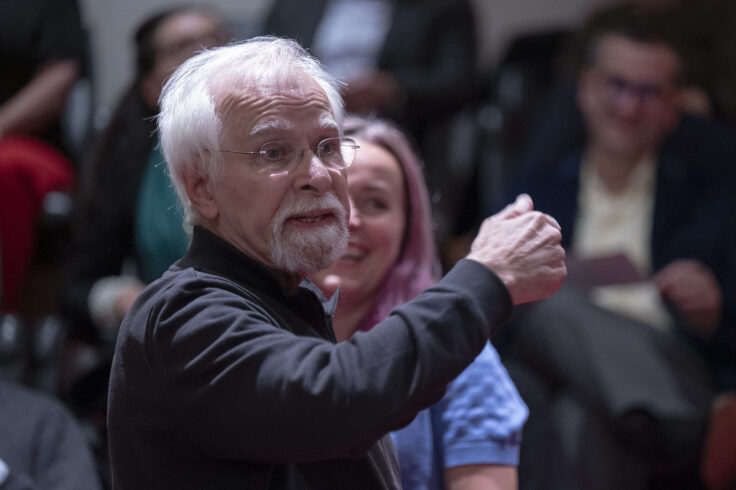
Amherst College Professor Austin Sarat Celebration of 50 Years Teaching. Photo: from Austin Sarat’s personal archive

T-i: As far as I understand, you came to your study of law “sideways”: you first became a political scientist, and only much later earned your degree in law. How did that background and that path shape the way you see law?

AS: When I did a postdoctoral year at Yale Law School, I saw a broader vision of what the study of law could entail. But I was still very much in the thrall of the way political scientists studied law: they took the blood and flesh off the subject. And I was quite comfortable with that at the time.

I came to Amherst to teach American politics and only had the idea of going to law school a decade after I started to teach. I went off to law school in 1985, and only there my vision broadened and changed.

My intellectual life turned because of an article written by a Yale law professor named Robert Cover. The title of the article was “Violence and the Word.” And from then till now, I’ve been imagining a conversation between myself and that article.

To study law, to be involved with law, is to have an opportunity to confront those two realities: the reality of language and its meanings, and the reality of violence and its uses.

T-i: In some of your courses and publications you say law consists of three components: moral argument, interpretive traditions, and the social organization of violence. For a reader who does not specialize in law, how could you explain how these three elements hold together?

AS: Most legal systems seek to articulate and reflect the moral values and political beliefs of the culture and country in which they are situated. And in most countries, legal disputes are developed on the terrain of arguments about what is right or just in accordance with the law.

But legal systems and legal institutions are not simply philosophical debating societies. Law is always articulated in language — codes, statutes, court decisions, orders. That means both citizens and scholars are called to attend to the way in which words are used and meanings are assigned in the articulation of laws and judgments. And in the United States and in the Anglo-American world, the way in which language is used in law is governed by its own set of rules.

There is no law without the possibility of enforcement. Otherwise, law is like a birthday card: it carries no more weight than a wish or a greeting. What gives law its weight is the deployment of violence. And legal systems deploy violence in a variety of ways. They punish people and authorize others to use violence.

To make sense of the world of law that surrounds us, we have to understand that we’re going to make arguments about what is right and fair. Those arguments should be made in ways that are recognizable to legal officials. We have to speak this language and follow these distinct traditions and to be aware that there is a lot at stake. When the poets are finished with their argument about what things mean, they go home. When the legal arguments are done, people lose their property, liberty, or in some cases even life.

T-i: For many years, the problem of capital punishment has been the focus of your research. Why has it held you for so long? And what do you think about the development of attitudes toward the whole issue in the United States — do you see it as part of a slow abolition, or of entrenchment?

AS: To study capital punishment is to have an opportunity to see the way in which the legal system — in my case, in the United States — seeks to legitimize the right to take the lives of citizens.

When I started to study capital punishment, I was less interested in its survival than in seeing through capital punishment to broader issues in the culture and the society. I thought this practice crystallizes our attitudes toward justice and mercy, our beliefs about deservedness, our horror at the crimes that in theory warrant capital punishment.

Over time, and somewhat to my surprise, I’ve come to live in two different worlds. One is the old world, where I studied the death penalty not to advance the cause of abolition. I am publishing a new book, and that’s not going to help abolish the death penalty.

But then I have this more public side. I write, and I’m now on the board of Massachusetts Citizens Against the Death Penalty.

And I think the practice of capital punishment is a moral horror. The United States is in a period of national reconsideration of capital punishment. I believe that the United States is on the road to abolition of the death penalty. The abolition is not going to come smoothly — there’ll be ups and downs.

But maybe not in my lifetime — certainly not in my lifetime — but in the lifetime of my thirty-year-old son, I would not be surprised if the death penalty died in the United States.

T-i: Why is it so important to study the new methods of capital punishment and to assess them?

AS: For the last several decades, arguments about the death penalty have shifted a little bit away from its morality and toward an examination of the way it works. You can be in favor of the death penalty in the abstract but against executing the innocent or against executing people because of their race or the race of their victim.

It’s my belief that the death penalty system in the United States is broken from beginning to end. Innocent people get convicted and sentenced to death row. You’re more likely to get a death sentence if you kill a white person than if you kill a person of color. Those are, in my view, easier problems than the cruelty of the method itself.

Because in theory the innocent who are condemned are innocent — they’re like you and me, they haven’t done anything — and people who get death sentences because of the race of their victim are clearly the subjects of injustice. But when we’re inside the execution chamber, we’re mostly dealing with people who “deserve to die,” if anyone ever deserves to die. It’s harder — and, in my view, more important — to focus on the fate of the guilty than on the fate of the innocent.

I don’t think there’s any method of execution, or any practice of execution, that can be considered anything other than cruel. I want to focus attention not just on the suffering of the people being condemned, but on the question of who we want to be. The way we punish is as much about those who punish as about those who are punished. What animates the people who do this?

The United States has been on this quest for a method of execution that would be safe, reliable, and humane. I think it’s a fool’s errand. There’s no method of execution that is going to be humane, even if we could find one that is “safe and reliable” — and we haven’t been able to, and we’re not going to be able to.

T-i: You created something unusual at Amherst — one of America’s most selective liberal-arts colleges. The department you founded there, Law, Jurisprudence and Social Thought, was among the first programs anywhere to teach undergraduates to study law as one of the humanities rather than as pre-law training. I know that when the college formally reviewed the program, an outside committee of experts judged it “superior to every other undergraduate program of its kind in the country.” How did the idea first emerge, and who stood with you as you built it?

AS: I’m going to mention Robert Cover again — “Violence and the Word.” I went to law school and had this intellectual revelation with Robert Cover; it was like deciphering the Rosetta Stone. I came back to the college, and soon the Mellon Foundation was soliciting grants from liberal arts colleges under the theme of “fresh combinations.” I picked up the phone and called my colleague Thomas Kearns from the philosophy department. I said, “Tom, we’re a fresh combination. Let’s see whether we can put together a program at the undergraduate level in law that’s the equivalent of studying religion. We have theology schools — that doesn’t mean we don’t teach undergraduates about religion. We have law schools — why can’t we teach undergraduates about law?”

Kearns and I got support through this Mellon initiative. We developed new courses that didn’t fit comfortably in political science or philosophy or history or anywhere else. And we were doing jazz more than symphony, because there were few, if any, models for us. The first course taught was called “The Fate of Law.” We didn’t want to do “legal studies”; we wanted to do what people had done in the study of religion — to study this thing in its social, intellectual, and cultural context.

LJST was founded on a kind of conceit: that we were going to revolutionize the study of law. We were going to set a model, not just for Amherst, but for the world of undergraduate education. We started a book series. I created new professional associations — all inspired by the idea that law is a subject in the liberal arts. And you don’t have to do it our way; you can have your own church. But at least recognize that law is a subject in the liberal arts: you can look into the way moral argument plays out, understand the play of language, confront the reality that people’s lives are on the line.

And our little college was a perfectly hospitable place to do it, because it’s a liberal arts college. It was easy intellectually and hard logistically, because this was not something the college needed to do, and people in political science were very threatened by this; in part, I think, because they thought it was going to kill the discipline of political science — everyone was going to go study law. The program was voted by the faculty in 1992. We did it differently than I think anybody else has ever done. Generally, when you adopt a new program, you first adopt the program and then the program articulates its curriculum. We did the reverse: we had a whole curriculum lined up, so that people knew what they were buying, so to speak, if they voted for the creation of LJST. The curriculum has changed since, but there it was.

T-i: If you were founding this program today, in the current political climate, would you do it differently? 

AS: Throughout most of my career as an intellectual, I have not wanted students to know what I think.

I don’t go in and try to persuade them. If they want to be in favor of the death penalty, then I would leave them to be in favor of the death penalty. But the present moment — the last decade or so in the United States — has occasioned in me a little bit of a rethinking. I still don’t want students to know what I think about most subjects, but I want them to understand the depth of my commitment to democracy and the rule of law.

So, in the face of the current moment — we can disagree about abortion, or environmental policy, or whatever, and that’s fine; I’m not going to tell you what I think about those things. But the ground norm for the work that we do, you and I, is democracy and the rule of law.

The original impulse of LJST was critical of the rule of law — as ideology, as mystification. And it’s a nightmare, in a way, to look back at all the things we wrote, and to hear similar lines now being articulated by the current President of the United States — “Oh, it’s just political.” In fact, just yesterday we were drafting a job description for a visiting professor, and I said, “How about we include in the job description someone who’s interested in the virtues of the rule of law?”

If I were founding it today, the three pillars would still be the same. But I think the orientation would be to a different kind of relationship to the practices of law in the world. Eighty million Americans voted for the current President of the United States knowing who he was. If you’re going to save democracy and the rule of law in the United States, you need to connect those things to what people care about — how they live, how their children live. Otherwise, why should they care?

T-i: In the recent year and a half, you have written a lot about what you call the weaponization of law against the rule of law. Where, for you, is the line between aggressive but still lawful executive action and what you would define as an actual assault on the rule of law? Has the American state already crossed that line?

AS: The answer to your last question is “yes.” We’ve had many powerful executives; we’ve had many presidents who stretched the limits of presidential power. Franklin Roosevelt used the power of the presidency, but I don’t think it was in the name of aggrandizing himself. This one is different. It’s not just that he’s a powerful executive. His conception of politics is messianic. It’s not just that he’s corrupt or egotistical. What’s his slogan? “Make America great again.” What did he say? “I alone can fix it.”

That’s what we must understand: whatever the peculiarities of his psyche, the politics is illiberal because it’s so personalistic. Whenever I talk about Trump, here’s what I try to say: you can call him names, but my guess is that when he looks in the mirror in the morning, he says to himself, “I’m going to save this country. And anything that gets in my way — what do I care about? Law? A few legal niceties? I’m on a mission from God.” And that’s what I think we need to understand.

We — the American academy — have spent too much time patting each other on the back and making sure we were using the right pronouns. We, the American academy, at a time when we are reviled, need to look outside, to try to understand why millions of people say, “I don’t care about any of that; he’s going to reduce inflation,” or “I don’t care about any of that; he’s going to put a stop to political correctness.”

I used to criticize public intellectuals for fancying themselves of some significance. Now, every day when I come into the office, what I’m likely to do is write something that has no audience in the academy. Every week for the last year and a half I’ve organized a protest — we stand on the corner and stand up for democracy. I’ve organized a network of alumni called the “Stand Up for Democracy Network.” I’ve organized things on campus and helped create a student organization called “Amherst Students for Democracy.”

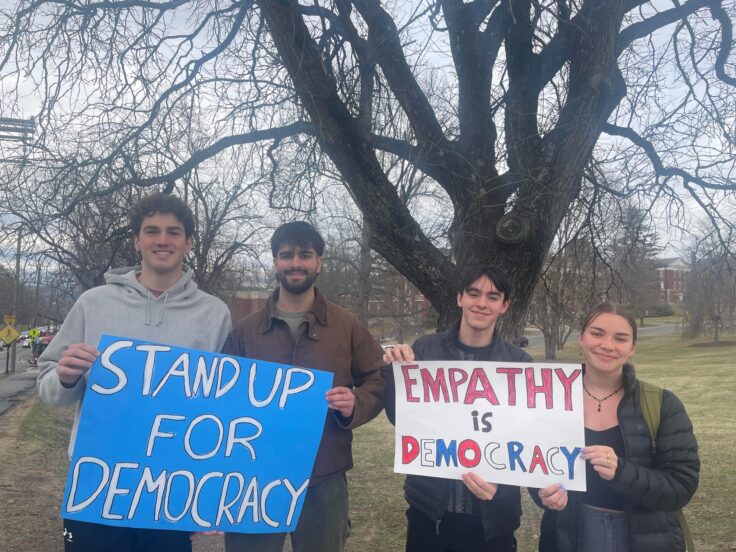
Students from Amherst College at a rally in support of democracy. Photo: Alejandra Chavez-Flores / The Amherst Student

I don’t write, or demonstrate, or organize, imagining that I’m going to convert the hardcore Trump supporters. I don’t have time to do that. When I was complaining, “Oh, I’m not converting anybody,” one of my former students said, “You don’t understand how much it means to people who are on the front lines that people like you are writing.” I regard my writing as cheering on my side. I regard my writing as bearing witness. I regard my public activity as exemplifying what someone can do when they are terrified all the time. Fear is my friend, and it gets me out on the street — not because I’m courageous, and not because I think they care about me, but because if I don’t stand up, who will?

T-i: At this moment, what is the role of a scholar of law? What can such an expert do to help prevent the abuse of law?

AS: As an expert, I can claim the attention of legislators developing legislation. I can claim the attention of judges, if I’m asked to testify. When I write something for the public, I can do it as an expert: I know these things, and I want to tell you these things. But the real question is: what is the demand for my expertise, and to whom am I lending it? As a person who thinks for a living, do I see things that others might not see, or see them differently than others might?

I think our obligation emerges from our privilege — to be an intellectual, to be able to teach and write. I regard that as a privilege; I just mean, I’m glad I have a job. And with privilege, according to John Kennedy when he spoke at Amherst College in 1963, comes responsibility.

I tell everybody that if you ask the following question — namely, “What will work? What will work to preserve the rule of law? What will work to preserve a constitution?” — it’s the wrong question, because no one knows what will work.

Nevertheless, we need to do three things. The first thing we as citizens and residents of the United States need to do is put out the fire, in whatever way we can: demonstrate, protest, write, organize. The second thing is that we need to commit ourselves to a program of reform that is really oriented to dealing with the despair among large segments of the population.

Go to the emergency room at a public hospital and wait for seven hours. Call your cell phone provider and try to get decent service. Go to Stop & Shop and pick up feta cheese and look at the price: “It’s ten dollars?” Do I need to be an expert to know about those experiences? No, I don’t. Even if you can put out the fire, it’s only going to reignite if we don’t attend to the desperation that leads people to say, “I’ll choose him.”

The third thing is that we need to practice what I call thinking democratically. It means that I should tell the truth as I know it, but I need to tell it in a way that can be heard by someone who doesn’t already agree with me. It’s not enough to say, “You’re a racist, you’re a sexist” — nobody’s mind is going to be changed. To think democratically, you must speak less and listen more. American democracy in many ways failed long before Trump. Trump is a symptom.

You must be curious. You must practice empathy before judgment. You can do that alone; you don’t need to be part of a movement to do it. We not only need to rebuild the infrastructure of democracy — we need to rebuild a culture of democracy.

I’m committed to a program of reform when the time comes — and that will mean people like me live a little less well, so that others can live a little better.

T-i: What’s happening to American higher education under Trump’s presidency, in your view?

AS: American higher education was in trouble long before Donald Trump came on the scene. Now, to talk about American higher education is to talk about apples and oranges and tomatoes and broccoli — the community colleges, the state universities, the research universities; it’s a different thing in each case. What I know best is Amherst College and similar liberal arts colleges.

Amherst College. Photo: amherst.edu

In many ways, places like Amherst had lost their way, but they didn’t know it. If you wanted to talk about racism, Amherst was a fine place for you, long before Trump. If you wanted to denounce capitalism, Amherst was a fine place for you, long before Trump. If you wanted to talk about the white working class, Amherst was not such a fine place for you — because you’d have to look long and hard for people who cared about the white working class.

American higher education, even small colleges, is hierarchical. Colleges and universities in the United States were much more collegial than they are now. I’m not talking about a golden age when everything was great, but let’s be honest — teaching is undervalued in most places. You want to get a job offer? No one’s going to give you a job because you’re a terrific teacher. They’re going to give you a job because you wrote something. That’s fine, but it speaks to a certain kind of values.

So, we were ripe for the picking. And then Trump comes along. What could be better to have as a target? His brand of politics is so interesting, because he targets the powerless — immigrants — and the powerful — he goes after law firms and prestigious universities. What he’s done to American higher education is both dreadful and a kind of slap in the face that may have helped higher education in the United States.

The horrors are unspeakable. But before Trump, if I asked most of my colleagues to explain the difference between academic freedom and freedom of speech, they could not do it. Now, at least, there’s a conversation about what academic freedom is and how to protect it. My hope is that out of the crisis will come something good — a renewal, a regeneration, a recommitment, a recentering of values. How’s that for optimism?

T-i: What can be done, at both the national and the local level, to minimize this harm?

AS: We need alliances, not enclaves.

I’ll give you an example. I was very involved in getting the college to add something to its commitment to academic freedom. The commitment to academic freedom has been, in effect, “The institution won’t punish me.” I said, “That’s fine, but I’m not worried about the institution. I’m worried about threats from the outside.” And the college changed its statement on academic freedom.

It’s the same thing as we think about rebuilding democracy. If you say, “Oh yes, we’re the pure, we’re the just, we’re the righteous.” Why should anybody come to the rescue of American higher education if the attitude is, “Well, what have you done for me?” The next thing I wanted to do was to get the faculty to vote on a democracy resolution. It’s not that we stand for something only when it benefits us. Democracy is essential to education, but our commitment to standing up for democracy is not just so that we’ll live more comfortably. The more that all of us can be seen to be committed to things that don’t just benefit us, the better off we’ll be.

T-i: Why do you think the motivation toward building alliances is still so low?

AS: In the United States this has been going on for a decade, and many people are just beaten down. Others are afraid. Others just want to turn off the noise and take their kids to the skating rink or the library. We know the way this works, and Trump has been pretty good at it. It’s like when your roof is leaking — but it’s leaking from nineteen different places. You put a bucket over here, and then it leaks over there: you are tired of moving your bucket around the house.

I think politics at this moment requires navigating between fear and faith: fear in what I see, faith in what I cannot yet see.

The post Austin Sarat: “Fear Is My Friend” appeared first on Т-инвариант / T-invariant.

  •  
❌