
❌

Reading view

Brazil Protesters Accuse Meta of Election Interference
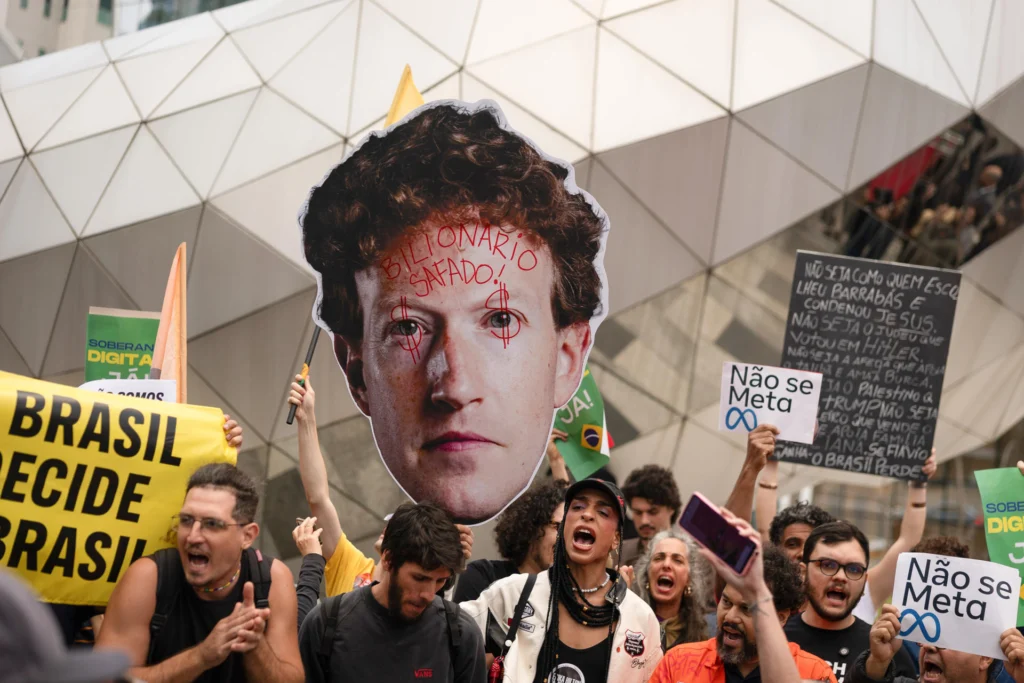
Brazilian protesters outside Meta headquarters in São Paulo denounce alleged Instagram restrictions on Lula’s campaign ahead of the presidential runoff.

Demonstrators demand algorithmic transparency as Brazil’s electoral court gives Meta 24 hours to prove equal treatment of presidential campaigns.


Hundreds of Brazilians protested outside Meta’s São Paulo offices on Monday, accusing the technology giant of restricting the reach of President Luiz Inácio Lula da Silva’s campaign while boosting far-right candidate Flávio Bolsonaro, six days before the presidential runoff. The demonstration coincided with a court order giving Meta 24 hours to prove it was treating both campaigns equally.

RELATED: Brazilian Court Gives Meta 24 Hours to Prove Equal Treatment of Presidential Campaigns

The protest on Faria Lima Avenue called for an end to what demonstrators described as the suppression of progressive political content. Organizers also demanded transparency in content moderation algorithms, protections for activists and journalists, and compensation for damage to public debate.

The Superior Electoral Court (TSE) imposed the 24-hour deadline amid mounting scrutiny of Meta’s handling of the campaigns. The dispute intensified after internal messages emerged in which company employees acknowledged that Lula’s account had faced restrictions compared with Bolsonaro’s. The messages indicated that Lula’s Instagram posts could not be promoted for nearly 24 hours between Oct. 9 and 10.

“META NO SE META!”

Movimientos brasileños ocupan la sede de la plataforma de redes sociales. pic.twitter.com/wetfUpEryA

— Nacho Lemus (@LemusteleSUR) October 19, 2026

Text Reads: “META DON’T GET INVOLVED!” Brazilian movements occupy the headquarters of the social media platform.

TSE Justice Marco Aurélio Bellizze warned that appeals would not suspend the court’s orders and doubled the daily fine for noncompliance from 500,000 reais to 1 million reais, or about $180,000.

The court also ordered Meta to submit individual reports in Portuguese, explain its recommendation algorithms, provide details on electoral advertising oversight, and identify potential networks of fake accounts and AI-generated images.

“Unilaterally replacing deadlines set by the court amounts to noncompliance, particularly in a process whose effectiveness depends on time,” Bellizze said.

Meta maintains that its content moderation policies apply equally to all political actors. Bolsonaro has also sought to join the proceedings, arguing that his own content has been harmed.

Concerns over digital sovereignty

Protesters argued that the dispute exposed the broader influence of social media platforms over Brazil’s electoral process. They noted that 70% of the Brazilian population uses Instagram to obtain information and accused Meta, owned by Mark Zuckerberg, of wielding opaque power over political visibility.

“We cannot say we have fair elections when a company uses its economic, technical and technological power to tilt public debate toward one side, which is what is happening,” said Dani Silva, executive director of Ctrl+Z, one of the organizations behind the demonstration.

The rally was organized by the Não se Meta coalition, which included the Landless Workers’ Movement (MST), Levantamento da Juventude Popular, Brasil Popular, Article 19, Ctrl+Z, Código No Binário, Diracom, the National Forum for the Democratization of Communication and Sleeping Giants Brazil.

Under the slogan “Meta, stay out of our election,” demonstrators displayed signs featuring Zuckerberg alongside U.S. President Donald Trump and chanted for digital sovereignty and Meta’s exclusion from the electoral process.

Activist Veronyka Gimenes, known as Trava Hacker, described the company’s actions as part of what she called “digital colonialism,” alleging that technology companies seek to influence domestic politics across the Global South.

“Digital sovereignty is no joke; it is something that must be taken very seriously,” she said.

Activist Tiana Cauton urged people to take to the streets to demand the democratization of communications. She also expressed hope that a new presidential term would advance “autonomy through our own open and clean social networks.”

Demonstrators said Meta’s influence over political communication had undermined Brazil’s national sovereignty since the 2018 elections, renewing calls for greater accountability for social media platforms during the electoral process.
  •  

Lula’s Digital Campaign Restructures its Communications Leadership in Brazil

Brazilian President Luiz Inácio Lula da Silva’s campaign restructured its political and communications leadership, implementing a digital strategy centered on grassroots mobilization, relatable content, and community organization ahead of the October 25 runoff.

RELATED:

Brazil’s Lula Announces MEI 12.6 Billion Reais Debt Relief

In the first round on October 4, Flávio Bolsonaro of the Liberal Party secured 47.03% of valid votes, while Lula of the Workers’ Party (PT) garnered 45.16%, according to the Superior Electoral Court (TSE). The margin between them was 1.87 percentage points.

Following that result, the president’s campaign faced the challenge of mobilizing the more than 33 million people who had abstained from voting and vying for the votes of the undecided. Between October 5 and 9, students, social movements, artists, influencers, and fan communities launched initiatives—both on the streets and across digital platforms—to boost voter turnout.

To course-correct, Lula’s team brought in political figures such as Rafael Fonteles, Camilo Santana, Rui Costa, and Jerônimo Rodrigues, alongside lawmakers and influential social media figures—including Erika Hilton, Sâmia Bomfim, Jones Manoel, and Guilherme Cortez.

This strategic shift moved away from a strictly institutional aesthetic, adopting a “creator-as-person” format: selfie-style videos, casual street conversations, and simpler audiovisual productions. Guided by Congressman André Janones’s mantra of “more street, less helicopter,” the campaign disseminated dozens of native posts specifically targeting young voters.

Between October 4 and 11, the total number of social media interactions for both candidates resulted in a statistical dead heat: 266.5 million actions for Lula and 268.2 million for Flávio Bolsonaro. However, the president held an advantage on key platforms, garnering 24.3% more interactions than his rival on Facebook and 13.7% more on TikTok.

The architecture of this digital comeback relied on the “Exército do Lula” (Lula’s Army) channel, managed by Janones, which grew from 50,000 followers to over 3.3 million in a single week. The channel operates as a distributed coordination hub, sending daily audio messages, tasks, and “missions” to supporters to help make content go viral and counter attacks.

Flávio Bolsonaro’s campaign petitioned the TSE (Superior Electoral Court) to review the channel, alleging the dissemination of falsehoods. On October 12, the court ruled that the content in question did not contain the alleged falsehoods.

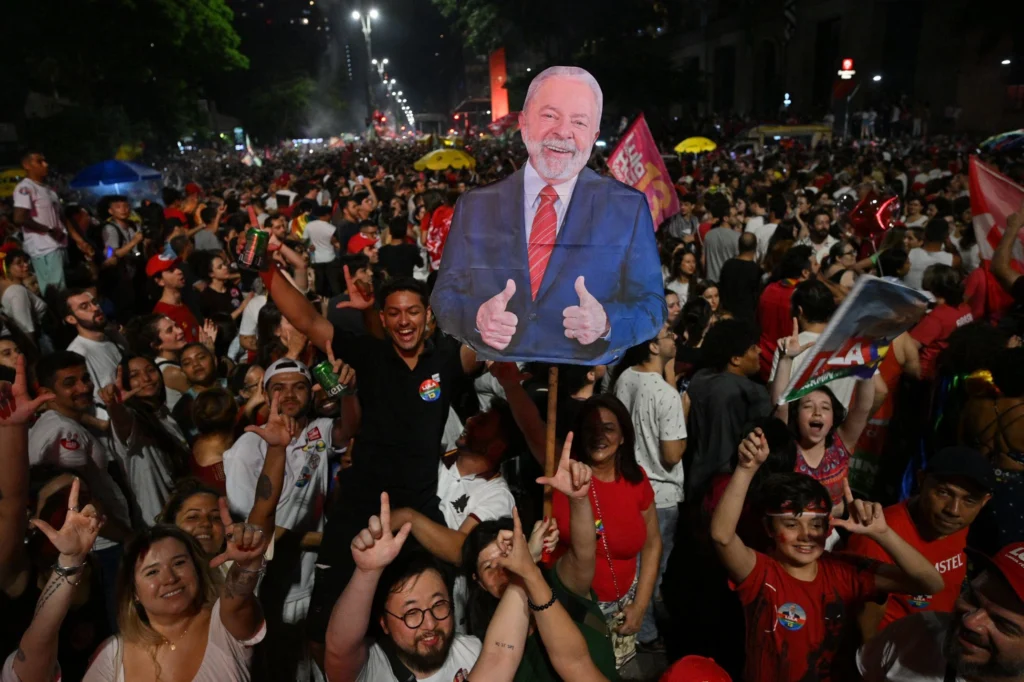
Another strategic pillar was the “Fandoms com Lula” (Fandoms for Lula) coalition, comprising over 250 fan clubs for artists such as Anitta, Taylor Swift, BTS, BLACKPINK, and Beyoncé. These communities applied their experience with massive streaming campaigns to tasks such as creating memes and AI-generated montages, producing guides for engaging with non-voters over the age of 60, and participating in in-person rallies, including the one held on Avenida Paulista.

The contest also extended to platform policies. The PT filed a complaint with the TSE regarding an unjustified drop in the algorithmic reach of Lula’s content on Meta’s apps. The company attributed the issue to global “technical problems” and denied any political bias.

Despite disagreements regarding social media bias, the most significant digital surge in Lula’s favor coincided with the major rallies on Sunday, October 11; on that day, his campaign recorded 31.8 million interactions, compared to 18.1 million for Flávio Bolsonaro’s campaign. Analysts highlight that the Brazilian experience demonstrates that communication success does not depend solely on official party accounts, but rather on the ability to build organic communities capable of taking ownership of the message, transforming it, and distributing it within their everyday circles ahead of the October 25 runoff.

Speaking on national economic strategy, President Luiz Inácio Lula da Silva emphasized that a country cannot succeed unless capital circulates across its entire population. Lula highlighted his core economic policy principle: placing wealth into the hands of the working majority… pic.twitter.com/5ATbGtTcuv

— teleSUR English (@telesurenglish) October 13, 2026
  •  
❌