Voters disapprove of Trump’s handling of economy and cost of living, says poll in new low recorded by NY Times/Siena
Donald Trump’s approval rating sank to 36% just two weeks before the midterm elections, the lowest recorded in a poll by the New York Times/Siena College, with most respondents expressing frustration over his handling of the US economy, cost of living and Iran war.
In an October survey of approximately 3,494 likely voters, 59% said they disapproved of Trump’s handling of his job, and 52% said they planned to vote for the Democratic candidate in the upcoming election.
Cyprus recorded the largest quarterly decline in government debt relative to GDP in the European Union in the second quarter of 2026, with the ratio falling to 48.5 per cent, according to Eurostat figures published on Wednesday.
The ratio dropped by 3 percentage points from 51.5 per cent in the first quarter and was 9.5 percentage points lower than the 58.1 per cent recorded in the second quarter of 2025.
Cyprus’ general government gross debt stood at €19.2 billion at the end of June 2026, down from €20.03 billion at the end of March and €21.7 billion a year earlier.
The figures underline the continued reduction in the country’s debt burden relative to the size of its economy, with Cyprus recording the second-largest annual decline in the EU after Greece.
Greece’s debt-to-GDP ratio fell by 11.2 percentage points year-on-year, while Cyprus recorded a decline of 9.5 percentage points.
Slovenia and Portugal followed, with decreases of 4.5 and 3.4 percentage points respectively.
Compared with the first quarter of 2026, Cyprus recorded the largest reduction among member states, ahead of Greece, where the ratio fell by 2.7 percentage points.
Hungary recorded a decrease of 2 percentage points, Ireland 1.8 percentage points, Croatia 1.6 percentage points and Slovakia 1 percentage point.
Across the EU, government debt continued to rise in the second quarter, reaching 82.9 per cent of GDP, up from 82.5 per cent in the first quarter.
The euro area’s debt-to-GDP ratio increased to 88.8 per cent from 88.4 per cent over the same period.
Compared with the second quarter of 2025, the EU ratio rose from 81.4 per cent, while the euro area figure increased from 87.3 per cent.
At the end of June, Greece had the EU’s highest government debt ratio, at 140.8 per cent of GDP, followed by Italy at 139.9 per cent, France at 119.1 per cent, Belgium at 110.2 per cent and Spain at 101.4 per cent.
The lowest ratios were recorded in Estonia at 26.1 per cent, Denmark at 27.1 per cent, Luxembourg at 28.2 per cent and Bulgaria at 28.7 per cent.
Compared with the first quarter, government debt ratios increased in 15 member states and decreased in 10, while the figures for the Netherlands and Spain remained unchanged.
The largest quarterly increases were recorded in Poland, where the ratio rose by 3 percentage points, Portugal at 2.1 percentage points, Latvia at 1.9 percentage points, Lithuania at 1.6 percentage points and France at 1.4 percentage points.
Italy and Malta each recorded increases of 1.3 percentage points, while Estonia’s ratio rose by 1.1 percentage points.
On an annual basis, 18 member states recorded higher debt ratios and nine registered declines.
Poland had the largest increase, at 6.7 percentage points, followed by Lithuania at 4.9 percentage points, Belgium at 3.8 percentage points, France at 3.7 percentage points, Luxembourg at 3.6 percentage points and Estonia at 3 percentage points.
Eurostat’s data also showed that Cyprus’ government debt at the end of 2025 amounted to €20.05bn, equivalent to 52.3 per cent of GDP, according to the audited annual figures published by the Cyprus Statistical Service.
The annual figures placed Cyprus among the five EU member states to record a government surplus in 2025, with the country’s surplus reaching 3.6 per cent of GDP.
Looking at government debt across the bloc at the end of 2025, the lowest ratios were recorded in Estonia at 24 per cent of GDP, Luxembourg at 26 per cent, Denmark at 27.2 per cent, Bulgaria at 29.9 per cent, Ireland at 34.8 per cent, Sweden at 35.1 per cent and Lithuania at 39.3 per cent.
Twelve member states had debt ratios above the EU’s 60 per cent reference level, with the highest figures recorded in Greece at 145.4 per cent, Italy at 136.7 per cent, France at 115.7 per cent, Belgium at 108.1 per cent and Spain at 100.5 per cent.
At the end of the second quarter of 2026, debt securities accounted for 84.5 per cent of general government debt in the euro area and 83.9 per cent in the EU.
Loans represented 13.1 per cent of euro area debt and 13.8 per cent of EU debt, while currency and deposits accounted for 2.4 per cent in both.
Eurostat also reported intergovernmental lending, reflecting EU member states’ governments lending to other member states, at 1.3 per cent of GDP in the euro area and 1.1 per cent in the EU at the end of June.
Separately, seasonally adjusted government revenue in the euro area stood at 46.8 per cent of GDP in the second quarter of 2026, down from 46.9 per cent in the first quarter.
Although revenue increased by around €21bn in absolute terms, the rise was outweighed by growth in nominal GDP.
Government expenditure in the euro area increased to 50.1 per cent of GDP from 50 per cent, as seasonally adjusted spending rose by around €28bn.
In the EU, government revenue fell to 46.3 per cent of GDP from 46.4 per cent in the first quarter, as an increase of around €25bn in seasonally adjusted revenue was outweighed by nominal GDP growth.
EU government expenditure rose to 49.8 per cent of GDP from 49.6 per cent, with seasonally adjusted spending increasing by around €42bn.
Cyprus’ seasonally adjusted government surplus stood at 3.3 per cent of GDP in the second quarter of 2026, down from 3.8 per cent in the first quarter.
The surplus had fluctuated during 2025, standing at 3.6 per cent of GDP in the first quarter, 3.3 per cent in the second, 2.9 per cent in the third and 4.3 per cent in the fourth.
The latest quarterly decline followed a 0.5 percentage point decrease in the first quarter of 2026, meaning the surplus-to-GDP ratio fell by a further 0.5 percentage points in the second quarter.
Earlier, Cyprus recorded seasonally adjusted government surpluses of 4.5 per cent of GDP in the second quarter of 2024, 4.3 per cent in the third quarter and 2.9 per cent in the fourth quarter.
The figures were included in Eurostat’s latest government deficit and debt data, based on member states’ second 2026 notifications under the European Union’s Excessive Deficit Procedure and compiled using the European System of Accounts 2010 methodology.
Cyprus has ranked among the European Union’s two fastest-growing economies for three consecutive years, according to revised national accounts figures released on Tuesday, government spokesman Konstantinos Letymbiotis said on Tuesday.
The revised data show economic growth of 6 per cent in 2023, up from the previous estimate of 3.6 per cent, while growth for 2024 was revised upwards from 3.9 per cent to 6.6 per cent.
For 2025, the growth rate was revised from 3.8 per cent to 4.8 per cent, placing Cyprus second among the EU’s 27 member states, according to the government.
By comparison, the EU economy grew by 1.4 per cent in 2025 and the eurozone by 1.2 per cent, meaning Cyprus expanded at more than three times the EU average.
Letymbiotis said Cyprus ranked first in the EU in 2024 and second in both 2023 and 2025, despite successive international economic and geopolitical challenges.
He attributed the performance to an expanding productive base, increased investment, the attraction of new business activities and continued confidence among international investors.
“These developments highlight the resilience, dynamism and significant prospects of our economy,” he said in a written statement.
The spokesman added that stronger economic growth had improved the country’s fiscal position, strengthened public debt indicators and increased the government’s capacity to support society.
He also pointed to a 15 per cent increase in median earnings, arguing that the benefits of economic growth were being reflected in household incomes and employment opportunities.
“The real value of growth is to create more wealth, better wages, greater economic security and more opportunities for citizens,” he said.
Letymbiotis said the government intended to use the economy’s performance to strengthen disposable incomes, support families, reinforce the welfare state and improve opportunities for younger generations.
“Our goal is to turn this momentum into even greater progress and prosperity for society as a whole,” he said, adding that the government would continue pursuing its economic objectives through fiscal responsibility and long-term planning.
Democrats lead Republicans 47% to 35% on question of which party is preferred to be in charge in Congress; 68% disapprove of Trump's handling of economy, including 37% of Republicans
Poll finds 66% of Americans think Trump is using position for monetary gain as his approval rating hits a new low
Most Americans think Donald Trump is using the presidency to enrich himself, according to a new poll, as the US president’s approval rating falls to a new low ahead of November’s midterm elections.
A new Washington Post-ABC poll put Trump’s approval rating at 33% as he continues to crisscross the country as part of his campaign blitz for embattled Republicans.
An accelerating sell-off of AI-linked shares has hit global markets, as fears over rising inflation and future interest rate hikes spooked traders already wary of the heavily indebted sector.
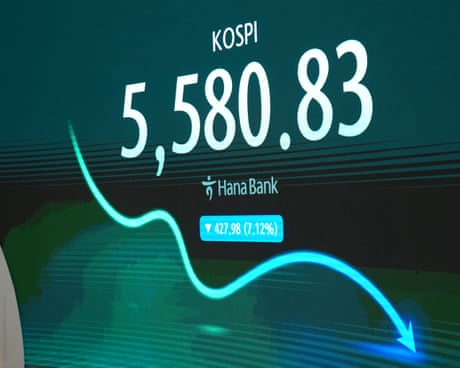
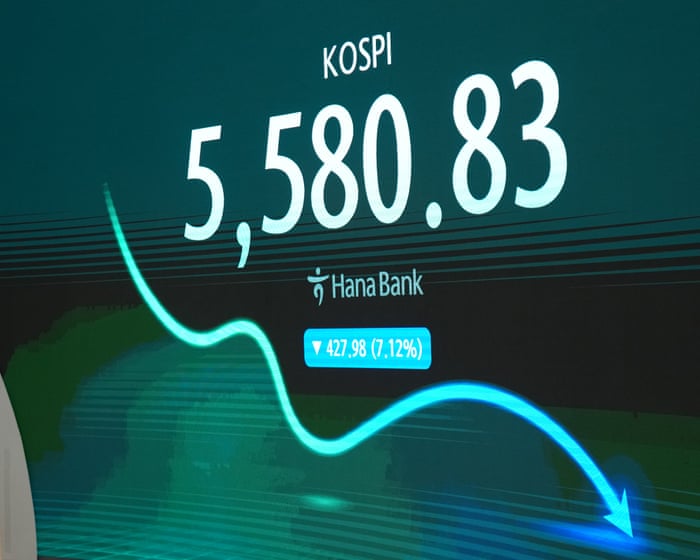
South Korea’s benchmark Kospi 200index, which is heavily skewed towards the companies that make memory chips, fell more than 8% overnight to a six-month closing low, triggering circuit breakers that brought trading to a halt at various points.
Analysts say fuel will take weeks to ship and quantity is too small to affect prices, while full deal is unlikely to be met given damage to Russian refineries
Donald Trump’s deal with Vladimir Putin to temporarily lift sanctions on US imports of Russian diesel will have little “meaningful” effect on motorists and businesses in the US and overseas, energy and foreign policy analysts have predicted.
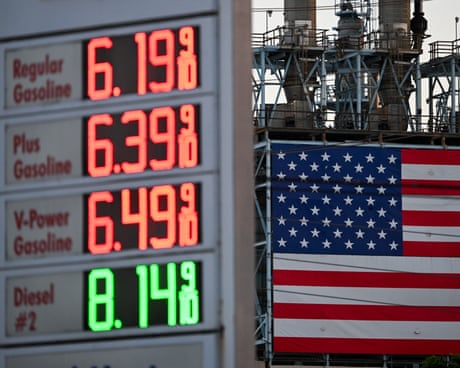
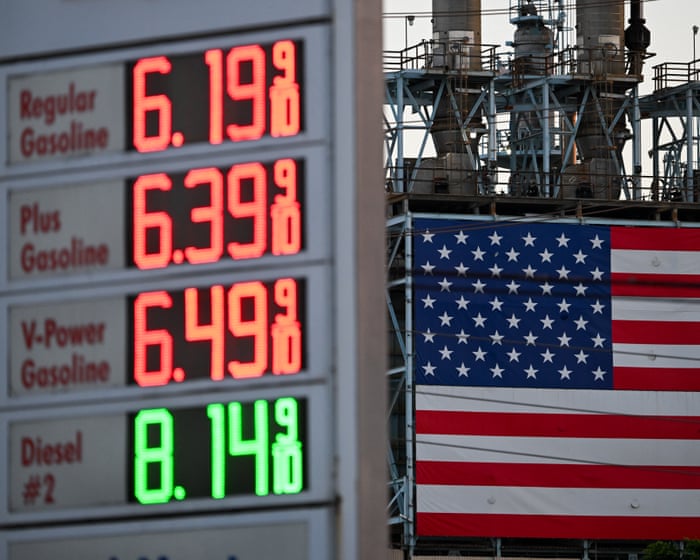
The US president infuriated Volodymyr Zelenskyy when he announced the deal on Friday, writing on Truth Social that the agreement with his Russia counterpart to supply millions of tonnes of diesel was essential to reduce fuel prices in the US, which have soared after his decision to go to war against Iran.

 Login